20 May 2020

US government uses Pensacola shooter’s alleged ties to Al Qaeda to renew attack on end-to-end encryption

Kevin Reed

The US Department of Justice (DOJ) and Federal Bureau of Investigation (FBI) ratcheted up the attack on end-to-end encryption of consumer electronic and mobile devices on Monday during a virtual press conference to review developments in the investigation of the Naval Air Station shooting in Pensacola, Florida last December.
Attorney General William Barr and FBI Director Christopher Wray both specifically denounced Apple, Inc. for refusing to unlock the encrypted contents of the two iPhones belonging to Second Lieutenant Mohammed Alshamrani, a member of the Saudi air force, who killed 3 and wounded 8 in a Navy classroom before being fatally shot by law enforcement on December 6, 2019.
The US officials reported that, through their own decryption efforts bypassing Apple’s built-in device security, they found that Alshamrani was a longtime affiliate of Al Qaeda. As Wray stated, “The evidence we’ve been able to develop from the killer’s devices shows that the Pensacola attack was actually the brutal culmination of years of planning and preparation by a longtime AQAP associate.” AQAP stands for Al Qaeda of the Arabia Peninsula.
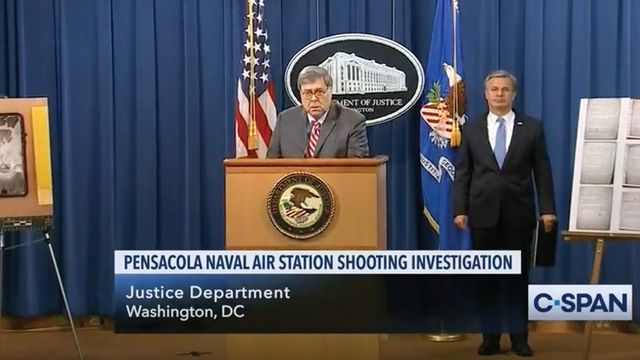
Attorney General William Barr and FBI Director Christopher Wray at the Department of Justice virtual press conference on Monday
A statement published by the Justice Department said, “The phones contained important, previously-unknown information that definitively established Alshamrani’s significant ties to Al Qaeda in the Arabian Peninsula (AQAP), not only before the attack, but before he even arrived in the United States. The FBI now has a clearer understanding of Alshamrani’s associations and activities in the years, months, and days leading up to the attack.”
Barr claimed that the evidence gathered from Alshamrani’s phone enabled the US government to carry out a counterterrorism operation in Yemen “targeting an operative, one of the overseas associates” and that the information “already proved invaluable in protecting the American people.”
Although little details of the alleged “significant ties” and “associations and activities” of Alshamrani with AQAP were revealed, Barr and Wray moved quickly to the real purpose of their press conference: to attack Apple’s defense of end-to-end encryption and refusal to provide law enforcement with a back door into encrypted personal data and communications on mobile devices.
In his remarks, Barr said that the iPhones were crucial to their investigation of the shooter, but they were locked. He said, “Apple has made a business and marketing decision to design its phones in a way that only the user can unlock the contents no matter what the circumstances. In cases like this when the user is a terrorist, or in other cases where the user is a violent criminal, a human trafficker or a child predator, Apple’s decision has dangerous consequences for public safety and national security and is, in my judgement, unacceptable.”
Barr then went on to say that there is no reason why Apple cannot design its consumer products and apps to “allow for law enforcement access when permitted by a judge.” Significantly, Barr pointed to the collaboration of Apple and other US manufacturers with “authoritarian regimes when it suits their business interests” and referenced both China and Russia as examples of countries where Apple has cooperated with undemocratic government surveillance.
In his remarks, Wray said that FBI agents had worked for months to break into Alshamrani’s phones and added, “The magnitude of the challenge they faced is hard to overstate. We received effectively no help from Apple. We canvassed every partner, and every company, that might have had a solution to access these phones. None did, despite what some claimed in the media.”
The claims that Apple provided “no help” to the Justice Department have been made by authorities since the immediate aftermath of the Pensacola shooting. However, Apple has maintained that “within hours” the company provided everything requested by the investigators including the shooter’s unencrypted iCloud backups, account information and transactional data.
Meanwhile, Apple has argued that the encryption and other security features on its devices, “protect millions of users and our national security.” As maintained by all of the major Silicon Valley tech firms, the creation of backdoor access undermines the entire system by making every device vulnerable to malicious cyberactivity.
Along with the specious claim that end-to-end encryption hinders important police work against “violent crimes” and “terrorism,” Barr complained that the four-month effort by the FBI to decrypt Alshamrani’s phones was very expensive and cost “large sums of taxpayer dollars to obtain evidence that should have been quickly accessible when we obtained the court orders”
Finally, Barr revealed that the endgame of the Trump administration is now to pass laws in the US that ban encryption on consumer devices. “The bottom line: our national security cannot remain in the hands of big corporations who put dollars over lawful access and public safety. The time has come for a legislative solution.”
Behind the elaborate presentation of photos of the shooter’s two iPhones and other images of notes found on the device, is the increasing effort to remove the barrier that end-to-end encryption places in the path of the US police and intelligence state from gaining unrestricted access to everyone’s mobile device communications and contents at will.
As explained by Brett Max Kaufman, a senior staff attorney at the American Civil Liberties Union, “Every time there’s a traumatic event requiring investigation into digital devices, the Justice Department loudly claims that it needs backdoors to encryption, and then quietly announces it actually found a way to access information without threatening the security and privacy of the entire world. The boy who cried wolf has nothing on the agency that cried encryption.”
As has been the case in every instance of terrorism beginning with the attacks of September 11, 2001, the US government has exploited these violent attacks to advance imperialist war aims abroad and attack the democratic rights of the people at home.
No one should take at face value the claims about the supposed decryption of Alshamrani’s iPhones and uncovering of evidence about his association with Yemeni terrorists. This is especially true given that a good number of CIA and State Department officials have the contact information of Al Qaeda members in their mobile phone address books as part of the American regime-change operations in the Middle East and Africa.
The conflict between the tech monopolies and the US government over consumer device encryption is not going to be resolved in favor of democratic rights. The ability to stop unfettered surveillance of the public—whether in the form of electronic eavesdropping on web browsing activity, facial recognition databanks or geolocation tracking—depends upon the independent struggle of the working class to defend democratic rights in the fight for socialism against the capitalist system.

New analysis predicts US coronavirus deaths will triple by end of year

Bryan Dyne

A peer-reviewed article in the medical journal Health Affairs predicts that the number of deaths in the United States caused by COVID-19 will increase at least three-fold by the end of the year, from 350,000 to 1.2 million dead.
The current death toll in the US stands at 93,500, with nearly 1.6 million confirmed cases in the country. There are 4.9 million cases internationally and more than 324,000 deaths. Countries including Brazil, Russia, India, Peru and Chile are emerging as new epicenters of the coronavirus pandemic.
The research was conducted by Anirban Basu, a professor at the University of Washington School of Pharmacy and its Stergachis Family Endowed Director of the CHOICE Institute. It was part of a broad effort to study infection and fatality rates in US counties for patients with symptoms. A survey of data collected through April 20 in 116 counties in 33 states produced an infection fatality rate between 0.6 and 2.1 percent.
The rate was centered at 1.3 percent, 13 times higher than the seasonal flu.
“COVID-19 infection is deadlier than flu—we can put that debate to rest,” said Basu in the study’s press released. He continued that the estimated number of deaths “is a staggering number, which can only be brought down with sound public health measures.” These include mass testing for the coronavirus, comprehensive contact tracing and safely isolating and caring for those infected. Such a program does not exist in the United States or the vast majority of the world’s countries.
Moreover, as Basu notes, his current estimates likely undercount the number of eventual dead from the coronavirus, because he conservatively calculated that only 20 percent of the US population will become infected by the end of the year. This assumes that physical distancing measures are maintained, which are now being ramped down at least partially in every state in the country.
As such, it is not out of the realm of possibility that, in the next seven months, 60 to 70 percent of all Americans will be infected. This is a worst-case scenario predicted by many epidemiologists, including Michael Osterholm, director of the Center for Infectious Disease Research and Prevention at the University of Minnesota. In this scenario, between 1.2 million and 4.8 million people in the United States will die of COVID-19.
This horrific scenario is already being played out. Several states that have begun to reopen, including Alabama, Arkansas, Maine, Minnesota, North Carolina and North Dakota, have already seen their number of new cases increase by more than 25 percent over the last two weeks. Since Texas began rolling back restrictions on April, it has seen a 55 percent increase in new cases.
And while Basu makes clear that his model will be updated as new data becomes available, this is already becoming more difficult. It was reported in Florida Today that the manager of Florida’s COVID-19 dashboard, Rebekah Jones, had been fired. In the days since being let go, the dashboard has crashed multiple times and data has been removed from the site without explanation.
In a public announcement of her removal by the state’s Department of Health, Jones warned that she no longer has any control over the data, including “what data they are now restricting.” She also made clear that she was the only one maintaining the database, which likely explains the reports of the system failing.
Ben Sawyer, a professor at the University of Central Florida and director of its LabX, responded by warning that there is “the worry that the scientists within government who can access the full data are being actively censored.” His colleague Jennifer Larson commented along the same lines, stating that, “We would not accept this lack of transparency for any other natural disaster, so why are we willing to accept it here?”
Both professors reportedly contacted the Florida Department of Health to regain their previous access to the data and were rejected on the grounds that the data are “provisional” and that they will have to wait until May 2021 at the earliest.
Despite this, the office of Florida Governor Ron DeSantis issued a statement saying, “The Florida COVID-19 Dashboard was created by the Geographic Information System (GIS) team in the Division of Disease Control and Health Protection at the Florida Department of Health. Although Rebekah Jones is no longer involved, the GIS team continues to manage and update the Dashboard providing accurate and important information that is publicly accessible.”
This is not the first time that there have been questions raised about the accuracy of the coronavirus case count and death toll in the state. In the weeks leading up to the state’s reopening on May 4, there were numerous reports that at least 10 percent of those who had died from the pandemic were not being accurately counted. According to the Miami Herald, health officials in Miami-Dade and Palm Beach counties were asked to restrict access to COVID-19-related deaths, even as these areas saw a spike in their respective new cases and fatalities.
This has become an issue nationwide. The Centers for Disease Control and Prevention tracking for the deaths overall in the US has been delayed since the week ending February 8. This includes both the seasonally expected deaths and the excess deaths as a result of the pandemic. The agency reports that “only 60 percent of death records are submitted … within 10 days of the date of death, and completeness varies by jurisdiction.”
While some of this backlog can be attributed to the surge in deaths caused by the pandemic, no doubt a large portion of it is due to interference by the Trump administration. Earlier this month, White House Coronavirus Task Force Response Coordinator Deborah Birx told CDC Director Robert Redfield, “There is nothing from the CDC that I can trust.” She also claimed that the organization was inflating its death counts by up to 25 percent, even as Anthony Fauci, the nation’s top infectious diseases expert warned the Senate that the “the number of deaths are likely higher.”
The CDC reporting also raises questions about when the pandemic began killing people in the United States. The first official death in the United States was on February 6, but a single death would likely not cause medical examiners across the country to delay submitting death certificates. If there has been a genuine backlog in reporting deaths since that time, it suggests that the pandemic could have been far more widespread far earlier than currently known.

19 May 2020

Zurich One Young World Scholarship 2021 for Young Leaders (Fully-funded to Munich, Germany)

Application Deadline: 17th July 2020

About the Award: At Zurich Insurance, we aspire to become one of the most sustainable companies in the world. We strive to create positive and sustainable change as an insurer, an investor and as an employer. Through our Z Zurich Foundation, we also look to empower vulnerable people within our communities to better protect themselves from risk, and to adapt and thrive in a rapidly changing environment. NEXT is a grassroots movement within Zurich Insurance that advocates for the voices of the next generation of leaders to be heard by promoting intergenerational dialogue, partnering with other corporations and finding ways to do good while doing well. NEXT is made up of intrapreneurs from across the Zurich Group, who attend the One Young World Summit alongside external scholars.
 We focus on innovating in three areas: Mitigating the impacts of climate change, tackling the world’s increasing physical and mental health challenges, and striving to increase both social and financial inclusion. Our aim is to transform the lives of 1m people by 2024, and positively impact the lives of 10m more. 

Type: Short course

Eligibility: This scholarship is intended for 12 inspirational young leaders who share Zurich’s vision for a more sustainable world. You should apply for this scholarship if:
  • You are a young leader working in the fields of climate change, wellbeing or inclusion.
  • You have demonstrated commitment to shaping a more fair, more equal society in which everyone can succeed. 
  • Applications from every country are welcomed. 
Selection Criteria: One Young World will assess candidates based on their:
  • Evidenced commitment to delivering positive change.
  • Demonstrated capacity for leadership
  • Understanding of key local and/or global issues.
  • Track record of generating impactful and innovative solutions to address education and skills challenges.
Eligible Countries: All

To be Taken at (Country): Munich, Germany

Number of Awards: Not specified

Value of Award:
  • Access to the One Young World Summit 2021 in Munich;
    • Hotel accommodation in a shared room between 22 and 26 (inclusive) April, 2021.
    • The cost of travel to and from Munich (economy class), the carbon emissions of which will be doubly offset by the Z Zurich. Foundation through an accredited scheme in Myanmar.
    • Catering which includes breakfast, lunch, and dinner (provided by the hotel and during the Summit).
    • Ground transportation between Summit venues.
  • Access to additional programming offered by Zurich;
    • Participation in Zurich-led sessions in the lead-up to, during, and after the Summit.
    • A Zurich buddy from NEXT.
    • A personal development workshop held at Zurich Insurance’s headquarters in Switzerland. All costs relating to these sessions are covered by Zurich.
Duration of Award: between 22 and 26 (inclusive) April, 2021.

How to Apply: APPLY HERE

Visit Award Webpage for Details

World Bank Global Tech Challenge: Solutions for Women 2020

Application Deadline: 1st June 2020

About the Award: Over 300 million fewer women access the internet in low-and-middle-income countries than men. This divide has persisted and is in fact widening in some regions. Barriers to digital equality are linked, among other factors, to availability of infrastructure, financial constraints, interest and perceived relevance of digital technologies, and socio-cultural and institutional contexts.
Addressing the gender digital divide is crucial to ensuring sustainability of women’s livelihood. This is particularly the case during crisis such as the COVID-19 pandemic when connectivity is key. Historically, leaving structural gender inequalities out of the crisis response has further compounded those inequalities. At times like this, we need to emphasize the importance of digital access for women.
  • Access to mobile phones can help gain access to key information for women, at a time when access to their traditional information channels may be limited.
  • Access to information and communication technologies can ensure that women have access to mobile money, helping poverty outcomes for female-headed households. As countries implement unconditional cash transfer programs, enabling women to access money can improve their household bargaining power.
  • Access to mobile phones during area-wide quarantines can help women seek emotional support and advice as they shoulder more care work within the household.
We will reward scalable, innovative technological solutions that seek to empower women in four areas. Given the COVID-19 pandemic, we will accept rapid response applications to fast track implementation of sustainable solutions around digital access and online content. The deadline for rapid response solutions is extended to May 4, 2020. The deadline for regular solutions is extended to June 1, 2020.
  • Platforms: Solutions that increase the availability of locally relevant digital platforms catering to women. For example, local marketplaces and solutions building online communities for women.
  • Digital skills: Solutions that support the development of digital skills by women and girls. For example, applications that use personalized and adaptive learning to teach basic, intermediate or advanced digital skills.
  • Online content: Solutions that increase the availability of women-oriented content. For example, locally relevant content on reproductive health or to combat gender-based violence. 
  • Enhancing digital access: Solutions that focus on innovative business models that make it easier for women to access and use digital technologies and enable the use of digital identification, such as pay-as-you-go and other models that promote women’s sustained use of mobile internet.
Type: Contest

Eligible Countries: All (We encourage the greater participation and recognition of organizations in emerging and developing countries in international tech events and tech challenges).

Number of Awards: Not specified

Value of Award: Winners will:
  • Receive recognition and brand visibility at CES 2021 as a Global Tech Challenge winner.
  • Engage with governments and World Bank Group teams to potentially scale their solutions within development projects.
  • Access mentorship from technology companies and World Bank leaders to help scale their solutions.
  • Share their stories at multiple international fora such as CES 2021, regional conferences, and the World Bank Group’s Spring and Annual Meetings.
  • Build their professional networks and raise their international profile and brand.
How to Apply:

UNESCO International Literacy Prizes 2020 for Innovative Literacy Projects

Application Deadlines:
  • Deadline for candidates to submit applications to nominating entities: 28th June 2020 (midnight, Paris time).
  • Deadline for nominating entities to submit their nominations to UNESCO: 12th July 2020 (midnight, Paris time).
Offered Annually? Yes

Eligible Countries: All

About the Award: UNESCO has now opened its call for applications and nominations for the 2020 UNESCO International Literacy Prizes. This year UNESCO will reward five individuals or organizations around the world for their outstanding projects that promote literacy within the theme ‘Teaching and learning literacy: the role of educators and changing pedagogies’.
2020 thematic focus: “Teaching and learning literacy: The role of educators and changing pedagogies”.
This year’s thematic focus is highlighting teachers who are at the frontline of delivering literacy learning, and their contribution to promoting youth and adult literacy, linked to target 4.6 of the Sustainable Development Goal on Education (SDG4), where literacy is perceived as a continuum developed throughout life.
UNESCO distinguishes between two Literacy Prizes which are given to five laureates:
The UNESCO King Sejong Literacy Prize (2 awards), was established in 1989 and is supported by the Government of the Republic of Korea. It gives special consideration to programmes that focus on the development and use of mother-tongue literacy education and training.
The UNESCO Confucius Prize for Literacy (3 awards), was established in 2005, and is supported by the Government of the People’s Republic of China. This Prize recognizes programmes that promote adult literacy, especially in rural areas and for out-of-school youth, particularly girls and women.

Type: Contest

Eligibility: Candidates should take into account this year’s theme – literacy and Multilingualism – and also consider the special focus of each Prize.
  • Institutions, organizations and individuals promoting literacy through effective and innovative projects or programmes.
  • Eligible programmes or projects who have a proven record of innovative work in the field of literacy for at least three years.
  • Programmes/projects that have not been awarded the UNESCO International Literacy Prizes in the past five years.
Number of Awards: 5

Value of Program: Each of the five prizewinners receives a medal, a diploma and US$20.000.
The UNESCO International Literacy Prizes are awarded in an official ceremony on the occasion of the International Literacy Day.

How to Apply: Governments, non-governmental organizations and individuals are kindly invited to apply. All applications should be submitted to nominating entities, such as the National Commission for UNESCO in the country of the programme, or an NGO that is in an official partnership with UNESCO. Applications can be submitted via the online platform, detailed information about the application and nomination process is to be found on the UNESCO International Literacy Prizes’ website.

Visit Program Webpage for details

Isu Elihle Awards 2020 for Innovative Journalism about Children

Application Deadline: 30th June 2020.

Eligible Fields: All; seasoned journalists, fresh young talents, photographer, editor, in print, digital, radio, TV or the web.

About the Award: In a first of its kinds for our continent we are launching awards for media professionals that seek to encourage fresh reporting, innovative angles, insightful investigations and those that seek to give children a voice and elevates the status of the child in Africa.  Whether you are a seasoned journalist, a fresh young talent, photographer, editor, in print, digital, radio, TV or the web – we want your story ideas.  So get thinking!

Type: Contest

Eligibility: Please note by submitting your entry, you confirm that you have read and agree with the following rules:
  1. The Competition is open to professional journalists, whether directly employed or freelancers, working in the continent of Africa.
  2. No entry fee is payable.
  3. Employees and their immediate families of Media Monitoring Africa (MMA) are not eligible to participate in the competition.
  4. The Competition is held in English. Therefore all entries and story ideas should be in English.
  5. Applicants are strictly limited to a maximum of one entry; however, each media house can have as many applicants as it wishes.
  6. Entries should be made in accordance with the instructions given on the competition entry form and must be submitted on, or before, 00:00 (CAT) 23 September 2019. After this date, no extensions will be made to this closing date.
  7. Late, incomplete, illegible and/or fraudulent entries will be disqualified.
  8. MMA reserves the right to refuse entries that do not comply with the above rules. No correspondence will be entered into in this regard.
  9. A panel of distinguished, independent judges with appropriate knowledge and experience of children and the media will judge the competition. The panel of judges will be determined by MMA in their sole discretion.
  10. No handwritten applications will be accepted. All applications must be completed online using the online form, which is available here.
  11. The judges reserve the right to transfer entries for consideration in other categories at their discretion, for instance the new Isu Elihle Mandy Rossouw Accountability Category.
  12. The judges’ decision is final and no correspondence will be entered into.
  13. The top six journalists including the Mandy Rossouw Accountability Category winner, selected by the panel of judges will be taken to the final story-writing round of the competition. MMA will provide financial support to enable the journalists to write and complete their stories in the timeline provided.All finalists will be individually responsible and accountable to MMA for their costs. The journalist is also required to provide MMA with invoices and supporting documents for all expenditure on the account. Any irregular expenditure will lead to the finalist being disqualified and being held liable for the amount.
  14. Should MMA require the top six finalists to travel as part of the Awards or related activities, sufficient notice will be given, however each finalist will be required to arrange for their visas and any other documentation required for travel. MMA will cover for travel and accommodation costs.
  15. Finalists will be expected to be available for the duration of the programme and participate fully in the calendar of events that are expected to take place on those dates as indicated under the Isu Elihle Awards Timeline.
  16. Journalists must acknowledge that this is only a competition and the awarding of any prize does not give rise to an employment agency or joint venture relationship or arrangement between journalists and MMA.
  17. The top six finalists must commit in writing that they will publish the completed story otherwise the journalist may be disqualified.
  18. Individuals and media houses enter this competition at their own risk. MMA and its affiliates cannot be held liable for any injury or accidents, fatalities or damage incurred whilst participating in this competition.
  19. By submitting your entry, you confirm that you have read and agree with these rules and agree that should you be in breach of the terms, you may be disqualified from the competition.
  20. Journalists must submit new story ideas and not ones that have been previously published.
Selection Criteria: Please note that both the story idea and the published story will be judged according to the criteria below.
  • The focus on or extensive voice given to children or an issue that impacts children. Children are defined as any persons between the ages of 0-17.
  • Consideration for the best interests of children and the ethical manner in which children are treated and given a voice in the story (Ethical Guidelines). Journalists must adhere to ethical practices and principles in the planning and execution of the story as MMA will not tolerate the violation of children’s rights in any shape or form.
  • Fresh, innovative, and different perspective to children’s issues and/or investigative angle undertaken to report on issue.
  • Must be able to complete the story in the period allowed.
  • Clarity of the issue and extent to which story engages and captures audiences. The story could be about an area that is not commonly given a children’s angle such as the economy or economic impact on children, land issues, investment or an existing news story and giving it a children’s focus.
  • Stories need to highlight possible solutions to the problem or issues that children face.
  • Extent to which story challenges common negative stereotypes about the roles of children in society, especially within the gender debate.
  • The story should also explore relevant legislation of policy issues related to the issue being explored.
The Isu Elihle Mandy Rossouw Accountability Category
The Isu Elihle Mandy Rossouw Accountability prize will be awarded to the best story idea in which the powerful are held to account on issues specifically related to children.
In honour of the late Mandy Rossouw, her journalism and her immense contribution, MMA is proud to announce that the Isu Elihle Awards will now include the Mandy Rossouw Accountability Category for those journalists who are brave enough to take up the courage to hold the powerful to account in the context of fulfilling children’s rights on our continent.”


Number of Awardees: 3

Value of Contest: The prizes include:

Winner Categories Financial Support Cash prize 
Overall WinnerR10 000R25 000
First runner upR10 000R15 000
Second runner upR10 000R10 000
*Please note that the amount calculated above is in South African currency.

How to Apply: To enter the Isu Elihle competition, access the application form here

Visit Contest Webpage for details

The World Trade Organization and the Demise of Multilateralism

Daniel Warner

Seventy-five years after the creation of the United Nations in the wake of the Second World War, the recent resignation of the director-general of the World Trade Organization (WTO), Roberto Azevedo, does not bode well for the international trading system, multilateralism and International Geneva.
The organization has had several setbacks even before the pandemic: The Doha Development Round to lower trade barriers which started in November 2001 has not been completed; the WTO’s unique dispute-settlement system was stymied last year when the United States blocked all nominees.
The disheartened Brazilian diplomat threw in the towel saying;” If I stay here will the virus go away? The virus will not go away. If I stay here will the U.S. and China all of a sudden shake hands and say, ‘OK, let bygones be bygones’? No, that is not going to happen. Nothing is going to change if I stay here.”
The director-general was not without his critics. “He was not courageous enough to take positions on major issues in favor of the principles of the organization and he was afraid to confront the United States,” said a former member of the WTO’s Appellate Body, who commented that Azevedo lacked the political dexterity of his predecessor, Pascal Lamy.
“In a sense, the WTO never recovered from the violent protests against the organization during the 1999 Seattle Ministerial meeting,” the former member added.
More recently, the United States-China trade war has hindered any progress towards global trade agreements. While working on a bilateral arrangement, the United States and China have bypassed the Geneva-based organization, significantly hindering any new global agreements or completion of the Doha Round. Azevedo admitted that “We are doing nothing now — no negotiations, everything is stuck. There’s nothing happening in terms of regular work.”
In a larger sense, the failure of the WTO reflects the demise of multilateralism through the lack of American leadership. President Woodrow Wilson was the driving force behind the League of Nations. The United States and its allies were instrumental in the creation of the United Nations, specifically in the establishment of the General Agreement on Tariffs and Trade (GATT), the predecessor of the WTO.
As well as being a multilateral leader, the United States has also been suspicious of multilateralism, as evidenced by the failure of the U.S. Congress to agree to join the League of Nations. Today, the list of the Trump Administration’s attacks on the system is long. Among them are failure to sign the Paris climate accord; withdrawal from the Iran nuclear agreement; withdrawal from the United Nations Human Rights Council (UNHRC); withdrawal from the United Nations Organization for Education, Science and Culture (UNESCO); suspending payments to the World Health Organization (WHO) and ending funding to the United Nations Relief and Works Agency (UNRWA).
The consequences for International Geneva and Switzerland are dramatic. The WTO, UNHRC and WHO are all based in Geneva. Aside from a vacuum left by the lack of U.S. political leadership, the financial consequences could be dire. The United States has been the multilateral system’s major contributor. Countries under economic pressure due to the pandemic will have trouble supporting the United Nations system.
The coronavirus has shown the weaknesses of multilateralism. It is ironic that solutions to a global pandemic have turned countries inward. Scientists are cooperating to find a vaccine, but competition over scarce resources has shown that in times of crisis countries look for domestic solutions to a global problem.
So beyond the chaos at the WTO, the United Nations system continues to be weakened. “The balance of power has changed since the end of World War II,” notes Georges Abi-Saab, Emeritus Professor of International Law at the Graduate Institute. “Formal structures and international organizations are too divorced from the new balance of power.” In addition, he said, “Multilateral organizations lack charismatic leaders which has led the UN to be marginalized on major issues like peace and security.”

Persecution of Christians in India Has Increased

K.P. Sasi

In December 2019, the UK-US based monitoring group Open Doors that publishes an annual World Watch List of 50 countries, ranked India 10th in the world where it is most dangerous to live as a Christian. The report states that political rhetoric and ambiguous interpretations of the Freedom of Religion Acts (or “anti-conversion” laws) are responsible for the high rate of Christian persecution in India. It is mentioned that the persecution of Christians has worsened steadily from 2014 onwards.
These are also the times when more and more incidents of persecution of Christians are coming to the foreground of hate crimes in India. However, somehow these issues are not getting the required attention in the media, among the wider secular section as well as among the Christians themselves. In order to fill this gap Persecution Relief has been consistently documenting cases of hate crimes on the Christians in India, trying to build more awareness on the issue persecution of the Christians and to generate support for the survivors and the necessary advocacy on this issue. Persecution Relief is an interdenominational organisation covering all denominations of the church and tries to build relations with like-minded individuals and organisations to find effective solutions for the increasing hate crimes on the Christians. It has a base of thousands of individuals all over and many volunteers all over India. Its founder, Shibu Thomas has been a moving force to bring out many cases of victims and survivors of persecution of Christians in India.
This interview of Shibu Thomas, founder of Persecution Relief brings out some of the crucial information which need wider discussion in our efforts to end hate crimes.
Question: Your efforts through the network of Persecution Relief has been extremely significant and deserves much wider and stronger support.  Could you please tell us how did you start this organisation, what were the contexts and what were the motivations to set up Persecution Relief?
Answer: I did not start the organization by myself, it was a divine call I received from the Lord. As a businessman, I was never interested and had no idea about Christian persecution in India. I was completely unaware. But inside my heart I had a deep inclination to help my persecuted brothers and sisters and started the journey on my own. The journey was full of obstacles, but the grace of God sustained me. Today I am overjoyed and thankful to God that he found me worthy of this task and entrusted me with it. All the obstacles I face today is nothing compared to the pain that the persecuted Christians in India, endure and this gives me the strength to carry on.
Q:  In a nutshell, how do you explain the overall aims, objectives and mission of your organisation?
A: Our mission is to provide comprehensive support to the persecuted church in India by linking it to the free church of the world. Our goal has been to ensure freedom to worship Jesus Christ in India. Our motto ‘Serving Persecuted-Loving Persecutors’
Q: What according to you are the main reason for the persecution of religious minorities in India?
A: After the BJP government took charge, the so-called Hindu organizations believed that they acquired a licence to persecute the minorities. Many new organizations have sprouted up since then and every state today has independent organizations which are against religious minorities. Hate crimes are mostly executed with the support of local politicians. In some states police and local administration work as an extended arm for these groups. Most of these activities go unpunished and that gives these groups more freedom to attack with impunity. Lynching has become such a normal thing today that nobody is prosecuted by it. Most of these organizations are run by youth and they have a strong network in different places to attack minorities. Hate Speeches advocating Hindu nationalism, made by politicians, people in power and religious heads, corrupts the minds of youngsters and that plays a major role in dividing India in the name of religion. Our Prime Minister must put a stop to these hate speeches. In his own words, “The constitution of India is my religion”, these words must become a reality in India.
Q: The Hindutva forces have always attacked the Christians for undertaking religious conversion. They seem to cultivate a fear among the members of majoritarian faith that the number of Christians are on the rise. Such campaigns based on politics of hate were undertaken before the major incidents of persecution. For example, before the Kandhamal genocide such a campaign against the Christians was aggressively undertaken. Interestingly, during the period before Kandhamal, the ratio of population of Christians in India had really gone down, instead of going up. Still, these campaigns on religious conversion have made an impact to instigate hate against the Christians. In this context, how do you see the issue of conversion and the Christian communities in general.
A: The Indian Constitution guarantees right to Freedom of Religion which is a fundamental right guaranteed by Article 25-28 of the Constitution of India. This fundamental right provides members of every faith in this secular India, the right to practice, preach and promote their religion peacefully. According to the Indian Constitution, every citizen has the freedom to change their religion or belief. As per these principles, the Constitution guarantees every citizen the liberty to choose, follow, practice and propagate the religion of their choice. Therefore, the Indian Constitution is not against conversion as such, so long as it is executed through peaceful means and not forcefully. However, this right under the Constitution is getting violated in India in the case of religious minorities, through intimidation and persecution of minorities by the Hindutva forces. It is in this context that the efforts of organisations like ours become important in providing the necessary dignity of faith, relief mechanisms for the victims and the advocacy when required.
Q: What is the overall reach of Persecution Relief?
A: Persecution cases are usually reported on our dedicated toll-free number: 1800-1234-461 for the persecuted Christians. We have coordinators across 28 states and 9 union territories. We have partnerships with over 25000 congregations in India.  Our social media network reach millions throughout the world. We connect with our volunteers through 120 WhatsApp groups. The intense, dedicated and genuine work of Persecution Relief has drawn minorities to rely on and trust us with great expectations, hence our reach has been increasing over a period of time.
Q:  How many cases of persecution have you documented so far? How many cases do you normally receive in a year? Recently, how many cases have you received? Is there any specific difference in the nature of persecution cases during this COVID-19 period?
A: We have documented cases of persecution of Christians in every state and every union territory in India. Not too many people know that the persecution of Christians is such a widespread issue in India. Both the wider secular sections as well as the Christians should be aware of this reality, on how widespread this issue really is. We have documented 1987 cases from January 2016 to April 2020. In 2016 we documented 330 cases, 2017-440, 2018-477 and in 2019-527. From January 2020 to April 2020 we have recorded 213 cases. During the Covid-19 lockdown period we recorded more than 35 incidents and have found a different trend in these cases. In the villages especially, where the Christian population is scarce, they have been forced into ‘Ghar Wapsi’. If they refuse, they are beaten up, even women are not spared, their homes are vandalized. they are ultimately boycotted and, in many cases, excommunicated. Even the village council favours the religious fanatics. Of the many incidents we came across, one such incident came to light in Jharkhand, where a penalty of Rs 5001 was imposed on any one who attempted to communicate with the Christians who were living in that village.
Q: To what extent can you cater to all these cases that you receive? How do you prioritise them in your work?
A: Even though Christian persecution is rapidly increasing and widely spreading across the country, we are still able to cater to these cases because we have a team of dedicated volunteers and our organization is well connected and has a great network in place. Cases involving women and children and medical emergencies are always given top priority. We are continually supporting the widows and families of Christian Martyrs as they are a very vulnerable group in India. Besides that, we also provide immediate support to those who are beaten and forced out of their homes. We also speak to officials when Christians are taken into custody due to false accusations. When Christians are arrested and imprisoned under false charges, we provide the necessary assistance to bail them out.
Q: Being a secular state, what role do you conceive from the wider secular community in protecting the rights of the religious minorities in India.
A: The wider secular community must be mindful of the basic constitutional rights of every Indian citizen with regards to religious minorities. Propagation and practice of one’s religion must not be perceived as forced conversions or a threat to another religion. Hate speeches made to incite communal hatred must be discerned before they are believed as such discord is capable of ripping the beautiful fabric of a peaceful nation apart. The role of the Christian minority in the building and upliftment of this great nation must not be forgotten or ignored.
Q: How do you evaluate the overall performance of the churches and their institutions in dealing with the increasing persecution of the Christians in India. What more can be done by these organisations to protect the rights of the persecuted Christians in India. In short, how do you evaluate the work on justice in this regard by the church in particular?
A: Hating persecutors is an obvious result of Christian persecution; however, Jesus Christ has urged us to forgive those who persecute us. Likewise, Persecution Relief continually encourages Christians to forgive the persecutors. During the initial days the Church was unaware of the increasing persecution in India, however we have been successful in bringing forth the intensity of this reality. Persecution has definitely broken the denominational barriers and an initiation of unity has taken place amongst Christians. Churches and institutions must readily reach out and support persecuted Christians by informing them about their basic rights and advocating for them. The church is still holding back from fully opening up to stand with the persecuted.  Many denominations are still not in favour of supporting the protestant and charismatic groups with regards to Christian persecution. As the Church is the body of Christ, if one part is hurt the whole body hurts too. Hence Christians must unite as it doesn’t matter what you believe in but whom you believe in.
Q: What are your recent achievements in your work on persecution relief? On the one hand, there is an increasing attack on the Christians on the basis of their faith in every state and on the other hand, organisations like Persecution Relief are struggling to make the issues heard by the communities at large. How do you intend to make a dent in such a context?
A: Indian Christians amount to 2.3 % of India’s total population. However, they have never faced a situation as hostile as the current one since independence.
From January 2016 to March 2020, 1961 cases of Hate crimes against Christians have been recorded across India. In the 1st Quarter of 2020, we recorded 187 cases. Between 1st Quarter of 2016 to 1st Quarter of 2020, there has been a rise of 128.04 % of Hate Crimes against Christians all across the country. We recorded 71 incidents related to Threats, Intimidations & Harassments against Christians, 49 incidents of Physical Attack, 49 incidents of Restriction on Religious Assembly. Even In the midst of coronavirus challenges and situation, the attacks on Christians have not stopped. The state of Uttar Pradesh continues to be on top with 47 cases followed by Tamil Nadu 20 and Karnataka with 16 cases.
We at Persecution Relief are an organization that creates a global awareness about Christian Persecution in India by reporting authentic information and advocating on behalf of the persecuted Christians by providing them with comprehensive support. Our Reports are trusted and utilised by various Governments & Organisations across the globe. Our reports are logical and all-inclusive about the atrocities faced by the Christians in India.
The Persecution Relief Toll Free Number 1800-1234-461 started in 2017 to provide comprehensive support to the persecuted. Between the years 2017 to 2020 we received an alarming amount of around 3000 calls from many helpless Christians who were desperately seeking for help and relief. I have recently written an Open Letter to The Prime Minister of India, highlighting the plight of the Persecuted Christians in India.

Why do Indian Media Detest Muslims So Much?

Syed Ali Mujtaba

Indian Muslims always get a bad press and the blame is put on the community for not doing anything spectacular that may give them positive coverage. This is a hackneyed narrative that is going on since independence against the largest minority of the country. Muslims has been on the receiving end, searching souls, looking for faults within themselves which aren’t there because the fault lines are the media that has tarred the entire community with a black brush.
Why do Indian media detest Muslims so much? Before getting into the media coverage of the Muslims, one need to understand the nature and character of Indian media and the role it plays in shaping the society.
One needs to begin the story from 1990s when the media got out of government control and the corporate cartels started controlling this communication network. There was a plethora of media outlets that sprung up in no time and all were controlled by the business establishments.
These corporates media establishments had twin objectives, one to make profit and second to be on the government side to protect their own larger business interests.
On the profit side, media has two sources of revenue, one subscription and other advertisement. The advertisement is dependent on the subscription and subscription is the readership or the viewership. So if the profit has to be made, advertisement has to be solicited and this can be only done if the subscription based is increased phenomenally.
And that’s where the content became the king in this business. The content is decided on the impact factor of the news that can fetch large subscription and as a result the corresponding revenue through the advertisement.
It’s here the negative news contents has a huge role to play because of its impact factor to enlist huge subscription and huge advertisement.  In this paradigm negative content related to Islam, Muslims, Islamic Jihad Kashmir and Pakistan are the most selling news items. This is because it generates a large number of subscriptions among the Hindu majority community and since it pertains to Muslims, they willy-nilly get sucked into this vortex.
The basic criterion of the media is to search stories that can have an impact factor to get large readership/viewership and that can translate into revenue generation. Such malpractice in the media is now going on for some time and has become a widespread phenomenon across the media platforms and all kind of media outlets subscribe to this journalistic model to get good financial returns.
The negative profiling of the Muslims in media normally runs stories on; Islamic Jihad, love-jihad, nikah halala, triple talaq, Muslim personal law, beef eating, Tablighi jamaat, besides usual stuff like anti- Kashmir, anti- Pakistan to fetch huge subscription and advertisements.
There are other reasons why Muslims get a bad press in India. Ever since the incumbent government has come to power in 2014, there is a well-planned and finely crafted political project to increase anti-Muslim environment in the country. This is to gain political benefit and here media’s help is sought to execute such game plan.
As a result, Indian media is now reduced to government propaganda machinery. Anything that a devious mind can conjure against Muslims is fabricated and blown up out of proportion by the Indian media. This is to create a panic among majority community that may lead them to hate Muslims, and at the same time instill fear among the Muslim community for being targeted through communal violence.  This serves well the government’s narrative that Muslim bashing by the media will consolidate the Hindu vote bank.
Since anti-Muslim narrative has all the juice and pulp fiction to regiment the majority community, majority of the media outlets have teamed up together with an open display of bigotry abuse and hatred against the Indian Muslims. This also keeps them in the good books of the government as it helps in promoting the Hindutva agenda which is essential for the political survival of the ruling dispensation.
The Cobrapost.com expose in 2018, brings true picture of media- Hinduvta collaboration to communalize the society for political gains. The undercover agents of the cobra-post website approached the top media houses and offered them huge sum of money to publish/ broadcast Hindutva contents for communalize the society to gain political mileage for the ruling party. The expose revealed that all the media houses agreed to engage in campaigns to induce communal discord in the society and were willing to polarize the society on communal lines, so that it can fetch political dividends.
The media coverage of Tablighi Jamaat members stuck at Delhi’s Nizamuddin Markaz in the last week of the March is a classic example of media government collaboration in building hate Muslim campaign. Instead of lambasting the government for not testing the foreign Tablighi members at the airport, the media went hammer and tongs attacking the Tablighi Jamaat and the Muslims holding them responsible for bringing the corona virus in the country.
What could have been a story directed against government’s inefficiency to make efforts to contain the virus at the entry point, a slander campaign against a particular community was started in the media. The media instead of showing any sympathy towards the Tablighi Jamaat members’ ignorance of the presence of Corona virus i8n their midst attacked them of hiding as terrorists inside the Tablighi Jamaat Markaz in New Delhi.
The media did not question the government why it did not evacuate the Markaz members when it knew its Corona linkage as early as March 18? Why it prolonged the evacuation to March 29? The media did not asked the government why it allowed congregation at the Hindu temples as late as March 20 and has been questioning the Markaz for organizing the congregation on earlier dates.
Instead of standing by the side of journalistic ethics, the media chose to demonize the Muslim community for the congregation organized by the Tablighi Jamat. It was a well thought out plan, where subscription, advertisements and building of government’s vote bank were all involved.
There was a pathological preoccupation and obsession with bigotry against Islam and Muslims in the India media in coverage of Tablighi Jamat news. This vociferous tirade against Muslims by the media made the Tablighi Markaz, synonym to Akal Thakat and some equated Maulana Saad with Sant Jarnail Singh Bhindranwale.
Such media bashing of the Muslims lead to a huge fall out at the societal level. It is for the acts of the Tablighi Jamat in Delhi, Muslims all over the country were targeted, abused assaulted on streets at several places in India. Many BJP legislators openly asked Hindus to boycott Muslim vegetable vendors and not allow them to enter their locality.  Such blatant stoking of communal polarization was condoned by the media attacks that conveniently ignored reporting the injustices being done to the Muslims.
The negative profiling of the Muslims is assiduously done to create a sense of unity within the Hindu community for political millage. It is being done to create maximum impact on the readers and viewers mind. These were done with an eye on ‘us vs them’ elixir, the magical political formula that wins election.
The media is a party to the execution to such well thought out political plan. The strategy is to develop a common enemy in name of Muslims and to foment a feeling of insecurity among the Hindu elements so that the ruling party’s becomes their savior and their vote bank is protected.
In doing so, the media knew it well the impact factor of the anti-Muslim news story and the value of such negative reportage can make them rich.  While doing so media also very well knows that Muslim side do not have any wherewithal to resist such attack against them. This is because the organs of government that can come to the Muslims rescue are pro government and since the anti-Muslim propaganda will give political benefit to the ruling government, they watch the media’s blatant display of hatred against the Muslims.
This is a wake-up call for the Muslims in India to rise up against the media and government’s collaborative efforts to give them bad press.  In the battle against the ‘Godi media,’ Muslims have to stand up, unite and forge alliances to launch media projects in the country. In the age of TV media, social media, and whats-app networking groups any such fight cannot take place till the Muslim community do not have their own media.
But so far, Muslims have miserably have failed to set up any strong media platform to counter such humiliation by the so called ‘Godi media.’ It is high time for the Indian Muslims to come forward to create elite group of like minded people who can respond to the anti-Muslim propaganda done by so called ‘Godi media.’
The Muslim elite group and the like minded non-Muslims may sit in conjugation, and confabulate and chalk out plans how to increase their share in the media market of India.
There is need Muslims with resources can join hand to set up a major media house and respond to the anti-Muslim hate mongers media outlets. There are problems in doing so, but there is a space in which Muslim-owed media can still operate in the country.
If such media outlet is professionally run by the trailblazers of truth and investigative journalists, such a media platform will definitely make an honest and meaningful impact on the Indian society.

From Spanish Flu to Covid-19: A Repeat of Folly?

Maya John

The last most remembered pandemic can be traced to the general crisis facilitated by the First World War. The “Spanish Flu”, as it was popularly known, was connected to a strain of the influenza viruses, which was in circulation among troops from 1916 onwards. By 1918, the virus strain triggered a full-blown pandemic, spreading in waves that lasted up till the spring of 1920.
The pandemic was inseparable from the unprecedented conditions created by the War itself. Movement of large troops, overcrowded military camps, and overflowing hospitals were fertile ground for the spread of the respiratory contagion. Together, the filth of the trenches and military camps, as well as widespread festering war injuries and rampant malnutrition that bred immuno-compromised conditions facilitated easy spread of the disease among troops. Later, returning troops became super-spreaders of the contagion, as in the case of Bombay where the pandemic broke out in June 1918, following the return of troops via ships.
War-time hardship borne by large sections of the civilian poor, particularly enhanced poverty and malnutrition, coincided with overburdened healthcare systems that were reeling under the impact of the War. The fallout of this was a devastating death toll once the contagion reached the wider community. Estimated mortalities vary between the conservative figure of 17 million to a much higher figure of 50 million, with approximately 12 million deaths being reported from India alone.
Significantly, recent studies have strongly emphasized that the majority of deaths associated with the pandemic were cases of comorbidity, i.e. the combination of influenza with pre-existing diseases in circulation and adverse medical conditions. A marked comorbidity was most evident in the case of those suffering from Tuberculosis (TB). Notably, the Spanish Flu pandemic overlapped with a fresh spurt of TB during the same period. Recent research thus points to the fact that the influenza contagion was only partially to blame for the massive loss of life, making it imperative for us to compare the Spanish Flu pandemic with the contemporaneous Covid-19 scenario.
Importantly, there is an eerie similarity in the vulnerable conditions that our response to Covid-19 has fostered and the conditions which allowed for the easy spread of the Spanish Flu in 1918-19. It has been shown that the Spanish Flu ploughed through the populations of Iran and India in the background of preexisting conditions of drought, food shortages triggered by heavy grain exports to England, as well as cholera. At present, the ensuing Covid-19 triggered lockdown has accentuated similar vulnerabilities of food crisis, malnutrition, etc. In such conditions, while the severity of Covid-19 may come down in coming weeks, the disease may combine with debilitating ground realities so as to live longer at the subterranean level within the community.
Unfortunately our single disease-centric approach has blinded us to the intersectional axes around which a disease has devastating effects. In the current context, we have seen singular prominence being assigned to Covid-19 over and above other contagious and lethal diseases in circulation. This is despite the Central government’s own statistics pointing to co-morbidities in majority of the deceased who tested positive for Covid-19. One wonders then how a line has even been drawn between dying of Covid-19 and dying with Covid-19.
The question that emerges is how some diseases gain prominence and are declared epidemics/pandemics, while other infectious diseases pervasively circulating within large sections of the population continue to draw little attention. In reality, our ways of knowing and understanding things about diseases are shaped by the biases of ‘scientific’ research. Class, region and other social dynamics tend to influence mainstream epidemiology, and the overall disease monitoring system sponsored by governmental and global health agencies. Essentially, diseases are being selectively discovered and are usually identified as an epidemic when they have a signaling effect for the scientific community. In majority of instances, it is only when there is a threat of transmission to the well-to-do sections of society or wealthier regions that the disease actually has such a signaling effect. Expectedly, the adverse medical conditions prevalent among the labouring poor and poorer regions continue to be left unidentified by the lax disease monitoring system.
The underlying biases of scientific research which are fueled by the interests of private pharmaceutical companies, in addition to the lack of priority that governments assign to general healthcare and diseases of the poor, actively prevent the discovery of the specific cause (aetiology) behind numerous diseases and ailments. Many ailments are simply clubbed together under catch-all-categories like ‘Respiratory Tract Infection’, ‘Urinary Tract Infection’, ‘Fever of Unknown Origin’, ‘Acute Undifferentiated Fever’, etc. These disease are often more contagious and fatal than those which gain prominence. However, given their incomplete diagnosis, it is at most symptomatic treatment which is made available to the common masses; leading to persistent spread of the disease and continuous heavy loss of life.
Even when the aetiology of a contagious disease and its treatment are well known, the disease’s prevalence does not generate the adequate reaction. TB, a disease largely associated with the poor, is a suitable example. Sources highlight that every ten seconds a person contracts TB, pointing to a very high R0 (basic reproduction number) for the disease. With four to five lakh persons succumbing to the disease every year in India, TB has not only a higher mortality rate than Covid-19 so far, but is clearly an undeclared persistent silent epidemic. Given these silent epidemics and the general poor health conditions of the vast majority, the disruption of public hospitals’ routine services – like out-patient department services – during the lockdown have had dangerous ramifications for the millions of poorer citizens dependent on public healthcare. Ironically, with Covid-19 projected as the only, or rather, lonely threat, there is no comparative analysis of mortality rates of prevailing diseases.
This may appear as a shallow whataboutery that seeks to draw attention away from a concrete crisis. However, such an approach is firmly anchored on the specificity of the crisis at hand. It recognizes that our population is falling prey to the sinister synergy between co-existing diseases and the vulnerabilities fostered by the overall functioning of our socio-economic system. Given these realities, what is more sinister is the predominance of the vertical model of health intervention, which is driven by global health agencies and pharmaceutical companies’ singular interest in Covid-19. The vertical model propagates surgical mode of intervention on a singular disease; leaving unaddressed the collateral damage, i.e. increasing fatality rates of numerous other debilitating diseases and illnesses prevalent within the population, which only horizontal health intervention or an expansive public healthcare system can resolve. Hence, it is imperative that we stop ignoring other identified and unidentified infectious diseases plaguing our population, many of which have the propensity to combine with Covid-19 to unleash devastating effects.
For the human race that has seen approximately 100 billion of its specie die in the past fifty thousand years, death is an inescapable reality. What has changed now, of course, is our enhanced ability to systematically track down death to specific causes. With its national level tracker for Covid-19 deaths, perhaps India for the first time has launched a daily tracker for deaths caused by a disease. If only there had been a daily national tracker for other diseases then the singular prominence given to Covid-19 may not have preoccupied us as it currently has.