22 May 2020

Is the US-Saudi Alliance Headed Off a Cliff?

Charles Pierson

Can the US-Saudi alliance endure? Should it? World oil prices crashed in March during a price war between the Kingdom of Saudi Arabia and rival oil producer Russia. Disregarding the advice of his ministers, Crown Prince Mohammad bin Salman (“MBS,” as he is known to friends and foes), the kingdom’s de facto ruler, turned the oil spigots on full blast. On April 20, the price of oil briefly plunged below $0 a barrel for the first time in history.
The oil crash has been exacerbated by the coronavirus pandemic which has brought industry to a standstill and kept people at home. The plummeting price of crude has been a calamity for highly-leveraged US shale oil producers, several of which have been forced into bankruptcy.
On April 2, President Trump telephoned MBS with an ultimatum: decrease production or face oil tariffs. In classic “Good Cop, Bad Cop” fashion, Trump warned that he would be unable to prevent Congress from withdrawing US troops from Saudi Arabia if the kingdom did not cut production.
OPEC and Russia (the so-called “OPEC+” group) went into a huddle and on April 12 agreed to an unprecedented cut in oil production by 9.7 million barrels per day (bpd) for May and June.” Reuters calls this “the biggest oil cut ever.”
* * *
Saudi Arabia has fallen into line—for now—but has not been forgiven. On May 7, the Wall Street Journal reported that the US is removing two Patriot anti-missile batteries guarding Saudi oil fields. The US will also withdraw three hundred troops sent to operate the Patriots. Two US jet fighter squadrons have already left the Middle East. The Journal adds that the US “also will consider a reduction in the U.S. Navy presence in the Persian Gulf.” These moves put a halt, at least for the time being, to “a large-scale military buildup to counter Iran, according to U.S. officials.”
Trump has not said that these are moves to punish Saudi Arabia. Trump has remarked that the US shifts troops around all the time, a sentiment seconded by Secretary of State Mike Pompeo.
Still, it is hard not to see US actions as punitive and as reflecting a deteriorating US-Saudi relationship. Hitherto, Trump and bin Salman enjoyed a fine bromance. It seemed that bin Salman could do no wrong in Trump’s eyes. Trump, who hates everything President Obama ever did, has continued Obama’s policy of providing active US assistance to the Saudi war on Yemen in which 100,000 civilians have died. Trump stuck by bin Salman even after Saudi agents murdered dissident Saudi journalist Jamal Khashoggi, a US resident, in their consulate in Istanbul in October 2018. Trump stuck by the kingdom after a Saudi air force pilot trainee killed three Americans at a US naval air base in Florida on December 6, 2019. Later, in 2019, Trump issued an emergency declaration to ram through an $8 billion arms sale to the Saudis and Emiratis which Congress was unlikely to approve.
Of course, in those incidents, the only thing lost was human lives. Now, MBS has at last done something serous: he’s taken a bone saw to the profits of US oil companies. Trump has to see bin Salman’s willingness to wreak hell in the US oil sector as base ingratitude. The reason the Patriots were deployed was in order to protect Saudi oil fields following the September 14, 2019 drone attacks on Saudi oil fields which knocked out 6% of world oil production. Yemen’s Houthi rebels took credit for the attacks, but the US and Saudi Arabia blame Iran which supplies weapons and training to the Houthis.
Republican Rage
Trump wasn’t kidding about Congress. Senator Ted Cruz (R-TX) called Saudi actions “economic warfare” and “a serious act of hostility,” and those are not words you want to hear from a Texan. Cruz and other oil state Republican senators placed two calls in late March and on April 11 to the Saudi Energy Minister, Deputy Defense Minister, and Saudi Ambassador to the US. CNN quotes an unnamed source who said that “The anger from the senators was unlike anything I have heard from this group.”
Cruz and the other Republicans demanded to know whether the Saudis’ conduct was any way to treat friends? You can’t blame them. They’ve been the Saudis’ staunchest defenders in Congress. Now they were threatening to “rethink” the US-Saudi relationship, even to the extent of imposing economic sanctions.
Backing up words with action are two pending bills containing harsher measures than Trump has taken. A bill (S. 3687) introduced on April 9 by Republican Senator Bill Cassidy of Louisiana, a major oil-producing state, would require Trump to remove US troops from Saudi Arabia 30 days after enactment. ALL US troops, not just 300. Cassidy’s bill, which refers to “Saudi Arabia’s aggression against the U.S. petroleum industry” in its title, would, in addition, impose a tariff to keep the price of Saudi oil above $40 a barrel.
Reuters notes that Cassidy’s bill “would not remove U.S. Patriot missiles or THAAD defense systems.” But a bill introduced in March would. Trump is removing two Patriot anti-missile batteries, but two other batteries at Prince Sultan Air Base will be left in place. The deliciously named Strained Partnership Act (S. 3572), introduced by Senator Dan Sullivan of Alaska and Senator Kevin Cramer of North Dakota, would remove all the Patriots plus the THADD defense system and would also force Trump to remove all US troops from Saudi Arabia within 90 days of enactment. Tariffs are not mentioned.
It is too bad that lawmakers aren’t taking another stab at cutting off arms sales to the Saudis or terminating US assistance to bin Salman’s war on Yemen.
In 1945, the US and Saudi Arabia entered into a devil’s bargain: oil for US military protection. Today, the US is the world’s largest producer of crude oil. Trump himself has tweeted that “We don’t need Middle Eastern Oil & Gas.” Particularly not when we urgently need to transition to renewable energy sources if human life is to continue on this planet. The US no longer needs to overlook the Saudi Royals’ monstrous record on human rights, religious intolerance, sexism, and hatred of democracy. What still holds the alliance together? Arms sales have, but the plunge in oil prices may force the Saudis to buy fewer deadly toys. What’s left is US and Saudi hatred of Iran. Can hatred keep the alliance together? A total break between the US and the Saudis will probably not occur, but a more arm’s length relationship would be welcome.

PM Modi: In the Service of Empire, merchandising Fear and Death

Vinod Kumar Edachery

As a singular event, Covid-19 could be an opportunity for a total political and economic reconfiguration. Instead, Modi capitalizes on daily fatality statistics (short term chaos) and uses the fear of death as the basis of his strategies; best exemplified by his death discourses directed at the nation. Faced with an emerging humanitarian catastrophe (long term focus), the national response is woefully inadequate.
To conceal his policy paralysis, which has resulted in the steep decline of GDP, the PM has transmuted the outbreak into a “good and nice pandemic.” The Modi regime, with its penchant for spectacle, has declared battle against covid-19—while imposing a State of Exception (created by Carl Schmitt, crown jurist of the Third Reich) to thrive on the rhetoric of an unclean enemy. While the mortality rate of TB patients in India —1630 deaths per day—is ignored, Covid-19’s mortality of 3 percent to 5 percent provides the pretext for an unprecedented and underprepared scale of lockdown. In doing so, the most vulnerable—urban workers, peasants and agricultural laborers—are targeted as the enemy; transformed as the living dead to be enslaved for capitalist exploitation.
As the lockdown’s surgical oppression continues to perpetuate the ignominy of the living dead, they are forced to wander along India’s agriculture wastelands. The agricultural workers income has plummeted, depleted by the systematic withdrawal of government support for the sector. Coupled with urban unemployment, this creates a “synchronous downward movement of the earning capacity of the entire working population” (Prof. Prabhat Patnaik). And so the agricultural laborer is again forced to seek employment in cities, enabling urban capitalists to increase their wealth by offering even lower wages.
Wages suppressed by market conditions have been legitimatized by ordinances permitting unlimited wage reduction and increased working hours. All in the name of the “good and nice pandemic.” The vista of displaced workers trudging along is a testament to Modi’s deplorable inability to feed the working class. The National Sample Survey shows that 62% of displaced workers are unable to achieve the nutritional threshold of 2100 calories necessary for urban workers, and 2200 calories for workers in the rural sector. A slight improvement on the calorie-intake “inside the infamous Buchenwald concentration camp”(Late Victorian Holocausts, Mike Davis, P 38). The loose cannon of a promise maker (PM) Modi has conceptualized a perpetual battle against a pandemic, and lead India to the 102nd position out of 117 countries in the Global Hunger Index.
Economic policies, dictated by capitalists and implemented by the increasingly racialised Indian state, have created a skeletonized crew of displaced workers as captive citizens. They are impelled to live on bare sustenance; low-hanging fruit for exploitation by the emerging fusion of the Indian state and capital. The capitalists, served by the pliant Modi, have triggered a “race to the bottom” with “downward equalization of wages” (Istvan Meszarios). To further maximize exploitation, a carte blanche has also been graciously awarded to the States, facilitating reduced wages and increased working hours. The diminishing wage component of the GDP appears as increasing surplus value, so the capitalists can pump dollars into their coffers. Riding the crest of this surplus wave and cronyism, the total number of dollar -millionaires in India has reached 382,000. Slightly higher than 350,000 being the number of farmer suicides. A large part of this morbid statistical dichotomy can be attributed to the sharp drop in the share of India’s national income going to rural households. The upward transfer is legal, but this legitimized theft evidently has lethal consequences—facilitated by laws, ordinances, tax waivers, loan write-offs, deep cuts in social expenditure, and budgetary gimmicks declared through demagogic death discourses, post-lockdown.
Rural poverty and an increase in the wealth accumulation of Indian crony millionaires are the direct outcome of an uncontrolled exploitation of labor, enabled by the BJP regime for capitalists. The peasant hosts—stripped of alternate modes of survival, kettled, and kept barely alive (colonial Temple wages)—are made dependent on capitalist parasites for employment. To increase this abhorrent dependency, the State conveniently withdraws from its social responsibility (read: elected obligation) to provide employment to the constantly burgeoning work force. Living to die working, never to stop working, is their ‘acche din’ fate. This slow march of the peasantry to inevitable death is hastened by labor reforms abolishing minimum wage and health and safety legislation.
Modi’s labour reforms for capital is a verbatim manifestation of the 1995 World Bank Report, Workers in an Integrating World, for middle and low-income economies with large agricultural or informal sectors. The Indian Puppet Minister has conceded sovereign policy space by adapting and implementing measures that enhance poverty, at the behest of the US hegemon. If globalization, understood in Kissinger’s words, “is to strengthen US hegemony”—then Modi serves the empire.
With Parliament stifled by the ethnic majority; the Supreme Court morphing into a silent court; dissidents like Sudha Bharadwaj, and Dr. Anand Teltumbde, and student leaders like Meeran Haider, and Safoor Zargar,  labeled as anti-national and imprisoned by the authoritarian regime—Brand Modi has structured a racialised sovereignty to serve the Empire, with a State of Exception imposed with impunity. A “good and nice pandemic” reconfigured to “breed inequality of income earned and wealth owned, between the very rich capitalists and the mass of working people” (Marx). Under the guise of leading a battle, Modi has instead attacked the poor and extended the dominion of poverty lusted after by the World Bank, on behalf of the US hegemon.
Modi would not be the first leader to capitalize on his own failures. So, if it still snows in Davos this year, Modi will be feted as the author who scripted the Indian theatre of hunger, famine and death.

In search of the ultimate justice: Dismantling rape culture in India

Shaily Mishra

20th March 2020, the Nirbhaya accused were hanged in the wee hours, at 5 o’ clock, and we all woke up inhaling the sense of closure. Deep down it wasn’t so oblivious that the death sentence would actually never serve as a future deterrent. But, nevertheless the perpetrators left no stone unturned to make the crime what is called ‘the rarest of the rare’. Therefore hanging was not merely the sum total of pressure on the government but also the need of the hour to establish an example, to duly abstain from. Have we established one? Yes. Would it really abstain individuals from committing such heinous crimes? Hard to say.
Rape is not just the act of coercive sexual intercourse but a culmination of different layers of a ‘man’s’ identity, unconsciously stacked by the society. The anatomical differences have given a safe space for the sense of superlative in men, and hence the moral responsibility of shielding the sanctity of a woman to flourish in our society. Rape not only breathes, now and then in this very society, it thrives here. Anatomy stands for privileges, anatomy stands for domination. Just a pinch of prudent placement of the words like ‘sacrifice’ and ‘responsibility’ as a burden or a favour and the soup is ready to be consumed, you’re obligated to acknowledge the whole facade.
Even the top-level bureaucracy is the flagbearer of this concept. Take for instance the controversial statement by the Chief of Defense Staff on why the Indian army is not equipped for women at combat roles. He had put that a woman had to be cocooned separately, because the system will be required to wrap a sheet around her when she complains that someone is peeping at her. And, he also stated the uncertainty around army officials from rural areas following orders given by a woman army officer of superior rank. He even mentioned the problem encompassing maternity leave. We definitely have counter-argument for every ounce of the word he spoke but it is shattering and flabbergasting to see the person who is in the topmost position of the department that stands for vigilance and defense of the country to cite this anatomical difference as a shortcoming with such a nonchalance. The anatomical difference justifies the subordination. It does not look at mending the society that peeps at a woman, instead it believes in correcting a woman, the way she is supposed to carry herself or better advising her to flee past the perimeter. She can be the corporate boss, dictating a whole company at her own terms but no, not the army because it circumscribes the dearest attribute of a man’s possession, the ‘man’s virility’.
Rape is the final act of appropriation. The appropriation of masculinity with male genitalia and feminity with female genitalia. This reaches its threshold when toxic qualities at the extremes of these attributes are cherished and encouraged to cultivate by the virtue of one’s sex. This leads to acceptance and hushing of the scars of crimes like marital rape. The form of crime that the court fails to pay heed to even after the recommendation of the Justice J.S Verma Committee formed after the Nirbhaya case.
Rape is not just the physical attack on a woman’s body but the celebration of slut-shaming for political biases too. No matter which side of the line you associate your ideology to belong to, holding a woman’s pregnancy as an object to be questioned and ridiculed upon, does only reflect the hind side of the perpetuating rape culture. Safoora Zargar, the MPhil student of Jamia Millia Islamia who is pregnant and was charged under UAPA, a draconian law that makes it near impossible for the accused to get bail was shamed and trolled on social media. The twitter was jam-packed with filthy and vulgar tweets by the right-wing supporters like- ‘Desh Todne Chali thi Lock tudwa baithi’ (the lock clearly standing for hymen in the vagina), ‘Saheen Bagh ki sherni ko ghori kisne banaya’ (the sex position in which the woman is fucked), ‘sabhi ke boond gere thein uske matke mein’ (the semen of multiple men that fell into the ‘pot’ of the vagina). Be it a rape victim or an activist, a woman’s identity is always reduced to her vagina, and, this is mercilessly exploited to threaten her. The society of the rape victim which constantly makes her realize that she is now maligned and has now lost everything that defines her, the steady judicial system that requires her to remember every minuscule detail afresh for years, the medical official who examines her body as a mere piece of evidence and the police who advises her that covering up the matter would be in her best interest, all equally constituted to the phenomenon of her rape.
The ‘boys lockerroom’ finally unveiled and the social media stormed with people posting that the so-called ‘feminazi’ has made its own tomfoolery by making a fuss out of the incident. ‘Fuss’, often termed to any complaints made by a woman about the things that made/make her uncomfortable. The social order based on sex would not have thrived in the first place if, ‘Fuss’, ‘hush’, and ‘cover it up’ was replaced by, ‘C’mon! It’s okay, speak up!’. The conclusion of the boys locker room was titled ‘Big Revelation’ by the news portals, indeed because it came out as a surprise for everyone. So, bragging of being a real champ by abstaining from standing against what seemed evident is sheer ignorance of ones underlying patriarchal fervour.
A punishment can never be deterrent to a crime that is backed by a set of belief systems cultured by our society. A punishment can only give a brief-zestful satisfaction to us, but in the long term, the fundamentals of gender has to be fitted in the frame of everyone’s mind, be it the state itself. It’s time to unlearn and learn the fluidity of gender and for that it is of utmost importance that gender studies be included as a mandatory discipline in schools. This would enable the budding minds to appreciate the gender diversity naturally in their actions then constantly correcting the previous belief system before conducting oneself in a gender-neutral way. Indeed some issues amongst us do not require an order-driven by adrenaline rush but an empathetic, well-thought-out approach, to be really called an ultimate justice.

New Zealand government stokes tensions with China

Tom Peters

New Zealand’s Labour Party-led government is escalating tensions with China, the country’s main trading partner. In an inflammatory statement, Foreign Minister and Deputy Prime Minister Winston Peters alleged that China tried to dissuade New Zealand from going into lockdown to stop the spread of COVID-19.
The government has also backed US and Australian demands for an “investigation” into the origins of COVID-19 in China, and has called for Taiwan to be given observer status at the World Health Organisation.
The Trump administration is leading the drive to scapegoat China for the pandemic in order to divert attention from its own criminal negligence, which has led to nearly 100,000 deaths. The death toll is set to soar in the US and internationally as governments move to reopen businesses before it is safe to do so.
The US ruling elite is also using the pandemic to escalate its trade war and demonisation of China in preparation for military conflict. Trump has described the pandemic as an act of war “worse than Pearl Harbor” and threatened to cut all ties with China. US imperialism views Beijing as the main obstacle to its global dominance.
New Zealand, a de facto US ally and member of the US-led Five Eyes intelligence network, is integrated into the anti-China build-up. Prime Minister Jacinda Ardern’s government has called for a greater US military presence in the Pacific region to counter China. In 2018, her government joined the Pentagon in labelling Russia and China the greatest “threats” to global stability.
Deputy Prime Minister Peters, who leads the right-wing nationalist NZ First Party, is playing a key role in stoking anti-Chinese sentiment. On May 14, he told Stuff that the Chinese government “didn’t want us to go into lockdown” in late March and “thought it was an overreaction.” Peters said he had replied to Beijing: “We’ve got to protect our own people, and as fast as we can.”
The Chinese embassy issued a statement denying Peters’ allegation. It said China “has never dissuaded New Zealand from going into lockdown… We hope that certain people in New Zealand will stop spreading disinformation and creating trouble and work to enhance instead of undermining bilateral mutual trust and cooperation.”
In another statement on May 21, published on the Politik blog, Chinese ambassador Wu Xi warned that China-New Zealand relations were “at a crossroads.” Wu said “certain countries continue to use the pandemic to stigmatize China and scapegoating, creating all kinds of lies.” She urged the New Zealand government to “oppose politicizing the pandemic.”
These statements have prompted nervous responses from some commentators. New Zealand Herald columnist Matthew Hooton called for Ardern to “sack” Peters if he makes “one more gratuitous insult against China.” As the country enters an economic and social crisis worse than anything since the 1930s, sections of the business elite are clearly concerned about deteriorating relations with China.
Attempting to contain the diplomatic fallout, Ardern told Newshub on May 18 that New Zealand had joined the Australian-led call for an investigation into the pandemic as a “pragmatic” step to “learn” about the virus. She declared: “We’re not interested in blame, we’re not interested in any kind of witch-hunt.”
Speaking to TVNZ, Finance Minister Grant Robertson said despite the “difference of opinion between ourselves and China” over Taiwan’s status at the WHO, “the relationship is fundamentally sound.”
Ardern and Robertson, however, have not denounced Peters’ statements. Labour has no real disagreements with NZ First. After the 2017 election, Ardern gave considerable power to NZ First, including the positions of foreign minister, defence minister and deputy prime minister, despite the party receiving only 7 percent of the votes.
As the economic crisis continues to worsen, Labour and NZ First will resort to more xenophobic and anti-immigrant policies to divide the working class, as they have done for years. Workers and young people must oppose these poisonous politics, which have led to racist attacks on Chinese immigrants and other people of Asian appearance.
The government has refused to extend welfare benefits to temporary migrant workers, including many from China and other parts of Asia who have lost their jobs due to the lockdown and the economic collapse. On May 12, Peters declared that jobless migrants “should go home” and said that the government would consider paying their airfares, as this would be cheaper than “having them here year after year.”
Evidently emboldened by Peters’ statements, vandals spray-painted the Chinese consulate in Auckland on May 18 with the words: “F*** the CCP” and “Taiwan #1.” According to Taiwan News, a Twitter user who uploaded a video of the graffiti called for countries to confront China militarily.
Earlier this year, fascists vandalised the Auckland office of Chinese-born National Party MP Jian Yang. Peters and supporters of the government such as the Daily Blog have labelled Yang, without any evidence, as a Chinese Communist Party agent.
The trade union-backed Daily Blog published an article on May 19 by NZ First member Curwen Rolinson, who declared that Peters was “standing up for New Zealand’s interests and independence.” He accused China of “buying up our politicians and newspaper columnists,” the same rhetoric used by the fascists.
The blog has published anti-Chinese rants, echoing false claims by US intelligence agencies that Beijing “lied” to cover up the spread of the virus in January, and that the virus originated in a laboratory in Wuhan.
Pro-US academics, meanwhile, are urging the government to reduce its economic ties with China. The NATO-funded Small States and the New Security Environment (SSANSE) initiative, led by University of Canterbury academic Anne-Marie Brady, published a policy advice document on May 10 calling for the government to decrease New Zealand’s “trade dependency” on China.
The paper, written by public relations consultant and former diplomat Charles Finny and published on the Spinoff, declared that China had “a propensity to use trade dependency as a political lever,” without elaborating. Finny was named in US embassy cables published by WikiLeaks in 2010 as a “close contact” of the American embassy, prompting him to tell Stuff that he was “not a spy” for the US.

Merkel and Macron’s European bailout: €500 billion for trade war and austerity

Peter Schwarz

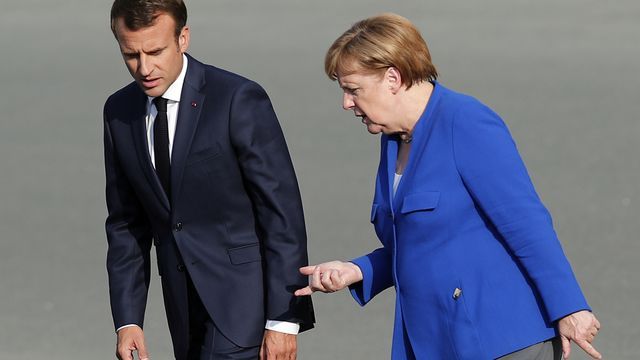
In a carefully choreographed video press conference on Monday, French President Emmanuel Macron and German Chancellor Angela Merkel announced a joint proposal for a €500 billion fund for “Europe’s economic recovery after the coronavirus crisis.”
The sum will be borrowed by the EU Commission in the form of long-term bonds and repaid by the member states over a 20-year period according to their share of the EU budget. In contrast to the €540 billion package agreed to by the EU states in April, rather than loans, the latest fund will consist of subsidies that do not need to be repaid.
Merkel and Macron praised the proposal as an act of European solidarity. Merkel stated that France and Germany were standing up for “the European idea” with an “extraordinary, unique effort.” French Finance Minister Bruno Le Maire described it as an “historic step” for France, Germany and the entire EU.
Emmanuel Macron and Angela Merkel (AP Photo/Francois Mori)
Praise was also forthcoming from the Financial Times and Le Monde. The British financial daily described it as a “significant breakthrough in the striving for solidarity between the EU states.” The French daily applauded it as a “small revolution for Europe.”
Italian Prime Minister Giuseppe Conte welcomed the proposal as a “good start” that could still be “expanded” financially. EU Commission President Ursula Von der Leyen, who was clearly involved in consultations on the proposal, also supported it.
The only opposition came from the so-called “thrifty four”—Austria, Denmark, the Netherlands and Sweden. Austrian Chancellor Sebastian Kurz said that he wished to show solidarity with the states hit especially hard by the crisis. “However, we think loans are the correct approach, not subsidies,” he added.
In Germany, the proposal was backed by the governing Christian Democrats (CDU), Christian Social Union (CSU) and Social Democrats (SPD), as well as the opposition Greens and Left Party. Left Party parliamentary group leader Dietmar Bartsch described the plan as “correct in principle” and urged it to be implemented “only by and for the states who move forward” to realise it if it proves impossible to reach unanimous agreement.
The reality is that the proposal has nothing to do with “solidarity”—neither with the countries hit particularly hard by the coronavirus, nor with the millions of workers and small businesspeople who have lost their incomes, livelihoods and even their lives. After weeks of disputes about how the programme should be financed, Merkel and Macron “got our act together,” as Merkel put it at the press conference, because they view the coronavirus crisis as an opportunity to strengthen their countries’ position in the world market and reorganise the European economy in the interests of the major corporations and at the expense of the working class.
As the proposal was presented, Merkel explicitly advocated for the EU’s own businesses to be “strengthened on the world market.” The EU is already funding “strategic projects,” such as the production of computer chips and battery cells. These efforts will now be intensified with the investments to overcome the crisis, she said. Like other countries, an effort will be made to create “global champions.”
The text of the joint proposal also makes this explicitly clear. The €500 billion programme is just one of various proposals contained within it. The first point is the striving for “strategic health sovereignty.” “We strive for a strategically positioned European health care industry,” states the document, “which will upgrade the European dimension of health care and reduce EU dependency.”
Point 4, “Enhancing EU economic and industrial resilience and sovereignty and give a new impulse to the single market,” makes clear that this goes hand in hand with trade war measures directed against economic rivals, above all China.
“A restart of the European economy and adapting it to the challenges of the future requires a resilient and sovereign economy and industrial base as well as a strong single market,” it states. It vows to “strengthen EU and national investment screening towards non-EU investors in strategic sectors (including health—pharmaceuticals, biotech, etc.), while at the same time encouraging investments (re)located in the EU.” The strengthening of the single market also requires “the full functioning of the Schengen Area ... (by) strengthening common external borders.”
Europe’s competition regulations should also be “modernized,” which in plain language means that the fusion of major corporations to form European “champions” will no longer be blocked on the basis of EU competition rules, as occurred last year with the failed merger of the train subsidiaries of Siemens and Alstom. In “key areas,” such as “digital, energy, capital markets,” accelerated legislative processes should ensure “a fully functioning internal market.”
The “strengthening of the EU’s economic resiliency” is bound up with savage attacks on wages, jobs and social rights. The joint proposal states that the €500 billion fund will be allocated by the EU Commission “on the basis of EU budget programmes and in line with European priorities.” “It will enhance the resilience, convergence and competitiveness of the European economies,” continues the document.
These are code words for the widespread destruction of social rights and achievements. Already during the euro debt crisis, “Merkel wanted to force the crisis countries to make cuts through ‘reform agreements’—she’s returning to that now in the coronavirus crisis,” remarked the conservative magazine Cicero. The EU Commission in Brussels, which would be responsible for allocating the funds and enforcing the conditions associated with them, “has long been waiting for an opportunity to impose its liberal economic recommendations.”
To mobilise support for these neoliberal “reforms,” they are being sold as a “Green Deal.” “Now is the time to boost the modernization of European economy and its business models. In this spirit, we reaffirm the European Green Deal as the EU’s new growth strategy,” the document cynically declares.
The advocates of eurobonds have stressed that for the first time, the German government has shifted from its principle of refusing to accept common European debt. But it is paying a modest price for this. Firstly, it is liable only for a quarter of the €500 billion total that will be paid back through the EU budget. Even at current levels, the top-up and Germany’s existing budget contribution would amount to a mere €7 billion per year. However, it is more likely that the EU budget will be cut back elsewhere, such as on spending for social or cultural affairs.
In contrast to the vast sums funneled into the coffers of the major German banks and corporations, this is a modest sum. The EU Commission has calculated that more than half of the coronavirus assistance measures adopted to date in Europe come from Germany. The French bailout measures account for 17 percent, Italy’s for 15.5 percent, and Poland’s for 2.5 percent.
Germany’s ruling elite fully expects to be able to strengthen its hegemonic position in Europe due to the coronavirus crisis. A few billion euros per year is therefore small change in order to resist the collapse of the EU.
The German-French proposal will deepen the national and social tensions within Europe. Only a unified offensive of the working class can prevent the relapse of the continent into nationalism, barbarism and war. Its goal must be the establishment of the United Socialist States of Europe. It must fight for the expropriation without compensation of the major corporations and banks and their transformation into democratically controlled public utilities. The billions now flowing into the accounts of the banks and super-rich must be deployed to combat the consequences for health care and society produced by the coronavirus pandemic.

Cyclone Amphan kills over 90 and devastates wide areas of eastern India and Bangladesh

Arun Kumar

Cyclone Amphan devastated coastal areas of the eastern Indian states of Odisha and West Bengal on Wednesday afternoon, and neighbouring Bangladesh on Thursday morning. Described as a “super cyclonic storm,” Amphan reached wind speeds of 185 kilometres per hour, tearing down powerlines, flooding low-lying areas and taking the lives of over 90 people—76 and 15 in India and Bangladesh respectively.
The Sundarbans mangroves forest region, a 140-hectare UNESCO world heritage site that is home to four million people, bore the brunt of the cyclone on Wednesday afternoon. The region lies on the delta of the Ganges, Brahmaputra and Meghna rivers on the Bay of Bengal. Cyclone Amphan then moved north and north-eastwards, hitting Kolkata, the West Bengal capital, and then Bangladesh on Thursday.
Working people and the rural poor in eastern India and Bangladesh have been worst hit by the disaster, which comes on top of the deadly impact of the coronavirus, which has already claimed more than 3,800 lives in the two countries.
While an estimated total of more than three million people have been evacuated from cyclone affected areas in both countries, their relocation into overcrowded shelters places them in real danger of contracting the highly infectious virus.
West Bengal Chief Minister Mamata Banerjee said that over 70 people had been killed by Cyclone Amphan and announced a meagre compensation package of 250,000 rupees ($US3,300) for the families of victims.
The worst hit areas in West Bengal included South and North 24 Parganas and East Midnapore. The state’s capital Kolkata, which has a population of 15 million, was also battered by the storm.
In a press briefing, West Bengal officials declared that it was “impossible to provide an immediate assessment of the damage,” but added: “Amphan mauled telecommunication systems, uprooted trees and electric poles, destroyed thousands of dwellings, and ravaged roads, bridges and embankments and jetties across North and South 24-Parganas and parts of East Midnapore…
“At least 15 embankments were breached. Telephone connectivity is badly affected… In Minakha alone, 5,200 houses have collapsed. Dozens of places are as badly affected or worse… National Highway 117 had become virtually inaccessible because of fallen trees between Kolkata and Diamond Harbour.”
Kolkata residents told the BBC that it was the worst storm they had experienced in decades and described flooded homes, electricity transformers exploding and extensive power outages.
Krishnachandrapur High School headmaster Chandan Maity told Telegraphindia that Amphan was “the worst cyclone in living memory” and that dangerously high winds had prevented residents from moving to safety. A disaster management official told the publication that over 50,000 mud and brick homes had been severely or permanently damaged in the Sundarbans region. “Almost all tin roofs have been blown away” and most cellphone networks were down, he said.
Chief Minister Banerjee, fearful of the political consequences of the catastrophic impact of the cyclone and rising popular anger over the failure of Indian authorities to protect the population from COVID-19 infections, told the media that the cyclone was “more worrying” than the coronavirus.
“We don’t know how to handle it,” Banerjee said. “Almost everything is destroyed in the coastal villages of the state… area after area has been devastated [and] communications are disrupted. We’ve never seen such a cyclone.”
In Bangladesh, the cyclone struck seven low-lying areas in the country’s south-west including Jashore, Bhola, Barguna, Patuakhali and Pirojpur with high winds and torrential rains. Powerful tidal waves, some as high as 12 feet (3.7 metres), destroyed embankments (levees), inundating villages and towns and cutting electricity supplies to more than five million people.
Ahmadul Kabir, director of Bangladesh’s Cyclone Preparedness Programme, said that around 2.4 million people from 19 coastal districts had been relocated to over 14,600 schools and other buildings that were being used as temporary storm shelters. Hundreds of Rohingya refugees, living in overcrowded and substandard accommodation in Cox’s Bazar, were reported to have been moved to shelters. About one million refugees live at 34 camps in the Cox’s Bazar district.
Several embankments or levees in Barguna and other districts were breached resulting in crops and fish farms being washed away. Sanjib Sagar, a resident of Ghoramara Island in the Sundarbans, told Reuters that many houses have been damaged. Another villager Babul Mondal, 35, who lived on the edge of the Sundarbans said that the houses “look like they have been run over by a bulldozer.”
Enamur Rahman, minister for disaster management and relief, arrogantly told the New Nation that: “Bangladesh is viewed as ‘a role model’ when it comes to calamity management” and that millions had been relocated to over 12,000 cyclone shelters in the coastal regions.
Notwithstanding these claims, the Bangladeshi government’s overcrowded temporary cyclone shelters place working people and the rural poor in real danger of contracting COVID-19.
While the cyclone is an environmental disaster, its impact on the lives and livelihood of millions of people in India and Bangladesh has been worsened by the callous refusal of the ruling elites to provide whatever is necessary to protect working people and the rural poor.
Cyclones, torrential rains and floods are regular events throughout South Asia. Despite this, successive governments of every political colouration in the region have refused to allocate the desperately needed resources to build infrastructure that would mitigate the impact of environmental catastrophes, and health disasters such as COVID-19, on ordinary people.

Washington incites India in tense border dispute with China

Keith Jones

Tensions between India and China and India and Nepal over their disputed Himalayan borders have flared in recent weeks.
Yesterday, they reached a new high, with New Delhi angrily dismissing a Chinese claim that Indian troops had crossed over the Line of Actual Control (LAC) into territory that India concedes is under Chinese control, pending final resolution of their border dispute.
“Any suggestion that Indian troops had undertaken activity across the LAC in the Western Sector or the Sikkim Sector is not accurate,” said Indian Ministry of External Affairs spokesperson Anurag Srivastava. “In fact, it is the Chinese side that has recently undertaken activity hindering India’s normal patrolling patterns.”
Underscoring the sharpening of the conflict, Srivastava said “peace and tranquility in border areas” is an “essential prerequisite” for developing Sino-Indian relations.
The world’s two most populous countries are now reported to be stepping up deployments of additional troops and weapons along their more than 3,000 kilometer (2,000 mile) contested border.
Until this week, Indian government and military officials had played down the significance of the border tensions, which have included mutual charges the other is not respecting the LAC in at least four places, and a scuffle between Indian and Chinese troops on May 5 in which soldiers exchanged blows with fists and sticks and threw stones at each other.
But on Tuesday talks between local LAC military commanders failed to resolve the dispute, after which China’s Foreign Affairs Ministry issued a statement accusing Indian forces of attempting to “unilaterally change” the LAC by “blocking” Chinese border patrols.
Then on Wednesday, Washington obtrusively intervened in the dispute. Acting US Assistant Secretary of State for South and Central Asia Alice G. Wells accused China of “aggression” against India, claimed this was part of a pattern of “disturbing behaviour” by Beijing, and vaunted India’s burgeoning military-strategic cooperation with the US and its principal Asia-Pacific allies, Japan and Australia.
“The flare-ups on the border,” Wells told a Zoom press conference with select Indian journalists, “… are a reminder that Chinese aggression is not always rhetorical and whether it’s in the South China Sea or whether it’s along the border with India, we continue to see provocations and disturbing behaviour by China that raises questions about how China seeks to use its growing power.”
Wells did not make a direct pledge of US military support should the India-China border dispute trigger a clash or all-out war between the rival nuclear powers. But she did so implicitly, with her claim that Chinese “aggression” was causing “like-minded nations” to join forces in strategic initiatives such as the “Trilateral” between the US, Japan and India, and the “Quad.” The latter grouping, which Washington aims to transform into a NATO-style anti-China alliance, unites the US, Japan, Australia and India.
Washington’s vocal intervention in support of New Delhi is in marked contrast with the stance it took during the 2017 Doklam dispute. For 73 days in the summer of 2017, Beijing and New Delhi exchanged bellicose threats, while hundreds of Indian and Chinese troops faced off on the Doklam Plateau, a Himalayan ridge claimed by both China and Bhutan, a tiny kingdom New Delhi has long treated like an Indian protectorate.
As the confrontation dragged on, the Trump administration took a series of actions aimed at highlighting the strength of the Indo-US “global strategic partnership,” but it maintained a position of “neutrality” on the Doklam dispute.
Washington’s aggressive intervention in the current flare-up is part of a massive escalation of US imperialism’s strategic offensive against China that enjoys bipartisan Democratic and Republican support. This escalation can be dated back at least to the fall of 2018. It has seen the Trump administration launch a drive to throttle Chinese tech giant Huawei as part of a broader campaign to thwart China’s emergence as a competitor in high-tech industries; intensify US “freedom of navigation” exercises in the South China Sea and Taiwan Strait; and move to deploy previously banned nuclear-capable intermediate missiles against China.
In recent weeks, President Trump and Secretary of State Mike Pompeo have thrown the anti-China campaign into a still higher gear in response to the crisis and economic collapse triggered by the COVID-19 pandemic. This had included baseless claims Beijing is responsible for the massive loss of life in the US—Trump has gone as far as to suggest the pandemic was a “sneak attack”—and demands that China be “held to account.”
In the three years since the Doklam crisis, India has further integrated itself into the US military-strategic offensive against China, including by aligning with Washington and its principal Asia-Pacific allies through the Quad, and by establishing in 2018 an Indo-US “2+2 Defence and Foreign Affairs Minister dialogue.”
Washington has reciprocated by offering India high-tech weaponry sold only to its closest allies and by green-lighting India’s February 2019 “surgical strike” air attack on Pakistan—a violation of international law that brought the nuclear-armed rivals the closest they have been to all-out war since the third Indo-Pakistani war of 1971.
As part of Washington’s latest volleys against China, Pompeo is urging US companies to pull production out of China and touting India as an alternate cheap-labour producer. For its part, India’s Narendra Modi-led far-right Bharatiya Janata Party (BJP) government has placed making India an alternate production-chain hub to China, through still closer collaboration with Washington and a “quantum jump” in pro-investor “reforms,” at the heart of its COVID-19 economic “recovery” strategy.
Beijing, not surprisingly, has reacted angrily to Washington’s intervention in the Sino-Indian border dispute and virtual incitement of India. Speaking Thursday at a regularly scheduled press briefing, Ministry of Foreign Affairs spokesperson Zhao Lijian called Wells’ provocative remarks “nonsense.” “China’s position on the China-India boundary issue is consistent and clear,” he added. “China’s border troops firmly safeguard(ed) China’s territorial sovereignty and security and firmly dealt with the Indian side’s crossover and infringement activities.”
According to Indian sources, since May 5 there have been “scuffles” between Indian and Chinese forces near Pangong Tso (lake), which divides Indian-held Ladakh from the Chinese Tibet Autonomous Region (TAR), and far to the east along the LAC between the Indian state of Sikkim and TAR. There have also been standoffs between Indian and Chinese troops at two other places that India claims are part of its Ladakh Union Territory and China claims are part of TAR or its Xinjiang Uyghur Autonomous Region—Demchok and Galwan Nalah.
China has objected to India’s attempt to build a road to facilitate troop movements near the confluence of the Shyok and Galwan rivers, claiming that it intrudes on territory that falls on its side of the LAC.
Last August, the Modi government illegally abrogated the semi-autonomous constitutional status of Jammu and Kashmir, India’s only Muslim-majority state, and subsequently bifurcated it, creating two central government-controlled Union Territories—Jammu and Kashmir; and Ladakh.
The spinning off of Ladakh, which, under the new constitutional arrangement, does not even have an elected legislature, was to give the military free rein in using the large but sparsely populated region as a base of military operations against China.
Tensions have also erupted between India and Nepal over the inauguration by Defence Minister Rajnath Singh on May 8 of a new 80 kilometer (50 mile) road across part of Uttarakhand to the Line of Actual Control between India and China at the Lipulekh Pass. Nepal, which currently exerts state sovereignty over territory near the Himalayan pass, claims that the Indian road passes through territory that historically and rightfully belongs to it.
On Wednesday, Nepal’s government gave added weight to its longstanding territorial dispute with India by publishing a new political and administrative map showing about 330 square kilometers (115 square miles) of territory currently held by India, adjacent to China and including Lipulekh, as within Nepal.
Nepal’s Prime Minister K.P. Sharma Oli, who has vowed to ensure the territory is returned to Nepal, has used the dispute with India to whip up nationalism and deflect criticism over his government’s mishandling of the COVID-19 crisis.
Landlocked Nepal has traditionally been dominated by India. In 2015-16, New Delhi imposed a quasi-blockade on the country, in an attempt to force through constitutional changes that it believed would enable it to more effectively wield political influence. But the gambit, while causing great suffering in Nepal, failed.
As across South Asia, there is an increasingly fierce struggle in Nepal between India and the US on the one hand and China on the other for economic and geopolitical influence.
Speaking at an online conference May 15, Indian Army Chief General M.M. Naravane all but accused China of orchestrating Nepal’s protest over the new road to the Lipulekh Pass, saying there was good “reason to believe” Kathmandu was acting “at the behest of someone else.”

Chilean government violently represses demonstrations against hunger

Mauricio Saavedra

Los hambrientos piden pan, Plomo les da la milicia
(The hungry ask for bread, The militia gives them lead)
La Carta, Violeta Parra, 1964
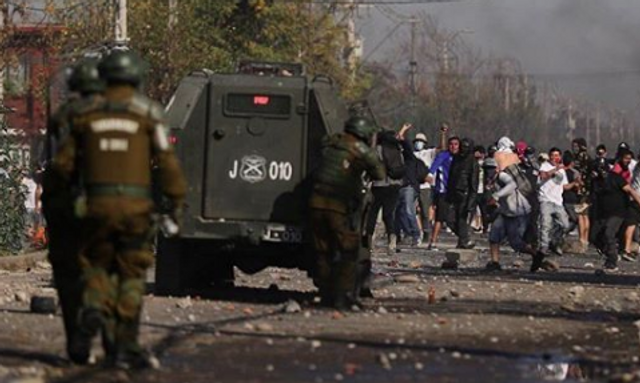
The ultra-right government of Chile’s President Sebastian Piñera has responded to a nationwide outbreak of protests against hunger with tear gas, water cannon and mass arrests. With goading from the fascistic Independent Democratic Union (UDI), recently enacted draconian laws are being applied to repress and intimidate an inflamed population as the coronavirus pandemic breaks new records in the country and the continent.
As of May 20, there were 53,617 confirmed coronavirus infections in Chile and 544 deaths. The day saw an all-time high of more than 4,000 new cases, and 35 more deaths. As elsewhere in Latin America and internationally, these figures are unquestionably a vast underestimation of the extent of the virus’s real spread and toll.
Demonstrators face Carabineros in El Bosque
Only this month did Piñera announce an emergency package to aid the 4.9 million informal sector workers who have recently struck against hunger. The Emergency Family Income delivers a miserable maximum payment of 65,000 pesos (US$80) for each member with a maximum of 500,000 pesos (US$620) per family group per month for up to three months. The government, meanwhile, has boasted that in a 24-hour period, its militarized police, the Carabineros, arrested 2,026 people nationwide, mainly for violating quarantines and curfews, while 1,088 were arrested for violating article 318 of the Criminal Code, endangering public health.
Thirty-seven protesters from greater Santiago’s El Bosque commune were arrested on May 18. Fifteen face serious charges for rioting against hunger and the lack of provisions after receiving no state financial assistance, despite being under lockdown since mid-April due to the pandemic.
Undersecretary of the Interior Juan Francisco Galli filed suits against 10 under the “anti-looting” law for stealing gas cylinders from an unattended distribution company. Three were charged under the “anti-barricade” law for obstructing a public thoroughfare. Two were accused of allegedly carrying incendiary devices for making Molotov cocktails. All were charged for violating the quarantine and Article 318 for putting the “health of the population at risk.”
UDI politicians have sought to go further, with Deputy María José Hoffmann accusing the demonstrators of harbouring drug traffickers in their midst and calling for the Carabineros to “do their part,” while the UDI mayor, Rodolfo Carter, on the show “Mucho Gusto” let slip a call for “repression” and for the protesters to be “shot at.”
Some sections of the ultra-right sought to claim that the protests was due to “premeditated political action” conducted by the Chilean left, to which the president of the Communist Party and House deputy, Guillermo Teillier truthfully responded: “It is very serious because we did not do anything. The reality is the reality. The reality is that the people are protesting. What can we do?” Teillier then pleaded with the government to work constructively with his party.
What provoked the riot? On Monday, May 18, with a 10,000-strong military deployment enforcing the shutdown of the Metropolitan Region of 7 million inhabitants, hundreds of residents of El Bosque commune in Santiago Province rioted after Carabinero police suppressed an earlier protest of senior adults demanding financial aid, assistance with utility payments and basic support.
“It was caused in large part by the repression against the elderly, who were protesting in the morning and that led to the anger of the young people who came out to defend their grandparents and parents,” Hector Perez, a resident of El Bosque, told the Desconcierto .
As news of the violent repression was transmitted over social media, demonstrations spread to other impoverished working-class communes in the capital, known for their historic resistance against the 17-year military dictatorship of Augusto Pinochet. Demonstrations also emerged in the regional cities of San Antonio, Antofagasta, Arica, Concepción and Valparaíso. Pots and pans were banged during the night.
By Wednesday, the residents of Villa San Francisco from La Pintana commune set up barricades and cut off traffic to protest the same social hardships. One Pintana resident explained to Teletrece “We are the ones who move the country … build the companies because without workers the companies would not exist. Many of my neighbours have had their contracts suspended without pay … we can’t quarantine like the eastern sector does because the eastern sector can lock themselves in. They’ve got their refrigerators full. We don’t. We live from day to day.”
Like so many other outer parts of the capital, sections of Pintana and El Bosque, are “campamentos,” squatter settlements that subsist in extreme poverty and overcrowding amidst gentrified condominiums and apartments. El Bosque commune suffers from multidimensional poverty at almost double the national average; overcrowding affects 18 percent of households and income poverty is the highest in the Metropolitan Region at 14.5 percent.
Historically, the settlement movement began in the 1950s in land takeovers and collective purchases by organized “homeless” as many thousands of rural families moved to the capital city in search of work.
Today there are 882 squatter settlements that house tens of thousands of families in squalid, overcrowded conditions. Seventy-five percent of the settlements have poor access to electricity, only 10 percent have regular access to drinking water, and 81 percent have poor access to sewage services. Squatter settlements have been on the rise since the 2008 global financial crisis and under Socialist Party and ultra-right governments alike. In 2007, 28,578 families were living in campamentos. By 2016 the number of families had increased to 38,570, and by 2019 it had almost doubled to 46,423, a significant fraction of whom are immigrants who receive no state assistance under conditions of an economic slowdown.
That was before the pandemic. El Mostrador early this month revealed that 16 of the poorest working-class communes in the Metropolitan Region had among the largest numbers of coronavirus infections with a growth rate of over 40 percent. Infections are doubling every two days and hospitals, running at 90 percent occupancy, are saturated, without sufficient resources, beds or personnel.
Only two weeks ago, a fire ravaged a settlement located in La Pincoya in the commune of Huechuraba that destroyed 24 homes and left 100 families utterly destitute. Like the other working-class neighbourhoods that resisted the military dictatorship, La Pincoya has suffered a disproportionate amount of police violence and state neglect.
An open letter submitted to social media by Pincoyano residents explained the since the massive social explosion last October, “we have had to face serious and systematic violations of our human rights by state agents just for demonstrating and fighting for a better future for our community and our families.”
The letter condemned the state repression, the major media conglomerates for deliberately maligning the community as criminals and drug traffickers and human rights organisations for abandoning their plight.
In the last six months the community has faced the police and the military tear-gassing and shooting with pellets of demonstrators, passers-by and children. Communal areas have been pepper-sprayed to prevent people from congregating. Homes have been raided at gunpoint in search of demonstrators, while detainees have been beaten and dumped in remote places. Tear gas canisters have been intentionally fired at roofs, causing fires. Drones and helicopters have hovered over the commune. Primary and high schools have been tear-gassed; children and adolescents harassed. Even the local primary care health centre has been repeatedly tear-gassed while attending to medical and public health emergencies.
The letter concluded: “Abandoned by the state, the municipality and the institutions in general, the inhabitants of La Pincoya will resist and continue in the streets fighting for our rights ... Neither their bullets nor their repression will be able to silence the voice of the people! We will continue to resist!”
Communal assemblies have formed in La Pincoya to oppose this state repression. These popular social and political assemblies have also been established in many other working-class communities.
The economic crisis, exacerbated by the health crisis and the complete lack of substantive assistance to millions, has in fact given rise to many working-class initiatives on a level not seen since the revolutionary period of 1968 to 1973.
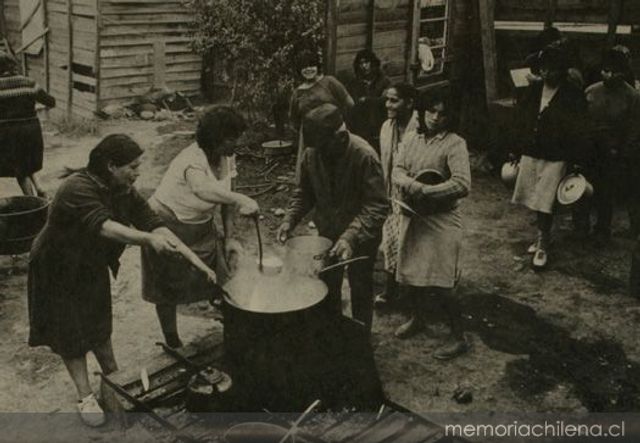
An olla común in 1980s Chile
These include the “olla común,” or communal kitchens, which have cropped up across the country as workers come together to purchase, distribute and package food hampers to deal with the exponential growth of want and misery. Trucks are collectively hired to pick up and distribute rations to women involved in the production of foodstuffs which are then distributed to the poor, elderly, frail and sick.
Desconcierto interviewed another El Bosque resident, Patricia Coñoman, who lives with nine other people in a single apartment. She said, “Here the right to health, the right to equal housing and now the right to eat is a laugh. We are living in very difficult times.
“People are now setting up fires again to cook, at the fair they are selling an oil quart in plastic bottles and in the shops people buy individual tea bags. It’s like going back in time, something I never thought I would experience again. It’s like the ’80s, because it’s not only hunger but also repression.”
The working class requires a clearly worked out program and perspective that transforms its initiatives into weapons for the conquest of state power. This is possible only when it mobilises independently in the fight for revolutionary international socialism and the overthrow of capitalism. This requires, above all, the building of a Chilean section of the International Committee of the Fourth International.

US withdraws from Open Skies Treaty, heightening danger of war with Russia

Clara Weiss

On Thursday, the Trump White House announced it will unilaterally withdraw from the Open Skies Treaty, which permits participating states to conduct limited, unarmed reconnaissance flights over the territories of other member states in order to collect data on military forces and activities. The scrapping of Open Skies heightens the likelihood of a major conflict between the United States, Russia and the major European powers.
The treaty, signed in 1992 after the dissolution of the USSR, has been in full force since 2002. It has been ratified by 34 states, including almost all NATO and EU members, Russia and most countries of the former Soviet Union. The US withdrawal from Open Skies, which will take effect within six months, comes amidst growing tensions with Russia. In June, Washington and its NATO allies will stage major war games just 35 miles from Kaliningrad, a Russian enclave in Europe.
Russian media report that NATO is convening an extraordinary session on Friday, May 22, to discuss the situation.
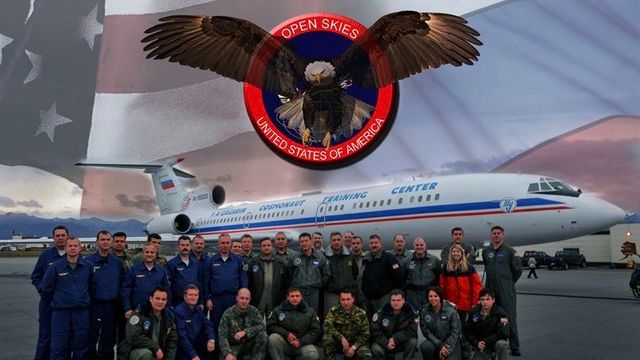
Russian military members stand in front of a Russian TU-154 after a flyover mission at Elmendorf Air Force Base, Alaska as part of the Open Skies Treaty. (U.S. Air Force photoillistration/ Staff Sgt. Joshua Garcia)
Trump’s move is universally seen as a sign that the US will also soon end the 2010 New START treaty with Russia, which limits the number of deployable nuclear missiles to 1,550 for each country. It is the last remaining treaty constraining the arsenal of the world’s two largest nuclear powers.
The American withdrawal from the Open Skies Treaty means that Russia and other member states can no longer conduct observational flights over the US that provide information, among other things, about the growing nuclear capabilities of the US. Washington will no longer provide advance notice to other states before it conducts surveillance flights or limit its activities to dictates established by the treaty.
The White House argues that the US withdrawal is justified by Russia’s alleged “violation” of the treaty. “Russia didn’t adhere to the treaty. So until they adhere, we will pull out, but there’s a very good chance we’ll make a new agreement or do something to put that agreement back together,” Trump said at a press briefing on Thursday.
The alleged violations refer to the fact that Russia has excluded Kaliningrad, a small piece of Russian territory that abuts Poland and Lithuania, and the Georgian breakaway republics of Ossetia and South Abkhazia in the south Caucasus, from the treaty. Moscow does not allow Open Skies surveillance of these areas. In 2008, Georgia provoked a war with Russia over Ossetia and South Abkhazia with the full backing of the US, bringing NATO and Russia to the brink of all-out war.
Russian deputy foreign minister Alexander Grushko sharply criticized Washington’s withdrawal from Open Skies. “Our position is absolutely clear and is invariable: The withdrawal of the US from this treaty will come as yet another blow to the system of military security in Europe, which is already weakened by the previous moves by the administration.”
Indicating that Russia might now also withdraw from the treaty, the spokesperson for the Russian foreign ministry, Maria Zakharova, declared on Thursday that the US itself violated the treaty.
Since 2002, the US has undertaken three times as many reconnaissance flights over Russia than Russia has over the US. In 2019, Washington conducted 18 flights out of a maximum allowed of 21, whereas Moscow carried out 7. In 2020, the US is expected to reach the upper limit of 21.
Europe has been the primary target of Russian surveillance under Open Skies, with Moscow using the treaty provisions to observe the movement of NATO troops and the build-up of American military capabilities on the continent. Particularly since the 2014 crisis in Ukraine, when Washington and Brussels supported a far-right, anti-Russian coup in Kiev, the Western allies have staged ever larger and more provocative military exercises in the region.
If Russia withdraws from the treaty, it will no longer be able to continue its overflights in Europe. European signatories would also be legally prohibited from carrying out such missions over Russia.
The Trump administration first signaled its intention to withdraw from the treaty in November 2019. At that time, Konstantin Bogdanov of the Russian Academy of Sciences’ Center for International Security warned, “There is nothing to replace it with. ‘Open Skies’ is an important, symbolic treaty which has enormous political significance.”
Europe’s imperialist powers and NATO members have long opposed an American withdrawal from the treaty. Ukraine, whose eastern Donbass region is engulfed in a conflict between pro-Ukrainian and pro-Russian separatists, has also opposed the scrapping of Open Skies.
On May 12, the European Leadership Network think tank published an open letter signed by several high-ranking NATO ex-generals that called upon the Trump administration to continue complying with Open Skies. It further appealed to the European powers to “make every effort to remain in the treaty, even if the United States withdraws.” The letter, whose signatories included former military chiefs from Germany, Ukraine, the UK, France and Italy, declared that “while the intelligence and confidence building advantages are limited for the US itself, they are very real for America’s NATO allies.”
German Foreign Minister Heiko Maas criticized the American withdrawal of the treaty and urged the US government to “reconsider.” He said, “We are calling upon Russia to resume full obligations under the treaty. For us it is clear that we will continue to implement the treaty and that we will do everything to maintain it.”
The European powers, which have played a central role in staging major NATO exercises on Russia’s borders in recent years, are interested in keeping the treaty because it enables them to gather military intelligence using air surveillance. The US, by contrast, has more advanced satellite capabilities than the European powers.
While utterly reckless, the unilateral withdrawal from the treaty is part of systematic preparations by US imperialism for world war. Since 2018, Washington has officially based its military policy on the prospect of a “great power conflict,” above all with Russia and China.
In 2017, the US pulled out of the Iran nuclear deal, exacerbating tensions with Germany and France and setting the stage for an open military conflict with Tehran. Last summer, the US scrapped the Intermediate-range Nuclear Forces (INF) deal, a clear signal that it was preparing for nuclear war. And in 2019, Democrats and Republicans voted for a $750 billion military budget—the largest in history—which explicitly rejected any kind of limitations on the development of “low-yield” nuclear weapons. Other imperialist powers, most notably Germany, have stepped up their military rearmament.