26 May 2020

Thyssenkrupp in Germany to be broken up

Dietmar Gaisenkersting

On May 18, the supervisory board of the Thyssenkrupp company decided to break up the industrial group, a move hedge funds have been demanding for years. The decision was unanimous and included the votes of IG Metall trade union members and works council representatives who sit on the company supervisory board.
The concept presented by Thyssenkrupp CEO Martina Merz to the supervisory board envisages the sale of almost all of the company’s divisions. The only sections to be kept are trading in materials and parts of the company’s industrial component production. The overwhelming majority of the concern’s 160,000 employees will either end up with another employer or lose their jobs.
Thyssenkrupp plans to sell off its divisions in heavy plate, special construction and battery cell production. If no buyers are found the subsidiaries are to be closed down, including the heavy plate plant in Duisburg with its 800 employees.
The group also plans to separate parts of its auto parts business (springs and stabilizers), its steel plant in Terni, Italy, and plant engineering. The company executive says it is already engaged in talks with interested parties regarding the future of its plant engineering division.
The executive has fused the sectors for sale, with a workforce of around 20,000, into a separate company. Manager Volkmar Dinstuhl will take charge of this holding, also known as a “bad bank.” Dinstuhl had organised the sale of the company elevator division three months ago. Thyssenkrupp Elevator—with around 54,000 employees worldwide, including 5,000 in Germany—is to be sold off at the end of September for the sum of €17.2 billion to an international consortium consisting of financial investors Advent and Cinven and coal foundation RAG.
If no buyers are found, the steel and shipyard divisions are to be merged with other companies. According to recent figures the two divisions employ 27,000 and 6,000 workers, respectively.
Previous merger attempts have failed. Some years ago, the EU Commission prohibited the merger of Thyssenkrupp Stahl Europe with the European sector of the Indian group Tata Steel. The current announcement that the company’s core business will once again be reorganised into a joint venture with a competitor is one of the most important components of the breakup plan.
Contacts with other companies are apparently well advanced. CEO Merz said that talks were “quite intense.” In the shipyard business, the company wants to “form a national champion together with the Lürssen shipyard,” said Oliver Burkhard, Thyssenkrupp’s human resources officer, who is also responsible for the company’s Marine Systems unit. Burkhard was a local leader of the IG Metall union before moving onto the board of Thyssenkrupp with an annual salary of over €4 million.
Lürssen has already announced it will cooperate in the long term with German Naval Yards in Kiel in “military and official shipbuilding.” Now Thyssenkrupp is also due to participate.
IG Metall supports this national concentration of warship construction. The merger of Lürssen and German Naval Yards can “only be a first step,” said the IG Metall coastal district leader, Daniel Friedrich. In the consolidation process ThyssenKrupp Marine Systems had to be included and cooperation extended to construction of submarines.
In February, the German government issued a “Strategy Paper to strengthen the German Security and Defence Industry,” calling upon German shipbuilders to join forces. The document declared naval shipbuilding to be a key technology for the country.
Talks between Thyssenkrupp and other steel producers are already underway. Last weekend it emerged that Thyssenkrupp was in talks with Chinese steel producer Baosteel, Swedish manufacturer SSAB and once again with Tata Steel.
Thyssenkrupp boss Merz is also in constant contact with the CEO of German steel producer Salzgitter AG, with 25,000 employees. Merz reported this fact in an interview with the Süddeutsche Zeitung.
Once again IG Metall is an advocate of developing a “national champion,” involving a fusion of Thyssenkrupp with Saarstahl and Salzgitter. Steel General Works Council Chairman Tekin Nasikkol supports the plan—but “only under the leadership of Thyssenkrupp.”
Jürgen Kerner, IGM board member and deputy head of the supervisory board of Thyssenkrupp, demands that the German state also be involved. The fund set up for companies by the government would be “a suitable instrument for direct state participation in steel manufacturers.” It makes sense to “use this instrument now,” declared Kerner, the main IGM beneficiary from any future deal.
In contrast to the failed merger with Tata Steel, the sale of the entire steel division could not be ruled out. Merz said that “everything was on the table.” It was also possible to ditch the majority of company sectors in the event of forming a joint venture. For both Kerner and Nasikkol such a prospect represents crossing a “red line”—at least for the time being.
Thyssenkrupp boss Merz knows very well that the union and the works council will agree to everything, including the closure of entire plants, as long as the company’s well-paid officials get their share of the spoils. In an interview with the Süddeutsche Zeitung, she replied to indications that IG Metall was “critical” of a merger with a Chinese manufacturer: “I have often seen that solutions first raise concerns—but this can change afterwards. We witnessed this before when selling the elevator division to private equity investors.”
In reality, the initial purely verbal protests by union bosses serve only to head off and stifle the existing discontent amongst the workforce. They are the inevitable accompaniment to the attacks demanded by shareholders.
It is unclear how many jobs will be destroyed as a result of the breakup, but potential buyers and future co-owners or partners in a joint venture will undoubtedly demand the shedding of “excess capacity” in order to ensure “synergies.”
Thyssenkrupp has already announced that it will cut around 500 of 3,400 jobs worldwide in its auto supplier division that is now up for sale. The Olpe plant with its 330 employees will be decommissioned at the end of 2021; 160 jobs are to be cut at the Hagen plant. In the steel sector, IG Metall agreed in March to cut 3,000 jobs, 1,000 more than originally planned.
Merz’s stated goal is also to reduce pension obligations currently totalling €7.6 billion. This applies primarily to company pensions, which will also be outsourced or wiped out when the company is broken up.
The dissolution of the company announced a week ago by the supervisory board corresponds exactly to the demands made by financial investors for several years. The fact that these are now being implemented is the direct result of the close cooperation between the company executive, IG Metall and shareholders, in particular the hedge fund Cevian.
When asked by the Süddeutsche Zeitung whether she was the “executor of this shareholder,” Merz replied: “Well, that means you have a completely wrong idea of how we run things.” The executive runs the company in close coordination with the supervisory board, where one is of course in dialogue with Cevian, she said. However, she “did not have the impression that the Krupp Foundation or IG Metall were less involved in the discussions.”
In fact, all 10 IGM and works council representatives have approved the company dismantlement and Merz praised their decision, saying: “That’s great.”
Markus Grolms, the new human resources officer, is responsible for the close cooperation between the union and hedge fund shareholders. Up until the start of this year he was acting IG Metall secretary and deputy chairman of the supervisory board of Thyssenkrupp, the predecessor to Jürgen Kerner. After the resignations, within the space of a few days, of both the executive chairman, Heinrich Hiesinger, and the supervisory board chairman, Ulrich Lehner—probably due to pressure from hedge fund shareholders—Grolms took over the chairmanship of the supervisory board.
During this time, he worked on an agreement between the 10 employee representatives on the supervisory board—IG Metall, the main shareholders, the Krupp Foundation and hedge fund Cevian. “Unfortunately, the reorganisation of Thyssenkrupp is unavoidable,” Grolms declared in May 2019. This would be “a difficult but unfortunately necessary path for the company and its employees” but the workforce was “prepared to endure pain,” the millionaire union boss declared.
Company shareholders are initially satisfied. The price of Thyssenkrupp shares rose the day after the breakup was announced. At the same time, the Krupp Foundation, which holds the largest share package at Thyssenkrupp, warned: “Thyssenkrupp has no time to waste.”

After French bailout, Renault-Nissan announces global jobs massacre

Alex Lantier

After the French government announced plans last week for a €5 billion bailout of automaker Renault, due to the economic fallout from the COVID-19 pandemic, the Renault-Nissan alliance is about to announce plans for an international wave of plant closings and layoffs.
President Emmanuel Macron is scheduled to speak today on his government’s plan to “rescue” the French auto industry. This will be followed by the release of Renault-Nissan’s “strategic plan” on Wednesday, May 27, and the unveiling of further details of its cost-cutting plans on Friday, May 29. Last February, Renault-Nissan laid out a €2 billion cost-cutting plan to boost corporate profits and ensure that any public bailout money leads to even greater profits for private investors.
Details of the new restructuring measures planned by Renault were leaked by an anonymous source to the Parisian weekly Canard enchaîné. According to the publication, “Four plants will be closed in France: Choisy-le-Roi, Dieppe, and Fonderies de Bretagne. The biggest one—Flins (where the electric compact car Zoe and the Nissan Micra are assembled)—will come later.” The financial press reported official sources saying that taking a public bailout “does not mean giving up on slashing jobs.”
Nissan, which had already announced in 2019 its intention to cut 12,500 jobs worldwide, now plans to cut 20,000 after the pandemic, Japan’s Kyodo News reported. This is 15 percent of its workforce. Spanish factories are especially threatened, notably plants at Zona Franca, Montcada and Sant Andreu de la Barca. In 2019, the company also announced plans to slash jobs in Japan, Britain, Mexico, India and Indonesia, among others.
Workers at Montcada have been on strike since May 4, and Nissan’s Sunderland plant in Britain is also potentially threatened with closure.
The use of billions in public funds to destroy tens of thousands of jobs, a decade after the Wall Street bailout, will provoke legitimate outrage among workers internationally. While governments and central banks hand trillions of dollars and euros to the ruling class, it uses these resources in an utterly parasitic fashion. Even as a raging pandemic kills hundreds of thousands, Renault-Nissan is not using these funds to save jobs or retool to produce critical health equipment, but to slash jobs and try to profit from an ongoing global restructuring of the auto industry.
This is a warning of the global jobs massacre being prepared in industries from airlines and travel to auto—where at least 100,000 job cuts were planned even before the pandemic. Vast corporate bailouts are being announced, with €300 billion from the French state, and two slices of €750 billion and €540 billion from the European Central Bank. This plundering of public coffers, planned with the union bureaucracies in each country, sets the stage for enormous attacks on workers.
On May 19, talks between Renault, private banks and the French state (which holds 15 percent of Renault’s shares) led to a state-backed bailout of €5 billion to Renault.
Renault skipped ahead of countless firms in France, 500,000 of which have applied for emergency loan assistance to deal with the collapse in business activity during the pandemic, and many of which are in imminent danger of bankruptcy. Renault had €10.3 billion in cash reserves in late March and monthly expenses of €600 million, with plant operations suspended worldwide. However, Renault management told La Tribune that it would have been “reckless not to ask for state aid.”
The only condition for the loan, according to sources who spoke to the press, was that Renault not pay out dividends this year. It can, however, choose its repayment terms in coming years, including how to distribute profits made off public funds obtained in 2020. Renault has no legal obligation to avoid layoffs or plant closures under the terms of the bailout.
Vast COVID-19 bailouts are not serving to meet urgent needs posed by the pandemic, but to finance previously planned corporate restructurings amid a global transition toward electric cars and a global economic slowdown already underway before the pandemic. Renault CEO Clotilde Delbos announced the €2 billion cost-cutting plan on February 14, just after announcing a net loss in 2019, for the first time since 2009, of €141 million. Falls in economic activity in China and Iran due to US trade war measures have particularly hurt the automaker.
In April, Nissan, which has 1.14 trillion yen (€9 billion) in cash reserves, asked for 500 billion yen in loans from public and private banks in Japan. “We have enough liquidity for current operations, but we are examining different possibilities if a crisis arises in future,” said Nissan spokeswoman Azusa Momose. Nissan expected to make only 4.6 million vehicles in 2020, though its production capacity is 7 million.
The two corporations are linked by mutual capital holdings: Nissan has 15 percent of Renault stock, while Renault holds 43 percent of Nissan stock.
For now, the French government is trying to lull workers to sleep, claiming that Macron’s speech today will be about defending ecology and French industry.
An anonymous official told AFP that Macron is preparing a general plan to support automakers: “This plan has different components: industrial sovereignty, transition to clean vehicles, and also ensuring industrial competitiveness.” The official said he would stress “the industrial stakes, the stake in jobs and transforming the industry to transition and convert to clean vehicles.”
In fact, even Macron’s ministers are signaling that they will accept massive job losses everywhere, including in France. “We will be very demanding, France must remain Renault’s global center for engineering, research, innovation and development,” said Prime Minister Édouard Philippe, adding only, “We will be very mindful of the quality of social dialog and policy.”
Economy Minister Bruno Le Maire said Renault’s “survival” is at stake, while indicating that he opposes closing the Flins plant—passing over the three other plants in silence.
The struggle against these reactionary bailouts, which force workers and the public to finance their own impoverishment, requires the construction of an international movement among workers. Against transnational companies, which shift production from one country to another to maximize profits, the opposition of autoworkers, including strikes and other struggles, can only be effective if it is mobilized across national borders. This requires building rank-and-file committees of action independent of the nationalist and pro-capitalist trade unions.
The French unions are not even organizing symbolic protests. Instead, union officials have attended talks with representatives of the government and Renault since April and have kept a deafening silence on what was being planned. After the Canard enchaîné report, Philippe Martinez, the head of the Stalinist General Confederation of Labour (CGT) union, responded with impotent and nationalist rhetoric. “We are very upset. What Renault needs is to produce Renault cars in France and work on creating French jobs.”
Jobs must be protected not just in one country, but across the world. Renault’s massive cost-cutting plan also underscores the bankruptcy of Martinez’s Spanish counterpart, Unai Sordo, the boss of the Stalinist Workers Commissions (CCOO) union. While isolating the Montcada strike, Sordo asked the Podemos-social democratic government in Spain to beg Renault for relief.
The pandemic and the dangerous and premature back-to-work policy of the national governments and trade unions further underscores the bankruptcy of the existing social order. Only a politically independent and international struggle by the working class, fighting for socialism against the diktat of the banks over world industry, can protect lives and jobs. Instead of bailing out the giant corporations, they should be transformed into public utilities under workers’ control, and run as part of a world socialist economy based on social need, not private profit.

Washington’s criminal deportations to Haiti threaten to ignite pandemic

Alberto Escalera

The US Immigration and Customs Enforcement (ICE) is planning to carry out a fourth deportation flight shipping Haitian refugees and migrants back to Port-au-Prince today under conditions in which the impoverished Caribbean country is confronting a threatened explosion of the coronavirus pandemic. Its health care system in shambles and confronting a protracted political crisis, Haiti is among the least prepared countries in the hemisphere to deal with the deadly pandemic.
The flight, which will carry 78 Haitians deemed in violation of US immigration laws, follows widespread protests after ICE attempted to deport to Haiti five detainees who were known to have tested positive for the coronavirus at the privately run Pine Prairie, Louisiana immigration detention center. Detainees there went on hunger strike because of the virus running rampant in the for-profit lock-up facility and the lack of any protections.
According to official figures, Haiti has roughly 1,000 confirmed cases and has recorded nearly 30 deaths. Both figures are unquestionably severe underestimations of the real impact of COVID-19 under conditions in which there has been scant testing and many Haitians lack access to health care. Nonetheless, the numbers are rising steeply.
In addition to the innocent migrant workers being forcibly sent back with possible coronavirus infections to the impoverished country they fled, Tuesday’s flight will reportedly carry another deadly threat to the population of Haiti.
According to press reports, the May 26 flight’s passenger list includes one Emmanuel “Toto” Constant, a death squad leader and long-time CIA “asset.” In the years following the 1991 military coup that overthrew elected President Jean-Bertrand Aristide, Constant headed the infamous Front for the Advancement and Progress of Haiti (FRAPH), a paramilitary organization, whose death squads were responsible for more than 3,000 assassinations along with torture and rapes.
In 2001, Constant and several officers of the military and police high command under the coup government were tried and convicted in absentia by a Haitian court for their role in the 1994 Raboteau massacre, in which his FRAPH paramilitaries and army troops terrorized an entire slum neighborhood in the northern city of Gonaïves. The sentences of all those convicted for the atrocity would later be overturned by Haiti’s Supreme Court on a technicality in 2005.
Constant has been living in the United States since fleeing Haiti in 1994 after the then exiled Aristide was reinstalled after coming to terms with the US State Department and the IMF to carry out the policies dictated by US imperialism.
Constant was recently released from a New York state prison and placed in US immigration custody after serving 12 years of a 37-year sentence for crimes carried out in the US, including mortgage fraud and grand larceny. It is widely believed that if repatriated to Haiti, the former FRAPH leader will not face any legal consequences for his past crimes under the widely despised regime headed by President Jovenel Moïse, which itself is mobilizing armed thugs to terrorize Haitian working people.
The repatriation of Constant and his likely return to his deadly profession would add an additional layer of cruelty to the already callous immigration and deportation policies being carried out by US imperialism in the midst of the global coronavirus pandemic.
There are approximately 32,000 people currently being held under concentration camp-like conditions in ICE detention prisons—many of them run by private, profit-making companies—throughout the United States. These facilities have fast become foci of COVID-19 infections as detainees are forced to live in overcrowded and unhygienic conditions, often in cages, without adequate medical attention.
In March, the Trump administration closed the US-Mexico border to all asylum seekers under the pretext of preventing the spread of coronavirus within the US. The US State Department subsequently shut down various consulates located in countries from which many asylum seekers come to the US. US immigration courts have also ceased to operate, and in April, Trump signed an executive order suspending the issuance of green cards to immigrants abroad.
At the same time, the Trump administration has continued to carry out deportation flights to Central American and Caribbean countries like Guatemala, Honduras, El Salvador, Haiti, the Dominican Republic and Jamaica. A recent analysis by the Center for Economic and Policy Research found that in the six weeks between March 15 and the end of April of this year, ICE carried out at least 55 deportation flights to these Central American and Caribbean countries.
US deportation policies are contributing to a significant spike in coronavirus infections in Central American and Caribbean countries already suffering from fragile health care systems crippled by years of austerity and war as well as extremely limited testing capacity. In several cases, ICE deportation flights are being carried out despite the closure of local airports and protests by government officials, typically subservient to Washington, who are fearful of the social and political repercussions of the spread of infections from newly arrived deportees from the US.
In Haiti, a country with 11 million people, there are a total of 126 intensive care unit beds and 68 ventilators. The country has one of the lowest ratios of physicians per 100,000 inhabitants in the world, .234 as of 2018, and a recent UN report concluded that there were currently only 911 doctors remaining in the country. Haiti has only two laboratories with the capacity to process the scant number of coronavirus tests that are being administered.
An additional factor accelerating the humanitarian crisis facing Haiti as the virus spreads is the return of tens of thousands of migrant workers from the neighboring Dominican Republic. An estimated 500,000 Haitians work there under conditions of brutal exploitation and extreme social and political alienation.
The Dominican Republic, which is highly reliant upon tourism, has one of the highest numbers of COVID-19 infections in the region. As of May 23, there were 14,000 confirmed cases and nearly 500 deaths in the country, again a fraction of the real numbers given inadequate testing and heath care.
Since the onset of the pandemic, the Dominican Liberation Party (PLD) government headed by Danilo Medina has enacted a state of emergency, recently extended until June 1, that has effectively shuttered the economy and postponed the presidential elections originally slated for May 17. Under the PLD government’s state of emergency order, 150,000 Haitian migrant workers have had their temporary legal status suspended, forcing them to return to Haiti, often via unofficial border crossings.
In recent comments that highlight the chauvinist filth with which the Dominican elite has historically sought to deflect from its own reactionary policies, the government’s health minister, Rafael Sánchez Cárdenas, referred to Haitians as a “major threat to the Dominican Republic from a health point of view.”
Haiti is a country with a long history of endemic poverty and brutal dictatorships in which the vast chasm between the tiny ruling elite and the broad masses has acquired the most grotesque forms. From 1915 to 1934, the country was occupied by US Marines to protect sugar and banking interests in the United States. Subsequently, Haiti was ruled for nearly three decades by the US-supported Duvalier dictatorship. After the 1991 election of Aristide, a former priest who emerged as the leader of a movement for moderate democratic reforms during the last years of the Duvalier dictatorship, Haiti experienced another series of military coups orchestrated from Washington.
The current Tèt Kale government of Jovenel Moïse, who came to power through rigged elections in 2016, has been characterized by brazen corruption and the widescale use of armed gangs to carry out assassinations of political opponents and intimidate the working masses.
In July of 2018, mass demonstrations calling for the ouster of Moïse erupted throughout Haiti. For more than a year, tens of thousands of working people repeatedly took to the streets in cities across the country, often in violent clashes with the police, to protest rising inflation and brutal austerity measures imposed by the government under the dictates of the IMF. These included the elimination of state subsidies for fuel.
Protesters also demanded the resignation of Moïse for his role in an embezzlement scandal involving as much as $2 billion in PetroCaribe funds earmarked for infrastructure development projects that were never carried out. Some of these funds were funneled to President Moïse himself through a construction company he owns that was awarded state contracts.
The PetroCaribe program, started by Venezuela’s former president Hugo Chávez in 2005, when the country faced favorable conditions on the world market, entailed the heavily subsidized sale of petroleum to governments in the region with deferred payment provisions. These governments would then resell the oil on the international market at margins allowing them to pay for infrastructure projects and social programs.
The Trump administration’s use of the pandemic as a cover to repatriate a notorious CIA henchman like Constant under conditions of guaranteed immunity is a clear signal to the ruling Moïse government in Haiti. Washington is green lighting the stepped-up use of extrajudicial killings, kidnappings, torture and rape in an attempt to crush the struggles of the working masses in Haiti.

Brazil surpasses 350,000 cases as politicians promote rapid reopening of economy

Tomas Castanheira

On Monday, for the first time, Brazil announced a larger number of deaths from COVID-19 in a single day than the United States. On Sunday, Latin America’s largest country recorded 703 deaths, while the US registered 617. The confirmed death toll in Brazil has already surpassed 23,000.
The country currently has the second-largest number of confirmed coronavirus cases in the world, 367,906 in total. It trails the United States, which has 1,697,182 cases, and is just ahead of Russia with 353,427 cases.
Brazil's testing rate, however, is significantly lower than that of both these countries, with only 3,461 tests per million inhabitants, compared to 25,456 tests per million inhabitants in the United States and 61,300 tests per million in Russia.
An estimate based on parameters established by the London School of Hygiene and Tropical Medicine indicates that only one in 20 cases of COVID-19 is being reported in Brazil. This would translate into an actual number of cases exceeding 7 million.
As a consequence of the uncontrolled spread of the virus, the country's precarious health care system is collapsing in every region.
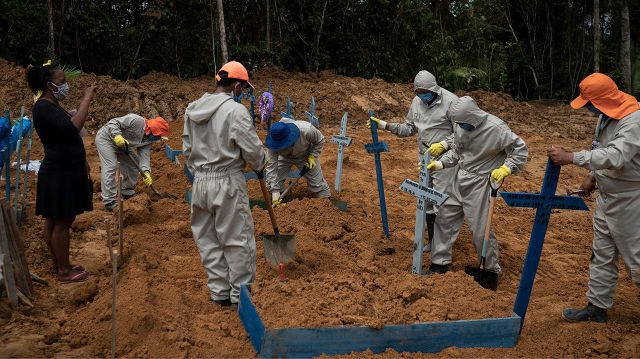
Cemetery workers place crosses over a common grave after burying five people at the Nossa Senhora Aparecida cemetery in Manaus, Brazil, Wednesday, May 13, 2020. The new section of the cemetery was opened last month to cope with a surge in deaths. (AP Photo/Felipe Dana)
The state of São Paulo is the center of the disease, with 83,625 cases and 6,220 deaths. The city of São Paulo already has more than 90 percent of its ICU beds occupied, despite the hundreds of new beds opened in field hospitals. Thirteen hospitals in the metropolitan region of São Paulo are already full and the disease is spreading more rapidly (up to four times faster) through the state’s countryside.
In second place is the state of Rio de Janeiro, with 37,912 cases and 3,993 confirmed deaths. Like São Paulo, occupation of the ICU beds has also reached 90 percent, and there are more than 200 patients waiting for intensive care. There are also indications of high under-reporting of deaths in the state, suggesting twice the number recorded by the government.
Nevertheless, the right-wing governors of these states—São Paulo’s João Doria of the Brazilian Social Democratic Party (PSDB) and Rio de Janeiro’s Wilson Witzel of the Christian Social Party (PSC)—are promoting a general resumption of economic activities.
Doria plans to reopen by June 1, but stresses that 74 percent of the economy is already open and only 26 percent remains closed. Last week, he already met with retail associations to discuss their return.
Witzel also presented a program to resume economic activities last week. He determined that once the ICU bed occupancy rate drops to between 90 and 70 percent, the reopening of commerce and the return of spectator sports, with up to 50 percent stadium capacity, among other things, will be allowed.
On Monday, commerce was reopened in Duque de Caxias, the second city most affected by the coronavirus in Rio de Janeiro, bringing crowds to the streets and forming lines in front of stores. The justification presented by the government was totally absurd—once new hospital beds have been created, the health system can accommodate more sick people and, without tax revenues, there will be no money to pay doctors.
The same trajectory, demanded by the capitalist class as a whole, is spreading throughout each state in the country.
Last week, the reopening of businesses was announced by the governors of the Northeastern states who define themselves as left-wing: Flávio Dino, of the Communist Party of Brazil (PCdoB), governor of Maranhão, and Camilo Santana, of the Workers Party (PT), governor of Ceará. The state of Ceará is one of the most affected by the coronavirus in the country, with 36,000 cases and 2,400 deaths, more than half of them in the capital, Fortaleza.
On Monday, the lockdown of the state of Pará was suspended. It lasted for about two weeks and had low effectiveness, reaching a peak of just over 50 percent of social isolation. The neighboring state of Amazonas, which has seen the greatest calamities associated with the coronavirus and registered more than 1,000 new infections last Sunday alone, plans to reopen its businesses on June 1.
Among the most criminal actions of the Brazilian bourgeoisie is the resumption of commercial activity in Belo Horizonte, the capital of Minas Gerais. It was directly promoted by the president of the Federation of Industries of Minas Gerais (FIEMG), Flávio Roscoe, who said in an interview last week, “There is no point in the functioning of industry if commerce is stopped.”
He continued, “Activities, such as street commerce and stores with a small flow of people, do not offer real risk. If hand sanitizer is distributed at the doors and masks are worn, you are protected. Minas' industry did not stop at any time because of COVID-19... The risk of contagion in the state is one of the lowest in Brazil.”
Roscoe's allegations are based on a direct coverup of the facts. Thousands of victims of respiratory diseases have been buried in Minas Gerais without being tested for COVID-19. Data from the Ministry of Health and the Health Department of the state show that, compared to last year, cases of Severe Acute Respiratory Syndrome had a jump of 691 percent, and deaths of 838 percent.
Roscoe himself was infected with the coronavirus after joining Brazil’s fascistic President Jair Bolsonaro's entourage on a trip to Washington in March, where he met with Donald Trump. Bolsonaro is the political leader of the bourgeois movement for the reopening of the country's economy and has defended a “war against the lockdowns” in the interests of industrialists and shareholders.
Despite the deep crisis shaking the Brazilian state and his government, Bolsonaro has been able to promote the most reactionary and criminal policies associated with the coronavirus crisis, which will lead to the deaths of hundreds of thousands of Brazilians.
After the resignation of two health ministers, the Bolsonaro government succeeded in recommending chloroquine and hydroxychloroquine for all COVID-19 patients last week. The protocol was signed by the interim Minister of Health, General Eduardo Pazuello whom Bolsonaro calls “doctor”, even if he is not.
Tests with hydroxychloroquine were suspended by the World Health Organization (WHO), after the release of a study by the scientific journal The Lancet that revealed that the substance was ineffective in treating the disease and increased the risk of death.
But scientific evidence will not stop Bolsonaro in his promotion of chloroquine as the miracle cure of COVID-19, a central piece of his obscurantist campaign to reopen the economy, which is going full steam ahead.
On Monday, he announced to a group of his followers that he will force the reopening of the country’s churches. They will join the series of services decreed as essential by the government over the past few weeks. Attacking judicial orders, Bolsonaro speaks openly about imposing his measures by force.
In a Twitter post, Bolsonaro addressed the governors who “have publicly stated that they will not comply with our Decree No. 10,344/2020, which includes gyms, barbershops and beauty salons as essential activities.” He concluded with the dangerous threat: “To challenge the democratic constitutional state is the worst path, it will bring out the undesirable authoritarianism in Brazil.”
The "undesirable authoritarianism" was expressed last Sunday in front of the Palácio do Planalto, the seat of the government. After flying over the Three Powers Square by helicopter, in a scenographic gesture, Bolsonaro went down to a demonstration. The far-right hysterical gangs were carrying banners expressing support for the armed forces and attacking the Supreme Court. Bolsonaro paraded without a mask between them for 40 minutes, taking pictures and holding children in his lap.
He described it as “another spontaneous [demonstration]. It's a sign that the people want freedom and democracy and they want the president to be allowed to work.” This is a complete lie. These demonstrations are not spontaneous but engineered by groups directly linked to the state. They represent not the feelings of broad layers of the working class, but the interests of the Brazilian ruling class.
Bolsonaro knows that his capitalist policies in response to the coronavirus crisis—to let the population starve and the virus spread, killing thousands—are extremely unpopular and will generate waves of social opposition.
He expressed this clearly in a videotape of a meeting with his ministers on April 22 which was released by court order last week. In it, he said: “The fertile ground appears... some piece of shit… raising the flag of the people… it costs nothing. And that is the fertile ground: unemployment, chaos, misery, social disorder and other things.”

Nearly 1,200 workers contract COVID-19 at remote Siberian goldmine

Andrea Peters

Nearly 1,200 workers at a goldmine deep in the Siberian wilderness have come down with COVID-19. The virus was first detected at the Olimpiada mining and processing plant on May 8 and has spread uncontrolled ever since. About 20 percent of the facility’s workforce is now infected. Coronavirus cases and fatalities continue to climb in Russia as a whole, with the country now having more than 350,000 known infections and 3,633 official deaths.
Yegor Korchagin, the chief doctor at the regional hospital in Krasnoyarsk—which at 350 miles to the south is the nearest major city to the mining operation—attributed the outbreak to crowded conditions. When the first cases appeared, sickened miners received care from on-site medics. Shortly after, further medical personnel arrived, many of whom also then fell ill, but work continued at the mine.
Korchagin said that about 700 of those infected are asymptomatic, while others are moderately to severely sick. Given the total number of infections at the mine, this would mean hundreds of workers are in need of medical care.
The mine quickly became one of the main hotspots for the spread of the coronavirus in Russia. On May 14, the US-funded Radio Free Europe/Liberty reported that the National Guard had been deployed to the plant. One miner told the outlet: “If the infection has already spread, we’ll all get infected. Everyone understands this and people are already losing their nerve. They brought in the National Guard so that we don’t start a riot, surrounded us like in prisons with patrols everywhere.” At the time, the miners, including those receiving medical treatment, were reportedly forbidden to leave the site under the threat of significant fines and even imprisonment.
With the aid of the military, a field hospital was eventually set up at the Olimpiada plant, which is owned by Russia’s largest gold producer, Polyus. However, relatives of the miners have been pleading for weeks for the company to extract their ill family members, as they cannot get to a major hospital on their own because the remoteness of the mine requires evacuation by helicopter or other heavy-duty transport.
On May 22, the news outlet Babr24 broadcast the story related by the wife of one miner:
“On May 15 the husband started to have trouble breathing. At the on-site clinic, they weren’t able to do anything to help. Only after many calls from relatives did they take an x-ray, which showed bilateral pneumonia. Through an acquaintance, they managed to get him transferred to the Northern-Yeniseysk Hospital—Polyus did not provide the transportation. An ambulance took the patient.
“In the hospital, they had to put him in an induced coma. He needed to be transferred to Krasnoyarsk, however at the regional hospital they said Polyus was obligated to get the patient out. Only after turning to the TV channel ‘Yenisey’ did they [Polyus] send a medical helicopter.”
The only statement issued by Polyus, which boasts the third largest gold reserves in the world, on the coronavirus situation at its mine was on May 10. It insisted that miners were receiving “the best medical care” and assured investors of “uninterrupted operations.” The company describes itself on its website as “a top 10 gold producer with one of the lowest cost profiles.” It is majority owned by Said Kerimov, the 24-year-old son of the billionaire Russian oligarch Sulyeman Kerimov. Alongside a number of other Russian stakeholders, on its board sit Canadian and British businessmen with extensive ties to the US financial elite.
Elsewhere in Russia, COVID-19 continues to spread as well, despite President Vladimir Putin’s insistence over this past weekend that the situation in the country is under control. In Moscow, the center of the outbreak, an overburdened ambulance system is unable to respond to residents’ calls. It was just reported that there are now 980 COVID-19 cases among workers in federal prisons and 238 cases among inmates.
Health care workers across the country continue to protest a lack of personal protective equipment (PPE), the government’s failure to pay promised bonuses, and false official reporting of mortality among doctors.
Dagestan, a region in Russia’s north Caucasus, is being particularly hard hit by coronavirus. For weeks there have been competing claims about the number of COVID-19 infections and deaths in the area, with press outlets and local residents insisting that the numbers are significantly higher than that reported by government representatives in Moscow.
As of May 25, there have officially been 4,205 cases in Dagestan. Earlier in the month, however, the regional health minister said that when COVID-19 and community-acquired pneumonia are counted together, there had already been 13,697 cases and 657 deaths. The mufti of Dagestan, the top religious leader in the majority-Muslim region, recently stated that 50 doctors have died of coronavirus and that there are many unrecorded fatalities because people are dying in their homes without ever receiving treatment.
Even according to official estimates, Dagestan accounts for most of the COVID-19 mortality in the north Caucasus. In the capital city Makhachkala, masks and gloves are being distributed at the entry to markets and disinfecting stations are being set up around the city. The neighboring oblast of Kalmyk has sealed its border with the mountainous republic. Ramzan Kadyrov, the leader of Chechnya, which lies to Dagestan’s west, has reportedly been hospitalized with the virus.
In a sign of growing anxiety in the country’s capital over the COVID-19 situation on Dagestan, on May 23 the military was dispatched to the region as part of the efforts to build two “observational” field hospitals—locations to which people suspected of having or having been exposed to COVID-19 can be kept in isolation. Each has 35 tents capable of holding 20 people. The erection of these facilities follows on the heels of the construction of a facility intended to treat coronavirus victims, staffed with doctors from around Moscow.
The billionaire oligarch Sulyeman Kerimov—father of the owner of the Polyus goldmine, originally from Dagestan, and the region’s representative at the federal level—allegedly donated 1.5 billion rubles (US$21 million) to the fight against coronavirus in Dagestan. It is unclear, however, where these funds, if they ever existed, have gone.

Hundreds of thousands of Americans face homelessness during pandemic as states begin lifting restrictions on evictions

Trévon Austin

With nearly 40 million officially unemployed in the United States, state and local governments are preparing to throw workers and their families out of their homes and into the street. Across the US, moratoriums on eviction proceedings and home foreclosures, set in place during the onset of the pandemic, have either been lifted or are set to expire early next month.
Nationally, there has been a patchwork of temporary safeguards for renters and homeowners invoked as tens of millions of workers lost their jobs in the economic fallout caused by the coronavirus pandemic. Some states, such as South Dakota and Wyoming, never had any protections in place. Others, including Florida, Mississippi, California, and Illinois are set to allow evictions to resume in early June.
Cities are spending millions on rent assistance, only to see funds quickly drained by overwhelming demand. According to NPR, a rental assistance program in Houston, Texas ran out of funding in 90 minutes.
Texas paved the way for other states after it lifted bans on evictions in place since March. On May 19, Texas courts were opened for landlords to file eviction proceedings against tenants. A mixture of emergency orders from cities and counties protect renters in metropolitan areas such as Austin, El Paso, Dallas, and San Antonio, but Houston—the fourth largest city in the US—and Fort Worth have issued no additional protective measures.
Accordingly, Fort Worth and Houston will now be among the first major metropolitan areas in the country that will see a sharp rise in evictions, despite significant job losses. According to state figures, more unemployment claims were filed in Harris County, which accounts for about 98 percent of the Houston metropolitan area, than Dallas County and Travis County combined: 184,281 claims in the Houston area, compared to 92,380 in Dallas and 42,623 in Austin.
Houston’s City Council and Democratic mayor, Sylvester Turner, have done nothing to extend protections and have simply called on the state to extend protections. When asked about issuing orders like those in other Texas cities, Houston’s attorney’s office suggested it was not possible from a legal perspective. When local media reached out to city officials, they declined to offer any explanation.
Many of the country’s largest cities are still under state moratoriums but have not passed local eviction measures. In Chicago, evictions have been halted until Illinois lifts its state of emergency, which is currently slated for the end of this week. In states like Florida, landlords have filed hundreds of eviction cases, waiting for the state’s moratorium to expire. In Hillsborough County alone, the home of Tampa, 250 cases have already piled up in courts waiting to be processed. Neighboring Pinellas County already has 190 cases pending.
New York Governor Andrew Cuomo extended a moratorium for tenants and homeowners affected by the pandemic until August 20. For cases not related to COVID-19, evictions will resume June 20. Under Cuomo’s executive order, those who qualify for unemployment benefits or who are experiencing a “financial hardship” as a result of COVID-19 are temporarily protected from eviction.
However, many point out that tenants will likely be required to prove that they qualify for the exemption. Attorneys and advocates argue that this burden of proof will leave many tenants vulnerable. In New York City, where it is estimated that as many as 25 percent of renters, who make up nearly two thirds of the population, missed their rent payment in May, an end to the eviction moratorium heralds an impending social disaster.
Advocates for affordable housing say that millions across the US are at risk of homelessness. The National Low Income Housing Coalition estimates that at least $100 billion in emergency rental assistance is needed nationwide to stave off a catastrophe. According to a Washington Post-University of Maryland poll, a majority of the nation’s 43.8 million renting households have lost income during the pandemic. Additionally, the fact that 40 percent of households making under $40,000 a year lost jobs in March spells ruin for a significant portion of the population.
Renters must rely on a confusing patchwork of local laws and ordinances for security against eviction, which attorneys say have little or no legal precedent. Many attorneys say they are unsure what happens after state moratoriums are lifted, even in cities with eviction measures in place. Some worry that legal battles could ensue where tenants will struggle to mount a defense without any financial resources. In states like Florida, most renters are required to pay the amount of outstanding rent before they can fight an eviction.
The federal CARES Act, passed with the support of the Democrats and Republicans in Congress in March, includes a hold on eviction proceedings and foreclosures nationally until late July, but the exemptions only apply to residents in properties that receive federal funding or assistance. The Urban Institute estimates that the law protects 12.3 million households, only 28 percent of renters and homeowners.
Even when residents are protected by federal law, they could face challenges. Tenants and homeowners, without the aid of an attorney, could bear the burden of proving they are benefactors of federal or state protections. There are also reports of landlords illegally threatening tenants with evection despite federal rules, with some cases being held up in courts.
It is important to note that even though many are still legally safe from eviction, rent suspension is virtually unheard of. Tenants unable to make rent payments report being fined with late fees that only place them closer to being kicked out of their homes once restrictions are lifted. At best, the mishmash of eviction moratoriums has delayed the eruption of evictions as rent payments pile up and workers lose their jobs and income.
The number of eviction proceedings is expected to spike quickly but the ultimate impact will not be seen for many months. Eviction processes can take months before residents are forcefully removed from their homes by armed county sheriffs. Furthermore, those who have received short-term assistance from the one-time $1,200 stimulus check and a $600 expansion of unemployment payments will soon be told there is no money to pay for extending such initiatives.
The impending social disaster in the US, triggered by the pandemic, lays bare the irrationality of the capitalist system. While it rapidly shoveled trillions of dollars to prop up Wall Street through the CARES Act bailout and “quantitative easing” by the Federal Reserve, the American ruling class has shown it is both unwilling and incapable of providing aid to millions during a public health crisis that has claimed the lives of over 100,000 people in America. Millions now face for the first time the prospect of homelessness, hunger, and joblessness while the wealthiest enrich themselves from social devastation.

The global pandemic and global war on immigrants and refugees

Bill Van Auken

As the COVID-19 pandemic continues to spread, inflicting mass death and suffering on a global scale, calls by international institutions like the United Nations and the World Health Organization for global “solidarity” are falling on deaf ears, as far as the capitalist ruling classes are concerned.
In his statement on the COVID-19 crisis, Filippo Grandi, UN High Commissioner for Refugees, warned against the pandemic being used as the pretext for abolishing the right to asylum and driving back those fleeing death and oppression. “In these challenging times, let us not forget those who are fleeing war and persecution. They need—we all need—solidarity and compassion now more than ever before,” he said.
Far from “solidarity and compassion,” refugees and migrants on a global scale are on the receiving end of state violence, mass deportations, incarceration, hunger and death. As with the social inequality and intensified exploitation of the working class that pervades capitalist societies around the world, the relentless drive toward imperialist war and the turn toward authoritarian methods of rule, the coronavirus pandemic has served to accelerate, and justify, a war on refugees that was raging well before the virus claimed its first victim.
As of today, 177 countries have either fully or partially closed their borders, and the right to asylum has effectively been abrogated throughout most of the world.
Nowhere is this truer than in the United States, where the Trump administration has seized upon the coronavirus pandemic to implement sweeping anti-immigration decrees that it had planned well before the term COVID-19 was ever coined. It has invoked an obscure immigration statute enacted as a defense against communicable diseases to deport tens of thousands of people to countries where the spread of coronavirus is far less than in the US itself.
While promoting conspiracy theories about China having deliberately “seeded” the virus into the US and Western Europe, the Trump administration is doing precisely that with the summary deportation of planeloads of immigrants to impoverished countries in Central America as well as Haiti and elsewhere in the Caribbean. Dragged out of immigration detention centers, many of them run by for-profit prison corporations, where the coronavirus has spread like wildfire, these deportations have become a driving force in the spread of the pandemic in countries whose healthcare systems are quickly becoming overwhelmed.
Even Guatemala’s far-right President Alejandro Giammattei, a servile ally of US imperialism, was compelled to condemn the US deportations, telling the Washington think tank, the Atlantic Council, “We understand that the United States wants to deport people, we understand that, but what we don’t understand is that they send us contaminated flights.” His words provide an accurate reflection of his government’s contempt and cruelty towards those of his countrymen forcibly shipped back from the US.
Not even children are exempt from the US government’s sadism, with more than 1,000 of them subjected to summary deportations to Mexico and the violence-ridden Northern Triangle countries of Central America since March.
The Trump administration is notorious for its abject failure to carry out any effective policy to stem the spread of the coronavirus, leaving the US, a country that accounts for barely four percent of the world’s population, with roughly a third of the world’s infections and deaths. It has excelled, however, in the closing of borders and riding roughshod over US and international laws to deny essential rights to immigrants and refugees, all under the pretext of protecting America from a virus that has already spread without hinderance from coast to coast.
That such a response is not merely the product of the fascistic and criminal mind of the US president is made clear by the enactment of similar draconian crackdowns on immigrants across the globe.
In Europe, the two nations that serve as the main frontline border guards of “Fortress Europe”—Greece and Hungary, guarding, respectively, the Mediterranean and Balkan migration routes—have carried out equally barbarous policies against masses of refugees fleeing for their lives.
In Greece, hundreds if not thousands of asylum seekers have been subjected to extrajudicial deportations since the beginning of the pandemic.
Men, women and children fleeing the effects of imperialist wars in Afghanistan, Syria, Iraq, Libya and elsewhere have been met at the Greek border with police firing tear gas and deploying razor wire. Refugees and migrants already in the country have been grabbed by police from the street and from detention centers, beaten, robbed of their money and cellphones, stripped of their clothes and forced across the border into Turkey. Meanwhile, coronavirus is running rampant in the overcrowded Greek refugee camps.
In Turkey itself, which hosts one of the largest refugee populations in the world, conditions are growing increasingly desperate. A survey conducted by the country’s Association for Solidarity with Asylum Seekers and Migrants found that 63 percent of refugees said that they had difficulty accessing food during the pandemic, and that more than 88 percent had no employment, compared to 18 percent before the outbreak.
Hungary last week bowed to a European Union court ruling that the so-called “migrant transit zones” on its borders, where refugees seeking entry from Serbia and Croatia were trapped, in some cases for more than a year, living in shipping containers and surrounded by razor wire and heavily armed border guards, were illegal. At the same time, it announced that it would bar access to its territory to anyone seeking asylum, a direct repudiation of the Geneva Conventions.
Meanwhile, in the Mediterranean, where 20,000 have died trying to reach Europe over the past four years, conditions have only become crueler with the pandemic. With both Malta and Italy having closed their ports to migrants on the grounds of the coronavirus threat, hundreds of refugees have been left stranded in the sea for weeks. In a shocking videotaped incident, Maltese patrol boats staged threatening maneuvers around refugees who had found themselves cast into the water from a sinking rubber boat.
Thousands of those stopped from reaching Europe have been sent back to Libya since the pandemic—with the aid of a Libyan “coast guard" funded by the EU—ending up in detention centers that are in many cases run by armed militias, where they are assaulted, starved, raped and even sold into slavery.
Driving this barbarous treatment of immigrants and refugees are the policies and interests of the ruling classes of all of Western Europe, those of Germany, France and the UK at their head.
Within country after country, from the US to Europe to the Persian Gulf oil monarchies, migrant workers face the worst conditions and account for a grossly disproportionate share of COVID-19’s victims. This includes the meatpacking plants in the US, previously the targets of ICE raids in which workers were frog-marched out of the factories, and now declared “essential services,” with workers being forced back onto lines where hundreds upon hundreds have been infected, and many have died.
The same response of capitalism extends to the masses of South Asian workers who are now being unceremoniously thrown out of countries like the UAE, Saudi Arabia and Kuwait, where they have served as the backbone of the workforce, toiling for low wages and without basic rights. And it includes the large number of Eastern European workers laboring under the worst conditions throughout the European Union.
Meanwhile, in refugee camps across the globe, hundreds of thousands of men, women and children are crowded into spaces where the admonitions of health authorities to combat the coronavirus with social distancing, hand-washing and other basic sanitary precautions are quite beyond their reach.
The fascistic conception that the coronavirus can be defeated by sealing national borders from “foreign” contagion is as unscientific as it is reactionary. The virus respects no national boundaries; it requires neither visa nor passport. As long as it persists anywhere on the planet, it will continue to threaten all of humanity.
The coronavirus pandemic poses the necessity of the working class mobilizing its immense social power independently on the basis of a socialist program, irreconcilably opposed to the economic interests of the capitalist class and the capitalist system as a whole. This requires above all the unification of the working class across national boundaries based upon the strategic perspective of the world socialist revolution. An integral part of this perspective is the unconditional defense of the right of workers from every corner of the globe to live and work in the country of their choice, with full citizenship rights, including the right to healthcare, a livable income and the ability to work and travel without fear of repression or deportation.

25 May 2020

Japanese Government Scholarships (Monbukagakusho) 2021

Application Deadline: Varying for different countries
The deadlines of the applications differ according to the country. Please contact with Japanese embassy or consulate general in your country (See link below).

Offered annually? Yes

To be taken at (country):  Japanese Universities

Eligible Field of Study: Those who wish to study through the Japanese Government Scholarships as an undergraduate student must choose a field of major from (1) or (2) below. Applicants may enter a first, second, and third choice.
(1) Social Sciences and Humanities: Social Sciences and Humanities-A: Laws, Politics, Pedagogy, Sociology, Literature, History, Japanese language, and others. Social Sciences and Humanities-B: Economics and Business Administration.
(2) Natural Sciences: Natural Sciences-A: Science (Mathematics, Physics, Chemistry), Electrical and Electronic Studies (Electronics, Electrical Engineering, Information Engineering), Mechanical Studies  (Mechanical Engineering, Naval Architecture), Civil Engineering and Architecture (Civil Engineering, Architecture, Environmental Engineering), Chemical Studies (Applied Chemistry, Chemical Engineering, Industrial Chemistry, Textile Engineering), and other fields (Metallurgical Engineering, Mining Engineering, Maritime Engineering, Biotechnology). Natural Sciences-B: Agricultural studies (Agriculture, Agricultural Chemistry, Agricultural Engineering, Animal Science, Veterinary Medicine, Forestry, Food Science, Fisheries), Hygienic studies (Pharmacy, Hygienics, Nursing), and Science (Biology). Natural Sciences-C: Medicine, and Dentistry.
For postgraduate, applicants should apply for the field of study they majored in at university or its related field. Moreover, the fields of study must be subjects which applicants will be able to study and research in graduate courses at Japanese universities.

About the Award: The Japanese Government’s Ministry of Education, Culture, Sports, Science and Technology (MEXT) offers Japanese Government Scholarships for academic study in Japan to foreign students interested in deepening their understanding of the Japanese language, Japanese affairs and Japanese culture. The purpose of the Japanese Government Scholarships is to promote mutual understanding and deepening friendly ties between Japan and other countries through the application of advanced knowledge regarding Japan’s language and culture.

Type: Undergraduate, Postgraduate
Scholarship is available in four categories:
  1. Research students
  2. Undergraduate students
  3. College of Technology students
  4. Specialized Training College students
Selection Criteria and Eligibility: To be eligible for the Japanese Government Scholarships:
  • Nationality: Applicants must have the nationality of a country that has diplomatic relations with Japan. An applicant who has Japanese nationality at the time of application is not eligible. Selection is conducted at facilities such as the Japanese Embassy /Consulate General (hereinafter “Japanese legation”) located in the country of the applicant’s nationality. (This shall not necessarily be applied in cases where one embassy covers multiple nations.)
  • Health: Applicants must be free from any mental or physical disabilities that would be an impediment to the
    pursuit of university study.
  • Military personnel or military civilian employees at the time of arriving in Japan are not eligible.
  • Availability on arriving in Japan by April/ October 2020
  •  Age: Research Student: Applicants generally must have been born on or after April 2, 1985.
         Undergraduate Student: Applicants generally must have been born between April 2, 1995 and April 1, 2003.
    College of Technology Student: Applicants generally must have been born between April 2, 1995 and April 1, 2003.
    Specialised Training College Student: Applicants generally must have been born between April 2, 1995 and April 1, 2003. 

    vi) Research Student: Undergraduate Degree holders from universities and/or colleges with a total mark of Second Class Upper Division or higher. Applicants for this program must submit a complete research proposal at the time of applying Undergraduate Student: Highschool graduate with a mathmatic score of B3 or higher.
Number of Scholarships: Not specified

Value of Scholarship:
  • -Allowance: The amount of the scholarship disbursement per month has yet to be determined.
  • -Transportation to Japan
  • -Transportation from Japan: The recipient who returns to his/her home country within the fixed period after the expiration of his/her scholarship will be supplied, upon application, with an economy-class airplane ticket for travel from the New Tokyo International Airport or any other international airport that the appointed university usually uses to the international airport nearest to his/her home address
  • -Tuition and Other Fees: Fees for the entrance examination, matriculation, and tuition at universities will be borne by the Japanese Government.
Duration of Scholarship: For undergraduate, the scholarship period will last for five years from April 2020 to March 2025, including the one-year preparatory education in the Japanese language and other subjects due to be provided upon arrival in Japan. For Japanese Government Scholarships grantees majoring in medicine, dentistry, veterinary medicine or a six-year course in pharmacy, the scholarship period will be seven years until March 2026.
For postgraduate,  between 18 & 24 months.

Eligible African Countries: Africa: Algeria, Angola, Benin, Botswana, Burkina Faso, Burundi, Cameroon, Central African Republic, Cape Verde, Chad, Comoros, Republic of Congo, Democratic Republic of the Congo, Côte d’Ivoire, Djibouti, Egypt, Equatorial Guinea, Eritrea, Ethiopia, Gabonese Republic, Gambia, Ghana, Republic of Guinea, Guinea-Bissau, Kenya, Lesotho, Liberia, Libya, Madagascar, Malawi, Mali, Mauritania, Mauritius, Morocco, Mozambique, Namibia, Niger, Nigeria, Rwanda, Sao Tome and Principe, Senegal, Seychelles, Sierra Leone, Somalia, South Africa, Sudan, Swaziland, Tanzania, Togo, Tunisia, Zambia, Uganda and Zimbabwe

Other Eligible Countries: See link below for eligible European, Middle East, Asian and other developing countries

How to Apply: Apply below
Visit the general scholarship webpage for details. For country specific details, please contact with Japanese embassy or consulate general in your country.
For Sample, See the Embassy of Japan in South Africa

Important Notes: Please note that applications forms for the current exercise is clearly marked – (2021). Applications made with the 2020 forms will, therefore, not be processed by the Embassy. If applications are not open for your country, kindly wait until they are.

This Year’s Forest Fire Season Could Be Even Deadlier

Luciana Tellez-Chavez

The world’s forests could soon join the growing list of casualties of the coronavirus pandemic. The fire season is approaching for many. And governments grappling with COVID-19 are rolling back enforcement of environmental protections that are crucial for containing the fires.
COVID-19 makes the effort to reduce forest fires more urgent, not less. This is especially the case as those who are most affected by smoke from the fires — older people, and people with pre-existing heart and lung diseases — are also at higher risk if they contract the virus.
Recognizing how air pollution caused by smoke may increase vulnerability to COVID-19, British Columbia’s Environment Ministry recently banned open burning of vegetative debris in areas at high-risk for wildfires. The Canadian province acted on a recommendation from its Center for Disease Control to reduce excess air pollution. In the U.S., the state of Colorado took similar measures to protect residents.
But they are the exception.
In Brazil, most fires in the Amazon rainforest are intentionally set, often on illegally cleared land, chiefly between June and October. President Jair Bolsonaro’s efforts to weaken environmental enforcement have led to a dramatic increase in deforestation, and last year’s fires concentrated along these newly razed areas, scientists from NASA and the Brazilian space agency concluded. Environmental enforcement has continued to drop during the pandemic, with preliminary estimates of forest loss up by 50 percent in 2020 compared with last year, according to government data.
In Indonesia, rather than relaxing enforcement, the authorities have scrapped regulations that keep illegal logging in check altogether. As of May, exporters will no longer need to obtain licenses verifying that their timber and wood products come from legal sources. The trade minister justified the move as part of a stimulus to boost the timber industry amid the economic slowdown caused by the COVID-19 outbreak.
It is understandable that some governments might be tempted to reduce enforcement in the midst of the pandemic. But that would be a mistake for several reasons.
For one, curbing deforestation is essential to mitigate climate change, which in the long term threatens to have catastrophic consequences for human life and public health. As illegal logging and fires combine to shrink forests, they degrade ecosystems that play a crucial role as “carbon sinks,” absorbing carbon from the atmosphere and offsetting the greenhouse gas emissions that drive global warming. Moreover, destruction of forests itself releases large quantities of carbon.
Recent studies indicate that deforestation is driving the Amazon rainforest toward an “irreversible tipping point” where it will dry out and degrade into shrubland, releasing massive amounts of greenhouse gases into the atmosphere.
In the boreal forests of the northernmost parts of the world, like the Russian taiga, fires are seasonal — but there too, corruption and environmental crime are suspected of amplifying them. As with the Amazon, studies indicate that they might be reaching a tipping point. Absent effective conservation measures, boreal forests could turn into a savannah, and bigger, more frequent fires could cause them to start releasing more carbon than they store, a NASA-funded study found.
In addition to contributing to climate change, forest fires present a more immediate and very grave threat to public health. Every year, the smoke that rises from burning landscapes causes increased heart and lung diseases — health conditions that increase the risk of severe illness or death from COVID-19, as well as thousands of premature deaths among people exposed to the haze.
In Australia, smoke from the bushfires caused more than 400 deaths and 3,000 hospitalizations for cardiovascular and respiratory problems. Brazilian scientists affiliated with the Health Ministry found that, in the areas worst-affected by the fires in 2019, the number of hospitalizations of children with respiratory diseases doubled in May and June, at the very beginning of the fire season, totaling 5,000. Previously, Harvard and Columbia University scientists calculated that haze from Indonesia’s fires in 2015 will result in 100,000 premature deaths across Equatorial Asia.
“There’s evidence that even short term exposure to poor air quality [such as that caused by haze from the fires] could make us vulnerable to respiratory infections,” Dr. Aaron Bernstein, interim director of the Center for Climate, Health, and the Global Environment at the Harvard T.H. Chan School of Public Health, told Human Rights Watch. Air pollution caused by the fires may lead to more severe symptoms or increased deaths among those with COVID-19, Dr. Bernstein said.
Other governments should follow British Columbia’s and Colorado’s lead and step up their own efforts to contain the coming fire season. Such measures will protect health in the short and long term as we fight COVID-19, future viral respiratory epidemics, and the catastrophic health effects of climate change that are already beginning to be felt.