29 May 2020

U.S. Declares a Vaccine War on the World

Prabir Purkayastha

Donald Trump launched a new vaccine war in May, but not against the virus. It was against the world. The United States and the UK were the only two holdouts in the World Health Assembly from the declaration that vaccines and medicines for COVID-19 should be available as public goods, and not under exclusive patent rights. The United States explicitly disassociated itself from the patent pool call, talking instead of “the critical role that intellectual property plays”—in other words, patents for vaccines and medicines. Having badly botched his COVID-19 response, Trump is trying to redeem his electoral fortunes in the November elections this year by promising an early vaccine. The 2020 version of Trump’s “Make America Great Again” slogan is shaping up to be, essentially, “vaccines for us”—but the rest of the world will have to queue up and pay what big pharma asks, as they will hold the patents.
In contrast, all other countries agreed with the Costa Rican proposal in the World Health Assembly that there should be a patent pool for all COVID-19 vaccines and medicines. President Xi said that Chinese vaccines would be available as a public good, a view also shared by European Union leaders. Among the 10 candidate vaccines in Phase 1 and 2 of clinical trials, the Chinese have five, the United States has three, and the UK and Germany have one each.
Trump has given an ultimatum to the World Health Organization (WHO) with a permanent withdrawal of funds if it does not mend its ways in 30 days. In sharp contrast, in the World Health Assembly (the highest decision-making body of the WHO), almost all countries, including close allies of the United States, rallied behind the WHO. The failure of the United States Centers for Disease Control and Prevention (CDC)against COVID-19, with nearly four times the annual budget of the WHO, is visible to the world. The CDC failed to provide a successful test for SARS-CoV-2 in the critical months of February and March, while ignoring the WHO’s successful test kits that were distributed to 120 countries.
Trump has yet to hold his administration and the CDC responsible for this criminal bungling. This, more than any other failure, is the reason that the U.S. numbers for COVID-19 are now more than 1.5 million and about a third of all global infections. Contrast this with China, the first to face an unknown epidemic, stopping it at 82,000 infections, and the amazing results that countries such as Vietnam and South Korea have produced.
One issue is now looming large over the COVID-19 pandemic. If we do not address the intellectual property rights issue in this pandemic, we are likely to see a repeat of the AIDS tragedyPeople died for 10 years (1994-2004) as patented AIDS medicine was priced at $10,000 to $15,000 for a year’s supply, far beyond their reach. Finally, patent laws in India allowed people to get AIDS medicine at less than a dollar a day, or $350 for a year’s supply. Today, 80 percent of the world’s AIDS medicine comes from India. For big pharma, profits trumped lives, and they will continue to do so, COVID or no COVID, unless we change the world.
Most countries have compulsory licensing provisions that will allow them to break patents in case of epidemics or health emergencies. Even the WTO, after a bitter fight, accepted in its Doha Declaration (2001) that countries, in a health emergency, have the right to allow any company to manufacture a patented drug without the patent holder’s permission, and even import it from other countries.
Why is it, then, that countries are unable to break patents, even if there are provisions in their laws and in the TRIPS Agreement? The answer is their fear of U.S. sanctions against them. Every year, the U.S. Office of the United States Trade Representative (USTR) issues a Special 301 Report that it has used to threaten trade sanctions against any country that tries to compulsorily license any patented product. India figures prominently in this report year after year, for daring to issue a compulsory license in 2012 to Natco for nexavar, a cancer drug Bayer was selling for more than $65,000 a year. Marijn Dekkers, the CEO of Bayer, was quoted widely that this was “theft,” and “We did not develop this medicine for Indians… We developed it for Western patients who can afford it.”
This leaves unanswered how many people even in the affluent West can afford a $65,000 bill for an illness. But there is no question that a bill of this magnitude is a death sentence for anybody but the super-rich in countries like India. Though a number of other drugs were under also consideration for compulsory licensing at that time, India has not exercised this provision again after receiving U.S. threats.
It is the fear that countries can break patents using their compulsory licensing powers that led to proposals for patent pooling. The argument was that since many of these diseases do not affect rich countries, big pharma should either let go of their patents to such patent pools, or philanthropic capital should fund the development of new drugs for this pool. Facing the pandemic of COVID-19, it is this idea of patent pooling that emerged in the recent World Health Assembly, WHA-73. All countries supported this proposal, barring the United States and its loyal camp follower, the UK. The United States also entered its disagreement on the final WHA resolution, being the lone objector to patent pooling of COVID-19 medicines and vaccines, noting “the critical role that intellectual property plays in incentivizing the development of new and improved health products.”
While patent pooling is welcome if no other measure is available, it also makes it appear as if countries have no other recourse apart from the charity of big capital. What this hides, as charity always does, is that people and countries have legitimate rights even under TRIPS to break patents under conditions of an epidemic or a health emergency.
The United States, which screams murder if a compulsory license is issued by any country, has no such compunction when its own interests are threatened. During the anthrax scare in 2001, the U.S. Secretary of Health issued a threat to Bayer under “eminent domain for patents” for licensing the anthrax-treatment drug ciprofloxacin to other manufacturers. Bayer folded, and agreed to supply the quantity at a price that the U.S. government had set. And without a whimper. Yes, this is the same Bayer that considers India as a “thief” for issuing a compulsory license!
The vaccination for COVID-19 might need to be repeated each year, as we still do not know the duration of its protection. It is unlikely that a vaccine against SARS-CoV-2 will provide a lifetime immunity like the smallpox vaccine. Unlike AIDS, where the patient numbers were smaller and were unfortunately stigmatized in different ways, COVID-19 is a visible threat for everyone. Any attempt to hold people and governments to ransom on COVID-19 vaccines or medicines could see the collapse of the entire patent edifice of TRIPS that big pharma backed by the United States and major EU countries have built. That is why the more clever in the capitalist world have moved toward a voluntary patent pool for potential COVID-19 medicines and vaccines. A voluntary patent pool means that companies or institutions holding patents on medicines—such as remdesivir—or vaccines would voluntarily hand them over to such a pool. The terms and conditions of such a handover, meaning at concessional rates, or for only for certain regions, are still not clear—leading to criticism that a voluntary patent pool is not a substitute for declaring that all such medicines and vaccines should be declared global public goods during the COVID-19 pandemic.
Unlike clever capital, Trump’s response to the COVID-19 vaccine is to thuggishly bully his way through. He believes that with the unlimited money that the United States is now willing to put into the vaccine efforts, it will either beat everybody else to the winning post, or buy the company that is successful. If this strategy succeeds, he can then use “his” COVID-19 vaccine as a new instrument of global power. It is the United States that will then decide which countries get the vaccine (and for how much), and which ones don’t.
Trump does not believe in a rule-based global order, even if the rules are biased in favor of the rich. He is walking out of various arms control agreements and has crippled the WTO. He believes that the United States, as the biggest economy and the most powerful military power, should have the untrammeled right to dictate to all countries. Threats of bombing and invasions can be combined with illegal unilateral sanctions; and the latest weapon in his imaginary arsenal is withholding vaccines.
Trump’s little problem is that the days of the United States being a sole global hegemon passed decades ago. The United States has shown itself as a fumbling giant and its epidemic response shambolic. It has been unable to provide virus tests to its people in time, and failed to stop the epidemic through containment/mitigation measures, which a number of other countries have done.
China and the EU have already agreed that any vaccine developed by them will be regarded as a public good. Even without that, once a medicine or a vaccine is known to be successful, any country with a reasonable scientific infrastructure can replicate the medicine or the vaccine, and manufacture it locally. India in particular has one of the largest generic drug and vaccine manufacturing capacities in the world. What prevents India, or any country for that matter, from manufacturing COVID-19 vaccines or drugs once they are developed—only the empty threat of a failed hegemon on breaking patents?

A Growing Wave of Bankruptcies Threatens U.S. Recovery

Pam Martens & Russ Martens

The bankruptcy epidemic in the U.S. started last year, long before any COVID-19 pandemic had touched down. U.S. retailers ranked among the greatest casualties of 2019 with a total of 17 bankruptcies. Big names among the retail bankruptcies in 2019 included Gymboree on January 16; Charlotte Russe on February 3; Things Remembered on February 6; Payless ShoeSource on February 18; Charming Charlie on July 11; Barneys New York on August 6; and Forever 21 on September 29.
Now, the retail shutdowns resulting from COVID-19 have simply accelerated what was already a growing trend of companies seeking relief from debts they cannot pay back. Some of the major bankruptcies this year mean permanent, not temporary, job losses.
The 118-year old J.C. Penney Co. had 846 stores when it filed for bankruptcy on May 15 of this year. It said it plans to permanently close 242 of those stores. On May 19, Pier 1 Imports, which filed for bankruptcy in February, said it plans to liquidate all of its remaining 540 stores.
Hundreds of store closings in malls spell escalating job losses and more pain in the commercial real estate market. According to Moody’s, shopping mall vacancies had already reached an historic high of 9.7 percent at the end of March. Distressed mall owners will, in turn, put stress on big Wall Street banks which will have to take more loan loss reserves on their exposure to commercial real estate. That, in turn, will mean that the big banks, which have an outsized presence in consumer and business lending, will start trimming credit card lines to consumers and credit lines to businesses. In fact, that process has already begun. That, in turn, will stunt consumer spending, which, unfortunately, represents two-thirds of U.S. GDP.
Another major shopping mall retailer, J. Crew, filed bankruptcy on May 4. It has been slowly closing stores since 2018. It currently operates 182 J. Crew retail stores, as well as 140 Madewell stores. Due to its debt burden, analysts say it could be forced to close as many as half of its stores.
Neiman Marcus, which filed for bankruptcy protection on May 7, had announced  in March that it would close most of its off-price Last Call stores by early 2021. It has indicated it hopes to keep its 43 Neiman Marcus stores and two Bergdorf Goodman stores open.
Other big name retail bankruptcies this year include Modell’s Sporting Goods on March 11; True Religion on April 13; Roots USA April 29; Aldo May 7; Stage Stores (owner of Bealls, Palais Royal, Peebles, Stage and Goody’s) on May 11.
Just yesterday, discount retailer Tuesday Morning filed for bankruptcy protection with plans to permanently close about 230 of its 687 stores.
But retailers are not the only companies piled high with debt that are increasingly turning to bankruptcy protection. Telecommunications company, Frontier Communications Corp., filed for bankruptcy protection on April 15. It had $17.5 billion in debt.
With almost $19 billion of debt, the century-old Hertz rental car company filed for bankruptcy protection on Friday, May 22. In addition to Hertz, it operates Dollar and Thrifty car rentals. At the end of 2019, it had 38,000 workers. Earlier this year, it announced 10,000 layoffs. Hertz operates a fleet of 500,000 vehicles. It may begin selling off tens of thousands of those cars to raise cash, raising concerns that this could devastate prices in the used car market, potentially shuttering small used car businesses. A long-term problem for Hertz is that approximately two-thirds of its revenue stream comes from business at airports. The public is not expected to warm up to vacation airline travel anytime soon.
Bankruptcies this year in the energy sector are almost as severe as with retailers. One of the largest was Whiting Petroleum, which filed for bankruptcy protection on April 1. It has reported a net loss in four of the past five years. Diamond Offshore filed for bankruptcy on April 27, having also posted losses in four of the last five years, cumulatively totaling $1.2 billion in losses. At the end of last year, Diamond had almost $2 billion in long-term debt on its balance sheet with approximately $156 million in cash.
On April 15, shale driller Yuma Energy filed for bankruptcy protection, seeking court approval to auction off its assets.
Yesterday, S&P Global Market Intelligence reported that “the amount of defaulted U.S. leveraged loan debt over the past 12 months, at $37.4 billion, is 270% ahead of the figure one year ago, and is the highest since February 2010…” In February 2010, the U.S. was still in the midst of the overhang from the 2008 financial collapse on Wall Street, the worst crisis since the Great Depression.
S&P Global further reports that CLOs (Collateralized Loan Obligations) are “by far the biggest investor in the leveraged loan asset class” and that “CLOs have limits on the amount of lower-rated debt they want to hold.”
That would explain why the Federal Reserve has – after warning for months about the threat of leveraged loans – decided to accept CLOs as collateral for the loans it is making under its Primary Dealer Credit Facility (PDCF), just one of its alphabet soup list of Wall Street bailout programs. Stocks and other questionable collateral are also being accepted under this loan facility, which is currently making loans at ¼ of one percent interest to the trading houses on Wall Street.
According to the Fed’s latest report to Congress, as of May 14 it has $9.287 billion in outstanding loans under the PDCF facility against collateral of $10.37 billion. This means that we are now back to the days of the roaring twenties when margin loans against highly questionable collateral are being made on 90 percent margin.
The Vice Chair for Supervision of the Federal Reserve, Randal Quarles, has repeatedly stated that the Fed plans to make extra efforts at transparency and will reveal the names of borrowers and dollar amounts for its emergency loan programs. It has now filed three monthly reports to Congress and not one of the three reports contains any name of a Wall Street borrower or the individual amounts borrowed by a specific Wall Street firm.

Who Are the Secret Puppet-Masters Behind Trump’s War on Iran?

Medea Benjamin & Nicolas J S Davies

On May 6th, President Trump vetoed a war powers bill specifying that he must ask Congress for authorization to use military force against Iran. Trump’s “maximum pressure” campaign of deadly sanctions and threats of war against Iran has seen no let-up, even as the U.S., Iran and the whole world desperately need to set aside our conflicts to face down the common danger of the Covid-19 pandemic.
So what is it about Iran that makes it such a target of hostility for Trump and the neocons? There are many repressive regimes in the world, and many of them are close U.S. allies, so this policy is clearly not based on an objective assessment that Iran is more repressive than Egypt, Saudi Arabia or other monarchies in the Persian Gulf.
The Trump administration claims that its “maximum pressure” sanctions and threats of war against Iran are based on the danger that Iran will develop nuclear weapons. But after decades of inspections by the International Atomic Energy Agency (IAEA) and despite the U.S.’s politicization of the IAEA, the Agency has repeatedly confirmed that Iran does not have a nuclear weapons program.
If Iran ever did any preliminary research on nuclear weapons, it was probably during the Iran-Iraq War in the 1980s, when the U.S. and its allies helped Iraq to make and use chemical weapons that killed up to 100,000 Iranians. A 2007 U.S. National Intelligence Estimate, the IAEA’s 2015 “Final Assessment on Past and Present Outstanding Issues” and decades of IAEA inspections have examined and resolved every scrap of false evidence of a nuclear weapons program presented or fabricated by the CIA and its allies.
If, despite all the evidence, U.S. policymakers still fear that Iran could develop nuclear weapons, then adhering to the Iran Nuclear Deal (JCPOA), keeping Iran inside the Non-Proliferation Treaty, and ensuring ongoing access by IAEA inspectors would provide greater security than abandoning the deal.
As with Bush’s false WMD claims about Iraq in 2003, Trump’s real goal is not nuclear non-proliferation but regime change. After 40 years of failed sanctions and hostility, Trump and a cabal of U.S. warhawks still cling to the vain hope that a tanking economy and widespread suffering in Iran will lead to a popular uprising or make it vulnerable to another U.S.-backed coup or invasion.
United Against a Nuclear Iran and the Counter Extremism Project
One of the key organizations promoting and pushing hostility towards Iran is a shadowy group called United Against a Nuclear Iran (UANI). Founded in 2008, it was expanded and reorganized in 2014 under the umbrella of the Counter Extremism Project United (CEPU) to broaden its attacks on Iran and divert U.S. policymakers’ attention away from the role of Israel, Saudi Arabia, the United Arab Emirates and other U.S. allies in spreading violence, extremism and chaos in the greater Middle East.
UANI acts as a private enforcer of U.S. sanctions by keeping a “business registry” of hundreds of companies all over the world—from Adidas to Zurich Financial Services—that trade with or are considering trading with Iran. UANI hounds these companies by naming and shaming them, issuing reports for the media, and urging the Office of Foreign Assets Control to impose fines and sanctions. It also keeps a checklist of companies that have signed a declaration certifying they do not conduct business in or with Iran.
Proving how little they care about the Iranian people, UANI even targets pharmaceutical, biotechnology, and medical-device corporations—including BayerMerckPfizerEli Lilly, and Abbott Laboratories—that have been granted special U.S. humanitarian aid licenses.
Where does UANI get its funds? 
UANI was founded by three former U.S. officials, Dennis Ross, Richard Holbrooke and Mark Wallace. In 2013, it still had a modest budget of $1.7 million, nearly 80% coming from two Jewish-American billionaires with strong ties to Israel and the Republican Party: $843,000 from precious metals investor Thomas Kaplan and $500,000 from casino owner Sheldon Adelson. Wallace and other UANI staff have also worked for Kaplan’s investment firms, and he remains a key funder and advocate for UANI and its affiliated groups.
In 2014, UANI split into two entities: the original UANI and the Green Light Project, which does business as the Counter Extremism Project. Both entities are under the umbrella of and funded by a third, Counter Extremism Project United (CEPU). This permits the organization to brand its fundraising as being for the Counter Extremism Project, even though it still regrants a third of its funds to UANI.
CEO Mark Wallace, Executive Director David Ibsen and other staff work for all three groups in their shared offices in Grand Central Tower in New York. In 2018, Wallace drew a combined salary of $750,000 from all three entities, while Ibsen’s combined salary was $512,126.
In recent years, the revenues for the umbrella group, CEPU, have mushroomed, reaching $22 million in 2017. CEPU is secretive about the sources of this money. But investigative journalist Eli Clifton, who starting looking into UANI in 2014 when it was sued for defamation by a Greek ship owner it accused of violating sanctions on Iran, has found evidence suggesting financial ties with Saudi Arabia and the United Arab Emirates.
That is certainly what hacked emails between CEPU staff, an Emirati official and a Saudi lobbyist imply. In September 2014, CEPU’s president Frances Townsend emailed the UAE Ambassador to the U.S. to solicit the UAE’s support and propose that it host and fund a CEPU forum in Abu Dhabi.
Four months later, Townsend emailed again to thank him, writing, “And many thanks for your and Richard Mintz’ (UAE lobbyist) ongoing support of the CEP effort!” UANI fundraiser Thomas Kaplan has formed a close relationship with Emirati ruler Bin Zayed, and visited the UAE at least 24 times. In 2019, he gushed to an interviewer that the UAE and its despotic rulers “are my closest partners in more parts of my life than anyone else other than my wife.”
Another email from Saudi lobbyist and former Senator Norm Coleman to the Emirati Ambassador about CEPU’s tax status implied that the Saudis and Emiratis were both involved in its funding, which would mean that CEPU may be violating the Foreign Agents Registration Act by failing to register as a Saudi or Emirati agent in the U.S.
Ben Freeman of the Center for International Policy has documented the dangerously unaccountable and covert expansion of the influence of foreign governments and military-industrial interests over U.S. foreign policy in recent years, in which registered lobbyists are only the “tip of the iceberg” when it comes to foreign influence. Eli Clifton calls UANI, “a fantastic case study and maybe a microcosm of the ways in which American foreign policy is actually influenced and implemented.”
CEPU and UANI’s staff and advisory boards are stocked with Republicans, neoconservatives and warhawks, many of whom earn lavish salaries and consulting fees. In the two years before President Trump appointed John Bolton as his National Security Advisor, CEPU paid Bolton $240,000 in consulting fees. Bolton, who openly advocates war with Iran, was instrumental in getting the Trump administration to withdraw from the nuclear deal.
UANI also enlists Democrats to try to give the group broader, bipartisan credibility. The chair of UANI’s board is former Democratic Senator Joe Lieberman, who was known as the most pro-Zionist member of the Senate. A more moderate Democrat on UANI’s board is former New Mexico governor and UN ambassador Bill Richardson.
Norman Roule, a CIA veteran who was the National Intelligence Manager for Iran throughout the Obama administration was paid $366,000 in consulting fees by CEPU in 2018. Soon after the brutal Saudi assassination of journalist Jamal Khassoghi, Roule and UANI fundraiser Thomas Kaplan met with Crown Prince Mohammed Bin Salman in Saudi Arabia, and Roule then played a leading role in articles and on the talk-show circuit whitewashing Bin Salman’s repression and talking up his superficial “reforms” of Saudi society.
More recently, amid a growing outcry from Congress, the UN and the European Union to ease U.S. sanctions on Iran during the pandemic, UANI chairman Joe Lieberman, CEPU president Frances Townsend and CEO Mark Wallace signed a letter to Trump that falsely claimed, “U.S. sanctions neither prevent nor target the supply of food, medicine or medical devices to Iran,” and begged him not to relax his murderous sanctions because of COVID-19. This was too much for Norman Roule, who tossed out his UANI script and told the Nation, “the international community should do everything it can to enable the Iranian people to obtain access to medical supplies and equipment.”
Two Israeli shell companies to whom CEPU and UANI have paid millions of dollars in “consulting fees” raise even more troubling questions. CEPU has paid over $500,000 to Darlink, located near Tel Aviv, while UANI paid at least $1.5 million to Grove Business Consulting in Hod Hasharon, about 10% of its revenues from 2016 to 2018. Neither firm seems to really exist, but Grove’s address on UANI’s IRS filings appears in the Panama Papers as that of Dr. Gideon Ginossar, an officer of an offshore company registered in the British Virgin Islands that defaulted on its creditors in 2010.
Selling a Corrupted Picture to U.S. Policymakers
UANI’s parent group, Counter Extremism Project United, presents itself as dedicated to countering all forms of extremism. But in practice, it is predictably selective in its targets, demonizing Iran and its allies while turning a blind eye to other countries with more credible links to extremism and terrorism.
UANI supports accusations by Trump and U.S. warhawks that Iran is “the world’s worst state sponsor of terrorism,” based mainly on its support for the Lebanese Shiite political party Hezbollah, whose militia defends southern Lebanon against Israel and fights in Syria as an ally of the government.
But Iran placed UANI on its own list of terrorist groups in 2019 after Mark Wallace and UANI hosted a meeting at the Roosevelt Hotel in New York that was mainly attended by supporters of the Mujahedin-e-Kalqh (MEK). The MEK is a group that the U.S. government itself listed as a terrorist organization until 2012 and which is still committed to the violent overthrow of the government in Iran – preferably by persuading the U.S. and its allies to do it for them. UANI tried to distance itself from the meeting after the fact, but the published program listed UANI as the event organizer.
On the other hand, there are two countries where CEPU and UANI seem strangely unable to find any links to extremism or terrorism at all, and they are the very countries that appear to be funding their operations, lavish salaries and shadowy “consulting fees”: Saudi Arabia and the United Arab Emirates.
Many Americans are still demanding a public investigation into Saudi Arabia’s role in the crimes of September 11th. In a court case against Saudi Arabia brought by 9/11 victims’ families, the FBI recently revealed that a Saudi Embassy official, Mussaed Ahmed al-Jarrah, provided crucial support to two of the hijackers. Brett Eagleson, a spokesman for the families whose father was killed on September 11th, told Yahoo News, “(This) demonstrates there was a hierarchy of command that’s coming from the Saudi Embassy to the Ministry of Islamic Affairs [in Los Angeles] to the hijackers.”
The global spread of the Wahhabi version of Islam that unleashed and fueled Al Qaeda, ISIS and other violent Muslim extremist groups has been driven primarily by Saudi Arabia, which has built and funded Wahhabi schools and mosques all over the world. That includes the King Fahd Mosque in Los Angeles that the two 9/11 hijackers attended.
It is also well documented that Saudi Arabia has been the largest funder and arms supplier for the Al Qaeda-led forces that have destroyed Syria since 2011, including CIA-brokered shipments of thousands of tons of weapons from Benghazi in Libya and at least eight countries in Eastern Europe. The UAE also supplied arms funding to Al Qaeda-allied rebels in Syria between 2012 and 2016, and the Saudi and UAE roles have now been reversed in Libya, where the UAE is the main supplier of thousands of tons of weapons to General Haftar’s rebel forces. In Yemen, both the Saudis and Emiratis have committed war crimes. The Saudi and Emirati air forces have bombed schools, clinics, weddings and school buses, while the Emiratis tortured detainees in 18 secret prisons in Yemen.
But United Against a Nuclear Iran and Counter Extremism Project have redacted all of this from the one-sided worldview they offer to U.S. policymakers and the American corporate media. While they demonize Iran, Qatar, Hezbollah and the Muslim Brotherhood as extremists and terrorists, they depict Saudi Arabia and the UAE exclusively as victims of terrorism and allies in U.S.-led “counterterrorism” campaigns, never as sponsors of extremism and terrorism or perpetrators of war crimes.
The message of these groups dedicated to “countering extremism” is clear and none too subtle: Saudi Arabia and the UAE are always U.S. allies and victims of extremism, never a problem or a source of danger, violence or chaos. The country we should all be worrying about is – you guessed it – Iran. You couldn’t pay for propaganda like this! But on the other hand, if you’re Saudi Arabia or the United Arab Emirates and you have greedy, corrupt Americans knocking on your door eager to sell their loyalty, maybe you can.

Out-Of-Pocket Healthcare Expenditure, Covid-19 and Impoverishment in India

Iffat Jahan Azhar & Mohammad Akram

According to World Health Organisation (WHO), healthcare services, all over the world, aim to ensure that necessary services are accessible to people at affordable prices. But it seems different in low and middle income countries including India, where government’s spending on healthcare is very little and healthcare financing is heavily relying upon out-of-pocket expenditure made by individuals. In India, healthcare services are provided by public as well as private sectors. However, the share of the private health sector is much more than the public sector in the overall utilization of health services in India due to lack of facilities provided in public sector, low health expenditure by the government and highly developed private health care sector.
India’s total health care spending is 3.6% of Gross Domestic Product (GDP) as per the Organisation for Economic Co-operation and Development (OECD) in 2018. According to latest budget, the government expenditure on healthcare is only 1.6% of the GDP in FY20, while the National Health Policy in 2017 proposes to increase this to 2.5% of the GDP by 2025. However, India’s public health expenditure is amongst the lowest in the world. According to Hooda, low and inadequate public spending in health sector has been a generic problem of India. In a recent period, the spending level is noticed to be lower than the required level of resources; in fact, it cannot even meet the minimum level of basic healthcare facilities in the country (Hooda, 2015). Low investment in health by Indian government is unable to cover the full spectrum of healthcare needs. This has resulted in low utilization of public healthcare facilities. According to NITI AAYOG report, the country’s health system lags behind many comparable countries on multiple dimensions including public financing for healthcare, level and depth of health insurance coverage as measured by household exposure to out-to-pocket expenditure to health.
Indians are the sixth biggest out-of-pocket (OOP) health spenders in the low-middle income group of 50 nations, as IndiaSpend reported in May 2018. As per the latest National Health Accounts (NHA) 2016-17, the OOP expenditure as a percentage of total health expenditure has declined from 64.2% in 2013-14 to 58.7 in 2016-17 but still dominates in India. This high share of OOP health expenditure imposes an extreme financial burden on households because the fees and cost of treatment is very high in private facilities and unaffordable for people with low income. However, this OOP health expenditure is constraining expenditure on other necessities and leading to a loss of welfare both at micro (household) and at macro (national) levels (Garg & Karan, 2008). OOP expenditure on health is one of the biggest reasons for people falling into poverty in India.
According to National Sample Survey Organisation (NSSO) 71st round, held in 2014, the cost of hospitalisation in a private facility increased 4.2 times as compared to that in a public facility. New data from the National Health Accounts (NHA) published by the union health ministry reveals that medicines are the biggest financial burden on Indian households. According to National Health Profile 2018, around 43% of the total OOP spending went in buying medicines. Because of the shortage of medicine in most of the public health facilities patient are forced to buy it from private pharmacies with their own money. According to Ladusingh & Pandey, the high OOP health care expenditure expose households to substantial financial risk and in extreme situation can push households to poverty. Hence, health cost keeps people poor, and push those just above the poverty line back into poverty. Evidence shows that medical poverty owing to high OOP expenditure increased from 32.5 million in 1999–2000 to 50.6 million in 2011–12. Every year, 3.5 to 6.2% of the population of India is pushed into poverty due to high OOP expenditure (Dash & Mohanty, 2019).
The main causes of high share of OOP health expenditure in India is low government allocation for healthcare. However, government often projects low coverage of health insurance in India as the main cause of high OOP expenditure. Health insurance is often seen as means to finance household healthcare expenditure. It provides financial protection to the population from being trapped in poverty. But NSSO’s 75th report shows that less than 20% of the population is covered by health insurance in India. That is, only 14.1% in rural areas and 19.1% in urban areas had any form of health coverage. This leaves the vast majority of Indians exposed to health related financial shocks. Hence, more than 80% of the population pays from their pocket at the time of healthcare services. Patients end up spending out of their pockets on medicines, doctors’ fees, bed charges, diagnostic tests, drugs at public and private hospitals and pharmacies despite various public healthcare schemes. This high OOP payment for healthcare and lack of comprehensive insurance coverage has exposed vulnerable households to the risk of impoverishment.
With this healthcare system, India is currently facing coronavirus pandemic. Shortage in medical care facility centres, medical supplies and inability to provide adequate testing are the major medical issues of concern. Loss of employment and reverse migration of lackhs of workers from the major cities have become other serious problem caused by Covid-19 and the consequent abrupt lockdowns. Governments are trying to expand facilities to deal with this situation. Though the government of India has made some efforts to rationalize the treatment price in case of Covid-19 cases by coming out with the package for Covid-19 under Ayushman Bharat, but those who are not covered under this scheme have a fear of burden of Covid-19 treatment cost because data shows that the average treatment cost in the case of Covid-19 is very high in private hospitals. Even a single test of Covid-19 costs Rupees 4,500/- in private labs. Trapped between reductions in income and often complete loss of employment due to lockdown and the state of not having any insurance coverage, the lower as well as middle income families either go to over-burdened government facilities for treatment or get pushed under poverty while seeking treatment in private hospitals or even completely get perished. Many just don’t have the privilege of even thinking of a proper medical care.
At this point of time it is a reminder that government needs to rapidly introduce several large scale interventions to increase the income of the lower and lower-middle classes by offering direct employment opportunities or compensatory income benefits along with increasing the spending in healthcare and standardising the hospital packages for all morbidities including Covid-19 patients so that those without enough income or health insurance coverage could not be exploited with excessive high pricing by private medical care and can think of getting the most necessary medical care.

Sri Lankan government responds to rising COVID-19 infections by abandoning expatriate workers

Saman Gunadasa

This week, the Sri Lankan government stopped planned air flights to bring Sri Lankan migrant workers back home from the Middle East. The decision was made after it was discovered that many were infected with the coronavirus.
On May 26, President Gotabhaya Rajapakse’s media division announced that a “new mechanism is to be formulated to repatriate Sri Lankans.” Information about the “new mechanism” has not yet been released.
On Wednesday, Army Commander Shavendra Silva, head of the National Operation Centre for the Prevention of COVID-19, told the media that 157 coronavirus cases had resulted from workers returning from abroad. “If more Sri Lankans were repatriated from Middle Eastern (ME) countries,” he said, “there’s the possibility of more infected patients.”
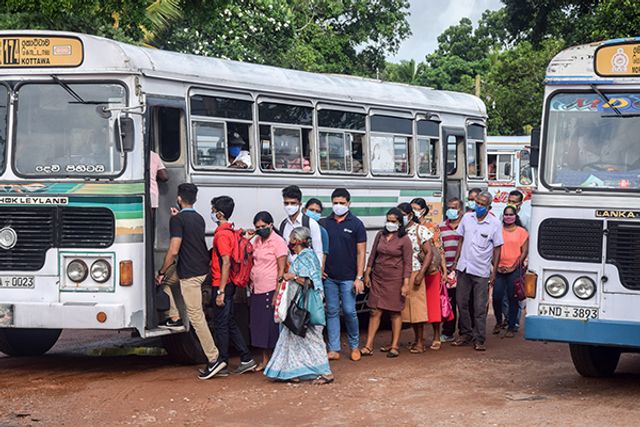
Workers jostle to get seat in bus at Kottawa (Credit: WSWS)
Between May 24 and 28, the number of confirmed infections in Sri Lanka spiked by 383, to a total of 1,524. The increase was a new record and saw the government allocate two additional hospitals—in Hambantota and Teldeniya—to deal with the growing number of cases. The surge was a result virus-infected migrant workers returning from Kuwait, Dubai and Qatar, along with increased cases among Sri Lankan sailors.
The migrant workers have correctly pointed out that they became infected because Colombo refused to organise their prompt repatriation. There are still more than 16,000 migrant workers stranded with lapsed visas in Kuwait alone.
On April 21, the Kuwaiti government granted a “general amnesty period” so these workers could leave the country. The Sri Lankan government, however, failed to immediately organise their return, even as the pandemic rapidly spread in Kuwait.
The Sri Lankan workers, many of whom are destitute and currently staying in unsafe and overcrowded accommodation, even staged a protest outside the Sri Lankan embassy in Kuwait. Several workers spoke out on a YouTube video calling on Colombo to get them back home.
R. Wickremanayake, a Sri Lankan printer in Sharjah, a city in the United Arab Emirates, told the WSWS that his salary was cut by 50 percent last month and then reduced by 40 percent in May. His previous 1,600 dirhams ($US435) monthly salary is now just 640 dirhams.
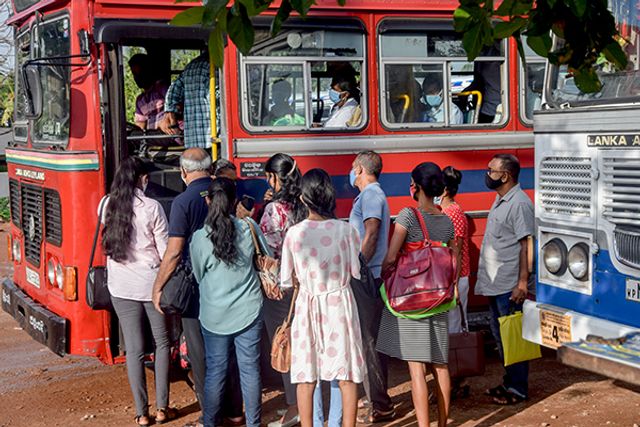
Social-distancing not possible as workers board bus in Kottawa (Credit: WSWS)
The government hospitals were full of patients and migrant workers were instructed to remain where they were even if they became ill, he said. The Sri Lankan government had done nothing more than advising the migrant workers to be careful and register their locations.
There are over one million Sri Lankan migrant workers in the Middle East, one component of the multi-million-strong South Asian workforce toiling in that region for low wages and in horrible working conditions.
The cash-strapped Sri Lankan government depends on up to $7 billion in annual remittances from these workers. Successive Colombo governments have hypocritically praised these workers as the “lifeblood of the country,” but the real attitude of Sri Lanka’s ruling elite was blurted out by Mahindananda Aluthgamage, a former minister and ruling Sri Lanka Podujana Peramuna leader. Appearing on the Derana talk show this week, he referred to the infected workers as “bombs.”
While Middle Eastern governments want to send back the migrant workers, Colombo is not interested. Discouraging expatriate workers from returning home, Ravinatha Ariyasinha, Sri Lanka’s foreign ministry secretary, said: “Our plea to these employees, as we did to students some time ago, is to ask them to carefully calibrate the possible loss of jobs or loss of educational opportunity or major delays which can occur with their return.”
The attitude of the Sri Lankan capitalist class towards these workers echoes observations made by Friedrich Engels about the British bourgeoisie in his 1845 book The Condition of the Working Class in England: “For it [the bourgeoisie] nothing exists in this world, except for the sake of money, itself not excluded. It knows no bliss save that of rapid gain, no pain save that of losing gold. In the presence of this avarice and lust of gain, it is not possible for a single human sentiment or opinion to remain untainted.”
On May 26, as it was rejecting the stranded Sri Lankan migrant workers’ appeals, Colombo continued its reckless reopening of the economy, ending the daytime lockdown for all districts, including the country’s most virus-affected commercial centres in Colombo and Gampaha.
Army Commander Silva, however, cynically declared: “We are winning the war against the deadly virus. What I expect from the public is to bear with us for another few weeks by strictly adhering to health and security advisories, paramount being physical distancing and hygiene.”
These health directives cannot be observed by workers, who have to travel on overcrowded buses or railways and endure workplaces where social distancing is impossible.
The Rajapakse government’s callous indifference towards the plight of the stranded migrants is the same as its attitude towards workers inside Sri Lanka. The government has not bothered to even issue an estimate on national job losses or the numbers of people with no income. There is no official information on whose wages and pensions have been slashed, and whose working hours have increased.
Like its counterparts around the world, the Sri Lankan government, with the support of a compliant media, is covertly practicing “herd immunity” policies that allow the virus to spread unhindered and infect the most vulnerable sections of society.
From the outset, the Rajapakse government downplayed the deadly disease when the first case was discovered in January and claimed that the problem was “under control.”
Colombo is disregarding World Health Organization (WHO) advice and attempting to paint a rosy picture of the situation, asserting that Sri Lanka is “open for business.”
WHO emergencies head Dr. Mike Ryan said on May 25 that COVID-19 cases were still “increasing in Central and South America, South Asia and Africa,” and that “infection rates could rise again more quickly if measures to halt the first wave were lifted too soon.”
According to figures released yesterday by the national health bureau, daily average tests conducted in Sri Lanka between February 18 and May 27 were just 883, one of the lowest rates in the world.

Child poverty and hunger set to spike in Puerto Rico

Alberto Escalera

A recent study conducted by the Institute of Youth Development (IYD) in Puerto Rico is warning of a sharp increase in the already shameful level of child poverty in the US colony due to the COVID-19 pandemic. The increase in the number of youth living in extreme poverty is by no means a phenomenon limited to places like Puerto Rico. Poverty and hunger among children across the globe, including in countries like the United States, have now reached levels without modern precedent.
According to the authors of the IYD study, “Los efectos del Covid-19 en la niñez de Puerto Rico: Vulnerabilidades, proyecciones y recomendaciones,” in the absence of significant measures to mitigate the trend, the percentage of children living in extreme poverty in Puerto Rico is likely to rise this year from 58 percent to a staggering 65 percent. The study highlights that within the first four months of 2020, an additional 244,000 residents of Puerto Rico fell below the federal poverty line, including 43,000 children.
Even before the pandemic, Puerto Rico, with a current population of just over 3 million, was reeling from a decade-long economic recession, chronically low labor force participation rates and a public debt crisis that served as a pretext for years of severe austerity policies. These conditions provoked an exodus of approximately 500,000 people during the same period. A significant number of those that left Puerto Rico were of prime working age, resulting in a demographic shift in which people age 60 and older now represent 26 percent of the population. Approximately 40 percent of the elderly in Puerto Rico also live below the poverty line.
As the IYD study points out, working families in Puerto Rico were already facing elevated levels of economic and food insecurity as well as associated health risks when the pandemic struck. The high percentage of single-parent households and workers susceptible to layoffs due to economic closure are additional factors that have deepened the social impact of the pandemic.
Despite the important exposures of capitalism’s failures contained in the IYD report, the narrow political perspective of its authors leads them to deflect from the structural roots of poverty down the blind alley of policy recommendations which, even in the unlikely event of being fully implemented, will do nothing to address the structural roots of poverty.
For example, the authors advocate for an extension of the federal Earned Income Tax Credit (EITC) and Child Tax Credit (CTC) to Puerto Rico, as well as a combination of cash payments to the working poor and unemployed and tax credits to employers. These paltry measures, which are already being implemented to some degree in the mainland US, have done little to stem the increase in poverty there, particularly among children.
Another policy prescription proposed by the report’s authors calls for including Puerto Rico in the federal Pandemic EBT program enacted by the US Congress this past March. The EBT program, which is intended to compensate for the lost school meals of school-aged children due to school closures by placing the value of those meals on debit-like, electronic cards that families can use to purchase food, has been plagued by a series of problems since its inception.
Under the EBT program, families receive $5.70 for each day of school missed due to the pandemic. In states like Texas, where the school year ends earlier than in other parts of the country, this amounts to just $285 per school-aged child. In New York state, families are set to receive a meager $420.
It is important to highlight that according to the Consumer Price Index Summary included on the US Bureau of Labor Statistics website, April saw the largest monthly increase in food prices since February of 1974. This increase in food prices is taking place amid the mass dumping of foodstuffs and euthanizing of livestock while scores of people go hungry.
A recent New York Times article pointed out that as of May 15, only 15 percent, or 4.4 million of the 30 million children who qualify for the EBT program, have received any benefits since it was started in March. In addition to delays stemming from the patchwork of state and federal nutrition programs and the lack of centralized data collection system on a national level, many state governors have either postponed applications to the EBT program or refused to participate altogether. This apparent lack of urgency on the part of many state governors can only be understood as part of the cynical strategy being pushed by the ruling class to starve working families back to work under dangerous conditions.
The question of reallocating resources from school meal programs to needy children during the COVID-19 pandemic recently provoked mass outrage in Puerto Rico, which was excluded from the Pandemic EBT program approved by Congress in March.
After weeks of schools being closed due to the pandemic, the Puerto Rico Department of Education (DE) finally opened up a limited number of school lunch facilities, comedores escolares, on May 6. Only 10 of Puerto Rico’s 78 municipalities, including San Juan with a population of over 300,000 residents, initially opened school lunch facilities to serve one hot meal a day to needy children.
A wave of protests eventually forced the DE to expand the number of open school lunch facilities to 105, an amount that remains woefully inadequate to address the needs of 180,000 low income, school-aged children that qualify for free meals in Puerto Rico. Last week, a group of parents successfully petitioned a Puerto Rico court to order the DE to open as many school lunch facilities as necessary. However, school officials in Puerto Rico have yet to make public any plans to carry out the court ruling.

Amid worsening economic downturn, European Union moves to set up bailout fund

Nick Beams

The European Commission, the executive branch of the European Union, has set out a €750 billion economic recovery plan to try and counter the impact of the COVID-19 pandemic on its economy amid fears that unless action is taken the bloc could disintegrate.
Under the plan, set out in a speech by the commission president Ursula von der Leyen to the European Parliament in Brussels on Wednesday, the money would be raised by the commission in capital markets and then distributed to member nations in order to finance stimulus packages. It would be financed either by a special tax or increased contribution from EU member states.
Of the €750 billion, €500 billion would be in the form of non-repayable grants with a further €250 billion issued as loans.
But there is no guarantee that the proposal, which requires the unanimous approval from the 27 member nations of the EU, will go ahead because of substantial divisions within the organisation.
The proposal to make grants has been opposed by the Netherlands, Austria, Denmark and Sweden. Dubbed the “frugal four,” they have insisted that there should be an emergency fund financed by loans only. But this has been rejected by southern states because it would only add to their already high levels of government debt.
The move to establish the new fund comes amid warnings that the effects of the pandemic on the European economy are far more serious than had been initially anticipated. In a webinar with students on Wednesday, European Central Bank (ECB) President Christine Lagarde said the euro zone would shrink by between 8 and 12 percent this year.
This recession, twice as deep as that resulting from the global financial crisis of 2008, was the outcome of the “sudden stop of activity” due to the pandemic. It had slowed down the “pace of life, the pace of growth, the creation of value” and would have “lasting effects despite all the measures we are taking,” she said.
The ECB launched a €750 billion bond buying program in March and is predicted to increase its purchases by a further €500 billion when its governing council meets on June 4.
In its biannual financial stability review, issued earlier this week, the ECB warned that rapidly rising government debt levels could lead to a reassessment of sovereign risk and “reignite pressures on some countries where debt levels are already high.”
Overall aggregate government debt in the euro zone is predicted to rise from 86 percent of GDP to more than 100 percent. Public debt is already at record levels in a number of countries, approaching 200 percent in Greece, 160 percent in Italy, 130 percent in Portugal and just below 120 percent in France and Spain.
The ECB warned that a more severe downturn than expected could set public finances on an “unsustainable path in highly indebted countries” and that a “negative feedback loop” could re-emerge where a downgrade in ratings for banks holding large amounts of government debt feeds into sovereign debt ratings. This so-called “doom loop,” which appeared in the euro zone in the financial crisis of 2012, could affect Italy, Portugal and Spain, “where bank ratings are closest to non-investment grade.”
The proposal for an EU-funded bailout mechanism was only made possible by a surprise decision by Germany on May 18 to agree with France on a proposal for a €500 billion fund to be made available in the form of grants.
The decision was taken against strong internal opposition in Germany against any measures in which the richer EU countries would fund the economies of the poorer ones. This opposition was given expression in a ruling by Germany’s constitutional court on May 5, which challenged the legality of the country’s Bundesbank taking part in the ECB’s asset purchasing program.
The court said the government had to carry out a “proportionality assessment” of the ECB’s asset purchases to ensure their economic and fiscal policy effects were within the ECB’s mandate, that is, the purchases did not involve funding the debt of other governments. It threatened to order the Bundesbank to block asset purchases unless this assessment was done within three months.
The decision raised wide concerns about the future of the European Union and the ECB. Financial Times economics commentator Martin Wolf wrote that the court decision had “launched a legal missile into the heart of the EU.” The “extraordinary judgement” was “an attack on basic economics, the central bank’s integrity, its independence and the legal order of the EU.”
It opened the way for courts in other countries to decree that their national central banks could not take part in policies they disliked and “pretty soon, the ECB will have been sliced and diced into a nullity.”
The German court decision appears to have been at least partly responsible for the switch by the government of Chancellor Angela Merkel to throw its support behind an EU-backed bailout fund. Previously Berlin had opposed any suggestion that money from a fund should be distributed in the form of grants rather than loans.
But according to a “senior German official,” cited in a report by the Financial Times, the “moment of reckoning” came when the court cast doubt on the legality of the ECB’s bond buying program so far as the Bundesbank was concerned and some other policy had to be developed.
In April, as the effects of the pandemic were spreading, French President Emmanuel Macron warned in an interview with the Financial Times that the euro zone and the “European idea” would fail if the EU did not set up a fund to issue common debt and finance member states according to their needs rather than the size of their economies.
These sentiments were echoed in recent comments by Merkel that the economic impact of the virus was so great that it could “endanger the European Union’s cohesion” and “the national state alone has no future.”
The proposal for the bailout measures has nothing to do with meeting the needs of the mass of the European population, now confronted with the worst economic and social conditions since the 1930s.
It appears that Paris and Berlin, which both utilise the EU to enhance their economic and political power globally, have made the decision that economic and financial stops have to be pulled out to try to save it.
But whether the plan even goes ahead in the face of opposition within the EU itself is another question.
The Austrian chancellor, Sebastian Kurz, told Politico on Wednesday: “We need to take everyone’s interests into account and there are very different interest groups: the southern countries, who fundamentally always want more; the East Europeans, who have an interest in preventing everything from flowing south; and, of course, those who have to pay for it all, the net payers.”
A diplomat from the Netherlands, along with Austria a member of the “frugal four,” told the Wall Street Journal: “Negotiations will take time. It’s difficult to imagine this proposal will be the end-state of those negotiations.”

Russia’s right-wing opposition tries to gain from COVID-19 crisis

Andrea Peters

The COVID-19 pandemic has unleashed a political crisis inside Russia, as the Kremlin struggles to bring the outbreak under control and address its economic fallout. With the situation exacerbated by a simultaneous steep drop in global oil prices, the Ministry of Economic Development revealed yesterday that it anticipates a decline in gross domestic product by as much as 7.5 percent this year.
President Vladimir Putin’s poll numbers have fallen to historically low levels, as social anger mounts over the conditions facing the country’s health care workers, official efforts to cover up the scale of the death toll, and the government’s failure to take any meaningful action to shield the population from the impact of mass layoffs and falling real incomes. Following the approach taken in every major country, the Kremlin “reopened” the economy more than a week ago in a reckless effort to force people back to work, even as the country’s coronavirus cases approach 380,000, the third-most diagnosed cases on the planet.
The Kremlin announced earlier this week that it will hold postponed Victory Day celebrations, which were to take place May 9 in Moscow, on June 24. The parade, which at the very least will bring thousands of soldiers to the capital city—the center of Russia’s COVID-19 outbreak—threatens a new surge in the pandemic. The government is willing to risk this, as well as the possibility of another postponement, because it needs the display of state authority, nationalist hoopla, and feeling of shared sacrifice that the commemoration of the victory over Nazi Germany in World War II generates, as a counter to the political tensions developing because of the pandemic.
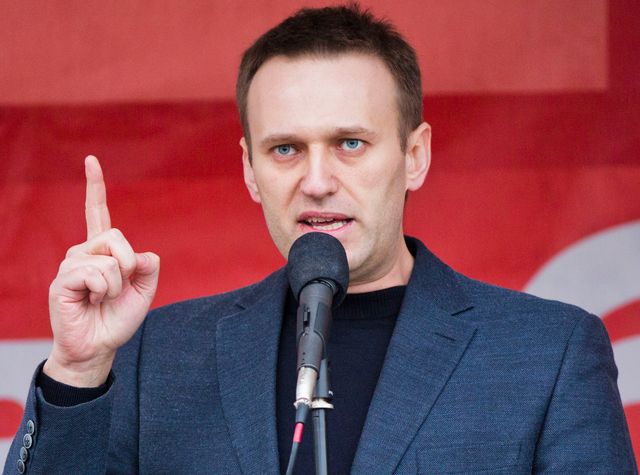
Alexei Navalny
As Russia’s government tries to shore up its position, Alexei Navalny, the leading spokesperson of the liberal opposition and a self-styled “anticorruption” politician, is working to capitalize on mass discontent and steer it in a right-wing direction. Through his social media accounts and the Navalny Live program—a YouTube forum where he discusses political issues—he works to present himself as a platform through which health care workers can air their grievances and specialists can challenge official data on the pandemic.
According to a late April poll by the Levada Center, Navalny’s popularity, while still low, is rising. In Moscow, he has more support than Prime Minister Mikhail Mishustin and the far-right head of the Liberal Democratic Party, Vladimir Zhirinovsky. In the country as a whole, he has a higher rating than Moscow’s mayor, Sergei Sobyanin, who has been promoted in the media as the city’s champion in the battle against COVID-19.
The material Navalny rebroadcasts on his Twitter, Facebook, and Telegram from medical workers sometimes strikes a nerve. A nurse in Saransk describes a bureaucratic nightmare of ineptitude and indifference; she and her family all came down with COVID-19 and received no help from the authorities. She was made to work despite being severely ill, and then threatened with fines for allegedly violating her quarantine when she was finally sent off to self-isolate. The nurse’s mother succumbed to the illness, a death unrecorded in COVID-19 mortality data because she also suffered from diabetes, which will be registered as the official cause of death.
Medics in Simferopol, exhausted and angry, read out a statement denouncing the government’s failure to pay them promised bonuses. Doctors seeking to expose the conditions under which they work reveal they are muzzled, fired or threatened with firing. Physicians’ publications of the names of their dead colleagues show an extremely high mortality rate for medical workers. Special place is given to videos by Leonid Volkov, a Yale-trained, right-wing ally of Navalny’s, to raise questions about the government’s questionable virus counts. The Doctor’s Alliance—a supposedly “independent” trade union founded in 2018 to tap into protests over the disastrous state of Russia’s health care system—is put forward as a force for change.
All of this is interspersed with, as is typical for Navalny, corruption revelations of different sorts. The children of top bureaucrats are receiving various government awards; former Prime Minister Dmitri Medvedev has a fancy yacht; the speaker of the Russian parliament is hiding his wealth.
As Navalny noted in a May 20 interview with Radio Free Europe/Radio Liberty, the US government-funded news outlet, “right now the degree of protest activity among citizens is probably one of the highest in recent times.” Just a few days earlier, he insisted that the opposition is fit to rule because “it needs the support of the people and the growth of that support.” Navalny is calling for a boycott or a “no” vote on proposed changes to the constitution, which Putin views as key to further consolidating power at the federal level. They are expected to be put to a popular referendum at some point in the coming months.
Despite Navalny’s efforts to present himself as an advocate for the people, his limp populism is a weak cover for a right-wing program. His “Five steps to support the citizens of Russia and its economy”—which is supposed to be an answer to the government’s miserable measures—consists of a few paltry payouts to individuals and their children, a short-term suspension of utility payments, and significant tax breaks and bailouts for small and medium-sized business. There is no indication that the business interests Navalny criticizes for their corruption would be asked to give up the tiniest fraction of their wealth. Notably absent from Navalny’s media presence is any mention of the mass COVID-19 outbreaks among oil field workers and gold miners, employed by two of Russia’s largest corporations: Gazprom and Polyus.
What stands behind the populist feint that Navalny is attempting in the midst of the coronavirus pandemic is a standard-fare, right-wing program of free markets, economic austerity, cutting taxes and red tape for corporations, the privatization of semi-state-owned enterprises, and the deepening of Russia’s bonds with global finance capital. Navalny and his entourage have extensive ties to the American state, media, and foreign policy establishment, with an examination of his political allies and advisers showing a revolving door of individuals moving from “opposition” politics in Russia to think tanks and media outlets in the US. Navalny has a long history of close involvement with far-right politics, including marching alongside Russia’s fascists and spitting vitriol about immigrants.
As evidenced by his regular promotion in the American press as a “democrat” doing battle against Putin’s despotism, Navalny has a significant level of support among forces in the United States that are at the center of the anti-Russian campaign that threatens to provoke a world war. As the Kremlin is further destabilized by the coronavirus pandemic and the spreading global economic crisis, Navalny may be increasingly pushed forward by those who view the Putin government’s control of Russia’s wealth as an intolerable limit to their own desires to exploit the Eurasian landmass and its people.