30 May 2020

German and French trade unions back Merkel and Macron’s recovery programme

Peter Schwarz

The major German and French trade unions have expressed their support for the European recovery plan proposed by German Chancellor Angela Merkel and French President Emmanuel Macron. In a joint declaration on May 20, the German Trade Union Confederation (DGB) and the French trade union federations CFDT, CGT, FO, CFTC and UNSA “expressly welcome the Franco-German initiative for economic recovery in Europe after the coronavirus crisis presented by the French president and the German chancellor on May 18, 2020.”
The unions describe the initiative as a “change of direction towards more solidarity between the member states of the European Union [EU]” and proclaim: “We are convinced that our two countries must now assume their special responsibility to ensure that the European Union emerges stronger, more socially equitable, more democratic, more responsible and more environmentally friendly.” The task now was to “convince all other EU member states of the Franco-German proposals so that after the crisis we can build a more sustainable Europe based on more solidarity.”
These highly paid union officials are well aware that Merkel and Macron’s proposal has nothing to do with social justice, democracy and environmental sustainability. Neither does it serve European solidarity—let alone solidarity with the millions of workers, clerical employees and self-employed who are losing their incomes and livelihoods due to the coronavirus crisis. Instead, the fund—like the numerous national aid programmes and European Central Bank’s bond purchases—will continue to inflate the equity portfolios and bank accounts of the rich.
As we demonstrated in an earlier article, the main aim of the Franco-German initiative is to reinforce European companies in their trade war with rivals, particularly the US and China. Accordingly, “strategic projects” are to be promoted and “global champions” built up. The coronavirus crisis is to be used to reorganise the European economy in the global battle for markets and profits.
In particular, the economies of weaker EU countries, for which the fund is primarily intended, are to be restructured. It goes without saying that this will involve mass layoffs, and cuts to wages and social benefits. Major corporations in the auto, aerospace and steel industries as well as numerous other industries have already announced tens of thousands of layoffs.
The reconstruction plan, presented by EU Commission President Ursula von der Leyen in more detail on May 27, is expected to total €750 billion, of which €500 billion will be allocated in the form of grants and €250 billion as loans. In order to finance the package, the EU Commission will break with previous practice and borrow money, which is then to be repaid from the EU budget between 2028 and 2058.
As the EU budget is financed by the member states, they will then have to repay the programme according to their economic weight. Also in consideration are new import taxes to directly boost the EU budget. The main recipients of the programme will be Italy (€82 billion in grants/€91 billion in loans), Spain (€77/€63 billion) and Poland (€38/€26 billion). France and Germany are also slated to receive grants of €39 billion and €29 billion, respectively.
An EU summit will discuss the proposal on June 18–19. At least one further summit will be necessary, however, until an agreement is reached.
As the funds are allocated within the framework of the EU budget, they are subject to strict neo-liberal requirements, as is the case for all EU programmes. Von der Leyen wants to ensure that the annual recommendations from the EU Commission for the economic and financial policies of member countries, which have so far largely been ignored, are binding on the recipients of grants. Brussels could then dictate cuts in social, educational and cultural spending, as it did after the 2008 financial crisis in Greece.
The exact use of the funds is still under debate. In addition to traditional regional and structural aid, subsidies for climate protection, renewable energies, digitisation and, above all, armaments production are also under discussion.
The trade union declaration of support, which is only one-and-a-half pages long, is a signal to the rulers in Paris and Berlin and the EU Commission in Brussels that they can rely on the unflinching support of the trade unions in combating their rivals in the global trade war and implementing the consequent attacks on the working class.
The unions are already in the forefront of driving workers back into the factories where they risk their health and lives due to the continuing risk of infection. To give one example, IG Metall and the works council in Wolfsburg organised a three-day light show on the wall of the Volkswagen plant in the city to promote the return of workers to Europe’s largest car factory. For years, every plant closure and layoff plan in Germany has borne the signature of union officials.
The coronavirus crisis, however, has hugely intensified the tendency towards corporatism—i.e., the fusion of entrepreneurs, unions and government. The greatest economic downturn since the 1930s has to a great extent swept the carpet from beneath the so often praised free-market economy. Governments are pumping billions of euros and dollars into aerospace, auto and other corporations, and even becoming shareholders to strengthen their own companies in the struggle to survive against competitors.
This form of nationalisation has nothing to do with socialism. Rather, it serves to defend corporate profits against international rivals and claims made by workers and is inevitably linked to whipping up nationalism. The unions, nationalist to the core, cannot stand aside. As always in times of crisis and war they jettison even the appearance of representing the interests of their members.
In August 1914, when World War I broke out, Germany’s trade unions announced a “truce” with employers and government and sent their members to the front to slaughter French and Russian workers. On May 1, 1933, three months after Hitler came to power, they even marched under the swastika to offer their services to the new regime. Hitler interpreted this as weakness and dissolved the unions the following day.
The unions in France and other countries behave no differently in similar situations. If German and French unions are now giving their support to this latest initiative, it is only because they believe that Germany and France cannot advance their interests on the world market without the EU. At the same time, when it comes to job cuts—for example at Airbus or in the auto industry—the unions divide workers and play off one country and location against another.
The unions’ drive to corporatism inevitably arises from their pro-capitalist perspective. It is significant that the CGT, which pretends to be the most radical of the French unions, also signed the joint declaration.
In the fight against the health and social consequences of the coronavirus crisis, workers in Europe confront not only corporations and governments, but also the unions. They must break with these organisations and set up their own independent action committees.
The fight against the consequences of the pandemic is ultimately a political struggle against capitalism. This requires the unity of the European and international working class on the basis of a socialist programme to replace the European Union, the tool of the most powerful capitalist interests, with the United Socialist States of Europe.

UK: Official figures inflate COVID-19 testing rate by more than a million

Alice Summers

The Johnson Conservative government is engaged in a massive campaign of public deception, making cynical claims and pledges about the number of COVID-19 tests being carried out.
Its aim is to cover up the impact of its “herd immunity” policy, which has led to tens of thousands of coronavirus deaths.
Over 1 million more tests have been reported by the government than the numbers genuinely tested, according to Department of Health and Social Care (DHSC) figures. This is largely due to a practice of duplicating tests involving two samples from one individual in the official figures. According to Public Health England (PHE), other factors contributing to this discrepancy are tests being repeated due to an inconclusive outcome or being double-checked after a negative result.
Tests that involve taking both nasal and saliva samples from the same person have been counted as two separate tests, the DHSC and PHE have admitted. This double-counting means that daily COVID-19 screening figures reported by the government have been exaggerated by as much as 20 percent, according to the Daily Telegraph. On May 21, the newspaper reported, “Almost 350,000 more tests have been reported in Government data than people tested since the start of the pandemic.”
The last day the DHSC published figures on the number of people tested was May 21. From May 22 to May 29, the DHSC have not published any figures on the total number of people tested but have continued to publish the number of cumulative tests. A post on the department’s Twitter page stated that publication has been “temporarily paused to ensure consistent reporting across all pillars [types of testing]. This is due to a small percentage of cases where the same person would have more than one test.”
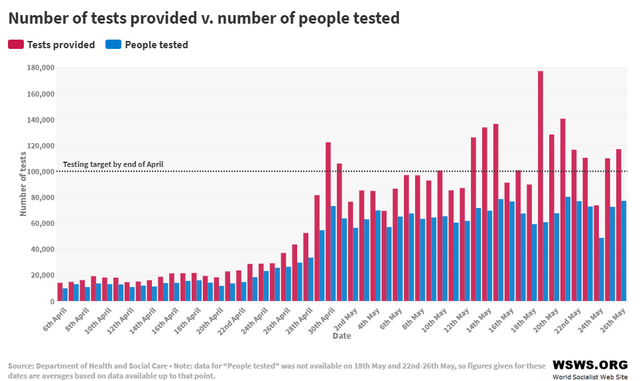
Number of tests provided versus number of people tested (credit-https://flourish.studio)
An analysis of the figures shows that the discrepancy between the number of cumulative tests and the number of people tested is far higher than estimated by the Telegraph. The cumulative number of tests as of May 21 was 3,231,921. The number of people tested was 2,144,626. This is a ratio equivalent to approximately 66 percent. As of May 27, the government claims a total of 3,918,079 cumulative tests, which based on the 66 percent calculation means that around 2.6 million people have been tested. This is approximately 1.3 million fewer than the number of tests the government reported.
The testing debacle confirms that not a word that comes out the mouths of Johnson or his ministers at their daily press briefings can be believed. On Thursday, Professor John Ashton, a former regional director of public health said, “It’s very difficult, even for someone like me whose living has centred on numbers, to know exactly what is going on. We don’t know how many people have been tested. We don’t know how many tests have been satisfactory. There’s a real problem of transparency and trust.”
On April 2, the government announced that it planned to conduct 100,000 tests a day by the end of that month, with a Twitter post on the prime minister’s official account stating that this meant “100,000 people per day.” When this plan was announced, only around 10,000 daily tests were being conducted.
After weeks of the government falling far short of this target, it was only finally “met” on April 30 because official figures included thousands of swab kits bulk posted to UK homes and to satellite testing sites like care homes, which had not yet been used or sent to laboratories for results.
Over 40,000 of the 122,347 COVID-19 tests announced by the government on the last day of April were made up of kits that had been sent out but not yet been processed; 27,497 of these were test kits sent out to private homes and 12,872 were posted to satellite testing sites. Moreover, despite claiming to have exceeded its target DHSC figures show that only 73,191 individual people were screened for the virus on that day.
Many home testing kits like these have still not been analysed, with thousands yet to be returned to laboratories according to Professor John Newton, director of health improvement at PHE and the government’s COVID-19 testing coordinator.
Professor Newton told the parliamentary Science and Technology Select Committee on May 22 that while 762,252 coronavirus tests have been posted to people’s homes, around half have not been returned for analysis. Admitting that he did not have an up-to-date figure for the numbers processed, Newton stated, “I think certainly more than half [of tests have been returned], and we would like to get that amount up.”
Newton confirmed that tests are counted at the point they are sent out to people or satellite centres, not at the point of being analysed at laboratories and results established.
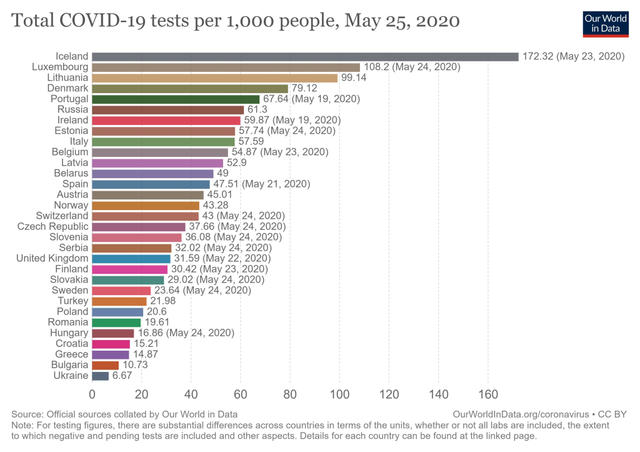
Comparison between countries of cumulative total tests per thousand population
Taking account of the discrepancy between the number of tests provided and the number of individuals tested, the government has not once succeeded in testing 100,000 people in one day (as of May 26). The number of individuals receiving a test averages around 67,000 a day since the government’s target was supposedly met on April 30.
The number of individuals tested in a single day reached 80,297 on May 21—the highest figure yet—still far short of the government’s 100,000 a day target. On May 2, the lowest day between April 30 and May 26, a mere 56,397 individuals were tested. Given that these figures are compiled at the point of test delivery, not completion, far fewer tests will have been sent to laboratories.
On May 6, Johnson announced yet another arbitrary testing target, pledging to reach 200,000 tests a day by the end of May. On May 27, Health Minister Matt Hancock stated that this target was in fact based on the UK’s “capacity to perform 200,000 tests a day,” and will be measured by “asking laboratories each day to set out how many tests they can provide” rather than counting how many tests are conducted.
Even those tests submitted to laboratories for analysis have been found to be unreliable, with many returning false negative results. According to the Hospital Consultants and Specialists Association (HCSA), three in 10 National Health Service staff taking swab tests could be receiving a false negative result.
Many health workers who may have been coronavirus positive were pushed back to work, potentially infecting patients and other staff members and contributing to the rapid spread of the virus in hospitals. PHE research published mid-May indicated that as many as 20 percent of inpatients and 90 percent of medical workers contracted the virus while in hospital.
A study in the British Medical Journal found that between 2 and 29 percent of COVID-19 tests wrongly came back as negative. The number of “true positive” results from nasal swabs was as little as 63 percent and just 32 percent from throat swabs, according to the lead author, Dr. Jessica Watson.
In a letter to PHE Chief Executive Duncan Selbie, Dr. Paul Donaldson, the general secretary of the HCSA, wrote of his “deep concern and frustration” at the body’s “systematic lack of information” over the reliability of polymerase chain reaction (PCR) tests for coronavirus. Dr. Donaldson said, “A wall of silence seems to have been erected around the issue, with only the occasional claim or hint emerging regarding the current testing regime.”
“Separately, statements by PHE officials and others place the incidence of false negatives somewhere between 20 and 30 percent,” he continued. “If confirmed, this is a worryingly high rate which raises the prospect of many infected individuals, possibly without symptoms, being passed fit to return to health care settings where they will transmit SARS-CoV-2 [COVID-19] to colleagues and patients.”
Responsibility for the sustained and uncontrolled spread of COVID-19 in hospitals and throughout the population lies with the Johnson government. Determined to impose its criminal herd immunity policy, it refused for weeks to implement a systematic testing programme, on the basis that there was already widespread community transmission and therefore testing was not useful.
On March 12, the day that the government announced its herd immunity policy, Johnson declared that health staff would no longer test people at home—with testing only to be conducted on those already in hospital. Most people were refused tests and simply told to self-isolate at home if they had symptoms. At that point just 10 people had died of COVID-19.
Only when the death toll reached hundreds of people a day did the government announce its 100,000 tests a day plan, limited to only a select group of key workers until mid-May.
The UK ranks at number 20 out of the 31 European countries with available data for coronavirus testing per capita, screening only 31.59 people for every thousand of the population. Impoverished Eastern European countries such as Lithuania (99.14 per thousand), Estonia (57.74), Latvia (52.9) and Belarus (49) have tested far more people relative to their population sizes. Russia, which has more than twice the population of the UK, has tested 61.3 people per thousand.

US Justice Department drops insider trading investigation of three senators

Jacob Crosse

Aides to three US senators, Republicans Kelly Loeffler (Georgia) and James Inhofe (Oklahoma) and Democrat Dianne Feinstein (California), confirmed this week that the US Justice Department has dropped investigations into insider trading activity by the senators in January and February of this year. However, North Carolina Senator Richard Burr, the former chairman of the Senate Intelligence Committee, remains under investigation.
Federal Bureau of Investigation agents seized Burr’s cell phone earlier this month under a warrant that granted agents access to Burrs’ iCloud storage and private messages. As of this writing, no charges have been publicly filed against Burr.
Publicly disclosed Senate filings by all four senators documented that they and/or their associates sold off millions of dollars of their stock investments after the senators were given access to classified briefings in January warning of a major coronavirus pandemic hitting the US. On the basis of this inside information, which they did not share with their constituents or the general public, the senators sold off large stock holdings while the market was at its apex, in advance of a 10,000-point drop in the Dow that began in mid-February and continued into late-March in response to the growing international pandemic crisis.
The market collapse was halted and reversed around the time of the passage of the multi-trillion-dollar CARES Act bailout, which has sustained a record 35 percent rise in the Dow since the end of March.
Even as they were dumping stock holdings, several of the senators were publicly reassuring the country that it had nothing to fear from the virus.
All four senators are multimillionaires. Feinstein, at $58.5 million, is the eighth richest member of the Senate. Loeffler, at $500 million, is the richest member of Congress.
In March, the four were publicly named as targets of a Securities and Exchange Commission and Justice Department investigation after it was reported by multiple news organizations that each had sold six-figures (or more) worth of stock after receiving classified intelligence briefings on January 24. The Senate Health Committee and the Senate Foreign Relations Committee hosted the briefing, which included Dr. Robert Redfield, director of the Centers for Disease Control and Prevention (CDC) and Dr. Anthony Fauci, head of the infectious disease unit of the National Institutes of Health.
While all four senators were, and still are, privy to classified briefings, at the time the transactions were made, Inhofe, Feinstein and Burr were all members of the US Senate Select Intelligence Committee, with Burr serving as chair. Through this committee, each member had access to highly classified and detailed CIA briefings that detailed the true threat of the COVID-19 pandemic as early as the first week of January. This privileged knowledge allowed the senators ample opportunity to maneuver and safeguard their personal wealth, while concealing the US government’s lack of pandemic preparedness.
Through a spokesperson, Loeffler released a statement claiming vindication after a “clear exoneration by the Department of Justice, [which] affirms what Sen. Loeffler has said all along: She did nothing wrong, this was a politically motivated attack shamelessly promoted by the fake news media and her political opponent.”
Disclosure forms revealed that Loeffler engaged in 27 different transactions over a 22-day period starting in January and continuing through February, in which Loeffler sold up to $3.1 million worth of stock.
In April, Loeffler took to Fox News to defend her “success” against “socialist attacks,” stating, “This was a political attack designed to take away from the issue at hand. And to use this outbreak to play politics. We have addressed this and taken extraordinary measures to make sure that we can’t be attacked for our success. This gets at the very heart of why I came to Washington, to defend free enterprise, to defend capitalism. This is a socialist attack.”
It is highly symbolic that in the same week, Loeffler, an embodiment of ill-gotten wealth, was protected by the FBI, while George Floyd was murdered by Minneapolis police for allegedly passing a $10 bill. This is an instructive example of class justice.
Inhofe, speaking to the Oklahoman, also claimed vindication, stating, “I did nothing wrong, and I’m pleased the Justice Department has exonerated me.” Inhofe had sold shares worth between $180,000 and $400,000 from five companies on January 27. A month later he disclosed that he sold an additional $50,000–$100,000 worth of stock.
California Senator Feinstein declined to comment through representatives after the FBI decided to halt its investigation into her stock dealings. Feinstein’s Senate disclosures revealed that she had sold up to $6 million worth of stock in a single company between January 31 and February 18.
Inhofe, Feinstein and Loeffler all claimed from the outset that they had “no knowledge” of any sales conducted in their names or on their behalf. All three insist that intermediaries handled all of their transactions and no confidential information was provided.
Burr, unlike his fellow grifters, has always acknowledged that he had sold his shares, up to $1.72 million worth, not through an intermediary but on his own accord, and that he sold them in large part due to fears of the financial impact of the virus. His holdings included over $300,000 worth of stock in Wyndham Hotel and Resorts, Extended Stay America and Park Hotels and Resorts.
Burr first claimed in a March 20 statement that he knew to sell his stock after viewing publicly available reports on television. His statement read, in part: “I relied solely on public news reports to guide my decision regarding the sale of stocks on February 13. Specifically, I closely followed CNBC’s daily health and science reporting out of its Asia bureaus at the time.”
In his capacity as chair of the Senate Intelligence Committee, Burr oversaw the Senate investigation into the claims of massive Russian interference in the 2016 elections and possible collusion by the Trump campaign. He worked closely with the Democratic vice chair of the Intelligence Committee, Mark Warner of Virginia, and maintained a show of bipartisan objectivity, in contrast with his Republican counterparts in the House.
His committee’s final report backed the claims of the intelligence agencies that there was Russian interference, unprecedented in its “manner and aggressiveness.” These findings, coupled with a 2017 subpoena issued by the committee that compelled Donald Trump Jr. to testify before the Senate, angered President Trump. This may explain, at least in part, the disparate treatment of Burr from that of the other three senators.
It is also the case that Burr has been rather brazen in his dealings. Throughout his Senate career, he has sat on committees that oversee the regulation of industries in which he has a direct financial interest. A May 15 article by Politico detailed numerous examples of Burr trading stock in companies while at the same time introducing legislation to benefit the same companies. For example, he bought stock in medical device companies while overseeing a repeal of the medical device tax.

Coronavirus cases surpass six million globally

Bryan Dyne

There are now more than six million officially confirmed cases of the coronavirus pandemic globally, a number that is increasing by one million every 10 days. The dead now number 365,000, or about 6.1 percent of those infected, and the toll of fatalities is growing.
These numbers account for both the 2.6 million people who have recovered, some of whom suffered for weeks or months fighting off the disease, as well as the 2.9 million active mild cases of COVID-19 and nearly 54,000 serious or critical cases caused by the infection. As it has been noted before, these official numbers are a gross underestimation of the pandemic’s true toll.
In the midst of the worst global medical emergency since the 1918 flu pandemic, US President Donald Trump announced Friday that he will withdraw the country from the World Health Organization and halt federal funding to the international public health agency. US funds presently account for roughly 15 percent of the WHO’s budget. In his announcement, Trump reiterated the lie that the WHO is an agent of China and colluded with the regime in Beijing to conceal for weeks the seriousness of the “Wuhan virus” and allow it to escape to the rest of the world.
The president made no mention of the early warnings of the dangers of the virus provided by both China and the WHO, or the belated response by the United States, which allowed the coronavirus to gain a foothold in New York City and elsewhere and spread across the country. He instead demanded, “The world needs answers from China.”
In fact, many of the strains of the virus that causes the disease, SARS-CoV-2, have come from the United States. An analysis of the genetic structure of the virus in different parts of the world, using data from Nextstrain and GISAID, clearly shows that the virus escaped from the US to the Indian subcontinent, the Middle East, South America and Eastern Europe in February and March. And while the United States remains the hardest hit country, at nearly 1.8 million infections and 104,000 dead, many countries in those parts of the world are now regional and even global epicenters of the pandemic.
Such hotspots include India, which now has the most cases, 173,000, of any country in Asia. This is more than twice that of China. India also has one of the highest rates of new coronavirus cases on the planet. And while its current official death toll is still under 5,000, it is an open secret within the country that the official counts are under-reporting the scope of the disease.
At the same time, the forced reopening of the country by the government of Narendra Modi has caused the case count in the country to begin increasing exponentially. Epidemiologists estimate that the number of cases will hit one million within weeks, with a surge in mass deaths soon after.
Similar policies in neighboring Pakistan and Bangladesh have caused their infection and fatality rates to increase in recent weeks. The two countries have 64,000 and 43,000 cases, respectively. Both are second only to India in terms of new cases and face many of the same overcrowding problems in their cities that plague India, creating similar health emergencies.
There is also an increasing danger of a spike in cases in South Korea, which has begun to reopen after a largely successful campaign of testing and contact tracing to contain the pandemic as much as possible. Several clusters of the coronavirus have emerged in the country in the past few weeks, the most recent being a set of 96 new cases that occurred at a logistics center.
This and dozens of other cases forced more than 500 schools to close again Friday after briefly reopening. The government in Seoul has also closed its parks, art galleries, theaters and museums and urged similar private entities to do the same for the next 14 days to curb the current outbreak.
The Middle East has also been hard hit. The number of cases and deaths in Turkey and Iran currently rival those in India. There are currently 162,000 cases and 4,400 deaths in Turkey and 146,000 cases and 7,600 deaths in Iran. Saudi Arabia has also become one of the most plagued nations in the region, with nearly 82,000 cases and 450 deaths. While its number of new cases is currently decreasing, Saudi Arabia’s new death count has been steadily increasing since April.
Over that same period, Qatar has earned the dubious distinction of becoming the country with the most coronavirus cases per capita in the region and the world, excluding European microstates. This is followed by another Gulf nation, Bahrain. While both countries currently have a relatively low death toll, the pandemic is poised to rip through the populations of both nations, particularly their vulnerable immigrant laborers.
In South America, Brazil, Peru, Chile and Ecuador are the countries most infected by the pandemic. They collectively have more than 700,000 cases and more than 32,000 deaths, and are one of the global epicenters of the pandemic. The majority of these are in Brazil, which has at least 443,000 cases and nearly 27,000 deaths. Brazil’s numbers are rising as fast as those in the United States even as fascistic President Jair Bolsonaro orders offices, retail stores, car dealerships, real estate agencies and shopping malls to reopen.
The worst hit city in Brazil is Sao Paulo, which is the most populous city in the Western Hemisphere and the one of the largest metropolitan areas in the world. There have so far been 55,000 cases of the virus in the city, which has already caused the medical system to reach capacity.
While Brazil may have overtaken it in the total number of cases and the daily number of new cases, Russia remains the European country with the most coronavirus infections, 387,000. Health officials in Moscow recently more than doubled the number of official fatalities in the city, with 1,561 in Moscow alone.
This figure was revised to account for those who had been recorded as having died from other causes even though they were, in fact, infected with the coronavirus. According to a report from the city’s health department, the new toll now accounts for even the “most debatable” coronavirus deaths.
Other areas of the country are following suit. If a similar correction to the tally were to be made across the nation as a whole, Russia’s dead would be behind only the United Kingdom, Italy, France and Spain, which are the hardest hit countries in Europe in terms of deaths, and remain some of the worst epicenters in the world.
The center of the pandemic, however, remains the United States, which has seen dramatic spikes in cases in certain areas. In Montgomery Alabama, there are currently just two unoccupied ICU beds as a result of an explosion of cases in the county, which have quadrupled since the state begun reopening. The majority of states in the South are seeing an increase in the number of cases, and it is likely that the two that are reporting a decrease in new cases, Texas and Florida, are deliberately manipulating their data to justify reopening. In the opposite end of the country, California continues to average more than 2,000 cases each day.
At the same time as case counts and deaths continue their macabre rise, the Trump administration is rolling back its Coronavirus Task Force. Vice President Mike Pence, who is the formal head of the group, called it together on Thursday for the first time in a week. This is down from daily meetings in March and April and meetings three times a week starting in May. Trump himself has focused his efforts on whipping workers back into factories, offices and plants, even as the deadly contagion continues to rage through the auto, meatpacking and logistics industries.

29 May 2020

African Water Resources Mobility Network (AWaRMN) PhD Scholarships 2020 for African Scholars

Application Deadline: 5th June 2020 at 11:59 PM (SAST).

Target Groups:
  • Group 1: Students who are registered or have obtained a degree from any of the AWaRMN partner institutions: RU, UNIKIN, FUTMINNA, MU, ENSH.
  • Group 2: Students who are registered or have obtained a degree from any Higher Education Institution (HEI) established in an African Union Member State apart from AWaRMN partner institutions.
Eligible Field(s): These are:

Rhodes University, South Africa (RU)
  • PhD Water Resource Science
  • PhD Hydrology
Federal University of Technology, Minna, Nigeria (FUTMINNA)
  • PhD Applied Hydrobiology
Makerere University, Uganda (MU)
  • PhD Chemistry
University of Kinshasa, Congo (UNIKIN)
  • PhD Water Resources
Ecole Nationale Supérieure d’Hydrauilique, Algeria (ENSH)
  • PhD Hydraulics
Type: Degree-seeking Mobility (long-term study that leads to an award of a PhD degree).

Eligibility:
General eligibility
To be eligible for support from AWaRMN, applicants must:
  • be a national of an African Union member state and resident in Africa at the time of application.
  • meet both institutional and partnership requirements for admission.
  • not have benefited from any form of previous support from Intra-Africa Academic Mobility Scheme, or Intra-ACP Mobility or Erasmus or Erasmus + programmes
  • must be prepared to move from home country to another country where AWARM has a partner institution. This also apply to foreign applicants who resides in a country with AWARMN institution. For such applicants, you must then consider applying to a third country. For example, you are a Ugandan, but resides in South Africa or have studied in South Africa, you can not apply to Rhodes University in South Africa or Makerere in Uganda. Scholarships are attached to mobility.
Academic eligibility
Applicants must also fulfill the academic eligibility criteria of the partner institution(s) of their choice. Please read the Eligibility Criteria of the Partner Institutions document. You can find it here https://www.ru.ac.za/intra-africa-awarmn/

Selection:
  • Applicants will be informed about the outcome of the competitive selection process by email by 19 June 2020
  • Successful candidates will be expected to resume their study by August 2020.
  • Applications with incomplete or incorrect information will not be considered.
  • Female applicants, people with disability or people from socio-economically disadvantaged background are strongly encouraged to apply.
Eligible Countries: African countries

Number of Awards: Not specified

Value of Award: For successful applicants, AWaRMN funding will cover the following areas:
  • Participation costs (e.g. tuition/registration fees) of students.
  • Research costs (e.g. field work, laboratory consumables).
  • Subsistence allowance: PhD: 900 Euro per month.
  • Special allowance to female students for mobility equal or more than 2 academic years, viz – PhD: 900 Euro per year.
  • Economic class roundtrip flight ticket and visa costs
  • Insurance (Health, accident and travel)
  • One-off settling-in allowance upon arrival to cover installation costs, viz – PhD: 900 Euro.
Duration of Award: 2 years

How to Apply:
  • Read the guidelines carefully here: https://www.ru.ac.za/intra-africa-awarmn/ and complete the application form
  • The following documents need to be included in your application:
    • certified copies of academic degrees and official transcripts,
    • 2 paged CV,
    • 250 words motivation stating why you should be awarded a scholarship,
    • a formal identity document e.g. passport, national identity card, driver license or any other officially recognized form of identification indicating your nationality,
    • short research proposal of not more than 1000 words,
    • two reference letters (one academic and one non-academic). The academic referee must be able to attest to your academic standing.
  • Remember to click on the submit button.
General enquiries: awarmnadmin@ru.ac.za
  • It is important to go through all application requirements in the Award Webpage (see Link below) before applying.
Visit Award Webpage for Details

Air Pollution Mental Illness and Covid-19

Graham Peebles

Lockdowns imposed in response to Covid-19 forced millions of people to stay at home, businesses closed and a widespread hush descended. The major beneficiary of the controls has been the natural environment; in particular there has been a dramatic reduction in air pollution everywhere. But as countries begin to lift restrictions, road traffic levels are once again increasing, air and noise pollution rising.
Changes to working patterns and daily living have created a unique opportunity to re-imagine how we live and work. Central to any new pattern needs to be the environment; many people recognize this and the importance of not ‘going back’. Some cities in Europe are already responding positively (Milan, London, Bristol e.g.), proposing pedestrian only areas together with an increase in cycle lanes, and the results of a recent survey by the Automobile Association (AA) in Britain are encouraging. “Half of those polled said they would walk more and 40% intended to drive less…to maintain the cleaner air of the lockdown and protect the environment.” In addition around a quarter said they planned to (continue) to work more from home, as well as flying less.
Death by Breathing
According to the World Health Organization (WHO) 90% of the global population breathe filthy toxic air. The bulk of air pollution is the result of burning fossil fuels for heat and power generation (e.g. oil and coal power plants and boilers) and fuel combustion from vehicles – cars, motorbikes, lorries etc. All of which not only throw toxins into the air but also generate enormous levels of noise pollution.
Worldwide, air pollution is said to kill around nine million people a year, making it the fifth leading risk factor for death in the world. Children are particularly vulnerable; they inhale more airborne toxins than adults, tend to spend greater periods of time outside and are more active. The detrimental effects can be long lasting, affecting their physical and mental health as well their education.
Contaminated air is also a significant factor in a person’s susceptibility to Covid-19. Air pollution, particularly Nitrogen Dioxide (NO2), as well as Particulate Matter (PM)) – both of which are released by vehicles burning fossil fuels, causes and exacerbates respiratory complaints. A university study conducted in Germany found that of the total number of coronavirus deaths in 66 administrative regions of Italy, Spain, France and Germany, “78% of them occurred in just five regions, and these were the most polluted.”
The results of the research “indicate that long-term exposure to this pollutant may be one of the most important contributors to fatality caused by the Covid-19 virus…poisoning our environment means poisoning our own body, and when it experiences chronic respiratory stress [Covid-19 e.g.] it’s ability to defend itself from infections is limited.” A separate study in the US shows that even small “single-unit” increases in particle pollution in the years prior to the pandemic is linked with a 15% increase in deaths. Cleaner air in London or New York e.g., in the past could have saved hundreds of lives.
Air pollution affects everyone but predictably the poorest members of society, including people from black and minority ethnic (BAME) groups, are the most severely impacted, they appear also to be the most at risk from Covid-19. In multi-cultural Britain e.g., people in deprived areas have been dying of coronavirus at double the rate of those in affluent areas. And those from BAME backgrounds –making up around 13% of the UK population – account for a third of virus patients admitted to hospital critical care units. Similar patterns have emerged in other European countries with large minority populations as well as the US. Black Americans represent around 14 per cent of the US population but total 30 per cent of those who have contracted the virus. In Norway people born in Somalia have infection rates more than 10 times above the national average.
The social causes behind the figures are complex. Many people from BAME groups live in overcrowded housing in extremely polluted areas and work in high-risk low paid jobs. Diet among some BAME communities is poor and (in part as a result) there is a propensity to underlying health conditions such as diabetes, heart disease, obesity and respiratory illnesses, all of which make people more vulnerable to Covid-19.
Poverty is the world’s biggest killer, and Covid-19 is, it seems, the most recent addition to the symptomatic causes of death for the poor, the vulnerable and people from minorities, which, in many cases are one and the same.
In addition to causing millions of deaths and a variety of respiratory conditions, air pollution is increasingly being linked to a range of mental health illnesses, including depression, bipolar, and, according to a study in the UK, psychotic experiences in children.
An estimated 300 million people in the world suffer from depression, a similar number are plagued by anxiety. Many aspects of contemporary living contribute to mental health illnesses, various studies in recent years show that air pollution is one of them. The finest particle pollutants are known to reach the brain via the bloodstream and the nose, The Guardian report, causing increased brain inflammation, “damage to nerve cells and to changes in stress hormone production, which have been linked to poor mental health.” Air pollution has also been shown to quadruple the risk of depression in teenagers and is being linked to dementia.
Together with noise pollution, studies show that filthy air feeds sleep apnea symptoms and may disturb sleep by exacerbating asthma, COPD, or other respiratory or chronic diseases. This in turn creates greater vulnerability to depression and anxiety, as well as the current Covid-19 virus.
Changing behavior
Air pollution is poison, we are literally breathing in toxic compounds that are making us ill, physically and mentally. Urgent and lasting steps are required to reduce to an absolute minimum the levels of air pollution. This requires humanity to drastically reduce its dependency on fossil fuels.
For this to happen there needs to be a major shift in attitudes, triggering a change in behavior and greater levels of environmental responsibility. Consumerism (including consumption of animal food produce) is the principle cause of the environmental emergency, including air pollution. Excessive, unnecessary consumption needs to stop, sufficiency not excess promoted and adopted as the guiding principle. Meat and dairy diets reduced and the trend towards plant based diets encouraged.
At the same time investment in renewable sources of energy generation and supply needs to be increased throughout the world. All unnecessary travel should be eliminated (including air travel), and (where practical) a strategic movement away from the car onto public transport – reliable and clean, cycling and walking. Public transport needs to be state owned and run as a service, not for profit. China, with 99% of the world’s total electric fleet, leads the way in the electrification of public transport, in addition, the Chinese government has invested heavily in electric cars and has set a target of 40% electric vehicles by 2025.
The beautification of our towns and cities (where over 50% of the world’s population now live) goes hand in hand with the reduction in traffic and the promotion of clean modes of transport. Bold imaginative initiatives are required that prioritize the environment and human welfare over corporate concerns. Whole sections of cities and towns, major streets and abandoned sites could be redesigned as peaceful green spaces. And while many fear the closure of retail outlets and the slow death of shopping streets, the possibility of converting these areas to parklands and gardens, present itself and should be embraced.
All flows from a shift in thinking. The environmental emergency is the greatest crisis facing humanity; with every new report published the scope and depth of the crisis becomes increasingly stark, the need for action more urgent. To date the complacency of governments and corporations, as well as large tracts of the public, has been astonishing and shameful; this must now change.
Covid-19 forced governments to act (albeit in many cases inadequately); the same sense of urgency needs to be applied to tackling air pollution, which, I say again, is responsible for at least nine million deaths a year, and the wider environmental emergency. The pandemic has given the natural environment a brief respite from human abuse; as countries ‘open up’, we have the chance to adopt a new responsible approach to living and not revert to old destructive ways.

Coronavirus and the Telecom Crisis

David Rosen

The current Corvis-19 pandemic provides a unique vantage point to assess key social institutions of American life. Sadly, none has failed so gravely as the nation’s health care system, especially as underwritten by the private insurance model. The crisis of the U.S. healthcare system raises the deeper, more fundamental, question as to whether health care is a privilege or a right, a private business or a social utility?
This debate over the role of social services, whether private or public, defines other activities including housing and food, water, electricity and even roadways and telecommunications. The logic of capitalism demands that everything be turned into a commodity, something bought and sold, from one’s labor power to the air we breathe. And yet, as has occurred numerous times, the logic of the market – while beneficial for a select few — has failed the public at large. In such cases, the power of the redistributive society intervened.
When the Corvis-19 crisis is contained and an effective vaccine widely adopted, a day of reckoning will come for the private insurance system of health care. The same question will be raised regarding other social institution, especially the nation’s telecommunications system. Would Americans be better served by the current quasi-monopoly of private telecom companies or by publicly owned communications utilities?
***
The Corvis-19 pandemic has exposed the underlying weakness of the U.S. health care system based on private insurance. It has also exposed the limitations of the private, minimally “regulated,” telecommunications industry.
The policy of shelter-in-place to contain coronavirus has led to a significant increase in broadband usage. As one report notes, “in the week from March 11 to March 18, 2020, the average daily broadband data usage per user in the United States was 6.3 GB during the office hours, an increase of 41.4 percent compared to January.” It also points out that there’s been a 25 percent increase in overall average bandwidth usage between January and March 11-18, 2020 – from 12.19 GB to 15.45 GB. It concludes, “the increase is most likely due to more people working from home and overall restrictions for people to stay at home.”
Sadly, this report does not document the inequities inherent in the current private-market telecom system. Former FCC attorney Gigi Sohn estimated that some 141 million people in the U.S. lack access to fixed broadband at speeds of 25 Mbps, the FCC’s base definition of broadband.
Another report estimates that “42 million Americans, including a quarter of rural residents, lack access to broadband internet — and this doesn’t even include the people who don’t have broadband because they can’t afford it.” It goes on to warn, “nearly 5 million households with children, half of adults earning less than $30,000, and roughly six out of ten households in poor cities like Flint, Michigan and Trenton, New Jersey have no home broadband connection.”
In addition to the lack of connectivity, these poorer families with children tend to be dependent on smartphones – as distinguished from Internet-enabled devices (e.g., desktop or laptop PCs or tablets) to get online. In addition, an increasing number of hospitals and medical centers are relying on telemedicine to safely screen and treat patients (especially with Corvis-19) and the lack of Internet connectivity will restrict remote services. Making matters worse, data caps on broadband services are forcing low-income subscribers to ration online access.
According to the latest data from BroadbandNow, there are 2,665 Internet service providers (ISPs) operating in the U.S. These providers fall into six types: (i) Digital Subscriber Line (DSL) (882 ISPs); (ii) copper (business T1/T3) (235); (iii) cable (447); (iv) fiber-optic (1,297); (v) fixed wireless broadband (1,568); and mobile broadband (LTE)(52).
These providers reach an estimated population ranging from just a few thousand to hundreds of millions. However, the telecom industry is dominated by a handful of huge conglomerates, the 21st century telecom trust — the top five telecom providers in 2018 (and the annual revenue) were: AT&T ($170.7 billion); Verizon ($130.9 bil); T-Mobile ($43.3 bil); Sprint ($33.6 bil); and US Cellular ($5.2 bil).
Unfortunately, the development of broadband has resulted in the U.S. becoming a second-tier communications country. A July 2019 report from the Organization for Economic Co-operation and Development (OECD) ranked the U.S. 15th of the 34 OECD countries in terms of broadband usage. The country’s position is pretty bleak per data rate. For mobile, it didn’t make the top 25 countries assessed; for fixed broadband, it ranked 11th at 130.9 Mbps – Singapore ranked first at 200.12 Mbps.
Compounding this picture, Americans pay more for inferior services. A 2019 report in Forbes assessed 6,313 mobile data plans in 230 countries and found that Americans pay the most for a gigabyte of data. Fees ranged from $0.26 in India and $0.27 in Kyrgyzstan to $6.66 in the United Kingdom and $6.96 in Germany. Costs in North America were the highest, averaging $12.02 in Canada and $12.38 in the U.S.
***
The tug-of-war between the dictates of capitalist self-enrichment and the needs of the public good defines the modern era. In the decades before the Civil War, three innovative technologies helped transform the U.S.’s emerging industrial economy — canals, railroads and the telegraph. In the decades after the Civil War, there was increased concerns over the concentration of power by those with significant influence or control over key sectors of social and economic life.
As David Gabel points out, “the telegraphy was the nation’s first high-speed information network,” essential for an efficient railroad system and the integration of banking and brokerage houses into a national economic market. In 1876, the telephone was introduced and, according to the Bureau of the Census, “By 1899 telephony … not only had surpassed telegraphy in physical and financial magnitude, but by its very growth had seriously restricted the expansion of telegraphy.”
However, in 1877, the Supreme Court, in Munn v. Illinois, sought to limit the absolutist power of private interests, the tendency toward monopoly market control. In this early case, it ruled against grain-elevator operators. A decade later, in 1887, Congress adopted the Interstate Commerce Act that regulated the railroad industry, particularly its monopolistic practices. That same year, the Court extended the thinking behind the Commerce Act to telecommunications. It ruled, in Chesapeake & Potomac Tel. Co. v. Baltimore & Ohio Tel. Co.:
The telegraph and telephone are important instruments of commerce, and their service, as such, has become indispensable to the commercial and business public. They are public vehicles of intelligence, and they who own or control them can no more refuse to perform impartially the functions that they have assumed to discharge than a railway company, as a common carrier, can rightfully refuse to perform its duty to the public.
By 1901, the Court ruled in Western Union Tel. Co. v. Call Publishing Co. that the telegraphy was a common carrier and, as such, required to provide services on a nondiscriminatory basis. Nine-years later, with the Mann-Elkins Act (1910), Congress extended common carrier or public utilities status to telephones and telegraphs.
On September 21, 1932, the U.S. was in the throes of the Great Depression and Franklin D. Roosevelt was running for president. Not unlike today’s health crisis, he addressed a major social crisis of the day, faltering electrical service. “My answer has been, as it is tonight, to point out these plain principles,” Roosevelt told his audience in Portland, OR. “That where a community — a city or county or a district — is not satisfied with the service rendered or the rates charged by the private utility, it has the undeniable basic right, as one of its functions of government, one of its functions of home rule, to set up … its own governmentally owned and operated service.”
In 1934, following his election and amidst a deepening Great Depression, Pres. Roosevelt supported the enactment of the Communications Act of 1934. He recommended the creation of the Federal Communications Commission (FCC), writing: “I have long felt that for the sake of clarity and effectiveness the relationship of the Federal Government to certain services known as utilities should be divided into three fields — transportation, power and communications.” Under Title II of the Act, the FCC came to regulate telecommunications networks as common carriers.
Other key social sectors – the gas, electric and water industries – followed similar patterns of evolution. From privately owned and operated systems with weak municipal oversight (late-19th century); to a period of aggressive municipal regulation (Progressive era); to extensive municipal/state regulation and/or ownership (post-WW-II era); and, currently, deregulation, with limited state/municipal control and increased competition.
In the decades between the Great Depression and post-WW-II period, a spirit of state/municipal regulation was widespread. However, in the wake of the oil crisis of the mid-1970s and Pres. Ronald Reagan’s push at deregulation in the ‘80s, a new era of aggressive privatization of the economy was launched. Among the major initiatives of the period were the breakup of AT&T in 1984 into a long-distance company and seven regional Bell Operating Companies (RBOCs) and Congress imposing traditional rate regulation on cable television services.
It was under Pres. Bill Clinton that telecommunications was deregulated. He insisted that the 1996 Telecommunications Act would “promotes competition as the key to opening new markets and new opportunities.” And he argued, “it will protect consumers by regulating the remaining monopolies for a time and by providing a roadmap for deregulation in the future.”
***
Susan Crawford, a Harvard law professor, has been the strongest advocate for the replacement of the private operator, quasi-monopoly telecom system for one based on a public utility model. She has written, “a utility is not a luxury. Utility services can be sold by private or public entities, but they are always subject to public obligations to reach everyone at a reasonable price, with a service meeting public quality standards.” She reminds us, “services that start off as luxuries can become utilities as their centrality to life becomes clear.”
Digging deeper, Crawford lays out her analysis:
Utilities are things, physical networks, that public utility commissions regulate: electric, gas, communications, water, and wastewater, mostly. These commissions typically ensure that utilities provide reasonably priced, adequate, and efficient services to customers, while allowing the companies involved to recover their costs plus a fair return to their investors. These physical networks are considered to be “affected with the public interest.” They often have franchises from the government that give them benefits like special rights of access to rights-of-way in exchange for their promises to serve.
Over the last few years, states and municipalities have heard Crawford’s call for telecom as a public utility. One estimate finds that “more than 560 communities across the country are served by municipal networks and more than 300 are served by a cooperative.” Electric Power Board (EPB) of Chattanooga, TN, implemented the world’s first community-wide 10-gig Internet service, available to more than 170,000 homes and businesses. Other cities implementing telecom as a public utility plan are Virginia Beach, VA, that connects the city’s government buildings, schools, fire stations, and more. By connecting these sites, the city reportedly saves at least $500,000 per year. Schools in Portland, OR, are connected through a publicly owned network that cut costs by more than half (to $616 from $1,310 per month per site) and achieve speed 40 times greater. After a failed undertaken with Verizon, New York City is exploring implementing an open-access broadband network.
Bruce Kushnick, team leader of the Irregulators, a group of independent telecom expert challenging the FCC and various state telecoms, notes that the designation of “public” utilities is part of Illinois, New Jersey and California regulatory oversight (e.g., California Public Utility Commission).
The National Conference of State Legislatures (NCSL) notes that as of the 2019 legislative session, “45 states and Puerto Rico addressed broadband in issue areas such as educational institutions and schools, dig once, funding, governance authorities and commissions, infrastructure, municipal-run broadband networks, rural and underserved communities and taxes.” It adds, “thirty-one states and Puerto Rico enacted legislation or adopted resolutions.”
(The American Public Power Association reports that “about 2,000 cities with public power utilities or ‘munis,’ and more than 900 cooperatively owned power companies that collectively serve over 100 million Americans.”)
As expected, the telecom companies are aggressively fighting back. Some 26 states have adopted laws that seek to either restrict or prohibit municipally owned broadband networks. In 2018, they spent over $92 million to block or ban public telecom utilities.
When the Covid-19 pandemic is finally contained, a day of reckoning over the various failures of the American social system will likely come. Foremost, Sanders’ call for a Medicare for All plan may well gain political support in the face of the failure of the private insurance model tied to one’s employment. In a similar spirit, an increasing number of localities may move to offer municipally owned broadband services and push a campaign to – yet again – break-up the 21st century telecom trust.