1 Jun 2020

US telecoms see opportunity to cut jobs, boost profits in pandemic

Mark Witkowski

After an initial confused response to the COVID-19 crisis, the two largest telecom providers in the US directed much of their workforce to work from home (WFH) rather than report to a central location. By mid-March, Verizon had some 115,000 out of a workforce of 135,000 working from home. AT&T reported similar figures. Both firms already had a number of contract and full-time employees working from home.
Under state-mandated social distancing rules relating to the pandemic, the number ordered to work from home increased to unprecedented levels and expanded to include job titles previously excluded from WFH policies.
The giant telecoms no doubt see an opportunity to use the pandemic as a means to cut cost, eliminate jobs and restructure the workplace, shifting many costs onto the shoulders of employees.
Neil Anderson of World Wide Technology speaking to Fierce Telecom noted “we don’t expect that there’s going to be a return of 100 percent going back to central working locations and office locations,” He continued, “It depends on the industry. You can’t be a surgeon [and] work from home. But for knowledge working at carpeted office spaces, we think that there’s actually going to be a significant reduction somewhere on the order of 30 percent to 40 percent of the employees continuing to work from home.” He went on to say: “Some of that may be out of a company led initiative where they say ‘Hey, this worked pretty well. Let’s take advantage of that and save some money on real estate costs.’”
A policy shifting employees to WFH status opens up the possibility of more rapidly shifting work to where labor costs are lowest. This is something they are no strangers to. For decades, the telecoms have moved jobs around the globe, seeking the most exploited workers. Even within the US salaries vary greatly between high cost cities like New York, San Francisco and Boston and other comparatively low cost areas outside major metropolitan centers.
WFH allows the telecoms to isolate workers, undermining their ability to connect in order to exercise their collective strength. Further, it allows the possibility that companies can close entire buildings and layoff support personal. These include watch engineers, cleaning staff, security, fire safety, clerical staff, and others.
In addition, real estate tax, heating, air conditioning and electrical cost are all reduced or eliminated through WFH, with the cost shifted to employees.
Then there is the question of liability. Workers injured in a company location are entitled to workers compensation, with workers working at home full time it calls into question existing compensation laws. The courts in this regard tend to rule on behalf of business owners.
Verizon has long been in the real estate business. In recent years it as has sold off many of its properties in the Northeastern US to be converted to ultra-high rent luxury condominiums particularly in New York City.
In New York City, where Verizon has tried to get out from under its franchise agreement to make its FiOS service available to more city residents, the company has directed its field technicians not to enter customer premises for obvious safety reasons. Technicians are instructed to walk customers through repairs over the phone. Due dates for new installs have been pushed out until November. No doubt Verizon is auditing the numbers in an effort eliminate even more technician jobs, adding to those it has been cutting for decades.
For its part, the Communications Workers of America (CWA) union has been quick to sign off on this. While the union and its pseudo-left accomplices hailed bonus pay and other short-term benefits to workers as a win, the union itself did little if anything to secure these. The company recognized the tremendous anger in the work force and understood that the union might be unable to prevent workers from walking off the job en masse faced with unsafe conditions. To avoid this the company offered the bonus and some other minor temporary concessions to workers.
Field managers in Verizon’s wireline division were directed to work from home. Field employees who cannot work from home were directed to “home garage,” meaning they would bring company vehicles and tools home and report directly to their work assignment in the field without first meeting at a garage or central office. One field technician in New York who spoke on the condition of anonymity reported that a number of technicians in one group were exposed to the virus by a local manager who ignored the work at home rules and dropped in on them at work to discuss their metrics, in other words enforce productivity requirements.
Verizon had previously invested heavily in GPS and other technology providing tracking measures allowing managers to closely monitor location and key productivity metrics for these workers in order to extract more productivity from the workforce. This intense monitoring has also had the effect of creating a highly stressful work environment for frontline workers.
The same is true for call center employees and other inside workers who were directed to work from home. Intense and pervasive monitoring used to extract productivity from workers often takes a psychological toll as well. Calls are recorded as is every keystroke entry onto a computer. In fact, everything these workers access and the speed at which they do it is monitored and recorded in the interest of extracting more labor from them.
Verizon and ATT have in the past had experience with management employees who work in office environments, such as engineering, IT, billing systems and human resources who work from home during work stoppages by unionized employees. This enabled them to conduct business without having to send non-striking workers across picket lines.
Cynically, management touts WFH as a perk for employees. While it may in fact save the employee on commuting cost and childcare, the ultimate aim is to save money for the company.
Many of the management workers on WFH are on call 24 hours a day and expected to conduct business with little notice at all hours.
Verizon and ATT are among the biggest sources of dividend payments to Wall Street, which is driving companies to extract greater profits from workers in order to shovel more money to the financial oligarchy. The interests of both workers and the broader public require that the telecom industry be taken out of the hands of investors and private equity firms and operated to meet social need rather than the demands of the financial oligarchy. This requires the development of an independent, socialist, political movement of the working in opposition to the Democrats and Republicans, the parties of the banks and big business.


Explosion at Indian thermal power plant kills four workers

Arun Kumar

A massive explosion at a Neyveli Lignite Corporation (NLC)-owned thermal power plant in southern India on May 7 has taken the lives of four workers. Two permanent workers—Sharfuddin, 54, and Pavadai—and two contract workers—Shanmugam, 26, and Balamurugan, 36—have succumbed to severe burns in hospital.
Four other contract workers—Anburaj, Jayshankar, Manikandan, Ranjitha Kumar—were injured by the blast. They were initially admitted to a NLC-run hospital in Neyveli, then later shifted to Kauveri private hospital in Trichi city due to the seriousness of their injuries.
The tragic deaths are a result of the management’s hasty moves to resume work, in line with the Modi government’s instructions to reopen the economy, despite the worsening COVID-19 pandemic.
The NLC management resumed operations at the plant on April 8 without carrying out mandatory maintenance procedures and ensuring safety measures. Its failure to renew outdated boilers led to the explosion.
This was an act of callous disregard for the basic safety of workers, in addition to pushing them back to work amid the rapid spread of the coronavirus in Tamil Nadu and across India, which also placed their lives in grave danger.
Tamil Nadu has become the second most pandemic-affected Indian state, after Maharashtra. As of Sunday, Tamil Nadu’s recorded infection cases rose to 22,333, while the figure for the whole country reached 190,162.
Trade unions linked to almost all the main political parties operate at the NLC, including the Centre of Indian Trade Unions (CITU), affiliated to the Stalinist Communist Party of India (Marxist) or CPM. They are complicit in this tragedy because they refused to demand mandatory safety measures at the plant.
The NLC is a highly profitable, central government-owned corporation, based in Neyveli, 200 kilometres southwest of Chennai, the capital of Tamil Nadu. The company mines lignite and generates electricity. It has four open cut mines with an annual capacity of about 30 million tonnes in Neyveli and one open cut mine at Barsingsar in the state of Rajasthan. It operates four thermal electric power stations in Neyveli and one at Barsingsar.
The workers’ deaths triggered protests by their families and fellow workers. They demanded financial compensation of 10 million rupees and a permanent job for a member of each victim’s family. The NLC rejected the demand and offered to pay only 1.5 million rupees.
After angry workers and family members refused to accept that offer, the management agreed only to increase the compensation to 2.5 million rupees per dead worker, with a permanent job for a member of each victim’s family. The trade unions held several hours of talks with the management, and accepted the meagre compensation, one quarter of the workers’ demand.
The NLC has a record of ignoring basic safety measures. A report published by downtoearth.org referred to two major accidents and a minor accident in the past five years that exposed serious issues in maintenance and safety systems in the old units running at the company’s thermal power stations.
The efficient and safe operating life of a thermal power plant is considered to be around 25 years but there has been a protracted delay in commissioning new units at NLC. Its plants have been running with units that were scheduled to retire between 2011 and 2015. A large number of its units are 25-57 years old.
Over the years, the report added, the Delhi-based non-profit Centre for Science and Environment has pushed for the NLC to expedite the retirement of old units. But the management failed to do so, endangering workers’ lives.
Despite the public sector company continuing to make huge profits, it has refused to install new units to ensure safety. This is a clear example of how workers’ lives are sacrificed for profits under the capitalist system.
According to Business Standard: “On a consolidated basis, the company reported a 15.03 percent rise in net profit to Rs 398.75 crore [3,987.5 million rupees] … in Q3 [3rd quarter] December 2019 over Q3 December 2018.”
Contract workers make up at least half the Neyveli workforce. They are subject to arbitrary and brutal working conditions, and many are paid as little as 10 percent of the wages of regular workers.
The NLC management has long ignored their demands to be hired as permanent workers, even though many have worked for the company for decades. This is another example about how contract labour, once considered rare, is widely used in India, in both the private and public sectors, to extract lucrative profits.
Contract workers are denied even the meagre benefits, like medical insurance, pensions or provident funds, won by permanent workers through generations of struggle. The exploitation of contract employees is one of the main weapons used by the ruling elite to drive down the wages and conditions of all workers.
The NLC unions maintain a strict segregation between the contract and permanent workers inside their own organisations, thereby reinforcing the inferior status of the contract workers. The unions oppose any unified struggle with the contract workers, even when forced to call industrial action because of the growing opposition of permanent workers to the conditions they face.

Germany’s right-wing Bild tabloid agitates against leading virologist Christian Drosten

Marianne Arens

In a targeted campaign of gutter journalism, Germany’s right-wing Bild tabloid is seeking to discredit the world-renowned virologist Christian Drosten. Despite knowing better, Bild denounced his academic work so as to justify the political race to lift lockdown measures and create the greatest possible confusion among the population.
On May 25, Bild published the following headline online, “Dubious methods. Drosten study about infectious children totally wrong. How long did the star virologist know about this?” This was the introduction to a video that allegedly presented the criticisms of various academics before stating, “In his most important study, Drosten got it wrong.”
The Bild sought specifically to ridicule a study in which Drosten found that children may be just as infectious when they have coronavirus as adults. Drosten’s study is backed up by further international research and confirms what has been tragically visible in Wuhan and other parts of the world: children carry large quantities of virus. As a result, they can easily transmit the virus and become severely ill themselves. But according to Bild, “the Charité researcher worked dishonestly.” The study was “erroneous” and reached “false conclusions.”
Christian Drosten (Image Credit: Twitter C_drosten)
In addition, Bild reporter Philipp Piatov points out that Drosten is a “well respected virologist who is listened to closely by politicians, including the chancellor herself, i.e., he has considerable political influence.” Politicians must now “answer the question of if and to what degree they listened to this study from the Charité, if they have investigated the doubts ... and if the school’s policy over recent months needs to be revised.”
In an attempt to hold the proverbial gun to Drosten’s head, Piatov sent him an email at 3 p.m. on Monday in which he confronted him with four citations from various academics torn out of context. The virologist should state his position on the citations and defend his study within an hour, “by 4 p.m.,” the email stated.
Entirely appropriately, Drosten refused to assume the role crafted for him in this disgraceful spectacle. He published the email from Bild ’s politics desk on Twitter with the remark, “Interesting: the #Bild is planning a tendentious report on our pre-print on virus loads and is using chunks of citations torn out of context. I’m supposed to state my position within an hour. I have better things to do.”
The academics upon which the Bild based its report were the statistics professors Dominik Liebl (University of Bonn) and Christoph Rothe (University of Mannheim), Professor Leonhard Held (Institute of Epidemiology, Zurich), and Jörg Stoye, an economics professor from Cornell University in New York.
Within a short period of time on Monday evening, all four academics distanced themselves from the Bild report. Christoph Rothe wrote, “Nobody from #Bild spoke to me, and I explicitly reject this type of reportage.”
Jörg Stoye added, “I don’t want to be part of an anti-Drosten campaign. I did not and do not have any contact with Bild. I of course have great respect for Christian Drosten. Germany can count itself lucky to have him and his team.”
Dominik Liebl tweeted, “I knew nothing about the request from Bild and reject putting people under pressure in this way in the strongest terms. We can consider ourselves much more fortunate to have Christian Drosten and his research team in the German scientific community. They saved lives!”
These objections did not stop the Bild newspaper from emblazoning its Tuesday edition with the bold headline, “Schools and kindergartens closed due to false coronavirus study.” This alone shows that what is involved is a deliberate campaign of defamation. The Bild tabloid has no interest in clarifying right from wrong, but pursues a definite political agenda.
By attacking Drosten, the newspaper wants to intimidate anyone who tries to oppose the ever more far-reaching lifting of restrictions with scientific facts and reason. The enrichment of the super-rich is not to be interrupted with warnings about mass fatalities and the risk of death.
Bild is the newspaper with the largest circulation in Germany and is owned by Axel Springer Publishing, which has close ties to the top echelons of the corporate and political elites. The Deutsche Bank holds a large portion of Springer’s shares, and the publishing house’s heiress, Friede Springer, is close friends with Chancellor Angela Merkel. Axel Springer Publishing regularly brings together the creme de la creme from the government, political parties, big business, show business, and sport at its gatherings.
Springer has used the Bild tabloid as a useful propaganda tool with a multi-million readership to popularise the politics of the far-right Alternative for Germany, Pegida and others. Even in the post-war era, Bild slandered engaged democratic intellectuals as “the left-wing mob,” an “abscess,” “academic layabouts,” “rabble” and “neurotics.” Its aggressive agitation against the student movement led to an assassination attempt on German student activist Rudi Dutschke in 1968.
More recent examples of how the tabloid constantly seeks to promote backwardness and poison the political climate in the interests of the ruling elite include propaganda about a “sex mob” on New Year’s Eve in Cologne in 2017 and agitation for war against Syria. Under editor-in-chief Julian Reichelt, this despicable approach has become even more pronounced. He recently led the anti-China campaign with the Bild newspaper, as the WSWS reported.
With its targeted campaign against Drosten, the tabloid is contributing to agitation against science in general and mobilising a dangerous mob against one of its most well-known representatives.
On Tuesday, Drosten wrote on Twitter that he and the Social Democrats’ health expert, Karl Lauterbach, received packages with bottles labelled “CoV-positive” and containing the anonymous message, “Drink this and you’ll be immune.” Already in April, Drosten said in a Guardian interview that he has received death threats due to his role in the coronavirus crisis.
By contrast, he enjoys broad support on social media. Typical comments read, “Bild is beyond the pale,” and “that’s not journalism, but just a squad of character assassins.” Polls show that most people oppose the premature lifting of the lockdown measures.
Drosten and other academics are increasingly valued and respected by the population. They have provided the public since the beginning of the pandemic with scientifically grounded information. Under conditions where big business and the political establishment are prepared to walk over corpses, this is increasingly viewed as a necessity of life.
As the Sozialistische Gleichheitspartei and the World Socialist Web Site note in their latest statement on the pandemic, “The maintenance of a safe working environment is an immensely complex task that can only be achieved through a scientific and rational plan, in active consultation with health care experts in every workplace.” It added, “The costs necessary to ensure safe working conditions, as well as to provide health care and full income for all workers, must be borne by the corporations and the capitalist ruling elite.”
For his part, Drosten explained once again on Tuesday in the podcast Coronavirus Update that teachers and childcare workers must be tested regularly and all measures to combat the pandemic must be followed.
The virologist remarked on the main point of his study that Bild criticised, “The statement is quite clear: children have high loads of virus. That is all that we wanted to say. In principle, it could have been published without any statistical analysis.” From his entire research, the “very clear” conclusion is that “children have the same concentration of virus as other age groups.” There is “nothing to criticise about that.”
It is precisely this clarity that is a thorn in the side of the ruling elite. The capitalist economy must soon boom again, regardless of what it costs. To enforce the interests of the super-rich, banks, and big business, lockdown measures are being lifted so that autoworkers, teachers, childcare workers, retail workers, meatpackers, and others have to return to unsafe workplaces with inadequate personal protection.
Accelerating this process still further is the goal pursued by the Bild tabloid’s latest campaign against Christian Drosten.

Sharp rise in right-wing extremist and anti-Semitic violence in Germany

Peter Schwarz

The number of right-wing extremist and anti-Semitic acts of violence in Germany rose sharply in 2019. This is revealed in the statistics and figures on political crime presented May 27 by federal Interior Minister Horst Seehofer (Christian Social Union, CSU).
The number of anti-Semitic crimes rose by 13 percent over the previous year to 2,032 cases. The number of attacks on people of the Jewish faith reached its highest level since statistics began being compiled twenty years ago. On average, five to six anti-Semitic crimes were committed each day last year. According to the police, 93 percent of these crimes came from the right. The terrorist attack on the synagogue in Halle was only the tip of the iceberg.
In total, the police registered 41,177 politically motivated crimes last year, an increase of 14 percent. 22,342 of these were assigned to the right-wing camp, 9,849 to the left-wing camp. However, these figures have only limited significance, as they are so-called initial statistics. Incidents are recorded when an initial suspicion is raised, regardless of whether criminal proceedings are held or a court sentence subsequently passed.
In addition, the crimes involved are highly diverse—from mere propaganda offences (40 percent of all cases) to resistance to the police at demonstrations, to cold-blooded murder.
The definition of what is “right” and “left” is also left to the police, whose ranks include many sympathizers of the far right. When neo-Nazis march, the police often take brutal action against left-wing counter-demonstrators, with the result that it is these, and not the neo-Nazis, who appear in the violence statistics.
All in all, however, the figures leave no doubt that right-wing extremism and anti-Semitism are on the rise in Germany. Even Interior Minister Seehofer, who otherwise notoriously trivializes right-wing extremism, could no longer deny this.
“The greatest threat in our country comes from the right,” he said at the presentation of the report and spoke of a “long blood trail” of right-wing extremism, ranging from the actions of the terrorist neo-Nazi National Socialist Union (NSU) to the attacks in Munich, Halle and Hanau, to the murder of Kassel’s District President Walter Lübcke by a right-wing extremist.
Georg Meier (Social Democratic Party, SPD), chairman of the Conference of Interior Ministers, said that structures had emerged in the right-wing extremist sector that had not been seen or fought against for too long. The Thuringian state interior minister reported on right-wing concerts in his state with thousands of participants who had given the Hitler salute (Sieg Heil).
Given the hostility to the right-wing extremists felt by the vast majority of the population, Seehofer and Meier are trying to cover their tracks. The neo-Nazis and anti-Semites feel strong above all because they have the state apparatus and the parties of the ruling class behind them. Even the hypocritical assertions by officials that they now want to take action against the right-wing threat do not change this.
In his book Why Are They B ack?, the deputy chairman of the Sozialistische Gleichheitspartei (Socialist Equality Party, SGP) Christoph Vandreier has shown in detail how the conditions for the rise of the far-right Alternative for Germany (AfD) and its fascist periphery were created at the universities, in the media, in politics and in the state apparatus.
Global capitalism has “solved none of the problems that led to catastrophe in the 1930s,” the book’s foreword says. “All of the social, economic, and political contradictions are erupting once again with full force.” The German bourgeoisie is thus confronted again with the same problems it tried to solve through war and fascism and is now returning to the same methods.
This began with the trivialisation of the crimes of German imperialism and the Nazi regime by professors such as Herfried Münkler and Jörg Baberowski, and their vehement defence by the media and official politics against student criticism. It continued with the hype surrounding the racist inflammatory writings of leading SPD figure Thilo Sarrazin and the anti-refugee Pegida protests, which were played down as a demonstration by “concerned citizens” who had to be “taken seriously.”
The campaign against refugees, which was more or less openly supported by all the establishment parties and media, was accompanied by the assertion that the danger of anti-Semitism did not come from the right, but from refugees of the Muslim faith and the left.
While the Israeli Prime Minister feted notorious right-wing extremists such as Matteo Salvini, Viktor Orbán and Rodrigo Duterte at the Yad Vashem Holocaust Memorial, left-wing intellectuals, artists and activists were denounced as anti-Semites. Only recently, the Cameroonian historian and philosopher Achille Mbembe has become the subject of such a campaign. The statistics fully confirm that anti-Semitism comes from the fascist right.
The AfD has also been courted by politicians and the media and has been entrusted with the chairmanship of important committees in the Bundestag (parliament). Hans-Georg Maassen, when head of the secret service, advised the ultra-right party and openly sympathises with its positions. Only recently, the Thuringia state premier Minister Bodo Ramelow (Left Party) personally helped the AfD obtain a vice-president post in state parliament with his vote.
Above all, the state apparatus has played a major role in building up right-wing extremist structures. The fascist network, from which the NSU terrorists and the murderer of Kassel district president Walter Lübcke emerged, is riddled with dozens of Confidential Informants from the secret service and the Criminal Investigation Departments, who financed and built it up. Not one of them has been brought to justice, and the relevant files remain under lock and key to this day.
Numerous articles and television documentaries have also been produced about the so-called “Hannibal” network, consisting of elite KSK soldiers, special police officers, judges, lawyers and secret service officials, which keeps death lists, hoards weapons and conducts military exercises, without any of those with political responsibility having reacted. Almost all of the network’s protagonists are at large.
Two weeks ago, when another large weapons cache and Nazi memorabilia were found belonging to a KSK soldier, KSK Commander Markus Kreitmayr wrote a letter to his soldiers, wondering why, “in the midst of our community, there are obviously still individuals” who “belong to the so-called right-wing spectrum.” Extremists would be removed, he threatened and then asked them to please leave the Bundeswehr (Armed Forces) of their own accord.
Kreitmayr knows better. The soldier, who was arrested in early May, had served in the KSK for 20 years and had also been there when a company commander celebrated his departure two years ago with a right-wing rock concert, Hitler salute, and prostitutes.
The existence of right-wing extremist networks in the Bundeswehr has not been a secret since at least February 2017, since the unmasking of Franco A., who had acquired a false identity as a refugee. But the defence ministry, the Bundeswehr leadership and the Military Counter-Intelligence Service systematically shielded them and will continue to do so.
The rise in right-wing extremist and anti-Semitic crimes is a warning. In the face of the deepest international economic crisis since the 1930s, the ruling class is once again preparing for dictatorship and war.

UK Counter-Terrorism and Sentencing Bill deepens attack on fundamental civil liberties

Paul Bond

The Counter-Terrorism and Sentencing Bill being introduced by Boris Johnson’s Conservative government is a draconian assault on civil liberties. The Bill passed its first reading in parliament on May 20.
Home Secretary Priti Patel introduced what ministers are describing as the biggest overhaul of terrorist sentencing and monitoring for decades. Given how far and how punitively this area has been legislated in the last 15 years, this is a serious warning.
The Bill seeks to indefinitely restrict the movements of terrorism suspects not convicted of any offense and lower the standard of proof required for monitoring suspects. It seeks to reintroduce controversial “control orders,” which were repealed in favour of allegedly less intrusive measures.
Boris Johnson and Priti Patel
Human rights organisations Liberty and Amnesty International have expressed concerns at the level of oversight available under present parliamentary pandemic restrictions. Amnesty warned that rushing the Bill through under these conditions “suggests the government could be trying to minimise scrutiny for significant legal changes.”
The Bill would see a drastic extension of sentencing for convicted offenders. Offenders sentenced to life—where a minimum “tariff” must be served before consideration for release by a Parole Board—might never be released if they are subject to an Extended Determinate Sentence (EDS).
Prisoners with an EDS face extended licence periods of up to 10 years after release. Paroled offenders would spend the rest of their life on licence, subject to recall to custody.
A new category, the serious terrorist sentence, would carry a minimum 14-year jail term followed by an extended period of 7-25 years on licence.
The Bill would increase from 10 to 14 years the maximum penalty for some offences, including membership of a proscribed organisation, supporting a proscribed organisation and attending a place used for terrorist training.
At present, judges are able to consider the possibility of a “terrorist connection” for specific offences, allowing them to increase custodial sentencing. The Bill would allow them to consider whether there is a “proven terrorist connection” for any crime carrying a sentence greater than two years, giving them the option to extend sentencing everywhere.
The Bill would introduce a Sentence for Offenders of Particular Concern (SOPC), aimed in part at youth offenders. Under the SOPC, offenders would spend two-thirds of their sentence in custody before being eligible to apply for parole. Release would be followed by a mandatory 12-month licence period.
The Bill seeks to extend licence supervision, with 12 months being the minimum period for all offenders. Paroled adult offenders would also have to take lie detector tests.
The extension of surveillance marks the Bill’s most draconian measures. At present, terrorism suspects not convicted of an offence can be monitored for up to two years by Terrorism Prevention and Investigation Measures (TPIMs).
TPIMs, often based on secret intelligence, are considered the strictest control measures available to the security services against suspects who are not being prosecuted or deported.
At present, TPIMs offer 14 restrictions, including residence requirements, exclusion zones, police reporting, limits on the use of financial services and electronic equipment, and a ban on holding travel documents. The Bill would allow more, including mandatory drug-testing and having to account for all electronic devices in a household rather than just the subject’s own.
TPIMs will no longer be restricted to two years but could be renewed indefinitely on review. Potentially, this could see suspects not prosecuted but subject to restrictions on travel and accommodation for the rest of their lives.
TPIMs are used against those who cannot be prosecuted, but breach of a TPIM is a criminal offence allowing for imprisonment.
The standard of proof required for imposing a TPIM will also be lowered. At present, the home secretary must base the decision on a “balance of probabilities.” The new legislation changes this to the less stringent “reasonable grounds” for suspecting someone is or has been involved in terrorist activity.
The Home Office has refused to comment on whether it believes the Bill will see an increased use of TPIMs.
The TPIM proposals have exposed the repressive content of the Bill. Critics warn that the proposals would mark a return to draconian control orders—a form of house arrest —in place previously. Introduced by Tony Blair’s Labour government in the Prevention of Terrorism Act (2005), control orders allowed suspects to be placed under close supervision with restrictions imposed on movement, association and use of specific facilities.
Control orders were to be signed off by the home secretary. In 2006, a High Court judge, Justice Jeremy Sullivan, declared that section 3 of the 2005 Act was incompatible with the right to fair proceedings under the European Convention on Human Rights (which outlaws indefinite detention without trial). He noted that it had been drafted in such a way as to prevent courts from overturning control orders.
In 2011, the Conservative/Liberal Democrat coalition replaced control orders with TPIMs, which it claimed were less intrusive and had greater concern for civil liberties. That the current Bill would effectively reverse even that gesture in favour of more repressive measures is a mark of the escalating threat to democratic rights posed by the Johnson government.
This Bill follows legislation enacted in February allowing for the indefinite detention of those charged with terrorist offences and prisoners suspected of radicalisation.
Patel has justified the Bill, like February’s Act, on the basis of recent terrorist attacks in London. She said these attacks had revealed “serious flaws in the way terrorist offenders are dealt with.”
Human rights bodies have noted that the Bill is solely concerned with incarceration. There is no consideration of the reasons people undertake terrorist activity. Liberty, which has described the Bill as “a threat to fundamental pillars of our justice system,” said, “The government’s counter-terror strategy is failing, yet instead of reviewing the errors it is rolling out a bill that threatens all of our civil liberties.
“Without an evidence-based approach the government is failing to address the root causes of these incidents and therefore failing to stop them.”
Earlier this year, it was reported that Islamic extremists had been able to meet up and network in prisons. Professor Ian Acheson, a former prison governor who conducted a government review of Islamic extremism in prisons, called for “more focus on how extra time for violent extremists in custody will be used to challenge and change their hateful ideologies. If this isn’t effectively addressed, the new measures will simply delay further attacks, and might even inspire them.”
One man who works in de-radicalising jailed terrorists told The Independent simply that the plans were “crazy.”
The police have broadly welcomed the Bill’s extension of their monitoring powers. Deputy Assistant Commissioner Dean Haydon, the senior coordinator of UK counter-terrorism policing, said monitoring changes would “only work effectively if used alongside a whole society approach aiming to reduce that threat in the long term.”
Haydon wants the controversial Prevent programme to be bolstered. Another creation of the Blair government, Prevent was ostensibly aimed at countering the supposed threat of religious radicalisation, but centred on targeting the Muslim community and creating wider anti-Muslim sentiment.
Its remit was expanded in 2011 and it has become more nakedly a vehicle for political surveillance and suppression. In 2015, it became a statutory requirement for schools, local authorities, prisons and National Health Service staff to report any individual deemed vulnerable to radicalisation to the programme.
Prevent is widely opposed. Last year the government was forced to announce a review of Prevent, but appointed as its head Lord Carlile, a loyal supporter of both the programme and of the security services. He was removed after a legal challenge, but the post remains vacant.
The review was due to be completed by August, but the current Bill scraps that statutory deadline. Instead “the aim” is to review Prevent “by August 2021.”
The Bill faces no obstacles in going through. After backing the rushing through of February’s legislation under then party leader Jeremy Corbyn, Labour under his successor, Sir Keir Starmer, has welcomed the Bill.
Shadow Justice Secretary David Lammy said, “The horrific terrorist attacks on British soil in recent years demonstrate the need to update terrorism sentencing legislation.” He pledged that Labour “will work constructively with the Government on measures that reduce the chances of those who commit terrorist offences from re-offending.” Labour Shadow Home Secretary Nick Thomas-Symonds MP declared, “As a responsible opposition, we will work with the Government to scrutinise this proposed piece of legislation to make it effective.”
Jonathan Hall QC, the Independent Reviewer of Terrorism Legislation, said he was “uncomfortable with getting rid of protections for individual rights that don’t appear to have caused any real problems for the authorities to date.” These criticisms will not lead to him opposing anything. The position of “independent” reviewer of terrorism legislation is just window-dressing to give the appearance of oversight.
Hall was appointed to the position in May 2019 and has supported further attacks on civil liberties. In a speech to the conservative Henry Jackson Society think-tank in January, Hall said section 49 of the Regulation of Investigatory Powers Act (RIPA) 2000 is too “difficult” for police and intelligence agencies to work with. Section 49 of RIPA allows police and others to legally order suspects to hand over their passwords for encrypted information. Hall spoke in favour of legislating a new offence of failing to hand over a password during a terrorism investigation.

COVID-19 fatalities in Europe’s care homes far higher than official counts

Stephen Alexander

Across Europe and internationally, the deaths and suffering wrought by government and corporate criminality in the face of the coronavirus pandemic has fallen most heavily on the elderly, sick and disabled.
Just as the belated and partial lockdown measures have begun to stem the tide of fatalities in care homes, the ruling elite in Europe is forging ahead with a recklessly premature easing of lockdown restrictions in line with the demands of big business. This takes place under conditions where none of the major causes of transmission in care homes—inadequate personal protective equipment for health and social care workers, no systematic testing regime, and profoundly under-resourced care services—have been resolved, leaving millions of residents and workers dangerously exposed to an ongoing wave of the pandemic and making a much larger second wave inevitable.
The World Health Organisation (WHO) estimates that up to 50 percent of all COVID-19 deaths to date have occurred among care home residents in Europe. As of June 30, cases in Europe rose above 2 million (2,004,226) and 173,280 deaths have been reported by authorities across the European Union (EU) and the European Economic Area, according to the European Centre for Disease Prevention and Control (ECDPC). This means that at least 80,000 care home residents have now died of the virus. Hundreds of care workers have also died and tens of thousands have been infected.
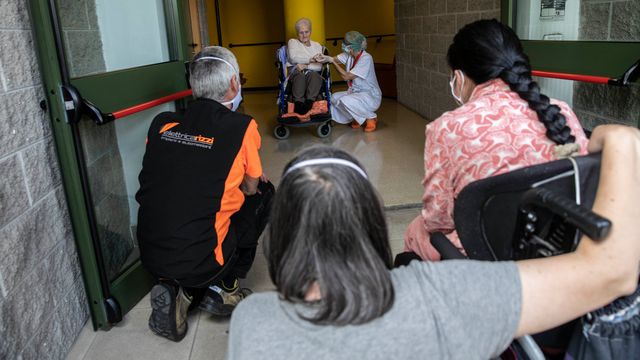
Albina Minelli, 92, sits on a wheelchair as talk from a safe distance with relatives, at the elderly nursing, in Alzano Lombardo, Italy. (AP Photo/Luca Bruno)
Care home deaths are highest in countries where the virus has been allowed to run rampant through the population, with capitalist governments mirroring the fascistic, pseudo-scientific strategy of “herd immunity,” first espoused by the British Conservative government. Across Europe and internationally, corporate profits have been prioritised over the lives and health of the working class. Broad swathes of industry have been allowed to operate with only cosmetic safety measures in place, and mass public events, including sports fixtures and conferences, continued well into March.
The proportion of overall COVID-19 deaths involving care home residents ranges between 24 percent in Hungary to 82 percent in Canada, according to figures compiled by the International Long Term Care Policy Network (ILTCP) at the London School of Economics. In absolute terms, however, the worst care home fatalities have occurred in some of the wealthiest countries in Europe as well as the United States, the world’s deadliest pandemic hotspot, where care residents comprise 42 percent of nearly 100,000 COVID-19 fatalities.
Spain currently has the highest number of care deaths in Europe, at 16,678, approximately one-third of probable COVID-19 deaths across the country, according to the ILTCP. France’s count is close behind with 14,363 deaths as of May 18, 51 percent of the pandemic death toll. In the UK, the Office for National Statistics recorded 12,526 death among care home residents in England and Wales as of May 1, amounting to 38 percent of all coronavirus fatalities. The overall UK figure is much higher, with 1,623 COVID-19 deaths in Scottish care homes as of May 17, 46 percent of the total.
Several other states have recorded thousands of deaths among care home residents, including Belgium, where 4,646 residents have died (51 percent of the official COVID-19 death toll), Sweden, where 1,661 residents have died (48.9 percent), and Germany, where 3,029 deaths (37 percent) have occurred in residential care, homeless centres, refugee detention facilities and prisons. Residential care also accounts for a high proportion of COVID-19 fatalities in Ireland, comprising 62 percent of more than 1,500 COVID-19 fatalities; Norway (58 percent of 233 deaths); Portugal (40 percent of 1,125 deaths); and Austria (41 percent of 510 deaths).
The true scale of the COVID-19 deaths and infections in social care is yet to emerge, as many countries do not have systems in place either to track or control the contagion. A recent report by the ECDPC explained:
“Under-ascertainment and under-reporting of COVID-19 cases in LTCFs (Long Term Care Facilities) has been a common feature of the COVID-19 surveillance in Europe… The majority of European countries did not have surveillance systems for LTCFs in place before the current pandemic—i.e. systems able to systematically and consistently monitor respiratory diseases and provide timely reporting at local or national level to inform interventions.”
The true death toll will perhaps never be counted as thousands of care residents have been buried or cremated without first being tested for the disease. Post-mortem testing is virtually non-existent and unsystematic in the countries where it is practiced. In Germany, where the federal government has been lauded by the corporate media for its handling of the pandemic, comprehensive testing is still not provided for care home residents or staff. The Robert Koch Institute, the country’s leading authority on infectious diseases, has stated that official figures are incomplete and “should be considered minimum values.” In Italy, which has had some of the worst single cases of mass care home deaths—190 of 1,000 residents at one large care home near Milan died of the virus—there are no official statistics for infections or deaths in residential care.
Up-to-date figures on excess mortality, which are currently only available in the UK, demonstrate that the impact of the pandemic in social care is far more acute than indicated by official statistics. In England and Wales, there were 25,591 excess deaths in care homes between April 10 and May 15—more than double the official figure—compared to a five-year average, amounting to 52 percent of all excess deaths during the pandemic.
Excess deaths beyond those already linked to coronavirus are thought to comprise undiagnosed COVID-19 fatalities and secondary victims, who have died due to neglect as already woefully underfunded services were overwhelmed and those in need of care were told to stay away. Horrific reports have emerged from the worst affected states of elderly people dying horrendously, isolated from their families, without adequate palliative treatment or even basic daily care. The virus was transmitted rapidly in care partly due to the widespread, genocidal policy of discharging patients from hospitals into care homes without first testing them for the virus, while criminally rationing hospital treatment for coronavirus at the expense of the elderly and disabled.
Last week it emerged that the Johnson government refused to sanction a plan by Public Health England to lock down care homes, which would have prevented many deaths. The 11-point plan which PHE considered would be “high impact” in tackling the spread of the virus was sent to Downing Street on April 28 but rejected. PHE called for a “a further lockdown of care homes” and included proposals that staff move in to care homes for four weeks. It requested the government “use NHS facilities and other temporary accommodation to quarantine and isolate residents.” At the time the government was opening temporary large-scale Nightingale hospitals at which many care home residents could have received urgent treatment.
The ILCPT has calculated that the proportion of care home residents to die of COVID-19 ranges from “0 in Hong Kong, 0.3% in Austria, 0.4% in Germany and 0.9% in Canada, to 2% in Sweden, 2.4% in France and 3.7% in Belgium.” “In the UK,” the report continues, “if only deaths in care homes registered as linked to COVID-19, the figure would be 2.8, whereas if excess deaths of care home residents is used, it would be 6.7%.”
The fact that these deaths were entirely preventable through the basic public health measures insisted upon by the WHO since January, including regular testing, proactive contact tracing and quarantine protocols, is proven by the handful of countries where they were instituted. Hong Kong has had no COVID-19 deaths among care home residents, despite being one of the most densely populated and internationally connected areas of the planet, situated in close proximity to the first epicentre of the pandemic in mainland China.

Protests internationally against police murder of George Floyd

Thomas Scripps

Thousands of people have protested internationally in a show of solidarity with US protests against the police murder of George Floyd in Minneapolis. Floyd, a 46-year-old African-American, died after a policeman pressed his knee on his throat for nine minutes.
Several demonstrations took place in Germany. In the Bavarian capital of Munich, 400 people gathered on Saturday evening, including a march on the city’s US Consulate.
Several protests took place in Berlin over the weekend. On Sunday, a protest march through the Kreuzberg district attracted around 1,500 mostly young people. They demonstrated under a banner “Justice for George Floyd” and carried signs with inscriptions including: “I can’t breathe,” “Justice for George Floyd” and “Being black is not a crime.” Shortly before, a “Memorial March against racist police violence in the USA” marched to the Brandenburg Gate.
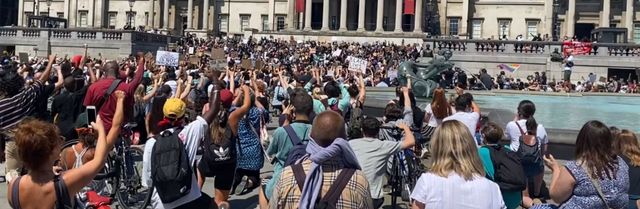
Protesters in Trafalgar Square in London chanting George Floyd
The largest demonstration took place on Saturday in front of the US Embassy in Berlin. More than 2,000 people expressed their anger at the brutal police violence. Banners included, “Justice for George Floyd!” and “Against Racist Police Violence.”
Demonstrators not only protested Floyd's death, but also the conditions in Germany and the growth of far-right forces within the state. Neo-Nazi structures in the police force must be uncovered, said one of the speakers. One participant explained: the denazification that allegedly took place after World War II never really took place. We still have Nazis in various structural areas. Another referred directly to police violence in Germany: it is by no means an isolated incident. It happens almost daily in Germany, she explained, recalling the case of Oury Jalloh, who burned to death in a prison cell in 2005.
On Saturday, up to 5,000 people demonstrated in the Danish capital Copenhagen. Protesters began their protest at the US embassy in Østerbro and finished at Christianborg.
Last Thursday, demonstrators protested outside the US consulate in Milan, Italy. During the day, a mural was painted in the city reading “I Can’t Breathe” in reference to Floyd’s last words.
In Canada, thousands protested Saturday in Toronto’s Christie Pitts Park at the deaths of Floyd and Regis Korchinski-Paquet. Korchinski-Paquet, a 29-year-old black woman died last Wednesday, after falling from her 24th-floor balcony when police officers were called to her home. Korchinski-Paquet’s family are seeking to establish the truth about how she died and dispute the police version of events.
Solidarity demonstrations were held in Jerusalem and Tel Aviv, where hundreds of Israelis and Palestinians marched Saturday in protest against the killing by Israeli border police of Iyad Halak. Halak, a disabled Palestinian man who had autism was shot in Jerusalem’s Old City. Demonstrators held placards reading “Palestinian Lives Matter” and “Justice for Iyad, Justice for George.”
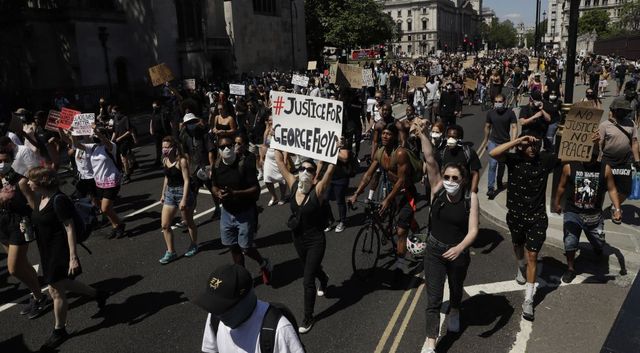
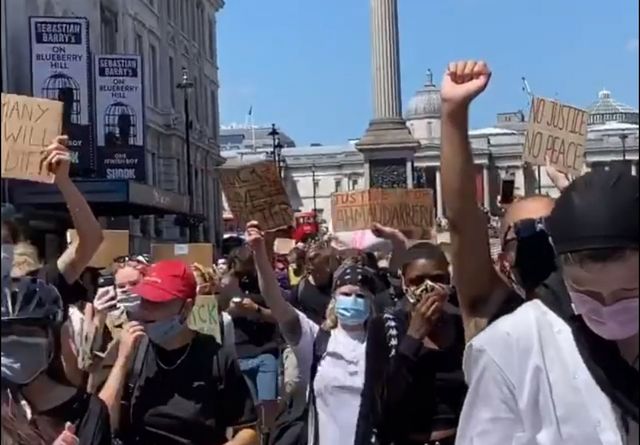
In London, thousands gathered in Trafalgar Square on Sunday afternoon, before marching past Downing Street and the Houses of Parliament. They crossed the River Thames to rally outside the US embassy at Nine Elms in the Battersea area. The protestors chanted “No justice, no peace,” “Black lives matter” and “Say my name, George Floyd.” They carried banners with the slogans “Justice for George Floyd,” “Racism has no place” and “I can’t breathe.”
People march from Parliament Square in central London on Sunday, May 31, 2020, to protest against the recent killing of George Floyd by police officers in Minneapolis, USA, that has led to protests in many countries and across the US. (AP Photo/Matt Dunham)
One protester told Sophie Walsh, European correspondent for Australia’s “Nine News,” “expect more and bigger protests here, we’ve had enough.”
At 1pm, protesters dropped to their knees in memory of Floyd.
The demonstration stopped traffic on Lambeth Bridge and blocked the road to the US embassy. Many drivers sounded their horns in support as they passed, and onlookers applauded the march.
Showing a recognition of the fundamental and international class issues involved in Floyd’s death, some protestors made their way to Grenfell Tower in North Kensington in west London, where 72 people were killed in a horrific fire in 2017 caused by decades of deregulation, neglect and reckless profiteering.
The Metropolitan Police were deployed in large numbers to confront protesters. Walsh tweeted a video noting the police show of force as they cleared the Whitehall area. At the US Embassy, police lined up to prevent protesters going any further. They made several arrests.
Protesters brought placards demanding Justice for Belly. Rail worker Belly Mujinga died last month after being spat on by a man claiming to have coronavirus. Nothing has been done by the authorities, with the British Transport Police deciding not to prosecute the man.
Sunday’s protests in London followed a march of several hundred people in Peckham in the south of the capital, on Saturday. A number carried banners including one reading “Solidarity.”
Other protests in Britain took place on Sunday in Manchester and Cardiff. In Cardiff, hundreds of people gathered by the walls of the city’s castle. One banner read: “If you are neutral in situations of injustice you have chosen the side of the oppressor.”
In Manchester, protesters marched through some the city’s main thoroughfares including Market Street, St Ann’s Square and Peter Street. The march finished in St Peters Square, where protesters kneeled in tribute to Floyd. This was just yards from the site of the 1819 Peterloo Massacre, where yeomanry and regular cavalry attacked and killed protesting workers. Among their chants were “Justice for George Floyd” and “The UK is not innocent”—referencing deaths in police custody.
Proving this last point, Foreign Secretary Dominic Raab has refused to comment on US President Donald Trump’s fascistic response to the protests in America. Trump denounced the protestors as “THUGS” and threatened to send in the military to quash demonstrations. On Friday, he tweeted: “Any difficulty and we will assume control, but when the looting starts, the shooting starts.”
Protesters marching in London from Trafalgar Square down Whitehall
Speaking in an interview with Sky News Sunday morning, Raab said: “I’m not going to start commenting on the commentary or indeed the press statements that other world leaders make, or indeed the US president.”
The British state has its own brutal record of police violence. The London Metropolitan police alone used violence a staggering 41,477 times in a five-month period in 2018. In that period, police fired or aimed Tasers at suspects 2,663 times and trained real firearms on suspects 591 times in London—an average of nearly four times a day.
In the year 2017-2018, 283 people lost their lives following contact with UK police. Of these, 23 occurred in or following police custody, 57 were supposed suicides following custody and 29 related to road traffic incidents. There were four police shootings (three of which were related to terrorism) and 170 unspecified “other” deaths at the hands of the police.
As in the US, this violence falls disproportionately on the black population—particularly young black men—but is rooted fundamentally in the oppression of the entire working class by the capitalist state.
More protests are planned in the UK in the coming week—on June 3, 6 and 7 in London, June 6 in Manchester and June 4 in Birmingham. Similar events are being prepared across Europe.
The rallies are also extending into the Asia-Pacific.
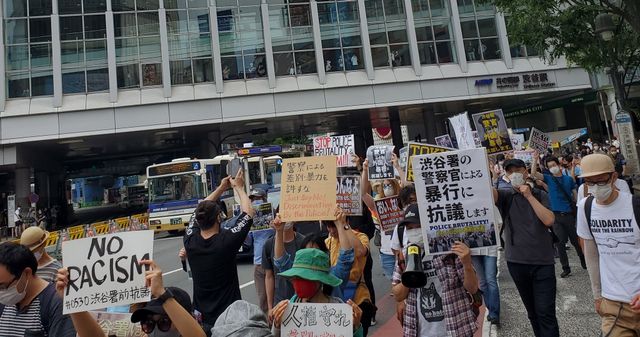
Several hundred gathered in Tokyo, Japan on Saturday to express their support for the US demonstrations. The protesters also condemned a recent unprovoked assault on a 33-year-old worker of Kurdish origin by Tokyo police. Footage of the attack, showing the man being held to the ground by two officers while they brutalised him, went viral and provoked widespread anger.
Part of the protest in Tokyo, Credit: @Gregor_Wakounig (Twitter)
The demonstrators marched from Shibuya Square, a well-known rallying place, to Shibuya police station. They demanded that the authorities “Turn over the criminal policemen” involved in the attack on the Kurdish worker and chanted other slogans, including “Do not discriminate against foreigners!” Police, in large numbers, sought to break up the protest and arrested at least one activist.
In Australia, thousands of people have indicated on social media that they will attend protests over the coming days in the capital cities including Sydney, Melbourne and Brisbane. In addition to extending solidarity to the US demonstrations, they will be raising opposition to police killings in Australia, many of which have targeted Aboriginal people.
This morning, Prime Minister Scott Morrison expressed fears that the US protests are resonating among Australian workers and young people. “There's no need to import things happening in other countries here to Australia,” he said, adding that “Australia is not the United States.”
In New Zealand, rallies will be held in Auckland, Wellington, Christchurch and Dunedin, beginning this afternoon.

New COVID-19 infections worldwide hit record levels

Patrick Martin

June is the fifth month of the global COVID-19 pandemic. The World Health Organization declared the coronavirus a Public Health Emergency of International Concern on January 30.
Over the weekend, as the world entered the fifth month of the public health and economic disaster, new infections worldwide hit record levels, approximately 125,000 per day on May 29 and May 30, according to WorldoMeter.
Brazil passed a grim milestone, with 500,000 cases, second in the world to the United States, while approaching 30,000 deaths. Of the 125,000 new cases, Brazil accounted for the most, more than 30,000, and the US ranked second, at nearly 25,000. Other countries contributing to the surge were Russia, India, Peru, Chile and Mexico, with a combined total of more than 30,000. The same seven countries accounted for three quarters of the nearly 4,100 deaths recorded for May 30.
Officially, the first American death from COVID-19 came on February 28 in the Seattle, Washington area. In the 93 days that have passed since then, more than 106,000 people have died of coronavirus in the United States, while the number infected has skyrocketed from a handful to more than 1.8 million people. Even these figures are likely gross underestimates of the real impact of the pandemic.
The United States, the richest country in the world, with vast medical and scientific resources, has lost far more of its people to the coronavirus than any other nation because of the greed, callousness and sheer incompetence of its ruling elite. In the eyes of working people, both within the US and around the world, this is a political and social disgrace from which American capitalism will never recover.
June 1 marks two weeks since the auto industry and other major US employers fully resumed operations at factories, warehouses and offices. These facilities are likely to become new hotspots for the pandemic, following in the footsteps of meatpacking plants, which were never closed down and saw infection rates of well over 50 percent of the workers in some cases.
The Centers for Disease Control and Prevention projects that between 10,000 and 30,000 more Americans will die from the coronavirus over the next three weeks, an estimate that does not take into account the likely acceleration of community spread because of the large-scale reopening of factories and workplaces, as well as stores, churches and other potential points of transmission of the virus.
There are already disturbing reports, both anecdotal and statistical, of an upsurge of the pandemic in those states that first began reopening, or which never imposed any sort of lockdown. According to the site covidexitstrategy.org, which uses fairly conservative estimates based on CDC guidelines, 22 states, mainly in the South and the Mountain West, show increasing levels of COVID-19.
The 14-day moving average for new coronavirus infections is up 60 percent in Alabama, 40 percent in Arkansas, 15 percent in Florida, 38 percent in South Carolina, 40 percent in North Carolina, 38 percent in Missouri and an astonishing 139 percent in West Virginia (more than doubling in two weeks from a previously low level).
Several of these states were the scenes of notorious violations of social distancing last month, including a pool party in Arkansas attended by dozens of people, and the Lake of the Ozarks resort in southern Missouri, where thousands gathered on the Memorial Day weekend. New COVID-19 cases have been reported in connection with both events.
The most rapid increase in a Midwest state was in Wisconsin. Again, this is associated with the collapse of social distancing after the state Supreme Court overruled lockdown orders issued by the governor, leading to widely publicized scenes of tightly packed crowds gathered in bars and restaurants. The court ruling was issued May 13. Just over two weeks later, COVID-19 cases in the state are up 47 percent.
According to one report, ICU beds are filling up in Minneapolis-St. Paul; Omaha, Nebraska and the state of Rhode Island, a signal of impending crisis. Leavitt Partners, led by former Health and Human Services Secretary Mike Leavitt, projected that Hennepin and Ramsey counties, which include Minneapolis and St. Paul, respectively, will have a shortage of dozens of ICU beds in the next three weeks. Ramsey County could have a shortage of overall hospital beds as well. Minnesota saw its largest one-day rise in coronavirus-related ICU bed hospitalizations with 260 on Wednesday.
But that same day, as protests mounted in Minneapolis over the police murder of George Floyd, Minnesota Governor Tim Walz signed an executive order allowing salons and barbershops to reopen and bars and restaurants to begin outdoor dining. State Health Commissioner Jan Malcolm said that the state would not hit its peak coronavirus infection level until late June or July.
The Washington Post reported Sunday: “Two to four weeks after many states began lifting restrictions on restaurants, bars and larger gatherings, cases are rising in areas that had previously dodged the worst of the virus’s impact. Arizona, Mississippi, South Carolina, Utah and Wisconsin all set record highs for new cases reported Friday… In many areas, large gatherings are cited as the center of major outbreaks.”
While some of the previously hardest-hit states have begun to see a decrease in their 14-day moving average, including New York, New Jersey, Massachusetts and Michigan, these are decreases from appalling highs. Even with the “improvement,” these states still account for half of total US deaths and at least a quarter of new deaths.
In California, where Democratic Governor Gavin Newsom has begun the systematic relaxation of the lockdown, hotspots have begun to flare outside of Los Angeles, which has been the center of infection so far. In Alameda County, which includes the city of Oakland, new cases jumped by 30 percent last week, with 107 new cases on Thursday, the most on a single day since the pandemic began.
In practice, every state governor, Democratic or Republican, is carrying out the same policy as the Trump administration and bourgeois governments throughout the world: forcing millions of workers back to work to resume the process of profit and wealth accumulation for the capitalist class, while deliberately encouraging the breakdown of social distancing in order to spread the infection as widely as possible.
The policy of “herd immunity” has no scientific or public health content whatsoever. It is a label that disguises a social policy whose deliberate purpose is to dispose of as much of the most vulnerable population as possible—the elderly, the sick, the immune-compromised, all those who do not produce surplus value and profit for the financial aristocracy.
As the World Socialist Web Site and the Socialist Equality Party have insisted, fighting the pandemic requires the independent mobilization of the working class, advancing a socialist program irreconcilably opposed to the economic interests of the capitalist class and the capitalist system as a whole. Millions of lives are at stake. They can be defended only through an open struggle to end the corporate-financial dictatorship over social policy and redeploy economic resources on the basis of social need.