4 Jun 2020

Onset of Mental Health Crisis: Changing the Conversation in Pandemic times

Jitamanyu Sahoo & Syed Mujtaba Hussain

The current pandemic situation across the globe has accentuated the pre-existing trend of mental health issues to the global forefront.  What is more alarming is most of the world is under complete or partial lockdown and people living or developing mental health issues are unable to access the basic treatment. The emergence of mental health issues which is visible now in the low and middle income countries and its address has been thwarted by the pandemic on the run.
The COVID-19 as it unfolds is going to have lasting and profound effects on the mental health. Under the sub-text of ‘Changing the Conversation’ we would be writing series of articles on how to put forward a public health response on mental health challenges from different vantage points. The deniability of mental health treatments to individuals and vulnerable groups is due to lack of awareness and stigma attached to it. This stigma multiplies over a period of time having an enduring effect on mental health. Moreover, absence of coherent data, form, extent, duration and distribution has led to difficulties in mitigating the mental health issues now. Here, we look at the onset of mental health problems which is looming before us and how we must start a conversation.
Distress, Disorders and Disabilities
There is no health without mental health. A healthy person should have a healthy mind. A healthy person should be able to think clearly. A healthy person should be able to find solutions to her problem. A healthy person should be able to have good relations and be satisfied. It is in these essential aspects of our health which is known as mental health. Prof. Vikram Patel (one of the leading psychiatrist of the world) says mental health problem is ‘a problem experienced by a person which affects their emotions, thoughts or behaviour, which is out of keeping with their cultural beliefs and personality, and which is producing a negative effect on their lives or the lives of their families.’ The way a physical body can be ill, the mind too can be ill.
However, it is important to understand there is severity in which mental health problems can be categorized as it affects the impact of the individual.
  • Distress is the most common type of mental health problem. Distress is characterised by a mixture of different complaints (such asfeeling sad, worried, tense or angry), often of short duration, and in response to difficulties in one’s life (such as the loss of a loved one).
  • Disorder is a more severe, but less common,type of mental health problem. Disorders are characterised by more clearly defined groups of complaints which can be classified using a medical diagnosis, typically of a longer duration than distress, and not necessarily associated with, or explained by, difficulties in one’s life.
  • Disability is the most severe, and least common, type of mental health problem. Disabilities are characterised by enduring impairments in a person’s daily functioning (e.g. the ability to communicate with others) and may be present from birth or very early childhood, or appear later in life as a consequence of a mental disorder.
The categories lay emphasis as Prof. Patel highlights on mental health problems which can be suspected and thrive on an individual even in the absence of physical disease.
Identification and Assessment of mental health problems
According to the survey conducted by The Indian Psychiatry Society after 21 days of the lockdown in India revealed a rise of 20 percent rise in mental health cases. This survey has raised pertinent questions on the need for early recognition of mental health issues during a health crisis and the consequences for the person affected by it. Can we say that the rapid propagation of online surveys which claim some representation and media attention captured atleast the broader mental health problem during the pandemic? How can the value of the data collected through the samples be measured against the use of the data? Does larger sample sizes in identifying the mental health issues solve the biases attached?
There is inter-dependency on how we identify the mental health problems and which lead to timely assessment and treatment. The causes of identification problems includes lack of knowledge of health and social care staff, about the symptoms ( be it emotional, cognitive, behavioral or perceptual), not addressing the learning and physical disabilities, lack of information being shared among peers and difficulties for an individual to communicate her distress. Since the identification of the mental health problems is impaired; assessment and resource allocation becomes ineffective. We need now comprehensive evidence through surveys with detail sample strategy which is currently unavailable to mitigate the mental health challenges before us today.
Starting the Conversation
Mental health problems, depression, anxiety and so on are conversation which the society till now is not willing to engage with and take note of. The individuals going through the traumatic experience are categorized as weak, attention seeking and they need to toughen up. This belief which lingers on in a community is one of the central reasons why stigma is attached to mental health education.
In this health crisis another crisis of mental health has emerged. How do you a start a conversation in this pervasive atmosphere. The community needs to be receptive and take the initiative. If someone you know, or even don’t know needs assistance and to have a conversation ask them “Are you OK?”, “I’ve got time to talk” “So tell me about..? “Lots of people go through this sort of thing. Getting help will make it easier” “There are people that can help. Have you thought of visiting your doctor?”.
Moreover, the role of family members and caregivers becomes paramount to identify for instance the behavior, signs of distress, loss of skills or onset of cognitive systems. Since family is the first point of contact to an individual, when families raise concern the treatment by paid career or psychologist could be carried out. The lockdown due to pandemic have forced the persistence of mental health problems and denied access to diagnostic interventions.  But community and family can be integrated to promote mental health at all levels of care.
We can and must do better.

Lack of Identity of Migrant Workers

Chittarvu Raghu

The plight of migrant workers during the lockdown period has necessitated to examine the law prevailing relating to the migrant workmen. We have witnessed reverse migration and the pathetic conditions faced by the migrant workmen in the process. Thousands of migrant workmen started trekking hundreds of kilometres to their villages in spite of the tightened surveillance by the authorities to prevent people from crossing states amid fears that they could carry the virus.
The sudden clampdown throughout the country generated insecurity in the minds of the migrant workmen mostly who are working in un-organised employment such as shop assistants, security guards, cooks and other casual jobs. There is no record maintained with regard to the particulars of such migrant workmen by any of the employers. The only law that is governing the field of migrant labour is The Inter-state Migrant Workmen (Regulation of Employment & Conditions of Service) Act, 1979. Now the question is as to whether the said Act takes into its fold the grievances of all the migrant workmen mostly those who are working in un-organised employment.
Most of the people migrate from rural areas to urban areas wherein there are green pastures of labour employment in various sectors such as industries, farms, labour markets, hotels, tea stalls and such other allied businesses. The lack of uniform development throughout the country, deficit rainfall in certain areas adversely effecting agricultural activities, stimulated the migration of labour to the urban areas. The largest employer of the migrant workers is the construction sector, domestic work, textile industries, brick kill work, transportation, mines and quarries and agriculture. Most of them are managed by private labour contractors. The migrant workmen can be classified into two categories (1) those who are working in any establishment wherein five or more migrant workmen are engaged and (2) those who are working in petty businesses and jobs. These migrant workers are the most vulnerable group and subjected to opportunistic in difference. The private contractors or any other like source of agencies are not duly identified in case of those migrant workmen falling in the later category. In such crisis as we are facing today, it would be necessary to maintain a record of the migrant labour working in various cities so as to prevent such a huge calamity of reverse migration. If proper record is maintained encompassing various types of migrant labour, it would be easier to protect their interest by the State in such a situation as we are facing now.
The Central government though had directed the local authorities to provide food, sanitation and accommodation to migrate workmen, most of them could not be benefitted for the reason of lack of their identity as migrant workmen. Obviously most of the migrant workmen working in small businesses and works are outside the ambit of The Inter-state Migrant Workmen (Regulation of Employment & Conditions of Service) Act, 1979 and therefore it has become very difficult to identify them.
The Inter-state Migrant Workmen (Regulation of Employment & Conditions of Service) Act, 1979 is only the major Act governing the field. The said Act was enacted with a main objective to eliminate the abuses prevalent in the system. In the background of the inter-state migrant workmen who are generally illiterate, unorganised and have normally to work under extremely adverse conditions, it necessitated for passing the said legislation to prevent exploitation.
A reading of the provisions of the said Act shows that the said Act is made applicable only to the establishments wherein five or more inter-state migrant workmen are employed on any day of the preceding twelvemonths. The Act is not applicable to those migrants who are engaged in petty businesses and in fact they are larger in number. The provisions of the Act mandate that the establishments have to get registered with the department if engaging migrant workmen. License is granted under the said Act to the contractors through whom the migrant workmen are inducted by the establishments. The Act specifies duties and obligations on the contractors and also various aspects relating to wage rates, welfare and other facilities to be provided to the inter-state migrant workers. Most of the obligations are cast upon the contractors only. Therefore the identity of those migrant workmen who are working in any establishment as defined within the ambit of said Act can easily be established.
Since the Act is limited in its application, it does not take into account the spread of migrant labour in the major cities engaged in small businesses. There is no record pertaining to the migrant labour engaged in petty businesses and works. The Act as stated above speaks only with regard to the duties and obligations of a labour contractor and to some extent establishment in which the migrant workmen are engaged.
The definition of migrant labour of the said Act is a very confined definition. It defines inter-state migrant workmen as a person who is recruited by or through a contractor in one State under an agreement or other arrangement for employment in any establishment in any other State whether with or without the knowledge of the principal employer in such establishments. This definition shows that it does not take into its ambit the various migrant labour spread in various mega cities working in small businesses and doing petty works. Most of them are migrated to the cities in such of employment directly without approaching any contractor. The Act does not take into its fold such migrant labour and therefore there would not be any record available in relation to such type of most spread and un-organised migrant labour and their identity cannot be easily established.
In the type of calamities which we are facing today, the migrant workers try to go back to their village where they have homes, food and support systems from close-knit communities. Since their identity is already established in their villages, the feel secured if they return back to their villages.
In order to pass on the benefits provided by the State to minimise the plight of the migrant workmen, a proper record fully containing the particulars of the various types of migrant workmen who are working in petty businesses and works irrespective as to whether they are engaged through a contractor or not has to be maintained and the same would resolve the problem of identity of such migrant workmen. There has to be a comprehensive legislation contemplating maintenance of records and creating obligations upon the employers who are engaging migrant workmen in small businesses and works in big cities. This would benefit such class migrant workmen who are outside the ambit of The Inter-state Migrant Workmen (Regulation of Employment & Conditions of Service) Act, 1979 and to some extent may eliminate the fear of lack of identity generated in their minds.

Irish government plans full return to work by August

Dermot Quinn

On June 8, the Irish Taoiseach (prime minister) Leo Varadkar, leader of the current Fine Gael government, will instigate Phase Two of a five phase plan to exit from the coronavirus lockdown.
Under Phase One, 1,500 retail shops reopened on May 18 along with outdoor workers, including construction workers, returning to sites. Varadkar’s government is planning to reopen further shops and businesses, with a full opening up of the economy in Phase Five of the plan by August 10. Schools and colleges will reopen in September.
Varadkar told the Dáil [parliament] last week that the government’s mission was to get “business open again” and “get the economy humming.” But he is not moving quickly enough for business. The Irish Business and Employers Confederation (IBEC) has insisted that the government bring forward the phases of reopening of the economy and scrap the two-week quarantine restrictions for people entering the country.
There have been over 25,000 confirmed cases of the coronavirus in Ireland, almost half in Dublin. Almost 8,000 have been among healthcare workers. Of the 1,650 deaths from the pandemic, one of the highest death-to-infection ratios globally, the old and infirm have suffered greatly with 62 percent of deaths occurring in nursing and residential homes. Northern Ireland has seen approaching 5,000 cases and over 500 deaths. Around half have been in care homes.
The scandalous treatment of the old and infirm in nursing homes led Dr. Marcus De Brun to resign from the Irish Medical Council in late April. On May 30, it was widely reported that Dr. De Brun had released a memo from the Health Service Executive (HSE) showing that doctors in care homes were instructed that if one resident tested positive for the virus, others should not be tested as it was assumed they already had it.
The decision not to test cost the deaths of 52 residents in the North Dublin nursing home to which he was attached. Dr. De Brun stated last week, “Residents I had put on the list to be tested were being booted off the list without me being informed. To be denied the possibility of testing, to figure out if this COVID or not COVID, that created huge difficulties for the sector and certainly for the nursing staff and any hopes of isolation.”
Just two weeks ago, more than 600 coronavirus infections were reported in 12 meat processing plants across the country. Frigid temperatures, cramped conditions, and long hours put meat processing workers internationally in danger as the super-rich seek to rake in profits at any cost.
The collaboration of Varadkar’s caretaker government with the bosses who own and control the meat plants came sharply into focus last week. Irish Chief Medical Officer Tony Holohan revealed that the Health Service Executive (HSE) was running a practice whereby COVID-19 test results of workers were being given to the companies instead of to the workers concerned. In many cases the first time that workers heard of their positive diagnosis was from the company and not from the HSE.
Even though this was condemned by the Data Protection Commission as “not legitimate”, Minister for Health Simon Harris condoned the arrangement stating baldly, “It has been necessary in the interests of public health to give the results of confirmed cases of Covid-19 to the management of meat plants.”
There is widespread anger among working people at the callous indifference shown to workers and young people by the ruling elite. It is four months since the Irish general election on February 8 which resulted in Varadkar’s governing Fine Gael party coming third in the poll, both in seats and in first preference votes. Even before the pandemic, the vote reflected working people’s anger at a growing housing and homeless crisis, coupled with a deterioration of the health services and all aspects of social care.
In response, the two main bourgeois nationalist parties, Fianna Fáil and Fine Gael, are posed to abandon their already nominal differences—resting on a historical division over the Irish border and Civil War—and concentrate on jointly implementing the dictates of the ruling elite. The Green Party are holding talks with both Fianna Fáil and Fine Gael and are seeking to enter government with them. Sinn Fein, who have no fundamental differences with the talks’ participants, won the election with some left posturing but have thus far been excluded.
The talks between the three parties are to be concluded in two weeks. Varadkar and Simon Harris have set the agenda of future policies by scrapping the state takeover of private hospitals implemented at the start of the pandemic with the aim of returning the sector to private interests.
A right-wing ideological barrage against workers opened last week when Varadkar outlined to the Dáil an extension to the €350 COVID-19 pandemic unemployment payment beyond June 8. The temporary payment, introduced in March, is paid weekly to laid off and self-employed workers. As of mid-May, around 585,000 were in receipt of it. In total, 1.26 million workers are relying on state support for all or part of their income through various similar schemes, including a wage subsidy scheme for which 54,000 employers registered.
Varadkar insisted the €350 payment would be cut by the next incoming government because some workers were better off on the payment than when working. Varadkar sniped, “I have heard stories of people who have asked their employers to lay them off, because they would be better off on the €350 payment. I would say to anyone who is thinking that, we are all in this together, and nobody in any walk of life should seek to be better off, or seek to make a profit out of this crisis.”
Varadkar was supported last Saturday by the Irish Independent newspaper which gave a two-page spread to Pat McDonagh, owner of Irish burger chain Supermac’s. McDonagh, who spoke in opposition to the continued payment and whose estimated wealth is €117 million, compared the emergency pandemic payment of €350 for low paid workers during the pandemic to being like “winning the lotto.”
The social policy of the Varadkar government, which is willing to dispose of the elderly, the sick, and the immune-compromised, while attacking workers’ conditions on behalf of the financial elite, will continue with the aid of the rest of the political establishment—likely with the forming of the three party coalition government. An indication of any new government’s agenda can be drawn out from the fact that talks with the Greens are reported to be dragging on over finance, levels of social protection, the state deficit, the pension age and carbon emissions. Last time the Greens were in power, they assisted Fianna Fáil in launching billions of euros of austerity measures in the aftermath of the 2008 financial crisis.
Workers in Ireland, North and South, find themselves irreconcilably opposed to the economic interests of the Irish capitalist class and the capitalist system. Fighting the pandemic and the assault on jobs, wages and benefits requires that Irish workers mobilize independently, form rank-and-file action committees in every workplace and seek to unite as a class in Ireland and internationally.

Survey exposes COVID-19 dangers facing call centre workers

Joe Mount

A detailed survey has exposed the shocking conditions facing UK call centre workers during the coronavirus pandemic.
Boris Johnson’s Conservative government denoted call centre operatives as “key workers.” This meant that throughout lockdown imposed on March 23, many major companies could operate call centres to maintain and even expand the flow of profits to their shareholders. In the process they exposed workers to serious hazards.
Data collected through an ongoing survey by Professor Phillip Taylor, an expert on employment issues at the University of Strathclyde in Glasgow, centred on a confidential questionnaire, began on April 8. Over 2,800 workers responded, with Taylor receiving several calls each day from call centre staff frightened to enter their offices and risk contracting the virus due to employer malpractice.
Call centre operatives are placed at risk on multiple levels, due to commuting—often by public transport—to cramped, overcrowded offices where management often insist on normal working practice, including meetings proceeding as normal.
Approximately 1.3 million people in Britain are employed in call centres, four percent of the workforce. The COVID-19 fatality rate is generally higher among lower-skilled occupations. According to official figures, those in sales and customer service occupations are suffering 14.3 deaths per 100,000 males (the average death rates differ greatly by gender.)
Reports have emerged of call centre workers dying of COVID-19. Victims include an employee of multinational outsourcing firm Capita in Rotherham, South Yorkshire, who died in April. A female worker in her 50s who worked at Virgin Media call centre in Wythenshawe, Manchester died on April 2. She left work on March 2 to self-isolate. The office was closed for just one day before opening again.
The Manchester Evening News reported, “It prompted scores of worried members of staff to contact the M.E.N. to express concern about an alleged lack of social distancing at the office and another office in Baguley, alleging they were being asked to carry out non-essential work like convincing customers not to leave them.”
Professor Taylor was told of multiple critical hospitalisations and even fatalities among the co-workers of those responding to the survey. Three-quarters of respondents had colleagues in their call centre forced to self-isolate after developing symptoms.
The survey measured the acute concern and suffering among call centre workers: 78 percent believed they might get coronavirus at work and 91 percent feared passing the virus onto their families. Seven-in-ten reported feeling “very scared” at having to continue to report for work.
The author notes that the total length of the responses from workers—of over 200,000 words—is a measure of the impact of the crisis and the social tensions it is generating.
Most call centre workers (82 percent of replies) felt their services are non-essential and they are being made to risk illness and death unnecessarily. As large sections of the economy and public sector have switched to online operation, many call centres are critical (e.g. the National Health Service help line emergency services), but most are not, including certain financial services, retail, etc. One worker cited in the study said, “I’m going to work during a national lockdown as I am now described by the government as ‘essential’ when only a few months ago I was ‘low skilled’... it’s a joke.”
Workers expressed their scorn at management neglect. Many have been coerced back to work by performance targets and financial pressures, despite presenting undiagnosed symptoms or soon after recovering from the disease. Seventy eight percent of respondents reported feeling pressurised into attending work. One worker reported several cases where management, despite being informed of the condition of ill co-workers, compelled them to attend: “They came to work as they were worried about their job due to discipline action. They were told then to go home after completing half of the shift.”
Management at many workplaces have concealed incidences of the disease to prevent opposition mounting to their back-to-work drive. One respondent explained, “Of my knowledge there has been one confirmed case and two suspected cases. The confirmed case was a colleague… he required hospital treatment. Managers are aware of this and tried to deny the situation at first. When the colleague eventually confirmed it to everyone for himself, they then accepted that it had happened but have made several cover stories to try to keep the office open.”
Workers with pre-existing health conditions, who are at increased risk, are being made to report for work.
Many call centres contain large numbers working in confined spaces with shared facilities and breathing in recycled air. Alongside complaints of dirty offices and a lack of sanitation, such as insufficient hand sanitiser and toilet cleaning, only 4 percent said that their employer had provided face masks.
Only half of those surveyed reported being at least two metres distant from their colleagues. A particularly strong opposition was expressed to “hot desking,” whereby multiple people on different shifts share the same desk space.
These concerns were voiced by workers at two of NHS 24’s main contact centres, in Cardonald Park, Glasgow, and Clydebank. Every worker of 800 surveyed at the sites said it was impossible to socially distance at the required two metres. Ninety one percent said they “do not feel safe at work,” while 90 percent said health and safety concerns “have made them think about not going into work.”
Many call centre businesses have not organised homeworking. Taylor’s report notes, “Two-thirds of staff still working in the sector have asked bosses to work from home, but just four percent of all requests have been granted.”
Taylor’s survey notes that it is supported by various trade unions and health and safety campaigning bodies, notably Hazards. The main aim of the survey is “To expose bad employment practices hazardous to call-handlers and, through intervention by trade unions, health and safety and regulatory bodies, to stop them…”
The claim that the employment practises exposed can be opposed by the trade unions is belied by all experience. Trades Union Congress General Secretary Frances O’Grady described the report as “grim reading”, adding, “Bosses who refuse to take steps to protect their workforces should be prosecuted.”
But the unions will do nothing. Such rhetoric is aimed at concealing their corporatist role and collaboration in enforcing the return-to-work, beginning with Monday’s reopening of schools.
Labour’s Shadow Employment Minister Andy McDonald described the report as “deeply concerning” before declaring that the Johnson’s governments “guidance”—a government whose polices have led to at least 60,000 coronavirus deaths—was the way forward. “The government’s guidance must be strictly implemented and enforced, in the interests of workers’ safety and to protect public health,” he insisted. The unions must be involved to ensure “workplaces are safe to work in now and when we emerge from this crisis.”
Labour councils have played a key role in signing off unsafe working conditions and the unions are policing the return to work. McDonald’s party nationally is collaborating in implementing a return to work in a de facto national unity government.
Call centre workers can only oppose the dangerous conditions they face by establishing rank and file safety committees, independent of the trade unions. These must organise the resources to create safe working conditions, including provisions for home working, sanitation, and social distancing to halt the spread of contagion.

Nearly 65,000 COVID-19 deaths in UK according to Financial Times

Barry Mason

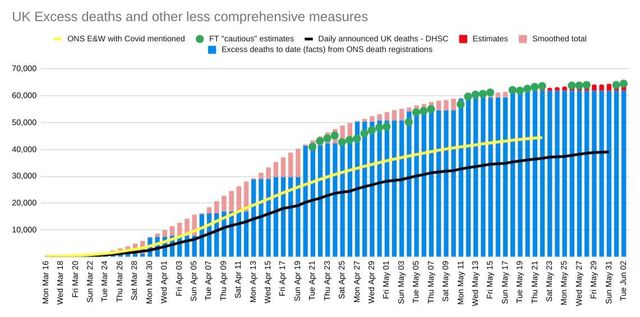
There have been at least 64,500 deaths in the UK linked to coronavirus, according to modelling by the Financial Times.
Its figures were based on those released Tuesday by the Office for National Statistics (ONS). The ONS found that deaths registered in England and Wales with confirmed or suspected COVID-19 reached 44,401 by May 22. When figures for Northern Ireland are added, the total reaches just over 50,000.
On Tuesday, the government announced a further 324 deaths, meaning that even its own heavily manipulated death toll calculation has reached almost 40,000 (39,369). These are the highest number of COVID-19 deaths of any country except the United States.
Chart showing UK excess deaths and what the Financial Times describes as “less comprehensive figures”. It shows: Blue: UK excess deaths (official figures) Pink: smoothed data to take account of weekly publication Green: FT cautious estimates as published Black: DHSC daily total of deaths Yellow: ONS deaths with Covid mentioned on the death certificate (E&W only) (Credit: Financial Times)
The data used by the Johnson government to compile its daily figures only includes people who died with positive test results confirmed by a Public Health or National Health Service laboratory. They do not, it states, include “deaths of people who had COVID-19 but had not been tested, people who were tested positive only via a non-NHS or Public Health laboratory, or people who had been tested negative and subsequently caught the virus and died.”
Financial Times economics editor Chris Giles tweeted of the ONS data, “Following today’s official excess deaths figures and hospital data, a cautious estimate for the total UK excess deaths during the coronavirus pandemic up to 2 June is 64,500. Of these 61,920 have happened, the rest are estimates.”
The FT’s modelling follows an extensive survey of 19 countries carried out by the newspaper last week. It found that the UK was only behind Spain in its COVID-19 deaths in Europe, according to “excess mortality figures.” The UK’s death rate from the disease was 891 deaths per million, while Spain’s was 921 per million. In each country the figure was based on the number of “excess deaths” since the week ending March 20. The UK was in first place internationally until May 21, when Spain revised sharply upwards its mortality estimates, adding 12,000 to its toll of excess deaths, taking them to 43,000.
Excess deaths are defined as the number of deaths in a certain period compared to a five-year average. The FT noted, “The data were compiled from national statistical agencies for 19 countries for which sufficient information exists to make robust comparisons. The figures include all of the European countries hit hard by coronavirus.”
The excess deaths method of compiling figures for COVID-19 is internationally recognised as the best. The Heath Foundation explains, “Excess deaths is a better measure than the COVID-19 deaths of the pandemic’s total mortality. It measures the additional deaths in a given time period compared to the number usually expected and does not depend on how COVID-19 deaths are recorded.”
The FT highlighted the fact that in absolute terms the number of excess deaths in the UK is the highest in Europe, and internationally is only second to the US. The figures for percentage increases in excess deaths in the UK is the highest in Europe and second only to Peru internationally.
The newspaper report was accompanied by graphs showing that the rise in excess deaths was spread across all regions of the UK. This was unlike Italy, where the impact of the pandemic was concentrated in the Lombardy area. In France, the impact was mainly in two regions, including one around Paris.
An important graph shows the number of excess deaths related to how soon lockdowns were imposed. There is a strong correlation between the date of lockdown imposed and the number of likely COVID-19 cases that followed. It is further evidence that the Johnson government’s “herd immunity” policy and refusal to impose lockdown until March 23 was an act of mass murder.
Natalie Dean, assistant professor of Biostatics at the University of Florida, told the FT, “I was very surprised by the delayed response in the UK. Given what we were observing in Italy at the time and that the UK was on the exact same trajectory, had the same very steep rise, I was surprised to see discussion about waiting. There was an immediate need to stop what was happening.”
The government attempted to dismiss the FT’s assessment, with a spokesperson claiming it was “wrong and premature to be drawing conclusions at this stage.” The official said that one of the reasons was that excess deaths should be adjusted for age. The newspaper replied, “The FT analysis shows that the UK’s excess deaths figure remains the highest whether younger people are excluded or the analysis is limited to pensioners.”
The latest figures released by the ONS on the number of excess deaths shows a decline. For the week ending May 22, the figure for excess deaths was 2,348 compared to 12,000 at the height of the pandemic. However, these figures relate to a week before the lockdown measures were eased, forcing millions back to work and then the reopening of targeted schools.
A June 1 Health Service Journal article on the latest figures of deaths from COVID-19 in English hospitals noted that in the northwest and London the rate of decline is beginning to slow, while in the southwest cases are on the rise.
The Johnson government claimed it was possible to ease the lockdown because it had a world beating test and trace system in place. The system began on May 28, but Health Secretary Matt Hancock has not provided any figures on its operation. On June 2, Channel 4 revealed leaked figures showing that from its inception on May 28 until May 31, only 4,456 cases of COVID-19 were reported to the test and trace service across England. Of these, 1,831 either self-registered on the system or were contacted by contact tracers. They were able to provide the names of 4,634 contacts, but the tracers were only able to contact 1,749.
Anthony Costello, Professor of Global Health at University College London who is member of the Independent Sage group, described the test and trace system as “not fit for purpose yet.”
The government recruited 25,000 contact tracers. While some are health workers, many have been recruited through call centre recruitment campaigns. Under the system, people testing positive for COVID-19 must complete an online form. They will be asked for details of family members who live with them, plus anyone they have been within two metres of for 15 minutes or more.
One contact tracer told the pro-Tory Daily Mail, “It is so chaotic. You complete the online training but that doesn’t register on the system. You can have a problem with a log-in to one of the many different systems we are using, and you are put in a queue with upwards of 300 people for help.”
The government put great store in developing a mobile phone app to be able to track and trace possible COVID-19 victims. It was released with serious flaws and bugs. Seven major problems were identified by a team of security experts, including several with serious implications for infringements of privacy and civil liberties. The trial of the software on the Isle of Wight proved ineffectual and inconclusive.

Economic effects of pandemic to last a decade

Nick Beams

The US Congressional Budget Office (CBO), a nonpartisan body, has put paid to claims by President Trump that the American economy will come “roaring back” once lockdowns and other restrictions to deal with the COVID-19 pandemic are lifted.
In a report issued earlier this week, it reduced its forecast for growth over the next decade by a cumulative $7.9 trillion, equivalent to 3 percent of gross domestic product, compared to the forecast it made in January. GDP growth will not catch up to its previous forecast until the last quarter of 2029, the CBO predicted.
The report was issued amid reports from organisations around the world that show that the impact of the pandemic will be long-lasting, even on the highly unlikely assumption that there are no further disruptions to the global economy.
Commenting on the CBO report, Michelle Meyer, chief US economist at Bank of America Merrill Lynch, told the Wall Street Journal: “After you get the initial bounce of economic activity from simply removing the lockdowns, I think we’ll see an economy that is running at a level of activity notably below where we were prior to COVID. It’s going to take a long time to heal. There will be scars as a result of such a painful shock to the economy.”
The CBO said it expected the US economy to shrink by 5.6 percent in the fourth quarter of this year compared to a year earlier. At the end of 2019, it had forecast growth of 2.2 percent.
Surveys conducted by the data firm IHS Markit, which tracks global trends through its purchasing managers’ indexes, have indicated some recovery from the plunge in April, but the longer term is another question.
“Whether growth can achieve any serious momentum remains highly uncertain, however, as demand looks set to remain subdued by social-distancing measures, high unemployment and falling corporate profits for some time to some,” Chris Williamson, the chief business economist at IHS Markit, said.
Falling demand in the major economies is hitting manufacturing production around the world. For example, South Korea has reported that exports in May were down by 23.7 percent from a year earlier.
Last month, a report by the International Labour Organisation (ILO) detailed both the extent of job losses and their severe impact on young people around the world. It found that one in six people surveyed aged 18 to 29 who had been employed before the pandemic struck said they had stopped working. Reporting on the data, the Financial Times estimated this amounted to 200 million people.
The ILO said the total number of hours worked by people of all ages would fall by 10.7 percent in the second quarter of this year, equivalent to the loss of 305 million full-time jobs.
It concluded that the economic effects of the pandemic were delivering a “triple shock” to young people. “Not only is it destroying their employment, but it is also disrupting their education and training, and placing major obstacles in the way of those seeking to enter the labour market or move between jobs,” it wrote.
Its grim warning was that the pandemic risked creating a “lockdown generation” of young people, with the effects lasting a decade.
“If we do not take significant and immediate action to improve their situation, the legacy of the virus could be with us for decades,” Guy Ryder, the director-general of the ILO said. But there is no sign of any such action.
Ryder warned that if the talent and energy of young people is sidelined, either by lack of opportunity or skills, then “it will damage all our futures and make it much more difficult to rebuild a better, post-COVID economy.”
The ILO has said the Americas, now the epicentre of the pandemic, would incur the largest hit in terms of job losses.
Writing in the Financial Times this week, Andrés Velasco, dean of the School of Public Policy at the London School of Economics, warned that Latin America was heading for a repeat of the Great Depression, when it was rocked by a collapse in commodity prices, a slowdown in world trade and a massive capital outflow.
The same shocks were hitting the region today, with the added impact of a halt in remittances and a productivity freeze because of the lockdown.
Velasco noted that under the mildest scenario, Latin America’s economy would contract by 6.3 percent between 2020 and 2022, but under a more extreme case, “the cumulative contraction reaches 14.4 percent—not too different from what the region experienced in the Depression.”
The reports on the state of the US and global economy, indicating that there is no V-shaped recovery or anything remotely resembling it, underscore the widening divorce between the financial markets and the underlying real economy.
Yesterday, Wall Street’s Dow Jones index recorded another 500-point gain. The three major indexes, the Dow, the S&P 500 and the Nasdaq, have all recorded a 40 percent increase since their lows in the midst of the crisis in mid-March, when markets in all financial assets froze.
This prompted a massive intervention by the Fed. Over a few days it stepped in to act as the backstop for every financial market—an intervention the likes of which had never been seen in history.
The subsequent rise in the markets does not reflect a healthy US economy, but rather its diseased character. The boom is being fueled by the flood of money coming from the government in the form of corporate bailouts and the trillions of dollars pumped out by the Fed.
The mountain of fictitious capital has no intrinsic value. In the final analysis, it is a claim on the future surplus value to be extracted from the working class. This process must be intensified while the trillions of dollars of government debt are paid down through the slashing of spending on social services.
This means a major restructuring of class and social relations, carried out through measures even more brutal than those implemented in the wake of the 2008 crisis. In the face of mass opposition, such measures can be carried out only by the development of authoritarian forms of rule. This is a driving force behind the extra-constitutional measures initiated this week by Trump, the representative of the financial oligarchy.

Use of tear gas by US police may exacerbate COVID-19 pandemic

Meenakshi Jagadeesan

The use of significant amounts of tear gas by police against protesters across the United States in the last week could exacerbate the on-going coronavirus pandemic. A chilling report published in the New York Times yesterday highlighted the fact that the gas, which is being used without hesitation to disperse protesting crowds, directly attacks the lungs, and its corrosive effects could make people far more susceptible to respiratory illnesses like COVID-19.
The past week has witnessed day after day of popular protests in hundreds of cities around the country following the murder of George Floyd by four police officers in Minneapolis, Minnesota on May 25, Memorial Day.
Scenes of largely peaceful crowds chanting and marching have been interspersed with those of police and military personnel in riot gear wantonly beating protesters, firing rubber bullets and unleashing canisters of tear gas. Justified by the Trump administration and its fascistic supporters as essential to maintaining “law and order” against “anarchists,” “thugs,” “looters” and “terrorists,” these measures deserve condemnation given that they are fundamentally undemocratic, illegitimate and deliberately disproportionate. What makes the situation even worse is the fact that it is unfolding in the midst of the deadly pandemic.
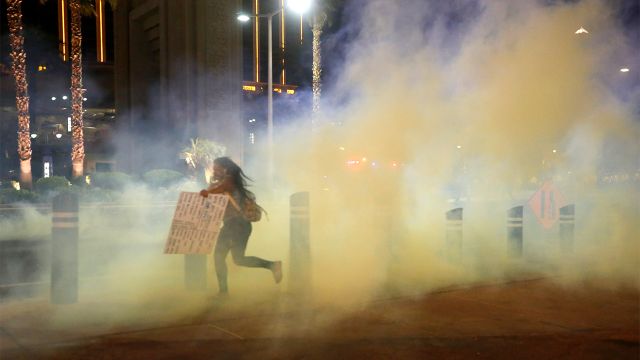
A protester runs through tear gas on the Las Vegas Strip on Sunday, May 31, 2020, in Las Vegas (AP Photo/Steve Marcus)
Those looking to Trump and his administration for any clues to understanding the current crisis might be forgiven for thinking that the United States has turned the corner and that the coronavirus is a thing of the past. The reality, however, is starkly different.
As of yesterday, the official COVID-19 death toll in the United States stood at nearly 109,000. The number of those infected with the virus is over 1.9 million and continues to increase. These numbers, widely regarded as underreported, would have been even worse but for the stringent lockdown measures that had been put in place more or less since mid-March. And now, despite the dire warnings of public health experts, those measures are being relaxed around the country. State after state, responding to the bullying tactics not just of the Trump administration, but also the initiatives of Democratic governors, has started opening up, setting the stage for what experts warn will be a far worse wave of infection in the coming months.
In this context, epidemiologists have issued grave warnings about the dangers of the ongoing mass protests. Politicians, like Mayor Eric Garcetti of Los Angeles, have tried to cast themselves as caring human beings by warning people to stay at home since such gatherings could become “superspreader events.” It is indeed true that social distancing is practically impossible in such situations, as is a guarantee that all participants would be wearing facemasks or any protective gear. Specific aspects of protest gatherings—yelling and chanting in close quarters—create a situation that is ripe for spreading contagion.
What the New York Times report, however, makes clear is that it is not just the gathering of citizens in close quarters that is dangerous. The specific tactics that are being employed by the oppressive arm of the state apparatus seems almost calculated to ensure the continuation, and increased virulence of the pandemic—herding protesters into smaller areas citing “crowd control”; shoving large numbers of people into vans, buses and holding cells; and using tear gas to disperse crowds.
The immediate effects of tear gas—coughing, stinging in the eyes and throat that can last for about 30 minutes—are only the tip of the iceberg. A 2012 study conducted by the US Army on the effects of CS gas, the main component of tear gas, found that recruits exposed to the agent had a substantially higher risk of acute respiratory illness several days after exposure.
Unlike the physically fit Army recruits, many people on the streets might have underlying conditions and thus the effects of the gas could be even worse. Sven-Eric Jordt, a Duke University researcher who has studied the effects of tear gas, told the New York Times that he was shocked at how often tear gas was being used against protesters and that he was “really concerned that this might catalyze a new wave of COVID-19.”
Tear gas, long used as a riot-control tactic by states, has been linked to higher risk of chronic bronchitis and all kinds of lung ailments. While the research on the effects of the gas has not kept pace with its actual usage, it is considered harmful enough that its use is prohibited in war. Given the nature of the coronavirus pandemic, its use should be considered beyond the pale in any context. Its indiscriminate use by the police, and the incitement to use such tactics by the Trump administration, is yet another illustration of the ruling elite’s callousness and complete disregard for the lives of the working class.

Canadian establishment shrugs off Trump’s authoritarian power grab, voices “horror” over mass protests

Roger Jordan & Keith Jones

The eruption across the United States of mass multiracial, multi-ethnic protests against racist police violence and the Trump administration’s incitement of a vicious military-police crackdown have shaken Canada’s ruling elite. While glossing over the dangerous implications of Trump’s shredding of constitutional prohibitions on the deployment of the military against the American people, the comments of Canada’s political leaders and corporate media underscore that their greatest fear is that the demonstrations now sweeping the United States will trigger an explosive upsurge of the class struggle in Canada.
Mimicking the Democratic Party’s fecklessness, no political leader in Canada has directly criticized Trump’s decision Monday—in what amounts to a bid to establish a presidential dictatorship—to arrogate the power to unleash the military against peaceful protesters.
Asked at his daily coronavirus briefing Tuesday for his opinion of the Trump-incited police rampages against demonstrators, the President’s smearing of the protesters as “terrorists,” and his vow to “dominate” the street with the military, all Canadian Prime Minister Justin Trudeau could muster, after a lengthy 21-second pause, was: “We all watch in horror and consternation at what is going on in the United States.” Pressed by a reporter to condemn Trump’s use of heavily armed police to expel peaceful protesters from a park near the White House, Trudeau deliberately avoided doing so. “Canadians,” he answered, “need a government that will be there for them, that will support them and that will move us forward in the right direction, and I will do that.”
There was one grain of truth in Trudeau’s response: the ruling elite is horrified by the emergence of a mass working class movement in opposition to police violence, state repression, and social inequality. It is terrified that the political and social destabilization of its key military strategic partner will undermine Canadian imperialist interests around the world, and that the wave of protests in the US, the largest since the 1960s, will fan social opposition in Canada, demonstrating the class unity of workers on both sides of 49th parallel.
To conceal the class character and significance of the protests, Trudeau, together with Conservative leader Andrew Scheer and New Democratic Party leader Jagmeet Singh, have portrayed them as being almost entirely about race relations. Singh, who described Trump’s role as “reprehensible,” avoided any reference to Trump’s move towards authoritarian forms of rule. Instead, he accused people in general of being “passive bystanders” to “hatred and racism.”
The protests, which have been overwhelmingly working class and multiracial, were triggered by the brutal police murder of George Floyd, an African American worker. But they are being fueled by mass anger over decades of savage austerity, endless wars, and the looting of society by the financial oligarchy, as exemplified by the rise of Donald Trump to the presidency and US capitalism’s catastrophic response to the COVID-19 pandemic. While tens of millions have been deprived of their jobs and income, the US has become the center of the pandemic with more than 100,000 acknowledged COVID-19 deaths.
As they do whenever confronted with a crisis, Canada’s political leaders and corporate media have responded to the explosion of working class opposition in the US by brandishing their principal ideological weapon—Canadian nationalism. Desperate to insulate and inoculate Canada from the “social contagion” of class struggle, they relentlessly promote the lie that Canadian capitalism is a more “humane” and just society, qualitatively different from the rapacious dollar republic to the south. Susan Delacourt in the Toronto Star observed, “While Donald Trump was lashing out over mass civil unrest in his country on Monday, Canadians were getting practical protest advice from top-level government officials.”
Another variant on this theme was provided by the Globe and Mail ’s Gary Mason, who placed all the blame for the social convulsions shaking the US on the figure of Trump, who has apparently descended from the sky to infect an otherwise healthy social and political order. “The US president,” wrote Mason, “is the embodiment of white privilege. … At a moment in the country’s history that cries out for leadership, that yearns for someone to speak to a country that is hurting and frightened and doesn’t know what tomorrow will bring, he is incapable of such empathy. He is devoid of anything that even slightly resembles the common touch” While left unsaid, the implication was clear, Canada’s ruling elite has such a leader in Trudeau.

The shambolic state of Canadian democracy

The Canadian bourgeoisie’s refusal to publicly acknowledge the class character and social grievances animating the US protests says more about that state of Canadian society than it cares to admit. Over the past four decades Canada, like the US, has witnessed a massive growth in social inequality and brutalization of society. For the better part of a quarter century, it has been almost perpetually at war, and the ruling elite has increasingly sought to criminalize social opposition.
The solidarity protests that have been joined by tens of thousands in Toronto, Montreal, Vancouver, Halifax and other cities in recent days underscore that a process of political radicalization among workers and young people is well under way. This has no doubt been further fueled by the ruling elite’s response to the pandemic, which has been to bail out the banks and big business to the tune of $650 billion while placing workers on rations. More than 7,000 Canadians have perished from COVID-19, and 25 percent of the labour force has lost their jobs.
As in the US, democracy in Canada is in shambles. Following the September 11, 2001 attacks, the ruling elite enthusiastically joined George W. Bush’s “war on terror,” including the deployment of military forces to Afghanistan and the erection of a police state infrastructure. Both Liberal and Conservative governments have instituted legislation attacking basic democratic rights and have used the same concept of “domestic terrorism” now invoked by Trump to justify his military crackdown to intimidate and suppress protests. In 2016, a Liberal government minister told big business at a closed-door meeting that the government was prepared to deploy the army against anti-pipeline protests. This discussion was given new life earlier this year during the railway blockades in support of the Wet’suwet’en land rights protest. The blockades were ultimately broken up by the police, but only after substantial sections of the ruling class clamoured for the army to be sent in.
The ruling elite’s readiness to abrogate democratic forms of rule has been proven time and again. It was Trudeau’s own father, Pierre Elliott Trudeau, who seized on two kidnappings by the FLQ in 1970 to invoke the War Measures Act and deploy troops on the streets of Canadian cities amid an upsurge of militant working class struggles. Trudeau continues to defend his father’s political legacy, including the detention without charge of hundreds of leftists in Quebec.
In the midst of the 2008 economic crisis, Prime Minister Stephen Harper was strongly supported by the ruling elite when he shut down parliament to prevent the fall of his government, using the anti-democratic powers of the unelected Governor General in what amounted to a constitutional coup. This manoeuvre enabled his right-wing government to cling to power for a further seven years and launch a devastating onslaught on the working class, including the virtual abolition of the right to strike, sweeping social spending cuts, the promotion of Canada as a “warrior nation,” and the whipping up of Islamophobia. Harper’s willingness to ride roughshod over democratic rights was enthusiastically applauded by the Globe, which hailed him during the 2011 election campaign for his “bullheadedness.” Trudeau’s trade union-backed Liberals have picked up where Harper left off in 2015, persisting with austerity, accelerating the buildup of the military, and expanding the powers of the national security apparatus.
As in the US, the ruling elite is increasingly promoting the far right. Police and the management of FCL, one of the largest companies in Western Canada, have collaborated with the anti-immigrant, ultraright United We Roll Group in violent attacks against 750 locked out oil refinery workers in Regina.
Trudeau, his Liberals, and the dominant sections of the Canadian bourgeoisie were undoubtedly taken aback by Trump’s election in 2016. Subsequently, they lent support to the anti-Russia campaign that was spearheaded by the US intelligence agencies and promoted by the Democrats, with the aim of removing Trump by methods of intrigue and palace coup.
Now they fear that Trump’s provocative actions could trigger a social explosion that could threaten capitalist rule. But their opposition is of a tactical rather than a principled character.
Like the faction of the US oligarchy aligned with the Democratic Party, the Canadian bourgeoisie fears a mass popular upsurge of the working class against Trump, far more than it does the US President’s turn to authoritarian forms of rule.
This is demonstrated by the Trudeau government’s record of close cooperation with Trump and his administration. Within days of Trump’s election, the Liberals agreed to renegotiate the North American Free Trade Agreement (NAFTA), which had been one of Trump’s main campaign pledges. Ultimately this resulted in USMCA or NAFTA 2.0, a trade war bloc aimed at the global rivals of US and Canadian imperialism, above all China.
In keeping with the orders of Canada’s “newspaper of record,” the Globe and Mail, which insisted Canada must be “inside” Trump’s walls, the Liberal government has worked with Trump’s fascistic thugs in Immigration and Customs Enforcement to persecute and deport immigrants. The Trudeau government has also expanded Canada’s role in Washington’s three principal military-strategic offensives against China and Russia, and in the oil-rich Middle East, and assisted US imperialism in its intrigues and aggression in Venezuela and elsewhere in Latin America.

The military strategic partnership between Canadian and US imperialism

Whilst Canada’s ruling elite has bristled at the adverse impacts some of Trump’s “America First” policies have had on their wallets and geostrategic interests, they have egged on the purported “human rights” advocate and “progressive” Trudeau in his pursuit of closer ties with Trump-led Washington.
In her speech on the release of the Liberals’ national defence policy in June 2017, Foreign Minister Chrystia Freeland hailed the “outsized role” US imperialism has played since the Second World War in creating and sustaining an “international rules-based order,” that is, in defending and stabilizing world capitalism under US economic and geopolitical dominance.
She reaffirmed Ottawa’s commitment to the Canada-US military security partnership that has formed the cornerstone of Canadian imperialist strategy since 1940, and which saw Canada serve as a key US ally throughout the Cold War, and join a never-ending series of US-led wars, including in Yugoslavia, Afghanistan, Libya and Iraq over the past quarter century.
But Freeland had to acknowledge that the US-led postwar order was unraveling. Canada, she declared, would therefore need to do more to assist its strategic partner in upholding North American global dominance, including through “hard power,” i.e., the waging of war.
The deepening social crisis in the United States and its precipitous global economic decline, processes which have accelerated dramatically over the intervening three years, are rapidly eroding the material and ideological foundation of Canadian imperialism’s predatory partnership with Washington and Wall Street.
The United States is no longer a force for global capitalist stability, but a source of increased conflict and friction, as it pursues aggression and unilateralism around the world in a desperate attempt to reverse its decline and beat back rivals. Washington no longer has the economic heft or inclination to enforce a “rules-based order;” it has, in fact, played the leading role in tearing it down. And how can Canada’s “progressive” politicians cloak the pursuit of profits and strategic advantage in “human rights” and “democratic” rhetoric when its closest ally embraces dictatorial forms of rule and launches brutal military police crackdowns on peaceful protesters producing popular revulsion around the world?
For the Canadian ruling elite, which has always benefited from a close partnership with the dominant imperialist power of the day, this has created an unprecedented crisis with no obvious solution.
Notwithstanding Trudeau’s desire to accommodate himself to Trump, powerful sections of the ruling circles are increasingly hostile to his strategy, arguing that Canada must pursue an even more aggressive policy. Foreign policy experts are openly discussing the outdated character of the Liberals’ 2017 defence policy statement, since no “rules-based order” to speak of exists.
One faction is pushing for an even closer alliance with Trump. In an editorial Monday, the Toronto Sun assailed Trudeau for making “political sideswipes” at Trump on the issue of racism and not “denouncing” the protesters for “violence and riots.” Just two weeks earlier, the Sun suggested that Trudeau’s ouster would be warranted if he fails to take a harder line towards China. While the Liberals have lined up behind Trump’s aggressive moves against Beijing, the Sun and other right-wing forces are angered by Trudeau’s hesitation over excluding Chinese tech giant Huawei from Canada’s 5G network, among other issues.
Trump’s shift in the direction of a presidential dictatorship will only throw fuel on the fire of these factional disputes. But whatever their disagreements, all sections of the ruling class are implacably hostile to the working class and, as demonstrated in their response to the events in the US, complicit in the assault on democratic rights. Their principal concern is how best to advance the global interests and ambitions of Canadian imperialism under conditions of the deepest crisis of world capitalism since the Great Depression. In the final analysis, this means escalating military violence abroad and ratcheting up the exploitation of the working class at home.
In opposition to this, workers and young people in Canada must unify their struggles with their class brothers and sisters in the United States to beat back Trump’s presidential dictatorship and the turn towards authoritarianism and war that is supported by the ruling elites of both countries. This requires building the Socialist Equality Parties of Canada and the United States to provide the mass struggles now erupting with a socialist and internationalist program and perspective.

European media outlets fear bitter class struggles in the US

Peter Schwarz

“The image of the United States as the centre of Western civilisation is collapsing before our eyes. Will it be possible to rebuild the old image again?,” commented the Polish daily newspaper Rzeczpospolita on Tuesday with reference to the recent events in the US.
This sums up the fear of substantial sections of the European ruling class. The claim that capitalist private property and the market economy provided the basis for freedom and democracy, and that altogether this amounted to “Western civilisation” has served as the ideological cement for capitalist rule in Europe—and the United States played not an insignificant part in this.
In Western Europe and Germany in particular, it was the US through its economic power and democratic traditions that helped revive the bourgeoisie following its discrediting due to its crimes during the war. In 1990, the American model, although somewhat tarnished even then, played an important role in Eastern Europe in selling the restoration of capitalism and its horrific social consequences as a step in the direction of freedom and democracy.
Reading through the European comments on Monday’s events, one senses that they are not particularly troubled by Donald Trump’s efforts to establish a presidential dictatorship. Rather, they fear the president’s provocative actions could provoke resistance and class struggles that will endanger the capitalist system and spread to Europe. After all, the social and political situation is no less explosive there.
With a few exceptions, the comments acknowledged that the nationwide protests are not just directed against racism, but are motivated by social oppression and exploitation and are being joined by people of all races and ethnicities. They accuse Trump of dividing instead of reconciling. By contrast, they hardly say a word about the mobilisation of the military and the preparations for dictatorship connected with this.
The Norwegian tabloid newspaper Verdens Gang wrote, “Once again it becomes clear how unequal US society is. These problems run deeper than Trump, but the US has never needed a unifying president more than now.”
Germany’s Süddeutsche Zeitung commented, “When the country goes up in flames, the president ought to mediate and unify.” But Trump doesn’t want to and cannot do so. He is “incapable of protecting and calming his compatriots.”
The Swiss Neue Zürcher Zeitung (NZZ) pointed to three key factors it believes are at work, “Racist police violence against blacks, a greater susceptibility of blacks to COVID-19, and an economic crisis that has hit minorities the hardest.” All of this is connected, it continued, adding, “Economic disadvantage leads to a lack of access to health care, which allows health problems to become chronic thus increasing the vulnerability to the lung disease. No wonder that frustration is widespread.”
“In such a situation,” says another comment in the NZZ, “the US needs a unifying figure who can calm the country down, unify it, and lead it forward in cooperation with other political forces.” But Trump is doing what he does best, “polarising the country and inciting people against each other.”
The Tagesschau (a news and public affairs programme) on Germany’s public broadcaster ARD commented, “An uprising is the language of those not being listened to. With words of reconciliation, Donald Trump could calm things down quickly. Instead, he is escalating the situation with ruthless Rambo rhetoric.”
The suggestion that the situation could be brought under control if only Trump would give up his Rambo rhetoric is of course absurd. As the WSWS has explained in numerous analyses and comments, the preconditions for the current social explosion have been brewing for a long time. The Democrats have contributed no less to this process than the Republicans and Trump. The gulf between rich and poor increased more rapidly under Obama than any of his predecessors, and police violence continued apace.
The Democrats, much like the European media, fear that Trump could provoke a revolutionary uprising that could no longer be controlled. This is why they are doing everything to evade the issue and suppress the protests against Trump, with whom they agree on virtually every question of domestic, social and foreign policy. Like the German bourgeoisie in 1933, they fear a mass movement of the working class more than a fascist dictatorship.
In Europe, preparations for authoritarian forms of rule and dictatorship are already far advanced. In Hungary and Poland, the parties in power have suspended basic democratic rights. Italy’s far-right Lega, which was in government for a year-and-a-half, responded to Trump’s Twitter announcement that he would classify the Antifa organisation as a “terrorist group,” by marking the post with a “Like.”
In France, President Emmanuel Macron brutally suppressed Yellow Vest protests with the police and now attacks demonstrations in solidarity with George Floyd. In Germany, the Social Democrats and Christian Democrats made the far-right Alternative for Germany the official opposition in parliament and have implemented its policies in the grand coalition. Anyone who dares to criticise capitalism or resist the growth of militarism is branded a “left-wing extremist” and criminalised. At the same time, neo-Nazi structures within the state apparatus are built and covered up.
The crisis of American democracy, which is the underlying cause of Trump’s attempt to establish a personal dictatorship based on the military, is the product of unprecedented levels of social inequality and endless wars. It cannot be reversed on a capitalist basis. The same process is taking place in Europe. The struggle against the fascist danger requires the independent mobilisation of the working class, which must assume the leadership of the defence of democratic rights.