6 Jun 2020

Australian government hands more cash to big business as recession deepens

Mike Head

Last Thursday, the same day that the Liberal-National government conceded that the Australian economy was officially in recession for the first time in three decades, it announced another handout to major corporations—$688 million for the construction industry.
Over the past three months, the government and its state and territory counterparts have allocated unprecedented amounts totaling more than $250 billion, either in cash or access to cheap loans, for rescue packages targeted to benefit the banks and big business.
Yet the slide into recession has continued, leaving an estimated 2.5 million workers out of work or on short hours—20 percent of the labour force. The statistics released on Thursday show that the slump began before the main COVID-19 pandemic restrictions commenced in the third week of March, and has led to the greatest loss of livelihoods since the 1930s Great Depression.
Treasurer Josh Frydenberg declared Australia was in recession after the economy officially contracted 0.3 percent in the first three months of 2020, with a much worse result expected for the current June quarter. The statistics show only the initial impact of the coronavirus, which came on top of a global downturn over the previous three months and the catastrophic summer bushfires.
If not for government spending to prop up business, the drop in gross domestic product (GDP) would have been 0.7 percent. Household consumption plummeted 1.1 percent in the quarter, the worst result in 34 years, pointing to the devastating effect on many working-class households.
This blow has intensified since the end of March. Updated retail figures for April, published this week, showed that turnover plunged 17.7 percent in the month, the biggest drop ever recorded.
Frydenberg prematurely claimed that Australia would avoid an earlier predicted GDP drop of more than 20 percent in the June quarter, saying that would have been “the economists’ version of Armageddon.” This false optimism flies in the face of the worsening worldwide pandemic, which is causing a severe global recession.
Prime Minister Scott Morrison’s government is trying to use the crash as a reason to ratchet up the drive to fully reopen businesses. Working through the bipartisan “national cabinet,” it is ditching at breakneck speed the safety restrictions that may have limited the COVID-19 outbreak in Australia so far.
But even if this headlong rush, backed by the trade unions and the opposition Labor Party, succeeds in pushing workers back into workplaces, many of their jobs will have been eliminated and mass unemployment will continue.
Melbourne University economics professor Jeff Borland told the Australian Financial Review the “best-case scenario” is that about 850,000 to 950,000 jobs may be regained by the end of September, less than half the job losses.
By then, the government is scheduled to end its JobKeeper wage subsidies and expanded JobSeeker welfare payments, adding to the pressure on workers to take any job they can find, regardless of the pay and conditions.
The March quarter statistics underscored a longer-term economic crisis. Business investment contracted 0.4 percent in the quarter and 2.9 percent for the year. Non-mining investment went backward long before the coronavirus containment measures. It fell 1.7 percent in the three months to March 31 and 6.6 percent through the year.
For all the government’s hype about a “business-led recovery,” capital expenditure plans by business for next financial year have fallen 9 percent to $90 billion, according to figures published last week.
With the government due to hand down a delayed annual budget on October 6, it will demand that the cost of the immense business bailouts be extracted from the working class, both through deeper social spending cuts and through reduced wages and working conditions.
Because of the pandemic, federal government net debt, already at $570 billion, will rise by up to $620 billion extra by the end of this decade, according to Parliamentary Budget Office projections. The budget deficit will reach nearly $200 billion in the next financial year.
Working in close collaboration with the unions, the employers and the government are demanding that the cuts to pay and working hours they jointly imposed at the outset of the pandemic be made permanent and widened.
As the Australian Council of Trade Unions commenced its tripartite talks with big business and the government on such industrial relations “reforms,” the country’s biggest employer, retail giant Woolworths, publicly called for cutting after-hours wage penalty rates, supposedly to “create jobs.”
The Morrison government’s latest corporate subsidy—its $688 million “HomeBuilder” package—epitomises the propping up of big business at the expense of working people. The scheme offers grants of $25,000 to people to buy a new home or undertake a “renovation” worth $150,000 or more.
Only the wealthiest 10 percent of people could spend that much money, and only substantial contractors, not local “tradies,” could undertake work on that scale. That is why the Property Council and the Master Builders Association, representing the major companies, back the government’s bailout.
In reality, millions of working-class households are unable to meet their mortgage payments or pay their rent, with average household debt rising to 200 percent of income long before the pandemic.
The scheme’s only purpose is to try to reverse an underlying home building industry collapse. After the four boom years to 2017–18, when the industry started around 225,000 homes a year, new starts have fallen to around 165,000 this financial year.
Due to the Construction Forestry Maritime Mining and Energy Union (CFMMEU) suppressing workers’ opposition to the lack of physical distancing, construction sites have been kept open during the pandemic. Nevertheless, investment in new and used dwellings fell 2.9 percent in the March quarter and 15.5 percent through the year.
The most blatant feature of the government’s package is the exclusion of spending on social housing. Accommodation is urgently needed for those with the lowest incomes. National Shelter estimates the current shortfall at around 500,000 homes.
About a quarter of public housing applicants in “greatest need” in 2017–18 had been on a waiting list longer than 12 months, according to a study released this week by the Australian Institute of Health and Welfare.
Federal, state and territory governments have presided over the loss of more than 20,000 public housing units during the 10 years to 2017–18. Despite a 55,470 increase in non-government social housing during the decade, the increase had “not kept pace with the growth in households,” the study said.
The housing package once again demonstrates the class bias of the government’s so-called rescue operations, which bolster corporate profits and the wealth of the super-rich at the expense of the working class.

Nissan confirms job cuts as strike against Spanish plant closures continues

Alejandro López

Thousands of Nissan workers, their families and sympathisers are striking, protesting and blocking roads to protest the Japanese automaker’s decision to shut down its Barcelona plant by December. Twenty-five thousand workers are to be directly or indirectly affected by the closure of Nissan’s largest plant in Spain.
Since May 4, amid the resumption of production in its plants after the Socialist Party (PSOE)-Podemos government imposed the reactionary back-to-work policy, unions have called Nissan workers out on strike. The cynicism of the company formerly led by fugitive CEO Carlos Ghosn could not be clearer. They ordered workers back to work on May 4, amid the pandemic, to complete 1,300 unfinished Mercedes vans and then close the factory.
Last week, Nissan reported a US$6.2 billion loss for the fiscal year ending in March, its first annual loss in 11 years. The plant closure is part of a plan to restructure the Alliance, cut costs and raise profits. Under the plan, the company aims to reduce its production capacity worldwide by 20 percent, to about 5.4 million units, and cut its costs by 15 percent. Another Nissan factory will also be closed in Indonesia.
Their aim is to intensify the exploitation of workers by pooling production facilities elsewhere in Europe as well as in South America, South Africa and Southeast Asia.
Last week, soon after the announcement, workers blocked off streets and burned tires outside the plant, located in the Zona Franca industrial area.
Cristina Montero, 43, a single mother with a mortgage who has been working at the Nissan plant for 15 years, told El País, “It’s very tough news. We knew about it, we imagined it could happen, but you never think it’s really going to come true. There are many families who could be left out in the street, and we feel impotence and a lot of anger.”
Another Nissan worker with 21 years seniority, José Antonio Pina, said, “We have been doing badly for many years, and now it has been a total collapse.”
Outside, hundreds of workers gathered to hear the head of the Workers Council, the trade union delegate Juan Carlos Vicente, after a meeting with company executives.
In an orchestrated announcement to the media, Vicente complained, “They’ve left us to die,” and asserted that workers “will not make it easy” for Nissan to shut down: “We now have six months to try and make them change their plans. … This is a long process, we have to pressure both the politicians and the company so that they understand that Nissan must stay, because around 20,000 families are at risk, and the industrial fabric of Catalonia and Spain are at stake.”
Nissan workers’ fight against the closure is arousing enormous sympathy and solidarity. The following day, thousands of autoworkers gathered at the doors of the four main Nissan dealerships, shouting with fists raised, “War, war, war, Nissan will not close!” As protesters marched and blocked roads, dozens of vehicles honked their horns in support; neighbours clapped or raised their fists.
Yesterday, Nissan workers organised a slow march of hundreds of vehicles in the centre of Barcelona. Autoworkers, many accompanied by their families, also received support from taxi drivers, who have been waging a bitter struggle against Uber for over a year.
Amid this jobs massacre, workers now confront a concerted attack by the PSOE-Podemos government, the Catalan nationalist-led regional government, and the trade unions to isolate, wear down and finally suppress the strike.
The unions and the PSOE-Podemos government are sowing illusions that negotiations with Nissan remain open, and that there still exists a possibility of the plant remaining open. The Works Council, run by the Podemos-linked Workers Commissions (CC.OO) and pro-PSOE General Union of Labour (UGT) unions, has argued for delaying any escalation of the strikes and protests until the business meeting of the Nissan executives on June 6, insisting that Nissan could reverse its decision.
In a joint statement with the Catalan regional government, the Foment Del Treball business association, and small business groups, the CCOO and UGT, urged “Nissan to reconsider the decision bound with their responsibility with their workers.” They added that they would “continue working to maintain Nissan’s supply chain in Catalonia and value the unity of action of the different administrations, employers and unions to avoid confirming the definitive closure of the plants in Catalonia.”
Similarly, Economic Affairs Minister Nadia Calviño claimed she is willing to look for “an alternative solution,” adding, “We have proposed to the company to implement a process of discussion and negotiation to see how this process can be channeled,” since “it is a plant that made strategic sense for the company, being the only one in Europe.”
However, Gianluca De Ficchy, president of Nissan Europe, reappeared to state that the decision to close the Barcelona plant has been taken and is irreversible.
Last week, Nissan indirectly alluded as to why it wanted its plants in Barcelona to remain open until December. Ashwani Gupta, the Japanese company’s global chief operating officer, said that it would close its Sunderland manufacturing plant in the UK if London leaves the EU in a no-deal Brexit. He stated that with the EU being the Sunderland factory’s biggest customer, the tariffs that would come with a no-deal Brexit would mean manufacturing in Britain would not be viable.
Whether in Spain, the UK or France, all the unions are using the same “common front” to lull workers to sleep as they work to increase the exploitation of workers or force workers to accept plant closures.
In Spain’s Nissan plant, the last “common front” of unions, big business and regional and national governments happened in June 2019, when the USOC, CC.OO and UGT accepted a redundancy scheme, backed by the regional Catalan government, affecting 620 workers through early retirement and other cuts. In exchange, Nissan fraudulently committed to making new investments in Barcelona plants.
Spanish unions have even refused to mobilize workers in the other Nissan plants unaffected by the closures, let alone other auto factories of Seat, Mercedes, Volkswagen and PSA. On the same day as Nissan made its announcement, at Ford the UGT and CC.OO signed a redundancy scheme affecting 350 workers from the plant in Valencia, to make the plant more competitive.
This same tactic is now being implemented in the UK, where Nissan announced plans to end a defined benefits pension scheme for hundreds of workers as part of its cost saving measures.
British trade union Unite reacted by announcing that it “is more than willing to help Nissan recalibrate to a changing world but this must not come at the expense of our members’ jobs, terms and conditions or other benefits. In the coming days we will be seeking our members’ views and be sitting down with the company to find a positive way forward for all.”
In neighbouring France, Renault has announced plans for an international wave of plant closings and layoffs, including 15,000 jobs worldwide, 4,600 of these in France. The French unions are not even organizing symbolic protests. Philippe Martinez, the head of the Stalinist General Confederation of Labour (CGT) union, responded with impotent and nationalist rhetoric. “We are very upset,” he said. “What Renault needs is to produce Renault cars in France and work on creating French jobs.”
Whether in Spain, the UK, France or other countries, workers confront the same reactionary trade union tactics to divide workers on national lines, trying to sell multinationals their workers’ labour power for a cheaper market rate than other countries.
A fight against this requires the construction of an international movement among workers. The opposition of autoworkers, including strikes and other struggles, can only be effective if it is mobilized across national borders against transnational companies, which shift production from one country to another to maximize profits. This requires building rank-and-file committees of action independent of the nationalist and pro-capitalist trade unions.

Plummeting vaccinations in the US and globally put millions of children at risk

Katy Kinner

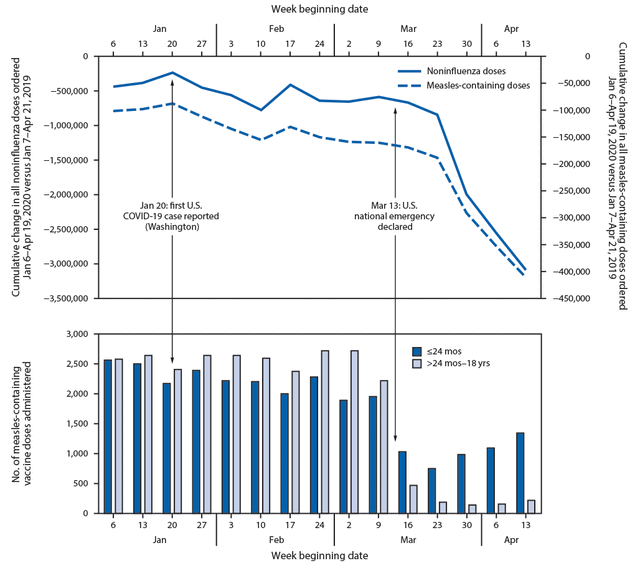
New data gathered by the Centers for Disease Control and Prevention (CDC) points to the alarming effects of the COVID-19 pandemic on routine pediatric vaccinations. Data from two different sources examined—Vaccines for Children Program (VFC) provider order data and Vaccine Safety Datalink (VSD) administration data. Both sources showed a significant decline in routine pediatric vaccinations beginning one week after the national emergency declaration on March 13, 2020.
Vaccines for Children Program (VFC) is a federally funded vaccine program that accounts for roughly 50 percent of pediatric vaccines in the US, providing vaccines to the under- and uninsured. The Vaccine Safety Datalink (VSD) data is collected from a collaborative project between the CDC and eight US health care groups serving publicly and privately insured patients.
Both data sets compared two different weekly intervals: January 7, 2019–April 21, 2019 (time period A) and January 6, 2020–April 19, 2020 (time period B). Data was further separated to examine all non-influenza vaccines and measles-containing vaccines only, as well as age group categories of under 24 months and over 24 months–18 years of age.
[Source: CDC Authors: * VFC data represent the difference in cumulative doses of VFC-funded noninfluenza and measles-containing vaccines ordered by health care providers at weekly intervals between Jan 7–Apr 21, 2019, and Jan 6–Apr 19, 2020]
As the graphs above show, the administration of non-influenza vaccines and measles-containing vaccines dropped precipitously after January 20, when the first COVID-19 case was reported in the US. On April 13, non-influenza vaccines from time period B were down 3 million as compared with time period A of the previous year. Measles-containing vaccines dropped 400,000 doses in time period B as compared with time period A.
The decrease was less prominent in the under 24 month age group for both vaccination categories, suggesting that the systematic prioritization of vaccinating this age group before and after the start of the pandemic has had a minor effect.
On a global scale, the decline in vital pediatric immunizations is of monumental proportions. The WHO dedicated its May 22 press conference to the issue of routine immunizations during COVID-19, with guest panelists Henrietta Fore, UNICEF executive director and CEO of Gavi, and Dr. Seth Berkley of the Vaccine Alliance. Together, the WHO, UNICEF and Gavi warned that at least 80 million of the world’s children under the age of one are at risk of vaccine preventable diseases such as diphtheria, measles and polio.
Immunization programs became widely available in high-income countries beginning in the 1950s. To increase access to immunizations, the Expanded Programme on Immunization (EPI) was founded in 1974 with its first major goal being the eradication of smallpox. Just six years later, as a result of coordinated and international participation, smallpox was eradicated worldwide.
Since the smallpox milestone, EPI has continued to play a major role in the rising levels of immunization around the world contributing to the 86 percent global child protection rate from vaccine preventable diseases. In 1974, only 5 percent of the world’s children were protected from the aforementioned diseases. Globally, the WHO estimates that vaccinations saved 10 million lives in the years 2010 through 2015.
COVID-19 threatens to unwind this progress. Fifty-three percent of the 129 countries with sufficient vaccination data have reported moderate to severe decline or total suspension of vaccination services in March to April 2020.
Mass immunization campaigns, especially crucial in developing countries with fewer resources, have been severely cut back, putting children at risk for diseases like cholera, measles, meningitis, polio, tetanus, typhoid and yellow fever. Mass immunization campaigns for measles and polio have been particularly hard hit with immunization campaigns put on hold in 27 countries for measles and 38 countries for polio.
There are several factors contributing to the decline of immunizations. Regular health clinic appointments and mass immunization campaigns have been halted in the name of social distancing or because of a lack of personal protective equipment (PPE). Health workers have been pulled from clinics and campaigns to work with COVID-19 patients instead. Parents, understandably, are fearful of bringing their children to hospitals or clinics for regular check-ups for fear of exposing their families to COVID-19.
The comeback of vaccine preventable diseases as a result of a decline in immunization rates rivals the global threat of COVID-19.
One study from the London School of Hygiene and Tropical Medicine seeks to develop a risk-benefit analysis of routine childhood immunizations against risk of COVID-19 infections in Africa. While the study is currently in the process of peer-review, its results are worth a closer look.
The study takes into account that upon infection with COVID-19 a child would likely infect his or her entire family. Even with such risks accounted for, the researchers found that for every one COVID-19 infection acquired during the process of routine immunization, 140 children’s lives could be saved by maintaining immunization schedules. While health clinics and mass immunization campaigns must be prepared to implement infection control protocols to decrease COVID-19 infections, the above data clearly indicates that regular immunizations must continue.
Furthermore, the disruption of global systems of immunization threatens to slow or halt the delivery of a COVID-19 vaccination when it is available.
To further highlight the global crisis of missed vaccinations, it is necessary to zoom in on the measles crisis. In an April edition of Nature, an article titled “Why measles deaths are surging—and coronavirus could make it worse” outlines the risk of the spread of measles, especially in developing countries. The article explains that in many countries, “measles is a constant, simmering at low levels until the number of children susceptible to the virus builds up and it takes off.”
Measles is the most contagious known virus in the world, with a reproduction number—the scientific term used to quantify the infectiousness of a virus—of 12 to 18. For comparison, COVID-19 has a reproduction number between 2 and 3 and Ebola is estimated at 1.5–2. Measles is spread by respiratory droplets that can remain in the air for hours, infecting those who enter a room hours after a measles infected person has exited.
With this high of an infection rate, immunization rates of a population at minimum must be 92 percent to keep the virus at bay. Before the COVID-19 outbreak, many countries had low measles immunization rates. The Democratic Republic of the Congo, for example, had a 57 percent immunization rate against measles. These figures are worsening due to COVID-19, creating the perfect conditions for a worldwide measles outbreak. Global measles immunization rates are currently stalled at 86 percent.
Under-immunization of children in one country presents a risk in all countries. In addition, the rapid spread of COVID-19 in the Southern Hemisphere presents the possibility of a new flare-up in the US later this year. Pathogens don’t recognize borders. The fight against infectious disease will inevitably fail within the outdated nation-state system. Instead, the mobilization of society against the pandemic requires internationally coordinated scientific planning, which at every point comes into conflict with the pursuit of private profit and individual wealth.

US colleges and universities continue jobs bloodbath as they press to open in the fall

Alexander Fangmann

Colleges and universities throughout the United States are carrying out mass layoffs, furloughs and pay cuts of university workers, including faculty, in response to budget pressures stemming from the COVID-19 pandemic. Facing declines in enrollment and tuition revenue and losses from unused dorms and other facilities, public universities and colleges are additionally being hit by cuts to state spending on higher education.
A report in the Chronicle of Higher Education suggested that as of May 26, at least 48,086 higher education employees have been affected by layoffs or furloughs, whether temporary or permanent. The Chronicle report also noted that Bureau of Labor Statistics numbers from early May suggest there were 19,200 fewer workers in higher education this March than there were in March of 2019.
Among the universities facing deep cuts is the University of Wisconsin system, which is facing cuts that University of Wisconsin-Milwaukee chancellor Mark Mone has called “catastrophic.” The 26 campuses of the UW system stand to see a potential revenue collapse of up to $100 million for next year out of a total budget of $650 million, on top of this year’s $18 million deficit. Adding to the damage is a five percent cut in state funding carried out by Democratic governor Tony Evers in collaboration with the Republican-led state legislature.
At the University of Hawaii, the official in charge of the budget, Kalbert Young, told the university’s board of regents in a meeting, “There will be prolonged, possibly perpetual changes to how the university is run.”
Out of several presented budget scenarios, in the worst case the university would stand to lose 25 percent of its funding from the state and 15 percent of its tuition revenue. This would translate to a $181 million decline from its current $1 billion operating budget.
Jan Sullivan, a UH regent and COO of Oceanit, said “We have to do cuts, and they have to be done in a way that will leave the university standing.” Young warned the regents not to get too specific about plans, saying, “I don’t know if anyone would want to throw ideas out here in a public meeting right now.” He added, “The depth will be significant, maybe never seen.”
At the University of Texas at San Antonio, president Taylor Eighmy told university workers in a letter to prepare for budget cuts of 9–10 percent, which would include layoffs.
A group of faculty department chairs responded, “As a group we are committed to ensuring that student success and research excellence are maintained as the core principles underlying our budgetary decisions.” If departments are forced to get rid of teaching and research faculty, the council said, “We are very concerned that those two core principles will be seriously undermined by a 9 percent cut to academic programs.”
In response to shortfalls, the University of Alaska board is considering the merger of the University of Alaska Southeast into the University of Alaska Anchorage, the University of Alaska Fairbanks or possibly both. Also on the table are cuts to around 50 degree or certificate programs. Last year, the UA board agreed to $70 million in cuts to state funding over three years after governor Mike Dunleavy proposed cutting $135 million from the system.
Even in states that are not cutting funding outright, schools will still face funding shortfalls and budget cuts. While Illinois kept state funding for colleges and universities flat, they will still be forced to make cuts given regular and pandemic-driven cost increases. Illinois state support of higher education is also still lower than it was in 2015, even without taking inflation into account. Moreover, many Illinois schools, like their counterparts elsewhere, are public in name only, with the majority of their revenue coming from other sources, primarily tuition.
The concern to stem the tide of financial losses on campuses, including extremely lucrative college sports, especially football, has led many schools to announce they will be opening in the fall, despite very real concerns about the ongoing pandemic and the near-impossibility of maintaining social-distancing or otherwise preventing the spread of COVID-19 on college campuses.
According to the Chronicle of Higher Education, which has been tracking announcements, 68 percent of the 890 colleges being tracked are planning for in-person instruction in the fall. Many of the schools anticipate ending the in-person part of the fall term at the Thanksgiving break, in order to reduce the possibility of travel causing a coronavirus outbreak. Only a minority of the schools being tracked, 7 percent, are planning for instruction to be completely or largely online.
The drive for an in-person fall semester has led some college and university presidents to call for blanket immunity from COVID-related lawsuits should students get sick or die. In a May discussion between Vice President Mike Pence, Education Secretary Betsy DeVos and 14 college presidents, University of Texas at El Paso president Heather Wilson, a former Republican congresswoman and Secretary of the Air Force, suggested the best way the government could be helpful “is to have some kind of liability protection.”
US President Donald Trump has linked the reopening of college campuses to the overall reopening of the economy, saying, “I don’t consider our country coming back if the schools are closed.”
Senate Republicans, led by Tennessee Senator Lamar Alexander, have floated the idea of a general protection from liability for colleges and schools as long as they follow “reasonable practices.” Linking this protection from lawsuits to school reopening, Alexander said, “Schools and businesses will be less likely to reopen if they think they’ll be sued if someone gets sick.”
Regardless of whether any action is taken at the federal level, some states have already granted blanket immunity to colleges. North Carolina may have gone furthest, giving immunity to businesses and schools with no specific requirements to follow, while Utah and Alabama have approved measures limiting lawsuits or raising the bar of proof in such cases.
Despite the very real danger to many faculty and students from the ongoing COVID-19 pandemic, the faculty unions have been largely working to push for reopening along the lines being used by states, accepting as good coin the idea that it is possible to maintain social distancing or other effective disease-control measures on campus.

Over 20,000 tons of diesel spilled in Russian arctic river

Clara Weiss

On May 29 an accident at a power plant near the northern Siberian city of Norilsk led to a massive spill that released 23,000 tons of diesel into the environment, most of which has drifted into the Ambarnaya River. It is one the greatest environmental catastrophes to ever occur in the Arctic, and is being compared to the Exxon Valdez spill of 1989, when about 39,000 tons of fuel flooded into the waters off the coast of Alaska.
Aerial view of the oil spill into the Ambarnaya River
The company which owns the plant, Norilsk Nickel, stated that the accident likely occurred because thawing permafrost caused an oil tank to collapse. According to Norilsk, the tank rested on 30-year-old pillars. An area of 350 sq kilometers (135 sq miles) has been contaminated. The Ambarnaya is now crimson red.
Special booms could contain the spill. However, Alexei Knizhnikov from the World Wildlife Fund Russia warned, this “doesn’t mean that toxic elements have not gotten into the water of the lake [Pyasino]. Unfortunately, the most poisonous elements of diesel fuel are aromatic compounds like benzol, toluene, ethyl benzene, xylene, which will massively mix with water. It is impossible to collect them using oil booms.”
Environmental groups have noted that cleaning up the spill is difficult because of its scale and the geography of the river, which is located in a remote and swampy area. According to Oleg Mitvoi, the former deputy head of Russia’s environmental agency Rosprirodnadzor, there has “never been such an accident in the Arctic zone”. The clean-up, he said, could take between five and ten years, and cost up to $1.5 billion.
The criminally slow response by both the company Norilsk Nickel and regional authorities has dramatically amplified the scale of the disaster.
Even though the catastrophe occurred on May 29, regional authorities did not take any action until two days later on May 31, when images of the spill had spread on social media. Authorities claimed that they were not aware of the incident until oil oozed onto a highway, causing a car to catch fire.
Sergey Verkhovets from Greenpeace Russia said that in the case of such a catastrophe two days is “a very long time.” He also stated that the company had been reckless in its exploitation of natural resources under conditions where thawing permafrost—a result of global warming—has dramatically transformed the ecological landscape.
Verkhovets warned that the impact of the oil spill would be felt for “many years to come”, further polluting the already damaged water systems in the region. The indigenous population, which depends on these rivers for its livelihood, will be particularly impacted.
“We are talking about dead fish, polluted plumage of birds and poisoned animals”, he said. Authorities have assured the population that the oil has not polluted the ground water, but whether this is true or not is far from certain. About 175,000 people live in the nearby city of Norilsk.
On June 3, Russian president Vladimir Putin, in a highly-staged televised address, chided the company and declared a federal state of emergency. A federal investigation was initiated and state television made a point of showing the foreman at the power plant being led off to jail in handcuffs. He is being made the main scapegoat of the disaster, and is being charged for violating environmental protection rules. He may face up to five years in prison.
In reality, however, it is the government and Norilsk Nickel that bear primary responsibility.
Norilsk Nickel is one of the largest producers of nickel, platinum and copper in the world, and one of the most influential and valuable in Russia. The multi-billion state-owned company has been at the center of intense struggles between Russian oligarchs since the destruction of the Soviet Union and restoration of capitalism. It is now headed by Vladimir Potanin, who is worth over $25 billion, and is close to President Vladimir Putin. In a statement on Friday, Potanin claimed the company would pay for the clean-up of the disaster.
Environmental protection regulations in Russia are notoriously poor, and systematic violations by companies are routinely overlooked by state authorities. Four years ago, an accident at another plant of Norilsk Nickel in the region resulted in an oil spill that turned another river red and transformed an area twice the size of Rhode Island into a “dead zone.” The company was fined less than $1,000, which made clear signal that it had nothing to fear in case of future disasters.
The catastrophe on the Ambarnaya underlies the dangers bound up with the “new scramble for the Arctic” by the major powers and corporations. Rapidly warming temperatures have made the exploitation of raw material resources in the region much more dangerous from an environmental standpoint, but also more alluring for major corporations.
At the same time, the Arctic, which is of major economic and geostrategic significance to Russia, has become a central arena of the US imperialist drive to encircle Russia. This further heightens the danger of military and environmental catastrophes.
As part of the standoff with the US, Russia launched a floating nuclear power plant in the Arctic Sea late last summer. The ship has been called a “nuclear Titanic” and “floating Chernobyl” by environmental groups that warn of the potentially catastrophic consequences of any accident on board. Just a few months before the launching of the floating nuclear power plant, a fire on a Russian nuclear submarine in the Barents Sea killed 14 high-ranking Russian navy officers. An aide to the commander of Russia’s navy later ominously warned that, “With their lives, they saved the lives of their colleagues, saved the vessel and prevented a planetary catastrophe.”

As the world approaches 7 million cases of COVID-19, the pandemic casts a broader net

Benjamin Mateus

A little more than four months had passed since the declaration of the Public Health Emergency of International concern on January 30, when only 80 cases of COVID-19 existed outside of China, and no deaths had been recorded. By the close of this weekend, the number of cases of COVID-19 around the world is expected to exceed over 7 million, and the number of deaths will have continued its climb with over 400,000 victims who should by all accounts still be alive had the governments of a multitude of nations taken the necessary public health measures as the declaration required.
The inability of the producing nations to heed the critical concerns raised by various health institutions and infectious disease experts has placed the world in a calamitous position where every social aspect of life on the planet has been threatened. The protests that have erupted since the murder of George Floyd more than 10 days ago in Minneapolis, Minnesota, and the international and multiracial character of this mass movement, speak to the fundamental inability of capitalism to address the most urgent and necessary needs of society, and instead, indiscriminately value property more than life.
The trend in new daily cases has been consistently climbing for more than two weeks, while case fatalities have halted their decline and began to uptick again. In the categories of total and daily new cases and deaths, the United States has remained a constant presence among the worst-hit nations. With all the promises of expanded testing capacities, the US has not been able to exceed 500,000 daily tests, far below that needed for adequate public health containment measures that need to be instituted. More worrisome, testing centers are being closed, using the protests as an excuse to stop testing.
In the US, the number of new cases, on a seven-day average, has exceeded 20,000 per day since March 29. The decline in fatality cases has stalled. According to the New York Times, California, Texas, Florida, North Carolina, Tennessee, Arizona, Washington and Mississippi have seen recent growths in newly reported cases over the last two weeks.
Massachusetts, Virginia, Georgia, Louisiana, Ohio, Colorado, Iowa and Wisconsin have seen their daily cases hold steady. The White House task force guidance on reopening the country was simply another hoax by this administration and their political accomplices in both Wall Street parties to force workers back to the factories. The Financial Times headline reads, “unemployment rate in the US falls unexpectedly to 13.3 percent. Markets rally as economy adds 2.5 million jobs in May to ease concerns over coronavirus impact.” The Dow Jones Industrial Average climbed 830 points to close at 27,111.
Given the world’s experience with the nature of the outbreak over the last several months in hard-hit countries like Italy, Spain, and, specifically, New York City in the US, the course of the virus in Mexico, Brazil and India bodes disastrous. The curves of their outbreaks continue to accelerate and by all accounts represent only a fraction of the true toll of the pandemic on the poorest who face the main brunt of the consequences. The per capita testing in Mexico is at 2,438 per one million; in India, 3,181 per million; in Brazil, 4,643. Where is the global response in bringing their experience to these regions to aid them in their moment of struggle?
San Lorenzo Tezonco cemetery in Mexico City, Mexico [Credit: Carlos Jasso]
Brazil presently has 614,941 total cases and over 34,000 deaths. The states of Amazonas, Maranhão and Ceara are the hardest hit, though cities like Rio de Janeiro and São Paulo are facing a collapse in their public hospitals. Mexico has 105,680 cases, with 12,545 deaths. Mexico City has suffered the highest case number at 28,389, with 2,862 deaths, however, news sources report that the Mexican government’s number is undercounted by a factor of three. According to a Mexican physician, Dr. Giovanna Avila, “It’s like we doctors are living in two different worlds. One is inside of the hospital, with patients dying all the time. And the other is when we walk out onto the streets and see people walking around, clueless of what is going on and how bad the situation really is.” Reports of patients lying on floors, turned away dying in search of care, and propped up in chairs are reminiscent of images that first poured out of Italian hospitals in Bergamo.
Despite the World Health Organization’s insistence at repeated press briefings that the coronavirus has not demonstrated that it has become more benign and adapting into a seasonal contagion, media outlets have promoted comments by the likes of Dr. Alberto Zangrillo’s, head of the San Raffaele Hospital in Milan, and Matteo Bassetti, head of infectious diseases clinic at the San Martino hospital in the city of Genoa.
Zangrillo: “In reality, the virus clinically no longer exists in Italy. The swabs that were performed over the last ten days showed a viral load in quantitative terms that was absolutely infinitesimal compared to the ones carried out a month ago.”
Bassetti: “The strength the virus had two months ago is not the same strength it has today. It is clear that today the COVID-19 disease is different.”
According to Dr. Francois Balloux, professor of Computational Systems Biology and Director of UCL Genetics Institute at the University College of London, the genetic composition of the viral population that has been screened has not changed much since it first emerged in December 2019. “The outbreak in Italy has been waning over recent weeks despite the relaxation of the social distancing measures previously in place. This is in line with what has been observed in most European countries. The extent to which this is only due to residual social distancing measures in place, or whether seasonality or some other factors are playing a role remains debated. That said, we should definitely not rule out a second epidemic wave later this year.”
In a little-too-late reversal of opinion, Anders Tegnell, Sweden’s infamous state epidemiologist promoting a laissez-faire attitude to containing the epidemic, conceded that stricter restrictions should have been imposed earlier to avoid the high death toll Sweden has faced. “If we would encounter the same disease, with exactly what we know about it today, I think we would land midway between what Sweden did and what the rest of the world did,” he said in an interview on Wednesday, stepping back from his previous endorsement of a controlled herd immunity strategy.
In a world stricken by a lack of therapeutics to treat COVID-19 patients, the scientific community is roiling from its controversy. The Lancet observational study on the increased mortality associated with hydroxychloroquine published on May 22 was retracted on request by the authors this week. “We can no longer vouch for the veracity of the primary data source.” The results of the study had led to the WHO halting their arm of the trial using the medication until safety data could be analyzed to ensure patients were not unduly harmed. They have since resumed their investigation, noting no increased mortality.
Soon after the peer-reviewed study was published, the study came under scrutiny by many researchers who pointed to the study’s implausible numbers, flawed demographics, and inconsistent dosage of medication that stretched the limits of possibility. The supposed multinational, multi-hospital data was obtained through the Chicago-based Surgisphere, an American health care analytics company operated and founded by CEO Sapan Desai, a vascular surgeon. Surgisphere has refused to release the data underlying this and two other important studies despite promising they would. The dataset claiming access to 1,200 hospitals had multiple errors including incorrectly locating Asian hospitals in Australia. There are no indications of how Surgisphere amassed the data. According to the Guardian, one employee was a science fiction author and another an adult model and events hostess.
Countering these developments, two randomized control trials, one published in the New England Journal of Medicine and the other from the recovery trial, reported that hydroxychloroquine offers no benefit as prophylaxis or for hospital patients in decreasing exposure or mortality.
Dr. Mike Ryan, head of emergencies at the WHO, when asked about these controversies, said, “With a story of such huge public interests and 24-hour coverage of those issues, then the normal process of science can seem confusing. I can assure you the actions that were taken in relation to the signal of potential higher mortality of HCQ [hydroxychloroquine] was taken with the best interest of the patients enrolled in that study to ensure that any indication of higher mortality from a peer-reviewed study will be taken seriously.”
He explained that despite the need for studies on the nature of the virus and the illness it causes, the peer review process becomes even more critical. Oversight committees and boards are needed to ensure that public interest and patient protection remains paramount and can’t be superseded. “We cannot rely on a single paper or a press release. We must collectively look at the evidence before consensus is developed.”

Brazil’s President Bolsonaro calls demonstrators “terrorists,” threatens military repression

Miguel Andrade

In a fascist rant delivered during the opening of a field hospital to treat COVID-19 patients, Brazilian president Jair Bolsonaro once again denounced demonstrators joining marches in five Brazilian cities held in solidarity with the protests in United States as “terrorists” and “outcasts” aiming to “break the country.”
He called for governors to deploy the National Guard against demonstrators taking part in new anti-government marches scheduled for Sunday, a day chosen as an answer to the weekly fascist demonstrations held by Bolsonaro supporters on Sundays. These rallies feature Bolsonaro himself and regularly call for a military coup and hail the brutal history of torture and executions of the 1964–1985 military dictatorship.
Bolsonaro’s latest threats came on the heels of a frenzied and terrified reaction by the president and his cabinet to the demonstrations last Sunday by youth joining the global wave of protests against the murder of George Floyd and social inequality, police brutality and racism, as well as the promotion of the latter by the Bolsonaro government. The demonstrations were met with brutal repression unleashed by state-controlled military police soldiers, which in turn protected fascist provocateurs bearing flags of the Ukranian neo-Nazi Right Sector. Protests have grown as Bolsonaro supporters respond to the US marches by holding Ku-Klux-Klan-like nightly marches with torches at the Supreme Court and Congress in an appeal to the most backward and disoriented members of Brazilian society.
Most significantly, however, Bolsonaro’s rant came just three days after an opinion piece published by vice president Gen. Hamilton Mourão published by Brazil’s oldest daily, Estado de S. Paulo, calling for demonstrators’ forceful seizure and arrest. In the article, Mourão fully endorsed the denunciations of Bolsonaro, aping Donald Trump’s rants against “antifa” that the demonstrators were “terrorists” that should be proscribed.
In the opinion piece, Mourão charged that “presenting the last anti-government demonstrations as democratic constitutes a clear abuse” and that it was an abuse to “forget who they are and to portray them as a counterposition to government supporters and transform them into legitimate demonstrators,” adding that “troublemakers were a police issue and not a matter for politics.”
He also resurrected known authoritarian tropes of “outside agitators” to denounce demonstrators for “bringing to our country problems and conflicts of other peoples and cultures.” He further rallied against the senior member of the Brazilian Supreme Court (STF), Celso de Mello, who warned on Sunday of parallels between Brazil and the Weimar Republic in the years preceding Hitler’s takeover as “irresponsible,” dismissing Bolsonaro’s fascist rants as “rhetorical excesses,” whose condemnation might lead “everyone to lose their senses”—that is to say, would justify a violent reaction of Bolsonaro against the Court.
Mourão is a notorious ultra-right coup-monger, that was twice punished while in active duty for political statements against toothless attempts by Congress to review the horrific crimes of the 1964-1985 military dictatorship. He also presided over the ultra-right Military Club, an association of retired high-ranking officials that was one of the active proponents of the 1964 coup.
But Mourão wrote his Tuesday libel with the authority of someone insistently portrayed as the “adult in the room” of the crisis-ridden Bolsonaro administration by the opposition’s former presidential candidates, Fernando Haddad of the Workers Party (PT), Guilherme Boulos of the Socialism and Liberty Party (PSOL), Ciro Gomes of the Democratic Labor Party (PDT) and governor Flávio Dino of the Communist Party (PCdoB).
Sunday demonstrations were an initial expression of a long-suppressed class anger against Bolsonaro and the abysmal social inequality that defines Brazilian capitalism. In an act of political cowardice, the PT called for their supporters not to join the demonstrations scheduled for Sunday in order “not to offer the government, what it desires, the environment for authoritarian measures.” Hours later, the PT stated they were “in solidarity” with demonstrators and calling for them “to take care and not give in to provocateurs.”
There is wide significance to the unleashing of brutal police violence on peaceful demonstrators and the ominous resurrection of the reactionary dictatorship-era language of “terrorism” and “infiltrators” and “external incitement” by Bolsonaro and Mourão after a week in which Bolsonaro’s bourgeois opposition was celebrating police raids on his supporters as the sign of his demise.
The raids had been ordered by Supreme Court (STF) Justice Alexandre de Moraes, who presides over an inquiry on the incitement of far-right demonstrations against the STF by Bolsonaro supporters. It runs parallel to another inquiry, presided by the Justice cited by Mourão, Celso de Mello, on the charges presented by former Justice Minister Sérgio Moro as he resigned, accusing Bolsonaro of interfering in the Federal Police (PF) to protect his son, Rio de Janeiro senator Flávio Bolsonaro. Moro charged that Bolsonaro wanted to suppress investigations that might tie his family to criminal organizations known as “militias” which control gambling and drug trafficking and were also named as responsible for the death squad murder of Rio de Janeiro City Councilor Marielle Franco in 2018.
Both are now at the center of the impeachment articles presented against Bolsonaro by the bourgeois opposition led by the PT, which claims Bolsonaro’s militia ties, interference in the PF and incitement of the far-right threaten the “internal security” of Brazilian capitalism.
One of the leading proponents of such charges of Bolsonaro as a threat to “internal security” of the Brazilian state, Estado de S. Paulo editorialized only a day before Mourão’s threats that “something is moving” in Brazilian society and celebrated that the issuing on Sunday of the so-called “We Are Together” manifesto, a right-wing piece stating that “as was the case with the ‘Direct Elections Now!’” at the end of the 1964-1985 dictatorship, “it is time to leave aside old disputes and seek common good,” calling for “left, center and right” to be united “to defend law, order politics, ethics, families” and “responsible economics.”
The manifesto brought together virtually all of the bourgeois and petty bourgeois opposition to Bolsonaro, from former President Fernando Henrique Cardoso to billionaire banker Alice Setúbal to former presidential candidates of the pseudo-left Socialism and Liberty Party (PSOL), Guilherme Boulos, Workers Party (PT), Fernando Haddad and his Communist Party running mate, Manuela D’Ávila.
Every major news outlet, from Globo to Estado de S. Paulo, immediately endorsed the manifesto, which has as a rallying point that Bolsonaro is a threat to Brazilian capitalism for “sowing disorder” by inciting the far-right—that is, that opposing Bolsonaro is necessary from the standpoint of avoiding mass political reaction from the working class.
The apparent contradiction between a paper celebrating the “opposition” to the government in one day and opening it pages for a fascist rant by the vice-president in the next lays bare the unifying feature of such a so-called opposition: its loyalty to bourgeois institutions, and, above all, the repressive apparatus, which they see as being irreversibly demoralized by Bolsonaro.
That includes the criticism made of the manifesto by former PT president Luiz Inácio Lula da Silva, who reportedly refused to sign the manifesto after his handpicked candidate for 2018, Fernando Haddad, in order to placate criticism from PT supporters to its right-wing, “law and order” language. The next day, however, he endorsed the right-wing manoeuvers on CNN International on Tuesday by saying the House Speaker Rodrigo Maia would have to choose “one of 36 impeachment petitions against Bolsonaro”—which includes the PT’s own petition accusing Bolsonaro of threatening “internal security”—in a vote.
Even more revealing is the fact that such a “unity” movement is echoing the campaign spearheaded by the pseudo-left PSOL after Bolsonaro’s election. This campaign views Bolsonaro as the product of a subversion of an otherwise healthy Brazilian capitalism through a massive fake news campaign.
All of these forces have even adopted PSOL’s portrayal of Bolsonaro, according to which his chief crime is not the management of Brazilian capitalism and its absolute disregard for workers lives during the COVID-19 pandemic, or his all-out assault on workers social rights, but being tied to Rio’s militias, as “rogue element” of bourgeois rule that should be suppressed in order not to demoralize the bourgeois setup.
Now they are all hailing the fact that the Supreme Court is working to dismantle the “virtual militias” organized by his supporters, possibly uncovering evidence that could be used in PSOL’s petition to annul the 2018 elections because of the spread of “fake news.” Exposing the right-wing character of this whole movement spearheaded by the PT and the pseudo-left PSOL, Estado de S. Paulo even compares Bolsonaro to the late Hugo Chavez, an unmistakable pro-imperialist trope that is only the corollary of PSOL’s campaign against Bolsonaro’s “threats” to the bourgeois order.
While Gen. Mourão responds to the objective needs of the Brazilian bourgeoisie as it presides over the world’s most unequal major economy, Bolsonaro’s fascist drive also feeds on the complicity of the bourgeois opposition, which shares his and Mourão’s class interests and fears above all mass social opposition. Such opposition has nothing to do with the massive display of solidarity to US workers and opposition to social inequality and police violence by Brazilian working youth seen since Sunday. This movement must now proceed in conscious opposition to the bourgeois manoeuvers to channel it back behind the capitalist state, tying its hands in face of massive repression.

The police murder of George Floyd sparks mass protests throughout the world

Thomas Scripps

This weekend, hundreds of thousands of workers and youth will protest the police murder of George Floyd, not only in the United States, but in Australia, Britain, Germany, France, Belgium, Spain, Hungary, Brazil, South Korea and many other countries.
Demonstrations have already taken place this week in over a hundred towns and cities, in countries on every inhabited continent in the world.
In South and Central America, thousands of people protested in front of the Federal University of Paraná in Brazil. Others demonstrated outside the state government building in Rio de Janeiro. Hundreds have also protested in Mexico and demonstrations have been held in Bermuda and Argentina.
Australasia has seen dozens of protests, including of more than 3,000 people in Sydney, Australia, more than 2,000 in Perth and tens of thousands in Auckland, New Zealand. They carried banners that declared, “The government does not care! We the people must help each other!” and “Australia is not innocent.”
In Asia and the Middle East, demonstrations have been held in India, Japan, the Philippines, Turkey, Israel and Iran.
In Africa, rallies have been organised in Ghana, Kenya, Liberia, Nigeria, and South Africa.
At least nineteen towns and cities in Canada have seen protests, including 20,000 in Ontario and 3,000 in Toronto.
Across Europe, Germany saw thousands protest outside the US embassy in Berlin and the consulate in Hamburg. Slogans included “Your Pain Is My Pain, Your Fight Is My Fight.” Thousands have protested in Amsterdam and Rotterdam in the Netherlands; in Athens, Greece; in Copenhagen, Denmark; Stockholm, Sweden; Helsinki, Finland; Oslo, Norway and Reykjavik, Iceland. Other demonstrations have been held in Italy, Belgium, Spain, Ireland, Poland, Lithuania, Slovakia and Switzerland.
The United Kingdom has witnessed at least 25 separate protests. Over 15,000 people gathered in Hyde Park on Wednesday and marched to the Prime Minister’s residence on Downing Street, carrying placards reading “If you are neutral in situations of injustice you have chosen the side of the oppressor” and, as in Australia, “The UK is not innocent.” In France, 5,000 marched in Montpellier and 25,000 people defied a ban to protest in Paris. A speaker at the rally announced, “What’s happening in the United States highlights what is happening today in France.”
Of extraordinary significance, in Austria, a massive 50,000 demonstrated in Vienna Thursday. If a similar percentage of the urban population protested in New York, this would equate to a rally of over 200,000 people.
The international outpouring of solidarity is animated by opposition to Donald Trump’s brutal repression of peaceful multi-ethnic protests. Their scale also indicates an initial recognition of the dangers posed to the American working class and billions throughout the world by Trump’s drive to establish a presidential dictatorship. Moreover, the working class in every country sees in the scenes playing out in the US an echo of its own social conditions, dominated by extreme and growing levels of inequality, which dictate ever more fascistic forms of rule the world over.
In addition to the state violence in the US, Tuesday’s demonstration in Paris protested the death of French youth Adama Traoré, beaten and asphyxiated by police in 2016. It follows more than two years in which “yellow vest” protests against social inequality have been brutalised by the riot police of President Emmanuel Macron, the man who has sought to rehabilitate the Nazi collaborator Marshall Petain.
Brazilian workers are demonstrating against the wave of killings carried out by police in Rio de Janeiro’s favellas under the oversight of fascistic President Jair Bolsonaro.
German workers and youth have spent the past six years watching the unfolding of a conspiracy within the state and academia to rehabilitate the Third Reich, bring the fascist Alternative for Germany (AfD) to the fore and prepare a return to unrestrained imperialist militarism. Trump’s threat to designate protestors as “terrorists” follows the German state security service’s placing of the Sozialistische Gleichheitspartei on its extremism watchlist for the “crime” of conducting a fight against this fascist revanchism.
The global protests sparked by Floyd’s killing have also erupted nearly three months into a pandemic that, due to the deliberate and criminal actions of the ruling class, continues to have a devastating impact on billions of workers and young people. Hundreds of thousands have died, and millions have lost their jobs while trillions are funneled into the coffers of the major corporations by governments of the financial oligarchy. Now workers are being forced back to work in unsafe conditions on pain of poverty and starvation.
The police murder of George Floyd, and the daily scenes of unrestrained state violence against black, white and Hispanic youth have acted as a trigger event setting simmering class tensions alight.
Last year saw a massive escalation of class struggle worldwide, with millions protesting worsening social inequality and the assault on democratic rights.
At its May Day Rally last month, the WSWS drew attention to a concerned report by the leading imperialist think tank, the Centre for Strategic and International Studies (CSIS), which warned:
“We are living in an age of global mass protests that are historically unprecedented in frequency, scope and size… The coronavirus will likely suppress protests in the short term both due to government restrictions in urban areas and citizens’ own reluctance to expose themselves to large public gatherings. However, depending on the future course of this likely pandemic, government responses may themselves become another trigger of mass political protest.”
The WSWS and the International Committee have sought to politically alert the working class in anticipation of precisely such a re-eruption of the class struggle and to provide a revolutionary perspective and orientation.
The moment lockdowns were ended, the first act of murderous police violence in America triggered a social explosion. Even under conditions in which millions rightly fear an escalation in the spread of the coronavirus, “global mass protests” have returned, in united opposition to the brutality of the capitalist state.
The American media will give little or no indication of these events, which testify to the real state of class relations and the real balance of forces in the US and across the world. They prove that the American working class, now involved in a struggle that demands the removal of Trump, has immensely powerful allies. The fight against Trump, hated throughout the world as the thuggish personification of rule by the oligarchy, will find huge support in the working class and youth in every country entering into conflict with their own rulers.
Workers and young people must counter Trump’s offensive with the adoption of an internationalist program of struggle on which to remove Trump, Mike Pence, and their co-conspirators from office. On this basis, a world movement of the working class will begin to take shape that will take on and defeat Trump’s plan to impose a police-military dictatorship in the struggle for socialism.

5 Jun 2020

As 42.6 Million Americans File for Unemployment, Billionaires Add Half a Trillion Dollars to Their Cumulative Wealth

Chuck Collins

In a turbulent week across the nation, the wealth of U.S. billionaires surged past half a trillion dollars since the beginning of the pandemic unemployment.
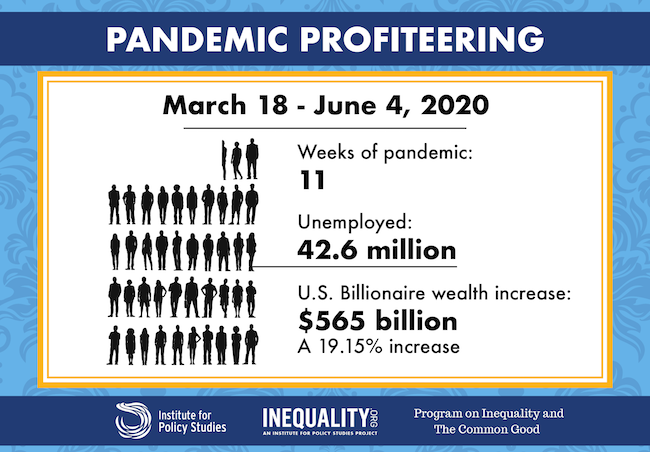
The announcement on June 4th that an additional 1.9 million more have filed for unemployment in the last week means that 42.6 million Americans have filed since March 18th, according to the Bureau of Labor Statistics. This doesn’t include the millions more who have applied for help as self-employed workers.
Over these same 11 weeks, between March 18th and June 4, the cumulative total wealth of U.S. billionaires has increased $565 billion, an increase of 19.15 percent.The markets have risen, but certain individual fortunes have surged significantly over market gains.  In the 11 weeks since March 18th, these billionaires have seen their wealth accelerate:
Jeff Bezos – up $36.2bn
Mark Zuckerberg – up $30.1bn
Elon Musk – up $14.1bn
Sergey Brin – up $13.9bn
Larry Page – up $13.7bn
Steve Ballmer – up $13.3bn
MacKenzie Bezos – up $12.6bn
Michael Bloomberg – up $12.1bn
Bill Gates – up $11.8bn
Phil Knight – up $11.6bn
Larry Ellison – up $8.5bn
Warren Buffett – up $7.7bn
Michael Dell – up $7.6bn
Sheldon Adelson – up $6.1 billion
One commentator complained that by picking March 18th, IPS research is only capturing the recovery in billionaire wealth that plummeted in the proceeding weeks in late February and early March.  It is true — the market has done better since then. But a large segment of the U.S. billionaire class is beating the market. And we stand by our analysis that it is newsworthy and meaningful that billionaire wealth is accelerating while others are experiencing job losses, declining savings, debilitating illness, and death.
The reason IPS pinpoints March 18th as a date for tracking wealth is because that date is tied to this year’s annual Forbes Global Billionaire survey, published on April 7th.  This year, Forbes reported that total U.S. billionaire wealth had declined from its 2019 levels, from $3.111 trillion down to $2.947 trillion.  But our report showed that these losses were quickly erased within weeks. As of June 4, total U.S. billionaire wealth is $3.512 trillion, a $565 billion increase over March 18th and a $401 billion increase over last year’s Forbes billionaire survey. There are also 16 more billionaires than two months ago.
Some billionaires have lost wealth since the beginning of the year, especially those in the oil and gas sector. Warren Buffet is down over $14 billion since the beginning of the year. But even during a time of unprecedented economic adversity, some billionaires are riding higher than ever.
According to Bloomberg estimates, with their just-in-time analysis of the top 50 U.S. billionaires, Jeff Bezos is still $34 billion ahead of where he was on January 1st.  Steve Ballmer is up $9 billion.  Elon Musk is up $15.3 billion.  Mark Zuckerberg is up $9 billion. The top 50 billionaires as a group, however, are up over $39 billion during the worst health and economic calamity of the modern era.