20 Jun 2020

Air France-KLM prepares to slash at least 6,000 jobs

Anthony Torres

The ruling classes worldwide are seizing upon the COVID-19 pandemic to restructure the capitalist economy, slashing hundreds of thousands of jobs, benefits and social conditions. After French President Emmanuel Macron announced a €15 billion aerospace industry bailout, Air France-KLM is preparing to slash thousands of jobs after having received €7 billion in state funding.
Major European corporations deemed to be strategic are being restructured based on the €1.35 trillion in money printed by the European Central Bank (ECB) and the €500 billion French state bailout to boost profits by slashing jobs. After tens of thousands of jobs were cut in the auto industry including at Renault and Nissan, it is the airlines’ turn. British Airways is cutting 12,000 jobs and Ryanair is preparing 3,000 job cuts. Lufthansa wants to cut 22,000 full-time and 4,000 part time jobs. Airbus is to cut over 10,000 jobs, or 10 percent of its workforce.
Wednesday morning, the Air France-KLM board was brought together by president Anne-Marie Couderc and CEO Benjamin Smith. It announced a record loss of €1.8 billion in the first quarter, although in that period, air traffic was seriously impacted only in March.
The daily Libération reported that Air France-KLM “is paying not only for the stupendous collapse of its revenues, because most of its planes are stuck on the ground, but also for the low price of petroleum.” It had agreed to buy kerosene in advance at a price which is now well above the market price after the collapse of oil markets due to the pandemic. Now it is sitting unused, leaving a €500 million hole in the corporation’s bottom line.
The very gradual regrowth of air traffic does not help Air France-KLM: its flights to America, Asia and Africa are the most profitable but they are generating no revenue because the European Union’s (EU) Schengen zone borders are closed. The company anticipates massive losses in coming quarters.
It has announced cuts in investment from €3.6 billion to €2.4 billion, including cancelling the purchase of three long-range Airbus jets this year. But the cost-cutting measures will affect jobs the most brutally. According to Libération, during the corporate board meeting, “the two representatives of the French state did not make even the slightest comment” when the plans for job cuts were announced.
Smith did not announce any specific figures, but he reportedly plans to slash jobs in administrative services and in Air France’s regional flights. Its regional subsidiary Hop is to see the number and volume of flights cut by half. According to a member of management who spoke anonymously, 6,000 to 10,000 jobs will be cut out of 80,000 total.
Aerospace workers, like autoworkers, are not responsible for the losses in these industries, nor for the pandemic. The hundreds of billions of euros forked over to the banks and big corporations must go to save jobs and boost wages and benefits, through the nationalization of firms under workers control at the European and international level. This requires a political struggle by the working class, aiming to take power, expropriate the financial aristocracy and build the United Socialist States of Europe.
To fight the attacks now being planned, workers need to build their own action committees, independently of the unions and their political allies to organize a political struggle against Macron and the EU.
Workers at Air France-KLM must be warned that the state, Air France and the union bureaucracies are negotiating attacks behind their backs. All are agreed upon the plan to slash jobs. The unions did not try to mobilize workers to take strike action against job cuts, because they are already negotiating them outright with Benjamin Smith and the rest of management. Air France-KLM workers already have a long experience with the treachery of Air France unions.
Already in 2014, Air France workers faced several corporate restructuring plans slashing several thousand jobs and cutting wages, with the complicity of the National Union of Airline Pilots (SNPL) and the Stalinist General Confederation of Labor (CGT) unions. That year, Air France pilots struck for 14 days against plans to develop a low-cost subsidiary, Transavia. The strike not only cost the company hundreds of millions of euros but staggered the unpopular government of then French President François Hollande.
Like Hollande’s social-democratic government, the unions feared that this strike, which enjoyed broad popular support, could encourage broader strike action in the working class.
Manuel Valls, the social democratic prime minister, intervened to demand the end of the strike, which the SNPL rapidly did, claiming that it “is our duty to preserve the company’s future and to bandage its wounds before irreparable damage is done.”
In 2018, as French rail workers struck against Macron’s rail privatization plan, Air France workers also took strike action alongside students protesting university reform plans. Air France unions ended the strike, however, after Smith was named CEO, to avoid a broader political movement against Macron that would have escaped the unions’ control. This allowed the unions to isolate striking rail workers from other layers of workers, ensuring passage of the rail privatization and preparing Macron’s pension cuts.
Now, amid the pandemic, the unions are preparing another attack on the members they claim to represent. They will try to play different sections of the workforce against each other to divide Air France-KLM workers, as a pilot with a long trade union record told Libération: “Benjamin Smith has ceaselessly told us in French and in English that we are the leaders of the company. The pilots are won over by his rhetoric, especially given that he knows air transport much better than his predecessors at the head of the company.”
Despite what this union official claims, pilots will also be impacted by layoffs and will oppose the corporation’s cost-cutting plans. The defence of their jobs and working conditions requires unifying their struggle with those of other layers of workers in the corporation. Indeed, this declaration signifies in the final analysis that the SNPL will not try to mobilize the pilots, in order to divide and weaken the Air France-KLM workers’ struggle.
The period since 2018 has seen many social struggles organized independently of the unions, like those of the “yellow vests” in France or of Portuguese nurses. Now it is essential to organize struggles independently of the unions, in committees of action, to defend jobs and wages internationally—thus including workers both at Air France and at the Dutch firm KLM—threatened by social attacks caused by the pandemic.

130,000 jobs at risk in the German auto industry

Dietmar Gaisenkersting & Peter Schwarz

Although German auto companies have received a lion’s share of the government’s 130 billion euro [$US146 billion] stimulus package and are collecting billions more through the state’s short-time working scheme, industry bosses are preparing to cut well over 100,000 jobs.
According to Christian Malorny, head of the automotive unit at the Kearney global management consulting firm, “Around 15 percent of jobs in the German auto industry are at risk in the next 18 months,” or about 130,000 jobs. Short-time working benefits, the extension of which is to be decided this autumn, provide no long-term protection for workers.
Auto industry expert Ferdinand Dudenhöffer believes that the German auto industry will “steer short-time working into a wave of layoffs.” According to Dudenhöffer, “The crisis in Germany will cost at least 100,000 jobs in its auto and supply industries.”
The IG Metall union is also proceeding from the likelihood of the destruction of tens of thousands of jobs, plus numerous bankruptcies in the supply industry. “Our latest survey shows that over 80,000 employees in 270 companies are at high or acute risk of insolvency. And these numbers are increasing,” IG Metall Chairman Jörg Hofmann told the Tagesspiegel newspaper last week.
Car sales have plummeted due to the coronavirus crisis. According to Dudenhöffer, just under 1.2 million cars were built in German plants in the first five months of 2020, a staggering 44 percent less than last year. Due to continuing weak demand in Europe, Africa and South America, he expects production to decline by 26 percent to 3.4 million cars over the full year. This represents the lowest level of production since 1974.
Auto companies are using the crisis to implement restructuring measures planned long in advance. Even before the coronavirus pandemic, experts anticipated the loss of hundreds of thousands of jobs in the auto industry. In the autumn of 2018, a study by the Friedrich-Ebert Institute (FES) concluded that a rapid switch to the production of electric autos would endanger 600,000 jobs and bankrupt the majority of suppliers in the German auto industry. At the same time, any “postponement of system innovations” would have equally catastrophic consequences.
At the end of last year, the Munich-based Ifo Institute for Economic Research announced that 137,000 jobs were in danger in the Bavarian auto industry alone.
The government and big corporations are now working closely together to implement these plans. The German government has decided to subsidize those purchasing electric cars and plug-in hybrids with a premium of up to 9,000 euros, while excluding any subsidy for those purchasing petrol and diesel vehicles, apart from the already announced three percent reduction in VAT, the general consumer purchase tax.
The Social Democratic Party (SPD) was the prime mover behind this decision and is trying to present it as a contribution to environmental protection. But this is nonsense. Going back at least 20 years to the time of the “auto chancellor” Gerhard Schröder, the SPD has carried out the auto companies’ every demand. The party’s arrogant adherence to internal combustion engines and a business model based on manipulated exhaust gases created considerable difficulties for the German auto industry. That is why the government is now pressing to speed up the conversion to electric autos.
Its main concern is to strengthen German companies in the bitter struggle against its international rivals to dominate the world market. Other governments are also investing billions to support their auto industry. For example, President Emmanuel Macron is funding French car companies to the tune of eight billion euros. The European Union Commission is also investing 100 billion euros to strengthen the European auto industry against its Asian and American competitors.
The restructuring and struggle for a dominant position in the global market will be carried out on the backs of the industrial workforce. Despite the ongoing coronavirus pandemic, auto workers are being forced to return to the factories and risk their lives and must fear for their jobs, wages and social rights. Agency and temporarily employed workers in particular are being used by the corporations in hire-and-fire manner; but the companies’ core workforces are also affected.
In this conflict, the unions and their affiliated works councils are firmly on the side of the corporations and the government. They are expanding the corporatist policies of the “German system of social partnership” that they have pursued for decades. Their antiworking class character is becoming increasingly evident.
As has been the case repeatedly in the past, when IG Metall and its works councils supported plans to cut tens of thousands of jobs at VW and Opel, including the closure of factories in Antwerp and Bochum, they are now taking responsibility for enforcing new job cuts. They work out the appropriate plans, implement them and divide autoworkers against one another along nationalist and local lines. A united struggle of workers from all countries and all factories is the only way to combat the offensive by the corporations.
At the same time, the unions act as aggressive lobbyists for the multibillion dollar corporations to squeeze billions more in public funds out of the government. This is the reason why IG Metall has responded angrily to the government’s refusal of a purchase premium for vehicles with internal combustion engines.
On June 5, the union announced, “This is bad news for the approximately 2.2 million employees who work in the auto industry and the industries that depend on it.” In order to secure employment with a purchase bonus, “it is necessary to support not only electric autos but also the purchase of low-emission, modern internal combustion engines.”
Daimler general works council chief Michael Brecht grumbled that he and his counterparts in the auto and supplier industry were “pissed off.” The industry had invested in growth, and now there was the risk of overcapacity that could not be bridged for the next three or four years. Some 95 percent of workers in the German auto industry were employed in the production of vehicles with conventional motors, Brecht said.
The works council chairman for the MAN concern, Saki Stimoniaris, commented, “The SPD leadership should ask itself: Does it actually represent the interests of workers?”
Former SPD Chairman Sigmar Gabriel, who has since been appointed to the supervisory board of Deutsche Bank, also weighed in. On Facebook, Gabriel complained that the industry “appears to Germans to be more of an environmental problem than a central factor for prosperity.” This attitude is now also reflected in the SPD. “Climate policy has become more important to them than representing workers’ interests.”
In fact, the IG Metall and its works council advocates are just as far removed from the “interests of workers,” which the SPD ditched a long time ago. The chief concern of the union and SPD bureaucrats is guaranteeing the profits of the auto companies and the billion-dollar dividends that most car companies continue to pay to shareholders despite the fact they are raking in government aid. The bureaucrats are also determined to see that millions of euros come their way.
The 30 supervisory board members of IG Metall and the works councils at Volkswagen, BMW and Daimler received over six million euros last year for their participation on supervisory boards. At VW, MAN works council head Stimoniaris takes home 482,040 euros for his services, IGM chief Hofmann receives 289,000 euros, group works council chief Bernd Osterloh takes in 387,000 euros, and Audi general works council chief Peter Mosch makes 579,800 euros, all for supervisory board activities.
At Daimler, works council chief Brecht pocketed 499,129 euros and IGM district manager Roman Zitzelsberger 236,253 euros. BMW paid out 430,000 euros to both general works council head Manfred Schoch and chairman of the works council at the Dingolfing plant, Stefan Schmid.
The claim that the government’s purchase premium for autos will be used to save jobs is absurd. Above all, such a move benefits those who can afford luxury cars and big firms that purchase company cars. In reality, IG Metall is campaigning for billions of euros of tax payers’ money to feather its own nest and the dividends of shareholders while preparing German corporations for a destructive international trade war, taking place under conditions of a virtual massacre of auto jobs.
To defend jobs, autoworkers must break with the unions and their highly paid works councils, form independent action committees, join forces internationally and fight for a socialist program. It is necessary to convert the entire auto industry, manufacturers and suppliers, into democratically controlled, socially owned property in order to redirect the billions paid out to shareholders to secure jobs and, in the medium- and long-term, to develop the industry within the framework of comprehensive, rational social planning.

Aviation industry workers face deep cuts to pay and hours worldwide

Steve Filips

Aviation industry workers are facing deep cuts to wages, benefits, and jobs worldwide, and although US workers are temporarily secure through September under the Payroll Protection Plan, their future can be seen by looking at fate of an increasing amount of their international brothers and sisters at pandemic distressed aviation companies.
Chicago-based United Airlines is cutting the hours of its 2,500 catering workers, members of the Unite Here union, according to reports released Wednesday. Even though United received $4.8 billion from the CARES Act the company reduced hours for caterers at Newark International Airport in New Jersey by 25 percent in late May, and they also cut caterer hours the same amount at United facilities in Cleveland, Denver, Honolulu, and Houston. The workers are low wage earners, and the cuts will force them into dire financial circumstances. Unite Here has been seeking a contract with United, which is one of the only major airlines that doesn’t utilize an outside catering contractor.
In a preemptive move, Alaska Airlines announced that they were going cut up to 3,000 of the company’s 23,000 workers when the pay support program under the federal CARES act is depleted at the end of September. Alaska is one of the ten largest US airlines. It was founded as McGee Airways in 1932. The airline’s operations are focused on the US and Pacific Northwest region, along with destinations across North and Central America. The company’s home base is at the Seattle Tacoma International Airport.
Hawaiian Airlines, the tenth largest airline in the US, received $654 million in federal funds in April as part of the bailout of the airline industry. It has meanwhile been given permission to eliminate some of its flights. A report revealed Great Depression-era unemployment levels in Hawaii, which is heavily dependent on tourists, with an estimated 25 percent of jobs there linked to tourism.
Major US airlines including American, Delta, Southwest, and United have all seen severe downturns in the volume of travelers as a result of the coronavirus pandemic. The conditions in the travel industry are still very unstable, despite some media reports of a rebound, some of the hype was doused when Delta announced June 5 that it was indefinitely curtailing service to 11 US cities including Erie, Pennsylvania, Flint, Michigan and Peoria, Illinois. In addition, Delta is retiring a number of its planes effective July 8, and ending service to Ottawa, Canada June 21. It expects to reduce its domestic and international schedule by 85 percent and 90 percent respectively in the second quarter of the year.
On Tuesday, some of the major airlines announced stricter enforcement of facemask requirements for passengers, which include banning those that refuse to wear masks from future flights. The Trump Administration has failed to issue any national or industry-wide rules mandating the use of facemasks to protect travelers and crewmembers from COVID-19.
Other measures airlines have taken to raise cash include the selling of their planes to leasing companies, who then lease back the aircraft. Southwest sold 20 planes in May to raise $815 million.
Consumer Reports has received over 3,500 airline customer complaints with Southwest over flight cancellations, where the airline has refused to make a refund, so that the money can be used to bankroll their faltering operations. This has prompted the US Department of Transportation Secretary Elaine Chao, spouse of the senior US Senator from Kentucky Mitch McConnell, to write letter to the airlines stating that in certain cases they could theoretically force the airlines to give refunds. United and Hawaiian were noted to be strictest in not issuing refunds.
American and others have also attempted to sell junk bonds, but inadequate collateral was cited as the reason that American’s bond offer was withdrawn. This forced the airline to put forward a stake in its loyalty program, which is the industry’s largest at $31.5 billion, in order to have credit extended through a consortium of banks.
In the first-quarter, American had reported a first-quarter net loss of $2.2 billion, but had received $5.8 billion in payroll support from the US CARES Act in April.
This past May 26, LATAM Airlines, based in Chile, with subsidiaries in the US, Colombia, Ecuador, and Peru sought Chapter 11 bankruptcy in Manhattan federal court to reorganize its business. The company had laid off 1,400 workers in Chile, Ecuador, Peru, and Colombia this past May 15, and was the largest airline in South America with 42,000 employees.
After pulling down $10 billion in 2019 revenue, LATAM suspended operations this Wednesday at its Argentinean subsidiary, placing 1,715 employees on unpaid leave. Management blamed Argentina’s travel ban for the indefinite closing of operations there. This Thursday LATAM announced that its Colombian operations temporarily suspended employment contracts.
While the global airline industry was flying with a tail wind of profits in 2019, it had been announced in September that Delta Air Lines had bought 20 percent stake of LATAM shares in a deal valued at $1.9 billion, which was seen as a blow aimed at its US rival American Airlines that enjoys greater access to region. American failed in its attempt to acquire LATAM as both sought to expand and solidify their routes and position in Latin America. The complex bankruptcy does not yet involve LATAM’s largest section in Brazil, or the Paraguay affiliate.
Colombia’s Avianca with 20,000 employees, the second largest airline in Latin America, had also filed for bankruptcy protection on May 10 in Manhattan federal court. Last year it was reported that United Airlines turned a 2018 loan of $456 million that was defaulted upon in May 2019 into a majority stake in Avianca. United loaned another $250 million to Avianca in November 2019 to shore up operations.
Irish carrier Aer Lingus workers face deep pay cuts of 70 percent in a plan the company unveiled and that will be put up for a ratification vote by the unions as part of the company’s “Covid Crisis recovery program.” It was the state-owned airline of Ireland until the privatization process began in 2005. International Airlines Group (IAG) now owns the company, which is a product of the merger between British Airways and Iberia of Spain. United Kingdom flag carrier, the privatized British Airways, is demanding an up to 60 percent wage cut from workers, or they will face massive layoffs of 12,000 of the 42,000 employees there. British Airways is also demanding that the pay of those that remain be cut or “streamlined” as the company has termed it.
German airline Lufthansa has also announced cuts of some 22,000 workers across all sections of the company, which include Austrian Airlines, Brussels Airlines, and Eurowings. They are in talks with their Vereinigung Cockpit, Verdi, and UFO unions, and are asking that they pressure members to accept a cuts agreement by June 22.
Meanwhile, airline ground crews from gate staff to those that are fueling, loading, and unloading the planes face dangerous conditions, while at the same time often receiving minimal pay and benefits.
On the other end of the spectrum the wealthy are increasingly utilizing private airplanes to avoid the hazards of exposure to COVID-19 present on existing commercial aviation flights.

Hundreds of new COVID-19 infections in German meat industry

Marianne Arens

The latest coronavirus outbreak at the Tönnies abattoir in Rheda-Wiedenbrück in the Gütersloh district is the largest since the beginning of the pandemic. By Thursday, more than two-thirds of the meatpacking workers there were found to be infected with COVID-19: of 1,050 initial test results, 730 were positive.
This new hotspot at a slaughterhouse demonstrates the brutal conditions in the meatpacking industry under conditions of private, capitalist ownership. Hundreds of workers are on assembly lines where the air is cooled and constantly circulated. They work 10, 12 or even more hours of hard labour until they are exhausted. Unable to maintain the prescribed minimum distance of 1.5 metres, they can neither wash their hands sufficiently nor change their facemasks.
Contract workers receive neither vacation pay nor sick pay and earn so little that they are almost forced to continue working even when they have symptoms.
These are conditions under which the coronavirus can spread like wildfire. And such settings are found not only at industry “black sheep,” but represent the norm. North Rhine-Westphalia (NRW) Labour Minister Karl-Josef Laumann (Christian Democratic Union, CDU) said, “We checked the Tönnies slaughterhouse at the end of May with the occupational safety department. At that time, everything was fine at Toennies.”
With 6,800 workers and over 20 million slaughtered pigs annually, Tönnies is the largest meat processing plant in Germany and one of the largest meat producers in Europe. But it is by no means the only one facing a mass outbreak of COVID-19. For weeks, hotspots have been accumulating in slaughterhouses, where well over 1,500 workers have been infected with the Sars-CoV-2 virus since the end of March.
So far, at least 265 workers at Westfleisch in Coesfeld, 40 in Oer-Erkenschwick and 34 at Boeser Frischfleisch in Schöppingen (Borken) have fallen ill. At Vion in Schleswig-Holstein, at least 110 workers were infected and 412 at Müller-Fleisch in Baden-Wuerttemberg. In other countries, too, and especially in the United States, the pandemic has struck devastatingly among slaughterhouse workers, as the World Socialist Web Site has reported several times.
On Wednesday evening, the district of Gütersloh extended testing to all workers at Tönnies. District Administrator Sven-Georg Adenauer, a grandson of Germany’s first post-war Chancellor, Konrad Adenauer, asked the Bundeswehr (Armed Forces) for administrative assistance with coronavirus testing. The district also ordered the closure of production at Tönnies and, at the same time, had all schools and day-care centres closed again until the summer holidays. These had only ended the lockdown two days earlier, on June 15. Dozens of parents and children protested against the closure in front of the meat factory on Thursday afternoon.
Corporate managers and politicians as well as many journalists are now trying to blame the workers themselves for the recent outbreak. When asked what the outbreak at Tönnies says about the loosening of the pandemic measures, Armin Laschet (CDU), Minister-President of North Rhine-Westphalia, replied, “That says nothing about it at all, because Romanians and Bulgarians entered the country and that is where the virus comes from. That will happen everywhere.”
Gereon Schulze-Althoff, head of the Tönnies pandemic crisis team, also tried to explain the outbreak by the fact that many Eastern European workers went home to their families on the long Corpus Christi weekend. This “probably led to a source of infection in our company,” said the Tönnies’ spokesman. District Administrator Adenauer followed suit, claiming that the company was “professionally positioned” and that “probably other workers from outside had joined us.”
This is a transparent attempt to take the company out of the line of fire. It follows the playbook of the far-right Alternative for Germany (AfD) by seeking to divert the anger of the population against Romanian, Bulgarian and Polish workers.
However, this attempt failed after only a few hours when a prominent scientist refuted the claims based on an objective analysis. Isabella Eckerle, head of research in the department of infectious diseases at the University of Geneva, explained that a weekend visit could by no means explain such a large number of new infections in such a short time. The incubation period takes much longer, she said. The mass outbreak pointed to an “unnoticed superspreading event” in the meat factory that has been going on for some time. “In close contact, and under unfavourable working and living conditions, a single person or only a few people infected initially can lead to a very high number of secondary infections,” explained Eckerle.
On Thursday, several media outlets quoted Freddy Adjan, deputy federal chairman of the Gewerkschaft Nahrung-Genuss-Gaststätten (NGG, Union of Food and Beverage Workers), with the demand, “This sick system must now finally be put to an end.” The federal government must implement the already-decided ban on work contracts “without compromising the legislative process,” because the outbreaks were obviously “connected with the catastrophic working and living conditions for the mostly Eastern European contract employees,” Adjan told the Funke media group.
It is noticeable that the union leader did not say a word about how the “mostly Eastern European contract workers” could now be defended, supported, and protected. Not a word about the fact that they had to be reasonably paid and compensated for the loss of work, or that the sick among them were now entitled to the best possible treatment. Not to mention that it is necessary to mobilize German workers in their defence. Instead, Adjan exclusively addressed the government—which has known about and been responsible for the catastrophic conditions for years.
The NGG is pursuing a thoroughly nationalist policy that carefully avoids addressing all workers. In this way, it tries to prevent a united struggle against such exploitative conditions. Neither the NGG nor any other German union has ever attempted to “represent” the many thousands of low-wage workers who slave away through subcontractors in German industry. There is a works council at Tönnies in Rheda-Wiedenbrück, but it is only responsible for about 500 permanent employees out of a total of 4,000 mainly contract workers.
The business model exploiting contract workers, with four-fifths of the employees being practically unregulated work slaves, is based on regulations and laws which the Social Democratic Party (SPD) and the Greens, together with the unions, helped to introduce 20 years ago with the “Hartz” labour and market reforms. They have all actively supported capitalist restoration in Eastern Europe and the expansion of the EU to the East. This has led to the complete impoverishment of the working class there, which has resulted in thousands being forced to accept employment via shady subcontractors for sweatshop jobs in Germany.
The former butcher’s son Clemens Tönnies can today be found on the Forbes list of the richest people in the world. A multi-billionaire, who achieved his wealth walking over dead bodies, he was helped along in no small part by the unions’ boundless willingness to collaborate as the industrial police of the capitalist system.

Around 250 workers infected with COVID-19 in three UK food processing plants

Robert Stevens

Outbreaks of coronavirus have been reported at two food processing plants and a meat factory within the space of 24 hours, with all three having to be temporarily closed.
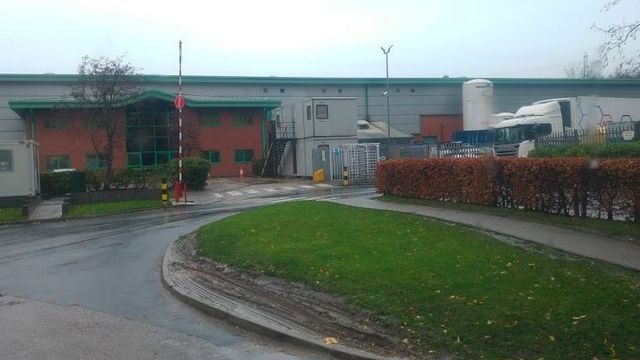
Two of the plants are in Wales. By Thursday, there had been 58 confirmed cases among workers at the 2 Sisters chicken factory in Llangefni on Anglesey, and 38 at Rowan Foods in Wrexham. Yesterday it was revealed that “up to 150” workers have tested positive for COVID-19 at the Kober Ltd meatpacking factory near Cleckheaton, in the local government district of Kirklees, West Yorkshire, England. It could be even higher with Huddersfield MP Barry Sheerman stating, “The figure of 150 is less than the one that was leaked to me by a high-level source, but it is still a serious outbreak…”
Kober Ltd in Cleckheaton [Source: Google Maps]
The plants are major suppliers to the UK food market. The 2 Sisters Food Group’s Llangefni plant employs 560 people and is the UK’s main supplier of supermarket chicken. It also supplies chicken to KFC. The firm produces about a third of all the poultry products eaten daily in Britain.
Rowan Foods, which employs 1,500 people in Wrexham, supplies food for supermarkets across Britain. It is owned by Oscar Meyer Quality Foods, which in turn is owned by the major US corporation Kraft Heinz.
The Kober plant is owned by the Asda supermarket giant and supplies it with bacon rashers and joints.
The outbreaks underscore the criminality of the decision by the Johnson government to enforce a mass return to work, and the lack of basic safety for workers in plants that have been operating throughout the pandemic—including the three food processing facilities.
On Friday, the UK’s joint biosecurity centre reduced the virus threat level from four to three despite the food processing plant outbreaks and significant increases in some areas. The official “R” value of the virus remains at the dangerously high level of between 0.7 and 0.9. In the last weeks, two of the UK regions—the North West and South West—reached an R value of 1 or over.
One of the new outbreaks is in Leicester, which has a population of over 329,000. About 25 percent of the total 2,494 confirmed cases of COVID-19 in the city were reported in the last two weeks.
Well over 1,000 new cases are reported in Britain daily, with hundreds of lives lost each week.
Four meat processing plants have now been hit by COVID-19 outbreaks. While no deaths are reported among employees at 2 Sisters, Rowan Foods and Kober, three workers employed at the Cranswick plant in Barnsley, South Yorkshire, have died.
In a statement Rowan Food owners Oscar Mayer said, “Whilst we are seeing a number of cases on site, Public Health Wales support our view that there is no clear evidence to suggest that there is a spread of the virus within the site, we are seeing a reflection on site of the increases in cases within the locality.”
How and why an increase in cases “locally” that is then “reflected” in the factory does not require action is not explained. But it is clear that companies, in alliance with the authorities, are concealing the extent of the spread of the virus in workplaces and the dangers to the local population.
That there was a coronavirus outbreak in Kirklees was only made public Thursday evening when Health Minister Matt Hancock praised the government for being proactive in its “local lockdowns” in “parts of Leicester” and Kirklees. He stated, “In fact, I chaired a meeting this morning of our local action committee, which is the formal process through which we make these decisions, working with local leaders, for instance, in Kirklees. And the local director of public health and the council are heavily involved in the response.”
Hancock did not name where the outbreak was in Kirklees, but it rapidly became public knowledge after concerned residents discussed the crisis on social media.
The event further exposes the pernicious role of Labour and the trade unions, without whom companies could not operate unsafe workplaces. The main concern of Labour-run Kirklees Council and local Labour MP Tracy Brabin was that Hancock had blown their dirty secret, with the local population alerted as to the dangerous situation.
Brabin complained, “My anger is the way we were thrown to the wolves.” Her next move was to downplay the fact that a deadly disease was rife in a local food plant declaring, “No-one in Kirklees should be concerned. Having spoken to the council they’ve acted very swiftly, I’m proud of them but I’m really frustrated Matt Hancock took it on himself to announce it like that.”
Kirklees Council admitted it had kept the Kober outbreak from the public “because it doesn’t combat the spread of the virus, compromises patient confidentiality and it could discourage businesses and organisations from coming forward in future.”
There is presently not even a requirement for corporations to tell their own workforce that there is an outbreak of coronavirus!
That dozens of workers at Kober and the food processing plants were infected is no surprise, given that companies have routinely flaunted basic social distancing rules ever since the March 23 lockdown came into operation. On social media, as far back as two months ago, one local resident pointed out the lack of any enforced social distancing by Kober during shift changes. Posting a photo on Twitter of workers gathered in confined spaces next to a road, he commented, “They really just don’t get it!!! Kober Ltd/Forza Foods shift change #SocialDistanacing #SocialDistancingNow.”
Alan Hair gave voice to the anger of local residents at being kept in the dark. He posted a tweet Thursday reading, “So there’s a #Covid_19 outbreak in ‘Kirklees’ but it’s a secret where. No it isn’t, it’s half a mile from our house at Kober Ltd by Chain Bar, no surprise at all when you see them piling out en-masse at shift changes over the past months. Why were we not informed?”
He told the BBC, “We are trying to shield some family members and have been for the past 12 weeks and it’s part and parcel of that that we need to know if there are local issues that could affect us actually taking the virus to people who are at risk.” Another replied to Kirklees Council and Brabin, “No wonder there was an #outbreak #Kirklees unbelievable!”
The trade unions too are up to their necks in concealing the dangers facing workers. Quoted on the BBC Thursday, Paddy McNaught, a regional organiser for the Unite union, admitted—without giving figures—that coronavirus cases at the 2 Sisters chicken factory in Anglesey factory had risen “significantly” in just a few days. He added, “In fairness, the company, they have tried to work with us to provide a safe working environment, where social distancing—as best as it can—takes place.”
Making a mockery of the claims of working to achieve safe working conditions, he admitted that social distancing in the plant had been “virtually impossible” and there had been the “usual” concerns from staff about “social distancing and face masks.”
These developments reinforce the call made by the Socialist Equality Party for the establishment of rank-and-file safety committees in every workplace to protect workers from the spread of the virus. All such unsafe workplaces must be immediately closed until they can be made to operate safely!
Food and meat processing workers internationally face the same terrible conditions. Hundreds of new infections were reported this week in Germany, with the largest outbreak yet recorded among meatpackers at the Tönnies abattoir in Rheda-Wiedenbrück. By Thursday, more than two-thirds of meat packers there were found to be infected. Of 1,050 initial test results, 730 were positive.

Companies vow no more shutdowns for COVID-19 as US auto plants resume full production

Shannon Jones

US automakers Ford and Fiat Chrysler (FCA) report they will resume full production at all their North American plants on Monday, ahead of their previously announced schedule despite continued concerns over the spread of COVID-19.
FCA said the second shift at its Belvidere, Illinois assembly plant, which produces the Jeep Cherokee, is set to return on Monday. It was the last FCA plant to return to pre-pandemic levels of operation.
Meanwhile, Ford will return third shifts at assembly plants in Chicago, Dearborn Michigan and Louisville Assembly and Kentucky Truck in Louisville. The plants build SUVs as well as bestselling F-Series pickup trucks.
General Motors has confirmed that it will resume full North American production by the end of June.
The auto companies are still keeping a tight lid on the number of COVID-19 infections among plant employees even as infections have been reported at plants of all the major automakers.
There have been cases at Ford plants in Chicago, Dearborn, and Kansas City, Missouri. There have also been reports of cases at General Motors plants in Arlington, Texas; Wentzville, Missouri; Kansas City, Kansas and Spring Hill, Tennessee as well as Fiat Chrysler plants in Toledo, Ohio and the Detroit area. At least 4 workers have tested positive at electric carmaker Tesla, which operates a giant factory in Fremont, California.
Auto factories in the South operated by Japanese and German automakers have seen a rise in cases as the novel coronavirus surges in the area after the premature reopening of local economies.
Toyota has reported 40 cases at its US facilities, including its huge Georgetown, Kentucky facility. Volkswagen has reported 12 cases at its Chattanooga, Tennessee plant since restarting production last month as COVID-19-related hospitalizations have surged in the state. Nissan has confirmed three cases at its Canton, Mississippi plant. Mississippi has the second fastest growth of new coronavirus cases of any US state.
On Thursday German carmaker BMW reported 14 cases at its plant in Spartanburg, South Carolina. The plant employs 11,000 workers and builds a wide range of SUVs, most of which are exported to overseas markets, including China. The same day that BMW reported the outbreak at its Spartanburg plants South Carolina saw a record number of new COVID-19 cases, 987, and four deaths. The state was one of the first to remove lockdown restrictions.
BMW claimed that all the new COVID-19 infections were unrelated and that the individuals have been quarantined and their work areas cleaned. Production at the plant continued without interruption.
A worker at the Spartanburg plant wrote on Facebook, “No one's checking temps on night shift. We're all required to wear masks; we can be walked out if we fail to do so. And we have been hearing rumors about the 4-14 infected (as the stories changed) that tested positive and were sent home for the last two weeks+/-.
“I do believe the bathrooms are disinfected between shifts, and there are signs everywhere reminding us to distance and wash our hands and wear our masks. I don't think they care at all, but they've done a good job covering their bases when they are asked ‘what did you do about Corona?’”
Another wrote, “We got three confirmed cases where I’m working and we [are] not getting hazard pay or nothing, but we have to work or have no job, this is not right at all.”
“They care nothing about their employees,” a third worker noted. “The safety NOR the wellbeing. I reported a positive [case] exposure last Wednesday to MY BOSS and on the 7th day, got in touch with HR and was told he never even made a case or reported it.”
All the major carmakers have expressed their determination to continue production without interruption even as COVID-19 cases surge in many areas of the US. In their effort to prevent disruption, car companies are attempting to cover up coronavirus infections at their factories and provide as little information as possible. This reckless attitude thwarts the possibility of contacting and quarantining workers who may have been exposed to the infection.
Workers continue to express anger at the policy of cover-up, which places workers’ lives in danger. A worker at the Ford Kentucky Truck Plant posted on her Facebook page, “Today after work I was told by a friend that 2 people have tested positive for coronavirus. Isn't it illegal for them not to inform us? Aren't they supposed to tell us?”
A worker at the FCA transmission operations in Kokomo, Indiana wrote to the World Socialist Web Site Autoworker Newsletter about conditions at the factory. “At the Tipton transmission plant in Indiana it is a joke. There are people dropping left and right every night in all the Kokomo plants, and the Tipton plant is off the charts. They are threatening to fire us workers if we go to medical.” The worker reported that cleaning in the plants was atrocious, “nobody wants to admit we should not be inside these plants.”
A worker at the GM plant in Wentzville, Missouri told the Autoworker Newsletter, “The talk is a member of management got tested, worked the full day and didn't tell anyone. Tested positive. They say he was working at the front door handing out masks...35 workers demanded to be tested immediately...”
Behind the homicidal focus of the auto companies on production are financial pressures, including the massive growth of corporate debt. According to a report Wednesday in the Wall Street Journal “As of June 16, car manufacturers and their suppliers had raised $21.7 billion in extra long-term debt as a result of the Covid shutdowns ...” The Journal noted that the additional debt brought their total debt load to $1.1 trillion. That was 3.4 times total auto company earnings before interest, taxes, depreciation and amortization. At the end of last year the ratio stood at 3.0.
Even before the COVID-19 pandemic hit auto companies were facing lower returns on investment as they faced the added cost of research and development of electric and autonomous vehicles. Further compounding the pressure on auto companies have been stagnant or declining sales in their major markets; the US, Europe and China.
These debts must eventually be paid, and that can only come through the intensified exploitation of the working class. To carry this out they are determined to suppress all opposition to the ramp up of production, which is being carried out with the full support of the United Auto Workers.
This raises urgently the need for workers to take the defense of health and safety into their own hands by building rank and file safety committees, democratically chosen by workers themselves, in every work location. This is connected with the fight to end the subordination of production to the demands of Wall Street through the nationalization of auto and other basic industry under the democratic ownership and control of the working class.

WHO warns coronavirus pandemic entering a “dangerous phase”

Benjamin Mateus

The World Health Organization (WHO) reported that the COVID-19 pandemic had marked a one-day high of over 150,000 confirmed cases on Thursday. According to the New York Times database, that figure totaled 166,099 cases. A separate tracking database maintained by Worldometer found that the total was even higher on Friday with 181,000 newly confirmed cases.
Since May 2, the seven-day average for the total daily cases of COVID-19 on the globe has been rising steadily from approximately 81,000 to a high of 136,956 yesterday, a 70 percent increase. The seven-day global average in case fatalities reached its ebb on May 26 with 4,079 deaths and has since been slowly climbing to 4,649. The one-day global death toll climbed over 5,000 yesterday.
By all accounts, despite the massive lockdowns that impacted billions and brought the global capitalist economy to near collapse, the policy to open the markets, throw caution to the wind, and resume all commerce and social activities as if the pandemic was conquered and a mere historical reference point is sheer madness. While the scientific reality of the epidemic cannot be circumnavigated nor ignored, the demands for profits insulate the markets and ruling elites in every country from sage counsel.
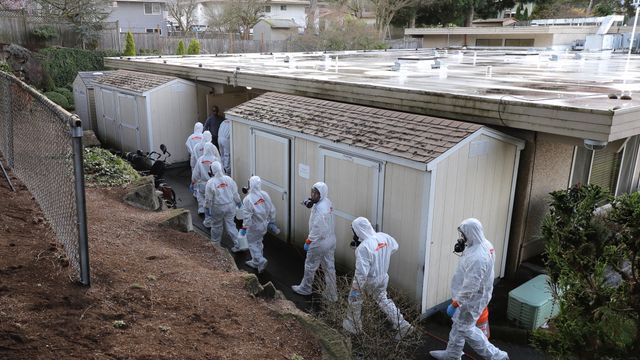
Workers from a Servpro disaster recovery team wearing protective suits and respirators enter the Life Care Center in Kirkland, Wash., to begin cleaning and disinfecting the facility [Credit: AP Photo/Ted S. Warren]
The Director-General Dr. Tedros Adhanom Ghebreyesus reported at the regular press briefing Friday: “The world is in a new and dangerous phase. Many people are understandably fed up with being home. Countries are understandably eager to open up their societies and economies, but the virus is still spreading fast. It is still deadly, and most people are susceptible.” More than 81 countries, including India, Chile, Turkey, Mexico, Pakistan, South Africa, and Bangladesh, have seen a rise in COVID-19 cases over the last two weeks, while less than half of the world’s nations have reported declining figures.
According to Worldmeter’s COVID-19 tracker, as of this writing, there are over 8.75 million cases of COVID-19. There have also been close to 462,000 deaths reported, which by every account is an underestimation of the true magnitude of the fatalities. Brazil accounted for the lion’s share of new cases Friday with a horrific 55,209 infections confirmed in just one day, the highest one-day total to date. It also joined the United States in surpassing over 1 million total cases. Brazil marked 1,221 new deaths, the highest for June 19, pushing its official death toll over 49,000.
President Trump and his administration have much in common with the likes of Jair Bolsonaro, the fascist president of Brazil, in their utter disregard for public safety and health consequences from the coronavirus infection.
However, the dismissive attitude of Trump, who personifies the diktats of the financial oligarchs, is of a far more sinister and calculated character. In a recent interview with Gray Television’s Jacqueline Policastro, when asked about the concerning rise in new cases across 22 states, including Oklahoma, where he is planning to hold a massive rally today, he said, “If you look, the numbers are very minuscule compared to what it was. It’s dying out. By the way, we’re doing very well in vaccines and therapeutics. I think there’s going to be some big announcements on that in the not-too-distant future. But no, we’re not concerned.”
Vice President Mike Pence wrote in an op-ed piece in the Wall Street Journal this week, “Lost in the coverage is the fact that today less than 6 percent of Americans tested each week are found to have the virus… The truth is that we’ve made great progress over the past four months, and it’s a testament to the leadership of President Trump.” The real figures behind these bald assertions paint a far different picture. The meaning behind these sentiments, however, is simple: there will be no further lockdowns or other measures in response to the resurgence of the outbreak.
South Carolina has seen cases climbed from an average of fewer than 200 cases a day at the end of May to a peak of 1,083 cases on Friday. Some of this rise is being attributed to recent tourism, specifically in the popular tourist town of Myrtle Beach. In mid-May, Governor Henry McMaster allowed hotels to resume taking reservations and for restaurants to open. On June 1, there were 22 new cases in Horry County, where Myrtle Beach is located. By June 17, the number of infected grew to 120 new cases occurring in conjunction with Memorial Day weekend. There are presently 660 hospital beds occupied by patients infected with the coronavirus in the state.
Florida beat its record two days running with 3,822 new cases on Friday, according to the John Hopkins dashboard. That state’s Republican Governor Ron DeSantis sought to deflect criticism by suggesting that more testing had taken place and that infections were occurring among younger, healthier people. He then pointed to clusters of “overwhelmingly Hispanic” day workers as the main factor for the rising numbers. “Some of these guys go to work in a school bus, and they are all just packed there like sardines, going across Palm Beach County or some of these other places, and there are all these opportunities to have transmission.” However, Florida Agricultural Commissioner Nikki Fried challenged the Governor’s assertions by highlighting that most of the farmworkers had left several weeks ago after the harvest had ended.
Texas reported 3,516 new cases on Thursday, a more than 10 percent increase than the day before, followed by another 4,497 infections on Friday. Despite the claim that these increases are due solely to more testing, public health experts have noted that the percentage of tests coming back positive is also rising, indicating a growing outbreak that is out of control. The greater Houston area has seen close to 26,000 cases with a caseload of 1.2 times higher than the week before. Harris County Judge Lina Hidalgo issued an order that will go into effect on June 22 that will require all businesses to mandate the wearing of masks. “The idea is to see this is a ‘no shirt, no shoes, no mask, no service’ policy,” Hidalgo told local media.
On Friday, Arizona saw a big jump in cases from a record-setting 2,519 cases on Thursday to 3,246 new cases, a more than 25 percent increase. Despite pressure from medical communities who are seeing dwindling resources in the form of ICU beds, Republican Governor Doug Ducey has stopped short of issuing statewide mask mandates, preferring to allow cities and counties to enforce such policies which amounts to a form of criminal negligence. As of Thursday, 85 percent of the southwestern state’s inpatient beds were occupied. The number of hospital beds used for COVID-19 patients has risen from 1,667 on Wednesday to 1,832 in twenty-four hours.
In an interview on Wednesday with the Wall Street Journal, President Trump declared, “I personally think testing is overrated, even though I created the greatest testing machine in history,” only to go on and add that increase in confirmed cases “in many ways, it makes us look bad.”
Such a dismissive sentiment is countered by that of Dr. Ashish Jha of the Harvard Global Health Institute, who recently told CNN, “We may be done with the pandemic, but the pandemic is not done with us.”
At every step during the pandemic, not only did the Trump administration delay taking immediate action, costing massive needless deaths, but by all accounts, the premature reopening of the country advocated by Trump will lead to the acceleration of such deaths and inundating the shell-shocked health care infrastructure again.
To provide a quantitative sense to the magnitude of this malign neglect, a recent study that compared the United States’ response to the pandemic and other countries, such as South Korea, Australia, Germany, and Singapore, found that 70 to 99 percent of Americans who died from the virus might have been saved.
In an opinion piece in Stat News, researchers Isaac and James Sebenius, noted: “Due to exponential viral spread, our delay in action was devastating. In the wake of the US response, 117,858 Americans died in the four months following the first 15 confirmed cases. After an equivalent period … scaling up the German population of 83.7 million to America’s 331 million, a US-sized Germany would have suffered 35,049 COVID-19 deaths.” The study notes that the US response in the first 14 days from the date of the fifteenth confirmed case lagged behind the mentioned countries “by miles.” They estimated that 99 percent of the 120,000 COVID-19 deaths might have been prevented had they handled the outbreak as effectively as these other countries.

19 Jun 2020

Undermining Pandemic: A look back

Ganatantrik Adhikar & Surakha Sangathan

Health is one of the basic human rights of a human being. But this has always been undermined by the governments everywhere in the world, even though the UN has proclaimed–Health is a right. Some of the States have incorporated it in their constitution but it stands as a customary one. Majority of the countries don’t guarantee that none of their citizens would die out of negligence. A common man’s death is meaningless to them.
Any infectious disease generally turns into pandemic. Pandemic comes in and goes out. It costs heavy   loss of life. But no ruler/government takes it seriously to build a robust health system, rather try to distract people in the line of divide and rule. The entire projection is whatever happened at time of pandemic as if that had happened never before. In this back-drop , let us look back the history of pandemics.
  1. Why so many pandemics in the last century:   
The recorded history of pandemic takes us back to the Plague of B.C. 430 in which more than a lakh people died. The Wikipedia is taking us back to BC 1200 and the influenza pandemic was seen in various parts of the world, though some other reports deny it. However, since BC 430 there has been a breakout of pandemic somewhere in the world in every 300 to 400 years. It may be a kind of plague (three types of plague seen), yellow fever, aids, tuberculosis, influenza or any type of corona. Some of these have repeated breakouts.
In the last century (by the end of second decade of 21st century), altogether six types of pandemic breakouts have been observed. These could be Swine flu (1917-19), Asian flu (1957-58), AIDS (1981 – present), Ebola (2014 – ), Zika (2015 – ), H1N1 virus (SARS, MERS and COVID 19). Previously, the movement of soldiers from one place to another was the root cause of spreading virus but in the age of globalisation, the role of spreading virus has shifted to air-travellers. The casualty of these six pandemics is far more than that of last 2400 years. What is seen here that the environmental pollution, the change of life style, mass production of live stocks and profit motive behind health business etc. are the reasons for it.
  1. Debate on the origin of the pandemic breakout:
Whenever a pandemic break anywhere in the world, it cites much debate. The same has been seen in case of Corona:
  1. In 1851, the Europe faced a severe breakout of cholera pandemic (Great Stink). Subsequently, the entire Europe blamed the British India in the Paris conference on “Garbage Clearance” without any conclusive proof to this regard.
  2. The Spanish Flu of the 1st World War that claimed about 6.5 crore lives in the world, was also debated of its origin whether it came from Kansas of US.
  3. Similarly, the yellow fever took a severe turn in America (the US) and continued nearly for two hundred years. Once again, the blame was attributed to the Asians.
It has been observed that every pandemic comes with various rumours about its origin. It is also observed that in order to cover up inefficiency of the ruling authorities to tackle the situation, these rumours are built up and spread across.
3. Pandemic in the eye of Europeans:
The Europeans generally think that a pandemic virus is basically originated from a poor nation due to their uncleanliness and nasty social life. They do not recognize that some of the tribal societies have totally been extinguished due to infection spread by those Europeans. They blame others especially the people from the East for certain spread of virus. Hence, on the eve of the COVID 19 pandemic, the accusation to the Asians by the Western media is nothing new one. But the most disturbing fact is that the Indian media is also rallying with the western in a same chorus and accusing China for COVID 19. The COVID19 has already playing havoc in the society and now it has far and widely percolated to the poorest section of the society. Without seeing how it came to India, the media is blaming the working-class people for spreading the virus. They find migrant workers are responsible of it!
4. Understanding of people about pandemic in India:
The most important aspect is that a normal and healthy one is infected by the person who is already infected. Hence, a contagious disease doesn’t have any selection while spreading from man to man. We, the Indians are usually trying to accuse the infected person only but not the diseases. There are various misconceptions and traditional beliefs. The people from the West Bengal and Odisha have a general belief that the outbreak of pox is the result of some sort of anger of the local goddess (Thakurani).
There are a number of literature and films that have depicted the life and death of our poor people in tuberculosis. These also show how it is caused due to poverty and absence of any treatment measure. But the root cause of tuberculosis is obviously poverty as well as severely congiousness. Similarly, it is also another misconception that the leprosy is a cause of anger of certain God. Prior to the Christian Missionaries, no one believed that the cause is something else and it could be cured. Again, the unfortunate misconception about AIDS can be seen. The taboo of morality is unnecessarily tagged to it and the homosexuals and the transgender are generally accused. Similarly, we observed that the poverty and illiteracy have been projected as the root cause of cholera in some of the Odia literature. It is a seer lack of knowledge and proper scientific understanding.
The newly independent India accepted the concept of public health and accordingly, a roadmap was drawn and developed. Subsequently, it was ultimately sacrificed at the time of reform and globalization. It is now in a dilapidated condition.
5. Pandemic and Religion:
The pandemic breaks out and spreads in its own course unless it is checked. But the ruling authority doesn’t usually take it seriously. They assure people of their safety and ask them not to be panicked. But when they fail to control, the vulnerable section of the society becomes the easy target. This results in the violent attack against them.
A) The Bubonic Plague of 1337 broke out in Europe and grabbed almost entire Europe. It took 31000 lives within a span of six months in Italy but the people of Europe accused the Jews of Italy as spreader and originator of the virus. As a result, it is recorded that no less than 1000 Jews were burnt in 26 countries of Europe. Actually, the people of Italy specifically of the part of the river Tigris were throwing infected dead bodies to the river which was the root cause of spreading the disease throughout Europe.
B) The Yellow Fever had a havoc in the US especially among white people which led to believe that the black people had better immunity. Hence, the black people were asked to perform the hospital duties forcibly. This had led to a short of violence.
C). The COVID 19 pandemic is now in severe condition in India. It has already been far and wide. The majority section of both the electronic and print media are now accusing the   Tablighies of Nizamuddin as “super spreaders” at the behest of the Union Govt. Not only that, they are vitiating the religious atmosphere of the country. Some of the ruling BJP parliamentarians are also talking of “Corona Jihadies”. The media reported that one public hospital of Ahmedabad had separated COVID wards according to the faith, Hindu ward and Muslim ward. One MLA from BJP was threatening a Muslim vendor not to enter into the colony with the vegetables. In all these cases the Union government is quite silent to this effect. These have already vitiated the social fabrics of the country.  The number of physical assaults were gradually increasing specifically on religious minority groups when this ‘Nizamuddin link’ was in news.
6. Wrong decisions of the administration multiply the cases:
A) London plague: The London Plague broke out during 1665-66. Without going through any proper investigation, the Mayor of London declared that the said virus originated either from dogs or cats. As a result, it was about 40,000 dogs and 80,000 cats were killed mercilessly. Similarly, due to wrong conception about the disease, the infected person was ostracized along with the family members for which other family members of the infected person were also infected and gradually, it spread over the larger community. And more than a lakh of people in this plague died in London.
B) Swine Flu in the US: It is generally believed that the “swine flu” broke out in the military camp of Kansas in the USA and subsequently, it spiralled throughout the world during the First World War. It is known that a US warship consisting of 800 soldiers moving around the coasts of Asia , Africa , Europe and finally returned to the US coast which was the root cause of spreading the virus throughout the world. The death toll in the USA alone was nearly 65 In India, the said virus routed through Mumbai Port and it took near about 20 millions lives throughout the country. As per records, a number of 7000 patients out of 13000, in a hospital in Delhi, died due to this pandemic. It is also reported that the morbidity rate was quite high as 35 persons in every 1000 in Asia,10 in Latin America and 15 in Africa. It may also be further reminded that during the World War 1, the USA played actually no such vital role but the US ruling authority moved their warships and soldiers to exercise its military authority and prowess. That caused death of more people in Swine Flu than death due to the First World War.
C) Lockdown in India: The present COVID19 outbreak related lockdown in India was almost a bolt from the blue. The air passengers from abroad were freely allowed to enter into the country without any sort of scrutiny. When the virus erupted the Union government declared a nationwide lockdown all of a sudden and without any preparation. As a consequence, the millions of migrant workers were thrown on to the street and they were desperate to return to their homes, finding no other alternatives. It may be pointed out that the Mayor of London forced the infected persons to stay with their family members during the outbreak of the Plague. Like this, the Indian authority also began to keep these migrants in the same quarantine centres without knowing who are infected or not. ? As a result, a large number of people from these quarantine centres are being identified as COVID 19
7. Few positive contributions:
Aftermath of cholera epidemic outbreak in London (1830), it was investigated further and was revealed that the latrine water and waste of London actually contaminated the underground water level. Subsequently, the entire underground sewage system of London town was planned so nicely that it has eradicated the problem forever. The Americans suffered from the Yellow Fever for almost two hundred years. Subsequent research brought to light its career, the mosquitoes. The USA government then took an extensive measure; breeding place of mosquitoes were cleaned, roads were sanitised, people were directed to use mosquito net etc. This successful campaign of public health often is used as an example. Interestingly, on the eve of COVID 19 outbreak, the US government is purchasing Hydroxychloroquine from India. But every year India is losing 20,000 people due to Malaria fever and we are unable to check it.
Conclusion:
If we go through various discussions in the electronic and print media, it seems that the present pandemic is a new one to us and it ever happened. In the back drop of lackadaisical decision of the Union Government, almost all the Provincial Governments are projecting themselves as the saviours with the help of media houses and also their superiority in handling the situation which is totally false and unhealthy one. Further, a sort of unhealthy regionalism is also promoted and propagated. For example, the phrases like “Bengal Link”‘ ,”Tamil Nadu Link” , or ” Surat Link” may be cited. This type of rapid regionalism promotion is also silently accommodated by the Union Govt.
While tracking the history of any pandemic, it is generally observed that the poorest section of the society bears the burden. At the advent of any pandemic, the public health and prevention get the more importance in the society but the development of vaccine is generally motivated by its business aspects. Aftermath of any pandemic, the government forgets everything about the public health and financial empowerment of common people. All sorts of research take the back seat. On the other hand, in the name of security and national interest, the purchase and development of arms and ammunitions get the maximum priority. As a result, the epidemic comes out with its ugly face often and on. It is the “small pox” only that has been eradicated. Hence, the covid19 may not be end of all epidemic viruses and we may be waiting for another coronavirus outbreak in the world unless there is a rapid change in economy and its distribution system as well as the public health system in the country.