23 Jun 2020

Germany seeks to tighten European asylum law

Martin Kreickenbaum

Shortly before the German government takes over the European Union Council presidency on July 1, Interior Minister Horst Seehofer (Christian Social Union-CSU) has presented plans for a further tightening of European refugee policy.
The core elements are the internment of refugees at the EU’s external borders and the implementation of fast-track asylum procedures. Seehofer’s proposal for a reform of the Common European Asylum System (GEAS) completely overturns international refugee law and perfects the EU’s perfidious attacks on refugees.
The plight of refugees is becoming more and more acute worldwide. On June 20, World Refugee Day, the United Nations High Commissioner for Refugees (UNHCR) announced that the number of refugees worldwide had doubled in the last 10 years. Nearly 80 million people were fleeing their homeland in 2019, almost 10 million more than a year ago, and more than ever before. Almost 30 million had to leave their country of origin and seek refuge in another country.
But the European Union is systematically blocking access for these desperate people. Less than 10 percent of the new refugees who have arrived worldwide have managed to apply for asylum in an EU member state. The EU statistics authority registered just 600,000 asylum applications for the year 2019.
This year, the coronavirus pandemic provided governments with a welcome pretext to close their borders. In the first six months of the year, the International Organization for Migration (IOM) counted only about 25,000 arrivals on Europe’s Mediterranean coasts and land borders. Nevertheless, Seehofer’s Interior Ministry is seeking to destroy existing protections for refugees in Europe.
The reason given for this is the failure of the Dublin system, according to which the EU country a refugee first enters is responsible for carrying out his or her asylum procedure and providing for his or her needs. This system has led to a disproportionate number of refugees having to be received and cared for by the border states—and especially by Mediterranean states such as Italy, Spain and Greece. At the same time, an agreement on the distribution of refugees within the EU failed due to the resistance of states that have no or only little-used external borders.
As a solution, Seehofer now proposes a three-stage plan that radically reduces the number of refugees to be accepted and legitimizes the illegal practices at the EU’s external borders and transposes them into EU law. The plan is to be implemented during the German EU presidency from July to December.
The programme of the German government for the upcoming EU Council presidency states: “Among other things, we want to introduce obligatory procedures at the EU external borders in order to categorize and examine asylum applications at an early stage within the framework of a preliminary procedure, and to refuse entry into the EU if there is an obvious lack of need for protection.”
The first pillar of Seehofer’s plan is a “mandatory preliminary examination of asylum applications at the EU’s external border.” During this “preliminary examination”—a fast-track procedure without adherence to internationally binding standards—“measures restricting freedom, if necessary, to ensure that those wishing to enter the EU do not evade the preliminary examination” will be in place, according to the paper of the Interior Ministry.
This means the EU setting up huge internment camps at its external borders, where refugees are not yet legally on EU territory, where they are to be detained and undergo a sorting process so that only a few will have access to a regular asylum procedure.
With the perfidious sleight of hand—placing the detention camps outside EU territory—Seehofer is undermining the standards for asylum procedures binding on EU member states, as laid down in the Geneva Convention on Refugees and the European Convention on Human Rights, among others. According to Seehofer’s plans, a newly founded European Asylum Authority (EUAA) will be responsible for the fast-track procedures, while the European border control authority Frontex will take over the task of deporting rejected refugees. To this end, Frontex is to be massively expanded. Both authorities would operate in a legal grey area.
The refugee aid organization Pro Asyl has therefore sharply criticized the plans from the Interior Ministry. “We reject mass procedures at the borders,” said Pro Asyl managing director Günter Burkhardt. In asylum proceedings at the EU’s external borders, those affected could neither be given legal representation, nor would it be possible to have wrong decisions taken by the authorities reviewed by the courts. “In detention camps, the rule of law is effectively suspended,” said Burkhardt.
The second pillar of Seehofer’s plan is the distribution among the EU member states of asylum seekers who have passed the preliminary examination. Since Hungary, Poland, the Czech Republic and Austria categorically reject fixed quotas, Seehofer has included the principle of “flexible solidarity” in his paper.
In Brussels, a “handy translation” has established itself for this, according to the Süddeutsche Zeitung —“one takes refugees and the other supplies horse blankets.” States that refuse to take in even one refugee should send police and border guards to stop refugees at the EU’s external border. The border police and soldiers from these countries are notorious for their brutality in dealing with asylum seekers.
The third pillar is designed to prevent refugees from moving from the country to which they have been allocated to an EU member state of their choice. “Accommodation and social benefits will only be granted in the responsible member state,” according to Seehofer’s paper. An asylum application in another member state should be immediately rejected as “manifestly unfounded” and the applicant sent back to the responsible state.
The procedure outlined in Seehofer’s paper largely coincides with the plans being prepared in the EU Commission. Originally, EU Commission head Ursula von der Leyen had intended to present a draft for a future European migration and asylum system as early as March, but now the draft is to be presented at the end of June.
However, EU Commission Vice-President Margeritis Schinas has recently stated that EU authorities and EU regulations would take effect in the new system from the first moment, “so that we can very quickly distinguish who is eligible for asylum and who is not.” Like Seehofer, the EU Commission is trying to tighten up anti-refugee procedures at the external borders.
Much of what Seehofer and the EU Commission are proposing is already being practised in individual EU states. Seehofer is essentially advocating a combination of the most inhumane practices.
Internment and preliminary asylum checks at the EU’s external borders are practised in so-called “hotspots” on Greek islands, such as Camp Moria on Lesbos, and have led to disastrous conditions in these camps. Germany has created a similar procedure with closed refugee camps with the “Anchor Centres.”
The returning of rejected asylum seekers is part of the dirty refugee agreement between the EU and Turkey. Deportation back to the state responsible for the asylum procedure is already practised in the Dublin process, and withholding social benefits is common practice in many EU states. Recently, the Greek government decided to stop providing assistance to recognised asylum seekers, with the result that more and more refugees are becoming homeless and have to camp out and beg in the city centres.
Internment camps and preliminary examinations, which take place outside EU territory, have so far only existed in a similar way in Viktor Orbán’s Hungary. The European Court of Justice (ECJ) recently condemned this practice as a violation of existing EU law. The conditions in the camp near Röszke on the Hungarian-Serbian border resembled imprisonment, the Luxembourg judges found. Asylum seekers, however, could only be detained if a justified order had been issued beforehand.
The UNHCR is also concerned that the EU wants to seal itself off even more strongly against refugees. “We urge countries not to tighten their borders,” says a communication to the EU urging it to respect international obligations.
The occasion was reports of sharply increasing pushbacks at Europe’s external borders. For example, the Greek coastguard acts violently against refugee boats, destroying the flotation chambers of inflatable boats, dismantling the engine and driving the boats out of Greek waters. In addition, refugees are said to have been abandoned on life rafts and left to their fate. In early March, Greek soldiers fired live ammunition at refugees on the land border with Turkey, killing at least three refugees.
The Maltese and Italian coastguards also refuse to rescue refugees in the central Mediterranean and have closed their ports to refugees on the pretext of the coronavirus pandemic. They have also chartered a fishing boat to deport apprehended refugees back to inhumane Libyan detention camps. This is a blatant violation of the non-refoulement order, which forbids a country receiving asylum seekers from returning them to a country in which they would be in likely danger of persecution.
Greece has completely suspended asylum procedures for months.
Croatian border police systematically mistreat refugees who are apprehended near the border with Bosnia-Herzegovina. They have been beaten, robbed and recently even maltreated by painting coloured crosses on their heads. In all these cases, the refugees have been deprived of the right to apply for asylum. Seehofer’s plan will further encourage such practices, which are contrary to international law.
Refugees must regard it as a mockery when the EU Commissioner responsible, Ylva Johannson, and High Representative for EU Foreign and Security Policy Josep Borrell said in a press statement on the occasion of World Refugee Day: “The European Union reaffirms its unbroken solidarity with the millions of people who flee their country and sometimes have to leave their families behind because their homeland is no longer safe.” Nothing could be further from the truth than this brazen lie.
Johannson and Borrell continued, “The EU is committed to upholding the Geneva Convention on Refugees, which is the cornerstone of refugee protection. It also insists on respect for the right to asylum and the principle of non-refoulement as enshrined in the EU Charter of Fundamental Rights. It is essential that these fundamental principles continue to apply worldwide during the coronavirus pandemic so that those in need can continue to have access to procedures for international protection and find protection.”
The events of recent weeks—the targeted mistreatment of refugees, the systematic refusal to carry out asylum procedures, the crackdown on refugees in the Mediterranean who are drowning en masse—show that exactly the opposite is happening. Seehofer’s plans are aimed at legitimising the breach of international law that has already taken place, at making it general EU practice and at perfecting the sealing off of Europe against refugees.

India-China conflict threatens to undermine Russian foreign policy

Clara Weiss

The border clash between India and China on June 15, which left dozens of Chinese and Indian military personnel dead, has significantly heightened international tensions. While the US has aggressively intervened on the side of India, Russia sees the clash as a major challenge to its geo-strategy and has been heavily involved in trying negotiate a resolution to the conflict.
Just two days after the clash occurred, on June 17, the Indian ambassador to Russia, D. Bala Venkatesh Varma, spoke on the phone with Russia’s deputy foreign minister, Igor Morgulov, about the border dispute. Last Wednesday, Russian President Vladimir Putin’s spokesman, Dmitry Peskov, stated that “we are watching with great attention what is happening on the Chinese-Indian border” and called the developments there “very alarming.”
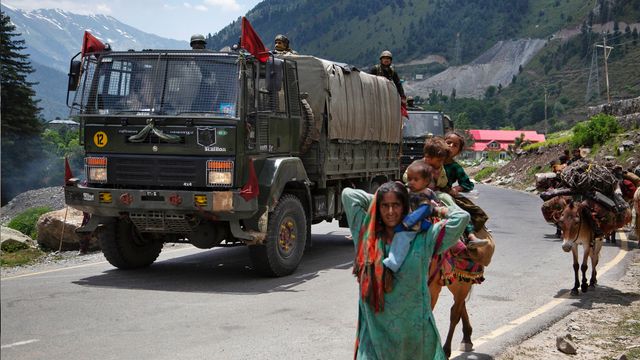
Kashmiri Bakarwal nomads walk as an Indian army convoy moves on the Srinagar- Ladakh highway at Gagangeer, north-east of Srinagar, India, Wednesday, June 17, 2020. (AP Photo/Mukhtar Khan)
Russia is hosting a meeting today with the Chinese and Indian foreign ministers in Moscow as part of the Russia-India-China trilateral grouping (RIC). According to media reports, the sides have agreed not to discuss the border dispute and instead focus solely on the COVID-19 pandemic. On Wednesday, the Indian defense minister Rajnath Singh  will be participating in a “victory day parade” to celebrate the end of World War II in Moscow. The parade, originally planned for May 9, had been delayed because of the coronavirus pandemic. It is being held now under conditions where the Russian economy has been fully reopened despite a spike in cases.
The conflict between India and China is posing a fundamental challenge to Russia’s foreign policy in Asia and, more broadly, on the world stage. Russia has historically maintained close ties to India. Even though bilateral trade is relatively low, Russia is India’s largest supplier of weapons and both countries have a series of joint military production agreements. Moreover, Russia plays an important role in India’s civilian nuclear program
However, encircled by US imperialism and the European imperialist powers, over the past decade Russia has also been pushed into an increasingly close alliance with China, which has been engulfed in long-standing conflicts with India. Moscow and Beijing have developed a closer military collaboration, and Russia has pushed for several major economic projects, most notably the Power of Siberia pipeline.
While energy cooperation, in particular, has fallen far short of Russia’s expectations—the Russian economy is heavily dependent on oil and gas exports, and China has been unwilling to pay the prices asked by Moscow—it has become a central component of Moscow’s economic and geopolitical strategy.
By contrast, India, especially under Prime Minister Narendra Modi, has been fully integrated into the war drive by US imperialism against China. India has undertaken major military purchases from the US, including very advanced military technology that the US only sells to its closest allies, and the countries undertake a large number of joint military exercises. Under Modi, New Delhi has also made its military bases available to US warships and warplanes.
Under conditions of growing isolation on the world stage, Russia has sought to maintain good relations with both India and China. Moscow has pushed for several organizations that include all three powers, including the Shanghai Cooperation Organization, an economic and security alliance, and the RIC. Russia has tried to use India, in particular, to counterbalance China’s growing influence in Central Asia, where Russia’s economic interests in countries of the former Soviet Union often clash with those of Beijing. More generally, Russia is also concerned about becoming too dependent on China on both a political and economic level.
At the same time, the Indian government has refrained from joining the anti-Russia campaign of US and European imperialism, which has escalated in recent years over the Ukraine conflict and the Syrian war. Moreover, despite vocal objections from Washington, India has purchased Russia’s S-400 defense system. The finalization of the purchase will also be a subject of discussion during India’s defense minister Rajnath Singh’s visit to Moscow this week. 
In May, at the 2020 Valdai Club meeting, an annual gathering of leading Russian foreign policy pundits and officials, Fyodor Lukyanov, Russia’s leading foreign policy analyst, insisted: “We should by all means stay away from the flywheel of the US-Chinese confrontation, which is gaining momentum. One of the tasks of Russia’s foreign policy in the foreseeable future will be to accurately build a system of counterbalances that would on the one hand prevent us from being involved in this confrontation, and, on the other hand, enable us to use the fact that there are some other countries that have absolutely no intention to participate in it. There is a common task of positioning oneself in the new world in a new way. I think that India and Russia can play the role of flagships.”
Vasily Kashin, senior research fellow at the Russian Academy of Sciences’ Institute of the Far East, was quoted by TASS as saying: “What makes the role of Russia and India so special is that the outcome of the US-Chinese standoff will depend on them.” He added that Russia’s position “implies certain opportunities, but it is rather risky at the same time.”
A Russian diplomat told the Hindu that Moscow had “high stakes” at a global level in the conflict, adding that “Good relations between India and China are central to the rise of Eurasia and the emergence of a multipolar world order, which is not dominated by a single pole.”
This strategy is now threatened by the growing tensions between India and China, which are fueled, above all, by the US war drive against China. At the same time, notwithstanding the infighting within the American ruling class over foreign policy and the Kremlin’s repeated attempts to find a negotiated settlement with American imperialism, Washington has only further ratcheted up its encirclement of Russia, most recently by enhancing the NATO status of Ukraine.
The campaign against China has been escalated at even greater speed and intensity. In a recent piece in Foreign Affairs that reflects the intense discussions in Washington about war preparations against China, Michele A. Flournoy, the former undersecretary of defense for policy, noted that the risk of a war between the US and China, which would inevitably draw in India and enflame the entire Asian continent, “is higher than it has been for decades, and it is growing.”
Flournoy argued that the most significant obstacle to averting “war in Asia” was the allegedly low “deterrence” by the US against China, and complained that Washington had “not delivered on its promised ‘pivot’ to Asia,” which had been initiated by Obama.
Flournoy proposed a series of measures to dramatically heighten the US military buildup and prepare for warfare “in all domains—air, sea, undersea, space, cyberspace.” She wrote, “To reestablish credible deterrence of China, the United States must be able to prevent the success of any act of military aggression by Beijing, either by denying the PLA’s [People’s Liberation Army] ability to achieve its aims or by imposing costs so great that Chinese leaders ultimately decide that the act is not in their interest. And [Chinese President] Xi and his advisers must believe that the United States has not just the capability but also the resolve to carry through on any deterrent threat it makes.”

UK students in precarious situation during the pandemic

Ioan Petrescu

The coronavirus pandemic has had a devastating impact on UK students. As the WSWS reported, many have been charged rent for vacated student accommodation and threatened with eviction.
In addition, many students and often their parents have lost jobs or been furloughed, depriving them of income and making it extremely hard to pay for their accommodation or daily necessities.
Adding to students’ stress, they have also had to make do with online learning in the final term of this academic year. Due to the lockdown, lessons have been abruptly cut and replaced with hastily put together online alternatives. Online learning is notoriously unreliable, depending on the teachers’ familiarity with online tools as well as the suitability of the subject to being taught on the internet.
Of course, to be able do that in the first place, students must have both a laptop and a decent internet connection to be able to attend the lesson, which is not guaranteed. This leaves students in a situation where they are not only paying exorbitant sums in tuition fees (£9,250 a year for domestic students and up to £26,000 a year for non-UK/European Union students, or up to £56,800 for some medical degrees), but they are not receiving anything in return!
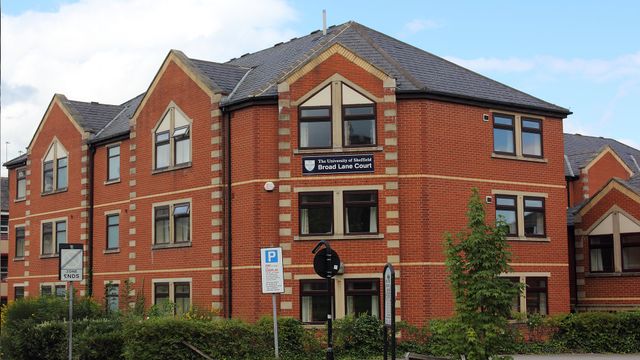
University of Sheffield student accommodation at Broad Lane Court in Sheffield (Image Credit: Wikimedia/Todo hzk)
An online petition demanding the reimbursement of all this years’ fee due to the pandemic has gathered 345,731 signatures as of the time of writing. Another one, that only asks for refunds for the third semester, has 109,282 signatures. The petitions raise the fact that online lessons are inferior, usually consisting of simple PowerPoints and lacking any interaction with staff. Students justifiably disagree with paying for low-quality learning materials and for campus facilities they have no access to.
The petition collected enough signatures to be brought before the House of Commons Petitions Committee. The Committee now has until September 23 to decide whether to bring the petition to a debate in the House of Commons. Two hearings have taken place so far. During the first hearing, with student representatives, the committee was told that students were feeling “angry and let down” and had not got what they paid for.
The government’s response has been predictably dismissive, with a one sentence reply instructing students that are unhappy with the quality of their courses to complain to the Office of the Independent Adjudicator for Higher Education (OIA) individually. At the second hearing, when the Petitions Committee pressed for a more detailed response, the Universities Minister Michelle Donelan made clear it expects all higher education providers to enable students to complete their studies and “avoid charging students for any additional terms”, but made only a passing reference to the quality of the provided studies. It merely encouraged “universities and private hall providers to be fair in their decisions about rent charges for this period.”
Students have reacted angrily, calling it “insulting” that they will be charged full fees for online courses. Jake, a student from Leeds university told the BBC, “There has clearly been no consideration of students with this decision. I pay tuition fees to go to my university in person, to be taught at my university in person, to access the facilities of the university—libraries, societies, sports facilities—in person.”
Other students are making their opinions known on social media. The BBC quotes Livi, posting on Twitter: “So by September I’ll have lost almost £3,000 to rent a house I’m not even living in, and tuition fees will still be max even if it’s online—something about this seems unfair.”
The situation is even more outrageous for international students, most of whom choose to study in the UK due to the lack of high-quality higher education in their own countries and are charged exorbitant prices to do so. In the same article, the BBC quotes Rose, an international student at Manchester University, expressing regret at paying so much: “I paid £19,000 for my course. We’re not a rich family. That’s all the money my family have. I feel so guilty for using it all up for this.”
Due to the impact of the coronavirus crisis, UK universities face a massive loss of funds for the year 2020/21, with an estimated 47 percent drop in international student numbers, and a 16 percent drop in domestic enrollment. The fall in domestic and international student enrollments is having a devastating effect on UK universities due to their overwhelming dependence on tuition fee income, as central government funding into higher education has been cut to the bone.
In response to these historic financial losses and a proposed all-out assault on university workers’ pay and conditions, the University and College Union (UCU) pathetically pleaded with the Johnson government to “stand behind” universities and to “[underwrite] funding lost from the fall in student numbers.”
These dismal appeals have fallen on deaf ears, with the Conservative government refusing to allocate a single penny in additional funding. Instead, a misnamed “support package” will bring forward £2.6 billion worth of tuition fees (paid by the government as a loan to students)—which universities would have received anyway—and £100 million in advances on research grants to universities.
There is also the issue of next year’s courses. While it is expected that teaching will be at least partly online, the government has said that students will still be charged full price for their studies. This will push students further into debt, in conditions where unemployment is soaring and the possibility of finding a decent job after graduating is less and less likely.
According to the job search website Adzuna, graduate job openings have fallen by 77 per cent since the beginning of the year, with 100 graduates now competing for each role. Average graduate salaries have already slipped by 3.3 per cent from £24,000 last year to £23,200.
As a result, up to 20 percent of students are trying to defer their studies. In ordinary times, students have the option to take a year or more out of their course if they need to, for any reason. But there are reports that some universities, in an attempt to squeeze more profit at less cost from students, are blocking all attempts by those who want to interrupt their studies because of the virus, unless they can show they are in an at-risk group for infection. This measure will affect poor, working class students the hardest, as they would be the most likely to need the money saved by deferment to make ends meet.
The universities have a financial incentive in lying to the students and claiming that they will provide a safe, on-campus experience come autumn, even if they cannot provide it. New students favor on-campus teaching to online courses and the universities which promote that will attract a larger number from the diminished student pool.
According to a survey conducted by the UCU, 71 percent of students would prefer to push back the start of term if it meant they had more in-person and less online teaching. Coupled with the denying of deferment, students will be put in the impossible situation of giving up on their higher education or studying in unsafe and inadequate conditions.
The situation confronting both students and lecturers is the outcome of a process begun before the COVID-19 crisis. Since the 1997 Labour government, universities have been turned into money-making enterprises, whose main concern is the generation of revenue, and who view students (especially international ones) as nothing more than cash-cows.
The Socialist Equality Party stands for the democratic right to a free and high-quality education for all youth. We demand the cancellation of all student debt. Billions of pounds need to be made available to reorganize courses in a way that makes them safe and accessible to all students during the pandemic. All university employees must be paid full wages, whether they are able to work or not.
The fight for these demands can only be taken forward by the formation of democratically elected rank-and-file committees of university workers and students. These must be independent of the trade unions. Such committees are essential to organize a nationwide, unified struggle to defend all jobs and basic rights, and protect university staff and students from unsafe COVID-19 conditions. The committees must turn to workers and students internationally, who are facing similar critical struggles against the impact of the worsening global crisis.

Reading terror suspect fought in US-British proxy war to overthrow Libya’s Gaddafi

Robert Stevens

Khairi Saadallah has been named as the main suspect in the murder of three people stabbed to death in Reading’s Forbury Gardens on Saturday evening. Three others were injured in the attack, with all now released from hospital.
Saadallah was arrested on suspicion of murder on Saturday and was later re-arrested under Section 41 of the Terrorism Act 2000.
The second and third victims of the attack were named on Monday, after the first—teacher James Furlong—was named Sunday. Pharmaceutical worker Joe Ritchie-Bennett, aged 39, was killed. Originally from Philadelphia in the US, Ritchie-Bennett had lived in the UK for 15 years. The third victim was David Wails, a senior principal scientist at global chemicals company Johnson Matthey. It appears Wails knew the two other victims, as they were together in the park and he was connected to them on Facebook.
It emerged within hours that Saadallah, aged 25, was known to the intelligence agencies. Last year, he was placed on MI5’s “long list” of around 40,000 people, who are monitored as potential terrorists. The Guardian reported that “Saadallah…was under investigation as a person who might travel abroad ‘for extremist reasons,’ but sources indicated that the inquiry was closed relatively quickly without any action taken as no genuine threat or immediate risk was identified.” A source told the BBC that Saadallah wanted to travel abroad, “potentially for terrorism.” The Sun was told by a source that “Saadallah was on MI5’s radar for a few months last year over his aspirations to travel to Syria.” Police closed their investigation into Saadallah after just two months.
Saadallah was released from HMP Bullingdon prison in Oxfordshire 18 days ago. He had been jailed last October for a total of 25 months and 20 days for various non-terror-related offences dating back to November 2018. On appeal, his sentence was reduced to 17 months and 20 days in March 2020. Saadallah served less than half of his sentence before being released. The PA news agency reported that Saadallah had six previous convictions for 11 crimes between June 2015 and January 2019.
By far the most significant information that has emerged is that Saadallah and his family have connections to the British-based group of Libyans who were opposed to the rule of the country’s then-leader, Colonel Gaddafi. Many of these lived in the Manchester area—the location of the UK’s largest Libyan community—and travelled to Libya in 2011 as part of a proxy force for US and British imperialism in the bloody regime-change operation against Gaddafi.
Yesterday, the Daily Telegraph reported, “Saadallah lived in Manchester when he arrived in the UK and former neighbours in Reading suggested he moved in the same circles as Salman Abedi, who carried out the Manchester [Arena bomb] attack, when he lived in the North West.”
Another Telegraph report stated that “Saadallah was about 18 when he moved to Bury, studying computing and communications at college, and living with friends. He told fellow students he had been in the military in Libya and had killed people fighting against Col. Gaddafi.” Bury is part of the Greater Manchester conurbation, nine miles north of Manchester.
The Telegraph added, “He told friends in the UK that he had fought as a child soldier to overthrow Colonel Gaddafi.” The newspaper quoted a friend who said, “He would describe himself as a Libyan soldier and said he had escaped [from Libya] because he didn’t want to be in the army.”
The Guardian reported that “Neighbours said a close family member of Saadallah’s had fought in Libya against Gaddafi.”
Several sources including the Telegraph report that Saadallah arrived in the UK in 2012 as a refugee from Libya. In 2018, he was granted leave to remain in the UK for five years despite having convictions for violence and having reportedly arrived in the UK illegally.
Salman Abedi and his brother Hashem were responsible for killing 22 men, women and children, and wounding 116 in the foyer of Manchester Arena after a May 22, 2017, concert by Ariana Grande. Salman Abedi detonated a backpack full of explosives, killing himself in the process.
The Abedis were protected assets of the British state, allowed to travel to and from Libya without hindrance because they were part of a network of proxy forces for British imperialism.
The father of the Abedi brothers, Ramadan Abedi, was a leading member of the Libyan Islamic Fighting Group (LIFG), an Al Qaeda-linked group opposed to Gaddafi. His son Salman travelled to Libya in 2011 and as a 16-year-old child soldier fought alongside his father to overthrow Gaddafi.
The Abedis and other LIFG fighters travelled to and from Libya at will. In 2014, as the civil war raged, the brothers received British government assistance and fled Libya in August 2014 onboard a Royal Navy vessel, the HMS Enterprise. According to the Mail, “The information [on the soldiers who boarded HMS Enterprise] was subsequently passed on to Number Ten [Downing Street], the Foreign Office and the Home Office.” Less than three years later, Abedi bombed the Manchester Arena.
As details emerged yesterday of Saadallah’s involvement in the war in Libya, the media quickly focused on his mental instability as the central motivating factor in Saturday night’s attack.
Official documents provided to the Guardian and other newspapers reportedly revealed that Saadallah had post-traumatic stress disorder and a personality disorder and had previously been detained under the Mental Health Act. The Times reported that Saadallah “had made erratic claims, including that he had fought for and against Isis. His comments were assessed by other officials as being linked to mental health problems.” The newspaper added, “Officials outside MI5 assessed that he did not subscribe to an ideology and did not have a belief system, although he suffered from mental health issues.”
The Telegraph took the same angle, with an article headlined, “Khairi Saadallah boasted about fighting in Libya but had mental health issues, friends claim.” The Mail reported, “Saadallah was diagnosed with post-traumatic stress disorder and delusional and paranoid schizophrenia, requiring medication before his release, a source told the Sun.” The BBC’s home affairs correspondent Daniel Sandford was “told by neighbours of the suspect that he once threw a television out of a top floor window and was regularly visited by a mental health key worker.”
Saadallah’s actions undoubtedly reflect an unhinged mental state—one entirely consistent with being pressed into service as a child-soldier in Libya’s brutal civil war. He and others have returned to the UK as ticking time-bombs, protected by the British state.
Whatever further information emerges about Saadallah’s mental health, there is no innocent explanation for his kid gloves treatment by the British state. Despite being on the radar of the intelligence agencies as recently as the middle of last year, “potentially for terrorism,” MI5 deemed he did not meet the threshold for an investigation or even for the opening of an active person-of-interest file.

COVID-19 rages through food processing plants, warehouses and manufacturing facilities

Jerry White

The coronavirus continues to spread through factories, warehouses and other workplaces as the number of COVID-19 cases rises sharply in US states that have reopened businesses and abandoned social distancing guidelines.
Twenty-nine states and US territories logged an increase in their seven-day average of new reported cases on Monday, with nine states—California, Texas, Arizona, Nevada, Oklahoma, Utah, Florida, South Carolina and Georgia—reporting record average highs. Disturbingly, many of the new cases are among younger people, with the median age for newly diagnosed coronavirus cases in Florida falling to 37.
As the World Socialist Web Site reported yesterday, Florida’s agricultural regions—where migrant workers pick fruit and vegetables next to each other and are cramped into crowded busses, trailers and apartments—have been major vectors for the spread of the deadly disease.
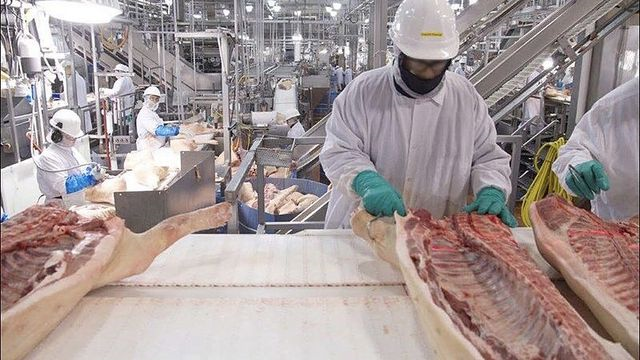
Workers in a hog slaughter and processing plant (Wikipedia Commons)
Immokalee, Florida, the country’s winter tomato capital, has 1,207 reported cases. With the harvest season over, thousands of migrant workers are now making their way up the East Coast and to the Midwest, with many of them taking the virus to Georgia, North Carolina, Michigan and other states.
The meatpacking industry continues to be the largest spreader of COVID-19. It is esimated that more than 24,000 workers have been infected and at least 91, including more than 25 at facilities owned by Tyson Foods, have died. Both figures have increased five-fold since Trump used the Defense Production Act to reopen infected slaughterhouses and meat processing plants in late April.
In North Carolina, where cases were found in at least 23 meat processing plants, the Raleigh News & Observer noted the comments of State Representative Jimmy Dixon, a staunch ally of the hog industry. During a recent committee meeting he said a policy of “herd immunity” would be better for the economy. “We’d better start addressing the economic health of this state," he said. "In my opinion, we’re all going to get [COVID-19], and the sooner we get it the better off we are.”
The wave of infections in the meatpacking industry is a global phenomenon, with major outbreaks last week in Wales in the UK, in Germany, where officials said 1,331 workers tested positive at a Tönnies Group slaughterhouse in North Rhine-Westphalia, and Brazil, where almost 24 percent of all COVID-19 cases in Brazil's southern Rio Grande do Sul state are workers in the meat industry.
The construction industry, which was exempted from lockdowns in many states or prematurely opened in others, is another hotspot. Fifty-five out of the 153 construction workers at a site on the Texas A&M campus in College Station, Texas tested positive last week.
Construction workers building new stadiums or renovating old ones for professional football teams are also contracting the disease. This includes at least 18 workers at the SoFi Stadium construction site in Los Angeles; 15 workers at the Allegiant Stadium site in Las Vegas; and at least 32 of the 275 construction workers at the renovation site for the Mercedes Benz Superdome in New Orleans—which Louisiana’s Democratic governor, John Bel Edwards, has declared “essential.”
In Santa Clara County, in the San Francisco Bay Area, there were 10 confirmed cases and more than 30 potential exposures reported at one Mountain View construction site, near Google headquarters, along with several other cases at San Jose and Milpitas construction sites.
Restaurant, retail and public transit workers are in peril as major cities reopen. Some 300,000 people are expected to return to work in New York City this week, as city and state officials allow the reopening of outdoor dining at bars and restaurants, in-person retail, hair salons and barbershops and more office-based jobs. Although subway ridership is only 17 percent of pre-pandemic levels, it is being ramped up under conditions where more than 130 transit workers have died from COVID-19.
Large crowds are expected for the July 4th weekend at casinos in New Jersey and Las Vegas, Nevada. Cases spiked in Nevada after the initial reopening of casinos in early June. Two employees at the Flamingo Casino tested positive last week, along with at least eight restaurant employees on and off the Strip.
Outbreaks of the disease have also hit major factories and warehouses. The Occupational Safety and Health Administration has announced that it will investigate conditions at Amazon facilities in Kenosha, Wisconsin, where at least 60 workers have tested positive. The giant corporation, whose CEO Jeff Bezos has gotten $33 billion richer since the pandemic began, has sought to conceal information about the spread of the virus, but former Amazon employee Jana Jumpp has compiled a list of nearly 1,600 infections and at least nine deaths in Ohio, California, Missouri, New York, Texas, Illinois and Indiana. She recently told the WSWS, “This is just the tip of the iceberg.”
The auto industry, which reopened on May 18, continues to see outbreaks. BMW has acknowledged 14 cases at its Spartanburg, South Carolina facility, and Toyota has confirmed 40 cases at its US plants, including in Georgetown, Kentucky. Previously, Hyundai acknowledged one death at its Montgomery, Alabama plant.
At General Motors, Ford and Fiat Chrysler, the corporate management of the Detroit Three automakers, with the full backing of the United Auto Workers union, has concealed information about the spread of the virus in an effort to prevent a repeat of the walkouts and other job actions by workers that shut down the industry in mid-March.
Workers at GM’s Wentzville, Missouri plant, just outside of St. Louis, have reported to the WSWS Autoworker Newsletter that at least 10 coworkers have tested positive. “When a manager tested positive, 36 people in trim walked out," one worker said. "They ended up staying out for three days so that they could get tested. It's resulted in a lot of manpower issues.”
A worker at GM’s Ft. Wayne, Indiana plant, which produces the company’s most profitable vehicles, reported, “People are gradually getting sick and it’s moving closer to my area. GM isn’t telling us real numbers. I know people that are sick and are home for quarantine. The UAW is also looking the other way. Today there were so many that were sent to the hospital to get tested that we couldn’t run the first half. The results take 2-3 days! No one wants to talk about the numbers. They even told us that people just had the flu... Secretive here.”
Workers in the auto parts industry also described their unsafe workplaces. “Conditions at Flex N Gate LLC Of Battle Creek are bad," said one worker. "We have cleaners who are supposed to be sanitizing the plant each shift, all shift, with alcohol, but on 3rd shift that’s not really likely. The cleaner isn’t using the alcohol, but is just wiping things with a rag! They have super-stupid one-way directions and the heat is unbearable in there, but yet we still have to wear a mask! They won’t clean the fans that they put out on the floor! We only have limited cold water! This sucks, as workers have to go in there and risk our health and safety just for some cars and trucks that most likely won’t even be purchased anytime soon.”
In an effort to counter large absenteeism rates among auto, meatpacking and other workers who do not want to infect themselves and their families, companies are restricting sick leave policies, and the Trump administration has announced it will not renew the $600 a week supplement to unemployment benefits when it runs out the week ending July 25. The removal of the subsidy, which many workers, including undocumented immigrants, never received, would throw millions of families into destitution.
Amidst the moves to cut off the $600-a-week lifeline to workers, both parties have handed over trillions of dollars to Wall Street and other giant corporations by passing the CARES Act in near-unanimous votes and sanctioning the Federal Reserve’s purchase of corporate bonds. Both corporate-controlled parties are now herding workers back into the factories and other workplaces to produce the profits needed to pay for the vast increase in government and corporate debt.
There is growing opposition to this homicidal policy and the plans to use the pandemic and the creation a vast pool of jobless workers to accelerate the assault on the jobs, wages and conditions of workers. In opposition to this, the Socialist Equality Party calls on workers to elect rank-and-file committees in every factory and workplace to unite workers across the US and internationally in an industrial and political counteroffensive to protect lives and living standards. The fight for safe workplaces requires a fight against the capitalist system, which sacrifices workers’ lives to corporate profit.

Understanding Pyongyang’s Belligerence towards Seoul

Sandip Kumar Mishra

On 16 June, North Korea blew up the Inter-Korean Liaison Office in Gaeseong. This is being seen as symbolic of South Korea’s failure to engage North Korea over the past few years. Effectively, North Korea has walked out of all agreements and understandings that have taken place between the two Koreas since the first half of 2018, including the Panmunjom Declaration. Kim Jong-un’s sister, Kim Yo-jong, who is first vice department director of the Workers’ Party Central Committee, used the occasion of the anniversary of the first Trump-Kim summit, to lambast President Moon Jae-in and South Korea with sharp rhetoric.
North Korea’s recent belligerence towards South Korea began with an over-reaction to ‘objectionable’ leaflets that called Kim Jong-un a “devil” who would meet the “same bloody fate as Saddam Hussein or Muammar Gaddafi.” A few South Korean conservative civil society groups were responsible for these leaflets. Pyongyang was not pacified even after Seoul announced a crackdown on such activities—the former characterised them as provocations graver than gun and artillery fire.” North Korea threatened to break all relations with South Korea, suggesting that the next action against the ‘enemy’ will come from the army.”
These developments are indicative of a larger trend over the past few weeks, in which North Korea has deliberately tried to ruin relations with South Korea. Leaflets and other materials such as Bibles, dollar bills, small radio sets, and memory sticks have been sent by South Korean civil society groups into North Korea, through air and sea routes, and using balloons and water bottles, from more than two decades. It had not elicited such an oversized reaction until now because Pyongyang has been well-aware of Seoul, or the state, playing no part in these activities.
However, this time, North Korea has chosen to go the route of issuing unusually strong, provocative, and often humiliating statements. On 4 June  Kim Yo-jong announced North Korea’s consideration of destroying the Inter-Korean Liaision Office, and nullifying the defence agreement between the two countries.  On 9 June, the Korean Central News Agency (KCNA) reported that the regime would cut off all communications with South Korea. Jang Kum-chol, who heads the United Front Department, warned on 12 June of possible military action against South Korea as a result of the break in trust between them. North Korean Foreign Ministry official Kwon Jong-gun said the following day that South Korea’s call for “denuclearisation must be abandoned” as they are “nonsensical.” On 16 June, North Korea destroyed the Liaison Office, and announced that troops would be sent to the Mount Geumgang and Gaeseong areas as well as sentry posts, and military exercises in border areas would be restarted.
The Moon Jae-in administration’s engagement policy towards North Korea has since come under heavy criticism. To avoid political fall-out, the South Korean Unification Minister Kim Yeon-chul resigned on 19 June, taking all responsibility for this so-called failure. The South Korea Defence Ministry, in a show of toughness, said that Pyongyang would pay a price if it took military action. The South Korean Blue House declared on 17 June that Seoul would not tolerate North Korea’s “unreasonable words and actions.” While Seoul is clearly trying to publicly respond to Pyongyang’s provocations, it is also aware that North Korean aggression is motivated by other important reasons that have little to do with their bilateral relationship.
One, North Korea is desperate for the removal of economic sanctions, which the US administration under President Donald Trump does not appear at all interested in. By being belligerent towards a neighbour and US ally, Pyongyang seeks to draw Washington’s attention to its own demands.
Second, North Korea has recently gone through internal political changes. Kim Jong-un appears to be suffering from health issues, and Kim Yo-jong has emerged in this time as the second most important leader in the regime. Kim Yo-jong is keen on a tough approach—she was involved in North Korea’s rapprochement with South Korea and the US, which unfortunately did not yield a wholly favourable outcome from their perspective. A tough image could help Kim Yo-jong rescue her image, and legitimise her ascendence.
Thus, North Korea’s recent provocations do not necessarily imply a failure of South Korea’s engagement policy. Rather, they are to suggest that the relationship, although bilateral, features an important third party, the US. Of course, political changes within the regime will also have a bearing on its approach towards inter-Korea relations. For these reasons, South Korea is best advised to be militarily prepared and positionally firm, even while maintaining a constructive policy approach.

North Korea and the US Disembark from a Summit Train Going Nowhere

Manpreet Sethi 

China has dominated headlines across the world in June 2020. This is not just because of the global fight against COVID-19, whose virus originated in China, but also because the country has simultaneously activated prickly issues with India, the US, Hong Kong, Taiwan, Australia, Vietnam, Malaysia, and Indonesia, to name but a few of the relationships that have been trending this summer owing to Beijing’s aggressive behaviour.
For India, this manifested in the form of a tense military face-off in eastern Ladakh. The matter had been simmering since mid-April and turned particularly bloody mid-June. Caught up in these developments, India paid little attention to another event that was taking place in northeast Asia. This was the rather grim commemoration of the second anniversary of the historic Trump-Kim meeting that took place in Singapore on 12 June 2018.
The Democratic People’s Republic of Korea (DPRK) chose this day to bid farewell to the summit process that had generated much excitement only two short years ago. It vowed instead to further build its nuclear and military force to counter perceived threats. While there is little reason for India to be overly concerned with these developments, there are indirect implications that should not be ignored. And, of course, China, which seems to be everywhere these days, has more than just a finger in the North Korean nuclear pie, from where clandestine nuclear business has been known to have been done in the past.
On 12 June 2020, a strongly worded statement was issued by DPRK’s Ministry of Foreign Affairs. It drew attention to the Singapore Summit, where US President Donald Trump and DPRK Premier Kim Jong-un held the first-of-its-kind bilateral meeting between these two countries caught in a hostile relationship since the 1950s Korean War. Pyongyang had long indicated its desire for direct negotiations with the US for resolving their relations, including addressing concerns about its nuclear programme. Washington, however, had preferred the trilateral, quadrilateral, and six-party talks formats. However, an out-of-the-box President Trump decided to take the plunge for a direct tête-à-tête with Supreme Leader Marshal Kim Jong-un. The world waited with bated breath, and expectations ran high.
The meeting went well as far as the personal chemistry between the two heads was concerned. They even managed a joint statement that made a mention of denuclearisation. The details of the process, however, were to be worked out at lower levels, where unfortunately nothing concrete could be achieved. To give the process another push, the two leaders met again in Hanoi in 2019. The meeting, however, ended abruptly, as differences over sequencing of sanctions removal and steps towards denuclearisation were found to be irreconcilable. Even though both leaders continued to express their admiration for each other and optimism for the bilateral relationship, 2019 yielded nothing. In any case, it appeared that President Trump had lost interest in the issue as other more pressing and immediate domestic and international concerns kept landing on his table fast and furiously.
The recently issued statement by North Korea now openly expresses a sense of disappointment with the Summits. It laments that over “not a short period of 732 days” since the first Summit, even a “slim ray of hope of peace and prosperity on the Korean peninsula has faded away into a dark nightmare.” Therefore, “it is futile to continue maintaining” the relationship with President Trump. Expectedly, DPRK draws attention to the many steps that it had undertaken, such as total shutdown of its nuclear test site, return of US prisoners, non-conduct nuclear tests, and suspension of further testing of its inter-continental ballistic missiles (ICBMs), even though it had received nothing from the other side.
As US-DPRK relations nosedive, those between the two Koreas, too, have worsened over the last few months. Military hotlines between the two were severed by Pyongyang earlier in June. As this column was being written, news came in that North Korea had blown up the Inter-Korean building, the joint liaison office at Kaesong, which was symbolic of their cooperation. The step was reportedly taken to express anger with the propaganda war being allegedly waged from South Korea through balloons and leaflets carrying anti-regime messages.
With this, another short episode of attempted détente seems to have stalled. Having expressed its unhappiness and anger with both Washington and Seoul, Pyongyang’s message is loud and clear as voiced in its statement. It reportedly carries the endorsement of the Fourth Enlarged Meeting of the Seventh CMC of the Worker’s Party of Korea: the strategic goal and national strategy for nuclear development of the country is now to “build up more reliable force to cope with the long-term military threats from the US.”
Perhaps, having realised the limits of what President Trump can do in the last few months of his presidency, Pyongyang sees greater benefit in ramping up its strategic capability in order to strengthen its bargaining position for when the next occupant of the White House is ready for another round of negotiations. During this time, when US attention is sure to be elsewhere, North Korea has a safe period to improve its nuclear deterrent, including conducting more nuclear and missile tests if it feels the need. The fear of more sanctions that may follow any such move is allayed by the friendship DPRK enjoys with China, which in any case has been its saviour over the years. That backdoor has always been open for the regime, even if the sanctions may have caused suffering to the ordinary citizens.
Meanwhile, what should be a matter of concern for all, and particularly for India, is the possibility of leakage of nuclear material, technology, or equipment from DPRK. Reeling from the pandemic’s impact (Pyongyang has reported complete control over the virus though the claim cannot be substantiated in the absence of independent verification), suffering from the effects of sanctions, not allowing any international oversight on its nuclear activities, and making use of a distracted international community, DPRK may be tempted towards clandestine nuclear transfers to interested state or non-state actors. It may be recalled that it has been involved in such actions in the past with Pakistan and China.
So, even though both the US and DPRK appear to have disembarked from the train of summit diplomacy that seemed to be going nowhere, it is imperative that a close watch be maintained to obviate the possibility of Pyongyang embarking on a train of nuclear proliferation that would certainly lead to disaster.  

22 Jun 2020

Draconian changes to India’s labour laws!

Rashme Madhavan

Labour “reforms” – India goes back in time
Given the COVID-19 situation, though not with the same enthusiasm, nevertheless the entire world celebrated workers May Day recently. Ironically, here in India in the same month of May, antithetical to the ideal of May Day the major states of India moved to destroy the hard-won gains of the working class. The states ruled by BJP have amended the labour laws heavily favouring the capitalist class. The other state governments in India are also planning to implement these draconian changes in labour laws.
Ever since the lockdown began the plight of all the sections of working-class increased drastically. The anti-poor Modi government started to use the corona crisis as a trump card to cover its inefficiencies.
The New Socialist Alternative has already come up with articles explaining as to how the migrant labourers suffered because of the mismanagement of the Modi regime. It took a toll on the workers of other sections as well. The sanitation workers were forced to work without proper protective equipment. The public sector workers were forced to sacrifice a part of their salary for the “PM Cares” fund. Many private and IT sector workers had to take a wage cut. Employers took extreme lay off measures in order to save their profits.
Though this is a global scenario the authoritarian BJP government has taken a greater step in order to take the society backwards. After having ideological debates one may have clarity that the change in the “production method” will only lay the foundations for a societal change. i.e when the productive force reaches a certain level it will come into conflicts with the relations of production which will lead to new economic condition & societal change (when the production ceases the workers will come in conflict with the owners which will lead to a change in society). But the dilution of the labour law has paved the way for a backward societal change.
Failure of the Modi’s regime
The severe violation of workers’ rights is euphemistically termed as “labour law reforms”. Reform for the benefit of whom? The amendment of the labour laws in the pretext of attracting investments will push the workers to sub-human levels & it’ll bring back the slavery officially.
The Building and Other Construction Workers Act, 1996; The Workmen Compensation Act, 1923; The Bonded Labour System (Abolition) Act, 1976 and Section 5 of the Payment of Wages Act, 1936 (the right to receive timely wages) are the only major labour laws that will remain undiluted while others will be suspended for 3 years.
The term “employer” in the BOCW Act is defined to include both contractors and owners. So, the owners and the contractors pass the responsibility to one another. Similarly, other laws are not being implemented properly. If we don’t fight for our rights now this will not be revoked even after 3 years.
That is to say, the workers will be deprived of their rights. The employers can hire and fire workers as per their wish without paying any compensation. The workers will not have any association with the trade unions and they’ll not have a say in their wage and working conditions.
Though the health crisis was unpredicted, the economic crisis is man-made. Finance Minister Nirmala Seetharaman announced that all PSUs in non-strategic sectors will be privatized, while in the strategic sector, there will be only one PSU, at the minimum and four PSUs, at the maximum, fully owned by the Govt. This move, instead of promoting self-reliance, will destroy the Indian economy.
At a time when money should be used to protect the workers (the real wealth creators), Modi plans to rebuild the parliament. More than Rs 600 crore is spent on dropping flower petals as a gesture of gratitude to doctors, nurses, and other workers on the frontline fighting the novel coronavirus pandemic. Even this was an utter flop. Around 150 medical professionals of the Government Medical College and ESI Hospital, Coimbatore, were forced to assemble in front of the hospital. After waiting for half an hour they realized that the fighter jets didn’t turn up for honouring them.
The Union government special COVID relief fund wasn’t used for transporting the migrant labourers. The hundreds of thousands of migrant labourers who were stranded in cities without wages or access to food had to pay their train fares. They weren’t just charged for these trips, they had to pay higher fares than usual. Ironically, even the Indian Railways had donated Rs 151 crore to the fund. Despite all this, the Union Railways Minister Piyush Goyal has the audacity to claim that “nobody starved in the last 3 months”.
The so-called Rs “20-lakh-crore stimulus package” is being widely criticized by famous economists and radical thinkers. It is nothing but an imaginary number. The jobless migrant workers need money to buy milk, vegetables, and cooking oil and to pay rent. In the name of relief, the government is giving loans to the already economically burdened working people and it continues its bailout packages for the rich.
How to build a fight back?Mere sloganeering of workers unity, opposition to Modi and lampooning of the regime will not suffice. Challenging the rabid right-wing regime of Modi needs a combative programme which is methodical in its approach taking into account the consciousness of the working class, especially of the advanced and combative layers. Such a programme should be clearly linked to fighting for a socialist alternative with transitional demands.
* Reject changes in working hours duration, must remain 8 hours only.* Stop all changes to labour laws and legislations.* Say no to all attacks on workers’ rights.* Minimum Wages must be raised to Rs.25,000 per month, with ₹100/ an hour minimum for all workers* Stop all privatization plans; we demand renationalization of all public sector industries and services.
* Trade Unions must organise a robust resistance against these draconian changes.
This is a do or die battle for the working class of India. While the 3rd July All India Protest by the Central Trade Unions is welcome, nothing short of an all-out political General Strike will deter the right-wing capitalist regime of Modi.
Workers of all sections, including public, private and other migrant workers, must unite as one class to fight back against this onslaught by the Modi regime.
We shall fight & we will win – Workers’ unity zindabad.

Australian government steps up attack on university students and workers

Mike Head

University students, as well as staff, are under mounting assault by the Australian government. It is attempting to exploit the COVID-19 pandemic to impose a major pro-business slashing and restructuring of higher education.
Last Friday, the government unveiled plans to more than double the fees for humanities and communications students, alongside 28 percent higher fees for law, economics and commerce, putting them all in the highest price band of $14,500 a year.
Students could pay as much as $43,500 for a three-year undergraduate humanities degree, up from $20,400. This would financially punish young people, and mature-aged workers seeking further education, who wish to study potentially intellectually stimulating courses as history, geography, politics, sociology, film studies, behavioural sciences and journalism. Creative arts fees would rise by 13 percent to $7,700 a year.
By this move, the government is seeking to further transform universities into vocational businesses, churning out “job-ready graduates” to meet the immediate profit-making requirements of employers. Addressing the National Press Club, Education Minister Dan Tehan said the plan would “incentivise students to make more job-relevant choices.”
This is antithetical to genuine education, which requires critical thinking and the exposure to new ideas. Young people, now facing an unemployment and under-employment level of 48 percent, are being denied the basic right to decent education.
Fees for courses that big business regards as vital, such as science, maths, agriculture, IT, engineering, teaching, nursing, clinical psychology, English and languages, would be reduced. But the government funds for most of these degrees would be lowered too, leaving the universities with less money overall and therefore forced to cut costs, including by increasing class sizes. There is no guarantee against students in those courses paying higher fees in the future.
Despite the corporate media fully backing this offensive, there is clearly outraged opposition among young people, including this year’s school leavers, and university educators, reflected in social media posts and comments published by some media outlets.
One student told the Australian Broadcasting Corporation: “I am a business/politics (humanities) student. I am the first in my family to attend university, and all this does is make university (for the most part) unattainable. My degree is now going to be on par with the cost of a medical degree … Poorer kids are going to move away from economics, humanities and law.”
Another message stated: “Truly devastating news. What the world needs now more than ever is for young people to learn to think deeply, critically, and creatively about the complex issues we face as a global community, to challenge the status quo, learn from the past and understand other cultures and points of view.”
Tehan denied that students would be priced out of degrees, saying “no student pays a single dollar upfront” due to the HECS-HELP fees loan scheme. Because of lower income thresholds introduced in 2018, however, graduates must start repaying their fee debts when they earn more than $46,000 annually—only about $730 a week after tax.
Many students will be saddled with a life of debt. By January 2019, about 3.2 million graduates had outstanding student loan debts, totaling over $66 billion.
After a three-year funding freeze, Tehan said an extra 39,000 university places for domestic students would be funded by 2023 to cope with the extra demand caused by the collapse of job prospects, but without any overall increase in government funding for universities. The plan would lift student contributions to the overall cost of degrees from 42 percent to 48 percent.
The latest measures will need to be legislated and pass the Senate, where the Liberal-National Coalition government holds only a minority of seats. But no reliance can be placed on the other Senate parties, including Labor and the Greens, which have helped decimate university funding over the past decade.
The government has been emboldened by the role of the university staff and student unions. They have assisted the government and the university managements to inflict the burden of the financial crisis triggered by the pandemic on staff and students.
Because of the loss of international student fees, the 39 public universities expect to lose revenues of $16 billion between June this year and 2023, with up to 30,000 jobs to be eliminated as a result. This is on top of years of multi-billion dollar funding cuts by the current Liberal-National Coalition government and the previous Greens-backed Labor government.
The government has refused to rescue the public universities, while handing JobKeeper wage subsidies to private universities. It has been aided by the fact that as soon as the pandemic began to hit, the National Tertiary Education Union (NTEU) rushed into backroom national talks with the managements, offering wage cuts of up to 15 percent while still agreeing to the destruction of at least 18,000 jobs.
The NTEU thus made clear its commitment to help the managements impose cuts and restructuring on university workers and students. For two months, while the closed-door negotiations continued, the union stifled any struggle against the offensive, permitting hundreds of job cuts, particularly of casual workers.
Since the NTEU-management “Job Protection Framework” was finally revealed to university workers last month and collapsed in the face of intense opposition, the NTEU and the Community and Public Sector Union (CPSU) have intensified their efforts to inflict similar job- and pay-cutting agreements on university workers at individual universities.
Likewise, the National Union of Students has opposed any mobilisation of students against the attack on jobs and conditions, which also means lower quality education, larger classes and worse services and facilities for students.
This escalating offensive underscores the call issued by the Committee for Public Education (CFPE) and the International Youth and Students for Social Equality (IYSSE) for a unified struggle by university workers and students for the defence of jobs and conditions and for the right to decent, free and first-class education for all, including international students, and full-time jobs for all university workers.
This will require the formation of democratically elected rank-and-file committees of university workers and students. These must be completely independent of the unions, which have shown they are nothing but political and industrial police forces.
Instead of big business being bailed out with billions of dollars, and billions more being handed to the military, resources must be poured into healthcare and education funding. That means challenging the capitalist profit system and turning to a socialist perspective, based on the total reorganisation of society in the interests of all, instead of the financial oligarchy.