24 Jun 2020

The COVID-19 pandemic and the global plight of refugees and migrant workers

Jordan Shilton

As the COVID-19 pandemic continues to tear through the global population, the disease is having an especially devastating impact on the tens of millions of displaced people throughout the world.
More than 1 percent of humanity–some 79.5 million people–were living as forcibly displaced people in 2019, the highest number on record. This staggering figure, which is almost double the number of displaced people just a decade ago and 10 million more than at the end of 2018, was contained in the latest United Nations Refugee Agency’s annual Global Trends report released last week.
If the world’s displaced were considered as their own country, it would have a population almost equivalent to that of Europe’s largest economy, Germany, or Iran.
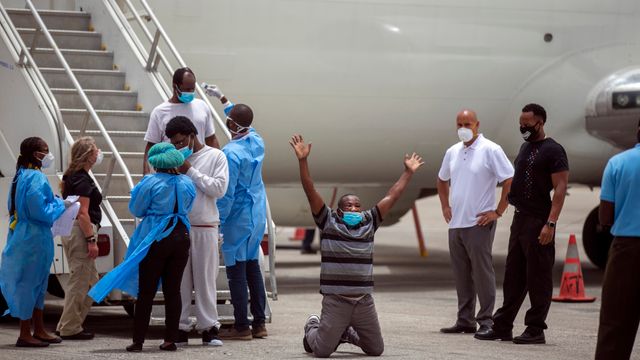
Roland Jean, a Haitian deported from the United States, kneels on the tarmac after arriving at the Toussaint Louverture airport in Port-au-Prince, Haiti. ( AP Photo/Dieu Nalio Chery)
The vast majority of the refugees come from five countries, all of which have either been direct targets for US imperialist aggression and intrigue or are suffering as a result of decades of colonial domination and neocolonial occupation. Afghanistan, Myanmar, South Sudan, Syria, and Venezuela account for 68 percent of the total. Syria, which has been devastated by a bloody US-instigated civil war for almost a decade, alone accounts for over 13 million displaced people–more than half of its 22 million pre-war population.
The poorest countries are bearing the brunt of the crisis, as the imperialist powers in North America and Europe seal their borders to refugees, fire on them with heavily-armed, fascistic border guards, or allow them to drown at sea. The UNHCR report notes that 73 percent of people displaced outside of their home country have found refuge in a neighbouring country, i.e. they live in countries that are often as ill-prepared as their war-torn, impoverished homelands to provide for their survival and well-being.
The report noted in this context the fate of the Rohingya, who were forced out of Myanmar by a vicious campaign of terror by the US-backed military regime. Tens of thousands remain confined to miserable, inhospitable camps in Bangladesh. Since the outbreak of the coronavirus pandemic, the UNHCR has registered growing numbers of Rohingya moving towards Malaysia and other southeast Asian countries due to the growing hardship produced by lockdown measures and the diminishing prospect of ever returning home.
Refugees and displaced people who seek to reach richer countries in Europe and North America confront brutal repression and the threat of death due to the ruling elites’ criminal policies. In the United States, the Trump administration has established a vast array of internment camps, where desperate and impoverished people fleeing horrendous social conditions in Latin America, including women and children separated from their families, are held in conditions no better than animals. Militarized guards and militias patrol the US-Mexico border, which has become the scene of hundreds of migrant deaths every year.
In “fortress Europe,” the European Union has all but abolished the right to asylum and shredded the protections adopted in the Geneva Convention on Refugees, a piece of international law instituted following the unbridled savagery of the Nazi regime. Seven decades later, European governments, with Germany in the lead, are well on the way to resurrecting similarly barbaric practices. Tens of thousands of refugees are confined to hellish concentration camps in Libya and other parts of North Africa, where they are subjected to torture, rape, slavery, and worse by EU-funded militias. On the Greek islands, tens of thousands of people are crammed into overcrowded camps with virtually no sanitary facilities amid a raging global pandemic. Thousands of refugees are left to drown in the Mediterranean on Europe’s doorstep each year.
The cruelty and vindictiveness shown towards refugees by European capitalism is so brazen that even UN officials have been compelled to criticise it. Speaking at the release of the Global Trends report, UN High Commissioner for Refugees Filippo Grandi said that as a European, he feels “embarrassed and ashamed” over how the EU has handled the refugee crisis.
As horrific as the figures are in the UNHCR report, it only accounts for the situation in 2019. It therefore does not take note of the devastating impact of the coronavirus crisis, which has dramatically worsened conditions facing refugees and migrant workers on every continent.
Migrants and displaced people typically belong to the most oppressed and exploited sections of the working class. They have been hit especially hard by coronavirus outbreaks, and largely left to fend for themselves by callously indifferent and often maliciously hostile state authorities from Modi’s India to Merkel’s Germany and Trump’s United States.
In Germany, where the fascistic Alternative for Germany plays a major role in determining government policy, large numbers of Romanian, Bulgarian and other Eastern European migrant workers are herded into dilapidated buildings often unfit for human habitation and receive poverty wages with no rights or job protections. They have been infected in large numbers in meat packing plants and in the agricultural sector, while many more have been placed under effective police guard in hopelessly overcrowded tower blocks and disused army barracks, which then become hotbeds for the spread of the virus.
In India, millions of migrant workers were left to starve by the Hindu supremacist government of Narendra Modi, which failed to provide adequate assistance to them when it unveiled a nationwide lockdown with just four hours’ notice in March. Due to the fact that the vast majority of migrant workers are day labourers in the so-called “informal sector,” they were left virtually overnight with no income to obtain food and other basic necessities for life. Hundreds of thousands began trekking on foot back to their home villages, often covering hundreds of miles and carrying the virus with them. Many more were detained in camps.
In the United States, migrant workers make up a large proportion of the more than 25,000 meat packing workers infected by CoVID-19. Hundreds of thousands of undocumented immigrants received no assistance during lockdown measures, due to fears that contacting state institutions could result in their detention or deportation. Building on the Obama presidency, which oversaw a record number of immigrant deportations, the fascistic-minded Trump has launched a series of military-style immigration raids carried out by Immigration and Customs Enforcement thugs to arbitrarily round up immigrants for detention and removal. In July 2019, Trump launched nationwide raids targeting 2,000 families in 10 major cities for deportation.
The defence of refugees and migrant workers is a task that falls to the working class. Anti-immigrant chauvinism and nationalism have been systematically promoted by all factions of the political establishment in every country to justify right-wing policies of law-and-order and attacks on democratic rights. They also seek to scapegoat immigrants and refugees for the social problems produced by decades of savage austerity and attacks on working conditions, which have in reality been implemented to boost the wealth of the super-rich and pay for imperialist militarism and war.
“The world of decaying capitalism is overcrowded,” wrote Leon Trotsky in the Manifesto of the Fourth International in 1940. “The question of admitting a hundred extra refugees becomes a major problem for such a world power as the United States. In an era of aviation, telegraph, telephone, radio, and television, travel from country to country is paralyzed by passports and visas. The period of the wasting away of foreign trade and the decline of domestic trade is at the same time the period of the monstrous intensification of chauvinism and especially of anti Semitism…Amid the vast expanses of land and the marvels of technology, which has also conquered the skies for man as well as the earth, the bourgeoisie has managed to convert our planet into a foul prison.”
Eighty years after these lines were written, their forceful condemnation of the bourgeoisie is, if anything, even stronger than in 1940. While the bourgeoisie of every country is returning to the reactionary politics of nationalism, militarism, and the far-right, the working class on a world scale is more interconnected and unified than ever before. The mass multi-racial protests over recent weeks in dozens of countries triggered by the brutal police murder of George Floyd testify to the common experiences of ruthless exploitation and state repression faced by workers of all backgrounds around the world under capitalism.
Rejecting the ruling elite’s nationalism and anti-immigrant poison, working people must come to the defence of refugees and migrant workers on a global scale. They must defend the rights of workers of all nationalities to work, live, and access social and health care services in the country of their choice without fear of persecution or deportation.
The defence of the democratic rights of refugees and migrant workers is possible only as part of the broadest mobilisation of workers and young people against social inequality, capitalist state repression, and militarism and war. Such a struggle should be guided by a socialist and internationalist perspective and set as its goal the transfer of political power to a workers’ government committed to socialist policies.

What are the Key Tenets of China’s Propaganda Regime?

Atharv S Desai

China has unleashed an international propaganda offensive, and demonstrated its ability to obscure truth while changing narratives, in the midst of the COVID-19 pandemic. Beijing is efficiently exploiting the platforms of journalism and social media to further its cause. Along with the Chinese Communist Party’s (CCP) traditional approach to cultivating China’s positive image globally, this new strategy, drawing on Russian media warfare tactics, is to "sow doubt, dissension, and disarray" to cause public information anarchy.
However, unlike Russia's covert strategies, the CCP employs more direct tactics of flooding mainstream global media coverage with pro-China messaging, and garnering support from ‘neutral’ global institutions, to back Chinese narratives. The real strength of contemporary Chinese propaganda—such as sophisticated message delivery, subtlety, and the professionalism of its information manipulation—is the obscuring of sources and intentions driving propaganda. To exhume the subversive nature of these activities and go beyond the technical aspects its information warfare, this commentary analyses five key tenets of the Chinese propaganda regime.
Information Dominance
Under President Xi Jinping, CCP’s United Front Work Department (UFWD) has been tasked with using the ‘magic weapons’ of political propaganda activities to further Chinese strategic, economic, and political interestsThis is grounded in a long-held view on the power of effective propaganda.
As an autocratic one party-state, China’s strategy of using information to achieve political goals is rooted in traditional CCP approaches. Information warfare is a part of PRC’s ambitious ‘Three Warfares strategyContemporary Chinese military literature has extensively explored the idea of ‘information dominance’ as a favourable pre-combat strategy for victory in modern warfare. This concept encapsulates CCP’s propaganda strategies, ranging from China’s ongoing global media expansion, cyber warfare, to social media disinformation campaigns.
Exploitation of Democracy
For communist China, the concept of liberal democracies may be a political anomaly, but its attributes are useful for Chinese strategic exploitation. This sort of exploitation appears to be taking place on three fronts. One, to further its discursive agenda inside countries with democratic systems, China has been promoting narratives that discredit responses by these governments to COVID-19. Two, China’s authoritarian capitalism is aiming to weaken the liberal transnational project. Such encroachment against liberal internationalism ranges from China’s so-called ‘cheque-book diplomacy’ to the pandemic-related ‘face-mask diplomacy’. Finally, the covert, corrupt and coercive elements of Chinese propaganda are threatening free press and democratic governance in a number of countries.
While the freedom and openness of liberal democratic systems have provided China an opportunity to influence their institutions, the reverse is not true. China continues to strictly guard—using a wide range of tactics such as censorship and surveillance—against efforts by external actors to engage with Chinese civil society organisations.
Foreign Lobbying
Following Mao's vision to “Make the Past serve the Present and Foreign actors serve China,” Xi aims to develop pro-China pressure groups abroad to promote the country’s interests. One aspect of this doctrine is to co-opt foreign academic, media, policy, and political institutions. This is illustrated, for example, by the gradual increase in the number of all-expense paid scholarships and quasi-scholarship trips to China.
Cultivating a class of China supporters—especially among freelance professionals—to act like ‘third-party spokespersons’ is another part of this doctrine. Such paid supporters range from professional PR organisations and corporate lobbies to pro-China policy and opinion-makers.
'Borrowed Boat' Strategy
The ‘borrowed boat’ strategy refers to the use of well-known and widely read foreign media platforms to publish coverage that lends credibility to Chinese narratives. Through this, the CCP is aiming to insinuate its official narrative in foreign mainstream media, through things like paid advertorials. China’s state-run English-language newspaper, China Daily, has signed deals with about 30 international newspapers to cross publish its official inserts, called China Watch. Chinese news agencies are also providing free content to partner media organisations abroad in their attempt influence foreign coverage of domestic developments.
Cultivating an information order that produces pro-China content without paid advertorials is the advanced version of this strategy. China’s extensive investments in media outlets of the Global South are extension of this cheque-book diplomacy. These investments are structured in a way that obscures its majority shareholder—state-run Chinese media.
Media for Intelligence
The most potent threat of Chinese interventions in foreign media arguably comes from the very nature of Chinese espionage and national security laws. As per as 2017 National Intelligence Act, both governmental and non-governmental Chinese organisations would have no choice but to “support, assist and cooperate with state intelligence work.”
There are several examples to support this claim. For instance, Mark Bourrie, a Canadian journalist working with Xinhua news agency was asked to submit a confidential report on the closed-door discussions between the Dalai Lama and Canadian Prime Minister Justin Trudeau. This highlights how China is using media platforms to collect sensitive information useful for its intelligence operations. According to a 2017 report by the US China Economic and Security Review Commission, Xinhua is involved in intelligence agency-like functions, such as information-gathering and producing classified reports on domestic and international events for Chinese leadership.
Chinese propaganda activities are not merely for image-building, or PR campaigns. While campaigns for political influence are a common tool of public diplomacy, the insidiousness of China’s global outreach and its skilled exploitation of the press threatens to damage the integrity of sovereign democratic institutions, and pose more serious challenges in the future. 

23 Jun 2020

Hopes Quashed: The Sudan Uprisings

Michael Welton

John Young has lots of guts and stamina to probe every nook, cranny and hidden crevice of the multiplex conflicts, strife, wars and struggle for power in a country, the Sudan, that lacks the necessary ingredients to call itself a viable nation-state. Young provides exacting detail demonstrating the deep fractures that disenable peace processes and turn the Sudan into a state approximating anarchy. Plunging into the literature on the Sudan, my head is barely above water, filled with factoids, dates, armies, militias, acronyms, civil society groups and too much detail. How can I make sense of all of this?
The excruciatingly poor, remote and landlocked Darfur region in the Western Sudan crisis erupted in 2003, killing 200,000 or more people. It is now placed on a recent list of shame along with Rwanda and Srebrenica. The Sudan Liberation Army and Justice and Equality Movement rebel groups began fighting the al-Bashir government for neglecting its economic needs. They accused them of oppressing the neglected Darfur’s (Western Sudan) non-Arab population. The al-Bashir government, in return, used its violent instrument of choice, the repellant Janjaweed, to commit acts of genocide (including much rape). The civil war between North and South Sudan cost the lives of 1.5 million and drove millions from their homes. One descends into the dark void. Can anyone emerge waving a white flag?
Young has lived and worked in the Sudan as teacher and journalist since 1986. He has also participated in consultations regarding the peace process in Sudan, monitored the conflict in southern Sudan and various other security matters. The author of three books, Peasant revolution in Ethiopia: Tigray People’s liberation front, 1975-1991 [1998], The fate of Sudan: origins and consequences of a flawed peace process (2012) and South Sudan’s civil war: violence, insurgency and failed peacemaking (2019).
Most recently, he has authored a report, Sudan uprising: popular compromises, and revolution betrayed (2020), published by Small Arms Survey’s Human Security Baseline Assessment for Sudan and South Sudan project with support from the US Department of State as well as support from Canada, Norway, Switzerland and Demark. Both the National Endowment for Democracy (United States) and the United States Institute for Peace have also provided support.
Young’s Report, then, is a helpful guide to begin sorting out what’s has been happening in the Sudan over the last fifty years since independence was achieved in 1956, then a loose confederation of tribal, racial and regional identities. Since I am not an expert on Sudanese history or strife, I will try to highlight those aspects of Sudan uprisings that catch my interest. A short 70 pages, the Report analyzes Sudan’s history of rebellion, the National Islamic Front and National Congress Party in power, the regional context on the eve of the collapse of the al-Bashir regime, internal developments preceding the 2018-2019 uprising and the dynamics of the uprising. It’s quite the dispiriting story and mostly does not end well. Young uses “failed” and “flawed” to describe Sudan’s state of affairs. How does he bear this endless suffering? What words must he speak before the unspeakable? Put bluntly, Young states unequivocally, the regime of al-Bashir was too brutal and the resistance too disorganized.
In South Sudan’s civil war: violence, insurgency and failed understanding, Young makes is clear that the British wanted to maintain hegemony in the Sudan. Ironically, in the mid-nineteenth century the British effort to end the trade in ivory and slaves abruptly ended the South Sudan’s economy. Later, in the early twenty-first century, US pressured the regime to adopt policy positions suitable to Bush’s “war on terror” in 2003. This increased markedly Sudan’s instability and inability to meet its diverse citizens’ economic needs or uphold human rights. The Sudan has been kicked around like a football by external forces and no wonder the leaders retreat to the ignoble murderous defense of their power.
And the fact that the Sudan has 19 different ethnic groups (with 597 ethnic sub-groups), speaking around 100 languages and dialects makes it hard for tribes to imagine something called “nation.”. The majority of Sudanese are Arabs; the largest tribes are the Dinka and Nuer, who are pastoralists. Forms of social organization differ. They range from the kingships of the Shilluk, Zande and Anuak to the stateless Nuer. Now, some highlights.
“Similar to uprisings in 1964 and 1985, a major cause of the 2018-2019 uprising was an extended period of economic decline and uneven development that fostered insurgencies in Sudan’s peripheries. The economic crisis was exacerbated by the cost of combating these insurgencies, a vastly inflated security sector, endemic corruption, and US sanctions. The economic crisis and the regime’s attempt to foster Islamist values served to bring large numbers of youth, notably including women, onto the streets, in contrast to the uprisings in 1964 and 1985, when trade unions played a leading role.”
Certainly, this statement accentuates several things of importance: the citizenry in the Sudan has been unhappy and dissatisfied with their governance for a long time and the youth and women have been key players within civil society. Do we have a rough equivalent to civil society vs. the state that emerged in Eastern Europe?
“With the support of Saudi Arabia, the UAE, and Egypt, the military expected that, after it had deposed al-Bashir, it could form a transitional government on its own, but the brutality of the RSF [Rapid Support Forces] suppression of the sit-in in Khartoum on June 3 June 2019 [around 200 were murdered] lost the junta domestic and international legitimacy, and it was compelled to sign a power-sharing agreement with the FFC [Forces for Freedom and Change] on 17 July 2019. Fearing further attacks on civilians, weakened by internal divisions, and under international pressure, the FFC accepted an agreement that involved abandoning its central demand for a civil administration.”
Here, Young uses the word “brutality” one of many times in his analysis. I also notice that civil society cannot muster the power and authority to help topple the regime. This reminds me of the inability of an aroused civil society (with lots of youth using social media and out in the streets) in the Arab Spring of 2011 to overthrow a dictatorship like Abdel el-Sisi in Egypt. In the Sudan, how much “influence” did the youth actually have with the FFC?
“Youth made up the core of the uprising, and their challenge to the junta was mainly manifested in the sit-ins that they organized. But when the brutal RSF attack on the Khartoum sit-in on 3 June 2019 effectively ended the sit-ins, the youth lost much of their influence over the FFC, had no say on the political agreements reached between it and the generals, have no representation on the transitional government, and cannot be expected to exert much influence during the 39-month transitional period.”
Perhaps we could compare the impotence of Sudanese youth to other youth uprisings in a place like South Africa or the US during the anti-Viet Nam war protests. Under what circumstances does “youth protest” get translated into policy and changes initiated? The Sudan, it seems to me, has an undeveloped culture of deliberative forms of democracy. Up against brutal militaries, the youth have strong moral force, but little else. Fighting is better than talking in the Sudan.
“This report concludes that because the opposition was unable to impose its objective of a genuine civil administration and, given the preponderance of the military in the transitional government, it is very unlikely that this government will be able to eliminate the deep and corrupting influences of the NCP and the military in the state and society, much less overcome systemic inequities that have afflicted Sudan since its independence. Unless the civil and armed opposition can overcome the power of the military, the 2019 uprising will suffer the same fate as those in 1964 and 1985, when hopes for a radical transformation of Sudanese society were quashed.”
The military cannot function as an autonomous agent. They must be under the control of elected institutions. Otherwise, one is in danger of descending into a Hobbesian “war of all against all.”
One of the interesting things Young does in his report, packed tightly with details hugging each other, is to select provocative statements to headline each section. In his “Introduction” he writes: “Because the NIF never governed with the consent of the Sudanese people, violence was always integral to the pursuit of its domestic and foreign policies.” Indeed, the NIF was a nasty piece of work, doing things like facilitating an attack against Hosni Mubarak in June 1995. This phrase—“Sudan has an illustrious history of civilians overthrowing military dictatorships and a dismal record of their replacements”–articulates a central theme in Young’s books. For those with visions of the liberal cosmopolitan order bubbling in their minds, the case of the Sudan may be soberly instructive.
The section of the report, “The NIF/NCP in power,” observes that: “There is a long history of Sudanese opposition parties and civil society opposing oppressive governments, but never before had they confronted a government as ruthless as that of the NIF/NCP.” Knowing the Sudanese peoples’ proclivity to rebel, Young informs us that the NIF regime restricted political parities, ruthlessly contained dissent, replaced trade unions with submissive company unions, and a security apparatus that was seeded in government structures. The lifeworld basis for an active and dynamic civil society is damaged almost beyond repair.
In the section, “Regional context on the eve of the collapse of the al-Bashir regime,” Young choses this statement: “Over the years regional conflicts and configurations of power significantly shaped Sudan’s politics, including the 2018-2019 uprising.” One gets dizzy reading the malevolent doings of the NCP, including murdering hundreds of unarmed Muslim Brotherhood protestors in Cairo in July 2013.
The “Conclusion” carries this disheartening observation: “Attempts to overcome endemic corruption will be undermined, because the security organs are a primary source and beneficiary of such corruption.” Young’s work indicates, for me, that like Israel, oppression and brutal acts in the Sudan can seem to just go on forever. Young believes that if outside forces could give up their superiority, North and South Sudan might just get themselves out of their mess.

Billions of Children are Being Punished by the Pandemic

Vijay Prashad

The Great Lockdown lingers month upon month. The virus continues its march across the world; the disease continues to infect people and take lives. Uncertainty grips all of us, unsure if the disease’s peak has been reached and if the Great Lockdown will soon slowly lift. In places such as Brazil, India, and the United States, the irresponsible and incompetent governments are eager to open things up to galvanize economic activity; they do not appear as concerned about breaking the chain of the infection. U.S. President Donald Trump said that he wanted testing to be slowed down, a dangerous statement that goes against all the advice from the World Health Organization. No sense in ending the Great Lockdown if such an opening is only going to continue to infect people and prevent a proper end to the pandemic.
There are immense casualties from this Great Lockdown. Incomes have collapsed for half the world’s population, while hunger rates are on the rise. But there are other casualties, other victims, often less remarked upon.
Digital Divide
Parents around the world have been confounded by the school closures. Their children have been at home, experimenting with different forms of home schooling. Schools have closed in 191 countries, with at least 1.5 billion students and 63 million primary and secondary school teachers out of the classroom. Where the internet is widely available, children have been able to do their schooling through web-based platforms, although the character of the learning is doubtful. Concentration has diminished, and the depth of the educational experience has become shallow.
Where the internet is not available, children have been unable to continue with their studies. A UNICEF study from 2017 showed that 29 percent of youth worldwide—about 346 individuals—are not online; on the African continent, 60 percent of children are not online compared to 4 percent of European children who are not online.
Many of these children can go online with a phone and with expensive cellular data; they do not have a computer or wireless internet connections at home. A UNESCO study recently found that half of the children who are not in a classroom—namely 830 million students—do not have access to a computer; more than 40 percent of children have no internet at home. In sub-Saharan Africa, almost 90 percent of students have no household computer and 82 percent cannot get online through broadband at home. The digital divide is real, and it continues to impact the educational opportunities of children during this pandemic.
There is no clarity that these children will be able to go back to school anytime soon. Creative ways to continue distant learning—such as the use of community radio stations and television channels—are being studied. But there has been no will to impose a mandate for educational programming on private television channels and radio stations.
Violence
In June, the WHO, along with other UN agencies, released a landmark study, “Global Status Report on Preventing Violence Against Children 2020.” Sadly, this study—like so much about the status of children in our time—has received almost no news coverage.
The data on violence against children—before the Great Lockdown—is shocking. One out of every two children aged two to seventeen experienced some form of violence each year. A third of students between the ages of eleven and fifteen have been bullied by their peers during the past month, while about 120 million girls have suffered from forced sexual contact before the age of twenty (it is important to note that there are no global numbers on the rates of sexual violence against boys). The report offers the first-ever global homicide number for children under the age of 18; in 2017, 40,000 children were victims of homicide. Laws exist in 88 percent of the world’s countries that forbid all these atrocities; yet, reporting rates are low, and in at least 47 percent of the countries, enforcement is miserable.
The WHO study says that violence rates against children have increased during the pandemic and such violence “is likely to have long-lasting negative consequences.” In many countries—such as the United States—there is a decline in reporting of child abuse cases to child protection services; this, the study’s authors argue, is because the “frontline providers in the community such as teachers, social workers, nurses, physicians—who under normal circumstances would recognize the signs of abuse—no longer [have] direct contact with children, and therefore [are] unable to report suspected abuse.” In the United Kingdom, calls to the National Society for the Prevention of Cruelty to Children rose by 20 percent.
Movement restrictions, unemployment, isolation, overcrowding, and other factors, the report notes, “have heightened levels of stress and anxiety in parents, caregivers and children.” For those households where family violence is already a problem, this is a nightmare scenario. “Stay-at-home measures have limited the usual sources of support for families and individuals—be they friends, extended family, or professionals—further eroding their ability to successfully cope with crises and the new routines of daily life.” Writing in the Atlantic, Ashley Fetters and Olga Khazan say that this is “the worst situation imaginable for family violence.”
Solutions
While the Great Lockdown continues, no good solutions exist for either the digital divide or the violence inside homes. Without a robust public sector that invests in free and universal internet access and provides computers to each child, there is going to be no real breakthrough of the digital divide.
Similarly, unless governments transform their public health systems and social worker programs to have routine contact with households in communities, there will be no real way to identify cases of child abuse and protect the children.
No amount of privatization or philanthropy can solve the problems of the digital divide and of violence against children. What is needed are well-funded programs of a decentralized but robust state, with free Wi-Fi and neighborhood public health and social work offices. In a post-COVID-19 world, such policy demands should be at the tip of the world’s tongue. It is the only approach that will be able to provide children with protection.

Turbulence in the life of Elderly People in India

Rahul Kumar

At 69, Prime Minister Narendra Modi has no sympathy & compassion for the elderly population of India. In the pandemic of Coronavirus, there is a turbulence in the life of elderly people in India. More than 85 percent lower-income group elderly people living in remote villages of India are not in a position to afford expensive sanitizers and masks. Studies indicate that some elderly people use unhygienic sand to wash their hands as they cannot afford even soap. Water scarcity in the villages of India has further crippled the life of the elderly population in India. Wheelchair if at all available in government hospitals are broken. In most Indian states, more than 75 percent of government hospitals have no wheelchair for the use of elderly people.
A retired gynaecologist who has been chair of National Accreditation Board and Hospitals & Healthcare Providers, said he looked for a vacant bed for two days for his 93-year old diabetic father who tested positive. “I had all the contacts but nothing seemed to work initially. When he was finally admitted, we could not enter the isolation ward… there was no communication. It becomes distressing not to know how your loved ones (Indian Express 23rd June 2020). If this is happening with such a well-connected retired official then one can think of what will be the condition of a poor man or woman. Private hospitals are minting money despite government cap on the lab test for the Covid-19 patients. From 2014 to 2019, it shows that the Narendra Modi government in India has paid no attention to the health infrastructure.
Since the first lockdown in India due to the Coronavirus, the majority of the elderly people are confined either to their homes or to the hospitals. They are feeling lonely and isolated when they are at home. They are tortured by the health staff when they are admitted to the hospital infected with the virus. Media reports show that many dead bodies of elderly people disappeared from the government hospitals in the state of Maharashtra. Nears and dears of the deceased elderly had lost opportunity even to see his or her face.  What a tragedy?  There is a long queue in front of the electric furnace. Some of the children have reported that they had paid a bribe to the management of the electric furnaces to burn the body. This is called New India of Indian Prime Minister Narendra Modi.
It is supposed that the retired elderly from the middle –income group draw their income mostly from the Bank Fixed Deposits or the Retirement pension. State pension varies from state to state in India. There is around 3.23 Crore of the 10.38 Crore elderly beneficiaries of old-age pension in the country ( Deccan Herald). Despite protests by Elderly people, various state governments did not raise state pension. However, the Elderly people approached the Narendra Modi and pleaded for the enhancement of government pension but all in vain.
Since 2014, the Narendra Modi government has constantly been decreasing Bank interest on Fixed Deposit that has jeopardized the livelihood of the elderly people in India. The government pension is irregular. In the pandemic of Coronavirus, media reports show that retired elderly people are not receiving a government pension on time. If at all they receive, half of the pension is already deducted without assigning any reason.
Prime Minister Narendra Modi without intense deliberations declared the first lockdown in the country on 25 March 2020. More than 300 million people lost their jobs in India. Children who were supporting their older parents stop supporting them because they are left with no regular source of income. In the pandemic, the Narendra Modi government did not give a single penny to the elderly people.
Elderly abuse has doubled in the pandemic of Coronavirus, According to a recent study done by Agewell Foundation, New Delhi, 71 percent elderly face mistreatment in old age mostly due to financial reasons. 62.1 percent elderly in India do not get long term, palliative care and 67.6 percent of the elderly being taken care of their family members have to babysit their children. It has been observed that the elderly people are mistreated by government officials when they go to the department to make inquiries about their pension. In Digital India of Narendra Modi, it is the elderly people who are suffering the most as the majority of the elderly people do not know how to operate a computer. The central and state government do not extend a helping hand to them in fulfilling the complex paper formalities to avail the pension.
In case of a family dispute over property, the elderly people suffer the most as the judicial system is corrupt and the police personnel do not behave properly with the elderly people in India. Not only this but also there is no separate comfortable place to sit for the elderly people in most of the Police Stations in India. They are treated like other criminals by the Police Officer. In New India of Narendra Modi, nothing is changed for elderly people.
In an era of advancement of technical devices, the life span of older people increased, at the same, the economic threat to their pocket also increased due to expensive medication and hospitalization. In the old age, older people need a lot of money to deal with routine medical expenses. In the case of hospitalization, the life of 99.9 percent of older people becomes miserable. Government hospitals are crowded in India. Private hospitals that are on the government penal exploit every patient particularly the older one.
In the absence of economic support by the Narendra Modi government, older people left with no choice than to die either prematurely or languish in hospital. Low –income older people run from pillar to post from one government hospital to another for seeking an appointment from the doctor especially a specialist or a renounced one. Blessed are those who have some political connection to get a bed in the government hospital.
Doctors are still considered God in India but greed and corruption have already penetrated the medical profession. A new breed of doctors violates flagrantly the oath of the medical profession. It is common among the doctors who pay heavy capitation fee to get admission in a recognized medical college. Various studies and surveys conducted by experts in the medical profession show that the element of greed and corruption is commonly found among the doctors who obtain a medical degree from other countries and practices profession in India. Past studies also show that the same doctors indulge in several types of corrupt practices in connivance with the manufacturers of medical equipments and medicines. The health system has collapsed under India Prime Minister Narendra Modi. Regulatory bodies do not bother about the quality of medicines produced by Indian companies. Some companies import cheaper medicines in India and sell without hindrance or penalties under the nose of Prime Minister Narendra Modi.
The Indian Health System is in dire need of funds to be pumped by the Narendra Modi`s government to upgrade government hospital infrastructure. The Narendra Modi government debt rose to 84.5 percent of GDP. And general government fiscal deficit is likely to rise to 11.5 percent as predicted by Fitch Rating. Moody Investor service projected the Indian economy to shrink 3.1 percent in 2020. In Western countries, bank levy fees on your money if you keep in Fixed Deposits. In the same way, the Narendra Modi government in India is closely implementing the western banking system.
In that case, the older population in India should not expect anything good from the Narendra Modi government.

Indian Nationalism Heading Towards A Catastrophe

Mohamed Rashid KC

Nationalism, a modern political narration, flourished across the globe in different nature of colour, cuisine, creed, culture, race , religion, region, and language etc. This ‘ism’ mobilised mass to cripple the imperialism on the one side and built a new road to majoritarian polities on the other. The very idea of Indian nationalism evolved as a struggle against British colonial suppression and to obtain freedom thereof. The political mobilisation under Indian national congress, peasants organisations, Radical left movements and trade unions brought people under a single platform, Indian national movement.Inspite of linguistics, class, ideological, religious , philosophical and political differences the cooperation, mutual respect, democratic values and secularism was the essence of Indian nationalism. The entry of Mahatma Ghandi, into the picture of Indian national movement vitalised the aforesaid features of nationalism, especially the cooperation between religious groups and, planted a pluralistic political culture across the nation.
Hindutva and Paradigm shift
The disintegration of USSR, and consequent political propaganda of United States of America, in the international flora, ‘Green Danger’ painted terrorist and trouble maker colour on muslims, and its effects started to reflect in Indian subcontinent also. The anti Muslim tendency orchestrated by the western world applied by the advocates of Hindu rashtra on the wounds of partition caused the emergence of new radical apolitical religious groups, which later fuelled to the demolition of Babari Masjid in 1992. In the meantime the nationalism geared to Hindu Rashtra, especially in Hindi belt. Nevertheless, the secular feature of Indian nationalism continued till 2014. The post 2014, witnessed a paradigm shift in the discourse of Indian nationalism. The exploitation of fourth estate and social media by Hindutva forces tainted the social psyche of Indian people to think of a Hindu Rashtra, which reflected in the political issues from cow vigilantism to CAA – NRC shows where the nationalism stands and its direction to. Even it threw up science and profiled the Muslims as carriers of coronavirus.
Anti Minority nationalism
The journey towards ultra-nationalism culminates in anti-minority politics or ‘politics of othering’. It’s been crystal clear from the past incidents whether it is love jihad or Pulwama terrorist attack or cow vigilantism or National anthem in cinema halls or triple talaq or uniform civil code or Citizenship Amendment Act or spike of positive corona cases in India, that Muslims are being targeted by the Hindutva backed government. Moreover, it’s very interesting to note that the criticisms against the Hindutva led governments are considered as anti-national or from Pak agents. Apart from these, the overwhelming support of people to the propagations of Hindutva is alarming the jeopardised situation of Indian democracy as well as the Indian nationalism. When we analyse the anti-minority issues case by case, the mainstream secular political parties have turned a deaf ear and skipped such issues from their campaigns shows that the Hindutva forces have hijacked the discourse of nationalism, and empowered themselves to redefine the future of India.
The way Forward
The paramount hegemony of Hindutva over the discourse of nationalism and patriotism should be countered urgently on ideological lines.Firstly, the constant effort to legitimise the majoritarian nationalism through the academic discourse have to be defended. Secondly, it’s the responsibility of the mainstream secular parties to address the Hindutva projection. Finally, a collective effort of the intellectuals, working professionals and students of the nation is necessary otherwise, the basic principles of Indian nationalism will be replaced by the majoritarian principles of tyranny and theocracy and, ultimately to undermine the Democratic republic nature of India.

Canada presses ahead with final phase of back-to-work drive

Frédéric Charlebois

The Quebec government unveiled the next stage in its reckless back-to-work drive last week. New measures include allowing indoor gatherings of 50 people; reopening cinemas, pools, arenas and gyms; the resumption of day care services in Montreal; the reopening of shopping malls; and the relaxing of “social distancing” measures to the point of making them effectively useless.
The Coalition Avenir Québec’s (CAQ) back-to-work drive began in April, at the height of the pandemic, with the reopening of mines and residential construction. It was intensified in May with the reopening of most businesses, primary schools and daycare centres (except in the Greater Montreal area, the epicentre of the COVID-19 pandemic in Canada).
Quebec is the Canadian province most affected by COVID-19. It accounts for more than half of all infections and deaths although it is home to less than a quarter of the country's population. Yet the Quebec government has mounted the most aggressive campaign for a premature reopening of non-essential sectors of the economy.
The announcement of similar measures in neighbouring Ontario by the hard-right government of Doug Ford underscores that the back-to-work drive is a cross-Canada policy aimed at enabling big business to begin reaping profits once again from the working class, irrespective of the consequences for human life.
The push for a premature return to work is being carried out under the oversight of Justin Trudeau's federal Liberal government. After demonstrating a complete lack of preparedness for a foreseeable and predicted pandemic, Ottawa responded by bailing out big business to the tune of hundreds of billions of dollars, while placing workers who lost their jobs on meagre rations.
Like their European and American counterparts, all levels of government in Canada are in the process of lifting their last remaining lockdown measures. Their intended goal is the creation of conditions in which workers are forced, under threat of dismissal, to return to workplaces where the risk of contracting the deadly coronavirus, and passing it on to their loved ones, is high.
This is highlighted by the Trudeau government's Bill C-17, which threatens severe fines and even prison sentences for workers who use the meagre assistance provided by the Canada Emergency Response Benefit (CERB) to delay their return to unsafe workplaces.
The priority for the capitalist elite is to recover the costs of the massive bailout provided it by the state through increased exploitation of the working class. Underscoring that the financial aristocracy is determined to put profits before human lives, their hirelings in government are already letting it be known that they intend to ignore the sharp rise in COVID-19 and deaths that will inevitably be the product of their premature “reopening” of the economy.
Quebec's director of public health, Horacio Arruda, has already declared that there will be no “total lockdown” in the event of a “second wave” of the pandemic. Similar statements have been made by other Canadian officials, including Saskatchewan and British Columbia’s chief medical officers and by US President Donald Trump.
The forced return to work is accompanied by an official campaign to give the false impression of a return to “normality,” when in reality the COVID-19 pandemic continues to progress at an accelerated pace.
The World Health Organization (WHO) reported last week that the number of new cases worldwide has surpassed a record 150,000 daily. “We are entering a “new and dangerous phase” of the pandemic, warned WHO Director-General Tedros Adhanom Ghebreyesus.
In Canada, the ruling class has seized on a moderate decline in the number of infections since the beginning of June to intensify the back-to-work drive.
This is particularly true in Quebec which since it reached the gruesome threshold of 5,000 coronavirus deaths on June 8, has seen a drop in the number of new infections. Currently they average about 100 per day.
The decision by François Legault's government to take advantage of this decline in the official pandemic figures, which is primarily the result of lockdown measures, to move to the final stage of its back-to-work campaign is nothing short of criminal.
Canada's Chief Public Health Officer, Dr. Theresa Tam, explicitly warned last Tuesday, “Although the growth of the epidemic has slowed considerably, and we can now see these signs of hope, we are at the stage where we need to work together and continue our efforts, because it only takes one new case of COVID-19 to trigger an epidemic or to restart an exponential growth that could change our trajectory.”
According to Dr. David Kaiser of Montreal’s regional Public Health Agency, the reduced number of infections is due in part to better controls in nursing homes and other care facilities.
Looking at infections caused by community transmission, he adds, the decline in the number of new cases has been “more modest.” Dr. Kaiser also warned that it is too early to see the real impact of the Legault government's measures to “reopen” the economy. He added, “We're going to find out in the next couple of weeks, not necessarily today.”
Another factor in the decline in new cases is the sharp drop in testing. Since June 1, less than 8,000 people on average have been tested daily for the coronavirus in Quebec. This is little more than half of the already insufficient target of 14,000 daily tests set by the province’s own health authorities.
According to David Buckeridge, an epidemiologist at McGill University, the province mainly tests people who are sick enough to seek testing, rather than proactively screening large segments of the population. “There are certainly more [infections]. The number confirmed by tests will be much lower than the real number,” he explains.
Quebec’s refusal to carry out systematic pro-active testing, which is replicated across Canada, underscores that the ruling elite has no interest in containing the spread of the pandemic. It was only under pressure from the working class, including mass walkouts by construction workers in Quebec and auto workers in Ontario, that Legault and premiers across Canada were forced to close many non-essential sectors of industry in March.
But Legault’s government rejected from the outset the only known effective methods to combat COVID-19: mass testing, quarantining, systematic contact-tracing and the injection of massive resources to strengthen health care infrastructure.
Instead, the CAQ favoured (first overtly, then covertly) the strategy of herd immunity, i.e., deliberate mass contamination, regardless of the cost in human lives. The result was that Quebec has one of the highest death rates per head of population in the world.
With last week's announcements, Legault abandoned all lockdown measures. A range of confusing social distancing regulations—including keeping 2 metres distance in crowded areas, 1.5 metres in places where people are seated and not talking, and 1 meter for school students under 16—are designed to create complacency and break down the observance of WHO-recommended distancing practices. For younger students, “bubbles” of four to six students where no distance requirements apply are to be created. A distance of 1.5 metres between each “bubble” is supposed to be observed.
“I fell off my chair when I heard the new measures,” says Steeve Tremblay, an occupational health and safety consultant. “It's far too complicated and difficult to understand. The problem is the message it sends,” he says. “People may assume that it's not that bad. But we're still in the midst of a pandemic! And it's far from over.”
The CAQ government’s criminally irresponsible back-to-work drive will make working conditions for frontline workers even more dangerous and life-threatening.
Since the start of the outbreak in Quebec, more than 5,000 workers in Quebec’s public health system, devastated by decades of budget cuts, have contracted COVID-19 because they lacked personal protective equipment (PPE). Many have died as a result.
Other workers in services deemed “essential” have also been exposed to the deadly coronavirus. Two weeks ago, about 60 employees at retailer Dollarama’s warehouse and distribution centre, which employs close to 1,000 workers, held a demonstration. They were protesting the impossibility of enforcing social distancing, and management’s minimal application or outright violation of safety standards and public health measures.
“The company has prioritized money, leaving aside the health and safety of its workers,” said one employee in an anonymous interview. Workers, some with many years of seniority, have been fired for filing a complaint. Dollarama, which was declared an “essential service” at the start of the pandemic, has seen its profits exceed expectations, with the company making nearly $86 million in the first quarter.

Quarantine bungles in New Zealand threaten new COVID-19 outbreak

Tom Peters

On June 9, Prime Minister Jacinda Ardern’s government lifted all social distancing restrictions and declared the country free from the coronavirus, to great media fanfare in New Zealand and internationally. One week later, director-general of health Ashley Bloomfield reported two new cases, the first detected since May 22.
Two sisters who returned from Britain on June 7 were allowed to drive more than 600 kilometres from Auckland to Wellington on June 13 following the death of a family member in the capital. The Labour Party-led government had assured the public that returned travelers were required to spend 14 days in hotels that are being used as quarantine facilities. However, the women were granted a “compassionate exemption” to leave early and were only tested for COVID-19 after they reached Wellington, on June 15.
Bloomfield initially told the media only “low-risk” individuals were granted such exemptions and said he was “not nervous” about the possibility the women had infected others, because they had remained in their vehicle. Later it was revealed that they actually stopped to seek directions from friends, placing them at risk.
A number of similar reports have emerged. Newshub reported that 10 travelers were allowed to leave quarantine in Christchurch to attend a burial with about 150 people on June 16. Health authorities did not confirm whether they had been tested for COVID-19.
On Sunday, Bloomfield revealed that approximately 2,400 returned travelers had been quarantined for 14 days but not tested before release. He downplayed the risk that the virus had escaped into the community, but added that these people were being followed up to check that they do not have the virus.
In fact, the failure to test all new arrivals carries tremendous dangers. COVID-19 spreads extremely quickly and many carriers have no symptoms. With the pandemic raging throughout the world largely unchecked, the likelihood of travelers returning to New Zealand with the virus is high.
New Zealand has recorded 1,513 cases of COVID-19, including 22 deaths. The Ministry of Health says there are 10 active cases, all recent arrivals from overseas who are isolated in hotels.
As in nearly every country, however, the Ardern government has not carried out mass testing of the population. Tests have been restricted to people with symptoms and close contacts of positive cases. As of Monday, 344,519 people had been tested (under 7 percent of the population).
Several community testing sites in small towns have reportedly been closed in recent weeks. A plan to close Wellington’s testing centres this week was dropped after the recent quarantine breaches.
Media commentators have attacked the government over the debacle. Radio NZ’s Kathryn Ryan declared yesterday that “tens of billions of dollars” had been spent fighting the virus and “failure is not an option.” She asked: “What the hell is going on when a protocol is instituted and it is not being carried out?”
Newshub’s Duncan Garner told his viewers: “You have every right to stand up and hurl obscenities at those in charge, who look more than incompetent.”
Such statements reflect fears in the ruling elite that a renewed outbreak of COVID-19 would further damage the economy and jeopardise plans to reopen the border with Australia and other countries.
On June 18, Bloomfield apologised for the failure to test the two sisters before they left isolation. The opposition National Party, meanwhile, is demanding that Health Minister David Clark be sacked.
Scrambling to contain the political damage, Ardern last week placed the Defence Force in charge of the quarantine hotels, which currently have more than 4,200 travelers in isolation. The public health system, after decades of severe under-funding by Labour and National governments, was incapable of managing the facilities and had already been relying on the military for assistance for weeks.
Neale Jones, Ardern’s former chief of staff, told Radio NZ yesterday that the government was in “very dangerous territory” because its “entire current popularity is built on its response to COVID.”
Polls showed strong support for the lockdown imposed from late March to mid-May. However, as in other countries, the government sought to appease businesses by allowing workplaces and schools to reopen earlier than health experts had recommended.
Above all, the ruling elite fears the growth of anger in the working class. Businesses, assisted by the trade union bureaucracy, have seized on the pandemic to slash jobs and restructure their operations at the expense of workers. More than a third of households have suffered a decline in income since the pandemic.
One sign of the shift to the left, particularly among young people, is the mass protests against police killings in the US and the arming of police in NZ. This radicalisation will deepen and take on a more pronounced anti-capitalist character as the economic crisis worsens.
New Zealand’s gross domestic product fell by 1.6 percent in the March quarter, the worst contraction in 29 years. ANZ Bank economists expect the economy to shrink by 19 percent in the second quarter, with unemployment rising to 10 percent by September.
More than 50,000 people have signed up to the Jobseeker allowance since March 20. Tourism-related businesses have collapsed and virtually every sector of the economy is in crisis.
Retail Association chief executive Greg Harford told Radio NZ yesterday about 6,700 retail businesses are “at serious risk” of failing. He said that job losses could be “between 17,000 and 65,000 over the next six to eight months.”
Thousands of temporary migrant workers who have lost jobs are barred from accessing unemployment benefits and relying on emergency relief from the government. Deputy Prime Minister Winston Peters, from the anti-immigrant NZ First Party, has demanded that jobless migrants leave the country “as soon as possible.”
Meanwhile, there is unlimited cash for the financial markets, and big businesses have received billions in subsidies, bailouts and tax breaks. Defence Minister Ron Mark told Stuff on June 13 that the government remains committed to spending $20 billion on military upgrades, including new air force planes, naval vessels and armoured vehicles.
The government, supported by every party in parliament, is strengthening the armed forces in order to integrate further New Zealand into US war plans, particularly against China. It is also preparing to suppress opposition at home to the worst levels of social inequality since the 1930s Great Depression.