29 Jun 2020

Onslaught on jobs and conditions at British Telecom

Barry Mason & Robert Stevens

BT (British Telecom) is using the COVID-19 pandemic to step up long planned measures to push through massive job cuts and restructuring.
Two years ago, BT first announced its Better Workplace Programme restructuring operation and last June confirmed its intention to reduce its 300 sites down to 30. As part of the downsizing, BT will vacate its site in London in St Pauls, which had been its headquarters since the privatised company was set up in 1984.
BT employs over 100,000 staff. The reduction in the number of offices comes on top of proposals to cut its workforce by around 13,000, first announced in 2018.
BT CEO Philip Jansen, who took over in February 2019, vowed to continue the restructuring programme begun by his predecessor, Gavin Patterson. Quoted in an I article in May last year, Jansen confirmed that BT was set on a five-year cost-cutting plan to save £2 billion. The article stated, “[A]sked during the interview if the company’s headcount would be around 10 per cent lower after the restructuring plan had been implemented…,” Jansen replied this would “not be a stupid assumption”. The job cuts would come as BT introduces more automation in the businesses, with Jansen speaking of the necessity to end “outdated practices.”
A June 2019 Reuters report quoted a BT spokesperson boasting, “BT’s workplace improvement and consolidation programme is the biggest of its type ever undertaken in the UK and is expected to complete by 2023.” Eight of its new proposed offices with contact centres would be located in Belfast, Birmingham, Cardiff, Edinburgh, Ipswich, London and Manchester.
BT’s share price is down by nearly 40 percent this year, but some investors have taken advantage of the low price to snap up shares, expecting the restructuring to pay big dividends. A June 21 thismoney website article noted that the Saudi Arabian government sovereign wealth fund had recently bought BT shares.
The Communications Workers Union (CWU) has issued a series of statements on the plans, with the union concerned only how they can be implemented without provoking a rebellion among the workforce.
A report on the CWU’s site of June 18 notes, “BT Group’s shock decision at the end of last month to attack redundancy and paid leaver terms by serving notice on the 2018 Pension Agreement—a development made all the more provocative by the timing of the announcement which fell on the eve of the first ever compulsory redundancy of a team member grade employee.”
Chris Power, of South East Central Branch, states, “At the moment my branch has had one member go on compulsory redundancy from Enterprise. There are six more scheduled to go at the end of August…” In total “we’ve got about 20 who will be made redundant against their will in our branch alone… You have to wonder how many hundreds, if not thousands, more of our members are going to be made redundant in the coming months.”
In response, the “union’s BT committee has agreed to a twin-track approach, under which talks will take place with the company in an attempt to defuse the biggest threat to decades of industrial peace since privatisation.
“We’ve already given the company every opportunity to see sense and change its position on the compulsory redundancies taking place in Enterprise—time and again proving that the surplus could be addressed in a different way, and saving a significant number of job in the process—but at this point in time they are not responding in the right manner. BT Enterprise was formed in April 2018 and brings together BT’s business, public sector and wholesale and ventures businesses.”
The CWU declared its aim is “an acceptable way forward that meets the needs of both the business and employees.” Only then does it raise the suggestion that “if there’s no way through to an agreement with the company, we will have no option but to ballot for industrial action.”
Workers can have no faith in the CWU, which has spent the last years suppressing struggles by its members, including national strike action, which had been voted for twice by huge majorities at Royal Mail.
What is most revealing about the CWU’s response is the citing of the extraordinary levels it has gone to over the past 30 years to cement its partnership with BT. A February 7 statement headlined, “Stop this madness, CWU tell BT as one compulsory redundancy notice is issued,” declares, “A massive threat to more than three decades of industrial peace in BT took a dramatic and dangerous turn for the worse on Wednesday [February 5] as Enterprise division management issued the first compulsory redundancy notice ever to have been served to a team member grade employee in BT group.”
It continued, “The highly inflammatory move represents a huge escalation in what was already recognised to be the most serious challenge the union has faced in BT since the 1987 national strike.”
The CWU stressed the role played over the years in enabling BT to cut jobs through voluntary redundancy. It stated that Enterprise’s “bombshell that 367 jobs were ‘at risk’ in November last year” had “triggering CWU fury” as the company were “refusing to commit to deal with the surplus using time-honoured protocols based on voluntarism which have seen more than 100,000 leave BT since privatisation without the need for a single forced exit…”
The CWU extolled the middle management role of the union, stating that “in recent weeks it has repeatedly been the union, not management that has been doing most of the ‘heavy lifting’ to get the number of ‘at risk’ individuals down…”
CWU Deputy General Secretary Andy Kerr complained of “the obvious lunacy of any suggestion that a company the size of BT cannot find alternative roles for a comparatively tiny surplus in Enterprise that pales into insignificance compared to the huge headcount reductions that have repeatedly taken place across BT, with the full co-operation of the CWU since privatisation.”
The main concern of the CWU is to prove to BT it can be continued to be relied on to help smoothly implement the upcoming attacks—“Calling on management to stop pouring petrol on a fire that threatens to burn out of control if more compulsory redundancy notices are served in the coming weeks, Andy concludes: ‘This is not a fight that the CWU has brought on—in fact we’ve done everything we possibly can to avert it by identifying practical solutions that can and do exist’.”
In a final reassurance, Kerr insisted, “the CWU is committed to work with the company to achieve everything it wants without creating a needless industrial relations and staff morale crisis.”
BT workers seeking a way to oppose the attacks on jobs and conditions must take the fight into their own hands or see thousands of more jobs lost and devastating attacks on their conditions and pensions. A vital step in opposing these plans is the establishing of workplace committees independent of the CWU to take this fight forward.


Sudanese asylum seeker shot dead in Glasgow

Steve James

Sudanese asylum seeker, Badreddin Abadlla Adam, was shot dead in Glasgow’s Park Inn Hotel last Friday after he had stabbed six people. Those wounded at the hotel, in temporary use as an asylum hostel, included three other asylum seekers, two hotel staff and a police officer. One of those stabbed is in a critical condition.
Within minutes of the initial attack, a squad of armed police stormed the building, shooting 28-year-old Badreddin dead. For reasons yet to be explained, the incident was initially falsely reported by the BBC, and then other media, as a terrorist attack with three fatalities.
It was the desperate conditions facing asylum seekers under Boris Johnson’s government that pushed Badreddin over the edge. Fellow asylum seekers had raised concerns about Badreddin’s mental state in the days before his death. Siraj, a resident at the hotel, said that Badreddin, only recently arrived in Britain, had felt “people were against him, people hate him.” Siraj likened the hotel to a prison. He had tried to calm the attacker down, telling him to ignore everything because “no one was happy inside”.
Badreddin was forced to stay in his room and self-isolate for one month, with suspected coronavirus. There is no evidence that he was tested. One of his friends told Sky News, “Because of bad food [at the hotel] this man [Badreddin] started to suffer from abdominal disturbances and vomit every time. The people thought he was affected by coronavirus and detained him in his room for one month which affected his mental health badly.”
Since April, several hundred asylum seekers have been placed in five hotels around the city during the pandemic. Asylum seekers, mostly men but including some pregnant women, were rounded up in vans and forcibly removed from the temporary flats they had been allocated.
The mass eviction was carried out by Mears Group, the housing and services company that operates the multi-billion asylum housing contract in Glasgow on behalf of the British Home Office to save money.
Reports quickly emerged that the hotels, all empty due to the lockdown, were unable to cope with the social distancing and infection control required to limit transmission of the coronavirus. Because meals were available along with a laundry service, the Home Office withdrew the asylum seekers’ miserly £5.39 daily allowance, leaving them penniless and unable to buy phone top-ups to contact legal representatives and family members, sanitary products and other essentials.
Residents reported prison like conditions, with limited access to Wi-Fi, strictly enforced mealtimes, poor quality food and inappropriate diets, lack of hygiene products and no food or drink available outside of mealtimes. Some bedroom windows in cramped rooms did not open.
The action by Mears Group and the Home Office is only the latest episode in a series of outrages against asylum seekers in Glasgow. Badreddin Abadlla Adam is the latest tragic victim.
In 2006, Zamira Sadigova fell to her death from her 11th floor flat as police were breaking down the door to section her under the Mental Health Act. In 2007, Uddav Bhandari, from Nepal, doused himself in petrol and set himself alight in the offices of the Immigration Tribunal. He died shortly after. In 2010 Sergei Serykh, his wife Tatiana and their 21-year-old son jumped from the 15th floor of their tower block. The family had recently been told that their asylum claim had been rejected.
In 2012, 80 asylum seekers were evicted from their tower block flats by the Y People charity, having had their asylum claims rejected. Locks on the flat were changed and the electricity turned off. The evictions were triggered because Y People lost the Home Office asylum accommodation contract to Serco, who wanted vacant possession of all flats.
In 2018, Serco tried to evict 330 asylum seekers in line with the Conservative government’s “hostile environment” strategy against immigrants. Serco’s move generated massive popular opposition and the company was forced to delay evictions. In August 2019, Serco restarted evictions and asylum seekers with no active asylum claims were pitched onto the streets following a Court of Session decision in the company’s favour. Protests and legal action stayed evictions pending appeal. Later that year, the Court of Session again sided with Serco. This April, the verdict was also upheld by the UK Supreme Court.
Last year, Mears Group took over the lucrative Glasgow contract for Home Office accommodation from Serco. At any one time some 5,000 people are housed in and around Glasgow under the scheme. Mears Group’s own mass evictions are proof that the Tory “hostile environment” policy is still in operation.
This time Mears Group targeted people whose asylum claims are recent and still being processed. Mears Group told the House of Commons Home Affairs Committee that the decision was to avoid the need for staff to deliver cash and to offer better access to health services. These claims are absurd. Why would removing hundreds of people from their private flats into five hotels do anything but accelerate coronavirus transmission? Mears Group has confessed it had not carried out any risk assessment of the move, despite the vulnerability of those involved.
Days before the tragic events at the Park Inn, Ronier Deumeni, of charity African Challenge Scotland, voiced concerns over the mental health pressures confronting asylum seekers. He told the Herald, “Levels of anxiety and depression are very high and lockdown has triggered incidences of post-traumatic stress, with people being reminded of treatment during detention or before they came to the UK. There is real atmosphere of fear.” The Refugee Council report that 61 percent of asylum seekers experience serious mental illness.
In May, Adnan Olbeh was found dead in the McLay’s Guest House in Glasgow. Adnan was a 30-year-old Kurd, who left Syria in 2012. He endured abuse and torture in Libya while making his way to Europe, a journey that took many years. After a period in Denmark, Adnan eventually arrived in Britain.
Having spent time in Dungavel detention centre and then a night shelter, he was finally given a temporary flat in Glasgow while his asylum claim was processed. He was in the flat for four months before being evicted by Mears Group and dumped in McLay’s hotel. His friends reported he had become distressed and suicidal and was experiencing flashbacks to his ordeals in Libya.
In addition to the risks of contracting COVID-19, residents report other health conditions being ignored or dismissed. One man told staff at the Ibis Budget Hotel he feared he had broken his foot. Hotel staff refused to provide painkillers or help transport the man to hospital. Mears Group staff told the man to put his leg up and wait till after the weekend.
On Friday June 12, a 67-year-old man at the Park Inn reported a “strong pain in his back and around his heart and he was having difficulty breathing” to Mears Group staff, who told him to wait until Monday.
Residents and their supporters have launched protests. Twenty asylum seekers McClay’s Guest House, the Ibis Budget Hotel and the Mercure Hotel went on hunger strikes demanding better food.
Two demonstrations were organised in support of the asylum seekers. One was called off in the face of fascist and loyalist mobs claiming to be defending statues in George Square, in central Glasgow. A second larger demonstration attended by several hundred people went ahead June 20, World Refugee Day, and also faced loyalist provocations and a large police operation.
The Scottish National Party (SNP) has issued repeated condemnations of the treatment of asylum seekers, but otherwise has done nothing, under the pretext that immigration is not a devolved matter and is the responsibility of the Home Office. Last year, local council leader Susan Aitken washed her hands of responsibility for asylum seeker housing, declaring, “In order for Glasgow City Council to provide support, I would have to instruct officers to break the law.” The SNP issued a statement boasting that it had supplied a paltry £150,000 emergency funding “to strengthen local advocacy support for destitute asylum seekers at risk of eviction.”

Polish president fails to secure absolute majority in first round of elections

Clara Weiss

In the first round of Poland’s presidential elections on Sunday, incumbent President Andrzej Duda from the ruling Law and Justice Party (PiS) failed to secure an absolute majority of votes. As of this writing, he received 41.8 percent of the total vote. His main rival from the liberal oppositionist Civic Platform (PO), Rafał Trzaskowski, the current mayor of Warsaw, received 30.4 percent. The remaining votes went to nine other candidates. Duda and Trzaskowski will have to stand in a run-off election on July 12.
It was the first election held in the EU since lockdown measures against the coronavirus were put in place and lifted. Based on Polish media reports, the turnout may have been as high as 62.9 percent, which would set a record. By noon on Sunday, already 25 percent had handed in their votes.
The result is universally seen as a defeat for Duda and PiS. Duda received about 7.7 million votes. These are fewer votes than in the second round of 2015 and also less than PiS received in the 2019 parliamentary elections.
The elections had originally been planned for May 10. The PiS government had tried to insist on holding them even as the country went into a de facto lockdown. However, at the last minute, PiS was forced to delay the elections.
Fearing that any substantial delay would minimize the chances of Duda winning, they decided to hold them on June 28, under conditions where the virus is still raging in Poland and across Europe. The Polish president has the power to veto decisions by the PiS-dominated Senate and also has a say in the country’s foreign and defense policy. PiS only has a shaky majority in parliament and keeping Duda in office is key for its ability to rule in the coming period.
The elections will most likely contribute to a renewed spike in cases in Poland which so far has recorded over 31,000 cases. In Duda’s campaign events, people were standing in close distance of each other and not wearing masks. Duda took pictures with his supporters without wearing a mask.
The callousness with which PiS has pushed for the election to take place, without appropriate safety measures put in place—and the fact that the liberal opposition went along with it—speaks to both the criminality and the profound crisis of the Polish bourgeoisie. This crisis is driven by both the escalating class tensions in Poland and internationally, and the growing conflicts between the imperialist powers, most notably the US and Germany.
In an unprecedented move, Duda had made a visit to the White House on Wednesday, just days before the elections, to meet Donald Trump. It was the first visit of a foreign head of state to Washington since the US went into a lockdown.
At the meeting, Trump announced that the US will be sending some of the troops to Poland that it is now withdrawing from Germany. The Russian newspaper Gazeta.Ru commented, “Trump is exchanging Germany for Poland.” The visit was a clear signal by both Duda and the White House as to which candidate in the election US imperialism will prefer.
Under PiS, Poland has oriented almost exclusively toward strengthening its longstanding alliance with US imperialism, while relations with the EU at large and especially Germany, Poland’s largest economic partner, have significantly deteriorated. With the full support of Washington, PiS has pursued a strategy of establishing an alliance of far-right regimes in Eastern Europe that would be directed against both Russia and Germany.
To the extent that there are substantial differences between PiS’s Duda and Trzaskowski, they center on these differences about Poland’s foreign policy orientation. While both PiS and the liberal opposition are oriented toward preparing for war against Russia, there are heated disputes about which imperialist country they should rely upon primarily in their foreign relations.
Trzaskowski was put forward as the candidate of the PO above all because of his very close relations to Donald Tusk (PO), the former Polish prime minister and president of the European Council, and the EU. Tusk, who still plays a leading role in the PO, is the Polish politician with arguably the closest ties to German Chancellor Angela Merkel and other German politicians. Between 2014 and 2015, Trzaskowski worked as the deputy minister of foreign affairs under Tusk, and was responsible for handling all key business with the EU.
While the high turnout in the election points to a growing politicization, both the advanced war preparations by the Polish ruling class and the coronavirus crisis and its devastating economic and social impact were systematically blacked out in the campaign.
Over 1 million people are now unemployed (5.8 percent of the population) as hundreds of thousands have lost their jobs in April-May. Among miners, unemployment stands at 9 percent. In the restaurant and dining sector it stands at 13 percent. Unemployment is set to rise to 8 percent by the end of the year. The economy is expected to shrink by 7.4 percent if there is no second wave, and by 9.5 percent if there is a second wave, which is almost inevitable given the premature reopening internationally and in Poland itself.
The impact of the virus on the health care system, which had been starved off funds for decades, was nothing short of catastrophic. Even the comparatively low number of cases and hospitalizations completely overwhelmed Polish hospitals. Entire cities were lacking in ventilators, which are needed to treat critically ill COVID-19 patients. As in other countries, there was a dramatic shortage of PPE and other basic medical equipment for health care workers.
The Western region of Silesia has been affected worst of all. Because mines were left open for months, even as the rest of the country went into lockdown, the virus was allowed to rip through the population of miners and their families. As of this writing, the Silesian voivodeship
accounted for 12,000 cases, more than a third of the national total. Miners have made up at least a fifth of all Poles infected.
In neighboring Germany, where two million Poles live and many thousands go regularly for work, Polish workers have been heavily affected by the outbreak in the meat-packing industry. A large portion of the workforce at Tönnies in North Rhine-Westphalia, where over 1,500 workers were infected, is made up of workers from Poland, Romania and Bulgaria, countries that have been socially devastated by the Stalinist restoration of capitalism.
In an indication of the widespread social despair among the Polish working class at large, one Polish worker told the German magazine Der Spiegel that there could be no talk of social distancing at the plant, with workers standing 20 to 30 centimeters next to each other. Outside the factory, workers are crammed into overcrowded rooms. However, he had no choice but to accept this job, even at the risk of infection. His family had gone into debt because his daughter was sick, and there was no way for him to earn anything close to a living wage in Poland.
The enormous devastation caused by the virus, especially in Silesia, has significantly undermined the attempts by PiS to appeal to social discontent among the working class and layers of the rural population after decades-long austerity.
The liberal opposition, meanwhile, is widely hated in the working class for years of austerity that it implemented while in power. The liberal newspaper Newsweek Polska noted that his chance of getting elected in two weeks largely depended on the ability of his campaign to “eliminate major bomb shells” such as the raising of the retirement age, a widely unpopular austerity measure which Trzaskowski has supported in the past.
In his Twitter campaign video, Trzaskowski carefully avoided making any political statement whatsoever. Instead, he presented childhood pictures, pictures of his family, his dog, his books and workplaces. The only thing approaching a political statement were pictures of himself with Ursula von der Leyen, the former German defense minister and current president of the European Council, and a few other EU leaders.

Germany: Lufthansa and the bankruptcy of the unions

Peter Schwarz

On Thursday, shareholders approved the “rescue package” that Lufthansa has agreed with the German government. This means that the last hurdle for its acceptance has been cleared.
The government is providing €9 billion in aid to the largest German airline, which has practically come to a standstill due to the coronavirus crisis. This sum will be used to thoroughly streamline and restructure the airline.
Preliminary estimates assume that at least 22,000 of the 138,000 jobs in the company will be cut. There will also be drastic cuts in wages and working conditions. However, the measures could be even more dramatic if the consequences of the coronavirus crisis drag on for a long time.
The trade unions have not only agreed to the package, they have even called for rallies to support it. The service union Verdi and the various sectoral unions are surpassing each other with their savings proposals at the expense of the workforce.
The Independent Flight Attendants Organization (UFO) reached an agreement with Lufthansa the day before the shareholders’ meeting, which will bring the company savings of half a billion euros by the end of 2023. Applied to the 22,000-strong cabin crew of the parent company to which the agreement applies, this means an average loss of income of €23,000 over three and a half years!
The savings will be realised by suspending wage increases, reducing working hours with a corresponding reduction in wages, reducing contributions to company pension schemes and cutting jobs. In addition, there are “voluntary” measures such as unpaid leave, further reductions in working hours and early retirement. Those affected will thus not only lose a large part of their current income but also their future pension provision.
The company’s only concession is that there will be no “compulsory redundancies” for the next four years. This hackneyed formula has been used by the unions for decades to sell drastic attacks to their members. It does not mean that jobs will be maintained, but only that redundancies will be made through natural turnover. If this proves insufficient, the company has enough means of harassment at its disposal to drive employees from the company out of disgust.
The cabin crew union UFO has conducted several strikes against Lufthansa in recent years. Now, at the stroke of a pen, it is reversing everything achieved in the past. The UFO leadership now kneels before the company like a lapdog and is celebrating the drastic savings measures as a triumph of “social partnership.”
“UFO and Lufthansa are now proving, after years of fierce confrontation, that they can unite and act responsibly,” said UFO Chairman Daniel Flohr. “The procedures agreed upon in January will be terminated, some issues that arose in the conflict-laden past will from now on be handled jointly and without coercion”. He sees “this agreement as a sign of a regained and constructive social partnership with the UFO.”
UFO negotiator Nicoley Baublies rejoiced, “With this package and the further solutions found together, we are finally putting our social partnership visibly on a new foundation.”
Verdi and the Cockpit Pilots Association (VC) are still negotiating cuts with Lufthansa. But there is no doubt that they are prepared to make just as massive cutbacks as UFO.
Cockpit had already offered annual savings of €350 million affecting Lufthansa pilots, Germanwings, Lufthansa Cargo and Lufthansa Aviation Training at the end of April. The talk was of them forgoing 45 percent of their salary. In the meantime, the pilots’ union is negotiating a crisis package for cuts totalling €850 million by June 2022 but has not yet reached a final agreement on this.
Verdi has always served Lufthansa as its house union. Verdi deputy chair Christine Behle is also deputy chair of the Lufthansa supervisory board and has been a member of the Social Democratic Party (SPD) for 27 years. She was largely involved in negotiating the rescue package on behalf of the grand coalition of the Christian Democrats (CDU/CSU) and SPD.
Shortly before the shareholders’ meeting, Behle assured shareholders that Verdi was also prepared to make massive cuts. There was a constructive exchange on the question of what contribution employees could make to the crisis facing the company, she said. Appropriate collective bargaining solutions were being negotiated across the group, and negotiations would continue Friday, she added.
Thursday’s shareholders’ meeting had been preceded by a filthy show which served as a fig leaf for the unions.
Major shareholder Heinz Hermann Thiele had increased his share in Lufthansa to 15 percent, threatening to blow up the agreement with the government. Since most Lufthansa shares are widely held and less than 40 per cent of shareholders had registered for the Annual General Meeting, he could have blocked the two-thirds majority required to accept the package.
Thiele was bothered by the fact that the German government was taking over a 20 percent stake in Lufthansa as part of the rescue package (for the €9 billion it could buy the group twice over) and sending two representatives to the Supervisory Board. The 79-year-old multi-billionaire, who according to Forbes is one of the 100 richest men in the world with assets of 13 billion euros, is known for his aversion to state influence in business, his rough capitalist methods and his right-wing views.
Thiele’s company Knorr-Bremse, the world market leader in brakes for trains and commercial vehicles, left the employers’ association in 2004 and has his employees work 42 hours a week, seven hours longer than in metalworking companies bound by collective agreements. He prefers to stash his billions in tax havens.
The billionaire may reject the entrenched institutions of social partnership and have a difficult relationship with the trade unions, but he knows very well which buttons to press so that they act in his interests. No sooner had he threatened to reject the rescue package than the trade unions began a campaign in its defence. They were now able to present it as a lesser evil against the “Sword of Damocles of bankruptcy” (UFO) and distract from the dramatic cuts they had agreed as part of the rescue package.
VC President Markus Wahl publicly appealed to all shareholders, “Register for the Annual General Meeting and approve the rescue package.” Verdi also advocated acceptance of the rescue package. UFO even called for a rally during the AGM to show the shareholders present and the public that “Lufthansa employees stand by the company!”
Thiele would never dream of blowing up the €9 billion package, from which he would benefit most, especially when his shares would become worthless if the company went bankrupt. His concern was to increase the pressure and prepare further rounds of redundancies and cutbacks.
The billionaire is currently attempting to extend his influence over the aviation industry, which promises high profits again after the drastic cure that has now been decided. This is one of the reasons why he has appointed former Airbus CEO and Lufthansa Supervisory Board member Tom Enders to the Supervisory Board of Knorr-Bremse.
Earlier this week, Finance Minister Olaf Scholz (SDP) and Economics Minister Peter Altmaier (CDU) spoke to Thiele and assured him that he had nothing to fear from the German government. They want to install two representatives on the Lufthansa supervisory board but want them to be independent economic experts and not political representatives. On Wednesday, Thiele gave the all-clear. Via the Frankfurter Allgemeine Zeitung, he announced he would agree to the rescue package.
The excitement over Thiele buried news that Lufthansa had decided at the beginning of the week, without prior warning, to shut down the holiday airline Sun Express, which it operates as a joint venture with Turkish Airlines. The German operation, with 20 aircraft and 1,200 employees, is to be discontinued. The announcement was hardly worth a comment by the unions, even though it shows what is in store for the other Lufthansa subsidiaries.
The events at Lufthansa clearly show the bankruptcy of the trade unions and their perspective. For decades, they have subordinated the interests of the workers to the profit interests of the corporations, within the framework of “social partnership.” There are no mass dismissals and plant closures in Germany that do not bear the signature of the trade unions and their works council representatives. At Lufthansa, the unions are now going so far as to organize rallies for a “rescue package” that includes the destruction of tens of thousands of jobs and massive wage and social cuts!
Not a single job or social achievement can be defended with these organisations, nothing at all! Their generous incomes and social status mean the trade union officials, works council leaders and so-called employee representatives on the supervisory boards stand much closer to the managers and shareholders than to workers on the assembly line or at their desks. Politically, they are vehement defenders of capitalism, whose bankruptcy is becoming clearer every day with the coronavirus crisis.
The crisis in the aviation industry cannot be solved based on capitalism and on a national scale. It requires the expropriation of the companies and their transformation into democratically controlled public institutions that serve the needs of society and not shareholder profit.
Workers in the aviation industry must break with the bankrupt trade unions and build independent action committees that network internationally and across companies and organise the struggle to defend jobs and wages. The WSWS will support them in this.

Warnings of a second coronavirus wave in Germany

Marianne Arens

Following an outbreak of coronavirus infections in the Tönnies meat factory in East Westphalia, the virus is spreading rapidly to other companies and regions. Attempts by corporate heads and political leaders to prevent hotspots of the infection by isolating and locking away workers and those most vulnerable to sickness have patently failed.
Up to last Tuesday, 1,553 slaughterhouse workers and meat packers had been tested positive for the virus at Tönnies. Hundreds of workers had become infected, particularly in the meat-cutting department, where hard work at temperatures around 6°C provided ideal conditions for an outbreak. At least 27 workers had to be hospitalised, with five consigned to intensive care. At least two are being artificially ventilated.
Local residents held vigils and conducted protests to express their anger over the greed for profit on the part of company owner Clemens Tönnies. This week, a banner was hung at the entrance of the historic Glückauf-Kampfbahn in Gelsenkirchen with the inscription: “No exploiters at S04 - Tönnies must go!” The listed facility was the first stadium to be used by the football club Schalke 04, which was founded as a workers’ sports club.
Clemens Tönnies, a billionaire meat baron and intimate of Germany’s ruling Christian Democratic Union (CDU), is chairman of the supervisory board and sponsor of the first division football club. On Saturday, 1,000 Schalke fans conducted their own demonstration against Tönnies during a club football match.
Armin Laschet (CDU), premier of the state of North Rhine-Westphalia (NRW), refused for a long time to reimplement a lockdown to contain the outbreak. But in the Gütersloh district the number of new infections rose five times more than the critical limit at the beginning of last week: instead of 50, it rose to more than 270 per 100,000 inhabitants. The number of infected people also increased in the neighbouring district of Warendorf.
In the district of Gütersloh, the health authority registered more than 2,000 people, including 32 people with no direct connection to the Tönnies company. Finally, last Wednesday, the government of North Rhine-Westphalia was forced to impose contact restrictions on the more than 640,000 inhabitants of the two neighbouring regions.
The case of Tönnies has shown that the strategy of German business and political circles is not working. To keep profits flowing, Tönnies allowed his staff to continue working for four months, despite the risk of the pandemic. Leading politicians and the authorities played along, following the credo of Agriculture Minister Julia Klöckner (CDU) who advocated “de facto quarantine with simultaneous work opportunities.”
When the recent outbreak became known, Armin Laschet and other politicians first tried to stir up hostile sentiments against Eastern European workers, who make up a large proportion of the workforce in Germany’s meat industry. Politicians claimed that the virus was brought in by the Romanians and Bulgarians after the spring holidays—although these workers had worked continuously at the slaughterhouse. These Tönnies workers did not receive time off for the holiday break.
The virus knows no national or regional borders. Attempts to prevent its spread in Germany by establishing no-go ghettos are clearly doomed to failure.
Tönnies in Gütersloh is by no means an isolated case. This is clear from the example of the Müller Fleisch slaughterhouse in Birkenfeld (Baden-Württemberg), where the responsible district authority approved the continuation of production on April 24, although at least 230 workers in the company had already tested positive. Since then, other slaughterhouses, such as Vion in Schleswig-Holstein, have been affected by coronavirus. There have also already been outbreaks in North Rhine-Westphalia: for example, at Westfleisch (Coesfeld and Oer-Erkenschwick) and at Boeser Frischfleisch in Schöppingen (Borken).
On Monday, June 22, the Bochum slaughterhouse, run by Willms Fleisch, had to be shut down after two employees contracted the coronavirus virus. Both of the affected live in private apartments and not in collective accommodation. In Moers, several employees in a kebab production facility have been infected, where 17 out of 275 employees tested positive for the coronavirus.
There are now new outbreaks in other federal states. In Lower Saxony, Premier Stephan Weil (SPD) declared that the state would only accept tourists from Gütersloh with a medical certificate declaring they are free from the virus. At the same time, several slaughterhouses in Lower Saxony have developed new hotspots.
In the Oldenburg district, a series of tests at a turkey slaughterhouse owned by the Wiesenhof company revealed that at least 35 workers had been infected. The accommodation for 200 workers was quarantined. Another poultry processing plant belonging to the same company in the Lohne district is also affected and at least three workers have been infected at a Danish Crown slaughterhouse in the Cloppenburg district.
The number of coronavirus infections is rising again nationwide, with the virus spreading rapidly through reopened schools. Coronavirus hotspots have been reported in Magdeburg, Göttingen, Berlin-Neukölln, Berlin-Charlottenburg and a number of other cities. Whole residential complexes have been blocked off by squads of police with residents locked away behind fences. In Göttingen, police used pepper spray against people in quarantine at the weekend. Such acts fatally recall scenes of police enforcing a ghetto with the use of armed force.
According to the Robert Koch Institute (RKI), the R value rose briefly to 2.76 on Tuesday, reaching a level similar to March, before schools closed. Although this value has since fallen, a more stable R value, which is not so influenced by local outbreaks, has been well over 1 for several days. According to RKI head Lothar Wieler, this second value was 1.83 on Tuesday and 1.1 on Wednesday. The figure indicates how many people are infected on average by someone with the virus, and a figure of 1 or above means that the virus is spreading exponentially once again.
The official figures are undoubtedly an underestimate, as the health authorities themselves admit. The number of unreported cases is very high. Many health authorities test too little and do not pass on relevant figures, mainly because they lack the necessary staff. The additional staff available in the lockdown were withdrawn from duty after the lockdown was officially declared to have ended. Also, according to Donald Trump’s motto, “Testing is a double-edged sword.” Most politicians tend to avoid systematic testing because they fear the consequences.
The pandemic cannot be stopped by decree. “Science has an ice-cold hand,” said Christian Drosten, chief virologist at Charité in Berlin, in his latest coronavirus update on June 23. “Science does not work in such a way that you can talk to it and say go backwards: Hey, we are all agreed and in reality we all want the same thing; now you change your mind a bit. But science has no opinion.”
Speaking on a TV program titled “The virus is coming back,” Drosten was genuinely concerned. He warned of a second wave in the fall when schools reopen. Regarding the spread in the district of Gütersloh, he said, “the virus had already been carried out into the population” because of the delay in identifying the disease. It is now expected that the number of hospital admissions will increase.
These developments in Germany confirm the position taken by the International Committee of the Fourth International (ICFI) which wrote in its statement: “The global coronavirus pandemic is spiraling out of control. ... indifference, incompetence and conscious policy on the part of governments has led to a catastrophic spread of the epidemic with well over nine million people worldwide infected and nearly half a million dead.”

Citing COVID-19 spread, EU denies US citizens entry to Europe

Alex Lantier

In a devastating blow to the prestige of the United States, the European Union ruled Friday night that it would deny US citizens entry to Europe due to concerns over COVID-19. Shock and disbelief are mounting as the United States, the world’s wealthiest and most powerful country, continues to register by far the world’s highest toll in coronavirus cases and deaths, and the US government aggressively opposes health measures critical to stopping the pandemic.
With over 2.6 million cases and 130,000 deaths, the US has de-funded the World Health Organization (WHO) and repudiated confinement policies key to halting the virus. Even as COVID-19 is tearing through factories and working class communities, President Donald Trump is calling for a limit on testing. At an election rally last week in Tulsa, Oklahoma, he said: “When you do testing to that extent, you’re going to find more people, you’re going to find more cases… So I said to my people, ‘Slow the testing down, please.’ They test and they test!”
Such comments, evincing utter contempt for the health and well-being of the public, are rapidly undermining Washington’s position overseas, with far-reaching implications.
EU officials presented a short list of countries where COVID-19 is not spreading any more rapidly than in Europe, and whose nationals are therefore allowed to enter the EU. These include Australia, Canada, New Zealand, South Korea, Japan, Rwanda, Thailand, Uruguay, Algeria, Morocco, Tunisia, Georgia, Montenegro and Serbia. Chinese travelers are also to be allowed into the EU if Chinese officials allow European travelers into China. However, US citizens will not be admitted.
As the decision was being prepared, details of the discussions were leaked to the New York Times. It published a concerned article making clear that what was involved in this decision was far more than whether or not American tourists will be able to sight-see in Europe this summer.
Noting that the EU decision “would lump American visitors in with Russians and Brazilians as unwelcome,” the Times called it “a stinging blow to American prestige in the world and a repudiation of Trump’s handling of the virus in the United States.” However, the Times did not treat the matter simply as one of public health or wounded national pride. It added that such a decision “would have significant economic, cultural and geopolitical ramifications.”
In its article, the French daily Le Monde made clear that the EU had taken the decision, bucking US pressure, to send a signal. Without naming the United States, it wrote: “Will this decision have political consequences? While certain pressures were undoubtedly brought to bear and certain EU countries clearly had difficulty conceiving of banning certain nationalities, for economic, strategic and tourist reasons, a decision to make a ‘strong commitment’ was taken, diplomats said.”
What is driving the policy of Washington’s imperialist rivals in Europe is not primarily concern for the impact of Trump’s policies on the population’s health and well-being. They were, in fact, recklessly ordering tens of millions of European workers back to work amid the pandemic even as they took the decision to exclude US citizens from Europe. Rather, the pandemic is intensifying a ruthless struggle between the major powers for the division of profits in the world economy.
Washington’s response to the pandemic has consisted of multitrillion-dollar bailouts for the super-rich and contempt for workers’ health and lives. This spring, the Federal Reserve pledged to print trillions of dollars to be injected into the US banking system, while the US government borrowed more trillions to finance deficit spending to avoid taxing the wealthy. These bailouts sent US stock markets soaring, even as US economic activity collapsed and the pandemic spread.
These measures provoked visible anger from ostensible US allies in Europe. In London, Financial Times columnist Gideon Rachman declared in an April 13 column titled “Coronavirus and the threat to US supremacy” that “the US response to coronavirus may test the world’s faith in the dollar.”
Rachman wrote: “The $2 trillion dollar stimulus package just passed means that the US national debt, which has already risen sharply in the Trump years, will surge still further. Meanwhile, the Federal Reserve’s balance sheet is also expanding hugely as it buys up not just Treasury bonds but also corporate debt. If a ‘Third World’ country was behaving like this, wise heads in Washington would be warning that a crisis lay just around the corner. There must be a risk that even the US currency will eventually lose the world’s confidence.”
The American bourgeoisie’s ability to bail out its own wealthy despite the truly catastrophic results of its policies is not unlimited. These policies produce social anger in the international working class, but also explosive tensions with other major powers. These tensions are bound up with the US dollar’s role as the world reserve currency—kept and used by other countries for international transactions in the trading of goods, services and financial assets.
This role was enshrined in the Bretton Woods financial system set up in 1944, at the end of World War II, from which US capitalism emerged as the dominant economic power. Its then-highly competitive industry had survived the war, which had been fought on other countries’ soil. The US controlled half of world industrial production. It also had a massive gold reserve to back up the dollar’s value. Holders of dollars could buy gold for $35 per ounce. After the world war, dollars were strong and stable, and many countries wanted to hold them so they could purchase sought-after US products.
As US imperialism’s rivals regained strength, however, the dollar provoked growing opposition. In 1965, then-French Finance Minister Valéry Giscard d’Estaing denounced the “exorbitant privilege” granted to the United States by the fact that its national currency was the world reserve currency.
The US financial system can purchase vast wealth on world markets by printing dollars not backed by real value extracted from the labor of the working class—until the bill eventually comes due. Or, as US economist Barry Eichengreen explains: “It costs only a few cents for the [US] Bureau of Engraving and Printing to produce a $100 bill, but other countries have to pony up $100 of actual goods in order to obtain one.”
This “exorbitant privilege” has long underlain bitter inter-imperialist rivalries. In the 1960s, French and European officials began withdrawing gold from America as they earned dollars, prompting US President Richard Nixon to end dollar-gold convertibility in 1971. When European officials complained that rapid rises in price levels in America were being transmitted via the dollar to their economies, US Treasury Secretary John Connally bluntly told them that the dollar “is our currency, but your problem.”
The pandemic has brought these contradictions of world capitalism to a new, malignant intensity. Since 1971, America’s industrial and financial position has relentlessly eroded. Particularly since the Stalinist dissolution of the Soviet Union in 1991, the US economy has been undermined by the waste of trillions of dollars on bloody and destructive Middle East wars. The dollar still serves as the reserve currency, not because most of the world’s industrial or financial assets are American, or because the world needs dollars to buy US exports, but for lack of an alternative.
Now, however, in the pandemic, Washington’s financial recklessness is reaching new heights. It is using its “exorbitant privilege” to print unprecedented quantities of dollars while borrowing trillions from overseas, while Trump threatens to default on US debts to China—and potentially other foreign creditors. Ruling circles in Europe and in Asia are responding with calls to devise an alternative to the dollar, which risks provoking an explosive political or military reaction from Washington.
Two days after Rachman published his Financial Times column, the heads of government of Italy, Portugal, France, Germany, the Netherlands and Spain in Europe, and Ethiopia, Rwanda, Mali, Kenya, South Africa, Senegal, Egypt and the Democratic Republic of the Congo in Africa issued a joint statement in the Financial Times. It called on the International Monetary Fund (IMF) to create so-called Special Drawing Rights (SDRs), based not on the dollar, but a basket of several national currencies, to finance African spending to fight the pandemic.
They wrote, “To support this process and provide additional liquidity for the procurement of basic commodities and essential medical supplies, the IMF must decide immediately on the allocation of special drawing rights.” They called upon “the WHO, together with the World Bank, the ADB [Asian Development Bank] and other relevant health organizations… to devise a joint action plan on the basis of their respective mandates, to carry out relevant actions.”
US Treasury Secretary Steven Mnuchin vetoed the proposal at the IMF the day after, however, claiming that SDRs are “not an effective tool to respond to urgent needs.”
Of particular significance is the geopolitical impact of China’s rising economic weight. The EU’s participation in China’s Asian Infrastructure Investment Bank (AIIB), financing Chinese investments across Eurasia, has led to speculation of a rapid collapse of the US dollar.
Last year, Denmark’s Saxo Bank released a report that the AIIB could launch “a new reserve asset, called the Asian Drawing Right, or ADR, with 1 ADR equivalent to 2 US dollars, making the ADR the world's largest currency unit.” In this scenario, denominating Eurasian trade in ADRs could “quickly take a sizable chunk of global trade away from the US dollar, leaving the United States ever shorter of the inflows it needs to fund its double-digit deficits.” The bank added, “The US dollar will lose 20 percent against the ADR within months and 30 percent against gold.”
Such scenarios cast a sharp light on the financial interests that have underlain three decades of US wars to dominate regions of the Middle East and Central Asia vital to the control of the Eurasian landmass.
All such scenarios are, naturally, hypotheticals. However, the fact that they are being made and discussed points to the explosive political conflicts emerging amid the pandemic and the greatest economic crisis since the 1930s Great Depression. It is a warning that a catastrophic collapse in relations between the major powers is a real and growing possibility, hastening the outbreak of a new world war unless a revolutionary movement is built in the international working class to stop it.

Afghanistan: Concerns Regarding Political Prospects and Washington-Kabul Relations

Fawad Poya & Bushra Tariq


Developments in the run up to and post the signing of the February 2020 US-Taliban agreement have generated considerable concern regarding the political future of Afghanistan as well as regarding the prospects of the US-Afghanistan partnership, especially the Strategic Partnership Agreement (SPA) and the Bilateral Security Agreement (BSA). This commentary examines the operative aspects anchoring those concerns.

The US-Taliban AgreementOn the day the US-Taliban agreement was signed, Afghanistan and the US issued a joint declaration covering several issues, especially touching upon those in the SPA and in the BSA. In the joint declaration, the US and the Afghan governments took “note” of the US-Taliban agreement, signalling the non-binding nature of the US-Taliban agreement on the Afghan government. At the same time, legal scholars concerned with the “binding” aspect of the US-Taliban Agreement categorise ‘Peace Deals’ into three types: a) a pre-negotiation deal; b) a framework agreement; and c) an implementation deal. The US-Taliban agreement is not a “treaty,” and as such falls into the ‘pre-negotiation’ category, i.e. it is non-binding or enforced on the non-party—the Afghan government.

Legal Obligations Under SPA & BSAThe SPA and the BSA are relevant to the parties involved, i.e. Washington and Kabul. Under the Vienna Convention on the Law of Treaties, 1969 (VCLT) too, there is no general right to unilateral withdrawal from treaties. Under the VCLT, the right to opt out of a treaty is by default mutual and not unilateral. However, the VCLT recognises certain exceptions such as: if the treaty itself makes provision for unilateral withdrawal; if it is terminated by mutual consent of parties; or by any subsequent agreement between the parties of the earlier treaty. In this regard, Article 26 of the BSA (which mirrors part VIII of the SPA), establishes the conditions regarding entry into force, amendment and termination of the agreement by providing that “[t]his Agreement shall remain in force until the end of 2024 and beyond, unless terminated pursuant to paragraph 4 of this Article.”

Thus, there are two routes to terminate the BSA: first, when its validity ends at the end of 2024 (unless the parties agree to continue with the agreement); and second, by fulfilling the conditions provided in paragraph 4, i.e. by mutual written agreement or by either party upon giving two years’ written notice to the other party through diplomatic channels. In the absence of actions towards these provisions, the US has to follow the prescribed channel provided in the agreements signed with Afghanistan in order to fulfil its obligations under international law.

Political Implications of the US-Taliban AgreementPursuant to the US-Taliban Agreement, the Afghan government has, despite not being a party to it, agreed to commence a negotiation process with the Taliban with the objective of ending the long-running armed conflict. However, the Taliban’s outlook towards (and by extension, expectations regarding) political and legal frameworks in Afghanistan are problematic.

For example, the Afghan constitution recognises Afghanistan as an Islamic Republic (Article 1), and Islamic Law as the law of the land (Articles 2 and 3). Article 3 also stipulates that “No law shall contravene the tenets and provisions of the holy religion of Islam in Afghanistan;” and Article 2 contains provisions governing the status of followers of other faiths as well.  Article 130 stipulates that in case there is no provision in the constitution or other laws, the courts shall rule in on the basis of Hanafi jurisprudence.

Yet, the Taliban is not satisfied with the existing constitution and has for long criticised it for being “un-Islamic.” The Taliban’s preference is more towards the Saudi Arabian and the Iranian framework of constitutions, which are rigid in nature and xenophobic in content. For obvious reasons—e.g. to not disgruntle Taliban fighters on the ground and their ally al Qaeda internationally—the Taliban seeks to replace the existing Afghan constitution with a new, religiously-inclined one which suits their own ideology.

Furthermore, the current Afghan constitution recognises equal rights for all Afghan citizens, including women, without any caveats. However, Taliban leaders have consistently added the rider of ‘within the boundaries of Islamic law’ on the matter of equal rights for men and women. For example, in his New York Times Op Ed, the Taliban's Deputy Chief, Sirajuddin Haqqani, said that the Taliban will also establish equal rights for men and women, albeit within the contours of Islam. However, given how there are several varied streams of theological thoughts within Islam, the Taliban’s riders give cause for concern.

Looking AheadIronically, by signing a deal with the Taliban, the US appears to have undermined the commitment to support the constitutional order that it made in its agreement with Afghanistan. At present, optimism regarding a potential peace deal would be premature. If Washington seeks a reliable partner in Kabul in the future as well, the US government must remain committed to delivering on their treaty obligations under the BSA and the SPA—i.e. not only those pertaining to counter-terrorism, but also those related to upholding the constitutional order, human rights, women’s rights etc.

Pandemic surpasses 10 million COVID-19 cases and over 500,000 deaths globally

Benjamin Mateus

Over the weekend, the number of COVID-19 cases surpassed the 10 million mark as the pandemic accelerated throughout North and South America, the Indian subcontinent, the Middle East and South Africa. As of this writing, the Worldometer coronavirus tracker had logged 10,196,711 cases.
In another grim milestone, the number of global deaths due to COVID-19 rose above 500,000, standing at 503,149. The number of serious and critical cases has also begun to climb again.
On Saturday, the United States posted a one-day high of 47,341 new COVID-19 cases, fueled by the reckless and premature “reopening” of the country. Brazil also posted another massive one-day total of 46,907 COVID-19 cases, pushing the global number of new cases close to 200,000. In addition, the number of fatalities internationally has been slowly climbing since May 27.
A truck deliver coffins to a funeral store in Santiago, Chile. (AP Photo/Esteban Felix)
By all accounts, most European countries have been faring better on the basis of a more measured lifting of lockdowns, having turned case numbers down sharply and reduced fatalities to the single digits, with the exception of the United Kingdom and Russia, which posted 100 and 188 deaths yesterday, respectively.
However, on June 25, Hans Henri Kluge, the World Health Organization regional director for Europe, reported that Europe had seen an increase in weekly cases for the first time in months. “Thirty countries and territories have seen increases in new cumulative cases over the past two weeks,” he said. “In 11 of these, accelerated transmission has led to a very significant resurgence that, if unchecked, will push health systems to the brink once again in Europe.”
South America, with 2.1 million cases, recorded 52,943 new COVID-19 cases and 2,664 deaths. Brazil continues to remain the epicenter of the pandemic, with 35,887 new cases yesterday and 994 fatalities.
Presently, only hospital patients can be tested there, making its per capita testing abysmally low. At a health ministry briefing this weekend, officials indicated that plans were being worked out to acquire 46.5 million tests by the end of the year. In only two weeks, COVID-19 cases have soared from 867,000 to 1,344,000, an increase of nearly one-half million.
With its high crude case fatality rate of 12.4 percent, Mexico’s cases continue to accelerate, and deaths continue to climb. There are now over 213,000 cases and more than 26,000 deaths.
Epidemiologists in Mexico City, the epicenter of the outbreak in Mexico, noted that in late April the virus spread quickly through the stalls of Central de Abasto, where 350,000 people come daily to shop, browse or eat. The market, the size of over 600 football fields, employing over 90,000 people, cannot be closed because it provides the majority of fresh food to the city of 22 million people, according to the Wall Street Journal. Mexico City, with the support of the city’s mayor, has taken aggressive steps to test, isolate and trace contacts.
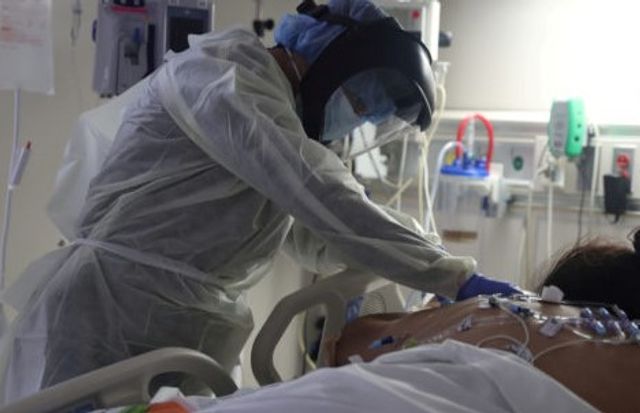
A medical staff member treats a patient suffering from the coronavirus disease (COVID-19) in the Intensive Care Unit (ICU), at Scripps Mercy Hospital in Chula Vista
However, the success with the market has not been emulated in the rest of the country, where President Andrés Manuel López Obrador has ruled out an aggressive public health initiative and instead allowed businesses to reopen. Like Trump and Brazilian President Jair Bolsonaro, he has chosen to downplay the dangers posed by the virus and refused to wear a mask in public. Plans are underway for López Obrador to travel in early July to meet Trump in Washington to launch the new United States-Mexico-Canada free trade agreement.
The official response to the pandemic in the United States, spearheaded by Trump but supported in all essentials by the Democrats, has produced a catastrophe. With 2,631,758 total cases and 128,412 deaths, the curve of daily cases is worse than in late March and early April, and now the pandemic has expanded across a far broader geographic area.
Only two states reported declines this weekend: Connecticut and Rhode Island. Thirty-six states are seeing cases climb.
By all accounts, Florida is the new epicenter in the US, with 9,585 cases recorded on Saturday, a one-day high. Arizona, Texas, Georgia, California, Louisiana and South Carolina all posted more than 1,000 COVID-19 cases. Arizona’s intensive care units (ICUs) are at capacity as accounts by health providers suggest the infrastructure is reaching a breaking point.
One Arizona nurse posted on Facebook: “I don't think there’s a shift where people don’t die. It’s horrible. The nurses are just numb from it. I’ve never seen so many people die.” Other posts indicate that hospitals are building out extensions to their ICUs by moving patients into the postoperative recovery or telemetry floors. Staff and material shortages abound.
Florida Governor Ron DeSantis, a Trump insider, is facing accusations that his administration is “cooking the books” to hide the true scope of the outbreak in the state. “That data is clearly indicating we have a problem,” said Dr. Mary Jo Trepka, professor and chair of the department of epidemiology at Florida International University’s Robert Stempel College of Public Health. “Testing data, symptom data, hospitalization data, it’s all been clearly going up.”
Houston hospitals have reported that their base ICU capacity has been reached for the first time since the pandemic began. Though several hospital CEOs have urged calm, they sent a letter to Houstonians on Wednesday warning that “if this trend continues, our hospital system capacity will become overwhelmed.” As of Friday, the Houston region had 37,173 cases. Harris County Judge Lina Hidalgo, who is self-quarantining after exposure to a person with COVID-19, is urging Governor Greg Abbott to issue a new stay-at-home order.
On Friday, Vice President Mike Pence and the White House Coronavirus Task Force held their first press briefing in two months. Pence praised Trump’s response to the pandemic and provided a surreal depiction of a country making remarkable progress in combatting the virus, having “flattened the curve.” He simply ignored the fact that the US was breaking records for new cases on a near daily basis and that in a range of states the average daily increase in infections had risen by as much as 80 or 90 percent over the numbers just two weeks ago.
In response to a reporter’s admonition that the administration had defied health officials’ recommendations and placed the lives of people in danger by holding political rallies, he said, “I want to remind you that the freedom of speech and the right to assemble peaceably is enshrined in the Constitution of the United States. Even in a health crisis, the American people don’t forfeit their rights.”
This is, as the saying goes, pretty rich coming from the second-highest official in an administration that less than a month ago sought to unleash the US military to crush peaceful protests against police brutality and impose martial law and continues to threaten such actions.
On Sunday, during an interview on the “Face the Nation” program, Pence continued his glowing assessment, declaring, “The American people should know that because of the leadership that President Trump has provided, because of the extraordinary innovation that we have brought to this task, we are in a much better place to respond to these outbreaks than we were four months ago.”
Just minutes before Pence’s interview was broadcast, Health and Human Services Secretary Alex Azar, speaking on CNN, warned that the “window is closing” for the US to get the pandemic under control. However, he placed the blame for the health disaster on the American people, who were failing to heed social distancing guidelines. He ignored the fact that reckless and disturbing behavior by sections of the population was being cheered on by the president.
Outside of lambasting President Trump, the Democrats’ response to the pandemic has carefully avoided any criticism of the back-to-work drive itself, which they support. They have, moreover, been largely silent on the massive numbers of workers being infected at meatpacking plants, Amazon distribution centers, auto plants, transit barns, hospitals, nursing homes and other workplaces where no serious measures have been taken to protect them from the virus.
Former Vice President Joe Biden, the Democratic presidential candidate, gave a speech last week in Lancaster, Pennsylvania in which he focused on the Trump administration’s filing of a suit with the US Supreme Court to abolish Obamacare. He said nothing about the back-to-work drive or the bailout of Wall Street and advanced no policies to halt the pandemic or address the social catastrophe resulting from the loss of some 45 million jobs.
Interviewed Sunday on ABC’s “This Week” program, House Speaker Nancy Pelosi began her remarks by hailing the reopening of “our economy,” while criticizing Trump for failing to provide sufficient testing for the virus.