29 Jun 2020

Covid-19 Means Good Times for the Pentagon

Mandy Smithberger


In response to the Covid-19 pandemic, Washington has initiated its largest spending binge in history. In the process, you might assume that the unparalleled spread of the disease would have led to a little rethinking when it came to all the trillions of dollars Congress has given the Pentagon in these years that have in no way made us safer from, or prepared us better to respond to, this predictable threat to American national security. As it happens, though, even if the rest of us remain in danger from the coronavirus, Congress has done a remarkably good job of vaccinating the Department of Defense and the weapons makers that rely on it financially.
There is, of course, a striking history here. Washington’s reflexive prioritizing of the interests of defense contractors has meant paying remarkably little attention to, and significantly underfunding, public health. Now, Americans are paying the price. With these health and economic crises playing out before our eyes and the government’s response to it so visibly incompetent and inadequate, you would expect Congress to begin reconsidering its strategic approach to making Americans safer. No such luck, however. Washington continues to operate just as it always has, filling the coffers of the Pentagon as though “national security” were nothing but a matter of war and more war.
Month by month, the cost of wasting so much money on weaponry and other military expenses grows higher, as defense contractor salaries continue to be fattened at taxpayer expense, while public health resources are robbed of financial support. Meanwhile, in Congress, both parties generally continue to defend excessive Pentagon budgets in the midst of a Covid-19-caused economic disaster of the first order. Such a business-as-usual approach means that the giant weapons makers will continue to take funds from agencies far better prepared to take the lead in addressing this crisis.
There are a number of ways the Pentagon’s budget could be reduced to keep Americans safer and better protected against future pandemics. As the Center for International Policy’s Sustainable Defense Task Force has pointed out, the biggest challenges we now confront, globally speaking — including such pandemics — are not, in fact, military in nature. In truth, hundreds of billions of dollars could be cut with remarkable ease from U.S. military spending and Americans would be far safer.
Recently, some members of Congress have started to focus on this very point. Representative Ro Khanna (D-CA), for instance, proposed diverting money from unnecessary intercontinental ballistic missile “modernization” into coronavirus and vaccine research. Senator Bernie Sanders (I-VT) has gone further, suggesting a 10% reduction in the Pentagon’s budget, while Representative Barbara Lee (D-CA), the only member of Congress to vote against the post-9/11 war resolution that led to the invasion of Afghanistan, has gone further yet, calling for the cutting of $350 billion from that budget.
But count on one thing: they’ll meet a lot of resistance. There’s no way, in fact, to overstate just how powerfully the congressional committees overseeing such spending are indebted to and under the influence of the defense contractors that profit off the Pentagon budget. As Politico reported years ago (and little’s changed), members of the House Armed Services committee are the top recipients of defense industry campaign contributions. Even the chair of the House Foreign Affairs committee, which should be advocating for the strengthening of American diplomacy, has drawn criticism for the significant backing he receives from the defense industry.
Focusing on Weaponry That Can’t Fight a Virus
Defense contractors have consistently seen such investments pay off. As my colleague at the Project on Government Oversight, Dan Grazier, has pointed out, despite repeated warnings from independent watchdogs and medical professionals, even military healthcare has been significantly underfunded, while both the Pentagon and Congress continue to prioritize buying weapons over taking care of our men and women in uniform. Congress’s watchdog, the Government Accountability Office, warned in February 2018 that the health system of the Department of Defense (DOD) lacked the capacity to handle routine needs, no less the emergencies of wartime. As Pentagon spending has continued to escalate over the past 20 years, military healthcare funding has stayed largely flat.
Under the circumstances, I doubt you’ll be surprised to learn that Congress has also written additional arms contractor giveaways into its coronavirus relief bills. Though its CARES Act authorized trillions of dollars in spending, ProPublica unearthed a provision in it (nearly identical to one proposed by industry groups) that allows defense contractors to bill the government for a range of costs meant to keep them in a “ready” state. The head of acquisition for the Pentagon, Ellen Lord, estimated (modestly indeed) that the provision would cost taxpayers in the low “double-digit billions.” Additional language offered in the House’s next relief bill, likely to survive whatever the Senate finally passes, would increase such profiteering further by including fees that such companies claim are related to the present crisis, including for executive compensation, marketing, and sales.
In such a context, it was hardly surprising that, during a recent hearing at the House Armed Services Committee on how the DOD was responding to the Covid-19 crisis, the focus remained largely on ways that the global epidemic might diminish arms industry profits. Representatives Joe Courtney (D-CT) and Mac Thornberry (R-TX) both argued that the Pentagon would need yet more money to cover the costs of any number of charges that defense contractors claim are related to the pandemic.
Most ludicrous is the idea that an agency slated to receive significantly more than $700 billion in 2020 can’t afford to lose a few billion dollars to the actual health of Americans. Of course, the Pentagon remained strategically mum earlier this year when, in an arguably unconstitutional manner, the White House diverted $7.2 billion from its funds to the building of the president’s “great, great wall” on our southern border. In fact, General Mark Milley, chairman of the Joint Chiefs of Staff, even admitted that it wasn’t exactly a major blow for the government agency with the largest discretionary budget. “It was not a significant, immediate, strategic, negative impact to the overall defense of the United States of America,” he assured Congress. “It’s half of one percent of the overall budget, so I can’t in good conscience say that it’s significant, immediate, or the sky is falling.”
A Chicken Little Congress, however, doesn’t consider taking more funds from the Pentagon budget to shore up the Centers for Disease Control and Prevention (CDC) anywhere near as crucial as, for example, approving the Pacific Deterrence Initiative, a slush fund that will be part of this country’s new Cold War with China — starting with a modest $1.4 billion in seed money, while the homework is done to justify another $5.5 billion next year. Similarly, even in such an economically disastrous moment, who could resist buying yet more of Lockheed Martin’s eternally troubled and staggeringly expensive F-35 Joint Strike Fighters than the Pentagon requested? Comparable support exists, even among senators unwilling to fork over any more dollars to desperate out-of-work Americans, for the president’s Space Force, that new service now in the process of creating a separate set of rules for itself that should allow it free reign over future spending. That, of course, reveals its real mission: making it easier for contractors to profit off the taxpayer.
If anything, the main congressional criticism of the Pentagon is that it’s been too slow to push money out the door. And yet, in an institution that has never been successfully audited, there are red flags galore, as a recent Government Accountability Office assessment of major weapons programs suggests. The costs of such new weapons systems have cumulatively soared by 54%, or $628 billion, from earlier GAO assessments. That, by the way, is almost 90 times this year’s budget request for the CDC.
And that’s just the waste. The same report shows that any number of weapons systems continue to fail in other ways entirely. Of the 42 major programs examined, 35 had inadequate security to prevent cyber attacks. General Dynamics Electric Boat’s $126 billion nuclear submarine program has been plagued by faulty welding for two years. The new Ford class aircraft carrier, built by Huntington Ingalls for $13.2 billion, includes a General Atomics launch system that continues to fail to launch aircraft as designed. In addition, as Bloomberg first reported, the ship’s toilets clog frequently and can only be cleaned with specialized acids that cost about $400,000 a flush. As my colleague Mark Thompson has pointed out, “escalating costs, blown schedules, and weapons unable to perform as advertised” are the norm, not the exception for the Pentagon.
That track record is troubling indeed, given that Congress is now turning to the Pentagon to help lead the way when it comes to this country’s pandemic response. Its record in America’s “forever wars” over the last nearly two decades should make anyone wonder about the very idea of positioning it as a lead agency in solving domestic public health crises or promoting this country’s economic recovery.
Broken Oversight
As the first wave of the pandemic continues and case numbers spike in a range of states, oversight structures designed to prevent waste, fraud, and abuse when it comes to defense spending are quite literally crumbling before our eyes. Combine weakened oversight, skewed priorities, and a Pentagon budget still rising and you’re potentially creating the perfect storm for squandering the resources needed to respond to our current crisis.
The erosion of oversight of the Pentagon budget has been a slow-building disaster, administration by administration, particularly with the continual weakening of the authority of inspectors general. As independent federal watchdogs, IGs are supposed to oversee the executive branch and report their findings both to it and to Congress.
In the Obama administration, however, their power was undermined when the Office of Legal Counsel, the legal expert for the White House, began to argue that accessing the “all” in “all records, reports, audits, reviews, documents, papers, recommendations, or other material” didn’t actually mean “all” when it came to inspectors general. Under President Donald Trump, the same office typically claimed that then-Intelligence Community Inspector General Michael Atkinson did not have the authority to forward to the House and Senate Intelligence committees a concern that the president had improperly withheld aid to Ukraine.
In fact, in the Trump years, such watchdogs have been purged in significant numbers. Shortly after Department of Defense principal Deputy Inspector General Glenn Fine was named to lead the Pandemic Response Accountability Committee, for instance, the president removed him. Not only did that weaken the authority of the body overseeing trillions of dollars in spending across the federal government, but it jeopardized the independence and clout of the Pentagon’s watchdog when it came to billions already being spent by the DOD.
In a similar fashion, the Trump administration has worked hard to stymie Congress’s ability to exercise its constitutional role in conducting oversight. A few months after the president entered the Oval Office, the White House temporarily ordered executive branch agencies to ignore oversight requests from congressional Democrats. Since then, the stonewalling of Congress has only increased. Mark Meadows, the president’s latest chief of staff, has, for example, reportedly implemented a new rule ensuring that executive branch witnesses cannot appear before Congress without his permission. In recent weeks, it was invoked to stop Secretary of State Mike Pompeo from appearing to justify his latest budget request or to answer questions about why his department’s inspector general was removed. (He was, among other things, reportedly investigating Pompeo himself.) Meanwhile, Secretary of Defense Mark Esper and Chairman of the Joint Chiefs Mark Milley have both resisted calls from Congress to answer questions about the use of military force against peaceful protesters.
Congress has a number of tools at its disposal to demand answers from the Pentagon. Unfortunately, the committees overseeing that agency have seldom demonstrated the will to exercise them. Last year, however, Congressman Ruben Gallego (D-AZ) added an amendment to a defense bill limiting funds for the secretary of defense’s travel until his department produced a report on disciplinary actions taken after U.S. troops were ambushed in Niger in 2018 and four of them died.
That tragic incident was also a reminder that Congress has taken little responsibility for the costs of the endless conflicts the U.S. military has engaged in across significant parts of the planet. Quite the opposite, it continues to leave untouched the 2001 authorization for use of military force, or AUMF, that has been abused by three administrations to justify waging wars ever since. The Congressional Research Service estimates that it has been used in that way at least 41 times in 19 countries. According to Brown University’s Costs of War project, that number should be 80 countries where the U.S. has been engaged in counterterror activities since 2001.
And there are significantly more warning signs in this Covid-19 moment that congressional oversight, long missing in action, is needed more than ever. (Trump’s response, classically enough, was “I’ll be the oversight.”) Typically, among the trillions of dollars Congress put up in responding to the pandemic-induced economic collapse, $10.5 billion was set aside for the Pentagon to take a leading role in addressing the crisis. As the Washington Post reported, among the first places those funds went were golf course staffing, submarine missile tubes, and space launch facilities, which is par for the course for the DOD.
Implementation of the Defense Production Act also betrayed a bizarre sense of priorities in these months. That law, passed in response to the Korean War, was designed to help fill shortfalls in goods in the midst of emergencies. In 2020, that should certainly have meant more masks and respirators. But as Defense One reported, that law was instead used to bail out defense contractors, some of whom weren’t even keeping their employees on staff. General Electric, which had laid off 25% of its workforce, received $20 million to expand its development of “advanced manufacturing techniques,” among things unrelated to the coronavirus. Spirit Aerosystems, which received $80 million to expand its domestic manufacturing, had similarly laid off or furloughed 900 workers.
While Americans are overwhelmed by the pandemic, the Pentagon and its boosters are exploiting the emergency to feather their own nests. Far stronger protections against such behavior are needed and, of course, Congress should take back what rightfully belongs to it under the Constitution, including its ability to stop illegal wars and reclaim its power of the purse. It’s long past time for that body to cancel the blank check it’s given both the Pentagon and the White House. But don’t hold your breath.
In the meantime, as Americans await a future Covid-19 vaccine, the military-industrial complex finds itself well vaccinated against this pandemic moment. Consider it a Pentagon miracle in terrible times.

The law of Sedition: Endangering the very idea of an inclusive Democracy

Atul & Sandeep Pandey

British left India in August 1947 but left many of their draconian laws here as a colonial legacy. Section 124A of the Indian Penal Code 1860, i.e., the law of sedition is one such law. British Government of India had inserted it in the penal code in the late 19th century to curb anti-colonial activities in British India. However, in Independent India, it has often been conveniently misused by successive central and state governments to harass their critiques under the grab of sedition. Even high profile individuals like Arundhati Roy could not save herself from the heat of this law for being too critical of the government policies for openly sympathizing with Kashmiri separatists. And now, Vinod Dua, an acclaimed journalist has become its latest target or victim so to say for allegedly accusing Prime Minister Narendra Modi of using “deaths and terror attacks” to get votes. Given its frequent misuse, Indians must give serious thoughts over the need, rationale, and utility of having a sedition law in Independent India.
The sedition law has been often misused by the colonial dispensation and its legacy of misuse continued even after independence as successive Indian governments did not hesitate in invoking it to curb dissent and harass individuals who were too critical of government policies. While the British government mainly used it against politicians like Gandhi, Nehru, Tilak, Azad, etc, independent India has used it even against dissenting doctors, students, teachers, journalists, human rights activists, scholars, poor, tribals and so on. This shows it has outwitted even the British in repressing dissent and criticism of the government. And through their reckless propaganda, ultra-nationalists have made it synonymous with being anti-national. The present Bhartiya Janata Party governments are also using the Unlawful Activities (Prevention) Act, National Security Act and even Epidemic Diseases Act to silence any dissent by targeting people who participated in anti-Citizenship Amendment Act and National Register of Citizens protests, any protests during coronavirus crisis and ordinary Muslim citizens even in local disputes.
The sedition law should have been repealed after independence. Even after drawing severe flak from the opposition and courts in numerous cases, the then Congress government went the extra mile to preserve the constitutionality of S.124A by amending the Constitution itself. Note, that its validity had been earlier challenged in the Romesh Thapar case wherein the court had held that the words like ‘Public Order’ and ‘Public Safety’ in S.124A of the penal code are too wide and broad compared to the more specific restrictions on freedom of speech and expression under Article 19(2) of the Constitution. To save it from being declared unconstitutional, the government amended the Constitution and added ‘Public Order’ as one of the reasons for restricting free speech and also added ‘Reasonable’ before the word ‘restriction’ in Article 19 of the Indian Constitution.
The sedition law has a long history of power and politics. Bal Gangadhar Tilak was tried thrice under this provision and in one case, was famously defended by Muhammad Ali Jinnah. In his defense, he had argued that if at all he had excited any defection, it was against a foreign occupation over India. In the first case, Tilak was convicted and could be released only after the intervention of some international figures like Max-Weber. Tilak was tried again in 1908 after an editorial in his newspaper ‘Kesari’ severely criticized the government policies of curbing press freedom. Despite the rigorous defense by Jinnah, Tilak was convicted and sentenced to 6-year rigorous punishment. In 1916, he was again arrested for allegedly disseminating seditious materials in the Bombay Province but this time Jinnah successfully saved him by arguing that Tilak had only criticized the bureaucracy and not the government.
In 1889, an amendment was made to the provision and the words ‘hatred’ and ‘contempt’ were added along with ‘disaffection’ which he explained, included all feelings of enmity and disloyalty against the government. This was done primarily to eliminate any possible loophole in the provision which could give an accused the benefit of the doubt. Some other provisions such as Sections 153A and 505 were also added in the penal code to deal with the rising cases of extremism and communal hatred and reign in the revolutionary preachings of some vernacular newspapers.
Another pre-independence trial that generated much hype was that of Mohandas Gandhi in 1922 for allegedly publishing some seditious articles in his magazine ‘Young India’. Gandhi was overwhelmed and felt honored when his case was compared to Tilak’s. During the trial when Justice Strangman asked what made him such a strong ‘disaffectionist’ from a staunch royalist, Gandhi replied that, “affection cannot be manufactured or regulated by the law. If one has no affection for a person, one should be free to give the fullest expression to his disaffection, so long as he does not contemplate, promote, or incite violence”. Though the judge was quite impressed with Gandhi, nonetheless, he gave him 6 years imprisonment. Note, that only Gandhi but also many revolutionaries justified their disaffection towards the British rule using novel arguments. Many even questioned the legality of the British government which they said was established in India not according to the will of people or the mandate of the law but by force and fraud and, therefore, there exists neither any obligation to obey its writs nor deserves any affection or loyalty from Indians.
The first direct challenge to the constitutionality S.124A came before the Allahabad High court in the case of Ram Nandan v State in 1959. Ram Nandan was charged under this section for giving an inflammatory speech against the Central government for not addressing the issues of poverty and laborers. He allegedly incited them to overthrow the Congress regime by forming an armed militia. He also accused Prime Minister Nehru of being a traitor for allowing the Partition of the nation. Allahabad HC overturned the conviction and also declared S.124A IPC to be ultra-vires of the Constitution because it restricted freedom of speech and expression regardless of the fact as to whether such an expression tended to cause public disorder. Court termed such restrictions to be undemocratic which can strike the very roots of the Constitution and the democracy.
But this decision was overturned by the Supreme Court in the case of Kedar Nath v State of Bihar 1962 wherein the apex court restored the constitutional validity of S.124A although limiting its scope at the same time. Kedar Nath was a communist leader who in his speeches had targeted the Congress Government and called for an armed revolution to overthrow zamindars, capitalists, and Congress governments from different provinces. The Supreme Court in this case distinguished between ‘disloyalty to government’ and ‘criticism of government policies without inciting public disorder by using acts of violence’. The court upheld the constitutionality of the provision by reasoning that if there are two interpretations of a statute, and one interpretation will render the provision as unconstitutional while another will make it constitutional, the court shall go by the latter interpretation. The court, however, limited the scope and application of the sedition provision by restricting its application to only those acts involving intention or tendency to create disorder or disturbance of law and order or an incitement to violence.
Despite the limits placed on the scope of the application of S.124A in the Kedar Nath case, accusations and trials under sedition law have only increased significantly over the years. People from diverse backgrounds have been charged under this section. Criticism of government, policies, politicians, and dissent that can be said to be the pillars of a healthy democracy, have been often treated as sedition by the police under political pressure and thus endangering the very idea of a healthy and inclusive democracy. Even if the convictions are rare in such cases, a mere accusation and arrest can cause so much harm to the prestige, honor, and dignity of an individual who is immediately labeled as anti-national through the media trial and by the propaganda of right-wing fanatics. Writing on this issue, Justice AP Shah said that, “A parochial, selfish, narrow-minded nationalism has caused so much misfortune and misery to the world. A mad and exaggerated form of this cult of nationalism is today running rampant.”
As Gandhi said affection towards any authority can be cultivated only through mutual consent and respect and not by fear or force. Also, disaffection towards a government, in and of itself does not necessarily imply disaffection towards one’s nation and people. It is unfortunate that even after India became independent, this draconian law has not only survived in the statutes books but also thrived through frequent misuse. It is high time the government must review it through amendment or repeal it altogether. And given its historicity of rampant misuse, it would not be unwise to call upon the honorable Supreme Court to reconsider its decision in the Kedar Nath. Last, but not least we also must give a serious thought if our republic is so fragile that its integrity is threatened by mere sloganeering and speeches. Concerned authorities must cultivate affection towards the nation by building confidence, by using reason and through public works and not through fear and force.

Transparency and Accountability During Crisis

Parvin Sultana

Pandemics present us with unprecedented crisis situations. Extraordinary situations demand extraordinary measures and many a time this is used to undermine democratic institutions and values. The Covid crisis is nothing different. This unprecedented crisis period has given certain political leaders across the world an opportunity to clamp down on many aspects of democracy – the most crucial ones being transparency and accountability. While on one hand, democracies take a bashing when compared with how countries like China succeeded in controlling the spread of the disease, on the other hand leaders of democracies might jeopardise public health at the altar of political cost. Decisions are also often delayed because they are evaluated by electoral concerns.
The crisis seems to have strengthened the pockets of authoritarianism inherent in democracies. Media, Courts and civil society organisations play the crucial role of watchdogs in a democracy. But now they are unable to serve as effective means of checks on arbitrary use and abuse of power. Periods like this also witness declaration of a number of welfare policies for the marginalised section. But they are also accompanied by a rise in corruption. This further erodes the public trust on these institutions. Interestingly such exploitation is not always undertaken for personal gain but also to consolidate political power. Cancelling, postponing elections, bypassing financial accountability and taking emergency measures undermining fundamental rights. Selectively targeting opposition leaders are examples of such manipulation and consolidation.
This crisis if not handled properly runs the risk of straining relationship between the government and the people, it might intensify polarisation, disenfranchise already marginalised voters, accentuate inequality and increase conditions of violence. Rumors and misinformation have the tendency of spreading too early and have the power to incite conflict, crackdowns and stigmatisation – something that we witnessed in India in case of Nizamuddin episode and also the attacks on health personnel.
These concerns have been raised in many countries. Countries like China, Taiwan and even South Korea used various apps to trace people’s movement. While many feel this is intrusive of their privacy, they kept quiet because this was seen as a measure to curb the spread of the disease. However in India from the very beginning the implementation of various policies have raised eyebrows – the sole reason being the arbitrary ways in which these implementations happened. There were clear violations of lockdown from certain sections – be it Tablighi Zamaat congregation or the gaumutra party held in Delhi, the swearing in ceremony in Madhya Pradesh or the chariot pulling in Karnataka’s Siddalingeshwara fair.
Such violation was in no way limited only to the ruling disposition. Incidents like Palghar saw people come out in large number and indulge in a violent crime, helpless migrant labourers kept walking and travelling back to home throughout the period. In times of crisis, when the enemy is an invisible virus against which we still do not have any cure, information is the key to keep ahead. Many state leaders starting from the Chief Ministers of Delhi, Kerala, Maharashtra and some other states and the health Minister Himanta Biswa Sharma of Assam held regular press conferences and disseminated information. But the same was not seen at all levels. Our Prime Minister made crucial announcements but didn’t break his record of not facing a single press meet. This is in stark contrast to someone like Donald Trump who could not stop talking to the press and often make remarks that would backfire.
In India, while Indian Council of Medical Research officials are regularly providing data, there seems to be a gap with regard to information like number of critical cases and follow up of discharged cases. Random news reports of cured patients being infected again cause confusion and panic among the people. This becomes important because in India most are asymptomatic and with a relaxation of lockdown the numbers have soared but general precautions have taken a backseat. In such a situation, a clearer picture of where we stand in case of critical cases would help people take much required precautions. Instead we are coming across decisions to impose lockdowns at short notice causing panic buy, price rise and large crowds in markets.
During this period, economic crisis was looming large. We are all aware of the pressure that India’s health care system had to face. Raising adequate funds to face this challenge was the need of the hour. For crisis periods like this, there are bodies like Prime Minister’s National Relief Fund (PMNRF). Along with the PM, President, it also has the president of Indian National Congress, a representative of industry and commerce and that of the Tata Trustees as members –making it more representative. In such a situation one is left wondering about the need to set up a parallel body Prime Minister’s Citizens Assistance and Relief in Emergency Situation (PMCARES) with members solely from the government. Both the bodies enjoy certain exemptions, are audited not by CAG but by external auditors.
While both bodies have similar functions, a question may rise about the need of two parallel bodies. As of 2019, the PMNRF has an unused corpus of Rs 3800.44 crores. But even then calls were given for fresh donation to PMCARES. Government employees were requested to donate a day’s salary to the fund. According to an Indian Express article and Indiaspend till June 10th, a massive amount of Rs 9677.90 has been deposited in the fund while the usage of only Rs 3100 crores has been made public. Interestingly a large part of the fund was disposed to buy ventilators. But questions are arising as to the quality and price of these ventilators.
Right to Information requests about the body has been rejected on the plea that it is not a Public Authority. While on technical grounds, this might be true – in crisis periods the government could have furnished the data to inculcate confidence and trust in citizens. Political leaders specially our Prime Minister has time and again come reached out to the civil society to help during this crisis. But at the same time, we know that such organisations are having a hard time due to the government tightening rules on funding. Like PMCARES, these NGOs could have also contributed more had they been given certain exemptions under FCRA.
Concern for public health should be above political pragmatism. Unlike authoritarian regimes, a democracy is better placed in consolidating a unified public mandate against crisis like this. Governments should not only act in a just manner but also be perceived to do so. If that sense of accountability, transparency and justifiability is missing, we will see doubts and conspiracy theories emerge from different corners which will not only undermine the effectiveness of government initiatives but jeopardise public health. There are no winners in such a situation and the most marginalised bear the brunt. The way anti-CAA protestors are being jailed also show an element of political vengeance. This is the time for those in power to work towards taking people on board and not use a crisis for consolidating political power at the cost of democratic values.

India’s Dependence on Imperialist China: “Make in India” Ends Up as “Made in China”

P. J. James

Following India’s bloodiest clash with imperialist China in 45 years, there seems to be no dearth of jingoistic postures from saffron centres, even as Chinese intrusion in to India’s territory is becoming self-evident now.  As part of this, a hectic campaign is in full swing for an economic retaliation against China mainly by boycotting Chinese products. For instance, the pro-RSS Confederation of All India Traders (CAIT), has called for an outright boycott of 450 broad categories of imported Chinese items which include 3500 products comprising a whole range of cosmetics, bags, toys, furniture, footwear, watches, etc. so as to reduce their imports by $13 billion or Rs. I lakh crore by December 2021, whereas the value of India’s import from China approximately equals to the staggering figure of around $70 million or Rs. 525000 crore in 2019-20. However, at the outset, it may be stated that such moves are mainly rhetorical since India’s dependence on and integration with imperialist China in the economic field (of course with its political ramifications) is so complex and deep-rooted that in the immediate future, despite the much trumpeted “Make in India”, and the latest “Atmanirbhar Bharat”, it will be well-nigh impossible for India to resort to a ban on Chinese investments and products.
 China’s Transformation as the Largest Imperialist Economy
To unravel this, a brief note on China’s emergence as an imperialist power with its position today as world’s leading capital and commodity exporter would be in order. No doubt, China’s experience of breaking the imperialist hierarchy inherited from the colonial world order is an exceptional and unique phenomenon. China’s political trajectory as a socialist country for more than a quarter century after WW II, its capitalist restoration following seizure of power by bureaucratic bourgeoisie in the late 1970s and its eventual transformation as an imperialist power are all complex processes that require in-depth analysis and, therefore, is outside the scope of this note. Since the beginning of the 1980s, with its catchword of “socialism with Chinese characteristics”, the bureaucratic state capitalism in China began its close integration with private sector orienting state-owned banks toward liberally supporting private businesses. Since the 1990s, there took place a relative shift in this privatisation strategy with more emphasis on FDI inflows that rushed in to take advantage of China’s inexhaustible supply of cheap labour. As the cheapest source of production and as an active participant in the neoliberal international division of labour, this enabled China to increasingly integrate itself with global finance capital. In conformity with the logic of capital accumulation, lucrative real estate, financial markets and other money spinning businesses also flourished as a concomitant. Party-led bureaucratic state was transformed into an apparatus committed to protect the interests of corporate capital at the expense of workers, peasants and toiling people. As estimated by All-China Federation of Industry and Commerce, the share of private sector in Chinese GDP today is more than 60 percent. As of 2018, the entire private sector including both domestic and foreign accounted for 70 percent of technological innovation, 80 percent (340 million) of the total employment (783 million) and 90 percent of all Chinese exports.
The bureaucratic state monopoly capitalism of China through various joint ventures between state-owned enterprises and foreign corporate capital went on adapting itself to the most modern and state-of-the-art technologies and in the process succeeded in building up a number of Chinese monopolies exporting capital to almost a hundred countries by the turn of the 21st century and to more than 125 countries as of now. Sino-US bilateral trade during the four decades following capitalist restoration in China had grown by 150 times—quite unprecedented in recorded history—from $4 billion in 1979 to around $600 billion in 2019.   With an average annual GDP growth rate of 10 percent since mid-1980s, China rose to the position of the second largest imperialist power when the 2008 world imperialist crisis erupted. Since then, though the growth rate has gone down, according to World Bank’s purchasing power parity estimates, by 2019 China became world’s largest economy with a GDP of around $27 trillion relegating the US to the second position with around $21 trillion. As its manifestation, in all other economic indicators including global trade volume, China had already surpassed the US. And by leading several organisations, groupings and initiatives such as Shanghai Cooperation Organisation (SCO), Regional Comprehensive Economic Partnership (RCEP), Asian Infrastructure Investment Bank (AIIB), Belt and Road Initiative (BRI), BRICS including New Development Bank (NDB), etc., China is already in an enviable position, as the US hold over many postwar neo-colonial institutions such as UN and its Specialised Agencies are rapidly loosening. And in tandem with its growing imperialist political-economic clout, China’s military budget had steadily grown from around $14 billion in 2000 to more than $260 billion in 2019, almost four times that of India!
This transformation has its domestic repercussions. The so called “iron rice bowl” of socialism that ensured food, housing health, education and employment for all has been demolished. All the evils of ‘uneven development’ associated with capitalism and market economy are on the ascendance.  Destruction of ‘self-reliant’ and ‘self-sufficient’ communes has led to one of the biggest internal migrations in history that resulted in tens of millions of displaced landless peasants becoming unemployed while a section of them who could migrate to urban centres and special economic zones in coastal areas were subjected to extreme forms of super-exploitation jointly by both foreign capital and emerging Chinese monopolies. In 1980, urban dwelling population was just 20 percent; it reached almost 50 percent in the first decade of the 21st century, a trend that gathered further momentum since then. China’s urbanisation, like its whole course of development, is unprecedented. According to latest Demographia’s World Urban Areas Report, there are now 113 urban centres in China that surpass the one million population threshold. In comparison, only North America and the European Union combined have 114 urban areas that surpass one million people. At the same time, large sections of the population still remain in the country-side at subsistence level. Since a social safety net composed of cost-indexed wages, health care and pensions is totally lacking outside the public sector employment, tens of millions of workers are left without access to welfare benefits or minimum standard of living. Migrant workers in construction sites and unorganised sectors live and work in desperate conditions and are paid below normal rates. As a reflection of the extreme misery and destitution suffered by people, all evils of capitalism such as poverty, price rise, corruption, sex trade, child-begging, homelessness and cultural degradation have also become rampant. And the emergence of a ‘deep state’ and political oppression have now become a corollary of the inevitable social tensions arising from the rigorous dismantling of even the remnants of erstwhile socialist achievements.
The concomitant political-ideological dimensions of this economic transformation found its first formal expression in the 16th Party Congress of Communist party of China (CPC) held in 2002 that formally announced extension of party membership to CEOs of corporate companies. Its outcome was well-reflected in the National People’s Congress (NPC) held in 2018 when large number of the delegates elected were from corporate CEOs and super-rich financial elite and wealthy individuals along with the party bureaucrats who have been the sole beneficiaries of the four decades of capitalist restoration.  For instance, almost half of the more than 300 Chinese global billionaires (3 times that in India and second only to the US in 2018) whose wealth has appreciated by around 20 percent a year had their berth in higher echelons of CPC. Overall proportion of millionaires and billionaires in party bureaucracy is relatively high compared with their membership in CPC composed of 89 million out of a total population of almost 1400 million. According to China Rich List released by Hurun, the total wealth held by the top 70 delegates to the 2018 NPC was larger than that with the members of the entire US Congress! China’s Gini coefficient estimated at 0.465, – a statistical measure of inequality in which 0 indicates perfect equality and 1 depicts a situation where all incomes go to one person – is one of the highest in the world. In view of corroborative evidences coming from various other sources, today it is difficult to ignore such data as mere guesstimates associated with usual West-sponsored Sinophobia.
As a matter of fact, the reunification of Hong Kong in 1997 and Macao in 1999, both being nerve centres of global finance, trade and speculation, followed by China’s formal entry in 2001 into WTO, often characterised as the third neo-colonial pillar (the other two being IMF and World Bank) were milestones that speeded up its integration with imperialist market and finance capital. As world’s low-cost production base, this integration enabled China to capture substantial share of commodity markets not only in Afro-Asian-Latin American dependent countries, but even in US, its main imperialist rival for world hegemony. At the same time, this Chinese integration with global market has coincided with the emergence of fast moving ‘frontier’ or new generation technologies such as, digitisation, blockchain, artificial intelligence, biotechnology, robotisation, etc. which were practically insignificant in the 20th century. Closely integrated with the bureaucratic state, many Chinese companies became pioneers in economic innovation and application of these technologies to production at a maddening speed.  Among them Baidu, Alibaba, Tencent (popularly known as BAT) and Huawei (pioneer in ‘5G revolution’) have now become world leaders in digitisation, the fast-moving frontier technology of the 21st century, and  even capable of successfully challenging US-based “Silicon Six” (Google, Facebook, Amazon, Netflix, Apple, Microsoft).  For instance, though five years younger than Amazon, the biggest American e-commerce giant, in terms of volume of trade, Alibaba has already eclipsed the former and is now the leading cloud-provider besides being world’s biggest e-commerce company. And backed by the breakthroughs in digital technology, China is also pioneering a digital currency alternative to the hegemony of US dollar in international transactions.
A crucial aspect to be underlined in this context is that mechanical approach to class/property relations and western notions of corporate governance do not fit in with the private sector in China. Chinese bureaucrats have learned lessons from Soviet Union’s eventual disintegration on account of private corporate sector finally usurping power and taking over the regime. As such, Chinese bureaucratic bourgeoisie’s unleashing of privatisation and corporatisation and encouragement to private businesses for generating economic growth, propelling investment and exports, etc., always go hand in hand with party bureaucracy’s strict supervision over the entire process. Party bodies and ‘party cells’ function in every private business including even foreign enterprises. This intervention is intended to ensure economic growth strictly avoiding the plausible danger arising from any organised alternative to centres of political power. It also ensures the regime’s close nexus with corporate capital together with constant surveillance over their dealings. According to a 2018 report, around 95 percent of the private enterprises in China had or in the process of having party cells/units in them. And the presence of the appropriate party representative in board meetings of companies is the accepted norm and corporate CEOs holding Communist party membership is the general rule. For instance, Jack Ma of Alibaba, global face of Chinese monopoly capital and corporate philanthropy has been a party member since 1980s, though his membership was openly declared only in 2018.  Even Walmart, world’s biggest US-based retail MNC (that at one time depended on China for around 70-80 percent of its merchandise) which is notorious for not allowing unions in its US stores, had party cells in its companies in China.  To be precise, driving corporate wealth accumulation and buttressing the bureaucratic state regime are two sides of China’s private sector that is accomplishing the miraculous “success story” of Chinese imperialism.
 Alarming Chinese Penetration to Indian Market
In the background briefly stated above, it may be stated that India’s transformation as a market for Chinese products as well as a destination for investments from China is primarily a 21st century phenomenon intertwined with latter’s emergence as the workshop of the world under neoliberal globalisation. On account of the 1962 Sino-Indian war and disputes such as the 1967 Chola incident, 1975 showdown when Sikkim became a state of India, and the 1987 Sino-Indian skirmish, both diplomatic and economic ties between India and China had not at all been enthusiastic during the 20th century. Obviously, it was China’s formal entry into WTO in 2001 that enabled it to integrate herself with other countries based on her ‘comparative advantage’ that prompted China to explore neighbouring India’s vast market. Consequently, Chinese premier Zhu Rongji’s 2001 India visit was duly reciprocated by Indian Prime Minister Vajpayee’s visit to China in 2003. The period that followed witnessed regular visits by both Indian and Chinese delegations for pursuing and signing innumerable bilateral investment and trade deals.
As a result, since 2000, trade between China and India has grown nearly twice as fast as each country’s trade with the rest of the world. In 2008 itself, surpassing US, China became India’s largest trade partner. Meanwhile, bilateral trade between China and India shot up from $2 billion in 2000-01 to $65 billion in 2013-14. Trade (including exports and imports) between China and India during this period was growing at nearly three times the pace of US-China trade. Modi’s tenure since 2014 saw a further boost to trade such that by 2017-18 India’s trade volume with China again rose to $89.76 excluding that with Hong Kong ($34 billion).  In 2018-19, though bilateral trade marginally declined to $87.07, in that year, India’s trade deficit with China was $53.57 billion (around Rs. 401700 crore) as India’s imports from China were worth US$ 70.32 billion and exports to China were only US$ 16.75 billion. Even today there is little change in India’s huge trade deficit with China. As such, India’s position in India-China bilateral trade is highly unfavourable for India.
According to IMF estimates (based on 2019 data), while China’s exports to and imports from India respectively came to 3 percent and 0.9 percent of its total exports and imports, the corresponding proportion for India was 5.1 percent and 13.7 percent (respective figures for 2020 February were 5.33 percent and 14.09 percent). Revealingly, according to 2020 February data, in percentage terms, India’s imports from US  at 7.58 percent of its total imports amount to only half of that from China. This depicts India’s relatively high dependence on China than US with whom India has even a strategic military relationship as a junior partner. An item-wise analysis of Indian imports from China also reveals the essence and gravity of this economic dependence.  For instance, 76.3 percent of all antibiotics and pharmaceutical products imported today by India is from China. This dependence of India on China is 84 percent for vehicle accessories, 68 percent for nitrogen compounds, 64 percent for diodes and transistors, 63 percent for iron & steel pipes and tubes, 58 percent for electric accumulators, 55 percent for LCD/LED/OLED panels for TVs, 52 percent of insecticides and pesticides, 46 percent of data processing machines, ACs and Fans and so on for several other items. A significant aspect connected with these imports by India is that they also comprise critical raw materials and intermediate items for production and export to other markets. To put it differently, while India depends heavily on imports from China, the latter has no such dependence on India. Hence an economic boycott of China, as stated at the outset, is only of rhetorical value and not at all feasible in the immediate future, especially at a time when India’s growth rate is projected to shrink by 5 percent during the fiscal year 2020-21. And many Indian auto, pharma and electronic companies that heavily depend on Chinese supplies have already raised alarm bells against such a move in the absence of developing reliable alternatives. More revealingly, even US companies in India that relies on raw-materials from China have conveyed their anxiety on carrying on production in view of the reported move to ban Chinese imports.
How “Make in India” Became “Made in China”
From the very beginning, due to its inherent far-right economic orientation, RSS’ servility to imperialist masters, to Britain during the colonial period and then to US in the postwar neo-colonial phase is not at all a debatable issue. Hence, the RSS-led Modi regime’s allegiance to US imperialism is expected to be its normal behaviour. However, though credited with the ultra-rightist ‘Gujarat model’ of privatisation/corporatisation during his long tenure as chief minister of Gujarat, on account of US visa denial to him following the Gujarat pogrom, Modi could not enter US for many years. Probably, this might have prompted him to cultivate his personal relationship with Chinese rulers by visiting China four times as chief minister of Gujarat, the only chief minister from India doing so, and again visiting China five times during 2015-18 as prime minister of India.
Modi’s five-day China visit in November 2011 was historic as it was against Manmohan government’s stand of not permitting him to travel to China. Modi went to China via Hong Kong and, according to reports, to the great embarrassment of the Indian ambassador, landed up at the Indian embassy in Beijing and during his visit met many Chinese companies willing to invest in Gujarat. This was followed by Vibrant Gujarat Global Investor Summit in 2013, and by 2014, could arrive at a deal on Chinese investments worth Rs. 9000 crore in the state. Apart from many Chinese firms such as Great Wall Motors Company Ltd and Shanghai Automotive Industries Corporation agreeing to set up mega vehicle manufacturing plants in the State, of particular importance was regarding the strategic Chinese investment in Mudra port owned by Adani. While ports like Mumbai and Tuticorin were not allowed to seek Chinese investment on account of security concerns, China’s investment in Mudra port remained an exception. In fact, the large-scale rolling-out of red carpet for Chinese investments in Gujarat was despite objections raised by the then UPA government at the centre. And as part of making Gujarat a Chinese investment hot-spot, Modi, in fact, went to the extent of initiating even Mandarin (China’s official language) coaching institutes and courses in universities in Gujarat.
No doubt, this “Gujarat-Cheeni Bhai Bhai” process accelerated once Modi became prime minister in 2014, and on his election Chinese media continued to eulogise the ‘Gujarat model’ followed by the 2014 visit of Chinese president Xi to Ahmedabad leading to a surge in Chinese investments in Gujarat and conversion of India as a dumping ground for Chinese exports. By the time of 2019 Vibrant Gujarat Summit, the committed investment by firms from China including Huawei were to the tune of Rs. 17000 crore in addition to proposals for a Rs. 21400 crore investment led by the Chinese solar giant East Hope Group  in Dholera Special Investment Region along with an Adani-owned power plant at Godda in Jharkhand. This was over and above the June 2017 Rs. 2250 crore deal that Adani had with Chinese firms. Of course, this Chinese connection had other dimensions too. As per a document revealed through Freedom Information (www.the guardian.com/environment/February 2018; www.ft.com), Adani, Modi’s closest friend even sought Australian ministers’ help to write to a Chinese government agency vouching the controversial Carmichael coalmine project in Australia.
Meanwhile, after his ascendance as prime minister, the immediate initiative that Modi undertook was a pan-India extrapolation this far-right ‘Gujarat model’ as prelude to the rapid transition from ‘Manmohanomics’ to ‘Modinomics’. At the same time, in conformity with RSS’ historical allegiance to US imperialism, even while maintaining his opportunistic Chinese link and camaraderie with Xi in relation to the economy, during the past six years Modi has strengthened India’s position as a strategic junior partner of US in latter’s geo-political contradictions with China by signing many military-to-military partnerships with Washington. Meanwhile, after a thorough overhauling of the last vestiges of Nehruvian state-led development paradigm including the abolition of the 64-year old Planning Commission, thereby transforming the state as a corporate-facilitator, Modi put forward the attractive formulation “Make in India”  on September 25, 2014 with much fanfare. Its objective was to transform India as world’s “sweatshop” emulating the Chinese experience as a low-cost workshop of the world. The aim was to project India before the West as an alternative cheap-labour manufacturing hub by improving “ease of doing business”, removal of all barriers to the free entry and exit of foreign capital and a series of investor-friendly measures such as aggressive liberalisation of labour, tax and environmental laws for unfettered plunder of labour and nature by MNCs and their junior Indian partners. Coupled with Modi’s high-profile tours to neoliberal centres, the “Make in India” prognosis,  amidst the pseudo-nationalism of the ruling regime, laid down the roadmap for India’s dependence on international capital at an alarming pace.
Obviously, even from a neoliberal perspective, the “Make in India” program, unlike the Chinese experience of making use of western capital in the initial phase of its capitalist transformation until the turn of the 21st century, was totally devoid of any domestic efforts to boost productivity and competitiveness. By utilising the ‘red-carpet for investors’, foreign companies wasted no time to enter the country and gobble-up precious natural and mineral resources and strategic public assets and critical infrastructure overheads through the “public-private-partnership” (PPP) route. And in accordance with the logic of corporatisation today, instead of developing employment-oriented productive spheres, capital that rushed in from the West, mainly from US with relatively obsolete manufacturing technologies, was only interested in ballooning the money-spinning speculative sectors thereby keeping up the bullish trend in the stock market and sky-rocketing of the Sensex. Accordingly, many concessions extended to US MNCs under pressure from Trump administration have led to a ‘financialisation-stagnation trap’ instead of adding up to real production, and this has been a contributory factor for the unprecedented unemployment and economic downturn in India since 2014.
It was in this context that China, as the leading imperialist economy with up-to-date production technologies and whose manufacturing contributes around 30 percent to GDP (for US the corresponding share is only 11 percent) has been in a better position to take advantage of Modi’s “Make India”. The background for this was already there through Modi’s friendship with Chinese president Xi including his meeting with the latter as many as on 18 occasions!  Cheaper and more efficient technology relative to that of the West has been a comparative advantage for China for grabbing projects India. Probably, an interesting example in this regard is that of Indian Army’s 2017 contract with Beijing Protech New Material Science Company Ltd for the import of material fabric and boron carbon white powder essential for manufacturing bullet proof jackets (thepolicytimes.com). Earlier these raw material/ intermediate goods were imported from the US and Netherlands; but the shift was necessitated as the Chinese imports were 60-70 percent cheaper and the decision was taken following a series of firing tests to check quality in tune with the standardisation laid by Bureau of Indian Standards. When the usual security question regarding this Chinese deal came up, V K Saraswat, NITI Aayog member and former DRDO chief explained the government’s ‘helplessness’ thus: “It is a market force; we cannot do much about this. The only thing is if we find that the bulletproof jackets produced by the Chinese material are not up to the mark, then we will have to say, as of now there is no such reports.”  Though a report on China printing Indian currency along with that of Brazil, Poland, Thailand, Malaysia and Sri Lanka (China is the only country that can perform the intaglio style of printing simultaneously on both sides of a banknote using a Color Dance to improve note’s security) was there in the media (Deccan Chronicle, April 14, 2018), an official on condition of anonymity later denied it.
It is this “law of market” dictating neoliberal globalisation today that ultimately became decisive in unravelling ‘Make in India’ as ‘Made in China’. Despite Modi regime’s intensified military integration with US transforming India as former’s strategic base for its Indo-Pacific machinations directed against China, the US obsolescence in many badly needed technologies coupled with their high cost enabled China to effectively displace the US from many investment spheres. Accordingly, total Chinese investments in India rose from $1.6 billion (Rs.12000 crore) in 2014 to $8 billion (Rs. 60000 crore) in the beginning of 2020. If the planned or proposed investment is also added to this, the figure will be more than $26 billion (nearly Rs. 2 lakh crore; on the other hand, cumulative Indian investment as of now is estimated only at Rs.7000 crore). However, according to many observers, a major part of Chinese capital investment is often “rerouted”, that is from third country sources such as Singapore, which is technically the largest source of foreign investment for India today. During the UPA rule, Mauritius had been India’s biggest FDI source, which was mainly camouflaged US capital export to India (for taking advantage of the tax-avoidance treaty between India and Mauritius). Now under Modi regime, Singapore replacing Mauritius as the biggest capital exporter to India may also be read along with India’s growing economic dependence on China. However, reliable data on this aspect are few and far between.
Now, coming to the concrete instance of Chinese investment with its thrust in the technology sector, the picture is too complex. In 2008 itself, India (Bangalore) with 1000 employees was the biggest foreign destination for the Shenzhen-based Huawei Technologies Company Ltd, world leader of 5G which (together with AI) is envisaged as the most strategic frontier technology. It is already reported to have carried out 5G trials in India much against the advice of Trump administration, though its future course of action in the wake of border dispute is uncertain. After Modi coming to power, as  estimated by  the Gateway House, leading Chinese tech MNCs have put an estimated $4 billion (Rs. 30000 crore) in Indian start-ups. Within five years of Modi rule, by March 2020, 18 of India’s 30 unicorns (unicorn is a start-up company valued at over $1 billion) are Chinese funded. Other 92 start-ups with less investments are also funded by Chinese companies.
Chinese software companies like Alibaba, Bytedance, Tencent, Huawei, ZTE, mobile companies like, Xiaomi, Oppo, Vivo, Oneplus, Coolpad, Motorola, LeEco, Lenovo, Meizu, Honor, Gionee, Gfive, Hair, TCL,  and automobile giants such as  Volvo, SAIC, Nippon, Shanghai Electric, Beijing Automotive, WISCO, China Dongfang, have already established there deep roots in India. Didi, Chunxing, Shunwei Capital, Fosun Capital, China-Eurasia Economic Cooperation Fund are well-known Chinese MNCs who have substantial investments in some of the important Indian start-ups such as Paytm, Ola, Snapdeal, Swiggy, Flipkart, MyDermacy, Hike Messenger, IBIBO and Make My Trip, Dream 11, Byju’s App, BigBasket, Delhivery, Oyo, PolicyBazzar, Quikr, Rivigo, Uddan, Zomato, etc. TikTok, the Chinese video app, has 200 million Indian subscribers and has overtaken the US-based YouTube in India. Alibaba, Tencent and ByteDance are in the process of overtaking the US giants Facebook, Amazon and Google in India. Chinese smartphones like Oppo and Xiaomi controls around 72 percent of Indian smartphone market leaving South Korean Samsung and American Apple far behind; and four out of the five top mobile phones in India today are Chinese brands. And unlike comparable investments from other imperialist powers, since Chinese investments are in fast moving frontier technology areas having complex linkages, their impact is considered to be disproportionate to the apparent size of such investments.  In this situation, it is left to readers to ponder over whether Indians today can afford to boycott Chinese products.
Of course, the aforesaid ‘Chinese connection’ with “Make in India” is more explicit with respect to former’s domination in frontier technologies including digitisation. For instance, an important component of “Make in India” has been “Digital India” that too launched by Modi on 1 July 2015. But the last five years’ history of digitising India including Modi’s experiments with digital transactions amply reveals India’s abject dependence on China for the essential digital tools and digital infrastructures required for them. Even the Arogya Setu App, India’s contact-tracing app to combat COVID-19, is modelled after the ‘authoritarian’ Health Code App of China. According to an MIT Technology Review, among 19 countries that designed similar apps, India belong to the category of the three countries, other two being China and Turkey, where the app poses greatest risks for user privacy.  Even though India still depends on the US technology giants for a major portion of the digital software needed, Chinese monopolistic hold over the required digital hardware is explicit. A typical example is that relating to the swiping machines or PoS terminals which are indispensable for the ongoing digital payments/cashless transactions taken up by the regime as its flagship program. In this regard, almost the entire PoS machines (around 3500000) in India today were made in China by two companies, Veriphone and Ingenica and directly exported to India. According to data published by an import tracking website Zauba.com, Ambani, India’s largest corporate player and very close to Modi together with Adani, has imported 435000 new 4G SIM cards from China. It is often said that through Jio, Ambani is trying to replicate the “Alibaba model” in India.  Still there is no dearth of calls for boycott of Chinese products from far-right saffron quarters.
Along with this, Chinese capital’s penetration in many sectors of industry and engineering including solar power generation equipment, chemicals, aluminium, animal feed, automobile, metallurgy, construction, rail and port construction, etc. is regularly taking place. In the banking sector too, the People’s Bank of China (PBOC) already has a series of moves in India. Recently, PBOC has increased its stake in Housing Development Finance Corp. Ltd (HDFC) in India. Even the 600ft high Patel statue, Modi’s towering tribute to Patel called “Statue of Unity” constructed at a cost of Rs. 2990 crore, is not free from the stamp of China.  Announced in 2010 when Modi was Gujarat chief minister, but completed after his ascendance to prime ministership, the entire 6500 bronze panels weighing 1700 metric tons were cast in Jiangxi Tongquing Metal Handicrafts Co. Ltd, as India lacks such facilities.
By Way of a Conclusion
The above is only a bird’s eye view on India’s dependence on China and other imperialist powers for the emerging technologies. No doubt, the pitiable Indian situation is not an overnight development. When the country was opened up for globalisation a quarter century ago, its industrial and manufacturing system was characterised by extremely low productivity mainly on account of technological obsolescence. The crony capitalism-corporate-politician-bureaucrat nexus- oriented towards quick-yielding money spinning businesses and speculation that flourished since then has little interest in applying science and technology to production appropriate to the country. While India is world’s second largest smartphone market, it is too pitiable that the country is still incapable of manufacturing any of the phones itself. While R&D expenditure in imperialist countries is between 2.5 and 2.75 percent of GDP, the same in India is still less than one percent on an average. Here too, China is the global leader with almost 20 percent of total world R&D expenditure as of now. In accordance with its geopolitical global ambitions, the 2020 National People’s Congress of China has launched the “Made in China 2025” and “China Standards 2035” initiatives with an astounding $1.4 trillion (approximately 70 percent of India’s current GDP) public spending program to further shore up its domination in industry  and frontier technologies.
On the other hand, India’s PSUs which were capable to undertake R&D even in advanced semiconductors were systematically dismantled or undermined while the crony capitalists who made fabulous wealth appropriation through speculative corporatisation have little interest either in heavy industries or in technology development. Meanwhile, under the post-truth prognoses of “Make in India” and “Atmanirbhar Bharat”, the Indian private corporate sector is encouraged for technology imports through foreign collaborations and joint ventures. And the MNCs from China, US, Japan and other countries that are rushing in under the liberalised atmosphere in IT, biotechnology, pharmaceuticals (and revealingly not in heavy industries) and in similar other areas are not all willing for technology transfer or up-gradation here. COVID-19 has once again underlined that no country can move towards self-reliance without substantial investments in public health, public education and research and development. For a country of India’s size and diversities, there is no model that can be copied from abroad. Dependence on private corporate sector, financing from external sources, and offshore manufacturing bases at the cost of planned government intervention with appropriate people’s participation is becoming suicidal for India. The ongoing border dispute with imperialist China has exposed this vulnerability of India more than ever, and it is high time on the part of all progressive democratic forces to seriously think over a viable political alternative to this deplorable situation.

Republicans introduce Senate bill to abolish strong encryption on consumer devices

Kevin Reed

Three Republican Senators introduced a bill on June 23 that would force tech companies to allow US law enforcement back door access to encrypted data and communications on consumer electronic devices and applications.
Senate Judiciary Committee Chairman Lindsay Graham (Republican from South Carolina), US Senators Tom Cotton (Republican from Arkansas) and Marsha Blackburn (Republican from Tennessee) proposed the draft bill called the Lawful Access to Encrypted Data Act. The Senators called the measure a “balanced solution to bolster national security” that would end what they call the “warrant proof” encryption on smartphones, tablets and computers that is used by “terrorists and other bad actors to conceal illicit behavior.”
The press release accompanying the introduction of the bill says that it would “require service providers and device manufacturers to provide assistance to law enforcement when access to encrypted devices or data is necessary— but only after a court issues a warrant, based on probable cause that a crime has occurred, authorizing law enforcement to search and seize the data.”
As has been repeatedly argued by the tech industry and data security experts, there is no way to develop “lawful” access to encryption without breaking the entire system that is now being used—especially in the wake of revelations of illegal government surveillance of electronic communications—by billions of people around the world.
Stopping short of naming specific companies—such as Apple, which has so far refused to grant the FBI or local police departments access to encrypted data on its iPhones—Cotton said of the bill, “Tech companies’ increasing reliance on encryption has turned their platforms into a new, lawless playground of criminal activity. Criminals from child predators to terrorists are taking full advantage. This bill will ensure law enforcement can access encrypted material with a warrant based on probable cause and help put an end to the Wild West of crime on the internet.”
Senator Cotton’s aggressive support for law enforcement access to the everyone’s encrypted information comes as no surprise. His advocacy for what will undoubtedly become a “wild west” of state attacks on Fourth Amendment rights against unreasonable searches and seizures is of a piece with his recent call to “send in the troops” to “restore order to our streets” during the protests against police violence across the country.
The draft bill has three components. The first is that it provides the US Department of Justice (DoJ) the authority to require the largest hardware manufacturers, computer and mobile device operating system developers and communications providers to comply with directives to decrypt data upon request. The new law applies to tech companies that sold at least 1 million systems to consumers or had at least 1 million monthly active users in 2016 or any year thereafter.
Second, these qualifying companies must figure out for themselves how to solve the technical problems in complying with a DoJ directive. While the companies can subcontract the solution for law enforcement access to encrypted data to a third party, the firms are required to “bear the costs associated with the development of the capability required.”
Last, in a back-handed acknowledgement that the entire conception of law enforcement-only access to encryption is fundamentally flawed, the law absurdly offers a “Prize Competition”—a cash payment of an unspecified amount—for a winning individual, group, organization or university based in the US that finds “solutions providing law enforcement access to encrypted data pursuant to legal process.”
Responding to the introduction of the bill, Attorney General William Barr said, “I am confident that our world-class technology companies can engineer secure products that protect user information and allow for lawful access.” In fact, Barr’s influence on the bill is obvious as there is a section of it that repeats more or less verbatim the novel legal arguments made by the attorney general last summer against the Fourth Amendment.
The Silicon Valley tech corporations issued a combined statement on Thursday through an organization called Reform Government Surveillance (RGS), which stated, “The Reform Government Surveillance Coalition strongly opposes the Lawful Access to Encrypted Data Act. This bill would require companies to build encryption backdoors that would jeopardize the sensitive data of our billions of users and the security of our products and services. It would leave all Americans, businesses, and government agencies dangerously exposed to cyber threats from criminals and foreign adversaries and make us all less safe.
“The global pandemic has forced everyone to rely on the internet in critical ways, making digital security more important than ever before for our economy and national security. Strong encryption provides users, businesses, and our government with the important tools they need to keep us protected.”
Members of RGS include Apple, Facebook, Google, Twitter, LinkedIn, Microsoft, DropBox and Snap, Inc and was founded in 2013 in response to the exposure of mass US government surveillance of the public by former intelligence analyst and NSA contractor Edward Snowden.
In a tweet the evening that the bill was introduced, Will Cathcart, head of the Facebook-owned WhatsApp, wrote, “At a time when cyberthreats from criminals, hackers, and nation states are on the rise, our nation's leaders should not be calling on companies to weaken the encryption that allows us to communicate privately and securely.” WhatsApp is an end-to-end encrypted communications platform and has 1.5 billion monthly active users—the majority of whom live outside the US—making it the most popular mobile messenger app in the world.
The Electronic Frontier Foundation (EFF) said of the proposed Republican bill, “The bill is sweeping in scope. It gives the government the ability to demand these backdoors in connection with a wide range of surveillance orders in criminal and national security cases, including Section 215 of the Patriot Act, a surveillance law so controversial that Congress can’t agree whether it should be reauthorized.”
The conflict between the tech companies and the Trump administration—as well as the Obama administration before it—goes back to 2015-2016 when Apple refused to assist the FBI in breaking the encryption on one of the iPhones of the San Bernardino shooters. As has been the case with each of the increasing claims that federal authorities must have unfettered access to encrypted data on-demand to “fight child sex traffickers and terrorists,” in the end, the FBI was able to hack the San Bernardino shooter’s phone.
The struggle to stop the US government assault on Fourth Amendment rights against unreasonable searches and seizures as it pertains to encrypted private information and communications cannot be left in the hands of the tech monopolies. Ultimately motivated by global market share and competitive considerations against rival manufacturers, software developers and communications platforms from other countries, especially China, the corporate decision-makers in Silicon Valley will ultimately drop their rejection of back door access when it comes down to state ultimatums regarding the protection of American “national security interests.”
Only the mobilization of the international working class on the basis of the struggle against capitalism and for socialism can defend and protect the democratic rights of the people against intrusions by both the state and the tech giants.

World Bank pushes privatized distance learning in Brazil

Eduardo Parati

In the first week of June, Rossieli Soares, the secretary of education of São Paulo, Brazil’s largest industrial state, announced the purchase of millions of dollars of digital equipment for teachers, to be subsidized by the World Bank. This initiative follows the model developed by this agency of international financial capital—in partnership with billionaire philanthropists like Bill Gates and Mark Zuckerberg, as well as giant education companies—to put in place low-cost private education programs in Asia and Africa.
Persistently high student dropout rates were already widespread in schools throughout Brazil before the coronavirus pandemic. Exactly how millions of dollars’ worth of digital equipment, to be paid for by the workers themselves through cuts in education programs, wages and jobs, will bring impoverished students back to school—whether virtual or not—is left unexplained by Soares.
According to a survey by APEOESP, the São Paulo teachers union, using reports sent by teachers, an average of only 25 percent of students are participating in online classes. According to the state government’s own data, only 47 percent of students had access to the distance learning app created during the pandemic for state schools.
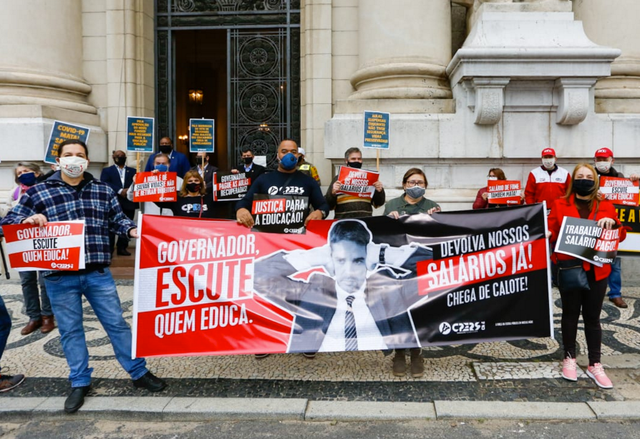
Rio Grande do Sul teachers protesting over delayed wages and working conditions during the coronavirus pandemic (Credit: CPERS)
Moreover, while this policy is carried out, education officials in both the government and the private sector are warning that the social and economic impact of the pandemic will provoke an enormous increase in student drop-out rates. In 2014, a survey of 271 institutions by the Brazilian Distance Learning Association (Abed) found that, among the obstacles to adequate learning, “student evasion” was the most cited, with 116 institutions declaring it as the biggest impediment. The main reason for the dropouts was the lack of time for students who had to work.
A 2018 study by the education NGO Todos pela Educação found that 36.5 percent of all 19-year-olds in Brazil had not finished high school, a percentage that corresponds to 1.2 million young people, indicating widespread financial pressures that force youth out of education.
The fact that the pandemic intensified pressures on poor students to miss classes or abandon school completely in order to help with household expenses is ignored by the government, as well as the education NGOs and private education companies.
The World Bank loan to subsidize the acquisition of thousands of tablets and computers by teachers was promoted as a way to “facilitate their work.” Under conditions of increased financial hardship and mass unemployment, the loan, to be paid for by the workers themselves, is designed to introduce new obligations on the digital platforms for an already overwhelmed and ever-poorer workforce.
Such platforms will be made tools not for better teaching, but to widen performance evaluations, which will be implemented through mass measurable criteria. These criteria are designed by the same private sector organizations that have been campaigning with high-level government education officials and representatives of international financial interests for more distance learning platforms and large-scale exams.
Amazonas, Brazil’s largest state, was used as a model for distance learning. Having its entire territory located inside the Amazon rainforest, the state started its program in 2007 due to difficult access to thousands of isolated riverside and indigenous communities. São Paulo’s current secretary of education, Soares, was Amazonas’ secretary of education during two administrations, and was later appointed as secretary of basic education in the federal government, playing a key role in the national pro-market high school reform approved in 2017. In 2018, he became minister of education during President Michel Temer’s acceleration of the austerity measures which had been initiated under the Workers Party (PT) government of Dilma Rousseff.
In the beginning of April, João Doria, the ultra-right governor of São Paulo, who has been promoted during the COVID-19 pandemic as a champion of science and reason against Brazil’s fascistic president, Jair Bolsonaro, and commended by PT former president Luiz Inácio Lula da Silva, announced cynically: “So that no student is excluded, the four major telecommunications companies—Claro, Vivo, Oi and Tim—reached a deal with the government providing free internet access.”
Similar deals were reached in the Federal District and the state of Paraná. The distance learning platform developed by the São Paulo Education Secretary (Seduc), expected to be used by a million high school students, is based on the Amazon Web Services (AWB) cloud, which, according to the state government, is being provided “at no cost.”
The real meaning of these deals is shown by Doria’s record of intense cuts and privatizations along with the simultaneous contribution of hundreds of millions in donations from big business during his brief one-year mandate as mayor of São Paulo’s capital in 2017. In the first three months of his administration, Doria announced 255 million reais (US$81.5 million) in donations, including 15 million reais (US$4.8 million) from Microsoft toward access to its online education platforms and training for teachers. Later he would announce the use of only 18 percent of the city’s annual budget for investments, the lowest in 10 years, having used a mere 7.5 percent by July.
Both the high rate of school dropouts and its social causes have been seen for years as an opportunity to place students in a lucrative market of private schools for low-income families and, more recently, the market of distance learning and “gamified” learning.
A study published in 2009 by the Getúlio Vargas Foundation’s Center of Social Policies (CPS), in partnership with the NGOs Educar Dpaschoal Foundation, Todos pela Educação and the Unibanco Institute, declared that among the main reasons for school dropouts were “restrictions on income and [access to] the credit market which prevent people from exploring the high payback provided by education in the long term.”
The study offers as a solution “providing education credit, awarding of scholarships or the transfer of conditioned income.” In other words, student dropouts are to be exploited as a lucrative market through exploiting the calamitous state of public education and offering a supposedly better quality education in the private sector. During the last decade, these efforts assumed the form of propping up distance learning and “technology-based learning,” and took a significant step forward with the approval of the high school reform of 2017.

Health care collapses in Bolivia after coup regime reopens economy

Tomas Castanheira

The number of confirmed cases of COVID-19 in Bolivia, which reached 30,676 this Saturday, has tripled since the country began reopening economic activities less than a month ago. The speed of transmission of the disease is reaching increasingly alarming levels, having exceeded a thousand new cases on five different days over the past week.
The Bolivian health care system is collapsing across the board. About two weeks ago, images of at least six people dying of COVID-19 in the streets of cities like La Paz, Cochabamba and Santa Cruz de la Sierra were reproduced in the media.
One of the cases was identified by El Deberas Juan Carlos Ch., who died on a street in Cochabamba after seeking aid at seven hospitals and not being admitted. Making the case even more horrendous, after that three different cemeteries refused to take his body, as they were full.
Jeanine Áñez at the celebration of 194th Anniversary of Bolivian Police, June 19.
This same situation has confronted many Bolivian families, who are being forced to keep the bodies of their loved ones for days inside their homes, or to bury them in an improvised manner threatening to spread the disease even further in the communities.
Over the past few days, a number of treatment centers and a laboratory that processes COVID-19 tests have been forced to suspend their activities after reaching maximum capacity, shortage of supplies or massive contamination among their employees.
Health professionals at the Viedma Hospital in Cochabamba, one of the affected sites, held a protest last Tuesday. The workers held signs demanding: “We don’t want life insurance, we want to live.” One of them told Los Tiempos: “The words of the governor stood in the air. We are the ones buying our protective equipment, the government hasn’t given us anything.”
Another one declared: “We asked the authorities for an isolation center, we have several infected colleagues who are in their homes compromising their families. We ask them to perform rapid tests because we don’t know who is infected.”
The same conditions have led workers to protest at other hospitals in Santa Cruz and La Paz. The absence of safe conditions is leading to substantial deaths of health care workers. Last Thursday alone, four doctors died from COVID-19 in Santa Cruz, bringing the official number of health care workers killed by the disease in the country to 48.
The advance of the infections also threatens the nearly 60 indigenous territories in Bolivia, most of them surrounded by municipalities with registered cases. Several territories have denounced the authorities for having abandoned them, without access to health care or government bonuses. According to Miguel Vargas Delgado, director of the Center for Legal Studies and Social Research, the indigenous peoples, without exaggeration, “are at risk of disappearing.”
The coup regime led by Jeanine Áñez has responded to the deadly spread of the COVID-19 pandemic in Bolivia with the escalation of its irresponsible reopening of the economy.
The government announced on Wednesday the creation of the so-called “National Program of Reactivation of Employment,” with the declared aim of reactivating the Bolivian economy. It creates a fund of 30 billion Bolivianos (about US$4.3 billions) to support programs transferring wealth to financial markets and corporations and financing public works and housing loans.
However, the policestate measures that have been implemented by the government under the pretext of enforcing quarantines are not being suspended; on the contrary.
In a June 19 event celebrating the 194th anniversary of the Bolivian Police, Áñez, who was awarded with the order of the “Gran Cruz,” said: “The moment we are approaching, will be [the police’s] turn to lead, together with its people, the construction of the necessary environment to reactivate the economy of the country and of Bolivian homes.”
The blame for the social and health catastrophe is being diverted by the government with increasing accusations against its opponents. Áñez attributed the collapse of hospitals to the precarious state of the health care system bequeathed by the administration of deposed President Evo Morales of the Movimiento al Socialismo (MAS). And the growing accusations of corruption over the government’s purchase of 170 ventilators were characterized by Áñez as fruit of “a network of conspiracy” involving the MAS.
These accusations add to reactionary attempts to attribute a “terrorist” character to the political opposition that would justify using force to maintain the regime established with the military coup that overthrew Morales last November.
The protests and blockades erected in May by poor workers in K’ara K’ara, south of Cochabamba, against the government’s starvation policy during the quarantine, have become the target of intense political persecution. Last week, two people were arrested as alleged leaders of the protests in K’ara K’ara, one of them a MAS candidate for deputy, Lucy Escobar, and were charged with assault on public health, terrorism and terrorist financing.
The holding for a few hours of a police officer, who apparently entered the K’ara K’ara blockade by mistake, was characterized by government minister Arturo Murillo as a “kidnapping” personally ordered by “narco-terrorist Evo Morales.” On his Twitter account, Murillo said that Morales “searches for death to convulse” the country.
On different occasions, Murillo and Áñez repeated the slogan that Bolivia has “two possible roads”: the first is that of the MAS and “evismo,” which they associate with terrorism, political violence and the division of Bolivians, and the second is “us.”
The threat of the coup regime remaining in power indefinitely was underscored over the past week. After a series of postponements, Áñez announced June 21 her agreement to hold new elections in September. However, she affirmed to have made her decision under pressure from her opposition, both the MAS and Carlos Mesa, candidate for Comunidad Ciudadana. “They now should courageously assume the responsibility that they have for demanding with such insistence that there be elections in the middle of a pandemic,” she declared.
But already on Tuesday, hours after the enactment of the election law, the government made a new contradictory statement. The national head of epidemiology at the Ministry of Health, Virgilio Prieto, said in an interview that, due to the prospects of growth of the pandemic and collapse of hospitals, “we may not even go to the polls.”
Bolivian workers, peasants and the indigenous population are seriously threatened by the criminal policies of Áñez’s reactionary government in response to the pandemic and its efforts to fortify the dictatorial regime.
But opposition to this threat can be mounted only by means of the independent political mobilization of the working class and a break with the political opposition headed by the MAS, which plays the role of paving the way for the reaction. Morales reaffirmed last week that the need of the moment is for a national dialog for reconciliation (with the forces that promoted the coup) and building a post-pandemic economic agenda.