30 Jun 2020

Broader reopening of UK schools leads to spread of COVID-19 infections

Tania Kent & Tim Pearce

Education Minister Gavin Williamson has threatened parents and families who refuse to send their children back to school in September with fines, insisting that the directive announced by Prime Minister Boris Johnson last week is “compulsory.”
The threat of £60 fines per pupil, which double if not paid within 21 days, comes under conditions in which the latest Public Health England’s (PHE) statistics reveal that schools are now register second in the outbreaks of acute respiratory infections.
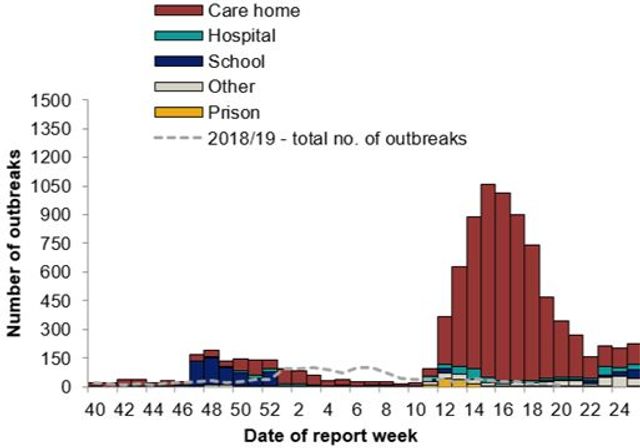
Graph showing the increase in COVID-19 outbreaks in schools
The broadly opposed “wider opening” of schools began on June 1. Such was the opposition that the government was forced to limit it to nurseries, reception stage, year 1 and year 6, plus year 10 and year 12 on a de facto part-time basis, from June 15, with plans to open all primary schools in July scrapped.
The latest Public Health England Weekly COVID-19 Surveillance Report reveals that up to June 24, schools stand just below care homes, but above hospitals for infections. There has been an overall increase in detections outside hospitals, with the wider reopening of schools a contributing factor.
The report shows that the number of outbreaks in schools increased from 24 to 44 in a week—16 more than were recorded at hospitals. It confirms that the rise “coincides with wider school reopening” and criticises the lack of an expansion of “test and trace” systems meant to accompany the wider reopening of schools. Although a relatively small number, schools made up nearly 20 percent of “new acute respiratory outbreaks,” which rose from 199 to 223.
The doubling of infections in schools within a week, following a still limited reopening of schools, should send alarm bells ringing for those concerned with public safety. Not so for the Conservative government. The scientific evidence has not only been ignored but met with belligerence and intimidation, with threats of fines for families who resist sending their children back to schools in September, with a deadly virus still in circulation.
The Surveillance Report shows that the week before schools started to open more widely, outbreaks did not rise above four. In the first week back alone, there were 14 outbreaks and 10 schools had to close in Lincolnshire. There were six school closures in Bradford and at least one each in Sheffield, Doncaster and Derby. There are no central statistics available, but 148 teachers have died of COVID-19.
The PHE report also states that “case detections remain highest in the north of the country and there have been increases in case detections outside of hospital testing in Yorkshire and Humber over the past 2 weeks. At a local authority level, activity was highest in parts of West Yorkshire, Greater Manchester and in Leicester.”
After 11 days of delays, Leicester was placed in “local lockdown” yesterday after 658 new cases have been recorded in the area of the city since mid-June. Five Leicester schools were shut last week: Moat Community College, in Highfields, Herrick Primary in Rushey Mead and Whitehall Primary, in Rowlatts Hill. They all closed to carry out a deep clean after members of staff tested positive for the virus.
Under these conditions, the government’s determination to continue with its deadly plan to reopen schools demonstrates its criminal indifference to the safety and lives of teachers, children, their families and their communities. The announcement to reopen all schools has not been followed by any official guidance on how this is to be achieved, which is scheduled to be announced at the end of the week. It is clear that the government is creating the conditions for the virus to “let rip.”
Social distancing will not exist in schools. The government plans to place large groups of pupils in “bubbles” to ensure schools can take all pupils back at the start of the new academic year. But the term “bubble” is a fiction. Children will be back in classes of about 30 children in primary schools, as they were pre-pandemic. There will be no possibility to socially distance or avoid sharing classroom resources.
In secondary schools, the “bubbles” could number into the hundreds, including entire year groups of up to 400 in some of the larger schools. Such a term applied to the various ability and subject groups into which secondary pupils are broken up is meaningless from a safety perspective.
On June 11, the Scientific Advisory Group for Emergencies (SAGE), the government advisory group, tweeted that in order to keep infections low in schools, “contact should be avoided between teaching staff and between pupils from different classes and especially different schools.” Head teachers responded by stating that the plan was “pure fantasy.”
There will be teachers whose partners work in different schools, teachers with children who attend different schools, children whose siblings attend different schools, of which the government and its advisers are well aware, but it will continue to allow the conditions for what Independent SAGE, a group of eminent scientists critical of the government, has defined as a “perfect storm” for the spreading of the virus.
Sir Jeremy Farrar, director of the Wellcome Trust and a member of SAGE, said that Britain was on a “knife edge” and likely to see an increase in coronavirus cases by July. He expressed concerned that there would soon be a surge of new infections caused by lockdown restrictions being eased towards the end of May and anticipated that there will be “an increase in new cases over the coming weeks.” This will be the very point at which schools are being forcibly reopened.
Government advice is for more regular breaks during school times in order to have additional cleaning, but the Department for Education (DfE) confirmed this week that schools are “not eligible to make claims for any additional costs associated with more pupils returning to school.” This means schools will have to absorb all the additional costs from their existing measly budgets.
The lifting of the lockdown, driven purely by “restarting the economy” in the interests of the rich at the expense of the lives of workers, can only be opposed through the independent action of the working class. The trade unions share responsibility for the deadly situation facing those being forced back into factories, offices and schools when it is not safe to do so.
The teaching unions repeat ad nauseam that schools should “only open when it is safe to do so,” but the reality is that they have ensured many schools are already open while the virus is still claiming lives and no vaccine or effective treatment yet exists. Their role is to dissipate the mass opposition that exists amongst educators and parents, who, through independent opposition, have forced the government to make U-turns such as delaying a wider reopening of schools, and the provision of free school meals over the summer.
This opposition to the reopening of schools must have a conscious political programme. It must be the spearhead of an independent movement of the working class against the Johnson government and its murderous back-to-work campaign. We urge educators to study our statement below and contact the SEP for advice and assistance in setting up action committees in your school.

Merkel, Macron promote EU militarism amid growing conflicts with Washington

Johannes Stern & Alex Lantier

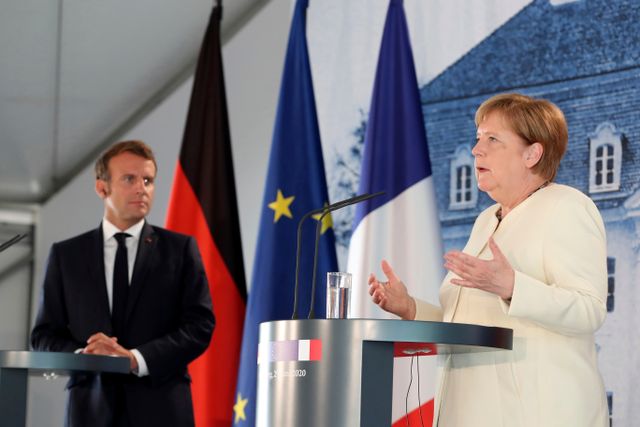
On Monday, German Chancellor Angela Merkel received French President Emmanuel Macron at Meseberg Castle near Berlin before the start of the German Presidency of the EU Council on July 1.
These talks took place amid the COVID-19 pandemic, the deepest economic crisis since the end of World War II, and growing US-EU tensions. There is rising shock and consternation internationally at the political and economic disintegration in the United States, where authorities refuse to take meaningful steps against COVID-19 even as the pandemic escalates wildly.
German Chancellor Angela Merkel, right, and French President Emmanuel Macron give a joint press conference after a bilateral meeting, at the German government's guest house Meseberg Castle in Gransee near Berlin, Germany, Monday, June 29 2020. The meeting takes place ahead of Germany's EU Council Presidency in the second half of 2020. (Hayoung Jeon, Pool via AP)
After the EU blocked US citizens from entering Europe, Merkel and Macron called for stepped-up military spending and austerity to ensure Europe’s ability to wage war independently from Washington.
Merkel began a joint press conference with the words, “We are living in a serious time.” She cited both the pandemic and “the economic challenge associated with it, the likes of which we have not seen for decades or perhaps ever before.”
She said Germany and France want to “play a joint role in the coming months, making it clear that Europe is our future ... Only in the European community will we be strong and play our role in the world.” The “great challenges” she foresaw included digitization, climate change, but also “the question of war and peace in the true sense of the word.”
Merkel and Macron did not explain which wars might be imminent, but they emphasized that the European states could only compete globally with other major powers by working together. “We must define our relations with the world as a European Union,” Merkel said. “This has to do with relations with Africa, with relations with China and, of course, with transatlantic relations. The fact that we are facing a great challenge here can be seen every day.”
The far-reaching character of the questions that were involved in the Meseberg talks was indicated by an interview Merkel granted to a consortium of European newspapers. Speaking to the Guardian in Britain, the Sueddeutsche Zeitung in Germany, Le Monde in France, La Stampa in Italy, La Vanguardia in Spain, and Polityka in Poland, she discussed Germany’s upcoming presidency of the European Council and voiced the growing concerns in European ruling circles at their relations with Washington.
Asked whether Europe would establish strategic autonomy from Washington, she replied: “There are compelling reasons to remain committed to a transatlantic defence community and our shared nuclear umbrella. But of course, Europe needs to carry more of the burden than during the Cold War. We grew up in the certain knowledge that the United States wanted to be a world power. Should the US now wish to withdraw from that role of its own free will, we would have to reflect on that very deeply.”
Merkel did not say what might lead Washington to abandon its role as the leading world power. However, it is no secret that the entire American capitalist establishment is desperate to maintain the United States’ rapidly fading global hegemony. What Merkel and other European heads of state are “reflecting” upon, in reality, is not the possibility of a change in policy decided by Washington “of its own free will,” but the accelerating collapse of American capitalism’s world position.
Conflicts between Washington and European capitals on international issues are steadily growing. With the Trump administration threatening both Germany and China with hundreds of billions of dollars in trade war tariffs, Merkel bemoaned a “brusque” tone in global politics: “These days, we have to do all we can to stop ourselves collapsing into protectionism. … I am under no illusions about how difficult the negotiations will be.”
While calling China’s economic rise “a major challenge for our liberal democracies,” Merkel proposed a visibly different approach from Washington, which is threatening to default on US debt to China and dispatching three aircraft carriers to threaten China’s coast. Merkel said Europe and China are “partners in economic cooperation and combating climate change, but also competitors with very different political systems. Not to talk to each other would certainly be a bad idea.”
She also suggested that limited concessions would be made to governments of more indebted EU countries in order to secure their support for Germany’s new bid for world power. She indicated Germany could contribute more money to a COVID-19 bailout fund because “Germany had a low debt ratio and can afford, in this extraordinary situation, to take on some more debt.” She also said she could support Spanish Economy Minister Nadia Calviño as the head of the Euro Group of euro zone finance ministers.
The measures to help the economically weaker European countries, Merkel said, are “in our own interests too, of course. It is in Germany’s interest to have a strong internal market and to have the European Union grow closer together, not fall apart.”
In Meseburg, Merkel and Macron left no doubt that the working class will bear the costs of the crisis. Merkel made clear the €500 billion “Recovery Fund” proposed by Germany and France will be linked to savage austerity against working people. “Everyone must make themselves fit for the future at home” and “strengthen their own competitiveness,” she said. She cited the example of Italian Prime Minister Giuseppe Conte, who she said had already “made proposals to modernise his country.”
Currently the European powers are working closely together on transforming the EU into a military alliance that—unlike NATO—can act independently of and if necessary against the US. But conflicts are also re-emerging between the European capitals. When Merkel suggested in her interview that the European Stability Mechanism (ESM) “can be used by everyone” hit by the crisis, Conte rebuffed her: “I’m the one who keeps the books. I take care of the Italian budget, together with Finance Minister Roberto Gualtieri, the state’s accountants and the other ministers.”
What keeps the European governments together at this point is not a unity of interests, but a desperate search for allies against foreign enemies and the working class at home. The only policy they can agree on is one of austerity, repression and militarism. Thus, the defense ministries of France, Germany, Italy and Spain issued a joint letter to Josep Borrell, the EU foreign and military policy chief, calling for a major joint EU military build-up in response to the COVID-19 pandemic.
During the pandemic, they wrote, “Our Armed Forces have been instrumental in helping to deal with the challenges posed—both in Europe and beyond. Today, the effects of the pandemic have already started aggravating existing conflicts and crises, further weakening fragile states and putting additional pressure on already strained systems and regions. Security and Defence must therefore remain a top priority. We want to live up to our responsibilities and be able to face present and upcoming challenges, at home and abroad.”
They called for strengthening the EU’s Permanent Structured Cooperation (PESCO) on military issues; reinforcing EU defence industries; developing a “Strategic Compass” governing common EU military missions; stepping up military operations in Mali, Libya, and the Gulf of Guinea; and further coordinating EU military policy. Cooperation with NATO was listed dead last, in a section that committed the four EU powers to “strengthening the European pillar within NATO” as well as to taking “forward the cooperation in security and defence with other partner organisations.”
They stressed that building the EU’s ability to wage large-scale military actions independently of Washington would require pouring financial resources into Europe’s war machines.
They added, “Building Europe’s industrial, technological and digital sovereignty requires us to link our economic policies even stronger with our security interests … The European Defence Fund (EDF) is key to financing and fostering defence research and capability development that will reinforce our ability to act and to face future military crises and global threats. We therefore advocate for an ambitious EDF budget as a priority in the defence area and a swift adoption of the EDF regulation, in full respect of the discussions on the Multiannual Financial Framework.”
As the European powers prepare for war, they openly acknowledge that their relations with America are collapsing. German Foreign Minister Heiko Maas (SPD) told DPA: “Anyone who thinks that with a president of the Democratic Party everything will be the same again in the transatlantic partnership as it once was underestimates the structural changes.”
Three decades after the Stalinist dissolution of the Soviet Union, historically-rooted contradictions of capitalism that led to two world wars in the 20th century are again rapidly erupting. This must be understood as a warning by the working class. The way forward against the capitalist warmongering on both sides of the Atlantic is the building of an international anti-war movement and a struggle for socialist revolution.

In Context: COVID-19 and Iran

Majid Izadpanahi


After China, Iran was the among the first countries that emerged as an epicentre of COVID-19 in the early stages of the pandemic. However, Iran’s response to the pandemic was different from those of other countries, and consequently, its impacts would be indissoluble.

According to reports, the source of the COVID-19 pandemic in Iran were Chinese students at seminaries in Qom, a Shia holy city, and a merchant from Qom who had traveled to China. From the very beginning, independent Iranian media based overseas (such as Iran International TV, Manoto TV etc) discussed the issue and reported on new cases in the country. On the other hand, Iranian officials rejected the reports. For example, Iran’s Deputy Minister of Health, Iraj Harirchi, strongly assured that the country was not hit by the virus but the very next day, he confirmed that he had tested positive for the virus. Iran’s reaction was characterised by denial and concealment of facts rather than informing the country and offering rational advice to mitigate the negative effects of the disaster. This begs the questions as to why Tehran denied and then downplayed the COVID-19 pandemic’s effect in Iran, and what its consequences might be.


Key Factors One factor pertains to the nature of Iran-China relations. Due to the anti-Western nature of the Islamic Republic, its regional policies, missile and nuclear programs, international conduct, relations with neighbours and Sunni Arab states, as well as sanctions—which prevent Iran’s historical friends such as India, South Korea, Turkey etc from expanding relations with Tehran—the country has been deprived of its natural allies and has been subjected to international isolation. This situation has pushed the country to develop imbalanced relations with China and Russia—two permanent members of the UN Security Council. Over the years, Tehran has tried to depict a positive picture of China and Russia while demonising the West. Another factor is the political structure of the Islamic Republic. It is dominated by the clergy and the Islamic Revolutionary Guard Corps officers and is based on religious legitimacy. This resulted in the centre of the power following a ‘religious-security’ approach towards countering the pandemic.

Key Impacts The first impact is on Iran’s foreign policy. When the pandemic was at its peak in China, Tehran sent aid to Beijing even though the price of face masks was skyrocketing across Iran. The cargo was transferred by Iran’s Mahan Airlines. Despite flight bans, the airline continued its flights to some Chinese cities, connecting Tehran to some Middle Eastern cities and spreading the virus to the countries in the region.

A diplomatic squabble also broke out between the Spokesperson of Iran’s Ministry of Health and Medical Education, Kianoush Jahanpour, and China’s Ambassador in Tehran, Chang Hua, when Jahanpour called China’s coronavirus figures “a bitter joke.” Curiously, both hardliners and moderates in Iran criticised Jahanpour for his tweet and consoled the Chinese ambassador. The Spokesperson of Iran’s Ministry of Foreign Affairs, Abbas Mousavi, tweeted that ”Iran has always been thankful to China in these trying times.” This sensitivity displayed towards Beijing and rejecting assistance from other international actors can be interpreted as Tehran’s straying away from its original slogan—‘No East, No West, Islamic Republic’.

The pandemic also has a bearing on the legitimacy of the Islamic Republic on the domestic level. This crisis is completely different from what the country has experienced so far. COVID-19 is undeniable, invisible and cannot be arrested—tactics Tehran has used to counter critics and opponents since 1979. Ayatollah Khamenei said the pandemic was the enemy’s plot to discourage the people from participating in the parliamentary election; President Hassan Rouhani referred to it as the enemy’s political propaganda; and Tehran rejected international help, arguing that it was a way to collect the information. The clergy strongly resisted the closure of religious places as well as quarantining of Qom city which was the epicentre of COVID 19 in Iran. Some religious figures questioned modern medical science and instead recommended “Islamic medication.”

Conclusion The COVID-19 experience in Iran could be compared to the Black Death experience in Europe where it changed the balance of power against the church. Both events altered  the worldview of the people and had an impact on the economy. In Iran, people largely understand that shrines and prayers cannot protect them against diseases—i.e. the opposite of what the clergy has been saying for 41 years. Ayatollah Khamenei has not had face-to-face meeting for over two months, only appearing via teleconferencing, and requested to open the holy places. The COVID-19 pandemic, along with its economic impact, holds the potential to have an undiminishable influence over the Iranian society and the regime. The legitimacy of the Islamic Republic (the state) depends on religion and that is one of the main reasons why there was considerable procrastination in quarantining Qom. If Qom had been quarantined on time, thousands of lives and the economy would have been saved. Thus, the pandemic experience not only demonstrated the Islamic Republic’s inability to protect its citizens at a crucial time but also brought to fore its heavy dependence on China.

29 Jun 2020

Queen Elizabeth Prize for Engineering 2021

Application Deadline: 17th July 2020.

About the Award: The QEPrize seeks nominations from the public that celebrate a wide variety of engineering innovations across all sectors of the profession, and a breadth of nominators from all corners of the globe.
The only limitations are that self-nomination and posthumous nomination are not allowed.
Full nominations should be made by completing the nominations form via the link below. You will be asked to explain how the nominated innovation meets the judging criteria, identify the engineer or engineers responsible for the innovation, and provide two referees who are sufficiently knowledgeable to support the nomination.
If you have limited information on an innovation but believe it to be ground-breaking and to have already displayed a significant benefit to humanity, please provide as much information as you can. The information will be used to make further enquiries as to the suitability of the suggestion and, where appropriate, to prepare a full nomination.
If you need help or have questions about making a nomination, please email nominations@qeprize.org.

Type: Award

Eligibility:
  • Does the innovation have global impact?
  • Can you identify up to 5 engineers responsible?
  • Do you have enough information to write a case for nomination?
  • Are you able to identify at least 2 people who are familiar enough with the innovation to act as referees?
Eligible Countries: Commonwealth countries

Number of Awards: This will be a single prize awarded to one individual, or a team of up to five people, responsible for a ground-breaking innovation in engineering that has been of global benefit to humanity.

Value of Award: The £1 million prize is the world’s most prestigious engineering accolade, awarded to up to five engineers responsible for a bold, groundbreaking engineering innovation of global benefit to humanity.

How to Apply: Make a nomination
  • It is important to go through all application requirements in the Award Webpage (see Link below) before applying.
Visit Award Webpage for Details

HiiL Innovating Justice Challenge 2020 for Entrepreneurs in Africa and Middle East

Application Deadline: 5th August 2020

Eligible Countries: The HiiL Justice Accelerator particularly encourages applications from Uganda, Kenya, Nigeria, Mali, South Africa, Zimbabwe, Ukraine, Tunisia, Lebanon, Jordan, Morocco, the United Arab Emirates and the Netherlands.

To be taken at (country): The Hague, The Netherlands

About the Award: The HiiL Justice Accelerator finds and supports the world’s best justice entrepreneurs in order to create access to justice for all.
Between 40-50 startups, selected as semi-finalists, will be invited to pitch at local Boostcamps. This year’s Boostcamps will take place in Johannesburg, Lagos, Nairobi, Kampala, Kyiv, and The Hague. In some cases, startups may pitch by Skype or be brought to the nearest Boostcamp. Additionally, these semi-finalists will be guided through a “market validation” process.

Eligibility: We look for ventures with strong potential to prevent or resolve pressing justice needs. Examples of such eventures are those that deliver concrete justice solutions for many people, including micro, small and medium-sized businesses, and initiatives within existing justice systems or public institutions, spearheaded by driven intrapreneurs.
  • Innovative justice initiatives who can make significant social impact
  • Ventures that have a business model and the ambition to scale across a country or internationally
  • Ventures that have a business model that enables them to become financially sustainable
  • Ventures led by a motivated and strong team that includes experienced and inspiring founder(s)
Criteria: who can apply?
  • The founder and applicant should be 18 years of age or older.
  • The venture must be committed to providing access to justice underpinned by evidence showing justice needs.
  • The person(s) with whom we engage should be the founder or a co-founder of the organization and should be able to make key, high-level, and direction-shifting decisions (such as whether or not to take investments and who to partner with) on behalf of the entire organization.
  • We can only accept innovations to be incorporated with a bank account in the name of the legal entity by the time they receive our grant funding.
Selection Criteria:
  • Scope (is it a justice innovation? is it solving pressing justice problem)
  • Impact
  • Uniqueness
  • Sustainability
  • Scalability
  • Team
Value of Award: Apply to receive seed funding, training and acceleration support, access to an international expert network and potential further investment opportunities.

How to Apply: Click here to apply

Visit Program Webpage for details

Is the Deep State Attempting a Hybrid War in Mexico?

Nino Pagliccia

An important article by journalist Ben Norton appeared on the online outlet The Grayzone describing the content of a leaked document that consists “of an executive summary of ‘Project BOA,’ outlining what it calls a ‘plan of action’ – a blueprint of concrete steps the opposition alliance will take to unseat AMLO.” AMLO is Mexican President Andres Manuel Lopez Obrador, and BOA stands for Bloque Opositor Amplio (Broad Opposition Bloc). The document was presented by AMLO himself at a press conference in early June and the source of the leak remains unknown. Some of the alleged members of this “alliance” have denied the existence of such document. However, its content is quite credible within the geopolitical context of the region.
Who is Andrés Manuel López Obrador?
Popularly know as AMLO by the initials of his name, he became president of Mexico in December 2018 after Mexican voters gave him a strong mandate on July 1, 2018 to change the course of Mexicos domestic policies. López Obrador and his left of center National Regeneration Movement party (Movimiento de Regeneración Nacional – MORENA) dominated Mexicos presidential and legislative elections.
López Obrador won 53.2% of the presidential vote, more than 30 percentage points ahead of his nearest rival, and won in 31 of 32 Mexican states. The MORENA party won solid majorities in the Senate and the Chamber of Deputies which convened on September 1, 2018.
AMLO followed as president to conservative Enrique Peñas Nieto who had seen economic downturn and a huge organised crime rate increase mostly related to drug trafficking that the AMLO administration inherited. In fact, he was elected on his platform to combat crime, corruption and related poverty, but more emphatically he promised to fight against neoliberalism.
He called his plan the Fourth Transformation following Mexico’s independence of 1810, the reform of 1861 and the Mexican revolution of 1910. One of the pillars of his government has been respecting the will of the people through popular referendums on major decisions. This he has done regularly. However, conservative critics like the Cato Institute have issued negative reports on AMLO criticising his approach as “populism”, his proposals as “toxic”, and his mandate as leading to a “perfect dictatorship.”
Nevertheless, Lopez Obrador still commands an approval rate of 65% in the eyes of Mexicans. Why would such a popular president trigger such a strong rejection by some groups? Maybe looking at the alleged groups involved might give a hint.
Is a Deep State plot at play to overthrow AMLO?
The leaked report gives a detailed list of the composition of the “opposition alliance”. Aside from most rightwing parties and former presidents Felipe Calderon and Vicente Fox, the opposition bloc “also says it has support from the governors of 14 states in Mexico, along with opposition lawmakers in both the Senate and Chamber of Deputies, judges from the Electoral Tribunal of the Federal Judiciary (TEPJF), and officials from the National Electoral Institute (INE).”
If we accept that as a fact, then to call the BOA an Opposition Alliance” as if it were the formation of a political coalition set to democratically challenge the elected president, is really a misleading term. The secrecy of this alliance is not reassuring either.
If we in fact recognise this as an organised entity that operates surreptitiously outside the formal State to exert influence and political changes, and that, tellingly, lists “specific media outlets, along with individual journalists and social media influencers”, the BOA is closer to what we know as a Deep State. Even more so when it claims to include lobbyists in Washington (White House and Capitol Hill) and financial investors on Wall Street. Only missing from the list is any reference to a military participation.
Is this proof that someone is planning a Hybrid War on Mexico?
The leaked document is clearly presented as a “plan of action” to oust Lopez Obrador. This would be done in two stages: first seemingly, through a democratic process by winning the 2021 legislative elections, and second through a parliamentary coup that would “impeach President López Obrador by 2022”, two years before the end of his term.
The BOA does not suggest the legal basis for an impeachment of AMLO. But that may not be a concern at this early stage because the “action plan” describes a strategy that may easily create one. The strategy would make heavy use of “major news publications and journalists from both domestic and foreign media outlets on their team” to insistently blame AMLO for unemployment, poverty, insecurity, and corruption” in Mexico.
The BOA document even states unambiguously in its plan that it would use groups of social media networks, influencers, and analysts to insist on the destruction of the economy, of the democratic institutions, and the political authoritarianism of the government of the 4T” (using an acronym for the Fourth Transformation process). They go on saying, Repeat this narrative in the US and European media.”
In other words the BOA action plan intends to organise a full scale Information war in order to demonise President Lopez Obrador regardless of the reality and the truth. Lets remember that an infowar is the initial stage of a Hybrid War.
Is the US behind a possible Hybrid War on Mexico?
At this early stage it is not totally obvious. The BOA action plan would involve an appeal to Washington for support. It would do so by reminding the Trump administration about the danger to the U.S. of the high mass migration of Mexicans toward the United States. This intends to play in the hands of one of the issues that Trump has referred to constantly in relation to Mexico and led him to build a wall at the border to contain immigrants.
So far, some relevant points are, 1) AMLO’s statement that “he would sell gasoline to Venezuela for ‘humanitarian’ reasons if asked to, despite U.S. sanctions on the South American country and its state-run oil firm, PDVSA”; 2) Mexico and Venezuela successfully had an oil-for-food exchange against U.S. sanctions on Venezuela; and 3) a swift U.S. reaction slapping sanctions on a Mexican company and another company involved in the exchange. This was followed by a report from Reuters that in an apparent unexplained compliance move Mexico froze bank accounts of entities and individuas sanctioned by the U.S.
The sequence of events may suggest a repetition of Washington’s trend chasing any government that attempts to break its economic and financial siege on Venezuela, even if this involves more extraterritorial coercive measures to destabilise the economy, an infowar to demonise a leader, or a full scale Hybrid War.
It is in this ongoing scenario that AMLO will travel to Washington for a meeting with Trump in July that has been highly criticised in Mexico. At the time of writing, the news that the Mexican finance minister who has been in close contact with AMLO was tested positive for the coronavirus may have an impact on the meeting in Washington. If indeed the meeting takes place, it will be interesting to see how it will play out vis-à-vis the BOA action plan.

On the Recession, Stimulus and Economic Recovery

Dean Baker

As we get more data in, it seems increasingly likely that we are looking at a horrible and prolonged recession, not a complete economic collapse of Great Depression proportions. The May employment report showed a substantial bounce back in employment, with jobs up by more than 2.5 million from the April level. Retail sales had a huge 17.7 percent jump in May, by far the largest on record, although they are still 6.1 percent below the May 2019 level.
Mortgage applications also show a considerable degree of confidence about the future, with both refinancing and purchase mortgages soaring. Mortgage applications for refinancing are up more than ten-fold from year-ago levels, while purchase applications are up 268.6 percent to the highest level in more than 11 years. The latter is far more important for the economy since it implies people are buying homes, which typically lead to the purchase of new appliances and spending on renovations.
These data, and a variety of surveys of consumers and businesses, do not show an economy in collapse. At the same time, there is little reason to believe that we will see a robust rebound to anything resembling normal. We lost 22 million jobs between February and April. Even if we had seven more months adding jobs back at the May rate, we would still be down by more than 2 million jobs from the pre-pandemic level. And, we are not likely to see seven more months with job growth anything like May’s pace, without some very serious fiscal stimulus.
new paper from Raj Chetty and co-authors provides some interesting insights on the problem the economy faces. Using real-time data from a number of private sources, it finds that there has been a sharp fall in consumption by people in the top income quartile of households, with relatively little change in consumption from the other three quartiles.
This drop is overwhelmingly associated with a sharp drop in demand for services, like restaurant meals, hair salons, and other personal services. Interestingly, the size of the drop is not affected to any substantial extent by laws on shutdowns. Areas where these services were fully available saw comparable declines in spending as areas where these services were still subject to lockdowns.
There are two major takeaways from these findings. First, the drop in demand that we have seen to date has little to do with declines in income. The top quartile has reduced its spending not because it lacks the income to spend, it has reduced spending because it is scared to spend in the areas where it would ordinarily be spending its money.
An implication is that any further efforts at boosting the economy should be better targeted than the first rounds. For example, giving $1,200 to every adult in the country was not a very effective way to boost the economy. While this was payment was phased out for very high-end earners, the phase out only affected the top 2-3 percent of the income distribution, the bulk of the top quartile received their checks even though they were not suffering any income loss as a result of the pandemic.
The other major take away is that if we want people to use restaurants, hair salons, gyms, and other services, the issue of legal shutdowns matters far less important than ensuring their safety. This means actually getting the pandemic under control. While virtually every wealthy country has been able to do this, outside of the Northeast corridor, new infections are higher than ever in the United States. This means that without a vaccine and/or effective treatment, we are likely to see demand for a wide range of services badly depressed for the foreseeable future.
This matters in a big way because these industries provide tens of millions of jobs largely to less-educated workers. These sectors also disproportionately employ women and people of color. If they continue to see demand at far below pre-pandemic levels, it will mean a massive and persistent increase in unemployment for the less-educated segments of the workforce. This will quickly reverse all the gains that lower-paid workers were able to make as the labor market tightened in the prior five years.

Shaping the Stimulus
The most immediate need in the next round of a rescue package to come from Congress is for money for state and local governments. Their budgets have been devastated by the loss of tax revenue due to the shutdown and the additional demand for services. The Center on Budget and Policy Priorities calculated that the shortfalls could be as high as $500 billion.
They have already laid off 1.6 million workers and this number will hugely increase if Congress does not provide a large chunk of money to make up for their shortfalls. Some people have pointed out that the laid-off workers were largely teachers, who were not paid for the period in which schools were shut down. This is true, but if state and local governments cannot get the money to make up shortfalls, many of these teachers may not be called back in the fall and other workers are likely to be laid off to make up the cost of paying the teachers who are called back. Cutbacks at the state and local level were one of the main reasons that the recovery from the Great Recession was so slow. We should not make an even larger mistake now.
The Post Office will also need substantial funding to stay in business, as it has seen both a sharp decline in revenue and sharp increase in spending due to efforts to keep its workers safe. As with state and local governments, the employees of the Post Office are disproportionately Black. This is due to the fact that Black workers in the public sector have faced less discrimination than Black workers in the private sector. As a result, the public sector has historically been an important source of middle-class jobs for Black workers. This will be threatened if the fallout from the pandemic forces large cutbacks in employment.
There has been a peculiar debate over the extension of the $600 weekly supplements to unemployment benefits that are scheduled to end next month. It is important to remember the reason these were included. We gave people this supplement because we did not want them to work. The point was to keep people whole through a period in which the economy was largely shut down in an effort to contain the virus.
In this context, the question we should be asking in deciding whether to continue the supplement is whether it is safe to work. This depends on our progress on containing the virus. One obvious way to determine the extent to which the pandemic has been contained is the positive rate on new tests. If the positive rate is below some low level, say 3 percent, then it would be reasonable to remove the supplement in that area (this can be county specific), however, if we are seeing high positive rates, then as a matter of policy it would make more sense to encourage people to stay at home than to work.
For the areas where the virus is under control, it would still be desirable to have some supplement to the standard benefit. Benefits in many states have been eroded in recent decades so that it would be very difficult for unemployed workers to survive on them. In a context where the nationwide unemployment rate is virtually certain to be in double digits through the rest of the year, most of the unemployed are not going to be able to find work. For these reasons, a smaller supplement, perhaps $200 a week, should be left in place until the economy has recovered more.
In addition, we should also increase SNAP benefits to protect those at the bottom of the income ladder. Food prices have risen sharply since the pandemic hit. These increases may be reversed in the months ahead, but for now, low-income families have to cope with high food prices, with no increase in benefits. It is also important to remember that SNAP spending is a small share of the total budget. At $70 billion a year, it is just 1.6 percent of total spending. It is less than one-fifth of the premium we pay each year for prescription drugs because of government-granted patent monopolies.
Longer Term Recovery
At the point where we have developed effective treatments and/or a vaccine, many people will go back to eating at restaurants and flying for vacations. However, there are some changes in spending patterns that are likely to be enduring.
It is likely that much of the increase in telecommuting will be permanent. This means that many fewer people will be going to downturn offices and taking advantage of restaurants, bars, gyms, and other services in central cities at lunch and after work. People are also likely to be taking many fewer business trips, as meetings will take place on Zoom. Also, many colleges and universities will likely be downsized, as more instruction takes place on the web, decreasing retail sales in college towns.
While there will be other long-term changes resulting from the pandemic (maybe even some questioning of government-granted patent monopolies for prescription drugs), the basic point is that large numbers of workers are likely to still be displaced even after the immediate impact of the pandemic is over.
This actually presents a great opportunity. If the private sector is not spending enough to fully employ the workforce, then the public sector has to fill the gap. In this case, we don’t need to have make-work jobs, we have enormous unmet needs.
Most obviously we need people to increase our capacity for clean energy and conservation. This can mean millions of jobs for people installing solar panels, insulation, and other energy-saving measures. We also need to ramp up our child care capacity. The lack of adequate child care was driven home in the pandemic as many health care and other essential workers had difficulty making arrangements when child care facilities shut down. We also need more health care workers as we move towards establishing a universal Medicare system. This will likely mean many more nurses, nurses’ assistants, and other health care professionals. And we will need social workers or other trained professionals who can be the first responders in many non-violent situations where the police are currently called in.
We can’t imagine that all the people who lose their jobs in restaurants and hotels will be able to work installing solar panels or train to be nurses, but that is not how the labor market functions. In a normal pre-pandemic month, more than five and a half million workers lost or left their job every month. As jobs are generated in these new areas, many currently employed people will look to fill them. That will create job openings that former restaurant and hotel workers can fill. The story is not as simple as this, as we know there is considerable discrimination in the labor market and many pockets of high unemployment, but we don’t have to imagine that we need to match up displaced workers directly with the newly created jobs in clean energy, child care and health care. The labor market is far more flexible than this story implies.
Anyhow, a full discussion of the post-pandemic economy is a much longer story, but the basic picture is actually a positive one. More telecommuting will mean a more productive and less polluting economy. It will also lead to more dispersion of higher paid jobs, benefiting many of the areas that have been left behind in the last four decades and lowering rents and house prices in places like New York City and San Francisco. If we can get through a very bad stretch for the country and the economy, the future could actually be quite bright.

Modi’s Foreign Policy Catastrophe, India’s marginalisation in South Asia

Damodar

“Diplomacy is the velvet glove that cloaks the fist of power.”
― Robin Hobb
Like its economy India’s foreign policy is going through a catastrophic phase. The country finds itself engaged in skirmishes and cartographic battle on its entire northern front. The spectacle that Modi created in the arena of foreign policy; his masculine nationalism and making partner in the US Israel axis, giving preference to trade over strategic relation, are all showing their limitations. The  truth is today India is surrounded by China from all sides and she finds herself without any reliable friend to bank upon. Its hitherto peaceful and secured borders have become disputed and once the pivot of South Asia it is increasingly being relegated to the corner.Modi’s style of personalised diplomacy instead of giving benefit has made Indian diplomacy hobble.
It is increasingly apparent that the ambitious plan which Modi had envisaged for himself of playing a  role in the world arena is over. India under him had adopted a policy of “bullying the weak while bulking at the strong”. He had stopped giving importance to  the  neighbour’s and moved towards the US and Israeli axis. The world is increasingly becoming oblivious to an India whose economy is on the downward spiral and where social tensions are growing.
Modi changed the realm of diplomacy by making strategic interest subservient to business interest. Foreign policy became means to further the interest of capitalists known for their close proximity to the Prime Minister. Today,  the interest of some crony capitalists has become the national interest! When the prime minister himself has donned the hat of being the sales representative, then talk of strategic policy initiatives and national interest becomes a chimera.
India today is forced to battle not only Covid 19 but also disputes  with all its neighbours. For the first time since independence,  clashes occurring between Nepalese police and Indian citizens have been reported. The border dispute between the two countries has hit an impasse, with the Nepalese parliament ratifying the Constitutional amendment on showing  Kalapani, Lipulekh, and Limpiyadhura as its territory. The new map that Nepal has ratified extends its territorial claims over approximately 400 sq km. A virtual cartographic war is going on between both the countries. This is the first time when Nepal has been so overt in its dispute with India.  Nepal, for the past few years, was seen to be drifting towards China and India that had a dominant role to play was  relegated from its position of eminence. With the coming of the current Oli government the Chinese influence increased substantially and today Nepal can be called anything but friendly towards New Delhi.
The dispute with Nepal on the Kalapani was not over when news came of Chinese incursion into Ladakh capturing, as per the media reports, almost 60 kilometres of Indian territory in the Galwan valley. On 15th of June, news came of a bloody clash between the Indian and Chinese troops in which 20 soldiers including the Commanding Officer of Indian Army were killed by the Chinese troops. That too when the high level military commanders from both sides had declared to “peacefully resolve the situation in the border areas in accordance with various bilateral agreements.” The Chinese incursion neither stopped nor has normalcy returned to that part, but the Chinese, as reported by the BBC, have built new structures near the site of clash, overlooking the Galwan River.
Apart from Nepal a sense of anti India feeling is discernible in the other traditional friend of ally Bhutan. After Doklam an anti India voice is growing within the kingdom and several journalists and political commentators in the country have raised concern about the excessive dependence on India. When India was embroiled with China and Nepal; Bhutan stopped releasing water for irrigation channelled in Assam affecting thousands of farmers in 25 villages.
India’s relations with Pakistan needs no further discussion, under Modi it has gone from bad to worse. Sri Lanka has also almost gone over to China, so is the case with Myanmar where China has been a dominant player since time of military rule. In January this year Chinese President Xi paid a state visit to the country and  several pacts were signed between the two countries. Like Gwadar port in Pakistan, China is also aiming to have a similar set up in Kyaukpyu, a port situated in the Rakhine state in western Mayanmar. In 2018, China had signed a deal with Mayanmar to develop the port. Chinese state-owned firms have reached agreements with Myanmar to construct a $7.3 billion deep-water port and $2.7 billion industrial area in a special economic zone at Kyaukpyu.
Junior partner of US
Under Modi India has forsaken all pretensions of non alignment and pursuit of independent foreign policy. Its foreign policy has increasingly been aligned with that of US and Israel. Modi kowtowing to the US imperialist dictum has virtually turned India into a strategic junior partner of US imperialism. As seen by its handling of, Iran and Venezuela situation. Following the US dictum India severed all its relations with both the countries. Irrespective, of the fact that both the countries had extremely healthy relationships with India, and were willing to export their petrol to the country at favourable terms. Today, like its neighbours, New Delhi has lost Iran and Venezuela again to China as well as to Pakistan in case of Iran.
Similarly in the Asia Pacific region, India’s interest is aligned with US interests, in the US China trade war, India threw its lot with US in the latters strategic objective of containment of China. The Quad initiative in which Modi has personally taken interest is being described as an alliance created for containment of China and an attempt to encircle it. The Indian proactive stance in the revival of Quad is being seen by many, China experts, as a reason for Chinese incursion in Ladakh. Beijing’s way of warning India and other potential candidates from South East Asia particularly Vietnam and Philippines of not harbouring any such ambition against it.
Under Modi, India has signed several commercial and defence related agreements with US, it became party to the COMCASA (Communications Compatibility and Security Agreement) signed in 2018 and LEMOA or Logistics Exchange Memorandum of Agreement signed in 2016.
LEMOA allows the two countries to use each others’ military facilities as required on credit, while COMCASA enables inter-operability between the two militaries by providing for sharing of secure communications and real-time intelligence through use of advanced US hardware and encryption software.
Both these agreements effectively binds India to become wholly dependent on US military hardware. Despite both these agreements being lauded by the ‘official’ strategic analysts and an equally ‘official’ mainstream media, due to these accords the country lost its strategic autonomy and is now dependent on US dictacts.
What did India get in return? Nothing, U.S. has also restricted the H1B visa grant for Indians to 15 percent only. As the lockdown will end, this move is likely to affect all the industries, specifically the IT industry. During Covid 19 Trump virtually publicly threatened India of ‘retribution’ if hydroxychloroquine was not exported to it. Modi had no option but to cave to this demand and Trump’s ‘request’ was acceded. As Trump finds himself embroiled in domestic affairs, economic recession and Middle East politics, India does not figure in the high priority list of the US.
How much importance does the US give to Indian interest became evident during the Ladakh dispute, when neither the US president nor any of India’s new found friends and allies, including Israel and the Quad countries, issued statements favouring India on the  military standoff. Ladakh was not even mentioned  in the joint statement issued after the heavily razzmatazzed virtual summit between Modi and Australian Prime Minister Scott Morrison on June 4.
US foreign policy is based on its own strategic and business interest. The military industrial complex that exerts significant influence on shaping of the US foreign policy, currently India is not of much use. As the international capitalism braces for the post-Covid world, in their worldview China holds much more importance, due to its economic relations and size. The US capital has invested heavily in China and it would not want to jeopardize its interest.
The dream that Modi was selling to his right wing constituency, about US and other Western companies leaving China and would set up their base in India. Anyone who has even the basic understanding of how manufacturing companies work and how international capital functions, would have known the truth. But the Modi media and the social media army made it into a big spectacle. But reality is far stranger than fiction. There has been neither any Exodus of companies from China nor are they are queing at the shores of India. Like his all other declarations this one also turned out to be jumla (a fib).
Foreign Policy as electoral tactics
Since ascending to power, Modi has changed the way how diplomacy was conducted. In place of policy he introduced personality. Diplomacy, which was conducted behind closed doors was  converted into a media event. Something which was to be showcased. Handshakes and bearhugs became his hallmark.
To cover up his domestic failures the media and Modi himself took refuge in foreign policy. Foreign affairs was used to secure votes and fire the imagination of his core rabid right wing supporters who since long had yearned for a masculine world leader India, by showcasing them his ‘personal’ relationship and engagement with the superpowers’ leaders, such as US President Donald Trump, Chinese President Xi Jinping, Russian leader Vladimir Putin, and others.
Despite failure on every front in domestic affairs, Modi successfully amplified his popularity with his foreign policy. He successfully concealed his internal policy failures from voters by impressing in international relations and strategy nothing is free, and so are the so-called friendships. Behind every hug and vigorous handshake lies the power of commerce. So, when Modi shook hands with Putin it was not out of Modi’s aura that Putin displayed his friendship towards him, but behind this facade was the  US$43 billion for the S-400 missile defense system,that Russia was eager to sell to india. With French it was the $30 billion for the Rafale deal, same was with Israel and all other powers.
In satisfying his supporters and securing his seat, Modi went on committing one mistake after another. He acceded to all the US demands while securing nothing from it. To showcase his image of world statesman he traveled the world costing an exorbitant amount to the exchequer, while most of them proved to be nothing more than a public relation exercise.
Wherever, he went he made commitments of gargantuan proportion, that later proved to be detrimental for Indian foreign relations. Mongolia, is a case study of how Modi’s words in reality had no substance. During his trip to Ulaanbaatar in May 2015, Modi announced a credit line of $1 billion and talked about expanding support to the country as well as trade. After some months due to a visit by the Dalai Lama to the country, China enforced an economic blockade against it. In desperation Mongolia turned to India. But instead of flexing his muscle Modi fumbled. No help was provided, as a result of which Mongolia had to apologise to China and committed that it will not allow Dalai Lama to visit the country again.
In face of a strong adversary Modi always buckles but when it comes to the weak,the masculine and territorial nationalism comes out. As we saw in case of Nepal’s economic blockade which effectively sent it to the Chinese orbit. After Pulwama he had publicly announced to take PoK, but after the airstrike whose efficacy is still debatable, he forgot it. Pulwama, Pakistan or even the entire foreign policy is used for winning elections and furthering his personality cult.
But as it is said all events come to a close. The limitation of this roadshow diplomacy has also come to its end. But like his domestic policy even in foreign policy, Modi has taken India to a place where she is marginalised and left with almost no ally. In the backdrop of spectacle, eventing and visiting a lack of coherent, dynamic vision the country’s foreign policy has completely lost its vision, direction and orientation, whose impact would be felt for a long time to come.