1 Jul 2020

Australian government unveils military boost aimed against China

Mike Head

Amid the worsening global COVID-19 pandemic, Prime Minister Scott Morrison today announced an aggressive military expansion, marking a more explicit shift to supporting the escalating US confrontation with China.
Over the next decade, $575 billion will be spent on the military, including an expanded $270 billion military hardware buildup, featuring “new long-range strike capabilities.”
This will start with the immediate purchase of US missiles capable of striking Chinese vessels and facilities in southeast Asia, and which could be reconfigured to hit southern China itself.
The announcement was made in the language of preparing the population for war. Asked on Seven TV’s “Today” show this morning if the “staggering” new amount of $270 billion meant China is “that great a threat,” Morrison answered in the affirmative.
“The big competition between China and the United States means tensions are much higher,” he said. “I mean, we haven’t seen a time of instability coming out of COVID-19 like this since the 1930s and early 1940s… And all of our defence force and defence strategy is built on the alliance, also as a foundation, with the United States.”
The 1930s and 1940s refer of course to the Great Depression and World War II.
Later, addressing military cadets, Morrison said Australia must “prepare for a post-COVID world that is poorer, more dangerous and more disorderly.” He emphasised: “Relations between China and the United States are fractious as they compete for political, economic and technological supremacy.”
Morrison said war could erupt suddenly. The Indo-Pacific was the “epicentre” of rising strategic competition and “the risk of miscalculation—and even conflict—is heightening.”
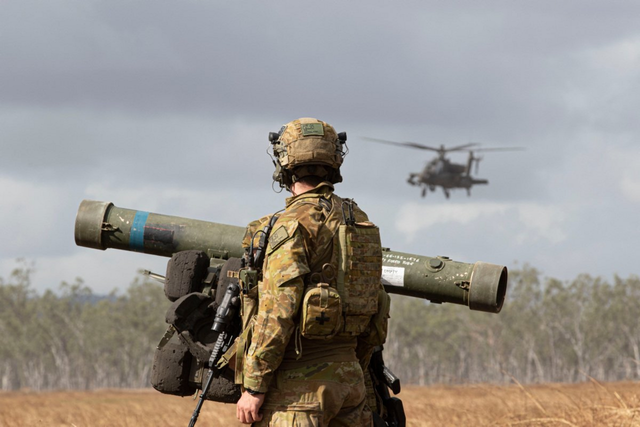
An Australian soldier participating in the Talisman Saber war games last year (Credit: Department of Defence)
As well as intensifying the US-China conflict, the COVID-19 pandemic has triggered a worldwide economic breakdown, thrown the Australian economy into its deepest contraction since the 1930s with government debt spiralling toward $1 trillion.
Yet, while millions of working people are suffering mass unemployment and vast social distress, hundreds of billions of dollars more are to be poured into the armed forces. Morrison boasted of exceeding the government’s previous promise of increasing annual military spending to 2 percent of gross domestic product.
In 2016, the Liberal-National government pledged to spend $195 billion over a decade to buy new warships, submarines, missiles and other weapons systems. Now that has been increased to $270 billion.
Morrison said Australia would remain prepared to join “US-led coalitions” globally, as it did in Afghanistan and Iraq, as provided for in the 2016 defence white paper. But the military’s geographical focus would now be the region ranging from the northeast Indian Ocean, through “maritime and mainland southeast Asia” to the southwest Pacific.
While this shift is couched in defensive terms of holding away “adversaries,” the build-up consists of offensive weaponry acquired from the US designed to help cut off Chinese access to vital shipping lanes through southeast Asia and block Chinese attempts to strike back if attacked by the US.
As a starting point, the Trump administration has already approved the $800 million sale of 200 AGM-158C Long Range Anti-Ship Missiles to Australia. These will be configured to travel up to 370 kilometres but can fly as far as 1,000 kilometres. Deployed on war planes, these missiles could strike targets in the South China Sea or southern China.
An estimated $10 billion-$17 billion is to be spent on fighter aircraft, signalling the possible expansion of the US Joint Strike Fighter acquisition program, and $5 billion for an “expanded long-range air launched strike capability.”
Between $6.2 billion and $9.3 billion will be spent on developing “high-speed long-range strike, including hypersonic weapons,” as well as $400 million-$500 million in joint US-Australian maritime strike missiles, capable of low-level flight. Also being considered are “additional, longer-range weapon systems.”
Between $168 billion and $183 billion will be spent on upgrades to the Navy and Army and $5 billion-$7 billion on “undersea surveillance systems including hi-tech sensors.” Also planned is a $75 billion expansion to maritime forces to “provide greater capability for anti-submarine warfare, sealift, border security, maritime patrol, aerial warfare, area denial and undersea warfare.”
Another $70 billion is to be spent on “increased combat power” for army and land-based forces, drone vehicles and long-range rocket artillery.
Space and cyber warfare is being prepared as well. The plan features “sovereign”-owned military satellites with “ground-based signals intelligence facilities.” Some $7 billion will go toward improving the military’s capabilities in space, and $15 billion will boost “cyber and information warfare” weaponry, $1.3 billion of which will expand the Australian Signals Directorate (ASD) and the Australian Cyber Security Centre.
While also presented as a defensive move to combat cyber attacks, the cyber warfare plan marks a further development of the offensive capacity of the country’s military and intelligence agencies and their US partners to attack targeted countries, such as China, by hacking into or destroying computer-operated facilities.
As far back as 2013, top US intelligence officials announced that Washington was setting up scores of military units to wage offensive cyber war—i.e., to write malicious computer code to disable or destroy computers and computer-controlled infrastructure.
Following suit, the 2016 Australian Defence White Paper announced a 10-year workforce expansion of 1,700 jobs in intelligence and cyber security. This included a 900-person joint cyber unit in the Australian Defence Force, announced in 2017.
The largest component in the latest cyber war package, first unveiled by Morrison yesterday, is $470 million allocated for expanding by 500 the personnel of the ASD. This is the country’s electronic eavesdropping agency, which collaborates closely with the US National Security Agency (NSA) and other members of the global “Five Eyes” spy network.
As the thousands of secret US documents published by NSA whistle-blower Edward Snowden and by Julian Assange via WikiLeaks showed, the Five Eyes partners intercept the communications of millions of people around the globe, exchange data about each others’ citizens, and supply cyber warfare facilities and targeting information to their militaries.
As the ASD’s expansion demonstrates, the drive toward war is being accompanied by preparations to spy on and crack down on political dissent, including anti-war sentiment, and the deepening working class discontent produced by the ruling elite’s exploitation of the COVID-19 crisis to attack jobs and working conditions.
Morrison’s two announcements in two days of major warfare expansions are transparently timed to feed into an escalating anti-China witch hunt, intended to poison public opinion, divert from the social crisis and prepare for potentially catastrophic military conflict.
Only two weeks ago, Morrison claimed that Australia was under attack by a “state-based cyber actor,” an unsubstantiated allegation clearly directed against China. Last Friday, his government authorised police raids on the home and parliamentary office of a state Labor Party MP, Shaoquett Moselmane, who was sensationally branded by the corporate media as a pro-China “foreign agent” and “the enemy within.”
The government has the support of the opposition Labor Party, which is equally committed to the US military alliance and has backed every move over the past two decades to strengthen the powers of the military and intelligence apparatus. In fact, it was the Gillard Labor government that emphatically aligned behind the US “pivot” to militarily confront China in 2011, agreeing to the stationing of US marines in Darwin and greater US access to northern Australian military bases.
At a media conference today, opposition leader Anthony Albanese stated his agreement with Morrison’s announcement, saying it was in line with Labor’s call “for a long time, to prioritise our regional security.”


Coronavirus crisis triggers mass layoffs, wage cuts across Europe

Will Morrow

As the economic crisis triggered by the coronavirus pandemic continues, hundreds of thousands of layoffs are hitting virtually every industry and every country across Europe.
The European ruling class is using the downturn to implement a historic restructuring of class relations. Trade unions are working hand-in-glove with employers to enforce job cuts and slash wages and working conditions.
Among the most severely impacted sectors is the airline and associated manufacturing industries. Yesterday Franco-German airplane manufacturer Airbus announced that it will destroy 15,000 jobs, including 5,100 in Germany, 5,000 in France, 1,700 in Britain, 900 in Spain and the remainder in other sites around the world.
Speaking Monday to the German newspaper Die Welt, Airbus CEO Guillaume Faury stated that the company’s economic activity would be 40 percent below previous predictions for 2020 and 2021. Its activity is not expected to return to 2019 levels until between 2023 and 2025, amid a global collapse in travel.
The trade unions have already made clear that they will not oppose the job cuts. The French trade unions have called only for there to be no “compulsory” redundancies, meaning that they will work with management to ensure that a sufficient number of workers are coerced into leaving. Airbus itself has insisted that it will implement layoffs if not enough workers can be pressured to leave.
Airbus’ main rival Boeing already announced a 10 percent cut in its workforce, destroying 16,000 jobs. Rolls Royce, which makes jet engines, is cutting 9,000 jobs worldwide.
Among the major airlines, Lufthansa in Germany will cut at least 22,000 of its 138,000 jobs. Air France-KLM is destroying 6,000–10,000 positions out of a total of 80,000. British Airways is slashing 14,000 out of 42,000 positions, and Ryanair is cutting 3,000. Scandinavia Airlines announced 5,000 job cuts in April, hitting workers in Sweden, Denmark and Norway. British budget airline Easyjet announced in May that it would cut 30 percent of its workforce, or 4,500 jobs, including one in three of its pilots in the UK. Virgin Atlantic is cutting 3,000 jobs.
Last week, the aviation services company Swissport announced that it would cut 4,556 jobs in the UK and Ireland. It had already laid off 1,500 staff in Belgium on June 9. It employs more than 64,000 people internationally, and told Euronews that it would inevitably be forced to announce more redundancies, without specifying how many. The Danish shipping company DFDS will cut 650 positions in coming months, according to a report published yesterday in Shipping Today.
A June 17 report by Allianz financial advisory firm, titled “The risk of 9 million zombie jobs in Europe,” makes clear that these layoffs are only the beginning. It states that 9 million people across the “big five” European economies—Germany, Britain, France, Italy and Spain—are at increased risk of losing their jobs in the next year with an end to government schemes that have provided companies with a portion of wages for employees throughout the pandemic.
The report states that close to one third of the workforce of these five countries, or 45 million people, is currently dependent upon temporary government wage payment schemes that will come to an end. It predicts that even with these schemes in place, an additional 4.3 million people will lose their jobs next year.
In the auto sector, BMW will cut its global workforce by 6,000, according to a report published June 20 by Belga. The reductions have already been agreed to by the trade union works council. The works council at Daimler sent a letter to employees this month informing them that the 15,000 job cuts already announced by the company would be increased, which the union declared was necessary.
Renault announced 15,000 job cuts in May, equivalent to almost 10 percent of its global workforce of 180,000, including the likely closure of four plants in France. Nissan is planning to lay off another 20,000. In Britain, the oil giant BP announced on June 8 that it would cut 10,000 jobs, most of them by the end of 2020.
In France, decorations and furniture brand Alinéa has been in financial proceedings since May 12 after declaring it was unable to pay its creditors. Dozens of other companies have been placed into receivership, threatening thousands of layoffs, including Celio, La Halle, Spartoo André, Naf Naf and Camaïeu. TUI France, the tourist operator, has announced it will cut 583 jobs, two thirds of its workforce.
The destruction of tens of thousands of jobs is proceeding with the critical assistance of the trade unions. Their role is to smother opposition among workers to the destruction of their jobs, and ensure that the cost of the coronavirus pandemic is borne by the working class, not only in mass deaths but in an assault on their living standards.
At Lufthansa, the trade unions have been the most enthusiastic supporters of a German state bailout involving not only 22,000 job cuts, but cuts to workers’ wages and conditions.
Similar agreements are being enforced across France. This month, the French trade unions led by Workers Force signed an agreement at Derichebourg, which manufactures aeronautics parts for Airbus, agreeing to the cancellation of the so-called 13th month for employees—effectively an 8 percent wage cut—as well as other bonuses, in the name of preventing the closure of the plant, which employs 1,600 people.
In every country, having carried out massive state bailouts of the corporations, the ruling class is using the conditions provided by the pandemic to effect a historic restructuring in class relations.
While collaborating in this offensive, the trade unions aggressively promote nationalism and chauvinism, aiming to divide workers between countries and prevent them from waging a unified struggle.
On Thursday, the CGT rallied with Unsubmissive France (LFI) leader Jean-Luc Melenchon and Raphael Glucksmann—a European parliament deputy who stood with the Socialist Party in the 2019 European elections—outside the Luxfer factory in Gerzat. The factory, which closed in June 2019, previously manufactured bottles of oxygen for medical use. The Luxfer plant has been the focal point of a nationalist campaign stretching from the CGT to the extreme-right Marine Le Pen demanding that the Macron administration purchase the plant in order to prevent France from being dependent upon foreign supplies of oxygen.
Speaking at the rally, Glucksmann declared, “The closure of this site is to condemn Europe to depend on the Turks and the Americans. If you really want this return of offshored production and this industrial sovereignty, start by saving this plant!” Mélenchon added that “the workers of Luxfer are ready to resume their posts and produce oxygen bottles that not only France but the world needs.” LFI has focused its response to the pandemic on demands to restore French economic “independence” and sovereignty.
The purpose of this nationalist demagogy is to hide the real source of the ongoing assault on jobs and conditions—the global crisis of the capitalist system—and to prevent workers from uniting across national borders against it. The trillions handed over to the banks and major corporations are to be extracted through a stepped-up exploitation of the working class and the destruction of social programs.
The response of the working class must be to develop its own international counteroffensive. The struggle must be taken out of the hands of the corrupt nationalist trade unions, which are the tools of corporate management, and placed under the control of independent rank-and-file committees controlled by workers and extending across the continent.
The growing struggle of autoworkers in the US against the return-to-work drive led by the Trump administration shows that there is a powerful objective basis for the development of such an international struggle. It must be connected to a socialist program for the establishment of workers governments and the socialist reorganization of the economy.

Chile: COVID-19 outbreak in mining regions

Mauricio Saavedra

Chilean mineworkers are being forced to bear the brunt of the health, social and economic crisis affecting the country since the outbreak of COVID-19 last March. With 280,000 confirmed infections and 5,688 deaths in Chile, mineworkers in particular face a severe threat of contracting coronavirus as it tears through mining towns and cities since May, as the ultra-right government of billionaire President Sebastian Piñera has refused to close down non-essential industries.
Three mineworkers have died in the giant state-owned mining corporation Codelco, and some 2,528 are infected, according to the Ministry of Mining. Even the corporatist unions, which have bent over backwards to appease the mining consortiums, question the veracity of these figures. The Health Ministry revealed that in the exclusively mining region of Antofagasta there has been an exponential increase in infections in the last two months: from 39 cases at the beginning of April to 8,308 cases on June 27. The rate of infection has similarly soared in other mining regions during the same period: O’Higgins rose from 26 cases to 5,606, Valparaiso from 136 to 11,307 and Tarapacá from 10 cases to 5,893.
Chuquicamata open pit mine outside Calama. (Credit: Diego Delso)
For both native and international capital, which have over-extracted the country’s natural resources and super-exploited labour for over a century, mining constitutes an industry too big to close. With an annual production of some 5.8 million tons, Chile produces about a third of the global supply of copper. The industry as a whole is responsible for between 10 percent and 15 percent of Chile’s GDP. Codelco, the state-owned company, produces 11 percent of the world’s copper and its Chuquicamata mine alone churns out 385,000 tons of the metal, or about six percent.
Major mining consortiums, BHP Billiton, Anglo American, Tech, Glencore, Antofagasta Minerals, along with the state-owned giant, have reaped billions in profits from a workforce that under ordinary conditions numbers up to 240,000 workers, contractors and subcontractors. Another 900,000 workers are dependent on the auxiliary industries for employment.
With the outbreak of the coronavirus in China, the main destination of copper, the price of the metal fell sharply in the first quarter of 2020. Since March over 40 percent of the workforce has been furloughed and 11,700 were laid off as construction projects were shut down. The remaining staff have been forced onto onerous 14-days-on 14-days-off shifts ostensibly as a “social distancing” measure. A fraction is working from home. Yet with a much-diminished workforce, the mining consortiums have extracted more copper ore during this year’s first quarter than in the same period in 2019.
Chile’s discredited former health minister, Jaime Mañalich, before resigning on June 12, attempted to blame the spike in cases on residents’ “untidiness in the measures of social distancing, like clandestine parties, social meetings, that unfortunately have been maintained in this commune, in a very intense form”. But social media has belied these claims with videos of empty streets and of the population practising, to the best of their ability, social distancing measures in overcrowded neighbourhoods.
The reality is that the Health Ministry delayed placing Antofagasta under total quarantine until an explosion in the infection rate and then removed the quarantine to allow the mining industry to continue operating unimpeded. The new health minister then waited another three weeks before re-ordering quarantine measures, after another sharp rise in coronavirus infections.
The present quarantines in the communes of the regional zone of Antofagasta—Antofagasta, Calama, Tocopilla and Mejillones—only apply to the urban radius and excludes mining operations and companies outside the city centres.
One of the primary sources of the outbreak in Antofagasta is the internal transfer of mineworkers, who often come from Santiago or other areas. While air traffic has dropped by 90 percent nationally, the Antofagasta region has the highest number of flights after Santiago. The Calama terminal has now been temporarily closed, but companies like BHP are sending staff to Antofagasta airport where they are provided with chartered buses to their final destination.
Another contributing factor is the viral spread in working class neighbourhoods which lack a regular supply of water. Access to the privatised water system comes in truck cisterns and families are provided with a negligible amount, insufficient to have daily showers let alone regularly wash hands. Another 7,600 families live in overcrowded squatter settlements in the region, also without access to potable water, electricity or sewer systems.
In other words, the mining regions of Antofagasta, Tarapacá, Valparaiso and O’Higgins are recording massive outbreaks of COVID-19 that surpass national averages as a result of the callous indifference to the conditions of the working class and placing profits before lives.
One tracker used to determine the viral spread is the “positive rate” in reference to the share of tests returning a positive result where the lower the number, the wider the testing. The World Health Organisation has recommended a positive rate of between 3–12 percent as a general benchmark of adequate testing. According to the online tracker Our World in Data, Italy has a positive test rate of 0.5 percent, England 1.5 percent, and the US 5.8 percent. Mexico on the other hand, has a rate exceeding 50 percent and Brazil has records that end in April, suggesting that the government of fascistic president Jair Bolsonaro has stopped publishing figures.
Chile has an average positive test rate of 30.9 percent for June 21, indicating that COVID-19 is being severely underreported amid an explosion in cases. The regional breakdown reveals an even more frightening picture. In a study conducted by investigative journal CIPER, the researchers showed that mining regions are registering up to double the national average.
The O’Higgins regional zone recorded a 62.4 percent positive rate; the Valparaíso region recorded 36.5 percent; Tarapacá 32.8 percent. The Antofagasta Region, the heart of the mining industry representing more than half of Chile’s mining output of copper, potassium nitrate, gold, iodine, and lithium, recorded 46.1 percent positive rate.
But even under these catastrophic conditions, the entire Chilean government, with the assistance of the corporatist unions, have refused to shut down the mining cash cow. The working class in the mining industry is supporting the entire state, which in turn has since March provided a myriad of tax and financial incentives to the financial and corporate elite. Total wealth, including liquid, financial and real assets, of the 31 most powerful economic groups reached US$490 billion last year.
Earlier in March, the Copper Mineworkers’ Federation, the CTC made a mealy-mouthed call on the government to close non-essential services. More recently, they said they wanted to “request, as the largest mining organization in Chile, a tripartite dialogue table, which is capable of unifying criteria in terms of health protocols, control measures and prevention to prevent even more mining workers from becoming infected.”
But it was their cynical advice to mineworkers that should be inscribed on the corporatist organisation’s epitaph. The CTC said workers should use the Labor Code to “interrupt or abandon their work because the conditions to protect the life and health of the workers do not exist. To that end, workers who are dismissed in reprisal for having protected their right to life and health may apply to the Labour Inspectorate and the Labour Courts for the appropriate action.”
This throwing the workers to the wolves reveals in the starkest colours the corporatist character of the bankrupt union apparatus. Since the late 1970s and early 1980s, with the developments of globalised production, which not by accident coincided with Chilean dictator Augusto Pinochet’s economic shock measures, the national reformist unions were transformed into instruments that police the workforce and implement the corporate agenda of internationally mobile capital.
These profound economic changes in the capitalist mode of production also transformed the economic nationalist political parties like the Chilean Socialist Party which was groomed in this period for reinsertion back into the capitalist state through the so-called Concertación de Partidos por la Democracia. If the Stalinist Chilean Communist Party was unable to enter into the centre-left coalition that held power for the first 20 years of civilian rule, it wasn’t for the lack of trying.
The executive and the parliament, in the midst of the pandemic, have introduced laws to facilitate the furloughing of labour without having to pay any entitlements under the “Employment Protection Law”. They have put into practise “Electronic Settlements” allowing massive layoffs without the right of workers to make any claims, and suspended Collective Negotiations for the duration of the State of Exception decreed on March 18, 2020 and extended for another 90 days in June.
The working class is paying for this crisis with its lives and livelihoods. It can only put a stop to this carnage by advancing an independent socialist internationalist political perspective. To this end the International Committee of the Fourth International, which publishes the World Socialist Web Site has pledged to assist the working class by providing it the essential tactical, strategic and programmatic direction. This requires above all the building of a section of the Fourth International in Chile. We appeal to workers, students, and all those who recognize the need for the socialist reorganization of the world to secure the future of humanity, to join us in this struggle.

Record 47.2 percent of working-age Americans without jobs

Shannon Jones

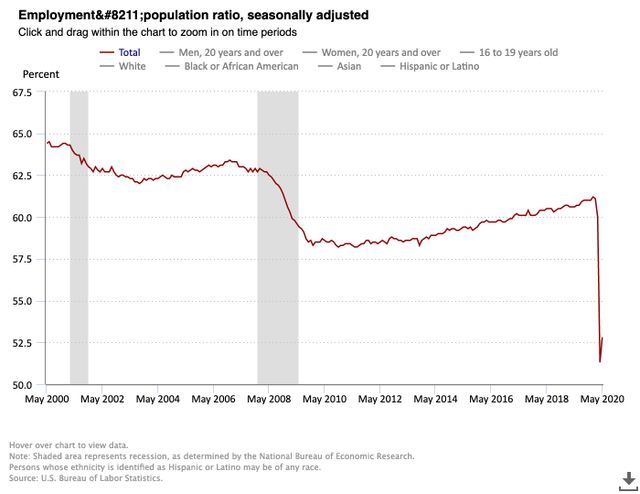
According to newly released Bureau of Labor Statistics (BLS) figures, 47.2 percent of working-age Americans were without work in May, the highest level recorded since the end of World War II.
The numbers are based on the BLS employment-population ratio, which takes the total labor force and divides it by the number of those actually working. It is a more accurate measure of joblessness than the monthly unemployment report, which only counts those actively seeking work.
At the end of May the employment-population ratio stood at 52.8 percent; it stood at 61.2 percent at the start of the year. The employment-population ratio reached a postwar high of nearly 65 percent in 2000.
Citing Torsten Slok, the chief economist at Deutsche Bank, CNBC said it would take the creation of an additional 30 million jobs to bring the employment-population ratio back to January levels.
The report comes ahead of the release of the official jobless statistics for June later this week. They are expected to reflect a marginal decline in the official unemployment rate from 13.3 percent in May to 12.4 percent in June. It is not known if the June figures will correct the previous undercount in the numbers of May and April, when millions of workers were incorrectly classified. This resulted in the official jobless percentages being about 3 percent lower in May and 5 percent lower in June.
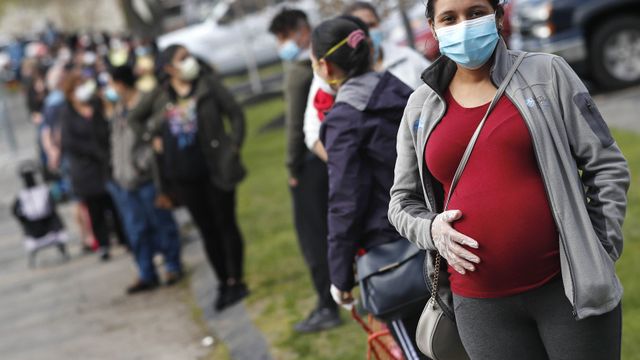
A pregnant woman waits in line for groceries with hundreds during a food pantry, sponsored by Healthy Waltham for those in need due to the COVID-19 virus outbreak, at St. Mary's Church in Waltham, Mass. (AP Photo/Charles Krupa)
The official unemployment rate remains at Great Depression levels in a number of states. Nevada, hard hit by the shutdown of the gaming industry, had an unemployment rate of 25.3 percent in May compared to 4.0 percent one year earlier. Hawaii stood at 22.6 percent in May compared to just 2.7 percent one year earlier while Michigan saw 21.2 percent compared to 4.2 percent in May 2019. In California and Massachusetts, unemployment stood at 16.3 percent in May.
Joblessness was the highest in the leisure and hospitality sector, 35.9 percent, with retail at 15.1 percent, construction 12.7 percent and manufacturing 11.6 percent. Among young people age 16–19, 29.9 percent were unemployed and 23.2 percent of workers age 20–24 had no work.
Despite the reckless early reopening of state economies during the course of June there were around 1.5 million new weekly claims for unemployment benefits. Many workers do not have a job to come back to. This is particularly the case for those employed at small businesses, such as restaurants, which could not survive the shutdown. A further wave of larger bankruptcies are also expected.
The full impact of this economic collapse will hit toward the end of July when the temporary weekly increase of $600 to unemployment benefits enacted in the CARES bill ends. The cutoff, scheduled for the week ending July 25, will slash income by about two-thirds for 20 million workers and will lead to a surge in hunger and evictions.
Personal income dropped 4.2 percent in May, despite the supplemental payments. The cutoff will be particularly devastating for low-wage workers, since regular unemployment benefits cover only perhaps half of weekly pay.
The moratorium on evictions from federally subsidized housing contained in the CARES Act is also set to expire at the end of July, meaning that millions of families could soon confront the possibility of being in the street. According to the latest US Census Bureau Household Pulse Survey, 30 percent of renters had little or no confidence that they could meet housing payments for the next month.
A patchwork of state and local temporary bans on evictions are expiring or are being challenged by landlord associations. A statewide eviction ban was set to expire in Florida on July 1, barring a last second extension by the governor. A statewide ban in Virginia expired June 29. In San Francisco, a citywide ban is being challenged in court. Earlier this month an eviction ban expired in New York City leading to warnings that 50–60,000 eviction cases could soon be filed in housing courts.
Andy Winkler of the Bipartisan Policy Center issued a warning reported in Politico of a “tsunami” of evictions following the expiration of the $600 unemployment supplement.
It is clear that corporations are using the crisis caused by the pandemic to carry out a major restructuring, including the permanent elimination of huge numbers of jobs. According to the International Monetary Fund, the world economy will contract by five percent in 2020 with US GDP down by eight percent. The GDP of Mexico and Europe is expected to decline 10 percent while China will show no growth. The second quarter in the US is expected to show the largest quarterly contraction since the end of WWII.
In an indication of what is to come, Airbus announced 15,000 job cuts worldwide by 2021 as it restructures its operations worldwide, an 11 percent reduction. Ten thousand job losses will be in Germany and France alone.
Graph showing the sharp fall in the employment-population ratio
In recent years, spokesmen for the ruling class have been bitterly complaining that record low unemployment had created “tight labor markets” and demands for rising wages. The destruction of tens of millions of jobs will now be used by corporations as a hammer to demand a new wave of wage and benefit cuts from workers. This has already been seen in the airlines and among public sector workers.
Amidst this devastation the US stock market closed June with one of the best quarterly rises in history. The Dow Jones Industrial Average rose 216 points Tuesday. For the second quarter the Dow Jones rose 16 percent, erasing most of the losses of the first quarter of 2020. Apple, Home Depot, Dow and Microsoft were among those making the strongest gains. The S&P 500 showed a 19.1 percent gain for the quarter while the Nasdaq is up 11 percent for the year.
The rise in the markets comes as COVID-19 cases surge in the United States, with record numbers of new infections, following the lifting of all attempts by federal and state governments to control the virus. The stock rise has not been fueled by an improving real economy but the unlimited infusion of cash by the US Federal Reserve. Like a heroin addict the markets rely on ever-greater injections of liquidity to maintain their inflated levels. Meanwhile, the attacks on workers’ jobs and living standards become ever more ferocious as the corporate oligarchy attempts to claw back the money from the hides of workers.
Workers should not accept that they shoulder the economic burden for the criminal and inept response of the capitalist authorities to the coronavirus pandemic. The massive resources going to the financial markets must be redirected to meeting pressing human needs. Workers made jobless by the spread of the virus and necessary health measures must have their incomes and livelihoods protected. This requires the independent political mobilization of the working class on the basis of a socialist and internationalist program.

Gilead Sciences cashes in on the pandemic

Bryan Dyne

Pharmaceutical giant Gilead Sciences announced Monday that it will charge $3,120 for a five-day course of its coronavirus therapeutic remdesivir for the vast majority of the US population, including those on Medicare and Medicaid. A single vial of remdesivir, containing a tenth of a gram of the drug, will cost $520, a hundred times more expensive than its weight in gold.
This is nothing less than the extortion of the American public amid the COVID-19 pandemic. The price is estimated to be 400 times higher than what the drug needs to be profitable. Gilead is expected to make $1.3 billion from private payers by the end of the year.
Gilead’s announcement sends a clear message: American pharmaceutical companies plan to make billions off the COVID-19 pandemic, which has infected more than 10.5 million people and killed at least 513,000 worldwide. Notably, Wall Street surged 800 points over the past two days on the news.
The revulsion felt toward Gilead in the aftermath of its press release was put most forcefully by AIDS Health Foundation president Michael Weinstein. “Gilead Sciences unmasked itself today as both a war profiteer and greedy bastards—a depressing feat and spectacularly tone-deaf response to a global pandemic that has so far killed over half-a-million people worldwide, including more than 120,000 deaths in the US.”
In an attempt to justify the company’s price-gouging, Gilead chairman and CEO Daniel O’Day released an open letter. Basing himself on data that was preliminary and not statistically significant, O’Day claimed that remdesivir “shortened time to recovery by an average of four days,” which, according to him saves hospitals “approximately $12,000 per patient.”
The company’s executives thus generously “decided to price remdesivir well below this value. To ensure broad and equitable access at a time of urgent global need, we have set a price… which equates to $2,340 per patient.” In O’Day’s opinion, this would allow “all patients [to] have access” to the therapeutic and balance the firm’s “longer-term responsibilities.”
The letter does not spell out what these “longer-term responsibilities” are, but they are not toward coronavirus patients. A report from the Institute for Clinical and Economic Review shows that the raw materials needed to make remdesivir cost only about $10 for a ten-day treatment, and has been priced at $600 by generic producers of the therapeutic in Bangladesh and India, a quarter of the “broad and equitable” cost boasted about by O’Day.
Moreover, while the cost of the therapeutic will be borne by their insurance for many millions in the United States, many millions more depend on the CARES Act funding for coronavirus treatments. They will have few options once that money pool runs dry, especially as even before the pandemic hit, nearly 40 percent of the population was unable to afford an emergency $400 expense, much less one which is six or eight times that amount.
In a rational world, Health and Human Services (HHS) Secretary Alex Azar would have demanded that Gilead end its blatant price gouging immediately. Instead, he hailed the drug as “life-saving” and pledged HHS to buy up to $1.56 billion worth of the drug.
Azar himself has many ties to the pharmaceutical industry. He was the president of the major drug enterprise Eli Lilly and Company before being tapped to be US President Donald Trump’s HHS secretary and was also a director of the lobbying group Biotechnology Innovation Organization. He has been denounced by whistleblower Rick Bright for seeking to downplay the pandemic when it first emerged in China in December and January.
It is also unclear whether remdesivir is actually effective in treating the novel coronavirus. Gilead had tested the efficacy of the remedy against the severe acute respiratory syndrome (SARS) and Middle East respiratory syndrome (MERS) coronaviruses, which led the company to suspect it might work against the pandemic virus, SARS-CoV-2. Doctors in China began treating patients with it in January.
Since then, medical studies on remdesivir’s effectiveness in treating COVID-19 have shown that it does not significantly reduce the death rate for those with the disease. Research by the National Institute of Allergy and Infectious Diseases (NIAID) in March and April concluded that, “given high mortality despite the use of remdesivir, it is clear that treatment with an antiviral drug alone is not likely to be sufficient.” In that context, billions of dollars are being spent to acquire a drug that, by the science available, doesn’t work.
The research did not stop NIAID director Anthony Fauci from declaring, when the preliminary results were released: “The data shows that remdesivir has a clear-cut, significant positive effect in diminishing the time to recovery… We think it is opening the door to the fact that we now have the capability of treating [the coronavirus].”
Fauci’s support helped drive Gilead’s stocks to new heights. Since the beginning of the year, the company’s market capitalization has increased by $20.1 billion to $96.5 billion, largely by promoting remdesivir as an effective treatment for the pandemic. This mirrors the fortunes of drugmaker Moderna, which has grown by more than 200 percent to a net worth of nearly $25 billion after proclaiming work on its own vaccine.
Moderna board member Moncef Slaoui, tapped by Trump to head the government’s “warp speed” vaccine development drive, became $2.4 million richer as a result of the media frenzy surrounding the announcement that Moderna had made progress toward a vaccine.
Beyond pumping up the share prices of the pharmaceutical giants, the media has promoted remdesevir and Moderna’s vaccine as “miracle drugs” to promote the campaign to get workers back on the job in factories and workplaces that have been hotbeds of COVID-19.
Wall Street sees the pandemic as a potential profit bonanza. The big banks and major corporations have received at least $6 trillion since March in bailouts and are going to make billions more holding the American and world population hostage by overcharging for potentially lifesaving coronavirus treatments.
Gilead is only one example of the lawlessness of corporate enterprises in the United States. The recent past has seen the poisoning of Flint, two Boeing 737 Max crashes, the opioid epidemic and the California wildfires caused by PG&E. No executive has ever gone to jail for these crimes. As Barack Obama’s attorney general told Congress in 2013, these modern-day robber barons are “too big to jail.”
The disastrous response of American capitalism to the COVID-19 pandemic makes clear the need to put an end to capitalism and the subjugation of human health to private profit. This means mobilizing the entire working class to expropriate the pharmaceutical giants and every major industry and transform these monopolies into publicly-owned and democratically-controlled utilities. The dictatorship of corporate interests over the working class must be abolished and economic life must be placed in the hands of the workers themselves.

30 Jun 2020

The Crisis Of Neoliberalism In Honduras

Yanis Iqbal

As the Covid-19 pandemic rages in Honduras, the healthcare infrastructure is increasingly coming under stress. Due to decades of privatization in the health sector, the role of the Ministry of Health and the Honduran Institute of Social Security (IHSS) has drastically diminished. Almost 9 out of 10 people in Honduras are not covered by any type of health insurance and 1.5 million Hondurans (18% of the population of 9.9 million people) don’t have access to health services.
Moreover, there are only 6,590 beds in the entire country, translating into 9.5 hospital beds per 10,000 citizens (compared to Cuba’s 59 beds per 10,000 inhabitants). The healthcare expenditure as a percentage of GDP is a measly 7.83%, lower than the average of 14% in the Americas. With an extremely weak public health edifice, Honduras is finding it difficult to cope with the Covid-19 pandemic and in April 2020, doctors and social workers announced “their withdrawal from the hospitals if the biosecurity equipment and resources necessary to avoid further contamination by the virus are not provided.”
The government has chosen to ignore these demands of health workers, leading to Honduran health workers protesting, with the support of Honduran Medical Association (CMH) and IHSS, for the provisioning of biosafety equipments.
The roots of present-day administrative malfunctioning can be located in the 28 June 2009 Honduran coup in which the left-leaning president Jose Manuel Zelaya Rosales was deposed. Under the presidency of Manuel Zelaya, Honduras had joined Petrocaribe, founded by Hugo Chavez in 2005 and the Bolivarian Alliance for the Peoples of Our America (ALBA), founded by Venezuela and Cuba in 2004. Furthermore, Manuel Zelaya also increased the monthly rural and urban minimum wages to $213 and $290, respectively, representing a 50% rise.
In April 2009, a constitutional convention or constituyente was called to replace the 1982 constitution, drafted under the guardianship of USA. The creation of this constituyente was sought to be done through the Cuarta Urna or fourth ballot box on June 28, 2009. In this nonbinding poll, voters were to be asked whether the upcoming presidential election should include the election of delegates to a constitutional convention. The Cuarta Urna project was enthusiastically supported by Bloque Popular (Popular Bloc), a grass-roots organization which later fused with Coordinadora Nacional de Resistencia Popular (Popular Resistance National Coordinating Committee) to give birth to the anti-coup National Front of Popular Resistance (FNRP).
Manuel Zelaya was progressively transgressing the politico-economic limits defined by the Honduran oligarchy and had to be overthrown. On 28 June 2009, President Manuel Zelaya was flown by the Honduran military to Costa Rica at gunpoint and in pajamas. This “pajama-clad expatriation” was tacitly supported by the US government and on the day of the coup, Barack Obama merely asked Honduran people to “respect democratic norms, the rule of law and the tenets of the Inter-American Democratic Charter” and resolve disputes “through dialogue free from any outside interference.”
highfalutin and pompous statements made by him during the “To Learn From History, Not Be Trapped by It,” speech: “I am here to launch a new chapter of engagement that will be sustained throughout my administration.” Obama’s new chapter of engagement was probably one where coup-plotters were authorized under the aegis of United States to arbitrarily subvert any government.
After the coup, a temporary government of Roberto Micheletti, the President of Congress, was cobbled up. Micheletti’s basic function was to violently discipline the rebellious Honduran population into peacefully voting in the post-coup election and shift the ideological plane from “coup” to “elections”. This objective of suppressing anti-golpista dissent was done through a violent process of militarization which involved, inter alia, the imposition of curfew, declaration of a state of siege and an unwarranted attack on social activists and organizations.
According to the Inter-American Commission on Human Rights (IACHR), the Micheletti period included “deaths, an arbitrary declaration of a state of emergency, suppression of public demonstrations through disproportionate use of force, criminalization of public protest, arbitrary detentions of thousands of persons, cruel, inhuman and degrading treatment and grossly inadequate conditions of detention, militarization of Honduran territory, a surge in incidents of racial discrimination, violations of women’s rights, serious and arbitrary restrictions on the right to freedom of expression, and grave violations of political rights.”
When a thorough state-sponsored tactic of terrorization was completed, general elections were held in which, through a witch-hunt against anti-coup voices, a right-wing candidate named Porfirio Lobo Sosa was elected. This illegitimate election result was eagerly embraced by the US State Department which issued a statement implicitly awarding plaudits on coup-plotters for efficiently eliminating opposition and holding bogus elections: “We commend the Honduran people for peacefully exercising their democratic right to select their leaders in an electoral process that began over a year ago, well before the June 28 coup d’etat.”
Hilary Clinton also played her role by relegating the patent occurrence of coup and instead prattling about elections: “We strategized on a plan to restore order in Honduras and ensure that free and fair elections could be held quickly and legitimately, which would render the question of Zelaya moot and give the Honduran people a chance to choose their own future.” It was the Assistant Secretary of State Thomas Shannon who wrote to Hilary Clinton, advising her how to handle the delicate Honduran situation: “As we think about what to say, I would strongly recommend that we not be shy. We should congratulate the Honduran people, we should connect today’s vote to the deep democratic vocation of the Honduran people, and we should call on the community of democratic nations (and especially those of the Americas) to recognize, respect, and respond to this accomplishment of the Honduran people.”
During Porfirio Lobo’s presidency, human rights abuses worsened and militarization increased. According to Human Rights Watch, “Honduras failed in 2011 to hold accountable those responsible for human rights violations under the de facto government that took power after the 2009 military coup.” As per the 2011 Annual Report produced by Amnesty International on the human rights conditions in Honduras, under the Porfirio administration “Freedom of expression came under attack. Little progress was made in repairing the damage to human rights protection and the rule of law that followed the 2009 coup. Impunity for human rights violations by military and police officers persisted. Human rights defenders were subject to intimidation.”
Judicial independence too was compromised through the politically-motivated expulsion of “four judges – Tirza del Carmen Flores Lanza, Ramón Enrique Barrios, Luis Alonso Chévez de la Rocha, Guillermo López Lone – and Public Attorney Osmán Fajardo Morel” for their involvement in anti-coup demonstrations. Militarization took place through the deployment of soldiers in the two largest cities of Honduras – Tegucigalpa and San Pedro Sula. USA funded this militarization through its military and security aid which increased by 50% from 2010-12. The funding for the Central American Regional Security Initiative (CARSI) too enlarged by 33% and an additional $45 million was also allotted for the expansion of Soto Cano Air Base and the establishment of 3 new US bases. In 2011, the US Department had spent $67.4 million on military contracts in Honduras, $89 million on the Soto Cano Air Base and exported military electronics to Honduras worth allegedly $1.3 billion.
In 2012, $26 million was funneled to Honduras through a program called “Honduras Convive”, designed by the Office of Transition Initiatives (OTI), a unit of USAID whose “activities are overtly political, based on the idea that in the midst of political crisis and instability abroad there are local agents of change whose efforts, when supported by timely and creative U.S. assistance, can tip the balance toward peaceful and democratic outcomes that advance U.S. foreign policy objectives.”
While this militarization of Honduras was happening, Porfirio Lobo was stealthily advancing his neoliberal agenda. He proposed a “Model Cities project” in which Zones of Employment and Economic Development (ZEDEs) would be created. These zones would be indemnified from the application of any law and could unrestrictedly exploit workers and sign treaties with transnational corporations. This law was initially rejected by the Supreme Court because it simply threw out the constitution from the proposed zones. Later, a “technical coup” took place wherein Juan Orlando Hernandez, at that time the president of the Congress, deposed four out of five members of the Sala constitucional (Constitutional Chamber). Oscar Chinchilla, the fifth justice, was left untouched because he was faithful to Orlando Hernandez.
After this illegal manoeuvre, four new justices were appointed. The Model Cities Law, which had been earlier rejected, was now passed by the Supreme Court. Along with the creation of economic exploitation zones, the government of Porfirio Lobo also held a business exhibition called “Honduras is Open for Business” in which Carlos Slim, at that time the richest man in the world, was also present. The aim of the business conference was to ‘relaunch Honduras as the most attractive investment destination in Latin America’.
In 2013, general elections were held in which the Liberty and Refoundation Party (LIBRE), headed by Xiomara Castro (wife of Manuel Zelaya), would also be participating. These elections presented the ruling National Party with enormous challenge because it was the first time that anti-coup forces were electorally participating in Honduran politics. To avoid LIBRE from winning, the National Party used a variety of tactics such as vote buying, selling election table credentials, violence and voter intimidation. According to the Report of the National Lawyers Guild Delegation to the November 2013 Election in Honduras, the November 2013 elections included “the purchase of MER credentials by the National Party, irregularities in the recording and transmission of actas [vote tallies], the distribution of discount cards to National Party voters, and irregularities with voting registration rolls which resulted in the inclusion of ineligible voters and the exclusion of eligible voters.”
During the election campaign, 18 LIBRE candidates and their family members were murdered and 15 were subjected to armed attacks. As said by Jenny O’Connor,  the “LIBRE party (Libertad y Refundacion Party) pre-candidates, candidates, their families and campaign leaders have suffered more killings and armed attacks than all other political parties combined. The disproportionate number of killings of LIBRE candidates seems a clear indication that many of the killings have been politically motivated.”
Despite the occurrence of serious irregularities and blatant violence, the US Ambassador to Honduras Lisa Kubiske said that “In general it has been a transparent process, beginning with the representation of the persons at the electoral tables, later the public scrutiny, the representation of all the parties in the computer center.” The Secretary of State John Kerry also legitimized the fraudulent electoral process through his unaccountably fulsome praise of the Honduran government: “The Honduran people turned out in record numbers to vote on November 24, and we commend the Honduran Government for ensuring that the election process was generally transparent, peaceful, and reflected the will of the Honduran people.”
Through an election process covered with blood and gore, Juan Orlando Hernandez (JOH) emerged as the president, supposedly receiving 36.89% of the total votes. With the election of JOH to power, the militarization of Honduras accelerated and slowly, JOH’s authoritarian election slogan “a soldier on every corner” was being materialized. In 2013, JOH established a police unit called Intelligence Troop and Special Security Response Groups (TIGRES) whose ostensible function was to “protect the security of the population and their belongings”.
This elite military-police squad is financed by the Inter-American Development Bank and uses the opaque security slush fund created through the 3% security tax on all financial operations to carry out its operations. TIGRES is trained by the “U.S. Army’s 7th Special Forces Group (Airborne) and members of the Comandos Jungla, an elite force of the Colombian police” and is also funded by the US Department of State through the International Narcotics and Law Enforcement Affairs (INL). Apart from TIGRES, 17 additional security force units also receive US military aid.
To carry out the crucial process of militarization, JOH inserted a provision in paragraph 5, Article 7, of Decree 168 through the Decree 286 of 2013. According to the provision, “the military police shall also have all those functions and actions that may be ordered by the President of the Republic”. Furthermore, Article 4 of Decree 168 of 2013 nebulously states that the military police will receive “the training necessary for dealing with the public.” Through constitutional changes, unabated militarization was unleashed. As a natural corollary of militarization, human rights abuses greatly increased and according to the 2014 Country Reports on Human Rights Practices, Honduras was suffering from “serious human rights problems”. These included “violence against detainees; lengthy pretrial detentions and failure to provide due process of law; threats against journalists;” and “encroachment on indigenous lands and discrimination against indigenous and Afro-descendent communities;”.
Militarizing Honduras directly facilitated the proliferation of narco-operations in which JOH and his brother were involved. According to US prosecutors, JOH had collaborated with a drug-trafficker named Geovanny Daniel Fuentes Ramírez in 2013 and “took $25,000 in exchange for protecting the trafficker from law enforcement.” Apart from working with Fuentes Ramirez, JOH had also personally received a $1 million bribe from drug lord El Chapo to subvert the 2013 Honduran elections.  Juan Antonio Tony Hernandez, JOH’s brother, was also convicted by the US District Court for trafficking 200,000 kilograms of cocaine, together with machine guns.
US attorney Geoffrey Berman said that “Former Honduran congressman Tony Hernandez was involved in all stages of the trafficking through Honduras of multi-ton loads of cocaine that were destined for the U.S. Hernandez bribed law enforcement officials to protect drug shipments, solicited large bribes from major drug traffickers, and arranged machine gun-toting security for cocaine shipments.” In addition, Tony Hernandez “funneled millions of dollars of drug proceeds to National Party campaigns to impact Honduran presidential elections in 2009, 2013, and 2017.”
Other than being a narco-trafficker, JOH is also a corrupt politician responsible for a “multimillion-dollar embezzlement of social security funds”. In this massive fraud, $350 million was stolen from IHSS, the governmental social security institute catering to more than 700,000 beneficiaries of the social security regime and roughly 900,000 beneficiaries of the health regime. The IHSS scam included “overpaying almost $400,000 for 10 ambulances and buying overpriced medicines which were then repeatedly stolen and resold to the IHSS.” JOH admitted that $150,000 of the IHSS money was spent on his election campaign.
In 2017 Honduran national elections, the 2013 spectacle of outright fraud was repeated. The overly illicit and absurd scene during the elections was pithily described by a report produced by NACLA: “National Party activists are buying voting table credentials from other parties to ensure access to tally sheets; the polls are closing early; votes are being bought outright.” According to the 2017 “Report of the United Nations High Commissioner for Human Rights”, the election was marred by “the issuing of blank credentials to parties and the related buying of votes; the lack of independence of the Supreme Electoral Tribunal; the lack of transparency and unreliability of the system of electronic transmission and counting of votes; and, further to the adoption, in 2017, of the Law on financing, transparency and accountability of political parties and candidates, the non-functioning of the mechanisms established by that law.”
Due to all these procedural irregularities, Organization of American States Secretary General Luis Almagro was compelled to say it was “impossible to determine the winner with the necessary certainty”. In the post-election period, JOH’s government dictatorially cracked down on protests, leaving 31 dead. Before this violent crackdown, the British government had sold spy equipments to Honduras worth $370,154. These equipments include “sophisticated spy technology which can be used to intercept, monitor and track emails, mobile phones, and online messaging services such as WhatsApp”.
Even during the Covid-19 pandemic, the government of JOH is persecuting human rights defenders and during the first few weeks of the pandemic 45 human rights defenders suffered attacks or harassment and 7 journalists were detained or assaulted. Between March and April, more than 6,000 people have been detained for protesting over layoffs and scarcity of food. All this has been made possible by the declaration of a state of sanitary emergency and curtailment of basic constitutional rights such as freedom of expression, association and assembly. According to the International Forum for Human Rights in Honduras, “the health emergency, coupled with a precarious health system, weak institutions, the shortage and privatization of water resources, and serious problems of corruption, militarization and exploitation of natural resources will deepen the risks faced by the Honduran people.” The need of the present is to wage an effective socialist offensive against the right-wing JOH administration and reclaim Honduras from US imperialism and the domestic oligarchy.