1 Jul 2020

Is Bolsonaro Plotting a Self-Coup?

Raphael Tsavkko Garcia

The Bolsonaro government’s recent decision to stop releasing data on the COVID-19 pandemic as the death toll surges above 40,000 has caused an international uproar and deepened domestic discontent. A DataPoder360 survey, published on June 11 showed that the sum of those who see the administration of Jair Bolsonaro as “regular” (22%) or “bad or awful” (47%) have become the large majority.
Bolsonaro has isolated himself internationally and even his main ally, U.S. President Donald Trump, has criticized the way in which he has dealt with the pandemic – not without first sending two million doses of Hydroxychloroquine, a treatment that the global far right has promoted as a miracle cure for the disease despite the lack of a medical consensus. With approval ratings in free fall, but still maintaining a base of about 30% of Brazilians, the Brazilian president has increasingly moved to the far right.
As his popularity wanes, Bolsonaro relies more and more on the support of ultraright groups and social media activists. Several of the most prominent among them are being investigated by Congress and the Supreme Court for spreading fake news and hate speech and attacking institutions. They advocate for violent repression of left-wing activists and count among their ranks growing fascist and neo-Nazi activists and groups. Some have openly called for a military coup d’état and a regimen of violent repression of Brazil’s black and indigenous populations.
“In these past two years we have seen a gradual erosion of Bolsonaro’s support base,” says David Magalhães, International Relations professor at the Pontifical Catholic University of São Paulo. “When he was elected in 2018 he had the support of various groups within the Brazilian right wing, the anti-middle class vote, the vote of those who seemed to have an allergy to politicians, but opted for Bolsonaro in the wake of the Lava Jato [Car Wash] operation, the ‘liberals,’ etc. The majority of this electorate moved away from Bolsonaro for a number of reasons, leaving a hard, ideological and increasingly fanatical core,” he says.
“It’s a naturally radical core, that flirts with the US alt-right, Viktor Órban’s religious nationalism, and Polish reactionaryism. The more harassed, the more violent and fascist this group reveals itself to be”.
Commenting on the radicalization of the right, philosopher and professor of the Lutheran University of Brazil (ULBRA), Moysés Pinto Neto, says that “it is difficult to know whether we are facing an escalation or the aggressive retreat of a cornered animal”.
Neto adds that “the government is weak, and weakness doesn’t mean no risk. Sometimes fascist regimes are consolidated by the inability of their opponents to organize, taking advantage of the fragmentation in their favour and governing in an authoritarian manner without a majority. Once it takes hold, the return is complicated and difficult.”
The far-right groups in Bolsonaro’s core bases are small, but they wield an outsized influence on a government that has espoused its affinity to their toxic blend of racism, misogyny and militarism.
Among the president’s support groups is the “300 do Brasil” (or 300 of Brazil, a reference to 2006 movie “300” which tells the story of the Battle of Thermopylae in 480 BC when 300 Spartan warriors commanded by King Leonidas face the army of the Persian King Xerxes I. Its followers encourage the use of violence. Some have been camped out in front of the Supreme Court in Brasília, occasionally threatening ministers of the court and implying they will invade the building. The Court has delivered some setbacks to Bolsonaro`s agenda, thus earning the enmity of his supporters.
300 do Brasil doesn’t even come close to 300. The group has only one or two dozen members, however, they are very vocal and form part of a larger pro-Bolsonaro militant block that includes a network of bloggers and fake news websites. Former members have revealed that there is a so-called Office of Hate, the nucleus of the government’s propaganda machine, headed by Carlos Bolsonaro, one of the president’s sons.
The “300 do Brasil” is led by former founder of the Brazilian chapter of the Ukrainian feminist group FEMEN turned-anti-feminist Christian, Sara Winter, who has a history of neo-Nazi militancy and an iron cross tattooed on her chest. Winter, whose real name is Sara Fernanda Giromini, adopted the false name of Nazi supporter and leader of the British Union of Fascists, Sarah Winter née Domville-Taylor – although publicly she claims the eponym is coincidence.
On May 31 she and her supporters marched through the streets of Brasilia with torches and masks to protest Supreme Court Judge Alexander de Moraes’ decision tinvestigate her for making threats against the court and for forming a private militia. Far-right guru, Olavo de Carvalho, who lives in the United State, has also recorded a video in which he asks for the death penalty for Moraes.
 “I believe that the increase in violence on the part of the far-right, including through the action of police forces, is due to the perception of the increase in their vulnerability. In other words, it is a reaction to the change in the political climate to its disadvantage,” explains political scientist and Coordinator of the Professional Master in Management and Public Policies at Getúlio Vargas Foundation (FGV), Claudio Couto.
He adds, “It is good to remember that violence, both symbolic and real, is a distinctive feature of the far-right; they cultivate violence and practice it whenever possible, so such actions are, to a large extent, an expected outcome of its political orientation.”
Bolsonaro has been politically isolated, particularly after the resignation of his former Minister of Justice, Sérgio Moro on April 24, who brought with him an important political base for the president. Bolsonaro’s policies to deny the seriousness of the coronavirus pandemic, catapulting Brazil to the top of the list of fatality rates, has also cost him significant support.
The president also faces backlashes due to investigations against family members and political allies for participation in fake news networks. Bolsonaro supporters have also been named in investigations into the March 2018 assassination of councilwoman Marielle Franco and involvement with militias in Rio de Janeiro. The president’s authoritarian tone, echoed by many of his supporters, has eroded his base among sectors that previously supported his presidency.
In April, far-right blogger Allan dos Santos, investigated by the National Congress’ recently formed Joint Parliamentary Committee of Inquiry on the spreading of Fake News, tweeted to his followers to create applications and locate “those who celebrate and promote communism” to “hunt these people down” and “lynch them on social media”.
Recent statements have indicated the possibility of a self-coup. The president himself was caught on video advocating handing over weapons to the population, saying that “It is easy to impose dictatorship in Brazil. That’s why I want the people to arm themselves.”
In the past months, Bolsonaro endorsed and directly participated in  several demonstrations in Brasilia that demanded shutting down the national congress (where Bolsonaro has difficulty forming a majority) and imposing a military dictatorship. “It’s more than your right — it’s your obligation to fight for your country,” Bolsonaro said to a crowd of pro-coup demonstrators against local lockdown measures on April 19. “We don’t want to negotiate anything. We want action for Brazil.”
The president and protestors oppose social isolation measures during the Covid-19 pandemic, challenging governors’ decisions to impose measures to restrict movement. Demonstrations against social isolation have taken place throughout the country, gathering between hundreds and thousands of people.
Targeting the Left
For the first time in many months, left-wing movements have organized to take to the streets in protest against Bolsonaro. On Sunday, May 31, antifascist members from football fan clubs protested on Paulista Avenue in São Paulo where they confronted right-wing forces, among them Neo-Nazis who had gathered to support Bolsonaro – as they do every weekend.
The Military Police attacked the anti-fascists with bombs and rubber bullets while ignoring the right-wing demonstrators. At least 6 anti-fascist activists were arrested.
Soon after, lawmaker and Bolsonaro supporter, Douglas Garcia (PSL-SP) asked his followers on social media to send him names, photos and any data of anti-fascist activists, whom he called criminals,  although there is no legislation criminalizing the act or practice of opposing fascism in Brazil.
At first activists, took Garcia’s initiative as a joke. Some organized a campaign to send photos of former soccer player Vampeta, naked, to the congressmen. But he wasn’t kidding. Days later he released  a 999-page list with names, addresses, phone numbers and social security numbers (among other sensitive data) of thousands of anti-fascists. The compiled list is being shared in WhatsApp groups and puts thousands of people at risk.
Lawmaker Garcia is being investigated by the Supreme Court for involvement in a fake news network. He says, however, that the investigation is a way to “silence the voice of the conservatives.” On May 27, Federal Police entered Garcia’s office to collect documents linking his chief of staff, Edson Salomão, to the fake news network. The São Paulo Public Ministry is looking into whether Garcia “used the structure of his office to promote hate demonstrations on the Internet against political opponents,”, and collect signatures for the creation of a new far-right political party, Alliance for Brazil, which Jair Bolsonaro would lead, reported the newspaper O Globo.
Bolsonaro currently does not belong to a party, having cut ties with the Social Liberal Party (PSL), which elected him. The PSL is divided between two blocs, one that supports him and another that has passed to the opposition.
The fake news networks near the president have also been persecuting journalists, with the promotion of doxxing (disclosing data about people and their families to intimidate them), using bots and virtual militancy to harass with accusations and threats and promoting attacks on journalists who cover acts and speeches of the president.
On June 2, a Twitter account linked to the far-right leaked personal data on Gabriela Biló, a reporter for the newspaper O Estado de São Paulo.In February, journalist Vera Magalhães, of the same newspaper, suffered a similar attack.
In response to Garcia’s  list, the Activist Bench – a group of 9 legislators members of the Socialism and Freedom Party (PSOL) – will ask for Garcia’s impeachment on the grounds of breaking congressional decorum. Several prominent human rights lawyers have offered their services to those who have had their data disclosed, as public outrage mounts.
However, Brazilian laws provide little guidance on the relatively new phenomenon of orchestrating social media attacks. “At a glance, the lawmaker has committed no felonies,” explains criminal lawyer and professor at the Center for Law and Business Studies, Marcelo Sarsur. “If he compiled public data, readily available on social media profiles, his action can be summarized as misguided, but not necessarily criminal.”
“Any misuse of public funds in order to compile this list might be scrutinized by internal investigations in the São Paulo State Assembly, or by the Public Prosecutor’s Office. However, the possibility of sanctions is slim.”
On the other hand, Sarsur notes that “calling oneself ‘antifa’ or joining ‘antifa’ discussion groups cannot be considered a felony, either for “belonging to a criminal enterprise” (Article 288 of the Brazilian Criminal Code) or “belonging to a terrorist organization” (Article 3, Federal Statute 13.260/2016 – Antiterrorism Bill). Should the lawmaker deliver the so-called ‘Antifa list’ to Federal authorities, or even to foreign embassies, no legal action can be taken against the people whose data were exposed.
He adds, “However, it is troubling that, 70 years after the McCarthyist movement in the US, someone could invoke the idea of a ‘subversives’ list’ as something brand new, or in the public interest.”
Sarsur notes that the people on the list could launch civil actions due to the unlawful public exposure of personal data. There are reports that people exposed on the list have been fired from their jobs. The list includes places frequented by left-wing activists, such as bars, bookstores, shops and public squares in several cities and  amateur football, potentially targeting these places for attacks.
Garcia tweeted that he handed the list over to the federal police and members of his party in several states. After the list was published, however, went on Twitter again to say he wasn’t responsible for the dossier, accusing the left of being liars, criminals and terrorists, and threatening to sue everyone who accused him of leaking the list he compiled. The list began circulating the day after the lawmaker showed a series of pages claiming to be a list of names of anti-fascists. He also recorded a blurry video showing images from the dossier.
Citizen engagement fellow at the World Bank and PhD in sociology Eduardo Caducos, and  technologist Lucas Lago created a tool to help people find out if their name is on the list without disclosing sensitive data Sharing the list is discouraged for obvious reasons, so although it was released online, lawyers and activists seek to avoid more widespread, data leakage that contributes to the persecution of activists and journalists. Since day one of Bolsonaro’s government, journalists have been threatened and n cases of physical assault have been reported.
On June 1, Federal Congressman Daniel Silveira (PSL-RJ), also a military policeman, proposed to change the Anti-Terrorism Law passed by then-President Dilma Rousseff to include anti-fascist groups, or Antifas, as terrorists. The proposal echoes U.S. President Donald Trump’s tweet the day before.  If passed, Silveira’s legislation would criminalize any activist who protested against the government and opposed fascism, leading to heavy prison sentences.
Both Neto and Couto expect the situation to get worse.
“Bolsonarism is an extremist movement and, as such, is nourished by conflict and the escalation of conflict, so keeping the conflict burning and stirring it up is inherent in its nature,” says Couto. “The government has passed the point of no return in its conflagration with other political actors, its retreats from now on, if they occur, will only be tactical, and of very short duration. The tendency is for this government to force the rupture and, to this end, mobilize the forces that support it.”
Before writing this article, I found out that I am on the list of anti-fascists – including my name, social security number, date of birth and e-mail address. As I currently live outside Brazil, I am safer than fellow journalists and activists who could be the target of violence in Brazil.
Nevertheless, it’s still worrying to see the long reach of the hate machine linked to President Jair Bolsonaro.
As Brazil’s president confronts serious difficulties in forming a new party and maintaining his electoral base, and his family and closest allies face numerous investigations that could very well wind back to him, he depends on the ultraright factions that unconditionally support him.
The philosophy professor, Neto, explains, “[Bolsonaro] will risk everything, because he is an impetuous and aggressive individual–and he has nothing to lose.”

The Pandemic and Wealth Inequality

Rick Baum

The latest figures from the Federal Reserve Board on wealth inequality cover through the quarter ending in March 2020. They show a reduction in wealth inequality—something that has happened during economic downturns.
More importantly, according to the Fed, wealth inequality has generally been increasing since the first covered period, the third quarter of 1989 to when it reached its highest level in the fourth quarter of 2019 during the Trump regime.
The dramatic change is highlighted in the two tables below. They show the Fed figures for both the percentage and dollar amounts of all household wealth held by each group. The figures in between are from the start of the Trump regime to the highest point of wealth inequality. Most of the increase in the share of wealth since 1989 went to those in the top 1% while the poorest 50% experienced a dramatic decline.

[*From the fourth quarter of 2019 to the first quarter of 2020, total wealth declined from $110.75 trillion to $104.3 trillion.
There was a significant decline in the share of the 1% during the great recession. It went from its then highest point of 29.7% during the third and fourth quarters declining to 25.8% in the first quarter of 2009. That high point was not reached again until the first quarter of 2013 when it came in at 30%. From then on, the share of the wealthiest 1% generally continued an upward trend during Obama’s presidency reaching 31.6% in the fourth quarter of 2016.
The recent decline in the share of wealth held by the wealthiest 1% occurring in the first quarter of 2020 is likely to have been reversed during the second quarter. There has been an upward spike in the stock market, presumably, largely brought on by the federal bailout money and actions of the Federal Reserve including lowering interest rates. From its low point during the first quarter in 2020, the NASDAQ index, as of June 26, is up over 42% and the Dow up almost 34%.
The stock market increase is especially favorable to the wealthiest. According to the Federal Reserve figures, since 2013, the wealthiest 1% have held over 50% of all corporate equities and mutual funds.
The increase in stock prices must be especially pleasing to many, if not all, of the wealthiest among the top 1%. For the year, as of June 26, the stock price of Microsoft has gone from $161 to $196 assumedly adding to the happiness of Bill Gates; and our wealthiest human, Jeff Bezos, has had the good fortune to see his Amazon stock go from $1,898 to $2,692. Tesla has outdone them all, more than doubling from $430 to $960, enhancing Elon Musk’s fortune.
The recent rise in the stock market is certainly not something that can be counted on to last, especially given the recent spikes in Covid-19 infections. It, along with threats to humanity that include the ongoing damage to the environment, the ever-present threat of nuclear war, the possible continuation of depression era levels of unemployment, and the never-ending chaos of the Trump regime may quickly prompt a decline in the stock market.
Wealth by Race and Ethnicity
Figures from another Federal Reserve Table covers household “wealth by race” for whites, Blacks and those labeled Hispanic. Not shown here is the fourth category “other.”

*The holding of wealth is not solely a function of one’s race or ethnicity. Poverty rates among Blacks and Hispanics are roughly twice the rate of poverty among whites. However, despite a much lower rate of poverty, most poor people are white. And women experience a higher rate than men.

*The tables do not appear to take into account the changing size of the population of each group. The relative size of the white population has been declining while the size of the Hispanic population has grown significantly increasing from 9% of the total U.S. population in 1990 to 16.3% as of 2010.
Critical are the dollar amounts. From the third quarter of 1989 to the first quarter of 2020, Black wealth increased almost 600% and Hispanic wealth over 800%, both more rapidly than the increase in white wealth of slightly over 475%.
However, more important is the increase in the dollar wealth gap. In the third quarter of 1989, Whites held $17.3 trillion more than the combined wealth of Blacks and Hispanics. By the fourth quarter of 2020, the gap between them came to $86.37 trillion, an increase of almost 500%. If wealth is the sole factor that determines power, those with power, especially the ones mostly in the wealthiest .01% who are predominantly white, have become that much more powerful.
Another Federal Reserve Board study, Updating the Racial Wealth Gap, covers the continuous wide gap in the average wealth of whites compared to that of Blacks and Hispanics. From Page 2,
“The wealth of white families is considerably greater than that of black or Hispanic families, and the gulf that separates them appears to have changed little over most of the last three decades. The distance between the net worth of white and non-white families – referred to as the “wealth gap” – increased sharply following the Great Recession,[when Obama was president] as non-white families experienced proportionally larger losses in net worth, and then declined modestly between 2013 and 2016.”
From 1989 until 2016, the average net worth of white families has ranged from being 4.6 to 7.2 times greater than the average wealth of Black families and from 3.6 to 6.1 times greater than the average wealth of Hispanic families.
Below is a table in this study titled “Assets, Debt, and Net Worth by Race” that covers average family worth in 2016 dollars. Unfortunately, this study goes through 2016 so there are not figures covering the impact of the leadership of a person who has characterized himself as “a stable genius” and as the “the least racist person there is anywhere in the world.”

*****
There are signs of hope resulting from the recent growth of mass movements struggling for social justice. However, even before the recent downturn in the economy, well over 30 million residents of the U.S. were deemed by the government to be living in poverty, thousands were homeless and millions were enduring food insecurity and a lack of adequate health care. With the loss of millions of jobs and the pandemic, many more are suffering.
Despite these conditions, there has been little talk in the halls of Washington and state Capitals of imposing a wealth tax, especially a windfall wealth tax on those billionaires whose wealth has increased during the pandemic. The funds from a wealth tax could be used to address the growing needs of those who are deprived and suffering.
Hasn’t the time come to use the excessive wealth of the excessively wealthy to provide people with meaningful relief from the difficulties they are needlessly facing?

The Coffee Crisis In Colombia

Yanis Iqbal

With the unabated march of the Covid-19 pandemic, the economic situation of Colombian coffee farmers is rapidly deteriorating. The price of Arabica coffee has reduced to an exceptionally low $0.9 per pound in June.  Earlier, coffee production had fallen by 28% in April, 12% in March, 9% in February and 19% in January.  Specialty coffee farmers too are experiencing difficulties in the form of shortage of experienced coffee pickers. In specialty coffee, coffee cherries are picked at the peak of ripeness. But with the absence of expert pickers, “Coffee cherries left on the tree will over-ripen or fall to the ground, effectively nullifying all the additional work put into the coffee to achieve the higher quality.” This labor shortage has been partly caused by the pandemic-necessitated closure of Colombia-Venezuela border which has significantly blocked the flow of Venezuelan migrants. 1.8 million Venezuelan migrants reside in Colombia and their contribution to Colombian coffee sector is indispensably important with nine out of ten coffee pickers in Colombia being Venezuelans.
If we historicize the current Coronavirus coffee crisis, we will observe that the dire situation of extremely low prices has previously occurred. For example, in 2016 the price of Arabica coffee was $1.55 per pound on the New York Stock Exchange. In 2018, it declined by more than 30% to less than $1 per pound. Similarly, in 2019 coffee prices were under barely $1 per pound, compared to $3 in 2011. These market fluctuation triggered systemic changes in the everyday lives of innumerable Colombians who are involved in coffee production. In Colombia, more than 550,000 families cultivate coffee and 96% of coffee farms, spread over an area of 877 ha, cultivate 5 or less hectares of land. When price fluctuations happen, it is these small farmers who are heavily impacted.
The origins of present-day market fluctuations in Colombia coffee prices can be situated in the 1990s process of neoliberalization. Before the unleashing of neoliberalization, the Colombian coffee market was extremely stable and secure. This stability was achieved through two primary mechanisms: – the International Coffee Organization (ICO) and the National Coffee Federation. Firstly, the founding of ICO in 1962 led to the establishment of an International Coffee Agreement (ICA) through which a quota system was established. Through ICA, states “sought to guarantee coffee profitability by providing financing, warehouses, and extension services for growers, engaging in research and development on high-yield and disease resistant coffee varieties, regulating coffee processing and/or internal price structures, and expanding exporting facilities.” Secondly, the Colombian state augmented the booming coffee prices guaranteed by ICA through the enlargement of its National Coffee Federation. The National Coffee Federation or the National Federation of Coffee Growers (FEDERACAFE), created in 1929, was functionally expanded with the stabilization of global coffee market: it was allowed to collect taxes from coffee farmers (currently, the tax represents 15% of farmer’s income), oversee production and devise developmental plans in health, education and infrastructure. To carry out these tasks, the Colombian government created the National Coffee Fund in 1940s which allowed FEDERACAFE to finance its programs.
With the end of cold war, every effort was made at erasing the traces of Soviet-style state institutions. This was part of the “End of History Project” wherein capitalist states were trying to achieve what Francis Fukuyama had called “the end point of mankind’s ideological evolution and the universalization of Western liberal democracy as the final form of human government.” Consequently, ICA also came under attack and it was subverted through the selling of coffee “to the nonquota markets of non-ICA signatory countries”. With the eventual collapse of ICA, “producing states surrendered their ability to regulate the world coffee trade.” and “coffee traders and roasters in the United States and Western Europe consolidated into a handful of enormous corporations that stockpiled large coffee reserves to strengthen their hand in the market. Under these conditions coffee prices dropped precipitously beginning in 1989.” The monopolization of coffee market by multinational corporations led to a decrease in the income of coffee farmers: “whereas coffee growers obtained an average of 20 percent of total income in the 1970s, this percentage dropped to 13 percent after 1989. Concomitantly, the percentage of total income accruing to roasters in the consuming countries increased from 53 percent to 78 percent in the same period”. In Colombia, neoliberal globalization caused a decrease in coffee production from 840,000 tons in 1990 to 682,580 tons in 2005.
In the contemporary time, Colombia is still reeling from the continued onslaught of neoliberal globalization. An important player in this Colombian coffee crisis is the American multinational corporation Starbucks which buys 40% of Central American Arabica varieties and has strategic interest Colombia which is the second largest Arabica producer.  After the end of the ICA regime, “there has been a general shift of power from producing to consuming countries in the coffee marketing chain”. According to Stefano Ponte, “Grower organisations have not been able to substitute governments as organisers of coffee exports. ‘Local’ exporters have not been able to raise necessary funds to compete with international traders, and have now either disappeared or allied themselves with international traders. The general trend has been a strengthening of the position of roasters vis-à-vis other actors.”
Starbucks has capitalized on this shift of power to gain an upper hand in the class war against Colombian coffee farmers.  Operating in a thoroughly deregulated coffee market, it has hyper-exploited small coffee farmers by purchasing their coffee beans at ridiculously low prices and selling the finished coffee at stable retail prices. As documented by “The Economist Group”, “Although world coffee consumption has been increasing at an average rate of 2.2% per year since 2011, to 163.6m 60 kg bags in 2018, the international price of raw coffee has been falling rapidly since late 2018. Meanwhile, coffee roasters are enjoying rising margins and coffee shops are booming globally. The C Price (the benchmark price for futures of raw arabica coffee) plunged to US$0.90/lb in mid-April [2019], while the cost of a cup of brewed coffee in coffee shops in the US and Europe has been increasing in recent years, to about US$2 at present”.
According to a report produced by ICO, Colombia is one of the 13 countries ( the other 12 are Brazil, Cameroon, Costa Rica, El Salvador, Honduras, Nicaragua, Papua New Guinea, Peru, Rwanda, Sierra Leone, Tanzania and Uganda) where 53% of coffee farmers work at a loss. This is bound to happen because the cash costs of production for Colombian farmers is estimated at $1.10 per pound and the selling price is even lower than $1. Starbucks has turned a blind eye to the rapid immiseration of coffee farmers and is busy in introducing new market segmentation techniques. In 2018, Nestle paid Starbucks $7.2 billion to acquire the market rights to sell Starbuck’s consumer and food service products. With the signing of this deal, “Starbucks continues purchasing the green coffee beans from farmers, but Nestlé roasts and distributes the coffee for consumers under strict Starbucks licensing and branding rules, while paying annual royalties.” This shows that Starbucks is only interested in commoditizing and increasing the value added of coffee and is uninterested in helping impoverished Colombian farmers.
Apart from its involvement in the international coffee market, Starbucks also has a domestic presence in Colombia. In 2013, Starbucks announced that it was entering the Colombian retail market through a “strategic association between Alsea and Grupo Nutresa”. In the domestic market, Starbucks has an objective differing from its aim in the international market. The internal Colombian coffee market is unattractive because Colombians drink less coffee than other Latin American people. An average Colombian consumes 1.5 kilograms (3.3 pounds) of coffee, compared to “3.7 kilograms per capita in Costa Rica and 5 kilograms per capita in Brazil.” As a result, the Colombian coffee economy is wholly export-oriented with most of the coffee being exported to other countries (in 2018, for example, 13.56 million 60-kilogram bags was produced and out of this 12.7 million 60 kilogram bags was exported).
Starbucks, instead of using the domestic Colombian market for economic purpose, uses it for politically covering its hyper-exploitative practices. For example, in 2017 Starbucks cooperated with the Inter-American Developmental Bank (IDB) to invest $2 million in a smallholder farmer loan initiative. In 2013, it formed a public-private partnership with the US Agency for International Development (USAID) with a $1.5 million investment. It has also partnered with the Colombian Coffee Growers Federation to supply twenty million coffee trees and other technical support. The meager Starbuck-sponsored assistance of $2 million or $1.5 million is nothing compared to the $4.52 billion annual income of Starbucks and $3.4 billion net worth of Howard Schultz, the owner of Starbucks.  Furthermore, Starbucks is attempting to provide only minimal assistance so that it can safely enter the zone of plausible deniability. It has done next to nothing to implement climate change adaptation and mitigation techniques in the regions where it operates. Some of the regions where Starbucks operates are Antioquia, Caldas, Quindío, Huila, Nariño and Tolima. All these regions are experiencing severe climate change.
In Caldas, “increasingly erratic and extreme weather conditions, such as excess rainfall and more frequent droughts, are threatening a way of life generations in the making.” The Quindío mountain region “is warming at a rate of 0.3°C per decade” and this is “having a dramatic effect on weather patterns in the region, altering the flowering and fruiting cycles of coffee and increasing pests and diseases.”
In the Huila region, “it has been found that the increase in temperature and the demand for water, together with the reduction in rainfall are, among other situations, proof that Huila Department is not free from the effects of global climate change… it is possible to conclude, in general, that the temperature will increase by close to 2°C in 75% of the Department, precipitation will fall by 67%, and even that certain ranges of precipitation above 2,500 mm per annum will disappear. These changes, added to the loss of natural vegetation coverages and the reduction in bio-diversity, have caused considerable environmental impacts which have placed this Department on alert.” In the Nariño plains of Colombia, river banks overflowed and converted the beautiful sight of 2000 Arabica coffee plants into “desert terrains scorched by the dry heat and severe droughts.” In Tolima, “Seasonal differences between wet and dry season are expected to increase.”, “Minimal increase in average annual rainfall” is anticipated and higher rainfall is “expected mainly at the end of the rainy season”.
The catastrophic impact of climate change on Starbucks-operating regions is contrary to the rosy narrative dishonestly peddled by the company itself. According to this narrative, “Starbucks has been implementing a climate change strategy since 2004, focusing on renewable energy, energy conservation and collaboration and advocacy.” No one exactly knows how this “conservation and collaboration” policy is being implemented when Colombia has already lost 40,000 hectares of coffee planting areas in 2019. Moreover, 30% of coffee crop areas in lower elevation are expected to become unsuitable, 15% of coffee growing areas are likely to experience a temperature increase of 3 degree Celsius (making them unsuitable for Arabica cultivation) and the shift of coffee production to higher altitudes is poised to disturb diverse ecosystems. Despite the existence of all these climate change catastrophes, Starbucks is somehow set to become “resource positive”.
With the intensification of the global economic crisis precipitated by the Covid-19 pandemic, the situation of Colombian coffee growers is likely to get worse. While Starbucks will emerge out of the pandemic unscathed, small Colombian coffee farmers will get economically oppressed further through the primary strategy of Starbucks. As noted before, the primary strategy of Starbucks consists in exploiting Colombian coffee farmers; politically covering it through a “strategy of bare minimum” with the help of USAID and IDB and effectively utilizing effusive rhetoric about climate change to hide its own destructive tendencies. But this strategy can’t last for long. As the Colombian senator Enrique Escovar alarmingly said, “Pay us good prices for our coffee or — God help us all — the masses will become one great Marxist revolutionary army that will sweep us all into the sea.” The specter of that “great Marxist revolutionary army” is looming over Colombia.

Australian cancer testing declines during coronavirus pandemic

Clare Bruderlin

Cancer testing in Australia has reduced significantly during the COVID-19 crisis, with testing and screening for some cancers declining by more than 50 percent in April, often because of shortages of personal protective equipment (PPE) for health workers and patients.
Aggregate data from major private pathology labs showed a 56 percent decrease in tissue testing in the week starting April 6, compared with the February average, according to an article published in the Sydney Morning Herald.
Tissue testing includes biopsies for breast cancer, prostate cancer, colon cancer, skin cancer and lung cancer—the five most common types of cancer.
Over the same period, cervical cancer screening fell by 71 percent and blood tests for prostate cancer were down by 58 percent. Toward the end of May, testing still remained lower than the February average. In the week starting May 25, tissue testing was down 17 percent, cervical cancer 28 percent and prostate cancer blood tests 14 percent.
Cancer is the leading cause of death in Australia. The Australian Institute of Health and Welfare (AIHW) estimates that in 2020 there will be just under 150,000 new cases of cancer diagnosed and just under 50,000 deaths.
Early detection and diagnosis are critical. A delay in diagnosis can significantly affect the outcome of cancer, leading to worse outcomes and increased deaths.
Jane O’Brien, a specialist oncoplastic breast cancer surgeon, told the Sydney Morning Herald: “It’s accepted that a delay in diagnosis of three months or more may be associated with a poorer prognosis—that is, the cancer is bigger and it would be more likely to have spread to the lymph gland… That means you may need more aggressive treatments, both surgically and with additional treatments like chemotherapy and radiotherapy.”
Breast cancer surgeons have reported a 40 percent fall in breast cancer diagnosis over the pandemic months, according to the Clinical Oncology Society of Australia. Breast cancer is the most commonly diagnosed cancer in Australia.
In April, BreastScreen Australia temporarily suspended its screening services, which provides free mammograms to women over 40. The Australian Broadcasting Corporation (ABC) reported that BreastScreen NSW said this decision was made in order to “avoid risks of COVID-19 exposure and to free up trained health practitioners so they can respond to the pandemic.” Also, it “did not want to use personal protective equipment when it was much needed elsewhere.”
Moreover, the lack of PPE in hospitals and the shortages of masks, gloves and sanitiser available to the general public have forced many people to put off attending appointments with their GP or following up on referrals, due to the risk of exposure to COVID-19.
Cancer Council CEO Sanchia Aranda told the ABC in May that as many as one in 10 people may have put off cancer screening during the pandemic. “If it is one in 10 people who delayed [tests] by up to six months, that’s about 7,000 cancers that would be diagnosed potentially later,” she said.
Writing on the impact the coronavirus pandemic on cancer diagnosis, the University of Melbourne’s Professor Maarten Ilzerman and Professor Jon Emery raised concerns that the delay in testing, diagnosis and surgery would cause “second and third wave effects of the COVID-19 pandemic.”
“The second wave is known as the impact on urgent care for non-COVID-19 diseases and usually is explained by delays in access to health services,” they wrote. “The third wave reflects the impact of COVID-19 on care interruptions in chronic diseases and patients with known cancer. The latter is likely to occur because of changes in management of (metastatic) cancers receiving less (hospital-based) chemotherapy.”
There is an estimated backlog of 400,000 elective surgeries in Australia, including some 25,000 cancer surgeries, as a result of the cancellation of most elective surgeries from March 25 up until mid-May, due to the lack of PPE, beds and equipment to cope with the pandemic.
This is a global trend. A recent World Economic Forum report stated that 38 percent of global cancer surgery has been postponed or cancelled due to the coronavirus pandemic. Health systems around the world, which for decades have seen funding cuts, under staffing and extensive privatisation, have been rapidly overwhelmed by the influx of COVID-19 patients.
Even before the outbreak of the pandemic, wait times for elective surgeries in Australia were lengthening. According to AIHW data, just 50 percent of patients were admitted for elective surgery within 41 days in 2018-19. That was up from 50 percent of patients admitted within 35 days in 2014-15.
Wait times were lengthy for diagnostic testing for some cancers. In 2018, Bowel Cancer Australia reported that 90 percent of National Bowel Cancer Screening Program participants with a positive screening were waiting between 116 and 181 days for a colonoscopy. Medical guidelines recommend that patients be referred to colonoscopy within a maximum 120-day threshold. Bowel cancer is the second most common cancer in Australia and kills over 5,000 people each year.
In addition to long wait times, life saving cancer treatments and care can cost thousands of dollars, becoming more costly the more advanced the treatments and surgery that is required.
One Western Australia study, recently published in the Australian Medical Journal, found that over 90 percent of participants incurred out-of-pocket expenses for their cancer care, including for surgery, medical tests and medical appointments.
Costs ranged from $51 to $106,140 for those living in outer metropolitan areas and from $13 to $20,842 for those in rural areas, and were higher among those who had private health insurance. Around 21 percent of all participants reported spending more than 10 percent of their household income on cancer care.
Moreover, clinical services such as radiology and pathology are often controlled by the private sector, increasing out-of-pocket expenses. A 2016 Australian Bureau of Statistics study showed that around 300,000 patients forgo early diagnosis each year due to the cost of radiology services.
Successive Labor and Liberal-National Coalition governments, state and federal, have inflicted cuts to health care and privatised health services. The lie that there is “not enough money” to provide decent health services has been exposed by the coronavirus pandemic. The federal Coalition government, with support from the opposition Labor Party, has funnelled hundreds of billions of dollars to bail out major corporations, while health workers have been left for months with inadequate PPE and resources to cope with the pandemic.
In March, with the outbreak of the pandemic, Prime Minister Scott Morrison announced a measly $2.4 billion package for health services to cope with the expected influx of COVID-19 patients. At the same time the government’s “economic stimulus” packages have exceeded $200 billion, most of which went to major corporations and the banks.

Migrants challenge visa processing delays by New Zealand authorities

Tom Peters

As an election approaches in September, the New Zealand government, a coalition between the Labour Party, the right-wing nationalist NZ First and the Greens, is intensifying its anti-immigrant measures.
Like its counterparts throughout the world, the government is seeking to divert anger over mass job losses triggered by the COVID-19 pandemic into xenophobia against immigrants, who make up a substantial portion of the population. According to the 2018 census, more than one in four people in New Zealand were born overseas.
Thousands of temporary migrant workers who have lost their jobs in recent months are ineligible for welfare payments and are being given “short term” relief including food parcels and vouchers. Deputy Prime Minister Winston Peters, leader of NZ First, has told jobless migrants to “go home,” declaring that the economy cannot support them. This is despite the government handing out billions of dollars in subsidies to businesses.
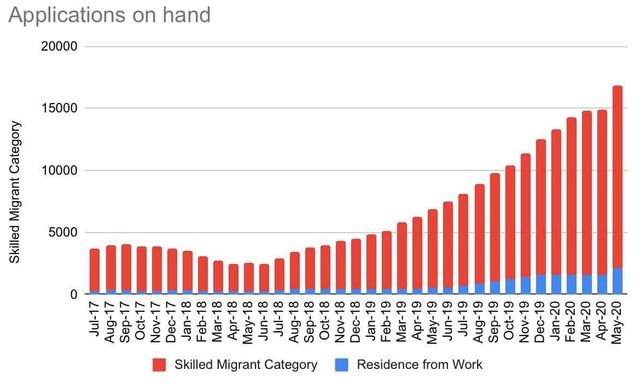
Meanwhile, tens of thousands of people applying for residency through the Skilled Migrant Category (SMC) are facing interminable delays and many fear they may be forced to leave the country. Immigration New Zealand (INZ) has a backlog of over 15,000 SMC and Work to Residence applications, representing more than 32,000 people. Many have been waiting a year or longer for a decision.
Graph showing the growing backlog of applications for Skilled Migrant Category visas (Source: Migrants NZ)
The World Socialist Web Site spoke with members of the recently established Facebook group Migrants NZ about their experiences. Migrants NZ, which has more than 4,600 members, has drafted a petition calling on the government to urgently process the applications, “make the process transparent and treat all applicants equally.”
The petition states: “We were promised that our applications would be processed in a reasonable timeframe. However, without any clear reasons we are forced to wait for a decision well over a year which takes an immense mental and financial toll on us and our families.”
Speaking to the Indian Weekender on Sunday, Immigration Minister Iain Lees-Galloway did not give a definite timeframe for visa processing or explanation for the backlog. He said waiting times would likely “increase for the foreseeable future” due to increased numbers of applications.
Anna, who is from Germany, told the WSWS she applied in May 2019 with her partner and their son. Her partner moved to New Zealand from Ireland seven years ago to work on the rebuild of Christchurch, which was devastated by an earthquake in 2011.
“When we applied we had one year left on our work visas, which we thought was sufficient,” she said. INZ estimated the processing time would be nine months, but this target was changed to 17 months. A year and a half ago a small number of applications were given priority, including people earning over $51 an hour and selected professions such as teachers and healthcare workers, “and the rest they’ve just stopped processing.”
Anna said the delay was “probably politically motivated,” noting that before the 2017 election Labour and NZ First “were saying: we will reduce immigrant numbers, and that’s what they’re doing at the moment.”
She said it was “hard to understand” how Prime Minister Jacinda Ardern could claim to lead the “kindest and most transparent government ever. Because this is not transparent, this is not kind. I’ve been talking to a lot of people recently and it has a massive impact on their mental health.”
Anna said her partner had worked for the same company for six years “and it doesn’t count for anything. I find it very frustrating when you put so much towards a country and its economy and the rebuild, and you’re just not given anything in return.”
She said the Facebook group gave people “a platform to share their stories and realise that they’re not alone in all this. It seems like to Immigration and the government we’re just a number. We want to get heard. We want people to understand the situation we’re in.”
A migrant from Britain, who we will call Jessica, said she and her partner had spent about $4,000 on applications and related costs. They have been waiting 18 months for INZ’s decision, despite initially being told to expect an answer by October 2019.
She was angry that INZ had received millions of dollars in fees from migrants for applications that are not being processed. The agency was “getting away with this, I don’t know how. They’re not accountable to anyone.”
“I’ve been here about three years and my partner’s been here for four,” Jessica said. Her partner works for an internet service provider “in critical infrastructure in Christchurch that doctors and nurses need to do their jobs, but that counts for nothing.”
Jessica is pregnant and due to give birth in December. Her current work visa expires in January 2021. “I don’t particularly want to go home with a one-month-old baby halfway across the world without a job,” she said. “It’s just awful, living in limbo.”
Visa applicants were “being fobbed off by the government” and given “nonsensical” excuses, she said. When she recently complained to her local MP, Jessica was told the delays were because of increased applications due to New Zealand being perceived as relatively safe from COVID-19. “But we’ve been waiting over 18 months. It makes no sense.”
Jessica believed the government was deliberately stalling “so that come election time they can say: ‘look how few migrants we’ve let in this year, aren’t we fantastic?’ Just to appeal to those that don’t want any more immigrants. I see no other reason, to be quite honest.”
A worker from China, based in Auckland, who wished to remain anonymous, told the WSWS he applied for residency almost a year ago and was very anxious about the future. He said the government was “trying to make people’s lives miserable to please a small number of anti-immigrant people. This whole thing is so inhumane. People have mental health issues from waiting so long. Every day they worry about their job or their application, about everything.”
He believed NZ First was “hijacking the whole process.” The party previously campaigned to cap immigration at 10,000 people a year, down from over 50,000 in recent years. Labour, supported by the Greens, gave NZ First considerable power in the coalition, even though the notoriously xenophobic party is very unpopular; NZ First received only 7.2 percent of the votes in 2017 and is currently polling below 2 percent.

COVID-19 cases increase across Pacific Island states

John Braddock

The World Health Organisation (WHO) warned last week of an increase of COVID-19 cases across small Pacific Island states. New cases were confirmed in Papua New Guinea (PNG), and in the US territory of Guam, where a fresh spike took the total to 231, which includes five deaths. The number of confirmed cases in the region is 353, an increase of 39 over the previous week.
The WHO says although official infection rates are slowing in the Pacific, the crisis is far from over. While most Pacific nations have few, if any, ongoing cases, the pandemic is only starting to make its presence felt. Should the virus take hold in any of the vulnerable and impoverished island states, with their inadequate health and welfare infrastructure, the results will be dire.
The closure of international borders has shattered economies and the meagre incomes of working people. The Guardian has reported that 90 percent of businesses have lost money, and are struggling with the effects of recent natural disasters such as Cyclone Harold. A quarter of businesses are unlikely to survive the pandemic, according to the latest Pacific Trade Invest Business Monitor Report.
The annual Pacific Islands Forum summit, the region’s major diplomatic gathering due to be hosted by Vanuatu in August, has been cancelled.
The Trump administration’s abject failure to bring COVID-19 under control is adversely affecting US territories across the northwest Pacific. As businesses and social venues reopened on Guam, the island was hit with 35 new cases from a unit recently deployed at the US Andersen air force base. Anger at the military erupted at reports that a group of US airmen absconded from quarantine to visit restaurants and other establishments.
In PNG, restrictions may be re-introduced in the capital Port Moresby after tests revealed the country’s latest case, a 26-year-old woman. A member of the Defence Force with COVID-19 was also found to be infected during mass testing at the Murray Barracks following another case involving a visiting Australian soldier.
Last month Fiji and New Zealand joined 13 Pacific neighbours in declaring themselves virus-free. The Cook Islands relaxed its travel ban with NZ, allowing workers and residents to re-enter. However, the emergence of new cases among people returning to New Zealand, and failures at the country’s quarantine facilities, set back similar plans in Samoa. Last year 83 people died when a measles epidemic spread from Auckland to Samoa.
The potential exists for new outbreaks as thousands of Pacific Island seasonal workers are being sent back home from Australia and New Zealand. The NZ air force has started flights to repatriate 1,000 ni-Vanuatu workers while flights for an estimated 7,000 stranded Tongans will start this month. Hundreds of cruise ship workers stuck in isolation for months on board empty ships were finally flown back to Fiji and Vanuatu by operator Carnival Australia.
Fiji’s Prime Minister Frank Bainimarama last week declared he is looking to attract “VIPs” to help restore the collapsed tourist industry. Billionaires who “fly your own jet, rent your own island, and invest millions of dollars in Fiji,” he tweeted, “may have a new home to escape the pandemic in paradise.” The first planeload of 30 “high-net-worth individuals… from a very well-known company” is due to arrive this week.
The number of infections in the French territories remains unchanged, at 21 for New Caledonia and 60 for French Polynesia. However, the economic cost is highlighted by Air Tahiti axing more than half its 48 domestic destinations, leaving many outlying islands isolated. A spokesman said the economic impact is 10 times worse than that which followed the 2008 financial meltdown.
Evidence continues to emerge that Pacific governments, preparing for an upsurge of social opposition to austerity measures, are using the pandemic to attack fundamental democratic rights.
In Vanuatu, while the opposition was under two-day suspension for boycotting an earlier sitting, an amendment passed through parliament extending a state of emergency indefinitely. The government also abruptly lifted the retirement age from 55 to 60 years.
Lawyer Paul Harricknen told Radio NZ that in PNG the ombudsman should step in after the government gave itself extraordinary new powers under the Public Health Emergency Act, which restrict basic rights for an indefinite period with no parliamentary oversight. Harricknen said the declaration of a “national emergency” was rushed through parliament and should be challenged in the Supreme Court.
The PNG legislation preceded an announcement that thousands of workers will lose their jobs due to an impasse over the huge Porgera gold mine. Canadian company Barrick Gold blames the government’s refusal to extend its mining lease. Barrick and Chinese partner Zijin have shut down production while they challenge the decision in court, and declared 2,650 jobs will be axed by the end of July.
Concerns have been raised about the Tongan government’s plans to spend $US1.9 million setting up a new security bureau, the Tonga National Security of Information Office, apparently to curb the leaking of government information. It will work closely with state agencies in Australia and New Zealand, and monitor a range of business and political negotiations. A Freedom of Information Act, initially proposed eight years ago, has meanwhile languished.
The Pacific journalists’ association PINA has accused the Cook Islands parliament of gagging the media after several local MPs objected to what they say was incorrect reporting about parliamentary allowances. The Speaker of the House was asked to require a Cook Islands News journalist’s withdrawal from parliament.
Financial assistance from international institutions has been both scarce and slow. The Solomon Islands has secured a meagre $US20 million from the Asian Development Bank (ADB), split between a concessional loan and grant to help mitigate the economic impacts of the virus. Tonga has received a similarly modest $US12.2 million from the ADB, following a previous $US6m injection to fund its border lockdown and relief for the effects of the pandemic. Tonga’s parliament has just passed a $US260 million budget for the coming year, with a record deficit of over $US26.4m.
The region’s imperialist powers, Australia and New Zealand, remain solely concerned with securing their geo-strategic interests and ensuring their continued dominance in what they regard as their semi-colonial “backyard.”
According to documents released in June by the New Zealand government, the Pacific will need “significant investment” to recover from the COVID-19 fallout. The foreign affairs ministry says the region is facing an “array of uncertainties in a significantly altered international environment.”
Far from focusing on the needs of the Pacific nations, however, the paper emphasises a rise in “security risks,” referring to greater opportunities for people smugglers and transnational crime. The ministry’s stated priority, however, is to reinforce the Labour-led government’s “Pacific reset” strategy, which aims to extend its diplomatic and military engagement in the region, in line with Washington’s war drive against China.

Ireland’s Greens agree to join austerity coalition government

Dermot Quinn

Almost five months after Ireland’s February 8 general election, Leo Varadkar’s Fine Gael and Micheál Martin’s Fianna Fáil have been able to form a coalition government after the Green Party membership voted to come on board.
On June 26, after weeks of negotiations, the membership of all three parties voted in favour of forming a coalition on a joint programme. Three quarters of the Green Party registered their support for an alliance with the architects of over a decade of austerity.
Micheál Martin will replace Varadkar as Taoiseach (Prime Minister) until December 2022 when the role will rotate back to Varadkar for the second half of the five-year parliamentary term.
The readiness of Fine Gael and Fianna Fáil to sink differences rooted in the bloodletting of the Civil War following the setting up of the Irish Free State in 1921 is a measure of the desperate crisis facing the bourgeoisie. Amid an imminent recession in the aftermath of the coronavirus pandemic, they need the Greens to secure a parliamentary majority and to have any hope of enforcing the savage attacks on jobs, wages and essential services now on the agenda.
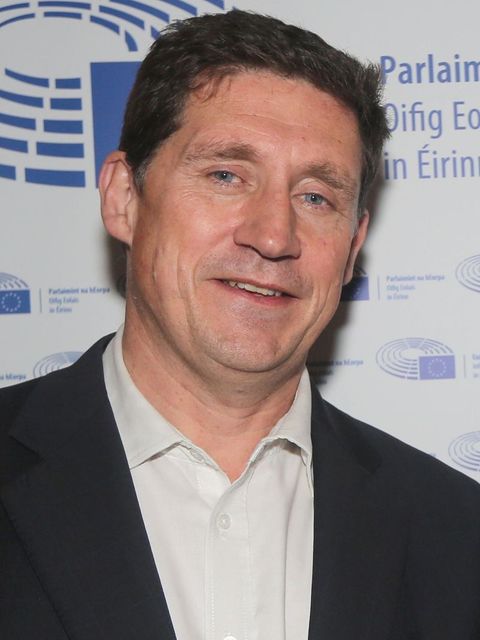
Eamon Ryan
In return for some environmental window dressing, the Green’s leader, Eamon Ryan, spoke of the “sense of responsibility on us now because we do have a job to do,” in “getting our country out of a really severe economic crisis.” What this means is not the protection of jobs and livelihoods that is routinely invoked, but imposing economic policies that will favour the corporations, banks and the super-rich.
From 2007 to 2011, as junior partners in a coalition government with Fianna Fáil, the Greens were complicit in introducing billions of euros of cuts to health, education, and other social services to bail out banks and protect the wealth of the super-rich.
Despite widespread opposition from working people, Fine Gael has been kept in power by Fianna Fáil under a “confidence and supply” agreement worked out three years ago by Varadkar and Martin. But the two-party system that has enabled Fine Gael and Fianna Fáil to control the Dáil (parliament) since the foundation of the Republic was rejected overwhelmingly in the February 8 election.
The combined votes of Fianna Fáil and Fine Gael fell to an historic low, with Sinn Fein winning a majority of first preference votes, based mainly on promises to end austerity, provide affordable housing, fund the health service and social care, and to tackle unemployment.
In Northern Ireland, Sinn Fein has proved its ability to combine such vaguely left rhetoric with the responsible safeguarding of corporate interests, in collaboration with the Unionists. But this was not enough to secure their inclusion in government in the South, with both the main parties refusing any discussion. Sinn Fein not only competes for a nationalist vote, but its anti-austerity rhetoric sends out the wrong message to workers when the official mantra must be “sacrificed in the national interest.”
Sinn Fein’s exclusion will likely strengthen its standing among sections of workers and youth. Party leader Mary Lou McDonald said Sinn Fein would continue to “press for change.” Deputy leader in the Dáil Pearse Doherty promised renewed opposition and to “stand up for ordinary workers and families.”
But their successes are only an initial expression of a more fundamental shift to the left by the working class, which cannot be satisfied by Sinn Fein’s pro-capitalist programme.
Varadkar’s term in government was marked by growing social inequality and the worst housing crisis in the country’s history, as well as a severe deterioration in the health care system that left the country woefully unprepared for the COVID-19 onslaught.
Between 2008 and 2015 Fine Gael and Fianna Fáil introduced a massive €2.7 billion of health service cuts, with patients forced to wait on trolleys in overcrowded and understaffed hospitals.
At the beginning of March there were over 500 patients waiting on trolleys in Irish hospitals, a figure which only fell after thousands were kept away from hospital during the pandemic.
Now that the numbers of COVID-19 deaths have fallen, those waiting on trolleys has started to rise, doubling to 102 a day. Dr Fergal Hickey, spokesman for the Irish Association of Emergency Medicine (IAEM), warned that patents in corridors are at particular risk from a winter virus surge, adding that the Health Service Executive (HSE) was “passively allowing a return to the status quo while we are still living with COVID-19 in the community.”
The months of lockdown due to the coronavirus pandemic will largely end on July 20. Travel restrictions were lifted on June 29 and the domestic tourism industry will reopen as well as cafes, restaurants and pubs.
The pandemic has decimated every sector of the economy, and economists are predicting a recession worse than the financial crash of 2008. The Economic and Social Research Institute (ESRI) predict investment will plummet by a third by the end of the year and consumer spending will fall by 13 percent, with unemployment spiraling to 17 percent of the workforce.
There are already 214,700 people claiming unemployment benefit, while almost a million people depend on some sort of state benefit—a fifth of the Republic of Ireland s population and just under half its working population. One of the first measures to be introduced by the new government will be to cut the Pandemic Unemployment Payment of €350 brought in by Varadkar after the country went into lockdown on March 27. Government estimates show €2.23 billion extra set aside for jobless payments for the rest of the year, but there is no provision for the Pandemic Unemployment Payment.
Central Statistics Office (CSO) figures show that the top 5 percent now has 46.4 percent of national wealth, with 1 percent of the population owning 27.3 percent. This concentration of wealth at the top has been accompanied by growing rates of poverty. Over 760,000 (15.7 percent) now live below the poverty line, with those under 16 years of age accounting for 23.9 percent of those in poverty.
One of the first pledges made in the joint document drafted by Fine Gael, Fianna Fáil and the Green Party for the formation of a government is that there will be a continuation of Ireland’s tax haven status. The corporation tax rate of just 12.5 percent will continue, around half the global average corporation tax rate of 27 percent and the European average of 25.3 percent.
Extra taxes will fall on those with low incomes, with the document stating that the government “will focus any tax rises on those taxes which tax behaviours with negative externalities such as carbon tax, sugar tax, and plastics.” The local property tax, which affects 1.2 million households and was introduced in 2012 during the financial and banking crisis, will be extended to include new homes which have been exempt.
The document pledges that the government will seek to negotiate a new public sector pay deal with the trade unions. These deals have long been used to reduce wages and undermine working conditions, including imposing recruitment embargos.
The treatment of health workers during the current COVID-19 pandemic brings into sharp focus the policing role played by the unions on behalf of big business. Of the 25,414 confirmed cases of coronavirus in Ireland, a staggering one third of these have been front-line staff, including nurses, diagnostic and therapy staff, and ambulance staff. This is the highest infection rate among health workers in the world.