The Republic of Georgia’s airspace is used by Turkey and Israel to support Azerbaijan in its war against the Armenians of Nagorno-Karabakh and Armenia.
Flight from Libya to Baku, Azerbaijan, September 30, 2020 Using Georgian Airspace
One need only review how many Turkish military transport flights from Libya, Turkey, and those transporting Syrian Jihadists are archived on sites such as flightradar24 (see accompanying images and sample) using Georgian airspace. Some flights are taking place as you read this article. We can add to this caravan of flights supporting Azerbaijan, Israeli military re-supply flights between Israel military airbases to Baku, Azerbaijan. While official Tbilisi claims it has not taken sides in this conflict, this evidence of Georgia’s permissiveness has allowed Israeli cluster bombs to kill Armenian civilians.
Georgia prevented Armenians from its Akhalkalaki region from sending used tires into Armenia to insulate military posts, yet allowed the Turkish military free access over its sovereign territory.
Videos show Bayraktar truck convoys escorted through Georgia towards Azerbaijan. True, Bayraktar is a transport company, but Georgian police escorted these trucks. The Turkish Bayraktar company manufactures kamikaze UAVs that are killing Armenian fighters and civilians. How did Turkish F-16s fly into Azerbaijan? I assure readers it was not over Iran or Russia. These F-16s are used against Armenians.
A Turkish military flight landing at Yevlakh military airport on September 26, a day before the Azerbaijani attack on Nagorno-Karabakh, flown over Georgian airspace.
Georgia replaced one master, Russia, with another, Turkey & Azerbaijan. Thanks to Saakashvili’s foreign policy “genius,” Georgian Adjara and its regional capital Batumi have been subjected to overwhelming Turkish influence. Batumi, Georgia, is considered a Turkish “domestic” flight. Azerbaijan is Georgia’s largest direct foreign investor. Georgia put itself in a position where it could not refuse Turkish aircraft access to its airspace. Any sovereignty Georgia thought it was accumulating by ejecting Russian influence has been replaced by bowing down to Turkish and Azerbaijani demands. It would not be surprising if Turkey never asked permission to use Georgian airspace, considering Georgian airports are managed by TAV (Turkish Airport Holdings).
Further, controversy continues in Georgia, leading up to their elections about an illegal transfer of 3,500 hectares of Georgian land to Azerbaijan.
Armenia’s North-South Highway Project will span the entire length of Armenia, from the Iranian border to Armenia’s north-west border with Georgia. Locals have reported (no real estate documents can be obtained) that Turks have acquired (purchased, rented) swath of lands near where that highway would enter the Samtskhe-Javakheti region of Georgia, interfering with the functioning of this highway.
Georgia will probably not escape diplomatic repercussions for having to bow to a new master. While Georgia touts its wine as the oldest globally, flies the EU flag next to its crusader national flag, accepts grants and loans from the West as long as it stays anti-Russian, its national sovereignty is being subordinated to the demands from its two Turkic neighbors; Turkey and Azerbaijan. For a state that has placed Orthodox Christianity as a centerpiece of his national ethos, Georgia has allowed Turkey to use its airspace to transport radical Jihadists to fight Armenians.
Georgia had better look in the mirror while it still owns one. Unfortunately, Georgia appears to be in too deep into Turkey’s neo-Ottoman plans to re-establish its sovereignty.
Strangely enough, the limit we seem to be reaching with respect to fossil fuel extraction comes from low prices. At low prices, the extraction of oil, coal, and natural gas becomes unprofitable. Producers go bankrupt, or they voluntarily cut back production in an attempt to force prices higher. As the result of these forces, production tends to fall. This limit comes long before the limit that many people imagine: the amount of fossil fuels in the ground that seems to be available with current extraction techniques.
The last time there was a similar problem was back in 1913, when coal was the predominant fossil fuel used and the United Kingdom was the largest coal producer in the world. The cost of production was rising due to depletion, but coal prices would not rise sufficiently to cover the higher cost of production. As a result, the United Kingdom’s coal production reached its highest level in 1913, the year before World War I started, and began to fall in 1914.
Between 1913 and 1945, the world economy was very troubled. There were two world wars, the Spanish Flu pandemic and the Great Depression. My concern is that we are again headed into another very troubled period that could last for many years.
The way the energy problems of the period between 1913 and 1945 were resolved was through the rapid ramp-up of oil production. Oil was, as that time, inexpensive to produce and could be sold for a very large multiple of the cost of production. If population is to remain at the current level or possibly grow, we need a similar “energy savior.” Unfortunately, none of the alternatives we are looking at now yield a high enough return relative to the required investment.
I recently gave a talk to an engineering group interested in energy research talking about these issues. In this post, I will discuss the slides of this presentation. A PDF of the presentation can be found at this link.
The Low Oil Price Problem
Oil prices seem to bounce around wildly. One major issue is that there is a two-way tug of war between the prices that citizens can afford and the prices that oil companies require. We can look back now and say that the mid-2008 price of over $150 per barrel was too high for consumers. But strangely enough, oil producers began complaining about oil prices being too low to cover to cover their rising cost levels, starting in 2012. Prices, at a 2019 cost level, were at about $120 per barrel at that time. I wrote about this issue in the post, Beginning of the End? Oil Companies Cut Back on Spending. Oil prices now are in the $40 range, so are way, way below both $120 per barrel and $150 per barrel.
Interest rates and the availability of debt also play a role in oil prices. If interest rates are low and debt is readily available, it is easy to buy a new home or new car, and oil prices tend to rise because of the higher demand. When prices are too low for producers, central banks have been able to lower interest rates through a program called “quantitative easing.” This program seems to have helped oil prices to rise again, over a three-year period, after they crashed in 2008.
OPEC producers are known for their low cost of production, but even they report needing high oil prices. The cost of extracting the oil is reported to be very low (perhaps $10 per barrel), but the price charged needs to be high enough to allow governments to collect very high taxes on the oil extracted. If prices are high enough, these countries can continue the food subsidies that their populations depend upon. They can also sponsor development programs to provide jobs for the ever-growing populations of these countries. OPEC producers also need to develop new oil fields because the old ones deplete.
Oil production outside of the United States and Canada entered a bumpy plateau in 2005. The US and Canada added oil production from shale and bitumen in recent years, helping to keep world oil production (including natural gas liquids) rising.
One reason why producers need higher prices is because their cost of extraction tends to rise over time. This happens because the oil that is cheapest to extract and process tends to be extracted first, leaving the oil with higher cost of extraction until later.
Some OPEC countries, such as Saudi Arabia, can hide the low price problem for a while by borrowing money. But even this approach does not work well for long. The longer low oil prices last, the greater the danger is of governments being overthrown by unhappy citizens. Oil production can then be expected to become erratic because of internal conflicts.
In the US and Canada, oil companies have been funded by bank loans, bond sales and the sale of shares of stock. These sources of funding are drying up, as many oil companies report poor earnings, year after year, and some are seeking bankruptcy protection.
Chart 6 shows that the number of drilling rigs in operation has dropped dramatically in both the United States and Canada, as oil companies cut back on drilling. There is a lag between the time the number of drilling rigs is cut back and the time production starts to fall of perhaps a year, in the case of shale. These low drilling rig counts suggest that US and Canadian oil production from shale will fall in 2021.
Of course, unused drilling rigs cannot be mothballed indefinitely. At some point, they are sold as scrap and the workers who operated them find other employment. It then becomes difficult to restart oil extraction.
How the Economy Works, and What Goes Wrong as Limits Are Reached
Slide 7 shows one way of visualizing how the world economy, as a self-organizing system, operates. It is somewhat like a child’s building toy. New layers are added as new consumers, new businesses and new laws are added. Old layers tend to disappear, as old consumers die, old products are replaced by new products, and new laws replace old laws. Thus, the structure is to some extent hollow.
Self-organizing objects that grow require energy under the laws of physics. Our human bodies are self-organizing systems that grow. We use food as our source of energy. The economy also requires energy products of many kinds, such as gasoline, jet fuel, coal and electricity to allow it to operate.
It is easy to see that energy consumption allows the economy to produce finished goods and services, such as homes, automobiles, and medical services. It is less obvious, but just as important, that energy consumption provides jobs that pay well. Without energy supplies in addition to food, typical jobs would be digging in the dirt with a stick or gathering food with our hands. These jobs don’t pay well.
Finally, Slide 7 shows an important equivalence between consumers and employees. If consumers are going to be able to afford to buy the output of the economy, they need to have adequate wages.
A typical situation that arises is that population rises more quickly than energy resources, such as land to grow food. For a while, it is possible to work around this shortfall with what is called added complexity: hierarchical organization, specialization, technology, and globalization. Unfortunately, as more complexity is added, the economic system increasingly produces winners and losers. The losers end up with very low wage jobs, or with no jobs at all. The winners get huge wages and often asset ownership, as well. The winners end up with far more revenue than they need to purchase basic goods and services. The losers often do not have enough revenue to feed their families and to buy basic necessities, such as a home and some form of basic transportation.
The strange way the economy works has to do with the physics of the situation. Physicist Francois Roddier explains this as being similar to what happens to water at different temperatures. When the world economy has somewhat inadequate energy supplies, the goods and services produced by the economy tend to bubble to the top members of the world economy, similar to the way steam rises. The bottom members of the economy tend to get “frozen out.” This way, the economy can downsize without losing all members of the economy, simultaneously. This is the way ecosystems of all kinds adapt to changing conditions: The plants and animals that are best adapted to the conditions of the time tend to be the survivors.
These issues are related to the fact that the economy is, in physics terms, a dissipative structure. The economy, like hurricanes and like humans, requires adequate energy if it is not to collapse. Dissipative structures attempt to work around temporary shortfalls in energy supplies. A human being will lose weight if his caloric intake is restricted for a while. A hurricane will lose speed, if the energy it gets from the warm water of the ocean is restricted. A world economy with inadequate energy is likely to shrink back in many ways: unprofitable businesses may fail, layers of government may disappear and population may fall, for example.
In the discussion of Slide 7, I mentioned the fact that if we try to “stretch” energy supply with added complexity, many workers would end up with very low wages. Some of these low wage workers would be in the US and Europe, but many of them would be in China, India and Africa. Even though these workers are producing goods for the world economy, they often cannot afford to buy those same goods themselves. Henry Ford is remembered to have said something to the effect that he needed to pay his workers enough so that they, themselves, could buy the cars they were making. To a significant extent, this is no longer happening when a person takes into account international workers.
The high interest rates that low-wage workers pay mean that loans don’t really help low-wage workers as much as they help high-wage workers. The high interest on credit cards debt and personal loans tend to transfer part of the income of low-wage workers to the financial sector, leaving poor people worse off than they would have been without the loans.
COVID shutdowns are extremely damaging to the world economy. They are like taking support sticks out of the dome on Slide 7. They produce many more unemployed people around the world. People in low wage countries that produce clothing for a living have been particularly hard hit, for example. Migrant workers and miners of various kinds have also been hard hit.
We Seem to Be Reaching a Major Turning Point
Oil production and consumption have both fallen in 2020; oil prices are far too low for producers; wage disparity is a major problem; countries seem to be increasingly having problems getting along. Many analysts are forecasting a prolonged recession.
The last time that we had a similar situation was in 1913, when the largest coal producer in the world was the United Kingdom. The UK’s cost of coal production kept rising because of depletion (deeper mines, thinner seams), but prices would not rise to compensate for the higher cost of production. Miners were paid very inadequate wages; poor workers regularly held strikes for higher wages. World War I started in 1914, the same year coal production of the UK started to fall. The UK’s coal production has fallen nearly every year since then.
The last time that wage disparity started to spike as badly as it has in recent years occurred back in the late 1920s, or perhaps as early as 1913 to 1915. The chart shown above is for the US; problems were greater in Europe at that time.
With continued low oil prices, production is likely to start falling and may continue to fall for years. It is hard to bring scrapped drilling rigs back into service, for example. The experience in the UK with coal shows that energy prices don’t necessarily rise to compensate for higher costs due to depletion. There need to be buyers for higher-priced goods made with higher-priced coal. If there is too much wage disparity, the many poor people in the system will tend to keep demand, and prices, too low. They may eat poorly, making it easier for pandemics to spread, as with the Spanish Flu in 1918-1919. These people will be unhappy, leading to the rise of leaders promising to change the system to make things better.
My concern is that we may be heading into a long period of unrest, as occurred in the 1913 to 1945 era. Instead of getting high energy prices, we will get disruption of the world economy. The self-organizing economy is attempting to fix itself, either by getting more energy supply or by eliminating parts of the economy that aren’t contributing enough to the overall system. Conflict between countries, pandemics, bankruptcies and economic contraction are likely to be part of the mix.
Coal Seems to Be Reaching Extraction Limits as Well
Coal has essentially the same problem as oil: Prices tend to be too low for producers to extract coal profitably. Many coal producers have gone bankrupt. Prices were higher back in 2008, when demand was high for everything, and again in 2011, when quantitative easing had been helpful.
There have been stories in the press in the past week about China limiting coal imports from Australia, so as to make more jobs for coal miners in China. The big conflict among countries relates to “not enough jobs that pay well” and “not enough profitable companies.” These indirectly are energy issues. If there was more “affordability” of goods made with high-priced coal, there would be no problem.
Coal production worldwide has been on a bumpy plateau since 2012. In fact, China, the largest producer of coal, found its production stagnating, starting about 2012. The problem was a familiar one: The cost of extraction rose because many mines that had been used for quite a number of years were depleted. The selling price would not rise to match the higher cost of extraction because of affordability issues.
The underlying problem is that the economy is a dissipative structure. Commodity prices are set by the laws of physics. Prices don’t rise high enough for producers, if there are not enough customers willing and able to buy the goods made with high-priced coal.
We Have a Major Problem If Both Coal and Oil Production Are in Danger of Falling Because of Low Prices
Oil and coal are the two largest sources of energy in the world. We can’t get along without them. While natural gas production is fairly high, there is not nearly enough natural gas to replace both oil and coal.
Looking down the list, we see that nuclear production hit a maximum back in 2006 and has fallen since then.
Hydroelectric continues to grow, but from a small base. Most of the good sites have already been taken. In many cases, there are conflicts between countries regarding who should get the benefit of water from a given river.
The only grouping that is growing rapidly is Renewables. (This is really Renewables Other than Hydroelectric.) It includes wind and solar plus a few other energy types, including geothermal. This grouping, too, is very small compared to oil and coal.
Natural Gas Has a Low Price Problem as Well
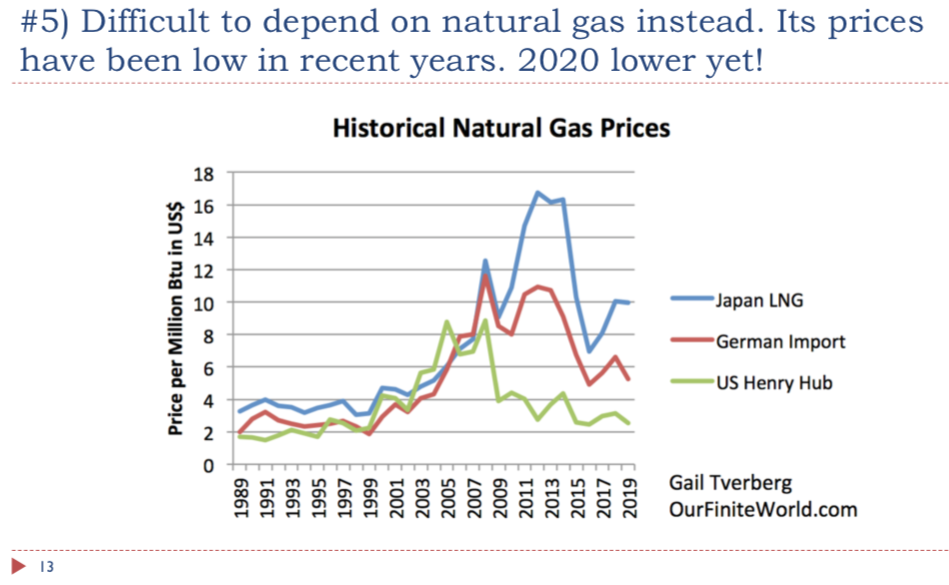
Natural gas, at first glance, looks like it might be a partial solution to the world’s energy problems: It is lower in carbon than coal and oil, and it is fairly abundant. The problem with natural gas is that it is terribly expensive to ship. At one time, people used to talk about there being a lot of “stranded” natural gas. This natural gas seemed to be available, but when shipping costs were included, the price of goods made with it (such as electricity or winter heat for homes) was often unaffordable.
After the run-up in oil prices in the early 2000s, many people became optimistic that, with energy scarcity, natural gas prices would rise sufficiently to make extraction and shipping long distances profitable. Unfortunately, it is becoming increasingly clear that, while prices can temporarily spike due to scarcity and perhaps a debt bubble, keeping the prices up for the long run is extremely difficult. Customers need to be able to afford the goods and services made with these energy products, or the laws of physics bring market prices back down to an affordable level.
The prices in the chart reflect three different natural gas products. The lowest priced one is US Henry Hub, which is priced near the place of extraction, so long distance shipping is not an issue. The other two, German Import and Japan Liquefied Natural Gas (LNG), include different quantities of long distance shipping. Prices in 2020 are even lower than in 2019. For example, some LNG imported by Japan has ben purchased for $4 per million Btu in 2020.
The Economy Needs a Bail-Out Similar to the Growth of Oil After WWII
The oil that was produced shortly after World War II had very important characteristics:
It was very inexpensive to produce, and
It could be sold to customers at a far higher price than its cost of production.
It was as if, today, we had a very useful energy product that could be produced and delivered for $4, but it was so valuable to consumers that they were willing to pay $120 for it. In other words, the consumer was willing to pay 30 times as much as the cost that went into extracting and refining the oil.
With an energy product this valuable, a company producing it would need virtually no debt. It could drill a well or two, and with the profits from the first wells, finance the investment of many more wells. The company could pay very high taxes, allowing governments to build roads, schools, electricity transmission lines and much other infrastructure, without having to raise taxes on citizens.
Besides using the profits for reinvestment and for taxes, oil companies could pay high dividends. This made oil company stocks favorites of pension plans. Thus, in a way, oil company profits could help subsidize pension plans, as well.
Now, because of depletion, we have reached a situation where oil companies, and in fact most companies, are unprofitable. Companies and governments keep adding debt at ever lower interest rates. In fact, the tradition of ever-increasing debt at ever-lower interest rates goes back to 1981. Thus, we have been using debt manipulation to hide energy problems for almost 40 years now.
We need a way to counteract this trend toward ever-lower returns. Some people talk about “Energy Return on Energy Investment” or EROEI. I gave an example in dollars, but a major thing those dollars are buying is energy, so the result is very similar.
I think researchers have set the “bar” far too low, in looking at what is an adequate EROEI. Today’s wind and solar don’t really have an adequate EROEI, when the full cost of delivery is included. If they did, they would not need the subsidy of “going first” on the electric grid. They would also be able to pay high taxes instead of requiring subsidies, year after year. We need much better solutions than the ones we have today.
Some researchers talk about “Net Energy per Capita,” calculated as ((Energy Delivered to the End User) minus (Energy Used in Making and Transporting Energy to the End User)) divided by (Population). It seems to me that Net Energy per Capita needs to stay at least constant, and perhaps rise. If net energy per capita could actually rise, it would allow the economy to increasingly fight depletion and pollution.
Conclusion: We Need a New Very Inexpensive Energy Source Now
We need a new, very inexpensive energy source that buyers will willingly pay a disproportionately high price for right now, not 20 or 50 years from now.
The alternative may be an economy that does poorly for a long time or collapses completely.
The one ray of hope, from a researcher’s perspective, is the fact that people are always looking for solutions. They may be able to provide funds for research at this time, even if funds for full implementation are unlikely.
Amnesty International has catalogued how the actions of Boris Johnson’s Conservative government led to the deaths of thousands of elderly people in care homes during the first stage of the coronavirus pandemic.
Amnesty’s report was largely ignored by the media or relegated to inside pages. Yet it presents evidence that the government’s policy of herd immunity was responsible for mass murder. The government was entirely aware of the probable outcome of their policy and went ahead regardless of the risk to thousands of lives.
The report, “As if expendable: The UK government’s failure to protect older people in care homes during the Covid-19 pandemic”, details how, between March 2 and June 12, 18,562 residents of care homes in England died with COVID-19. The vast majority (18,168) were aged 65 and over, representing almost 40 percent of all deaths involving the virus in England during this time frame. Of these, 76 percent (13,844 deaths) occurred within care homes for the elderly.
Amnesty International's report: "As if expendable: The UK government’s failure to protect older people in care homes during the Covid-19 pandemic"
During this brief period, 28,186 “excess deaths” were recorded in English care homes, a 46 percent increase in comparison with the same period over previous years.
Amnesty conclude that the Tory government together with its agencies at national and local level have “taken decisions and adopted policies during the Covid-19 pandemic that have directly violated the human rights of older residents of care homes in England—notably their right to life, their right to health, and their right to non-discrimination”.
The report argues that the decisions and policies of the Tory government “impacted the rights of care home residents to private and family life, and may have violated their right not to be subjected to inhuman or degrading treatment.”
Amnesty documents how the government was fully aware that COVID-19 represented a disproportionate risk of serious illness and death to older people, especially those suffering underlying health conditions. The government’s “Risk of death estimates”, compiled in early March, showed COVID-19 infection fatality rates ranging from 0.01 percent for people under 20, rising steeply to 8 percent for people aged 80 years and over.
The government therefore knew that the approximately 400,000 residents of care homes, many of whom live with multiple health conditions, physical dependency, dementia, and frailty, were at an exceptional risk. But at the height of the pandemic, the government failed to take any measures to protect care homes.
Contrary to the claims made by Matt Hancock, the Secretary of State for Health and Social Care, that a “protective ring” was encircling care homes “right from the start,” Amnesty highlights decisions and policies adopted by the authorities at the national and local level in England which served to increase care home residents’ risk of exposure to the virus. These include:
● The mass decanting from hospital into care homes of patients infected or possibly infected with COVID-19 and advice that “[n]egative tests are not required prior to transfers/admissions into the care home”.
● Advice to care homes that “no personal protective equipment (PPE) is required if the worker and the resident are not symptomatic,” and a failure to ensure adequate provisions of PPE to care homes.
● A failure to assess care homes’ capability to cope with and isolate infected or possibly infected patients discharged from hospitals, and failure to put in place adequate emergency mechanisms to help care homes respond to additional needs and diminished resources.
● A failure to ensure regular testing of care home workers and residents.
● Imposition of blanket Do Not Attempt Resuscitation (DNAR) orders on residents of many care homes around the country and restrictions on residents’ access to hospital.
● Suspension of regular oversight procedures for care homes by the statutory regulating body, the Care Quality Commission, and the Local Government and Social Care Ombudsman.
Amnesty states, “Some of the UK government’s decisions with regard to care homes seem heedless at best”. Until March 13, two days after the World Health Organization declared COVID-19 a global pandemic, and despite having received information warning of asymptomatic coronavirus cases from its own advisers, the government advised care homes against the use of PPE. Official guidance for care homes stated, “If neither the care worker nor the individual receiving care and support is symptomatic then no personal protective equipment is required above and beyond normal good hygiene practices.”
Amnesty suggests, “Other government decisions appear inexplicable.” But its actions were not merely heedless, or reckless, but actively murderous.
Amnesty concludes, “Via its Department of Health and Social Care (DHSC), the government in mid-March adopted a policy, executed by NHS England and NHS Improvement, that led to 25,000 patients, including those infected or possibly infected with Covid-19 who had not been tested, being discharged from hospital into care homes between 17 March and 15 April—exponentially increasing the risk of transmission to the very population most at risk of severe illness and death from the disease. With no access to testing, severe shortages of PPE, insufficient staff, and limited guidance, care homes were overwhelmed. Although care home deaths were not even being counted in daily official figures of Covid-19 deaths until 29 April, some 4,300 care home deaths were reported in a single fortnight during this period.”
The report notes how the level of virus transmission decreased dramatically over the summer—after thousands had died—allowing visits by friends and relatives to those who survived and still resided within care homes to recommence, making the impact of the pandemic on the health and wellbeing of older people much more visible. While the full extent of COVID-19’s impact on the body is not fully known, the consequences for older people have been, in the words of Amnesty, “tragic”. Among some older people there is “reduced movement and cognitive functions, loss of appetite, depression, and a general loss of the will and desire to live.”
Amnesty’s report calls for regular testing for care home residents, staff and visiting families, and for the government to review all “Do Not Attempt CPR” orders on care home residents that have been added without proper process. It cites the Joint Committee on Human Rights, a body appointed by the House of Lords and the House of Commons to consider matters relating to human rights in the UK, which wrote in a September report, “The blanket imposition of DNACPR [Do not attempt cardiopulmonary resuscitation] notices without proper patient involvement is unlawful. The evidence suggests that the use of them in the context of the Covid-19 pandemic has been widespread.”
The report also calls for an adequate and ongoing supply of PPE for care homes, to enable them to comply with national guidance, and to ensure all staff have received workplace training on its purpose and proper usage.
Amnesty raise the demand for an independent public inquiry into the government’s handling of the pandemic that should make “key recommendations on an urgent and expedited basis by the end of November 2020.”
Their report states, “The pandemic is not over… Lessons must be learned; remedial action must be taken without delay to ensure that mistakes are not repeated."
This will fall on deaf ears. Due to the government’s reckless reopening of the economy, schools, colleges and universities in the last three months, the virus is already out of control. For Johnson and the corporate oligarchs, what counts is profits not human lives.
At the end of February, Johnson’s chief advisor Dominic Cummings explained the crux of the Tory’s coronavirus response in a behind closed doors discussion. According to the Times, those present summarised his position as “herd immunity, protect the economy, and if that means some pensioners die, too bad.” A senior Conservative source described his view as “let old people die.”
Outside of a mobilisation of the working class—to protect lives and take the response to the pandemic out of the hands of the ruling elite—the policy that led to horrific death toll detailed in the report can only lead to many thousands more fatalities.
Nigeria has been hit by some of the largest protests in its history, as youth have taken to the streets in their thousands to protest police brutality.
The most populous country and largest economy in Africa has seen demonstrations by mainly young people in the capital Abuja, the port city of Lagos, Nigeria’s commercial centre, and the south-eastern cities of Port Harcourt and Uyo against the Special Anti-Robbery Squad (SARS). SARS is the elite federal police unit whose name has become synonymous with extortion, kidnappings, grotesque abuses, and killings.
The unit, set up in 1992 to tackle rising violent crime, soon replicated the thuggery of the groups they were supposed to combat. Amnesty International has documented 82 alleged human rights violations by SARS across the country in the past three years, including hanging, mock execution, assault, and waterboarding. The squad operates with complete impunity. Most of its victims were young people between the ages of 18 and 35.
A slum overlooking Lagos downtown in Nigeria, Tuesday May 12, 2020. (AP Photo/Sunday Alamba)
The protests have elicited support around the world from sports figures, celebrities, and other prominent figures—with the hashtags #EndSars and #SarsMustEndNow trending in multiple countries. Nigerian diaspora communities have rallied in sympathy in Atlanta, Berlin, London, and New York.
The protests were sparked by the killing of a young man in Delta State, in southern Nigeria, during a stop-and-search operation on October 3, although the police denied that SARS officers were involved. As the protests grew, demonstrators faced increasingly violent crackdowns from security forces which used tear gas, water cannon, and live ammunition, killing at least 10 people, according to Amnesty International . Dozens more have been arrested and remain in custody.
The family of 20-year old Jimoh Isiaq, one of those killed during the protests, told CNN, “The bullet police shot hit his abdomen and came out from the back… His death is very painful. The protest was largely peaceful before the police fired that shot from the evidence we had gathered. We know the shots were fired by policemen stationed in Owode police station. We know the names of the officers that fired the shots. We are not short of evidence to prove police brutality.”
The scale of the demonstrations has forced the government to announce the disbanding of the squad and pledge to rein in the police. On Monday, President Muhammadu Buhari declared, “The disbanding of SARS is only the first step in our commitment to extensive police reforms. We will also ensure that all those responsible for misconduct or wrongful acts are brought to justice.”
Given the ferocity of the police’s response to the mass demonstrations, these empty promises have done little to stop the protests from growing. The government has announced the disbanding of SARS on three previous occasions following similar protests—to no effect.
Protestors are demanding further action, including psychological evaluations for reassigned SARS officers and compensation for victims of police violence. Anuola, 26, told The Guardian, “First it’s Sars and then it’s the whole police system, because even with ordinary policemen and women we are not safe.”
The protests are also animated by the economic situation that has deteriorated even further in the wake of the pandemic, blaming the government for the soaring cost of living, rising unemployment, corruption, and economic mismanagement.
The International Monetary Fund (IMF) estimates that Nigeria’s economy, which is heavily dependent on its oil industry, will shrink by about 4.2 percent this year, despite a 6.1 percent contraction so far.
In March, the government responded to falling oil prices by slashing petrol subsidies, fueling mass opposition to wider budget cuts. The government also announced plans to cut health care spending at a time when the system is already under acute strain due to the pandemic, devalued its currency, and increased its borrowings from the IMF, which has led to soaring prices for everyday items.
Unemployment in Nigeria has surged to 27 percent, the highest in at least a decade. According to the World Bank, Nigeria has the largest number of people living in poverty in Sub-Saharan Africa, with 79 million people considered extremely poor. Nigeria accounts for 20 percent of the total poor in the region.
Other estimates put the number of people living in poverty at even higher levels. The Nigeria Employers Consultative Association (NECA) estimates that 102 million people, or more than half of the population, are living in poverty, fueled by a 10 percent rise as result of the pandemic.
The dire state of Nigeria’s minimal healthcare system has resulted in doctors and nurses working without proper personal protective equipment (PPE), leading to more than 2,000 health worker infections. There have been several strikes and walkouts by doctors and other healthcare professionals that were isolated and sold out by trade unions, working hand in glove with the government, amid mounting struggles by oil workers, miners and public sector workers.
The federal government in Abuja also faces unrest and conflicts in several regions that threaten the breakup of the country. The brutal methods used by the security forces to suppress them have only served to deepen opposition to the Buhari government and spawn the rise of civilian vigilante self-defence groups.
The decade-long insurgency by Islamist jihadist groups in the largely Muslim north-eastern states has killed nearly 30,000 people, displaced 2.6 million and left nearly 22,000 people missing. In the last few days, Turkey’s Anadolu Agency reported that at least 14 farmers were killed by Boko Haram after they seized farms in Borno State, the epicentre of the insurgency. The Nigerian military reported that 18 people—four soldiers, 10 police officers and four civilians—had been killed in an ambush on a government convoy.
The deteriorating situation has allowed splinter groups of Boko Haram to gain a foothold in the region. Jama’atu Ansarul Muslimina Fi Biladis Sudan (Group of Partisans for Muslims in Black Africa), known as Ansaru, that was active in the north-west of Nigeria between 2011 and 2014, has made a resurgence. Other Boko Haram offshoots, notably the Islamic State in West Africa Province, have also arrived in the area.
The north-west of the country has seen a burgeoning insurgency with more than 8,000 killed and 200,000 internally displaced, while another 60,000 have fled to neighbouring Niger. Armed groups, spurred on by a burgeoning small arms trade and fierce competition over water and land resources between the Fulani herders and mainly Hausa farmers, have proliferated—engaging in cattle rustling, kidnapping for ransom and armed robbery. Their attacks on villages that have destroyed crops and livestock have further impoverished people living in the region. These armed groups have spread into several states, reaching as far as North Central Nigeria.
This is in addition to the long-running discontent and militancy in the Niger Delta, the oil-producing region.
Under these conditions, the government has turned to ever more repressive methods and state agencies, including police squads and militarised security forces that terrorise the population. As the demonstrations and rallies continue nationwide, Nigeria’s army, which has been repeatedly accused of human rights abuses, declared on Wednesday it was ready to maintain law and order and deal decisively with any situation created by “subversive elements and troublemakers.”
As instruments of class rule, these forced are tasked with upholding class exploitation by the kleptocracy that rules Nigeria—a country rich in oil, agricultural products, and other resources. As opposition mounts to the staggering growth of inequality and the ruling elite’s criminal response to the pandemic, the Buhari government is seeking to abrogate democratic rights and crush social opposition from below to defend its massive wealth.