31 Jan 2021

UN human rights commissioner calls for probe into Sri Lanka’s war crimes

K. Ratnayake


UN Human Rights Commissioner Michelle Bachelet’s recent report on Sri Lanka has recommended war crime probes and targeted sanctions, including asset freezes and travel bans, on those “credibly accused of human rights violations.”

The 17-page report was prepared for the upcoming 46th session of UN Human Rights Council (UNHRC) and made public on January 27. The next session of the UNHRC is scheduled to begin at the end of February and continue until March 19.

Bachelet’s report contains proposed “options” for member states to “advance criminal accountability” of Sri Lanka and refer it to the International Criminal Court (ICC). Member states, it says, “can actively pursue investigation and criminal prosecution committed by all parties in Sri Lanka” before their own national courts.

Police arrest a protestor during June, 2020 protest against George Floyd killing [Credit: WSWS]

The report refers to the militarisation of the Sri Lankan state apparatus noting the appointment of serving and former senior officers to key government positions; the removal of constitutional safeguards; harassment of journalists and human rights activists; and the forcible cremation of all who have died from COVID-19. The UNHCR report describes these actions as curbs on civilian affairs and human rights by President Rajapakse’s government.

The war crimes cited in the report relate to the Sri Lankan military attacks during the final months of the bloody conflict against the Liberation Tigers of Tamil Eelam (LTTE). The separatist organisation was defeated in May 2009.

UN experts have estimated that at least 40,000 civilians died in brutal indiscriminate attacks by the army. A number of LTTE leaders who surrendered were killed in cold blood, while hundreds of youth who gave themselves up to the army have been disappeared.

President Gotabhaya Rajapakse, who was defence secretary under Mahinda Rajapakse, his older brother and then president, oversaw these military operations.

Successive Sri Lankan governments committed numerous war crimes during the 30-year communal conflict which began in July 1983. The final years of the war, which were re-launched in 2006 by the Mahinda Rajapakse regime with the backing of imperialist powers, including the US and India, saw an intensification of atrocities committed against the Tamils.

The brutal repression not only occurred in the war zones in Sri Lanka’s north and east but in the south where journalists and others who criticised the government were abducted, “disappeared” or killed.

Like all its predecessors, the current Rajapakse regime vehemently denies all war crime allegations and calls for legal immunity for all military officers. Colombo attempts to cover up its own crimes by pointing to the anti-democratic and terror methods used by the LTTE against Tamils, Sinhalese and Muslims.

The chief responsibility for the war, however, lies with the Sri Lankan ruling elite and its successive governments since 1948 which have consistently used anti-Tamil chauvinism to prop up bourgeois rule by dividing and weakening the working class along ethnic lines.

Bachelet’s report comes amid US moves to present a new human rights resolution on Sri Lanka in order to pressure the Rajapakse regime remain within Washington’s geostrategic orbit. The US has insisted since Rajapakse was elected president in November 2019 that Colombo remains integrated into its anti-China war push. This agenda was carried forward during President Maithripala Sirisena and Prime Minster Ranil Wickremesinghe’s administration.

Sirisena became president in 2015 in a regime-change operation orchestrated by the US to replace the former President Mahinda Rajapakse. Washington was hostile to Mahinda Rajapakse regime’s close relations with Beijing for investment and military equipment supplies during the war.

The Sirisena-Wickremesinghe regime immediately shifted Sri Lanka’s foreign policy in favour of Washington and began strengthening ties and operations between Sri Lankan armed forces and the US military.

In return, Washington helped to pass a resolution in the UNHRC in October 2015 that assisted Colombo to suppress calls for an international war crimes investigation by agreeing to domestic inquiries into the human rights abuses through Sri Lankan tribunals. These tribunals were never established.

Washington and India, its regional strategic partner, are deeply concerned about the return of Gotabhaya Rajapakse and Mahinda Rajapakse to power. At the same time the COVID-19 pandemic has sharply impacted the heavily-indebted Sri Lankan economy forcing the Rajapakse regime to increasingly turn to China for investment and loans.

Over the last month, the core UN group on Sri Lanka—Britain, Canada, Germany, Macedonia and Montenegro—has announced that it plans to present a resolution in the UNHRC on human rights violations.

US State Department spokesman Ned Price tweeted last week that “we are carefully reviewing the significant report” on Sri Lanka from the UNHRC. Sri Lanka’s future, he said, “depends on respecting rights today and taking meaningful steps to deal with the past.”

US “concerns” about human rights and similar statements from other major powers, who have all engaged in numerous documented war crimes and other atrocities, are cynical and hypocritical.

US imperialism, which is at the centre of the global crisis accelerated by the coronavirus pandemic, is aggressively pursuing its efforts to reassert its global hegemony. This is being continued and intensified under US President Biden’s administration.

Tamil parties in Sri Lanka, including the Tamil National Alliance (TNA), Tamil National People’s Front (TNPF) and the Tamil People’s Alliance, have rallied behind the latest US-led human rights charade.

US and UK diplomats have discussed the new human rights resolution with the TNA leadership, as well as leaders of the TPA and TNPF. Together with “civil society groups,” these parties have written to the UNHRC president calling for a war crimes probe in Sri Lanka and for it to be referred to the ICC.

In 2015, the TNA supported the US-led regime-change operation in Colombo and acted as a de facto partner of the Sirisena-Wickremesinghe government. The Tamil nationalist parties fully support the geo-political and military build-up against China. Their support for the “human rights concerns” of the “international community”—a euphemism for the US and other major powers—is an attempt to secure international backing for devolution of power to the Tamil bourgeoisie in the north and east.

Responding to the UNHRC report, Sri Lankan Foreign Secretary Admiral Jayanath Colambage told the Sunday Times that “nothing has been proven” against those accused of war crimes. “Sri Lanka is much more peaceful and stable than any of the countries trying to discredit us,” he declared.

Colambage admitted that the UNHCR report was “worse” than previous ones but insisted that “nearly all the commitments” to the earlier UNHCR resolution, apart from the establishment of a judicial mechanism, had been fulfilled by the previous administration. He then claimed that the report had been influenced by “shadow reporting from here and the Tamil diaspora.”

The Rajapakse regime rejects all the war crimes allegations and consistently accuses the Sirisena-Wickremesinghe administration of betraying the military. In March last year, President Rajapakse announced that Sri Lanka was withdrawing from the UNHRC resolution passed in October 2015.

The Rajapakse administration is acutely nervous about the intensifying US-led pressure and is anxious to avoid any war crime probe.

On January 22, Rajapakse appointed a new three-member Commission of Inquiry headed by a retired Supreme Court judge. Its task is to find out whether previous commissions revealed any human rights violations and examine whether their recommendations were carried out. This is another desperate manoeuvre to buy time. Two previous commissions were appointed by the former President Mahinda Rajapakse regime in response to previous US pressure.

On January 24, Colambage told the Sunday Observer: “We want to engage with the UNHRC [and] maintain cordial relations with the US. I think the US should engage with Sri Lanka constructively.”

The core group on Sri Lanka, he said, “proposed a consensual resolution that would give us another year to implement human rights commitments… [I]f we are to agree to that the text of the resolution should be drafted jointly. We are now waiting to see the text of the new resolution.”

The UN Human Rights High Commissioner’s report and all the behind-the-scenes wheeling and dealing make clear that Washington will stop at nothing—including another regime-change operation or dragging Sri Lanka to the ICC—to ensure Colombo remains in line with its war plans against China.

Population Problem Today

T. Vijayendra


ABSTRACT

Today no one is talking of controlling population any more. Fertility rates are falling all over the world and many governments are encouraging births; giving monetary support and withdrawing free contraceptives and free vasectomy operations. The new problem is that of ageing. No one is prepared to talk of decreasing the longevity. Increasing longevity has long been a marker of good health care. It may have been before World War II, but today it is irrational prolonging of death which is increasing longevity, at the cost of quality of life and benefitting only the medico industrial complex. We suggest replacing expensive and irrational geriatric care with rational palliative care where old people live in comfort with reduced suffering and die peacefully at home with their family.

Let me begin with a long quote (slightly edited) from a recent article in The Guardian, which is an excellent summary of the situation today:

For many years it seemed that overpopulation was the looming crisis of our age. Back in 1968, the Stanford biologists Paul and Anne Ehrlich infamously predicted that millions would soon starve to death in their bestselling, doom-saying book The Population Bomb; since then, neo-Malthusian rumblings of imminent disaster have been a continual refrain in certain sections of the environmental movement.   At the time the Ehrlichs were publishing their dark prophecies, the world was at its peak of population growth, which at that point was increasing at a rate of 2.1% a year. Since then, the global population has ballooned from 3.5 billion to 7.67 billion.

But growth has slowed – and considerably. As women’s empowerment advances and access to contraception improves, birthrates around the world are stuttering and stalling, and in many countries now there are fewer than 2.1 children per woman – the minimum level required to maintain a stable population.

Falling fertility rates have been a problem in the world’s wealthiest nations – notably in Japan and Germany – for some time. In South Korea last year, birthrates fell to 0.84 per woman, a record low despite extensive government efforts to promote childbearing. From next year, cash bonuses of 2m won (£1,320) will be paid to every couple expecting a child, on top of existing child benefit payments. The fertility rate is also falling dramatically in England and Wales – from 1.9 children per woman in 2012 to just 1.65 in 2019. The problem is even more severe in Scotland, where the rate has fallen from 1.67 in 2012 to 1.37 in 2019.

Increasingly this is also the case in middle-income countries too, including Thailand and Brazil. In Iran, a birthrate of 1.7 children per woman has alarmed the government; it recently announced that state clinics would no longer hand out contraceptives or offer vasectomies.

Thanks to this worldwide pattern of falling fertility levels, the UN now believes that we will see an end to population growth within decades – before the slide begins in earnest. An influential study published in the Lancet last year predicted that the global population would come to a peak much earlier than expected – reaching 9.73 billion in 2064 – before dropping to 8.79 billion by 2100. Falling birthrates, noted the authors, were likely to have significant “economic, social, environmental, and geopolitical consequences” around the world.

Their model predicted that 23 countries would see their populations more than halve before the end of this century, including Spain, Italy and Ukraine. China, where a controversial one-child per couple policy – brought in to slow spiraling population growth – only ended in 2016, is now also expected to experience massive population declines in the coming years, by an estimated 48% by 2100.

It’s growing ever clearer that we are looking at a future very different from the one we had been expecting – and a crisis of a different kind, as ageing populations place shrinking economies under ever greater strain.

https://www.theguardian.com

What exactly is the Ageing Problem?

People above sixty years are considered old or senior citizens. It is the percentage of old people in the total population that is important and not the total number, and especially in relation to those in the 0-15 age group in the population. If we consider only total numbers then China and India will have the largest number of old people because of their high population. On the other hand as a proportion of the total population it is the Scandinavian countries, France and Japan that have very high percentage old people in their population. As the population of the old approaches that of the 0-15 group, the working population shrinks in proportion and the burden of taking care of the old and the young becomes very heavy. In such cases, societies experience a shortfall in its working population.

The population of the elderly rises because of a fall in fertility and not because of decrease in mortality and increase in life expectancy at birth. (Ansley J. Coale, ‘The Effects of Changes in Mortality and Fertility on Age Composition’, 1955). Reduction of mortality will definitely increase the total number of old people in the population. However, it is the fall in fertility that increases the proportion of old people in the population. A reduction in the number of new additions to the population increases the ratio of old people in the population, which as we said above is the real problem of old age for the society.

This is the ageing problem.

Old Age is a Human Phenomenon

Old age is a human phenomenon with all the complexity that entails one. In nature, that is, in plant and animal kingdom, there is no such comparable phenomenon. And contrary to popular understanding, among humans also it is relatively recent – starting roughly since mid 19th century when it became possible to control reproduction. The knowledge of controlling reproduction became popular in modern societies due to technology, which made the availability of these devices cheap and easy. Although the Catholic Church frowns upon it, it rapidly spread in the developed capitalist countries.

Prolonging Death

However, today old age is not healthy people naturally growing old. You may still see some such people, particularly those who used a bicycle all their life. Today by and large old people are from relatively affluent families. Majority of them are not in good health but are kept alive because of modern health care system. These old people and their families suffer a lot in terms of agonies, harassment of frequent hospitalisation and drain of money. The doctors have forgotten the wisdom of their seniors, like, ‘Any medical intervention is advised only if it improves the quality of life’. Today, saving life at any cost is the mantra. It would be alright if the patients were young but in the case of senior citizens the mantra should be reducing suffering.

Old Age Care

Historically, old people were cared for within the family. With the increase in their number and increase in wage employment, more and more old people are getting care through old age homes. The funding for this comes from the welfare state, charities and the pension of the old people themselves. However, these ‘homes’, of which there are not enough to take care of all the old people, suffer from many defects. To begin with, they are often inadequately furnished or maintained and lack adequate funds. Also, because old people are vulnerable, they are often exploited by the owners of these homes (or the individuals who run them) and the medical industrial complex.

Today, the burden of the care of the elderly on the government is so big that it often exceeds the pay check of the working people. In Kerala, for instance, the pension of government employees is more than the current wages of the employees. As a result, today’s governments desperately want to get out of it.

The fact is, care of old people is rapidly becoming an unsolvable problem, and only more so in the coming resource crunch due to peaking of non renewable resource and economic crisis.

Palliative Care

In such a situation Palliative Care offers a viable solution. Although it has evolved mainly for terminal illnesses like cancer, it has been used for normal care for old people also.

The state of Kerala has managed to develop an integrated health service delivery model with community participation in palliative care. Institute of Palliative Medicine, Thiruvananthapuram, has been playing a major role in shaping up this model. The evolving palliative care system in Kerala tries to address the problems of the incurably ill, bedridden and dying patients irrespective of the diagnosis, age or social class. The program in Kerala is also expanding to areas like community psychiatry and social rehabilitation of the chronically ill. Palliative care has been declared by Government of Kerala as part of primary health care. Combined efforts by Civil Society Organisations, Local Self Government and Government of Kerala have resulted in the best coverage anywhere in Low and Middle Countries for palliative care. The ‘Quality of Death’ study by Economist Intelligence Unit (2010) states that “Amid the lamentably poor access to palliative care across India, the state of Kerala stands out as a beacon of hope. While India ranks at the bottom of the Index in overall score, and performs badly on many indicators, Kerala, if measured on the same points, would buck the trend. With only 3% of India’s population, the tiny state provides two-thirds of India’s palliative care services.

Palliative care is a relatively basic and relatively cheap healthcare provision. It requires simple facilities and by most healthcare standards basic nursing and medical care. With the present economic crisis and resource crunch, expensive and irrational geriatric health care should come down and be replaced by palliative care wherever possible. It will enable old people live in comfort with reduced suffering and die peacefully at home with their family. And in the end it will reduce the carbon foot print of the old people and reduce the population to manageable levels.

Livelihood Crisis Greatly Aggravated in Covid Times

Bharat Dogra & Kumar Gautam


While India had serious unemployment and livelihood protection problems even earlier, the Covid crisis accentuated these problems in unprecedented ways for some weeks, also leaving behind longer-term serious impacts. A report by Oxfam on Covid-time inequalities has highlighted this aspect of the crisis and recommended  shorter as well as longer term measures to provide relief and recovery on the livelihood front.

Drawing on a wide range of studies and research papers on this subject, the Oxfam report says that the economic fallout of the pandemic manifested in job losses and salary cuts for both informal and formal sector. The labour force participation rate fell to an all-time low from 43 percent to 35 percent from January to April 2020 and unemployment rose sharply since March 2020.  Eight in ten households saw decline in income during the lockdown. The job loss for the low-income households with no other alternative earnings and no social security has been the most troubling and they will find it extremely difficult to cope with and recover from the slowdown. Around 46 percent of the lower income group people have resorted to borrowing money to run their household. The economy is gradually opening up but the picture still remains grim for the many unemployed people. There are concerns that the impact would be beyond the temporary earning losses for unemployed work.

This report emphasizes that the pandemic had a staggering impact on India’s informal workers and small businesses. Out of a total 122 million who lost their jobs, 75 percent which accounts for 92 million jobs were lost in the informal sector. These workers are engaged in small businesses and casual labour and are at a high risk of being pushed into poverty. Informal workers also have relatively less opportunities to work from home and have suffered more job loss compared to the formal sector.

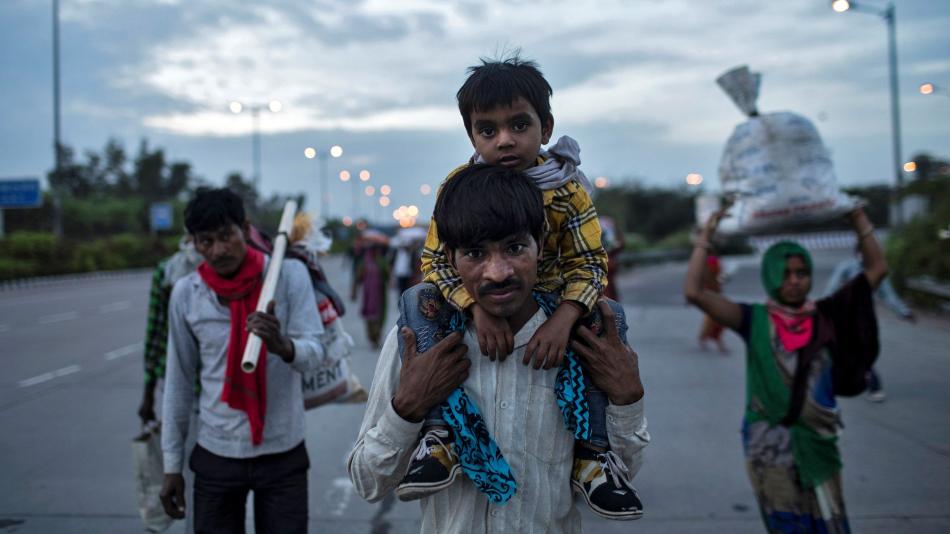
The plight of the informal workers as a result of the lockdown and loss of income got reflected in the panic exodus of migrant workers in their desperate attempt to get back to their homes in the hope of getting food and work in the harvesting season. India has about 40-50 million seasonal migrant workers working in construction sites, factory manufacturing units and services activities. According to a Stranded Workers Action Network  (SWAN) report in April, 2020, 50 percent of the respondents had no rations left even for a single day; while 96 percent had not received rations, 70 percent had not received cooked food from the government; and 78 percent of the respondents had less than INR 300 left.

With transportation system initially shut down, many had to walk hundreds of miles. Many migrant workers died due to the lockdown, with reasons ranging from starvation, suicides, exhaustion, road and rail accidents, police atrocity and denial of timely medical care. The Oxfam report says that they were exposed to inhuman conditions turning the pandemic into a humanitarian crisis. The National Human Rights Commission recorded over 2582 cases of human rights violation as early as in the month of April 2020.

It has been discussed that women are likely to bear the brunt of job losses the most because much of their work is invisible, and they are more likely to work in informal work arrangements. The Oxfam report says that as many as seventeen million women lost their job in April 2020.  Unemployment for women rose by 15 percent from a pre-lockdown level of 18 percent. This increase in unemployment of women can result in a loss to India’s GDP of about 8 percent or USD 218 billion. Women who were employed before the lockdown are also 23.5 percentage points less likely to be re-employed compared to men in the post-lockdown phase.

A survey by the Institute of Social Studies Trust found that among those who could retain their jobs, around 83 percent of women workers faced severe income drop. Sixty-six percent of the respondents also experienced an increase in unpaid care work and 36 per cent reported an increased burden of child and elderly care work during this period . Frontline health workers such as ASHAs experienced a big increase in their work but were not given adequate remuneration for this. The report presents estimates that if India’s top 11 billionaires are taxed at just 1 percent on their wealth, the government can pay the average wage of the nine lakh ASHA workers in the country for 5 years.

As many as ten states passed ordinances and regulations that would dilute the existing labour laws and their application. Changes have been brought in national labour laws, mainly in The Factories Act, 1948, The Industrial Disputes Act, 1947, and The Labour Laws (Exemption from Furnishing Returns and Maintaining Registers by Certain Establishments) Act, 1988.

The Oxfam report says that these changes in the labour laws violate the established standards of the International Labour Organisation and led to the filing of a number of Public Interest Litigations (PIL). For instance, the working hours were increased from eight to twelve hours in a day. The PILs eventually pressurised the Uttar Pradesh government to withdraw the 12-hour work shift. Many other states, however, have continued with the 12-hour work shift, six days a week which has transgressed the mandated 48-hour week as per global standards.

Many state governments have also brought changes that would allow workers to be hired at lower wages. There has also been evidence of workers being partially paid or not being paid at all. According to the Mobile Vaani survey, around 57 percent reported having pending wages and 20 percent had not received any support from their employers in the informal sector. As such, blue-collar workers who are mostly informal and daily wagers have to work longer hours with low wages in premises that will lack clean drinking water, toilet, medical and other occupational safety measures in the light of industrial inspection being suspended. India has 170 million blue-collar workers. Trade unions fear that 70 percent of factories  will fall outside the purview of labour laws exposing workers to exploitation with no legal safeguards while large private corporates gain from the dilution of the labour laws.

Drawing on a wide range of evidence, the Oxfam report argues that despite the adverse impact that the lockdown has had on informal, migrant workers and the economy, studies show that the relief packages have been miniscule. Additional expenditure of the government in the first relief package announced was only 0.5 percent of the GDP and the total additional public spending promised by all the relief measures announced by the end of May 2020 amounted to only around 1 percent of the GDP. Much of it has not reached the intended beneficiaries.

Keeping in view the deepening livelihood and unemployment crisis, this report makes a strong case for a recovery path led by reduction of inequalities and special concern for the needs of weaker sections.

A New U.S. Foreign Policy

Ron Forthofer


President Biden has inherited a terribly flawed US foreign policy. For the past few decades, the pro-corporate US foreign policy has been a catastrophic failure, especially in the Middle East. Our criminal military interventions there have resulted in the devastation of much of that area, impoverished millions, created millions of refugees, and injured or killed millions more. Moreover, this criminal policy has wasted trillions of US taxpayer dollars, injured or killed thousands of US forces, and has badly damaged US strategic interests.

The illegal US use of aggressive sanctions against nations that don’t follow its dictates has also harmed tens of millions of people worldwide. In addition, US pro-corporate trade policies as well as the US-influenced International Monetary Fund and World Bank have impoverished tens of millions in the Third World. Perhaps of even greater importance, the US-led opposition to enforceable policies that ameliorate the effects of climate chaos threatens billions of people.

Clearly these ruinous policies need to be changed. The Biden administration must seize this opportunity and implement a sane foreign policy. Below are some excellent principles that provide a guideline for such a foreign policy. These principles were laid out in the “ Cross of Iron” speech delivered by President Dwight Eisenhower on April 16, 1953. Two lengthy excerpts from this speech are shown next.

He said:

“The way chosen by the United States was plainly marked by a few clear precepts, which govern its conduct in world affairs.
First: No people on earth can be held, as a people, to be enemy, for all humanity shares the common hunger for peace and fellowship and justice.
Second: No nation’s security and well-being can be lastingly achieved in isolation but only in effective cooperation with fellow-nations.
Third: Any nation’s right to form of government and an economic system of its own choosing is inalienable.
Fourth: Any nation’s attempt to dictate to other nations their form of government is indefensible.
And fifth: A nation’s hope of lasting peace cannot be firmly based upon any race in armaments but rather upon just relations and honest understanding with all other nations.”

Later in this speech, Eisenhower added:

“This Government is ready to ask its people to join with all nations in devoting a substantial percentage of the savings achieved by disarmament to a fund for world aid and reconstruction. The purposes of this great work would be to help other peoples to develop the underdeveloped areas of the world, to stimulate profitability and fair world trade, to assist all peoples to know the blessings of productive freedom.
The monuments to this new kind of war would be these: roads and schools, hospitals and homes, food and health.
We are ready, in short, to dedicate our strength to serving the needs, rather than the fears, of the world.
We are ready, by these and all such actions, to make of the United Nations an institution that can effectively guard the peace and security of all peoples.”

Eisenhower also pointed out the implications of spending huge amounts on military weapons in terms of homes, schools, hospitals, etc. that weren’t built.

President Eisenhower plainly recognized that our security and well-being, as well as that of all people on the planet, come from cooperation, not competition. Once we understand this point, the necessary policies become clear. In summary, President Eisenhower, a military icon who knew well the horrors of war, specifically stressed respect for the sovereignty of nations, the need to make the U.N. stronger, spoke against forced changes in regimes or economic systems, called for military disarmament and supported world aid and reconstruction. Even though he wasn’t correct in describing what the US was willing to do or its path, imagine the difference had Eisenhower or any of his successors followed through on his words.

President Biden now has the opportunity to follow Eisenhower’s counsel in a world where US actions have destroyed the myth of its moral authority or of being the exceptional nation. The US must work to rejoin the community of nations by complying with international law instead of running roughshod over it. This means among other things that the US must stop threatening other nations as well as ending its illegal sanctions.

In particular, some possible steps the Biden administration could take in collaboration with the international community are:

  • share covid-19 vaccines with all nations at an affordable cost; may require the temporary suspension of patents;
  • create enforceable steps for dealing with climate chaos including a large and increasing carbon tax; and fulfill funding climate change commitments to Third World nations;
  • drastically reduce weapons spending, disband NATO and rely on the UN and diplomacy for settling conflicts; may require the ability to override a veto in the Security Council;
  • strongly support international law and human rights for Palestinians; also support enforcement of the Right of Return for Palestinians;
  • rejoin weapons treaties including the JCPOA (aka, the Iran Nuclear Deal) and ratify the Treaty on the Prohibition of Nuclear Weapons;
  • pay reparations for their rebuilding to nations the US has devastated;
  • close overseas military bases;
  • end unilateral sanctions, especially those against Venezuela, Cuba, Iran and North Korea; and
  • strongly support the Universal Declaration of Human Rights.

Disappointingly, it appears as if President Biden will continue to pursue the disastrous US foreign policy. It is up to us, we the people, to convince President Biden and Congress to put the public interest over corporate profits.

30 Jan 2021

London’s Wigmore Hall leads the way in live-streaming music during the pandemic

Fred Mazelis


Despite the restrictions forced on live performance by the COVID-19 pandemic, there are some musical institutions that have successfully brought soloists and chamber music ensembles to worldwide audiences online.

Wigmore Hall in London(Photo credit–wigmore-hall.org.uk)

London’s Wigmore Hall stands out in this category. It is famous for its acoustics and, with 552 seats, ideal for chamber music. While larger venues such as New York’s Carnegie Hall (capacity 2,800) and the Metropolitan Opera (3,800) have been forced to close their doors until at least the forthcoming fall 2021 season, Wigmore Hall has presented live performances on an almost daily basis since last June, on many occasions before smaller socially-distanced audiences, and sometimes with no live audience at all.

A report in the Financial Times last week highlighted the achievements of Wigmore Hall during the past year. Its ambitious programming has attracted a huge international audience, proving that there is a demand for classical music, and the potential for a vast increase in its audience, including among the young generation. The Wigmore’s live streams, which began with a recital by pianist Steven Hough last June that has reached an audience of 800,000, are archived in its Video Library and can be viewed and listened to for 30 days after the performance.

Recitalists have included not only world famous artists like Hough and other pianists, including Igor Levit, Angela Hewitt and Paul Lewis, as well as cellist Steven Isserlis and tenor Ian Bostridge, but also younger and less well known artists, such as soprano Kitty Whately, cellist Leonard Elschenbroich, soprano Christine Rice and many others.

The Carducci, Elias, Schumann and Doric string quartets were among those that performed last year, in some cases highlighting Beethoven quartets to mark the 250th anniversary of his birth. The opportunity for close-up views, as with the Elias Quartet’s performances of Beethoven’s sublime late 13th and 14th quartets in a recital last fall, at least partly compensated for not being able to be physically present at the concert.

The regular recitals have also included music of the 20th century, including work by Benjamin Britten, Dmitri Shostakovich and others. They have also on occasion featured far less frequently performed music, such as that of the mid-20th century American composer Morton Feldman, in a recital that reached seven to eight times the number it would have held in the hall, according to the Financial Times report.

While the Wigmore has been forced to interrupt its live programming during the latest lockdown, as COVID-19 rages in London and throughout Britain, it has tentative plans to resume by the spring, with additional recitals by Levit once again, soprano Diana Damrau, pianist Mitsuko Uchida and others.

Wigmore Hall is by no means the only venue or organization that has continued to present programming during the pandemic. Indeed, the majority have done so, although for orchestras and opera companies this has taken the form of films of past performances. The Metropolitan Opera continues its online presentations of performances recorded in recent years, as well as from the more distant past. The company began video broadcasts in 1977.

While orchestras in Detroit, San Francisco and elsewhere have made recordings of past performances available online, many chamber music venues in the US have presented live streamed music. These include the venerable Peoples’ Symphony Concerts in New York City, which is presenting almost a full lineup of its typical annual number of 18 concerts. Music Mondays, another small but admirable effort in New York, is continuing with its monthly series of free concerts, online instead of at its usual Manhattan venue. In addition, some summer music festivals, such as Music Mountain, in northwest Connecticut, have put some programs online.

The Wigmore series, however, is by far the most large-scale and impressive of these efforts, as reflected in the international audience it has reached.

The success of this series, as well as other efforts, also highlights the financial pressures facing nonprofit venues that work to present classical music and expand its audience. The Wigmore has raised donations from listeners, and is on track to raise 1 million pounds [$US1.4 million] by the time of the one-year anniversary of its first recital from last June. This compares to pre-pandemic annual revenue of 7 million pounds, 4.5 million in ticket sales and 2.5 million in grants and donations. Online performances are of course less costly to present, but are still estimated to cost 3,000 pounds per recital, plus artists’ fees.

Pianist Angela Hewitt in Toronto 2017 (Photo credit–Mykola Swarnyk)

European musical presenters receive far more in public subsidies than their counterparts in the US, who in many cases receive virtually nothing. The top one-tenth of one percent, multimillionaires and billionaires, generally reserve their largess for the biggest companies like the opera, and there too, their “generosity” has strict limits, as shown by the Met Opera’s demands for 30 percent pay cuts from its staff, and the lockout of its stagehands that began last month.

The success of Wigmore Hall shows all the more urgently the need for full public support for classical music and all of the arts, directing the resources of society away from profit and towards meeting the material, cultural and spiritual needs of all.

IG Metall agrees to 3,500 job cuts at MAN Truck & Bus in Germany and Austria

Gustav Kemper


The IG Metall trade union has agreed to the destruction of 3,500 jobs at truck and bus manufacturer MAN in Germany and Austria. Further job cuts at the Volkswagen subsidiary are already planned. The company employs 36,000 worldwide.

On Tuesday, the executive boards of MAN SE and MAN Truck & Bus SE, together with representatives of the union and the works council, signed a “key points paper” that is intended to achieve an “improvement in earnings of up to €1.7 billion,” not least through job cuts.

MAN plant in Steyr (Photo: Christoph Waghubinger / CC BY-SA 4.0)

Hardest hit are the plants in Steyr, Austria, with 2,200 jobs, and Plauen, Germany, with 150 jobs. The Steyr plant is to be sold and the Plauen site closed. Workers in Plauen have been offered new jobs at the VW plant in Zwickau, 52 km away. A plant closure could be decided as early as the first half of 2021, IG Metall Zwickau leader Thomas Knabel told the press.

IG Metall stresses that it has been possible to avert the 9,500 redundancies originally announced in the group’s strategy paper and reduce them to 3,500 jobs cut.

First, this is a well-known ruse of the trade unions. Corporations announce a high number of jobs to be cut so that the ultimately lower number can then be presented as a “success” by the unions. Second, even the figures mentioned are a smokescreen to hide the facts from the workforce.

The figure of 9,500 also included international locations and numerous temporary workers have already left in recent months because their contracts were simply not renewed. A few months ago, there were 4,000 workers at the Nuremberg plant. Currently, there are 3,600 workers, and by the end of 2022, there will only be 3,100. The 400 temporary workers who have left the company are not included in the reduction figures.

· In Salzgitter, 1,900 regular employees are to remain at the end of 2022 out of around 2,400 jobs at present, a reduction of 20 percent. “A reasonable amount,” as the IG Metall deputy secretary in Salzgitter-Peine Brigitte Runge puts it.

· In Munich and Dachau, according to the agreement, only 7,500 of the current 9,000 jobs will be occupied at the end of 2022. It is to remain the main production plant for trucks, with cab outfitting and assembly.

· The Nuremberg site is to develop drive technologies in the future. The workforce there is to shrink from 3,700 to 3,100 jobs.

· In Wittich, only 60 permanent employees are to remain.

These are some of the reduced numbers that IG Metall wants to claim as a “victory.” At the same time, however, it is preparing further cuts in upcoming negotiations, which are being kept confidential.

“The contents of this key points paper are to be implemented with a future collective agreement as well as in factory-level agreements,” the group’s press release says. The word “future collective agreement” should set alarm bells ringing for all workers—because IG Metall always takes this to mean job and wage cuts and a deterioration of working conditions. Supposedly, this is to ensure competitiveness and so save the production locations. The opposite is the case; these future collective agreements pave the way for the gradual closure of entire plants and locations.

What the now-agreed key points paper—the saving of €1.7 billion—means in concrete terms can only be guessed at from the announcement of the agreement:

· €550 million are to be saved in “material and personnel costs” in the group. What this means for working conditions and pay will only become clear in the forthcoming negotiations, but nothing good can be expected.

· €700 million are to be saved through the supply chain, i.e., job cuts and wage reductions for those working there.

· €450 million are to be “earned” in additional “distribution services.” Here, too, there is nothing concrete known.

Another hackneyed ritual is the threat of compulsory redundancies. As usual, the MAN group threatened this, and the works councils and trade unions were “up in arms” against it, only to finally agree to the cutbacks by other methods. This time was no exception. Saki Stimoniaris, chairman of the general works council and a member of the company’s supervisory board, had initiated labour court proceedings in September last year against the redundancies announced by the executive board. A “location and employment safeguard” from 2016, which excluded them, was valid until the end of 2030.

Like all such agreements, they are not worth the paper they are written on. Such agreements are only valid if they are not needed by the workers because the profits are flowing. But as soon as the profits dry up and the workers need a guarantee of employment and location, this is no longer the case.

The 2016 agreement on safeguarding jobs at MAN also contains a “right of termination,” known as the “bad weather clause.” This allows for dismissals for operational reasons if sales slump by 40 percent. Before the labour court, the company cited the slump in sales during the coronavirus pandemic and the European Union’s stricter CO2 regulations, which have been in force since 2019. The cutbacks were already on the horizon even before the pandemic, because the group did not achieve its targeted return on sales.

Proceedings in the labour court over the compulsory redundancies are still ongoing, with a verdict not expected until the summer. After Tuesday’s agreement, however, MAN works council head Stimoniaris was already proudly rejoicing. “We take responsibility for our MAN.” The “secret of the success of this proud company,” he said, was that the group could always rely on each individual.

Stimoniaris’ reliability in 2019 cost the MAN Group almost half a million euros, with this functionary pocketing exactly €482,040 for his work on the supervisory board.

After the group announced last year that it would cut 9,500 jobs, the leaders of IG Metall and the VW group immediately stepped in to find a mechanism to quell the anger in the ranks of the workforce.

This was the role played by the key points paper, which involved not only the MAN works council and the executive board of MAN Truck & Bus, but also Jürgen Kerner from the IG Metall executive board (who is also deputy chairman on the MAN supervisory board), Gunnar Kilian, the VW personnel director appointed by IG Metall, and Matthias Gründler, the chairman of MAN’s parent company Traton. All participants agreed from the beginning that workers’ livelihoods had to be subordinated to the strategic corporate goal of achieving an operating return of 8 percent on sales.

Workers can only defend their jobs and wages through a united, independent movement that opposes the capitalist system, which always subordinates workers’ interests to shareholders’ greed for profit. This movement must include colleagues in all international factories. For example, MAN has factories in Krakow, Poland (opened in 2007, with 580 workers) and Starachowice (in the MAN group since 1999, with 3,000 workers), to which production is now to be partially transferred.

Court rules Spanish fascist regime did not commit crimes against humanity

Alejandro López


Spain’s Constitutional Court, empowered to determine the constitutionality of all laws in the country, has ruled that the 1939-1978 fascist regime under General Francisco Franco did not commit crimes against humanity. The ruling constitutes an endorsement by a top European Union court for a four-decade fascist regime and its policy of mass murder and repression.

Adolf Hitler and Francisco Franco meeting in 1940 (Wikimedia Commons)

It is part of the unfolding global ramifications of the January 6 coup in Washington spearheaded by Donald Trump, with much of the Republican party and of the state apparatus. Emboldened by the US Democratic Party’s calls for “unity” with the fascist coup plotters, the adoption of far-right agenda by European governments, and the role of pseudo-left groups in downplaying the fascist threat, the Constitutional Court can publicly deny the atrocities committed by Spanish fascism.

Workers and youth internationally must be warned. If the crimes of fascism are being rehabilitated, it is because powerful sections of the ruling class are plotting to carry out a preemptive counterrevolution against the mass opposition against social inequality and murderous “herd immunity” policies.

On Wednesday, the Constitutional Court ruled 9 to 3 to reject the appeal filed by Gerardo Iglesias over tortures he suffered under the Franco regime. Iglesias, the former secretary general of the Communist Party of Spain (PCE) and founder of PCE-led United Left, appealed the decision of a regional judge not to hear his complaint in May 2018.

Iglesias filed the complaint along with those of two anti-Franco activists who also suffered tortures, Vicente Gutiérrez Solís and Faustino Sánchez García. The defendant, Pascual Honrado, was a former head of the Political-Social Brigade in the region of Asturias. This was a secret police unit, modelled on Nazi Germany’s Gestapo, tasked with repressing opposition movements. Honrado’s extradition requested by an Argentine court was denied by the conservative Popular Party (PP) government in 2015.

Gerardo Iglesias described Honrado as “real beast” in a 2018 press conference. According to the complaint, Iglesias was subjected to police torture on three occasions—in 1964, 1966 and 1974—due to his political and trade union activities.

The Court argued against Iglesias’ appeal on the basis that the statute of limitations on the “presumed crimes” has been reached. In addition, the 1977 Amnesty Law, which was backed by the PCE during the Transition, protects all crimes committed by the fascist regime.

Iglesias then argued that they represented crimes against humanity, for which there is no statute of limitations. The judges responded by shamelessly arguing that crimes against humanity did not exist in the Spanish Penal Code at the time—that is, when the fascist regime still held power and was committing these crimes—and provocatively asserted that the alleged crimes do not fit the category.

It is unquestionably established, however, that the torture of Iglesias is part of the crimes against humanity committed by the fascist regime of General Francisco Franco. Despite the attempts to enforce collective amnesia of its crimes, the Spanish ruling class, both under the dictatorship and the current post-Franco regime, have had to face the fact that its crimes were recorded in countless ways—in tens of thousands of books, films, songs and artworks. Moreover, just over half of the Spanish population was born before the Spanish fascist regime founded by Franco fell.

The Francoite regime’s crimes include:

· The killing of around 200,000 political oppositionists, intellectuals and left-wing workers during the Civil War. Approximately 75,000 were extra-judicially executed behind fascist lines.

· The deliberate targeting of civilians in bombing raids which killed around 10,000 civilians.

· Support to Nazi Germany in its war of extermination against the Soviet Union during the Second World War. It sent 45,000 fascists, the so-called Blue Division, to the Eastern Front.

· Detention of between 700,000 and one million people in 300 concentration camps from the Spanish Civil War into the 1940s. Many died of malnutrition and starvation.

· The use of approximately 400,000 left-wing workers as slave laborers for infrastructure construction.

· The theft of 300,000 babies from poor or left-wing mothers.

· Outlawing all trade unions and political parties and criminalizing strikes and protests.

· Widespread torture of political detainees in police stations and jails.

· Censorship of left-wing newspapers and books.

· Suppression of national minority languages and traditions, including those of Catalans, Basques and Galicians.

To date, only one person has been judged over these crimes: Baltasar Garzón. In 2008, the former judge opened an inquiry into the crimes against humanity committed by the fascist forces during the Spanish Civil War and the years that followed. He was accused of abusing his judicial authority. On this basis Garzón’s career, spanning over three decades, was terminated.

That the Constitutional Court can claim that all the above are not crimes against humanity exposes the rotten character of left populist Podemos, the main government coalition partner of the Spanish Socialist Party (PSOE). Confident that it will not be opposed by what the ruling elite passes off as left in Spain, the Court can make the most reactionary and grotesque assertions.

To date, Podemos has not even posted a Tweet, let alone made a statement on the reactionary ruling. This is despite the fact that the PCE, to which the torture victim Gerardo Iglesias belongs, is part of Podemos.

The ruling has barely received any media coverage. The last thing Podemos wants is to raise the issue of the fascist threat and the international ramifications of the ruling, concerned, above all, it would spark a movement against its own government.

Podemos only acknowledges the far-right danger when mass anger erupts, but otherwise tries to maintain total silence on the issue. One of the few times it spoke out on the issue was last December, when WhatsApp chats were leaked of a group of dozens of retired generals proclaiming their loyalty to Franco and calling for mass murder of left-wing voters to “extirpate the cancer.” One former general wrote: “I think what I’m missing is to shoot 26 million people!!!!!!!!”

Podemos leader Pablo Iglesias remained quiet for days, only to emerge in prime-time public television after mass anger erupted in social media. He brazenly insisted that “What these gentlemen say, at their age and already retired, in a chat with a few too many drinks, does not pose any threat.”

In the following weeks, Iglesias cynical ploy was exposed. Videos emerged of Spanish soldiers singing fascist and neo-Nazi songs and making the fascist salute and WhatsApp chats revealed active duty members supporting the fascist generals appeals to kill 26 million people. Then, on January 6, as Trump launched a fascist coup in Washington, retired Lieutenant General Emilio Pérez Alamán sent a letter to Spain’s Defence Minister demanding a “change the course” of the PSOE-Podemos government.

All these fascist threats are part of an intensifying coup plot by sections of the Spanish ruling class, now emboldened by the developments in the US and internationally, aiming to establish a dictatorship to impose the banks’ “herd immunity” diktat.

This reactionary court ruling of the Constitutional Court underscores that European workers should support the demand of the Socialist Equality Party (US) for an open, public, live-streamed investigation of all aspects and all the allies of the January 6 fascist coup in Washington. The exposure of the coup plotters in Washington will only strengthen the demands for a full exposure of the coup plotters in Spain.

New Zealand: COVID-19 cases highlight risk of new outbreak

Tom Peters


Over the past week three people in New Zealand have tested positive for the more contagious South African variant of COVID-19. They had earlier returned negative test results prior to being released from two weeks of mandatory isolation in Auckland’s Pullman Hotel, one of several hotels that are serving as managed isolation and quarantine (MIQ) facilities for people returning from overseas.

The entrance to the Christchurch Airport Novotel, which was converted into a managed isolation and quarantine facility. (Source: Wikimedia Commons)

A 56-year-old woman recently returned from Europe left the hotel on January 13 and began developing mild symptoms two days later while travelling in the Northland region. She tested positive for the virus on January 23. On January 26 two more Aucklanders, a father and daughter, who had left the hotel around the same time, also tested positive.

The cases highlight the ongoing risk of a serious outbreak in New Zealand, despite Prime Minister Jacinda Ardern’s government being lauded in the international media for supposedly stamping out the coronavirus. Under pressure from workers, Ardern imposed a relatively strict lockdown in March–April 2020, which limited the number of COVID-19 deaths to 25. However, as the pandemic continues to rage out of control in large parts of the world, with 2.2 million dead so far, no country can be considered isolated from the virus.

There is no evidence that the three returned travelers transmitted COVID-19 to anyone else in New Zealand, but the situation remains highly uncertain. Some school principals told Radio NZ yesterday that they were making plans for a return to remote learning in case a new community outbreak is detected. For now, the government has not announced any lockdowns or other restrictions.

The new cases quickly revealed that the Labour Party-led government has failed to properly equip the health system to respond rapidly to an outbreak. Newshub reported on January 25 that “there were wait times of more than six hours and police were called to turn people away” at understaffed COVID-19 testing stations in Northland. Leanne, who had visited the same locations as the Northland case and had developed symptoms, said: “Having a whole year now of experience with this virus should have prepared us far better than this.”

As of Friday more than 36,000 tests had been completed since the positive cases were confirmed.

Vaccines are not yet available and Stuff reported yesterday that “the Ministry of Health does not yet have a vaccination target for border, MIQ and health workers, or a time frame in which it will aim to vaccinate 70 percent of the population.” COVID Response Minister Chris Hipkins told the media that vaccination was “likely to be a year-long process.”

In the meantime, MIQ hotels present a clear risk of further outbreaks. There are currently more than 4,000 people staying in 32 MIQ facilities, and more than 4,000 staff. Yesterday there were 67 positive COVID cases among the returned travelers.

The source of infection for the three cases who stayed in the Pullman Hotel is still unconfirmed. Officials suspect they caught the virus from another person, or from a surface, shortly before the end of their two-week isolation period. The hotel is not taking any new returnees and people currently staying there are being mostly confined to their rooms while the cases are investigated.

Candice Botha, whose two daughters have been staying at the Pullman after returning from South Africa, told Stuff yesterday that one of them had contracted COVID-19 at the hotel and the pair will now have their isolation period extended. Botha said they had witnessed a “clear lack of social distancing” at the hotel, including guests playing basketball and running around.

There have been many warnings about inadequate staffing and safety procedures at the MIQ facilities. On January 21, Stuff reported that a woman quit her job at a MIQ hotel in Christchurch because “she didn’t feel enough was being done to stop workers getting COVID-19 from guests.” There were multiple instances of people not wearing masks, touching surfaces and mixing with others.

Microbiologist Duncan McMillan, who was isolated at the Novotel hotel near Auckland Airport, wrote to Minister Hipkins saying it was “as leaky as a sieve.” He said Defence Force personnel, who have been deployed to guard MIQ facilities, were not properly trained: “They have no idea on how to be careful to the extent that is necessary, and there is seemingly little oversight by trained microbiology professionals.”

Auckland Professor of Medicine Des Gorman told Radio NZ it was “dumb good luck” that the 56-year-old Northland woman had not been a “super-spreader,” like approximately 15–20 percent of coronavirus cases. He said New Zealand remained “very, very vulnerable” with an unvaccinated population and “a very leaky border.”

Gorman called for a temporary border closure to high-risk countries while quarantine facilities are improved, saying: “If you’re coming back from the UK then you shouldn’t be at the Pullman in the middle of Auckland city.”

University of Auckland scientist David Welch told the Conversation on January 27 that the Northland case was the ninth incursion of the virus into the community from a returned traveler since August 2020, when an outbreak in Auckland caused a number of deaths.

Welch wrote that the use of “makeshift” MIQ facilities in the country’s biggest city, “rather than purpose-built facilities,” combined with “the increasing prevalence of the new variants worldwide meant it was inevitable we’d eventually see [the virus] in the community. Unless there are major improvements at the border, we can expect more cases.”

Epidemiologist Nick Wilson has called for purpose-built MIQ facilities and earlier this month told Newstalk ZB it was “crazy” to use hotels in Auckland. He also strongly criticised the practice of using buses to transport MIQ guests from central city hotels to a sports field across town for exercise, telling Stuff: “The authorities are not recognising how infectious this pandemic virus is—and with the new variants it is even more so.”

Another outbreak could have devastating consequences if it is not quickly suppressed. The public health system is severely under-resourced after decades of austerity, and already crowded hospitals could be overwhelmed—as has happened throughout Europe, Brazil, the United States and elsewhere.

Auckland Mayor Phil Goff and Minister Hipkins both stressed this week that a lockdown in the city is unlikely, with Goff telling the media it would be considered as a “last resort.” Prime Minister Ardern has previously assured big business that her government will aim to avoid further nationwide lockdowns, so as not to disrupt profit-making.