2 Mar 2021

US-backed “human rights” resolution to pressure Sri Lanka to break ties with China

K. Ratnayake


Last week, a “Core Group on Sri Lanka” presented a resolution to the ongoing UN Human Rights Council (UNHRC) meeting in Geneva. The resolution focuses on human rights issues, including war crimes during the 30-year civil war between the Sri Lankan military and the separatist Liberation Tigers of Tamil Eelam (LTTE).

Entitled “Promoting reconciliation, accountability and human rights in Sri Lanka,” the resolution, with any modifications, will be put to the vote in the UNHRC on March 22.

Tamil families fleeing war in January 2009 (Source: Wikimedia)

The Core Group includes the UK, Canada, Germany, North Macedonia, Montenegro, and Malawi. Although Washington is not a member of the group, it was behind the resolution, having promoted it last December, following discussions with UK diplomats and Tamil groups in Sri Lanka, including the pro-US Tamil National Alliance.

US Secretary of State Antony Blinken addressed the UNHRC meeting last week via video, calling for his country’s readmission to the UN body.

Blinken hypocritically declared that President Biden’s administration is “placing democracy and human rights at the centre” of its foreign policy.

“We encourage the Council to support resolutions at this session addressing issues of concern around the world, including ongoing human rights violations in Syria and North Korea, the lack of accountability for past atrocities in Sri Lanka, and the need for further investigation into the situation in South Sudan.”

US imperialism is the world’s supreme war criminal. In the last three decades alone, it has launched one war after another in the Middle East, the Balkans, Afghanistan and elsewhere, killing hundreds of thousands of innocent men, women and children.

What US Secretary of State Blinken really meant was the Biden administration, just like its predecessors, will cynically use human rights violations to bring other countries into line with Washington’s geo-strategic interests. Blinken also condemned human rights violations by China and Russia in his video address.

Blinken’s speech and the Core Group resolution have nothing to do with defending human rights in Sri Lanka but are to “persuade” President Gotabhaya Rajapakse to break relations with Beijing and fully embrace Washington’s confrontation with China.

Washington is concerned that the cash-strapped Colombo regime is becoming more dependent on Chinese investments and loans. The debt-ridden Sri Lankan economy is in unprecedented turmoil, seriously impacted by the COVID-19 pandemic and confronting falling exports and the devaluation of the country’s currency.

The Core Group resolution calls for a “comprehensive accountability process for all violations and abuses of human rights committed in Sri Lanka,” including those by the LTTE. It also declares “the importance of preserving and analysing evidence relating to violations and abuses of human rights in Sri Lanka with a view to advancing accountability” by the High Commissioner for Human Rights. Such evidence would be used to “support relevant judicial proceedings” in member states of the UN, i.e., the prosecution of perpetrators of war crimes.

Although not included in the resolution, UN High Commissioner of Human Rights Michelle Bachelet’s report on Sri Lanka in January specifically referred to a failure of “accountability” and proposed referring this to the International Criminal Court. Bachelet also called for targeted sanctions, including the imposition of travel bans and freezing the assets of those “credibly accused of human rights violations” in Sri Lanka.

Addressing last week’s meeting, Bachelet offered support for judicial proceedings in other countries against “the perpetrators of grave human rights violations in Sri Lanka.”

Successive Sri Lankan governments and its military committed numerous war crimes during the 30-year war against the LTTE which began in 1983. The Sri Lankan ruling elite and the media used the LTTE’s terrorist and anti-democratic acts to cover up Colombo’s atrocities.

President Mahinda Rajapakse resumed the war in 2006 with the backing of the US and other imperialist powers, as well as India, after a four-year fragile “ceasefire.” His brother, the then defence secretary and now president, Gotabhaya Rajapakse, supervised these bloody military operations.

In the final months of the war, around 40,000 Tamil civilians were killed, according to UN estimates, and hundreds of young people who surrendered to the military were simply “disappeared.” Washington has never been seriously concerned about these war crimes.

Colombo was heavily dependent on Beijing for financial assistance and supplies of weapons to prosecute its brutal war. The then Obama administration—with Biden as vice president—began its “pivot to Asia” to encircle and isolate China and was hostile to these relations.

Washington used the UNHRC to bring a resolution on Sri Lanka and pressure it to distance itself from Beijing. When that failed, it orchestrated a regime-change operation to oust then President Mahinda Rajapakse and to replace him with Maithripala Sirisena.

Sirisena and his prime minister, Ranil Wickremesinghe, reoriented Sri Lanka’s foreign policy towards Washington and its strategic partner India. The new regime immediately began integrating the Sri Lankan military with US military planning against China. In return, Washington helped Sri Lanka suppress calls for an international war crimes probe and swung its support behind a resolution proposing a so-called “domestic judicial mechanism.”

Following the return to power of Gotabhaya Rajapakse and Mahinda Rajapakse as president and prime minister respectively in the 2019 and 2020 elections, Washington and New Delhi have consistently raised concerns about Colombo’s developing relations with Beijing.

Colombo hopes to appease Washington and New Delhi by declaring that it only has economic relations with China. The Rajapakse regime, however, is heavily dependent on the military to bolster its autocratic rule and vowed to protect it from any war crime investigations.

Addressing the UNHRC last week, Sri Lankan Foreign Affairs Minister Dinesh Gunawardena rejected Bachelet’s report. “The recommendations and conclusions [in the report],” he declared, “reflect the preconceived, politicised and prejudicial agenda which certain elements have relentlessly pursued against Sri Lanka.”

While Gunawardena said nothing about on the Core Group resolution, President Rajapakse wrote to UNHRC member countries seeking their support for Sri Lanka. The diplomatic battle unfolding in the UNHRC over the resolution on Sri Lanka underscores the deepening geopolitical tensions between the US on one side and China and Russia on the other.

China’s Permanent Representative in Geneva Ambassador Chen Xu commended Sri Lanka for its “efforts to actively promote and protect human rights, advance sustainable economic and social development, improve people’s living standard, protect the rights of the vulnerable groups, advance national reconciliation and combat terrorism.”

Without naming any country, Chen said that China opposes the “politicisation and double standards on human rights, as well as using human rights as an excuse in interfering in other countries’ internal affairs.”

China is keen to maintain—and bolster—its influence in Colombo as part of its efforts to counter US threats and in doing so has no concerns about human rights violations in Sri Lanka. Russia’s UNHRC envoy made similar statements opposing any interference in “Sri Lanka’s internal affairs.”

Because of its regional and global influence, Colombo is eager to win Indian support and defeat the UNHRC resolution. But like Washington, New Delhi is hostile to Rajapakse’s relations with China and in 2015, backed the US regime-change operation to remove Mahinda Rajapakse as president.

Last month, however, Colombo angered New Delhi by reneging on an agreement to hand over Colombo Port’s Eastern Terminal as a joint venture amid growing opposition among workers against the privatisation of state-owned assets.

Extreme-right nationalist elements that support the Rajapakse regime also whipped up an anti-Indian campaign against the agreement. Keen to secure a foothold in the strategically-located port, India blamed China, claiming it was behind this campaign to repudiate the agreement.

Without taking a position on the Core Group resolution Mani Pandey, India’s envoy to the UN, said his country supports “the aspirations” of the Tamil minority. He called on Colombo to take the necessary steps for “reconciliation,” and implement the 13th amendment to the constitution of Sri Lanka—a power-sharing arrangement with the Tamil elite. While Colombo is averse to any such power-sharing arrangement, India has continuously used the Tamil capitalist parties in Sri Lanka to pressure successive governments.

The escalating efforts to bring Sri Lanka into line point to the advanced nature of US war planning against China. Washington is making clear to the Rajapakse regime that it must end its political balancing act and fully align itself with US imperialism’s war preparations.

1 Mar 2021

Financial Reserves and the Racial Wealth Gap

Chuck Collins & Omar Ocampo


Why is it that the wealthiest country on earth has the highest death toll of any nation in the world?  And why are Black and Latino people among those experiencing the greatest mortality and hardship during the pandemic?

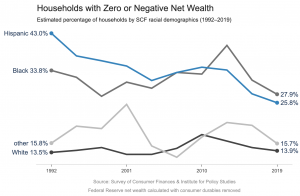
There is excellent research on how the Black-white wealth gap left Black households more vulnerable (see resources below).  But let’s consider the racial wealth divide in financial reserves as measure of precariousness as the U.S. entered into the pandemic.  A much higher percentage of Black and Latino households are part of the vulnerable “underwater nation,” with zero or negative wealth.

According to the most recent Federal Reserve data, 14 percent of white households had zero or negative wealth.  An estimated 28 percent of Black households had zero or negative wealth, twice the level of whites. And 26 percent of Latino households had zero or negative wealth.

This is a slight improvement over previous years.  Emerging from the 2008-2009 economic meltdown, 40 percent of Black households and 34 percent of Latino households had zero or negative wealth in 2013, compared to 16 percent of white households.

By one estimate, from before the pandemic, almost 80 percent of U.S. workers live paycheck to paycheck. Miss one check and you’re taking a second look at what’s in the back of the pantry cupboard.

There is a strong likelihood is that the pandemic will exhaust the financial savings and reserves of many households and we can anticipate an increase in the number of households in “underwater nation.”

Notes:  Our analysis draws from 2019 Federal Reserve data and excludes cars from the calculation of wealth.  Our view is that car ownership is an insufficient indicator of financial well-being and essentially illiquid as a form of wealth.

As schools reopen, UK educators among top groups at risk of catching COVID-19

Margot Miller


A report by the UK’s Office for National Statistics (ONS) found that educators are among the occupation groups most likely to contract COVID-19.

The “Coronavirus (Covid-19) Infection Survey: characteristics of people testing positive for Covid-19 in England, 22 February 2021” analysed data between September 1, 2020 and January 2021, putting education workers "at the upper end of the continuum".

Reception teacher Elizabeth Dockry places signage in a classroom before the reopening of Lostock Hall Primary school in Poynton near Manchester, England, Wednesday May 20, 2020. (AP Photo/Jon Super)

The likelihood of all occupations testing positive for the virus fell between the range of 2.1 percent to 4.8 percent. Educational professionals were in the “higher” risk group, which included “caring personal service occupations, protective service occupations, secretarial and related occupations and other managers and proprietors.”

Educators came fourth out of 25 occupations, with a 4.4 percent likelihood of catching the virus. The differences between those at the top of the continuum and those at the lower end at less risk were found to be “statistically significantly different.”

The government has attempted to conceal the number of infections and fatalities in schools and other workplaces, but an analysis of official figures reveals that at least 570 education workers lives have already been taken by Covid.

The latest ONS report was published February 22, the day after Prime Minister Boris Johnson announced the Conservative government’s roadmap for the “irreversible” lifting of the “last lockdown”. Publicly embracing the homicidal policy of herd immunity that has led to at least 135,000 fatalities, Johnson declared that the population must “accept that there will be more infections, more hospitalizations and … more deaths”.

The economy will fully reopen by June 21, before the virus can be suppressed, with new more deadly strains emerging, and the vaccination rollout only in its early stages. Schools and colleges reopening are pivotal to these plans, forcing millions of pupils and workers, including teachers, support staff, caterers and caretakers into a highly dangerous environment. Schools are to reopen from March 8 in England and the phased reopening of schools began a week ago in Scotland and Wales.

The narrative spun by politicians and the media is that attempts to suppress the virus should be measured against the harm this does to “the economy”, i.e, the profits of the corporations. The ruling elite insists that the working class must accept the new normal and send their children to school so they can go to work and risk death.

Discussions are open about what is an “acceptable” level of death. Former head of Ofsted (schools inspectorate) Sir Michael Wilshaw declared on the BBC’s Newsnight that teachers should show “a similar commitment” as medical professionals, some of whom “have sacrificed their lives.”

The Department for Education (DfE) dismissed the ONS findings on the dangers facing educators with a statement by Professor Viv Bennett, chief nurse and director of maternity and early years at Public Health England. She wrote, “It is vital for children’s wellbeing that we get schools open again.

“Staff, parents and pupils can feel reassured by scientific evidence that shows transmission in schools is low and that children are not drivers of infection in schools or the wider community.

“The system of controls and the introduction of rapid testing programmes in place in schools offer further reassurance in the measures taken to maximise the safety of the school environment.”

The clam that opening schools at the height of a deadly pandemic is out of concern for children’s wellbeing is absurd. Education and children’s services have been cut to the bone since the 2008 banking crisis. Progressive child-centred initiatives introduced in the 1960’s have long been replaced with rigorous targets and testing, to the detriment of children’s mental health.

The assertion that transmission from schools to the community is low is refuted by the government’s own Scientific Advisory Group for Emergencies (SAGE). The TES, (formerly , Times Educational Supplement ) reported minutes from a SAGE meeting that estimated “the opening of primary and secondary schools is likely to increase effective R [Reproduction of the virus] by a factor of 1.1 to 1.5 (10 percent to 50 percent).”

Numerous scientific studies have proved that children do catch, transmit and in some tragic cases become seriously ill with the virus, and die. Recent data from Quebec, Canada suggests children age nine or younger have the highest susceptibility to catching the B.1.1.7 (UK) variant of Covid-19.

Rapid testing offers no reassurance that levels of infection can be monitored. Lateral flow tests were previously abandoned, due to impracticalities and because they are not accurate.

The measures referred to by Bennett are an even more relaxed version of the ineffectual guidelines produced by the DfE when schools opened in September. Last week, the government reversed its guidelines and said that testing and wearing masks would not be compulsory in schools.

Previous guidance that two or more confirmed Covid cases in 10 days constitutes an “outbreak” has been relaxed to 14 days. SchoolsWeek reported the government “anticipates that it will no longer be necessary to advise shielding [for Clinically Extremely Vulnerable pupils and staff] beyond the end of March 2021”.

Last July 15, the infection rate was seven per 100,000 according to SAGE member Karl Friston of the University College London. He estimates that by March 8 it will be 42 per 100,000. Within two months after the September reopening there were 8,000 outbreaks in schools, so far worse can be anticipated.

Reopening schools is being backed to the hilt by the opposition Labour Party and the education unions. Throughout the pandemic, they have supported the government in suppressing educators acting alongside parents to maintain lockdown until the virus is suppressed.

Dr Mary Bousted, joint general secretary of the National Education Union (NEU), responded to the latest ONS report by reiterating the union’s support for the government’s roadmap, saying only that it must done safely, according to the NEU’s Education Recovery plan. But schools cannot be made safe because social distancing is impossible in a school setting.

To defuse the growing opposition of educators, the NEU has organised another zoom meeting of its members on March 1, advertised to discuss how to #MakeschoolsSafe. The meeting is being held at 5pm Monday, a week after many education staff nationally were sent back into classrooms.

Teachers took to Twitter to express their disgust at the union. One tweet declared, “I think your only choice is to ballot teachers and call a strike—parents would support you.”

Another stated, “You can’t send your members back to workplaces that are not safe. You’re playing fast and loose with their lives their families, and children and their families’ lives. You are their protection. You’ve not done a great job so far.”

Other comments included, “You must take a stand. Lives really do depend on it”; “What on earth do we pay you for? If you don’t take action during a global pandemic… then when will you?”

On teacher wrote, “It’s not a road map; It’s a shameful experiment; New Variant v. human lives; It starts on March 8; It lasts 5 weeks; Then they count the dead teachers. And call them statistics.”

School staff, pupils and their families face great danger. Longer school days and shorter holidays, to be implemented as part the government’s catch-up program for lost learning during lockdown, not only means the intensified exploitation of an already exhausted section of the working class. Under such conditions the virus will have greater opportunity to spread.

Memoirs of ex-army commander expose drive toward dictatorship in Brazil

Miguel Andrade


The publication in early February of the memoirs of Eduardo Villas Bôa, Brazilian Army commander between 2015 and 2019, has thrown national politics into turmoil and exposed the drive towards dictatorship in the sixth most populated country in the world.

A political crisis was unleashed by the book’s foremost revelation, in which Villas Bôas claimed the Army High command had full knowledge of a tweet he posted in 2018, on the eve of the vote by the Constitutional Court (STF) on a habeas corpus petition by former president Luiz Inácio Lula da Silva. Lula was serving a nine-year sentence for corruption and was the frontrunner in polls for the October presidential elections, which the fascistic Jair Bolsonaro would later win. Three members of the high command in 2018 are current ministers in the Bolsonaro administration.

The book is an edited version of 13 hours of interviews with Villas Boas by Getúlio Vargas Foundation (FGV) military researcher Celso de Castro.

General Villas Bôas testifying before the Brazilian Senate Foreign Relations Committee in 2017 (Credit: Geraldo Magela/Agência Senado)

On April 2, 2018, Villas Bôas tweeted: “In the situation currently confronting Brazil, we must ask the institutions and the people, who is really thinking of the wellbeing of the country and future generations and who is only worried about personal interests?” He concluded menacingly: “I reassure the nation that the Brazilian Army shares the desire of all good citizens in repudiating impunity.”

The most senior member of the court, Justice Celso de Mello, decried the tweet as appearing to foreshadow “the resumption of attitudes that are strange and harmful to constitutional orthodoxy,” referring to the pressure exerted by the 1964-1985 US-backed military dictatorship over the court, which remained formally open during the blood-soaked regime. In what was effectively a vote taken at gunpoint, Lula’s habeas petition was defeated by a 6-5 majority.

The book’s revelation sparked a political frenzy. On February 15, STF Justice Luiz Fachin, who was at the time the rapporteur on Lula’s habeas petition, called the revelations “intolerable and unacceptable.” Villas Bôas reacted on Twitter a day later with menace and contempt. He posted a link to a news report of Fachin’s declaration and wrote, “three years later.”

On February 19, the escalating crisis led to the unprecedented arrest of Brazilian House member Daniel Silveira, of the Social Liberal Party (PSL)—on whose ticket Bolsonaro was elected—for defending the general as well as the January 6 Washington putsch in a YouTube video, and calling the 1964 US-backed coup establishing the 21-year military regime a “warning” to STF members.

Silveira, a former Rio de Janeiro Military Police soldier, filmed his arrest live and contemptuously said he had already been arrested “90 times” for military offenses and knew exactly what was coming. Currently detained in a military prison, he is reportedly being treated as a “hero” by inmates, other fascistic soldiers deemed too dangerous even by a force that murders over 6,000 Brazilians a year. Silveira was already investigated by the STF for collaborating with a fascist group known as “The 300 of Brazil,” which campaigned throughout 2019 for the army to shut down the court to halt corruption probes against Bolsonaro.

A few days later, further exposing the political dangers being recognized by Brazilian authorities, former Defense Minister Raul Jungmann wrote an open letter to the STF appealing for it to bar recent decrees by Bolsonaro deregulating gun ownership. He warned that the increased arming of civilians “evokes the blight of civil war,” citing the January 6 coup attempt in Washington as an example of what might happen in Brazil. Bolsonaro himself has already threatened not to recognize the 2022 election results if he loses, claiming that election fraud would make the presidential elections in Brazil “worse than those in the US.”

Jungmann’s warning is even more significant, coming from a senior figure in the right-wing government of President Michel Temer. Temer came to power through the impeachment of Dilma Rousseff of the Workers Party (PT) with a mandate from the financial markets to impose brutal austerity on Brazilian workers. Also, Silveira’s arrest was ordered by STF Justice Alexandre de Moraes, Temer’s former justice minister.

He is considered the main representative in the court of the Brazilian Social Democracy Party (PSDB), the former traditional right-wing opposition to the PT, which entered into a coalition with Temer. Moraes opened the investigation into the “300 of Brazil” fascists in 2019 based on the reactionary dictatorship-era National Security Law, which originally targeted left-wing guerrillas.

The arrest of Silveira was a dangerous move. Both Bolsonaro’s intelligence chief, Gen. Augusto Heleno, and Attorney General Augusto Aras have warned repeatedly that they view the Constitution as allowing the calling out of the army in cases of an “overreach of power”—the exact term used by Bolsonaro loyalists to describe Silveira’s arrest.

The move also risked activating Bolsonaro’s base among junior officers and soldiers of the state-controlled Military Police, which form Silveira’s constituency. In March 2020, a strike by Ceará state Military Police was organized by Bolsonaro allies and led to open reports in the press that governors were afraid the police might turn against them if they opposed the president. Bolsonaro has proposed to amend the Constitution to create a rank of Military Police General under his control, to which governors reacted with a mix of nervousness and fear, calling it a breach of states’ rights.

The House, which eventually upheld the arrest, had to postpone its vote on the issue to allow room for negotiations with the STF and the army. In an indication of the reactionary content of these negotiations, the Rio de Janeiro Military Club, known as the place where the 1964 coup was planned, seized on Moraes’ use of dictatorship-era legislation, issuing an open letter asking if the same criteria applied against Silveira would be used against the left.

For his part, former Defense Minister Jungmann is spearheading the return of the military, and particularly the army, to political life in Brazil, barely 30 years after they were forced to retreat by the powerful strike movement which brought the dictatorship to an end in 1985. A former Communist Party member, Jungmann politically sponsored the 2018 federal intervention against crime in Rio de Janeiro, which saw the army all but depose the governor and police the streets. He is now the public face of the newly founded CEDESEN think tank, which describes itself as the first think tank dedicated to defense issues in the country. He shares this platform with Temer’s former intelligence chief, Gen. Sérgio Etchegoyen, a key ally of Villas Bôas whom Rousseff declined to punish when he criticized a Congressional Truth Commission into the crimes of the 1964-1985 dictatorship.

The revelations in Villas Bôas’ memoirs were not entirely new, as the general himself had previously declared his position to be that of the entire high command. But by naming as his direct co-thinkers key ministers in the Bolsonaro government, Villas Bôas lent additional weight to worries that the deep involvement of the military in this deeply unpopular administration will provoke uncontrolled social opposition and engulf it in the deep crisis affecting bourgeois rule in Brazil.

Bolsonaro has filled positions throughout his government with active and retired members of the armed forces, whose ranks now number over 6,000, more than at any previous point in history, including under the military dictatorship.

Most significantly, the military has been directly mobilized in support of Bolsonaro's murderous herd immunity policy in the face of the COVID-19 pandemic, with an active duty general heading the Health Ministry, and the army being employed to produce hydroxychloroquine, which Bolsonaro relentlessly promotes as a cure for COVID-19. Brazil has the second largest number of COVID-19 deaths in the world, having just passed the quarter million mark.

Under these conditions, official reaction to the crisis has been to downplay the risk of dictatorship with empty reassurances that the “checks and balances of democracy” are working. This attitude was personified by STF president Luiz Fux, who cast himself as conduit for the military, declaring on February 19 that Defense Minister Fernando Azevedo had told him the Villas Bôas allegations were not true and there had been no meeting to discuss the tweets.

As for the nominal target of the conspiracy, the Workers Party, its attitude towards the crisis is a mixture of deception, cowardice and hypocrisy. PT party president Gleisi Hoffmann, a House member for the state of Paraná, reacted with a perfunctory call for a congressional testimony by the current defense minister and Army commander.

Lula’s former foreign and defense Minister, Celso Amorim, told one of the party’s mouthpieces, Carta Capital magazine, that the revelations meant the tweets were a coup, and he was surprised by them.

In reality, the PT is principally responsible for the current dangers faced by the Brazilian working class, which cannot be stressed enough.

It was the PT that named Villas Bôas as army commander. It covered up for his threats when they were made in order to contain public reaction and cast itself as the best alternative for the Brazilian ruling class, as it had been considered for the better part of the 21st century.

In April 2018, Lula was barred from running for the presidency, but the acceptance of his habeas petition by the STF was seen as a potential turning point in appeals that could reverse this situation. Lula had been sentenced for receiving a beachfront penthouse from one of the key defendants in the Lava Jato (Carwash) corruption probe, the OAS construction company. While Lula was unquestionably at the center of the vast bribery and kickbacks scandal that centered on the state-run energy giant Petrobras, his appeals were based on the fact that he never established ownership or made use of the penthouse.

Business lobbies opposed Lula’s candidacy, worried that he would come under pressure to slow down the brutal austerity implemented by the right-wing factions which had ousted the PT in the trumped-up 2016 impeachment of Rousseff.

Those factions exploited the massive corruption schemes overseen by the PT and uncovered by the Lava Jato corruption probe, despite being involved in them up to their necks. They used the less than two years of Temer’s caretaker administration to impose a draconian 20-year freeze on health, education and public works spending and enact a labor reform authorizing zero-hours contracts and provoking massive pay reductions.

At the time of Villas Bôas tweet, the PT bent over backwards to cover up for the army’s assault on civil institutions, absurdly blaming the Globo media conglomerate for “manipulating” the tweet in order to vilify Lula. The PT chose not to alert the working class to the dangers of Villas Bôas’ threats, instead boasting treacherously that it had spent record sums on the military.

Villas Bôas had been named army commander by Rousseff in 2015, the youngest of candidates in a break with tradition. He was chosen on the grounds that he was supposedly a constitutionalist and opposed to the questioning voiced by other commanders of the work of the Congressional Truth Commission established in 2012 to investigate the crimes of the 1964-1985 dictatorship.

He had defended Lula’s rearmament program in 2015 before Congress as a “landmark achievement” and received standing ovations from the PT’s Senate caucus in 2017 when he publicly denied that the army considered intervening in the crisis of the Temer government. Barely a month before his coup threat on the eve of the habeas vote, Rousseff’s former defense minister, Jaques Wagner, publicly praised Villas Bôas, declaring: “Villas Bôas is a classical military man, a nationalist Brazilian who abides by the law. He has always become a leader wherever he commanded for being brave, kind and compelling. He is a democratic figure, someone who looks forward”—implying that he was not a defender of the 1964 coup and would never support extra-constitutional intervention by the military

As late as May 2019, when Villas Bâs came under fire from the Brazilian fascist ideologue Olavo de Carvalho, a key ally of Bolsonaro and bridge between him and the US far right, Jaques Wagner came to his defense, calling him “my Army commander.”

The closest historical analogy to the events that have unfolded in Brazil is Salvador Allende’s nomination of Augusto Pinochet as the commander-in-chief of the Chilean Army in 1973, providing him the means to overthrow Allende himself.

The working class must draw the lessons of the latest revelations in Brazil and fight to break the straitjacket of the Workers Party, whose main objective is to prevent the drive towards dictatorship being countered by a mass movement against the source of the crisis, the capitalist system.

One-third of US museums might close in 12 months, American Alliance of Museums warns

David Walsh


On February 22-23, Museum Advocacy Day, the American Alliance of Museums (AAM) issued a statement warning that one-third of US museums were at risk “of shuttering permanently within the next twelve months without immediate financial support.” That would mean, the AAM indicated, the loss of 12,000 museums and 124,000 jobs.

The Biden administration, although it may pay lip service to concerns about the situation, will essentially continue to implement the policy pursued by Democratic and Republican governments at every level for decades: “malign neglect” toward arts and culture. The bankrupting of thousands of arts organizations and the expulsion of tens of thousands of musicians, actors, dancers, visual artists and others from the field of their choice during the COVID-19 pandemic go hand in hand with the fabulous enrichment of a handful of plutocrats.

The AAM figures are consistent with the organization’s earlier statements released in July and September 2020.

San Francisco Museum of Modern Art (Photo credit–Beyond My Ken)

Laura Lott, AAM President and CEO, commented recently, “While the museum field received record levels of support from the federal government in the past 12 months, the funding provided only temporary relief. Museum recovery will take years and without a sustained Congressional lifeline, I fear that many museums will be lost forever.” Lott has argued that the permanent closure of the 12,000 museums would be “devastating for communities, economies, education systems, and our cultural history.”

In November, she pointed out that the “financial state of U.S. museums” was moving “from bad to worse.” Lott noted at the time that “30 percent of museums remain closed since the March lockdown and those that have reopened are operating on an average of 35 percent of their regular attendance—a reduction that is unsustainable long-term. Those that did safely serve their communities this summer do not have enough revenue to offset higher costs, especially during a potential winter lockdown.”

In October, Seattle-based Wilkening Consulting—on behalf of the AAM—found that, on average, individual museums had lost about $850,000 in revenue in 2020 due to the pandemic. Museum directors on average anticipated losing the equivalent of 35 percent of their annual operating income by the end of the year.

A spokeswoman for the consulting firm asserted that the current situation was “not sustainable, especially when over half of museums have less than six months of financial savings left to survive.”

Columbus Museum of Art (Photo credit–Ɱ)

In November, more than half of responding institutions in the US reported to the AAM having to furlough or lay off staff. The museums indicated that approximately 30 percent of their staff were currently out of work. The positions most affected by job losses included frontline (68 percent), education (40 percent), security/maintenance (29 percent) and collections staff (26 percent). The AAM argues that museums in the US support 726,000 direct and indirect jobs.

While museums in most locales are now open, attendance is sharply down and the institutions have taken the opportunity in many cases to reduce staff and wages, permanently if possible. In late August, for example, the San Francisco Museum of Modern Art (SFMOMA) imposed a 20 percent cut on all staff salaries. Critics pointed out there was a considerable difference in the impact of such a reduction on executives earning $400,000 a year and workers making $20 an hour.

The Columbus (Ohio) Museum of Art announced in October it was cutting 31 percent of staff. Columbus executive director Nannette Maciejunes told the Columbus Dispatch, “We did everything we could for seven months. … But what has crushed us is that we get a full third of our revenue from earned income.” She said attendance at the time was hovering at about 25 percent to 30 percent of the normal figure, which Maciejunes said “seems to be about the national average, in talking to my colleagues around the country.”

Last month, the Museum of Contemporary Art Chicago (MCA) eliminated some 11 percent of its staff, citing financial losses generated by the pandemic. Hyperallergic reported that, like other institutions across the US, “the MCA shuttered in March 2020 to help contain the spread of the virus and reopened its doors in August. Thanks in part to a $2 million forgivable loan from the Paycheck Protection Program, it had avoided layoffs of its full-time staff until now, and continued to pay full- and part-time staff during the first four-month period of closure.”

Rijksmuseum Amsterdam, Atrium (Photo credit–Hajotthu)

A similar story is being repeated, to one extent or another, at hundreds, if not thousands, of museums and other cultural organizations.

The miserably low level of government support in the US makes its smaller and “weaker” museums, i.e., those not enjoying the beneficence of one or more billionaires, especially vulnerable, but the process is a global one.

The International Council of Museums (ICOM) reported in May, in an initial study, that “a dire situation” faced museums and museum professionals around the world. Ninety-five percent of the world’s institutions closed down in response to the outbreak of the pandemic.

Based on information gathered in September and October, the ICOM reported that “16.2 percent of respondents stated that at least a quarter of the museum staff had been laid off or furloughed between February and September 2020 following the COVID-19 crisis, a figure that rises to more than half of the personnel for 10.6 percent of participants.” (Emphasis added.)

The ICOM noted that the situation for freelance museum professionals had slightly improved since April, but remained “alarming.” Among the freelance respondents, 10.7 percent said they had been temporarily laid off, and 16 percent had not had their contracts renewed. The study observed that the “freelance and consultancy sector is very fragile.” Nearly 41 percent (40.9 percent) of the respondents stated that they would have to suspend the payment of their own salary as a result of the crisis, and 28.9 percent said their employers would have to reduce the number of staff. Appallingly, some 27.5 percent of freelance museum professionals were “considering changing their career entirely.”

Nearly 13 percent of the world’s museums indicated they might have to close for good because of the consequences of the pandemic, and nearly one-third of them planned to reduce staff. The ICOM study reported that “82.6 percent of the respondents anticipate that museum programmes will have to be reduced and 29.8 percent expect that the number of staff will have to be reduced.”

German broadcaster Deutsche Welle reported recently that the Rijksmuseum in Amsterdam, the home “of masterpieces by Dutch Golden Age painters such as Rembrandt and Johannes Vermeer,” had “two million fewer physical visitors in 2020.”

The Louvre in Paris, the most visited museum in the world, experienced a 75 percent drop in visitors in 2020, “especially travellers from remote countries like China and US.” The Louvre is predicted “to have lost around 90 million euros in revenue last year.”

According to the ICOM, the pandemic-induced museum closures will have a particularly devastating impact on those regions “where museums are recent and few and where structures are still fragile: in African, Asian and the Arab countries 24, 27 and 39 percent respectively fear that museums may close,” compared to “only” 12 percent in Latin America and the Caribbean, 10 percent in North America and 8 percent in Europe.

In this arena too, the coronavirus pandemic is accelerating and amplifying already existing trends. The various statistics add up to increased social misery for hundreds of thousands of arts workers and a further and sustained attack on the ability of wide layers of the population to have access to art, history, science and culture generally.

On several occasions, Lott of the AAM has repeated a similar notion: “There is no financial safety net for many museums.” This is perfectly true, but Lott, one suspects, takes this entirely for granted. But why is this so? Why, in fact, is there no “safety net” for museums, schools, hospitals and every other institution critical to the population’s physical or spiritual well-being, whereas Wall Street parasites and financial sharks are cushioned from suffering losses and showered with cash to the tune of trillions of dollars? Ay, there’s the rub.

Australian university workers and students face new wave of job cuts and “commercialisation”

Mike Head


Australian university managements have announced hundreds more job losses over the past fortnight, adding to the 90,000 jobs that the National Tertiary Education Union (NTEU) estimated they destroyed in 2020. Increasingly, academics and professional workers are being forced to compete with each other in “spill and fill” contests for the remaining positions.

In a related move, the federal government has launched a new drive to tie university funding to “research commercialisation,” with Education Minister Alan Tudge declaring the need for academics to become “entrepreneurs.”

These developments further demonstrate that the COVID-19 pandemic is being exploited to accelerate a decades-long offensive against university workers and students. Far beyond the impact of the pandemic itself, government funding cuts and corporate restructuring are being intensified.

University of Sydney's Main Quadrangle. (Image credit: Jason Tong/Wikipedia)

Not only are the livelihoods and basic conditions of thousands of university employees being destroyed. Students confront larger class sizes and lower quality courses, and universities are being transformed even more into business entities serving the commercial and strategic demands of the financial elite.

Last week, Sydney’s Macquarie University took to a new level a Hunger Games -style “spill and fill” process, already seen at Sydney University and the University of Queensland late last year. The Macquarie management released “change proposals” that aim to eliminate about 90 full-time positions and require academics to fight each other for survival, on top of 109 “voluntary” redundancies already inflicted in 2020.

The business school is targeting the equivalent of 17 to 27 full-time positions, the science faculty “approximately 31–38 FTE (full-time equivalents)” and medicine “between 18 and 25 FTE.” The change papers identify academic roles that will be “in scope” or targeted for retrenchment. Those staff will have to submit application documents making a case for their retention, competing against their colleagues as judged by the university’s promotion criteria.

In the Faculty of Science and Engineering, for instance, 103 academics (or FTE) will compete for 65 positions. In the Faculty of Medicine, Health and Human Sciences, 100 academics will compete for 75 posts.

As the management stated, these plans are in accordance with the process set out in its 2018 enterprise agreement with the NTEU, which merely requires “consultation” with the union and staff members before being implemented.

The essential purpose of such “consultation” was revealed last month at Western Sydney University. Despite that university reporting a surplus for 2020, the NTEU admitted at a staff meeting that more than 200 jobs would be scrapped, not counting casuals and fixed-term workers, as the management’s 35 or so “change proposals” were finalised.

The union claimed that the “consultation” process instigated late last year had been successful because most of the jobs would be eliminated via “voluntary redundancies.”

As this response typifies, the trade unions work with employers to facilitate job cuts, and stifle workers’ opposition, by helping to pressure enough workers into taking retrenchment packages, supposedly as a matter of “choice,” to satisfy management’s requirements.

At the University of Melbourne, vice-chancellor Duncan Maskell sent a letter to staff last week declaring that savings of $252 million must be achieved in 2021, on top of $360 million in 2020, regardless of an operating surplus of $8 million in 2020. He said the pandemic had created a “pipeline problem” that would affect the university for multiple years, requiring up to 450 job losses. Revenue had dropped $275 million in 2020, and another fall of $200 million was projected for 2021, as international students remained shut out of the country.

As at all the country’s 39 public universities, these official job loss figures do not count the far greater number of casual and fixed-term workers who have been laid-off. Universities Australia, the employers’ organisation, last month said 17,300 full-time equivalent jobs had been abolished in 2020, but the real figure is close to the NTEU’s previous estimate of up to 90,000.

This is part of an international assault on the jobs and conditions of university workers and students. The United States Department of Labor published a report last month that said US colleges and universities had cut a total of 650,000 jobs since February 2020—13 percent of all US higher education workers—ranging from professors to food service employees.

The NTEU, like the education trade unions in the US and elsewhere, has systematically suppressed resistance to this escalating offensive. At the start of the pandemic, the NTEU offered employers wage cuts of up to 15 percent, supposedly as a “job protection” scheme, but nevertheless said it would accept thousands of redundancies.

When outraged university workers objected, rejecting the union’s betrayal, some university employers pulled out of that national deal, concerned that the NTEU could not enforce it against its members. But the NTEU then proceeded to strike similar agreements with individual universities, bulldozing them through despite members’ discontent.

The NTEU’s response to last week’s Macquarie announcement was typical. Michael Thomson, the union’s New South Wales state secretary said: “We call on the university management to sit down and negotiate with the union over alternative measures. If the management doesn’t have the decency to negotiate, then we will fight these callous job cuts.”

That is, the NTEU’s only concern is to retain its position at the bargaining table. Talk of “fighting” the cuts is for PR purposes only, both to placate members’ anger and convince management to keep engaging the union’s services as the police force best equipped to impose the cuts.

Likewise, the Liberal-National Coalition government’s latest edict on tying research funding to “commercialisation” and the “national interest” is only possible because of the NTEU’s long record of collaboration with the employers and governments.

Having deliberately starved the universities of funding throughout the pandemic, the government is now seizing on the crisis to intensify its corporate strategy. In a speech at the University of Melbourne last Friday, Education Minister Alan Tudge declared: “We want academics to become entrepreneurs, taking their ideas from the lab to the market.”

Tudge said the current funding model, where an average 25 percent of universities’ revenue relied on international students, had not only been disrupted by COVID-19 but was not sustainable beyond the pandemic. Instead, universities would be funded to “help us build our sovereign capabilities.” Tudge said this “great national project” included developing medical capacities, such as vaccine production, but extended to “security, manufacturing and energy.”

These remarks, coming on top of the government’s recent overturning of research grants that would allegedly benefit China, point to the growing integration of the universities into preparations for a US war against China to maintain Washington’s post-World War II hegemony.

Opposition Labor Party education spokeswoman Tanya Plibersek made it clear that her party agrees with this agenda. Her only criticism was that the government’s “research support” had come too late for thousands of university staff who lost their jobs in 2020.

With the help of the NTEU and other education trade unions, Liberal-National and Labor governments alike have implemented decades of market-driven education “reforms.” The last Greens-backed Labor government lifted caps on student enrolments and cut tertiary funding by $2.7 billion in 2013, forcing universities to constantly fight each other for enrolments, particularly from full-fee paying international students.

Labor’s market-style “education revolution” was endorsed and policed by the NTEU, underlining its own commitment to meeting the strategic, vocational and profit-making demands of the Australian capitalist class.

New Zealand government policies worsen housing crisis

Chris Ross & Tom Peters


On February 25, New Zealand’s finance minister Grant Robertson took the unusual step of instructing the Reserve Bank to “take into account the government’s objective to support more sustainable house prices” and affordability when setting monetary policy.

The statement directed to the central bank is an empty gesture, which will do nothing to halt out-of-control housing prices and rents. It indicates growing alarm in ruling circles about anger in the working class over the escalating housing crisis.

Robertson was warned in early 2020 that the Reserve Bank’s policies of ultra-low interest rates and quantitative easing, which the government fully supports, would push up house prices and worsen social inequality. Since March the central bank has been printing up to $100 billion dollars to buy bonds from commercial banks, in order to protect their profits during the economic crisis.

A modified container in Wellington, advertised for rent at $390 a week. (Source: Twitter)

Since the Labour Party-led coalition was formed in 2017, every measure supposedly aimed at making housing more affordable has proven to be a fraud. Labour initially promised that its KiwiBuild scheme would deliver 100,000 “affordable houses,” in partnership with private developers. By October 2020, however, it had built only about 600 houses. These were typically priced at over $600,000, well beyond the means of most working people.

The Organisation for Economic Co-operation and Development’s housing affordability report in January, based on data from 2019, said that over half of the poorest 20 percent of NZ workers “spend more than 40 percent of their disposable income on rent or mortgage payments.”

Just 64.5 percent of households own the house they live in, the lowest level since 1951. Quotable Value, a state-owned property valuer, reported the average house in Auckland was worth $1.2 million at the end of January. The national average was $815,898, up 12.96 percent from a year ago.

Trade Me Property, the main property-listing website, reported that in January Auckland rents reached an all-time high of $590 a week. In the working-class area of Porirua, near Wellington, median rents were $680, a sharp increase from $595 just two months earlier.

Last month, over 2,000 families joined New Zealand’s public housing waiting list, bringing the total to almost 22,500. More than 8,000 households in need of a home joined the list in 2020.

The government’s new “Public Housing Plan 2021-2024” states that it will fund 6,000 extra state houses, mainly in the North Island. In total, including promises made in 2018 and 2019, the government says it will increase the public housing supply from 67,200 in 2018 to 81,300 in 2024, and fund 6,641 “transitional” units for short-term occupation. Even if these numbers were to be achieved they would not be enough to meet the present level of need, let alone provide for the thousands more families joining the wait-list every year.

The government has not embarked on a major program of house building. On February 24, Stuff reported that only half of the 6,850 “new” public housing places added in the three years to June 2021 were newly-built houses. The rest were existing houses that the state has “leased, bought in the private market, or sourced from councils and community providers.”

Monte Cecilia Housing Trust chief executive Bernie Smith told Stuff the public housing plan will create 4,323 housing places by 2024 in Auckland, despite there being 7,823 applicants in the city. People would continue “being pushed into homelessness and poverty” if nothing was done to “subdue the rapidly increasing house prices and rents.”

There are increasing reports of people living in desperate conditions. On February 23, Newshub reported the shocking case of a sole mother in Gisborne “living in a tent with her six children,” the youngest just three months old. “There’s nowhere to cook, their laundry is piled into bags—to say life is tough is an understatement,” the report said.

In September last year, the most recent figures available, there were more than 4,000 households with at least one child living in motels, which the government is using as “temporary” housing. Hundreds of families have been in motels for longer than a year.

A few minor policy adjustments will do nothing to alleviate the financial burden on tenants. The Residential Tenancies Amendment Act came into force this month, described by Stuff as “the biggest overhaul of tenancy laws in thirty-five years.” The main change is that landlords can no longer end tenancy agreements before the lease expires without showing cause, unless they want to sell the property or a family member wants to live there.

Privacy Commissioner John Edwards has also announced a crackdown on landlords and property managers sharing information such as tenants’ bank statements to see how they spend their money, and circulating “bad tenant” blacklists on Facebook.

Landlords and property managers are still able to push up rents every year, including for run-down properties. Tenancy Services recently reported it was investigating a “windowless room” with two beds advertised in Auckland for $160 per bed per week. Wellington City Council is reportedly investigating “a glorified garden shed” listed on Trade Me for $390 a week. Such cases are increasingly common.

Green Party co-leader and associate housing minister Marama Davidson continues to posture about the need for a “fairer tax system” to discourage speculation in housing. The Greens, however, are a coalition partner in the Labour-led government which has ruled out any tax on capital gains or any significant wealth tax.

Many investment properties are sitting empty, creating artificial scarcity and further pushing up rents. According to Statistics NZ, the ratio of houses to people has remained the same for the last three decades: one house for every 2.7 people. Yet there are nearly 200,000 unoccupied houses nationwide and 40,000 in Auckland alone, 7.3 percent of the city’s total. Since 1990, meanwhile, the median house price has risen from around $200,000 to $730,000.

For years the Labour Party, the right-wing nationalist NZ First Party and Maori nationalist Mana Party falsely blamed the housing crisis on immigrants and foreigners, especially Chinese people. This xenophobic propaganda was aimed at diverting class tensions and aligning New Zealand with US war preparations against China.

Following the 2017 election, the coalition of Labour, NZ First and the Greens banned foreigners from buying houses. Since then, speculation and profiteering in the housing market has only intensified, driven by NZ-based investors. The crisis is the product of capitalism, which is defended by every party in parliament.