13 Mar 2021

Clashes break out in Senegal after arrest of opposition leader Ousmane Sonko

Anthony Torres


Clashes have broken out between young people and the police in Senegal for the past week and a half, leaving five dead. Riots broke out following the March 6 arrest of Ousmane Sonko, who is expected to be one of the main contenders for the 2024 presidential election. The events point to a political radicalization of youth and workers in Senegal and across West Africa under the impact of deteriorating social conditions intensified by the coronavirus pandemic, and the French-led war in Mali and the Sahel.

A demonstrator holds up a Senegalese flag during protests against the arrest of opposition leader and former presidential candidate Ousmane Sonko in Dakar, Senegal, Friday, March 5, 2021. (AP Photo/Leo Correa)

The unrest in the Senegalese capital is the most serious since 2011, when the then-president Abdoulaye Wade planned to change the constitution to ensure his election and the handover of power to his son after his departure. French imperialism then supported the installation of Macky Sall, who remains in power. Sonko’s arrest has sparked far broader social discontent that is escalating the class struggle in West Africa, the Maghreb and internationally.

Ousmane Sonko, leader of the Patriots of Senegal for Work, Ethics and Fraternity (Pastef) party, which came third in the 2019 presidential election, has been targeted since early February with charges of rape and making death threats against a young beauty salon employee. Sonko has denounced what he called “a plot” and an “attempt at political liquidation” by Sall, aimed at damaging his candidacy in 2024. Sonko is the third opponent to be arrested after Karim Wade and Khalifa Sall, who were also sidelined by legal allegations.

Summoned on February 8 to the police headquarters, Sonko refused to go because of his parliamentary immunity, which was finally suspended on February 26. Summoned to appear before the investigating judge on March 3, Sonko stated that he did not “trust the justice system,” and called on his supporters to remain mobilised. He was then arrested for “disturbing public order and participating in an unauthorised demonstration.”

Sonko’s arrest was the trigger for a much wider mobilisation than just his supporters, involving young people as well as Senegalese workers. Police used teargas against protesters, who threw stones at the police. A 20-year-old youth, Cheikh Coly, was killed by police in Bignona.

The Movement for the Defence of Democracy (M2D), a coalition of political opponents, called for three days of demonstrations starting this Monday, to demand “the immediate release of all illegally and arbitrarily detained political prisoners” and the restoration of the of two television stations that were shut down by the government, which accused them of broadcasting images of the unrest “in a loop.” The M2D statement also called for an investigation into what it referred to as the “plot” by the government.

On Saturday, the Economic Community of West African States (ECOWAS) condemned the violence, calling on “all parties to exercise restraint and calm.” It invited “the authorities to take the necessary measures to ease tensions and guarantee the freedom to demonstrate peacefully, in accordance with the laws in force.”

Last Sunday, the Senegalese authorities announced the suspension of schooling throughout the country. In addition to the two private television stations shut down, social media, photo and video sharing and messaging applications have been censored.

Young people chanted slogans such as “We want our freedom and we are not afraid,” “Ousmane Sonko is the hope of the youth,” and “We are fed up, President Macky Sall must pull himself together and take care of the people.” According to AFP, “groups of young people chanting ‘Libérez Sonko!’ harassed the many police officers by throwing stones, amid clouds of tear gas and the detonation of sound grenades.”

Sam Diop, a 45-year-old teacher who spoke to Le Monde, said he was not a supporter of Ousmane Sonko but that “he must be released, even provisionally, because it’s going to get bad. ... There is frustration and even hatred. The Senegalese are fed up with this situation.”

On television, the interior minister warned that he would use “all necessary means to restore order” and accused Sonko of having “launched calls for violence” and “insurrection.” All those who commit criminal acts “will be brought to justice,” he continued, also mentioning “a possible easing of the health curfew.”

These demonstrations, which have the sympathy of a broad section of the Senegalese population, point to the radicalisation of youth and workers in Senegal and West Africa against the deterioration of their living conditions since the pandemic and the military intervention of imperialism in the region. Approximately 40 percent of the Senegalese population live below the poverty line.

The restrictive measures to deal with COVID-19 have worsened living conditions. The fisheries sector, a key sector of the Senegalese economy that accounts for 16 percent of total national export earnings in 2018 and 600,000 direct and indirect jobs, is being undermined by the curfew.

The executive secretary of the West African Association for the Development of Artisanal Fisheries said in April 2020 that “some people are already having problems feeding their families, as workers in the informal sector … live from day to day.”

The anger of the protesters in Senegal is also directed at companies from France, which installed Sall in power in 2011 and which has apparently agreed to the arrest of his opponents. In Mbao, in the outer suburbs, many people were seen leaving an Auchan supermarket with their arms full of goods. At least 14 Auchan shops were attacked and 10 “looted,” according to the group’s management. Air France stopped flights in the country.

The driving force behind the demonstrations in Senegal is the fight against French and international imperialism. France is conducting neocolonial military operations in West Africa and the Sahel to defend its interests in the region by maintaining local puppet regimes. After NATO’s intervention in Libya, France, under former Socialist Party president Francois Hollande, launched a war in Mali in 2013, which has since been intensified by Macron. Several thousand soldiers are permanently stationed in the country, directly working with armed forces that have been accused by human rights organizations of committing war crimes and facilitating ethnic sectarian massacres.

Sonko is unable to respond to the democratic aspirations of workers and young people in Senegal, nor to resolve the social and economic crisis exacerbated by the coronavirus pandemic and the policy of “herd immunity” pursued by US and European imperialism.

The struggle for democratic rights in Senegal requires the mobilisation of the Senegalese and international working class, leading behind it the oppressed masses in a struggle for socialism against French and world imperialism.

President Macron admits French assassination of Ali Boumendjel in the Algerian war

Kumaran Ira


Last week, French President Emmanuel Macron acknowledged “in the name of France” that Ali Boumendjel, a lawyer and activist for the National Liberation Front (Front de Libération National—FLN), was “tortured and murdered” by French General Jacques Massu’s paratroopers in 1957, during the Algerian war. His execution was made to look like a suicide.

Portrait of Ali Boumendjel [Source: Wikimedia Commons]

Macron’s statement was published on March 2 by the Elysée Palace. The same day, Macron met with Boumendjel’s grandchildren. During the Battle for Algiers, Boumendjel “was arrested by the French army, placed in solitary confinement, tortured and then executed on March 23, 1957,” the statement read.

Boumendjel was born in 1919 and was the son of a Kabyle schoolteacher, a Berber ethnic group in the Kabylia region of northern Algeria. In 1946, he joined Ferhat Abbas’s Democratic Union of the Algerian Manifesto, and became one of the main lawyers for the Algerian nationalists. He joined the FLN in 1955, the year after the start of the Algerian war, while working for the Shell oil company.

The criminal colonial war waged by French imperialism left half a million people dead in Algeria. Out of 10 million Algerians, France detained 3 million in internment camps. Twenty-five thousand French soldiers died in the war and over 60,000 were wounded. Of the 1.5 million French soldiers involved in the war, most of them young conscripts, many returned traumatised by the crimes they had seen or committed.

Boumendjel was arrested on 9 February 1957, during the Battle for Algiers, an urban guerrilla war against French police and paratroopers in the Algerian capital. Detained and tortured for a month in various places in the Algiers region, he was murdered 43 days after his arrest, on March 23, 1957. He was thrown from the top of the sixth floor of a building in El Bair on the orders of Commander Paul Aussaresses. The Elysée press release recalls that in 2000, “Paul Aussaresses himself confessed to having ordered one of his subordinates to kill him and to make the crime look like suicide.”

During the same period, Maurice Audin, a young mathematician and activist of the Stalinist Algerian Communist Party (PCA), and supporter of Algerian independence, was detained and tortured in the same building before being executed by the French army. In 2018, Macron admitted that Audin was tortured and murdered by the French state.

Macron’s admission of Boumendjel’s assassination follows a report by historian Benjamin Stora. Commissioned in July 2020 by Macron to “draw up a fair and precise inventory” of the memory of colonisation and the Algerian War, Stora submitted his 160-page report in January. In his report, Stora formulates various recommendations to be “implemented for a possible memorial reconciliation between France and Algeria.”

In fact, Macron is trying to whitewash the crime of French imperialism during the Algerian War. The Elysée statement continues: “No crime, no atrocity committed by anyone during the Algerian War can be excused or concealed. They must be looked at with courage and lucidity, with absolute respect for all those whose lives they tore apart and whose destiny they shattered.”

Macron’s recognition of the French state’s crime in Algeria is a cynical and empty political manoeuvre. In January, Macron refused to apologise for French crimes in Algeria. There would be “no repentance or apology” either for the colonisation of Algeria or for the bloody eight-year war (1954-1962) that ended 132 years of French rule, he said. The Elysée added that Macron would instead participate in “symbolic acts.”

Moreover, Macron’s gesture will have no legal consequences for the officers who led the repression in Algeria, including Jean-Marie Le Pen, the founder of the far-right National Front (since renamed National Rally). They were protected and exonerated by the state.

To claim that this cynical and empty action could erase or forgive the enormous crimes of French imperialism in Algeria is an insult to the workers and oppressed masses of the former colonial countries. Moreover, the gesture of the “president of the rich” did not win any significant response in the Algerian or French population. Paris’s hollow “reconciliation” action is in fact directed toward the Algerian regime, which was shaken by mass protests in 2019-2020, and is part of a strategy to dominate the north African region.

As Macron makes his symbolic confession about the assassination of Boumendjel, he is himself moving towards a far-right policy by promoting anti-democratic measures and militarism. In Europe, his government is pursuing a policy of “herd immunity” toward the coronavirus that has devastated Europe. In Africa, he is intensifying the imperialist wars launched by his predecessors to defend the geostrategic interests of French imperialism.

For France, relations with Algeria are essential not only for the profits of major French companies, especially due to its oil and gas resources, but also for the waging of war in the Sahel. France launched this war with its intervention in northern Mali in 2013, following the 2011 war in Libya.

Paris has relied on the support of the Algerian regime to fight the war. Algeria allowed French warplanes to use its airspace to bomb Mali, with which Algeria shares a 1,300-kilometre desert border.

In 2013, Socialist Party Foreign Minister Laurent Fabius explicitly thanked the Algerian regime for allowing French flights over its territory, and for closing their border with Mali to trap militias in Mali hostile to Paris’ interests.

This highlights how, since Algeria’s formal independence, the bourgeois nationalist regime of the FLN has integrated itself into the camp of imperialism to defend the local bourgeoisie’s interests, while playing a central role in exploiting the Algerian working class and repressing class struggles.

Macron’s hypocritical acknowledgement of French imperialist crimes comes amid mounting social opposition against war and social inequality across the region and in France itself, as part of a radicalisation of the working class on a global scale.

Since February 2019, Algeria has been rocked by social anger and the Hirak protest movement against the FLN regime and the army. This movement is part of an international resurgence of class struggle against social inequality and imperialism. Mali has also seen several demonstrations in recent months to demand the withdrawal of French troops. Anger is erupting in Mali against the official lie that France’s aim is to protect the population from jihadist terrorist networks threatening to conquer Mali.

In this context, Macron’s acknowledgement of France’s assassination of Ali Boumendjel is an effort to dull workers’ anger on both sides of the Mediterranean, in Europe and in the Maghreb. The way forward to stop further imperialist crimes, such as the assassination of Boumendjel, is to unite and mobilise the international working class against capitalism and war on an international socialist perspective.

EU lifts ex-Catalan regional premier Carles Puigdemont’s parliamentary immunity

Alejandro López


The European Parliament has lifted the immunity of three Catalan parliamentarians, including former Catalan regional premier Carles Puigdemont. This is the first step to secure their extradition to Madrid, where they could face over a decade in jail for calling peaceful protests and a referendum on Catalan independence in October 2017.

Carles Puigdemont (Credit: govern.cat)

In a vote Tuesday, 404 European Members of Parliament (MEP) of the liberal, conservative and social-democratic blocs supported a resolution sponsored by the fascist Vox party’s European Conservatives and Reformists (ECR) group. It lifted the immunity of Puigdemont and former MEPs Antoni Comín (former Catalan regional health minister) and Clara Ponsatí (former regional education minister). Against the resolution, there were 247 votes, and 42 MEPs abstained. The ruling Spanish Socialist Party (PSOE) and the right-wing Popular Party, Citizens and Vox parties voted in favour.

This unprecedented decision is a warning to the European working class. Europe’s principal parties of rule have joined forces to pass a resolution originating from Spain’s leading fascist party to persecute Catalan lawmakers, lobbied for by the PSOE, with the active complicity of the pseudo-left Podemos party. The EU thus gave its political seal of approval to Madrid’s fascistic anti-Catalan campaign, the main means through which the Spanish ruling class has intervened to shift politics far to the right.

Amid mass death resulting from its “herd immunity” policy on the COVID-19 pandemic—that is, the premise that profits must take precedence over human life as over 800,000 people died in Europe—the European ruling class is backing the anti-Catalan campaign. Underlying this is the Spanish bourgeoisie’s view that, in the final analysis, it agrees with Madrid on the need to build a police-state regime across Europe. The central target, is not the bankrupt bourgeois and secessionist perspective of the Catalan nationalists, but the rising militancy and strikes among workers and youth.

The report was approved last month by the EU parliament’s Committee on Legal Affairs submitted by Bulgarian MEP Angel Dzhambazki, infamous in Bulgaria for his anti-LGBT, anti-Roma agitation. Fifteen MEPs of the committee voted in favour, with eight opposing and two abstaining.

After Vox’s report was passed, the PSOE government took it up. Iratxe García, leader of the social-democratic bloc in the EU parliament, the Progressive Alliance of Socialists and Democrats, said soon after the vote: “I want to thank the work that the Spanish Socialist delegation has done in recent months to guarantee the success that we have had in this vote today.”

Hours after the vote, Spanish Supreme Court Judge Pablo Llarena—the judge who has led the persecution the Catalan nationalists since 2017—asked the EU Court of Justice (CJEU) for a preliminary ruling on how to interpret an extradition order for the MEPs under EU law.

This aims to prevent the Belgian judiciary from rejecting European arrest warrants against the three Catalan MEPs. In January, the Belgian courts refused to extradite another former member of Puigdemont’s regional Catalan government, Lluís Puig. The Belgian judge rejected the Madrid’s Supreme Court requests, stating it lacked authority to request the extradition and try Puig. Moreover, it claimed, there were no guarantees that Spain’s Supreme Court would respect Puig’s fundamental rights, such as the presumption of innocence.

Spain’s judiciary, backed by the whole state apparatus, hopes that the EU Court of Justice will back its anti-Catalan campaign, overturning the Belgian court’s rulings. Llarena could issue a new European arrest warrant if the CJEU ruling supports his case. Minutes after the EU parliament’s decision, moreover, a Spanish court revoked the open prison regime granted to seven Catalan political prisoners fraudulently convicted for their involvement in the 2017 referendum and peaceful protests.

The EU’s backing of the anti-Catalan campaign also exposes the Catalan nationalists. After the EU parliament’s vote, Puigdemont said: “European democracy has lost. We have lost our immunity but the European parliament has lost much more. It’s clearly political persecution.”

In fact, the EU has continuously backed Madrid’s police-state policies since the mass crackdown on the Catalan referendum in 2017, which left over 1,000 peaceful voters injured. This has not prevented the Catalan nationalists from continuing to promote illusions that the “democratic” EU would intervene to halt the Spanish bourgeoisie’s police-state measures in Catalonia. In fact, the EU is escalating its support for Madrid’s police-state campaign.

Within Spain, the main Catalan separatist party, the Republican Left of Catalonia (ERC), continues to be a critical prop of the minority PSOE-Podemos government—voting for Spanish state budgets—even as the government continues to incarcerate several of its top officials, including ERC leader Oriol Junqueras.

The Catalan nationalists are pro-austerity, pro-NATO forces, fearing the working class far more than they do persecution by Madrid.

They have joined hysterical denunciations of youth protests against the PSOE-Podemos government’s incarceration of rapper Pablo Hasél. The law-and-order campaign, spearheaded by Vox, has received full backing by the Catalan nationalists. Miquel Sàmper, regional Minister of the Interior in the Catalan regional government for Puigdemont’s Together for Catalonia (JxCat) party hysterically declared that “combative communism” and a “large number of common criminals” lead these protests.

After hundreds of thousands demonstrated in Barcelona against the jailing of Catalan nationalists in 2019, the Catalan nationalist parties and associations are not calling significant demonstrations against the EU’s decision. Clearly, they fear that the youth protests will intersect with and radicalize the widespread opposition to the Spanish bourgeoisie’s police-state measures.

Above all, the lifting of the Catalan leaders’ immunity exposes yet again the bankruptcy of Podemos. While they tried to cover themselves by voting against the resolution at the EU parliament, they are partners in the PSOE-Podemos government which backed Vox’s resolution in the EU. Podemos is itself part of the rapidly-emerging police-state regime in Spain.

In July 2019, Iglesias pledged “full loyalty” to the PSOE on all state questions, including foreign policy, and thus including state repression in Catalonia. Months later, when a dozen Catalan leaders were fraudulently found guilty of sedition, Iglesias said: “Everyone must abide by the law and accept the verdict.” At the time, streets of cities across Catalonia were filled with tens or hundreds of thousands of demonstrators.

Similar pseudo-left parties are accelerating the drive to police state forms of rule across Europe. The French allies of Podemos, Jean-Luc Mélenchon’s Unsubmissive France party, voted several provisions of the reactionary, anti-Muslim “anti-separatist” law in parliament. The German Left Party has for its part joined in the anti-migrant campaign waged by the German state and police apparatus.

While the pandemic initially produced a lull of the anti-Catalan campaign, it has suddenly been whipped in the past months amid growing opposition to the PSOE-Podemos government’s “herd immunity” policy on the pandemic, which has left over 100,000 dead and 3.2 million infected in Spain.

In October, Spanish police ludicrously claimed that Russia planned to invade Catalonia in 2017 to support the secessionists, advancing wild and unsubstantiated allegations that the Kremlin offered Puigdemont 10,000 soldiers to deploy across the region. That same month, Spain’s Supreme Court upheld an 18-month ban from public office on Catalan regional premier Quim Torra on fraudulent disobedience charges, removing him from power.

Over the past months, Podemos has become the main instrument through which Spain’s increasingly fascistic ruling establishment implements policy. The Podemos government is increasingly adopting Vox’s programme, relentlessly persecuting migrants, incarcerating Catalan leaders and rappers, and denouncing youth protests. At the same time, it is showering corporations and banks with €140 billion thanks to Vox’s support in parliament and downplaying coup threats from sections of the military which are discussing their support for the murder of “26 million” leftists.

The role of Podemos in the anti-Catalan campaign confirms warnings made by the WSWS: Podemos’ claims to represent a “progressive” faction of the Spanish political establishment are political lies. The working class cannot “pressure” the “left populists” in Podemos to obtain social concessions, a less callous and repressive policy, or a scientifically-based approach to combat the virus. They are themselves closely associated to the bourgeoisie’s drive toward police-state forms of rule.

12 Mar 2021

Recurring Political Crisis in Haiti Connects with US Racism

W.T. Whitney Jr.


Haiti faces serious political crisis. The country has experienced great political difficulties ever since gaining independent nationhood in 1804. Impaired governance stems in large measure from U.S. meddling over many years.  We examine the current crisis and the basis for U.S. zeal to curtail Haiti’s future.

Mass demonstrations have continued intermittently since mid-2018, when two million Haitians were in the streets. At various times, protesters have called for: (1) relief from high prices for oil and gas, the result of IMF austerity decrees; (2) relief from shortages of basic supplies; (3) punishment of government officials who embezzled billions in funds from Venezuela’s PetroCaribe program of low-cost oil for Caribbean peoples (President Jovenel Moïse stole $700,000); (4) Moïse’s resignation.

Demonstrators targeted Moïse aggressively after he closed down Haiti’s parliament in January 2020. He’s ruled since by decree.  A general strike took place prior to February 7, 2021, which, according to lawyers and judges, marked the end of Moïse’s presidential term. He remains.

Moïse’s 2015 election victory was fraudulent. A transitional president served for one year. Moïse took office in early 2017 after winning a second election weeks earlier. Only 18 percent of Haitian adults voted.

Moïse recently appointed his own electoral council and his own committee for amending the constitution. He cemented ties with President Trump by supporting U.S. regime-change plans for Venezuela. His new National Intelligence Agency looks to one observer like “a new Gestapo-like force of armed spies.” Moïse has disregarded the suffering of Haitians, the most poverty-stricken population in the Americas.

Opposition elements recently named Supreme Court Justice Joseph Mécène as a transitional president replacing Moïse. Moïse responded by arresting 23 officials of whom three were Supreme Court justices. He replaced them.

Haiti’s opposition is divided between center-right political parties, headed loosely by lawyer André Michel, and protesters in the streets. Many of these belong to social movements and labor unions making up the new Patriotic Forum.

Violence is rampant. Some “150 criminal bands” have carried out murders and massacres. According to Argentinian Lautaro Rivara, active in Haiti, “Most of these groups have been organized and financed by senators, ministers, and presidents – when they are not directed fomented by the imperialist powers.”  Some gangs have united under government auspices as the “G9 and family.

These various problems reflect political norms from Haiti’s past. On display then and now have been: ineffectual, corrupt, undemocratic governance; governmental inattention to people’s basic needs; persistent, if unsuccessful, popular opposition; and politics mediated through violence. Submission to foreign masters has been less obvious recently than is usually the case. None of these failings operate against U.S. expectations for Haiti.

Setting the stage

The many foreign NGOs active in Haiti function autonomously, rarely collaborating with Haiti’s government. The “Core Group” of nations involving the United States, France, Canada, and others make strategic decisions for Haiti on their own.

The U.S government does likewise. Secretary of State Hillary Clinton inserted singer Michel Martelly into Haiti’s 2010 presidential elections. He won, and named banana tycoon Jovenal Moïse as his successor.

Haiti has long had to cope with burdensome foreign-debt obligations. Between 1825 and 1947, Haiti sent payments to France as compensation for Haiti’s slaves having liberated themselves. Said one observer recently, “the constant of financial needs forces all Haitian governments to take on even more debt with North American and European Banks.”

Bill Quigley, a close observer, notes that, “The US and the US dominated world financial institutions forced Haiti to open its markets [allowing] millions of tons of US subsidized rice and sugar into Haiti – undercutting their farmers and ruining Haitian agriculture.”

Held in Check

The United States has long had its way with Haiti. It withheld recognition of Haiti’s national independence until 1862, and embargoed trade with Haiti until 1863. A U.S. naval squadron arriving at Môle Saint-Nicolas in 1889 sought to occupy the port permanently to block access to Haiti by ships of other nations. The effort failed, partly due to the intercession of U.S. ambassador Frederic Douglass, the famous abolitionist.

U.S. military units occupying Haiti between 1915 and 1934 encountered armed resistance. Some 15,000 Haitians were killed. U.S. officials wrote a new Haitian Constitution, collected taxes, controlled customs, administered sections of Haiti’s government, and forced payments on loans held by U.S. banks.

The plundering, murderous Duvalier dictatorship, father and son, ruled Haiti from 1957 until 1986. The U.S. government cited anti-communism as justification.

CIA personnel collaborated with Haitian military officers to plan the coup that in 1991 removed President Jean-Bertrand Aristide. That he returned to power in 1994 by means of a U.S. invasion typifies Haiti’s subservience to decisions made in Washington.

Paramilitaries trained and funded by the United States removed President Aristide in 2004. Canada and France helped out. A U.S. plane conveyed Aristide to the Central African Republic. The three nations arranged for United Nations troops to occupy Haiti. They would remain until 2019.

Particular reasons

“There was hell in Hayti (sic) in the red waning of the eighteenth century … while black men in sudden frenzy fought like devils for their freedom and won it … the shudder of Hayti was running through all the Americas.”  (W. E. B. DuBois, John Brown, 1907)

Reports of the “tempest created by the black revolutionaries … spread rapidly and uncontrollably.” A maritime proletariat brought news to places like Charleston, South Carolina; “Afro-North Americans … derived inspiration from the example of Haitian freedom,” recalls historian Julius Scott. (Common Wind, 2018)

The U.S. slavocracy had much to protect. “Between 1775 and 1825 … a slave-labor large farming system [developed]. There was a close and indissoluble connection with the world’s cotton market.”  (DuBois, Suppression of the African Slave Trade,1896) The labor of enslaved people generated wealth and enabled debt repayment. Slave ownership represented 20 percent of private U. S. wealth.

Fearful slaveowners had Haiti on their minds, more so when slaves were unruly. Slaves conspired, sometimes were discovered, and rebelled. That Denmark Vesey, leader of a failed slave rebellion in Charleston in 1822, had been enslaved in Haiti was hardly reassuring.

The enslavement of Black people in the United States eventually ended; racism did not.  Haiti manifested a new orientation that would by no means mollify U. S. animosities against its people.

Historian C.L.R. James explains that, “Haiti had to find a national rallying point [and] discovered ‘negritude’ [involving] “substitution of Africa for France.” Until then, “Mulattos who were masters had their eyes fixed on Paris.” At work was the influence of pan-Africanists Marcus Garvey, George Padmore, and Martinican poet Aimé Césaire, regarding whom, says James, “it is Africa and African emancipation that he has in mind.” (Black Jacobins, 1989)

As a kind of African extension in the Western Hemisphere, Haiti solidified its place within the orbit of U.S racism. That showed in 1898 when U.S. troops intervened in Cuba’s war for independence from Spain. Later Cuba would become a U.S. protectorate of sorts. U.S. justification for both endeavors, according to statements, was to prevent “another Haiti, a “second Haiti.”

Indeed, Cuba’s rebel army was full of Black soldiers. African-descended General Antonio Maceo led rebel troops. Maceo at the time was a favorite in the U.S. Black community.

Much later, U.S. imperialists were alert to real or imagined socialist stirrings in Guatemala (1954), Dominican Republic (1965), Indonesia, (1965-66), Chile (1973), Cuba perennially, and Haiti. There, anti-communism competed with racism as motivation.

Maybe with the advent of President Jean-Bertrand Aristide in Haiti, whispers were heard in U.S. government circles of “another Cuba” in the making. After all, Haitians are poor, they suffer, they die young, and they are heirs of a revolution.

Aristide was new. His 1991 election victory with a 67% plurality was Haiti’s “first successful democratic election ever,” according to the  conservative National Republican Institute.  Aristide gained reelection in 2000 with 91% of the vote.

An observer notes that, “In the period of governance by Fanmi Lavalas, the party founded by President Aristide, more schools were built than the total constructed between 1804 and 1994. Twenty percent of the country’s budget was mandated for education.  Women’s groups and popular organizations helped coordinate a literacy campaign …The minimum wage was doubled. …  Health clinics were established in the poorest communities.  The government also launched an aggressive campaign to collect unpaid taxes owed by the wealthy elite.”

Haiti waits. Maybe Haitian President Moïse will be removed and maybe Haiti’s parliament will reopen. Maybe the new Biden administration will go along with a new array of officeholders.  His representatives may pull strings selectively, or give a nudge to favorites. What the U.S. government does in the short term, however, won’t matter much to masses of Haitian people who are victims.

What would matter for them is certainty of their independence, of being able to take charge of their own existence. Movement in that direction depends on change in the United States, forced by popular mobilization there, toward a politics that embraces the notion of human equality.

CEOs and Poisoning

Rosamma Thomas


In 2016, when CEO Ata Safdar of Reckitt Benckiser, a UK-based firm, offered an apology to all those who had been affected by a toxic product that his firm sold in South Korea, an angry relative of one of the victims slapped him – an act caught on camera. RB’s toxic humidifier disinfectant had caused over 1,500 deaths, many of them babies. The product was banned in 2011, after having been marketed for several years. RB may not be a name that rings a bell in India. Products the firm manufactures however, like disinfectants Dettol and Harpic – are widely used in urban households.

In all these years, victims of the poisoning await justice in South Korea. The topmost officials of the firm who are wanted by South Korean prosecutors have not complied with the law. Humidifiers are never used in India – in South Korea and other cold countries as indoor moisture is reduced in winter, a device is used to keep moisture levels in rooms pleasant. This device sprays water into the air. To keep the water in the device free of bacteria and fungi, a disinfectant was added – that was the source of the poisoning, it was later discovered.

Among those wanted by prosecutors for the deaths from humidifier disinfectant poisoning is Indian Gaurav Jain, who served as CEO of RB in South Korea at the time the poisonous substance was sold. Jain has flatly refused to join the process of investigation.

“We protect, heal and nurture in the relentless pursuit of a cleaner and healthier world,” says the website of RB. This bid for an unnatural ‘cleanliness’, however, endangers not just bacteria and fungi but human life as well. Oxy Humidifier Sanitizer (HS), which this firm sold, took at least 1,500 lives over several years. Over 7,000 people were affected, according to the website ‘Healthrelief”. (Available here in Korean: https://www.healthrelief.or.kr/home/content/stats01/view.do)

The disinfectant was first introduced in 1994. A local firm called Oxy which manufactured it was acquired by RB in 2001. The humidifier disinfectant caused tiny nano particles to be released into the air, inducing lung disease.

Eunjoo Ahn, among those affected, said, “I was a professional volleyball player. I used Oxy ‘Ssakssak’ at home and grew short of breath. It grew so bad in 2008 that I collapsed. As my condition worsened, I needed lung transplant – I have been through surgery twice, in 2015 and 2020. Despite long spells in hospital, the breathing difficulties continue. RB destroyed my life and my family. My wife left. My two children now do not have the protection of a mother.”

Domyung Paek, professor of public health at Seoul National University said, “Humidifiers pump water droplets into the air and nothing should be added to the water. Regardless of whether it was ignorance, negligence or greed, RB’s decision to sell such products should be reviewed and judged, so this kind of disaster is never repeated anywhere in the world.”

Although RB has acknowledged “how tragic this situation is” and has vowed to work towards putting things right in South Korea, it has done little to abide by the law and stand trial.

At the time of the introduction of the humidifier for the first time in the 1990s, there were few tests to examine whether it was safe. The market for the product grew rapidly, and as many as 43 different South Korean and international brands were marketing these disinfectants by the year 2011.

Between 2006 and 2011, there was an outbreak of severe lung disease among children in South Korea – a probe into the probable cause of the disease led to the discovery of the toxicity of Polyhexamethylene guanidine (PHMG) which was used for its potent action against bacteria and fungi in humidifiers. When it is inhaled, however, it causes harm to human lungs too, especially children’s lungs, inducing pulmonary fibrosis. It was clear that the children’s health was affected by an “environmentally induced disorder”.

By the spring of 2011, doctors alerted authorities to several cases of atypical lung injury among young, pregnant women. An environmental threat was suspected. Studies showed that regular addition of disinfectant to the water tanks of room humidifiers significantly increased the risk of such lung disease. Infants were more susceptible to lung damage through it, and the disease spiked in winter, when humidifiers were more commonly used.

Other toxic chemicals Chloromethyl isothiazolinon (CMIT/MIT), Benzylammonium chloride (BKC) and Oligo (2) ethoxyethoxyethyl guanidine hydrochloride (PGH) were also found in the humidifier disinfectants. One brand held about 80 per cent of the market share for these products in South Korea, RB.

Experiments showed that rats exposed to these disinfectants died in seven weeks. In the winter of 2011, the South Korean government banned the use of the humidifier disinfectants. Even though RB has accepted the enormity of the problem and apologized, its top management has so far dodged the law.

Research into this poisoning was conducted in 2013 by a team of scientists attached to the Korean Centre for Disease Control, whose work was later published under the title ‘Nationwide Study of Humidifier Disinfectant Lung Injury in South Korea, 1994-2011’.

The scientists traced 433 cases; 307 of the affected persons studied were alive, they noted also cases of 126 who had died and spoke with families of the deceased. The earliest case they found was from 2002, and they noted in their paper that the cases then “increased exponentially” until 2011. Frequency of use of the disinfectant, and the quantity of it used each time had a clear link with the severity of the impact on the lungs.

While the infants who were exposed had the highest mortality rate, the adults exposed too had long-term health effects that continue to be monitored. There was also improved lung function in some of the affected though it not yet clearly understood why in some cases the damage could be reversed.

South Korea government studies established that the humidifier disinfectants caused about 10 different health impacts, from severe respiratory disease to fetal damage. As of November 2020, over 6,900 cases were registered, and over 1,570 have died. Over 80% of all registered cases have used RB products. (Source – https://www.healthrelief.or.kr/home/content/stats01/view.do)

In 2015, United Nations Special Rapporteur for Toxics, Mr Baskut Tuncak investigated this matter and noted that RB held 80 per cent of the market share for this product in South Korea, but failed to ensure safety.

Health concerns: Product not sold in Europe

What was striking was that the toxic product was not sold in Europe, on account of safety concerns. With regulations being rather more lax in South Korea, the product was allowed to affect the population.

UN’s Tuncak noted the need for a comprehensive global framework to protect human health from a toxic environment, and observed also that injustices resulted from divergent standards adopted in different parts of the world.

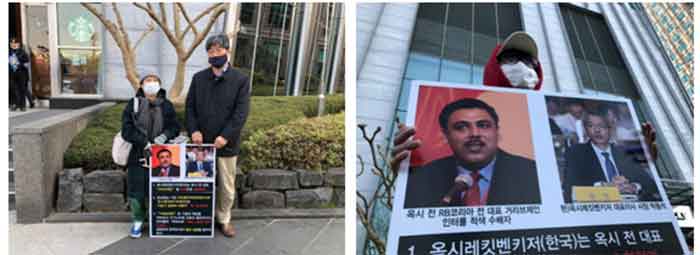
Even as the then CEO of RB has escaped the law, other officials who served RB in South Korea at the time are currently serving out jail sentences. Even in November 2019, South Korean officials involved in the probe sought to meet Jain in India; he refused. In November 2020, a small group of victims protested, carrying photographs of Jain and seeking justice.

Humidifier Disinfectant Victim outside RB headquarters in Seoul demanding investigation against Gaurav Jain on November 26, 2020

LG Chemical: Korean nationals wanted in India for Styrene gas leak deaths of May 2020

Jain is not the only CEO to have escaped the law. Korean national Rho Kuk-rae is wanted by Indian law enforcement agencies. He was the head of the support team of LG Chemical from where the leak of toxic styrene gas on May 7, 2020 caused 15 deaths at Andhra Pradesh’s Vishakapatnam. Rho Kuk-rae returned home after this tragedy; Shin Hak-cheol, CEO of LG Chemical, never visited India after that tragedy.

A high power government committee submitted its probe report in this case in July 2020, blaming the firm for negligence that caused the leak. Civil society groups have called for the South Korean firm’s management to be held responsible, but no action has yet been taken against them.

Countercurrents wrote an email to RB seeking a response on why Gaurav Jain was not cooperating with prosecutors in South Korea. No response was received. Activist Yeyong Choi, director of Asian Citizens’ Centre for Environment and Health, who has also served as a member of the government team that investigated RB, said, “RB should have Gaurav Jain attend the South Korean government’s investigation and express sincere apology. Otherwise, we will organize a campaign to boycott RB products.”

UK government advocates for murderous “learning to live with the virus”

Thomas Scripps


The ending of the Britain’s lockdown is witnessing the most open embrace of “herd immunity” in ruling circles since the pandemic began.

Prime Minister Boris Johnson announced the lifting of restrictions on February 22 while admitting this would mean “more infections, more hospitalisations… more deaths”.

Johnson and scientists close to the government have since spelled out the grisly details.

Chief Medical Officer Chris Whitty speaking during a Covid-19 press conference in Downing Street (Picture by Andrew Parsons / No 10 Downing Street-FlickR account)

Speaking to the House of Commons science and technology committee Tuesday, Chief Medical Officer Chris Whitty said a new surge of the virus was inevitable:

“All the modelling suggests there is going to be a further surge that will find people either that have not been vaccinated, or where the vaccine has not worked, and some of them will end up in hospital and sadly some of them will go on to die, and that is the reality of where we are.”

The day before, Professor Calum Semple, of the government’s Scientific Advisory Group for Emergencies (SAGE), told BBC Breakfast that the reopening of schools meant it was “inevitable that we will see a rise in cases” of COVID-19.

Johnson himself wrote in the Daily Telegraph Wednesday, “We can see the signs of a surge of Covid among some of our European friends, and we remember how we in the UK have tended to follow that upwards curve, if a few weeks later… Monday’s successful return to school will inevitably add to the budget of risk.”

In defence of this criminal policy, the Conservative government and its supporters have launched a relentless propaganda campaign insisting that the population must “learn to live with the virus”. On February 12, Health Secretary Matt Hancock gave an interview to the Telegraph titled, “We hope to live with Covid like flu by end of the year”.

This line was endorsed by the BBC’s health correspondent Nick Triggle who wrote the same day, “This is simply about being realistic. Covid isn’t something that can be eradicated like smallpox was… Thousands will still die in winters to come. But each year this should lessen until it gets near to the levels of mortality we see with flu—something which society readily accepts.”

Triggle followed this comment with an article on February 16, “Why goal is to live with the virus—not fight it”.

Speaking alongside Whitty at the Commons science and technology committee Tuesday, Chief Scientific Officer Sir Patrick Vallance was explicit:

“I do not think that zero Covid is possible. I think there’s nothing to suggest that this virus will go away, at least any time soon. It’s going to be there, circulating. It may be a winter virus that comes back over winters with increasing infection rates during that period.”

SAGE member Andrew Hayward told Times Radio Wednesday that the UK would “be talking in the tens of thousands of deaths, and hopefully in the low tens of thousands of deaths. And that sounds terrible. But actually, that’s not so dissimilar to what we put up with every year for flu and other respiratory infections. And so, I think, as a society, we need to really think what trade-offs we’re willing to make in terms of restrictions.”

These ghoulish arguments are an endorsement of another terrible wave of infections and death. By its own admission, the government’s reopening policy means at least multiple tens of thousands more fatalities in the next year. The most cited number in the media is 30,000 by summer 2022. But this is a minimum figure based on “the most optimistic set of assumptions modelled”, according to the researchers involved.

In early February, scientists from Imperial College London, together with the University of Warwick, presented a range of modelled reopening scenarios to SAGE. The scenario closest to that set out in the government’s “roadmap” (the government reopens faster) predicted between 33,200 and 81,200 COVID-19 deaths between February 12 and June 30, 2022.

Much worse can happen, according to the modelling. If infection rates are higher than expected once lockdown measures are lifted—due to ineffective test, trace and isolate systems, for example—then the range of predicted deaths is between 58,900 and 143,400. The coming death toll could exceed the two waves of COVID-19 already suffered. By comparison, flu kills roughly 12,000 people a year in England and Wales on average.

Hundreds of thousands more people will also be struck down with the debilitating effects of long COVID.

Disease will fall overwhelmingly on the poorest sections of society. Infection rates remain higher in more deprived regions, thanks to crowded, sub-standard accommodation, a growing number of people unable to work from home, and lower vaccine take-up rates.

There is nothing inevitable about any of this. A disaster is being prepared even as multiple highly effective vaccines are deployed, creating the potential, in a rationally organised global society, for the suppression of the virus to extremely low levels.

The ruling class does not view vaccines primarily as a tool to save lives, but as a means of enforcing its back-to-work strategy. Johnson hopes that partial vaccination will keep a lid on daily hospital admissions, removing the threat of a complete collapse of the National Health Service, while allowing the infection rate to rise. The deaths along the way of those left unprotected will be written off as the necessary costs of a return to “normality”, doing business and accumulating profits.

Under these conditions more dangerous variants of the virus will be allowed to develop. A study published in the British Medical Journal Wednesday found that the “UK variant”, already dominant, is between 30 and 100 percent more deadly than previous strains. It was already known to be 40 to 70 percent more transmissible.

In addition to the UK variant, the UK is currently monitoring three other “variants of concern”—the South African, Brazilian and Manaus—and four “variants under investigation”.

The serious risk is that the virus will develop mutations that helps it evade current vaccines, producing another huge surge of the pandemic. Allowing the number of infections to rise rapidly while placing the virus under selective pressure through vaccination is the perfect recipe for this deadly outcome.

Whitty and Vallance, et al., have made a deal with the devil. When they speak of “trade-offs” they are rationalising the deadly consequences of putting profits before lives. The reopening is taking place so quickly to satisfy the demands of big business and the competitive needs of British capital against its international rivals.

This was the government’s intended policy, signed-off on by its advisers, since the beginning of the pandemic. The first comments made by Johnson, Whitty and Vallance last March were about the need to prepare for large numbers of deaths—with Vallance promoting “herd immunity” explicitly. Now the same arguments are made from atop a mountain of corpses.

Only resistance in the working class forced three lockdowns in the last year. In declaring for the “irreversible” end of the “last lockdown,” Johnson is seeking to ram the programme of herd immunity down people’s throats, rebranded as “learning to live with the virus”.

This will provoke widespread opposition in the working class. Telegraph columnist Ross Clark asked nervously last month, “Matt Hancock may be ready to ‘live with the virus’—but is Britain?”, warning that over the last year, “Death has become less tolerable.”

Opposing the policy of herd immunity requires a socialist political programme. The basic desire of workers to save lives at the expense of capitalist profits necessitates effective lockdowns until the virus is under control, allowing vaccination programmes to be safely completed. Workers and their families must receive full income and social support, including quality online education, paid for out of the fortunes of the billionaire pandemic profiteers.

Switzerland votes to ban the burqa

Peter Schwarz


Swiss voters on Sunday narrowly approved a Verhüllungsverbot (veiling ban) that prohibits Muslim women from covering their faces in public and wearing a niqab or burqa.

A total of 1.43 million voted in favour of the ban. That is only one in six of the country’s 8.7 million inhabitants, of whom 2.2 million do not hold a Swiss passport and 1.7 million are minors. But with a turnout of just over 50 percent, this was enough for the ban to be accepted with 51.2 percent of the vote.

Swiss Parliament Building (Photo: Wikipedia)

The constitutional initiative and the campaign for it has served to fuel racist and anti-Muslim sentiments. According to research, only 30 women wear the niqab in the whole of Switzerland. Also, there are several hundred female tourists from Arab countries. There are no female burqa wearers at all.

The referendum was launched by the so-called Egerkingen Committee, in which politicians of the right-wing populist Swiss Peoples Party (SVP) and blatant fascists set the tone. The committee, which according to the Neue Zürcher Zeitung (NZZ) has over 4,500 sympathisers, was already successful in 2009 with a legal initiative banning the construction of minarets in Switzerland.

The managing director of the Egerkingen Committee, 31-year-old Anian Liebrand, describes himself as a “man of conviction.” He had joined the SVP at 16 and pursues the goal of breaking the alleged “left-wing mainstream” in the country. “To influence society in such a way that the trend turns back to the right: that is one of my greatest goals,” he told the NZZ.

Liebrand was convicted of multiple counts of defamation for publishing photos of young left-wing politicians on an SVP website and denouncing them as “cowardly slobs,” “wretched creatures” and perpetrators of violence. He is also active in initiatives against same-sex marriage and sex education in schools. His greatest fear, writes the NZZ, is “‘that the Swiss are dying out.’ Because of foreign infiltration and too few births of Swiss children.” He has called Holocaust Remembrance Day a “guilt inculcation programme” meant to “re-educate” the Swiss in schools.

Liebrand is not the only leading member of the Egerkingen Committee to espouse fascist ideas. Twenty-four-year-old Nils Fiechter, also a member of the SVP, was convicted of violating the Racial Discrimination Act for designing an inflammatory poster that read: “Millions in costs for construction and maintenance, dirt, faeces, noise, theft, etc. We say no to transit places for foreign gypsies!” In the campaign for the burqa ban, he appeared dressed as a suicide bomber wearing an explosive belt under the burqa.

The campaign posters were also reminiscent of Nazi propaganda in style, form and content: two dangerous-looking eyes behind a niqab, black on a red background, with the words “Stop extremism!”

The Egerkingen Committee also includes many veterans of earlier xenophobic campaigns by the SVP and its environs. Its president is National Councillor (member of the lower house of the Swiss parliament) Walter Wobmann, who is on the right wing of the SVP. The SVP has been initiating plebiscites against immigrants, refugees and Muslims for many years and has had some success with them.

The last time it succeeded was seven years ago with the so-called mass immigration initiative, which was adopted by an extremely narrow majority. It obliged the Swiss government to renegotiate the Agreement on the Free Movement of Persons with the EU within three years. Since then, corresponding initiatives have failed, and the SVP’s influence has declined somewhat. The fact that the burqa ban initiative has now succeeded again is mainly due to the support of some liberals and feminists who made common cause with the far-right.

For example, a women’s committee was formed for the burqa initiative. Writer Gisela Widmer explained in the Tages-Anzeiger that she had no sympathy for the initiators but would vote yes. It was not about the political agenda, but “only about the question: ‘Ban the veil, yes or no?’” she said. And a left-liberal would have to answer this question in the affirmative. Because the niqab was “the habit of political Islam.” Regina Probst, former staff member of Terre de femmes, also told Der Spiegel that she would vote yes.

The German feminist Alice Schwarzer, who had already been agitating against Muslim men in the refugee crisis, spoke out in the NZZ and supported the initiative, saying, “Is this what we want after 200 years of enlightenment and 50 years of fighting for equal rights? Conditions in which a woman has to be invisible to protect herself from male gaze?”

However, there were many other voices denouncing the racism of the campaign and condemning the ban as an attack on the democratic right to freedom of religion and expression, which discriminates against Muslim women, who are the only ones who would be punished if they violate it, whether voluntarily or under duress.

Even if not everyone who voted for the burqa ban is a convinced right-wing extremist, the adoption of this undemocratic and discriminatory initiative shows that even Switzerland is not immune to the return of fascist currents, as they are making themselves heard in the US (Trump and his followers), Germany (Alternative for Germany, AfD), Spain (Vox) and numerous other countries.

Switzerland is often portrayed as having always been an oasis of democracy immune to fascism and Nazism. But this is not true. Around 1930, an extensive Frontenbewegung (Front Movement) developed in Switzerland as well, advocating völkisch (Swiss-ethnic), anti-Semitic and fascist goals. It gave rise to the National Front party, which reached its peak in 1935 with 9,000 members and was represented in the Swiss parliament with its own deputies.

A direct line leads from the National Front to the Egerkingen Committee. Ulrich Schlüer, the political supporter of Anian Liebrand, who co-founded the committee and was in charge of the minaret initiative, had worked as a secretary for James Schwarzenbach in the 1970s. Schwarzenbach, a member of the Swiss National Council, launched the “National Action against the Alienation of the People and the Homeland” in 1968, which sought to limit the proportion of foreigners in each canton to a maximum of 10 percent. A corresponding initiative was rejected by 54 percent after a bitter referendum campaign. If it had been accepted, 300,000 to 400,000 people would have had to leave Switzerland.

Propaganda poster of the burqa ban initiative reads: Stop Extremism!

In his youth, Schwarzenbach had admired Spanish dictator Francisco Franco and had been a member and later even party leader of the National Front. In November 1934, he was recorded as having taken part in a raid on the Cabaret Pfeffermühle. The cabaret had been founded in Munich by Erika and Klaus Mann, the children of the famous writer Thomas Mann, and had moved to Zurich because of Nazi persecution. Schwarzenbach justified the raid by saying that it was time to show emigrants and Jews that there was no place for them in Switzerland if they abused the right of hospitality.

The return of these fascist forces is a reaction to the deep crisis of capitalism, which has not spared Switzerland either. Measured by GDP per inhabitant, the country may be one of the richest in the world, but it is also, more than almost any other country, dependent on the world economy. The oversized banking sector, tourism for the upper class and highly specialised industry respond extremely sensitively to economic fluctuations.

Added to this is the sharp social polarisation—ranging from a filthy rich upper class to seasonal workers without permanent residency status—and an underdeveloped welfare system. The coronavirus crisis has exacerbated these contrasts. Despite high infection rates, the government puts the interests of the economy above the lives of the people. Ski resorts, hotels and restaurants have remained mostly open, as have factories. As a result, 565,000 people have been infected with COVID-19, more than twice as many as in Germany in terms of population. More than 10,000 have died.

As everywhere else in the world, the ruling class is preparing for fierce class struggles in Switzerland by promoting fascist forces.