15 Mar 2021

Further evidence of the perils of US college reopenings

Bhuvana Tumakur


A recent article published in the science journalism web site Science News, “How 5 Universities tried to handle COVID-19 on campus: Fall semester was the start of a big experiment,” shows that in-person education remains a breeding ground for the spread of the pandemic. It lays out much of the growing evidence that the SARS-CoV-2 virus spreads easily through indoor and community living.

Students wear masks on campus at the University of North Carolina in Chapel Hill, N.C., Tuesday, Aug. 18, 2020. (AP Photo/Gerry Broome)

Science writer Betsy Ladyzhets found a 56 percent increase in COVID-19 cases during the three-week period of in-person instructions in comparison to the three weeks before, when the universities offered remote learning. The piece also found that in the same counties where universities offered remote learning, COVID-19 cases dropped by almost 18 percent. The author states, “With these kinds of risks, a college campus seems like one more dangerous place to spend time.”

The author looked at five large universities: University of Wisconsin, Madison; North Carolina Agricultural and Technical State University; University of Washington, Seattle; Colorado Mesa University; and Rice University in Houston, Texas. Data was extracted from university staff self-studies and university dashboards during the fall semester of 2020. Growth in new daily cases on a 7-day rolling average supported the evidence that in-person instruction increased COVID-19 virus spread significantly.

Some universities experienced late-semester peaks in infection from Halloween parties while others from surges in nearby cities. Each of the schools failed to fix the spread of the virus, even at the University of Washington, where the student and staff population was a fifth the normal level. Levels rose despite all schools cobbling together some type of mandatory PCR testing and mandating mask-wearing and restrictions on public gatherings. A large number of these efforts were initiated by the student “health ambassadors” to protect themselves, their friends and teachers, and loved ones at home.

This high risk is further corroborated by an analysis reported in Computer Methods in Biomechanics and Biomedical Engineering on January 13, 2021, which showed that at 30 large universities COVID infections spiked in 14 colleges within 14 days of class, with seven-day incidences well above 1,000 per 100,000, an order of magnitude larger than nationwide peaks of 70 and 150 during the first and second waves of the pandemic.

The danger is not only to college students, but to surrounding communities. In December, the New York Times reported that infection rates have risen faster than the national average in counties where students make up at least 10 percent of the population.

The Washington Post in a recent article, “As U-Va. and U-Md. try to curb surge in coronavirus cases, neighbors brace for impact,” reported that these schools have seen an alarming surge of new COVID cases after reopening in-person. The article stated that University of Maryland and University of Virginia officials claimed that they had not seen incidents of viral transmissions in the classrooms. While U-Md., temporarily cancelled in-person classes after coronavirus infections surged past 60 cases a day, U-Va. kept classes open even after it logged in 229 cases in a single day. In fact, Jim Ryan, U-Va.’s president, said at a virtual town hall, “We knew that if we went too far or were too aggressive, it would feel like we are living in a totalitarian state and it contravened our foundational culture of trusting students to govern themselves.”

According to the U-Va. and U-Md. officials the outbreak and surge in cases could not be traced to a single source. They claimed that the spike in infections was due to widespread noncompliance with the health guidelines and protocols, specifically blaming large student gatherings, not wearing of masks at dinners, holding in-person recruitment events by student sororities and fraternities, other social meetups, and the possibility of more infectious variant in the campus. The majority of the U-Va. and U-Md. COVID cases were from students living off campus, and the officials reported that there was no link to cases spreading from their students to the wider Charlottesville or Prince George’s County communities that surrounded these universities.

On March 1, the Erie Times-News posted an article on the Edinboro University of Pennsylvania that reported a dramatic surge of COVID cases at its campus in the last week of February. Out of only 420 students living on-campus this semester, about one-third the usual number, 58 students and 3 university employees tested positive for COVID-19. It was also reported that only 16 university students and one employee had tested positive for COVID-19 previously in this semester.

This spike caused the university to stop all in-person classes. Dale-Elizabeth Pehrsson, university interim president, said in the letter to university students and staff, “Our contract tracing had not revealed any evidence of transmission from in-person instructions” and “The decision to impose the 10-day pause is being made out of an abundance of caution for our students, faculty and staff. We plan to resume in-person classes and approved activities on Monday, March 8.”

The Times-News article further noted that Erie County saw 98 new cases on Saturday and 29 new cases on Sunday of this past week. The county reported that the amount of COVID-19 virus detected in the samples from the Erie Wastewater Treatment Plant had increased for the second straight week in a row. The estimated cases per day based on the sampling had risen from 40 to 120 in the past two weeks. The concern of the county officials was that fewer people were getting tested and these untested people could spark off an increase in COVID-19 cases and hospitalizations over the next two weeks.

Another article posted on 6 Action News reported an alarming spring surge of over 70 COVID cases a day at the University of Delaware, where the count was 134 a week in the prior semester. A spokesperson for the university said based on their contract tracing a lot of transmission is happening because students are taking off their masks and are in larger groups in the dining halls, are not following protocols, and are meeting in large gatherings. Here as well, the officials reported a lack of evidence in transmission of virus from in-person instruction.

Australian government announces poverty-level welfare boost

Martin Scott


With the Coronavirus Supplement to Australia’s JobSeeker scheme set to terminate at the end of March, the federal government has announced a paltry $50 per fortnight increase to the unemployment welfare payment.

In reality this “increase” represents a further cut to the current sub-poverty “supplemented” payment of $716 per fortnight.

Signs in store window advertise that they are closing in Sydney, Wednesday, Sept. 2, 2020. (AP Photo/Rick Rycroft)

A senate inquiry into the proposed changes received more than 500 submissions from charities, individuals, and think tanks, all calling for a genuine increase to the Jobseeker rate.

The slated $3.57 per day increase will bring the payment to just $616 per fortnight, almost $298 below the poverty line.

Prior to the Coronavirus Supplement, unemployed Australians received, on average, 38 percent of what they earned while working, the lowest of any OECD country. The proposed increase would shift the country up only one place, above Greece, and far short of the OECD average of 68 percent.

In return for this pathetic boost, welfare recipients will be forced to comply with increasingly punitive “mutual obligations,” including applying for at least 20 jobs each month (beginning in July), in circumstances where there are currently nine applicants for every advertised job.

With the onset of the pandemic last year, a sudden wave of job cuts forced the Morrison government to introduce the Coronavirus Supplement in April, initially at a rate of $550 per fortnight, almost doubling the income of Australian welfare recipients.

As a result, the number of Australians living in poverty fell from 3 million prior to the pandemic, to 2.6 million, despite at least 600,000 workers losing their jobs, and a similar number having their hours drastically reduced.

The reduction of the supplement to $250 per fortnight at the end of September, along with lower payments and tightened eligibility for the JobKeeper wage subsidy, condemned another million people to poverty.

While the federal government and corporate media have proclaimed a strong economic recovery, only 200,000 people have stopped receiving JobSeeker since the peak of 1.6 million in August last year.

Economist Jeff Borland estimates that between 125,000 and 250,000 jobs will be lost when the JobKeeper wage subsidy is terminated at the end of March, meaning that peak will likely be surpassed.

Already, “real” unemployment, as measured by survey firm Roy Morgan, was at 13.2 percent in February, the highest level (excluding last year) since January 1994.

Despite this stark reality, the federal government, big business, and the corporate media are attempting to justify the slashing of welfare payments with claims of a supposed labour shortage.

Prime Minister Scott Morrison told the Australian Financial Review (AFR) Business Summit on Tuesday that “unemployed Australians are simply and regrettably not filling” 54,000 vacant jobs in rural areas.

Aside from the fact that this represents one job for every 36 unemployed workers, the reality is that any regional labour shortage is a product of pay and conditions so poor that they only attract backpackers and temporary visa holders, who are compelled to work in regional areas by draconian immigration laws and desperate poverty.

Despite this, 10,500 unemployed Australian workers did accept fruit picking jobs in the last six months, and 3,500 more applied for this work but were not hired.

Morrison suggested that JobSeeker recipients may be forced to move to rural areas for work, or face being cut off from welfare entirely.

“If there is a job available, and you are able to do that job,” he insisted, “then it is reasonable for taxpayers to expect that you will take it up, rather than continue to receive benefits. And if you don’t, then payment should be withdrawn.”

The reality is, while the impact of the COVID-19 pandemic on jobs has been sharpest in major cities, long-term unemployment remains higher in rural areas, meaning such a move is likely to leave workers worse off.

This heightened form of “mutual obligation” will be enforced through a hotline allowing businesses to “dob in” job applicants who do not accept positions they are offered.

This is typical of the ruling elite’s attitude to the working class. Speaking in September 2019, Federal Minister for Families and Social Services Anne Ruston said, “Giving people more money will do absolutely nothing … probably all it will do is give drug dealers more money and give pubs more money.”

In fact, submissions to the Senate inquiry contain numerous accounts of what “luxuries” JobSeeker recipients were able to afford when the payment was temporarily increased last year.

One Queensland resident wrote: “With the Covid 19 supplement I have been able to pay my bills, get my life preserving medication, and buy fresh fruit and vegetables. Life on $44 a day will mean I have to go back to eating packets of pasta and sauce, two minute noodles, and rice with frozen vegetables.”

Another JobSeeker recipient said: “The supplement allowed us to get new clothes for our daughter and we were both able to get some dental work done. … As the months rolled by, our home life in lockdown was at least secure, we were in front with our rent, we had food, were able to afford internet service, prepaid phone credit and pay our licence and rego.”

Labor leader Anthony Albanese did not criticise Morrison’s plan at the AFR summit, instead stressing his support for business “growth,” which means further job cuts and attacks on wages and conditions.

The latest changes to welfare are a continuation of a decades-long offensive against the unemployed, presided over by Labor and Liberal-National governments.

Pitiful though it is, the $50 per fortnight JobSeeker increase is the largest in more than 30 years. In real terms, welfare payments were not increased under the Labor governments of Keating, Rudd or Gillard or by Liberal-National leaders Howard, Abbott or Turnbull.

Because the payment is indexed to inflation, rather than wages, it has fallen, in real terms, from 35 percent of the average wage in 2001, to 27 percent in 2019.

In the same period, housing prices have outstripped wage growth by a factor of five, meaning even workers with steady employment are struggling to keep up with rent or mortgage payments.

A December report, by Equity Economics, estimates that 7,500 more Australians will be homeless by June. Almost 880,000 households will experience housing stress, an increase of 24 percent.

In stark contrast to the government’s callous approach to the working class, Morrison announced yet another handout to big business on Thursday, in the form of 800,000 subsidised airfares to a handful of tourist hotspots.

The $1.2 billion package will primarily benefit major airlines Qantas and Virgin, which have stood down or sacked tens of thousands of workers in the last year, despite receiving billions of dollars in government aid.

The message from the Australian ruling elite is clear. The time has come for the working class to pay for the unprecedented upward transfer of wealth carried out during the pandemic.

Millions of workers are now presented with the choice of a life of abject poverty on JobSeeker, or a desperate scramble for whatever poorly-paid, insecure work they can find.

The alternative is for workers to join the struggle for a socialist program aimed at transforming society to meet social need, rather than the profit interests of the corporate and financial elites.

Coronavirus pandemic resurges throughout the world

Bryan Dyne


As the different variants of the SARS-CoV-2 virus continue to spread, particularly those originating in the United Kingdom, Brazil, and South Africa, reported cases of the coronavirus have again begun to rise.

Since February 20, the number of daily new cases worldwide has increased steadily, from 361,000 cases then, to more than 422,000 cases now, up 17 percent. The increase is being driven in countries across the world. Currently there are more than 22,000 new cases each day in India (an 80 percent increase), just under 25,000 in France (a 24 percent increase), and 22,000 in Italy (an 83 percent increase). The main driver of the new wave is Brazil, where there are at least 66,000 new cases each day (a 36 percent increase) and climbing.

Workers load empty coffins that had contained the remains of COVID-19 victims on a flatbed, to be destroyed by a company specializing in organic waste, at La Recoleta cemetery, in Santiago, Chile. (AP Photo/Esteban Felix, File)

The total number of cases worldwide has now exceeded 120 million, with more than 2,660,000 dead.

Numerous other countries have also seen steady, and in some cases sharp, increases in their case counts, including Chile, the Czech Republic, Ethiopia, Germany, Iran, Paraguay, Poland and the Philippines. And in the United States, where the decline in cases has largely plateaued, there is still an average of more than 55,000 new reported cases each day.

There is every indication that this new wave, if allowed to continue, will be the worst yet. The previous wave was spurred on by relatively limited school and workplace reopenings, driving the number of new cases each day from just under 300,000 at the beginning of October to 745,000 at the beginning of January. Globally, more than 900,000 people died during that three-month period.

The social misery produced by such a state of affairs is staggering. Bloomberg recently reported that 30 million people in Africa were plunged into extreme poverty by the pandemic in 2020, living on less than $1.90 a day, and an estimated 39 million people will be made equally destitute in 2021. The United Nations reports that poverty in Latin America rose in 2020 by 22 million people. The number of “new poor” in East Asia and the Pacific increased by at least 38 million.

Globally, the World Bank estimates that between 119 to 124 million people so far have been impoverished by the coronavirus pandemic.

“After the Second World War, the world has experienced mass trauma, because the Second World War affected many, many lives. And now, even with this COVID pandemic, with bigger magnitude, more lives have been affected,” WHO Director-General Tedros Adhanom Ghebreyesus said at a news conference Friday. “Almost the whole world is affected, each and every individual on the surface of the world actually has been affected.”

Now, with case numbers higher than they were at the beginning of the last surge, the Biden administration is spearheading an even more complete return to in-person schooling and work. Countries in Europe, South America, Asia and elsewhere are following suit, effectively inducing an even greater expansion of the pandemic. The ongoing reopenings in the United States and around the world are setting the stage for even greater heights of mass death.

The excuse being force-fed to the American and world public is that this is safe because the vaccine rollout is continuing apace.

The truth is quite the opposite. Even in the US, which has one of the highest vaccination rates, only about 10 percent of the population is fully vaccinated, meaning that the majority of the population is still susceptible to the deadly virus.

Moreover, the rollout itself is characterized by “many examples of vaccine nationalism and vaccine hoarding,” according to UN Secretary-General Antonio Gutierres. The Biden administration has openly admitted hoarding doses of the vaccine, including about 10 million doses of the AstraZeneca vaccine, for which the FDA has yet to give emergency authorization. AstraZeneca itself asked to transfer those doses to Europe, where it can be used. The idea was rejected out of hand, with Biden’s COVID-19 response coordinator Jeff Zients proclaiming Friday, “We’re rightly focused on getting Americans vaccinated as soon as possible.”

In other words, Biden has fully embraced the “America First” policy of ex-President Trump’s Operation Warp Speed.

Vaccine nationalism has also emerged sharply in Europe. Last week, Italy blocked the export of 250,000 doses of the AstraZeneca vaccine to Australia. Tensions between the UK and European Union continued as European Council President Charles Michel accused London of imposing an export ban on COVID-19 vaccines.

As a result, while more than 350 million doses of the coronavirus vaccine have been administered internationally, three-quarters of those have been given in just 10 countries, including more than 100 million in the United States alone. In contrast, less than five percent of the population in South America has received even a single dose. In Africa, where the total number of deaths just passed 100,000, less than half of one percent of the population has been vaccinated.

This uneven distribution itself has the potential to drive the pandemic. As Dr. Tedros recently noted, “The inequitable distribution of vaccines remains the biggest threat to ending the pandemic and driving a global recovery,” because “the longer the virus circulates, the higher the chances that variants will emerge that make vaccines less effective.”

In other words, there is nothing “right,” much less at all rational, about hoarding millions of life-saving vaccines in the middle of a pandemic. Every dose that is not used is potentially another infection stopped, another life saved. It is also more opportunity for the virus to mutate, increasing the chances of a variant emerging completely immune to the vaccines, retriggering the entire pandemic. Dr. Tedros rightly condemned this when he noted, “This is putting lives at risk around the world.”

Dr. Michael Osterholm, an infectious disease expert at the University of Wisconsin, made similar comments in a recent piece entitled, “COVID-19 Variants and the Peril of Vaccine Inequity.” In it, he made clear, “Neither the United States nor any other global power can defeat a pandemic by thinking in national terms. COVID-19 vaccines are now a central component of the United States’ national security and defense. But unlike other spheres of defense, this one involves protecting—not fighting—foreigners. As the poet John Donne noted centuries ago, ‘No man is an island, entire of itself; every man is a piece of the continent, a part of the main.’ Never has that been truer than during the current worldwide plague. If the bell continues to toll, it will be tolling for us all.”

As has been demonstrated over the past year, however, appeals to the ruling class fall on deaf ears. Neither the Trump nor Biden administrations, or their counterparts internationally, are capable, much less interested, in sharing the vaccine. Stockpiles are viewed as strategic assets to be wielded against geopolitical rivals, not medicine to save lives.

As David North writes in his essay, “Capitalism vs. socialism: The pandemic and the global class struggle”:

The capitalist program promotes a policy of vaccination nationalism, restricting and opposing equitable distribution of vaccines throughout the world. The socialist program, recognizing that the coronavirus can be eradicated only through a scientifically directed international strategy, calls for a globally coordinated inoculation program.

There can be no national solution to the pandemic. The social system bound up with the existence of nation-states, capitalism, must end and be replaced with a socialist society based on the democratic and scientific planning of the world’s resources, where human lives are placed above private profit.

13 Mar 2021

Ten Problems With Biden’s Foreign Policy – and One Solution

Medea Benjamin & Nicolas J. S. Davies 
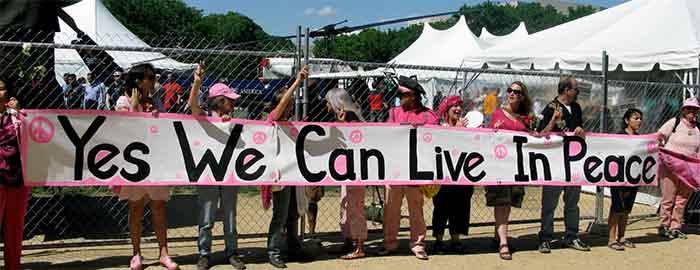


The Biden presidency is still in its early days, but it’s not too early to point to areas in the foreign policy realm where we, as progressives, have been disappointed–or even infuriated.

There are one or two positive developments, such as the renewal of Obama’s New START Treaty with Russia and Secretary of State Blinken’s initiative for a UN-led peace process in Afghanistan, where the United States is finally turning to peace as a last resort, after 20 years lost in the graveyard of empires.

By and large though, Biden’s foreign policy already seems stuck in the militarist quagmire of the past twenty years, a far cry from his campaign promise to reinvigorate diplomacy as the primary tool of U.S. foreign policy.

In this respect, Biden is following in the footsteps of Obama and Trump, who both promised fresh approaches to foreign policy but for the most part delivered more endless war.

By the end of his second term, Obama did have two significant diplomatic achievements with the signing of the Iran nuclear deal and normalization of relations with Cuba. So progressive Americans who voted for Biden had some grounds to hope that his experience as Obama’s vice-president would lead him to quickly restore and build on Obama’s achievements with Iran and Cuba as a foundation for the broader diplomacy he promised.

Instead, the Biden administration seems firmly entrenched behind the walls of hostility Trump built between America and our neighbors, from his renewed Cold War against China and Russia to his brutal sanctions against Cuba, Iran, Venezuela, Syria and dozens of countries around the world, and there is still no word on cuts to a military budget that has grown by 15% since FY2015 (inflation-adjusted).

Despite endless Democratic condemnations of Trump, Biden’s foreign policy so far shows no substantive change from the policies of the past four years. Here are ten of the lowlights:

1) Failing to quickly rejoin the Iran nuclear agreement. The Biden administration’s failure to immediately rejoin the JCPOA, as Bernie Sanders promised to do on his first day as president, has turned an easy win for Biden’s promised commitment to diplomacy into an entirely avoidable diplomatic crisis.

Trump’s withdrawal from the JCPOA and imposition of brutal “maximum pressure” sanctions on Iran were broadly condemned by Democrats and U.S. allies alike. But now Biden is making new demands on Iran to appease hawks who opposed the agreement all along, risking an outcome in which he will fail to reinstate the JCPOA and Trump’s policy will effectively become his policy. The Biden administration should re-enter the deal immediately, without preconditions.

2) U.S. Bombing Wars Rage On – Now In Secret. Also following in Trump’s footsteps, Biden has escalated tensions with Iran and Iraq by attacking and killing Iranian-backed Iraqi forces who play a critical role in the war against ISIS in Iraq and Syria. Biden’s February 25 U.S. airstrike predictably failed to end rocket attacks on deeply unpopular U.S. bases in Iraq, which the Iraqi National Assembly passed a resolution to close over a year ago.

The U.S. attack in Syria has been condemned as illegal by members of Biden’s own party, reinvigorating efforts to repeal the 2001 and 2002 Authorizations for the Use of Military Force that presidents have misused for 20 years. Other airstrikes the Biden administration is conducting in Afghanistan, Iraq and Syria are shrouded in secrecy, since it has not resumed publishing the monthly Airpower Summaries that every other administration has published since 2004, but which Trump discontinued a year ago.

3) Refusing to hold MBS accountable for the murder of Saudi journalist Jamal Khashoggi. Human rights activists were grateful that President Biden released the intelligence report on the gruesome murder of Washington Post columnist Jamal Khashoggi that confirmed what we already knew: that Saudi Crown Prince Mohammad Bin Salman (MBS) approved the murder. Yet, when it came to holding MBS accountable, Biden choked.

At the very least, the administration should have imposed the same sanctions on MBS, including asset freezes and travel bans, that the U.S. imposed on lower-level figures involved in the murder. Instead, like Trump, Biden is wedded to the Saudi dictatorship and its diabolical Crown Prince.

4) Clinging to Trump’s absurdist policy of recognizing Juan Guaidó as President of Venezuela. The Biden administration missed an opportunity to establish a new approach towards Venezuela when it decided to continue to recognize Juan Guaidó as “interim president”, ruled out talks with the Maduro government and appears to be freezing out the moderate opposition that participates in elections.

The administration also said it was in “no rush” to lift the Trump sanctions despite a recent study from the Government Accountability Office detailing their negative impact on the economy, and a scathing preliminary report by a UN Special Rapporteur, who noted their “devastating effect on the whole population of Venezuela.” The lack of dialogue with all political actors in Venezuela risks entrenching a policy of regime change and economic warfare for years to come, similar to the failed U.S. policy towards Cuba that has lasted for 60 years.

 5) Following Trump on Cuba instead of Obama. The Trump administration overturned all the progress towards normal relations achieved by President Obama, sanctioning Cuba’s tourism and energy industries, blocking coronavirus aid shipments, restricting remittances to family members, putting Cuba on a list of “state sponsors of terrorism,” and sabotaging Cuba’s international medical missions, which were a major source of revenue for its health system.

We expected Biden to immediately start unraveling Trump’s confrontational policies, but catering to Cuban exiles in Florida for domestic political gain apparently takes precedence over a humane and rational policy towards Cuba, for Biden as for Trump.

Biden should instead start working with the Cuban government to allow the return of diplomats to their respective embassies, lift all restrictions on remittances, make travel easier, and work with the Cuban health system in the fight against COVID-19, among other measures.

6) Ramping up the Cold War with China. Biden seems committed to Trump’s self-defeating Cold War and arms race with China, talking tough and ratcheting up tensions that have led to racist hate crimes against East Asian people in the United States. But it is the United States that is militarily surrounding and threatening China, not the other way round. As former President Jimmy Carter patiently explained to Trump, while the United States has been at war for 20 years, China has instead invested in 21st century infrastructure and in its own people, lifting 800 million of them out of poverty.

The greatest danger of this moment in history, short of all-out nuclear war, is that this aggressive U.S. military posture not only justifies unlimited U.S. military budgets, but will gradually force China to convert its economic success into military power and follow the United States down the tragic path of military imperialism.

7) Failing to lift painful, illegal sanctions during a pandemic. One of the legacies of the Trump administration is the devastating use of U.S. sanctions on countries around the world, including Iran, Venezuela, Cuba, Nicaragua, North Korea and Syria. UN special rapporteurs have condemned them as crimes against humanity and compared them to medieval sieges. Since most of these sanctions were imposed by executive order, President Biden could easily lift them. Even before taking power, his team announced a thorough review, but, three months later, it has yet to make a move.

Unilateral sanctions that affect entire populations are an illegal form of coercion, like military intervention, coups and covert operations, that have no place in a legitimate foreign policy based on diplomacy, the rule of law and the peaceful resolution of disputes. They are especially cruel and deadly during a pandemic and the Biden administration should take immediate action by lifting broad sectoral sanctions to ensure every country can adequately respond to the pandemic.

8) Not doing enough to support peace and humanitarian aid for Yemen. Biden appeared to partially fulfill his promise to stop U.S. support for the war in Yemen when he announced that the U.S. would stop selling “offensive” weapons to the Saudis. But he has yet to explain what that means. Which weapons sales has he cancelled?

We think he should stop ALL weapons sales to Saudi Arabia and the UAE, enforcing the Leahy Law that prohibits military assistance to forces that commit gross human rights violations, and the Arms Export Control Act, under which imported U.S. weapons may be used only for legitimate self defense. There should be no exceptions to these U.S. laws for Saudi Arabia, the UAE, Israel, Egypt or other U.S. allies around the world.

The U.S. should also accept its share of responsibility for what many have called the greatest humanitarian crisis in the world today, and provide Yemen with funding to feed its people, restore its health care system and rebuild its devastated country. A recent donor conference netted just $1.7 billion in pledges, less than half the $3.85 billion needed. Biden should restore and expand USAID funding and U.S. financial support to the UN, WHO and World Food Program relief operations in Yemen. He should also press the Saudis to reopen the air and seaports, and throw U.S. diplomatic weight behind the efforts of U.N. Special Envoy Martin Griffiths to negotiate a ceasefire.

9) Failing to back President Moon Jae-in’s diplomacy with North Korea. Trump’s failure to provide sanctions relief and explicit security guarantees to North Korea doomed his diplomacy and became an obstacle to the diplomatic process under way between Korean presidents Kim Jong-un and Moon Jae-in, who is himself the child of North Korean refugees. So far, Biden has continued this policy of Draconian sanctions and threats.

The Biden administration should revive the diplomatic process with confidence-building measures such as opening liaison offices, easing sanctions, facilitating reunions between Korean-American and North Korean families, permitting U.S. humanitarian organizations to resume their work when COVID conditions permit, and halting U.S.-South Korea military exercises and B-2 nuclear bomb flights.

Negotiations must involve concrete commitments to non-aggression from the U.S. side and a commitment to negotiating a peace agreement to formally end the Korean War. This would pave the way for a denuclearized Korean Peninsula and the reconciliation that so many Koreans desire — and deserve.

10) No initiative to reduce U.S. military spendingAt the end of the Cold War, former senior Pentagon officials told the Senate Budget Committee that U.S. military spending could safely be cut by half over the next 10 years. That goal was never achieved, and instead of a post-Cold War “peace dividend,” the military-industrial complex exploited the crimes of Sept. 11, 2001 to justify an extraordinary one-sided arms race. Between 2003 and 2011, the U.S. accounted for 45% of global military spending, far outstripping its own peak Cold War military spending.

Now the military-industrial complex is counting on Biden to escalate a renewed Cold War with Russia and China as the only plausible pretext for further record military budgets that are setting the stage for World War III.

Biden must dial back U.S. conflicts with China and Russia, and instead begin the critical task of moving money from the Pentagon to urgent domestic needs. He should start with at least the 10 percent cut that 93 Representatives and 23 Senators already voted for. In the longer term, Biden should look for deeper cuts in Pentagon spending, as in Rep. Barbara Lee’s bill to cut $350 billion per year from the U.S. military budget, to free up resources we sorely need to invest in health care, education, clean energy and modern infrastructure.

A Progressive Way Forward

These policies, common to Democratic and Republican administrations, not only inflict pain and suffering on millions of our neighbors in other countries, but also deliberately cause instability that can at any time escalate into war, plunge a formerly functioning state into chaos or spawn a secondary crisis whose human consequences will be even worse than the original one.

All these policies involve deliberate efforts to unilaterally impose the political will of U.S. leaders on other people and countries, by methods that consistently only cause more pain and suffering to the people they claim – or pretend – they want to help.

Biden should jettison the worst of Obama’s and Trump’s policies, and instead pick the best of them. Trump, recognizing the unpopular nature of U.S. military interventions, began the process of bringing U.S. troops home from Afghanistan and Iraq, which Biden should follow through on.

Obama’s diplomatic successes with Cuba, Iran and Russia demonstrated that negotiating with U.S. enemies to make peace, improve relations and make the world a safer place is a perfectly viable alternative to trying to force them to do what the United States wants by bombing, starving and besieging their people. This is in fact the core principle of the United Nations Charter, and it should be the core principle of Biden’s foreign policy.

Crisis of monarchy over Harry and Meghan dominates UK media

Chris Marsden


“The whole family is saddened to learn the full extent of how challenging the last few years have been for Harry and Meghan.

“The issues raised, particularly that of race, are concerning. Whilst some recollections may vary, they are taken very seriously and will be addressed by the family privately.

“Harry, Meghan and Archie will always be much loved family members.”

Britain's Queen Elizabeth II is joined by Prince Charles, the Prince of Wales, and at rear, from left, Kate, Duchess of Cambridge, Camilla, Duchess of Cornwall, Prince William, Prince Harry and Meghan, Duchess of Sussex during a reception at Buckingham Palace, London to mark the 50th anniversary of the investiture of the Prince of Wales. March 5, 2019 file photo (Dominic Lipinski/Pool via AP, File)

This was the brief statement issued by Buckingham Palace on March 9, around 40 hours after Oprah Winfrey’s interview with Prince Harry, Duke of Sussex, and his wife, Meghan Markle, was broadcast on CNN. It combines expressions of sympathy for the couple and an oblique reference to the issue of race with an insistence that these matters should be addressed privately and the caveat that “some recollections” of events “may vary.”

This failed to dampen a media-driven “debate” on the future of the monarchy, centering on whether it can still be reformed to reflect modern cultural norms or should be abolished. It is hard to give the full flavour of how pathetic and out of touch with social and political realities are the statements made on both sides.

Politicians and celebrities in the US, including tennis star Serena Williams, Beyoncé and lesser-known figures, lined up to express their disappointment that Meghan was not welcomed by the House of Windsor—as if a black princess would prove that an institution rooted in hereditary and class privilege and imperial subjugation was fit for the 21st century. Their every stupid comment was presented as of immense interest.

US first National Youth Poet Laureate Amanda Gorman declared pathetically, “Meghan was the Crown’s greatest opportunity for change, regeneration, and reconciliation in a new era. They didn’t just maltreat her light—they missed out on it.” It was, she added, “Unclear if this will change the royal family, but Meghan’s strength will certainly redefine family elsewhere.”

US President Joe Biden limited himself to a statement by his press secretary, Jen Psaki, praising Meghan as someone who came forward to speak about her “struggles with mental health and tell their own personal story, that takes courage and that's certainly something the president believes.”

Easily the most nauseating statement came from Hillary Clinton, who found the interview “heart-rending to watch.” It was also “heartbreaking to see the two of them sitting there having to describe how difficult it was to be accepted, to be integrated, not just into the royal family as they described, but more painfully into the larger societies whose narrative is driven by tabloids that are living in the past.”

This is said during the tenth anniversary of the Libyan war, which saw an eight-month bombardment by the US that left the country in ruins. When then Secretary of State Clinton was told of the torture and murder of Libyan leader Muammar Gaddafi, this supposedly sensitive soul, who cannot bear the suffering inflicted on the Duke and Duchess, laughed and said, “We came, we saw, he died.”

Open calls for abolishing the monarchy have been very rare and most often equally delusional. The Guardian, for example, featured an opinion piece by Nylah Burton, a “lifestyle writer” at Bustle magazine, that combined fawning on Harry and Meghan with a supposedly radical message. She wrote, “Lashing out at the Windsors is the appropriate response, but it’s my hope that those who were outraged at hearing how Meghan was treated will further interrogate the nature of this institution, and become radicalized into being anti-monarchists and anti-imperialists.”

Burton felt compelled to clarify that “these aren’t the Sussexes’ political stances… there is nothing to indicate that they’d like to abolish the system.” Nevertheless, “If that interview chilled us, we should examine whether we believe a monarchy can or should exist in a just world… we don’t need them to be radicalized for us to use this moment to question everything we thought we knew about this elitist system.”

In the real world, the response of those in power was far more cautious regarding an institution that still occupies a central role in British constitutional and political life.

Internationally, accusations of racism were decried as a political blow to “brand Britain”, especially in the 54 Commonwealth countries, of which Queen Elizabeth is the head of state of 16, including Australia, Canada and New Zealand. But the response was mainly limited to calls for carefully calibrated changes only after the queen steps down.

Former Australian prime minister and leader or the Australian Republican Movement, Malcolm Turnbull, said the interview bolstered his case for breaking away from the British monarchy. But he told ABC, “After the end of the Queen's reign, that is the time for us to say, 'OK, we've passed that watershed.’”

New Zealand Prime Minister Jacinda Ardern put her republican posturing to one side and said there was no likelihood of a break from the British monarchy in the near future. Prime Minister Justin Trudeau said the interview should not have a bearing on Canada’s constitutional status.

Domestically, things were also muted. The Guardian’s editorial, “Heavy is the head that wears the crown”, made the only hint of constitutional change, meekly suggesting, “Whether a hereditary head of state is required today ought to be considered in a programme of reform that the British state clearly—and urgently—needs.”

Elsewhere, Good Morning Britain news presenter Piers Morgan was forced to resign after saying he “didn't believe a word” Meghan said in her interview.

Ian Murray, executive director of the Society of Editors, was also forced to resign after organising an open letter stating that Harry’s description of some British tabloids as “racist” and “bigoted” and a “large part” of why he and his wife had left the UK was “not acceptable” without providing evidence.

Labour MP for Halifax Holly Lynch is one of a number reported to have made preliminary enquiries to see if a House of Commons debate could be held on racism in the media, the mental health strains of persistent press coverage and on further press regulation.

While the media focuses on blanket coverage of the doings of the “royals” at Buckingham Palace and Montecito California, Britain is in the grip of a social and economic crisis of unprecedented dimensions. Figures published by the UK’s statistics agencies for deaths where COVID-19 has been mentioned on the death certificate show there have now been over 144,000 deaths involving coronavirus in the UK. Over 4 million have been infected, often with serious and long-term consequences.

Prince Harry and Meghan Markle with other members of the royal family going to church at Sandringham on Christmas Day 2017 (credit: Mark Jones--FlickR, WikiMedia Commons)

Fully 1.3 million children under the age of five are living in poverty. The number of people on Universal Credit benefits has doubled in just a few months to 5.7 million. Another 2 million are still waiting to get on the list.

Payroll numbers have already dropped as much as 5.5 percent in London. Going forward, 274,720 jobs are at risk of being lost following the end of the furlough scheme, according to insolvency analysts. A survey by the Office for National Statistics found that 15 percent of businesses that had not stopped permanently trading had little or no confidence that their business would survive the next three months. That figure rises to 53 per cent in the hospitality sector.

At such a point in history, there is nothing “radical” whatsoever about calls for an end to the monarchy when not framed within a call to mobilise the working class against capitalism and for socialism. Policed and safely presented by the mass media, they act as one of many mechanisms through which social and political discontent is directed into safe political channels that do not threaten the ruling class and the profit system. As the saga is played out to mind-numbing effect, ever more people will see through this bogus “debate”.

Millions at risk in expected Istanbul earthquake

Ozan Özgür


Recent official statements on an expected earthquake in Istanbul underscore that millions of people living in Turkey’s largest city face an impending disaster due to official inaction.

On February 18, officials from the Istanbul Metropolitan Municipality (IMM) and the Esenler and Avcılar municipalities presented studies to the Turkish Parliament’s Earthquake Measures Research Commission. The Esenler and Avcılar districts are in the high-risk category.

Members of rescue services search in the debris of a collapsed building for survivors in Izmir, Turkey, early Saturday, Oct. 31, 2020. (AP Photo/Emrah Gurel)

Their statements made clear that the dimensions of the destruction caused by an expected earthquake in Istanbul could be much greater than thought.

Speaking at the commission meeting, IMM Deputy Secretary General Mahir Polat said that it is estimated that 200,000 buildings in Istanbul will suffer moderate to severe damage in the expected earthquake. As a result, approximately three million people might be affected.

He said that the figures obtained as a result of building surveillance in the Avcılar region quadrupled previous estimates and doubled those in the Silivri region. “We predict that the number of buildings to be damaged across Istanbul will be double the most optimistic figure,” he said, adding, “The number of buildings in Istanbul built before 2000 is 790,000.”

Tayfun Kahraman, head of the IMM Department of Earthquake Risk Management and Urban Improvement, said that there are 1.16 million buildings in Istanbul. One-fifth will become unusable in a possible major earthquake, and many will risk complete collapse.

Stating that 48,000 buildings are expected to be damaged and risk collapse in a magnitude 7.5 earthquake in Istanbul, Kahraman said that they expect damages to water mains, waste water and natural gas systems in a major earthquake. Residents would also face the threat of severe epidemics, should an earthquake erupt amid a raging COVID-19 pandemic.

However, Haluk Sur, president of the Urban Transformation and Urbanization Foundation (KENTSEV), cited the data of Kandilli Observatory and Earthquake Research Institute and announced that there are 1,164,000 buildings registered in Istanbul and 4,500,000 residents in those buildings.

According to Sur’s interview with the Anadolu Agency on February 23, 22 percent of all buildings in Istanbul were built before 1980. It is estimated that there are 1,051,000 residences, and 3,152,000 people live in these buildings. Given that even the youngest of these buildings are over 40 years old and many are 50 to 60 years old, residents of these buildings are expected to be at serious risk in a major earthquake.

In fact, many more buildings and people are at risk. After the Marmara earthquake on August 17, 1999, building construction regulations in Turkey were changed. In evaluations made so far for a possible earthquake in Istanbul, the year 2000, when the new regulations and laws went into effect, is taken as a landmark in terms of building construction.

The 790,000 buildings built before 2000 are considered risky in terms of materials and engineering. These buildings contain 3,054,123 residences. If these buildings contained the average number of 3.3 inhabitants per residence that prevails in the Istanbul area, the number of people in danger in an earthquake could be three times higher than the number cited by Sur.

These buildings are, moreover, concentrated in the working class districts of Istanbul.

Turkey is an earthquake-prone country, many of whose cities are built on active faults, and has a disastrous earthquake record. In the 1999 Marmara earthquake, official reports said about 18,000 people lost their lives, and more than 25,000 were injured. Unofficial reports estimated that the real death toll was 50,000, and there were 100,000 injured.

A 2011 earthquake in the eastern province of Van left more than 600 dead and nearly 4,200 injured. In the 6.8 magnitude earthquake in Elazığ on January 24 last year, 41 people died and more than 1,600 were injured. After the 6.9 magnitude earthquake off the Samos Island of Greece on October 30, 2020, 117 people died, 1,034 were injured and 15,000 were left homeless in the Turkish city of Izmir.

As scientists continue to warn of dangers, President Recep Tayyip Erdoğan’s Justice and Development Party (AKP) national government as well as municipal governments, including those under the control of the opposition parties, are wasting valuable time and concealing official crimes by preparing only optimistic reports on the earthquake.

While the government undoubtedly bears the main responsibility for this great destruction and death endangering millions of workers, the opposition parties are also complicit in the earthquake disasters caused by the capitalist profit system. Last year, the report prepared by the IMM, controlled by the Republican People’s Party (CHP), claimed that there would be only 14,000 deaths after a 7.2-magnitude earthquake in Istanbul, where 16 million people live.

“This is not true,” well known geologist Professor Naci Görür stated bluntly, describing the dangers facing millions of working people in Istanbul. “A simple account: there are 1.6 million buildings. Let’s reduce all mortal cases to one percent in Istanbul. This means 16,000 buildings. Suppose that each building has four floors. It means 64,000 floors. If we think two apartments on each floor, it means 128,000 apartments. Put four people in each apartment. Does it exceed 400,000 [deaths]?”

Research carried out especially after the 1999 earthquake shows that the anticipated earthquake on the North Anatolian Fault Line will likely be at least magnitude 7.2 in the Marmara Sea, off Istanbul. This would cause a disaster not only in Turkey’s biggest city, but also in neighboring industrial cities such as Kocaeli, Bursa and Tekirdağ.

Nonetheless, the ruling class and governments from all establishment parties have done nothing against this coming disaster in Istanbul, where 16 million people live, or almost 20 percent of Turkey’s population. Instead of preparing for a massive earthquake that scientists have warned about for years, the wealth created by the workers has been transferred to the capitalist class.

For years especially in Istanbul, “urban transformation,” which has been presented as an earthquake preparedness measure, has been a way to drive working class residents from the city centre and build luxury residences for the affluent. The underlying aim of this policy is not to protect residents from earthquakes but to boost profits for construction firms and enrich the wealthiest layers of society.

At the same time, workers are consigned to districts where buildings are largely older and risk turning into death traps in a major earthquake.

This is all the more politically criminal in that tens of thousands of residences remain empty in Istanbul, and the technology and labor exist to rapidly build hundreds of thousands of homes. Such solutions are not implemented by the ruling class and its political representatives, however, because they cut across the profit interests of the construction firms and the political objectives of the capitalist state.

The Erdoğan government is allocating billions of Turkish liras to a canal project between the Black Sea and the Marmara Sea, “Canal Istanbul.” At the same time, construction contractors are receiving billions of liras in tax relief, and hundreds of billions are being transferred to the financial oligarchy in bailout money after the pandemic. It is then claimed that there is no money for urban transformation to save hundreds of thousands, even millions of lives.

The contrast between the capitalist system based on private profit and the basic needs of society was recently revealed in the disastrous official handling of the COVID-19 pandemic and the recent breakdown of electricity supplies is the US state of Texas.

A massive plan of public works is necessary to reconstruct cities across the world threatened by natural disasters based on scientific planning and the highest level of security to provide everyone with the fundamental right to safe housing. The implementation of this solution requires the conscious struggle to transfer power to the working class—in a struggle for international socialism, based on planning global economic life around social needs not private profit.

German financial markets, big companies coin money out of the pandemic

Peter Schwarz


The leadership of Germany’s Christian Democratic Union (CDU) has been stricken with panic following revelations that two of its deputies in the German parliament ( Bundestag ) pocketed six-figure commissions after brokering deals with companies producing medical masks. Both men used their parliamentary mandate for personal gain. The revelations come just days before elections take place in the states of Baden-Württemberg and Rhineland-Palatinate on Sunday and six months before the federal election.

Georg Nüßlein, Nikolas Löbel (Photo: Marta Ifrim / Dkckrls / CC BY-SA)

Georg Nüßlein, a Christian Social Union (CSU) deputy, is alleged to have pocketed a “consulting fee” of 660,000 euros ($US790,000) for the purchase of coronavirus protection masks, while CDU MP Nikolas Löbel took home 250,000 euros for brokering a mask deal. Both finalised the deals through companies they ran. The conservative CDU and CSU form a block known as the Union and both parties, which currently govern Germany in a coalition with the Social Democratic Party (SPD), now fear the wrath of the electorate.

After initially refusing to do so, both Nüßlein and Löbel have since resigned from the Bundestag and Löbel has quit the CDU. Both men came under pressure from the party leadership, which feigned astonishment and horror at their behaviour. The leader of the CDU, Armin Laschet, told ARD television that anyone who engaged in business deals involving the protection of the population in the middle of a crisis did not represent the people and should quit parliament as soon as possible. CSU leader Markus Söder wrote on Twitter: “All those concerned should immediately come clean and draw fundamental consequences.”

CDU parliamentary group leader Ralph Brinkhaus also called on the pair to immediately relinquish their mandates. He also did not rule out the possibility of further cases of corruption. “We will use the next few days to clarify all doubtful cases accordingly,” he told ARD. This suggests that Brinkhaus is aware of other cases—perhaps also involving members of other parties.

In fact, the cases of Nüßlein and Löbel are only the tip of the iceberg. The two backbenchers simply carried out practices conducted by others on a much larger scale. CDU leader Laschet was involved in a similar scandal this past spring. In his function as the premier of the state of North Rhine-Westphalia, he ordered protective gowns worth 10,000,000 euros from a company for which his son Johannes works as a lobbyist.

Commissions and brokerage payments are just one way in which the pandemic is being used to coin money. Speculators, big corporations and their political stooges are exploiting every aspect of the crisis to profit from the casualties of the pandemic. Profits always take precedence over people’s health and lives.

This began with the refusal of federal and state governments to impose a strict lockdown. Such a lockdown, as the examples of China and other countries have shown, could have prevented most of the 73,000 COVID 19-related deaths in Germany and 2.6 million worldwide. Instead, the German government never contemplated shutting down production in non-essential industries. In order for factories and other workplaces to continue production, daycare centres, schools and public transport were largely permitted to continue operating.

Not only were the health and lives of children, teachers, bus drivers and workers endangered, they also transported the virus into families and nursing homes, where the old and those already sick were infected. Government experts then claimed that infections were taking place mainly in the private sphere, without asking the obvious question of how the virus got into the private sphere in the first place.

At the same time as they played Russian roulette with the lives of children, teachers and others, the German government, the European Union (EU) and the European Central Bank flooded the financial markets and big corporations with trillions of euros. A fraction of this sum would have been enough to compensate for all the wages lost and the losses incurred by the self-employed and small businesses during a lockdown lasting a number of weeks.

This, however, was never the purpose of the “aid packages.” Rather they generated a windfall for the super-rich. The DAX (German stock index) climbed to one record after another despite the economic slump. Last Wednesday it reached an all-time high of 14,540 points—72 percent higher than its level one year ago when the pandemic began. The total value of the 40 DAX companies has risen by 550 billion to 1.3 trillion euros in just under a year—an orgy of enrichment for investors and speculators.

Auto companies such as VW, Daimler and BMW, which received huge amounts of money from the state to subsidise short-time working and purchase bonuses, are now pouring out billions in dividends, while many workers are forced to live for months on meagre short-time working payments. BMW alone plans to hand out 1.64 billion euros to its shareholders for the past business year. Half of this sum goes to the major shareholders—the Quandt and Klatten families, whose wealth originates from the exploitation of forced labour during Hitler’s Third Reich.

At the same time, the pandemic is being used to press ahead with plans for company rationalisations and job cuts worked out long in advance. According to a study by the McKinsey Global Institute, which takes into account the impact of the pandemic, around 10.5 million workers in Germany will confront fundamental changes to their working lives up to the year 2030. Six-and-a-half million will have to “acquire significant new skills and qualifications or retrain,” while 4 million will have to find new jobs.

The snail’s pace of the vaccination campaign in Germany and Europe, which is crucial to overcoming the pandemic, also results in part from profit interests. Despite the fact that coronavirus vaccines were funded with government money and based on scientific knowledge and technologies developed at public universities, the government has flatly refused to lift patent protection rights or in any way interfere with the profits raked in by pharmaceutical companies.

For the latter, the vaccine is a goldmine. They have a vested interest in keeping the supply scarce and in building up the necessary production capacities only when sales of their vaccines are assured. Although supply contracts worth billions were already signed last summer and autumn, only now are some of the factory facilities necessary for mass production being expanded.

Pfizer and Biontech first offered their vaccine to the EU in June last year for the extortionate price of 54.08 euros per dose, according to the Süddeutsche Zeitung on February 18, citing internal documents. For 500 million doses, the companies demanded a total of 27 billion euros. They justified the price by claiming that it should not be based on research and development costs, but rather on the medical benefits of the drug, i.e., the damage the pandemic would cause without vaccination.

According to the Süddeutsche, this was one of the reasons why the contract was not signed until November. A price of 15.50 euros per dose was finally agreed upon, less than one third of the original demand. Nevertheless, Biontech expects a pre-tax profit of 4.4 billion based on sales totaling 6.5 billion euros this year—i.e., a profit margin of 68 percent. The stock market value of the company has correspondingly tripled to 27 billion dollars.

Moderna, founded in 2010, whose vaccine has also been approved and which had a turnover of 60 million dollars in 2019, expects sales of 13.2 billion this year and is now worth 62 billion dollars on the stock market.

Compared to the daylight robbery undertaken by the financial markets, auto companies and vaccine monopolies, the two German deputies, Nüßlein and Löbel, resemble mere pickpockets. Nevertheless, alarm bells are ringing in the party headquarters. They fear that public disclosure of enrichment by elected MPs will cause anger over the federal government’s coronavirus policy to spill over.

This policy, based on the principle of “profits before lives,” is supported by all the parties in Germany’s 16 state governments. In their programmes for the federal election this autumn, they advocate the continuation of the same policy. Even such timid demands as the massive taxation of speculative profits, assets and top incomes are not to be found, let alone the demand for expropriation of the crisis profiteers. All of the political parties represented in the Bundestag are determined to recoup the trillion-dollar handouts to the rich by restoring the country’s “black zero” balanced budget policy at the expense of social spending and wages.