4 Aug 2021

Morenoite Izquierda Diario silent on Spanish ruling against COVID-19 lockdowns

Alejandro López


The Morenoite Workers’ Revolutionary Current (CRT) has reacted with utter indifference to the reactionary ruling of Spain’s Constitutional Court that COVID-19 lockdown measures imposed in spring 2020 were unconstitutional. Its online daily Izquierda Diario has said absolutely nothing.

Last month, the Constitutional Court ruled that the restrictions implemented to halt the spread of the coronavirus exceeded the remit of the state of alarm, the juridical mechanism used to impose social distancing measures such as lockdowns. The appeal was lodged by far-right Vox.

People wearing face masks to protect against the spread of coronavirus walk along a commercial street in downtown Madrid, Spain, Saturday, June 5, 2021. (AP Photo/Manu Fernandez)

The WSWS has noted the significance of this ruling. We wrote: “The ruling in Spain represents an escalation of the ‘herd immunity’ policy pursued by the entire European bourgeoisie. This policy of keeping nonessential workers at work, letting the virus spread so as to avoid any slowdown in the flow of corporate profits, will lead to thousands more COVID-19 deaths. This was most crudely expressed by UK Prime Minister Boris Johnson, who allegedly demanded last year in a leaked private cabinet meeting: ‘No more f…ing lockdowns—let the bodies pile high in their thousands.’”

The signal of the ruling class is clear: There will be no measure limiting the spread of the virus which would jeopardize the accumulation of profits.

Days after the ruling, a number of limited measures reintroduced at the regional level to stop the spread of the virus have been suspended. The Superior Court of Justice of the Canary Islands, a region attracting mass European tourism, suspended the regional government’s measure forcing restaurants, hotels and gyms to demand COVID-19 certificates to enter. On Sunday, the Superior Court of Justice of Asturias rejected the curfew between 1:00 a.m. and 6:00 a.m. in various cities and towns in Asturias, where the virus is running rampant.

Both regions are at extreme risk of contagion, having exceeded 350 cases per 100,000 inhabitants for seven consecutive days as hospitals are increasingly crowded.

The fifth wave has so far infected 500,000 people, mostly those aged between 12 and 29, causing the unnecessary deaths of nearly 500 people. Last week, 98 people died from the virus. This is practically double the 50 weekly deaths reported the week before and triple the 32 deaths of three weeks ago. This is expected to increase in the coming days.

The Morenoite CRT—which was utterly indifferent last April when the Socialist Party (PSOE)-Podemos government announced it was ending all social distancing restrictions, which has now provoked the current wave of infections—has remained completely silent on the latest ruling.

Its last article on the COVID-19 situation, published on July 16, “New wave of infections in the face of exhausted public health care,” said nothing about the reactionary ruling of the Constitutional Court announced two days before. This article, remarkably, was written almost three weeks ago.

As usual, CRT blames the spread of the virus purely on the failure of regional and federal governments to invest enough in the public health care system. It wrote, “The situation [of the fifth wave] was not unpredictable either. As in the four previous waves, the rebound began to be noticed in Primary Care and Public Health services. … However, neither the PSOE and Podemos government nor the regional governments have strengthened the public health care system.”

Another reason for the spread of the virus, according to the CRT, is the “refusal of governments to release patents on vaccines,” which it claims allowed “the pandemic to develop new variants that increase the infectivity of the virus, which in turn have disrupted government vaccination plans.”

Mass vaccination and strengthening of the public health care systems are clearly vital, as the WSWS has insisted. However, they represent only one component of what must be a global effort to eradicate the virus, along with other measures like masking, social distancing and mass testing.

CRT’s omissions of social distancing and lockdowns as a necessary scientific policy against the virus and its silence on the Constitutional Court’s ruling are not accidental. During the pandemic, the Morenoites consistently opposed social distancing measures, reacting ambivalently to the suffering and death inflicted primarily on the working class due to the ruling elite’s criminal handling of the pandemic. While posing as a critic of the policies of the capitalist PSOE-Podemos government, in reality their position aligns with that of the ruling class in all its fundamentals.

In fact, if CRT were to be honest, they would say that they are in agreement with the appeal of the far-right Vox party and the ruling of the Constitutional Court. Last January, the CRT escalated its agitation against social distancing. Izquierda Diario carried an article, sarcastically titled “More restrictions, the recipe for confronting the third wave,” denouncing critical public health measures, such as lockdowns and social distancing, as “authoritarian and palliative.”

“As if it were a tap,” the Morenoites declared, “they [the PSOE-Podemos government] are limiting our liberties and movements at will.” Such language echoed that of Vox, which attacked lockdowns as the “biggest infringement on rights in history.”

This came after the CRT defended the reopening of schools. Last September, as Madrid decided to reopen schools even if it meant rapidly spreading the virus, CRT called for a “safe” return to schools, while acknowledging that the safety of teachers and students “cannot be guaranteed.”

In May, as the PSOE-Podemos government ended the state of alarm—the juridical mechanism now repudiated by the Constitutional Court as a mechanism allowing regional governments to impose health measures, such as lockdowns, curfews and mobility restrictions—the CRT made no criticism of this reckless endangerment of the lives of millions of workers in Spain. Instead, they refused to make any warnings of the serious danger still posed by COVID-19. Nor did they demand continued efforts to combat the pandemic.

Now, amid the fifth wave, the CRT’s most significant intervention has been to launch a politically criminal campaign of encouraging youth to pour back into nightclubs and bars. Despite the obvious health risks posed by the reopening of these facilities, it actively called for them to remain open and encouraged attendance, asserting, “Young people have the right to enjoy themselves.” One of its articles declared, “It’s time to demand a safe return of social, cultural and educational life.”

A youth representative of CRT was invited on prime time public television in Catalonia to agitate for “antigen tests and measures to resume the necessary safe socialization.”

The CRT’s silence on the court ruling reflects the material class interests upon which this tendency is based. It speaks for well-off layers of the upper middle class and union bureaucrats, whose positions and lifestyles depend on the upward movement of stock markets and the exploitation of workers. These interests are aligned with the demands of the Constitutional Court, Vox and PSOE-Podemos government against public health measures.


Craig Murray joins Julian Assange behind bars

Laura Tiernan


Former British diplomat and whistleblower Craig Murray has begun serving an eight-month prison sentence in Scotland over his supposed “jigsaw identification” of witnesses in a failed sexual assault case against former Scottish National Party (SNP) leader Alex Salmond.

Murray’s jailing for contempt of court is a settling of scores over his long record of exposing the crimes of British and US imperialism.

He surrendered himself to St Leonard’s police station in Edinburgh Sunday afternoon. Surrounded by supporters, the 62-year-old, whose pleas for mitigation on health grounds were rejected by courts in Scotland and England, embraced his wife Nadira and their two young children.

Since 2002, Murray has earned the enmity of the British state, its intelligence services, judiciary and media over his exposure of human rights abuses by the imperialist powers extending from Central Asia to London’s Belmarsh Prison.

As British Ambassador to Uzbekistan in 2002, Murray exposed British and US complicity in torture as part of the “war on terror.” One year after the US invasion of Afghanistan, he blew the whistle on the widespread use of torture by the US-backed regime of Islam Karimov, including “rape with objects such as broken bottles; asphyxiation; pulling out of fingernails; smashing of limbs with blunt objects; and use of boiling liquids including complete immersion of the body.”

Murray’s exposé cut across long-term strategic plans set in motion after the terrorist attacks of September 11, 2001. Within weeks of 9/11, Karimov allowed the US to establish a military base in southern Uzbekistan, with the US funnelling $79 million to Uzbekistan’s security forces. Torture was used to extract false confessions, with information fed to British and US intelligence, and used to justify the invasion and military occupation of Afghanistan and Iraq.

In 2018, Murray used his knowledge of the intelligence services to expose British imperialism’s efforts to utilise the poisoning of former Russian double agent Sergei Skripal and his daughter Yulia to ramp up hostilities against Russia, skewering their lurid claims that Moscow had manufactured and deployed “Novichoks” on British soil.

Left, Craig Murray and his family outside St Leonard's police station Edinburgh on the day of his incarceration for contempt of court. (Wikimedia Commons). Right, Julian Assange

But it was in 2019 that Murray came to worldwide prominence for his eloquent defence of persecuted WikiLeaks founder and journalist Julian Assange. After Assange was seized from the Ecuadorian Embassy in London by a police snatch-squad in April and indicted under the Espionage Act for his exposure of US war crimes, Murray’s defence of his friend was unrelenting. His daily reports during extradition hearings in February and September 2020 won an audience of millions, cutting through the lies, filth and hypocrisy of British judicial proceedings overseen by the CIA.

In 2020, Murray’s exposure of #MeToo-style court proceedings against Salmond provided the ruling class with its opportunity to silence him. The former SNP leader was charged with rape and sexual assault in 2019 based on allegations passed to police by the Scottish government. Murray later reported “with a high degree of certainty” that First Minister Nicola Sturgeon’s Chief of Staff, Liz Lloyd, was behind reports in the Scottish press in 2018 alleging sexual assault by Salmond.

Despite a massive police operation to encourage women to testify against Salmond, including some 400 police interviews, the jury exonerated him. Witnesses made claims that were impossible to verify, were frequently implausible and were sometimes disproven in court. But while Salmond was proven innocent, Murray was charged with contempt over his supposed “jigsaw identification” of witnesses—a claim that he has comprehensively refuted.

Murray’s jailing is a further milestone in the collapse of democracy. Lady Leeona Dorrian, who presided over the Salmond trial and later sentenced Murray, is leading efforts to abolish jury trials in sexual assault cases. As Murray wrote Sunday, “We will then have a situation where, as established by my imprisonment, no information at all on the defence case may be published in case it contributes to ‘jigsaw identification’, and where conviction will rest purely on the view of the judge…

“The right to have the facts judged in serious crime allegations by a jury of our peers is a glory of our civilisation. It is the product of millennia, not lightly to be thrown away and replaced by a huge increase in arbitrary state power. That movement is of course fuelled by current fashionable political dogma which is that the victim must always be believed. That claim has morphed from an initial meaning that police and first responders must take accusations seriously, to a dogma that accusation is proof and it is wrong to even question the evidence, which is of course to deny the very possibility of false accusation.”

Like Assange, who was targeted via state manufactured sexual assault allegations in Sweden, Murray is a victim of the state’s utilisation of gender politics to suppress fundamental democratic rights, aimed above all at silencing those who expose the crimes of imperialism.

The sentencing of Murray has set a dangerous precedent above all in its singling out of independent media. The judges’ June 8 High Court ruling insisted, “it is relevant to distinguish his [Murray’s] position from that of the mainstream press, which is regulated, and subject to codes of practice and ethics in a way in which those writing as the applicant does are not.”

This is sickening hypocrisy. What “codes of practice” and “ethics” were the mainstream press exhibiting when they recycled state propaganda about Iraq’s “Weapons of Mass Destruction”—lies used to illegally invade, occupy and destroy an oppressed country leading to 1 million dead?

Murray’s imprisonment extends the precedent set by Assange’s indictment under the Espionage Act. Amid a pandemic that has triggered an historic breakdown of the world capitalist order, the ruling class fears the eruption of mass working class opposition to malignant social inequality, austerity, police violence and authoritarianism, and the escalating drive to war.

In 2010, WikiLeaks’ exposures of war crimes in Iraq and Afghanistan, torture, rendition and state corruption sparked mass movements of the working class and oppressed in Tunisia that led to the Arab Spring. The ruling class responded by designating Assange a “high-tech terrorist,” in the words of Joe Biden, with former CIA Director Leon Panetta telling German public broadcaster ARD that Assange was being targeted to “send a message to others not to do the same thing.”

Last Thursday, Murray issued a press statement that was ignored by the mainstream media, “I believe this is actually the state’s long sought revenge for my whistleblowing on security service collusion with torture and my long-term collaboration with Wikileaks and other whistleblowers. Unfortunately important free speech issues are collateral damage.”

More political fallout from the Pegasus spyware revelations

Kevin Reed


Political fallout from the exposure of government use of the Israeli-based NSO Pegasus spyware continued last week as protesters rallied to demand the resignation of the right-wing government in Hungary.

On July 26, approximately 1,000 people organized by opposition political parties demonstrated at the House of Terror museum in Budapest in response to revelations that the Hungarian government had been using the spyware to monitor the activity of journalists, businesspeople and politicians. The House of Terror museum is housed in the building where individuals were interrogated, tortured and murdered and contains exhibits about the victims of both the fascist and Stalinist regimes in the twentieth century.

Photo shows the logo of the Israeli NSO Group company on a building where they had offices in Herzliya, Israel. The NSO is the company behind the Pegasus spyware. (AP Photo/Daniella Cheslow)

The protesters demanded the resignation of Prime Minister Viktor Orbán and Justice Minister Judit Varga, who has the authority under Hungarian law to sign off on secret surveillance without judicial oversight.

The events in Budapest were touched off by investigative reporting two weeks ago from a consortium of 16 media outlets called the Pegasus Project that analyzed leaked documents showing that more than 50,000 individuals had been targeted by the software and potentially had their smartphones hacked and transformed into 24-hour per day surveillance devices. Among the countries these individuals come from are Hungary, Pakistan, Saudi Arabia, Mexico, Azerbaijan, India and France.

The software firm NSO Group developed Pegasus ostensibly as a tool for stopping “terrorists and criminals,” but instead the leaked information showed that the numerous government customers of the Israeli firm were using the malware to spy on major political figures including sitting president and prime ministers and monarchs.

Headed up by the Paris-based Forbidden Stories and Amnesty International, the Pegasus Project—which also includes the Washington Post and the Guardian —performed forensic analysis on the smartphones of some of the individuals on the Pegasus target list and showed that their devices exhibited evidence of either hacking attempts or successful spyware installation.

While the leaked information included the phone numbers of approximately 300 Hungarian citizens, the forensic analysis demonstrated that Pegasus had been used to break into the smartphones of at least five Hungarian journalists. According to InsightHungary, for example, the smartphones of “Szabolcs Panyi and András Szabó of investigative reporting outfit Direkt36,” had been broken into. The phones of opposition politician György Gémesi who leads the New Start Party and János Banáti of the Hungarian Bar Association president were also on the leaked list of Pegasus targets, but these devices did not undergo the forensic examination to confirm that they had been breached.

While the journalistic investigation points to the involvement of the Hungarian government in a spyware operation, InsightHungary reported on July 22 that government officials have neither confirmed nor denied the use of Pegasus. They did, however, state that “covert surveillance in Hungary occurs only in accordance with relevant laws.”

Speaking in Brussels more directly on the subject without confirming the use of Pegasus, Justice Minister Varga said, “Let’s not be ridiculous, every country needs such tools! It’s an illusion if anyone tries to make an issue out of it.” Additionally, Prime Minister Orbán’s chief of staff told the press that the cabinet did not discuss the issue and had “no plans to conduct an investigation into the spying allegations,” according to InsightHungary.

The political crisis in Hungary follows close behind that of the far-right regime of Narendra Modi in India, where approximately 1,000 people were targeted by the Pegasus tool, including journalists, activists, lawyers and academics. Among the mobile numbers found on the leaked data list were two devices used by Congress leader Rahul Ghandi along with five of his close personal friends.

While NSO Group continues to absolve itself of any responsibility for the deployment of its hacking software by governments around the world—the company has refused to disclose a list of its 60 accounts within 40 or more state clients—the company has moved to block several governments from using Pegasus pending an investigation of the allegations.

An anonymous NSO Group representative told NPR on July 29, “There is an investigation into some clients. Some of those clients have been temporarily suspended.” The source added that NSO, “will no longer be responding to media inquiries on this matter and it will not play along with the vicious and slanderous campaign.” The Washington Post reported that the clients that have been suspended include Saudi Arabia, Dubai in the United Arab Emirates and some public agencies in Mexico.

Cyber-security experts have identified Pegasus as one of the most powerful spyware tools developed and deployed to date. As opposed to previous techniques, which require a user to click on something contained in a text message or email in order to install the malware on the device, Pegasus is a “zero-click” hack that penetrates the security of a smartphone simply by sending a text message to it that does not even need to be opened by the user to infect their system.

Dr. Tim Stevens, director of the Cybersecurity Research Group at King’s College London, explained the nature of zero-day vulnerabilities to BBC Science Focus magazine, “It is a fact that all very large pieces of software, like an operating system like Apple’s iOS or Android or any other, including open source operating systems, have bugs. None of them are perfect. They present openings or opportunities for people to use to gain access.

“It’s like locking up all the doors and windows, but leaving the kitchen window open overnight. If the burglar is going to recce the whole house, they will find it eventually, no matter how large your house. And that’s exactly what goes on with software. ...

“Pegasus effectively jailbreaks your phone, it unlocks all this kind of administrative functionality that it then uses to position itself and hide itself and have access to everything that’s going on in your phone. It’s a very novel and impressive technical feat.”

Once the spyware is on a smartphone, it can be used to monitor all activity within both the apps such as email, browser activity, text messaging and photo images as well as the hardware such as the microphone, speakers and front-facing and rear-facing cameras.

In response to the Pegasus leak revelations—which he called “the story of the year”—whistleblower and former intelligence analyst Edward Snowden published a blog post on Substack on July 26 entitled, “The Insecurity Industry.” In it, Snowden wrote that prior to the Pegasus revelations, “most smartphone manufacturers along with much of the world press collectively rolled their eyes at me whenever I publicly identified a fresh-out-of-the-box iPhone as a potentially lethal threat.”

He went on to say that despite years of reporting that implicated NSO Group’s “for-profit hacking of phones in the deaths and detentions of journalists and human rights defenders” and despite evidence that smartphone operating systems are “riddled with catastrophic security flaws,” that he has often felt like “someone trying to convince their one friend who refuses to grow up to quit smoking and cut back on the booze—meanwhile, the magazine ads still say ‘Nine of Ten Doctors Smoke iPhones!’ and ‘Unsecured Mobile Browsing is Refreshing!’”

Snowden, who has been living in asylum in Russia for more than eight years, exposed in 2013 the existence of a massive surveillance operation being run by the US National Security Agency and Central Intelligence Agency that was monitoring the electronic and phone activity of everyone on earth.

Of the Pegasus spyware, Snowden wrote in his blog post that he considered the leak and revelations about it to be a “turning point” and added that NSO Group and the global commercial hacking industry “involves cooking up new kinds of infections that will bypass the very latest digital vaccines—AKA security updates—and then selling them to countries that occupy the red-hot intersection of a Venn Diagram between ‘desperately craves the tools of oppression’ and ‘sorely lacks the sophistication to produce them domestically.’” Snowden has called for this industry to be dismantled.

3 Aug 2021

Swiss Government Excellence Scholarships 2022/2023

Application Deadline: Now Open (Deadline varies by countries, generally 30th November). Submission to Swiss Representation is from Sept to Dec. However, be sure to check the application deadline of your own country.

Offered annually? Yes

Eligible Countries: International students from more than 180 countries.  See the official website for complete list of eligible countries.

To be taken at: Any of the ten (10) Swiss Public Universities, the two (2) Swiss Federal Institutes of Technology, the public teaching and research institutes and the Universities of applied sciences

Eligible Field of Study: All academic fields

About Scholarship: The Swiss government, through the Federal Commission for Scholarships for Foreign Students (FCS), awards various postgraduate scholarships to foreign scholars and researchers:

  • The research scholarship is available to post-graduate researchers in any discipline (who hold a master’s degree as a minimum) who are planning to come to Switzerland to pursue research or further studies at doctoral or post-doctoral level.
    Research scholarships are awarded for research or study at all Swiss cantonal universities, universities of applied sciences and the two federal institutes of technology. Only candidates nominated by an academic mentor at one of these higher education institutions will be considered.
  • Art scholarships are open to art students wishing to pursue an initial master’s degree in Switzerland. Art scholarships are awarded for study at any Swiss conservatory or university of the arts. Only those who have already been awarded a place to study may apply. This scholarship is available to students from a limited number of countries only.

These scholarships provide graduates from all fields with the opportunity to pursue masters, doctoral or postdoctoral research in Switzerland at one of the public funded university or recognised institution.

Type: Masters (for the arts scholarship), PhD, Postdoctoral and Research Scholarships

Selection Criteria and Eligibility: The FCS assesses scholarship applications according to three criteria:

a) Candidate profile
b) Quality of the research project or artistic work
c) Synergies and potential for future research cooperation

Applications are subject to preliminary selection by the relevant national authorities and/or the Swiss diplomatic representation. The short-listed applications are then assessed by the Federal Commission for Scholarships for Foreign Students (FCS) which subsequently takes the final decision.

The FCS is composed of professors from all Swiss public universities. Scholarship awards are decided on the basis of academic and scientific excellence.

Candidates for the University Scholarships must;

  • hold a university degree (Bachelors/Masters) on commencement of the scholarship.
  • be able to demonstrate their academic abilities and what they aim to achieve.
  • contact the institution and/or the professor supervising their period of research. Universities may request supplementary information and/or set certain additional conditions to determine whether or not you qualify for admission.
  • be under the age of 35 (born on or after 1 January 1987).
  • be suitably proficient in the language of instruction (French, German, Italian or English) in order to draw full benefit from their studies in Switzerland.

Please refer to the country-specific fact sheets for general and specific eligibility criteria.

Number of Scholarships: not specified

Value of Scholarship: The scholarship covers a monthly payment , exemption of tuition fees, health insurance, air fare, special lodging allowance, etc. See the fact sheets for exact scholarship benefits.

Duration of Scholarship: for the period of study

How to Apply: Visit the scholarship webpage and select your country for country-specific application instruction.

1,500 Chevening Scholarships 2022/2023

Application Deadline: 2nd November 2021 at 12:00 (GMT)

Offered annually? Yes

Eligible African Countries: Developing countries

To be taken at (country): UK Universities

Eligible Fields of Study: Chevening Scholarships are awarded across a wide range of fields; including politics, government, business, the media, the environment, civil society, religion, and academia in any UK University.

About Chevening Scholarships: Applications for fully funded Chevening Scholarships to study for one-year master’s degrees at UK universities are now open.

Chevening enables outstanding emerging leaders from all over the world to pursue one-year master’s degrees in the UK.

There is no such thing as a ‘typical’ Chevening Scholar, but those who are successful tend to have ambition, leadership qualities, and a strong academic background.

We encourage you to apply if you meet our eligibility criteria and other requirements. Your gender, age (there is no upper age limit), sexual orientation, religion, marriage or parenthood status, caste, class, or other attributes do not matter to us. What matters is your ability to submit a strong application that demonstrates you are capable of excelling on an intense master’s course in the UK, and that you have a clear vision for your future – and maybe even that of your sector or your country.

Chevening Scholarships are awarded to individuals with strong academic backgrounds who also have demonstrable leadership potential. The scholarship offers financial support to study for a Master’s degree at any of the UK’s leading universities and the opportunity to become part of an influential global network of 44,000 alumni. There are approximately 1,500 Chevening Scholarships on offer globally for the2018/2019 academic cycle. These scholarships represent a significant investment from the UK government to develop the next cohort of global leaders.

Prior to starting your application for a Chevening Scholarship please ensure you have the following ready:

  • Essential: Three different UK master’s course choices
  • Optional: English language test results (if you’ve already met the requirements) 
  • Optional: UK master’s university offer (if you’ve already met the requirements)

Chevening Scholarship

Scholarship Offered Since: 1983

Eligibility: To be eligible for a Chevening Scholarship you must:

  • Be a citizen of a Chevening-eligible country
  • Return to your country of citizenship for a minimum of two years after your award has ended
  • Have an undergraduate degree that will enable you to gain entry onto a postgraduate programme at a UK university. This is typically equivalent to an upper second-class 2:1 honours degree in the UK.
  • Have at least two years’ work experience (this may be up to five years for fellowship programmes, so please refer to your country page for further details)
  • Apply to three different eligible UK university courses and have received an unconditional offer from one of these choices by 15 July 2021.

Number of Scholarship: 1,500

Value of Scholarship: full Chevening Scholarship award normally comprises:

  • payment of tuition fees;
  • travel to and from your country of residence by an approved route for you only;
  • an arrival allowance;
  • a grant for the cost of preparation of a thesis or dissertation (if required);
  • an excess baggage allowance;
  • the cost of an entry clearance (visa) application for you only;
  • a monthly personal living allowance (stipend) to cover accommodation and living expenses. The monthly stipend will depend on whether you are studying inside or outside London. It is currently £917 per month outside London and £1134 per month inside London (subject to annual review).

Duration of Scholarship: One year

How can I Apply?

  • All Chevening applicants must submit their education documents, references, and one unconditional UK university offer. The deadlines for these required documents are in the Chevening application timeline. Use the ‘update my application’ button above to upload them.
  • If you are conditionally selected for a Chevening Scholarship, it is essential that you submit these documents in order to remain in the process.

It is important to go through the application instructions on the scholarship webpage before applying.

Sponsors: Chevening Scholarships are funded by the Foreign and Commonwealth Office (FCO), with further contributions from universities and other partners in the UK and overseas, including governmental and private sector bodies.

Important Notes: The process of selecting Chevening Scholars takes a minimum of eight months from the application deadline to when scholars are conditionally selected for an award.

FAQ on the CHEVENING SCHOLARSHIPS

How can I learn step by step process for applying for Chevening Scholarships? We have an educative video above that you can watch in your spare time to apply successfully.

Will the UK COVID-19 Guidelines make my application difficult? Definitely not. Chevening Scholarships welcome students even from COVID-19 blacklisted countries. All scholars entering the UK from a blacklisted country will have the option to book the quarantine package through Diversity Travel after you have booked your incoming flight. Chevening will pay for quarantine packages booked through Diversity Travel. 

Can I stay back in the UK at the end of my course? No, Chevening Scholars cannot stay back or apply for a Graduate route visa. When you accept a Chevening Award, you agree to return home for two years at the end of your scholarship.

Visit Award Webpage for Details

The Need for Wild Bison Restoration

George Wuerthner


Bison were critical ecosystem influences on grasslands of North America, particularly in the Great Plains “bison belt.” They provided prey or carrion for wolves, grizzlies, other smaller predators and scavengers, and food for humans. In addition, bison grazing patterns influenced vegetation growth and distribution and created mutualistic relationships with wildlife such as prairie dogs.

Due to behavioral and other differences, domestic livestock are no substitute for bison.

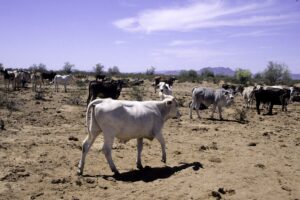
Due to behavioral and management differences, domestic cattle are no substitute for wild bison. Photo George Wuerthner.

Bison were critical to the horse-mounted bison hunting culture of the plains Indians and to their demise by the 1880s.  The disappearance of the vast herds of bison shocked or alarmed the American public and helped to foster new wildlife protection policies.

The Lacey Act, which prohibited the possession and transportation of wildlife across state borders, was explicitly enacted to protect bison from poachers in Yellowstone National Park.

Due to overhunting and commercial harvest, bison were extirpated from nearly all their vast range. By 1890 the last wild bison, perhaps only 50, remained in Yellowstone National Park. In addition to the Yellowstone herd, a few remaining wild bison were gathered into 5 or 6 small private herds. However, bison in most or all these herds were cross-bred with domestic cattle.

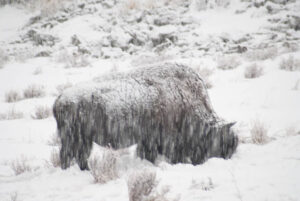
Few of the existing herds outside of Yellowstone National Park are large enough and subject to on-going natural selection such as native predators, variable climate, and other evolutionary influences to preserve wild genes. Photo George Wuerthner.

Today, there are bison herds in some national parks notably Badlands, Wind Cave, Grand Teton, and Yellowstone, and Theodore Roosevelt; and federal wildlife refuges such as Wichita Mountains. Among these, the Yellowstone herd is the most “wild”, being the largest and influenced by the least amount of domesticating management.  Smaller public herds, subject to more intensive and diverse management interventions are being domesticated, with simplification and disorganization of the wild bison genome.

Some bison advocates celebrate the more than 500,000 bison scattered on private ranches and in tribal herds. This is analogous to celebrating hatchery salmon as a substitute for wild salmon restoration.

Most or all these bison herds, wildness is being compromised. Most have cattle genes. These herds generally are subject to typical livestock management, including supplemental feeding, controlled rotations through pastures, selective culling, and controlled sex—age structure of the herd.  None are large enough to preclude degeneration of the wild genome.

This culling is not selective for wildness. Indeed, among many captive herds, the most unruly bison are often the first to be eliminated. The migratory tendency of bison is also being eradicated even among Yellowstone’s bison, shot at the park border by tribal gunners or captured for slaughter by the Park Service. This activity is done primarily to preclude the migration of Yellowstone bison out of the park onto private ranchlands.

Due to the small size of most domesticated bison herds and the heavy-handed livestock-oriented management, the genetic traits that could be summed up as “wildness” are being lost. Biologist Jim Bailey has written extensively about this loss.

A problem with many existing bison herds is their small size. Inbreeding depression and genetic drift are issues with small herds. All existing bison herds have been through genetic bottlenecks and thus have lost genetic variability. Considering that even the wilder bison herds such as those in Yellowstone and Utah’s Henry Mountains were started with tiny numbers, there are also likely some losses of genetic diversity even in these herds.

WHAT CONSTITUTES A WILD BISON HERD

A wild herd needs to be sufficiently large enough to avoid genetic inbreeding and significant genetic drift. Keep in mind that bison are tournament breeders, which means that a single bull can breed many females. The dominance of a few bulls can produce many half-siblings that may foster inbreeding in subsequent years.

Artificial selection, in many forms, plus genetic drift, reduces natural selection, allowing degradation of the wild genome. The pool of animals, actually the pool of alleles, subject to natural selection can be small, diminishing the effectiveness of natural selection.

A large herd also experiences more evolutionary influences and thus can preserve rare alleles that might only have value under stressful conditions (like climate change).

A diversity of landscapes also affects evolutionary selection; hence a large landscape segment is critical to sustaining wild bison. A bison range that is a large diverse landscape provides a diversity of natural opportunities and threats, and is necessary to provide the diversity of natural selection needed to retain the full wild genome.

OPPORTUNITIES FOR WILD BISON

Bison are the official mammal of the United States. It is time we started treating them with more respect and consideration.

We need to establish new wild herds of bison. Several prime locations could sustain large wild herds to ensure the ongoing preservation of “wild genes” in these animals. In 1910, William Hornaday of the Smithsonian Institution proposed a preserve for wild bison on the south side of the Missouri River in Montana and we still have an opportunity in this area to restore wild bison.

The million-acre refuge Charles M. Russell National Wildlife Refuge, along with adjacent Bureau of Land Management lands in the Missouri Breaks National Monument, and private lands in the American Prairie Reserve could easily support a herd of several thousand bison.

There is widespread public support for establishing a wild bison herd on the CMR under the U.S. Fish and Wildlife Service management. For example, a 2015 Draft Environmental Impact Statement for bison conservation and management that proposed establishing public bison herds in Montana by the Montana Fish, Wildlife & Parks received over 21,000 public comments. Likewise, the U. S. Fish and Wildlife Service received over 23,000 public comments during scoping and over 21,000 Public comments on the draft conservation plan for the CMR Refuge.

Three polls of citizens have shown that about 70 percent of Montana voters support the restoration of public trust, wild bison on the CMR Refuge.

Opposition to the establishment of wild bison herds in Montana comes primarily from Agricultural interests who currently control the political reins of the Montana legislature.

The Montana Wild Bison Restoration Coalition has put together a proposal to establish wild bison at the CMR

The second potential restoration area is the Green River/South Pass/Red Desert area of Wyoming. The Red Desert is the largest unfenced area in the West and once supported bison herds in the 1800s. Most of this area is BLM land, though there are sections of state lands and other agency lands that might be incorporated in a wild bison refuge.

Though human hunting was a major selective factor in evolution of modern bison before their near extinction, due to the small size of most existing herds, even a limited amount of human predation (as now occurred at the border of Yellowstone by tribal hunters) can negate natural processes like disease, social behavior, reproductive success, and energy efficiency, among other evolutionary factors.

We will have to control the sizes of all bison herds and human hunting is one appropriate method. The issue is to remove animals in ways that minimize weakening and replacement of natural selection by controlling the ages of removed animals and the seasons of removal. The smaller the herd, the fewer animals (alleles) that are available to natural selection.

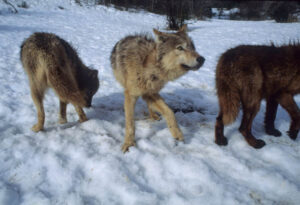
Wolf predator tends to select for the young and old. Any culling by humans should emulate this process. Photo George Wuerthner.

To degree that hunting is employed for culling herds, it should mimic the natural selection by predators like wolves who target yearlings and at the older animals, while prime age 5–10-year-old individuals should be off limits to removal.

It’s time to restore wild bison to the American West. We have the land base to do this, but do we have the political will?

Global Britain Slashes International Aid

Binoy Kampmark


“Decisions on aid are eroding trust and eroding relationships between the UK and developing countries.”

– Abby Baldoumas, Financial Times, July 15, 2021

Politics is not merely the art of the possible but the pursuit of concerted hypocrisy. When it comes to that matter of funding good causes – foreign aid, for instance – wealthy states are often happy to claim they open their wallets willingly.  As good international citizens, they fork out money for such causes as education, healthcare, sanitation.  The goals are always seen as bigger than the cash, a measure of self-enlightened interest.

The United Kingdom is certainly such a case. For years, governments of different stripes praised the political importance of the aid programme.  “Development has never just been about aid or money, but I am proud that Britain is a country that keeps its promises to the poorest in the world,” British Prime Minister David Cameron told the United Nations General Assembly in a 2012 speech.

This all started changing in 2020.  The merging of the Department of International Development with the Foreign Office was a signal that pennies would be in shorter supply.  On November 25, 2020, UK Chancellor of the Exchequer Rishi Sunak announced that the government would not spend 0.7% of gross national income on official development assistance in 2022.  The allocation would fall to 0.5% of GNI – £10 billion in monetary terms.  Relative to the 2019 budget, this would amount to an effective cut of around £4 to 5 billion.  Aid had very much become a matter of money.

The 0.7% allocation has been part of British policy since 2013.  Two years after that, it became part of legislation.  Up till September 2020, it was even assumed that it would also be part of Tory policy, given its mention in the Conservative Party manifesto.

Sunak did not shy away from populist justification in delivering his spending review for the 2021-22 financial year.  “During a domestic fiscal emergency, when we need to prioritise our limited resources on jobs and public services, sticking rigidly to spending 0.7% of our national income on overseas aid is difficult to justify to the British people.”

The Chancellor tried assuring his fellow parliamentarians that he had “listened with great respect to those who have argued passionately to retain this target, but at a time of unprecedented crisis, government must make tough choices.”  Such a tough choice seemed to put Sunak in breach of the law, not something alien to members of the Johnson government, including the prime minister himself.  But do not expect legal writs or the constabulary to be pursuing the matter: all that’s seemingly required is a statement to Parliament explaining why the aim was not achieved.

On July 13, Parliament passed a motion confirming the reduction in the aid budget, with 333 votes cast in favour of it.  298 opposed it.  Despite being billed as a compromise, the former international development secretary Andrew Mitchell was wiser.  “There is an unpleasant odour leaking from my party’s front door,” he ruefully admitted.  The motion had been “a fiscal trap for the unwary.”

The consequences of these slashing initiatives have laid waste to the charity and humanitarian landscape.  The list of casualties mentioned by Devex is grim and extensive.  A few unfortunates are worth mentioning.  On July 7, South Sudan country director of Christian Aid reflected upon the closure of peace-building efforts led by various churches in South Sudan given the 59% cut in UK aid.  “These cuts risk having a lethal effect on the chances of a lasting peace here,” James Wani lamented.

On June 14, support was cancelled for the Strategic Partnership Arrangement with Bangladesh.  In the view of the NGO BRAC, this would see a halt to educating 360,000 girls, stop the funding of 725,000 school places, and cut nutritional support for 12 million infants, not to mention access to family planning services for 14.6 million women and girls.

Whole initiatives will cease outright, such as the Malawi Violence Against Women and Girls Prevention and Response Programme or the Green Economic Growth for Papua programme, which focuses on preventing deforestation.  In some cases, existing budget allocations have been reduced by staggering amounts.  The UN Sexual and Reproductive Health Agency (UNFPA), for example, has seen its funding allotment from the UK for its family planning programme reduced by 85% – from £154 million to £23 million.

With all this devastation taking place, Prime Minister Boris Johnson could still breezily announce at the G7 summit that his government would be providing an extra £430 million of extra funding from UK coffers for girls’ education in 90 developing countries.  The timing of this was exquisite: only some weeks prior, cuts had been made amounting to over £200 million for the same cause, down from the £600 million offered in 2019.

In April 2021, Foreign Secretary Dominic Raab sounded every bit the stingy economic rationalist.  “Throughout the business planning process, we strived to ensure that every penny of the FCDO’s (Foreign, Commonwealth and Development Office’s) ODA (Official Development Assistance) spent brings maximum strategic coherence, impact and value for taxpayers’ money.”

At the Global Education Summit this July, the bleak and razored approach Johnson had taken to aid was concealed by a mask of colourful praise for his own moneyed initiatives.  He called the Global Partnership for Education “the universal cure”, “the Swiss Army knife, complete with Allen key and screwdriver and everything else that can solve virtually every problem that afflicts humanity.”

Without blushing at any point, he spoke about educating the world properly and fairly to “end a great natural injustice.”  In giving “every girl in the world the same education as every boy, 12 years of quality education, then you perform the most fantastic benefits for humanity – you lift life expectancy, you lift per capita GDP, you deal with infant mortality”.

The aid cuts have not only aggrieved those in the charity and development sector.  Baroness Liz Sugg resigned as minister for overseas territories and sustainable development in response to the cuts.  “Cutting UK aid risks,” she wrote to the prime minister last November, “risks undermining your efforts to promote a Global Britain and will diminish your power to influence and other nations to do what is right.”

From the levels of local government, Shropshire councillor Andy Boddington also expressed his dismay.  “Our local MPs and Boris Johnson should bow their heads in shame and recognise how this unnecessary cut has diminished Britain on the world stage just as we prepare to host the international climate summit COP26.”  The good councillor would surely be aware that the allocation of shame, for Johnson, is much like Britain’s current aid budget: diminished in supply.

The Fall of Tunisia, Last of the Arab Spring Nations

Patrick Cockburn


“Do you remember the tomorrow that never came?” asked a sad piece of street graffiti in Cairo, referring to the fate of the Arab Spring that once promised to overthrow the brutal autocracies that rule the Middle East.

That tomorrow moved even further into the future this week when a coup displaced the last surviving democracy to emerge from the Arab uprising of 2011. Appropriately, it took place in Tunisia, where the Arab Spring began a decade ago after a vegetable seller burned himself to death in a protest against the actions of the corrupt and dictatorial regime.

On 25 July, Kais Saied, the Trump-like populist president of Tunisia, sacked the prime minister, suspended parliament and declared himself prosecutor general. As with Donald Trump, he had spent the years since he was elected in 2019 blaming members of parliament, critical media and government institutions for the dire state of the country. Polls show that many Tunisians believe him.

The takeover of power has been called “a constitutional coup” because Saied, a law professor by profession, was already president, but decisive steps towards autocracy are being taken. By now this road to dictatorship is well-travelled in many countries and the Tunisian coup is only the concluding episode in the tragic saga of the Arab Spring. Almost every state in the Middle East and North Africa has now returned to – or never left – the political dark ages from which, not so long ago, they thought they might be emerging.

There was nothing phoney about the Arab Spring in its first phases, though western media coverage was over-optimistic about the chances of success. Spontaneous uprisings spread from Tunisia to Egypt, Bahrain, Yemen, Libya and Syria. People poured onto the streets chanting slogans like: “Bread! Freedom! Social Justice! The people demand the fall of the regime!”

And regimes did fall or falter as television screens worldwide were filled with pictures of protesters battling police in Tahrir Square in Cairo and Libyan militiamen fighting Muammar Gaddafi’s soldiers on the road to Benghazi. The scenes looked like something out of Les Misérables, with the revolutionary populace struggling against the forces of oppression.

In many ways this was true enough, but the chances of victory were always less than they appeared. At first, the demonstrators had the advantage of surprise because the sclerotic regimes that they were seeking to overthrow had never before faced mass protests on such a scale. The powers-that-be used enough violence to enrage, but not enough to intimidate. There was much wishful thinking about how social media had outflanked and marginalised official propaganda.

The greatest triumph of the Arab Spring was in Egypt with its 90m population, where President Hosni Mubarak was removed after 29 years in power. Astonished by their achievement, the revolutionaries did not grasp its limitations. They never took over state institutions, notably the Egyptian army, which in July 2013 staged a military coup with popular support and established an even more oppressive regime than that of Mubarak.

One by one, the countries that briefly dreamed of a bright future in 2011 saw their hopes extinguished. In Bahrain, the Sunni monarchy ferociously stamped out demonstrations by the Shia majority, torturing doctors who had treated the injured and claiming, without any evidence, that the protests were orchestrated by Iran.

The outcome of the Arab Spring was uniformly disastrous in that in the six countries where it took hold the situation is worse than before. In three of them – Libya, Syria and Yemen – civil wars, all fueled and manipulated by outside powers, are raging and show no sign of ending. Governments in Egypt and Bahrain, which is effectively a proxy of Saudi Arabia, ruthlessly crush any signs of dissent. Predictably, Egypt and Saudi Arabia have both welcomed the presidential coup in Tunisia.

I reported and wrote about all these uprisings at the time and in subsequent years. I was never optimistic that all would turn out well, but sitting in Cairo after the fall of Mubarak 10 years ago and trying to decide if I should cover the revolution in Benghazi or the one in Bahrain, it was impossible not to be caught up in the heady atmosphere of a new day dawning.

Even then I suspected that the old regimes were not going to disappear tamely. My minor skirmishes with the Egyptian bureaucracy convinced me that they were still waiting for a clear winner in the power struggle. In Libya, after Gaddafi had been killed, it was telling that one of the first proposals of the transitional government was to end the ban on polygamy.

I have asked myself ever since if the millions who demonstrated during the Arab Spring could have won or was the balance of power always too skewed against them. The answer to this question is vital if there is ever to be a second revolutionary wave more successful than the first.

Outside the Middle East, the vision of the forces at play 10 years ago was always naive, pitting “evil doers” against the good-and-the-true. Almost from the beginning, the Arab Spring was a peculiar mix of revolution and counter-revolution. Genuine popular uprisings took place in Libya and Syria, for instance, but it was absurd to imagine that Saudi Arabia, UAE and Qatar, the Sunni absolute monarchies of the Gulf, were giving vast sums of money to the parties and militias they supported in order to spread secularism, democracy and freedom of expression.

Anti-regime movements in their dealing with the West would sensibly downplay their religious and ethnic allegiances and adopt the vocabulary of liberal democracy. Usually they were taken uncritically at their word. Iraqi opposition to Saddam Hussein before the US-led invasion in 2003 blamed all sectarian hatreds on him, and the opponents of Bashar al-Assad did much the same after 2011. But in both countries, the military frontlines commonly mirror the religious and ethnic loyalties of local communities.

Western politicians who led the military interventions in Afghanistan and Iraq likewise pretend that one of their prime motives was to spread parliamentary democracy and personal freedom. But my experience of reporting these interventions was that they were not much different from 19th-century imperial ventures, and served to exacerbate divisions and spread chaos.

The first uprising in Tunisia provoked vast international interest, but the presidential coup in the same country last Sunday scarcely registered on the news agenda. This is a mistake even from the most nationally egocentric point of view because a great band of human misery now stretches more than 3,000 miles from Kabul to Tunis and 2,000 miles from Damascus to Mogadishu.

This vast zone of deprivation, dictatorship and violence may regenerate Isis or lead to rise of new al-Qaeda-type organisations. It will certainly produce great surges of refugees once again heading for Europe because they see no future for themselves in their own countries.