19 Oct 2021

Smithsonian Institution Fellowship Program (SIFP) 2022

Application Deadline: 1st November, 2021

Eligible Countries: All

To be taken at (country): United States of America

About the Award: The Smithsonian Institution Fellowship Program offers opportunities for independent research or study related to Smithsonian collections, facilities, and/or research interests of the Institution and its staff. Fellowships are offered to graduate students, predoctoral students, and postdoctoral and senior investigators to conduct independent research and to utilize the resources of the Institution with members of the Smithsonian professional research staff serving as advisors and hosts. These fellowships are offered through the Smithsonian’s Office of Fellowships and Internships, and are administered under the charter of the Institution, 20 U.S. Code section 41 et seq.

Applicants who wish to conduct research at the Smithsonian Astrophysical Observatory (SAO) should go here as SAO application requirements and deadlines may be different.

The publication, Smithsonian Opportunities for Research and Study, outlines Smithsonian research activities and lists the research staff. Applicants are strongly encouraged to contact staff members to help identify potential advisors, determine the feasibility of the proposed research being conducted at the Smithsonian Institution, and the availability of relevant resources such as staff, collections, archives and library materials during the proposed tenure dates.

The Smithsonian Institution Fellowship Program offers fellowships for research and study in the following fields and encourages applications of an interdisciplinary nature:

  • Animal behavior, ecology, and environmental science, including an emphasis on the tropics
  • Anthropology, including archaeology, cultural anthropology, linguistics, and physical anthropology
  • Astrophysics and astronomy
  • Earth sciences and paleobiology
  • Evolutionary & systematic biology
  • Folklife
  • History of science and technology
  • History of art, especially American, contemporary, African, and Asian art, twentieth-century American crafts, and decorative arts
  • Materials research
  • Molecular biology
  • Social and cultural history of the United States

Type: Fellowship

Eligibility: 

  • The program is open to US citizens and Non-US citizens. Applicants whose native language is not English are expected to have the ability to write and converse fluently in English. All application materials must be presented in English (foreign transcripts may be translated, see below).
  • Past or current fellowship recipients are eligible to apply for another award.

Graduate Student Fellowships: When they apply, students must be formally enrolled in a graduate program of study at a degree-granting institution. Before the appointment begins fellows must still be enrolled and must have completed at least one full-time semester or its equivalent, or have completed the graduate program within the past four months. Graduate Student Fellowships are usually intended for students who have not yet been advanced to candidacy if in a doctoral program.

Predoctoral Fellowships: Students enrolled in a university as candidates for the Ph.D. or equivalent are eligible for predoctoral fellowships. By the time the appointment begins, the university must approve the undertaking of dissertation research at the Smithsonian Institution and certify that requirements for the doctorate, other than the dissertation, have been met.

Postdoctoral Fellowships:  The doctorate degree must be completed by the time the fellowship begins.

Senior Fellowships:  Applicants must have held a Ph.D. or equivalent for at least 7 years. Applicants who have received the Ph.D. or equivalent before November 1, 2014 are eligible to apply for senior fellowships.  If you have taken a “leave of absence” from research and wish to apply under the postdoctoral fellowship application instead of senior fellowship application you will need to provide a justification in the additional information section at the end of the application.

Selection Criteria: Applications for Smithsonian Institution Fellowship are evaluated and fellows are selected, by scholars in appropriate fields, on the basis of the proposal’s merit, the applicant’s ability to carry out the proposed research and study, the likelihood that the research could be completed in the requested time, and the extent to which the Smithsonian, through its research staff members and resources, could contribute to the proposed research. The number of appointments made each year is determined by the availability of funds for the program. The Smithsonian Fellowship Program does not discriminate on grounds of race, color, religion, sex (including gender identity, sexual orientation, and pregnancy), national origin, age, or disability.

Number of Awardees: Not specified

Value of Fellowship:

SENIOR FELLOWSHIPS -for scholars at least seven years beyond the Ph.D.

Term: 3 to 12 months
Stipend: $55,000 per year
Research Allowance: up to $4,000 per year

POSTDOCTORAL FELLOWSHIPS – for scholars up to seven years beyond the Ph.D. *

Term: 3 to 12 months**
Stipend: $55,000 per year
Research Allowance: up to $4,000 per year
** Postdoctoral applicants in Science may apply for up to 24 months.

PREDOCTORAL FELLOWSHIPS -for doctoral candidates to conduct dissertation research.

Term: 3 to 12 months
Stipend: $40,000 per year
Research Allowance: up to $4,000 per year

TEN-WEEK GRADUATE STUDENT FELLOWSHIPS -for graduate students to conduct independent research usually before having been advanced to candidacy if in a Ph.D. program.

Term: 10 weeks
Stipend: $8,000

* If you have taken a “leave of absence” from research and wish to apply under the postdoctoral fellowship application instead of senior fellowship application which makes you 7 or more years out from receiving your Ph.D., please provide a justification in the additional information section at the end of the application.

Fellowship tenures must begin between June 1, 2021 and March 1, 2022. It is important that applicants consider the following factors carefully when choosing the dates for the proposed fellowship: their academic schedule; completion dates of their preliminary exams, course work, or dissertation (if applicable); the schedule of their proposed advisor/host and the availability of required resources.

How to Apply: Apply Through the Smithsonian Online Academic Appointment System (SOLAA)

Completed general information in SOLAA

Please ensure you go through the application guidelines in Scholarship Webpage before applying.

Visit Fellowship Webpage for details

The Embarrassment of Riches

John Feffer


The rich have always flaunted their wealth. It was rarely good enough to enjoy financial success, you had to be conspicuous about it.

They build enormous homes for everyone to gawk at. They throw lavish parties. They commission paintings, statues, biographies. They endow institutions so that their names can live on in granite forever.

At the same time, the rich withdraw into gated villas, travel in their own private jets, and buy their own Picassos so that they don’t have to mix with the hoi polloi at museums. The rich want us to know about their wealth, but they also want to be left alone to enjoy it. They engage in an enormous game of peekaboo with the public. Now you see my wealth, now you don’t

In our globalized era, this game of peekaboo has become a vast enterprise. Enormous fortunes are generated by multinational operations and transnational financial flows. The profits in turn are protected by a baroque system of secret bank accounts and tax shelters. The rich will give away their money, occasionally, but as little as possible to governments. Their gifts to private charity are often just another way of robbing the public. Global tax shelters, meanwhile, are grand theft.

The recently released Pandora Papers, a trove of nearly 12 million documents, shines some light on the mechanisms by which the wealthy squirrel away their gains. One example jumps out: Tony Blair.

The former British prime minister and his lawyer wife Cherie purchased a multi-million-dollar townhouse in London as her office but did it in such a way as to avoid paying a tax on the sale. In this offshore financial sleight of hand, they skipped out on paying several hundred thousand dollars to the very government over which Blair once presided.

The maneuver, which was perfectly legal, is salient for two reasons.

First, Blair himself had initially railed against tax dodges of this nature. “Offshore trusts get tax relief while homeowners pay VAT on insurance premiums,” he said as Labor Party leader. “We will create a tax system that is fair which is related to ability to pay.”

Second, Blair celebrated a “third way” that was supposedly an accommodation between socialism and capitalism. When it came to global markets, Blair wanted “to remove regulatory burdens and to untie the hands of business,” as he put it in a celebrated 1999 speech.

It’s no surprise, then, that he took advantage of the very mechanisms that he initially opposed and subsequently facilitated through deregulation.

Blair is by no means alone in his opportunism. The Pandora Papers are full of politicians who campaigned on anti-corruption platforms and are now being hoisted by their own petards.

The billionaire Czech prime minister Andrej Babiš, for instance, made his political fortune on the basis of promises to stand up to corruption and run the Czech Republic like a business. When Czechs gave his party an overwhelming victory in 2017, they didn’t seem to find anything contradictory about such promises. Babiš at that time stood accused of various corrupt practices involving his businesses, including improper receipt of European subsidies. These allegations continued to dog him throughout his term of office, leading to an official European Parliament censure several months ago.

So, naturally, Babiš turns up in the Pandora Papers as well. According to the documents, the businessman transferred $22 million to offshore entities to buy a luxury French chateau. He engaged in this subterfuge to keep the purchase secret and probably to reduce his tax burden as well. This week, Czech voters finally changed their minds about Babiš and effectively voted him out of office.

Other anti-corruption campaigners have been ensnared in the Pandora web of incriminating documents. Volodymyr Zelensky, for instance, promised voters that he would clean up Ukraine’s swamp of corruption, but the Pandora Papers revealed his ownership of shares in offshore entities and shell companies. Oh, Zelensky “cleaned up” all right.

What was surprising about many of the 35 current and former world leaders that appear in the Pandora Papers was not so much their presence on the list— Gabon’s Ali Bongo, for instance, is notoriously corrupt while Chile’s Sebastian Pinera was already linked to 14 corruption investigations before he became president again at the end of 2017—but that they went to such great lengths to hide their purchases from the public.

Jordan’s King Hussein is a monarch, for goodness sake. Monarchs are expected to spend royally. The Queen of England enjoys $500 million in personal assets, and hardly anyone blinks an eye at all the money the royals spend very publicly on weddings, junkets, and the like. And yet, according to the Pandora Papers, King Hussein went about collecting $100 million of property around the world in secret. Of course, Jordan is a relatively poor country, and the government has imposed very unpopular austerity measures. It doesn’t look so good for their king to buy three cliff-top mansions in Malibu, four apartments in Georgetown, and several properties near Buckingham Palace.

Tolerance for the fabulously wealthy waxes and wanes. Back in the 1980s, TV viewers thrilled to glimpses of the “lifestyles of the rich and famous.” Nowadays, anger has been steadily mounting against the 1 percent. That’s why kings and politicians have been more discrete in moving their wealth around.

And that’s why governments feel that they have the public on their side when they try, even in half-hearted ways, to tap into this stream of globally circulating wealth.

Doing the Minimum

One of the virtues of globalization, from the perspective of a corporation, is the ability to move operations from one jurisdiction to another to take advantage of better tax deals. Some countries, like Ireland and Hungary, have billed themselves as havens for corporations that want to pay as little tax as possible.

At the prodding of the United States, the Organization for Economic Cooperation and Development (OECD) has been pushing through a corporate minimum tax rate of 15 percent. It will also tax digital companies in locations where they operate even if they don’t maintain any offices there.

All of this is lower than what the United States initially pushed for—a 21 percent rate. The measure, if passed, will have a 10-year transition period. And it’s not entirely clear that the United States itself will ratify the accord given the predictable Republican opposition. But hey, it’s something.

This effort might make a small dent in the gross receipts of the world’s wealthiest, like Amazon’s Jeff Bezos and Facebook’s Mark Zuckerberg. But even a small dent adds up to a lot of revenue. “Tax havens collectively cost governments between $500 billion and $600 billion a year in lost corporate tax revenue,” writes tax haven expert Nicholas Shaxson. “Of that lost revenue, low-income economies account for some $200 billion—a larger hit as a percentage of GDP than advanced economies and more than the $150 billion or so they receive each year in foreign development assistance.”

It’s not just corporations that are hiding their profits from tax authorities. Individuals continue to profit enormously from the global economy and, with the help of their accountants, avoid paying as much as possible to their respective governments. Shaxson offers a range of anywhere between $8.7 trillion and $36 trillion, which adds at least another $200 billion in lost government tax revenue per year.

To take advantage of low to non-existent tax rates, the rich love to park their money, and sometimes themselves, in places like the Bahamas and the Cayman Islands. But the real surprise of the Pandora Papers is South Dakota’s status as a capital magnet. Like those island hideaways, South Dakota has no income tax, inheritance tax, or capital gains tax. And, like the Switzerland of old, it protects the money of the rich behind walls of secrecy.

On top of that, South Dakota trusts offer something else the rich crave: deniability. As Felix Salmon explains, “All three parties — the settlor, the trustee, and the beneficiary — can legally claim that the money isn’t theirs. The settlor and the beneficiary can say they don’t have the money, it’s all in a trust run by someone else. The trustee can say that she is just looking after the money and doesn’t own it.”

In other words, the rich often want to be as inconspicuous as possible—to avoid the tax inspector, that persistent creditor, and the anger of crowds.

So, the first step to clean up this highly lucrative mess is sunlight. One global tool is the Common Reporting Standard by which participating countries provide basic information about foreign assets held in their territories. Guess what: the United States is alone among major countries in not participating. In its usual exceptionalist way, America shares financial information on its own terms, not according to a global standard. Sunlight should extend to corporations as well, which should be obligated to submit financial information on every country where they operate.

The next step is to crack down on tax havens. The European Union maintains a tax haven black list, but it only has nine locations on it after the recent removal of Anguilla, Dominica, and the Seychelles. “Today’s decision to delist Anguilla, the only remaining jurisdiction with a 0% tax rate, and the Seychelles, which are at the heart of the latest tax scandal, renders the EU’s blacklist a joke,” concludes Oxfam’s Chiara Putaturo. So: better black lists.

And, of course, more should be done to raise the floor on corporate tax rates. The United States was right (for once): 15 percent is too low.

Soak the Rich

Decades of deregulation have led to the rise of a new class of the super-rich. More than 500,000 people around the world possess more than $30 million each, and half of these live in the United States. Of that latter number, over 700 are billionaires, and they saw their collective wealth increase by $1.8 trillion during the pandemic.

It’s time for rich people to fork over their fair share. The planet is presenting its bill to humanity. Pay up, says Mother Earth, or you’re toast.

Right now, those who are the least able to shoulder the costs of climate change are suffering its worst effects. In 2015, the World Bank estimated that, unless the international community took immediate steps, climate change would push 100 million people into poverty by 2030. Those immediate steps have not been taken. As a result, more than a million people are on the brink of famine because of drought in Madagascar. Poor islands like Haiti are especially vulnerable to climate change, and the population simply doesn’t have the capacity to adapt to their changing circumstances.

Elsewhere, the poor are doing whatever they can to keep their heads above water. In a recent astonishing study, the International Institute for Environment and Development reports that the rural poor in Bangladesh are spending more than their government or aid agencies to combat the climate impacts on their communities.

The rich are clearly embarrassed by their riches, so much so that they are going to great lengths to keep their transactions a secret. Now, can we embarrass them even more so that they pay what is necessary to save the planet?

Between Hunger and Poverty: Politics and Policies of Estimation

K.M. Seethi


Hunger and poverty are so intertwined that reports concerning one have implications for the other, and a palpable common factor is food security. The release of the Global Hunger Index (GHI) for 2021, on the eve of the observance of World Food Day (16 October), and the International Day for the Eradication of Poverty (17 October) has naturally generated both anxieties and resentment. While anxieties are understandably pervasive across regions and countries, the resentment has come, this time, from an emerging economy in South Asia—India—which has high stakes in the global economy with its collaboration and partnerships with a large number of stakeholders. This, however, does not mean that the economy at the macro level is doing badly, notwithstanding pressures of global recession and the pandemic. It is yet critically important what countries such as India are doing at the micro level where the link between poverty and hunger is so obvious.

The United Nations has already come out with reports that as much as 842 million people across countries are undernourished and “almost all of them live in developing countries,” such as in regions like Sub Saharan Africa and South Asia. According to the UN, “the COVID-19 pandemic that gripped the world during the past year has resulted in reversing decades of progress in the fight against poverty and extreme poverty.”  Quoting from the World Bank data, it says that “between 88 and 115 million people are being pushed into poverty as a result of the crisis, with the majority of the new extreme poor being found in South Asian and Sub-Saharan countries where poverty rates are already high.” The UN predicted that in 2021, “this number is expected to have risen to between 143 and 163 million. These ‘new poor’ will join the ranks of the 1.3 billion people already living in multidimensional and persistent poverty who saw their pre-existing deprivations aggravated during the global pandemic.”

According to the Food and Agricultural Organisation (FAO), more than 3 billion people (nearly 40 per cent of the world population) cannot afford a healthy diet. This happens when the world’s agri-food system employs 1 billion people, more than any other sector. FAO says that small holder farmers produce more than 33 per cent of the world’s food, despite challenges including poverty, and a lack of access to finance.  FAO also underlines that   governments “need to both repurpose old policies and adopt new ones that foster the sustainable production of affordable nutritious foods and promote farmer participation.” It also says that policies “should promote equality and learning, drive innovation, boost rural incomes, offer safety nets to smallholders and build climate resilience. They also need to consider the multiple linkages between areas affecting food systems including education, health, energy, social protection, finance and more, and make solutions fit together.”

Does this happen in regions such as Sub-Saharan Africa and South Asia? While the year-long farmers’ agitation in India is an indication of the ground level reality and burgeoning anxieties, the scenario in Africa is predictably grim. It is in this context that GHI 2021 holds significance, for countries like India.

Global Hunger Index and India

According to the GHI Report, India occupies 101th position in the hunger index, a further deterioration from 2020 rank (94). What is more disappointing for the policy circles in New Delhi is that India is lagging behind its neighbours in South Asia such as Nepal, Sri Lanka, Bangladesh and Pakistan. GHI—prepared by the Irish aid agency Concern Worldwide and Germany’s Welt Hunger Hilfe—revealed that 18 countries, including China, Brazil and Kuwait, come on the top of the ranking, with GHI scores of less than five. The GHI characterised the condition of hunger in India as ‘alarming.’ GHI sought to analyse data from 135 countries, but only 116 countries provided sufficient data.

The GHI considered four major indicators for score analysis—undernourishment; child wasting or the share of children under the age of five who have low weight for their height, reflecting acute undernutrition; child stunting or the number of under-5 children who have low height for their age, reflecting chronic undernutrition; and child mortality. According to the report, wasting among children in India grew from 17.1 per cent between 1998 and 2002 to 17.3 per cent between 2016 and 2020. “People have been severely hit by covid-19 and the pandemic-related restrictions in India, the country with the highest child-wasting rate worldwide.” The Report further said that though other countries in the region such as Nepal (76), Bangladesh (76), Myanmar (71) and Pakistan (92) are also placed in the ‘alarming’ hunger list, they have managed better at feeding its citizens than India. This obviously angered New Delhi. The Statement issued by India’s Ministry of Women and Child Development says:

“It is shocking to find that the Global Hunger Report 20201 has lowered the rank of India on the basis of FAO estimate on proportion of undernourished population, which is found to be devoid of ground reality and facts and suffers from serious methodological issues. The publishing agencies of the Global Hunger Report, Concern Worldwide and Welt Hunger Hilfe, have not done their due diligence before releasing the report.”

Terming the methodology employed by FAO as ‘unscientific,’ the Ministry alleged that these agencies “based their assessment on the results of a ‘four question’ opinion poll, which was conducted telephonically by Gallup. There is no scientific methodology to measure undernourishment like availability of food grains per capita during the period.” The statement further said that the scientific measurement of undernourishment “would require measurement of weight and Height, whereas the methodology involved here is based on Gallup poll based on pure telephonic estimate of the population.” According to the Ministry, the agencies completely disregarded “Government’s massive effort to ensure food security of the entire population during the covid period, verifiable data on which are available. The opinion poll does not have a single question on whether the respondent received any food support from the Government or other sources. The representativeness of even this opinion poll is doubtful for India and other countries.”

It also said that both GHI 2021 and FAO report on The State of Food Security and Nutrition in the World 2021 have completely ignored some glaring facts available in public domain, pertaining to schemes such as Pradhan Mantri Garib Kalyan Anna Yojna (PMGKAY) and Atma Nirbhar Bharat Scheme (ANBS). Under PMGKAY, the government “made allocation of food grains @ 5 kg per person per month free of cost for around 80 Crore (800 million) beneficiaries of the 36 States/UTs covered under National Food Security Act (Antyodaya Anna Yojana and Priority Households) including those covered under Direct Benefit Transfer for the period April to November 2O2O and again for the period May to November 2021.” In 2O2O, 3.22 crore (32.2 million) metric tons of food grains and in 2021, about 3.28 crore (32.8 million) metric tons of food grains were allocated free of cost under PMGKAY scheme to approximately 80 Crore (800 million) NFSA beneficiaries. Besides food grains, pulses were provided @ 1 kg per household per month for the period April to November 2020 free of cost to all beneficiaries under NFSA covering 19.4 Crore (194 million) households. The Ministry also noted that under ANBS, the government made allocation of about 8 lakh (800 thousand) metric tons of additional free of cost food grains covering all the States/UTs for migrants/stranded migrants who were neither covered under NFSA nor State Scheme PDS cards, @ 5 kg per person per month free of cost for a period of two months, May and June 2020.

GHI, however, stated that while India fared better in indicators such as the under-5 mortality rate, prevalence of stunting among children and incidence of undernourishment due to inadequate food continued to be high. The report indicated that food security is under challenge on multiple fronts. It highlighted that deteriorating conflict, weather fluctuations related to global climate change, and the economic and health challenges associated with the Covid-19 pandemic are all causing hunger. It said that “since 2000, India has made substantial progress, but there are still areas of concern, particularly regarding child nutrition. India’s GHI score has decreased from a 2000 GHI score of 38.8 points—considered alarming—to a 2021 GHI score of 27.5—considered serious. The proportion of undernourished in the population and the under-five child mortality rate are now at relatively low levels. While child stunting has seen a significant decrease—from 54.2 percent in 1998–1999 to 34.7 percent in 2016–2018—it is still considered very high. At 17.3 percent—according to the latest data—India has the highest child wasting rate of all countries covered in the GHI. This rate is slightly higher than it was in 1998–1999, when it was 17.1 percent.”

The report also noted that “it is difficult to be optimistic in 2021 because the forces driving hunger are overpowering good intentions and lofty goals. Among the most powerful and toxic of these forces are conflict, climate change, and covid-19—three Cs that threaten to wipe out any progress that has been made against hunger in recent years,” the report added.

As the GHI report appeared, the CPI(M) General Secretary Sitaram Yechury came down heavily against the Union Government saying that while “food grains rotting in central godowns, mass hunger grows.” He said that in 2014 when Modi became prime minister India ranked at 55. In 2020, India “slipped to rank 94. Now we rank 101/116 countries.”

It may be recalled that months back, India had proposed to help the World Food Programme (WFP) replenish its foodgrain stock from overflowing state-owned granaries to assist the organization’s efforts in providing food to the most vulnerable global population amid the covid-19 crisis. The proposal was in reply to an appeal by WTO nations to lift ban on shipment of foodgrain for humanitarian aid. A Live Mint report said that in recent years, the government’s record procurement had led to burgeoning central pool stocks at 2.5 times the existing buffer norms. Till September, for instance, Food Corporation of India had central stocks of 22.2 million metric tonnes of rice and 47.8 million metric tonnes of wheat. The food grains Stock in Central Pool for the years 2016-2021 is now available in the public domain.

A major question being raised is whether the Public Distribution System (PDS), which played an important role in providing relief to people in India, is any more ‘viable and sustainable’ under neoliberal policy regime and its pressures, beyond this critical period of pandemic. While the peasant population in India is under tremendous pressure of ‘contracting out’ farming, without any state protection, the accumulation of problems emerging from the situation of state withdrawal will be so critical. Hunger caused by poverty will naturally be higher notwithstanding robust schemes put in place from time to time. The peasantry in India is already a victim of crop price fluctuations, high inflation and the rising cost of living. The Global Hunger Index (GHI) for 2021 is therefore a matter of concern insofar as its forewarning has a bearing on policymaking, beyond the politics of resentment.

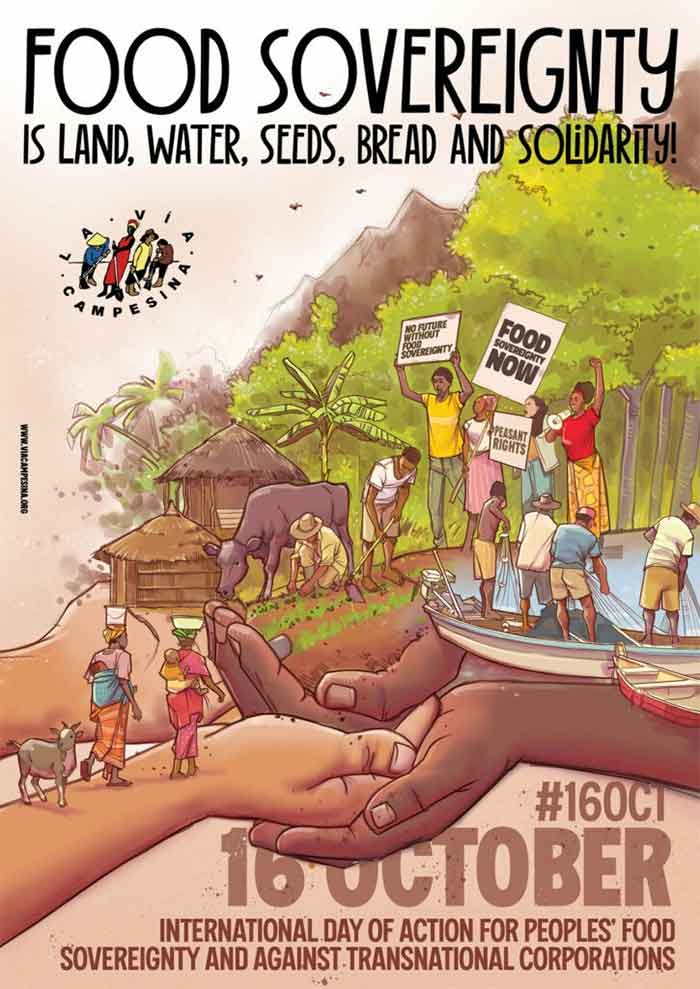
Food Sovereignty: A Manifesto for the Future of Our Planet

La Via Campesina


Food Sovereignty is a philosophy of life.

It offers a vision for our collective future, and defines the principles around which we organize our daily living and co-exist with Mother Earth. It is a celebration of life and all the diversity around us. It embraces every element of our cosmos; the sky above our heads, the land beneath our feet, the air we breathe, the forests, the mountains, valleys, farms, oceans, rivers and ponds. It recognizes and protects the inter-dependency between eight million species that share this home with us.

We inherited this collective wisdom from our ancestors, who ploughed the land and waded the waters for 10,000 years, a period in which we evolved into an agrarian society. Food Sovereignty promotes justice, equality, dignity, fraternity and solidarity. Food Sovereignty is also the science of life – built through lived realities spread across countless generations, each teaching their progeny something new, inventing new methods and techniques which sat harmoniously with nature.

As holders of this rich heritage, it is our collective responsibility to defend it and preserve it.

Recognizing this as our duty – especially in the late ’90s when conflicts, acute hunger, global warming and extreme poverty were too visible to ignore – La Via Campesina(LVC) brought the paradigm of Food Sovereignty into international policy-making spaces. LVC reminded the world that this philosophy of life must guide the principles of our shared living.

The ’80s and the ’90s were an era of unbridled capitalist expansion – at a pace never seen before in human history. Cities were expanding, growing on the backs of cheap, unpaid and underpaid labour. The countryside was being pushed into oblivion. Rural communities and rural ways of living were swept under the carpet by a new ideology that wanted to turn everybody into a mere consumer of things and an object of exploitation for profit. Popular culture and consciousness were under the spell of glittery advertisements goading people to “buy more”. In all this, though, the ones who produced – the working class in the rural areas, coasts and cities, which included the peasants and other small-scale food producers – remained invisible, while the ones who could afford to consume with wander took centre stage. Pushed to the edges, peasant1 workers and indigenous communities worldwide recognized the urgent necessity for an organized and internationalist response to this globalizing, free-market ideology propagated by the defenders of the capitalist world order. Food Sovereignty became one of the expressions of this collective response.

Food Soverignty

At the 1996 World Food Summit, in a debate about how we organize our global food systems, La Via Campesina coined the term food sovereignty; to insist upon the centrality of the small-scale food producers, the accumulated wisdom of generations, the autonomy and diversity of rural and urban communities and solidarity between peoples, as essential components for crafting policies around food and agriculture.

In the ensuing decade, social movements and civil society actors worked together to define it further “as the right of peoples to healthy and culturally appropriate food produced through ecologically sound and sustainable methods, and their right to define their own food and agriculture systems. It puts the aspirations and needs of those who produce, distribute and consume food at the heart of food systems and policies rather than the demands of markets and corporations.”

The introduction of Food Sovereignty as a collective right changed how the world understood poverty and hunger.

Until then, especially in the early years of the 21st century, a narrow idea of “Food Security” dominated governance and policy-making circles. Noble in its intent, food security treated those affected by hunger as objects of compassion, risked reducing them to passive consumers of food produced elsewhere. While it recognized food as a fundamental human right, it did not defend the objective conditions for producing food. Who produces? For Whom? How? Where? And Why? All these questions were absent, and the focus was decidedly on merely “feeding the people”. An overt emphasis on people’s food security ignored the hazardous consequences of industrial food production and factory farming, built on the sweat and labour of migrant workers.

Food Sovereignty, on the other hand, presents a radical overhaul. It recognizes people and local communities as the principal actors in the fight against poverty and hunger. It calls for strong local communities and defends their right to produce and consume before trading the surplus. It demands autonomy and objective conditions to use local resources, calls for agrarian reform and collective ownership of territories. It defends the rights of peasant communities to use, save, exchange seeds. It stands for the rights of people to eat healthy, nutritious food. It encourages agroecological production cycles, respecting climatic and cultural diversities in every community. Social peace, social justice, gender justice and solidarity economies are essential pre-conditions for realizing food sovereignty. It calls for an international trade order based on cooperation and compassion as against competition and coercion. It calls for a society that rejects discrimination in all forms – caste, class, racial and gender – and urges people to fight patriarchy and parochialism. A tree is only strong as its roots. Food Sovereignty, defined by social movements in the ‘90s and subsequently at the Nyeleni Forum in Mali in 2007, intends to do precisely that.

This year we celebrate 25 years of this collective construction.

The world is nowhere near perfect. Capitalism and free-market ideology continue to dominate policy circles even in the face of unprecedented inequality, rising hunger and extreme poverty. Worse, new attempts are also being made to envision a digital future – of farming without farmers, fishing without fishers- all under the garb of digitalisation of agriculture and to create new markets for synthetic food.

All these challenges notwithstanding, the Food Sovereignty Movement, which is now much more extensive than La Via Campesina and comprises several actors, has made significant advances.

Thanks to our joint struggles, global governance institutions such as the FAO 2 have come to recognize the centrality of peoples’ food sovereignty in international policy-making. The UN Declaration on Rights Peasants and Other People Working in Rural Areas further re-emphasizes this in Article 15.4, when it states, “ Peasants and other people working in rural areas have the right to determine their own food and agriculture systems, recognized by many States and regions as the right to food sovereignty. This includes the right to participate in decision-making processes on food and agriculture policy and the right to healthy and adequate food produced through ecologically sound and sustainable methods that respect their cultures.”

Some nations have also given constitutional recognition to Food Sovereignty. The disruptions caused by the COVID-19 pandemic in the industrial food chains have further reminded national governments of the importance of creating robust local economies.

Peasant Agroecology, which is fundamental to ensuring food sovereignty in our territories, is now recognized at the FAO as central to our fight against global warming. Current and previous Special Rapporteurs of the United Nations have endorsed food sovereignty as a simple but powerful idea that can transform the global food system favouring small-scale food producers. Sustained campaign by social movements have also resulted in several legal victories against corporations producing agro-toxins, other chemical inputs and transgenic seeds.

Yet, what lies ahead of us is a road ridden with many barriers.

The promoters of the capitalist world order realize that food sovereignty is an idea that impinges on their financial interests. They prefer a world of monoculture and homogenous tastes, where food can be mass-produced using cheap labour in faraway factories, disregarding its ecological, human and social impacts. They prefer economies of scale to robust local economies. They choose a global-free market (based on speculation and cut-throat competition) over solidarity economies that require more robust territorial markets (local peasant markets) and active participation of local food producers. They prefer to have land banks where industrial-scale contract farming would replace small-holder producers. They inject our soil with agro-toxics for better short-term yields, ignoring the irreversible damage to soil health. Their trawlers will again crawl the oceans and rivers, netting fishes for a global market while the coastal communities starve. They will continue to try to hijack indigenous peasant seeds through patents and seed treaties. The trade agreements they craft will again aim to bring down tariffs that protect our local economies.

An exodus of unemployed youth, deserting village farms and choosing wage work in cities, sits perfectly with their urge to find a regular supply of cheap labour. Their unrelenting focus on “margins” would mean that they will find all means to depress farm-gate prices while trading it at higher prices at retail supermarkets. In the end, the ones who lose are the people – both the producers and consumers. Those who resist will be criminalized. A happy co-existence of the global financial elite with authoritarian governments would mean that even the highest institutions – nationally and globally – meant to oversee and arrest human rights violations will look away. Billionaires would use their philanthropic foundations to fund agencies that churn out “research reports” and “scientific journals” to justify this corporate vision of our food systems. Every global governance space, where the social movements and civil society members campaigned hard to gain a seat at the table, will make way for Corporate Conglomerates who will enter the scene as “stakeholders”. Every attempt will be made to deride those of us who defend Food Sovereignty as unscientific, primitive, impractical and idealistic. All this will happen, as it did over the last two decades.

None of this is new to us. Those condemned to the peripheries of our societies by a cruel and all-devouring capitalist system have no choice but to fight back. We must resist and show that we exist. It is not just about our survival, but also about future generations and a way of life handed down through generations. It is for the future of humanity that we defend our food sovereignty.

This is only possible if we insist that any local, national or global policy proposal on food and agriculture must build from the principles of food sovereignty. The young peasants and workers of our worldwide movement must lead this fight. We must remind ourselves that the only way to make our voice heard is by uniting and building new alliances within and across every border. Rural and Urban Social Movements, Trade Unions and civil society actors, progressive governments, academics, scientists and technology enthusiasts must come together to defend this vision for our future. Peasant women and other oppressed gender minorities must find equal space in the leadership of our movement at all levels. We must sow the seeds of solidarity in our communities and address all forms of discrimination that keep rural societies divided.

Food Sovereignty offers a manifesto for the future, a feminist vision that embraces diversity. It is an idea that unites humanity and puts us at the service of Mother Earth that feeds and nourishes us.

UK: Corporate-backed groups promote mass infection of children with Covid-19

Julie Hyland


Covid-19 is once again ripping through the UK population, as the ruling elite actively enable mass infection. In one day alone, on October 14, 45,066 new cases were recorded—the highest since mid-July—and 157 deaths. Globally, the official death toll stands at almost five million, although the real global death toll, measured by “excess deaths,” is well over 10 million.

A massive, well-funded and well-connected campaign of disinformation is being deployed to legitimise this murderous policy of herd immunity. Various organisations and bodies have been created, deploying pseudo-science and “democratic” clothing to oppose efforts aimed at eradicating Covid. Demonstrations of varying size are held internationally, in which far right groups rub shoulders with libertarians, anarchists, disoriented conspiracy theory advocates and religious fringe organisations, making up the core of protests of a largely petty bourgeois character and dragging in their wake small business owners, ravers, and similar who want an end to anything impinging on their personal “freedom.” To this end they have carried out volent attacks on medical workers involved in the vaccine roll-out and intimidation of children and teachers at school entrances.

With the backing of billionaires and major corporations, they operate as de facto adjuncts of government, the official political parties and the mass media.

All the main ideological organisations involved are connected to the Great Barrington Declaration (GBD), an international proposal written and signed at the American Institute for Economic Research (AIER) in Great Barrington, Massachusetts, on October 4, 2020.

As the WSWS explained at the time, the AIER is a libertarian “free-market” think-tank, dedicated to a “highly reactionary, anti-working-class and anti-socialist enterprise. The declaration has been partly funded by the right-wing billionaire, Charles Koch, who hosted a private soiree of scientists, economists, and journalists to provide the homicidal declaration a modicum of respectability and formulate herd immunity as a necessary global policy in response to the pandemic.”

UK Prime Minister Boris Johnson met with several of the GBD’s authors—Professor Sunetra Gupta, Oxford University’s Carl Heneghan and Sweden’s state epidemiologist Anders Tegnell in September 2020—just before he declared “no more f**king lockdowns, let the bodies pile high in their thousands.”

Faced with public opposition to this criminal policy, the proponents of herd immunity are having to conceal their aims behind spurious “independent” or “grassroots” initiatives.

The latest is the All-Party Parliamentary Group (APPG) on Pandemic Response and Recovery founded in September. Chaired by a Conservative MP Esther McVey, previously the government’s Work and Pensions Secretary, it counts Labour MP Graham Stringer and Democratic Unionist Party MP Sammy Wilson amongst its number.

The APPG bills itself as a forum “for politicians, scientists, health professionals, economists, business leaders and other experts; to facilitate broad, balanced and open discussion” and “inform a more focused and flexible approach to Government policy.”

But as detailed by the BylineTimes, the APPG is funded and managed by Collateral Global (CG), the GBD’s successor, “established by two of its co-founders, Oxford epidemiologist Professor Sunetra Gupta and Ministry of Defence contractor Alex Caccia.”

CG functions as the APPG’s “secretariat and is also funding it.” The APPG’s “scientific advisors” include fellow GBD co-founders, Harvard University’s Professor Martin Kulldorf, and Stanford University’s Professor Jay Bhattacharya.

Drs. Martin Kulldorf, Sunetra Gupta, and Jay Bhattacharya at the American Institute for Economic Research, photo courtesy of American Institute for Economic Research.

Gupta was also the recipient of almost £90,000 from the Georg and Emily von Opel Foundation, Open Democracy has revealed. The foundation is named after its founder Georg, the great-grandson of German car manufacturer founder, Adam Opel, a leading Tory donor with a net worth of $2 billion.

The proponents of herd immunity advocate the deliberate mass infection of the young. Keeping schools open is central to forcing parents into unsafe workplaces and preventing any disruption to profits.

To this end the health and lives of children are being knowingly endangered. To date, 95 children in the UK have died from Covid and 570 educators. Cases of Long-Covid are spiraling, including one in seven of all children infected.

Among those backing the APPG is the Health Advisory and Recovery Group (HART), founded by businessman Narice Bernard. It was Bernard who originated the first campaign for Sir Keir Starmer to be Labour Party leader back in 2015, prior to Jeremy Corbyn’s election. Starmer has been a key advocate of keeping schools open declaring in August 2020, “no ifs, no buts, no equivocation.”

Labour Party leader Sir Keir Starmer's tweet of August 16, 2020 demanding the government reopen schools.

According to chat records and other documents leaked to Logically, a fact-checking tech company, Bernard described HART’s communication strategy in a post as, “We don't [sic] exist to engage the public this a [sic] a top down strategy.” HART is reportedly in direct contact with Sir Graham Brady, chair of the Thatcherite 1922 Committee backbench group of Tory MPs.

APPG press releases are distributed by HART’s head of communications Jemma Moran. Her brother, Telegraph cartoonist Bob Moran, who has publicly threatened health professionals advocating pandemic-control measures, is another member.

Another HART connection is Professor Robert Dingwall, advisor to England’s Chief Medical Officer Professor Chris Whitty’s Moral and Ethical Advisory Group. Byline Times has previously revealed that while he was an advisor on the Joint Committee on Vaccination and Immunisation (JCVI), Dingwall was “secretly in contact with the HART network”, with Bernard boasting in the leaked chats that he was “on the inside and is friendly.” In September, the JCVI recommended not giving vaccines to children aged 12-15 years old, much to the astonishment of leading scientists.

Other HART supporters and GBD signatories are Professor David Livermore, who sits on the government’s Advisory Committee on Antimicrobial Prescribing, Resistance and Healthcare Associated Infection and Ellen Townsend, Professor of Psychology at the University of Nottingham.

Co-ordinating with HART is UsforThem, which shares several of its members. Claiming to be a “parents lobby group”, it has received public support from Johnson’s former advisor Ed Barker and was praised by Tory MP Miriam Coates in parliament for “working tirelessly to stand up for children and campaign for their lives to be allowed to return to normal.” Barker also runs public relations for the Covid Recovery Group (CRG), headed by Tory MP Steve Baker.

In February, the Times reported that the CRG had joined forces with UsforThem to form an umbrella organisation called the Recovery Alliance. Barker’s aim, it wrote, was to bring all these groups “together with business figures who want the focus to shift from health to the economy.”

The demands of UsforThem for an end to all Covid-19 mitigations in schools is government policy. With links to anti-vax movements, including The Alliance for Natural Health, it opposes vaccinating children against Covid. In line with this, the vaccination programme in schools has largely ground to a halt.

HART and UsforThem are also involved in a new creation, the “Safer to Wait” campaign. Portrayed as a collective of “concerned parents, teachers, doctors, and lawyers,” it is described more truthfully by Byline Times as “part of a wider effort to radicalise members of the public, particularly parents, against vaccines and health workers.”

Its advocates include Karol Sikora and Anthony J. Brookes, both signatories to the GBD, and Elizabeth Evans, founder of the UK Medical Freedom Alliance, who is on the advisory board of the Robert F. Kennedy Jr.’s “Children’s Health Defense.” A notorious anti-vax propaganda group, it has previously financed lawsuits against the immunisation of children in America from measles and rubella.

Tellingly, none of the information uncovered by Byline Times and similar sources has received coverage in the official media. As for Starmer’s Labour Party and the Trades Union Congress, they too are silent on the origins and financing of those propagandising in favour of mass deaths. They are just as culpable as Johnson for the policy of social murder.

The pandemic can and must be stopped, but this requires a programme of global eradication. As leading scientists insist it requires the universal deployment of every weapon in the arsenal of measures to combat COVID-19, co-ordinated across the world.

The destruction of Opel in Germany: A new stage in the attack on autoworkers

Marianne Arens & Ulrich Rippert


When the merger of Opel’s parent company PSA with Fiat-Chrysler Automobiles (FCA) was announced in January, launching Stellantis as the fourth largest automaker in the world, the World Socialist Web Site wrote:

“The €43 billion ($53 billion) merger, first announced in 2019, will have far-reaching consequences throughout the auto industry and heralds an intensified assault on workers’ jobs internationally...”

This is exactly what is happening now. The decision by Stellantis head Carlos Tavares to dismantle the Opel network and transform the Opel plants in Eisenach and Rüsselsheim into independent companies is intended to accelerate job cuts and attacks on benefits and working conditions and initiate the gradual shutdown of the plants.

Old Opel headquarters in Rüsselsheim, on the right the International Technical Development Centre ITEZ

The decision is directed not only against Opel workers. It is related to massive attacks on the employees of automakers and parts suppliers throughout Europe and around the world.

VW boss Herbert Diess announced the elimination of 30,000 jobs at a supervisory board meeting last Tuesday. Ford Germany boss Gunnar Herrmann has stated that the Ford factory in Saarlouis is on the verge of shutting down and has a future only if the employees are willing to make extremely far-reaching concessions. He is demanding “gigantic flexibility” from the autoworkers.

The financial daily Handelsblatt was the first to report Stellantis’ Opel plans. Under the headline “More penetration, less co-determination,” the business paper wrote that the main issue was to rationalize the mammoth group, which has 14 different car brands (Peugeot, Citroën, DS, Opel, Vauxhall, Fiat, Lancia, Alfa Romeo, Maserati, Abarth, Chrysler, Dodge, Ram and Jeep), “with the help of maximum centralization.”

In view of increasing competition on the global auto market and the pressure of shareholders for ever higher returns, management wants to closely examine all areas of the company, impose restructuring, reduce social standards and impose low wages.

With the help of the trade unions, workers at one location are already being played off against workers at other locations. Short-time work has been announced for three months at the Eisenach assembly plant, which is widely understood as an initial step in the total shutdown of the facility. The global semiconductor shortage was invoked as a pretext, while production was relocated to Sochaux in France, where the workers have to work unpaid Saturday shifts.

An Opel spokesman explained to Handelsblatt that the main issue at the Eisenach and Rüsselsheim plants is to “implement more efficient solutions on site”—a rather transparent euphemism for the destruction of workers’ rights and benefits, which are viewed by shareholders as an expensive legacy cost. What are involved are collectively agreed wages and conditions for which generations of workers have fought. These include company pensions, which have been under attack at Opel for a year. Management has long wanted to lower pensions and switch to an employee-funded system.

Automotive expert Ferdinand Dudenhöffer from the Centre for Automotive Research explained to public broadcaster MDR that, in his opinion, the “tough cost optimizer” Stellantis is undoubtedly considering “that Eisenach will no longer be needed in the long term.”

At Opel headquarters in Rüsselsheim, Uwe Hochgeschurtz, the new CEO of Opel Automobile Ltd., says he wants to transform the 150-year-old Adam Opel AG into a so-called “green campus.”

What is being celebrated as a major technological innovation in the direction of “CO2-neutral driving” is actually the cover for the destruction of the main Opel plant. Hundreds of temporary workers have already been laid off and some 1,000 jobs have been cut through “voluntary” redundancy. Time and again, production is interrupted by short-time work and carried out for months at a time with only one shift. The forge and gear manufacturing facility were closed, which alone cost over 200 jobs.

In Rüsselsheim, management has for years been gradually dismantling the International Technical Development Centre (ITEZ). The merged group now has four development centres—in the US, Paris, Turin and Rüsselsheim. The French development service provider Segula has been based at the German Opel parent plant.

The ITEZ is only “a shadow of itself,” say the employees. Over 4,000 of its originally 7,000 highly skilled workers have either been contracted out to Segula, laid off or pressured into signing termination agreements. In July, ITEZ engineers watched during their vacation as an Opel service company, SGR products, sold off for next to nothing machines and production units from their factories on the Ebay Kleinanzeigen online platform.

When it merged with FCA in January, PSA announced that it would save $5 billion a year in costs. At that time, Tavares wanted to “concentrate on using synergies and increasing competitiveness from day one.” This is now being implemented step by step.

Jobs are threatened not only in Eisenach and Rüsselsheim, but also in Kaiserslautern, where up to now engines for diesel and gasoline have been built. The approximately 1,400 Opel jobs there are anything but secure.

A new battery cell plant is to be built there, but it is by no means certain that experienced Opel workers will find work. Stellantis has already founded a joint company with Total-Energies, named Automotive Cells Company (ACC), to manufacture batteries. Mercedes-Benz is also participating in ACC, which has already gone into operation at two French locations, in Bordeaux and in Nersac.

Stellantis has also announced the construction of a battery plant in Italy and has received subsidy commitments from the Italian government.

John Elkann, heir to the billion-dollar Italian Agnelli dynasty (Fiat, Alfa Romeo, Maserati, Lancia, Abarth), is chairman of the Stellantis Group’s supervisory board. Management also views the cost of production in Italy as too expensive. Next year, the electric version of the Maserati will be relocated from Grugliasco to the main Mirafiori plant (Turin). In the southern Italian city of Melfi two production lines will be merged into a single one, with no indication of how many jobs will be lost.

In Aspern, Austria, near Vienna, engine production has already been ended, wiping out 300 jobs. The transmission plant (350 positions) is still in operation, but, as in Eisenach, production has been halted until the beginning of January 2022 due to short-time work.

Likewise, jobs at Vauxhall’s UK production sites are at risk. The Brexit crisis is an additional threat to jobs at Vauxhall. Due to semiconductor shortages, production lines in both Ellesmere Port (1,000 jobs) and Luton (900 jobs) came to a standstill in September. In addition, parts suppliers at each location have seen thousands of job cuts.

There is only one maxim for all management decisions: profit. In August, in the middle of the coronavirus pandemic, Stellantis reported a net profit of almost €6 billion for the first half of 2021. This makes one thing clear: the attacks on the jobs, health and conditions of employees can be repulsed only through a joint international struggle of all autoworkers against the capitalist profit system.

That requires a socialist perspective and international strategy.

This is precisely what the IG Metall trade union is seeking to prevent. It defends the capitalist system and wants under all circumstances to prevent a common, worldwide struggle of autoworkers in all locations. Instead, the union demands closer cooperation with Stellantis management and fears losing its privileges and high-paid positions on the works councils and supervisory boards.

Many Opel workers remember how exuberantly the IG Metall officials praised the takeover of Opel by PSA four years ago. Back then, after meeting Tavares in Paris in February 2017, the long-time Opel works council chairman, Wolfgang Schäfer-Klug, celebrated the emergence of the new “European automobile champion with Franco-German roots.” He praised Tavares for having “credibly conveyed in the conversation that he is interested in sustainable development for Opel/Vauxhall as an independent company. We share this interest as employee representatives.”

Since then, the leading IG Metall officials have been working intensively on the “Pace!” restructuring plan, which has laid the groundwork for major attacks on workers over recent years. At Opel alone, more than 5,000 of the 19,000 jobs were cut in less than four years. Even after the Stellantis merger last year, IG Metall and the works council expressly agreed to destroy a further 2,100 jobs.