21 Oct 2021

U.S. Billionaires are Now $2.1 Trillion Richer Than Before the Pandemic

Chuck Collins


America’s billionaires have grown $2.1 trillion richer during the pandemic, their collective fortune skyrocketing by 70 percent — from just short of $3 trillion at the start of the COVID crisis on March 18, 2020, to over $5 trillion on October 15 of this year, according to Forbes data analyzed by Americans for Tax Fairness (ATF) and the Institute for Policy Studies Program on Inequality (IPS). [A table of the top 15 billionaires is below and the full data set is here.]

Not only did the wealth of U.S. billionaires grow, but so did their numbers: in March of last year, there were 614 Americans with 10-figure bank accounts. Today there are 745.

The $5 trillion in wealth now held by 745 billionaires is two-thirds more than the $3 trillion in wealth held by the bottom 50 percent of U.S. households estimated by the Federal Reserve Board.

The great good fortune of these billionaires over the past 19 months is even starker when contrasted with the devastating impact of coronavirus on working people. Almost 89 million Americans have lost jobs, over 44.9 million have been sickened by the virus, and over 724,000 have died from it.

To put this extraordinary wealth growth in perspective, the $2.1 trillion gain over 19 months by U.S. billionaires is equal to:

+ 60 percent of the $3.5 trillion 10-year cost of President Biden’s Build Back Better plan.

+ The entire $2.1 trillion in new revenues over 10 years approved by the House Ways and Means Committee to help pay for President Biden’s Build Back Better (BBB) investment plan.

Sixty-seven national organizations have sent a letter to Congress expressing concern that neither the Ways and Means committee plan nor President Biden’s plan will adequately tax billionaires. They  recommend that Billionaires Income Tax (BIT) legislation under development by Sen. Ron Wyden, chairman of the Finance Committee be included in final BBB legislation. President Biden also supports this tax reform.

Most of these huge billionaires’ gains will go untaxed under current rules and will disappear entirely for tax purposes when they’re passed onto the next generation. Under Wyden’s BIT, billionaires will start paying taxes on their increased wealth each year just like workers pay taxes on their paychecks each year.

The tax will apply only to taxpayers whose wealth exceeds $1 billion: about 700 households. It will be assessed annually on tradable assets, such as stocks, where the value of the asset is known at the beginning and end of the year. For non-tradable assets, such as ownership in a business or real estate holdings, taxes will be deferred until the asset is sold.

Public support for the Billionaire Income Tax is very strong. When proposed as a way to pay for President Biden’s $3.5 trillion investment package, it increases support for that package by 20 to 40 points among voters in battleground districts and states.
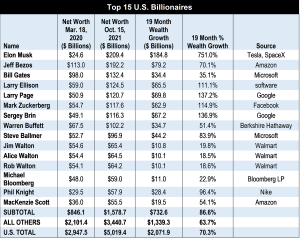
Sources: March 18, 2020 data: Forbes, “Forbes Publishes 34th Annual List of Global Billionaires” March 18, 2020 October 15, 2021 data: Forbes, “The World’s Real-Time Billionaires, Today’s Winners and Losers,” accessed October 15, 2021.

Among the individual stories behind the big numbers:

Elon Musk of Tesla and SpaceX fame is not only beating Jeff Bezos in space, he has rocketed past him in the billionaires club. Nineteen months ago, Bezos was nearly five times richer than Musk. Now, after a meteoric eight-fold increase in his wealth, Musk is worth $209 billion and Bezos $192 billion. Bezos’s wealth still grew by a very large 70 percent over the period.

Google founders Sergei Brin and Larry Page are now worth $237 billion combined, a 137 percent increase from their combined wealth of $100 billion at the beginning of the pandemic.

Nike head Phil Knight has nearly doubled his fortune from $29.5 billion to almost $58 billion. Maybe that’s in part because Nike didn’t pay a dime of federal income taxes in 2020 on its $2.9 billion in profits; and between 2018 and 2020 the corporation paid just a 3.3 percent tax rate on $9 billion in profits.

MacKenzie Scott, former wife of Amazon founder Jeff Bezos, has seen her wealth increase by $19.5 billion, or 54 percent, since the pandemic began, even after giving away $8.6 billion of her wealth to charity.

Chile Is at the Dawn of a New Political Era

Vijay Prashad


“It feels like we are at the end of an era,” Bárbara Sepúlveda tells me on October 12, 2021. Sepúlveda is a member of Chile’s Constitutional Convention and of the Communist Party of Chile. The era to which Sepúlveda refers is that of General Augusto Pinochet, who led the U.S.-backed coup in 1973 that overthrew the popularly elected government of President Salvador Allende. During the Pinochet era, the military acted with impunity, and the left was assassinated and sent into exile—while big business (both Chilean and foreign) received all the blessings of the dictatorship. That’s the era that has slowly been sputtering to a halt since Pinochet’s removal in 1990 and since the Chilean people voted to throw out the dictatorship’s Constitution of 1980 and write a new one.

Neoliberalism was born in Chile, as the popular slogan goes, and it will die in Chile. This slogan seems to have come true with the ending of the Pinochet era.

But Sepúlveda is not sure about what comes next. “Everybody knows everything is uncertain,” she says frankly. “That is an opportunity to begin a new era.” The first decade and a half after Pinochet’s removal seemed bleak. Then, in 2006, a cycle of student protests rattled the country. These were led by young students, whose black-and-white school uniforms gave the protests a name—La Revolución Pingüina, or the Penguin Revolution. The young people demanded a new national curriculum as well as a reduction in public transportation fares and examination fees. When the government failed to deliver on these demands, a second cycle of protests mobilized in 2011-2013 with the same demands. Their leaders—including Camila Vallejo of the Communist Party and Giorgio Jackson of the Democratic Revolution—are now important figures of the left project in Chile. Once more in 2011-2013, the students were met with a stalemate, with the Constitution of 1980 being a barricade to their ambitions.

A third cycle of student protests began in early October 2019 following a hike in public transportation fares. The “penguins” led a campaign of fare evasion (under the slogan ¡Evade!). The protesters were met with a harsh repression campaign including violent clashes with the Chilean police. On October 18, the right-wing government, led by President Sebastián Piñera, issued a two-week state of emergency, authorizing the deployment of the Chilean Army against the protests, which only intensified. The violence used to suppress the protests resulted in the emergence of the slogan Piñera Asesino (Piñera the assassin) among protesters and their supporters.

Sepúlveda says of the 2019 mobilization that the breaking point on “October 18 moved the axis [of Chilean politics] further to the left.” Although the third cycle of protests had initially been a response to the transportation fare hike, the government’s reaction made it clear that the country faced much deeper underlying structural issues including, Sepúlveda says, “overwhelming inequality” and corruption. Sepúlveda, a lawyer who co-founded Chile’s association of feminist lawyers (ABOFEM) in 2018 and was its executive director during the 2019 protests, saw at the time that changing these structural issues could not be done from within the existing system; at the very least, the country needed a new constitution and a more progressive government. And so the protest expanded to include the demands of the feminist movement and the Indigenous movement, pushing for broader economic and social changes to address the inequality at the root.

Two Sites of Struggle

The search for the new era in Chile has two important avenues: the writing of the new constitution, which is what the 155 members of the Constitutional Convention are doing, and the presidential election to be held on November 21, 2021.

The convention began work in July 2021 by voting in its president (Elisa Loncón) and vice president (Jaime Bassa); both Loncón and Bassa lean toward the left. So far, the convention has drafted its rules, which—Sepúlveda says—is more than half the work. Discussion about substantial issues began on the symbolic date of October 18, 2021, two years after the turning point of the third wave of protests. Sepúlveda is confident that agreements on social rights—for gender parity and for the environment—will happen. She says that “social changes of [these kinds] are inevitable”—even if there will be a fight from the calcified right wing to block them. The real dispute will take place around a new development model. Will the new constitution roll back the structural austerity program that the post-Pinochet period so far has not been able to undermine?

On October 14, I spent a few hours with Giorgio Jackson, one of the student leaders from the 2011-2013 protests, who is a member of Chile’s Chamber of Deputies and a close adviser to Gabriel Boric’s presidential campaign. Boric, a leader of the Frente Amplio (Broad Front) party and the Apruebo Dignidad (Approve Dignity) coalition, is the candidate of the left in the November presidential election. Jackson shared some elements of a new development model that a Boric administration would adopt, if Boric wins the presidential election. In the first year of the next presidency, the budget of Piñera would have to be followed, so only small changes can be made. From the start, Jackson told me, a priority for the Boric government would be to push to reform the health and pension systems, two arenas of great distress for Chile’s people. Building robust public health and pensions systems will require funds, which a left government would raise from royalties on copper extraction and by ensuring better prevention of tax evasion. Such an agenda would deepen a debate over a new development model, Jackson said.

But, Jackson admits, people are uneasy with the idea of having public provision of goods. Daniel Jadue, the communist leader and mayor of Recoleta, agrees that the real dispute will be over economic and social policy. He tells me that the answers to Chile’s problems could emerge from close cooperation between municipalities. If people have a positive experience with local public provision of social goods, it might change the general sentiment of suspicion surrounding the expansion of public health and pensions systems in the country, he noted. The work of mayors such as Jadue is crucial to the overall project for the construction of a new development model.

As far as the upcoming presidential election is concerned, Piñera cannot run for reelection, and besides, he is deeply unpopular. The open fascist in the race—José Antonio Kast—is popular, but he is being challenged by the center-right’s candidate Yasna Provoste for the right-wing votes. Meanwhile, capital has begun to flee Chile in anticipation of the introduction of a more progressive constitution and the potential ushering in of a Boric presidency after the November election.

In one corner of Bárbara Sepúlveda’s living room sits her collection of Rubik’s Cubes of varying difficulty. She’s a whiz at them. Sepúlveda picks one up and toys with it. “This one is easier to do,” she says of a cube that seems impossible to untangle. The cube is a great symbol for Chile. If people like Sepúlveda, Jadue, Jackson, and Boric can find a way to solve the puzzles before them, then perhaps there will be greater clarity on Chile’s new era.

Biden administration backs state of siege in Ecuador

Bill Van Auken


US Secretary of State Antony Blinken flew to Ecuador on October 19 to declare US support for the country’s beleaguered President Guillermo Lasso, one day after he imposed a state of emergency (estado de excepción), suspending constitutional rights and deploying heavily armed troops in the streets.

Appearing before the media alongside Ecuador’s foreign minister, Mauricio Montalvo, Blinken declared, “In extraordinary moments, democracies require exceptional measures.”

US Secretary of State Antony Blinken and President Guillermo Lasso at presidential palace in Quito. (Credit: @EmbajadaEcuUSA)

Referring directly to Lasso’s imposition of dictatorial measures, Blinken continued, “As I discussed with President Lasso, we understand that, support that, but know as well that these measures, of course, need to be taken pursuant to the constitution.”

Lasso announced the state of emergency on October 18, seizing as his pretext an incident in the coastal city of Guayaquil in which a 13-year-old boy was killed in the crossfire between police and gunmen.

While the Ecuadorian president claimed that his state of siege measures are aimed at suppressing crime and drug traffickers, his order allows the suspension of basic democratic rights, including freedom of movement, assembly and association.

They have been imposed under conditions in which his presidency has been plunged into deep political crisis.

Troops on the streets of Ecuador, October 20, 2021(Credit: @FFAAECUADOR)

Lasso, a right-wing multimillionaire ex-Coca Cola executive and banker, was elected president last April in what was seen as an upset victory in a second-round election. His path to power was paved by the failure of the so-called “Pink Tide” government of Rafael Correa, whose limited reforms were eroded with a fall in oil prices. Correa’s hand-picked successor, Lenin Moreno, initiated a sharp turn to the right, ingratiating his administration with US imperialism by expelling WikiLeaks founder Julian Assange from Ecuador’s embassy in London, turning him over to the British government to face extradition to the US on espionage charges.

Lasso’s party, however, holds only 12 of the 137 seats in the National Assembly, and, even with backing from other rightist parties, he has been unable to force through his free-market agenda.

He has sought to impose an IMF-dictated structural adjustment program that includes sharp cuts in social spending, a “labor reform” that would strip workers of job protections, tax cuts for capitalist investors and the lifting of restrictions on mining, oil drilling and foreign control over key sectors of Ecuador’s economy.

Lasso has seen his approval ratings plummet by more than 20 percent since the publication of the so-called Pandora Papers, which exposed his investments in at least 10 offshore shell companies located in Panama, South Dakota and Delaware.

Like other heads of state and top officials exposed by the Pandora Papers, Lasso insisted that his offshore holdings were all perfectly legal. The National Assembly, however, has launched an investigation, declaring that the right-wing president “may have breached” a statute that “prohibits candidates and public officials from having their resources or assets in tax havens.” Lasso has boycotted the probe, declaring himself the victim of a foreign conspiracy.

While Lasso was elected on promises that his policies would create jobs and raise living standards, some 6 million Ecuadorians—more than a third of the population—are living below a miserably low poverty line, with two and a half million barely surviving under conditions of extreme poverty. According to the government’s own figures, just three out of 10 Ecuadorians have formal employment, with the rest either unemployed, under-employed or eking out a living in the so-called informal sector.

His administration has also been rocked by violent prison revolts that have resulted in the deaths of about 230 inmates.

With growing popular opposition, the declaration of the state of emergency, imposed in the name of combating serious “internal unrest,” is a warning that Lasso intends to rely on naked force to remain in power and impose his right-wing agenda.

Lasso addressed a rally Wednesday, outside the Carondelet presidential palace, comprised of public employees, right-wing supporters and demonstrators who were paid by business interests. He denounced unions and indigenous organizations calling for an October 26 strike against his government’s policies as “conspirators” and “coup” supporters, vowing that he would defend Quito against them.

“With the support of the glorious Armed forces together with the National Police, we will give protection to the entire territory of Ecuador and the entire Ecuadorian family,” Lasso declared.

Earlier, he announced that his government is forming a legal defense body to defend any cop or soldier charged in connection with the state of emergency. “The law should intimidate the criminal, but not the police,” he said. He promised to pardon any member of the repressive forces charged with a crime, effectively granting them absolute impunity to carry out acts of violent and deadly repression against the population.

It is under these conditions that Secretary of State Blinken traveled to Quito to praise Lasso for “the strong pro-democracy voice that you have shared with the Ecuadorian people, but also with the people of our hemisphere.”

These statements, delivered on the first trip to Latin America by the Biden administration’s secretary of state, could be described as the “Blinken Doctrine.” Washington will support police state measures and dictatorship wherever they are required in the hemisphere to protect capitalist interests, sanctifying them as a defense of “democracy.”

Blinken’s second leg of his Latin American tour took him to Colombia, where he urged far-right President Iván Duque to “prevent rights abuses,” after his security forces gunned down dozens of protesters in nationwide demonstrations sparked by the government’s regressive tax policies. He proclaimed Duque “a very valued friend of the United States.”

In Bogota, Blinken met with foreign ministers from Chile, Brazil, Canada, Costa Rica, Honduras, Peru, Ecuador, Guatemala and El Salvador, among others, to secure collaboration in suppressing migration to the United States.

A central aim of the US Secretary of State’s first Latin American tour was also to shore up the support of the region’s right-wing regimes against the growing economic weight of China, which has displaced the United States as the region’s top trading partner, if Mexico is excluded from the equation.

Tram and subway workers strike in Izmir, Turkey’s third-largest city

Ulaş Ateşçi


Amid a sharp upsurge in the class struggle, 627 subway and tram workers at Metro AŞ, owned by the Izmir Metropolitan Municipality, are to go on strike Friday. A possible shutdown of the subway, used by approximately 2 million people per day, is expected to lock traffic in Izmir, Turkey’s third largest city.

Contract talks between the Social Democrat Public Employers Union (Sodem-Sen), representing the municipality, and the Demiryol-İş union, affiliated to the Türk-İş confederation, have continued since April. Declaring that no agreement could be reached on nine of 69 items, the union announced a strike on 1 October.

The impending subway strike in Izmir comes amid a surge of class struggle in Turkey and internationally, as the pandemic intensifies and workers’ living standards suffer unprecedented declines. Over 10,000 US workers are on strike at farm and construction equipment maker John Deere, and approximately 170,000 metal workers in South Africa have been striking for two weeks. In Brazil, 7,600 General Motors autoworkers voted overwhelmingly to continue their strike, defying the union and courts.

In Turkey, approximately 120 workers at the Mitsuba Otomotiv factory in Gebze, Kocaeli, stopped production and occupied the factory on October 9 after workers were dismissed for joining the Birleşik Metal-İş union.

Yesterday morning, hundreds of petrochemical workers at Petkim, one of Turkey’s largest industrial enterprises, started work two hours late to protest company policies that would endanger workers’ health. The workers marched in the refinery.

While workers from the Belediye-İş union (Türk-İş) in Bakırköy Municipality in Istanbul are preparing to go on strike on Monday, more than 1,000 workers at GAMAK Motor, also located in Istanbul, laid down tools for half an hour after management rejected to approve the proposed contract. If no agreement is reached within two months, GAMAK workers will go on strike.

As contract negotiations began for approximately 150,000 workers in the metal industry, production shutdowns in auto factories are increasing due to a global microchip supply crisis, leading to attacks on workers’ wages by management. The Renault factory in Bursa has announced that it will operate for a week and then stop production for a week, paying only 76 percent of workers’ wages.

Doctors of the Turkish Medical Association (TTB) are also organizing actions to protest the government’s criminal response to the pandemic and worsening working conditions.

These struggles show that the fight against the pandemic and the class struggle are closely linked, underlining the urgency of uniting them on a global scale by forming independent working-class committees, the International Workers Alliance of Rank-and-File Committees (IWA-RFC).

Over 30,000 people are officially infected with COVID-19 and more than 200 people die per day in Turkey, while the economic and social crisis, accelerated by the pandemic, continues to deepen.

While 518,000 people applied for unemployment insurance from July to September 2021, the grossly-understated annual inflation rate, as calculated by the official Turkish Statistical Institute (TÜIK), rose to 19.58 percent in September 2021. However, real annual inflation in September was 44.7 percent, according to a study by the independent Inflation Research Group. Millions of working people and their families can barely make ends meet.

According to research by Türk-İş, in September, “monthly food expenditure required for a family of four to have a healthy, balanced and adequate diet (the ‘hunger limit’)” rose to 3,049 Turkish liras. This sum “together with food expenditure, expenditures for clothing, housing (rent, electricity, water, fuel), transportation, education, health and the total amount of other mandatory monthly other needs (the ‘poverty line’)” has risen to 9,931 TL.

As the minimum wage is 2,825 TL (US$305; it corresponded US$385 just in May), most workers are employed for on the minimum wage or slightly above it. This also applies to subway and tram workers in Izmir. In August, a 5-year mechanic received only 3,175 TL, while a 21-year station operator got 3,800 TL, including benefits.

The subway workers, who for decades have suffered from union-sanctioned losses and had to work uninterruptedly during the pandemic, would no longer accept a new sellout contract and conditions of increasing misery. They forced the union to agree to a strike decision that it clearly did not want.

Demiryol-İş Union Izmir Branch President Hamdullah Giral made this clear on October 12, saying: “An agreement was reached on 60 items of our draft contract, which consists of 69 articles, and despite all our good faith efforts on the remaining 9 items, an agreement could not be reached.” He added, “We said give us our due to our employer, who forced us to take a strike decision on September 28, 2021 due to their non-agreement attitude, they did not hear!”

On October 15, the union repeated its anti-strike stance: “As the Demiryol-İş Union, we used all the legal time limits to reach an agreement at the table through peaceful means and in a conciliatory manner in the ongoing contract negotiations.”

The union tried to confuse workers by distinguishing between the management of Metro AŞ, which belongs to the municipality, and Tunç Soyer, the Mayor of the Metropolitan Municipality, whom it calls “worker-friendly.” Giray, who once again met with the company on Tuesday to prevent a strike, stated: “We reiterate our call for reconciliation. We do not want to make victims of our workers, the municipality or the people of İzmir. We demand a solution from our toiler president.”

In reality, this distinction is entirely artificial. Soyer, who was elected as mayor from the Republican People's Party (CHP) in the 2019 local elections with the support of various pseudo-left parties, has been chairman of Sodem-Sen since 2014.

The union’s statements are an admission of their complicity in condemning the workers to poverty wages. While union officials announced that “The subway workers, who have not gotten an honest wage for 21 years, do not want to be poor anymore,” they are covering up the fact that the union itself prevented strikes and signed eight sellout contracts in the last 21 years.

Demiryol-İş, which has approximately 21,000 members, is a significant example in Turkey of the international process of transformation of unions into an extension of the state and management. Overseeing the privatization of state railways and the erosion of railway workers’ wages and benefits, the union generates tens of millions of lira by selling properties previously purchased with workers’ dues.

The way unions help companies divide workers and stymie their collective strength is exemplified by the case of Izmir railway workers. Demiryol-İş signed a separate contract six months ago for the workers of the Izmir municipality’s İZBAN company, which operates the city’s suburban train.

When approximately 350 İZBAN workers struck in December 2018, the union isolated the workers, refusing to mobilize their members in other companies. The 2018 strike also revealed that the CHP was just as hostile to the workers as President Recep Tayyip Erdoğan’s Justice and Development Party (AKP) government. The CHP attacked the workers from the beginning of the strike, inciting Izmir’s population against them and accused the subway workers of serving the government, only to welcome Erdoğan’s presidential decree ending the strike a month later.

UK government refuses appeals for mitigations as COVID surge threatens to swamp hospitals

Robert Stevens


The UK’s Conservative government is refusing to make any change to its murderous policy of “learning to live with the virus”, amid warnings from National Health Service (NHS) leaders that a Plan B to stop the escalating spread of COVID must be put in place.

To avoid 'stumbling into a winter crisis', the NHS Confederation said that at least mandatory face coverings in crowded and enclosed spaces should be implemented. The body demanded that a Plan C be developed with tougher restrictions if those measures are insufficient, because hospitals already face being overwhelmed.

COVID-19 cases and deaths are surging in Britain, fueled by the reopening of schools in August and September.

Daily case numbers in Britain have averaged 45,000 over the last seven days and on Monday and Wednesday, hit 49,000—the highest level since July.

Britain's Health Secretary Sajid Javid speaks during a media briefing in Downing Street, London, Wednesday, Oct. 20, 2021. The U.K. recorded almost 50,000 new infections in a single day this week, and cases have risen 16% from a week earlier. Matthew Taylor, chief executive of health care umbrella group the NHS Confederation, said the health system risks being overwhelmed unless measures are introduced now. (Toby Melville/Pool Photo via AP)

More than 300,000 new cases (311,071) were recorded in the week to October 19—an increase of nearly 20 percent. Only the United States (546,319), with a population five times that of Britain had a higher number of cases over the same seven-day period. COVID cases in the US were 1,638 per million of the population and in Britain were 4,551.

COVID hospitalisations and deaths have also sharply increased, despite the suppressive impact of vaccinations. Monday saw 7,749 Covid patients in UK hospitals, a weekly rise of 11 percent, with 868 people per day taken into already overcrowded and overwhelmed NHS units. The 908 deaths recorded over the last week is a 15 percent increase and the 223 deaths Tuesday were the highest since March. Deaths were higher than on the same date in 2020, before the mass vaccination of most of the population was rolled out. Another 179 people were reported dead from COVID Wednesday.

UK cases now account for the bulk of those throughout the European continent. On Monday, the UK recorded more daily cases than France, Germany, Italy and Spain combined. Over the last week, Britain recorded almost 10 times the number of cases as France, despite both having similar sized populations. Compared to Germany, whose population is substantially larger than Britain’s, the UK recorded almost five times more cases.

A major factor in this case rate disparity is that the UK’s vaccination rollout, after being ahead of other countries in its initial phase, has virtually ground to a halt. Almost a third of Britain’s population is not vaccinated, with just 68 percent having had two jabs. Britain now stands at 13th place in Europe for full vaccinations and 22nd in the world.

Prime Minister Boris Johnson’s government refused to intervene to vaccinate children over the summer, allowing schools to become the major source of COVID infections today. Under 30 percent of children aged 12 to 17 have been vaccinated with a single dose, compared with over 60 percent in Italy, 70 percent in France and above 80 percent in Spain.

In addition, some limited mitigation measures are still in place in countries across Europe, whereas the UK abandoned all efforts to stem the pandemic on July 19, dubbed by the political criminal Johnson as “Freedom Day.” More than one in six of all UK cases have happened since then.

The Tories will not tolerate any impediment to the profit drive of the major corporations, no matter how many become sick or die.

The first response of government to the appeal for the most limited mitigation measures was for Business Secretary Kwasi Kwarteng to insist yesterday, “I don’t want to reverse back to a situation where we have lockdowns.”

Johnson knew very well that tens of thousands were being condemned to death when he first proclaimed Freedom Day. It was leaked that he had privately accepted that there would be at least a further 30,000 deaths in the UK over the next year. To quantify when “Plan B” restriction such as public mask wearing and urging people to work at home where possible might be introduced, it was suggested that a “sustained rate of death of around a 1,000 a week for two or three weeks”—50,000 a year, would “lead to discussion on restrictions being reimposed.”

With deaths already approaching a 1,000 a week, such a “discussion” has been rejected out of hand. Health Secretary Sajid Javid announced at a Downing Street press conference yesterday that “strengthening our vaccination programme” would be a “our primary line of defence” as “we learn to live with the virus.” This was even as he warned that cases could “go as high as 100,000 a day” in the weeks ahead. If the death rate remains unchanged, this would translate to around 2,000 deaths per week. But with winter and the flus season approaching this would be an optimistic prediction.

The fact that the surge in cases and deaths is being caused primarily by the reopening of schools underscores the criminality of the government’s response.

According to the Office for National Statistics, on October 14, 209,000 children were absent from school for COVID related reasons, including 111,000 confirmed cases. To indicate the explosive spread of the pandemic, the Leicestershire Live online news site reported Wednesday, “The number of Covid-19 cases among school pupils in [the city of] Leicester and [county of] Leicestershire has rocketed and is now around 11 times higher than before the peak of the third wave in June.”

The herd immunity policy of the Tory government has so far resulted in over 8.5 million people being infected with COVID and over 163,000 deaths. Moreover, its allowing the virus to spread unchecked in a partially vaccinated population has now led to the emergence of a yet more contagious and therefore deadly mutation of the still dominant Delta variant that has done so much to escalate the pandemic.

Javid acknowledged in his press conference that that Delta Plus (AY.4.2) is spreading throughout Britain. The Daily Mail reported Wednesday, “In just over three months it had reached almost every part of England. More than 2,500 cases of the subtype were detected across the country last week, meaning it now makes up almost 10 percent of all infections.”

It noted, “Scientists say the strain—thought to be 10-15 percent more transmissible than its ancestor—likely first emerged in the UK because of the high number of infections here compared to other countries, which gives the virus more chance to mutate.”

This murderous agenda must be opposed by class conscious workers in alliance with concerned scientists. They can expect no help from the Labour Party or the trade unions in this fight. Sir Keir Starmer spent yesterday boasting of his record in prosecuting terrorists, in response to the murder of Tory MP Sir David Amess, but had nothing to say about the 160,000 deaths from COVID resulting from his own collusion with Johnson. The National Education Union managed a single tweet calling for masks to be worn in secondary schools. Former Labour leader Jeremy Corbyn could not even manage such a mealy-mouthed tweet of protest.

German health minister demands ending of protective measures against coronavirus

Tamino Dreisam


Although around 9,000 people are infected with coronavirus every day in Germany, federal Health Minister Jens Spahn (Christian Democratic Union, CDU) has called for an end to the “epidemic situation.”

The decision rests with the Bundestag (federal parliament), which first declared an “epidemic situation of national scope” in March 2020 and must extend the decision every three months. The “epidemic situation” empowers the federal and state governments to issue regulations on coronavirus measures—such as social distancing, mask-wearing requirements, the obligation to present proof of COVID status, and contact restrictions.

If the “epidemic situation” is not extended until November 25, it means that no more measures will be taken to protect the population from the virus.

The reason given for lifting the measures is the allegedly high vaccination rate—a claim that is by no means tenable. Only just under two-thirds are fully vaccinated in Germany, and no one under the age of twelve.

Particularly threatening is the growing number of vaccine breakthroughs, infections of people who have already been vaccinated. Vaccination, falsely claimed by governments to be a panacea against the pandemic, is itself increasingly undermined by the herd immunity policy.

In the over-60 age group, one in two symptomatic infections in the last four weeks has been a vaccine breakthrough, and one in three in the 18-59 age group. It is not uncommon for a vaccine breakthrough to have fatal consequences. A total of 817 people in Germany have already succumbed to the coronavirus despite being fully vaccinated. The herd immunity policy also increases the risk that viral mutations will emerge that are resistant to current vaccines, thus invalidating one of the most important protective measures against the virus.

Contrary to government claims, the pandemic is not coming to an end. After stagnating at a high level over the past few weeks, new infections have again recorded a sharp increase in recent days. In the last week, the seven-day incidence rate rose from 65 to 75 infections per 100,000 inhabitants. Over 9,000 new infections and about 60 deaths occur every day. The figures are thus significantly higher than at the same time last year.

The increase is particularly strong among children and young people. Among 15-to-34-year-olds, the incidence rate is 98 per 100,000, and among 4-to-14-year-olds it is as high as 170. Regionally, even incidence rates of up to 1,000 cases per 100,000 inhabitants are being registered. In the last four weeks alone, 636 outbreaks have been reported in schools.

The high number of infections among young people is directly related to the reopening of schools after the summer vacations and the dismantling of any protective measures. With the dropping of compulsory mask wearing in most German states, there are hardly any protective measures worthy of the name.

Although the pandemic has already claimed 94,000 lives in Germany, according to official figures, all the establishment parties are committed to continuing this deadly policy. During the election campaign, all the candidates for chancellor had declared that there would be no further lockdowns. So far, in the exploratory talks to form a new government, coronavirus protection measures have not even been broached—a clear indication of the aggressiveness with which the incoming government will enforce the crackdown.

This policy will be implemented by all the establishment parties—especially the nominally left-wing ones. Even throughout the pandemic, leading representatives of the Left Party have supported the herd immunity policy. In April, in her YouTube programme “Wochenschau,” the party’s long-time parliamentary leader Sahra Wagenknecht appealed to right-wing QAnon types, coronavirus deniers and anti-vaxxers to roll back even the last measures to contain the pandemic.

A few weeks ago, Left Party founder Oskar Lafontaine called for a “Freedom Day,” meaning an end to any coronavirus measures. He referred to Freedom Days in countries such as Britain and made the claim that they had not led to an increase in the number of cases there. In reality, over 48,000 new infections occur every day in the UK, and the numbers continue to rise.

In other countries, the situation is even more dramatic. In the US, over 20,000 people have succumbed to the virus in the last two weeks alone. The total number of reported deaths is approaching 750,000.

The Left Party’s policies find their practical expression in Thuringia, where it holds the state premiership. In recent days, Thuringia has once again become the state with the highest incidence rate, with a figure of 139 per 100,000. Last year, the Thuringia state government distinguished itself by its ruthless policy of herd immunity. After Saxony, Thuringia is the federal state with the highest coronavirus death rate per inhabitant.

The Thuringia state executive’s unrestrained approach is particularly evident in school openings. Among 15-to-34-year-olds, the incidence is 158, and among 5-to-14-year-olds, it is as high as 390. These figures are a consequence of dismantling protective measures, which have gone further than in most other federal states. Not only is there no longer a requirement to wear masks in class, but also no mandatory testing in almost all of Thuringia.

The catastrophic coronavirus situation will worsen with the wave in the autumn and winter that virologists are warning about. In its weekly report, the Robert Koch Institute (RKI) writes, “A renewed increase in the number of cases is to be expected for the autumn and winter.” Virologist Christian Drosten recently commented on the rising incidence levels, “I think there are now signs of the autumn and winter wave, which we will probably see again in October.” An exponential increase was to be expected, as was the case last year, he said.

The rising level of infections proves the bankruptcy of the herd immunity strategy, which exposes the population to the virus unprotected, and without even the mitigations that slow the spread of the virus through minimal protective measures. Both strategies lead to the same ultimate result: mass infection with countless deaths, long-term illnesses, and the emergence of even more infectious and deadly variants.

The only way to end the pandemic is a strategy to eradicate the virus worldwide. It requires the use of all the weapons in the arsenal of countermeasures—vaccination, school and factory closures, mass testing, contact tracing and quarantine, etc.—coordinated at a global level to eliminate the virus once and for all. Several countries have demonstrated that such a strategy of elimination is possible.

20 Oct 2021

The Trial Of Thomas Sankara’s Killers

Kenneth Surin


I come here from a country whose seven million children, women, and men refuse to die from ignorance, hunger, and thirst any longer. My aspiration is to speak on behalf of my people, on behalf of the disinherited of the world. And to state the reasons for our revolt.

– Thomas Sankara (speech at UN General Assembly 1984)

 The renowned revolutionary and anti-imperialist leader Thomas Sankara was murdered on October 15, 1987, at the age of 37.

Sankara took power in the landlocked West African state of Upper Volta after a coup in 1983, changing the name of the former French colony to Burkina Faso (“the land of upright people” in Mossi, the language of the country’s largest ethnic group) the following year.

Sankara’s government, using a synthesis of Pan-Africanism and Marxist politics, initiated a string of far-reaching economic and social reforms that included nationalizations, land redistribution, reforestation, infrastructure and public housing construction, expanded access to education, vaccination campaigns, and advancing the rights of women by banning female genital mutilation, polygamy and forced marriages. His government, hewing to a foreign policy predicated on non-alignment, took on former colonial powers, as well as their satrap institutions, the World Bank and International Monetary Fund.

Sankara insisted that government officials give up perks such as first-class air travel. He got rid of the government’s fleet of expensive Mercedes Benz limousines, making the cheap and economical Renault 5 the official government vehicle instead—the Renault 5 was the cheapest car in Burkina Faso at that time.

At the same time, Sankara’s rule was said to be characterized by a degree of political repression, with some of his critics going into exile, and human rights groups alleging that prisoners were tortured.

Sankara, aware of the heavy burdens imposed by anti-capitalist and anti-colonial struggle– every African revolutionary has an indelible awareness of what befell Patrice Lumumba when the former Belgian Congo “achieved” independent in 1960 and Lumumba became the short-lived leader of the independent state– had declared that fundamental social and political change require a “certain amount of madness”.

The francophile comprador bourgeoisie of Upper Volta was certainly not going to welcome Sankara’s revolution with open arms. In fact, his blistering revolutionary pronouncements probably scared the shit out of them. For this comprador class, the neocolonial status quo was not to be disturbed, and this is precisely what Sankara set out to achieve.

Despite their popularity many of Sankara’s iconic reforms were undone soon after his assassination.

Sankara was murdered during a putsch led by Blaise Compaoré, a former friend and close associate who was minister of state at the presidency when Sankara was killed.

Compaoré maintains that his commandos had heard that Sankara planned to have him killed. The commandos went directly to the presidential palace from Compaoré’s residence, where allegedly without asking Compaoré first, they shot Sankara and 12 of his staff.

Compaoré, 70, has always denied that he ordered Sankara’s killing.

Compaoré said at the time that his men had intended to arrest Sankara, but “he answered firing”. Compaoré had his old friend buried in a commoner’s grave.

After 27 years in power, Compaoré tried to amend the constitution to allow him to rule in perpetuity. But Burkina Faso had enough of him by this time, and after massive protests he was forced to resign in 2014, leaving Burkina Faso for exile in the Ivory Coast.

After Compaoré’s fall from power, an inquiry into Sankara’s assassination was created by the transitional government, and a warrant was issued for Compaoré’s arrest.

The government exhumed what are thought to be Sankara’s remains from a grave on the outskirts of Ouagadougou. Sankara’s widow said an autopsy revealed his body was “riddled with more than a dozen bullets”.

Fourteen men, including Compaoré, are on trial for Sankara’s murder, the preliminaries of which began last week.

In addition to Compaoré, the man suspected of leading the squad that killed Sankara, Hyacinthe Kafando, will also be tried in absentia since he is currently on the run.

It was announced by his lawyers that “President [sic] Blaise Compaoré will not be attending the political trial that is being staged against him at the military court of Ouagadougou, nor will Burkinabe and French lawyers for Compaoré”.

The lawyers argued that Compaoré has “immunity (from prosecution) as a former head of state”.

Those on trial include Compaoré s former henchmen, General Gilbert Diendéré, a previous head of the elite Presidential Security Regiment (RSP). Diendéré, who attended the trial’s opening preliminary in a military uniform (shades of Oliver North during the Iran-Contra hearings!), faces charges of complicity in murder, undermining state security, bribing witnesses, and complicity in the concealment of corpses.

Diendéré, 61, who seems to be something of a veteran all-round plotter, is currently serving a 20-year sentence in Burkina Faso for masterminding a scheme in 2015 against the transitional government of Roch Marc Christian Kaboré that replaced Compaoré.

“We have been waiting for this moment”, said Mariam Sankara, Sankara’s widow, who arrived to attend the trial from her home in the south of France. She has campaigned for years to bring his killers to justice.

The preliminaries over, the trial proper– a military tribunal presided over both by civilian and military officials– is due to begin on October 25th and is expected to last several months. Over 200 foreign journalists have been accredited for the proceedings, which are being likened to a trial for the killers of Che Guevara in Bolivia had one been held.

Eagerly awaited at the trail is information on the part played by France in Sankara’s murder. Sankara made a clean break with Burkina Faso’s former colonial ruler, which has maintained clientelist associations, often involving strong-arm methods, with its former African colonies in a strategy known as Françafrique.

So far inquiries have established that French agents were present in Burkina Faso on the day after Sankara’s assassination to destroy wiretaps targeting Compaoré.

In addition to rejecting Françafrique, Sankara annoyed Paris by calling for New Caledonia, a French overseas territory in the Pacific, to be included on the UN’s list of places to be decolonized.

During a 2017 trip to Burkina Faso, the French President Emmanuel Macron said he would lift the “national defence secret” classification of all French archives concerning Sankara’s killing. Since then 3 batches of declassified documents have been sent to Ouagadougou.

However, it turns out that these contain only documents of secondary importance, and do not include vitally important files from the offices of François Mitterrand and Jacques Chirac, who were respectively president and prime minister of France at the time of Sankara’s assassination.

Informed observers are certain that these highly significant documents exist – and the fact that Macron didn’t deliver on what he promised is something that may be highlighted in the course of the trial of Sankara’s killers. Not that anything better could have been expected of the sly and devious Macron.

Burkina Faso faces massive challenges, not least the growing Islamic State insurgency, conducted in the name of jihad, that has killed thousands of people and displaced more than 1 million in recent years.

“Dare to invent the future”, said Sankara.

Depending in part on the trial’s outcome, and of course the flux that is Burkina Faso’s post-independence history, that future may not be forestalled in its entirety.

UK government continues plunder of miners’ pension scheme

Dennis Moore


Former miners and their families are waging a struggle against the Conservative government’s refusal to reverse a historic injustice over the Mineworkers’ Pension Scheme. Tory and Labour governments have plundered the pension scheme following its privatisation in 1994.

The original Mineworkers’ Pension Scheme (MPS) was set up by British Coal in 1952 and was the larger of two pensions schemes in the coal industry. The other was the British Coal Staff Superannuation Scheme.

The state-orchestrated defeat of the year-long 1984-5 strike paved the way for the privatisation of the pension scheme. The defeat saw the mass closures of pits, the end of the UK mining industry, and the widespread impoverishment of mining communities.

In 1994, the Mineworkers Pension Scheme was privatised, and the existing British Coal schemes closed to future contributions. The government took over the role as guarantor for the MPS from British Coal. It was arranged that 50 percent of the surplus in the scheme at privatisation would be used to enhance members’ pensions immediately. The other 50 percent would be being payable to the government as guarantor. It was stipulated that the government’s share would be left in the MPS as the Investment Reserve and paid to it over a 25-year period.

In 2021, the MPS had 124,796 pensioner members and 11,104 deferred members. It is currently managed by 10 Trustees. It is estimated that governments, including Labour, in power for 13 years from 1997-2010, have taken £1 million a day out of the pension fund since 1994, a total of around £4.4 billion.

When miners were employed, they contributed a sizable 5.2 percent of their pay towards the pension scheme. But 50 percent of ex-miners receive an average £65 per week in pension, plus a £19 per week bonus. A further 25 percent are paid less than £35 per week, and 10 percent of miners are paid less than £18 per week. Many miners’ widows receive just £10 a week in pension payments.

In 2019, a 100,000-strong petition by campaigners was handed to Downing Street, calling for a fairer deal. It demanded a review of pension arrangements for over 150,000 former mineworkers and widows. The number of MPS pension recipients is diminishing each year, with an estimated 7,000 dying, some from their industrial injuries. Many retired miners have been affected disproportionately by chronic health conditions, caused by poor working conditions.

So grotesque was the government denial of pension rights to former miners that Parliament’s Business, Energy and Industrial Strategy Committee (BEIS), despite being majority run by Conservative MPs, agreed to hold an inquiry into the crisis earlier this year.

Witnesses told inquiry that when the MPS was set up with the government becoming sole guarantor to the scheme, it was understood that this would guarantee members always receiving the benefits that they had earned up to the scheme being privatised, increasing in line with inflation. In return, the government would receive 50 percent of surpluses of future valuations with the remaining 50 percent distributed among members via bonuses.

Chair of the Trustees Chris Cheetham explained that this arrangement was highly unusual. “There is no current situation where sponsors (government) take money out of the scheme that they are responsible for; indeed, they cannot. Regulations do not enable it.”

Prior to the 1994 scheme being implemented, the previous scheme was in surplus at both the 1987 and 1990 valuations and at both times a 70:30 split (in favour of members) was agreed. This prior arrangement has prompted questions about why members entitlement of 70 percent ended up being reduced to 50 percent from the 1994 valuation onwards.

Cheetham and Allen Young, the Pensioner Elected Trustee and a former official of the National Union of Mineworkers (NUM), told the committee that the Trustees took actuarial and legal advice when these arrangements were agreed. The advice stressed that the government’s proposed guarantee was “essential”, and the proposal should be accepted on that basis.

Cheetham and Young told MPs they were critical of the arrangements made in 1993-4, “arguing that there was no negotiation. Basically, the Trustees were given an option of a guarantee with a 50:50 split, take it or leave it”.

The BEIS inquiry report, published in April, noted that the government said that it did not seek any actuarial advice at the time of the 1994 agreement, and when asked, Anne-Marie Trevelyan, Conservative minister of State for Business, Energy and Clean Growth, could not provide any explanation why this was the case. Neither could she provide reassurance that the 50:50 split proposed by the government in 1994 was underpinned by any empirical evidence.

The Business, Energy and Industrial Strategy inquiry report

Since 1994, the MPS has performed well beyond expectations, with the £4.4 billion taken from the scheme by successive governments made up of £3.1 billion of the governments share of surpluses post 1994 and £1.3 billion from the Investment Reserve.

The government has not had to contribute a penny towards the scheme, while many of those working in the mines suffering with long-term health conditions are having to accept a take it or leave it deal with the government set to take another £1.9 billion.

The BEIS report points to a lack of due diligence at the time of negotiations when the scheme was set up and the government was deemed negligent in not taking actuarial advice. It pointed to there being no evidence that would have supported the 50/50 split in the way the fund was apportioned out, with the government entitlement to 50 percent of surpluses not proportionate to the level of financial risk it faces.

The government, as the guarantor of the scheme, claim that they have had to face a “a significant contingent liability” in the event that there is a shortfall, leaving them having to find the money to ensure pension payments are paid out.

The level of risk claimed by the government is spurious. The scheme was in deficit in 2002, 2008, and 2011, yet the government did not have to pay into the scheme. The government is protected because the scheme’s rules protect it from having to fund the scheme in the event of short-term deficits.

The scheme performed well financially throughout both the 2008 financial crisis and the COVID-19 pandemic throughout 2020, where there was a return of 6.2 percent. Despite downturns in global markets the overall financial risk to the government is low.

The BEIS report noted a lack of any formal period review mechanism as being unfair, considering that the relative size of the fund and that the numbers of scheme members has fallen significantly since 1994. The government’s price for the guarantee has not been adjusted to take account of reduced risk.

The BEIS inquiry made several recommendation after stating that “government should not be in the business of profiting from miners’ pensions”. It said, “If this £1.2bn fund was to be distributed to members, this would roughly equate to a £14 per week uplift for members on the average pension of £84 per week.”

In June, the government rejected the committee’s recommendations, including the dispersal of £1.2 billion to miners, claiming that the scheme was “fair and beneficial to both Scheme members and taxpayers.”

The National Union of Mineworkers, which once represented hundreds of thousands of miners and now has less than 200 members, has waged no serious campaign in defence of pensioned miners. It told the BEIS inquiry that the government should “rethink its findings” and that there should be “a more balanced approach to the distribution of surplus funds, with the recommendation that its [the government’s] entitlement to the Investment Reserve of £1.2bn is also redirected to pension members.”

The campaign for miners to get justice in the fight for pension rights has been largely led by independent campaigns, such as National Mineworkers Pension Campaign (NMPC).

Responding to the government decision denying the miners’ justice, one member of the group commented on Facebook, “They should be taken to Court for theft, but it’s the government they can do what they like. Criminals no less.”

Another stated, “We don't need or have ever needed a guarantor. Time to get rid of it, we must stop these 21st century robbers from having our money.”