10 Dec 2021

Trudeau Foundation Doctoral Scholarships 2022/2023

Application Deadline: 21st December 2021

To be taken at (country): Canadian Universities

Accepted Subject Areas: Social Sciences and Humanities related studies, preferably one of the following:

  • Human Rights and Dignity
  • Responsible Citizenship
  • Canada and the World
  • People and their Natural Environment

About the Trudeau Foundation Doctoral Scholarships:  The Pierre Elliott Trudeau Foundation Scholarship Program will help shape researchers into engaged leaders who are conscious of the impact of their research, connected to the realities of the communities in which they work, and open to non-conventional forms of knowledge. The Foundation is seeking candidates who are audacious, original, and forward-thinking.

The program will last for three years and will also provide generous support for Scholars’ doctoral work in the form of a stipend and a research and travel allowance.

While the pandemic will require that the process be much more virtual, the Foundation will seek the brightest emerging Scholars from Canada and abroad to receive this remarkable Scholarship, as has always been the case. Through the Foundation’s leadership development program, these Scholars will learn from a new cohort of Fellows and Mentors, leading lights in their institutions and communities, under the scientific theme beginning in 2021, Language, Culture & Identity. 

The selection criteria for 2021 ushers in important changes rooted in the Foundation’s Strategic Plan 2019-2024. Importantly, these criteria are built upon the definition of diversity outlined in the plan, including the commitment to a diversity of perspectives, now under the banner Plurality of Perspectives. We continue to seek scholars with the greatest intellectual capacity, while also looking for those committed to deep listening, profound curiosity, exploring grey areas, and demonstrating a willingness to engage with a diversity of people, cultures, ideologies, and perspectives. In tandem with this development, the Foundation is pleased its programs will bear the emblem Brave Spaces, accountable and democratic spaces where a multiplicity of ideas may be expressed and debated in an open and welcoming fashion. This commitment to Brave Spaces, privileging robust debates while offering a safety net of policy, empathy circles, and mutual respect, recognizes that challenging and sometimes uncomfortable discussions are important steps on the road to becoming an Engaged Leader. 

Selection Criteria

  • Academic excellence;
  • Leadership experience and abilities;
  • Thematic relevance of research to the Foundation’s themes;
  • Public engagement;
  • Desire to contribute to public dialogue and share knowledge;
  • Communication skills;
  • Desire to belong to a vibrant community made up of leaders from across sectors

The Foundation welcomes candidates embodying all forms of diversity, including but not limited to gender, ethnicity, language, region, and discipline. We encourage First Nations, Métis, and Inuit candidates.

Eligibility: To apply to the Pierre Elliott Trudeau Scholarship, you must meet the following eligibility criteria:

  • 1) You must be already accepted into or in year one or two of a full-time doctoral program, and expected to complete your doctoral studies in 2025 or later.
  • 2) Your field of study is broadly related to the humanities or human sciences of direct relevance to the future of Canada; (please refer to the FAQ for more details and read up on past scholarship recipients)
  • 3) Your doctoral work must relate to at least one of the Foundation’s Four Themes: Human Rights and Dignity, Responsible Citizenship, Canada and the World, People and their Natural Environment.
  • 4) Be a Canadian citizen studying at a Canadian or foreign institution, or a non-Canadian (permanent resident of Canada or foreign national) enrolled in a doctoral program at a Canadian institution.

Selection:

  1. Candidates who are committed to a three-year leadership program and who meet the eligibility criteria can apply directly to the Foundation through the application portal.
  2. Universities play an integral role encouraging candidates to apply, recommending candidates (academic referees) and later, confirming the status of their students and other details.
  3. The Foundation reviews all applications and shortlisted candidates are invited to group interviews. Finalists proceed to interviews with the Application and Nomination Review Committee (ANRC) who ultimately recommend their choices to the Board of Directors for final approval.

Number of Awards: Up to 20 Scholars will be selected in 2021.

Value of Awards: If you are chosen as a Pierre Elliott Trudeau Foundation Scholar, you will receive:

  • Membership in a community of other Scholars, Mentors, and Fellows, all of whom are leaders and change-makers in their respective disciplines and sectors;
  • Leadership training from Mentors and Fellows;
  • $40,000 per year for three years to cover tuition and reasonable living expenses; and
  • Up to $20,000 per year for three years, as a research and travel allowance;

If you are chosen as a Pierre Elliott Trudeau Foundation Scholar, you must:

  • Attend a community retreat and two Institutes of Engaged Leadership during the first year of your term;
  • Collaboratively plan and participate in a conference event during the second year of your term;
  • Work with other Scholars, Mentors, and Fellows on a creative knowledge sharing and dissemination project during the third year of your term;
  • Work towards fluency in English and French with support from the Foundation;
  • Actively engage and collaborate with the Foundation’s community of Scholars, Mentors, and Fellows; and
  • Submit one research progress report per year.

Duration: 3 years

How to Apply for Trudeau Foundation Doctoral Scholarships:

  1. Are you ready to embark on a leadership development journey rooted in Brave Spaces? : Before beginning, make sure to read more about the Foundation’s programs and Brave Spaces. 
    • Are you willing to learn from peers, Fellows and Mentors? The Foundation’s leadership curriculum, Brave Spaces: The Path to Engaged Leadership, is anchored by six key leadership concepts: audacity & resilience communication & sharing knowledge, creativity & innovation, diversity, collaboration and duty of service, and by fostering these key competencies and values, the leadership program seeks to develop three dimensions of Scholars’ leadership: leadership of self, leadership among others and leadership of systems. Fellows and Mentors support this leadership training as trainers, advisers and mentors.
    • Are you interested to learn more about Global Economies? For the three-year leadership program starting in 2022, this scientific cycle will be focused on Global Economies, a theme that has interdisciplinary dimensions and reflects a timely and significant set of issues for the future of Canada and the world.
    • Are you committed to improving your abilities in the Canadian official language with which you are less familiar and an interest in becoming familiar with Indigenous Languages? The Foundation recognizes that knowledge of multiple languages is a hallmark of leaders and public intellectuals, and is a strength and advantage, both professionally and personally. The Foundation’s Policy on Language: BilingualismPlus outlines the Foundation’s support of its Scholars in Canada’s Official Languages – French and English – and in Canada’s Indigenous Languages. Read more about the Foundation’s BilingualismPlus policy here.
    • Do you believe in academic freedom, respectful dialogue, and open debate? The Foundation fosters a community of bold, cutting-edge researchers and community leaders who hold strong views and stand out in their respective fields, who explore, ask difficult questions, and discover new horizons as they blaze new trails. The Foundation openly encourages the free transmission and dissemination of knowledge and has enshrined this in a Code of Community Engagement . The Code informs successful engagement with a plurality of perspectives and encourage academic and intellectual freedom and open speech, while providing a framework for a positive and healthy environment for such exchanges.
    • Candidates are invited to join the Foundation for virtual information sessions on November 10th, 2021, at 10:00 a.m. EST for the French session and at 12:30 p.m. EST for the English session. These information sessions will take place via Zoom, and you may attend by video or by phone if you prefer. Kindly let us know if you require ASL or LSQ sign interpretation by emailing leadership@trudeaufoundation.ca. We will be happy to provide this service. Kindly note the following connection details: 
      • Wednesday, November 10th, 2021 – 1.5 hour French session for Scholar candidates at 10:00 a.m. EST. Register here!
         
      • Wednesday, November 10th, 2021 – 1.5 hour English session for Scholar candidates at 12:30 p.m. EST. Register here!
  2. Register for an account: When the competition opens, register for an account on the Foundation’s application portal. If you already have an account from a scholarship competition prior to 2021, you will need to create a new application.
  3. Fill out the application: Once your registration is complete, you will be able to create an application for the 2022 Scholarship Competition. In order to complete your application, you will need to provide: 
    • Demographic information on yourself: The Foundation gathers demographic information for statistical purposes, in order to fulfill its commitment to diversity and inclusion. This information will only be used by the Pierre Elliott Trudeau Foundation. 
    • Essay Questions: Provide answers (200 to 400 words) to four essay questions.
    • Doctoral Projects and Themes: Provide information on your doctoral project, with answers ranging from 200 to 400 words in length.
    • Referees: Enter the name and email address of two referees in the boxes provided. At least one of them must be an academic referee who is able to comment on your university academic performance. Refer to “Get recommendations” below for more details.
    • Language Skills, Post-secondary Education, Achievements and Experience: Provide information on your language skills, your post-secondary education, your achievements – including scholarships, fellowships, awards, publications, conferences, extracurricular and volunteer activities – as well as your relevant work experience.
    • Upload Transcripts: Upload transcripts for all your post-secondary education, except information related to CEGEP in Quebec, should you have attended CEGEP in Quebec. 
    • Read and understand the Foundation’s policies: All candidates are asked to acknowledge that they have read and understood key policies of the Foundation. Throughout the three-year program, all Scholars are asked to read, understand and comply with these policies: Policy on the Prevention of Harassment and Violence and Code of Community Engagement.  
  4. Get recommendations: Once you have entered the name and email address of your referees in the space provided in the application form, an email will automatically be sent to the referees, asking them to complete a predetermined referral form directly on the Foundation’s application portal. Referees must complete the predetermined referral form, which includes both narrative answers and numerical evaluations. We are no longer asking referees to upload their reference letter in PDF format on our application portal. We advise that you follow up with your referees to ensure they submit the completed form on time, by December 21, 2021 at 5:00 p.m EST.
  5. PETF selection process: All eligible candidates who submit a completed application by December 21, 2021 at 5:00 p.m. EST will go through a rigorous selection process. Shortlisted candidates (Round One) will be contacted in February 2022 and invited to group interviews. Finalists (Round Two) will then be invited to meet for individual interviews with members of the ANRC in March 2022. 
  • It is important to go through all application requirements in the Award Webpage (see Link below) before applying.

Visit Award Webpage for Details

Ten Contradictions That Plague Biden’s Democracy Summit

Medea Benjamin & Nicolas J. S. Davies


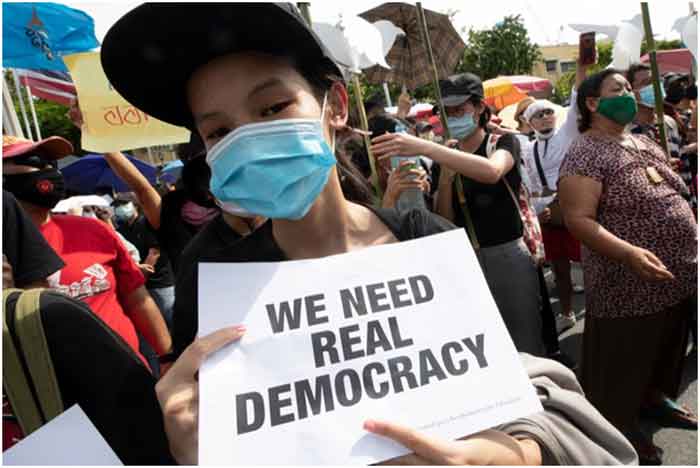
Thailand Protest
Protest by students in Thailand. AP

President Biden’s virtual Summit for Democracy on December 9-10 is part of a campaign to restore the United States’ standing in the world, which took such a beating under President Trump’s erratic foreign policies. Biden hopes to secure his place at the head of the “Free World” table by coming out as a champion for human rights and democratic practices worldwide.

The greater possible value of this gathering of 111 countries is that it could instead serve as an “intervention,” or an opportunity for people and governments around the world to express their concerns about the flaws in U.S. democracy and the undemocratic way the United States deals with the rest of the world. Here are just a few issues that should be considered

( 1) The U.S. claims to be a leader in global democracy at a time when its own already deeply flawed democracy is crumbling, as evidenced by the shocking January 6 assault on the nation’s Capitol. On top of the systemic problem of a duopoly that keeps other political parties locked out and the obscene influence of money in politics, the U.S. electoral system is being further eroded by the increasing tendency to contest credible election results and widespread efforts to suppress voter participation (19 states have enacted 33 laws that make it more difficult for citizens to vote).

A broad global ranking of countries by various measures of democracy puts the U.S. at # 33, while the U.S. government-funded Freedom House ranks the United States a miserable # 61 in the world for political freedom and civil liberties, on a par with Mongolia, Panama and Romania.

(2) The unspoken U.S. agenda at this “summit” is to demonize and isolate China and Russia. But if we agree that democracies should be judged by how they treat their people, then why is the U.S. Congress failing to pass a bill to provide basic services like health care, child care, housing and education, which are guaranteed to most Chinese citizens for free or at minimal cost?]

And consider China’s extraordinary success in relieving poverty. As UN Secretary General Antonio Guterres said, “Every time I visit China, I am stunned by the speed of change and progress. You have created one of the most dynamic economies in the world, while helping more than 800 million people to lift themselves out of poverty – the greatest anti-poverty achievement in history.”

China has also far surpassed the U.S. in dealing with the pandemic. Little wonder a Harvard University report found that over 90% of the Chinese people like their government. One would think that China’s extraordinary domestic achievements would make the Biden administration a bit more humble about its “one-size-fits-all” concept of democracy.

(3) The climate crisis and the pandemic are a wake-up call for global cooperation, but this Summit is transparently designed to exacerbate divisions. The Chinese and Russian ambassadors to Washington have publicly accused the United States of staging the summit to stoke ideological confrontation and divide the world into hostile camps, while China held a competing International Democracy Forum with 120 countries the weekend before the U.S. summit.

Inviting the government of Taiwan to the U.S. summit further erodes the 1972 Shanghai Communiqué, in which the United States acknowledged the One-China policy and agreed to cut back military installations on Taiwan.

Also invited is the corrupt anti-Russian government installed by the 2014 U.S.-backed coup in Ukraine, which reportedly has half its military forces poised to invade the self-declared People’s Republics of Donetsk and Luhansk in Eastern Ukraine, who declared independence in response to the 2014 coup. The U.S. and NATO have so far supported this major escalation of a civil war that already killed 14,000 people.

(4) The U.S. and its Western allies—the self-anointed leaders of human rights—just happen to be the major suppliers of weapons and training to some of the world’s most vicious dictators. Despite its verbal commitment to human rights, the Biden administration and Congress recently approved a $650 million weapons deal for Saudi Arabia at a time when this repressive kingdom is bombing and starving the people of Yemen.

Heck, the administration even uses U.S. tax dollars to “donate” weapons to dictators, like General Sisi in Egypt, who oversees a regime with thousands of political prisoners, many of whom have been tortured. Of course, these U.S. allies were not invited to the Democracy Summit—that would be too embarrassing.

(5) Perhaps someone should inform Biden that the right to survive is a basic human right. The right to food is recognized in the 1948 Universal Declaration of Human Rights as part of the right to an adequate standard of living, and is enshrined in the 1966 International Covenant on Economic, Social and Cultural Rights.

So why is the U.S. imposing brutal sanctions on countries from Venezuela to North Korea that are causing inflation, scarcity, and malnutrition among children? Former UN special rapporteur Alfred de Zayas has blasted the United States for engaging in “economic warfare” and compared its illegal unilateral sanctions to medieval sieges. No country that purposely denies children the right to food and starves them to death can call itself a champion of democracy.

(6) Since the United States was defeated by the Taliban and withdrew its occupation forces from Afghanistan, it is acting as a very sore loser and reneging on basic international and humanitarian commitments. Certainly Taliban rule in Afghanistan is a setback for human rights, especially for women, but pulling the plug on Afghanistan’s economy is catastrophic for the entire nation.

The United States is denying the new government access to billions of dollars in Afghanistan’s foreign currency reserves held in U.S. banks, causing a collapse in the banking system. Hundreds of thousands of public servants have not been paid. The UN is warning that millions of Afghans are at risk of starving to death this winter as the result of these coercive measures by the United States and its allies.

(7) It’s telling that the Biden administration had such a difficult time finding Middle Eastern countries to invite to the summit. The United States just spent 20 years and $8 trillion trying to impose its brand of democracy on the Middle East and Afghanistan, so you’d think it would have a few proteges to showcase.

But no. In the end, they could only agree to invite the state of Israel, an apartheid regime that enforces Jewish supremacy over all the land it occupies, legally or otherwise. Embarrassed to have no Arab states attending, the Biden administration added Iraq, whose unstable government has been racked by corruption and sectarian divisions ever since the U.S. invasion in 2003. Its brutal security forces have killed over 600 demonstrators since huge anti-government protests began in 2019.

(8) What, pray tell, is democratic about the U.S. gulag at Guantánamo Bay? The U.S. Government opened the Guantanamo detention center in January 2002 as a way to circumvent the rule of law as it kidnapped and jailed people without trial after the crimes of September 11, 2001. Since then, 780 men have been detained there. Very few were charged with any crime or confirmed as combatants, but still they were tortured, held for years without charges, and never tried.

This gross violation of human rights continues, with most of the 39 remaining detainees never even charged with a crime. Yet this country that has locked up hundreds of innocent men with no due process for up to 20 years still claims the authority to pass judgment on the legal processes of other countries, in particular on China’s efforts to cope with Islamist radicalism and terrorism among its Uighur minority.

(9) With the recent investigations into the March 2019 S. bombing in Syria that left 70 civilians dead and the drone strike that killed an Afghan family of ten in August 2021, the truth of massive civilian casualties in U.S. drone strikes and airstrikes is gradually emerging, as well as how these war crimes have perpetuated and fueled the “war on terror,” instead of winning or ending it.

If this was a real democracy summit, whistleblowers like Daniel HaleChelsea Manning and Julian Assange, who have risked so much to expose the reality of U.S. war crimes to the world, would be honored guests at the summit instead of political prisoners in the American gulag.

(10) The United States picks and chooses countries as “democracies” on an entirely self-serving basis. But in the case of Venezuela, it has gone even farther and invited an imaginary U.S.-appointed “president” instead of the country’s actual government.

The Trump administration anointed Juan Guaidó as “president” of Venezuela, and Biden invited him to the summit, but Guaidó is neither a president nor a democrat, and he boycotted parliamentary elections in 2020 and regional elections in 2021. But Guaido did come tops in one recent opinion poll, with the highest public disapproval of any opposition figure in Venezuela at 83%, and the lowest approval rating at 13%.

Guaidó named himself “interim president” (without any legal mandate) in 2019, and launched a failed coup against the elected government of Venezuela. When all his U.S.-backed efforts to overthrow the government failed, Guaidó signed off on a mercenary invasion which failed even more spectacularly. The European Union no longer recognizes Guaido’s claim to the presidency, and his “interim foreign minister” recently resigned, accusing Guaidó of corruption.

Conclusion

Just as the people of Venezuela have not elected or appointed Juan Guaidó as their president, the people of the world have not elected or appointed the United States as the president or leader of all Earthlings.

When the United States emerged from the Second World War as the strongest economic and military power in the world, its leaders had the wisdom not to claim such a role. Instead they brought the whole world together to form the United Nations, on the principles of sovereign equality, non-interference in each other’s internal affairs, a universal commitment to the peaceful resolution of disputes and a prohibition on the threat or use of force against each other.

The United States enjoyed great wealth and international power under the UN system it devised. But in the post-Cold War era, power-hungry U.S. leaders came to see the UN Charter and the rule of international law as obstacles to their insatiable ambitions. They belatedly staked a claim to universal global leadership and dominance, relying on the threat and use of force that the UN Charter prohibits. The results have been catastrophic for millions of people in many countries, including Americans.

Since the United States has invited its friends from around the world to this ”democracy summit,” maybe they can use the occasion to try to persuade their bomb-toting friend to recognize that its bid for unilateral global power has failed, and that it should instead make a real commitment to peace, cooperation and international democracy under the rules-based order of the UN Charter.

Irish coalition government forced to introduce new restrictions as COVID cases surge

Dermot Quinn


On Thursday, Ireland's National Public Health Emergency Team (NPHET) confirmed a further 4,022 new cases of COVID-19 with 530 patients hospitalised and 115 in intensive care. There were 81 deaths the previous week. In all 5,788 people have now died from COVID in the country. Daily infection rates have been running at around 5,000 for weeks now.

Although Ireland is one of the most vaccinated countries in the world, the country currently also has one of the highest rates of infection. As of December 6, 1,355 of every 100,000 people were infected with coronavirus. Just under 15 percent of all tests are returning positive results. Daily new case rates are twice the average across Europe.

Micheál Martin (credit: Wikimedia Commons)

Faced with the surge in cases, the coalition government made up of Fianna Fáil, Fine Gael and the Green Party was forced December 3 to extend COVID-19 emergency legislation until January 9, 2022 and re-introduce minimal restrictions.

From Tuesday this week, home visits were limited to individuals from four households. Social distancing requirements, restrictions on table numbers in restaurants and mandatory mask wearing have also been re-introduced. Nightclubs will close, and indoor sporting events, concerts, cultural and entertainment events have been reduced to 50 percent of capacity. At all these events a person will need “proof of immunity” to enter.

The government has partially restored the Pandemic Unemployment Payment (PUP). This was first introduced in March 2020 for those who had lost employment due to COVID-19 restrictions. New applications to the scheme were suspended in July 2021. Now it is being reintroduced on a graded and miserly basis with the worst-paid workers receiving as little as €150 per week.

At a recent NPHET meeting, Chief Medical Officer Dr Tony Holohan called for government restrictions to combat the virus to protect critical care capacity in the hospital system. As more people come forward for treatment for non-COVID related health issues, the Irish health system, suffering from decades of cuts and staff shortages, is beginning to tear at the seams. Accelerating COVID-19 cases threaten to overwhelm capacity. With an additional five cases of the even more transmissible Omicron variant identified in Ireland Thursday, this brings the total to six.

The Republic of Ireland already has one of the longest waiting times in the European Union for various medical procedures. It has 622,963 people waiting for outpatient procedures. During the first week of November 2,305 patients waited on trolleys due to bed shortages—the highest number since the pandemic began.

NPHET’s minutes from November gave insight into the spread of the virus into care, health and education institutions. In the week to November 6, three nursing homes, two community hospitals, 10 acute hospitals, 13 disability centres, two homeless units, two child residential centres, a prison, an older people’s centre and an addiction unit all reported outbreaks, as did six “other healthcare” services. Cases were also reported in seven childcare facilities, two schools and one university. Twenty-four workplaces, including ten associated with manufacturing, recorded outbreaks.

The rate of infection in children aged 5-12 has risen dramatically. Nearly 20,000 cases were reported in the last four weeks.

Last weekend, it was widely reported that two primary schools in Dublin developed large infection clusters. At Saint Pauls Senior School in Ayrfield, 12 out of 18 pupils in the same class were infected, as well as staff members. The second school reported 10 cases in one class.

Principal of St Paul's Senior School Feargal Brougham appealed for “honesty” from the authorities about what is happening in primary schools. He told broadcaster RTE, “I would ask that public health revisit their assurances that children are not transmitting the virus in schools. When community transmission is at such a height, I don’t believe that any mitigation measures can stop it from spreading in the classroom too.”

Both schools complained of a complete lack of support from the authorities in dealing with the outbreaks. According to the principle of the second, unnamed, school, “They take our query, log it, and then public health ignores it”.

Keeping schools open as child minding facilities so parents can work and keep profits flowing is the overriding concern of the coalition government and the ruling elite it serves. As infections surge, Taoiseach Micheál Martin told the Dáil last week there is “no talk of closing schools”, despite his admitting that cases of COVID-19 among children have gone “through the roof”. With the latest restrictions children will be required to wear masks from nine years up while attending school.

The new restrictions are overall mainly aimed at sporting events, concerts, cultural and entertainment events, restricting social life over the Christmas period. Profits, however, will continue to flow from production and the financial sector over the holiday period. As infections and hospitalisations soar the government has suggested people work from home only “where possible” in the full knowledge that tens of thousands will be forced to continue to labour in dangerous workplaces.

The spiraling case and death numbers bear witness to the criminal policy pursued by the coalition. One year ago, the government opened up the economy for Christmas at the behest of business interests, triggering waves of infections, hospitalisations and deaths. In July, despite much evidence that hasty removal of travel restrictions contributed to waves of infection, the government opened up travel, as deaths from the virus surpassed 5,000 and the Delta variant emerged.

The government is backed by a relentless propaganda offensive mounted by big business, exemplified by billionaire airline boss Michael O’Leary. The Ryanair CEO, speaking for the entire corporate oligarchy, is continually given media coverage to complain that NPHET is disseminating misinformation, “scare stories” and stoking “mass hysteria”. In July, during the summer holiday season, he rubbished NPHET’s warnings about the Delta strain as a “variant scariant” in a letter to government. O’Leary accused NPHET of “making it up as they go along”.

The situation in Northern Ireland is very similar. The Chief Scientific Officer Professor Ian Young warned this week of an incoming wave of infection associated with the Omicron variant. “When it comes will be rapid and potentially the wave will be large compared with previous waves of the virus in terms of numbers of cases”. Both Young and the Chief Medical Officer Sir Michael McBride, spoke of likely restrictions before Christmas but said it was not possible to predict measures necessary to keep the new variant under control. Closing schools would be “the very, very last thing we look at” insisted McBride.

The Northern Ireland Executive, led by Democratic Unionist Party First Minister Paul Givan and his Sinn Fein Deputy Michelle O’Neill, insisted decisions would not be taken in “panic mode”. O’Neill told the BBC that “what we’re doing is enough”. In all, 2,912 people have died of COVID-19 in the north, 329 are currently in hospital, including 38 in intensive care. 1,933 new cases were reported on Wednesday, up from 1,658 the previous day.

A balance sheet of Angela Merkel’s 16 years of rule in Berlin

Peter Schwarz


On Wednesday, Angela Merkel’s chancellorship came to an end after 16 years. After 5,860 days in office, she missed the record of her fellow Christian Democratic Union (CDU) chancellor Helmut Kohl by only 10 days. The tenure of the other six German chancellors since 1949 was considerably shorter. An objective examination of the balance sheet of her chancellorship shows that the axis of German politics has shifted far to the right under Merkel.

Merkel at the Chancellor’s Office in February (AP photo/Markus Schreiber, pool)

Socially, Germany is more deeply divided than at any time since the 1930s. The DAX stock index has tripled from 5,000 to 15,000 points since Merkel took office. While the richest 10 percent owned on average 50 times as much wealth as the lower half of the population at the beginning of her term, they can now call 100 times as much their own.

On the other hand, never before have so many worked for so long for such low wages. Even a full-time job is often no longer enough to live on. In 2019, one in five children and one in six inhabitants of Germany were living in poverty, a total of 13.2 million people. The chances of escaping poverty are slim. Among the 26 OECD countries, Germany is fifth from the bottom in this regard. In addition, there are dilapidated infrastructure, broken schools and hospitals, falling pensions and unaffordable rents and heating costs.

In domestic politics, too, the country has moved far to the right under Merkel. Four years ago, an extreme right-wing party, the Alternative for Germany (AfD), entered the Bundestag (federal parliament) for the first time. Since then, it has set the tone in refugee and domestic policies and is courted by all other parties.

For six years, the head of the federal secret service, Hans-Georg Maaßen, was an AfD sympathizer who declared the Sozialistische Gleichheitspartei (Socialist Equality Party) to be an object of surveillance on the grounds that the demand for an “egalitarian, democratic and socialist society” violated the constitution. As under Bismarck and Hitler, socialist politics are again being suppressed.

The powers of the police and secret services have been massively expanded. The state apparatus is riddled with right-wing extremist networks. Even after extensive arms caches had been dug up, kill lists found, violent coup plans discovered, district president Walter Lübcke murdered and a synagogue attacked in Halle, the ringleaders have remained at large.

The right of asylum has been practically abolished and Europe turned into a fortress under German leadership. Tens of thousands of refugees were locked up in inhumane camps or left to drown in the Mediterranean so that none would reach European soil.

In foreign policy, 75 years after the fall of the Nazi regime, Germany is again pursuing a great power and war policy. Under Social Democratic Party (SPD) leader Gerhard Schröder, “Germany took its first steps out of the culture of military restraint, in the Balkans, in Afghanistan. Under Angela Merkel, Germany is assuming its leadership role in Europe,” writes Der Spiegel.

What this “leadership role” means was first felt by the workers of Greece, Portugal, Spain and Italy, on whom the German government imposed a brutal austerity programme after rescuing the banks from self-inflicted bankruptcy.

In order to impose Germany’s imperialist interests worldwide, military spending was massively increased; rising from $33 billion to $53 billion during Merkel’s tenure, with the lion’s share of the increase occurring in the last five years. The relationship with nuclear powers Russia and China has been systematically undermined through support for the pro-western coup in Ukraine, the NATO build-up against Russia and US provocations against China. A third, nuclear world war is a real danger.

The political shift to the right under Merkel found its sharpest expression in the coronavirus pandemic. Her government sacrificed the health and lives of millions to corporate profits. While stock prices reached new record highs thanks to billions of dollars in coronavirus aid, over 6 million people were infected and more than 100,000 died.

Merkel’s government flatly refused to close workplaces and schools and impose other lockdown measures that might have reduced the flow of profits, even though they were strongly recommended by scientists. Currently, a systematic policy of the deliberate mass infection of children and young people is taking place in nurseries and schools, with incalculable long-term health consequences.

The end of the German Democratic Republic

To understand Merkel’s chancellorship, one has to look back not 16 but 32 years. There is no other political figure whose career is so closely linked to the end of the German Democratic Republic (GDR), the former East Germany, and the dissolution of the Soviet Union as that of Angela Merkel.

The end of Stalinist rule in Eastern Europe and the Soviet Union was not the result of democratic revolutions, as is often portrayed, but the end point of a counterrevolution that had begun in the Soviet Union in the 1920s with Stalin’s rise.

The socialised property relations created by the 1917 October Revolution in Russia and extended to Eastern Europe and Germany after the Second World War represented progress, despite the Stalinist degeneration of the political regime. They provided the basis for rapid industrial development, a degree of social security and wide-ranging education and health systems. The working class in the capitalist countries also benefited. The very existence of a social alternative forced governments to make social concessions.

The initiative for the restoration of capitalism finally came from the Stalinist bureaucracy itself, which chose Mikhail Gorbachev as its leader in 1985. Leon Trotsky, the leader of the Left Opposition and founder of the Fourth International, had already warned of such a development in the 1930s. If the working class did not overthrow the bureaucracy, he wrote, the bureaucracy would secure its privileges by restoring capitalist property relations.

This was confirmed in 1990. In the GDR, the dictatorship of the Socialist Unity Party (SED, the Stalinist party of state) was not replaced by the democratic rule of the people, but by the dictatorship of the West German banks and corporations, which introduced capitalist exploitation, looted state property, broke up over 8,000 enterprises and drove millions into unemployment and poverty. After the fall of the Berlin Wall, the Stalinist SED, renamed the Party of Democratic Socialism (PDS), and the newly formed “democratic opposition” had immediately come together at various “Round Table” talks to prepare for the unification of Germany on a capitalist basis.

Only the Bund Sozialistischer Arbeiter (Socialist Workers League, BSA), the predecessor to the Sozialistische Gleichheitspartei (Socialist Equality Party), called at that time for the formation of workers’ councils and the overthrow of the regime on a socialist basis. Outside the alternative of “bourgeois democracy or the dictatorship of capital on the one hand, or revolution, workers’ democracy and socialism on the other,” there was no way forward for the working class, stated an appeal that the BSA distributed in large numbers at the mass demonstration against the SED regime in East Berlin on November 4, 1989.

Capitalist restoration, which in addition to Eastern Europe and the Soviet Union also affected China, where the Communist Party introduced capitalism without giving up power, has had reactionary consequences in every respect.

In the working class, it led to confusion and disorientation. The social democratic parties and the trade unions, which had already been moving away from their policies of social reform since the late 1970s, now turned openly into bitter opponents of the workers—a development most clearly embodied by British Labour Prime Minister Tony Blair and his German colleague Gerhard Schröder. The bourgeoisie hailed its own triumph, believing there were no longer any barriers to its unrestrained enrichment and attacks on the working class.

Imperialist strategists raved about a “unipolar moment” and imagined that the global domination of US imperialism and its European allies could be secured forever through military force. Since then, entire countries and regions—such as Afghanistan, Iraq, Libya and Syria—have been militarily devastated and the world is approaching a third world war.

Under these circumstances, Angela Merkel rose to become Germany’s leading politician.

Merkel’s political ascent

Merkel came from those middle-class layers which had received an excellent education and led a relatively carefree existence in the GDR and now enthusiastically welcomed the introduction of capitalism because they expected better career opportunities from it.

Born in 1954 and raised in a priest’s household in rural Uckermark, Merkel had never been politically active until the age of 35. She had a successful academic career as a physicist, was a member of the state youth organisation FDJ and was repeatedly allowed to travel abroad for academic meetings, once also to West Germany. This would not have been possible if even the slightest suspicion of oppositional activity had weighed against her.

She did, however, meet later civil rights activists in her father’s parsonage. At that time, the traditionally state-loyal Lutheran church offered the only free space in which political discussions were possible outside the official structures. In return, the church ensured that opposition to the SED regime was kept within narrow limits. Many of its leading representatives later turned out to be informers for the Stasi (state security).

This was also true of Angela Merkel’s first political supporters. For example, the chairman of Demokratischer Aufbruch (Democratic Awakening), Wolfgang Schnur, who was in close contact with Merkel’s father Horst Kasner in the GDR and “discovered” Angela for politics, worked as an unofficial Stasi collaborator from 1965 to 1989.

Merkel herself joined Demokratischer Aufbruch only in December 1989, when the Berlin Wall had already fallen, and experienced a meteoric political rise. Although Demokratischer Aufbruch only received 0.9 percent of the vote in the GDR’s parliamentary elections in March 1990, Merkel became press spokesperson for the last GDR prime minister, Lothar de Maizière (CDU). In this capacity, she was involved in the negotiations for German reunification and was present at the conclusion of the “Two Plus Four Treaty” in Moscow, which sealed the end of the GDR.

After German unification, Chancellor Helmut Kohl brought her into his government, first as Minister for Women and Youth and later as Minister for the Environment. When Kohl lost the 1998 federal election to the SPD and the Greens, Merkel proved that she had learned from her patron, a master of backroom deals and intrigue. She used a donation scandal to push Kohl and his crown prince Wolfgang Schäuble from the throne and take over the CDU leadership herself in 2000.

In contrast, in the 2002 federal election she had to relinquish being chancellor candidate to Edmund Stoiber, leader of the CDU’s Bavarian sister party, the CSU. Stoiber lost the election to incumbent chancellor Gerhard Schröder.

The CDU’s Leipzig Party Congress the following year, at which Merkel consolidated her leadership of the party, was a celebration of neo-liberalism. It decided on a radical departure from its previous social policy. Capitation fees in health policy and a radical tax reform were to smash up all mechanisms of social equalisation. Kohl’s long-time Labour Minister Norbert Blüm, who spoke against this at the party conference, was booed. Merkel also backed US President George W. Bush’s war preparations against Iraq.

However, she quickly realised that such a course of social confrontation would trigger massive resistance, and the radical plans disappeared into the drawer. Instead, as leader of the opposition, Merkel worked closely with Gerhard Schröder’s SPD-Green Party government in drafting and passing “Agenda 2010.” The CDU approved these legislative changes—including Hartz IV, introducing major “reforms” in welfare and employment law—in the lower and upper chambers of parliament.

This remained Merkel’s preferred approach during her chancellorship.

Many commentaries on Merkel’s time in office praise her calm and pragmatic style. The “Tagesschau” news programme calls her the “antithesis of populist machos like Trump, Putin or Erdogan.” The Frankfurter Allgemeine Zeitung writes that she was not a “visionary” but a “crisis manager.” The “role of moderator in the middle and a policy of small steps were enough for her. The grand plan, the ‘historical project,’ was not her thing. Ideologies of all kinds are suspect to her.”

Merkel managed without the ideological fanaticism and aggressiveness of a Margaret Thatcher or a Donald Trump because she realised her right-wing policies with the help of the SPD, the trade unions and the Left Party (successor to the SED/PDS), which spared her an open confrontation with the working class. She governed three out of four terms in a grand coalition with the SPD. Only from 2009 to 2013 did she form an alliance with the Liberal Democrats (FDP) instead, which subsequently was eliminated from the Bundestag, failing to clear the 5 percent hurdle required for parliamentary representation.

Merkel used the SPD and its close ties to the trade unions to push social attacks on the working class. The birthday party she threw for then IG Metall union boss Berthold Huber in the chancellery in 2010 is infamous. In addition to trade union colleagues, the heads of several large corporations were among the invited guests.

During the 2008 financial crisis, Merkel and then finance minister Peer Steinbrück (SPD) worked together like a well-rehearsed team to hand out billions to the ailing banks, which were then squeezed back out of the working class through social cuts. The same thing was repeated in the coronavirus crisis with Finance Minister Olaf Scholz, now the new chancellor.

Alongside the SPD, the Greens also merged ever more closely with Merkel’s CDU. In Baden-Württemberg and Hesse, they have governed together for a long time. In the federal government, they had negotiated a ready-made coalition agreement in 2017, which only fell through because the FDP, the third coalition partner, pulled out at the last second.

The Left Party also played an important role in protecting Merkel’s back. Although it has not governed together with the CDU at federal and state levels, because the CDU has always refused to do so, it has supported the social attacks and militarism of Merkel’s government practically and lent it political backing.

For example, Left Party parliamentary group leader Dietmar Bartsch expressly welcomed the great power policy of the grand coalition. “It is high time that the cowering towards the United States stopped, that Germany wants to play a role in the world, in the European framework, with self-confidence,” he declared in 2017.

It is significant that on Wednesday in the plenary hall of the Bundestag, members of the Left Party joined members of the CDU/CSU, SPD, Greens and FDP in a standing ovation in Merkel’s honour. Only the representatives of the AfD remained seated.

The “traffic light” coalition

The new government, which was sworn in yesterday, follows directly on from Merkel’s right-wing policies. The “traffic light” parties of the SPD, FDP and Greens have all worked closely with Merkel in one form or another during her 16 years in office.

However, the conditions under which Merkel could implement her right-wing policies without open confrontation with the working class are over. Three decades after the end of the GDR, the confusion is beginning to subside. Workers are taking courage again. Protests and strikes are mounting all over the world, mostly—as at Volvo Trucks and John Deere in the US—in opposition or open rebellion against the unions.

In Germany, industrial action and protests have taken place this year on the railways, in hospitals, the public sector and in numerous metalworking companies. Anger at the murderous coronavirus policies and resistance to wage cuts, increasing work pressure and layoffs are growing. Sooner rather than later, this will lead to open class confrontations with the traffic light coalition.

In the Bundestag, no party remains—apart from a much reduced Left Party—that is nominally to the left of the traffic light coalition and could divert the growing opposition. And the Left Party, which governs in four federal states together with the SPD and the Greens, fully supports the policy of the traffic light coalition.

9 Dec 2021

Racism and the rule of law

Jim Miles


indigenouse genocideindigenouse genocide

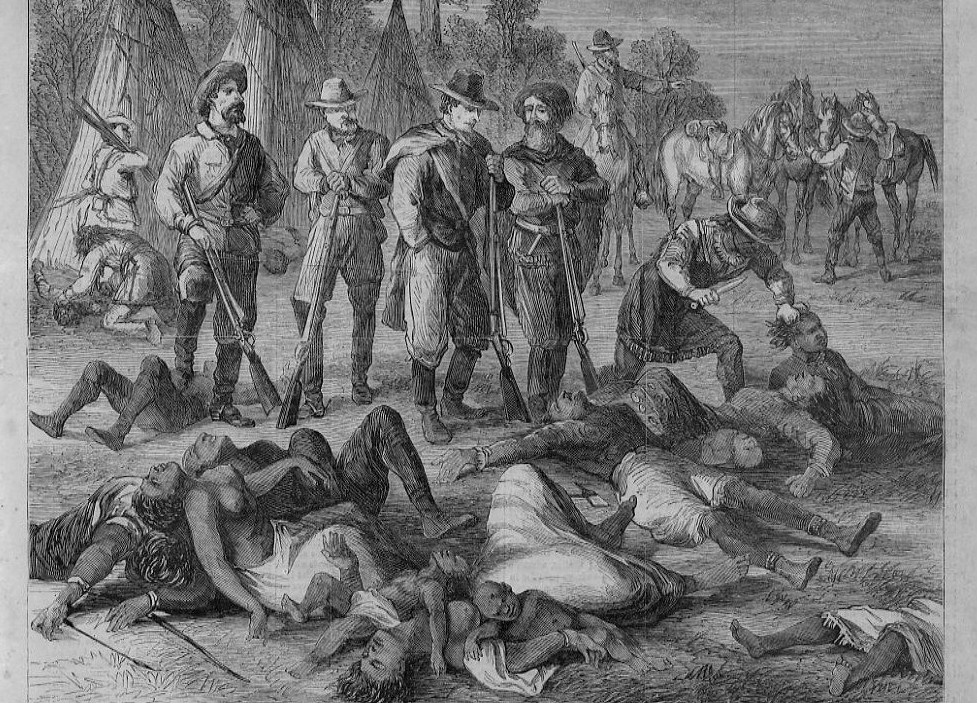
Consider living under a set of laws decreed by a racist theocratic dictator calling for ethnic cleansing, slavery, and cultural genocide if not outright genocide. It would probably not be the humanitarian thing to do while alternatively promoting freedom, democracy, and the ‘rule of law’. Unfortunately at its base, this is where the people of the Anglo empire – Canada, New Zealand, Australia, and their belligerent cousin, the U.S. (also the Five Eyes) – have settled their lives.

Truly settled – while the British Empire spanned the world, these countries are the main survivors of the colonial-settler nature of the British imperial quest for more land, more resources, and more power. Other colonial areas were essentially satrapies – controlled by a subservient domestic leader under British Foreign Office tutelage, or controlled by the British directly without encouraging colonial settlers. In many of the latter cases the number of indigenous people vastly outnumbered the British, resulting eventually in successful rebellions that pushed the formal British empire influence out: South Africa, the former Rhodesia (Zimbabwe), and India/Pakistan are prime examples of that.

The current Five Eyes are essentially successful colonial-settler countries having created varying systems of ethnic cleansing, apartheid, cultural and physical genocide, and have retained significant traits of their colonial past – today’s broad societal racism.

Throughout the era of western European imperialism mainstream history teaches that areas “discovered” by “explorers” belonged to certain countries through the simple right of discovery. These areas were decreed to be open for possession and the indigenous inhabitants subject to “perpetual slavery,” removal, and they and their “lands, possessions, and goods” were to be used by the discoverers for “their use and profit.”

The victim becomes perpetrator

If the indigenous people objected “we will enter your land against you with force and will make war in every place and by every means we can and are able….” and further blame the victims as “we avow that the deaths and harm which you will receive thereby will be your own blame, and not that of Their Highnesses, nor ours, nor of the gentlemen who come with us.”

“Violence becomes the instrument of its own exoneration…Your fear of our presence threatens our safety and we have come to make it safe. Secure. Irrational fear and self-defense have become the rationale for global slaughter.”

Rule of Law

Consider again living under a set of laws decreed by a racist theocratic dictator calling for ethnic cleansing, slavery, and cultural genocide if not outright genocide. The Papal Bull of 1452 and a subsequent Bull, the Requerimiento of 1514, set out this set of what could be considered international law. Empires of the day, initially the Portuguese and Spanish, took this ‘law’ as promulgated by a white racist theocratic dictator and used it to rationalize their conquest of as much of the rest of the world as they could. In polite terms, it is the Christian Doctrine of Discovery and it has become embedded in the laws of many countries pertaining to all facets of governmental control over land, resources, and people.

Contemporary politicians and pundits love to use the phrase “rule of law”. They are supporting these fundamental denials of human rights as even today, 450 years later, these Papal Bulls are still referenced to impose governmental dictates in order to deny indigenous rights – and indeed as they give all lands to the “sovereign” – they are used to be able to deny all rights to the citizen as required by the state.

The U.S. Supreme Court justice Ruth Bader Ginsberg reasoned in a 2005 case that “fee title to the lands occupied by Indians when the colonists arrived became vested in the sovereign – first the discovering European nation and later the original states and the United States.” Simple really: declare the land to be owned by the reigning foreign sovereign and it is open for exploitation of all kinds, regardless of whoever lives there. However, if a previous Christian entity had already claimed the land – maybe a problem of communication in the days of sailing ships – “the prior title of any Christian” was recognized.

The case in Canada

Canada is a very strong proponent of “rule of law.” All political leaders and wannabe leaders in Canada believe their own wisdom in repeating this mantra. Unfortunately, the very “rule of law” they shout about are the laws created from the heritage of the Christian Doctrine of Discovery.

Canada has referenced earlier court cases concerning the doctrine of discovery in some of its decisions, yet only this year Bill C-15, An Act respecting the United Nations Declaration on the Rights of Indigenous Peoples was passed denying the policies of discovery and terra-nullius, and supporting the UN Declaration on the Rights of Indigenous People. The policies of terra nullius and the Doctrine of Discovery are now labelled “racist, scientifically false, legally invalid, morally condemnable and socially unjust.”

Sounds great on paper but that is where it ends, in meaningful rhetoric stuffed inside what could lead to some important legislation; but the “rule of law”, as based on the very principles essentially annulled in C-15, continue to weave their powers across Canada.

In British Columbia there are two ongoing protests by indigenous people, one concerning the destruction of old growth forests, the other an attempt to stop the construction of a gas pipeline from passing through unceded native land. The latter is the crux of the matter, at least here in British Columbia where only a miniscule portion of provincial lands (the sovereign) have been acquired by treaty. While the Supreme Court of Canada has recognized that land title has not been extinguished in many areas, little has been accomplished within the province to negotiate fairly with the indigneous people.

Consider some domestic incidents. Within the last week, dozens of arrests of protesters – natives, journalists, and supporters – were made by a highly militarized RCMP platoon on Wet’suwet’en territory. The Alberta tar sands cover thousands of hectares of indigenous land, destroying the water, the forests, the air. Fairy Creek on Vancouver Island has become mostly an argument about climate change and deforestation, especially with old growth forests, but at its base is the element of unextinguished territorial rights.

Extinguishment

It might be a stretch but put the two references together: the illegality of the policies of terra nullius and the Doctrine of Discovery as per Bill C-15; and the ongoing usage of the very laws created by those policies in order to support the ongoing control and extraction of land resources. It is a huge contradiction between words and action, and it is the actions that speak much louder than words.

What needs to be extinguished is the “rule of law” as determined by these ancient and racist papal doctrines. It is not likely to happen: the rights of sovereigns and large corporations over the land and people are too well embedded in the underlying culture, a racist culture from its foundation. A few token agreements may be made sporadically but the underlying nature of Canada’s domestic corporate laws, the so called ‘free’ trade regulations, and the ongoing use of militarized force to support those domains will continue.

Foreign Policy

It goes further. Canada’s foreign policy is largely determined by “racist, scientifically false, legally invalid, morally condemnable and socially unjust” policies as these policies as well reflect the “rule of law” descending from the papal bulls of centuries ago. There is no determination in Canada’s foreign policy that their support of other governments actions based on settler colonialism, militarized forces of suppression, ethnic cleansing, and the creation of apartheid societies is to be equally condemned. Nor is it ever likely to happen. Racism is built into Canada’s structures and laws as it is in most countries colonized and settled under British dominion.

Under Canada’s domestic law (Bill C-15) and current international law, settler law is null and void. Also under international law, those occupied have a right to resist that occupation (Fourth Geneva Convention). Most of western wealth is based on ethnic cleansing and genocide from the “discovered” empires of western Europe. Much cannot be changed, but reconciliation, restitution, and the true equality of all before domestic and international law need to be addressed.