3 Feb 2022

US sends another 3,000 troops to Eastern Europe

Andrea Peters


The United States announced Wednesday it is deploying another 3,000 troops to two East European NATO member states, further escalating the prospect of an all-out war on the continent. The nearly 2,000 paratroopers being sent to Poland will join a 4,000-man NATO force already there, while those dispatched to Romania will more than double the number of military personnel currently stationed in that Black Sea nation. Washington reiterated that it has another 8,500 soldiers on standby. In late January, it emerged that war planners had considered putting 50,000 boots on the ground in Eastern Europe.

Airmen from the 436th Aerial Port Squadron load ammunition, weapons and other equipment bound for Ukraine during a foreign military sales mission at Dover Air Force Base, Del., on Jan. 30, 2022.

“It’s important that we send a strong signal to Mr. Putin and the world that NATO matters,” said Pentagon spokesman John F. Kirby yesterday. “We are making it clear that we are going to be prepared to defend our NATO allies if it comes to that,” he added. Given that Ukraine is not a NATO member, Kirby is implying in this statement that Russia’s war aims extend far beyond its western neighbor and that the United States is prepared to light the whole region on fire.

Along with these latest troop deployments, the Pentagon is sending another six F-15 fighter jets to Estonia, whose border is only about 200 miles from Russia’s second major city, St. Petersburg. The Belgian government is further bolstering NATO airpower in the Baltics by sending F-16s to join the American contingent. Sweden, although not a member of the alliance, just committed to several million dollars-worth of spending to help Ukraine “strengthen reliance” in its southeast.

The United States and NATO are making clear that they are prepared not to draw down, but rather increase the size of their forces arrayed along Russia’s entire western flank. The expansion of the trans-Atlantic alliance on the basis of an openly anti-Russian geopolitical and military policy is at the core of the current conflict with Moscow, which has made clear this is an existential threat to a country that has a tragic and bitter experience with hostile armies pouring across its European borders.

In response to Wednesday’s announcement of further US troop deployments, deputy head of the Russian Ministry of Foreign Affairs Aleksandr Grushko told news agency Interfax that the move would only increase military tensions.

On Wednesday, the Spanish newspaper El País published the contents of a written response by the US and NATO to Russia’s insistence that Ukraine not ever be admitted to the trans-Atlantic alliance. The letters, one from Washington and the other from Brussels, rejected that demand out of hand and declared it to be a violation of NATO’s “Open Door Policy,” whereby any country can be admitted at any time if seen fit.

While declaring that it is willing to consider a reciprocal agreement that neither party will station “ground-launched missile systems and permanent forces” on Ukrainian territory, the US position outlined in the letter left open plenty of opportunity for Washington and NATO to further militarize Ukraine by providing arms and financing to Kiev or moving armed forces through the country on a rotating basis.

The entire proposal, which includes an offer to review nuclear arms agreements of concern to Russia and start discussions on the basis of countries’ conceptions of the “indivisibility of security,” is contingent on Moscow “deescalating” the present situation and removing its forces from Ukraine, Georgia and Moldova. While unstated in the letter, this would have to involve, among other things, Russia abandoning its naval base on the Black Sea, turning Crimea back over to the far-right government in Kiev, and giving up its military presence in the highly contested and geostrategic southern Caucasus.

In addition, the letters declare Russia’s actions to be “unprovoked” and “unjustified” and demand that Moscow “refrain from coercive force posturing, aggressive nuclear rhetoric, and malign activities directed against Allies and other countries.” Apparently, such actions are the sole right of Washington and Brussels.

The Kremlin responded to these communications earlier this week by saying that neither the US nor NATO had seriously addressed any of its concerns.

Since then the media warmongering has continued, with the latest installment being satellite evidence published Wednesday that allegedly details Russia’s military build-up near Ukraine. The company that produced the photos, Maxar, is a Washington-based firm with extensive ties to the US government and military.

Not even two decades ago, Iraqi society was destroyed on the basis of lies, supposedly substantiated with satellite imagery, that Saddam Hussein had “weapons of mass destruction.” None of today’s claims, nor the newspapers that peddle them, has any credibility. And in all of the media coverage on this issue, it never occurs to any journalist or commentator that, even if the images are accurate, there is no reason why Russia, which faces overwhelming NATO firepower, cannot equip forces on its sovereign territory.

From the standpoint of both the US government and its backers in the mass media, Russia, in essence, has no right to exist. This is why all of the Kremlin’s national security concerns, as well as the sentiments of the country’s 140 million people who have lived through war on a scale not experienced by any other population, are dismissed as “misinformation.”

In a discussion on Wednesday, British Prime Minister Boris Johnson, whose government is in crisis because of its flagrant violation of COVID-19 protocols, warned President Vladimir Putin that a Russian invasion would be a “tragic miscalculation.”

The same day, Ukrainian President Volodymyr Zelensky, coming out of a meeting with Johnson, declared, “There will be, unfortunately, a tragedy if the escalation against our state begins. This will not be a war between Ukraine and Russia—this will be a war in Europe, full-scale war.”

The Kremlin has repeatedly said that it is not preparing to invade anyone.

In an indication that the US may be trying to slow down the mad dash to World War III or at the very least tone down the out-of-control war hysteria in the press, White House Spokeswoman Jen Psaki said Wednesday that the Biden administration would no longer describe Russia’s alleged plans to invade Ukraine as “imminent.” With the world standing on the brink of disaster, Psaki blithely noted, “I think it sent a message that we weren’t intending to send.”

Whatever the immediate twists and turns, the United States is on a collision course with Russia. It also has China in its gun sites. A major question facing Washington is how, or whether, it can manage a two-front war. The COVID-19 pandemic, for which the White House has no answer apart from mass death, is pushing the ruling class to find outlets for its internal crisis in foreign war.

2 Feb 2022

New Flood Maps Show US Damage Rising 26% in Next 30 Years Due to Climate Change Alone, and the Inequity is Stark

Oliver Wing, Carolyn Kousky, Jeremy Porter & Paul Bates


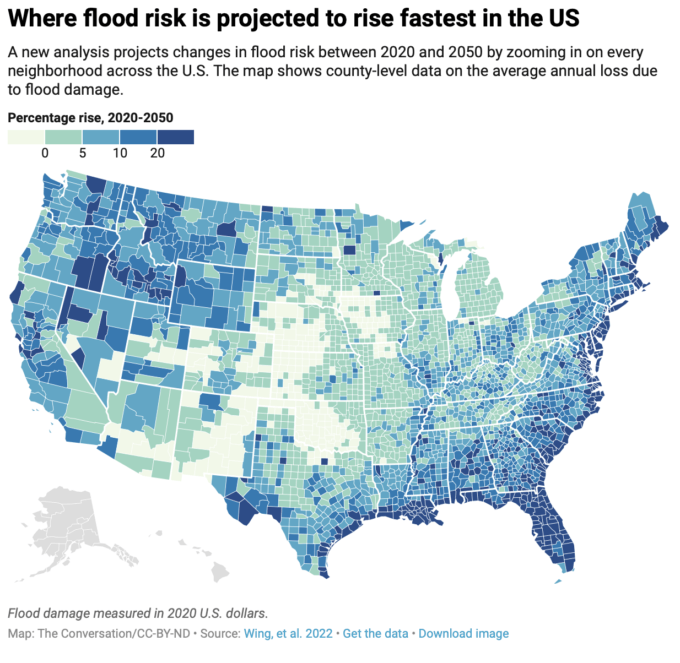
Climate change is raising flood risks in neighborhoods across the U.S. much faster than many people realize. Over the next three decades, the cost of flood damage is on pace to rise 26% due to climate change alone, an analysis of our new flood risk maps shows.

That’s only part of the risk. Despite recent devastating floods, people are still building in high-risk areas. With population growth factored in, we found the increase in U.S. flood losses will be four times higher than the climate-only effect.

Our team develops cutting-edge flood risk maps that incorporate climate change. It’s the data that drives local risk estimates you’re likely to see on real estate websites.

In the new analysis, published Jan. 31, 2022, we estimated where flood risk is rising fastest and who is in harm’s way. The results show the high costs of flooding and lay bare the inequities of who has to endure America’s crippling flood problem. They also show the importance of altering development patterns now.

The role of climate change

Flooding is the most frequent and costliest natural disaster in the United States, and its costs are projected to rise as the climate warms. Decades of measurements, computer models and basic physics all point to increasing precipitation and sea level rise.

As the atmosphere warms, it holds about 7% more moisture for every degree Celsius that the temperature rises, meaning more moisture is available to fall as rain, potentially raising the risk of inland flooding. A warmer climate also leads to rising sea levels and higher storm surges as land ice melts and warming ocean water expands.

Yet, translating that understanding into the detailed impact of future flooding has been beyond the grasp of existing flood mapping approaches.

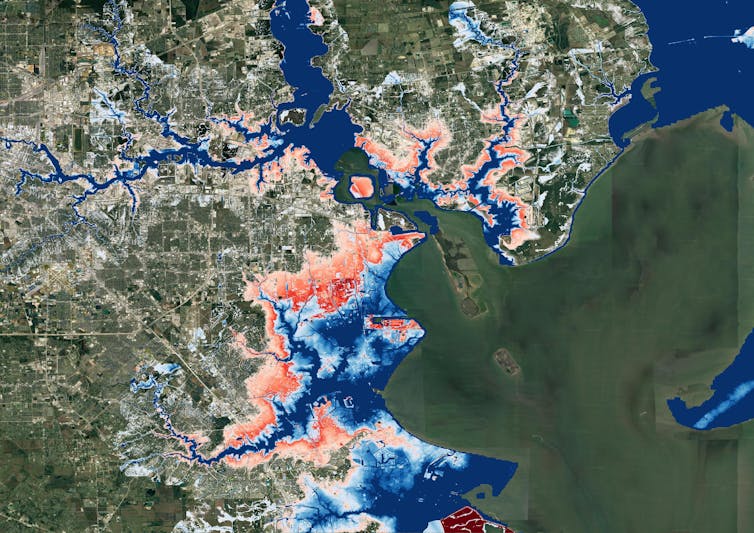
A map of Houston showing flooding extending much farther inland.

A map of Houston shows flood risk changing over the next 30 years. Blue areas are today’s 100-year flood-risk zones. The red areas reflect the same zones in 2050. Wing et al., 2022

Previous efforts to link climate change to flood models offered only a broad view of the threat and didn’t zoom in close enough to provide reliable measures of local risk, although they could illustrate the general direction of change. Most local flood maps, such as those produced by the Federal Emergency Management Agency, have a different problem: They’re based on historical changes rather than incorporating the risks ahead, and the government is slow to update them.

Our maps account for flooding from rivers, rainfall and the oceans – both now and into the future – across the entire contiguous United States. They are produced at scales that show street-by-street impacts, and unlike FEMA maps, they cover floods of many different sizes, from nuisance flooding that may occur every few years to once-in-a-millennium disasters.

While hazard maps only show where floods might occur, our new risk analysis combines that with data on the U.S. building stock to understand the damage that occurs when floodwaters collide with homes and businesses. It’s the first validated analysis of climate-driven flood risk for the U.S.

The inequity of America’s flood problem

We estimated that the annual cost of flooding today is over $32 billion nationwide, with an outsized burden on communities in Appalachia, the Gulf Coast and the Northwest.

When we looked at demographics, we found that today’s flood risk is predominantly concentrated in white, impoverished communities. Many of these are in low-lying areas directly on the coasts or Appalachian valleys at risk from heavy rainfall.

But the increase in risk as rising oceans reach farther inland during storms and high tides over the next 30 years falls disproportionately on communities with large African American populations on the Atlantic and Gulf coasts. Urban and rural areas from Texas to Florida to Virginia contain predominantly Black communities projected to see at least a 20% increase in flood risk over the next 30 years.

Historically, poorer communities haven’t seen as much investment in flood adaptation or infrastructure, leaving them more exposed. The new data, reflecting the cost of damage, contradicts a common misconception that flood risk exacerbated by sea level rise is concentrated in whiter, wealthier areas.

Our findings raise policy questions about disaster recovery. Prior research has found that these groups recover less quickly than more privileged residents and that disasters can further exacerbate existing inequities. Current federal disaster aid disproportionately helps wealthier residents. Without financial safety nets, disasters can be tipping points into financial stress or deeper poverty.

Population growth is a major driver of flood risk

Another important contributor to flood risk is the growing population.

As urban areas expand, people are building in riskier locations, including expanding into existing floodplains – areas that were already at risk of flooding, even in a stable climate. That’s making adapting to the rising climate risks even more difficult.

A satellite image of Kansas City showing flood risk overlaid along the rivers.

A Kansas City flood map shows developments in the 100-year flood zone. Fathom.

Hurricane Harvey made that risk painfully clear when its record rainfall sent two reservoirs spilling into neighborhoods, inundating homes that had been built in the reservoirs’ flood zones. That was in 2017, and communities in Houston are rebuilding in risky areas again.

We integrated into our model predictions how and where the increasing numbers of people will live in order to assess their future flood risk. The result: Future development patterns have a four times greater impact on 2050 flood risk than climate change alone.

On borrowed time

If these results seem alarming, consider that these are conservative estimates. We used a middle-of-the-road trajectory for atmospheric greenhouse gas concentrations, one in which global carbon emissions peak in the 2040s and then fall.

Importantly, much of this impact over the next three decades is already locked into the climate system. While cutting emissions now is crucial to slow the rate of sea level rise and reduce future flood risk, adaptation is required to protect against the losses we project to 2050.

If future development was directed outside of the riskiest areas, and new construction met higher standards for flood mitigation, some of these projected losses could be avoided. In previous research, we found that for a third of currently undeveloped U.S. floodplains it is cheaper to buy the land at today’s prices and preserve it for recreation and wildlife than develop it and pay for the inevitable flood damages later.

The results stress how critical land use and building codes are when it comes to adapting to climate change and managing future losses from increasing climate extremes. Protecting lives and property will mean moving existing populations out of harm’s way and stopping new construction in flood-risk areas.

The COVID pandemic continues to rage despite the delivery of more than 10 billion doses of vaccines

Benjamin Mateus


The online publication Our World in Data, which has been a leading and often referenced source for critical statistics regarding the COVID pandemic, reported that on Friday, January 28, 2022, more than 10 billion doses of COVID vaccines had been administered worldwide in the 13 months since they were first introduced to the public.

In that same period, the pandemic has only accelerated the mass deaths caused by the infection with the coronavirus. With 5.67 million reported COVID deaths during the pandemic, almost four million have died since Margaret Keenan, a 91-year-old grandmother from the UK, became the first person in the world to get the Pfizer COVID-19 vaccine on December 8, 2020.

Medics wearing special suits to protect against coronavirus treat a patient with coronavirus, left, as others prepare a patent to move at an ICU at the Moscow, Oct. 19, 2021. (AP Photo/Alexander Zemlianichenko)

As the New Year’s statement published in the WSWS noted, “The global pandemic is a catastrophe of historic dimensions. It is also a crime because the disastrous impact of the pandemic is the result of decisions made by capitalist governments—first and foremost in the United States and Western Europe—to deliberately prioritize profits over lives, to reject the implementation of public health measures required to eliminate SARS-CoV-2 and, instead, to adopt policies that allow the virus to spread widely throughout the global population.”

Indeed, the politics behind implementing the COVID vaccine campaign has been to disarm any public resistance against the malign “herd immunity” policies that various governmental institutions called for from the beginning, embedded into the interests of financial markets. The current objective is to completely dismantle the entire public health apparatus, including the necessary COVID metric dashboards that provide a sense of the scale of the calamity.

Share of people vaccinated against COVID-19 as of January 28, 2022.

In short, the promise of relying solely on vaccines as an exit strategy has been disastrous. Warnings to this effect were made by scientists at the World Health Organization, stating that depending on vaccines without strict infection controls risked breeding new, more virulent variants of the SARS-CoV-2 virus. These have been proven correct.

That 10 billion doses of vaccines have been administered in little more than a year is an astounding public health feat that belies the constantly repeated assertion that the virus is unstoppable. It provides objective evidence that the ruling elites’ malicious interest in vaccines is not as a social balm but as a political instrument.

Such a quantity is more than enough to offer every person on the planet at least one dose of a COVID vaccine. Not counting the 680 million children under five, for whom no vaccine has yet been approved, there are roughly 7.3 billion people. But only 4.8 billion, less than two-thirds of those eligible, have received even one shot. Just over half are considered fully vaccinated. While high-income countries have fully vaccinated 72 percent of their populations, the lowest-income countries, predominately on the African continent, have managed to give less than 10 percent of their people even one dose.

Vaccines doses per 100 persons by economic category. Source Our World in Data.

These stark disparities are a byproduct of the vaccine nationalism that has led to the hoarding of these life-saving treatments by the wealthy countries, further exacerbated by the emergence of more virulent, contagious, and immune-evading strains that have made it necessary to provide a third dose and for some a fourth, especially to the elderly or those with significant health issues. Given the limitations of supply, these additional doses, mainly in the rich countries and for the privileged elite in the poor countries, have come at the expense of the mass of the population in Africa, Asia and Latin America.

High and upper-middle-income countries have administered enough COVID vaccines to offer 180 doses for every 100 persons. Theoretically, that would mean that as many as 90 percent of the population could be fully vaccinated with the two-dose regimen. There have been 25 doses given for every 100 individuals on the African continent or just over 300 million doses. By comparison, the United States has administered 537 million doses though its population is one-quarter of Africa’s.

Objectively, the rate of vaccination uptake in these high-income regions is linked to socioeconomic factors and national initiatives. Whereas the US has fully vaccinated only 63 percent of its population, countries like Canada (79 percent), China (85 percent), Singapore (87 percent), Australia (78 percent), and many EU high-income EU nations have fully vaccinated far more than the 70 percent target set by the World Health Organization for 2022.

Of the ten billion COVID vaccines administered, nearly one billion have been given as boosters. High-income and upper-middle-income countries have received the lion’s share with more than 898 million third doses (and fourth doses). However, in the context of the immune-evading Omicron variant and the need for a third dose to be considered fully vaccinated, the result is that just over 11 percent of the world’s population can now be considered fully vaccinated. The US has only given a quarter of its population a booster shot, while EU nations are approaching half.

Doses of COVID vaccine boosters per 100 persons by Income group. Source Our World in Data.

Currently, between 25 and 30 million doses of COVID vaccines are being administered each day globally. Even if coordinated initiatives to equitably distribute vaccines were put in place, at this rate, it would take another four months to get 75 percent of the world population the first dose, another target set by the WHO.

Lower-middle-income countries have only managed to give their population 96 doses per 100 people, and low-income countries fewer than 14 doses per 100 people. As Bloomberg recently wrote, “The wealthiest 107 countries in the world—including China, the US, and Europe—comprise 54 percent of the global population but have used 71 percent of the vaccines. Less wealthy places such as India, much of Africa and parts of Asia make up almost half of people on Earth and yet account for less than 30 percent of shots given.”

Notwithstanding the patent inequities, the remarkable feat of inoculating billions of people has not led to the end of the pandemic, as so many leaders of the imperialist powers had promised. On the contrary, the vaccine-only initiative has spawned the Delta and Omicron waves, demonstrating the failure of this bankrupt policy.

According to the WHO COVID-19 dashboard, there have been 360.6 million confirmed infections, of which 290 million were contracted since the COVID vaccines were introduced in mid-December of 2020. Of the 5.62 million cumulative COVID deaths during the pandemic, almost four million took place after vaccines became available.

In less than two years, the United States, which has been the consistent epicenter of the COVID pandemic, has now seen more than 900,000 Americans perish from their infection, the highest in any country worldwide. When nurse Sandra Lindsay received the first dose of a COVID vaccine in Queens, New York, on December 14, 2020, inaugurating the vaccine campaign in the US, the total COVID deaths had reached an astounding 320,000. The vaccines were touted with much media fanfare as the beginning of the pandemic endgame. Since then, however, another 580,000 have perished in America.

Currently, daily COVID infections in the US remain well above pre-Omicron highs, with over a half-million cases per day. The daily average in COVID deaths had risen steadily since December, when numbers had dipped under 1,000 deaths per day. They are now at 2,500 a day, above the peak deaths from the Delta wave and fast approaching the deadly highs of last winter’s worst stretch when the seven-day average reached 3,323. Notably, all current COVID deaths are attributable to the Omicron variant, which entirely refutes the oft-repeated claims that it is only a mild infection.

Official COVID death figures are known to undercount the real scale of misery and devastation. Many of those who were infected and died were never tested and are lost in official statistical reports. Then there are those affected by the pandemic indirectly, who went to their deaths from non-COVID but preventable causes. Due to health systems being inundated with patients or fear of becoming infected, their conditions deteriorated sufficiently that medical intervention became futile.

In this sense, excess deaths provide a more reliable measure of total mortality due to COVID-19. As defined by the Economist, “This number is the gap between how many people died in a given region during a given time period, regardless of cause, and how many deaths would have been expected if a particular circumstance [in this case the COVID pandemic] had not occurred.”

The current estimate of excess deaths worldwide is 3.6 times higher than official global COVID-19 deaths. At 20.4 million, that figure surpasses all civilian and combat fatalities incurred in the four years of World War I. Bulgaria, a country with 6.9 million people, where 22 percent of the population lives below the poverty line of 185 euros a month, claims the unfortunate distinction of having the highest per capita excess deaths.

Global Estimated Excess Deaths and Official COVID-19 Deaths. Source from The Economist.

Countries with some of the highest excess deaths per 100,000 include small Eastern European countries like Bulgaria, along with Russia, India, South Africa, Argentina, Peru, Mexico, and the United States. Current estimates are that daily global excess death have reached a pandemic high of 78,100 per day (January 28, 2022), far above the mid-May peaks of 2021 when Delta was ravaging India.

In mid-December 2020, excess deaths had reached 5.2 million. In the 13 months since the COVID vaccines were publicly introduced, another 15 million people have died who could have been saved if a coordinated international effort had been employed to eliminate COVID across the globe.

For those fully inoculated with two doses, the current vaccines, formulated to fight the ancestral SARS-CoV-2 first encountered in Wuhan provide only 44 percent effectiveness against hospitalization from an Omicron infection if the last dose was given more than 25 weeks prior. Vaccine effectiveness to prevent symptomatic disease from Omicron is zero to 10 percent, essentially meaningless. A recent UK study found that more than two-thirds of people infected with Omicron had previously been infected.

The current variants of the Omicron coronavirus, BA.1 and BA.2, are highly contagious and are wreaking havoc in every country in which they have taken hold. Their immune-evading capacity means that herd immunity is scientifically impossible. And the idea of allowing the virus to become endemic is a political ploy. Endemic Omicron will mean repeated bouts of infection, a pandemic in permanence.

Boris Johnson pushes anti-Russia war rhetoric in Ukraine amid UK government crisis

Thomas Scripps


Boris Johnson continues to respond to the crisis facing his premiership by escalating the UK’s involvement in the US war drive against Russia.

After again rejecting calls for his resignation over the “partygate” scandal in Parliament Monday, Johnson flew to the Ukrainian capital Kyiv yesterday, where he met President Volodymyr Zelensky for talks in the Mariinsky Palace.

He tweeted ahead of his trip, “As a friend and a democratic partner, the UK will continue to uphold Ukraine’s sovereignty in the face of those who seek to destroy it.” In his opening statement to the press conferences following the talks, he warned of “perhaps the biggest demonstration of hostility towards Ukraine in our lifetimes.”

Prime Minister Boris Johnson and Ukrainian President Volodymyr Zelensky hold a press conference at the Mariyinsky Palace in Kiev, Ukraine. 01/02/2022. (Picture by Andrew Parsons /No 10 Downing Street/FlickR)

Johnson boasted of Britain’s pole position in the anti-Russian campaign. “The UK and other countries will be judged by the people of Ukraine and the world by how we respond and how we help,” he said, and it was “absolutely vital that the UK government should step up now [and] bring together our friends and partners in the West in the way that we are.”

But his efforts to strike a Churchillian pose on the world stage quickly ran into trouble. In a rare example of journalistic competence, the first questions posed to Johnson, by the BBC, were, “Have you done enough to survive? Have you done enough to persuade enough colleagues to rescue your premiership? And on the issue of Ukraine, why should the international community take your diplomacy seriously when you’re so preoccupied at home you put talking to MPs ahead of talking to President Putin?”

Johnson had been forced to cancel a scheduled phone call with Putin on Monday to deal with release of the senior civil servant Sue Gray’s inquiry report into parties held at Downing Street during pandemic lockdowns. The call with the Russian President has been rearranged for today after Putin refused a request for Tuesday.

Johnson blustered, “My focus is entirely on delivering the priorities of the British people and they include ensuring that our relations with our friends and allies, and that our friends and allies are secure.”

The same journalist asked Zelensky, “Do you believe that the prime minister and his American allies are exaggerating the threat from Russia?”

This was a pointed reference to the recent public clash between the Ukrainian president and US President Joe Biden, with the US insisting a Russian invasion was imminent and Zelensky answering that this was not his government’s assessment and telling the NATO powers not to spread “panic”.

Zelensky fudged his answer to spare Johnson’s blushes but did not reverse his earlier statements, replying, “In terms of exaggerating or underestimating the threats it’s difficult to answer your question. No one can predict or know what will happen next.”

Johnson was put on the defensive and forced to return to the issue later in the conference.

“I think somebody asked a question earlier: ‘were we exaggerating the threat, were the US and UK in any way trying to big this up?’ I’ve just got say that is not the intelligence that’s we’re seeing. There is a clear and present danger. We see large numbers of troops massing; we see all kinds of operations that are consistent with an imminent military campaign.”

Assertions of nondescript “intelligence” seen by UK officials and a “clear and present danger” recall nothing so much as Britain’s role in 2002-3 as bagman for the US war against Iraq, justified with lying claims of an imminent threat from Weapons of Mass Destruction.

The UK is directly responsible for the most widely discredited “intelligence”, asserting that a Russian invasion is imminent, the January 22 Foreign Office press release claiming that Putin’s government was “looking to install a pro-Russian leader in Kyiv as it considers whether to invade and occupy Ukraine.”

This was not the only embarrassment suffered by Johnson over Ukraine. On Monday his defence secretary Ben Wallace participated in a joint press conference with his Hungarian counterpart Tibor Benko.

Wallace attempted to further reported plans for NATO to send additional battle groups to Romania, Bulgaria, Slovakia and Hungary, saying it was “important to signal to Putin that the very thing he fears, that is, more NATO close to Russia, would be the consequence of invading Ukraine... This is why the UK offered NATO more ground forces, more readiness as a deterrent.”

But in the same conference Benko refused the deployment of NATO troops to Hungary. The country’s president, Viktor Orban, visited Moscow yesterday for high-profile talks with Putin.

Johnson’s performance in yesterday’s press conference made clear that his response to these setbacks will be to double down on the UK’s commitment to the imperialist aggression.

With customary hypocrisy, he claimed that Russia was trying to “redraw the security map of Europe and impose a new Yalta, new zones of influence” by “holding a gun to the head of Ukraine”. It is NATO which has “redrawn the security map of Europe” by advancing hundreds of miles to Russia’s border and NATO which has used Russia’s request that this threat to its security be withdrawn as a pretext for a massive militarist campaign.

Demanding Russia “steps back and chooses the path of diplomacy,” Johnson made clear that this meant recognising Ukraine’s right to decide “which organisations they aspire to join”, i.e., NATO.

He also threatened that in the event of any provoked conflict “Ukraine will fight… There are 200,000 men and women under arms in Ukraine, they will put up a very, very fierce and bloody resistance.” Johnson went on, “I think that parents, mothers in Russia should reflect on that.”

He once again turned to nationalist boasting, stating, “Since 2015, the UK has trained over 22,000 Ukrainian military personal and provided £2.2 million worth of non-lethal military equipment to Ukraine, two weeks ago, we sent anti-tank weaponry to strengthen Ukrainian defences further, and today I’ve announced a further £88 million of UK funding to support good governance and energy independence.”

There are currently around 100 British personnel in Ukrainian still conducting military training.

Last week, the Ukrainian parliament ratified a £1.7 billion loan from the UK designed to fund the development of the country’s navy, including two minesweepers, eight gunboats, a frigate and other naval infrastructure.

Zelensky also emphasised the “high risk for anyone who tries to occupy even a tiny bit of our territory,” adding the warning, “This is going to be a European war, a full-fledged war.”

The danger of a rapidly expanding conflict was underscored by the formal announcement of a trilateral alliance between the UK, Ukraine, and Poland. Ukraine’s Foreign Minister Dmytro Kuleba commented, “We cannot expect safety and prosperity somewhere in the future when we become members of the EU and NATO. We need them today.”

At a meeting last week of the Ukrainian and Polish prime ministers, the Polish PM Mateusz Morawiecki said, “Living close to a neighbour like Russia we have the feeling of living at the foot of a volcano,” and promised to provide Ukraine with mortars, artillery ammunition, air-defence systems, and surveillance drones.

Putin warns US seeks to “drag” Russia “into an armed conflict”

Clara Weiss


Speaking at a press conference with Hungary’s prime minister Viktor Orbán on Tuesday, Russian President Vladimir Putin said that the written response by the US to Russia’s key demands from December indicated that “the fundamental concerns of Russia have been ignored.”

The main demands from the December 17 document, which the Kremlin made public, were the non-extension of NATO, including a guarantee that Ukraine would not be admitted as a member; a return to its borders as agreed upon in the 1997 NATO-Russia agreement; and a guarantee that it would not station missiles in Eastern Europe and withdraw those that already exist.

NATO has nuclear missiles stationed in Romania, just 1,000 kilometers away from Moscow. Since the dissolution of the Soviet Union by the Stalinist bureaucracy in 1991, NATO has systematically encircled Russia, with all countries in Eastern Europe near its borders—with the exceptions of Ukraine, Moldova and Belarus—now members of the military alliance.

Russian President Vladimir Putin gives his annual state of the nation address in Manezh, Moscow, Russia, Wednesday, April 21, 2021. (Mikhail Metzel, Sputnik, Kremlin Pool Photo via AP)

Putin stated that for the US, “Ukraine is just a tool … They can drag Ukraine into NATO, they can deploy their strike weapons and instigate an offensive to retake Donbass or Crimea with military force and drag us into an armed conflict again.” Putin also pointed out that, in Ukraine, the “retaking of Crimea,” a peninsula in the Black Sea, is part of Kiev’s official military strategy.

The statements by Putin underscore the immense dangers of the situation that has been created by the aggressive moves of NATO and above all, US imperialism. Driven primarily by an extraordinary crisis and enormous class tensions at home, Washington has embarked on a series of reckless provocations—of which the response to Russia’s demands was a part—designed to create conditions and pretexts for war.

While a massive campaign of war propaganda alleging an impending “Russian invasion” of Ukraine was launched in the media, the White House has placed 8,500 troops on alert and has delivered 300 Javelin missiles and other weaponry to the Ukrainian army. Moreover, the Biden administration has threatened Russia with “crippling sanctions,” the implementation of which could only be understood as an act of warfare.

These provocations have created a powder keg in Eastern Europe that threatens to erupt into a war that could engulf not just the entire continent but the entire world.

The Russian newspaper Gazeta.Ru reported on Tuesday that officials of the so-called Donetsk People’s Republic and Lugansk People’s Republic, both located in the Donbass in East Ukraine and controlled by pro-Russian separatists since 2014, had received information that Kiev was planning a military offensive in the Donbass. The region has been the site of a civil war between pro-Russian separatists and US-backed and trained Ukrainian army and paramilitary forces since the US-EU-backed coup in February 2014, which ousted a pro-Russian government.

Eduard Basurin, head of the People’s Militia of the Donetsk People’s Republic, told Gazeta.Ru that Ukraine’s general staff was preparing an offensive operation. Basurin claimed that the plan for the offensive would be discussed later this week by the leadership of Ukraine’s Armed Forces. Separatist leaders also told the business daily Kommersant that new Ukrainian reconnaissance groups had recently arrived in East Ukraine, and that additional Ukrainian military units were about to be sent to the area.

Ukraine, which has been at the forefront of NATO’s war preparations since the 2014 US-backed coup, has been deeply destabilized by the war crisis and the ranging pandemic.

Last week, Ukraine’s President Volodymyr Zelensky rejected US claims of an impending Russian invasion, urging President Joe Biden in a phone call “to calm down the messaging.”

In the Ukrainian oligarchy and state apparatus, Zelensky has come under fire from various sides, most notably from his predecessor Petro Poroshenko and neo-Nazi forces which have been heavily funded and armed by the imperialist powers. Russian news reports suggest that Washington may view Poroshenko as a potential replacement for Zelensky.

On Monday, Ukraine’s Interior Ministry declared that it had uncovered and prevented plans for violent mass demonstrations across the country against Zelensky’s government. The demonstrations were set to take place on January 31 and designed to involve clashes with the police and create a media sensation. Demonstrators would have carried banners calling for a military offensive to “return” Crimea and the Donbass. The Russian business daily Kommersant highlighted the fact that the planners of the demonstrations were clearly very familiar with the modus operandi of Ukraine’s security forces, suggesting that they themselves had or still were part of the latter.

In Ukraine’s working population, which is plagued by inflation and yet another surge of the pandemic, the continuation and let alone escalation of the de facto proxy war against Russia is deeply unpopular. Over the past eight years, the war has already claimed over 14,000 lives and displaced millions. Tens of thousands of Ukrainian soldiers have deserted the front, refusing to engage in combat.

Polls have repeatedly indicated the main concern of the overwhelming majority of the population are rising prices, not Putin. These sentiments are a major reason why the imperialist powers and the Ukrainian ruling class are systematically arming fascist forces: both to carry out a war against Russia and to suppress opposition within the working class.

The situation in Russia is hardly any more stable. The pandemic, which has already led to a horrific drop in life expectancy by three years, is now experiencing its biggest surge yet with daily cases topping 125,000 on Tuesday, more than several times the peak during the Delta wave last fall. About 15 percent of the all cases are reported among children, the equivalent of 18,750 children on Tuesday alone. However, the Kremlin, mirroring the criminal response of the ruling class to the pandemic elsewhere, is ruling out any lockdowns and other critical public health measures.

Viewing the working class—not imperialism—as its central enemy, the response by the Russian oligarchy to the war preparations by the imperialist powers has consisted in a combination of military drills with a series of diplomatic maneuvers, which are aimed not only at potentially achieving a deal with imperialism after all, but also at securing support from potential allies in its conflict with NATO.

In Europe, the Kremlin is trying to play on divisions within the European Union over relations with both the US and Russia. At his meeting with Prime Minister Orbán on Tuesday, apart from Ukraine, Putin discussed increasing Russian gas deliveries to Hungary by another 1 billion cubic meters per year. Hungary already receives almost all of its gas from Russia.

Ukraine’s Foreign Ministry denounced a new deal between Russia’s Gazprom and Hungary last September as “a purely political, economically unreasonable decision taken in favor of the Kremlin.” Relations between Budapest and Kiev have long been strained over ethnic and border disputes.

Europe as a whole relies on Russia for about 40 percent of its gas imports. Amid fears of war over Ukraine, gas prices have spiked in recent weeks, adding to what are already very high inflation rates. Concerns about a potential disruption of oil and gas flows to Europe, and US opposition to the Russian-German gas pipeline Nord Stream 2, have long been a major factor in fueling divisions within the EU over its policy toward Russia and the US.

Despite these divisions, however, the EU has effectively backed the US war drive against Russia. Hungary, for its part, is reportedly discussing the deployment of NATO forces in the country in response to the crisis in Ukraine.

Putin is now traveling to China, where he is set to discuss Ukraine and other issues in a meeting with Xi Jinping. Last week, China openly denounced NATO provocations against Russia over Ukraine. Russian media reports suggest that Xi and Putin will be working out a political document. The Nezavisimaya Gazeta carried an editorial on Tuesday, noting that Washington had brought about an “unprecedented rapprochement between Moscow and Beijing.”

“Meaningfully milder” Omicron variant continues to kill more than 2,300 Americans each day

Bryan Dyne


The death toll caused by the coronavirus Omicron variant has risen to an average of more than 2,300 Americans a day, a figure that continues to undermine the lie promoted by media outlets such as the New York Times that the Omicron variant is “meaningfully milder than its predecessors.”

To put the current wave of death into perspective, it is higher than both the surge of deaths caused by the Delta variant in the fall, which peaked at just over 2,000 confirmed deaths each day, as well as the initial wave that peaked in April 2020 at more than 2,200 daily fatalities. It is still to be seen whether the current wave of death, which is still rising, will eclipse last winter’s peak of just under 3,600 deaths each day.

There are also still more than 125,000 people hospitalized across the country, including 23,000 who are in intensive care units. Hospitals remain at or near “crisis standards of care,” such as the ChristianaCare health network in Wilmington, Delaware. The 1,200-bed hospital system implemented its emergency protocols in early January, the first time in its 130-year history, and has not relaxed them since.

A healthcare worker stands near a COVID-19 patient at the University Hospital of Torrejon in Torrejon de Ardoz, Spain, Tuesday, Oct. 6, 2020 [Credit: AP Photo/Manu Fernandez]

Even the Biden administration has been forced to tacitly acknowledge the immense danger the current variant poses. During a meeting with US governors on Monday, President Biden sat 10 feet away from everyone in the meeting, including Vice President Kamala Harris, according to the Associated Press. Everyone in the room was required to wear N95 masks instead of the far-less-protective surgical masks, and only Biden himself was given a glass of water to prevent anyone else from taking their mask off for a drink.

The devastating Omicron death toll comes as new guidelines from the Department of Health and Human Services (HHS) “retire” its requirement that hospitals report to it “Previous day’s COVID-19 deaths.” The new policy was issued on January 6 and will go into effect February 2.

In effect, the HHS will no longer act as a central repository for daily in-hospital deaths caused by the coronavirus. Instead, it will be up to each state to report deaths to the Centers for Disease Control and Prevention (CDC), creating 50 points of potential failure and confusion as each state reports its COVID-19 deaths differently. Tennessee, for example, has only reported COVID-19 deaths on a weekly basis since December. Timely data on how many people are dying from the pandemic is no longer certain.

Alongside weakening efforts to tally coronavirus deaths, states across the country are also halting their contact-tracing efforts. Among the most recent is the Virginia Department of Health, which announced last week that it will only be doing contact tracing for “long-term care facilities and other congregate settings, healthcare settings, and other high-risk settings” because “it is not possible or fruitful to track every case.” Instead, “individuals” are encouraged to take “appropriate actions” if they suspect they have been infected, shifting the burden of basic public health measures to the population as a whole. At least a dozen other states are taking a similar approach.

The drive to limit death reporting and end contact tracing is reminiscent of remarks made by then-US President Donald Trump in the summer of 2020 that “Cases are going up in the US because we are testing far more. … With smaller testing we would show fewer cases!”

With Biden and the Democrats, it has become “with less reporting, we will have fewer deaths!”

The reality is quite the opposite. At least 65,510 people died from COVID-19 in the US in January, including at least 72 children, according to data gathered by the American Academy of Pediatrics. Total deaths have exceeded 913,000, among them 807 children. Worldwide, more than 5.7 million men, women and children have been officially declared dead as a result of COVID-19. Excess death estimates place the true total at more than 20 million.

Moreover, many survivors will likely suffer for months or years from Long COVID symptoms. An article published in Bloomberg on Monday noted that an estimated one third of those who contract COVID-19 will have lingering problems that have a myriad of symptoms, from brain fog, fatigue and pain to potential immune disorders and other chronic conditions such as diabetes.

Consider just the United States, where there have been more than 76.5 million confirmed coronavirus cases, nearly a quarter of the population. Using Bloomberg ’s estimate, that indicates that 25.5 million people, including nearly 4 million children, will develop such long-term health issues that can make life unbearable. Globally, the just under 382 million cases indicate 127 million people have contracted Long COVID, a pandemic in its own right.