12 Feb 2022

Sri Lankan nurses defy court ban and remain on indefinite strike with other health workers

K. Ratnayake


On Thursday evening, Colombo district courts issued an enjoining order against Government Nursing Officers’ Association (GNOA) President Saman Rathnapriya, directing him to immediately “suspend” the union’s involvement in ongoing indefinite strike action by tens of thousands of health workers. The judiciary will issue its final decision on the order on February 24 and has told Rathnapriya to appear in court on that day.

The GNOA, which has about 20,000 members, is one of 18 unions involved in the Federation of Health Professionals’ national strike that began on Monday. Over 65,000 health workers, including nurses, paramedic services, public health inspectors, medical laboratory technologists and pharmacists, are on strike.

Northern Province health workers strike in Jaffna on December 30, 2021 [WSWS Media]

The Federation of Health Professionals (FHP) was compelled to call the action amid the growing opposition of its members over low wages and deteriorating conditions. The strikers are demanding rectification of salary anomalies, higher transport and on-call duty allowances—from 3,000 rupees ($US15) to 10,000 rupees—increased overtime rates and improved promotion procedures.

Although the courts have singled out the nurses, the strike ban is aimed at breaking the industrial action of all health employees. Health workers, however, are defying the court order, making clear their determination to win their long outstanding demands.

Yesterday thousands of health workers demonstrated in the Anuradhapura, Hambantota and Nuwara Eliya districts. Similar numbers protested on Thursday in the Kurunegala, Matara, Badulla, Vavuniya and Ampara districts.

The request for a strike suspension order was made by the Sri Lankan Attorney General (AG). State lawyers appearing for the AG told the courts that “patient care has been gravely affected by the strike.”

The AG’s intervention would not have occurred without a directive from the highest levels of the government. It followed President Gotabhaya Rajapakse’s condemnation of the strike at a public rally of his Sri Lanka Podujana Peramuna (SLPP) in Anuradhapura on Wednesday.

Rajapakse declared that public servants were resorting to strikes under “the influence of various political forces,” adding: “Public officials have a responsibility to serve the people and the country.”

Rajapakse’s concerns about “the people” are bogus. His government have ended public health measures to suppress COVID-19 and are attempting to condition the population to mass infections and deaths. It is determined to impose the burden of crisis worsened by the COVID-19 global pandemic on workers and the poor.

Colombo is desperate to suppress the industrial action by health employees, fearing it will encourage other sections of the working class to fight the government’s social attacks. Last year strikes and struggles erupted across the island involving health, education, government administration, railway, electricity, ports, petroleum and plantations workers. Yesterday around 26,000 university non-academic workers held a national one-day protest to demand a salary increase.

Protest by striking non-academic workers at Jaffna University on February 10, 2022 [WSWS Media]

The Socialist Equality Party (SEP) condemns the government’s attack on the health workers’ right to strike and other industrial action. We urge the entire working class to oppose the government’s repressive legal moves and mobilise to defend all health employees. At stake is the basic democratic right of all workers to defend their living and social conditions.

The pro-government Public Services Nurses Union (PSNU), and the All Ceylon Health Services Union (ACHSU), which is controlled by opposition Janatha Vimukthi Peramunak, are scabbing on the strike. This has strengthened the government’s hand and opened the way for its repressive measures. Many PSNU and ACHSU members, however, have begun to join the industrial action in recent days and condemned their unions’ strike-breaking.

Last year, the FHP held 10 limited strikes over the current demands. These struggles were shut down and betrayed by the union body, following empty promises by President Rajapakse and his health minister.

While health workers remain on strike, the FHP are marking time waiting to abandon the strike after the court order. Yesterday morning the GNOA Facebook rhetorically declared: “Despite bringing not one enjoining order but 10 of such, the more than 65,000 officers in this coalition will continue this struggle.”

Yesterday evening, Rathnapriya told the media that the union’s executive committee would “convene a meeting immediately after receiving the enjoining order and discuss the future course of action.” FHP President Ravi Kumudesh said, “We are not aware of an issuance of any orders. In case there are any, we will seek legal advice regarding such.”

The FHP has no intention of turning to other sections of the working class to defend the democratic rights of their members and taking up a political struggle against the government’s latest assault. Tied to the nation state, all the unions fear that a mobilisation of workers would produce a direct confrontation with the government and the capitalist class.

This week, the FHP President Kumudesh publicly appealed to Health Minister Keheliya Rambukwella to make a “promise” on union’s demands and enabling the union alliance to call off the strike.

Significantly, not a single union in Sri Lanka condemned the attack on health workers or has come to their defence. Strengthened by this silence, the government stepped up its attack.

Yesterday Health Minister Rambukwella denounced the strikers, declaring that “unionists are in the habit of dismissing well-founded reasons and discussions for a sharply constructed and manipulative political agenda.”

Minister for Ports and Shipping Affairs Rohitha Abeywardhana attacked the striking health workers in parliament, declaring: “There should be laws curbing strikes in sectors related to essential services. People are dying without medicine.” He urged Justice Minister Ali Sabry to introduce anti-strike laws. Last month Sabry called on President Rajapakse to ban strikes in key institutions.

The media is backing the government threats, churning out vicious propaganda against strikers with stories about a man and a child who died because they were unable to get medical attention and photographs of suffering patients.

A hysterical editorial in Divaina, a Sinhala-daily, cited ruling party MP, Tissa Kuttiarachchi who said strikers should be attacked with clubs. “This country is facing a multiple crisis… We oppose strikes which are sabotaging the essential services of the public… Health workers are digging graves of people. If the people get provoked health workers would be thrown into same the graves,” the newspaper declared.

Workers must condemn the filthy propaganda of these media outlets who fully support the Rajapakse government’s “let it rip” coronavirus policies, putting profit before human lives, undermining public health measures, reopening the economy, and normalising pandemic deaths.

The court ban on health workers’ industrial action indicates that Rajapakse regime is moving into direct confrontation with the entire working class. Facing a desperate economic crisis, the government, like its counterparts around the world, it is cannot tolerate any action by the working class.

Once again, it sharply poses the necessity for the independent mobilisation of political and industrial strength of the working class to defeat the Rajapakse government and its big business policies.

Mars-Wrigley announces closure of its West Side Chicago factory

Brian Green


Mars-Wrigley has announced the closing of its long-established west side Chicago chocolate factory. Over the next two years, production will be ramped down until the plant closes its doors. Built and operated since 1928, the factory has earned praise from architects for its Spanish design style and has been noted by historians for its role in Chicago's industrialization.

Mars, Inc. candy factory in Chicago, IL (Credit: Glassdoor)

Mars-Wrigley has said that it will donate the factory “for the use of the community.” However, it said nothing of the fate of the 280 factory workers that the company will be laying off and forcing into financial peril.

As reported in the Chicago Tribune, a Mars-Wrigley spokesperson said only that workers are “encouraged to explore the opportunities to apply for open roles across our network, specifically in the Chicago area.” In other words, workers are left to fend for themselves to bid on open positions in the company, look for employment elsewhere, or face unemployment.

The factory’s closure is a further step in the restructuring of the company’s US operations as it winds up operations in Chicago. In 2017, Mars-Wrigley moved its US headquarters out of Chicago to New Jersey, a decision made following Mars’ $23 billion acquisition of Wrigley in 2008.

While the company has not explained the decision to close the factory, it is not for lack of profits. Mars-Wrigley reported net sales of $20 billion worldwide in 2020 and controlled an estimated 27.2 percent of the two hundred-billion-dollar confectionery market, according to Statista.

However, the process seems likely to continue. The Chicago Tribune reported that an email sent out by a Mars-Wrigley spokesperson earlier this week noted that workers were “informed yesterday of the decision to move the majority of operations to other facilities in the U.S. over the next two years.”

The loss of the factory and its jobs will severely impact the Chicago West Side Austin neighborhood. However, it cannot be seen separate from the deindustrialization of vast areas of the US, including Chicago, which were once booming centers of industry.

Known for its meat processing and steel plants, Chicago was once also considered the Candy Capitol of the World. In Chicago, like Detroit, Gary, Indiana, Cleveland and Pittsburgh, historic centers of manufacturing were devastated starting in the late 1970s and the process accelerated into the 1980s and 90s. Wall Street's offensive through austerity measures against the working class has been overseen by successive Democratic city administrations in Chicago, who, except perhaps for their gender and ethnicity, have differed little from each other, all sharing a deep hostility to the interests of workers.

As in many working class West and South Side Chicago communities, Austin has experienced the economic effects of deindustrialization as seen in demographic data compiled by the Chicago Metropolitan Agency for Planning from the 2020 Census and 2015–2019 American Community Survey five-year estimates. The population of this area fell by 17.8 percent, from 117,527 residents in 2000 to 96,557 in 2020. The median household income declined even more drastically, falling from $51,534 in 2000 to just $33,515 in 2019, with 39 percent of households earning less than $25,000 a year.

Chicago politicians are looking to offset manufacturers leaving the city by offering tax incentives and private upscale development contracts that are publicly funded to entice corporations and businesses to stay or return to the city. Some claim that replacing manufacturing with these jobs has produced economic growth over the past several years.

However, these corporate handouts have not benefited the working class neighborhoods blighted by deindustrialization. Rather, they have further accentuated the stark class divide between the city’s working class neighborhoods and the booming Lakeshore and Gold Coast areas downtown, home to corporate services like law, finance, real estate, tourism, public relations, and advertising that now fill downtown high-rises towers. At the same time, working class neighborhoods on the south and west sides of the city are desolate, often lacking basic accommodations like grocery stores. In contrast to Austin, the median income in the downtown Loop area increased from $99,704 in 2000 to $108,676 in 2019.

The closure of the Mars-Wrigley Chicago factory is another blow to the working class that will further exacerbate the social ills attendant on declining living standards. It is another reminder that there are two Chicagos: one of the capitalist class and the wealthy upper middle class, and the other of the struggling working class, increasingly being deprived of even the most minimal means of subsistence.

US accelerates troop deployments as Biden threatens “world war” with Russia

Alex Lantier & Johannes Stern


As Washington and its NATO allies work to militarily surround Russia, US officials yesterday declared that a US-Russia war is imminent.

US soldiers line up during the visit of NATO Secretary General Jens Stoltenberg at the Mihail Kogalniceanu airbase, near the Black Sea port city of Constanta, eastern Romania, Friday, Feb. 11, 2022 [Credit: AP Photo/Andreea Alexandru]

Yesterday, Washington announced the deployment of 3,000 troops from the 82nd Airborne Division to bases in Poland, which borders Ukraine. Britain and Germany will send hundreds of soldiers to strengthen NATO battlegroups in Estonia and Lithuania. This comes after NATO countries have for weeks delivered Javelin anti-tank missiles, Stinger anti-aircraft missiles and Turkish TB2 Bayraktar drones to the Ukrainian regime in Kiev.

The narrative NATO is peddling—that it is acting to defend Ukraine from Russia—is a pack of lies. Ukrainian President Volodymyr Zelensky has publicly declared that Russia’s military posture is not consistent with plans for an all-out invasion of Ukraine. Moreover, when reporters challenged US claims that Russia is preparing an attack, State Department spokesman Ned Price could do nothing but argue that undisclosed “intelligence information” meant his claims were true.

Nearly two decades after Washington invaded Iraq based on lies that it had “weapons of mass destruction,” US imperialism and its NATO allies are concocting a strategy to trigger a war with Russia, a nuclear-armed power, under conditions where they can blame Russia for it. Reports of mounting Ukrainian military activity in the Donbass region suggest that a NATO-backed military provocation can be staged there to trigger the war.

Yesterday, US National Security Advisor Jake Sullivan said Russia is “in a position to be able to mount a major military action” and refused to give any further details, stating: “I will not comment on the details of our intelligence information. But I do want to be clear, it could begin during the Olympics, despite a lot of speculation that it would only happen after the Olympics.” On this basis, Sullivan urged US citizens in Ukraine to “leave as soon as possible.”

Significantly, Sullivan added that the NATO alliance had concluded very detailed planning for a confrontation with Russia. He said, “We have achieved a remarkable level of unity and common purpose from the broad strategy down to the technical details. If Russia proceeds, its long-term power and influence will be diminished, not enhanced by an invasion. It will face a more determined transatlantic community.”

This followed a statement by Biden the day before calling on US citizens to leave Ukraine, adding that “things could go crazy quickly” and that a US-Russian conflict would be “world war.”

This strategy is coordinated with the European powers. Yesterday, Biden’s emergency call went to Prime Ministers Boris Johnson (UK), Justin Trudeau (Canada), and Mario Draghi (Italy); Presidents Emmanuel Macron (France), Andrzej Duda (Poland) and Klaus Iohannis (Romania), German Chancellor Olaf Scholz and EU and NATO officials. According to a White House report, they pledged “to impose massive consequences and severe economic costs on Russia, should it choose military escalation, and to continue reinforcing the defensive posture on NATO’s eastern flank.”

US officials insist war could begin next week, Der Spiegel reported, stating that “both the CIA and the US military informed the German government and other NATO states on Friday that they feared, based on new information, that the attack could take place as early as next Wednesday.”

At the same time, NATO is holding several major military exercises. The “Dynamic Manta 22” anti-submarine exercise begins on February 20 in the Mediterranean, followed by the “Dynamic Guard” exercise in Norway two days later. Both transition into “Cold Response,” the largest “war game” in Norway since the 1980s, involving 35,000 troops from 28 countries.

Yesterday, at Romania's Mihail Kogalniceanu Air Base, NATO General Secretary Jens Stoltenberg promised to reinforce Eastern Europe. About an upcoming Madrid summit, he said, “next week, NATO Defence Ministers will meet and discuss how we can further strengthen our presence in the Eastern part of the Alliance, including with new battlegroups. And I welcome France’s offer to lead a NATO battlegroup here in Romania.”

A war would be the product not of Russian aggression but of the imperialist powers’ aggressive response to the Stalinist dissolution of the Soviet Union in 1991. Over the last 30 years, Washington sought to establish its global primacy by dominating the Middle East and Central Asia. NATO waged wars, notably in Iraq, Afghanistan, Pakistan and Syria, that cost millions of lives and trillions of dollars.

Russia and, increasingly, China’s rising economic weight have become major obstacles to this strategy. In 2013, Russian warships based at Sevastopol in the Crimea confronted NATO warships that were threatening to bomb Syria, after which NATO backed down. Alongside Iran, Russia then intervened and defeated NATO-backed Islamist militias in Syria which have now joined China’s “Belt and Road” global industrial infrastructure project.

In 2014, shortly after Russia helped prevent direct NATO intervention in Syria, the NATO powers backed a putsch in Kiev, where far-right militias toppled a pro-Russian Ukrainian president and set up a NATO puppet regime. As these militias backed by NATO mercenaries attacked Russian-speaking areas of Ukraine like Donbass and Crimea, these areas broke off from Ukraine, with Crimea voting to rejoin Russia. Since then, far-right Ukrainian militias have faced off against Russian troops in Crimea and Russian-backed militias in the Donbass.

NATO’s conflict with Russia has been escalating again after last year’s humiliating NATO defeat in Afghanistan. The alliance is now redeploying towards Ukraine, bidding to seize a vast swath of territory around the Black Sea, the Caucasus and the Caspian Sea. This would allow them to isolate and threaten Russia, cut off Russian military aid to the Middle East, and intervene in Central Asia up to China’s western borders. This plan is being set into motion in Ukraine.

Russian-speaking areas of Ukraine are reporting highly advanced NATO war preparations. Yesterday, Donetsk People’s Republic (DPR) leader Denis Pushilin cited Biden’s call on US citizens to leave Ukraine, warning that war was imminent. “The US President, probably, given US influence in Ukraine, has information that allows him to make such statements and take such a position. … Ukraine may attack at any moment. Ukraine has everything ready for that: the concentration of forces and means makes it possible to do it at any moment, as soon as a political decision is made.”

On February 9, the DPR Militia’s Deputy Chief Eduard Basurin said Ukrainian tanks are taking positions only 15 kilometers from theirs, near Avdeyevka, Gorlovka and Novgorodskoye. Yesterday, Basurin said Ukrainian forces also deployed an S-300 missile system.

Such deployments violate the 2015 Minsk accords, which temporarily froze the Ukraine conflict and sent the Organization for Security and Cooperation in Europe (OSCE) to monitor the front line. Basurin said, however, that Kiev regime forces are using electronic jamming to prevent OSCE observers from using drones to observe these deployments. “It seems that OSCE observers are quite content with a situation where it is impossible to record violations by Ukraine,” he said.

Significantly, DPR forces last month warned, based on their sources in Kiev, that they expect an attack to come as soon as Ukrainian armored assault brigades are assembled and in position.

On January 28, Basurin said: “According to our intelligence, the Ukrainian General Staff under the guidance of US advisers at the Ukrainian Defense Ministry is putting final touches to a plan for offensive operations in Donbas. The date of aggression against the people’s republics will be set when the attack groups have been created and the operation’s plan approved by Ukraine’s National Security and Defense Council.”

These are conditions in which NATO could goad Russia, a nuclear power, into war. Were such an attack to begin, DPR forces would likely require Russian military assistance to avoid being overrun by far-right Ukrainian militias, which call to kill Russians and have bombed Russian-speaking Ukrainian cities near Russia’s borders. If Moscow intervened against this, however, would provide grounds for NATO war propaganda, denouncing Russian aid to the DPR as an “invasion” of Ukraine.

11 Feb 2022

The Link Between Gun Violence and Economic Hardship in Black Communities

Algernon Austin


With the spike in murders across the nation, many Americans have become more concerned about gun violence. While the increase in gun violence is worrying, it is important to be aware that even before the recent spike, the US suffered from a very high rate of gun violence relative to other rich countries. For example, in 2019, the US homicide rate from firearms was more than eight times the rate in Canada, more than 50 times the rate in Germany, and more than 100 times the rate in the United Kingdom.

As bad as the problem of gun violence is for people in the US generally, it is intensified in Black communities. In 2019, Black males between 15 and 34 years old were only two percent of the population, but 37 percent of gun homicide victims. Among racial and gender groups, homicide ranks highest as a cause of death for Black males—their fifth leading cause of mortality—and close to 80 percent of homicides are committed with firearms.

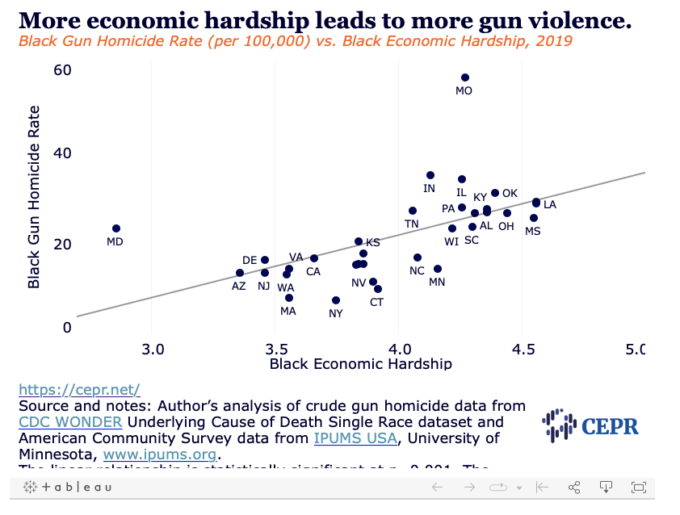
Gun violence is a complex issue with multiple causes. One important factor driving gun violence is economic hardship. A substantial body of criminological research finds that poverty is a powerful predictor of homicide rates. The figure illustrates this relationship at the state level for Black communities. In states where Black households are experiencing greater economic hardship, we find higher rates of gun violence.

If the US wants to reduce gun violence, it is important that to address the profound jobs crisis among Black men. We also need to combat racial discrimination in the labor market, and raise the federal minimum wage. This is by no means a comprehensive list of all that needs to be done to have a gun violence rate more like other rich countries, but it is a good place to start.

America’s Real Adversaries are Its European and Other Allies

Michael Hudson


Photograph Source: Office of the President of the United States – Public Domain

The U.S. aim is to keep them from trading with China and Russia

The Iron Curtain of the 1940s and ‘50s was ostensibly designed to isolate Russia from Western Europe – to keep out Communist ideology and military penetration. Today’s sanctions regime is aimed inward, to prevent America’s NATO and other Western allies from opening up more trade and investment with Russia and China. The aim is not so much to isolate Russia and China as to hold these allies firmly within America’s own economic orbit. Allies are to forego the benefits of importing Russian gas and Chinese products, buying much higher-priced U.S. LNG and other exports, capped by more U.S. arms.

The sanctions that U.S. diplomats are insisting that their allies impose against trade with Russia and China are aimed ostensibly at deterring a military buildup. But such a buildup cannot really be the main Russian and Chinese concern. They have much more to gain by offering mutual economic benefits to the West. So the underlying question is whether Europe will find its advantage in replacing U.S. exports with Russian and Chinese supplies and the associated mutual economic linkages.

What worries American diplomats is that Germany, other NATO nations and countries along the Belt and Road route understand the gains that can be made by opening up peaceful trade and investment. If there is no Russian or Chinese plan to invade or bomb them, what is the need for NATO? What is the need for such heavy purchases of U.S. military hardware by America’s affluent allies? And if there is no inherently adversarial relationship, why do foreign countries need to sacrifice their own trade and financial interests by relying exclusively on U.S. exporters and investors?

These are the concerns that have prompted French Prime Minister Macron to call forth the ghost of Charles de Gaulle and urge Europe to turn away from what he calls NATO’s “brain-dead” Cold War and beak with the pro-U.S. trade arrangements that are imposing rising costs on Europe while denying it potential gains from trade with Eurasia. Even Germany is balking at demands that it freeze by this coming March by going without Russian gas.

Instead of a real military threat from Russia and China, the problem for American strategists is the absence of such a threat. All countries have come to realize that the world has reached a point at which no industrial economy has the manpower and political ability to mobilize a standing army of the size that would be needed to invade or even wage a major battle with a significant adversary. That political cost makes it uneconomic for Russia to retaliate against NATO adventurism prodding at its western border trying to incite a military response. It’s just not worth taking over Ukraine.

America’s rising pressure on its allies threatens to drive them out of the U.S. orbit. For over 75 years they had little practical alternative to U.S. hegemony. But that is now changing. America no longer has the monetary power and seemingly chronic trade and balance-of-payments surplus that enabled it to draw up the world’s trade and investment rules in 1944-45. The threat to U.S. dominance is that China, Russia and Mackinder’s Eurasian World Island heartland are offering better trade and investment opportunities than are available from the United States with its increasingly desperate demand for sacrifices from its NATO and other allies.

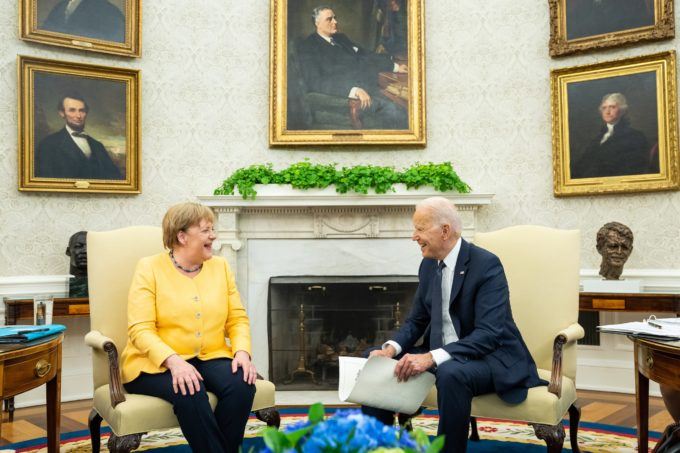
The most glaring example is the U.S. drive to block Germany from authorizing the Nord Stream 2 pipeline to obtain Russian gas for the coming cold weather. Angela Merkel agreed with Donald Trump to spend $1 billion building a new LNG port to become more dependent on highly priced U.S. LNG. (The plan was cancelled after the U.S. and German elections changed both leaders.) But Germany has no other way of heating many of its houses and office buildings (or supplying its fertilizer companies) than with Russian gas.

The only way left for U.S. diplomats to block European purchases is to goad Russia into a military response and then claim that avenging this response outweighs any purely national economic interest. As hawkish Under-Secretary of State for Political Affairs, Victoria Nuland, explained in a State Department press briefing on January 27: “If Russia invades Ukraine one way or another Nord Stream 2 will not move forward.” The problem is to create a suitably offensive incident and depict Russia as the aggressor.

Nuland expressed who was dictating the policies of NATO members succinctly in 2014: “Fuck the EU.” That was said as she told the U.S. ambassador to Ukraine that the State Department was backing the puppet Arseniy Yatsenyuk as Ukrainian prime minister (removed after two years in a corruption scandal), and U.S. political agencies backed the bloody Maidan massacre that ushered in what are now eight years of civil war. The result devastated Ukraine much as U.S. violence had done in Syria, Iraq and Afghanistan. This is not a policy of world peace or democracy that European voters endorse.

U.S. trade sanctions imposed on its NATO allies extend across the trade spectrum. Austerity-ridden Lithuania gave up its cheese and agricultural market in Russia, and is blocking its state-owned railroad from carrying Belarus potash to the Baltic port of Klaipeda. The port’s majority owner complained that “Lithuania will lose hundreds of millions of dollars from halting Belarus exports through Klaipeda,” and “could face legal claims of $15 billion over broken contracts.” Lithuania has even agreed to U.S. prompting to recognize Taiwan, resulting in China refusing to import German or other products that include Lithuanian-made components.

Europe is to impose sanctions at the cost of rising energy and agricultural prices by giving priority to imports from the United States and foregoing Russian, Belarusian and other linkages outside of the Dollar Area. As Sergey Lavrov put matters: “When the United States thinks that something suits its interests, it can betray those with whom it was friendly, with whom it cooperated and who catered to its positions around the world.”

America’s sanctions on its allies hurt their economies, not those of Russia and China

What seems ironic is that such sanctions against Russia and China have ended up helping rather than hurting them. But the primary aim was not to hurt nor to help the Russian and Chinese economies. After all, it is axiomatic that sanctions force the targeted countries to become more self-reliant. Deprived of Lithuanian cheese, Russian producers have produced their own, and no longer need to import it from the Baltic states. America’s underlying economic rivalry is aimed at keeping European and its allied Asian countries in its own increasingly protected economic orbit. Germany, Lithuania and other allies are told to impose sanctions directed against their own economic welfare by not trading with countries outside the U.S. dollar-area orbit.

Quite apart from the threat of actual war resulting from U.S. bellicosity, the cost to America’s allies of surrendering to U.S. trade and investment demands is becoming so high as to be politically unaffordable. For nearly a century there has been little alternative but to agree to trade and investment rules favoring the U.S. economy as the price of receiving U.S. financial and trade support and even military security. But an alternative is now threatening to emerge – one offering benefits from China’s Belt and Road initiative, and from Russia’s desire for foreign investment to help modernize its industrial organization, as seemed to be promised thirty years ago in 1991.

Ever since the closing years of World War II, U.S. diplomacy has aimed at locking Britain, France, and especially defeated Germany and Japan, into becoming U.S. economic and military dependencies. As I documented in Super Imperialism, American diplomats broke up the British Empire and absorbed its Sterling Area by the onerous terms imposed first by Lend-Lease and then the Anglo-American Loan Agreement of 1946. The latter’s terms obliged Britain to give up its Imperial Preference policy and unblock the sterling balances that India and other colonies had accumulated for their raw-materials exports during the war, thus opening the British Commonwealth to U.S. exports.

Britain committed itself not to recover its prewar markets by devaluing sterling. U.S. diplomats then created the IMF and World Bank on terms that promoted U.S. export markets and deterred competition from Britain and other former rivals. Debates in the House of Lords and the House of Commons showed that British politicians recognized that they were being consigned to a subservient economic position, but felt that they had no alternative. And once they gave up, U.S. diplomats had a free hand in confronting the rest of Europe.

Financial power has enabled America to continue dominating Western diplomacy despite being forced off gold in 1971 as a result of the balance-of-payments costs of its overseas military spending. For the past half-century, foreign countries have kept their international monetary reserves in U.S. dollars – mainly in U.S. Treasury securities, U.S. bank accounts and other financial investments in the U.S. economy. The Treasury-bill standard obliges foreign central banks to finance America’s military-based balance-of-payments deficit – and in the process, the domestic government budget deficit.

The United States does not need this recycling to create money. The government can simply print money, as MMT has demonstrated. But the United States does need this foreign central bank dollar recycling to balance its international payments and support the dollar’s exchange rate. If the dollar were to decline, foreign countries would find it much easier to pay international dollar-debts in their own currencies. U.S. import prices would rise, and it would be more costly for U.S. investors to buy foreign assets. And foreigners would lose money on U.S. stocks and bonds as denominated in their own currencies, and would drop them. Central banks in particular would take a loss on the Treasury’s dollar bonds that they hold in their monetary reserves – and would find their interest to lie in moving out of the dollar. So the U.S. balance of payments and exchange rate are both threatened by U.S. belligerency and military spending throughout the world – yet its diplomats are trying to stabilize matters by ramping up the military threat to crisis levels.

U.S. drives to keep its European and East Asian protectorates locked into its own sphere of influence is threatened by the emergence of China and Russia independently of the United States while the U.S. economy is de-industrializing as a result of its own deliberate policy choices. The industrial dynamic that made the United States so dominant from the late 19th century up to the 1970s has given way to an evangelistic neoliberal financialization. That is why U.S. diplomats need to arm-twist their allies to block their economic relations with post-Soviet Russia and socialist China, whose growth is outstripping that of the United States and whose trade arrangements offer more opportunities for mutual gain.

At issue is how long the United States can block its allies from taking advantage of China’s economic growth. Will Germany, France and other NATO countries seek prosperity for themselves instead of letting the U.S. dollar standard and trade preferences siphon off their economic surplus?

Oil diplomacy and America’s dream for post-Soviet Russia

The expectation of Gorbachev and other Russian officials in 1991 was that their economy would turn to the West for reorganization along the lines that had made the U.S., German and other economies so prosperous. The mutual expectation in Russia and Western Europe was for German, French and other investors to restructure the post-Soviet economy along more efficient lines.

That was not the U.S. plan. When Senator John McCain called Russia “a gas station with atom bombs,” that was America’s dream for what they wanted Russia to be – with Russia’s gas companies passing into control by U.S. stockholders, starting with the planned buyout of Yukos as arranged with Mikhail Khordokovsky. The last thing that U.S. strategists wanted to see was a thriving revived Russia. U.S. advisors sought to privatize Russia’s natural resources and other non-industrial assets, by turning them over to kleptocrats who could “cash out” on the value of what they had privatized only by selling to U.S. and other foreign investors for hard currency. The result was a neoliberal economic and demographic collapse throughout the post-Soviet states.

In some ways, America has been turning itself into its own version of a gas station with atom bombs (and arms exports). U.S. oil diplomacy aims to control the world’s oil trade so that its enormous profits will accrue to the major U.S. oil companies. It was to keep Iranian oil in the hands of British Petroleum that the CIA’s Kermit Roosevelt worked with British Petroleum’s Anglo-Persian Oil Company to overthrow Iran’s elected leader Mohammed Mossadegh in 1954 when he sought to nationalize the company after it refused decade after decade to perform its promised contributions to the economy. After installing the Shah whose democracy was based on a vicious police state, Iran threatened once again to act as the master of its own oil resources. So it was once again confronted with U.S.-sponsored sanctions, which remain in effect today. The aim of such sanctions is to keep the world oil trade firmly under U.S. control, because oil is energy and energy is the key to productivity and real GDP.

In cases where foreign governments such as Saudi Arabia and neighboring Arab petrostates have taken control, the export earnings of their oil are to be deposited in U.S. financial markets to support the dollar’s exchange rate and U.S. financial domination. When they quadrupled their oil prices in 1973-74 (in response to the U.S. quadrupling of its grain-export prices), the U.S. State Department laid down the law and told Saudi Arabia that it could charge as much as it wanted for its oil (thereby raising the price umbrella for U.S. oil producers), but it had to recycle its oil-export earnings to the United States in dollar-denominated securities – mainly in U.S. Treasury securities and U.S. bank accounts, along with some minority holdings of U.S. stocks and bonds (but only as passive investors, not using this financial power to control corporate policy).

The second mode of recycling oil-export earnings was to buy U.S. arms exports, with Saudi Arabia becoming one of the military-industrial complex’s largest customers. U.S. arms production actually is not primarily military in character. As the world is now seeing in the kerfuffle over Ukraine, America does not have a fighting army. What it has is what used to be called an “eating army.” U.S. arms production employs labor and produces weaponry as a kind of prestige good for governments to show off, not for actual fighting. Like most luxury goods, the markup is very high. That is the essence of high fashion and style, after all. The MIC uses its profits to subsidize U.S. civilian production in a way that does not violate the letter of international trade laws against government subsidy.

Sometimes, of course, military force is indeed used. In Iraq, first George W. Bush and then Barack Obama used the military to seize the country’ oil reserves, along with those of Syria and Libya. Control of world oil has been the buttress of America’s balance of payments. Despite the global drive to slow the planet’s warming, U.S. officials continue to view oil as the key to America’s economic supremacy. That is why the U.S. military is still refusing to obey Iraq’s orders to leave their country, keeping its troops in control of Iraqi oil, and why it agreed with the French to destroy Libya and still has troops in the oilfields of Syria. Closer to home, President Biden has approved offshore drilling and supports Canada’s expansion of its Athabasca tar sands, environmentally the dirtiest oil in the world.

Along with oil and food exports, arms exports support the Treasury-bill standard’s financing of America’s overseas military spending on its 750 bases abroad. But without a standing enemy constantly threatening at the gates, NATO’s existence falls apart. What would be the need for countries to buy submarines, aircraft carriers, airplanes, tanks, missiles and other arms?

As the United States has de-industrialized, its trade and balance-of-payments deficit is becoming more problematic. It needs arms export sales to help reduce its widening trade deficit and also to subsidize its commercial aircraft and related civilian sectors. The challenge is how to maintain its prosperity and world dominance as it de-industrializes while economic growth is surging ahead in China and now even Russia.

America has lost its industrial cost advantage by the sharp rise in its cost of living and doing business in its financialized post-industrial rentier economy. Additionally, as Seymour Melman explained in the 1970s, Pentagon capitalism is based on cost-plus contracts: The higher military hardware costs, the more profit its manufacturers receive. So U.S. arms are over-engineered – hence, the $500 toilet seats instead of a $50 model. The main attractiveness of luxury goods after all, including military hardware, is their high price.

This is the background for U.S. fury at its failure to seize Russia’s oil resources – and at seeing Russia also break free militarily to create its own arms exports, which now are typically better and much less costly than those of the U.S. Today Russia is in the position of Iran in 1954 and again in 1979. Not only do its oil sales rival those of U.S. LNG, but Russia keeps its oil-export earnings at home to finance its re-industrialization, so as to rebuild the economy that was destroyed by the U.S.-sponsored shock “therapy” of the 1990s.

The line of least resistance for U.S. strategy seeking to maintain control of the world’s oil supply while maintaining its luxury-arms export market via NATO is to Cry Wolf and insist that Russia is on the verge of invading Ukraine – as if Russia had anything to gain by quagmire warfare over Europe’s poorest and least productive economy. The winter of 2021-22 has seen a long attempt at U.S. prodding of NATO and Russia to fight – without success.

U.S. dreams of a neoliberalized China as a U.S. corporate affiliate

America has de-industrialized as a deliberate policy of slashing production costs as its manufacturing companies have sought low-wage labor abroad, most notably in China. This shift was not a rivalry with China, but was viewed as mutual gain. American banks and investors were expected to secure control and the profits of Chinese industry as it was marketized. The rivalry was between U.S. employers and U.S. labor, and the class-war weapon was offshoring and, in the process, cutting back government social spending.

Similar to the Russian pursuit of oil, arms and agricultural trade independent of U.S. control, China’s offense is keeping the profits of its industrialization at home, retaining state ownership of significant corporations and, most of all, keeping money creation and the Bank of China as a public utility to fund its own capital formation instead of letting U.S. banks and brokerage houses provide its financing and siphon off its surplus in the form of interest, dividends and management fees. The one saving grace to U.S. corporate planners has been China’s role in deterring U.S. wages from rising by providing a source of low-priced labor to enable American manufacturers to offshore and outsource their production.

The Democratic Party’s class war against unionized labor started in the Carter Administration and greatly accelerated when Bill Clinton opened the southern border with NAFTA. A string of maquiladoras were established along the border to supply low-priced handicraft labor. This became so successful a corporate profit center that Clinton pressed to admit China into the World Trade Organization in December 2001, in the closing month of his administration. The dream was for it to become a profit center for U.S. investors, producing for U.S. companies and financing its capital investment (and housing and government spending too, it was hoped) by borrowing U.S. dollars and organizing its industry in a stock market that, like that of Russia in 1994-96, would become a leading provider of finance-capital gains for U.S. and other foreign investors.

Walmart, Apple and many other U.S. companies organized production facilities in China, which necessarily involved technology transfers and creation of an efficient infrastructure for export trade. Goldman Sachs led the financial incursion, and helped China’s stock market soar. All this was what America had been urging.

Where did America’s neoliberal Cold War dream go wrong? For starters, China did not follow the World Bank’s policy of steering governments to borrow in dollars to hire U.S. engineering firms to provide export infrastructure. It industrialized in much the same way that the United States and Germany did in the late 19th century: By heavy public investment in infrastructure to provide basic needs at subsidized prices or freely, from health care and education to transportation and communications, in order to minimize the cost of living that employers and exporters had to pay. Most important, China avoided foreign debt service by creating its own money and keeping the most important production facilities in its own hands.

U.S. demands are driving its allies out of the dollar-NATO trade and monetary orbit

As in a classical Greek tragedy, U.S. foreign policy is bringing about precisely the outcome that it most fears. Overplaying their hand with their own NATO allies, U.S. diplomats are bringing about Kissinger’s nightmare scenario, driving Russia and China together. While America’s allies are told to bear the costs of U.S. sanctions, Russia and China are benefiting by being obliged to diversify and make their own economies independent of reliance on U.S. suppliers of food and other basic needs. Above all, these two countries are creating their own de-dollarized credit and bank-clearing systems, and holding their international monetary reserves in the form of gold, euros and each other’s currencies to conduct their mutual trade and investment.

This de-dollarization provides an alternative to the unipolar U.S. ability to gain free foreign credit via the U.S. Treasury-bill standard for world monetary reserves. As foreign countries and their central banks de-dollarize, what will support the dollar? Without the free line of credit provided by central banks automatically recycling America’s foreign military and other overseas spending back to the U.S. economy (with only a minimal return), how can the United States balance its international payments in the face of its de-industrialization?

The United States cannot simply reverse its de-industrialization and dependence on Chinese and other Asian labor by bringing production back home. It has built too high a rentier overhead into its economy for its labor to be able to compete internationally, given the U.S. wage-earner’s budgetary demands to pay high and rising housing and education costs, debt service and health insurance, and for privatized infrastructure services.

The only way for the United States to sustain its international financial balance is by monopoly pricing of its arms, patented pharmaceutical and information-technology exports, and by buying control of the most lucrative production and potentially rent-extracting sectors abroad – in other words, by spreading neoliberal economic policy throughout the world in a way that obliges other countries to depend on U.S. loans and investment.

That is not a way for national economies to grow. The alternative to neoliberal doctrine is China’s growth policies that follow the same basic industrial logic by which Britain, the United States, Germany and France rose to industrial power during their own industrial takeoffs with strong government support and social spending programs.

The United States has abandoned this traditional industrial policy since the 1980s. It is imposing on its own economy the neoliberal policies that de-industrialized Pinochetista Chile, Thatcherite Britain and the post-industrial former Soviet republics, the Baltics and Ukraine since 1991. Its highly polarized and debt-leveraged prosperity is based on inflating real estate and securities prices and privatizing infrastructure.

This neoliberalism has been a path to becoming a failed economy and indeed, a failed state, obliged to suffer debt deflation, rising housing prices and rents as owner-occupancy rates decline, as well as exorbitant medical and other costs resulting from privatizing what other countries provide freely or at subsidized prices as human rights – health care, education, medical insurance and pensions.

The success of China’s industrial policy with a mixed economy and state control of the monetary and credit system has led U.S. strategists to fear that Western European and Asian economies may find their advantage to lie in integrating more closely with China and Russia. The U.S. seems to have no response to such a global rapprochement with China and Russia except economic sanctions and military belligerence. That New Cold War stance is expensive, and other countries are balking at bearing the cost of a conflict that has no benefit for themselves and indeed, threatens to destabilize their own economic growth and political independence.

Without subsidy from these countries, especially as China, Russia and their neighbors de-dollarize their economies, how can the United States maintain the balance-of-payments costs of its overseas military spending? Cutting back that spending, and indeed recovering industrial self-reliance and competitive economic power, would require a transformation of American politics. Such a change seems unlikely, but without it, how long can America’s post-industrial rentier economy manage to force other countries to provide it with the economic affluence (literally a flowing-in) that it is no longer producing at home?

Cuba, Venezuela and Nicaragua: The US-Russia Conflict Enters a New Phase

Ramzy Baroud


russia usarussia usa

As soon as Moscow received an American response to its security demands in Ukraine, it answered indirectly by announcing greater military integration between it and three South American countries, Nicaragua, Venezuela and Cuba.

Washington’s response, on January 26, to Russia’s demands of withdrawing NATO forces from Eastern Europe and ending talks about a possible Kyiv membership in the US-led alliance, was noncommittal.

For its part, the US spoke of ‘a diplomatic path’, which will address Russian demands through ‘confidence-building measures’. For Russia, such elusive language is clearly a non-starter.

On that same day, Russian Foreign Minister Sergey Lavrov announced, in front of the Duma, Russia’s parliament, that his country “has agreed with the leaders of Cuba, Venezuela, and Nicaragua to develop partnerships in a range of areas, including stepping up military collaboration,” Russia Today reported.

The timing of this agreement was hardly coincidental, of course. The country’s Deputy Foreign Minister Sergey Ryabkov did not hesitate to link the move to the brewing Russia- NATO conflict. Russia’s strategy in South America could potentially be “involving the Russian Navy,” if the US continues to ‘provoke’ Russia. According to Ryabkov, this is Russia’s version of the “American style (of having) several options for its foreign and military policy”.

Now that the Russians are not hiding the motives behind their military engagement in South America, going as far as considering the option of sending troops to the region, Washington is being forced to seriously consider the new variable.

Though US National Security Advisor Jake Sullivan denied that Russian military presence in South America was considered in recent security talks between both countries, he described the agreement between Russia and the three South American countries as unacceptable, vowing that the US would react “decisively” to such a scenario.

The truth is, that scenario has already played out in the past. When, in January 2019, the US increased its pressure on Venezuela’s President Nicolás Maduro to concede power to the US-backed Juan Guaido, a coup seemed imminent. Chaos in the streets of Caracas, and other Venezuelan cities, mass electric outages, lack of basic food and supplies, all seemed part of an orchestrated attempt at subduing Venezuela, which has for years championed a political discourse that is based on independent and well-integrated South American countries.

For weeks, Washington continued to tighten the pressure valves imposing hundreds of sanction orders against Venezuelan entities, state-run companies and individuals. This led to Caracas’ decision to sever diplomatic ties with Washington. Ultimately, Moscow stepped in, sending in March 2019 two military planes full of troops and equipment to prevent any possible attempt at overthrowing Maduro. In the following months, Russian companies poured in to help Venezuela out of its devastating crisis, instigating another US-Russia conflict, where Washington resorted to its favorite weapon, sanctions, this time against Russian oil companies.

The reason that Russia is keen on maintaining a geostrategic presence in South America is due to the fact that a stronger Russian role in that region is coveted by several countries who are desperate to loosen Washington’s grip on their economies and political institutions.

Countries like Cuba, for example, have very little trust in the US. After having some of the decades-long sanctions lifted on Havana during the Obama administration in 2016, new sanctions were imposed during the Trump administration in 2021. That lack of trust in Washington’s political mood swings makes Cuba the perfect ally for Russia. The same logic applies to other South American countries.

It is still too early to speak with certainty about the future of Russia’s military presence in South America. What is clear, though, is the fact that Russia will continue to build on its geostrategic presence in South America, which is also strengthened by the greater economic integration between China and most South American countries. Thanks to the dual US political and economic war on Moscow and Beijing, both countries have fortified their alliance like never before.

What options does this new reality leave Washington with? Not many, especially as Washington has, for years, failed to defeat Maduro in Venezuela or to sway Cuba and others to join the pro-American camp.

Much of the outcome, however, is also dependent on whether Moscow sees itself as part of a protracted geostrategic game in South America. So far, there is little evidence to suggest that Moscow is using South America as a temporary card to be exchanged, when the time comes, for US and NATO concessions in Eastern Europe. Russia is clearly digging its heels, readying itself for the long haul.

For now, Moscow’s message to Washington is that Russia has plenty of options and that it is capable of responding to US pressure with equal or greater pressure. Indeed, if Ukraine is Russia’s redline, then South America – which has fallen under US influence since the Monroe Doctrine of 1823 – is the US’s own hemispheric redline.

As the plot thickens in Eastern Europe, Russia’s move in South America promises to add a new component that would make a win-lose scenario in favor of the US and NATO nearly impossible. An alternative outcome is for the US-led alliance to recognize the momentous changes on the world’s geopolitical map, and to simply learn to live with it.