11 Mar 2022

How the U.S. Has Empowered and Armed Neo-Nazis in Ukraine

Medea Benjamin & Nicolas J. S. Davies


Photograph Source: Ivan Bandura – CC BY 2.0

Russian President Putin has claimed that he ordered the invasion of Ukraine to “denazify” its government, while Western officials, such as former U.S. Ambassador to Moscow Michael McFaul, have called this pure propaganda, insisting, “There are no Nazis in Ukraine.”

In the context of the Russian invasion, the post-2014 Ukrainian government’s problematic relations with extreme right-wing groups and neo-Nazi parties has become an incendiary element on both sides of the propaganda war, with Russia exaggerating it as a pretext for war and the West trying to sweep it under the carpet.

The reality behind the propaganda is that the West and its Ukrainian allies have opportunistically exploited and empowered the extreme right in Ukraine, first to pull off the 2014 coup and then by redirecting it to fight separatists in Eastern Ukraine. And far from “denazifying” Ukraine, the Russian invasion is likely to further empower Ukrainian and international neo-Nazis, as it attracts fighters from around the world and provides them with weapons, military training and the combat experience that many of them are hungry for.

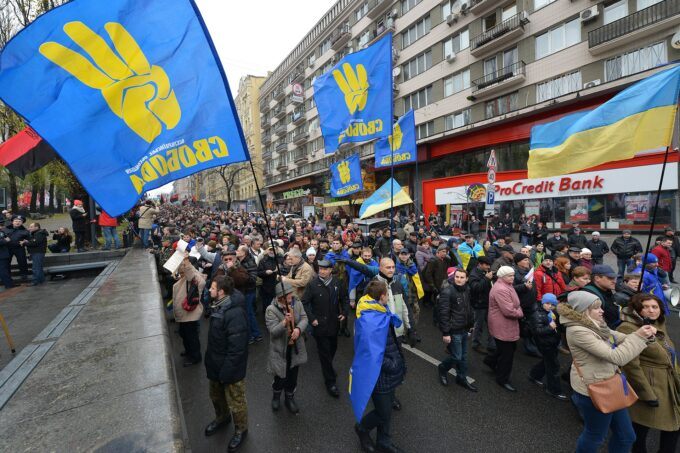
Ukraine’s neo-Nazi Svoboda Party and its founders Oleh Tyahnybok and Andriy Parubiy played leading roles in the U.S-backed coup in February 2014. Assistant Secretary Nuland and Ambassador Pyatt mentioned Tyahnybok as one of the leaders they were working with on their infamous leaked phone call before the coup, even as they tried to exclude him from an official position in the post-coup government.

As formerly peaceful protests in Kyiv gave way to pitched battles with police and violent, armed marches to try to break through police barricades and reach the Parliament building, Svoboda members and the newly-formed Right Sector militia, led by Dmytro Yarosh, battled police, spearheaded marches and raided a police armory for weapons. By mid-February 2014, these men with guns were the de facto leaders of the Maidan movement.

We will never know what kind of political transition peaceful protests alone would have led to in Ukraine or how different the new government would have been if a peaceful political process had been allowed to take its course, without interference by the United States or violent right-wing extremists.

But it was Yarosh who took to the stage in the Maidan and rejected the February 21, 2014 agreement negotiated by the French, German and Polish foreign ministers, under which Yanukovich and opposition political leaders agreed to hold new elections later that year. Instead, Yarosh and Right Sector refused to disarm and led the climactic march on Parliament that overthrew the government.

Since 1991, Ukrainian elections had swung back and forth between leaders like President Viktor Yanukovych, who was from Donetsk and had close ties with Russia, and Western-backed leaders like President Yushchenko, who was elected in 2005 after the “Orange Revolution” that followed a disputed election. Ukraine’s endemic corruption tainted every government, and rapid public disillusionment with whichever leader and party won power led to a see-saw between Western- and Russian-aligned factions.

In 2014, Nuland and the State Department got their favorite, Arseniy Yatsenyuk, installed as Prime Minister of the post-coup government. He lasted two years, until he, too, lost his job due to endless corruption scandalsPetro Poroshenko, the post-coup President, lasted a bit longer, until 2019, even after his personal tax evasion schemes were exposed in the 2016 Panama Papers and 2017 Paradise Papers.

When Yatsenyuk became Prime Minister, he rewarded Svoboda’s role in the coup with three cabinet positions, including Oleksander Sych as Deputy Prime Minister, and governorships of three of Ukraine’s 25 provinces. Svoboda’s Andriy Parubiy was appointed Chairman (or speaker) of Parliament, a post he held for the next 5 years. Tyahnybok ran for president in 2014, but only got 1.2% of the votes, and was not re-elected to Parliament.

Ukrainian voters turned their backs on the extreme-right in the 2014 post-coup elections, reducing Svoboda’s 10.4% share of the national vote in 2012 to 4.7%. Svoboda lost support in areas where it held control of local governments but had failed to live up to its promises, and its support was split now that it was no longer the only party running on explicitly anti-Russian slogans and rhetoric.

After the coup, Right Sector helped to consolidate the new order by attacking and breaking up anti-coup protests, in what their leader Yarosh described to Newsweek as a “war” to “cleanse the country” of pro-Russian protesters. This campaign climaxed on May 2nd with the massacre of 42 anti-coup protesters in a fiery inferno, after they took shelter from Right Sector attackers in the Trades Unions House in Odessa.

After anti-coup protests evolved into declarations of independence in Donetsk and Luhansk, the extreme right in Ukraine shifted gear to full-scale armed combat. The Ukrainian military had little enthusiasm for fighting its own people, so the government formed new National Guard units to do so.

Right Sector formed a battalion, and neo-Nazis also dominated the Azov Battalion, which was founded by Andriy Biletsky, an avowed white supremacist who claimed that Ukraine’s national purpose was to rid the country of Jews and other inferior races. It was the Azov battalion that led the post-coup government’s assault on the self-declared republics and retook the city of Mariupol from separatist forces.

The Minsk II agreement in 2015 ended the worst fighting and set up a buffer zone around the breakaway republics, but a low-intensity civil war continued. An estimated 14,000 people have been killed since 2014. Congressman Ro Khanna and progressive members of Congress tried for several years to end U.S. military aid to the Azov Battalion. They finally did so in the FY2018 Defense Appropriation Bill, but Azov reportedly continued to receive U.S. arms and training despite the ban.

In 2019, the Soufan Center, which tracks terrorist and extremist groups around the world, warned, “The Azov Battalion is emerging as a critical node in the transnational right-wing violent extremist network… (Its) aggressive approach to networking serves one of the Azov Battalion’s overarching objectives, to transform areas under its control in Ukraine into the primary hub for transnational white supremacy.”

The Soufan Center described how the Azov Battalion’s “aggressive networking” reaches around the world to recruit fighters and spread its white supremacist ideology. Foreign fighters who train and fight with the Azov Battalion then return to their own countries to apply what they have learned and recruit others.

Violent foreign extremists with links to Azov have included Brenton Tarrant, who massacred 51 worshippers at a mosque in Christchurch in New Zealand in 2019, and several members of the U.S. Rise Above Movement who were prosecuted for attacking counter-protestors at the “Unite the Right” rally in Charlottesville in August 2017. Other Azov veterans have returned to Australia, Brazil, Germany, Italy, Norway, Sweden, the U.K. and other countries.

Despite Svoboda’s declining success in national elections, neo-Nazi and extreme nationalist groups, increasingly linked to the Azov Battalion, have maintained power on the street in Ukraine, and in local politics in the Ukrainian nationalist heartland around Lviv in Western Ukraine.

After President Zelensky’s election in 2019, the extreme right threatened him with removal from office, or even death, if he negotiated with separatist leaders from Donbas and followed through on the Minsk Protocol. Zelensky had run for election as a “peace candidate,” but under threat from the right, he refused to even talk to Donbas leaders, whom he dismissed as terrorists.

During Trump’s presidency, the United States reversed Obama’s ban on weapons sales to Ukraine, and Zelensky’s aggressive rhetoric raised new fears in Donbas and Russia that he was building up Ukraine’s forces for a new offensive to retake Donetsk and Luhansk by force.

The civil war has combined with the government’s neoliberal economic policies to create fertile ground for the extreme right. The post-coup government imposed more of the same neoliberal “shock therapy” that was imposed throughout Eastern Europe in the 1990s. Ukraine received a $40 billion IMF bailout and, as part of the deal, privatized 342 state-owned enterprises; reduced public sector employment by 20%, along with salary and pension cuts; privatized healthcare, and disinvested in public education, closing 60% of its universities.

Coupled with Ukraine’s endemic corruption, these policies led to the profitable looting of state assets by the corrupt ruling class, and to falling living standards and austerity measures for everybody else. The post-coup government upheld Poland as its model, but the reality was closer to Yeltsin’s Russia in the 1990s. After a nearly 25% fall in GDP between 2012 and 2016, Ukraine is still the poorest country in Europe.

As elsewhere, the failures of neoliberalism have fueled the rise of right-wing extremism and racism, and now the war with Russia promises to provide thousands of alienated young men from around the world with military training and combat experience, which they can then take home to terrorize their own countries.

The Soufan Center has compared the Azov Battalion’s international networking strategy to that of Al Qaeda and ISIS. U.S. and NATO support for the Azov Battalion poses similar risks as their support for Al Qaeda-linked groups in Syria ten years ago. Those chickens quickly came home to roost when they spawned ISIS and turned decisively against their Western backers.

Right now, Ukrainians are united in their resistance to Russia’s invasion, but we should not be surprised when the U.S. alliance with neo-Nazi proxy forces in Ukraine, including the infusion of billions of dollars in sophisticated weapons, results in similarly violent and destructive blowback.


‘Reckoning’ with the Economic Marginalization of Native Americans

Threat of Nuclear Conflict is Higher Now Than in the Cold War

Patrick Cockburn


The risk of a nuclear war is becoming greater than it was in the first Cold War because Russia under President Vladimir Putin is much weaker – and therefore more likely to use nuclear weapons – than the Soviet Union at the height of its power under Nikita Khrushchev and Leonid Brezhnev. It is only as a nuclear superpower that Moscow retains parity with the US in their capacity for mass destruction.

Putin carried out some nuclear sabre-rattling at the start of his war in Ukraine by putting his nuclear forces on a higher level of alert, saying that he was determined to deter foreign interference in his military campaign. Many dismissed his threat as rhetorical at the time, but since then his ill-planned invasion has continued to falter, showing up Moscow’s conventional military forces as weaker than anybody had supposed.

Political leaders in the West now talk blithely of supporting regime change in Russia or imposing a no-fly zone on Ukraine, which would involve shooting down Russian planes and attacking anti-aircraft missile batteries inside Russia. These threats may not always be serious, but they are likely to be taken seriously in a paranoid Kremlin. With much of the Russian army tied down in Ukraine for the foreseeable future, Putin will increasingly look to his 1,000 to 2,000 tactical nuclear weapons to even up the balance against Nato in Eastern Europe.

US pandemic funding dries up as BA.2 Omicron subvariant spreads uncontrolled

Evan Blake


On Wednesday, the US House of Representatives passed a record $1.5 trillion omnibus spending package which includes nearly $800 billion in military spending and nothing for the COVID-19 pandemic, the most significant public health crisis in over a century.

House Speaker Nancy Pelosi of Calif., listens to a question from a reporter during a news conference on Capitol Hill in Washington, Thursday, Oct. 28, 2021. (AP Photo/Andrew Harnik)

At the last minute, $15.6 billion in federal pandemic funds was completely removed from the bill due to opposition from over a dozen Democratic representatives from Michigan, Wisconsin, Florida, Ohio, Kansas, Missouri, Maine and other states after they learned that the COVID funds were not actually new money, but would be drawn from pandemic monies previously allocated to their states. The $15.6 billion diversion of funds was secretly negotiated by the House Democratic leadership, whose own states would not have been impacted, likely in coordination with the White House.

While the $15.6 billion would not have been new funding per se, its removal marks the cutoff of all federal funding for key components of the fight against the pandemic, including continued testing and the purchase of the anti-viral drug produced by Pfizer. This takes place just as the more infectious, immune-resistant and virulent BA.2 Omicron subvariant is spreading across the US and globally and causing surges in infections, hospitalizations and deaths in Hong Kong, England, Denmark and other countries. It also transpired the day before the “Deltacron” variant, a recombination of Delta and Omicron which has been detected in France, Denmark and the Netherlands, was officially recognized by the World Health Organization.

Summarizing the significance of the collapse of US pandemic funding, the Associated Press reported, “This could be the end of the line for congressional funding to fight COVID-19. What started a month ago as a $30 billion request from the White House to prepare for the next phase of the pandemic has been slashed, reduced and fallen apart on Capitol Hill.”

A White House official told AP that the situation will be “dire,” adding, “Simply put, failing to take action now will have severe consequences for the American people.”

The official stated that COVID-19 testing capacity will decline in March. Funding to test and treat people who are uninsured will dry up in April. By May, the federal supply of monoclonal antibodies will run out. Preventative treatments for immunocompromised people will only last until July. The federal stockpile of antiviral pills such as Pfizer’s Paxlovid, which is highly effective at reducing hospitalizations, will be empty by September or earlier.

The Biden administration will now be unable to purchase further vaccine doses if a fourth shot is deemed necessary due to waning immunity. Already limited vaccine donations to other countries will be further hampered. Funding will not materialize to mass produce a much-hyped “pancoronavirus” vaccine which is currently in Phase 1 trials. By early summer, there will no longer be funding for federal studies on new coronavirus variants, treatments such as antivirals, and other measures to prepare for future surges.

The Biden administration’s “National COVID-19 Preparedness Plan,” released last week, which made grandiose claims that all of the above programs and more would be expanded in the coming weeks, stands exposed as so much hot air.

It is widely acknowledged that any standalone bill to provide additional federal funding for the pandemic and Biden’s “Preparedness Plan” will not pass the 60-vote threshold required in the Senate, where Republicans are cynically demanding that all prior pandemic funding be fully accounted for before any new appropriations.

The “Preparedness Plan,” previewed by Biden in his State of the Union address, was always window dressing meant to provide cover for the Democrats’ complete capitulation to the pandemic revealed most sharply during the Omicron surge. Since mid-December, nearly 30 million Americans were officially infected with COVID-19 (not counting infections detected by at-home rapid tests) and over 160,000 have succumbed to the disease, with an average of 1,120 continuing to die each day. By the end of March, the official death toll in the US will surpass 1 million.

The Democrats will now blame the cutoff of federal pandemic funds on Republicans, but in reality, there is bipartisan agreement that the pandemic should be erased from public consciousness and all internal social tensions diverted outwards towards war with Russia.

Since mid-January, as the surge of infections from the BA.1 Omicron subvariant began to subside, the entire political establishment and corporate media have sought to present the pandemic as over. They have propagated the myth that COVID-19 is now “endemic” and that a “new normal” of stability and predictability now exists.

In reality, the pandemic continues to rage globally, with the BA.2 Omicron subvariant now dominant throughout much of the world and causing another surge in global daily new cases. As the World Socialist Web Site has analyzed, the “new normal” will be one of unending mass infections, deaths and long-term debilitation, forced upon society by a rapacious ruling elite that subordinates public health to private profit.

As a result of this propaganda effort, American society is once again totally unprepared for the next surge of the pandemic. Misled by the pro-corporate Centers for Disease Control and Prevention (CDC), millions of people have removed their masks and fully resumed pre-pandemic activities. Vaccination rates in the US have completely stalled, with only 65 percent of the population having received two doses of vaccine and only 28 percent having received a necessary third dose of vaccine.

While average daily new cases have declined significantly from the peak of 821,888 infections reached on January 13 to an average of 38,684 daily new cases this Wednesday, they are clearly plateauing and could begin surging once again in the coming weeks. According to the CDC, as of March 5 the BA.2 subvariant accounted for 11.6 percent of all variants circulating in the US, nearly double the figure the week prior of 6.6 percent, meaning that by the end of March it will likely be dominant. In the Northeast states, BA.2 now accounts for 24 percent of all cases.

The disastrous pandemic policies of the entire American political establishment stem from the subordination of public health to the capitalist ruling class, which adamantly opposes lock-downs that would suspend the flow of profits and sees the decline in life expectancy as a positive good. Both the Democrats and Republicans are impervious to appeals from below and will only deepen their criminal and reckless pandemic policies.

The bipartisan support for the unprecedented military budget sharply expresses the nature of US imperialism, which is preparing for a direct confrontation with nuclear-armed Russia and China.

Amid warnings of world war, demands grow in Washington for escalation against Russia

Andre Damon


Despite warnings from the White House that an escalation of US involvement in the US-Russia war could rapidly trigger a third world war, there are growing calls from within both the Democratic and Republican parties for a more aggressive US military intervention.

A Royal Air Force Typhoon jet, foreground, intercepts a Russian Su-30 Flanker fighter over Estonia in 2019. (UK Ministry of Defence via AP)

As the war enters its third week, the fighting in Ukraine is rapidly intensifying, causing surging casualties among both military forces and civilians.

In an op-ed in the Wall Street Journal, Joe Lieberman, the former Connecticut Senator and Democratic candidate for Vice president, laid out “the case for a no-fly zone in Ukraine.”

“The North Atlantic Treaty Organization’s refusal to give Ukraine no-fly protection from the continuing, indiscriminate and inhumane Russian attacks from the air is strategically weak and morally wrong,” Lieberman wrote.

Responding to similar demands, White House spokesperson Jen Psaki said Tuesday setting up a no-fly zone would “require shooting down Russian planes if they fly into your no-fly zone… So that would still have—we would still have concerns about that being an escalatory action that could lead us into a war with Russia, which is not something the president intends to do.”

Responding to the White House’s warnings, Lieberman wrote, “The other argument against establishing a no-fly zone is that it might anger Mr. Putin and trigger World War III. But inaction based on fear usually causes more conflict than action based on confidence. Fearing to act not only makes it easier for Mr. Putin to win his inhumane war but also encourages such nations as China to believe they too can invade neighbors without fear of a U.S. response.”

Lieberman concluded, “Sending American or other NATO planes into the air over Ukraine to keep Russian aircraft away would protect Ukrainian lives and freedom on the ground, making it possible to defeat Mr. Putin’s brazen and brutal attempt to rebuild the Russian empire, undercut U.S. global leadership and destroy the world order that we and our allies have built.”

Asking “Why the West needs to impose a no-fly zone over Ukraine,” one op-ed in the Washington Post asserted: “NATO must step up to help prevent further devastation by declaring a no-fly zone over Ukraine. In the past, the West has imposed such zones over Libya, Bosnia and Iraq. Is Ukraine less deserving of its help?”

Similar calls were made by Bartosz Cichocki, Poland’s ambassador to Ukraine. “Every day of delay costs hundreds of human lives,” he told a Turkish broadcaster Thursday. “This is an extension of the conflict that could be ended much faster precisely thanks to the closure of the airspace.”

On Tuesday, Poland announced a plan to transfer all of its Soviet-era MiG-29 aircraft to the United States and fly them to Germany, from where they would be flown into Ukrainian airspace to engage Russian aircraft.

“The authorities of the Republic of Poland... are ready to deploy—immediately and free of charge—all their MIG-29 jets to the Ramstein Air Base and place them at the disposal of the Government of the United States of America,” Poland’s foreign ministry said.

For now, however, the US military has rejected this proposal. In a tersely worded statement, Pentagon spokesperson John Kirby said, “We do not believe Poland’s proposal is a tenable one.”

“The prospect of fighter jets ‘at the disposal of the Government of the United States of America’ departing from a U.S./NATO base in Germany to fly into airspace that is contested with Russia over Ukraine raises serious concerns for the entire NATO alliance,” Kirby warned.

These warnings by the White House were furiously denounced in the US press. “Send Ukraine planes now,” demanded Washington Post columnist Marc A. Thiessen.

The Wall Street Journal, for its part, called the White House’s rejection of Poland’s offer a “fiasco,” declaring: “What happened between Mr. Blinken’s endorsement and the Pentagon’s rejection? It’s hard not to conclude that the White House blinked for fear of provoking Mr. Putin, who is demanding that the West stop arming Ukraine.”

“But NATO countries are already sending all sorts of weapons into Ukraine. Is a Polish MiG with a Ukrainian pilot somehow more provocative than a Turkish drone or an American antitank missile? Transferring planes isn’t the same as NATO aviators directly shooting down Russian jets.”

In a chilling statement, the Wall Street Journal wrote, “As he escalates, will he use chemical weapons or tactical nukes? Will NATO refuse to respond then because it fears World War III? The MiG mistake may let Mr. Putin believe his threats will make NATO stand down.”

Russian officials are taking such statements with utmost seriousness. Earlier on Thursday, Russian foreign minister Sergei Lavrov was asked if he believed a nuclear war between the United States and NATO is possible.

Lavrov replied: “British Foreign Secretary Liz Truss said that she foresees war between Russia and the NATO powers. NATO Secretary-General Jens Stoltenberg said that if NATO wanted, atomic weapons would be deployed on the territory of the Eastern members of the Alliance. Mr. Le Drian said that Putin should keep in mind that France also has nuclear weapons. And the French economics minister [Bruno Le Maire] said with pride that the West is declaring against Russia ‘total war.’”

Lavrov used the German translation of the term: “Totaler Krieg,” invoking the German invasion of the Soviet Union in the Second World War.

“So, of course this puts us on our guard,” Lavrov said.

Kremlin spokesman Dmitry Peskov, for his part, said the sanctions being imposed against Russia are “absolutely unprecedented.” He concluded, “There had never been an economic war like the one that was started against our country, so it is very difficult to predict anything.”

The intensification of the fighting comes as the campaign to demonize Russia reached a fever pitch.

On Thursday, Reuters reported that Facebook and Instagram will change their hate speech policies to allow the incitement of violence against Russian public officials and military forces.

Reuters also reported that “Emails also showed that Meta (Facebook’s parent company) would allow praise of the right-wing Azov battalion, which is normally prohibited.”

As inflation surges, Spanish unions and Podemos slash real wages

Alejandro López


The spectacular increase in inflation throughout 2021 and 2022 has been a severe blow to the wages and living conditions of workers in Spain and internationally, further aggravated by European Union (EU)-NATO sanctions imposed on Russia amid the NATO war drive against Moscow.

Podemos party leader Pablo Iglesias speaks in the Spanish parliament in Madrid, Spain, Monday, Dec. 30, 2019. (AP Photo/Paul White)

Spain’s inflation accelerated well above expectations in February to its fastest pace in nearly 33 years. Consumer prices rose 7.4 percent in February from a year earlier driven by food, beverages, fuel and energy, mainly the price of electricity, which last week reached a new maximum of €442 per megawatt hour.

According to data from the Ministry of Labor published in February, wages established in collective bargaining agreements between employers and the trade unions in the first quarter of 2022 saw an average wage increase of only 2 percent, 0.5 percentage points above the December figure, but four points below the inflation registered in January (which was 6 percent, according to the National Institute of Statistics). This is based on the analysis of 1,554 collective bargaining agreements that cover 4.1 million workers.

Significantly, this is also below the minimum wage rise agreed between the Socialist Party (PSOE)-Podemos government and the trade unions for 2022: it will rise 3.6 percent, to €1,000 monthly. Celebrated as a progressive measure, the minimum wage increase in fact nonetheless remains below inflation. That is to say, workers’ real purchasing power will go down.

According to the Ministry of Labor report, most collective agreements closed with an increase of between 1 percent and 2 percent: eight out of 10 workers have seen their salary increase in that range. Only one in 10 have seen their payrolls grow at the same rate as inflation, shielded by salary review clauses that legally oblige companies to increase salaries in the same proportion as inflation.

This is an unusual practice among Spanish business, located mainly in industries where militant struggles took place during the transition to parliamentary rule after the death of fascist General Francisco Franco.

However, as El Periódico noted, “this is not always a guarantee that companies will comply with it, especially at the present time when the increases are usually agreed upon [between unions and employers] are far from the highest inflation in 30 years.” In these industries, like in the poultry and rabbit slaughterhouses or the metal and chocolate industry, unions are scrambling to suppress the workers’ struggles to keep wages below inflation.

At national level, CCOO, UGT and Spain’s largest business federation, CEOE, are preparing the Agreement for Employment and Collective Bargaining (AENC), a kind of “agreement of collective agreements” where these pro-capitalist organisations set recommendations to update salaries. These negotiations are leading to mass poverty. There are 11 million poor people in Spain of a population of 47 million, of which 4.5 million suffer from severe poverty, according to Oxfam. Among those living below the poverty line, 1 in 4 is an active worker.

Meanwhile, as workers are receiving poverty wages, banks and corporations have received lucrative profits. The 34 largest companies in Spain have declared a combined net profit of more than €54 billion, the maximum ever recorded. Banks earned €20 billion last year, the highest profits since the previous crisis in 2008. The five banks on Spain’s stock exchange—Ibex 35, Santander, BBVA, CaixaBank, Sabadell and Bankinter—have achieved the highest profit in the last decade. All these banks have been involved in mass redundancies, totaling over 20,000 last year.

Surging inflation is a byproduct of two interrelated policies. The first, the policy adopted by the ruling class in the US and Europe in response to the pandemic of pumping trillions of euros into the financial markets to prop up share values. Further adding to inflationary pressures are disruptions in supply chains due to the refusal of capitalist governments to implement an eradication strategy against the pandemic, which has led to massive infections and deeply disorganized the economy.

Second, the crippling economic sanctions imposed by the US and EU against Russia. The imperialist powers claim the destruction of the Russian economy and the ruble will deepen divisions within the Russian oligarchy and fuel social discontent, creating the conditions for regime change and even the breakup of the resource-rich country. However, by trying to cut Russian oil, gas and wheat out of world markets, they are creating conditions for an unprecedented surge in prices for essential commodities.

The trade unions and the ‘Left Populist’ Podemos party, in government with the PSOE, function as key tools of the ruling class to impose this policy. They have not only implemented a policy of mass infection during the COVID-19 pandemic, but also are pouring weapons into Ukraine to fight Russia troops. This goes hand-in-hand with war on the working class at home.

Over the past year, the PSOE-Podemos has passed reactionary labour reform presented as “progressive,” which in fact consolidates the right-wing Popular Party’s 2012 labour reform, the largest attack on Spanish workers since the Franco era. An increase in the minimum wage is below inflation levels. And a Minimum Vital Income subsidy only affects 160,000 households.

The Podemos-backed government is making it clear it is opposed to any salary increase. Mimicking the voices of powerful sections of finance capital that are demanding central banks lift interest rates to suppress the growing movement of the working class for wage rises, the Minister for Economic Affairs, Nadia Calviño, said: “From the point of view of economic stability in the medium term, we have to avoid a sharp rise in wages that produces structural inflation, what is known as second-round effects.”

Prime Minister Pedro Sánchez said wages should not increase, to “avoid what economists call the second-round effect, that is, that this rise in prices ends up permeating the entire economy.”

CCOO and UGT unions are supporting the mass COVID-19 infection policy and the EU-NATO war drive. Having backed the sanctions against Russia, they are now calling for rallies in front of workplaces throughout the country so that workers can “condemn” the invasion of Ukraine by “Putin’s Russia.” The rallies will last five minutes and, according to CCOO’s leader Unai Sordo, will allow the workers to “express their condemnation of this law of the fittest” imposed by the Russian president.

The CCOO leader acknowledged that, although the sanctions that are being imposed on Russia are “necessary,” they will “carry a slowdown in the economy” and a rise in prices, which “has a very decisive impact on wages.”

The NATO campaign against Russia will drive escalating class struggle across the world

Tom Hall


The reckless escalation of economic, political and military pressure by the United States and NATO against Russia is rapidly leading to a major global economic crisis with serious repercussions for the international working class.

At least 2,000 striking Minneapolis teachers, support staff and their supporters rallied outside the State Capitol in St. Paul, Minn., on Wednesday, March 9, 2022. (AP Photo/Steve Karnowski)

The campaign against Russia, which includes a crippling sanctions regime aimed at starving out the Russian people which has all but cut off Russia from the world economy, is aimed at the conversion of that country into a colony of western imperialism and the plundering of its natural resources. Putin’s invasion of Ukraine, while it is reactionary and must be opposed, is the product of a years-long campaign of escalating provocations by NATO against Russia, using Ukraine as bait.

Millions around the world look at the unfolding events in eastern Europe with anxiety and fear that they could rapidly escalate into a nuclear war. But the crisis is also triggering immense economic dislocation that is driving towards a massive explosion of class conflict. The orientation of those who seek to oppose the drive to a third World War must be, as Leon Trotsky observed in 1934, not to the war map, but to the map of the class struggle.

In a statement last week on the economic impact of the war and western sanctions against Russia, the International Monetary Fund predicted, “Price shocks will have an impact worldwide, especially on poor households for whom food and fuel are a higher proportion of expenses. Should the conflict escalate, the economic damage would be all the more devastating. The sanctions on Russia will also have a substantial impact on the global economy and financial markets, with significant spillovers to other countries.”

This is already beginning to take place. Oil prices have reached $130 per barrel, and in the United States, gasoline prices at the pumps have surged past $4 a gallon to their highest levels ever. In France, the price of gas has gone from €1.65 per liter at the end of last year to €2.20 per liter, or $9.16 per gallon. Wheat futures have already risen by 70 percent this year–Russia and Ukraine together account for one-quarter of all grain exports. In Europe, industrial production is beginning to shut down due to soaring energy prices.

In the month of February, US inflation reached 7.9 percent, and in the Eurozone it reached 5.8 percent, the highest level on record since the creation of the single currency in 1997. Inflation is expected to rise sharply in March as the consequences of sanctions reverberate throughout the world economy.

But among the worst hit will be developing countries in Africa and the Middle East. Starvation and famine in this region of the world is a real possibility. Eighty percent of grain in Egypt is purchased from Russia. Other major importers of Russian grain include Turkey, Bangladesh, Nigeria and Yemen.

The impact on the working class will be enormous. It is already reeling from more than two years of the pandemic, in which millions have died and living standards have been eroded to the breaking point by inflation caused by pandemic-induced chaos in global supply chains. This social trauma is the product of deliberate rejection of necessary public health measures by the world’s governments, above all the United States, in the name of “herd immunity,” or the sacrificing of life to profit.

Governments are using Ukraine to deflect attention from the war which should be waged against the pandemic, which is not over and is already beginning to surge again. They are also using it to recast inflation, which was already at its highest level in decades before, as a “Putin price hike” entirely the fault of Russia, in an attempt to deflect economic anxiety towards hatred of a foreign enemy. But while the wealthiest layers of society, including the most privileged layers of the middle class, have been gripped with war hysteria, there are no signs that this campaign is having any significant effect within the working class.

In a speech last week announcing a ban on Russian oil imports to the United States, President Biden presented the economic impact of these measures in the United States as a necessary sacrifice in the name of “defending freedom.” But neither Biden nor anyone else ever bothered to ask workers in the United States, much less workers in Africa and the developing world, whether they wanted to make such sacrifices for a reckless campaign which raises the danger of World War III.

No such sacrifices are being demanded of the corporate oligarchy, who will make money hand over fist from the war just as they have during the pandemic. Indeed, the stock prices of major US defense contractors such as Northrup Grumman and Raytheon have risen sharply in recent weeks. Western oil companies and agribusiness are also licking their chops at the prospects of superprofits from worldwide shortages derived from the removal of their Russian rivals.

The war in Ukraine is being used as cover to redirect billions in resources away from social programs benefiting the working class towards war. The latest spending bill making its way through Congress includes nearly $800 billion for the military, including $15 billion in spending for Ukraine, while omitting $15 billion in pandemic-related funding. The corporate media in Britain is calling for the gutting of the postwar welfare state for the sake of increasing military spending. Most ominously, Germany has rammed through a tripling of the military budget for this year, the largest increase since Adolf Hitler.

The attitude of the ruling class was summed up most crudely and bluntly by a Wall Street Journal editorial, whose headline declared, “NATO Needs More Guns and Less Butter.” The phrase recalls the infamous statement by Hermann Goering that “iron has always made an empire strong, at most butter and lard have made the people fat.”

The social consequences of this reckless campaign are preparations for a showdown between the working class and the capitalist class in each country, in which mass anger will intersect with the growing radicalization which is already underway as a consequence of the pandemic. The past two years have seen major strikes by industrial workers in the United States, the growth of wildcat strikes throughout Turkey, the defiance of anti-strike injunctions by healthcare workers in Sri Lanka and Australia, and other significant expressions of social opposition.

The ruling class itself is deeply concerned about this possibility, and nervous comments in the press have appeared comparing the current situation to the oil shocks of the 1970s, which drove a major strike wave in industrialized countries, as well as the Arab Spring of 2011, in which mass anger over the cost of living fueled revolutions in Tunisia and Egypt.

The response of capitalist governments claiming to be “defending freedom” in Ukraine will inevitably involve the greater use of state repression, including injunctions, anti-strike legislation, executive orders and other measures to suppress working class opposition at home. Already, an anti-strike injunction has been issued against 17,000 BNSF railroad workers in the United States, justified on the basis of protecting national supply chains. Many more such measures can be expected.

This campaign of repression also directly involves the cooperation of the pro-corporate unions. The United Steelworkers is openly boasting of its sellout “non-inflationary” contract limiting wage increases for 30,000 US oil refinery workers to 3 percent, an agreement which was worked out in direct behind-the-scenes personal discussions between USW head Tom Conway and Biden. At the same time, the corporate press will be counted on to brand any resistance from workers as the result of Russian sabotage, with workers acting as “Putin’s patsies,” as the British press recently branded striking London underground workers.

The social basis for the fight against war is the international working class. In contrast to the capitalist ruling class and the most privileged layers of the middle class, the social interests of the working class are irreconcilably opposed to war. Workers have nothing to gain from war, but as always will be made to foot the bill.

While Biden and other heads of state preach “national unity” in the name of fighting Russia, the consequences of the drive to war and the divergent responses of different layers in society will more and more openly reveal that the real dividing line in world society is not between NATO and Russia, but between the working class and the capitalist class in all countries.

Above all, the squandering of social resources for war raises the basic conflict between the capitalist system, which is based on the private accumulation of profit and national rivalries leading inevitably to war, with the maintenance and growth of a modern industrial society.

British ruling class to vastly increase military spending

Robert Stevens


NATO’s long-planned conflict with Russia over Ukraine has triggered an explosion of imperialist militarism. British capitalism is fighting to keep its place as lead dog in the US war drive.

After Brexit, the UK based its foreign policy on cleaving as closely as possibly to US imperialism. It sought to strengthen its naval power in the Asia-Pacific, targeting China, while carrying on as America’s chief anti-Russian sabre rattler in Europe.

The run up to and aftermath of the Ukraine war have been touted by Prime Minister Boris Johnson’s government and its supporters as proof of the success of this policy, proclaiming Britain’s ability to marshal Europe behind the US even from outside the EU, by leveraging its military credentials.

Tanks uploaded on military truck platforms as a part of additional British troops and military equipment arrive at Estonia's NATO Battle Group base in Tapa, Estonia, Friday, Feb. 25, 2022. (AP Photo/Sergei Stepanov)

However, Russia’s invasion has been used to justify a massive rearmament of the UK’s European rivals. This is led by Germany, now planning a €100 billion “German Army Special Fund” and at least an additional €24 billion a year for the defence budget, meeting NATO’s minimum 2 percent of GDP mandate.

An open discussion has begun on the transformation of Europe into an independent military bloc. The Telegraph writes that the “war in Ukraine has supercharged efforts to build an EU [European Union] army”. Leading member of the European Parliament Guy Verhofstadt told the Austrian newspaper Wiener Zeitung, “We need a united EU military. The member states were always against it, now hopefully they are waking up.”

These moves, especially by the much larger economy of Germany, threaten to crowd Britain out of its coveted position as the premier military power in Europe. It has so far attempted to carry out its foreign policy objectives while maintaining defence spending at just over 2 percent GDP. Its two new multi-billion-pound aircraft carriers have been built as troop numbers have been steadily cut, from 24,940 in 2010 to a planned 19,400 by 2024/5.

Europe’s military ambitions prompted the Guardian to argue in an editorial for the UK to seek a more balanced relationship with the EU and the US-dominated NATO. Declaring “Putin’s military aggression” a threat to both, the editors concluded, “For the foreseeable future, British interests will require institutional partnership with the EU on the level of foreign and security policy.”

The Tory Brexiteers counter that there must now be a massive increase in UK military spending to maintain Britain’s standing on the world stage.

On Tuesday, former Thatcher aide Nile Gardiner argued in the Daily Express, “Defence spending should double from two percent to four percent in the coming years if Britain is serious about being a world power again that can stand up to the likes of Russia and China.

“Britain has demonstrated tremendous political leadership on so many fronts with regards to Ukraine but the reality is, we need to be able to fight and win a ground war against the Russians in Europe.”

“We have to have that capability we had generations ago.”

UK military spending was almost 8 percent of GDP in the mid-1950’s, a decade after World War Two, and was still 4 percent in 1980.

Gardiner’s call is echoed in the highest echelons of the military and government.

Sir Michael Fallon, defence minister under prime ministers David Cameron and Theresa May, told the Sunday Telegraph that the case for more spending was now “unanswerable”. He called for an immediate 25 percent increase “building beyond 2.5 percent by the end of the Parliament. That’s the kind of ambition we need.”

General Lord Dannatt, former Chief of the General Staff intervened to demand an end to “cutting the size of the army any further”. Lord West, formerly a Labour government minister responsible for security and an adviser to Prime Minister Gordon Brown, demanded, “we should be looking at a minimum of 3 percent of GDP for defence”.

Tobias Ellwood, the Tory chair of the House of Commons defence select committee, argued for “a minimum of 3 percent of gross domestic product if Britain wants not only to defend its interests but play an enhanced leadership role on the international stage in these uncertain times”.

The first mammoth increase will be announced in Chancellor Rishi Sunak’s March 23 spring statement. Sky News reported Sunday that the “Treasury received almost £9bn more in tax receipts in January 2022” and that two sources told the broadcaster most of this windfall was earmarked for military spending.

This is only a down payment. Far more will come from savage cuts to social spending.

Ben Zaranko, a senior research economist at the Institute for Fiscal Studies, penned a revealing article for The Conversation on Monday, “Defence cuts effectively paid for UK welfare state for 60 years—but that looks impossible after Ukraine”.

He writes, “The ‘peace dividend’ from lower spending on defence has, in effect, allowed successive governments to pay for a growing welfare state without having to increase the overall size of the state. In other words, more healthcare without a higher tax burden. That’s been a handy trick—but you can only repeat it for so long.”

Zaranko explains, “If Germany succeeds in meeting its 2% of GDP target, the UK would need to boost its own spending by around 20% to retain its number two spot within Nato.”

Healthcare, pensions, welfare and education currently account for nearly 60 percent of all government spending. Total military spending, including military defence, civil defence, foreign military, foreign economic aid, and defence R&D, consumes 5 percent. Making resources available for a stepped-up military confrontation with Russia means radically shifting this balance.

Within days of the outbreak of war in Ukraine, all social spending is being spoken of as an unaffordable luxury to be done away with.

Sunday Telegraph editor Allister Heath spelled out how brutal the offensive will be: “The post-Blairite era of social-democratic largesse must end: the state needs to refocus on its core function of defending lives, liberty and property. We require less redistribution, and enhanced resilience. This implies large spending cuts. The social care plan will need to be abandoned, the pensions triple-lock axed, the NHS reformed and numerous wasteful subsidies, pseudo-levelling-up policies and other programmes and handouts ended.”

The Blairite Labour Party has no differences with this agenda. Party leader Sir Keir Starmer was calling on Johnson even before the Russian invasion to “reverse the government’s plans to axe 9,000 soldiers and 79 tanks from the army after a ‘decade of decline’ in the armed forces,” in the words of the Times. Shadow Defence Secretary John Healey said yesterday he expects a “big boost to defence” in the Chancellor’s spring statement.

Workers must be warned: This devastating onslaught on the living standards of millions is not being readied for the future. The offensive is underway, with the ruling class on a war footing abroad and at home.

The government has already funneled hundreds of millions of pounds to Ukraine’s government in the first weeks of the war and on Wednesday Defence Minister Ben Wallace vowed to step up its supply of arms, with the UK now sending anti-aircraft missiles. It has already sent over 3,600 anti-tank weapons as well as other small arms and ammunition. The cost of every one of these weapons will be clawed out of the backs of the working class.