30 Apr 2022

German parliament threatens Russia with war

Peter Schwarz


On Thursday, Germany’s parliament, the Bundestag, gave the green light for the delivery of heavy weapons to Ukraine.

The motion, with the cynical title “Defending Peace and Freedom in Europe,” was jointly introduced by the governing parties—Social Democratic Party (SPD), Greens and Liberal Democrats (FDP)—as well as the Christian Democratic (CDU/CSU) opposition, passing by 586 votes to 100, with seven abstentions. It is a barely veiled declaration of war on Russia.

Foreign Minister Annalena Baerbock (Greens) advocates the delivery of heavy weapons in the Bundestag on 27 April (Photo: DBT / Florian Gaertner / photothek)

The ten-page motion calls on the German government to “continue and, where possible, accelerate the delivery of needed equipment to Ukraine, including extending the delivery to heavy weapons and complex systems, for example in the framework of the ring exchange.” The “ring exchange” refers to a process whereby Eastern European NATO members supply Ukraine with Soviet-era weaponry, which is then back-filled by Germany with ultra-modern equipment.

The motion advocates the “comprehensive economic isolation and decoupling of Russia from international markets.” It states that in addition to “intensifying and accelerating the supply of effective, including heavy, weapons and complex systems by Germany,” this is the “most important and effective means of stopping the Russian advance.”

Accordingly, the German government should “follow up the embargo on coal decided by the EU as quickly as possible with an exit roadmap for Russian oil and gas imports,” and “initiate a far-reaching exclusion of all Russian banks from the SWIFT international banking communication system.” The motion adds that Germany should “further severely restrict economic relations with Russia and Belarus,” and “consistently implement, selectively expand and tighten the far-reaching sanctions against Russia decided so far.”

The Bundestag passed its declaration of war just two days after the US government held a war summit at Ramstein Air Base in Rhineland-Palatinate with representatives of 40 nations to plan the next stage of the escalation. The meeting left no doubt that NATO itself is the driving force in the war with Russia.

“The aims of the war are now clear,” the WSWS commented in regard to the meeting. “The bloodshed in Ukraine was not provoked to defend its technical right to join NATO, but rather was prepared, instigated and massively escalated in order to destroy Russia as a significant military force and to overthrow its government. Ukraine is a pawn in this conflict, and its population is cannon fodder.”

Meanwhile, both sides are with increasing openness considering the use of nuclear weapons. Russian Foreign Minister Sergei Lavrov and President Vladimir Putin have both made it clear that they will resort to this means if Russia feels its existence is threatened.

“If someone decides to intervene in ongoing events from the outside and create unacceptable strategic threats to us, they should know that our response to these coming strikes will be quick, lightning quick,” Putin told Russian parliamentarians on Wednesday. He said Russia had “all the tools” for a quick counterstrike, adding, “We will not brag about them for long: We will use them if we have to. And I want everyone to know that.”

The US is also stepping up its threats. They range from Defense Secretary Lloyd Austin’s statement that the Ramstein meeting was called to “win” the conflict with Russia, to former US Army Commander in Europe Ben Hodges’ announcement that the US was out to “break Russia’s back,” to discussions about the odds of victory in a nuclear war in the Wall Street Journal.

In that newspaper, Seth Cropsey, a former high-ranking official in the Department of Defense, published an opinion piece entitled, “The US should show it can win a nuclear war.” In it, he suggests that the US destroy a Russian nuclear missile submarine, thereby reducing Russia’s second-strike capability—that is, its ability to strike back after an American nuclear attack.

Instead of countering this dangerous spiral of escalation, which threatens to turn all of Europe and large parts of the world into a nuclear desert, the German government and the Bundestag continue to fuel it.

At the meeting in Ramstein, Defence Minister Christine Lambrecht (SPD) announced that the German government would now also supply Ukraine with heavy weapons and provide it with “Gepard” anti-aircraft tanks. Just four days earlier, Chancellor Olaf Scholz (SPD) had warned in Der Spiegel of a nuclear war and made assurances that everything would be done to avoid a direct military confrontation with the nuclear power Russia. Now he has cast his own warning to the wind.

The Bundestag has reaffirmed this dangerous course. Its decision is accompanied by a breath-taking falsification of history. To set German tanks in motion against Russia again, the responsibility arising from “our own history” is invoked. Germany “has a special responsibility to do everything possible to ensure that aggressive nationalism and imperialism no longer have a place in Europe and the world in the 21st century,” the motion says. Accordingly, the motion claims, the Bundestag fully supports Ukraine’s right to self-defence.

It takes a lot of effort to fit so many lies into a single paragraph. The biggest imperialist power in Europe, which twice plunged the continent into a world war, is fighting “nationalism and imperialism” by allying itself with Ukrainian nationalists to wage war against Russia!

In fact, the Nazis, in their war of extermination against the Soviet Union—and before that, the Kaiser’s imperial army in the war against Bolshevik Russia—had collaborated with Ukrainian nationalists who “unreservedly” advocated the independence of Ukraine, and in World War II participated in the genocidal crimes of the Nazis.

Today’s rulers in Kiev revere these collaborators as heroes and have erected monuments to them. For example, the Ukrainian ambassador in Berlin, Andriy Melnyk, is an avowed supporter of Stepan Bandera, the leader of the fascist-terrorist Organisation of Ukrainian Nationalists (OUN), which was responsible for the slaughter of tens of thousands of Jews, Poles and Russians.

Even after the Bandera biographer and historian Grzegorz Rossoliński-Liebe had described Bandera’s crimes in detail in the latest issue of Der Spiegel, Melnyk publicly acknowledged his role model. In defending his admiration for the Nazi collaborator, he tweeted that Germans, above all, should “rather hold back with lectures on whom we Ukrainians should revere.”

Elsewhere, the Bundestag resolution welcomes the “ban on broadcasting Russian propaganda channels.” It does so on the grounds that “freedom of the press is central to the defensive capabilities of democracies.” So “freedom of the press” prevails where one is allowed to listen only to the propaganda of one’s own government, and that of the other side is suppressed!

The Bundestag’s declaration of war is not a spontaneous response to the reactionary Russian war against Ukraine. It has been prepared over years. Back in 2014, when the US and Germany organized a right-wing coup in Kiev to install a regime dependent on them, a fierce campaign to revive German militarism and reinterpret history raged in Germany.

The government proclaimed that Germany had to once again play a role in foreign policy and military affairs commensurate with its economic weight. Political scientist Herfried Münkler relativized German responsibility for the First World War and proclaimed that Germany, as a “power in the centre [of Europe],” had to once again become the “taskmaster of Europe.” Historian Jörg Baberowski proclaimed that Hitler had not been cruel and that his war of extermination had been forced on the Wehrmacht.

When Russia responded to the coup in Kiev by annexing the largely Russian-populated Crimea, Germany imposed the first sanctions. The Ukrainian army, which had almost completely broken apart after the coup, proved powerless at the time. Germany and France therefore negotiated the Minsk Agreement, freezing the conflict over eastern Ukraine—which is also Russian-populated.

In the meantime, the Ukrainian army was systematically rearmed. The Bundestag resolution boasts that Germany has “provided a good two billion euros in financial support” since 2014. “No country has provided more financial support to Ukraine in recent years,” it adds. How much of this has gone to military projects is not mentioned.

The reactionary response of the Putin regime, which reacted to NATO encirclement with war, is now being used to advance the militarist and imperialist goals of 2014, for which there is little popular support.

One day before passage of the Ukraine motion, the Bundestag debated the first reading of the special fund appropriation of 100 billion euros, which triples the defence budget in one fell swoop this year. Here, too, all parties pulled together, with the only disputes being differences over technical details.

In the debate, it became clear that the 100 billion euros are only the beginning. Defence Minister Lambrecht enumerated a long list of deficiencies for which funds were needed for maintenance and repair. For ammunition shortages alone, 20 billion euros would be required. Planned armament projects—including procurement of nuclear-capable F-35 fighter bombers—meant that the 100 billion in special funds would quickly be depleted, she said.

The Reservists Association is urging a doubling of troop strength. “With around 200,000 soldiers, the Bundeswehr is too small,” association President Patrick Sensburg told the Rheinische Post. For national defence, he said, around 340,000 servicemen and women and 100,000 regularly exercising reservists were needed.

The Left Party and the far-right Alternative for Germany (AfD), most of whose deputies voted against the Bundestag’s decision to supply weapons, supported the government’s aggressive course. Four AfD deputies even voted in favour of the motion, while three abstained.

The Left Party, whose votes do not matter at the moment, officially speaks out against arms deliveries in order to keep up appearances, while pushing all the harder for tough sanctions.

Thuringia’s Prime Minister Bodo Ramelow (Left Party) told the Thüringer Allgemeine, “Before Russia turns off the gas tap, we turn off the money tap, step for step. Before Putin escalates, we have to escalate.” The entire energy infrastructure that Russia owns in Germany must be put under trustee administration, he said.

Protests mount in Germany and internationally against boycott of Russian artists and culture

Sybille Fuchs


The cultural boycott against Russian artists, museums and scientific institutions is assuming an increasingly vindictive character. Any artist who refrains from making a political declaration of solidarity with Ukraine and opposition to Russia is treated as an accomplice of Vladimir Putin by various cultural organisations, regardless of that artist’s contribution to global culture in the fields of music, art or literature.

Artists and scholars of Russian origin are being excluded from cultural activities in a manner that threatens to resemble the fate of Jewish artists in Nazi Germany almost 90 years ago.

At the same time, however, there is a growing chorus of artists and intellectuals who oppose the anti-Russian campaign. To a certain extent, they articulate the sentiments of millions of workers and young people who are deeply concerned about the massive rearmament taking place and the growing danger of nuclear war—a danger that is not being addressed by political parties or the media.

The recent courageous declaration by the Belgian national opera La Monnaie in Brussels that it would continue to perform Russian works in the coming season because its task was to create art, not wage war (“make art, not war”), has found a resonance in other countries, including Germany.

One recent example is the awarding of the Osnabrück Music Prize to young Russian violinist Dmitry Smirnov for a concert in which he played a concerto by the Ukrainian composer Valentin Silvestrov. The programme for the concert was deliberately changed and took place under the motto “Don’t Burn Bridges.” Instead of the music of Haydn, the focus of the concert became pieces by Ukrainian composers and the Russian composer Dmitri Shostakovich.

Confiscation of works of art

The anti-Russian cultural boycott has become a central component of the current hysterical war propaganda. Contrary to their deep roots in mankind’s yearning for peaceful and humane social relations, art and culture as a whole are being turned into weapons of war by those responsible for cultural policy.

In a criminal act, Finnish customs officials recently confiscated famous works of art by European masters worth about €42 million that were on loan to Western European museums. The artworks were on their way back to Russia after the Russian government ordered its museums to retrieve their possessions.

Titian, 'Portrait of a Young Woman with Feather Hat' (1536), Hermitage Museum, St. Petersburg

Among the confiscated paintings and sculptures from Russian museums, which until recently was on display in the Gallerie d’Italia in the Palazzo Reale in Milan and in the Fondazione Alda Fendi in Rome, is Titian’s world-famous work “Portrait of a Young Woman with Feather Hat” (1536). It was loaned to the Milanese museum along with other works by Titian, as well as paintings by the high-Renaissance artist Giovanni Cariani and Pablo Picasso. The masterpiece “Winged Cupid” by Antonio Canova was also exhibited in Milan. The works came from the collections of the Hermitage and the Tsarskoe Selo State Museum in St. Petersburg, and the State Tretyakov Gallery in Moscow.

The confiscation by customs at the Vaalimaa border crossing in southern Finland was justified on the basis of European Union (EU) sanctions against Russia. That such sanctions should include the confiscation of works of art recalls barbarous acts carried out by the Nazis.

In the Second World War, Finland was allied with Germany and participated in the war against the Soviet Union with its own divisions from 1941 to 1944. Now the Finnish government is seeking to join NATO as soon as possible and is attempting to whip up extreme hostility toward Russia.

Similar efforts in France to confiscate artworks from Russian owners have so far been rebuffed. In the past few months, over 1 million visitors have viewed the Morozov collection of modern art at the Fondation Louis Vuitton in Paris. The collection includes some 200 works by artists such as Pierre Bonnard, Paul Cézanne, Paul Gauguin, Henri Matisse, Claude Monet and Picasso. When the exhibition ended, there were calls made to confiscate these works under EU sanctions or even auction them off to “help Ukraine.” Such a move, however, was declared impermissible by French lawyers.

Other museums are now having to cancel exhibitions featuring Russian works of art or otherwise alter their plans. This not only affects art museums; the archaeological museum in Chemnitz, Germany has had to review its schedule. A mummified Scythian figure from Novosibirsk was due to be exhibited in the museum, which had procured a special cooling device to preserve the figure.

Joint research projects and cooperation between German and Russian museums, universities and scientific institutions, some of which have existed for decades, have also been abruptly terminated. For example, the director of Berlin’s Museum of Prehistory and Early History, Dr. Matthias Wemhoff, expressed his regret that a planned exhibition dealing with excavations carried out by famed archaeologist Heinrich Schliemann (1822-1890) due to open in May, will not go on later to Moscow as previously planned.

Tchaikovsky and Dostoevsky targeted

The current culture wars even affect composers and poets from past centuries, active long before Putin’s birth, and at a time when Europe’s elites were favoured guests in the court of the Tsar. In addition to cancelling performances by first-rate Russian musicians, such as conductor Valery Gergiev and soprano Anna Netrebko, spineless education and cultural officials are seeking to erase immortal works of literature and music from the cultural heritage.

In Cardiff, Wales, a concert programme of works by Tchaikovsky was cancelled, even though the composer was very fond of Ukraine, the birthplace of his grandfather. The Berlin Radio Symphony Orchestra cancelled a performance of Tchaikovsky’s “Slavonic March” and instead played a hymn by the Ukrainian composer Mychailo Werbyzkis. In Szczecin (Poland), Tchaikovsky’s music was replaced in a concert by pieces by Antonin Dvořák and Ludwig van Beethoven. In Bydgoszcz in northern Poland, Tchaikovsky’s opera “Eugene Onegin” was cancelled along with a performance of Mussorgsky’s “Boris Godunov” at the Polish National Theatre.

Back in March, the Greek Culture Minister Lina Mendoni cancelled all performances of Tchaikovsky’s “Swan Lake” with the Bolshoi Ballet, triggering a storm of protest. Dozens of Greek Facebook users posted angry comments addressed to Mendoni. “You are ridiculous to a dangerous degree and, of course, outrageously ignorant,” and “let us know when the book burning starts.” And: “Soon we’ll be reading Tolstoy in the cellar and hiding Tchaikovsky’s records in a basket with the dirty laundry. Mendoni is a disgrace to culture in Greece.”

Statue of Dostoevsky in Cascine Park, Florence (Photo-Facebook, City of Florence)

Even world literature in the form of works by Tolstoy or Dostoevsky has been targeted. The University of Milan, for example, sought to cancel a Dostoevsky lecture in order to “avoid tensions”—a move that also led to fierce protests. The lecturer who was going to give the lecture, Paolo Nori, wrote: “What is happening in Ukraine is terrible and makes me weep, but these reactions are ridiculous. When I read this email from the university, I couldn’t believe it.”

Dostoevsky, he said, had not only been sentenced to a labour camp for taking part in an uprising against the tsarist regime, he was also in frequent trouble with censors. “We should talk more about Dostoevsky or Tolstoy, the first to promote non-violent movements and who were greatly admired by Gandhi. For a university to ban this course of study is incredible!”

In a tweet, Nori also pointed out that the famous author Mikhail Bulgakov was born in Kiev, but had always written in Russian.

Even a statue of Dostoevsky in Florence has become the object of an absurd attack. It stands in Cascine Park and, according to so-called “culture warriors,” should be removed to disappear into a depot.

Increasing protests

The ferocious campaign against Russian culture inevitably brings to mind the era of Nazi rule in Germany and the exclusion of all Jewish artists and their works of art from cultural life.

“What gives us as Germans the right to equate Russian culture with war? Don’t we remember what German culture meant after the world war?” wrote film producer Günter Rohrbach in an angry comment in the Süddeutsche Zeitung. He referred to the crimes committed by the German Wehrmacht in its war of extermination in the Soviet Union and asked how serious were the “confessions of guilt” “that “our politicians make year after year with good reason at the places of our shame?!”

Rohrbach continued: “What gives us, we Germans of all people, the right to ban Russian artists, scientists, and athletes from public life, to prevent them from practising their profession, to demand they make statements resembling confessions? Do we no longer know who we are, where we come from?”

In another critical article in the Süddeutsche Zeitung, the well-known filmmaker, film producer and writer Alexander Kluge (b. 1932) expressed his horror that “great Russian artists are being pressured into making convenient statements.” He stated forthrightly: “A war is a challenge to art. In times of war, art is often used by both sides for propaganda purposes. It is not suitable for such a purpose. Actually, it belongs to the popular resistance against war.” Therefore, “obstructing artists cannot be an act against war.”

Among the few critical voices that have found a hearing in the German media are the writer Christian Baron, the philosopher and former Minister for Culture Julian Nida-Rümelin and the writer and vice-president of the Berlin Academy of the Arts, Kathrin Röggla. On Saarländischer Rundfunk, the Austrian-born Röggla expressed her opposition to the “deranged debate” about a blanket cultural boycott of Russia. She warned of the dangers “if people were once again exposed to currents such as xenophobia or nationalism.”

Japan takes more aggressive stance towards Russia, China

Ben McGrath


Japan has backed the US-NATO proxy war against Russia in Ukraine and exploiting the conflict to justify its own military buildup and remilitarization. In particular, Tokyo is aggressively asserting its territorial claims to the Kuril Islands in its longstanding dispute with Moscow, while accusing China of preparing to invade Taiwan.

Fumio Kishida in October 2017. (Photo: Wikimedia commons)

The Japanese foreign ministry released its annual Diplomatic Bluebook for 2022 on April 22. The document refers to four islands in the Kuril Island chain just to the north of Japan, which it calls the Northern Territories, as being “illegally occupied” by Russia. It insists that “the Northern Territories are islands over which Japan has sovereignty, and are an inherent part of the territory of Japan.” Russia refers to the four islands as the Southern Kurils.

It is the first time since 2003 that the words “illegally occupied” have appeared in the bluebook while the phrase an “inherent” part of Japanese territory has not been used since 2011. The report also attacked Russia’s military intervention in Ukraine as “an outrage that undermines the foundation of the international order not only in Europe but also in Asia.”

Relations between Tokyo and Moscow have rapidly soured since the outbreak of the Ukraine war in February and the Japanese government’s decision to side with the US in denouncing Russia and imposing economic sanctions.

Tokyo is also increasing monetary aid to Ukraine to $US300 million and plans to supply Kiev with surveillance drones and hazmat suits—thereby supporting Washington’s unsubstantiated allegations that Russia could be preparing to use chemical weapons.

Tokyo’s decision to side with the US against Russia is a clear turning point in relations with both Moscow and Beijing. An official in the prime minister’s office cited in the Asahi Shimbun described the sanctions against Russia as “a landmark political decision in the history of Japanese foreign diplomacy.”

On March 21, Russia formally broke off negotiations with Japan over the Kirils, “due to the impossibility of discussing the core document on bilateral relations with a country that has taken an openly hostile position and is striving to cause harm to the interests of our country.”

On March 25, Russia’s Eastern Military District said it was conducting military drills on the Kuril islands with more than 3,000 troops and associate military hardware.

The Kuril Islands are located to the northeast of Hokkaido, stretching from there to Russia’s Kamchatka Peninsula. Only four of the chain’s island groups are disputed—those closest to Hokkaido: Etorofu/Iturup, Kunashiri/Kunashir, Shikotan, and the Habomai Islands. The Soviet Union took control of the islands following Tokyo’s surrender on August 15, 1945.

Disputed Kuril Islands map [Wikipedia]

During World War II, the Allies—the Soviet Union, the US and Britain—agreed to strip Japan of all its colonies and islands, except its four main islands and other islands as they saw fit to return to Tokyo. The Yalta Agreement specifically stated that the Kurils would be handed to the Soviet Union.

In the immediate aftermath of World War II, the US relied on the betrayals of the Soviet Stalinist regime to restabilize capitalism, in Europe where the Communist Parties in France and Italy entered bourgeois governments, and in Japan, where the Japanese Communist Party suppressed the huge strike movement.

Having restabilized global capitalism, the US went on the offensive, leading to the start of the Cold War. Japan was transformed into a bastion of anti-communism and a base of military operations in the region in particular during the Korean War.

As a result, Japan and the Soviet Union never signed a treaty to formally end their conflict during World War II. During the 1950s, US intervention into negotiations prevented a resolution to the dispute and signing of a peace treaty, with the dispute over the Kurils serving as one excuse for Washington to maintain its military presence in Japan and the region.

The dispute has continued to fester after the dissolution of the Soviet Union. In 2018, Japanese Prime Minister Shinzo Abe and Russian President Vladimir Putin held talks with a view to concluding a peace treaty and resolving the dispute over the Kurils, but could come to no agreement.

Following Japan’s publication of the latest bluebook this month, Moscow insisted on its territorial rights over the Kurils. Kremlin Press Secretary Dmitry Peskov stated the four islands were Russia’s “integral territory” and denounced Tokyo for its “hostile actions” towards Moscow, saying any peace treaty talks in the future had become unlikely.

Japan’s aggressive stance towards Russia is bound up with its own remilitarization that intensified under the previous prime minister, Shinzo Abe, who boosted military spending. He also set out to undermine and rewrite the country’s postwar constitution that formally bars Japan from maintaining a military or deploying it overseas. The current government of Prime Minister Fumio Kishida has continued that policy.

While he stepped down in 2020, Abe remains highly influential within the ruling Liberal Democratic Party. In February, he called on the government to hold discussions on hosting US nuclear weapons in Japan, thus integrating it more directly in US war plans especially against China. While Kishida dismissed Abe’s remarks at the time, the LDP quietly began discussion his proposal in March, well aware that it would provoke widespread public opposition.

Abe has also been prominent in stoking tensions with China over Taiwan. He met online with Taiwanese President Tsai Ing-wen in March discuss the war in Ukraine. In her remarks to Abe, Tsai stated, “This kind of unilateral use of military force to change the status quo and infringe on the sovereignty of a democratic nation absolutely cannot be permitted to occur in the Indo-Pacific region.”

While not explicitly mentioning Beijing or Taipei, Tsai’s comments come close to referring to Taiwan as a sovereign nation and openly challenging the “One China” policy. The policy states that Taiwan is a part of China, though both Beijing and Taipei agree to differing interpretations so long as the latter does not declare independence. Nations with diplomatic relations with Beijing, including the US and Japan, adhere to the One China policy and do not recognize Taiwan as an independent country. 

Abe declared that he was interested in visiting Taiwan. Such a visit would almost certainly be interpreted as a major provocation by Beijing. Though no longer prime minister, Abe’s influence and status as a major supporter of remilitarization would be interpreted as a serious challenge to the “One China” policy.

Beijing’s Foreign Ministry spokesman Wang Wenbi responded to the Abe/Tsai meeting by saying, “Taiwan is China’s business, not Japan’s.”

Tokyo is attempting to capitalize on the barrage of anti-Russian and anti-Chinese propaganda to further push its goal of remilitarization. This has nothing to do with support for democratic or “human” rights in Russia or China, but is aimed at drowning out the widely held anti-war sentiment throughout the working class and among young people.

Fed monetary tightening hits Wall Street

Nick Beams


The move by the US Federal Reserve to lift interest rates and begin reducing its holdings of financial assets because of rising inflation is having a significant impact on Wall Street.

The Wall St. street sign is framed by the American flags flying outside the New York Stock exchange, Friday, Jan. 14, 2022, in the Financial District. (AP Photo/Mary Altaffer)

Yesterday, what has been described as an “April rout” continued and the NASDAQ index dropped 4.2 percent, bringing its total loss for the month to 13 percent. It was the worst month since October 2008 amid the global financial crisis, and took its fall for the year to 21 percent.

The Wall Street Journal reported that the “broad selloff has erased trillions of dollars in market value from the tech-heavy gauge with investors souring on shares of everything from software and semiconductor companies to social-media giants.”

The Financial Times (FT) reported that the fall across the NASDAQ wiped off more than $5 trillion from its market value since the record high of last November.

The so-called FAANG stocks—comprising Meta (the Facebook parent), Apple, Amazon, Netflix and Alphabet (the Google parent)—have together lost $1 trillion in market value. Individual falls are significant. Amazon has recorded a loss of 26 percent for the year and Apple 11 percent. Netflix has dropped by 49 percent in April alone.

There have been sizeable falls in other areas of the market. The S&P 500 index has dropped four weeks in a row with a loss of 8.8 percent for April. Its loss for the year, which began with the index at a record high, is 13 percent.

The Dow fell 4.9 percent in April and has lost 9 percent this year. Both indexes have recorded their worst month since the March 2020 plunge at the start of the COVID-19 pandemic.

The chief reason for the market decline is the inflation surge—the largest in four decades—which is pushing central banks to tighten monetary policy. When inflation was very low, they could pour money into the markets in response to a downturn without the fear this would spark a hike in prices.

These policies led to a 250 percent increase in the MSCI World Growth Index of stock markets over the past decade. But inflation means conditions have changed.

As Barry Norris, chief investment officer at Argonaut Capital told the FT: “Every time there’s been a selloff in markets there’s been a central bank put. Central banks are not going to come to the rescue this time.”

The shift by central banks is intersecting with the continuing problems in global supply chains. These have been caused by the refusal of capitalist governments to take co-ordinated international action to eliminate the pandemic, fearing necessary public health measures would adversely impact the stock markets and the financial system more broadly.

These decisions have now rebounded on the real economy with major effects. Apple alone forecast this week it could take a hit of as much as $8 billion in the current quarter because of supply chain problems.

“Supply constraints caused by COVID-related disruptions and industry-wide silicon shortages are impacting our ability to meet customer demand for our products,” the company’s finance chief, Luca Maestri, told analysts this week.

The type of constraints experienced by Apple stretch across the global economy as a whole—there is virtually no industry that has not been affected—meaning that losses will be of the order of hundreds of billions, if not trillions, of dollars.

Some indication of the continuing and worsening economic effects of COVID was the surprise news earlier this week that the US GDP had contracted at an annualised rate of 1.4 percent in the first quarter, due in part to the effects of the COVID surge at the start of the year.

The Biden administration has dismissed the figure as a “statistical quirk,” but the increasing view is that a significant shift is taking place. There are fears that inflation, already at more than 8 percent, is surging so rapidly that the Fed will need to lift rates to a level that will bring about a recession.

Recessionary trends are becoming ever more apparent in Europe as inflation continues to rise. The rate for the euro zone was 7.5 percent for the year to April and up 7.4 percent in March, led by the surge in energy prices, up 38 percent and unprocessed food prices which jumped 9.2 percent.

The price surge is taking place in conditions of weakening economic growth. GDP in the 19 euro zone countries grew by just 0.2 percent in the first quarter compared to 0.3 percent for the last three months of 2021.

The French economy showed no growth for the first quarter and the Spanish economy contracted as did the Italian. The German economy showed growth of only 0.2 percent over the previous three months.

The chief economics adviser at the Italian banking conglomerate UniCredit, Erik Nielsen, told the FT: “The world is in really bad shape. Particularly in Europe, where we have entered stagflation now.”

He said there was a “double whammy” looming in the euro zone where the European Central Bank was likely to start to lift rates because of inflation under conditions of an economic downturn.

China is also experiencing significant financial turbulence because of the latest outbreak of COVID, which the government is battling to bring under control. The renminbi fell by 4.2 percent against the dollar this month, a record decline, greater than the fall in 2015 which sent a tremor through global markets.

The fall in the currency constricts the ability of the government to take economic stimulus measures. The renminbi selloff accelerated after President Xi Jinping announced increased infrastructure spending to try to mitigate the economic effects of lockdowns in Shanghai and other major cities.

The tightening of monetary policy by the Fed is having major international ramifications because it effectively sets monetary policy for the rest of the world.

One of the effects of a rise in interest rates and a surge in the value of the dollar is to place increasing strains on poorer countries that have dollar-denominated debt.

A recent New York Times opinion piece by Georgetown University economic historian Jamie Martin noted: “Conditions are now ripe for the Fed to precipitate another global crisis. Of particular concern are extremely high levels of emerging market debt. The International Monetary Fund estimates that about 60 percent of low-income countries are experiencing debt distress or are close to it.”

Sri Lanka, he wrote, might be just the first domino to fall. But the conditions being experienced there, which have set off mass protests and demonstrations against the government, are only a very sharp expression of the struggles now developing in low-income and advanced economies alike amid a further deepening of the historic crisis of the global capitalist system.

US confirms threat to invade Solomon Islands over China security agreement

Patrick O’Connor


The United States government has confirmed its threat to invade the small South Pacific country of Solomon Islands in the event that China establishes a military base there.

An F/A-18 Super Hornet fighter jet is seen on the deck of the U.S. Navy USS Ronald Reagan in the South China Sea, 2018 (AP Photo/Kin Cheung)

The blatantly illegal ultimatum was personally issued to Solomon Islands Prime Minister Manasseh Sogavare by a US delegation led by National Security Council Coordinator for the Indo-Pacific, Kurt Campbell, on April 22.

Following the 90-minute meeting, the White House issued a menacing statement: “If steps are taken to establish a de facto permanent military presence, power-projection capabilities, or a military installation, the delegation noted that the United States would then have significant concerns and respond accordingly.”

The State Department has since left no doubt as to what is meant by “respond accordingly.”

On April 26, Assistant Secretary of State for East Asian and Pacific Affairs Daniel Kritenbrink, who was part of the delegation with Campbell, spoke with the media. He was asked directly whether the US “would take military action against Solomon Islands if China established a base there.” His refusal to rule out such an intervention means that is exactly what is under discussion in Washington.

Kurt Campbell in 2013 [Source: University of South Carolina US-China Institute]

“We’ve outlined the specific concerns that we have regarding the potential for a permanent military presence or power-projection capabilities or a military installation, and we’ve indicated that should those events come to pass, that the United States would respond accordingly. And I think it’s best if I leave it at that and not speculate on what that may or may not mean,” Kritenbrink replied.

The State Department official added that the recently signed Solomon Islands-China security agreement had implications for the “security interests of the United States and our partners,” and that in the meeting with Sogavare, “we wanted to be crystal-clear about what that may mean.”

These thuggish declarations have been echoed by the Australian government. Prime Minister Scott Morrison has stated he will not allow the establishment of a Chinese base on Australia’s so-called “door step,” adding that this would represent a “red line,” that is, a trigger for military action in Solomon Islands.

The Solomon Islands-China agreement has erupted as the most prominent issue in the federal election campaign, with the opposition Labor Party seeking to position itself as the most reliable and ruthless advocate of Australian and US imperialist interests.

What has emerged underscores the advanced nature of US plans for a military assault on China. Wracked by enormous social and political crises at home, and confronting a weakened position within the world economy, American imperialism is on a global rampage. The Biden administration previously pledged to end the “forever wars” in the Middle East only in order to better prepare for war against its great power rivals, Russia and China.

Washington has committed $33 billion to the US-NATO proxy war against Russia that has been provoked in Ukraine. US and Australian threats against Solomon Islands have further exposed the hypocrisy of imperialist geopolitics.

Ukraine’s moves to join the aggressive NATO alliance is defended as an absolute “right,” and Russian objections to additional US bases being established on its western land border dismissed out of hand. For Solomon Islands, on the other hand, despite being separated from the US landmass by 10,000 kilometres of ocean, the government’s decision to enter into a security agreement with Washington’s chief rival brings with it threats of retaliatory invasion. This demonstrates the reality behind US talk of a “rules-based order” and the sovereign rights of small nations under international law.

The Solomon Islands’ government has insisted it has no plans to house a Chinese military base.

Prime Minister Sogavare delivered a defiant speech to the parliament in Honiara yesterday. He raised rioting in 2006, which occurred during the neo-colonial, Australian-led Regional Assistance Mission to Solomon Islands (RAMSI), and the three days of destruction that followed last November’s failed coup attempt by US-backed forces from the province of Malaita. “Obviously, the security agreement with Australia is inadequate to deal with our hard internal threats,” he stated, adding that for the wellbeing “of our people and the economy of our country we had look elsewhere.”

Sogavare insisted that Canberra had informed his government that Australian police and military would not protect Chinese assets and infrastructure during their deployment to the Solomons last year. This allegation has been met with angry denials by Australian officials.

Sogavare’s speech also exposed the hypocrisy of US-Australian complaints of a lack of “transparency” with the China security agreement, by pointing to their failure to consult regional countries before signing the AUKUS military pact with the United Kingdom directed against China.  

“I learnt of the AUKUS treaty in the media,” he told parliament. “One would expect that as a member of the Pacific family, the Solomon Islands and members of the Pacific should have been consulted to ensure this AUKUS treaty is transparent. But I realise that Australia is a sovereign country, and that it can enter into any treaty it wants to, transparently or not, which is exactly what they did with AUKUS treaty. […] When Australia signed up to AUKUS, we did not become theatrical or hysterical about the implications this would have for us.”

Australian Prime Minister Scott Morrison was yesterday asked if he thought Sogavare was “parroting China’s rhetoric.” Completely ignoring what Sogavare actually said, he replied, “Well, there’s a remarkable similarity between those statements and those of the Chinese government.”

There can be little doubt that Washington and Canberra intend to step up their destabilisation campaign against the Sogavare government.

Separately from their discussion with Sogavare last week, Kurt Campbell and the State Department team met with Matthew Wale, Solomon Islands’ opposition leader. Wale has long sought to curry favour with Washington and Canberra, and has pledged that if he is prime minister he will rescind not only the military agreement with China but also the 2019 diplomatic switch from Taiwan to China.

The US also continues its highly provocative financial and political support for violent separatist forces in the province of Malaita. The provincial leader Daniel Suidani has insisted he will not recognise Beijing and has barred Chinese personnel from entering Malaita. Suidani’s supporters in the proscribed Malaita For Democracy (M4D) group have previously issued pogromist threats against ethnic Chinese people on the island, and led the failed coup attempt last November that involved three days of looting and arson in Honiara.

The US and Australian media have maintained a blackout on Washington’s support for these forces, which threatens to reignite sectarian divisions that wracked the impoverished country between 1998 and 2003.

29 Apr 2022

War in Ukraine is Pushing Global Acute Hunger to the Highest Level in This Century

Daniel Maxwell


Russia’s invasion of Ukraine has produced a terrible humanitarian crisis in eastern Europe. It also is worsening conditions for other countries, many of them thousands of miles away.

Together, Russia and Ukraine account for almost 30% of total global exports of wheat, nearly 20% of global exports of corn (maize) and close to 80% of sunflower seed products, including oils. The war has largely shut off grain exports from Ukraine and is affecting Ukrainian farmers’ ability to plant the 2022 crop. Planting there in 2022 is expected to be reduced by nearly a quarter.

Sanctions and constraints on shipping in the Black Sea have largely shut down Russian exports, except by land to neighboring friendly countries. This is driving up world prices for grain and oilseeds, and increasing the overall cost of food.

Bans on Russian oil have also caused global spikes in energy costs. And both Russia and its ally Belarus, which is affected by some economic sanctions, are major producers and exporters of agricultural fertilizer. High fertilizer prices could have widespread impacts on food production.

I research famines and extreme food security crises and am part of a group of independent experts who review the data, analysis and conclusions whenever a national assessment indicates that a famine may be occurring or about to occur.

The people of Ukraine deserve all of the attention and help that they are receiving. But I believe the global community must not lose sight of humanitarian suffering occurring elsewhere now, including many countries far from the spotlight.

Table showing five categories of food insecurity, ranging from minimal risk to famine.

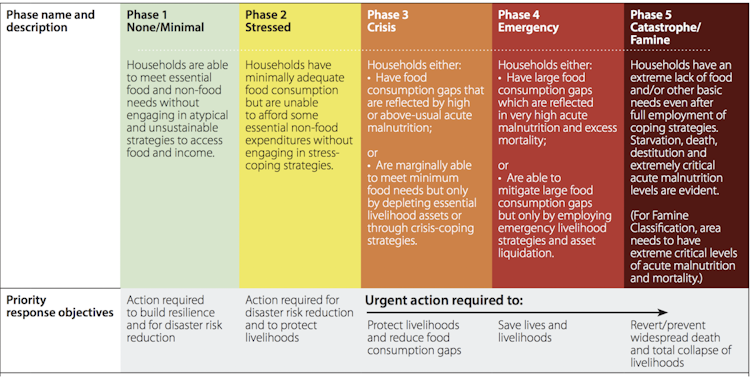
The Integrated Food Security Phase Classification measures food insecurity objectively based on a wide range of evidence.IPC, CC BY-ND.

A perfect storm for food scarcity

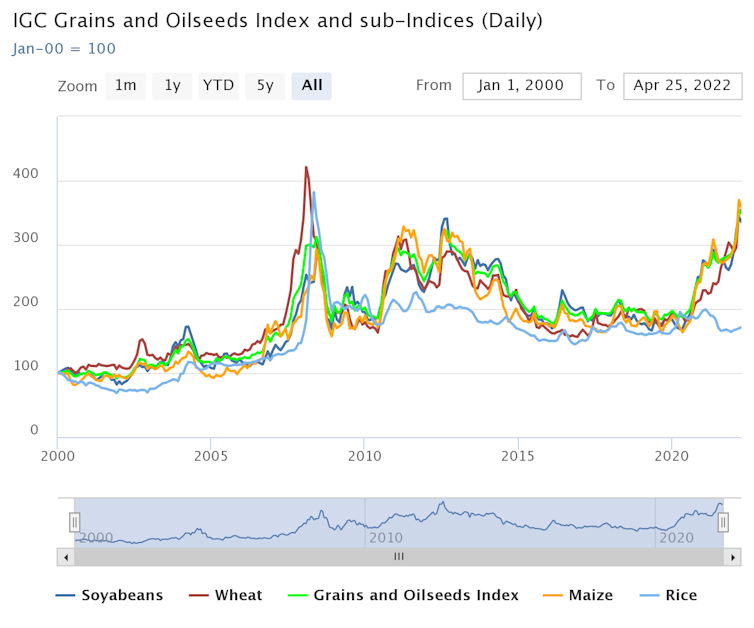
Global food and fertilizer prices were near record highs even before Russia invaded Ukraine in February 2022. Prices for grain and oilseed products had already reached or surpassed levels recorded in 2011, when a devastating famine in Somalia – triggered in part by extreme food prices – killed more than 250,000 people.

2011 was also the year of the Arab Spring uprisings in Egypt, Yemen, Libya, Bahrain and Syria. Many factors fueled those protests, including extraordinarily high bread prices in major Middle East and North African cities.

Now, the war in Ukraine has pushed prices to near all-time highs. As of April 8, the average cost of staple food grains had jumped by more than 17% from February levels. For food-importing countries everywhere, this increase will push the cost of food significantly higher. And with the war likely to continue, a global supply shortfall could lead nations to adopt measures such as export bans that further distort food markets.

The global grain market is very concentrated. More than 85% of global wheat exports come from just seven sources: the European Union, the U.S., Canada, Russia, Australia, Ukraine and Argentina. The same share of maize exports comes from just four countries: the U.S., Argentina, Brazil and Ukraine.

Many nations across the Middle East and North Africa are major wheat importers and buy much of their supply from Russia and Ukraine. For example, Russia and Ukraine provide 90% of Somalia’s wheat imports, 80% of the Democratic Republic of Congo’s, and about 40% each of Yemen’s and Ethiopia’s.

Losing Ukrainian and Russian exports means higher grain prices and much longer shipping distances from alternative suppliers such as Australia, the U.S., Canada and Argentina – at a time when high energy prices are raising shipping costs. And since global grain markets are denominated in U.S. dollars, the dollar’s current strength makes grain even more expensive for countries with weaker currencies.

Famine warning lights

For nations already at risk of famine, these effects could be disastrous. Prior to the war, the United Nations’ Food and Agriculture Organization estimated that 161 million people in 42 countries were in extreme food insecurity, meaning they needed urgent food assistance. Over a half-million people faced famine levels of food deprivation – by far the most extreme levels of hunger since at least the early 2000s. The most badly affected countries include Yemen, Ethiopia, Nigeria, the Democratic Republic of Congo, Sudan, South Sudan, Afghanistan, Somalia and Kenya.

The causes of these crises vary. Violent conflict is a common factor across most of them. Some countries are still struggling to recover from the economic and health impacts of the COVID-19 pandemic. A devastating drought is also affecting the Horn of Africa, with rains from March through May now forecast to be well below average. This would constitute the fourth failed or below-average rainy season in a row for areas of Ethiopia, Somalia and Kenya.

Even before the Ukraine invasion, this combination of factors had already led to the highest numbers on record of people needing food and other humanitarian assistance for their survival in the East African Region. Rural labor markets and the price of livestock – the two things that the poorest have to sell – have collapsed due to the drought, precisely as global food prices have spiked. A dramatic decline in purchasing power was a major driver of the 2011 famine in Somalia, and the same circumstances are rapidly taking shape now.

Not enough aid

For countries in crisis, the U.N. World Food Program is the primary global provider of food for at-risk populations. In 2021, the WFP procured nearly half of its grain from Ukraine.

Much of the WFP’s food aid is delivered as direct cash transfers rather than in-kind supplies. But whatever form it takes, the cost of that aid has increased substantially with rising food, fuel and shipping prices. WFP officials estimate that the cost of its operations has increased by 44% since the start of the war in Ukraine, and the agency now faces a 50% funding gap.

Graph of world prices for soybeans, wheat, grains and oil seeds, corn and rice.

International prices for grains and oilseeds were already high when Russia invaded Ukraine on Feb. 24, 2022. Agricultural Market Information System.

The crisis in Ukraine has also spotlighted a growing gap between funding and needs, especially in some of the world’s poorest countries. For example, the U.N. issued a flash appeal for humanitarian assistance to Ukraine in early March 2022. By April 15 it was 65% funded. Countries at risk of famine, whose appeals have been out longer, have received much less funding. On April 15, Afghanistan’s appeal was 13.5% funded; South Sudan, 8.2%; and Somalia only 4.4%. Overall funding for global humanitarian needs stood at 6.5% of requested levels.

When I worked as the deputy regional director for CARE International in East Africa, I often worried about how a humanitarian crisis in one country might have spillover effects in others. There could be influxes of refugees who need assistance, or humanitarian staff might have to be shifted to support the response to the new crisis.

In those days, some crises triggered by drought could affect several countries in the region at once. But the ripple effects from the war in Ukraine could lead to the worsening of humanitarian crises around the world.