3 May 2022

Can We Abandon Pollutive Fossil Fuels and Avoid an Energy Crisis?

Richard Heinberg


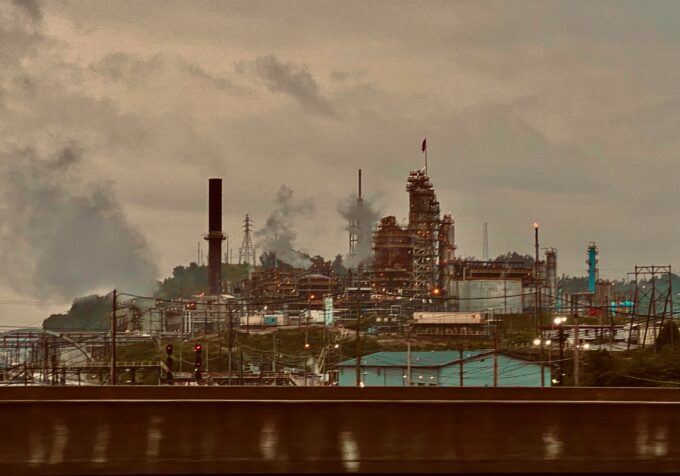
Refinery, Ashland, Kentucky. Photo: Jeffrey St. Clair.

Similar to the two navigational hazards mythologized as sea monsters in ancient Greece—Scylla and Charybdis—which gave rise to sayings such as, “between the devil and the deep blue sea” and “between a rock and a hard place,” modern energy policy has its own Scylla and Charybdis. On the one hand is the requirement to maintain sufficient energy flows to avoid economic peril. On the other hand is the need to avert climate catastrophe resulting from such activities. Policymakers naturally want all the benefits of abundant energy with none of the attendant climate risks. But tough choices can no longer be put off.

Russia’s invasion of Ukraine and the West’s response of imposing sanctions on Russia are forcing a reckoning as far as global energy policy is concerned. The International Energy Agency (IEA) forecasts that the ongoing war and the U.S. sanctions may together reduce Russian oil exports by at least 3 million barrels per day—more than 4 percent of global supplies, which is a huge chunk of the delicately balanced world energy market. Some energy analysts are forecasting that oil prices could spike up to $200 per barrel later this year, exacerbating inflation and triggering a global recession. We’re facing the biggest energy crisis in many decades, with supply chains seizing up and products made from or with oil and gas (notably fertilizers) suddenly becoming scarce and expensive. Scylla, therefore, calls out: “Drill more. Lift sanctions on Venezuela and Iran. Beg Saudi Arabia to increase output.” But if we go that route, we only deepen our dependency on fossil fuels, aggravating the climate monster Charybdis.

The IEA was created in the aftermath of the 1970s oil shocks to inform policymakers in times of energy supply crisis. The agency recently issued a 10-point emergency plan to reduce oil demand and help nations deal with looming shortages owing to Russia’s invasion of Ukraine. Its advice includes lowering speed limits, instituting car-free Sundays, encouraging working from home, and making public transport cheaper and more widely available.

All of these are good suggestions—and are very similar to what my colleagues and I have been advocating for nearly 20 years (some were even part of U.S. energy policy 50 years ago). Fossil fuel supply problems shouldn’t come as a surprise: we treat these fuels as though they were an inexhaustible birthright; but they are, of course, finite and depleting substances. We have extracted and burned the best of them first, leaving lower-quality and more polluting fuels for later—hence the recent turn toward fracked oil and gas and growing reliance on heavy crude from Venezuela and “tar sands” bitumen from Canada. Meanwhile, rather belatedly, it has gradually dawned on economists that these “unconventional” fuels typically require higher rates of investment and deliver lower profits to the energy industry, unless fuel prices rise to economy-crushing levels.

Indeed, it’s as though our leaders have worked overtime making sure we’re unprepared for an inevitable energy dilemma. We’ve neglected public transportation, and many Americans who are not part of the white-collar workforce have been pushed out from expensive cities to suburbs and beyond, with no alternative other than driving everywhere. While automakers have turned their focus to manufacturing electric vehicles (EVs), these still account for a small fraction of the car market, and most of today’s gas-guzzling cars will still be on the road a decade or two from now. Crucially, there are as yet only exploratory efforts underway to transition trucking and shipping—the mainstays of global supply chains—and find more sustainable alternatives. That creates a unique vulnerability: the current worldwide diesel shortage could hammer the economy even if the government and the energy industry somehow come up with enough gasoline to keep motorists cruising to jobs and shopping malls.

Then there’s the issue of the way fossil fuels are financed. They’re not treated as a depleting public good, but as a source of profit—with investors either easily enticed to plunge into a passing mania or spooked to flee the market. Just in the past decade, investors have gone from underwriting a rapid expansion of fracking (thereby incurring massive financial losses), to insisting on fiscal responsibility, while companies are now milking profits from high prices and buying back stocks to increase their wealth. Long-term energy security be damned.

Meanwhile, the climate monster stirs fitfully. With every passing year, we have seen worsening floodsfires and droughtsglaciers that supply water to billions of people melting; and trickles of climate refugees threatening to turn into rivers. As we continue to postpone reducing the amounts of fossil fuels we burn, the cuts that would be required in order to avert irreversible climate doom become almost impossibly severe. Our “carbon budget”—the amount of carbon we can burn without risking catastrophic global warming—will be “exhausted” in about eight years at current emission rates, but only a few serious analysts believe that it would be possible to fully replace fossil fuels with energy alternatives that soon.

We need coherent, bold federal policy—which must somehow survive the political minefield that is Washington, D.C., these days. Available policies could be mapped on a coordinate plane, with the horizontal x-axis representing actions that would be most transformative and the vertical y-axis showing what actions would be most politically feasible.

High on the y-axis are actions like those that the Biden administration just took, to release 1 million barrels a day of oil from the strategic petroleum reserve and to invoke the Defense Production Act to ramp up the production of minerals needed for the electric vehicle market. While politically feasible and likely popular, these efforts won’t be transformative.

An announcement by President Joe Biden of an ambitious energy-climate vision, with the goal of eliminating our dependence on foreign fuel sources and drastically reducing carbon emissions by the end of the decade, would probably fall somewhere in the middle, where the x- and y-axes meet. Such a vision would encompass a four-pronged effort being proposed by the government:

+ Incentivizing massive conservation efforts, including “Heat Pumps for Peace and Freedom” and providing inducements for businesses to implement telework broadly.

+ Directing domestic production of fossil fuels increasingly toward energy transition purposes (for example, making fossil fuel subsidies contingent on how businesses are growing the percentage of these fuels being used to build low-carbon infrastructure).

+ Mandating massive investments in domestic production of renewables and other energy transition technologies (including incentives to recycle materials).

+ Providing an “Energy Transition Tax Credit” to households or checks to offset energy inflation, with most of the benefits going to low-income households.

Ultimately, some form of fuel rationing may be inevitable, and it is time to start discussing that and planning for it (Germany has just taken the first steps toward gas rationing)—even though this would be firmly in the x-axis territory. Rationing just means directing scarce resources toward what’s vital versus what’s discretionary. We need energy for food, critical supply chains and hospitals; not so much for vacation travel and product packaging. When people first hear the word “rationing,” many of them recoil; but, as author Stan Cox details in his history of the subject, Any Way You Slice It, rationing has been used successfully for centuries as a way to manage scarcity and alleviate poverty. The U.S. SNAP (food stamp) program is essentially a rationing system, and all sorts of materials, including gasoline, were successfully rationed during both world wars. More than two decades ago, the late British economist David Fleming proposed a system for rationing fossil fuel consumption at the national level called Tradable Energy Quotas, or TEQs, which has been discussed and researched by the British government. The system could be used to cap and reduce fossil fuel usage, distribute energy fairly and incentivize energy conservation during our transition to alternative sources.

Also, we need to transform the ways we use energy—for example, in the food system, where a reduction in fossil fuel inputs could actually lead to healthier food and soil. Over the past century or so, fossil fuels provided so much energy, and so cheaply, that humanity developed the habit of solving any problem that came along by simply utilizing more energy as a solution. Want to move people or goods faster? Just build more kerosene-burning jet planes, runways and airports. Need to defeat diseases? Just use fossil fuels to make and distribute disinfectants, antibiotics and pharmaceuticals. In a multitude of ways, we used the blunt instrument of cheap energy to bludgeon nature into conforming with our wishes. The side effects were sometimes worrisome—air and water petrochemical pollution, antibiotic-resistant microbes and ruined farm soils. But we confronted these problems with the same mindset and toolbox, using cheap energy to clean up industrial wastes, developing new antibiotics and growing food without soil. As the fossil fuel era comes to an end, the rules of the game will change. We’ll need to learn how to solve problems with ecological intelligence, mimicking and partnering with nature rather than suppressing and subverting her. High tech may continue to provide useful ways of manipulating and storing data; but, when it comes to moving and transforming physical goods and products, intelligently engineered low tech may offer better answers in the long run.

Further along the x-axis would be the daring action of nationalizing the fossil fuel industry. But at the very farthest end of the x-axis is the possibility of deliberately reining in economic growth. Policymakers typically want more growth so we can have more jobs, profits, returns on investment and tax revenues. But growing the economy (at least, the way we’ve been doing it for the past few decades) also means increasing resource extraction, pollution, land use and carbon emissions. There’s a debate among economists and scientists as to whether or not economic growth could proceed in a more sustainable way, but the general public is largely in the dark about that discussion. Only in its most recent report has the Intergovernmental Panel on Climate Change (IPCC) begun to probe the potential for “degrowth” policies to reduce carbon emissions. So far, the scorecard is easy to read: only in years of economic recession (such as in 2008 and in 2020) have carbon emissions declined.

In years of economic expansion, emissions increased. Policymakers have held out the hope that if we build enough solar panels and wind turbines, these technologies will replace fossil fuels and we can have growth without emissions. Yet, in most years, the amount of increased energy usage due to economic growth has been greater than the amount of solar and wind power added to the overall energy mix, so these renewable sources ended up just supplementing, not displacing, fossil fuels. True, we could build turbines, panels and batteries faster; but, as long as overall energy usage is growing, we’re continually making the goal of reducing our reliance on fossil fuels harder to achieve.

Wouldn’t giving up growth mean steering perilously close to the Scylla of economic peril in order to avoid the Charybdis of climate doom? So far, we’ve been doing just the reverse, prizing growth while multiplying climate risks. Maybe it’s time to rethink those priorities. Post-growth economists have spent the last couple of decades enumerating the ways we could improve our quality of life while reducing our throughput of energy and materials. Policymakers must finally start to take these proposals seriously, or we will end up confronting the twin monsters—economy-crushing fossil fuel scarcity and devastating climate impacts—without prior planning and preparation.

It was always clear that we would eventually have to face the music with regard to our systemic economic dependency on depleting, polluting fossil fuels. We have delayed action, making both the economic challenge and the climate threat harder to manage. Our possible navigation channel between Scylla and Charybdis is now perilously narrow. If we wait much longer, this channel will vanish altogether.

British Virgin Islands premier’s arrest exposes Britain’s central role in global corruption and criminality

Jean Shaoul


On Thursday, the US Drug Enforcement Agency arrested Andrew Fahie, prime minister of the British Virgin Islands (BVI), in Florida charging him with drug trafficking and money laundering after undercover agents caught him in a sting operation set in motion last October. Also arrested were BVI port authority director Oleanvine Maynard, and his son Kadeem in a separate operation.

Andrew Fahie (Credit: Government of the Virgin Islands)

The arrests expose the financial skullduggery of not only the BVI, one of the world’s premier tax havens, but Britain, which retains overall control of the islands. Far from serving as a check on criminal activities, Britain stands exposed as the ringleader.

US law enforcement officials lured the pair into Miami’s Opa-Locka Executive Airport with the promise of $700,000 in cash in designer shopping bags in return for help in enabling drug shipments. Earlier this month, Fahie had agreed a 12 percent commission on a three-ton shipment for cocaine smuggled via the BVI. According to court filings, Fahie had complained that “the British did not pay him much.”

British Foreign Secretary Liz Truss struck an outraged pose, saying she was “appalled” by the arrest and associated revelations. The BVI has long been known to be the centre of a major drug trafficking route, with shipments of cocaine routed from Columbia to the US through the islands. In November 2020, the authorities seized more than two tons of cocaine at a property on the islands belonging to a serving police officer. Truss immediately dispatched Amanda Milling, the minister for overseas territories, to the British Virgin Islands for talks.

Fahie, widely described as a flamboyant character, was first investigated in 2003 in relation to money laundering, allegations he denied as 'outdated, unproven, and unsubstantiated,' but the investigation resulted in no action being taken against him.

So rife were the allegations of drug smuggling, corruption, nepotism, jury intimidation and the misuse of public funds that in January 2021 Britain’s then governor of the islands, Gus Jaspert, who once served as private secretary to former Prime Minister David Cameron—himself a beneficiary of BVI’s tax haven status, was forced to set up a Commission of Inquiry into mis-governance in the British overseas territory.

However, as the present governor John Rankin pointed out, “The remit of the Commission of Inquiry focused on governance and corruption and was not a criminal investigation into the illegal drug trade.” He failed to explain why it did not deal with the serious claims of high-level collusion with drug trafficking.

The Commission, due to report last January, conveniently published its 943-page long report the day after Fahie’s arrest. Headed by retired judge Sir Gary Hickinbottom, it found that “almost everywhere the principles of good governance… are ignored” but concluded it was “highly likely” that serious dishonesty had taken place. It recommended imposing direct rule from London by the BVI’s governor, tantamount to putting the mafia boss in direct charge.

The recommendation to suspend the elected government and impose direct rule comes just months after Barbados dumped the Queen as head of state and Prince William and Kate’s visit to Jamaica prompted similar calls, amid protests calling for apologies and reparations over slavery and historical mistreatment.

The lawyer hired to defend Fahie’s administration is former attorney-general, Sir Geoffrey Cox, widely criticized for taking on highly lucrative legal work when being a Conservative MP is supposed to be a full-time job. He earned more than £1 million in 2021 from his non-parliamentary work for the international law firm Withers. During his visits to the BVI, he stayed in a luxury villa that costs $7,100 a week to rent during the low season, paid for by the BVI government.

Locator map of British Virgin Islands (Credit: Creative Commons-UN Office for the Coordination of Humanitarian Affairs (OCHA)

The 50 or more islands that comprise the British Virgin Islands are situated to the east of Puerto Rico and the US Virgin Islands and have a population of just 30,000. After capturing the islands in 1672, the British introduced sugar cane production and brought slaves from Africa to work on the plantations. In the years that followed the Abolition of Slavery in the British Empire in 1833, the BVI, like its counterparts throughout the Caribbean, was never able to overcome British imperialism’s legacy of underdevelopment, dependency and economic hardship.

On gaining notional independence from Britain in 1960, when few people had access to electricity, the BVI diversified away from its traditionally agriculture-based economy in favour of tourism and financial services for the world’s corporations and kleptocrats that use the islands as a tax haven. Since the 1980s, the BVI has become synonymous with the tax avoidance industry, hosting the brass plates of 370,000 companies that control an estimated $1.5 trillion of assets, and is now one of the wealthiest areas in the Caribbean.

The scale of its transactions is enormous. By 2012, according to the Financial Times, the British Virgin Islands was the fifth largest recipient of foreign direct investment globally, “with inflows at $72 billion, higher than those of the UK, which has an economy almost 3,000 times larger.” Despite the enormous wealth controlled by BVI’s corporations, little remains in the BVI, with BVI’s entire banking system holding just $2.5 billion.

The money, often of dubious origin, and the financial services industry that provides the necessary legal cover is channeled through these tax havens that offer their owners both anonymity and tax-free status. The money is then funneled through to businesses and banks in the City of London that then pay little or no tax on their operations, while at the same time underpinning London’s position as a major financial centre as it laundered the world’s dirty money. Such is the sordid status today of what was the world’s first major capitalist state.

This is likely why the US launched the sting operation: to undermine London’s position and shore up New York’s. It comes as the City of London is still reeling from sanctions imposed in the wake of the US/NATO provoked war in Ukraine on Russian oligarchs who have parked their money in Britain’s capital.

The latest scandal follows the release of the Panama papers in 2016, and later the Paradise Papers in 2017 and the Pandora Papers in 2021, by International Consortium of Investigative Journalists (ICIJ). The Pandora Papers’ analysis identified 956 companies specializing in offshore tax havens with ties to 336 “high-level politicians and public officials, including country leaders, cabinet ministers, ambassadors and others.” “More than two-thirds” of the companies identified were “set up in the British Virgin Islands.”

The BVI is one of the 15 British Overseas Territories, a collection of islands strategically located around the world. Most of them function as tax havens and military bases for British imperialism, with Britain responsible for their criminal justice system, defence and foreign relations. To put it another way, their governments have no more powers than local authorities in Britain. The British government can issue instructions to the BVI, declare a state of emergency as the previous governor Jaspert did after Hurricane Irma caused devastation on the islands in 2017, and even assume overall control of the islands.

Thus, Britain plays a crucial role in enabling the tax havens that protect the wealth of the world’s kleptocrats and depriving the world’s governments of nearly half a trillion dollars through tax abuse by multinationals and the super-rich, according to the State of Tax Justice 2021 published jointly by the Tax Justice Network (TJN), the Global Alliance for Tax Justice and the global union federation Public Services International last November. It found that estimated tax losses had risen from $427 billion in 2020 to $483 billion in 2021, although these figures were likely “the tip of the iceberg”, with the UK alone responsible for almost 40 percent of the total. These losses must be recouped through savage cuts and ramping up the taxation and, above all, exploitation of the working class.

For decades successive British Chancellors of the Exchequer have lyingly protested their helplessness in the face of tax havens, even as the governor of the BVI, and the governors of Britain’s other tax havens, has for decades and by right attended and presided over the BVI’s cabinet, and is thus intimately involved in the formulation and implementation of its financial policy.

Fahie’s arrest come as British politicians, many of whom benefit from Britain’s offshore tax havens, insist there is no money to pay for the most essential social services. They allow the world’s financial elite and its bribed political stooges to dodge taxes by stashing their wealth in secretive locations right under the noses of the so-called “financial regulators,” while the working class is told it must accept ever worsening poverty and deprivation.

Sharp rise in cost of living, high unemployment portend renewal of class conflict in Chile

Mauricio Saavedra


Soaring costs of basic consumer goods triggered by the US/NATO war against Russia in Ukraine, the normalization of COVID-19 infections and deaths, high unemployment and historic levels of social inequality once again have brought to the surface immense social tensions in Chile. 

Chilean President Gabriel Boric arrives to La Moneda presidential palace in Santiago, Chile, Monday, May 2, 2022. [AP Photo/Esteban Felix]

As in October 2019, the eruption of the class struggle is a specter that brings jitters to the ruling class and the newly installed government of the pseudo-left-Stalinist coalition Apruebo Dignidad (I approve dignity).

Confronted in the last month with the outbreak of hunger riots and looting, school occupations, road blockades by truck owner-operators and striking port and health workers, the immediate reaction of the government of Gabriel Boric has been to unleash the murderous Carabinero special forces. 

Although the right-wing corporate media has all but censored the police-state repression and deliberately distorted the narrative to paint students, workers and the poor as common criminals, dozens have uploaded video and photos on social media reporting scenes of militarized riot police and special forces violently beating striking workers and protesting children with truncheons, indiscriminately using water cannon and tear gas and conducting mass arrests.

Up to 400 people were involved in a hunger riot culminating in the looting of a supermarket on the outskirts of Santiago last Monday, a gauge of the desperate situation facing the working class. What started off with 40 or 50 people setting up barricades in Talangante, a working class commune in the Metropolitan Region, quickly attracted hordes of desperate people ransacking a Tottus supermarket. 

The militarized police responded swiftly, arresting 48 people. Egged on by the right, baying for law and order, several parties in the coalition government condemned the riots as criminal and criticized the Prosecutor’s Office for releasing 33 of them. 

“All these were a bunch of criminals that the only thing they came to do was to steal, to loot,” the mayor of Talagante Carlos Álvarez (Socialist Party), told Expreso Biobio. “In the theory of criminal law, the state of necessity is an exoneration of responsibility in famine theft, which means that it is theft by hunger. Here nobody took something to eat … they were taking household appliances.” 

Álvarez’s contemptuous attitude betrays the cynicism of the government’s propaganda campaign of “empathizing” with “the people.” 

Gabriel Boric’s administration, which includes the pseudo-left Broad Front, the Stalinist Communist Party and sectors of the parliamentary left, came to power promising the masses that it would put an end to the “neo-liberal” free-market model. Yet the series of reforms that he has announced to date amount to a drop in the ocean compared to what is required to address entrenched poverty and social inequality, now exacerbated by steeply rising costs. 

Data from the National Statistics Institute indicates that the March Consumer Price Index reached a historical increase of 1.9 percent on top of a 9.4 percent inflation rate over the last 12 months. 

The surge in prices is in large part the outcome of the policies of the right-wing government of Sebastián Piñera approved by former deputy Boric and his associates in the parliamentary left, which mimicked those of the US and Europe during the economic crisis triggered by the COVID-19 pandemic in March 2020. 

Piñera introduced economic “reactivation” programs that consisted of providing collateral for credits to predominantly medium to large firms, guaranteeing up to US$20 billion in bank loans. It also covered the payroll by up to 80 percent of small and medium sized businesses. Beginning in May 2020, Mario Marcel—current finance minister and the former chief of the autonomous Central Bank—massively expanded the bank’s balance sheet to prop up the financial markets. 

All these measures helped increase the fortunes of the super-rich by 73 percent between 2020 and 2021. The combined wealth of the eight richest billionaires reached US$42.7 billion last year.

Forbes' list of Chilean billionaires in 2021

It now has come to light that the large supermarket chains in the country have over the last year artificially jacked up prices of basic consumer goods over and above inflation.

The 2022 World Inequality Report, coordinated by economists Thomas Piketty, Emmanuel Saez, Gabriel Zucman and Lucas Chancel, places Chile as among the most unequal countries in the Latin America. 

According to the report: “Available estimates suggest that inequality in Chile has been extreme over the past 120 years, with a top 10 percent income share constantly around 55%-60 percent and a bottom 50 percent income share around 9-10 percent.” 

Household wealth (the sum of all financial assets plus non-financial assets plus net debts) is even more skewed. In 2021, the average wealth for the bottom 50 percent in Chile was negative—meaning half of the population was in debt. On the other hand, the top 10 percent and top 1 percent of the population held 80 percent and 50 percent of total wealth, respectively. 

Fundación Sol infographic illustrating the sharp rise in basic consumer products over the last year. (Source: National Institute of Statistics)

Most significantly, the report explains that since 1995, that is, under the so-called socialist administrations of Ricardo Lagos (2000-2006) and Michelle Bachelet (2006-2010, 2014-2018), the wealth of the bottom half remained at zero or less while the shares of the top 10 and top 1 percent more than doubled.

This persistence of extreme inequality in Chile, whether under military or civilian rule, is key to understanding the profound social eruption that shook the country in late 2019 and the beginning of 2020 and threatens to erupt today in response to catastrophic food and energy prices rises.

Pelosi pledges war “until victory is won”

Andre Damon


Over the weekend, Nancy Pelosi, speaker of the US House of Representatives and second in the line of presidential succession, traveled in secret to the war zone of Kiev, Ukraine and pledged a commitment by the United States to ensure “victory” against Russia.

Repeating the false premise that the United States’ involvement in the war with Russia is about helping Ukraine, an embattled ally, Pelosi told Ukrainian President Volodymyr Zelensky, “Our commitment is to be there for you until the fight is done.” She added, “We stand with Ukraine until victory is won.”

House Speaker Nancy Pelosi visits the 82nd Airborne Division stationed in Rzeszów, Poland. (Credit: @SpeakerPelosi)

Democratic Representative Jason Crow, who accompanied Pelosi on her trip to Ukraine, was even more emphatic in asserting that the United States is a party to the war, declaring at a press conference in Poland, “The United States of America is in this to win, and we will stand with Ukraine until victory is won.”

Pelosi’s pledge, coming just one week after similar assurances by Secretary of Defense Lloyd Austin and Secretary of State Antony Blinken, amounts to an unlimited commitment of treasure and blood to the pursuit of sweeping, open-ended war aims that threaten to draw the United States into what Biden called “world war.”

What does “victory” in Ukraine mean? In the span of just one week, Biden, Austin and leading members of the president’s political party have all given conflicting and irreconcilable answers as to what the United States is trying to achieve in Eastern Europe.

On one hand, Biden claimed that it is “not true” that the United States is engaged in a proxy war with Russia. On the other, Austin said at a press conference in Poland last week that the United States is seeking to “weaken” Russia. The New York Times has raised the prospect of “bringing Russia to its knees,” while former US Army Europe Commander Ben Hodges called for “breaking the back” of Russia.

To which of these goals is Pelosi committing the United States?

If one accepts Pelosi’s statements in the most limited and most literal sense, they mean that the United States will assist Ukraine in achieving its military aims in regard to Russia. But Ukraine’s own military goals, developed in close cooperation with US military planners, are sweeping.

On March 24, 2021, Zelensky signed a document pledging to “implement measures to ensure the de-occupation and reintegration of the [Crimean] peninsula.” This means that Ukraine is formally committed to the seizure of Crimea, territory that Russia claims as its own, through military means.

If Ukraine succeeds in breaking the Russian offensive in the Donbas, routs the attacking Russian forces, and pushes into Russian territory, would the United States be “committed” to support Ukraine in this “fight”?

In another scenario, what will the United States do if Russian forces continue their advance toward Western Ukraine, encircling pockets of the Ukrainian army and leading to its disintegration? What does Pelosi’s open-ended commitment to “victory” against Russia mean if Ukraine is threatened with strategic defeat?

Pelosi’s statement makes clear that, forced to choose between the prospect of reneging on its “commitment” and the deployment of troops—or even the use of nuclear weapons—the United States will choose the latter.

Last week, Democratic Senator Chris Coons called for a “conversation” about sending US troops to fight against Russia in Ukraine.

Asked about Coons’s statements, Tim Kaine, Hillary Clinton’s running mate in 2016, merely called the measure “premature”—effectively an admission that plans are already in the works. On Sunday, Republican Congressman Adam Kinzinger announced that he has introduced an Authorization for Use of Military Force that would allow Biden to deploy US troops in a full-scale war with Russia.

In the course of the Vietnam War, the United States was drawn into an ever more bloody and brutal war that followed the logic of the military commitments it had made.

The Pentagon Papers, first published in 1971, revealed that in the early 1960s, under President John F. Kennedy, American imperialism transformed its involvement in Vietnam, which had up to that point been called a “limited-risk gamble” into a “broad commitment.”

One of the most damning components of the Pentagon Papers was an internal Defense Department memo, drafted in 1965, that concluded that the main reason for US involvement was to uphold the United States’ “commitment,” the breach of which would lead to a “humiliating U.S. defeat.”  The United States’ goals were ranked as follows:

  • 70% – To avoid a humiliating U.S. defeat (to our reputation as a guarantor).
  • 20% – To keep [South Vietnam] (and the adjacent) territory from Chinese hands.
  • 10% – To permit the people [of South Vietnam] to enjoy a better, freer way of life.
  • NOT – To help a friend
A memo published as part of the Pentagon Papers

In pursuit of enforcing the global position of the United States in the post-war period, 58,220 American soldiers lost their lives, hundreds of thousands were physically and psychologically destroyed, and over 1 million Vietnamese men, women and children were killed.

The Pentagon Papers revealed the extent to which American foreign policy is made in secret. The public is presented with a set of facts and arguments that bear no relationship to the actual goals that are propelling the conflict. The aim of media discussion is not to allow the people to democratically control the conduct of foreign policy, but to condition public opinion to accept the outcome desired by the American state apparatus.

The stakes in the present war are vastly higher than they were in Vietnam. From its origins as a US proxy war aiming to “bleed Russia white,” the conflict over Ukraine is rapidly spiraling into a full-scale war between two nuclear-armed states.

Within the entire US political establishment, there is no serious attempt to explain what the war is about. There simply exists no opposition to a reckless and insane policy that threatens to end human civilization through the eruption of a nuclear third world war.

China holds “emergency” conference over sanctions threat

Nick Beams


With China next in line to be targeted by US imperialism and the likely use of unprecedented financial sanctions, such as those employed against Russia, Beijing is seeking ways to counter the threat.

Chinese President Xi Jinping, right, and Russian President Vladimir Putin talk to each other during their meeting in Beijing, China, Friday, Feb. 4, 2022. (Alexei Druzhinin, Sputnik, Kremlin Pool Photo via AP)

According to a report in the Financial Times (FT) published over the weekend, Chinese financial regulators held an “emergency meeting” on April 22 with domestic and foreign banks to discuss how they could protect the country’s overseas assets from the type of measures imposed on Russia.

In a well-prepared operation going back at least several months, involving officials from the White House and the European Commission, the US and the European Union excluded Russia from the SWIFT international financial messaging system and froze much of its $630 billion worth of foreign currency reserves within days of the invasion of Ukraine.

Citing “people familiar with the discussion,” the FT said Chinese officials were “worried that the same measures could be taken against Beijing in the event of a regional military conflict or other crisis.”

Already US officials have been keeping a close watch on China’s financial dealings with Russia. This has provoked fears in Beijing that China will be hit with punitive measures if it is seen to infringe on the anti-Russia sanctions.

Chinese President Xi Jinping has expressed opposition to the US proxy war against Russia, calling for negotiations, and has refused to line up behind US-sponsored resolutions directed against Russia in the UN. But at the same time Chinese banks and firms have been wary of doing anything that could provoke a US reaction.

The conference involved officials from the central bank and the finance ministry as well as executives from “dozens of local and international lenders such as HSBC,” the FT report said. All large foreign and domestic banks operating in China were represented.

The meeting began with a briefing from a senior official from the finance ministry who said the government had been put on alert by the punitive sanctions against Russia. No doubt there are also concerns in Beijing that the measures against Moscow could go well beyond the existing sanctions.

There is already discussion in the imperialist capitals that Russia’s assets be completely expropriated to pay for the war damage in Ukraine.

No specific scenario was raised at the conference as to what could be the circumstances for the use of financial sanctions against China, but the issue of Taiwan was on the minds of participants.

Over the recent period the US has been steadily moving to abandon its “one China” policy agreed to when diplomatic recognition was accorded to China in 1979.

The provocations by the US over Ukraine which led to the Russian invasion will have raised concerns in Beijing that Washington will adopt a similar scenario in relation to Taiwan, possibly through a US military build-up on the island or encouraging Taiwan to declare formal independence.

Such actions could provoke Beijing to take military action in the same way as the NATO expansion goaded Russian President Putin to invade Ukraine.

Taiwan may not be the only issue to spark a US escalation. The US, backed by its ally Australia, has issued threats against the Solomon Islands over the decision of the Sogavare government to sign a security pact with China.

During a visit by senior White House official Kurt Campbell to Honiara, the Solomon Islands capital, last month, the White House issued a threatening statement that the US would have “significant concerns and respond accordingly” if steps were taken to establish a “de facto” Chinese military presence in the island nation.

The terms of the statement are so wide that an aggressive US response could follow from virtually any action that Washington interprets as inimical to its interests. There is already considerable US hostility to the decision by the Sogavare government to switch its diplomatic recognition from Taiwan to Beijing.

It appears, at least from the FT report, that the conference was unable to come up with concrete measures if the US decided to impose sanctions.

A person briefed on the meeting said: “No one on site could think of a good solution to the problem. China’s banking system isn’t prepared for a freeze of its dollar assets or exclusion from the SWIFT messaging system as the US has done to Russia.”

It cited Andrew Collier, managing director of Orient Capital Research in Hong Kong, who said Beijing was right to be concerned “because it has very few alternatives and the consequences [of US financial sanctions] are disastrous.”

The effect of any sanction measures, even if they were milder than those imposed on Russia, would go beyond the considerable financial turmoil the Russian ban has produced.

China’s weight in international financial markets is far greater than that of Russia. China is estimated to hold $1.5 trillion worth of US securities, including more than $1 trillion worth of US Treasury bonds. All told China holds $3.2 trillion in foreign assets.

According to some bankers present at the meeting, it was doubtful that the US could impose significant sanctions because of China’s huge holdings of dollar financial assets and the massive effect any freeze would have on the US and global financial system.

“It is difficult for the US to impose massive sanctions against China,” Collier said. “It is like mutually assured destruction in a nuclear war.”

But in conditions where the use of nuclear weapons has become an ever-greater danger in the proxy war against Russia in Ukraine, the use of the financial “nuclear option” can by no means be ruled out.

Moreover, the issue goes beyond China. The imposition of sanctions on Russia has already delivered a major blow to the international financial system based on the use of the dollar. Its weaponisation means that any country that crosses the US can find itself under attack, including major countries.

At present the major imperialist powers, above all those in Europe, have aligned themselves behind the US drive to “break the back” of Russia in the hope they may obtain some benefit from the plunder of its resources.

But they have conflicting interests which could rapidly emerge. The US has already used its control of the dollar to enforce unilateral sanctions against Iran by compelling European companies and financial institutions to abide by them or face large penalties.

The longer-term and not so long-term implications of the US measures against Russia are emerging clearly. So-called free market operations in the global system are being done away with. It is increasingly being placed on a war footing as the prospect re-emerges of the division of the world into rival currency and financial blocs, as took place in the lead-up to World War II.

Climate change will lead to increasing spillover of viruses to humans, potentially causing new pandemics

Philip Guelpa


A groundbreaking study newly published in the journal Nature (Carlson, Albery et al., “Climate change increases cross-species viral transmission risk”) concludes that ongoing climate change will dramatically increase the potential for viruses that already exist among animal populations to be spread to humans, as has already happened with SARS-CoV-2, and others such as HIV and Ebola, collectively known as zoonotic (animal derived) disease spillovers.

This alarming finding is based on the development of a model by these researchers which projects how the warming of the planet will likely cause displacement in a sample of over 3,000 mammal species over the next 50 years, assuming a likely increase of 2 degrees Celsius (3.6 degrees Fahrenheit) in average global temperature.

Geographically shifting ecozones will force animals, plants and other organisms to adjust their territorial distributions as the spatial limits of the habitats to which they are adapted are altered. This will involve the actual movement of individuals and/or the gradual adjustment of ranges as some populations die off and others, located in more favorable environments, are more successful.

These changes will not, due to a whole variety of factors (e.g., topography, latitude, rainfall patterns), simply displace existing ecozones intact. Rather, wholesale alterations will result in “mixing and matching” of varied environmental constituents, consequently bringing together species not previously in close proximity to each other and creating adaptive stresses which will likely favor some species over others, resulting in extinctions. Overall, the result will be a significant decrease in the stability of ecosystems.

As a result, the opportunity for viruses to spread not only between different, formerly dispersed populations of the same species but also between species, including to humans, will be increased.

An estimated 40,000 viruses exist that infect mammals. Of these, 10,000 are thought to have the potential to infect humans but are currently only found in animals. The model projects that climate change will result in approximately 300,000 “first encounters” between species not previously in contact. It is estimated that cross-species dispersal of viruses will occur on the order of 15,000 times, with over 4,000 of these among mammals alone, within the model’s timespan.

This map visualizes projected novel viral-sharing events near human population centers in equatorial Africa, south China, India and Southeast Asia in 2070. These will increasingly overlap with projected hotspots of cross-species viral transmission in wildlife. (Image courtesy of Colin Carlson/GUMC)

Furthermore, as new host species are infected, creating new selective environments for the viruses, it can be anticipated that novel variants will evolve, as we are currently experiencing with SARS-CoV-2. It must also be anticipated that viral exchanges between non-human species will also severely affect wild animal populations, resulting in their own unanticipated impacts.

Many factors influence whether any given interaction between species will result in effective viral transfer. The study does not project how many viruses will ultimately cause disease in humans, but the potential is significant. These findings augment earlier studies that examined how other forms of habitat disturbance and human incursion into existing wild areas will also increase the potential for animal to human viral transmission.

The effects will likely be especially pronounced, at least initially, in species-dense areas with high human population densities and significant economic inequality, such as tropical Africa and Asia, which experience massive numbers of “climate migrants” and thus a growing “interface” between animals and humans.

A co-author of the study, Gregory Albery, a disease ecologist at Georgetown University, told The Guardian that already occurring climate change is “shaking ecosystems to their core,” which means that significant animal to human viral transmission is already underway and likely to worsen.

In an interview with The Atlantic, another co-author of the study, Georgetown global-change biologist Colin Carlson, stated that the planetary network of viruses and wildlife “is rewiring itself right now.” He found the revelations “so large and heavy to behold that even as we were writing them, we didn’t want to.”

Commenting on the study to The Guardian, Aaron Bernstein, interim director of the Center for Climate, Health, and the Global Environment at Harvard University, said, “Vaccines, drugs and tests are essential but without major investments in primary pandemic prevention, namely habitat conservation, strictly regulating wildlife trade, and improved livestock biosecurity, as examples, we will find ourselves in a world where only the rich are able to endure ever more likely infectious disease outbreaks.”

The outbreak of pandemic diseases has been projected for decades. Urgent warnings that preparations should be made in advance have been issued repeatedly, and largely ignored, with the interests of business having been taken as paramount. Responses to every new outbreak have been short-lived. When the peak of the crisis has passed or pretended to have passed, as is currently the case with COVID-19, resources are quickly redirected into more profitable undertakings for the capitalist class. As a result, the rapid mobilization which should be undertaken to stop the spread of a new disease early in its development is significantly hampered.

The anticipated scenario based on the new model is truly sobering, Carlson told The Atlantic. It predicts that the COVID-19 pandemic is likely only the beginning of repeated outbreaks of new diseases, some of which may reach pandemic proportions. Given the disastrous response to COVID-19 by most nations of the world, the consequences of which are still unfolding, the prospect of wave after wave of such catastrophes would devastate humanity, not to mention a good portion of other living things on earth. The rate of change is such that multiple deadly pandemics may occur simultaneously.

The effects of climate change extend well beyond the spread of zoonotic diseases. The wholesale disruption of ecosystems and consequent ecological instability will certainly result in widespread extinctions, possibly the earth’s sixth mass extinction, but, in contrast to the previous five, this will be anthropogenic in origin. The biological systems on which humans rely for food will be severely impacted, if not totally devastated.

The growing understanding of the processes driving the increasing appearance of zoonotic diseases provides another nail in the coffin of reactionary attempts to blame China for somehow being responsible for the spread of COVID-19.

Chevron strike in seventh week as oil industry announces first quarter profit bonanza

Gabriel Black


Oil companies around the world are announcing massive first quarter profits amidst the surging cost of oil and natural gas.

Chevron, the $307 billion global oil company, quadrupled its profits in the first quarter of 2022. It made $6.5 billion in the first three months of 2022, up from $1.7 billion the year before. In the meantime, the energy giant has refused to budge on its demands that Chevron refinery workers in Richmond, California, who have been on strike since March 21, accept a deep cut in real wages.

ExxonMobil, the largest private oil company in the United States, doubled its profits. The company registered $5.48 billion in profits. This came even though ExxonMobil has effectively given up its Russian operations—for the current moment—losing $3.4 billion of revenue. Overall, Exxon made $90.5 billion in revenue, about $30 billion more compared to the same quarter last year.

Oil workers on strike at Chevron in Richmond, California, early in the morning on March 25, 2022 (Photo: United Steel Workers union)

Internationally, the Italian oil behemoth Eni saw its profits surge by more than 1,000 percent—as its net profit increased from 0.27 billion euros in the first quarter of last year to 3.27 billion euros this quarter. Meanwhile, Saudi Arabia has announced that booming oil revenues drove its economic growth the fastest it has seen in a decade—a 9.6 percent year-on-year increase in GDP.

These massive profits are the result of the surge in the price of oil and natural gas. The average monthly price of the West Texas Intermediate benchmark price for crude oil rose from $64 in March 2021 to $100 in March 2022.

The price of oil has risen for a variety of reasons. Demand continues to recover following the initial lockdowns at the beginning of the pandemic in Spring 2020 that decimated oil prices.

Although demand is expected to return to pre-pandemic levels next year, the oil companies have barely increased production, refusing to rehire the thousands of workers they laid off or reopen the refineries they closed when oil prices tanked. The gap between supply and demand has driven up oil and gas prices, allowing the companies to reap huge profits while oil workers are worked to the bone, and the working class consumers are punished at the pump.

The US Federal Reserve also continues its policies of pumping $120 billion of digital cash into financial markets to prop up the speculative activity of the ultra-rich, a part of a global policy of easy money and low interest rates that drives up costs.

On top of this, the US-NATO proxy war against Russia in Ukraine has further driven the price of oil higher, especially as sanctions have been levied by the United States against Russia.

While the oil companies are making near-record profits, this excess money is neither going to workers nor towards substantial new investments.

Chevron and Exxon Mobil, for example, have both announced massive shareholder buyback programs. Exxon said it would triple its buyback program to $30 billion a year. Chevron will now have a record buyback program of $10 billion a year.

Buybacks effectively take the value created by workers in their workplace and funnel that money directly into shareholders’ pockets. It is a completely parasitic use of profit that diverts funds from new hiring and investment and into the hand the super-rich.

Warren Buffett, the fifth richest person in the world, just substantially increased his share of Chevron and Occidental Petroleum. Through his company Berkshire Hathaway, Buffett now owns $26 billion worth of Chevron, one-twelfth of the company. He also bought $7 billion worth of Occidental Petroleum in March.

Buffett is also a major shareholder of BNSF railroad, which is conducting a brutal attack on the jobs and working conditions of locomotive engineers and other railway workers. This includes the imposition of a new punitive attendance policy aimed at purging the railroad of higher-paid experienced workers.

The refusal of Chevron, Marathon, ExxonMobil and other big refiners to rehire thousands of laid off workers has led to chronic, unsafe understaffing at refineries around the country.

“The company puts our lives in danger to save pennies,” Tom, a striking oil refinery worker in Richmond, California, told the WSWS. “They don’t hire enough. Because of this, we are forced in a lot, and this causes fatigue. Your sleep suffers. Your family life suffers. And when you’re on stand-by, you can’t have a life.”

Tens of thousands of refinery and petrochemical workers were prepared to strike when their contracts ran out on February 1. But the United Steelworkers (USW) union collaborated with the Biden administration to block the strike by 30,000 workers, which would have undermined the White House’s efforts to ramp up for war against Russia.

After weeks in which the USW claimed it was miles apart from an agreement with Marathon, the lead negotiator for the oil industry, USW President Tom Conway suddenly announced a deal, which he boasted, “does not add to inflationary pressures.”

In fact, the agreement was a steal for the oil companies. It included an average annual raise of only 3 percent over four years, which amounts to a huge pay cut in real terms given the 40-year high inflation rate of 8.5 percent. At the same time, the deal did nothing to force the companies to rehire workers and end the understaffing and overtime policies, which endanger workers and rob them of their family lives and health.

While the USW conducted a campaign of lies and intimidation, including forcing workers to revote on the contract if they rejected it the first time, 500 Chevron workers in Richmond, California, threw a wrench into the efforts by the USW to push through this pro-company deal.

After Richmond workers voted down two local contracts pushed by the USW, which were based on the national sellout deal, the union was forced to call a strike. From the beginning of the walkout, Conway and the rest of the USW have deliberately isolated the Chevron workers, kept them on starvation-level strike benefits and kept workers in the dark about ongoing “negotiations.”

In fact, the only talks between the oil bosses and the USW going on is how best to wear down the strikers and impose the company’s dictates. In an effort to conceal this conspiracy from workers, the USW is organizing toothless publicity stunts, including a protest tomorrow in Beverly Hills, California, at a conference where Chevron Executive Vice President Mark Nelson is speaking.

Biden administration sets up Disinformation Governance Board ahead of 2022 elections

Kevin Reed


The secretary of the US Department of Homeland Security (DHS), Alejandro Mayorkas, revealed last week during several appearances before Congress that the Biden administration was creating a Disinformation Governance Board in advance of the 2022 midterm elections.

Speaking before the House Appropriations Committee on Wednesday, called to discuss the DHS budget for 2023, Mayorkas said that the board had just been established to combat disinformation and misinformation and to “bring the resources of [DHS] together to address this threat.”

Mayorkas added that the department is focused on the spread of disinformation in minority communities and that the new board would help DHS be more effective in combatting the purported threat “not only to election security but to our national security.”

A report by the Associated Press on Thursday said that DHS is “stepping up an effort to counter disinformation coming from Russia as well as misleading information that human smugglers circulate to target migrants hoping to travel to the U.S.-Mexico border.”

The story quoted from a DHS statement that said, “The spread of disinformation can affect border security, Americans’ safety during disasters, and public trust in our democratic institutions,” but no one from the department would respond to AP requests for an interview on the matter.

Alejandro Mayorkas (Photo: United States Citizenship and Immigration Services/Wikipedia)

Although no details about the functioning of the governance board, its purpose or duties had been published prior to Mayorkas’ testimony, the secretary told the House hearing that it would be co-chaired by Undersecretary for Policy Rob Silvers and principal deputy general counsel Jennifer Gaskill.

An indication of the reactionary nature of the DHS board was revealed in the appointment of Nina Jankowicz as executive director. According to her official bio, Jankowicz was a “disinformation fellow” at the Wilson Center—a nonpartisan foreign policy think tank named after Woodrow Wilson—and she “advised the Ukrainian Foreign Ministry” and oversaw “Russia and Belarus programs at the National Democratic Institute (NDI).”

The NDI is a well-known nongovernmental organization that engages in US imperialist and CIA-sponsored political interventions in countries, particularly in Latin America, under the banner of “human rights,” “democracy” and “entrepreneurship.”  The NDI has counted among its board of directors leading figures of US militarism and war such as Henry Kissinger, Zbigniew Brzezinski, Paul Wolfowitz, Madeleine Albright and Elliott Abrams.

In a tweet on Wednesday morning, Jankowicz posted, “Cat’s out of the bag: here’s what I’ve been up to the past two months, and why I’ve been a bit quiet on here. Honored to be serving in the Biden Administration @DHSgov and helping shape our counter-disinformation efforts.” In plain language, this means that Jankowicz and the Disinformation Governance Board will be working on shutting down the flow of information that runs counter to the interests of American imperialism, both within the country and abroad, especially as it applies to the war in Ukraine.

Following the hastily prepared announcement by Mayorkas before Congress, a barrage of attacks were launched by right-wing and fascistic Republicans, claiming that the board was the Democrats’ response to the purchase of Twitter by Elon Musk and part of a plan to suppress the free speech rights of the ultra-right.

On Monday, DHS published a “Fact Sheet” about the board aimed at clarifying what it is now calling an “Internal Working Group” that will “address disinformation that threatens the security of the United States.” Among the primary targets of the DHS initiative is “disinformation spread by foreign states such as Russia, China and Iran.”

Significantly, amid all the topics listed by DHS as national security threats—including the activity of “transnational criminal organizations,” “human smugglers” and “malicious actors”—there is not one reference to elected Republican politicians or fascist groups and individuals outside the government who are actively working to disrupt the democratic process in the 2022 elections and previously attempted to overthrow the US Constitution to keep Trump in the White House.

In a tweet on Monday, Trump devotee Senator Josh Hawley of Missouri summed up the Republican response, “There’s no ‘confusion’ over the Biden Disinformation Board. Everyone understands exactly what it is—a censorship committee to punish free speech. Dissolve it now.”

Other Republicans called the board “Orwellian.” The Wall Street Journal injected its own anticommunist voice by comparing the DGB to the Soviet-era KGB. Far-right Colorado Republican Congresswoman Lauren Boebert tweeted. “Today’s news of a Biden backed ‘Disinformation Governance Board’ is dystopian. They can't afford to let the truth be anything but what they say.”

In reality, the Republican response to the DHS disinformation board is part of the ongoing conspiracy against democratic rights that was being run out of the White House during the Trump administration and culminated in the attempt to overturn the results of the 2020 presidential elections with a right-wing coup attempt on January 6, 2021.

While the DHS disinformation effort may cut across some of the conspiracy theories embraced by a faction of extreme right-wing Republicans, the US political establishment and corporate media as a whole have embraced the Biden administration’s militarist arming of Ukraine in the war with Russia, including the preparations for the use of nuclear weapons.