12 May 2022

Covid-19 still spreading in Spain as PSOE-Podemos government ends mask mandate

Alice Summers


COVID-19 cases are rising once again in Spain only weeks after the Socialist Party (PSOE)-Podemos government ended the country’s mask mandate in indoor spaces. Spain has recorded over 12 million coronavirus cases since the start of the pandemic—more than a quarter of its population—and well over 100,000 deaths.

People walk along a boulevard in Barcelona, Spain. (AP Photo/Emilio Morenatti)

While data is skewed by irregular reporting, cases have clearly been trending upwards since mid-April. By last Friday, a seven-day average of just over 16,500 new infections a day was reported, compared to a daily figure of 4,961 on April 15. Hospital admissions are also rising, up from 3,881 hospitalisations in the week ending April 16 to 5,371 in the week to April 27, the last week for which figures are available.

Over the last fortnight, around 1,000 people have died of COVID-19. More than 550 people died of the virus in the week ending May 1, averaging about 80 deaths a day. The following week, just under 490 people lost their lives. Many media outlets are now speaking of an impending “seventh wave” of the pandemic in Spain.

Incidence rates are also rising, although data reporting has been scaled down to such an extent that it is now close to meaningless. As of March 29, 7- and 14-day incidence rates have only been reported for the 60+ age group, as part of the Public Health Commission’s (CSP) misnamed “COVID-19 Surveillance and Control Strategy.” For this age group, the 14-day incidence rate almost doubled from 435.42 per 100,000 people on April 12 to 813.22 on May 10.

According to the CSP, its new framework is one that “observes and directs actions at people and environments of greater vulnerability and monitors serious cases of COVID-19 and cases in vulnerable environments and people.” In reality, this strategy means downplaying the severity of the pandemic, covering up infection figures and refusing to take measures to combat the spread of the virus—whether in vulnerable settings or otherwise.

Throughout the pandemic, the PSOE-Podemos government has refused to follow a scientifically guided policy to eliminate the virus, instead prioritising the profits of the banks and big business. The government’s criminal policy has had devastating consequences for the lives and health of the Spanish population. Now, even the most basic anti-COVID public health measures are being ended.

As of April 20, the PSOE-Podemos government lifted the mask mandate that had been in place for nearly two years. Face coverings will no longer be required in any outdoor or indoor space, with the limited exceptions of public transport and health and social care settings. The impact of this reactionary policy is already being felt in the significant rise in infections.

Compulsory masking was one of the last health policies to remain after the PSOE-Podemos government dropped virtually all other pandemic-related restrictions at the end of March. The requirement to isolate if infected with COVID-19 was ended, other than in vulnerable settings like care homes for the elderly. At the same time, access to accurate PCR tests was severely limited, now only available on medical prescription.

The ending of COVID-19 measures finds no broad support within the Spanish population. According to a 40dB poll conducted for newspaper El País, almost half (48.5 percent) of people feel “only a little or not at all safe” when they consider going about their day-to-day life without a face covering. The same survey also showed that 54 percent of the population deem the ending of the mask mandate to have come too soon, compared to only 28.2 percent who believe now to be the right moment and 10.2 percent who feel it is coming too late.

The majority of respondents to the survey also said that they would continue using a mask even in places where it’s no longer compulsory. Seventy percent of those polled said it was “very” or “quite” likely that they would continue wearing a mask in shops, with 69 percent giving the same answers for cinemas, theatres and concerts. Sixty-two percent said they would still use a face covering in sports centres, and 61 percent at their workplace.

The ending of restrictions comes as new variants continue to spread throughout Spain and internationally. The XE strain, a “recombinant” of the BA.1 and BA.2 sub-variants of Omicron, which was first discovered in the United Kingdom in January, is now starting to be transmitted in Spain, with around 2 percent of sequenced cases corresponding to this strain.

In mid-April, the World Health Organization stated that XE may be as much as 10 percent more transmissible than the already highly infectious Omicron variant.

Spain has also detected cases of the BA.5 sub-variant of Omicron, which is thought to be immune resistant. “The first in vitro studies indicate that prior infection with BA.1 would offer a lesser degree of protection against BA.4 and BA.5 than that which has been observed against BA.2,” Spain’s Ministry of Health reported.

The spread of new and more contagious variants will not and is not just leading to an increase in hospitalisations and deaths, but also to the long-term incapacitation of large swathes of the population who survive infection with the virus.

At the end of April, the Independent Trade Union and Civil Servants’ Confederation (CSIF) reported that approximately 22,000 health care workers have suffered from symptoms of Long COVID, which can include headaches, fatigue, dizziness, muscular pain, problems with concentration and shortness of breath.

Between 10 and 15 percent of all people infected with the coronavirus continue to suffer symptoms weeks or months after being infected with the virus. And according to the March 10 government figures, 217,987 confirmed cases of COVID have been recorded among health care workers, leading to the CSIF’s estimate of 22,000.

Of the 1,000 health professionals consulted by the CSIF, over half (56.7 percent) also said that they received no support or assistance after returning to work post-recovery. Forty-nine percent of those surveyed also stated that their infection with COVID-19 had not been classed as an accident at work nor as an occupational illness.

According to estimates from the Multidisciplinary Work Group (GTM), which has worked with Spain’s Ministry of Science and Innovation on the coronavirus pandemic, more than a million people across the whole country may have or may still be suffering from Long COVID.

The longer-term impact of COVID over years, or even decades, is not yet known, but a recent study from the University of Cambridge and Imperial College London showed that severe cases of COVID could cause cognitive impairment equivalent to ageing 20 years.

Ukrainian secret service detains popular blogger in Spain

Jason Melanovski


Ukraine’s Security Service (SBU), the country’s equivalent of the FBI, detained the popular blogger Anatoly Shariy in Spain last Wednesday on suspicion of “committing treason.” The SBU was forced to release Shariy just one day later because a Spanish judge ordered his release.

Despite his brief detainment and release, Shariy was still forced to surrender his passport and has to present himself to a court twice a month. He is also barred from leaving the country pending an extradition hearing requested by the Ukrainian government.

In addition to “treason,” the SBU accuses Shariy of carrying “out illegal activities to the detriment of Ukraine’s national security in the information sphere.” According to the SBU, “there is reason to believe that Shariy acted on behalf of foreign entities.”

Reports indicated that Shariy’s arrest was coordinated between Ukrainian authorities and the Spanish police. The involvement of the government of a NATO member suggests that Shariy’s pending extradition hearing may well be a mere formality that will result in his forced return to Ukraine and immediate imprisonment. 

The arrest, which did not even take place on Ukrainian territory, marks a significant escalation in the Ukrainian government’s targeting of political opponents.

Since the beginning of the war, Shariy has been subject to protests and harassment by right-wing thugs outside his home in Spain. Despite living abroad since 2012, Shariy’s address and personal details have been published on Ukraine’s Myrotvorets (Peacemaker) online database of supposed “enemies of the state,” indicating that the campaign against him was being led by the SBU. 

The SBU has well-known ties to the country’s far-right and proudly places itself in the tradition of the Organization of Ukrainian Nationalists (OUN), which collaborated with the Nazis in World War II and was involved in the massacres of tens of thousands of Jews and Poles.

Just prior to his arrest, Shariy reported to Mint Press News that he believed the SBU was looking to assassinate him after receiving an obviously staged email from a friend who was looking to pin down Shariy’s daily whereabouts. 

Fascist elements in Ukraine immediately celebrated news of Shariy’s arrest on social media. Serhii Sternenko, a leader of the fascist Right Sector and prominent social media figure, quickly uploaded a YouTube video gloating over Shariy’s detention abroad. He stated, “Shariy has been detained, and now all the other participants in the information war will be detained as well.” As in all of Sternenko’s video blogs, a portrait of the Ukrainian nationalist hero and World War II Nazi collaborator Stepan Bandera was strategically placed in the background.

Shariy initially fled Ukraine for Lithuania in 2012 because his investigations of government corruption during the presidency of the pro-Russian Viktor Yanukovych had led to his prosecution in Ukraine. After the February 2014 US-backed coup that ousted the Yanukovych government, he became a target of Ukraine’s far-right. Opposing the civil war in eastern Ukraine, which was initiated by the right-wing Petro Poroshenko government, Shariy quickly gained popularity among Ukrainians who were skeptical of the war and the supposedly “democratic” pro-NATO government.

While Shariy himself has displayed a serious degree of political disorientation over the years — including homophobic and chauvinistic remarks — he has never the less made a number of important reports on corruption, and the promotion of antisemitism, and far-right violent Ukrainian nationalism by the Ukrainian government. 

Most notably, Shariy exposed the fact that the killers in the horrific acid attack and murder of anti-corruption activist Kateryna Handziuk in 2018 were members of the Right Sector battalion and that one of the attackers proudly sported neo-Nazi tattoos. 

All of the attackers received light sentences of just 3-6 years for the political assassination. Following the beginning of full-scale war with Russia in February, Kiev despicably released the leader of Handziuk’s murder, Sergey Torbin, and allowed him to pick other far-right inmates with military experience like himself to join in the NATO-provoked war against Russia. 

Such revelations made Shariy both highly popular on social media and a target of the Poroshenko government which saw its own political support plummet to around 20 percent due to widespread disillusionment with corruption, poverty, and the never-ending civil war in Donbass that had claimed the lives of over 13,000 Ukrainians at the time. 

In June 2019, Shariy announced the creation of his own “center-right libertarian” political party, which favored a negotiated settlement to end the ongoing civil war between Kiev and pro-Russian separatists in Eastern Ukraine.

The Party of Shariy initially supported the candidacy of the former comedian Volodymyr Zelensky who presented himself as a candidate of peace in opposition to the incumbent war monger Poroshenko. Shariy recently told MintPress News, “I thought he [Zelensky] was determined to follow up on his election promises. I helped him to become the president. It’s true me and my team did anything for him to get the post.”

However, Zelensky quickly exposed himself as a fraud. Basing himself just like Poroshenko on sections of the Ukrainian oligarchy and an alliance with imperialism, he doubled-down on the war in Eastern Ukraine by refusing to implement the Minsk peace accords and announcing a highly provocative “Crimea Platform” strategy to retake the Black Sea peninsula from Russia by any means. 

The pro-war, NATO-friendly policies of Zelensky, like those of Poroshenko, required the support of Ukraine’s far-right militias. As a result, members of Shariy’s party suffered a number of targeted political attacks following Zelensky’s election. 

In February of 2021, with Zelensky himself now facing the same rapidly declining popularity ratings as his predecessor Poroshenko, Shariy was first charged with “treason” and “spreading Russian propaganda.”

At the time, Zelensky had also shut down three popular television stations associated with the pro-Russian Opposition Platform — For Life party and likewise began prosecution of party leader Viktor Medvedchuk for “treason.” 

While Zelensky is now hailed in the Western capitalist press as a modern-day Ukrainian George Washington, in January 2022 his popularity ratings stood at just 23 percent and there was widespread skepticism whether he would finish out his full presidency before forced early elections or another far-right orchestrated coup. 

Now, the war is providing the basis for the Ukrainian government to completely eradicate political opposition and engage in an unprecedented promotion of the far-right. Making a mockery of the Western propaganda about the alleged defense of “democracy” in Ukraine, since the beginning of the war, the Zelensky government has arrested both Medvedchuk and Shariy, has outlawed 11 political opposition parties including Shariy’s, and has provided de facto state-support for a widespread campaign of political arrests, lynchings and murders. 

An Instagram post by Ukrainian President Volodymyr Zelensky on celebrating the end of World War II on May 9. The image shows a soldier proudly wearing the Nazi Totenkopf insignia. Zelensky has since deleted the post.

On Monday, May 9, the day of the anniversary of the end of World War II, President Zelensky shared a photo on Instagram and Telegram of a Ukrainian soldier sporting the Nazi “Totenkopf” (skull) insignia. This insignia was used during World War II by the 3rd SS Panzer Division, a unit of elite Nazi soldiers infamous for committing numerous war crimes. It is now a favorite symbol of neo-Nazis worldwide. The Ukrainian President has since deleted the image from his post.

US overdose deaths rose to record levels in 2021, fueled by fentanyl, exacerbated by pandemic

Kate Randall


Deaths from drug overdoses in 2021, the second year of the COVID-19 pandemic, rose to record-setting levels. Overdose deaths neared 108,000, fueled by an ever-worsening fentanyl crisis, according to preliminary data published Wednesday by the Centers for Disease Control and Prevention (CDC).

Hydrocodone pills, also known as Vicodin, are arranged for a photo at a pharmacy in Montpelier, Vt. on Tuesday, Feb. 19, 2013. [AP Photo/Toby Talbot]

Overdose deaths in the US have now surpassed a staggering 1 million since the CDC began collecting data about two decades ago. The surge over the past two years is a result not only of the proliferation of fentanyl, but has been exacerbated by the COVID-19 pandemic, which has served to isolate growing numbers of people and restricted access to treatment programs.

The number of deadly overdoses in 2021 was similar to those caused by diabetes and Alzheimer’s disease and approximately a quarter of the official number of deaths from COVID-19 that year, according to the CDC.

Prior to the pandemic, the US was already coping with a groundswell of “deaths of despair” from suicides, overdoses and alcohol poisoning, as well as deaths from gun violence.

The 15 percent rise in overdose deaths in 2021 followed a rise of almost 30 percent in 2020. A growing share of these deaths were driven by fentanyl, a class of potent synthetic opioids that is as much as 100 times more powerful than morphine. Fentanyl and methamphetamines, synthetic stimulants, are often mixed with other drugs. Users are most often not aware of fentanyl’s presence in the drugs they are using.

According to state health officials, many overdose deaths appear to be the result of mixing fentanyl and methamphetamines. Deaths involving synthetic opioids rose to 71,000 in 2021, up from 58,000 the year before, while deaths from stimulants like methamphetamines increased to 33,000 from 25,000.

Alaska saw the largest percentage increase of any state in 2021. Dr. Anne Zink, Alaska’s chief health official, told the New York Times that of the 140 fentanyl overdose deaths recorded in 2021, over 60 percent also involved methamphetamines and nearly 30 percent involved heroin.

Fentanyl, introduced in the 1960s as an intravenous anesthetic, is a white powder that is now often combined with other drugs such as heroin and cocaine to be sold on the illegal market. It can be produced in a lab and can be cheaper and easier to distribute than heroin, making it more lucrative for drug dealers and traffickers. It is often unwittingly used by those who have moved on to heroin after becoming addicted to opioids that have been pushed by Purdue and other pharmaceutical companies.

A substantial share of illicit pills believed by users to be the opioid OxyContin, the benzodiazepine Xanax or the attention deficit hyperactivity disorder drug Adderall now contains fentanyl, oftentimes in deadly doses. Individuals seeking prescription opioids, relief from anxiety, or a stimulant to stay awake for exams or work, become the unwitting victims of deadly doses of fentanyl.

Black Americas now have the highest fatality rates from drug overdoses, followed by American Indian and Alaska Native males, with significant increases seen among these groups in recent years.

According to the National Institute on Drug Abuse (NIDA), at the National Institutes of Health, overdose deaths among teens have doubled in the past three years, even though drug use is decreasing overall among teens. Teens are more likely to take pills they think are Adderall, Xanax or Percocet, seeking help to study, calm anxiety or treat pain, according to Dr. Nora Volkow, director of NIDA.

“They’ve been doing this for decades,” the Guardian quotes Volkow saying. “What is now different is these prescription drugs that are illicitly manufactured containing fentanyl have increased 50-fold,” she said.

The proliferation of fentanyl is undoubtedly a significant contributing factor to the surge in overdose deaths. However, this epidemic of deaths cannot be separated from either the pandemic or the social crisis that it has exacerbated. The criminal government policy pursued by both the Trump and Biden administrations in relation to COVID-19 has led to an official death toll of 1 million Americans in just two years.

The government’s refusal to adopt a Zero-COVID public health strategy has created conditions in which the country is now in the third year of the pandemic with no end in sight.

The White House announced earlier this month that it expects the US to record 100 million new cases of COVID-19 during the coming fall and winter months, along with a “significant wave of deaths.” Using the accepted infection fatality rate from the virus of 0.5 percent, this translates into 500,000 additional deaths.

Last month, President Biden sent his administration’s inaugural National Drug Control Strategy to Congress which, according to the White House web site, “focuses on two critical drivers of the epidemic: untreated addiction and drug trafficking.” The Office of National Drug Control Policy has requested just over $450 million for fiscal year 2023 to fund this effort.

This sum—much of which will end up going to federal and local police—compares to the record $39.8 billion in military aid to Ukraine just authorized by the US House to fund the US-NATO proxy war. This goes beyond the $33 billion requested by the Biden administration and is being pushed through by a bipartisan effort, including from the “left” wing of the Democratic Party.

The geyser of money for war comes as $10 billion for COVID-19 relief was dropped by the Democrats, despite the Biden administration’s predictions of an approaching fall and winter of surging deaths from the coronavirus. Can it seriously be believed that this same Democratic Party will lead a war against overdose deaths that are almost certain to rise in 2022–2023?

The crisis of overdose deaths in the US is above all a social crisis that must be confronted by workers and youth in a struggle against a wealthy elite that is prepared to sacrifice hundreds of thousands of lives annually to overdoses and other deaths of despair at the same time as it forces the population into unsafe workplaces and schools and drives millions into poverty as prices soar and real wages plunge.

Sri Lankan president mobilises military with orders to shoot on sight

K. Ratnayake


Sri Lankan President Gotabhaya Rajapakse addressed the nation yesterday evening after mobilising the military throughout the country with orders to “strictly enforce the law against rioters” and to shoot on sight.

Gotabaya Rajapaksa [Credit: AP Photo/Eranga Jayawardena]

Referring to the thug attack on anti-government protesters in Colombo on Monday, Rajapakse hypocritically condemned the “unfortunate situation” and said police has been instructed to initiate a full investigation.

The attack was orchestrated by the ruling Sri Lanka Podujana Peramuna as the pretext for the imposition of police-state measures. After being addressed by Prime Minister Mahinda Rajapakse, hundreds of SLPP goons, armed with clubs and sticks, were unleashed against anti-government demonstrators outside his official residence and then on protesters who had occupied Galle Face Green in central Colombo for about a month.

The extensive nationwide protests demanding President Rajapakse and his government resign have been fueled by a social disaster created by huge price increases, acute shortages of essential food, medicines, fuel and lengthy daily power cuts.

In his national address, Rajapakse focused on the violent clashes that erupted outside the houses of SLPP ministers and parliamentarians across the country after that attack on Galle Face Green protesters. Houses were set on fire and several people died in the clashes.

As the Socialist Equality Party (SEP) warned in a statement on May 10, these clashes have played directly into the hands of Rajapakse and the state apparatus. The president declared that soldiers from the three branches of the armed forces and the police “have been ordered to strictly enforce the law against the rioters.”

Rajapakse had already declared a state of emergency last Friday after a massive one-day general strike and business closures shut down the country’s economy and sent a shudder of fear through the ruling class. The state of emergency gives the president extensive powers to deploy armed forces with powers, arrest people without warrant, ban strikes, protests and meetings, impose curfews and media censorship, and proscribe political parties.

The island-wide deployment of the military yesterday is reminiscent of the reactionary 26-year communal war against the separatist Liberation Tigers of Tamil Eelam. In Colombo, armoured vehicles and soldiers on motorcycles are patrolling the streets. Heavily-armed soldiers are manning checkpoints complete with barricades to stop and search vehicles and people.

Heavily-armed soldiers and military vehicle in Colombo enforcing curfew. [Image: Facebook]

In every part of the country, military personnel have set up checkpoints at the entrances to all major towns and at strategic points along highways.

The presidential media division has announced that the round-the-clock curfew imposed on Monday will be lifted at 7 am today, but only for seven hours and will remain in place until Friday morning.

Following the thug attack on anti-government protesters on Monday, thousands of people poured into Galle Face Green defying the curfew and security forces to show their solidarity. Yesterday evening, however, the police declared that the regrouped protesters were in breach of curfew regulations, indicating preparations for their forcible removal.

Hundreds of health workers in Kandy march in protest against thug attack on Galle Face Green demonstrators.

A crackdown on social media is also on the cards. Yesterday the police said they had identified 59 social media platforms with investigations commenced against them under repressive Computer Crimes Act and other criminal laws.

The extensive military deployment and resort to police-state measures is a sharp warning that Rajapakse is systematically preparing for a showdown with the working class that has already demonstrated its determination to defend its social and democratic rights.

Millions of workers participated in the April 28 and May 6 general strikes, shocking the entire political establishment, including the trade unions which they thought would be limited protests.

All of the capitalist political parties—government and opposition alike—are committed to reaching a deal with the International Monetary Fund (IMF) for an emergency bailout and to implementing the draconian emergency measures that will accompany it. All of them support the IMF’s demand for “stability”—in other words, the suppression of working-class opposition.

Twelve business lobby groups, including the Ceylon Chamber of Commerce, Federation of Chambers of Commerce and Industry of Sri Lanka, and the Joint Apparel Association Forum, wrote to the president this week calling on him to appoint a prime minister and cabinet acceptable to all leading parliamentary political parties.

The big-business groups declared that these steps “must be done with immediate effect in order to take urgent action to restore law and order and economic activity in the country and not to ‘jeopardise’ talks with the IMF.”

Despite the deployment of the military, President Rajapakse remains in a weakened position. Prime Minister Mahinda Rajapakse resigned on Monday, along with this cabinet, after it became clear that working people were outraged at the attack by pro-government thugs and sections of the working class stopped work. The president, using his far-reaching executive powers, currently holds all cabinet posts.

In his national address, Rajapakse said he would appoint a new prime minister and cabinet within a week that “commands a majority in the parliament and secures the confidence of the people.” Steps would then be taken to revert to the 19th constitutional amendment to “empower the parliament.” Currently the president can sack ministers or the whole government at his own discretion.

Currently, however, no party commands a parliamentary majority and all of them are deeply discredited. The opposition Samagi Jana Balawegaya (SJB), which has 65 members in the 225-seat parliament, offered to form a government yesterday but declared that the president must step down.

Similarly, the Janatha Vimukthi Peramuna (JVP)-led National People’s Power (NPP) proposed that it be allowed to appoint an interim government, but also demands that Rajapakse resigns. It has only three MPs but has urged other parties to support it. It has also declared that it would back an interim regime from outside.

While President Rajapakse has repeatedly insisted that he will not resign, there are clearly frantic behind the scenes discussions taking place to put some form of interim government in place and to buy time for the implementation of the IMF’s agenda.

A politically criminal role is being played by the trade unions. In response to the attack on anti-government protesters on Monday and the outrage of broader sections of workers, the trade unions called an indefinite general strike on Monday evening.

Given that a 24-hour curfew was in place, however, many workers were de facto “on strike”—that is, they were not permitted to go to work. Key sections of workers—in the plantations and free trade zones—did go to work, with the permission of the police and the unions.

Now that Rajapakse has eased the curfew, the Trade Union Coordinating Committee (TUCC) yesterday called off their “general strike,” telling the media it was necessary to “normalise public services” to prevent the country falling into “anarchy.” They declared that they would “contribute to the people’s struggle in a new form.”

All along the trade unions have acted not to fight for the democratic and social rights of the working class, but to confine, divert and suppress the groundswell of opposition in the working class to the government and to prop up bourgeois rule. Their demands are virtually identical to the opposition parties—the resignation of the government and the formation of a new capitalist interim government.

11 May 2022

Chartered Financial Analyst (CFA) Institute Financial Support Scholarship for Students Worldwide 2022

Application Deadline: 13th June 2022

Offered annually? Yes

Eligible Countries: All

About the Award: The CFA Institute Access Scholarship Program (“Program”) is designed to make CFA Institute programs more available to individuals who may not be able to afford the full program fees. (“Access Scholarships”). In order to protect the integrity of the Program, the following Official Rules (“Rules”) shall bind all participants in the Program.

Scholarship Candidates may be either new or existing candidates in the CFA Program. There is no minimum or maximum income or asset level for Scholarship Candidates. Candidates are ineligible if their current employer provides any financial assistance for participation in the CFA Program. Candidates can only receive one Access Scholarship per calendar year. Further, a Candidate may only receive one scholarship per exam, so if a candidate applies for both an Access and an Awareness Scholarship, and receives an award, the remaining application will be void.

Selection Criteria: Applications will be reviewed by CFA Institute and/or a local CFA Institute Member Society in the Scholarship Candidate’s geographic area. While financial need will be strongly considered, awards may be made based on a combination of factors, including financial need; the academic, professional or other accomplishments of the candidate; obstacles overcome by the candidate; contributions to the local community; the candidate’s interest in pursuing the CFA charter; and other personal characteristics that indicate the individual is a strong candidate to receive an Access Scholarship and become a CFA charter holder.

Number of Awardees: Not specified

Value of Scholarship: The scholarship covers the one-time CFA Program enrollment fee (if applicable) and reduces the exam registration fee (includes access to the curriculum eBook) to US$250.

How to Apply: Log in and complete the CFA Program Access Scholarship Application. You can expect a review decision no later than 31 July 2022.

Visit Scholarship Webpage for details

Why Latin America Needs a New World Order

Marco Fernandes


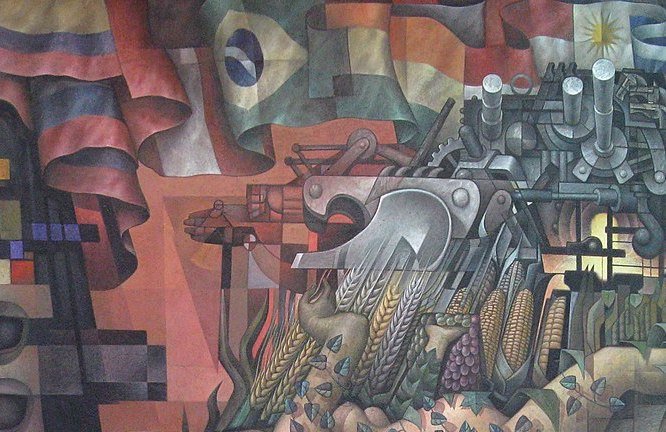
Mural at the hall of the Arts House of the University of Concepción, Chile. Photograph Source: Fotografía tomada por Farisori; Autor del mural: Jorge González Camarena – CC BY-SA 3.0

The world wants to see an end to the conflict in Ukraine. The NATO countries, however, want to prolong the conflict by increasing arms shipments to Ukraine and by declaring that they want to “weaken Russia.” The United States had already allocated $13.6 billion to arm Ukraine. Biden has just requested $33 billion more. By comparison, it would require $45 billion per year to end world hunger by 2030.

Even if negotiations take place and the war ends, an actual peaceful solution will not likely be possible. Nothing leads us to believe that geopolitical tensions will decrease, since behind the conflict around Ukraine is an attempt by the West to halt the development of China, to break its links with Russia, and to end China’s strategic partnerships with the Global South.

In March, commanders of the U.S. Africa Command (General Stephen J. Townsend) and Southern Command (General Laura Richardson) warned the U.S. Senate about the perceived dangers of increased Chinese and Russian influence in Africa as well as Latin America and the Caribbean. The generals recommended that the United States weaken the influence of Moscow and Beijing in these regions. This policy is part of the 2018 national security doctrine of the United States, which frames China and Russia as its “central challenges.”

No Cold War

Latin America does not want a new cold war. The region has already suffered from decades of military rule and austerity politics justified based on the so-called “communist threat.” Tens of thousands of people lost their lives and many tens of thousands more were imprisoned, tortured, and exiled only because they wanted to create sovereign countries and decent societies. This violence was a product of the U.S.-imposed cold war on Latin America.

Latin America wants peace. Peace can only be built on regional unity, a process that began 20 years ago after a cycle of popular uprisings, driven by the tsunami of neoliberal austerity, led to the election of progressive governments: Venezuela (1999), Brazil (2002), Argentina (2003), Uruguay (2005), Bolivia (2005), Ecuador (2007), and Paraguay (2008). These countries, joined by Cuba and Nicaragua, created a set of regional organizations: the Bolivarian Alliance for the Peoples of Our America–Peoples’ Trade Treaty (ALBA-TCP) in 2004, the Union of South American Nations (UNASUR) in 2008, and the Community of Latin American and Caribbean States (CELAC) in 2011. These platforms were intended to increase regional trade and political integration. Their gains were met with increased aggression from Washington, which sought to undermine the process by attempting to overthrow the governments in many of the member countries and by dividing the regional blocs to suit Washington’s interests.

Brazil

Because of its size and its political relevance, Brazil was a key player in these early organizations. In 2009, Brazil joined with Russia, India, China, and South Africa to form BRICS, a new alliance with the goal to rearrange the power relations of global trade and politics.

Brazil’s role did not please the White House, which—avoiding the crudeness of a military coup—staged a successful operation, in alliance with sectors of the Brazilian elite, that used the Brazilian legislature, judiciary system, and media to overthrow the government of President Dilma Rousseff in 2016 and to cause the arrest of President Lula in 2018 (who was then leading the polls in the presidential election). Both were accused of a corruption scheme involving the Brazilian state oil company, and an investigation by Brazil’s judiciary known as Operation Car Wash ensued. The participation of both the U.S. Department of Justice and the FBI in that investigation was revealed following a massive leak of the Telegram chats of Operation Car Wash’s lead prosecutor. However, before the U.S. interference was uncovered, the removal of Lula and Dilma from politics brought the right wing back to power in Brasília; Brazil no longer played a leading role in either the regional or the global projects that could weaken U.S. power. Brazil abandoned UNASUR and CELAC, and remains in BRICS only formally—as is also the case with India—weakening the perspective of strategic alliances of the Global South.

Turning Tide

In recent years, Latin America has experienced a new wave of progressive governments. The idea of regional integration has returned to the table. After four years without a summit meeting, CELAC reconvened in September 2021 under the leadership of Mexican President Andrés Manuel López Obrador and Argentine President Alberto Fernández. Should Gustavo Petro win the Colombian presidential election in May 2022, and Lula win his campaign for reelection to Brazil’s presidency in October 2022, for the first time in decades, the four largest economies in Latin America (Brazil, Mexico, Argentina, and Colombia) would be governed by the center-left, notably supporters of Latin American and Caribbean integration. Lula has said that if he wins the presidency, Brazil will return to CELAC and will resume an active stance in BRICS.

The Global South might be prepared to reemerge by the end of the year and create space for itself within the world order. Evidence for this is in the lack of unanimity that greeted NATO’s attempt to create the largest coalition to sanction Russia. This NATO project has aroused a backlash around the Global South. Even governments that condemn the war (such as Argentina, Brazil, India, and South Africa) do not agree with NATO’s unilateral sanction policy and prefer to support negotiations for a peaceful solution. The idea of resuming a movement of the nonaligned—inspired by the initiative launched at the conference held in Bandung, Indonesia, in 1955—has found resonance in numerous circles.

Their intention is correct. They seek to de-escalate global political tensions, which are a threat to the sovereignty of countries and tend to negatively impact the global economy. The spirit of nonconfrontation, and peace, of the Bandung Conference is urgent today.

But the Non-Aligned Movement emerged as a refusal by Third World countries to choose a side in the polarization between the United States and USSR during the Cold War. They were fighting for their sovereignty and the right to have relations with the countries of both systems, without their foreign policy being decided in Washington or Moscow.

This is not the current scenario. Only the Washington-Brussels axis (and allies) demand alignment with their so-called “rules-based international order.” Those who do not align suffer from sanctions applied against dozens of countries (devastating entire economies, such as those of Venezuela and Cuba), illegal confiscation of hundreds of billions of dollars in assets (as in the cases of Venezuela, Iran, Afghanistan, and Russia), invasions and interference resulting in genocidal wars (as in Iraq, Syria, Libya, and Afghanistan), and outside support for “color revolutions” (from Ukraine in 2014 to Brazil in 2016). The demand for alignment comes only from the West, not from China or Russia.

Humanity faces urgent challenges, such as inequality, hunger, the climate crisis, and the threat of new pandemics. To overcome them, regional alliances in the Global South must be able to institute a new multipolarity in global politics. But the usual suspects may have other plans for humanity.

UK: Queen’s Speech lays out brutal class war agenda and evisceration of democratic rights

Robert Stevens


Today’s Queen’s Speech, in which the government’s legislative agenda for the upcoming session of Parliament is outlined, took place amid a heightened political crisis for the ruling class. The Conservative government’s programme was a further lurch to the right, with an evisceration of democratic rights at its centre.

With Buckingham Palace citing the queen’s “episodic mobility problems”, the 96-year-old monarch was unable to attend the State Opening of Parliament to read the speech. The queen has only twice missed the ritualistic constitutional ceremony in her 70 years on the throne, both due to pregnancies, and the last time in 1963.

Instead, the deeply unpopular Prince Charles, himself 73 and next in line to the throne, gave the speech with the queen’s Imperial State Crown on a table next to him. The Palace ensured that Charles’s eldest son, Prince William, attended his first State Opening sitting alongside him.

Prince Charles sits next to the Queen's crown during the State Opening of Parliament, at the Palace of Westminster in London, May 10, 2022. Queen Elizabeth II did not attend the opening of Parliament amid ongoing mobility issues. Prince William is seated second left, and Camilla Duchess of Cornwall is seated right. (AP Photo/Alastair Grant, Pool)

With both heirs to the throne present, the state was on full alert. Sky News anchor Adam Boulton noted, “The security around Westminster is the greatest I have seen in four decades,” adding that “they’ve [police and security] sealed off all the way around the [Buckingham] Palace, as well as the Mall, and St James Park, as well as here at Westminster.”

The event took place amid NATO’s proxy war against Russia in Ukraine, in which Britain is buried up to the hilt, and as a massive political crisis affecting the major political parties rages at home.

Last week’s elections to the Northern Ireland Assembly saw the nationalist Sinn Féin win the most seats, intensifying the crisis of British imperialism both in its oldest colony and regarding its relations with the European Union and the US. The pro-British Unionist parties are demanding the scrapping of the Northern Ireland Protocol governing post-Brexit EU trade and there is little possibility of the power-sharing executive resuming. But given the threat of a constitutional unravelling and a possible trade war that would alienate Washington as well as Berlin and Paris, the Queen’s Speech could only refer in general to taking “all steps necessary” to protect Northern Ireland’s place in the UK internal market.

Since November, Prime Minister Boris Johnson’s leadership has been threatened by the Partygate scandal, after it was revealed he and other leading government officials broke COVID public health measures in place during 2020/21. But Johnson may now not be the first leader forced to stand down. Labour leader Sir Keir Starmer has been dragged into the crisis in the “Beergate” scandal, with Durham police launching an investigation into whether he also breached rules during a political campaign event in the north east of England. Just 24 hours prior to Parliament opening, Starmer announced that if he is fined he will resign along with his deputy, Angela Rayner—following his repeated calls demanding Johnson’s resignation.

Labour leader Sir Keir Starmer (left) and Boris Johnson walk to the House of Lords to hear the Queen's Speech (Credit: UK Parliament Jessica Taylor)

The government’s response was to throw “red meat” to satisfy the Tory Party’s right-wing constituency and the capitalist class demanding an escalation in the offensive against the working class.

Despite Johnson’s “levelling up” mantra, there was not a single concession to workers being hammered by more than a decade of grinding austerity. In what was presented as the first “post-COVID” Queen’s Speech by a government that has overseen almost 200,000 deaths, what was tabled was a deepening of the onslaught to be imposed by repressive measures.

The speech contained 38 bills to be legislated, including a Public Order Bill, which, building on the newly passed Police, Crime, Sentencing and Courts Act, effectively ends the right to protest. All protests “interfering with key national infrastructure” such as airports, railways and newspaper printing presses, will be outlawed, with prison sentences of up to 12 months. Any person blocking the construction of major transport projects such as the HS2 high-speed train network faces six months in prison.

“Locking on”, where environment protesters glue themselves to roads and structures, will incur a maximum penalty of six months’ imprisonment and an unlimited fine. People deemed to have come equipped to lock on will also be hit with a fine.

Justice Secretary and Deputy Prime Minister Dominic Raab has authored a grotesquely named Bill of Rights to “restore the balance of power between the legislature and the courts”, which will repeal the Human Rights Act introduced in 1998 by the Blair Labour government. The government cynically announced Raab’s Bill would curb “the incremental expansion of a rights culture without proper democratic oversight”.

Law Society president Stephanie Boyce warned, “If the new Bill of Rights becomes law, it would make it harder for all of us to protect or enforce our rights. The proposed changes make the state less accountable. This undermines a crucial element of the rule of law, preventing people from challenging illegitimate uses of power.”

Whatever remains of any European Union-based legislation that hinders the untrammelled operations of big business is to be shredded under a Brexit Freedoms Bill. The Independent noted, “The legislation will also remove the principle of supremacy of EU law, which still applies to 2,376 acts of parliament passed before Brexit.” The Bill allows the amendment or repeal of many laws by using “secondary legislation”, to be enacted by ministers without full parliamentary scrutiny.

Among other incoming legislation is a media bill facilitating the privatisation of Channel 4 Television, a precursor to the eventual privatising of the main state broadcaster the BBC, a long-time aim of the Conservatives.

A measure aimed at bolstering the Israeli apartheid state will prevent public bodies from boycotting certain countries, i.e., Israel.

Further laws to be enacted include a national security bill, which will tighten the official secrets law and require lobbyists and PRs to register any work carried out for foreign states.

The Great British Railways Act will see the state offering the private sector train-operating companies guaranteed returns. It lays the basis for intensifying attacks on railworkers’ conditions. Another law will require all vessels operating at UK ports, specifically ferry companies, to pay employees the minimum wage, in effect laying the basis for a permanently low paid workforce.

The Queen’s Speech is a declaration of war against the working class by a ruling elite that is shoveling unlimited financial resources into a proxy war against Russia, threatening a nuclear conflict. This is to be paid for by workers through an assault on their jobs, pay, terms and conditions and access to the basics of life including health care, education and housing.

In response, Starmer cynically called for the government to address the raging cost of living crisis as inflation races towards 10 percent. Johnson said only that he would address this “in the days to come”. This will consist of a few sops doing nothing to address the social distress impacting millions of people who can no longer afford to live. It may include making a grant of the £200 energy bills loan being made available to households from October. To put this into perspective, a household using a typical amount of gas and electricity will by then be paying up to £2,600 annually.

Millions already cannot even afford to eat properly. Research published this week by the Food Foundation reveals that almost 5 percent of households, or 2.4 million adults, had not eaten for a whole day during the last month. More than one in 10 households (6.8 million adults) had eaten smaller meals than usual or skipped meals because they could not afford or access food. Some 2.6 million children live in households that do not have access to a healthy and affordable diet, which puts them at high risk of diet-related diseases.

In this situation, that a sated ruling elite with no significant social base to govern can offer nothing except militarism, war and repression points to a society headed for a social explosion.