20 May 2022

More than 1,000 COVID-19 deaths in New Zealand

Tom Peters


This week New Zealand’s total COVID-19 death toll passed 1,000, reaching 1,039 today.

The stark reality is that hundreds and hundreds of people are dead who would still be alive if the Labour Party-led government had maintained its zero COVID policy, instead of switching to the homicidal program of mass infection.

Wellington Hospital

Acting on the instructions of the corporate and financial elite, the government has put an end to lockdowns and reopened all schools and nonessential businesses. As in every country, the pro-capitalist trade unions played a key role in preventing any organised opposition from the working class to this criminal agenda.

Last October, when Prime Minister Jacinda Ardern announced the change in policy—without any pretence of consulting the population, and going against the advice of public health experts—New Zealand had recorded only 32 deaths from the pandemic. Since then, the toll has increased about thirty-fold. The vast majority of the country’s infections and deaths took place following the start of the school year in February.

More than 1 million COVID-19 cases have been officially recorded, that is, one in five people, but disease modeler Dion O’Neale told Radio NZ this week that “probably by this point around half of the population, very roughly, have been infected.” As in every country except China, there is no effort made to systematically test non-symptomatic people. Testing is now being left up to individuals, who must obtain their own, notoriously unreliable, rapid antigen test kits.

On May 14, Ardern herself tested positive for COVID and went into isolation, after her partner tested positive about a week earlier.

The government’s response to the surging death toll was grotesque. In a statement on May 18, COVID-19 Response Minister Chris Hipkins dishonestly declared, “We recognise the pain of losing a family member or friend, and do not wish to diminish that.” He then proceeded to boast about New Zealand’s relatively low number of deaths.

He claimed that the death rate in New Zealand has not exceeded that of the previous two years of the pandemic, and “this reflected the benefits of our COVID-19 response in reducing exposure to the virus and protecting our more vulnerable New Zealanders.” 

Associate Minister Dr Ayesha Verrall added that “if New Zealand had a similar rate of COVID-19 mortality as the United States, we would be reporting approximately 15,000 deaths from COVID-19 today.”

The ministers did not mention the obvious fact that the country’s relatively low toll is due to public health measures which have now been removed. Along with reopening the economy, the government has ditched mandatory masking in schools, dismantled contact tracing systems, ended vaccine mandates and passes, and closed border quarantine hotels.

Just 2.6 million people have received a third (or booster) dose of the Pfizer vaccine—slightly more than half the population—leaving millions of people without substantial protection from severe disease. Vaccination alone is not enough to prevent significant numbers of deaths. According to the Ministry of Health, out of 967 deaths, 261 (26.9 percent)​ had received two doses of vaccine and 488 (50.4 percent)​ had received three.

According to the Worldometers data aggregation website, New Zealand recorded 112 deaths in the last seven days, a rate of 22 per million. This is the fifth-highest death rate in the world—higher than anywhere in Europe except Finland and Iceland (which are ranked third and fourth). By comparison, in the same period the UK recorded 16 deaths per million, and Australia 12.

In addition to the deaths, more than 10,000 people have received hospital treatment for COVID, including 714 children under 10 years of age. There is no end in sight. As New Zealand heads into winter, experts are predicting a further surge in hospitalisations and deaths, brought about by a combination of COVID, influenza and the respiratory virus RSV.

A recent report by the International Science Council, led by New Zealand’s former chief scientist, Professor Sir Peter Gluckman, predicted that in 2027 there would still be regular surges of COVID-19 worldwide, due to the failure of governments to stop the virus. The report noted that, in addition to more than 15 million deaths, about one in 10 people who are infected develop long-term debilitating symptoms from Long COVID—which can affect the brain, lungs, heart and other organs.

The University of Otago’s Dr Ross Griffiths has predicted that at least 200,000 people in New Zealand could develop Long COVID. That is based on an estimate of 2 million people infected, meaning the real numbers suffering from long-term symptoms could be even higher.

Hospitals, which were understaffed and overstretched before the pandemic, have been thrown into crisis, with 10 to 15 percent of staff becoming sick, and wards overwhelmed with patients. These conditions, along with the soaring cost of living, are driving workers into struggle—including 10,000 healthcare workers who held a nationwide strike on May 16.

The government has no response, other than telling people to get used to endless waves of illness and death. Minister Hipkins told the media this week that COVID is “not going to go away as a health condition. It is going to be something we live with over the medium to long-term.”

Hipkins, who is also the education minister, has downplayed the mass infection of children in schools as something families should just accept. He told Newsroom on May 18: “I really don’t think parents should be as anxious about that as some are—a proportion of children will get COVID, that’s just the reality of living in a community where COVID is circulating.” He said people expressing concern about the virus ripping through schools were “catastrophising.”

The claim that children being infected is nothing to worry about is an outrageous lie aimed at justifying the ruling elite’s “let it rip” agenda. Hipkins is foreshadowing a crackdown on “truancy,” targeting large numbers of parents—including many with diabetes, asthma and other health conditions—who have decided to keep their children at home out of entirely justified fears that they will get COVID and spread it to the rest of the household.

Over 100 monkeypox infections detected in 10 countries as unprecedented outbreak spreads globally

Benjamin Mateus & Evan Blake


An unprecedented outbreak of monkeypox virus has officially spread to 10 countries outside of Africa, with 107 confirmed or suspected cases reported as of this writing, in the United Kingdom (9 cases), Portugal (34), Spain (32), France (1), Belgium (2), Sweden (1), Italy (3), Canada (22), the United States (2), and Australia (1).

Much remains unknown about what is causing the outbreak, which is the most geographically dispersed and rapidly spreading monkeypox outbreak since the virus was first discovered in 1958. In the coming days and weeks, more data and scientific understanding will emerge, but already there is profound concern within the scientific community and among the public, which has found wide expression on social media.

In preliminary posts, scientists speculate that the virus, which is endemic in parts of Africa, could have evolved to become more contagious and better suited to human-to-human transmission. In addition, nearly all people under 42 years old have not received a smallpox vaccine (which is 85 percent effective at preventing monkeypox infection) since smallpox was eradicated in 1980. As a result, they have no immunity, and younger adults can be infected as easily as children. Since 2017, annual monkeypox cases have been steadily rising in Africa.

The fact that this monkeypox outbreak takes place amid the deepening COVID-19 pandemic has caused unease among a growing number of people, particularly those who have been alerted to threats to public health by the COVID pandemic. Over the past two years, the criminal negligence and policies of deliberate mass infection by the majority of world governments have needlessly killed over 20 million people worldwide. If capitalist society has disastrously failed to stop the preventable spread of COVID-19, what will transpire in the coming weeks and months with new or previously rare infections?

Since the peak of the global Omicron BA.1 surge in January, nearly every government outside China has scrapped all mitigation measures to slow the spread of COVID-19, falsely claiming that the virus has become “endemic.”

In the US, the Biden administration is presently doing nothing to stop the growing surge of the highly infectious Omicron BA.2 and BA.2.12.1 subvariants, which have once again driven the 7-day average of daily new cases above 100,000.

Due to the deliberate undermining of public health during the COVID-19 pandemic, world society is deeply unprepared for this latest infectious disease outbreak, which could potentially develop into another parallel global pandemic.

On May 13, the World Health Organization (WHO) was first notified of two confirmed and one probable case of monkeypox in the same household in the UK. A British citizen who traveled to Nigeria developed a classic monkeypox rash on April 29, and subsequently returned to the UK on May 4, is considered a likely index case. Upon his return, he was immediately isolated and contact tracing identified chains of transmission, though health authorities indicated that onward risk of infections from this case is minimal. The source of infection in Nigeria has not been determined.

Regarding the UK cases, the WHO has stated, “In contrast to sporadic cases with travel links to endemic countries, no source of infection has been confirmed yet. Based on currently available information, infection seems to have been locally acquired in the United Kingdom.”

The emergence of multiple cases across different countries is deeply problematic. Dr. Jennifer McQuiston, the Deputy Director of the US Centers for Disease Control and Prevention (CDC) division of high consequences pathogens and pathology, told STAT News, “Given that we have seen now confirmed cases out of Portugal, suspected cases out of Spain, we’re seeing this expansion of confirmed and suspect cases globally, we have a sense that no one has their arms around this to know how large and expansive it might be. And given how much travel there is between the United States and Europe, I am very confident we’re going to see cases in the United States.”

Michael Osterholm, director of the University of Minnesota’s Center for Infectious Disease Research and Policy, added his concerns, stating, “There could be dynamic transmission here that we just haven’t appreciated because of the potential number of contacts.”

In nearly every public statement by epidemiologists, they have all admitted to being bewildered by how entrenched the virus already is in communities, given that it is normally extremely rare. Tom Inglesby, director of the Johns Hopkins Center for Health Security, told STAT News, “this is starting off with much more of a foothold, in a much more distributed way, and we don’t understand how it got into those networks.”

The monkeypox virus was first identified by Danish virologist Preben von Magnus in 1958 from crab-eating macaque monkeys used as laboratory animals, hence the name of the disease and the virus that causes it. Unlike the single-stranded RNA-based SARS-CoV-2, the virus that causes COVID-19, the monkeypox virus is a double-stranded DNA zoonotic virus, one of the human orthopoxyviruses that includes the variola virus which causes smallpox.

The incubation period lasts about one to two weeks and symptoms of overt infection begin with fever, headache, fatigue, muscle aches and swollen glands. After a few days of high fever, distinct lesions appear, first on the face before spreading to other parts of the body. The lesions begin flat, then raise, containing fluid and pus. The lesions then scab over and can leave scars. The course of illness usually takes two to four weeks.

Close-up of monkeypox lesions on the arm and leg of a female child in Bondua, Grand Gedeh County, Liberia. http://phil.cdc.gov (CDC's Public Health Image Library)

According to the WHO, human-to-human transmission is normally limited, requiring close contact with respiratory secretions or skin lesions of an infected person or recently contaminated objects. Saliva and respiratory droplet transmission are possible, placing health care workers and their family members at risk of infection. Some studies have shown that monkeypox could potentially be airborne, similar to SARS-CoV-2, although this has not been definitively proven.

Asymptomatic transmission is theoretically possible. Patients with monkeypox can suffer from secondary infections, respiratory distress, gastrointestinal disturbances, vision problems, and brain inflammation. Treatment is supportive.

The number of severe side-effects of the smallpox vaccine makes its use in a mass vaccination campaign problematic. However, due to the long incubation period for monkeypox, the smallpox vaccine can work as a post-exposure prophylaxis in a “ring vaccination” model.

Monkeypox is endemic to Central and West Africa and found mainly in the rainforest regions. There are two natural groups of viruses split into clades (groups with common ancestry) from the Congo Basin and West Africa. The first human transmission was reported in 1970 in the Democratic Republic of the Congo (DRC, then known as Zaire) in a nine-year-old boy in a region where smallpox had been eliminated two years earlier.

Since its emergence in human populations, monkeypox outbreaks have been primarily limited to the African continent. In a World Health Organization (WHO) surveillance between 1981 and 1986 in the DRC, 338 confirmed cases and 33 deaths gave the Congo Basic clade a case fatality ratio of roughly 10 percent, similar to SARS-CoV-1. The clade that has caused the current outbreak in Europe and North America is the milder West African clade, with a fatality rate comparable to SARS-CoV-2.

The first monkeypox outbreak outside Africa occurred in the Midwest of the US in the spring of 2003. The zoonotic source was pet prairie dogs that had been infected by African rodents brought in from Ghana. Since then, there have been more frequent reports of cases across the globe.

An outbreak in Nigeria that started in 2017 has been ongoing. The UK reported its first case of monkeypox in September of 2018 from a Nigerian national, and three additional cases were identified that winter. In May 2019, a middle-aged man traveling from Nigeria was hospitalized with monkeypox in Singapore.

Amid the COVID-19 pandemic, three cases in a UK household with connection to Nigeria were identified on May 24, 2021. On July 16, 2021, an American traveling from Nigeria was hospitalized.

A report published in the CDC’s Emerging Infectious Diseases in April 2021, by Dr. Raina MacIntyre of the Kirby Institute in New South Wales, Australia, detailed the emergence of monkeypox in Nigeria, noting, “[t]he effect of a decline in individual-level immunity among vaccinated persons, as well as population growth in the [smallpox] postvaccination era, has substantially reduced the overall population immunity level within the past 45 years.”

Critical to the current global outbreak of monkeypox was the ending of the mass vaccination program for smallpox after it was eradicated in 1980, leaving the youngest in the population susceptible to monkeypox.

MacIntyre et al. wrote, “This contemporary susceptible population is composed mainly of working adults who maintain wider social contact and are more likely to engage in activities that include risk of animal exposures, such as hunting, farming, or trading bush meat. In addition, the expanding unvaccinated population means that entire households are now susceptible to monkeypox instead of just children, which enhances the risk of human-to-human transmission. In fact, the index case in 2017 was part of a five-member family cluster of cases.”

These observations for the Nigerian population are just as applicable to the global population. In a world deeply interconnected by travel and commerce, local outbreaks in one country are no longer isolated events.

As with COVID-19, the emergence of monkeypox and the lack of any internationally coordinated response by health authorities to address the crisis speaks to a much broader decay of public health precautions under the impact of the deepening crisis of capitalism.

The past two years of the COVID-19 pandemic and the deepening propaganda campaign that workers must “learn to live the virus” underscores the inability of capitalism to protect the lives and livelihood of the world’s population against any such threat.

Biden administration pushes for NATO accession of Finland, Sweden, as Senate passes $40 billion aid package for Ukraine

Clara Weiss


Following the defeat of the Ukrainian army in Mariupol on Tuesday, a city of great strategic significance in the Ukraine war, the American ruling class is taking further steps to prolong and expand its proxy war with Russia in Eastern Europe. 

On Thursday, the Senate voted 86-11 in favor of a massive $40 billion aid package for Ukraine. All votes against the bill came from the Republican right. The bill brings the total US aid for Ukraine in just over the past two months to $54 billion. It has been rammed through above all by the Democrats, all of whom support the unprecedented US arming of Ukraine’s army and fascist forces and the stifling of any public discussion about its implications. Once US President Joe Biden signs the bill, it will go into effect.

A few hours before the Senate vote, Biden held a joint press conference with Finland’s President Sauli Niinistö and Sweden’s Prime Minister Magdalena Andersson, both of whom had just applied for NATO accession. In the press conference, Biden provided yet another display of the extraordinary recklessness and arrogance that now dominate the highest levels of the American state. 

Following objections by Turkey, a NATO member, against the accession of Finland and Sweden and warnings by the Kremlin that Russia will be forced to respond with appropriate “military technical means” to such a step, Biden effectively declared that the US will do everything to ensure the fastest possible accession of both countries to the military alliance.

The US president emphasized that both countries had the “the full, total, complete backing” from the US for their membership requests. He also all but acknowledged that Washington had been the principal driving force behind the move of Finland and Sweden to join NATO. According to Biden, discussions with Finland’s Sauli Niinistö already took place last December; further meetings took place in the weeks leading up to Russia’s invasion of Ukraine and then again in March. “We’ve consulted closely at every stage,” the US president stated.

Clearly, the plans for Finland and Sweden to join the alliance had been made well before Russia launched its invasion of Ukraine—an invasion that NATO has worked to provoke for years and is now exploiting the long-awaited pretext to realize plans for massive rearmaments and a direct military confrontation with Russia. 

Biden thanked Democratic Party leaders for helping “to move this to the Senate as quickly as possible” and announced that the White House would submit a bill to Congress later that day to approve the request by Sweden and Finland. 

He also reiterated that the US was committed to Article 5 of the NATO treaty which obliges all NATO countries to help a member in case of a military attack. The US will “defend every inch of NATO territory,” Biden said. The US president stressed that Finland’s and Sweden’s request to join NATO underscored that “NATO’s door remains open.”

For years, Ukraine has sought admission to the alliance. A guarantee that NATO not admit Ukraine was one of the main security guarantees that the oligarchic Putin regime demanded—and was denied—before it decided to invade Ukraine. 

Finnish President Sauli Niinistö, for his part, stressed that the Finnish army was “one of the strongest in Europe,” while Swedish Prime Minister Magdalena Andersson promised that her country would “reach 2 percent of GDP [for military spending] as soon as practically possible.” Both indicated that they counted on their countries joining NATO in a “swift” process and said that they were in the process of conducting negotiations with all NATO members, including Turkey, now and over “the coming days.” 

The Senate vote and the demonstrative press conference on Thursday are calculated moves to further escalate the NATO proxy war in Ukraine in the wake of Russia’s seizure of the strategic port city of Mariupol in the southeast of the country. Mariupol had been under siege by Russian forces for almost three months with both Russia and Ukraine focusing much of their military fighting power on gaining control over the city. The neo-Nazi Azov Battalion, which has been fully integrated into the Ukrainian army, played the central role in the Ukrainian military’s combat operations against Russian troops and were the last to surrender at the Azovstal factory.

Now, according to Russian press reports, over 1,800 Azov fighters have surrendered. The Putin regime, which itself appeals to Russian far-right forces and Great Russian chauvinism, is exploiting its military victory in Mariupol to bolster its own war propaganda, in which the Kremlin falsely portrays its reactionary war for security guarantees from the imperialist powers as a fight against fascism.

The victory in Mariupol also strengthens Russia’s military and strategic position after three months in which the Russian army has suffered catastrophic military losses, including thousands of soldiers, several generals and the flagship of its Black Sea fleet, the Moskva. With control over Mariupol, Russia can establish a land bridge in eastern Ukraine, connecting the Crimean Peninsula in the Black Sea, which Russia annexed in March 2014 after the US-backed coup in Kiev in February, and the territories around Donetsk and Lugansk, where fighting still continues to range.

From both a military but also a political standpoint, the loss of Mariupol is, thus, a significant blow to the Kiev regime and its war strategy. As of 2020, far-right paramilitary forces made up some 104,000 troops, or 40 percent, of the Ukrainian army. Azov, which has been headquartered in Mariupol since 2014, is by far the largest of them. 

The Azov Battalion has also played a major role in the propaganda of the Kiev regime and the imperialist powers which have consistently portrayed them as “heroes” and the best defenders of Ukraine. Now, the pro-imperialist media is doubling down on the legitimization of these Hitler-admiring fascists. 

The Washington Post on Thursday ran a editorial declaring that the Azov Battalion had been “reformed” and that they “deserve the accolades they are receiving from their government.” In fact, the neo-Nazi orientation of the Azov Battalion is beyond dispute. It openly places itself in the tradition of the Nazi collaborators of the Organization of Ukrainian Nationalists, which murdered tens of thousands of Jews and Poles in World War II and uses symbols and emblems that hail back to Nazi formations like the SS. The founder of the Azov Battalion, Andrei Biletsky, publicly called for a “crusade of the white nations of the world against the Semitic-led sub-humans.”

It is not despite but because of the Azov Battalion’s fascist orientation that they have been built up by the Ukrainian state and the imperialist powers as shock troops in the war against Russia. Fascists from around the world have been encouraged to join Azov in Ukraine, and a good portion of the tens of billions of NATO weapons and tanks that have been pouring into the Ukrainian army are ending up in their hands. 

With the push for the NATO accession of Sweden and Finland and the gigantic $40 billion aid package, Washington is signaling unambiguously that the response of US imperialism to this setback is not a return to the negotiating table but a further escalation of its proxy war with Russia.

Commenting on the implications of the expansion of NATO to Scandinavia, Nikita Liponuv noted in the Kremlin think tank magazine Russia in Global Affairs that the Kremlin had “for many years” warned Finland and Sweden “publicly and privately about the military-political consequences of joining the alliance.”

With Finland and Sweden in NATO, Liponuv warned, the Baltic Sea would effectively become territory controlled by NATO. The alliance’s border with Russia will double in size and “the entire region is becoming another theater of confrontation between Russia and the West. … In the long-run, we can forget about a nuclear-free Northern Europe.” 

He continued, “The accession of the two Nordic countries to the alliance will affect the politico-military situation not only in Europe, but also in the Arctic: Seven of the eight permanent members of the Arctic Council will represent NATO. The trend among Western Arctic powers to increase defense spending and military buildup in the High North, which began even before the escalation of the Ukrainian crisis, will continue and may intensify.” 

Tax documents reveal Black Lives Matter improperly spent tens of millions in donations

Trévon Austin & Barry Grey


The Associated Press reported on May 17 that tax filings for fiscal 2020 by the Black Lives Matter Global Network Foundation (BLMGNF) list millions of dollars paid to entities controlled by relatives and close associates of then-Executive Director and co-founder Patrisse Cullors.

The filings with the Internal Revenue Service are the first and to date only public disclosures of the Black Lives Matter foundation’s finances. They show that the “non-profit” took in $76,872,002 in fiscal 2020, mainly in donations from corporate backers and individuals, and paid out $25,997,945 in grants to other non-profits and contractors.

Patrisse Cullors, co-founder of Black Lives Matter [Wikimedia Commons]

Cullors, the only BLMGNF board member listed on the 63-page filing, resigned as executive director in June of 2021. She did so just weeks after two mothers of victims of police violence—Lisa Simpson, the mother of 18-year-old Richard Risher, killed by Los Angeles police in 2016, and Samara Rice, the mother of 12-year-old Tamir Rice, killed by Cleveland police in 2014—released a statement demanding that BLMGNF stop exploiting the deaths of their children to make money.

They wrote: “We don’t want or need y’all parading in the streets accumulating donations, platforms, movie deals, etc. off the death of our loved ones, while the families and communities are left clueless and broken. Don’t say our loved ones’ names, period!”

The same month as the mothers’ statement was published, the New York Post revealed that Cullors and her wife had purchased four properties worth approximately $3 million between 2016 and 2021.

Last month, New York Magazine reported that in October 2020 the organization spent $6 million of donated money to purchase a mansion in Southern California. The 6,500 square foot property, with seven bedrooms and bathrooms, a sound stage, music studio and pool, was supposedly bought to serve as a “safe house” and headquarters for BLM leaders to create social media content.

Last June, Cullors and two other BLM leaders, Alicia Garza and Melina Abdullah, recorded a video outside the mansion to mark the first anniversary of the police murder of George Floyd.

According to the fiscal 2020 tax filings, BLMGNF’s biggest payout—$2,167,894—went to the Bowers Consulting Firm, which is owned by current BLMGNF board member Shalomyah Bowers. Defending his lucrative take, Bowers called Black Lives Matter “the largest black abolitionist nonprofit organization that has ever existed in the nation’s history.”

Los Angeles-based Trap Heals LLC, owned by Damon Turner, received $969,459 for “live production, design and media.” Turner, a rapper and artist, is the father of Cullors’ son.

The BLM foundation also paid $840,993 to Cullors Protection LLC, a company owned by Patrisse Cullors’ brother Paul and established in July 2020.

Kailee Scales, a consultant whose name appears on the original Delaware registration of BLMGNF, was paid $139,625.

According to the tax filings, the Black Lives Matter foundation still has more than $50 million in donations. It invested $32 million of that in the stock market.

Cullors gave an exclusive interview to MSNBC in an attempt to clear her name. She said that BLM was unprepared for the rush of donations and complained that her “mistakes” were being weaponized against her.

Her mistake was failing to conceal the blatant self-dealing, nepotism and corruption of BLMGNF. She and her cronies have enriched themselves by fraudulently portraying their operation as a movement in defense of oppressed African Americans and in opposition to police brutality.

This is not simply a matter of individual moral depravity, although there is plenty of that. It has rather a broader social and political significance. Exposed here is the reactionary character of racial politics and the right-wing social interests it serves.

The grasping proponents of black capitalism are massively promoted and subsidized by sections of the corporate elite, the so-called “liberal” media and the Democratic Party. They are well paid for services rendered in promoting racial divisions and obscuring the common class interests of all workers.

Germany’s Left Party in free fall

Peter Schwarz


The Left Party is in free fall. Since March last year, it has lost massively in seven consecutive state elections. In western Germany, it is now only represented in the state parliaments of the city-states of Hamburg and Bremen and the more sparsely populated state of Hesse.

In the federal elections last September, the vote for the Left Party fell from 9.2 to 4.9 percent (below the 5 percent hurdle for a party slate) and it only managed to return to parliament thanks to winning three individual mandates. In Saarland, it plummeted from 12.8 to 2.6 percent at the end of March. In North Rhine-Westphalia, it lost two-thirds of its voters last Sunday, falling well short of entering the state parliament with 2.1 percent. Among workers, only one percent voted for the Left Party, although the Social Democratic Party (SPD) also achieved its historically worst result.

The Left Party leadership at the Luxemburg-Liebknecht Memorial Day 2022: Federal Executive Director Jörg Schindler, Chairwoman Janine Wissler, Parliamentary Group Chairwoman Amira Mohamed Ali and Dietmar Bartsch (Photo: Die Linke/Martin Heinlein/CC-BY 2.0)

The decline of the Left Party is good news. Its claim to represent left-wing or even socialist politics has always been a fraud. Since it emerged from the Stalinist state party of the German Democratic Republic (GDR, formerly East Germany) in 1990 under the name Party of Democratic Socialism (PDS), it has professed unreserved support for capitalism and sought to block and stifle any expression of social and political opposition.

In doing so, it worked closely with the trade unions and—since the founding of the Left Party in 2007—with renegade social democrats led by the former Saarland prime minister, SPD leader and federal finance minister Oskar Lafontaine. Wherever it has had the opportunity to put its policies into practice, it has proved to be as anti-social, ruthless and pro-capitalist as all the other bourgeois parties.

Its role in the “Red-Red” (SPD-Left Party) Berlin Senate (state executive) from 2002 to 2011 is notorious. While the SPD and Greens pushed through the Agenda 2010 and Hartz laws—welfare and labour “reforms”—at the federal level, the SPD and PDS/Left Party in Berlin destroyed a third of public sector jobs, cut wages and social benefits, privatised hospitals and sold off 150,000 publicly owned apartments to property sharks. The Left Party's government record in other federal states is similar.

Since the 2008 financial crisis, the party has found it increasingly difficult to reconcile its left-wing rhetoric with its right-wing policies. The banks and the rich were 'rescued' with billions of euros, while the working class had to foot the bill in the form of falling wages, social cuts and dilapidated schools and hospitals. The Left Party supported all these policies.

In 2009, the party achieved its best federal election result with just under 12 percent. Since then, with occasional fluctuations, it has only gone downhill. Its number of voters and members declined, internal quarrels increased.

One wing, led by Katja Kipping and the pseudo-left Marx 21 (aligned with the Socialist Workers Party in Britain), turned to identity politics and other hobbyhorses of the affluent urban upper middle class. Another, personified by Sahra Wagenknecht, competed with the far-right Alternative for Germany (AfD) on nationalism and xenophobia. Still others, personified by Dietmar Bartsch, leader of the parliamentary group in the Bundestag (federal parliament), and Bodo Ramelow, prime minister of Thuringia, were interested above all in retaining power and sought the closest possible proximity to the SPD and Christian Democratic Union (CDU).

Support for the Ukraine war

The war in Ukraine has now finally exposed the pro-imperialist character of the Left Party. Its founder Gregor Gysi originally even wanted to support the federal government's €100 billion rearmaments programme, but was unable to get his way, for the time being. Parliamentary faction leader Bartsch attacked the “traffic light coalition” of the SPD, Liberal Democrats (FDP) and Greens in the Bundestag from the right, accusing it of failing to enforce sanctions against Russian oligarchs.

On the eve of the North Rhine-Westphalia state elections, federal party leader Jörg Schindler angrily attacked an upcoming event that was mildly critical of NATO. Asked by the moderator of broadcaster ZDF’s 'Berliner Runde' programme about the 'Living without NATO—Ideas for Peace' congress, in which pacifists and bourgeois journalists as well as some members of the Left Party will participate, Schindler indignantly distanced himself from it.

'I can explicitly say that this is not the position of our party,' he stressed. 'Our party has a clear position on the issue of the Ukraine war. We criticise and condemn Putin's war of aggression. It is as simple as that, and there is nothing else to say.'

The statement calling for the congress, which takes place in Berlin on May 21, explicitly calls Russia's war of aggression against Ukraine 'contrary to international law.” All it advocates is a negotiated settlement and 'compromises without loss of face for either side.”

The Left Party has convened a party congress in Erfurt for June 24 to elect a new leadership and—in the name of overcoming the “self-destructive processes and substantive blockades”—to pledge the party to NATO’s war course. To this end, the party executive has submitted a lead motion which completely supports NATO propaganda.

For years, Russia had “been pursuing a policy aimed at keeping the post-Soviet states under Russia's influence: By attempting to establish authoritarian vassal regimes or, where that fails, to destabilise the states,” it reads.

Russia was “one of the geostrategic power centres in fossilised capitalism, in which different actors fight for access to resources and spheres of influence, also by means of war.” The country pursued “an imperialist policy” which was “legitimised vis-à-vis its own population by a nationalist, militarist and autocratic great power ideology.”

The systematic expansion of NATO towards Russia and the coup in Ukraine supported by the US and Germany, which brought a pro-Western regime to power in 2014 with the help of right-wing militias and laid the seeds for the current war, are not mentioned, let alone condemned, in the lead motion.

Instead, the Executive Committee exercises self-criticism. 'After the end of the Cold War, the Western states, with their overwhelming economic and military power and NATO, have often (see the Kosovo or Iraq wars) disregarded institutions such as the UN and international law,' it says in the lead motion. This had been the focus of the Left Party's criticism. “Too little attention was paid to imperial wars beyond NATO, such as Russia's military interventions in Chechnya and Syria.”

The motion supports economic warfare against Russia, which is a central part of the NATO offensive. Victory over Russia is not to be achieved through arms deliveries, but through tightening sanctions: “Sanctions must be directed against the economic power base of the Putin system, the concentration of wealth in the hands of a few. The German government must fulfil its responsibility to freeze these assets of Russian oligarchs in the national and European framework.”

In fact, the sanctions and the rearmament of Ukraine—the US alone has approved $53 billion in military aid since the war began—serve the same goal: to inflict a crushing defeat on Russia and create the conditions for its disintegration and submission to the imperialist powers.

The US media speak this openly. The Washington Post, for example, recently condemned the—supposed—efforts of France, Germany and Italy to end the bloodshed through a ceasefire. “The risks of reducing pressure on Mr. Putin before he is thoroughly defeated, and perhaps not even then,” were too high, it says. The desire of Paris, Berlin and Rome “to shorten this destructive war—and thus limit the damage both to Ukraine and to their own badly battered economies,” should not stand in the way of that goal, it continues.

In other words, to “thoroughly defeat Putin” and subdue Russia, NATO is prepared to bleed Ukraine dry in a months-long war and risk a nuclear third world war.

Pacifist phrases

But it would not be the Left Party if it did not try to cover up its support for imperialist war policy with moral appeals and calls for peace addressed to the imperialist powers and institutions responsible for the war.

With a raised finger, the lead motion warns NATO that its attempts to “install a 'new world order” had “failed many times, often with disastrous consequences.” The “spiral of worldwide rearmament and the use of war as a means of enforcing hegemonic interests” was “dangerous as hell.” The motion calls for “a global peace order involving all actors,” to be achieved, among other things, by strengthening the International Criminal Court and the UN.

What a bankrupt perspective! Since the dissolution of the Soviet Union 30 years ago, the US has been waging war almost continuously with the declared aim of defending its position as the “sole world power” and preventing the rise of China. In the process, it and its NATO allies have destroyed Iraq, Afghanistan, Libya and Syria, as well as numerous other countries, and militarily surrounded Russia.

German imperialism reacts to all this by returning to a great power policy itself and fervently rearming. The Left Party supports this policy while blathering about a new “peace order” in the manner of a priest blessing the cannons while quoting the Sermon on the Mount.

Fortunately, more and more people are seeing through this deception, as the decline of the vote for the Left Party shows. The only way to stop the Ukraine war and prevent a nuclear catastrophe is through an independent movement of the international working class, which is being forced to bear the brunt of militarism.

This does not mean support for Putin and his regime. On the contrary, Putin's reaction to NATO’s encirclement of Russia is as short-sighted as it is reactionary and plays into the hands of NATO. It is the response of a regime of oligarchs who have plundered the social property of the Soviet Union and are irreconcilably opposed to the working class.

The overthrow of Putin is the task of the Russian working class. The same applies to the right-wing regime and the working class of Ukraine. The Russian and Ukrainian workers need the support and solidarity of workers throughout Europe, the USA, and the whole world in this.

The objective conditions for such a movement are developing rapidly. All over the world, workers are rebelling against the social consequences of the war and the capitalist crisis: inflation, hunger, job losses and growing exploitation--a movement that is increasingly taking open forms against capitalist rule.

UK: Johnson government calls for slashing 90,000 civil service jobs

Paul Bond


UK Prime Minister Boris Johnson has signaled massively stepped-up austerity measures, calling for 90,000 civil service jobs to be cut.

He made the call to cabinet colleagues last week, before outlining his plans to the Daily Mail. The head of one department later apologised to staff that they had learned of the jobs massacre “from the media rather than from me or civil service leaders.” 

Johnson has tasked cabinet ministers with reducing civil service staffing by one fifth. There are currently 475,000 full-time employees of the civil service across the country. Cabinet ministers have been given one month to submit proposals for their own departments, with two years for implementation. No announcements have yet been made about which departments will face the heaviest losses. 

The “civil service” covers every aspect of public service and government policy support, including welfare benefits, passports, vehicle registration, border control and prisons. 

Johnson is talking about a further wholesale assault on social provision, packaged as a move to help those struggling with the cost-of-living crisis. He has hinted that the £3.5 billion saved annually by the job cull could be used to fund tax cuts. 

In typical fashion, Johnson is appealing to the most selfish social layers in the upper middle class, claiming, “Every pound the government pre-empts from the taxpayer is money they can spend on their own priorities, on their own lives.” 

Britain's Brexit Opportunities and Government Efficiency Secretary Jacob Rees-Mogg arrives for a regional cabinet meeting at Middleport Pottery in Stoke on Trent, England, Thursday, May 12, 2022. (Oli Scarff/Pool Photo via AP)

Cabinet Office minister Jacob Rees-Mogg has joined Johnson’s call for civil service staffing to return to 2016 levels. At that point, after five years of austerity under David Cameron’s Tory-led coalition government with the Liberal Democrats, the civil service employed 384,000, the lowest number since the end of World War II. 

Staffing increased subsequently by around 25 percent, chiefly due to Brexit, and later in response to the COVID-19 pandemic. 

Declarations that the pandemic is over are being used to justify the cuts. Rees-Mogg has declared that “we’re now trying to get back to normal.” 

Following the global financial crisis, Cameron sold his government’s slash-and-burn measures as “cutting waste and bureaucracy”. Johnson and Rees-Mogg repeat these claims under conditions where government departments are failing to stem mounting social and economic disasters on every front.

Johnson speaks of the need to reduce a civil service “swollen” by the pandemic, under conditions where infection rates are rising as a direct result of his government’s “herd immunity” policies.

Rees-Mogg, the Minister for Brexit Opportunities and Government Efficiency, spoke last week of “the requirements of Brexit and the pandemic now receding,” even as disputes over the Irish border are escalating the possibility of all-out trade war with the European Union.

Rees-Mogg has been spearheading efforts to end working from home, demanding that ministers send a “clear message to… your department to ensure a rapid return to the office.” The living Dickensian caricature was reportedly found stalking his department’s offices last month, leaving printed calling cards on empty desks, with the message, “Sorry you were out when I visited. I look forward to seeing you in the office very soon. With every good wish, Rt Hon Jacob Rees-Mogg MP.” 

For all the government’s insistence that its planned cuts are “not ideological,” the announcement was followed by a report that Rees-Mogg had also called for an operational review of all arms-length funding bodies. These 295 bodies in England, including the Arts Council, the British Film Institute and Historic England, employ more than 300,000 people, and spend more than £220 billion each year. 

Rees-Mogg’s review will assess whether each “should be abolished or retained.” As part of the process, it would ask whether the body is appropriately taking decisions under review or whether “an alternative is more fitting”—such as direct ministerial interference. Bodies surviving the review would be required to implement savings of at least five percent within three years. 

The attack on public services is being accelerated by the Johnson government’s need to fund its support for the NATO proxy war against Russia. Military spending already reached £3 billion, nearing the annual savings being sought from these job cuts. 

Prior to his job cull announcement, Johnson had floated the idea of tax cuts in response to the cost-of-living crisis. These were quashed by Treasury, with a source telling the Guardian that Johnson was just “echoing the chancellor’s ambition to cut taxes.” Chancellor Rishi Sunak then ruled out a limited one-off windfall tax on energy companies, even as every household in the UK was hit by a 54 percent rise in energy bills, with another hike due in October.

There is concern within official circles that the scale of job cuts will meet a response from public sector workers. Not the least anxiety has come from the public sector unions who complain they were not consulted. The Public Commercial and Services (PCS) union declared a strike is “very much on the table.”

Mark Serwotka, its nominally “left” leader, made clear the union’s chief concern is to defer and restrict any such response from its members, stating, “it is almost inevitable we will vote to move to an industrial action ballot early in the autumn.” 

The DVLA headquarters in Swansea (credit: Wikimedia Commons)

During a strike at the Driver and Vehicle Licensing Agency (DVLA) last year, the only industrial action called by any union over COVID-19, the PCS showed greater energy in ending the dispute than in safeguarding workers’ health. In the face of a state-orchestrated attack on the strike, the PCS’s primary concern was to ensure it remained isolated.

Dave Penman, general secretary of the FDA, representing senior civil servants, appealed to their role in staffing some of the most reactionary arms of the state. He tweeted, “Are ministers serious about what the consequences of these cuts would be? Are they really saying they won’t replace people who leave in the Border Force or the MoD [Ministry of Defence]?” 

Frances O’Grady, General Secretary of the Trades Union Congress (TUC), similarly appealed to the national economic interest. She told Sky News“This is back to austerity—and we saw how austerity failed not only ordinary people but the country in the end by holding back growth.”

19 May 2022

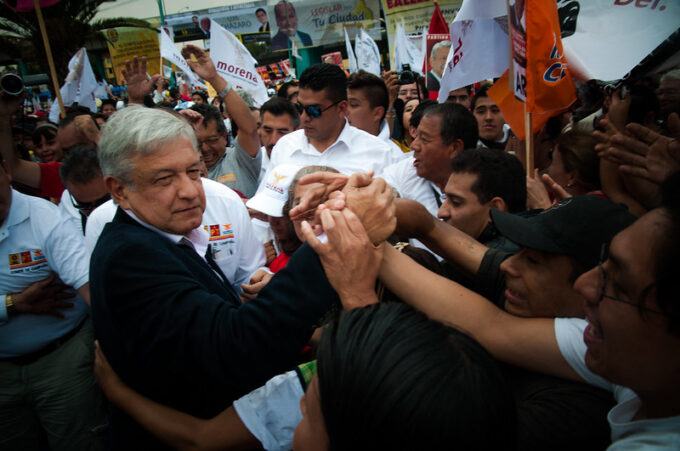
Mexico Leads in Opposing the Cuba Blockade and US Imperialism

W.T. Whitney Jr.


Photograph Source: Eneas De Troya – CC BY 2.0

Mexican president Andrés Manuel López Obrador (AMLO) visited Cuba on May 8-9. He began by highlighting regional unity as good for equal promotion of economic development for all states. AMLO addressed themes he had discussed previously when Cuban president Miguel Diaz-Canel visited Mexico City in 2021.

At that time AMLO, by virtue of Mexico serving as president pro tempore, presided over a summit meeting of the Community of Latin American and Caribbean states (CELAC). He proposed building “in the Western Hemisphere something similar to what was the economic community that gave rise to the current European Union.”

Two days later, AMLO included Diaz-Canel in a celebration of the 200th anniversary of Mexican independence. Praising Cuba’s dignity in resisting U.S. aggression, he called for an end to the blockade.

Months later in Havana, on May 8, 2022, AMLO, speaking before Cuban leaders and others, recalled “times when the United States wanted to own the continent …. They were at their peak in annexations, deciding on independence wherever, creating new countries, freely associated states, protectorates, military bases, and … invasions.”

U.S. leaders, he declared, need to be convinced “that a new relationship among the peoples of America … is possible.” He called for “replacing the OAS with a truly autonomous organism.” CELAC presumably would be that alternative alliance. Formed in 2011, CELAC includes all Western Hemisphere nations except for the United States and Canada.

The United States in 1948 established the Organization of American States (OAS) for Cold War purposes. When the OAS expelled Cuba in 1962, only Mexico’s government opposed that action and later Mexico was one of two nations rejecting an OAS demand to break off diplomatic relations with Cuba.

AMLO predicted that “by 2051, China will exert domination over 64.8% of the world market and the United States only 25%, or even 10%.” He suggested that, “Washington, finding this unacceptable,” would be tempted “to resolve that disparity through force.”

AMLO rejected “growing competition and disunity that will inevitably lead to decline in all the Americas.” He called for “Integration with respect to sovereignties and forms of government and effective application of a treaty of economic-commercial development suiting everybody.” The “first step” would be for the United States “to lift its blockade of this sister nation.”

AMLO’s visit prompted agreements on practicalities. The two presidents determined that Cuba would supply Mexico with medications and vaccines – particularly Cuba’s anti-Covid-19 Abdala vaccine for children. Mexico’s government will send almost 200 Mexican youths to Cuba to study medicine; 500 Cuban physicians will go to Mexico to work in underserved areas. The two presidents signed a general agreement providing for expanded cooperation in other areas.

Before arriving in Cuba, AMLO had visited Guatemala, El Salvador, Honduras, and Belize. Along the way he reportedly complained that, “The United States may have awarded $40 billion in aid to Ukraine but doesn’t fulfill its promise of years ago of helping out Central America.”

The two presidents’ encounter in Havana raises the question of a long-term Mexican role in mobilizing collective resistance to U.S. domination and the U.S. blockade of Cuba. Mexico is well-positioned to lead that effort, what with strong economic and commercial connections with the United States. The United States, leaning on Mexico as an economic partner, may well be receptive to certain demands.

According to the White House-based Office of the U.S. Trade Representative, “Mexico is currently our largest goods trading partner with $614.5 billion in total (two way) goods trade during 2019.”

Beyond that, and in relation to Cuba, Mexico has its own revolutionary tradition and longstanding ties with Cuba.  She is well-placed to lead a strong international campaign to undo the U.S. blockade.

In his major speech, AMLO cited support from Mexico in Cuba’s first War for Independence. He mentioned Cubans’ collaboration with Mexico’s much-admired president Benito Juárez and pointed out that Mexico in1956 hosted Cuban revolutionaries led by Fidel Castro as they prepared for their uprising against Batista. AMLO cited former Mexican President Lázaro Cárdenas’s solidarity visit to Cuba in 1961 after the CIA -organized Bay of Pigs invasion. In token of cultural ties between the two peoples, Mexico was the guest of honor at Havana’s recently concluded International Book Fair.

José Martí warrants special attention. In exile, Martí lived, taught and wrote in Mexico City from 1875 to 1875. Afterwards he stayed connected with Mexican friends. Martí would later write admiringly about the liberal reforms of Indian-descended president Juarez, whom he regarded as the “impenetrable guardian of America.”

That “America” would be “Our America,” which became the title of a Martí essay with deep meaning for unity and for separation from the United States. “Our America” proclaimed that the culture and history of lands south of the Rio Bravo (Rio Grande) originated autonomously, quite apart from European and U.S. influences. The essay appeared first in January 1891, in two journals simultaneously.  One was El Partido Liberal, published in Mexico, the other being a New York periodical.

Unity among Latin American and Caribbean nations appears to be precarious as the U.S. government prepares to host the 9th Summit of the Americas in Los Angeles, on June 6-10. The Summit is an offshoot of the OAS which, according to its website, “serves as the technical secretariat of the Summits process.”

The United States has indicated that the leftist governments of Cuba, Venezuela, and Nicaragua won’t be receiving invitations. AMLO, speaking in Havana, reiterated his objection and once more stated that if nations are left out, he will not attend. Nor will the presidents of Bolivia and Honduras, Luis Arce and Xiomara Castro, respectively.

The presidents of several Caribbean nations will also be staying away. They point to the hypocrisy of U.S.-appointed Venezuelan president Juan Guaidó being invited, but not Cuban president Miguel Díaz-Canel.  Unhappy with U.S. advice on transparency of elections and Russia-Brazil relations, Brazilian president Jair Bolsonaro will not attend.

The conclusion here is that the old system of regional alliances is unstable and that the timing may be right for renewed resistance to U.S domination and the blockade. Now would be the occasion for U.S. anti-imperialists and blockade opponents to align their strategizing and efforts with actions, trends, and flux in Latin America and the Caribbean. And, most certainly, they would be paying attention to actions and policies of Mexico’s government.

Martí had often corresponded with his Mexican friend Manuel Mercado.  His letter of May 18, 1895, the day before he died in battle, stated that, “The Cuban war … has come to America in time to prevent Cuba’s annexation to the United States. …  And Mexico, will it not find a wise, effective and immediate way of helping, in due time, its own defender?”