28 Jun 2022

Turkish government escalates attack on democratic rights amid explosive social conditions

Ulaş Ateşçi


On Sunday, the annual Pride March in Beyoğlu, Istanbul, attended by thousands of people, was violently attacked by police. In Istanbul, 371 people were detained, including AFP photojournalist Bülent Kılıç, along with dozens more in other cities, including Izmir and Ankara. According to news reports and statements by lawyers, those detained were released in the following hours.

The Istanbul Governor’s Office closed some roads to traffic on Sunday morning in Beyoğlu, where Taksim Square is located, and deployed a large number of police forces in the area ahead of the peaceful march, citing “calls for unauthorized meetings, demonstrations and similar activities on social media.” During the day, the police relentlessly attacked those who wanted to gather, while marches and protests took place on various streets despite the crackdown.

People display rainbow flags as Turkish police officers cordon an area off during the LGBTQ Pride March in Istanbul, Turkey, Sunday, June 26, 2022 [AP Photo/Emrah Gurel]

Last week, the district governorships of Beyoğlu and Kadıköy announced a one-week ban on “LGBTI+ Pride Week” events. In the Kadıköy District Governorship’s statement, the arbitrary ban was based on Article 17 of Law No. 2911 on Meetings and Demonstrations, hypocritically citing “the protection of peace, security and well-being and the prevention of crime.”

In fact, this law effectively abolishes the Constitutional article stating that “Everyone has the right to organize unarmed and nonviolent meetings and demonstrations without prior permission.” This arbitrary police attack, ordered by President Recep Tayyip Erdoğan’s government, is one of the largest detention operations in recent years and an obvious onslaught on basic democratic rights.

The main target of the Erdoğan government’s increased police state repression and authoritarianism is the working class, which is beginning to mobilize together with its international class brothers and sisters against skyrocketing costs of living and growing attacks on social conditions.

Inflation—triggered by the massive printing of money by central banks around the world, further enriching the super-rich and exacerbated by the NATO war against Russia in Ukraine—has pushed the cost of living in Turkey to unprecedented levels. According to a survey conducted in March, 90 percent of the population lives below the poverty line. Under these explosive social conditions, the strike and protest movement of various sections of the working class, especially health workers, is developing.

Faced with ever-increasing inflation and poverty and growing social opposition, the government is targeting basic democratic rights, promoting religious reaction, chauvinism and militarism to suppress the working class.

The anti-democratic state crackdown on Kurdish politicians and the media escalated after Erdogan announced in late May a new military operation against the US-backed Kurdish nationalist People’s Protection Units (YPG) in Syria.

Members of the Kurdish nationalist People’s Democratic Party (HDP), a legal pro-NATO and pro-European Union party with more than 5 million votes, which the government accuses of being an extension of the Kurdistan Workers’ Party (PKK) and YPG, are detained or arrested on charges of being “members of a terrorist group” without any evidence. Another 38 politicians were detained in Adana yesterday, including HDP Provincial Co-chairs Helin Kaya and Mehmet Karakış and Seyhan Municipality Deputy Mayor Funda Buyruk.

Also this month, 20 journalists from the Kurdish press were detained on similar allegations and 16 of them were arrested. In this attack on press freedom, journalists were sent to jail for news they reported.

The attack on press freedom is accompanied by the government’s planned amendment to the press law, which has been postponed in the face of widespread public opposition. The amendment envisages a prison sentence of one to three years for “anyone who publicly disseminates untrue information about the country’s internal and external security, public order and public health with the intention of creating anxiety, fear or panic among the public in a manner likely to disrupt public peace.”

In Turkey, for example, where the official annual inflation rate announced by the government is over 70 percent, according to this amendment it will be a criminal offense to disseminate information based on a study by ENAG, an independent research agency, that the real annual inflation rate is 160 percent. Under the pretext of “internal and external security” and “disturbing public peace,” exposing the reactionary character of the government’s war policies or state repression against workers’ struggles could be criminalized.

Moreover, the amendment also places under threat scientists and health care workers who directly provide information on the COVID-19 pandemic in the press or on social media, under conditions where the government has stopped releasing all official data on the COVID-19 pandemic since June 12. Scientists and public health advocates who warn the population against the government’s false claim that “the pandemic is over,” or those who calculate the excess death toll and expose the government’s concealment of the true death toll from the pandemic, could become targets.

These reactionary attacks on democratic rights are by no means confined to Turkey. All over the world the escalation of the war by the US-led NATO powers against Russia in Ukraine is accompanied by the elimination of basic democratic rights and the promotion of the far-right forces at home.

In the US, five unelected members of the Supreme Court have decided to strip hundreds of millions of Americans of the right to abortion. In France, an unelected administrative court has banned Muslim women from wearing religious bathing suits. This attack on the rights of the immigrant population is accompanied by the elimination of the right to asylum. Britain attempts to deport asylum seekers to Rwanda. In Spain at least 37 asylum seekers were massacred by security forces trying to cross the Spanish-Moroccan border.

NATO announces plan for massive European land army

Andre Damon


In what NATO Secretary-General Jens Stoltenberg called the “biggest overhaul of our collective deterrence and defense since the Cold War,” the US-led NATO alliance has announced plans to build a massive standing land army in Europe, numbering in the hundreds of thousands.

Stoltenberg said NATO would increase its “high readiness forces” sevenfold, from 40,000 to 300,000, deploying tens of thousands of additional troops, as well as countless tanks and aircraft, directly to Russia’s border.

The move will entail a massive diversion of social resources to NATO’s ongoing war with Russia and planned war with China, draining treasuries throughout Europe and North America and fueling demands for the elimination of social services, the slashing of wages, and the gutting of workers’ pensions.

Stoltenberg said the creation of this massive fighting force was a response to the “new era of strategic competition” with Russia and China.

He called the plan “a fundamental shift in NATO’s deterrence and defense,” embracing not only the war with Russia, but “the challenges that Beijing poses to our security, interests and values.”

As a part of this massive expansion of its fighting force, NATO will increase the numbers of troops stationed in Latvia, Lithuania and Estonia to the “brigade” level, meaning approximately 3,000 to 5,000 troops.

The Financial Times reported, based on an interview with Stoltenberg, that the plan will “include new structures in which Western NATO allies, such as the US, UK and France, would pledge their ships, warplanes and a total of more than 300,000 troops to be ready to deploy to specific territories on the alliance’s eastern flank, with graded response times starting from the opening hours of any attack.”

Instead of troops deployed to the Baltics serving as a “tripwire,” the new plan would envision NATO fighting a war against Russia directly on the borders of these countries on NATO’s eastern battlefront.

Stoltenberg boasted that “2022 will be the eighth consecutive year of increases across European Allies and Canada,” adding that NATO’s target of two percent of economic output going to military spending will be “considered a floor, not a ceiling.”

That same day, US officials previewed yet another massive weapons shipment to Ukraine, including the NASAMS medium-to-long-range surface-to-air missile defense system created by Raytheon.

In addition to “advanced medium- and long-range air defense capabilities for the Ukrainians,” the US would also provide “ammunition for artillery and counter battery radar systems,” National Security Advisor Jake Sullivan said.

Members of the NATO alliance, meanwhile, are openly using the language of war. In his first public speech as the chief of the general staff, General Sir Patrick Sanders will, according to the Telegraph, declare that the UK army must be ready to “fight and win” against Russia.

Simultaneously, the US and its allies are intensifying the economic embargo against Russia. Over the weekend, participants in the G7 summit announced plans to ban imports of gold from Russia and are finalizing plans to try to put price caps on oil and gas sold by Russia.

On Monday, Russia officially defaulted on its foreign debt payments, after European payments clearinghouses refused to process payments from the country. Russian officials insist that they have the funds available to make the payments, but that it has been effectively cut out from the European financial system and hence forced to carry out an artificial default.

Regardless, this would be the first time Russia has defaulted on its debts since 1918, when the Bolshevik government, in the wake of the 1917 revolution, repudiated the foreign debts of the Tsarist regime.

NATO’s  massive military escalation comes as the official position of the United States and NATO—that they are not at war with Russia—becomes increasingly untenable.

This weekend, the New York Times reported that US forces are secretly operating on the ground in Ukraine, as well as forces from several other NATO countries, despite the denials of Biden and other NATO leaders.

“But even as the Biden administration has declared it will not deploy American troops to Ukraine, some C.I.A. personnel have continued to operate in the country… directing much of the vast amounts of intelligence the United States is sharing with Ukrainian forces,” the Times wrote.

The newspaper reported that dozens of special forces from the UK, Canada, France and Lithuania have been operating inside the country.

The revelation, the report continued, “hints at the scale of the secretive effort to assist Ukraine that is underway and the risks that Washington and its allies are taking.”

The Times report is only the latest piece of evidence documenting the extent of US involvement in the war. Earlier this year, NBC and other media outlets reported that the United States was directly involved in Ukrainian targeted killings of Russian generals, as well as the sinking of the Moskva, the flagship of Russia’s Black Sea fleet.

Ukrainian commanders, according to these reports, are provided intelligence extracted from satellites “which they can call up on tablet computers provided by the allies. The tablets run a battlefield mapping app that the Ukrainians use to target and attack Russian troops.”

Despite the massive degree of US involvement in the war, Ukrainian losses are surging, rivaling the number of US combat deaths at the deadliest point of the Vietnam war. On some days, Ukrainian forces have suffered between 500 and 1,000 casualties.

Russia now controls more than 90 percent of the Donbass in East Ukraine and a total of one fifth of the entire territory of Ukraine. But despite the disastrous series of battlefield setbacks, the United States and its NATO allies are massively intensifying their involvement in the war, no matter the cost in Ukrainian lives or the trillions of dollars diverted from vital social programs.

Russian officials are drawing the conclusion that open war between NATO and Russia is all but inevitable. In remarks last week, Russian Foreign Minister Sergey Lavrov said: “Hitler rallied a significant part, if not most, of the European nations under his banner for a war against the Soviet Union… now, the EU together with NATO are forming another—modern—coalition for a standoff and, ultimately, war with the Russian Federation.”

At least 46 undocumented immigrants found dead in truck trailer in sweltering Texas heat

Eric London


Hardly a day goes by in contemporary America without a mass casualty event produced by capitalist reaction. On Monday evening, a semi-truck trailer filled with bodies—some dead, some still clinging to life—was discovered a stone’s throw from a busy interstate highway in San Antonio, Texas.

Police block the scene where a semitrailer with multiple dead bodies were discovered, Monday, June 27, 2022, in San Antonio. [AP Photo/Eric Gay]

The truck was carrying undocumented immigrants fleeing desperate economic conditions in Central America and the legacy of over a century of US imperialist exploitation. The immigrants were forced to enter surreptitiously due to the anti-immigrant restrictions imposed by the Democratic administration of President Joe Biden.

So far, the official death toll is 46, but this is expected to rise, as local officials say 16 others were hospitalized at varying stages of illness. This is the deadliest such event in US history. It doubles the death toll of the second highest mass immigrant asphyxiation, when 19 people suffocated in a truck trailer in Victoria, Texas, in 2003.

Earlier Monday, temperatures in San Antonio hit 103 degrees Fahrenheit (40 Celsius). It is difficult to imagine how those who perished in the trailer spent their last moments struggling to escape. One individual who lives near the spot where the trailer was found told the New York Times, “Now I’m hearing there are kids.” Families often make the journey together.

After discovering the trailer, police and Border Patrol reportedly deployed military-grade heat-seeking equipment to search for and detain any immigrants who managed to escape.

This social crime is the responsibility of the Biden administration, which was elected on the basis of mass opposition to the fascist Donald Trump, but whose administration has carried out a ruthless attack on immigrants, arresting more in 2021 than Trump detained in any one year in office. Biden is on pace to arrest some 2 million immigrants this year, a new record. Two days ago, Biden ended all previous restrictions on ICE arrests, ordering agents to arrest immigrants regardless of arrest record or how many years they have been in the United States.

The trailer was discovered in Texas hardly 24 hours after Spanish and Moroccan border police carried out a brutal melee attack on a crowd of African immigrants attempting to cross into the Spanish outpost of Melilla on Africa’s northern coast. At least 36 immigrants died, some after being beaten by police, some hanging from the barbed wire border fence, some in the stampede that followed the police assault.  

Both crimes expose the lie that the US and its NATO allies are waging war against Russia in Ukraine for humanitarian reasons. If these crimes had taken place in Russia, the imperialist governments would have used them as pretenses to justify further escalation of a war which threatens the world with nuclear catastrophe.

It is already clear that the political establishment in the US will respond to the mass death in San Antonio by using the event to justify a further crackdown on immigration. An hour before the bodies were discovered in his district, Texas Republican Congressman Tony Gonzales tweeted that immigration is “incentivizing lawlessness and creating absolute chaos at our southern border.”

After the event, Gonzales blamed Democrats for being insufficiently iron fisted. Texas Governor Greg Abbott, a fascist supporter of Trump, blamed Biden for the deaths, tweeting: “They are a result of his deadly open border policies. They show the deadly consequences of his refusal to enforce the law.”

The corporate media will alternate between demands for a military-style crackdown on the border and denunciations of whichever criminal was driving and abandoned the trailer in the heat.

But the existence of smugglers is a criminal byproduct of the bipartisan border policies of the US government which are fundamentally to blame.

Deaths like these did not occur prior to the militarization of the US-Mexico border initiated by Democratic President Bill Clinton. In the 1990s, Clinton, with the support of Democrats and Republicans, enacted programs like “Operation Gatekeeper” and “Operation Hold-the-Line,” the aim of which was to militarize urban crossing zones and force migrants to cross in the uninhabitable deserts.

In 2006, under the George W. Bush administration, Congress passed the Secure Fences Act, which facilitated the construction of hundreds of miles of border barriers and further militarized the border. Those voting “yes” for this law included then-Senators Joseph Biden, Hillary Clinton, Barack Obama, John McCain and Charles Schumer.

In 2010, Obama signed legislation that deployed a fleet of drones to the border and 1,500 National Guard soldiers to block or arrest immigrants. In 2018, the Democratic Party caved when Trump illegally redirected congressionally-apportioned money to fund his deployment of the National Guard to the border. The Biden administration kept pandemic-related restrictions on all asylum applicants and kept Trump’s Remain In Mexico policy in place, which barred all refugees from entering the US through Mexico.

The trailer was discovered in southwest San Antonio, barely a mile from where nine immigrants were found dead of dehydration and asphyxiation in the back of a semi-truck trailer almost exactly five years ago, on July 17, 2017.

NATO summit to embrace US-led confrontation with China

Peter Symonds


Amid the US-led proxy war against Russia in Ukraine, a major focus of the NATO summit beginning today in Madrid will be the extension of the Atlantic military alliance to the Asia-Pacific, directed against China. NATO’s agenda derives directly from Washington’s rapidly intensifying and aggressive confrontation with Beijing, which the US regards as the chief threat to its global dominance.

NATO Secretary General Jens Stoltenberg speaks during a media conference, after a meeting of NATO defense ministers in video format, at NATO headquarters in Brussels on Thursday, Feb. 18, 2021. (AP Photo/Virginia Mayo, Pool)

During a press conference yesterday, NATO Secretary General Jens Stoltenberg declared that the summit would directly address China for the first time, and “the challenges that Beijing poses to our security, interests, and values.” He said NATO members would “consider our response to Russia and China’s increasing influence in our southern neighbourhood”—that is, the Indo-Pacific region, on the other side of the globe, thousands of kilometres from the nearest NATO member.

While Stoltenberg’s language was guarded, what is proposed is an extraordinary expansion of NATO’s scope across the entire world, making clear that the escalating US-NATO proxy war against Russia is not a limited, episodic conflict in Europe, but global in character. The massive expansion of NATO military forces slated to be discussed at the summit is not just directed against Russia, but China as well.

In preparation for the summit, Stoltenberg flew to the US in early June to hold talks with both US Secretary of State Antony Blinken and Defense Secretary Lloyd Austin. Not surprisingly, he is parroting Washington’s propaganda.

Even as basic democratic rights are being eviscerated in the US and Europe, Stoltenberg, in a media forum hosted by Politico last week, painted the conflict with Russia and China as a rising competition “between democracy and authoritarianism,” adding “Moscow and Beijing are openly contesting the rules-based international order.” In reality, the US is seeking to preserve the post-World War II order, in which it set the rules, through military means.

Like Washington, the NATO chief told the forum that he was concerned “at the rise of China, the fact that they’re investing heavily in new modern military equipment, including scaling significantly their nuclear capabilities, investing in key technologies, and trying also to control critical infrastructure in Europe coming closer to us.”

The NATO summit will revise its Strategic Concept, which has been in place since 2010 and makes no mention of China. The new document, in line with the Pentagon’s strategic orientation, will be focused, not only on the “war on terrorism,” but as NATO deputy secretary general Mircea Geoană, told a conference in Copenhagen on June 10, on great power competition—particularly on Russia and China.

Significantly, the leaders of four Asia-Pacific countries—Australia, New Zealand, Japan and South Korea—will attend the NATO summit for the first time. Australia, Japan and South Korea are all formal US military allies, while Australia and Japan are part of the Quadrilateral Security Dialogue or Quad, along with the US and India, that is targeting China.

Recently-installed Australian Labor Party prime minister, Anthony Albanese, on landing in Madrid immediately reiterated his government’s support for the NATO proxy war, and expressed concern about China “becoming increasingly aggressive” and its “closeness” to Russia. He said Australia would welcome increased military cooperation with other members of the “Asia-Pacific Four”—that is, Japan, South Korea and New Zealand. A meeting has been mooted of the leaders of those four countries on the sidelines of the summit.

Since being sworn in last month, the Australian Labor government has been engaged in frenetic diplomatic activity in the Asia-Pacific—including taking part in a Quad leaders meeting in Tokyo while barely in office, and despatching Foreign Minister Penny Wong to Pacific Island states in a bid to counter Chinese influence in the region. The new government has fully endorsed the AUKUS pact with the US and Britain, aimed against China, that will arm Australia with nuclear-powered attack submarines.

On Sunday, speaking at the G7 leaders meeting, Japanese Prime Minister Fumio Kishida made a thinly-veiled swipe at China. He declared that a united front was necessary to prevent other countries drawing the “wrong lessons” from Russia’s war in Ukraine. Japan has joined the US and other allies in accusing China of preparing to invade Taiwan as the pretext for strengthening ties with the island which all nominally accept, under the One China policy, is part of China.

Beijing is deeply concerned at aggressive US-led efforts to build military alliances, strategic partnerships and basing arrangements throughout the Indo-Pacific in conjunction with NATO. Speaking at the BRICS summit of Brazil, Russia, India, China and South Africa last week, Chinese President Xi Jinping called for a rejection of “Cold War mentality” and warned against the type of crippling unilateral sanctions imposed by the US and allies on Russia.

Last Thursday, Chinese foreign affairs ministry spokesman Wang Wenbin explicitly accused NATO of engaging in a “highly dangerous” effort to create hostile blocs in Asia. “NATO has already disrupted stability in Europe. It should not try to do the same to the Asia-Pacific and the whole world,” he said.

The shift by NATO toward a confrontation with China as well as Russia is bound up with the sharp escalation in geo-political tensions associated with the COVID-19 pandemic and growing economic and financial instability. Previously the European powers sought to balance their economic ties with China with their military alliance with the US. Now they have joined in the US-led war against Russia in Ukraine, while also preparing to play a far greater military role in the Indo-Pacific.

In 2019, China was referenced for the first time in a NATO summit in a sentence declaring that Beijing presented “both opportunities and challenges.” In 2021, however, a joint NATO communique adopted a sharply different approach, accusing China of “systemic challenges to the rules-based international order.”

Last year Britain joined the AUKUS alliance and has begun the deployment of warships to the South China Sea off the Chinese mainland. France and Germany also have despatched warships through these sensitive strategic waters.

The NATO summit marks a sharp turning point in the accelerating proxy war with Russia, and the involvement of the US military allies in Europe in Washington’s aggressive confrontation with China—posing the very real danger of a global war between nuclear-armed powers.

Sri Lankan corporations reap large profits as workers and rural toilers face poverty and starvation

N. Ranges


Food, beverage and tobacco, capital goods, diversified financials, transportation and consumers services companies in Sri Lanka are enjoying increased profits while millions of workers, poor and children are in a desperate struggle to survive the worsening economic crisis. Many companies have recorded their highest-ever annual profits.

Luxury villas for rent in Weligama, Sri Lanka (Image: Tripadvisor)

According to the recent figures, the listed companies in the above sectors have secured large increases in their combined earnings in the first quarter of 2022 on a year-to-year basis. This includes 303 percent growth in the food, beverage and tobacco sector’s earnings, 210.2 percent in capital goods, 138.8 percent in diversified financials, 682.1 percent in transportation and 173.6 percent increases consumer services, compared to the same quarter of 2021.

The most diversified blue chip, Hayleys PLC, recorded an all-time high profit of 28.1 billion rupees ($US78 million) in the last financial year. It was the highest profit in the company’s 144-year group history, chairman Mohan Pandithage said.

LOLC financial service group recorded a profit growth of 443.8 percent year-on-year basis to 39.3 billion rupees in the first quarter. The increase was mainly a result of its global operations.

Hatton National Bank Finance, which is involved in a range of loans and other financial services, recorded a group net profit of 515.6 million rupees for the 2021–22 financial year, up from a loss the previous last year. The diversified blue-chip Aitken Spence conglomerate reported a profit before tax of 14.2 billion rupees, an increase of 2.8 billion rupees from previous year. Prime Lands Residencies also posted a record before tax profit of 1,848 million rupees for the 2021–2022 fiscal year.

Softlogic Holding’s consolidated annual revenue surged by 35 percent to 111.2 billion rupees and consolidated year-on-year gross profit increased 52 percent to 39 billion rupees. It is involved in healthcare, retail services, insurance and financial services.

The Lanka Hospitals Corporation, one of the largest of the more than 140 private hospitals in Sri Lanka, recorded a 2.8 billion-rupee turn over in the first quarter of this year. Benefiting from COVID-19, which continues to rage across the country, it was a 27 percent increase on the same period last year.

By contrast, Sri Lanka’s year-on-year inflation rate for May rose to 45.3 percent and food inflation to 58 percent—figures that are continuously climbing as fuel prices increase. High prices are devastating the social conditions of millions of workers, the self-employed, farmers and the poor.

Long queue for cooking gas at Mahabage, 5 May 2022 [Photo: WSWS]

The vast gulf between these huge profits and the social disaster being unleashed against the Sri Lankan masses is yet another dramatic confirmation of Karl Marx’s famous observation: “Accumulation of wealth at one pole is, therefore, at the same time accumulation of misery, agony of toil slavery, ignorance, brutality, mental degradation, at the opposite pole, i.e., on the side of the class that produces its own product in the form of capital” (Section 4, Chapter 25 Capital, Volume 1).

According to a recent United Nations report, nearly 5 million Sri Lankans are living hand to mouth, forced to sell their jewelry and to borrow money in order to survive. It noted 22 percent of country’s population needs food aid and 86 percent of households have been compelled to reduce what they eat, including skipping meals. The UN also reported that 56,000 children under five suffer from severe acute malnutrition and urgently need nutrient-rich food.

An indication of the desperate conditions confronting children was revealed by doctors at Colombo’s Lady Ridgeway Hospital for Children (LRH) who reported that 20 percent of children admitted to the facility suffered from malnutrition. These children, LRH Consultant Paediatrician Dr. Deepal Perara said, were not receiving the required quantities of carbohydrates, proteins, lipids and vitamins.

The disaster facing children was further confirmed by UNICEF’s representative in Sri Lanka, Christian Skoog. He reported that nearly one in two children in the country required some form of emergency assistance, including nutrition, health care, clean drinking water, education and mental health service. Sri Lanka, he added, has the second-highest rate of acute malnutrition among children under five in South Asia and at least 17 percent of children are suffering from chronic wasting.

While Lanka Hospitals Corporation in Colombo, which is part of the island’s expanding private hospital sector, is making high profits, the overall public health system is on the brink of collapse as stocks of vital medicines and medical equipment dry up.

According to the latest UN update, about 200 essential medicines are now out of stock in Sri Lanka, with predicted shortages of another 163 critical drugs over the next two to three months. Over 2,700 essential surgical items and more than 250 regular laboratory items are also out of stock.

This social calamity is a product of the capitalist profit system. From so-called independence from the British colonial rule in 1948, successive Sri Lankan governments have systematically worked to secure the profit interests of local and foreign big business at the expense of all working people and the poor.

Sri Lanka’s tiny capitalist elite, and the governments that serve it, regard the state-owned sector as their own private assets, demanding and receiving bail outs and concessions paid for by increased exploitation and social attacks on the working class.

There is no solution to burning issues confronting the masses—the shortages and skyrocketing prices of essentials like food, fuel and cooking gas—within the capitalist system and national borders.

The only way for the working class to secure its essential needs is to take the production and distribution out of the hands of the capitalists. Inventories must be made of these resources and the wealth of the ruling elite seized by the working class and redistributed on the basis of social need.

Sri Lankan workers, who demonstrated their political and industrial strength in powerful general strikes against the Rajapakse government on April 28, May 6, and May 10 should review the political lessons of this struggle and the treacherous role played by the unions.

During the two-month popular anti-government uprising, the trade unions systematically blocked any independent intervention of the working class against Rajapakse government, and its brutal attacks on social and democratic rights. The unions do not represent the working class but defend the profit system, functioning as industrial police force on behalf of the government and employers.

27 Jun 2022

Hypocrisies and Successes at UN Meeting to Ban Nuclear Weapons

John LaForge


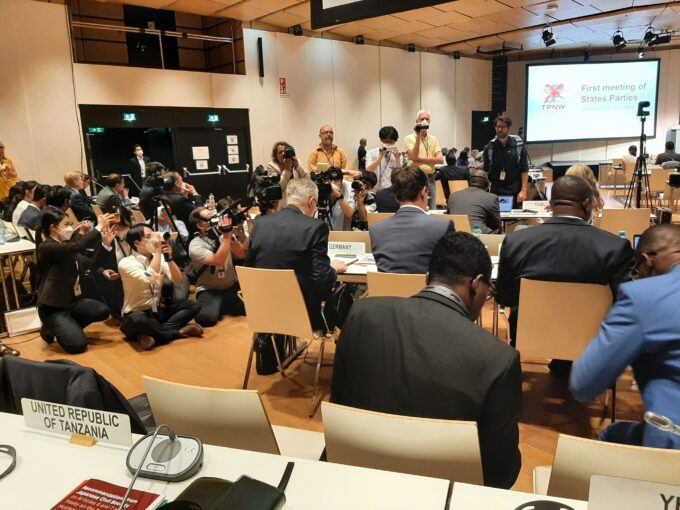
German Representative Rüdiger Bohn (center) speaking June 22nd to the First Meeting of States Parties to the Treaty on the Prohibition of Nuclear Weapons. Photo by John LaForge, for Nukewatch.

The Treaty on the Prohibition of Nuclear Weapons has been ratified by 65 governments, known in diplomatic circles as States Parties. The treaty’s first Meeting of States Parties (1MSP) concluded here June 23, after painstakingly working out — in the words of the International Campaign to Abolish Nuclear Weapons — “a blueprint for the end of nuclear weapons.” The new Treaty is the extraordinary, crowning achievement of ICAN, which won the 2017 Nobel Peace Prize for its efforts.

At 1MSP, The Netherlands, Belgium and Germany — all three of whom use U.S. nuclear weapons on their air force bases — participated as Observer States. The three have not ratified the TPNW, having acquiesced with a string of U.S. administrations — Obama’s, Trump’s, and Biden’s — that conspired at every opportunity to derail, prevent, delay, weaken, and boycott the new ban — in spite of broad public support for nuclear disarmament. Mr. Trump demanded that States Parties withdraw their ratifications. None did. Biden’s White House reportedly urged Japan not to attend the 1MSP as an Observer, and they stayed away.

German and Dutch representatives took their turn and spoke to the MSP on June 22, but both NATO members used exactly the same words to note their government’s explicit disapproval of the TPNW, and to voice their supposed support for the 1970 Nuclear Non-Proliferation Treaty. Both representatives said their governments “will not accede to” the nuclear ban treaty “because the TPNW is inconsistent with NATO doctrine.”

The hypocrisy in German and Dutch opposition is that their “sharing” of U.S. nuclear weapons, while consistent with “NATO doctrine” is totally inconsistent with their hallowed Non-Proliferation Treaty (NPT). In fact, their 50-year-long dismissal of the NPT’s binding (Art. VI) obligation to begin negotiations leading to nuclear disarmament “at an early date” is also completely inconsistent with their feigned support for the NPT.

As German Representative Rüdiger Bohn said June 22, NATO “doctrine” includes the doleful edict, “As long as nuclear weapons exist, NATO will remain a nuclear Alliance.” This embrace of genocidal atomic violence is not an Article of the 1949 North Atlantic Treaty or NATO Charter. It was manufactured entirely by its nuclear-armed members, and there is no legal obligation for NATO to remain a nuclear-armed terrorist organization.

NATO “doctrine” is fluid, strictly advisory, and accepted voluntarily by its members. Even the NATO Charter’s famous Article 5, regarding collective response to a military attack on a member state, declares only that the NATO membership “will assist the Party or Parties so attacked by taking … such action as it deems necessary.”

In comparison, the Non-Proliferation Treaty is binding international law and includes explicit, unambiguous prohibitions and clear, binding obligations. NATO’s ongoing planning, preparations and ever-present threat to launch nuclear attacks (known as “deterrence”), is simply a ritualized practice which can be ended at any time — say by complying with the NPT’s Articles I and II which prohibit any transfer or reception of nuclear weapons between states, or its Article VI pledge to negotiate nuclear disarmament. Indeed, it is the 50-year-long postponement, or rejection of Art. VI that has prompted and propelled the overwhelming success of the new TPNW.

What might have been a week-long celebration of the TPNW’s progress in seeking a world free of nuclear threats, was dimmed by Russia’s ongoing war on Ukraine. It was the war’s spoken and unspoken reminders of ready nuclear arsenals in Russia and NATO that moved the MSP to say, in its final Declaration, that it “condemn[s] unequivocally any and all nuclear threats, whether they be explicit or implicit and irrespective of the circumstances.”

The Declaration castigates nuclear weapons and echoes Daniel Ellsberg’s 1959 essay “The Threat and Practice of Blackmail,” noting that the Bomb is used to coerce, intimidate, plague, curse, and terrify. “This highlights, now more than ever, the fallacy of nuclear deterrence doctrines, which are based and rely on the threat of the actual use of nuclear weapons and, hence, the risks of the destruction of countless lives, of societies, of nations, and of inflicting global catastrophic consequences.”

The Parties agreed to push ahead with resolve to eventually see the nuclear weapons states sign on, saying “In the face of the catastrophic risks posed by nuclear weapons and in the interest of the very survival of humanity, we cannot do otherwise.”

Ahead of the WHO emergency deliberations, the World Health Network declares monkeypox a pandemic

Benjamin Mateus


In a lead-up to the World Health Organization’s (WHO) emergency meeting on Thursday to decide on whether the current global outbreak of the monkeypox virus should be declared a Public Health Emergency of International Concern (PHEIC), the World Health Network (WHN), an independent international collaboration of scientists and concerned citizens, said on Wednesday, June 22, 2022, that the monkeypox outbreak conformed to the definition of a pandemic.

The statement reads, “The World Health Network (WHN) today announced that they are declaring the current monkeypox outbreak a pandemic given that there are now 3,417 confirmed monkeypox cases reported across 58 countries, and the outbreak is rapidly expanding across multiple continents.”

They explained that without a concerted global action, the outbreak would continue and move into vulnerable populations such as children, expecting mothers and the immunocompromised. They warned that all people 40 and under who have never previously been immunized against smallpox remain extremely vulnerable to monkeypox, and that spillage into animals such as rodents and domesticated pets would potentially make the pathogen endemic in a broad geographic region with significant long-term consequences.

The WHN declaration states, “Even with death rates much lower than smallpox, unless actions are taken to stop the ongoing spread—actions that can be practically implemented—millions of people will die, and many more will become blind and disabled.” So far, only one death in Brazil has been attributed to monkeypox.

As of June 24, there have been 4,118 confirmed or suspected cases spanning at least 65 countries and territories. Yesterday, 461 more cases were added to the growing total. The seven-day rolling average of new infections has grown to 280 per day and is climbing. Taiwan, Singapore, and South Korea are the latest countries in Asia that have confirmed cases. Other non-endemic countries recently reporting monkeypox cases include South Africa, Croatia, Bulgaria, Colombia, and Gibraltar.

Figure 1: Seven-day average and cumulative cases of monkeypox infections. Source @antonio_caramia gave the WSWS permission to use these figures. Please follow the hyperlink to the website.

The case in Singapore involved a British Airways flight attendant who had attended several establishments on his layovers in mid-June. On June 20, he developed flu-like symptoms and pathognomonic skin rashes, prompting him to seek medical attention. Singapore’s ministry of health told the press that the man was being treated at the National Centre for Infectious Diseases, 13 close contacts had been identified, and tracing was ongoing.

The South Korean citizen who reported to the Korean CDC had just returned from Germany, where cases have been up-trending recently. He was symptomatic on his return flight with headaches, fever, sore throat, fatigue, and skin lesions. Another case is also being investigated.

On Thursday, Health Minister for South Africa, Joe Phaahla, reported that they had confirmed a case of monkeypox in a 30-year-old man from Johannesburg without travel history, meaning it was community-acquired and the extent of infections remains unknown. The health minister assured the press that contact tracing was underway.

With more than 900 cases, Britain leads all other countries in the sheer number of cases. According to the UK Health Security Agency, cases soared by more than 40 percent in less than one week. Europe remains the epicenter of the monkeypox outbreak, with Germany surpassing Spain and Portugal. However, in North America, Canada has seen 267 cases and the United States 173.

Figure 2: Cumulative monkeypox cases across Europe as of June 24, 2022. Source: @antonio_caramia

Professor Yaneer Bar-Yam, Ph.D., President of New England Complex System Institute and co-founder of WHN, stated emphatically, “There is no justification to wait for the monkeypox pandemic to grow further. The best time to act is now. By taking immediate action, we can control the outbreak with the least effort and prevent consequences from becoming worse. The actions needed now only require clear public communication about symptoms, widely available testing, and contact tracing with very few quarantines. Any delay only makes the effort harder and the consequences more severe.”

Dr. Eric Feigl-Ding, Ph.D., Epidemiologist and Health Economist, and co-founder of WHN, added, “The WHO needs to urgently declare its own Public Health Emergency of International Concern (PHEIC)—the lessons of not declaring a PHEIC immediately in early January 2020 should be remembered as a history lesson of what acting late on an epidemic can mean for the world.”

The WHO’s Director-General, Dr. Tedros Adhanom Ghebreyesus, has previously acknowledged that the disease is more widespread than the official numbers suggest. At the emergency committee meeting on Thursday, he reaffirmed this fact stating, “Person-to-person transmission is ongoing and is likely underestimated.” His statement implies that public health officials lack a clear comprehension of where these cases arise and how widespread they are.

Public health officials have been focused on tracing cases among men who have sex with men. The UK Health Security Agency noted that the monkeypox virus appears to be a threat “in the sexual networks of gay, bisexual and other men who have sex with men.”

David Heymann, a professor of infectious disease epidemiology at the London School of Hygiene and Tropical Medicine present at the WHO emergency conference, told the Washington Post, “We’re beginning to understand how widespread it really is. We know it’s widespread in certain populations, and we need to know whether it’s spreading in other populations as well.” Evidence is mounting that there are multiple routes of transmission that also include airborne routes, although it does not spread easily between people and requires close contact.

Figure 3: Monkeypox cases by date and country as of June 24, 2022. Source @antonio_caramia.

Genetic sequencing data places the origin of the outbreak back a few years. Trevor Bedford, an evolutionary biologist at the Fred Hutchinson Cancer Research center in Seattle, told the New York Times that “genomic patterns would suggest this occurred around 2018,” when the virus potentially became better at spreading from person to person.

Anthropologist and Assistant Professor Sagan Friant at Pennsylvania State University, who has been studying the zoonotic interactions of monkeypox in Nigeria, said in May during an interview with WPSU public media for Central Pennsylvania, “Many of the export cases that we’ve seen in the past have had one or few or zero subsequent cases due to human-to-human contact. But now as we’re seeing these multiple cases [in] multiple parts of the globe, you’re seeing sustained human-to-human transmission that is very unexpected and something that we’re keeping an eye on.”

 She also explained that the zoonotic interaction between humans and animals goes both ways. Spilling the monkeypox virus from humans back into animals such as rodents in countries outside of previously non-endemic regions would mean that the virus could find a permanent niche throughout the globe, threatening new outbreaks repeatedly.

Genomic analysis of recent cases has surprised virologists. Monkeypox is a large double-stranded DNA virus with very efficient error correction mechanisms during replication. It acquires approximately one or two mutations yearly compared to the 20 to 30 mutations for RNA viruses. However, the current monkeypox virus has gained almost 50 mutations compared to the 2018 version, meaning it should have taken the monkeypox virus several decades to acquire these many changes to its DNA.

Scientists are zeroing in on a family of enzymes called APOBEC3 based on their analysis of recent cases and the specific type of mutations associated with this enzyme. The enzymes are part of anti-viral defense systems that animals, including humans, possess that induce mutations in the virus when they encounter it.

Richard Neher, a computational evolutionary biologist at the University of Basel, speaking with STAT News, explained that “the idea behind such a sabotage scheme is that if you trigger enough mutations, certainly some of them will be deleterious. The virus won’t be able to replicate, and what will be left is just a dead piece of DNA. It’d be like rearranging the letters on your enemy’s typewriter so they can’t get a clear message out.” However, the process is not foolproof, and mutations that incur an advantage may be passed to the next generation.

Dr. Bedford said that while mice carry only one version of the APOBEC3 enzyme, humans possess seven. The implication is that the rapid accumulation of mutations may be a product of the monkeypox virus having shifted to spreading through people rather than from rodents to humans. Neher admitted, “We don’t have a good enough understanding of how this virus interacts with the host [people], or what these individual mutations could do.”

As urbanization, deforestation, and climate change have radically altered the natural habitats of animals and the pathogens that have colonized them, the jump into human hosts becomes ever more inevitable unless efforts are immediately undertaken to study and address this compelling question. Virologist Dr. Michael Malim at King’s College London, who discovered APOBEC3 in 2002, told the Times, “These spillovers from other species, and what that means and what the trajectory is—it’s very unpredictable. And it’s occurring more and more.”

UN investigation finds Israeli forces killed Al Jazeera journalist Shireen Abu Akleh with “seemingly well-aimed bullets”

Jean Shaoul


A UN Human Rights Office (OHCHR) investigation has shown that the bullets that killed Al Jazeera journalist Shireen Abu Akleh and injured her colleague Ali Sammoudi, were fired by Israeli forces.

Shireen Abu Akleh (Credit: Arwa/Ibrahim Twitter)

It is a damning refutation of Israel’s preposterous lie about her murder, including that she was shot by Palestinians firing indiscriminately at its troops.

Spokeswoman Ravina Shamdasani told reporters Friday, “All information we have gathered … is consistent with the finding that the shots that killed Abu Akleh and injured her colleague Ali Sammoudi came from Israeli security forces and not from indiscriminate firing by armed Palestinians” and that there was no evidence of “activity by armed Palestinians in the immediate vicinity of the journalists.”

The killing on May 11 of Al-Jazeera Arabic’s widely respected veteran journalist, a US-Palestinian citizen, by Israeli forces while she was covering an army raid on Jenin in the occupied West Bank, caused mass outrage. Clad in a press vest and helmet and standing in open view near a roundabout, she was targeted and shot by Israeli snipers along with her co-producer Ali Sammoudi who was hospitalised.

It was a brazen attempt to intimidate and prevent journalists reporting on Israel’s brutal suppression of the Palestinians. According to the Palestinian Center for Development and Media Freedoms, Israeli troops have killed 30 journalists in the West Bank and Gaza Strip since 2000. In each case, there have been no indictments against the soldiers responsible, testifying to the degree to which US backing guarantees impunity.

Israeli police later stormed her family’s home demanding the mourners take down the Palestinian flags and end the gathering and singing. On the day of the funeral, the police gave the pall bearers such a beating that they nearly dropped the coffin. Soldiers fired sponge-tipped bullets and threw stun grenades at the crowds gathered at the hospital morgue until Abu Akleh’s family were forced to whisk her coffin away in a car as a police officer removed the Palestinian flags covering it.

Israeli police confront mourners as they carry the casket of slain Al Jazeera veteran journalist Shireen Abu Akleh during her funeral in East Jerusalem, Friday, May 13, 2022. [AP Photo/Maya Levin]

Shamdasani said the UN Human Rights Office had gone through photo, video and audio material, visited the scene, consulted experts, reviewed official communications and interviewed witnesses. She confirmed that the Al Jazeera reporter along with her fellow journalists had made a real effort to be clearly visible as members of the press to Israeli soldiers. She said, “The journalists said they chose a side street for their approach to avoid the location of armed Palestinians inside the camp and that they proceeded slowly in order to make their presence visible to the Israeli forces deployed down the street.”

Shamdasani said, “Our findings indicate that no warnings were issued and no shooting was taking place at that time and at that location. Several single, seemingly well-aimed bullets were fired towards them [the journalists] from the direction of the Israeli security forces.” Furthermore, bullets continued to be fired at an unarmed man who tried to help Abu Akleh, as well as a journalist who was sheltering behind a tree. At least 16 shots were fired in total.

She concluded, “It is deeply disturbing that Israeli authorities have not conducted a criminal investigation.”

The UN Human Rights Office report follows an investigation by the Palestinian Authority (PA) published May 26 that arrived at the same conclusion from the autopsy and an examination of the armour-piercing bullets that hit Abu Akleh and Sammoudi. Palestinian officials accused Israel of killing her deliberately, citing the fact that she had been shot in the head even though she was wearing a vest clearly identifying her as a journalist. Palestinian officials have refused to cooperate with any Israeli investigation or hand over the bullets, knowing full well that any such inquiry will allow the soldiers responsible to get off scot-free.

There have been at least five other investigations into Abu Akleh’s death published in international media outlets, including the New York Times, the Washington Post, CNN and the Associated Press, all of which have subjected witnesses’ statements and the video clips to extensive forensic examination by experts and confirmed Israel’s responsibility for her killing.

Israeli officials variously charged the Palestinians with responsibility both directly and indirectly—for Abu Akleh’s death and denying any possibility that Israeli troops had killed her since “the army opens fire only in an orderly, controlled manner,” while others even blamed the journalist for her own death, claiming she was just a paid agent of terrorists.

Later as Israel’s Prime Minister Naftali Bennett realized that Abu Akleh's murder was turning into a public relations disaster, officials went into damage control mode, proposing a joint Israeli-Palestinian investigation.

There would be a police investigation into the attack on the pallbearers carrying Abu Akleh’s coffin out of the hospital morgue. But its outcome was determined in advance. While it found that the handling of the event amounted to police misconduct, none of the commanders in charge of the incident would be disciplined in line with a decision made prior to the investigation. Israel's Police Commissioner Kobi Shabtai told a lawyers’ conference in Tel Aviv, “The bottom line is that the conduct of police officers there was wrong, but not every investigation has to end with heads rolling.”

Eventually, the army accepted the “possibility” that Israeli gunfire had “inadvertently” killed the veteran journalist. However, the military’s advocate general ruled against a criminal investigation by the military police since the incident was a “combat event” with no suspicion of a criminal offense, even though she was a journalist killed in the line of duty.

This is a clear breach of the order put in place in 2011 that requires an investigation into every case of a death in the West Bank, except in a clear case of thwarting of a terror attack or the death of an armed individual during an exchange of fire. Israel has always used this order as the basis for its claim that it is capable of investigating itself, despite few indictments ever following.

Instead, as a sop to international public opinion, an army spokesperson promised a “thorough examination” of the events—with the proviso that without the PA handing over the bullet removed from Abu Akleh’s body it would be impossible to establish the truth.

Israel’s paymaster in Washington rushed to support its regional policeman, rejecting any responsibility to investigate the death of an American citizen, only belatedly echoing Israel’s call for a joint Israeli-Palestinian inquiry, since changed to “an independent, credible investigation.”

According to the army’s own data released in response to a freedom of information request and analysed by Yesh Din, an Israeli human rights organisation, only five (7.2 percent) of all internal military investigations opened in 2019-20 resulted in criminal indictments, and only 2 percent of the complaints received led to the prosecution of a suspect, up from 0.7 percent in 2017-18. The punishment, usually for low level offences rather than manslaughter or murder, typically result in a trivial punishment. The total number of investigations by the army is declining each year.

Abu Akleh’s death is to be added to a legal complaint by the International Federation of Journalists, the Palestinian Journalists’ Syndicate and the International Centre of Justice for Palestinians to the International Criminal Court (ICC). It relates to four Palestinian journalists wearing press helmets and vests—two killed and the other two maimed—and the attacks on international media buildings in Gaza in May 2021. The case argues that Israeli security forces have systematically targeted Palestinian journalists in violation of international humanitarian law and failed to investigate such incidents.

Al Jazeera has referred the case to the ICC, vowing to bring the killers to justice using all available legal means. Israel has dismissed this, saying that as it is not a signatory to the Rome Statute it is not subject to the court’s mandate and outside the court’s jurisdiction as Palestine is not a state. In February 2021, the ICC said its jurisdiction did extend to Gaza and West Bank, making it more likely the ICC can take up the issue.