3 Aug 2022

US-Saudi Relationship: Beyond the Obvious

Sam Husseini


Photograph Source: Saudi Press Agency – CC BY 4.0

An adage favored by Claud Cockburn as well as Otto von Bismarck advises “Never believe anything in politics until it has been officially denied.”

Indeed, it should be a clear tenet of political analysis

that stated goals are frequently not actual goals. US war planners used rhetorical concerns over non-existent Iraq WMDs as a pretext for invasion. Alleged human rights preoccupations were falsely heralded as the rationale for NATO bombings in Yugoslavia, Afghanistan and Libya.

One reason it was clear in real time that the US establishment was putting forward false pretexts in those cases was the contrast with the US relationship with Saudi Arabia and Israel.

But stated goals are not always false.

The bulk of the discussion over Biden’s visit to Saudi Arabia framed it as an attempt to get some relief for US consumers paying $100 to fill up their gas tanks.

Interestingly, that largely contradicted what Biden was actually saying: “The commitments from the Saudis don’t relate to anything having to do with energy. … And it has to do with national security for them — for Israelis. … It has to do with much larger issues than having to do with energy.”

But that was frequently ignored in the media discussion. That is, on a rare occasion when a US politician was indicating that he was focusing on geopolitical goals rather than working for the benefit of US consumers, this very real possibility was remarkably marginalized.

For example, Mehdi Hasan on MSNBC stated: “Whatever we’re getting from this meeting [with Saudi leader MBS] maybe, maybe a slight fall in gas prices, is it really worth selling out the family of Jamal Khashoggi, the people of Yemen, and our own moral authority and values?”

The end of Hasan’s statement highlights a certain strain of US victimology, wherein the US government — which has illegally invaded country after country with horrific results, as indicated above — is deemed to have “moral authority.” Biden himself backed the Iraq invasion and has lied about it for years on the rare occasions he’s been asked.

In fact, the US establishment has lots of other motives for working closely with the Saudis: It wants to sell billions of dollars in weapons, something Trump was almost refreshingly honest about; normalize Arab states’ relations with an expansive Israel, as symbolized by Biden flying directly from Israel to Saudi Arabia; ensure lots of financial and political and media relations with Saudi Arabia.

One obvious “benefit” is that oil profits are used largely to finance Wall Street and Big Tech at the expense of funding reasonable regional development — Silicon Valley is awash with Saudi money while countless are compelled to live in cemeteries in Cairo. The late scholar activist Eqbal Ahmad frequently commented on how the Arabs were separated from their wealth.

The US establishment also wants to ensure its primacy with respect to Russia and China in the region of course. It has been long argued that US control — not just access — to oil from the Mideast gives it leverage over Europe, something all the more important as the US seeks to block Russian oil. Indeed, Biden’s visit helped pave the way for MBS’s subsequent trip to Europe.

The US, Saudi Arabia and Israel also have a shared interest in squashing any moves toward independent states and movements.

But all those things may not be as appealing to the US public as cheaper gas. Accepting the notion that the motive is cheap gas for the benefit of the US consumer makes the twisted US-Saudi relationship seem more decent than it actually is.

Additionally, if cheaper gas were the actual US government goal, couldn’t Biden do lots of other things — like lift sanctions on Iran, Venezuela (which may be modestly occurring), and (even) Russia?

Biden could also address oil company profits.

Sen. Bernie Sanders has proposed the latter, but has often played a role regarding the US-Saudi relationship that may be unexpected to some.

In 2019 he urged a Senate override to Trump’s veto of a congressional resolution to end US involvement in the Saudi-led war in Yemen — described by many as genocidal. But his movement against the Saudi war slowed when Biden came to office.

He finally introduced another resolution to end the US support for the Saudi war on July 14, while Biden was in Israel. But remarkably, when Sanders got on “This Week” on ABC, just after the infamous fist bump, he made absolutely no mention of the war in Yemen. The word “Yemen” literally does not appear in the transcript.

So, when Sanders was given the mic by the major media he was silent — even though he had just — finally! — introduced a resolution on the Yemen war. This indicates that Sanders’ alleged opposition to the Saudi war is not even rhetorical when it matters most.

Indeed, in 2015, after the Saudis began their horrific attack on Yemen, Sanders actually proposed a larger Saudi role in the region, arguing against increased US intervention in Syria because what was needed was a force: “led by the Muslim countries themselves! Saudi Arabia is the third largest military budget in the world, they’re going to have to get their hands dirty in this fight” he told former AIPAC employee Wolf Blitzer.

Sanders’ lack of scrutiny allows the US government to continue its machinations regarding Yemen, as Biden and MBS issued a one-sided statement regarding Yemen, laying the foundation for more war.

Meanwhile, the German press reported that “Rumors of a new Middle Eastern military alliance are flying. They’re significant because an ‘Arab NATO’ may include Israel, signaling next steps in better ties between Israel and Arab neighbors. But are the rumors real?” The Wilson Center reported with less speculation that despite their glaring headline — “America’s Arab Partners Show No Interest in Biden’s Cold War” — they are “secretly increasing their participation in an air defense system arrayed against Iranian missiles in partnership with Israel and the United States.”

Such apparent US goals show a remarkable continuity of US policy over the decades, which formed CENTO in the 1950s (also known as the Baghdad Pact) which was to be NATO’s southern flank. The organization became moribund after the Iraq revolution of 1958 which overthrew the monarchy and collapsed altogether with the 1979 ousting of the Shah. Thus, smaller monarchies have become pillars of “security” for US policymakers.

Saudi apparent designs to acquire nuclear weapons may thus seem more plausible. That is, one would think that US planners — and especially the Israelis — would be adamantly opposed to a possible Saudi bomb, but it might not be so clear cut when one considers that a nuclear arsenal might be seen as an anchor to Saudi rule. This may help explain the Biden administration’s rejection of renewing the “Iran Deal” since an alleged Iranian nuclear weapons program may provide a sufficient pretext. Meanwhile, even “The Squad” refuses to acknowledge Israel’s massive nuclear weapons arsenal.

Of course, it’s not inconceivable that the US and Israeli establishments could turn on Saudi Arabia at some point as they did against Iraq when it has outlived its usefulness to them. Interestingly, a new profile of MBS in the sophisticated establishment outlet the Economist repeatedly likens MBS to Saddam. The Saudi role in 9/11 has largely been pushed down the memory hole, but could be revived at any time by the US establishment.

Notably, the Saudi assault on Yemen escalated last year and a truce was put in place shortly after the Ukraine invasion. This truce may have been partly motivated by the obvious public relations problem of having the US helping bomb Yemenis while decrying the Russian invasion of Ukraine. This raises a complex question: Did the Saudi escalation indicate some foreknowledge of the coming Ukraine invasion — that Saudi Arabia needed to get their licks in while they could?

Scrutinizing the timing of Biden’s trip itself [which had been delayed] may also offer a window into the actual decision making process by US planners. It was announced to substantial media attention just as gas prices for US consumers peaked in June at over $5.00 for the first time ever. In the time since — and since the trip itself — gas prices have gone down significantly — I just saw gas at $3.99 for the first time in ages. There’s no evidence this was related to anything the trip accomplished, but it may well have been an effective mechanism of public relations. That is, the trip may have been timed to coincide with a predictable slide in price. The US public hears of the trip, sees the fist bump and gets relief at the pump. This indicates a great deal of planning by the US establishment to manage the public consciousness on such issues.

The timing of the Israeli assassination of Shireen Abu Akleh in May, while derided in some quarters, may also have had a very serious silver lining for US planners. Since virtually no one with access to major media and the US establishment would argue that Israel is a “pariah”, the Israeli killing likely helped relieve pressure on Saudi Arabia. The Saudis themselves pointed to the assassination of Abu Akleh (as well as US torture at Abu Ghraib) to defuse criticism. Of course, this too is hypocritical, since Saudi Arabia is facilitating other Arab states recognizing Israel as it continues its onslaughts upon the Palestinian people, most recently with the so-called Abraham Accords — part of a long-standing pattern. Additionally, the Saudis are now apparently pushing Pakistan to follow suit, particularly since that country may be even more malleable with the de facto coup against Imran Khan.

For the time being, each of the Saudi crimes as recognized by the US establishment was overcome: 9/11 was memory-holed and replaced by the Khashoggi killing and that in turn was somewhat diffused thanks to Israel’s killing.

Thus, there’s a perverse cycle at play wherein tyrannical forces from these states effectively absolve each other of their respective oppression by engaging in their own. They pose as critics of the other while in fact colluding together against their respective publics and professed principles.

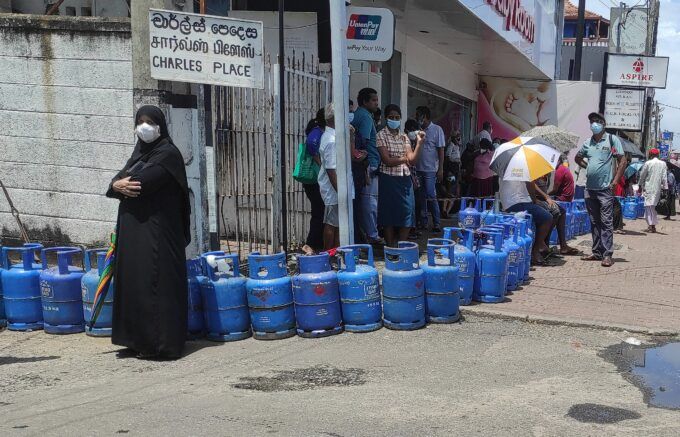
Sri Lanka’s Political and Economic Crisis

Kenneth Surin


2022 Sri Lankan economic crisis, people wait for long time to refill liquefied petroleum gas cylinders. Photograph Source: AntanO – CC BY-SA 4.0

Sri Lanka, an island of 22 million people, continues to be in the grip of its worst economic and political crisis since independence on 10 February 1948.

Since April there have been protests against extensive shortages of food and fuel, as well as a profound crisis of trust in Sri Lanka’s political institutions, primarily parliament and the presidency (both have faced repeated charges of corruption and nepotism for decades, a situation unable to be surmounted by a cowed judicial system).

The heart of the anti-government movement, at this point, was a demand for the resignation of the strongman president Gotabaya Rajapaksa, a member of a successional political family.

This demand was a success. In the middle of July Rajapaksa fled Sri Lanka for the Maldives during the night on an air force plane, and announced a couple of days later that he was stepping down from the presidency. Gotabaya is now said to be in Singapore.

What precipitated Gotabaya Rajapaksa’s flight was the massive scale of his family’s corruption and venality.

The rule of the Rajapaksas began in 2005 when the older brother Mahinda was elected president. A sectarian, he became a hero with his Sinhalese Buddhist majority community for ending the brutal three-decade civil war with Hindu Tamil separatists.

At the same time, the Tamil minority regarded him as a mortal enemy for the viciousness of the war, where Tamils were killed in their tens of thousands, and even more “disappeared” when the war was supposedly over.

Gotabaya Rajapaksa was Mahinda’s defence secretary and head of the armed forces, and has repeatedly been accused of war crimes and of being personally incriminated in the killings of journalists and the enforced disappearances and the unidentifiable “white van abductions” of Tamils, human rights campaigners, and political opponents.

Mahinda lost the presidential election in 2014, brought down by widespread corruption allegations, but the stranglehold of his family on Sri Lanka’s politics meant that neither these allegations nor those of war crimes were investigated.

The president from 2015 to 2018 was the placeholder Maithripala Sirisena.

Supposedly “non-affiliated”, Sirisena turned out to be a stooge of the Rajapaksa family. Promising to serve only one term, he made Ranil Wickremesinghe (the current president) his first prime minister.

Ranil Wickremesinghe lasted until 2018, when Sirisena sacked him and appointed the former President Mahinda Rajapaksa (his erstwhile supposed rival) as prime minister.

Sirisena then prorogued Parliament, violating the Sri Lankan constitution in the process, and precipitating a constitutional crisis.

In November 2019, Gotabaya Rajapaksa, the former defense secretary who presided over the last phase of the civil war, was elected president, and appointed his brother (the former president) Mahinda as prime minister.

Parliamentary elections were held in August 2020. The brothers’ party, Sri Lanka People’s Front– campaigning on a platform of Sinhala-Buddhist chauvinism and governmental militarism– achieved a supermajority in these elections. This put them in a position to amend the constitution and remove curbs on presidential powers.

Assurances given to the international community by Maithripala Sirisena and the Rajapaksa brothers that there would be investigations into war crimes perpetrated during the civil war have always come to naught— at the same time as they mouthed these bromides to the international community, the Rajapaksas were telling their domestic audience that such measures would never be taken against the country’s “war heroes”.

Despite this, the US Ambassador to the United Nations Samantha Power in 2016 called Sri Lanka a “global champion of human rights and democratic accountability” (sic).

Ms Power was voicing what had become conventional wisdom in the international community, namely, that Sri Lanka merely “needs time” to heal the wounds of the civil war, and was somehow already embarked on that curative trajectory. Sri Lanka therefore needed encouragement rather the horsewhip. This was a grievous miscalculation.

As a result of this blunder, pervasive in international political circles, the Rajapaksas always knew they were in for an easy ride from the international community, and could use this impunity to ride rough-shod over ordinary Sri Lankans.

Mahinda and Gotabaya weren’t the only Rajapaksa players in Sri Lankan politics. Another brother, Basil, who was finance minister, as well as several other Rajapaksas who held cabinet posts, are said collectively to have bankrupted the country by engaging in widespread corruption, economic mismanagement, reckless borrowing, drastic and unnecessary tax cuts (which increased the national debt), profligate spending on vanity projects, and the already-mentioned militarization of government (the US now supplies military equipment to Sri Lanka), and a conflict-riven Buddhist-Sinhalese racist politics.

Basil Rajapaksa, a US citizen, is nicknamed “Mr Ten Percent” as a result of his habit of demanding a 10% personal commission from local and foreign companies on their receipt of government contracts.

Basil, and the eldest Rajapaksa, Mahinda, remain in Sri Lanka on the orders of the supreme court. Also subject to this order is Mahinda’s nephew Namal Rajapaksa, said to be the family’s political heir apparent.

Sri Lanka ran out of foreign currency to pay for imports. The ensuing fuel and food shortages, months of lengthy power blackouts, and record inflation (39.1% in May), prompted Sri Lankans to take to the streets in April.

These protests were met with teargas attacks, draconian surveillance, travel bans, death threats, and imprisonment of protesters without charge.

The protesters stormed the presidential palace, took dips in the absconded Gotabaya’s swimming pool, and worked out in his gym.

There is no confidence that current president Ranil Wickremesinghe can, or will, do anything significant about this critical situation. Ranil is expected to seek a bail-out deal with the IMF, which of course will demand its usual hardline “conditionality” that will hit the poorest hardest.

Like the 2015-2018 placeholder president Maithripala Sirisena, the wily and opportunistic deal-making Ranil Wickremesinghe (nickname “Deal Ranil”) seems to have been earmarked for a similar role by the Rajapaksas.

The Rajapaksas may be a family, but their record shows they are also Sri Lanka’s foremost cartel.

Soon after being made president, Wickremesinghe declared a state of emergency, and called the protesters “fascists” while cracking down on the demonstrations.

The state of emergency continues, allowing security forces to arrest leaders of the protest movement, conduct searches without warrants, limit public gatherings, and to demolish the main anti-government protest camp in a violent pre-dawn raid that caused consternation in foreign embassies and among human rights advocates.

A government spokesman said last week that Gotabaya will return to Sri Lanka— he only has a short-term visa for his stay in Singapore, and has not so far applied for asylum there.

However, last week Sri Lanka’s supreme court posted a call for Gotabaya Rajapaksa to make submissions by 1 August in response to various petitions seeking accountability for those deemed responsible for the country’s economic collapse.

This step by the supreme court may encourage Gotabaya to prolong his foreign travels, taking care of course to avoid those countries which have extradition agreements with Sri Lanka.

Instead of walking away with their tails between their legs for turning a long and steady blind eye to the Rajapaksas’ excesses and crimes, western governments and media saw Sri Lanka’s economic collapse as yet another opportunity to target bogeyman China.

Western political leaders and media have consistently depicted China’s Belt and Road initiative as a “debt trap” for the countries benefitting from it.

Sri Lanka is now alleged to be the latest “victim” of this “debt trap”.

Alas for purveyors of this “debt trap” narrative, the vast majority of Sri Lankan foreign debt is owed to the West.

It turns out that (as of 2021) a massive 81% of Sri Lanka’s foreign debt was owned by US and European financial institutions, as well as western allies Japan and India.

According to statistics released by Sri Lanka’s Department of External Resources, as of April 2021, the bulk of its foreign debt is owned by Western venture capitalists and banks, who own 47% of the debt.

The top holders of Sri Lankan foreign debt, in the form of international sovereign bonds (ISBs), are the following:

BlackRock (US)
Ashmore Group (Britain)
Allianz (Germany)
UBS (Switzerland)
HSBC (Britain)
JPMorgan Chase (US)
Prudential (US)

The Asian Development Bank and World Bank, which are arms of the US’s Washington Consensus, own 13% and 9% of Sri Lankan foreign debt (respectively).

Japan owns 10% of Sri Lanka’s foreign debt, while India own’s another 2% as of April 2021.

China, by contrast, owns !0% of Sri Lanka’s foreign debt.

Most of my information regarding Sri Lanka’s debt is taken from Ben Norton’s excellent piece (posted on 13 July) on MRonline.

To quote Norton: “Western media reporting on the economic crisis in Sri Lanka, however, ignores these facts, giving the strong, and deeply misleading, impression that the chaos is in large part because of Beijing”.

Meanwhile the people of Sri Lanka continue to suffer, with the prospect of a Rajapaksa return to power somehow looming over them.

Five Haitian migrants dead, dozens rescued as US escalates its anti-immigrant policies

Alex Johnson


Several incidences recently have pointed to the horrendous circumstances facing impoverished and desperate Haitian migrants who have been forced to take deadly sea voyages, confirming once again that hardly a week goes by without a shocking disaster caused by capitalism. 

In this photo provided by Puerto Rico's Department of Natural Resources, rescued migrants walk on the shore off Mona Island, west of Puerto Rico, Thursday, July 28, 2022. (Puerto Rico's Department of Natural Resources via AP)

This reality was on full display last week when five Haitian migrants drowned and 68 others were left stranded Thursday after being dropped off from a boat in waters near Mona Island, west of Puerto Rico. Federal and local authorities who spotted the migrants identified 41 men and 25 women who survived.

Authorities searched the area near the uninhabited island for several hours after receiving a call from agents with the Puerto Rico Department of Natural Resources, who first spotted the migrants. The sailors who led the migrants onboard fled the scene along with the boat, according to officials. 

Many of the vessels carrying Haitian migrants that travel to Puerto Rico often depart from the neighboring Dominican Republic, which shares the island of Hispaniola with Haiti. Some of the vessels wind up capsizing in the treacherous Mona Passage that separates the two islands while others are dropped off prematurely in tiny uninhabited islands before reaching Puerto Rico, leaving many stranded without food or resources.

While the exact causes of Thursday’s unexpected drop-off are unclear, immigration officials noted that the exploitation of migrants, including offering trips on makeshift vessels in exchange for cash, is not uncommon. US Coast Guard spokesman Ricardo Castrodad said following the incident, “Smugglers are there to make a profit, and they are not concerned about your well-being.” He continued, “They were left at the mercy of their ability to reach shore.”

In late May, 842 Haitians were rescued from a boat off Cuba’s north coast, where they had been abandoned by the lead voyagers. Although many Haitian nationals who arrive in Cuba are not officially reported, in recent months Cuban authorities in Havana have acknowledged an increase in migrants reaching its shores. On Saturday, a group of 141 Haitian migrants were found stranded on Cuba’s southern coast, as part of a series of large-scale efforts by Haitians to flee the country’s insufferable and violent conditions. 

According to the head of Red Cross Operations in Cienfuegos, Cuba, Nadiezka Carvajal, of the people traveling on the boat, over capacity and in precarious conditions, 22 were children and there were also pregnant women and elderly people. Testimony from one of the trip’s castaways revealed that the objective was to reach Florida, with the closest distance from Cuba just 91 nautical miles, but the voyage was imperiled as a result of tumultuous weather. 

Thursday’s deadly event came barely a week after 17 Haitian migrants were found dead and 25 others were rescued in the Bahamas after their boat overturned and sank while attempting to reach US shores. Two months prior, 11 Haitian women drowned and 38 others were rescued after their boat capsized near Puerto Rico. Eight of the survivors had been taken to a Puerto Rican hospital and treated for serious injuries. 

US Customs and Border Protection (CBP) officials are also reporting a substantial growth in Cuban migration amid an acute economic crisis on the island. More than 140,000 Cubans have been detained from October to May, a tenfold increase from the fiscal year 2020, according to the CBP. The recent wave is greater than the Mariel boat-lift of 1980, when 125,000 Cubans fled the island.

Widely viewed video footage taken by a Carnival Cruise passenger last week captured 12 Cuban migrants stranded at sea before being rescued by the ship. The ship’s passengers, who were heading back to Port Miami, Florida, revealed that the migrants were at sea for five days and lost communication with their families. According to CBP officials, 21 migrants arrived in different parts of the Florida Keys. 

The Biden administration is responding to the growing humanitarian crisis in the Caribbean with an escalation of detentions and rapid deportations of refugees. The US Coast Guard’s Tampa Cutter repatriated 109 Haitians to Cap-Haitien, Haiti, Saturday, following an interdiction near Cay Sal Bank.

Connor Ives, Lieutenant for the Coast Guard’s seventh district, warned Haitians against making “illegal voyages” to the US. “Anyone attempting to enter the US illegally by sea should expect to be repatriated once interdicted,” Ives declared. On Saturday, a Coast Guard crew repatriated 83 Cuban refugees back to Cuba following several recent interdictions off the Florida Keys.

The transformation of the Caribbean into a watery graveyard, only a few hundred miles from US shores, is one element of the barbaric and politically driven nature of the anti-immigrant policies of the American ruling class, and exposes the hypocrisy and cynicism of the Biden administration and Democratic Party.

President Joe Biden’s election was billed as a progressive achievement that would bring about social reform and a leftward shift away from the openly fascistic approach of Donald Trump. Instead, Biden has accelerated the attacks on immigrants and continued the discrimination and xenophobia that was the hallmark of his predecessor and Trump’s fascist policymaker Stephen Miller.

Just nine months after Biden’s election victory, US Border Patrol agents on horseback launched a vicious attack against Haitian migrants who had taken shelter under a freeway overpass in Del Rio, Texas. Biden then ordered the thousands of refugees dragged from the makeshift camp and sent back in a wave of mass deportations that continue to this day. 

Biden and the Democrats have since then presided over the extension of the inhumane Title 42 mass expulsions introduced under Trump. This is a violation of international and domestic law, the rejection of the right to asylum for thousands, is leading to a surge of immigrant deaths and injuries along the US-Mexico border. In late June, 46 undocumented immigrants were found dead in a freight trailer, asphyxiated after escaping abysmal economic conditions in Central America produced by over a century of US imperialist exploitation. 

The anti-immigrant restrictions imposed by the current Democratic administration are far from unique. Biden was, after all, vice president during the presidency of Barack Obama, whose legacy as “Deporter-In-Chief” saw the apprehension of one million Central American immigrants and the deportation of more than 800,000, an amount that dwarfs all other administrations.

The history of repression against Haitian refugees can be traced back decades to Democratic and Republican administrations alike, as the capitalist class dictated that the utmost brutality be meted out to this highly exploited section of the international working class. 

The 1970s witnessed a growing number of Haitians fleeing social misery and violence at the hands of the three-decades-long US-backed Duvalier dictatorship and its vicious paramilitary forces. In response, Democratic President Jimmy Carter established the so-called Haitian Program, a reactionary and racist policy which placed newly arrived Haitians in local jails, denied them employment and applied a blanket denial of their asylum claims. Carter also sought the repatriation of Haitians in droves, returning them to Haiti to face unbridled torture under the Duvalier regime. 

Carter administration officials were unequivocal that their aim was to deny Haitians their right to asylum. A high-ranking Immigration and Naturalization Service (INS) official said at the time, “the most practical deterrent to this problem [was] expulsion from the United States.” The INS classified most detained Haitians as “economic migrants” and many were quickly repatriated to Haiti despite the violent political repression of the military dictatorship. 

In 1980, federal judge James Lawrence King struck down Carter’s measure and called the administration’s treatment of Haitians “discriminatory acts” against “the first substantial flight of black refugees,” and all “part of a program to expel Haitians.” King asserted that the US government’s prejudgment decisions discriminated against refugees and violated their right to claim asylum and to due process.

Carter’s successor, Republican President Ronald Reagan continued the practice of jailing Haitian refugees, a major goal being to intimidate and dissuade more of them from traveling to the US. Haitians already living in the US were also detained and confined until they could be expelled from the country.

Reagan sought to maneuver around King’s court decision as he introduced the practice of “interdiction,” meaning the United States could intercept migrant boats before they could reach American shores and deprive them of the ability to claim asylum. During George H.W. Bush’s presidency, Haitian asylum seekers who had been intercepted by the US Coast Guard were taken to six overcrowded camps at the US naval base in Guantanamo Bay, Cuba.

From 1991 to 1993 there emerged the “Haitian Refugee Crisis,” when the US Coast Guard was instructed to grab an outflow of Haitian refugees and take them to the Guantanamo camps. In the early 1990s more than 32,000 Haitian men, women and children fled the country after democratically elected president Jean-Claude Duvalier was overthrown in a coup backed by the US intelligence agencies and replaced by Henri Namphy’s brutal junta. 

During the eight months that Aristide was in power the number of Haitians who fled was reduced by a third. Six weeks after Aristide was overthrown, at least 1,500 Haitians had been killed. In the decade prior to Aristide being overthrown, 25,000 Haitians were intercepted at sea by U.S coastal officials. One year after the coup 38,000 refugees were intercepted.

In May 1992, Bush announced the Kennebunkport Order aimed at slowly emptying the refugee camps and which instructed the Coast Guard not to bring Haitians to Guantanamo. But this elicited condemnations from human rights organizations because of its blatant violation of the Geneva Conventions’ treatment of refugees. The new policy prioritized returning refugees to Haiti who had left to escape political persecution, thus making their return a death sentence at the hands of the blood-drenched Namphy regime. 

An element of this infamous history was Camp Bulkeley, one of the two encampments which held about 270 refugees approved for asylum who tested positive for HIV or were related to someone with HIV at the camp. The US government demonstrated a staggering and criminal indifference to infected detainees, with many denied basic treatment for the life-threatening disease. In March 1993, US District Judge Sterling Johnson Jr. deemed the facility an “HIV prison camp” and ruled that the 'government either had to provide medical treatment for those with the AIDS virus or send them where they could be treated.” 

The refugees endured lengthy detention as no push was made to move their asylum claims forward. US courts declared that detained Haitians had “no substantive rights” under federal law. Virtually all refugees were subjected to horrid treatment, as most slept on cardboard or bare ground and others on cots. The food provided was inedible and their living conditions were squalid and lacked proper infrastructure for sanitation.

Karma Chavez, an associate professor and researcher at the University of Texas, Austin, wrote, “These refugees lived in deplorable conditions, were subjected to violence and repression by the US military, deprived of proper medical care, and left without any legal recourse of rights.”

Haitian detainees who protested the camp’s abhorrent conditions and demanded their right to due process were punished with solitary confinement, and women were forced to undergo abusive and degrading physical examinations. “When we protested,” one detainee recalled, “I was beaten…made to sleep on the ground like animals, like dogs, not like humans.”

President Biden has all but reprised the lies of Bill Clinton, who promised during his presidential campaign against Bush that he would make it easier for Haitians to apply for political asylum and end the “cruel policy of returning Haitian refugees to a brutal dictatorship without an asylum hearing.”

But when it became apparent that hundreds of thousands of Haitians were preparing to sail to US shores following Clinton’s electoral victory, the Democratic president quickly reversed course and said Haitians who fled by boat would be intercepted and returned to the island. In a taped video broadcast aimed at browbeating political refugees, Clinton declared that “leaving by boat is not the route to freedom” and that there would be no alteration in the policy of forced returns. 

The barbaric treatment of Haitian refugees demolishes every effort of the US political establishment to lecture the world on “human rights.” American capitalism’s domestic crimes correspond with its unflinching endorsement of the bloodthirsty dictatorships in Egypt and Saudi Arabia, two regimes that murder and torture their civilians regularly. Alongside that is the US-instigated military conflicts and provocations directed against Russia and China which have already killed thousands in Ukraine and risks triggering a global conflagration that would kill hundreds of millions if not billions. 

Haitians and other migrants risking their lives to make the perilous journey to the US are impoverished workers, rural toilers, and ruined small businesspeople that have faced savage oppression under US-backed dictatorships and super-exploitation by transnational corporations.

As inflation surges, France’s TotalEnergies posts €18 billion super-profits

Samuel Tissot


On July 28, French energy giant TotalEnergies announced more than €17.7 billion in profit ($18.8 billion) in the first half of 2022, a three-fold increase over the same period last year. The corporation has invoked increased oil and gas prices driven by the NATO-Russia war in Ukraine to justify a huge spike in fuel prices. In reality, it is using the Ukraine crisis to extract billions from the pockets of workers in France and internationally.

A TotalEnergies filling station in Paris, France [Photo by Chabe01 / CC BY-SA 4.0]

This phenomena is not limited to just Total or France. Multiple oil and energy corporations posted record profits in the second quarter of 2022. In just three months, ExxonMobil made profits of $17.9 billion, Chevron $11.6 billion, and Shell Oil $11.6 billion.

The 6.1 percent inflation rate recorded in France at the end of July is the highest ever. Fuel prices have been one of the principal drivers of rising costs. National averages for petrol prices peaked at €2.12 per liter in early June before reaching €1.85 per liter at the beginning of August, an increase of €0.30 from a year ago.

Although French president Emmanuel Macron demagogically denounced “war profiteers” who would seek to use the war in Ukraine to increase profits at June’s G7 meeting, his government is giving its full support to Total’s war profiteering.

In a Senate debate, as a motion to place a pitiful “exceptional solidarity contribution” on Total’s record profits was rejected, Economy and Finance Minister Bruno Le Maire defended Total. He said that businesses also “bear the burden of inflation,” claiming that the “best way for a company to [aid society] is not to be taxed, but to increase the salaries of its employees.”

Both claims are preposterous. Total’s year-on-year profit increase of over 300 percent in the first six months of 2022 is 50 times larger than France’s 6.1 percent inflation rate. Meanwhile, Total Energy has not increased workers’ salaries by a cent despite inflation; since 2020, the corporation has cut 6,500 jobs internationally, including 1,100 in France.

Analyzing Total’s “super profits” and tax evasion practices, economist Maxime Combes explains how its “profits are increasing at all stages of its production process, without the corporation having to change anything in its production process.” That is, Total’s record profits are driven automatically by the rise of oil on global financial markets. Besides the increased exploitation of its workforce by refusing to grant them raises as prices surge, it has not taken any action to obtain these windfall profits.

Total’s record 2022 profits follow its “tax optimization” policy, popular with most multinational corporations operating in France, where they declare engineered losses in France while enjoying billions in profit in countries with lower tax rates. As a result, Total has not paid a single euro in French corporation tax in the last 24 months due to losses in 2020 (although it still paid out €7.6 billion to its shareholders in that year).

To placate rising popular anger over blatant price-gouging of the population, Total executives promised an insulting 20-centime reduction in fuel prices from September 1 to November 1. With their pockets already stuffed with ill-gotten billions, Total’s executives and shareholders will walk away massively enriched despite this pitiful measure.

There is no indication that consumer fuel and energy prices or Total’s record profits will decline anytime soon. According to the International Energy Agency (IEA), energy multinationals could see “excess profits of up to €200 billion in the European Union in 2022.” According to Combes, this could see Total’s own profits reaching €35 billion for the year.

Total is not the only corporation funneling billions in profits to shareholders whilst the great mass of the population suffers amid the pandemic, runaway inflation, and the economic fallout of the war between NATO and Russia in Ukraine.

Last week, corporations listed on the CAC-40 Paris stock market announced a record €174 billion in profits in 2021, over double the €80 billion recorded in 2019 before the COVID-19 pandemic. This is almost double the record profits of €100 billion recorded in 2007, on the eve of the 2008 financial meltdown.

Alongside Total, the most profitable corporations were the Vivendi media group, which made over €24.6 billion; and luxury group LVMH, owned by France’s richest man Bernard Arnault, which made €12.7 billion.

Despite the automotive industry being plagued with a semi-conductor shortage for over three years, automaker Stellantis, which operates multiple factories in France, posted profits of €18 billion in 2021, a 34 percent increase on the previous year.

Alongside Total, corporate profits are continuing to surge in 2022 despite record inflation, the economic impacts of the war in Ukraine, and warnings of an impending recession in France and throughout the eurozone. In the first quarter, LVMH announced a profit of €6.5 billion in the first quarter of 2022, a 23 percent increase on 2021. Stellantis reported profits of €8 billion for the first six months of the year.

Across the globe, the ruling class is acting on the motto “never let a good crisis go to waste.” Following the first, and to date only proper lockdown against COVID-19, in May 2020 European corporations were bailed out for hundreds of billions of dollars with the approval of the CGT and other Franco-German unions.

Alongside the implementation of a back-to-work policy, which has led to millions of deaths and multiple waves of the virus, this created the conditions for a massive surge in the stock market, record corporate profits, and an unprecedented increase in the wealth of the super-rich. Amid rising inflation, the war in Ukraine, and an impending recession, this process is only accelerating.

Both internationally and in France, the ruling class has never had it so good. In just one telling example, during the pandemic and accompanying economic crisis, France’s richest man, Bernard Arnault, has seen his wealth more than double from $76 billion in 2020, to $166 billion on August 1, 2022, according to Forbes wealth tracker.

On the other hand, the working class is facing rising costs, alongside cuts to already grossly inadequate social support. In response to inflation, the Macron government passed a 4 percent increase in retirement pensions and family allowances, an effective cut given the 6.1 percent inflation rate.

Though Total’s profits are widely viewed with outrage and disgust, no major party has proposed any measure that questions, let alone threatens, the ability of corporate executives to horde billions. Had the political theatre of the dead-on-arrival “solidarity contribution” passed the National Assembly and Senate, it would have been no more than a drop in the bucket of the hundreds of billions funneled to the super-rich every year.

Spain signs military agreement with US amid US-NATO war in Ukraine

Alice Summers


Last month, Spain’s PSOE (Socialist Party) Prime Minister Pedro Sánchez issued a joint statement with US President Joe Biden pledging to increase the number of US warships and soldiers stationed on Spanish territory. The declaration outlining the military plans was adopted at an hour-long meeting between the two leaders on June 28, during the NATO summit in Madrid at the end of that month.

Prime Minister of Spain Pedro Sanchez speaks to Spanish troops during his visit to Adazi Military base in Kadaga, Latvia, Tuesday, March. 8, 2022. (AP Photo/Roman Koksarov)

The agreement will increase the number of US destroyers stationed at the southern Spanish naval base of Rota in Cádiz by 50 percent, from four to six destroyers. It also provides for the garrisoning of an additional 600 American Marines at this base, taking the total number up to 1,800. The four destroyers currently stationed at Rota are part of NATO’s “antimissile shield,” as well as taking part in unilateral US missions, and regularly patrol the Black Sea.

The meeting between Biden and Sánchez comes amid the US-led proxy war against Russia in Ukraine. Having goaded Russia into an invasion of its Eastern European neighbour, the NATO powers seek to use the conflict to escalate tensions with Moscow and to push for regime change and the dismemberment of Russia’s vast landmass.

Sánchez’s coalition government of the PSOE and the pseudo-left Podemos has fully signed up to the warmongering of the NATO alliance in Ukraine, sending warships, jet fighters and soldiers to Eastern Europe and funnelling tanks, ammunition and rocket launchers to NATO’s Ukrainian proxies for use against Russia. The Biden–Sánchez pact signals the Spanish government’s intention to continue and escalate its imperialist aggression in conjunction with the US.

Speaking to the press after his meeting with Biden, Sánchez declared: “Spain and the United States are allies, we share the will to promote democracy, freedom, human rights.” Biden, for his part, told Sánchez: “I want to thank you for your leadership, Pedro.”

He continued: “We are together with Ukraine giving it everything it needs to defend itself. … This makes us strong allies. The United States and Spain are also working in Latin America to strengthen democracies and strengthen our immigration policies. The joint statement reflects the great breadth of our cooperation.”

The document also lays out plans to escalate the campaign of violence and intimidation against migrants and refugees seeking to enter the European Union through Spain and the US from Latin America by “promoting safe, ordered and regular migration.

“Both countries intend to collaborate in a comprehensive approach to manage the flow of irregular migration that guarantees a fair and humane treatment of migrants,” the document dishonestly claims. “Both countries plan to coordinate efforts to tackle the root causes of irregular migration and work to strengthen the legal routes, with particular emphasis on the countries of Latin America and the Caribbean.

“Spain and the United States also recognise the importance of a permanent cooperation with respect to the challenges of irregular migration in the region of North Africa,” it adds.

This comes in response to the PSOE-Podemos government’s demand at the end of June that NATO consider migration as well as food insecurity and terrorism to be “hybrid threats,” a reference to NATO denunciations of Russian “hybrid warfare” before the war in Ukraine. NATO must strengthen its “southern flank”—i.e., the Sahel and Maghreb—PSOE Foreign Minister Jose Manuel Albares had also told Reuters.

Not coincidentally, the PSOE-Podemos government’s demands came just days after at least 37 migrants were killed and 150 more injured on the border between Spain’s North African enclave of Melilla and Morocco. Spanish and Moroccan police collaborated to systematically entrap, beat and tear gas refugees as they tried to climb the border fence, causing many to be suffocated or crushed to death.

On June 30, Spain’s Congress also voted in favour of doubling its military spending to 2 percent of GDP, reaffirming a pledge made by the PSOE-Podemos government to this effect in February. The motion on military spending, brought by the conservative People’s Party (PP), was passed in parliament with the votes of the PSOE, PP, the right-wing Citizens and a number of other deputies. Podemos, the pseudo-left junior partner in the Spanish government, voted against the bill, knowing full well that it would win a majority regardless of its support.

In an interview with TV talk show “La Hora de La 1,” Prime Minister Sánchez defended plans to increase the defense budget, stating, “NATO is an alliance of democracies in defence of democracy, and we must defend democracy by increasing our dissuasive capabilities.”

He continued, “We have to be very conscious of the fact that, beyond Europe and NATO, the world is very complicated, very difficult, it’s getting cold and it is important to defend our way of life and situate ourselves on the basis of an internal order.”

Podemos tried to distance itself from the warmongering of the Biden administration and the Spanish government, issuing mild criticisms of the Spain-US military agreement.

“We don’t like this pact,” Jaume Asens, president of Podemos’ parliamentary group, told the media inside Spain’s Congress building. “It means more soldiers, more North American destroyers and, therefore, a greater dependence on or submission to the USA when at times our interests are not the same.

“We defend European autonomy in terms of security, and this [the pact] goes in the opposite direction,” Asens added. But asked explicitly whether Podemos would vote against the military agreement when it reaches the Spanish Congress, Asens refused to commit his party to opposing it.

“We still have to decide about the vote, but it is evident that our position is different,” Asens declared. “We have always insisted that the solution is not greater military investment.”

Podemos’ criticisms of the policies of a government of which it is itself a part of have nothing to do with principled opposition to imperialist war. Podemos is aligning itself with a faction of the European bourgeoisie that wishes to develop greater military autonomy under the aegis of the EU. These calls aim to arm and prepare the European powers to pursue their own imperialist interests around the world, independently of or even in opposition to the military policies of the United States.

As the war in Ukraine progresses, the tensions between the countries that make up the NATO bloc will only increase, as each imperialist power seeks to pursue its own aggressive interests in dividing up the world’s resources and territories.

Oil giants reap record profits from war, pandemic and skyrocketing prices

Jacob Crosse


As working class families the world over struggle to afford basic necessities amid historic inflation, driven by the pandemic and the US-NATO war against Russia in Ukraine, the world’s largest multinational oil corporations are announcing record profits.

High gas prices are shown as a pedestrian waits to cross the street in Los Angeles, June 16, 2022. Oil companies were swimming in record profits the last few months. (AP Photo/Jae C. Hong, File)

Over the past week, the six major multinational oil giants—ExxonMobil, Chevron, Shell, BP, TotalEnergies and Eni—reported combined profits of over $64 billion in the second quarter alone. The orgy of profiteering is not limited to the six major oil companies. The smaller US companies Valero, Phillips 66 and Hess posted a massive combined quarterly profit of $8.62 billion.

In total, these nine companies reported over $72 billion in profits over three months. The oil companies, by and large, have refused to increase production, driving gas prices in the United States earlier this summer to an average of $5 a gallon and siphoning billions from working class families into their coffers. While the price of a gallon of gas has dipped somewhat in the last month to a nationwide average of $4.19 a gallon, this is still over a dollar more than the $3.17 recorded at this same time last year.

Every day during this period, the oil companies made $800 million in profit, or about $33.3 million an hour.

An analysis by the Natural Resources Defense Council (NRDC), an environmental lobbying group that tracks the profits of the 15 largest oil and gas companies in the United States, found that compared to the same period in 2021, oil company profits grew “a staggering 242 percent.”

The largest private oil company in the United States, ExxonMobil, reported a second-quarter profit of nearly $17.9 billion, which represents a year-to-year increase of 226 percent, according to the NRDC. Overall, ExxonMobil has reported over $23.3 billion in profits this year alone.

Chevron reported a second-quarter profit of $11.62 billion, a 277 percent year increase from a year ago. The United Steelworkers union played a key role in the company’s massive profit increase through its isolation and betrayal of Chevron workers’ struggles for improved wages and working conditions, including its sellout in June of a strike by 500 oil workers in Richmond, California.

UK-based Shell reported a second-quarter profit of $17.85 billion, a 107 percent increase from last year, bringing this year’s total profits to date to over $20 billion.

Italian-based oil giant Eni reported a second-quarter adjusted net profit of $3.88 billion, a year-to-year improvement of nearly $1 billion.

French-based TotalEnergies likewise posted an all-time-high second-quarter profit of $9.8 billion, nearly a three-fold increase from last year. This figure topped the company’s previous high set in 2008, when the price of a barrel of oil (Brent Crude) was $147, roughly $47 more than current prices.

The profit figures exceeded Wall Street expectations and left investors and oil billionaires salivating at the prospect of stock buybacks and increased dividend payments. Instead of using their ill-gotten profits to hire more workers, increase wages or invest in new technologies to improve safety and combat the impact of climate change, all of the oil companies announced a new round of stock buybacks.

Industry publication RigZone.com notes that TotalEnergies already “bought back $2 billion of its shares” in the second quarter, and “will do so again in the third quarter.” The publication continued: “The board of directors of the company also approved the distribution of the second dividend in 2022, 5 percent higher year-on-year.”

Similarly, BP has spent $3.9 billion on stock buybacks in the first half of the year and announced another $3.5 billion buyback for the third quarterThe New York Times reported that the company would “devote 60 percent of its ‘surplus cash flow’ this year to share buybacks,” and raise the stock dividend by 10 percent.

ExxonMobil has already spent $7.6 billion on dividends and share purchases through the second quarter.

The New York Times reported Tuesday that BP, Chevron, ExxonMobil, Shell and TotalEnergies have collectively spent some $25 billion in the first half of the year buying back their own shares.

While the portfolios of major oil company shareholders are booming, American families are falling deeper into debt, unable to keep up with record cost-of-living increases and soaring interest payments fueled by the Federal Reserve’s rate-hiking program. At the same time, the Fed is deliberately engineering a slowdown in economic activity in order to drive up unemployment and undermine workers’ struggles for higher wages and better working conditions.

On Tuesday, the New York Federal Reserve reported that US household debt exceeded $16 trillion for the first time ever. It noted that credit card balances increased by $46 billion last year.

According to CNN, in the past year overall credit card debt has “jumped by $100 billion, or 13 percent, the biggest percentage increased in more than 20 years.”

The oil companies’ price-gouging and profiteering in the midst of mass death from the pandemic and the escalating US-NATO war against Russia underscores the necessity for the working class to take possession not only of fuel, but also of food, medicine and all the other essentials of modern life to use for the betterment of all of humanity, not the enrichment of privileged idle few.