23 Sept 2022

EU states thrust aside Kremlin’s warnings of nuclear war over Ukraine

Alex Lantier & Johannes Stern


On Thursday, after Russian President Vladimir Putin called up 300,000 reservists and warned that he was prepared to use nuclear weapons in case of a NATO attack on Russia, European Union (EU) officials recklessly pledged to continue escalating the conflict. They announced new sanctions on Russia, which will further raise food and energy prices that are devastating workers’ budgets, and continued arms deliveries to Ukraine.

“We decided to bring forward as soon as possible additional restrictive measures against Russia in coordination with partners,” EU Foreign Policy chief Josep Borrell said after a meeting of EU foreign ministers at the UN General Assembly meeting in New York. The EU “will study, we will adopt new restrictive measures, both personal and sectoral” targeting Russian industries, he added.

European Union foreign policy chief Josep Borrell (AP Photo/Jean-Francois Badias) [AP Photo]

Borrell admitted that Putin’s warnings that he would use “all weapons systems available to us” to defend Russian territory from NATO attack are genuine. The threat of nuclear war, Borrell said, “is a real danger to the whole world, and the international community must react.” However, Borrell made clear that the EU plans to accelerate delivery of billions of euros in weapons to the far-right Ukrainian regime, which has repeatedly attacked Russian-speaking areas of the country.

Putin’s “references to nuclear weapons do not shake our determination, resolve and unity to stand by Ukraine,” Borrell said.

The reckless and utterly irresponsible statements of Borrell, echoed by other EU officials, are leading Europe and the world straight to nuclear war.

Washington and the EU powers have delivered tens of billions of dollars in weapons to Ukrainian army units and far-right militias to hit targets deep inside Russian-claimed territory. On Wednesday, Putin said the Kremlin has concluded that the NATO powers aim to “weaken, divide and ultimately destroy our country.” He added that his threat to use Russia’s full military arsenal, thus including nuclear weapons, was “no bluff.”

Top Russian officials have since repeated Putin’s threats that Russia would respond to attacks on territory, including Russian-speaking areas of Ukraine it currently holds, by using nuclear weapons. Yesterday, Former President Dmitri Medvedev declared: “The Donbas (Donetsk and Luhansk) republics and other territories will be accepted into Russia. … Russia has announced that not only mobilization capabilities, but also any Russian weapons, including strategic nuclear weapons and weapons based on new principles, could be used for such protection.”

Already last week, Medvedev warned that NATO’s “unrestrained pumping of the Kiev regime with the most dangerous types of weapons” could provoke Russian military escalation.

The firing of strategic nuclear weapons by Russia and the NATO powers would lead to hundreds of millions of deaths at the very least and possibly the destruction of humanity. A Russian RS-28 strategic nuclear missile carries 15 independently-targetable warheads, each with an explosive yield of up to 25 megatons of TNT. That is over a thousand times the power of the US nuclear bombs that annihilated the Japanese cities of Hiroshima and Nagasaki in 1945.

French media have cited Russian reports that a single RS-28 missile can destroy a territory the size of Texas or of France, which is the largest EU country by land area.

Other Russian officials also emphasized that they had nothing to propose besides military escalation, including Russian Foreign Minister Sergei Lavrov who briefly appeared at the UN Security Council meeting in New York to make a statement denouncing the NATO powers before leaving, without listening to any remarks from other diplomats present.

Accusing Kiev of “brazenly trampling” the rights of Russians and Russian-speakers in Ukraine, Lavrov said this “simply confirms the decision to conduct the special military operation was inevitable.” He added that “the intentional fomenting of this conflict by the collective West remained unpunished.”

Both the desperate and belligerent remarks of the representatives of Russia’s post-Soviet capitalist regime and the aggressive and reckless statements of the European imperialist powers must be taken as warnings: The deep crisis of the capitalist system is threatening to lead to all-out nuclear war between the major world powers.

The bankruptcy of the Kremlin and the disastrous consequences of the Stalinist dissolution of the Soviet Union in 1991 are now apparent. The NATO imperialist powers not only waged war in the Middle East and the Balkans, freed from any concern about a military and political counterweight to imperialism. They also stirred up conflicts among the former Soviet Republics that now have exploded into all-out war. The Moscow regime, no longer able to make any social appeal to workers internationally and oscillating between attempts to reach a deal with imperialism and to threaten it with its military power, is left with the choice of capitulation or nuclear escalation.

The NATO powers for their part are pouring fuel on the fire. Having provoked the conflict in Ukraine by backing a far-right, anti-Russian coup in the Ukrainian capital Kiev in 2014, they are now using the war to justify a vast expansion of military-police forces, such as the German government’s drive to rearm and implement an aggressive military foreign policy.

Yesterday, German Defense Minister Christine Lambrecht and her French counterpart, Sebastien Lecornu, met in Berlin to stress that the EU powers would continue to arm Ukrainian army units and far-right militias even if this risks nuclear war.

“Our response is really consistent and, most importantly, resolute and joint: there will be no deviations, we will continue to support Ukraine in its courageous struggle in the future,” Lambrecht said. She boasted that “huge successes” of the Ukrainian army were in part due to military aid from Germany and France.

Lambrecht added that Berlin and Paris would continue to run roughshod over Russian warnings of nuclear escalation and support attacks on Russian-held territory. “For us, these referenda [in Donetsk and Luhansk] will be of no significance as this is the territory of Ukraine and will remain so,” she said. “It’s good that we are sending a clear signal: This Putin reaction to Ukraine’s successes only encourages us to continue supporting Ukraine.”

The warmongers in the media are overflowing with calls for a rapid escalation. One should not be “blackmailed” by “Putin’s nuclear saber rattling,” demands the editor of the Frankfurter Allgemeine Zeitung Berthold Kohler in a commentary. “In the tussle with Putin, the West will only remain a credible opponent if it actually continues to stand by Ukraine, at least to the extent it has done so far.” Anything else would be “appeasement” and “betrayal of its own values and interests.”

Clemens Wergins, chief foreign affairs correspondent, demands in Die Welt: “Ukraine must now quickly get all the weapons it needs to quickly liberate the occupied territories, including, for example, modern Western tanks like the Leopard 2 or infantry fighting vehicles like the Marder.” He said it is “in Germany’s interest that the Russian front also collapses in other places in the coming months as it did recently in Kharkiv, when Ukraine succeeded in panic-striking Russian troops into flight and capturing vast swaths of territory in a lightning advance.”

Then he adds, “Because the more clearly this war is lost for Russia when the new recruits come to the front, and the less Ukrainian land the invaders then still occupy, the sooner this war will come to an end.”

This cynical reasoning corresponds to the murderous logic of German militarism in the 20th century. The leading representatives of the Kaiserreich and the Nazis also argued that the rapid and maximum mobilization of the German war machine was necessary to achieve a quick “victorious peace” (Siegfrieden) or “final victory” (Endsieg). In reality, this strategy of escalation led to total war, with tens of millions of war dead and barbaric crimes.

22 Sept 2022

Preventing Climate Disaster in Africa; Eritrea Leads the Way

Thomas C. Mountain


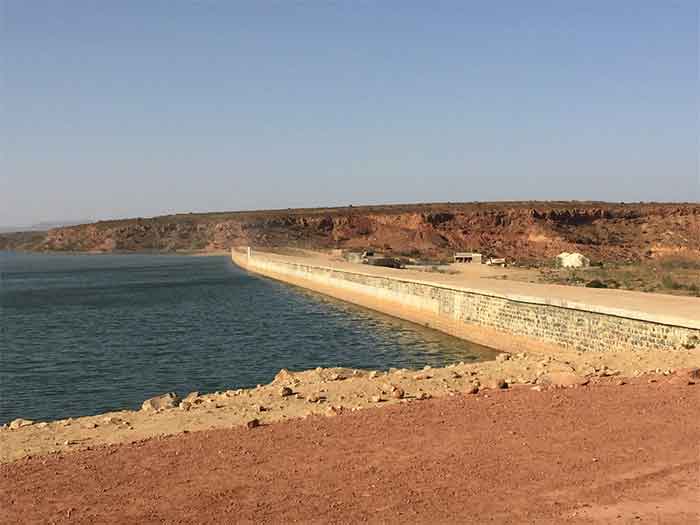
water conservation in eritreawater conservation in eritrea

As what is mainly a western caused climate disaster continues to hammer Africa, with tens of millions facing famine and starvation in the Horn of Africa, the small, underdeveloped country of Eritrea is leading the fight to prevent this from happening.

Eritrea is doing this by aggressively carrying out water conservation by building water reservoirs, both small and large. Over 800 and counting in the last 15 years including 9 large reservoirs, massive even, holding billions of tons of water. Breaking the age old dependency on rain fed irrigation is key to this with water conservation being the key to food security through modern irrigation techniques. This while Eritrea has been hammered by illegal US/UN just sanctions and record breaking droughts.

We lived in Eritrea from 2006 to 2021 and saw first hand the rapid rate of water conservation. Alongside water conservation the critical task of soil conservation through terracing and reforestation is taking place, for without both these new water reservoirs will quickly fill up with silt, making them far less effective.

In 2008-2009 Eritrea experienced the second back to back drought in history, the first being in 2003-2004, with the rain fed harvest completely failing throughout the country. Eritrea’s response, led hands on by the Eritrean President Issias Aferwerki was to divert a major part of the countries limited resources into water reservoir construction.

The results have been clear for all to see and African leaders including the President of Djibouti and the Prime Minister of Ethiopia have both been given guided tours. Today Eritrea is almost food secure in the critical area of cereal staple crops like wheat, barley, sorghum and millet. Eritrea no longer imports almost any fruit or vegetables and is progressing towards self sufficiency in processed products like cooking oil based on canola production.

To understand the accomplishment this is you must know the history of what can only be described as an environmental holocaust that was inflicted on Eritrea during the modern period of colonialism.

In the 1880’s when the first colonialists invaded and subjugated the Eritrean people, the Italians, Eritrea was almost 1/3 forested. By the time the last colonial power, the Ethiopians, were driven from Eritrea and the country became fully liberated, less than 2% of Eritrea was forested.

From almost 1/3 of the country being forested to less than 2% forested in less than a century constitutes an environmental catastrophe than I have been unable to find anywhere else in the world.

When Eritrea became independent in 1991 its leaders had to begin rebuilding the country not from zero but from far below zero.

So for today’s Eritrea in 30 years to become almost completely food self sufficient is a powerful role model for the rest of Africa. And remember, this is in a country wracked by major drought as well as being invaded by the TPLF terrorist regime in Ethiopia in 2000 where some 40% of the Eritrean people, 1.5 million, were driven from their homes and farms with little more than the clothes on their backs.

The lesson that needs to be learned for all Africans is that food security is national security and critical towards not just a countries survival but for its independence and ability to grow and prosper for western bankster institutions like the World Bank, whose policy is in opposition to food security, and the IMF, are determined to keep Africans poor, debt ridden with predatory loans, and on their knees begging for their survival from the very western bankster criminals that caused their problems in the first place.

Eritrea is not only about to be completely food secure but is the ONLY country in Africa NOT to accept predatory loans from the western banksters like the IMF and World Bank. Food secure, financially and politically independent, with the rest of Africa becoming increasingly aware of this small but powerful “threat of a good example”, it isn’t a coincidence that the LiarsForHire in the western MSM alongside their cohorts in the Human Rights Mob are going berserk in their efforts to demonize what remains the way forward towards the very survival of the African people as western caused climate disaster continues to menace the continent.

UK Prime Minister Truss pledges escalated offensive against Russia

Robert Stevens


Prime Minister Liz Truss, in her first trip outside the UK since she succeeded Boris Johnson on September 6, declared that London would double down on military aid and assistance to Ukraine.

Truss spoke evening at the United Nations General Assembly in New York, just hours after Russian President Vladimir Putin announced the mobilisation of 300,000 troops and threatened to use nuclear weapons. Putin was responding to NATO threats to do the same, and to dismember the Russian Federation.

She stated that Putin was “making yet more bogus claims and sabre-rattling threats. This will not work.”

Prime Minister Liz Truss (left) and the President of the United States, Joe Biden, during a bilateral meeting whilst attending the United Nations General Assembly in New York. [Photo by Andrew Parsons/No 10 Downing Street/Flickr / CC BY-NC-ND 4.0]

This was said just weeks after Truss declared her willingness to use nuclear weapons against Russia even though this would mean “global annihilation”. A Downing Street press release reported that Truss would announce a new defence review to “ensure the UK’s diplomatic, military and security architecture is keeping pace with evolving threats posed by hostile nations”.

The review comes 18 months after the last defence review ordered by Johnson. The Financial Times revealed, “Professor John Bew, the prime minister’s special adviser for foreign affairs and defence, will lead a Downing Street process to update the review, which is expected to be completed by the end of the year.”

Russia was to be offered no opportunity for a negotiated settlement in Ukraine, with Truss stating in reply to a question in New York, “First, Russia needs to leave Ukraine, and we need to make sure that there is proper recompense for what has happened in Ukraine, and we need to make sure Russia is never again able to threaten countries on its border.”

Downing Street said she will tell the UN, “The free world needs this economic strength and resilience to push back against authoritarian aggression and win this new era of strategic competition.”

Truss has pledged to increase UK spending on the military to 3 percent of GDP by 2030 at a staggering additional cost of £157 billion. The Financial Times, ever the watchful eye on the profit margins of the ruling elite, noted that an agenda of militarism and war against Russia and China was coupled with Truss’s agenda of class war at home. It commented, “In her speech to the UN General Assembly, Truss will try to link her rightwing economic reforms, including tax cuts and deregulation, with a broader imperative for the west to build its economic resilience.”

These comments are made ahead of an emergency budget Friday that Truss has already declared will be “unpopular” and centred on tax cuts for big business.

Prior to Truss’s trip, Downing Street said it “will meet or exceed the amount of military aid spent on Ukraine in 2022 next year.”

Truss told the UN, “The UK will spend 3% of GDP on defence by 2030, maintaining our position as the leading security actor in Europe. And that’s why – at this crucial moment in the conflict – I pledge that we will sustain or increase our military support to Ukraine, for as long as it takes. New UK weapons are arriving in Ukraine as I speak – including more MLRS [Multiple Launch Rocket System] rockets.”

In an acknowledgement of how deeply Britain is engaged in the military conflict and provocations against Moscow, Downing Street boasted, “The UK is already the second largest military donor to Ukraine, committing £2.3bn in 2022. We have trained 27,000 members of the Ukrainian Armed Forces since 2015, and in the last year we have provided hundreds of rockets, five air defence systems, 120 armoured vehicles and over 200,000 pieces of non-lethal military equipment.

“Last week saw the largest commercial road move of ammunition since the Second World War as tens of thousands more rounds of UK-donated artillery ammunition went to the front lines in Ukraine.”

There is no limit to Britain’s investment in military action against Russia. The statement warned, “The precise nature of UK military support in 2023 will be determined based on the needs of the Armed Forces of Ukraine.”

Figures with close connections to Putin have insisted for months that the first nation to face Russia’s vast nuclear arsenal would be Britain, given its role as Washington’s main partner in attacking Moscow.

Former Putin advisor Sergei Markov told the BBC’s Today radio programme Wednesday, “For western countries, for your British listeners, I would say that Vladimir Putin tells you that he will be ready to use nuclear weapons against western countries including nuclear weapons against Great Britain.”

Russia would use its nuclear arms, “if Great Britain continue to be aggressor against Russia, if Prime Minister of Great Britain Liz Truss still has plans to destroy Russia… This nuclear war could be [the] result of the crazy behaviour of the President of the United States, Joe Biden, and prime ministers of Great Britain Boris Johnson and Lizzie Truss. People in London should understand that this threat comes from Liz Truss, who is the aggressor.”

At the end of August, Russian General Andrey Gurulyov, a deputy in Russia’s parliament (Duma), said of a nuclear attack on Britain, “Let’s make it super-simple. Two ships, 50 launches of Zircon [hypersonic cruise] missiles—and there is not a single power station left in the UK. Fifty more Zircons and the entire port infrastructure is gone. One more—and we forget about the British Isles.”

None of this deters in the slightest the war fever of Britain’s ruling elite. Foreign & Commonwealth Office Minister of State Gillian Keegan said brazenly of Putin’s threat to use nuclear weapons, “Some of the language is quite concerning and obviously we should aim for calm… of course, we will still stand by Ukraine as well, with all of our Nato allies.” Her words echo the World War Two slogan, “Keep Calm and Carry on”.

Tobias Ellwood—a former Tory MP, chair of parliament’s Defence Select Committee and captain of the Royal Green Jackets regiment—who now sits in parliament as an Independent, has long demanded a doubling of military spending to a least 4 percent of GDP. This week he co-authored an op-ed in the Telegraph with Hamish de Bretton-Gordon. Only last month Bretton-Gordon, the former commanding officer of the UK’s Joint Chemical, Biological, Radiological and Nuclear Regiment, wrote in the same newspaper to insist, “Britain should prepare for nuclear war.”

Ellwood and Bretton-Gordon complain, “The West can throw money at the food and fuel crisis to alleviate problems in home countries and less developed ones, but not at the nuclear conundrum.”

Justifying their war aims by warning of the uncertain fate of Ukraine’s Zaporizhzhya nuclear facility, they insisted, “If we are to prevent a serious disaster, we must be far more proactive in establishing and defending precedents for modern nuclear warfare before it’s too late.”

As “the IAEA [International Atomic Energy Agency] and the UN are calling for a demilitarised zone to ring fence Zaporizhzhia and other nuclear power stations,” they wrote, “we need a No-fly zone around the plant. The UN could deploy air defence systems to enforce it. An anti-missile system could be in place to prevent missiles hitting the reactors.”

Britain’s involvement in the military confrontation with Russia continues apace. Between August 29-September 2, the UK completed Exercise Vigilant Knife alongside Swedish and Finnish Armed Forces. This followed a trip by Armed Forces Minister James Heappey to meet UK troops in Tapa, Estonia, 160 kilometres from Russia’s border. An MoD statement said, “More than 800 troops from 1st Battalion, the Royal Welsh currently lead a NATO enhanced Forward Presence (eFP) battlegroup in Estonia. The UK also has a second battlegroup of over 800 from 2nd Battalion, The Rifles, in the country after deploying them in response to Russia’s invasion of Ukraine.”

The MoD added, “Defence Secretary Ben Wallace announced in June that the lethality of these deployments would be enhanced with advanced capabilities including helicopters and artillery systems, as part of an increased UK contribution to NATO. Meanwhile, the UK’s existing HQ in Tallinn will be expanded. Led by a Brigadier, it will support the rapid deployment of high readiness forces at the brigade level.”

In the Italian election campaign, the establishment parties and media pave the way for the fascists

Peter Schwarz


The Italian election campaign suggests only one thing: the country’s leading politicians and media are determined to pave the way for fascist Giorgia Meloni to enter Palazzo Chigi, the official residence of Italy’s prime minister.

For weeks, opinion polls have been predicting a September 25 election victory for Meloni’s Fratelli d’Italia (Brothers of Italy) and the right-wing alliance it heads. But no one is expressing alarm at the prospect of Benito Mussolini’s heirs returning to power in Italy a hundred years after he took power in October 1922. On the contrary, Meloni and her party are embraced and praised, and dangers of fascists in power downplayed.

Commenting on the complaint by the Fratelli d’Italia that its leader is “demonized by the left,” the Süddeutsche Zeitung’s correspondent in Rome writes, “It is rather the other way around: no one demonizes Giorgia Meloni in Italy, not even the press. She is sailing to her election victory, at least that is how it appears.”

The only condition Meloni had to fulfil to be recognized as a possible head of government was a commitment to the continuation of Mario Draghi’s austerity policies, to the European Union, to NATO and to the war against Russia. She promptly fulfilled this condition.

Italy is “a full part of Europe, the Atlantic Alliance and the West,” reads the first of 15 points in the election program Meloni agreed with her alliance partners Matteo Salvini (Lega) and Silvio Berlusconi (Forza Italia). She was “very prudent” and would “not ruin” the state finances, she gave her “full approval to the process of European integration,” she had never proposed an exit from the euro and would stay in line with the EU and NATO in the Ukraine war, Meloni stresses at every available opportunity. She has even released a trilingual video to reassure Italy’s NATO allies and international financial markets.

By contrast, Meloni’s fascist past, her admiration for “il Duce” Mussolini, the numerous neo-fascists and violent neo-Nazis in and around her party, and her connections to right-wing networks in the state apparatus are all benignly ignored—even secretly welcomed, since the representatives of the ruling class apparently believe they will be needed in future confrontations with the working class.

The only face-to-face debate that has taken place between the two most likely candidates for head of government is symptomatic of Meloni’s treatment. The newspaper Corriere della Sera invited Meloni and Enrico Letta, head of the social-democratic Partito Democratico, to a televised duel, which it broadcast live on its website.

Privately, the two like each other and are on first name terms. Letta refrained from making any sharp attacks and said not a word about the fascist past of Meloni and her party. While Meloni invoked the fascist slogan “God, Fatherland and Family,” Letta accused her of not backing the EU clearly enough and of disregarding gay rights. That was as far as his accusations went.

Meloni also received the indirect blessing of Mario Draghi, who continued as acting head of government following his resignation on July 21. “I am convinced that the next government, of whatever political hue it may be, will overcome the challenges of today, even though they seem insurmountable,” he said in a speech—which the Fratelli d’Italia celebrated as a political endorsement.

Not even on an electoral level are the so-called centre-left parties trying to prevent a Meloni victory. Although their programs differ only in nuances, they are running separately in the election. In addition to Letta’s Democrats, who have allied themselves with the pseudo-left Sinistra Italiana, the Greens and a European party, a “Third Pole” led by ex-government leader Matteo Renzi and ex-industry minister Carlo Calenda, as well as ex-government leader Giuseppe Conte’s Five Stars, are running for election.

Since Italian electoral law favours large parties and electoral alliances, this gives the three allied right-wing parties a major advantage. It is considered possible that with just half the votes, they could win two-thirds of the parliamentary seats and then be able to change the constitution.

Support for Meloni is not limited to Italy. Manfred Weber, the German chairman of the European People’s Party (EPP, an alliance of Christian-democratic, conservative, and liberal-conservative member parties at EU level) is campaigning in Italy for Silvio Berlusconi and thus indirectly for Meloni. Like the German Christian Democrats (CDU/CSU), the party of the 85-year-old media tycoon and ex-head of government, against whom three dozen cases of corruption, abuse of office, tax evasion and promotion of prostitution are pending, is a member of the EPP.

The effort to portray Meloni as a reformed politician who would pursue a moderate, conservative course and embody a triumph of women’s emancipation as the first female to head the Italian government stands in stark contrast to reality.

Meloni joined the youth movement of the Movimento Sociale Italiano (MSI), which had emerged directly from Mussolini’s Fascist Party, in 1992 as a 15-year-old. The MSI was a rallying point for fascists who remained loyal to the dictator. It had close ties to far-right networks in the state security apparatus, which repeatedly attempted to create the conditions for a coup d’état through mounting terrorist attacks.

The MSI had influence at local level, but cooperation with it at the national level was considered a taboo. That changed in 1994, when Silvio Berlusconi brought the party into his first government. At age 31, Meloni later became Italy’s youth and sports minister under Berlusconi.

In 2009, the Alleanza Nazionale, as the MSI had come to call itself, merged with Berlusconi’s party. Three years later, Meloni founded the Fratelli d’Italia to continue the MSI’s fascist traditions.

The party initially led a fringe existence. In 2013 it received two percent of the electoral vote and in 2017 just over four percent. Its growth began after virtually all parties joined forces last spring to form a government of national unity under former European Central Bank chief Mario Draghi. Meanwhile, the Fratelli stand at 25 percent in the polls.

The party is teeming with convinced, violent fascists. For example, Francesco Lollobrigida, the Fratelli’s faction leader in the Chamber of Deputies (lower house of parliament) and Meloni’s brother-in-law, championed the construction of a mausoleum for Rodolfo Graziani, which was erected in 2012. Graziani, as Mussolini’s field marshal and minister of war, was responsible for the use of poison gas and mass executions in the colonies, and the construction of concentration camps in North Africa that killed at least 50,000 prisoners.

Three years ago, Meloni’s fellow party members in the Marche region celebrated Mussolini’s march on Rome with a commemorative dinner. One of the participants, Francesco Acquaroli, is now prime minister of the region. In Verona, the party’s youth organization commemorated Nazi collaborator and SS Standartenführer (Standard Leader) Léon Degrelle. Elsewhere, too, the “Roman salute” of the fascists is often seen at commemorative events of the Fratelli.

The party maintains close ties with militant neo-Nazi groups such as CasaPound, whose members describe themselves as “fascists of the Third Millennium.” In one of the organization’s properties, police found a shrine honouring Nazi war criminals Heinrich Himmler, a main architect of the Holocaust, and Erich Priebke, responsible for the Ardeatine massacre in Rome in 1944 in which 335 Italian civilians were killed in retaliation for a partisan attack that killed 33 men of the German SS Police Regiment.

Activists and journalists who have exposed the right-wing machinations of the Fratelli must fear for their lives. For example, Paolo Berizzi, a journalist for the newspaper La Repubblica and author of several books on the extreme right, is under the kind of constant personal protection usually only required by prosecutors investigating the Mafia. He receives dozens of death threats every day and is even threatened on banners at soccer stadiums, where the Ultras are one of the main recruiting grounds for neo-Nazis.

To this can be added Meloni’s connections to far-right parties in other countries. For example, she regularly appears at events organized by Spain’s Vox, a rallying point for supporters of former dictator Franco. She is also close to Hungarian Prime Minister Viktor Orbán and Donald Trump’s supporters in the United States.

Meloni’s takeover of the Italian government is a serious threat to the working class. It will strengthen the far-right forces in the state apparatus and in society that are already terrorizing workers, left-wing activists, and immigrants.

Her allies—the Lega and Forza Italia—stand no less to the right. Lega leader Salvini, as Italy’s interior minister, has incited the most right-wing elements through unrestrained refugee-baiting and massively increasing the powers of the state apparatus. He was supported by the same neo-Nazis who have now turned to Meloni. Silvio Berlusconi began his economic and political career in Licio Gelli’s “Propaganda Due” (Propaganda Two, or P2) Masonic lodge, long the hub of the far-right conspiracy involving the police, military, business, politics, Mafia, and secret services.

The support for Meloni and downplaying of the dangers by all the bourgeois parties and media cannot, therefore, be dismissed as just misunderstandings or “mistakes.” They show that the ruling class as a whole is moving to the right and preparing for the violent suppression of social and political resistance. For this, it needs the fascists.

In the past 30 years, the so-called centre-left parties have conducted massive attacks on the working class. While Berlusconi and his allies looted the state treasury for their own enrichment, it fell to the centre-left and technocrat governments, which the centre-left supported, to replenish state coffers at the expense of the working class. In the process, pseudo-left parties, such as Rifondazione Comunista, have covered for them from the left and supported them against the working class.

The consequences are a hopeless crisis of bourgeois politics and, as far as workers’ interests are concerned, a complete political vacuum. All the establishment parties, and the trade unions, have conspired against the working class. Spending on education, health, and culture has been cut to the bone, those on lower incomes and pensions have seen them massively decline, and unemployment and youth unemployment are among the highest in Europe. The national debt is 150 percent of GDP and is to be reduced by imposing further austerity measures dictated by the EU.

In addition, there are the catastrophic consequences of the pandemic, the climate catastrophe, and the war against Russia. With 177,000 coronavirus deaths, Italy has recorded the second highest number of COVID victims in Europe after Britain. Two-thirds of the population, 40 million people, live in dangerous regions threatened by disasters (fire, flood, earthquake).

NATO’s war against Russia, which Italy fully supports, threatens to turn into a nuclear catastrophe and is driving up prices. Inflation is at 8.4 percent—and rising. Countless families will no longer be able to heat their homes in winter or afford enough to eat.

21 Sept 2022

Hague Institute for Innovation of Law (HiiL)/FATE Foundation Justice Entrepreneurship School 2022

Application Deadline:

30th September 2022

Tell Me About Award:

The Hague Institute for Innovation of Law (HiiL) in partnership with FATE Foundation has launched the call for application for the Justice Entrepreneurship School (JES) which is a programme targeted at entrepreneurs within West Africa who are in the incubation stage of business and have innovative ideas about businesses within the justice sector of economies. HiiL (The Hague Institute for Innovation of Law) is a social enterprise devoted to user-friendly justice and has a goal to develop entrepreneurs working on solutions that will address and solve the pressing justice needs of people in West Africa.

Our Target Audience Includes Startups that empower people with break-through innovations to create better:

  • Working conditions with employers
  • Separation terms with spouses
  • Protection against theft, fraud and violence
  • Arrangements about noise, damages and property access with neighbours
  • Housing maintenance and rent conditions with landlords
  • Agreements on ownership, registration and use of land
  • Contracts, fraud protection and compliance for their small business

Areas of focus for prevention or resolving pressing justice problems are in the following areas:

  • Employment: contract termination, payment of wages/social security/insurance, working conditions, equal hiring opportunities.
  • Family: separation, abuse, child support, custody and inheritance.
  • Neighbours: excessive noise or disorder, right of way, damage to property.
  • Crime: theft, robbery, burglary, and bodily injury, lending and borrowing money.
  • Land: ownership, registration, use of land, tenure.
  • Housing: eviction, living conditions, payment of rent
  • Small business: supplier or client contracts, tax, registration, regulatory compliance, fraud, business premises.
  • Public sector: corruption, bribery, access to utilities (water, sanitation, electricity)
  • Consumer: unfair/unauthorised charges by company or bank, purchasing defective goods or substandard services, warranties.
  • Money: Solutions that help prevent or resolve disputes over lending and borrowing money.

What Type of Award is this?

Entrepreneurship

Who can apply?

To be eligible, you must:

  • Be computer Literate
  • Have basic computer knowledge
  • Have a certificate from a tertiary institution
  • Have a prototype or MVP solution that prevents or resolves justice problems like Neighbours, crime, money, Land, Employment, etc
  • Have a Prototype or MVP solutions that cause social change or has a social impact that pertains to justice.

Which Countries are Eligible?

West African countries

How Many Positions will be Given?

Not specified

What is the Benefit of Award?

Tuition Fee is Free

The curriculum is designed to help the participants become more knowledgeable on how to build and sustain innovative businesses that can solve today’s Justice problems sessions are facilitated by various industry leaders across the entrepreneurial value chain specifically social justice professionals with its learning structure, a combination of virtual sessions, case studies and group activities.

The programme will run for 8 weeks with a single touchpoint twice a week (Mondays and Wednesday) between 26 September –  16 November 2022

How Long is the Program?

Monday 26 September –  Wednesday 6 November 2022

How to Apply for Program?

To apply, click here

Visit Award Webpage for Details

Podemos backs Madrid's commitment to NATO war on Russia

Alejandro López


Podemos’ aggressive support for NATO’s war in Ukraine against Russia, amid mounting working class anger at inflation and war, exposes it as a reactionary petty-bourgeois militarist party. Fearing rising opposition to its left, Podemos is mounting one anti-war charade after another, while continuing to support Spain’s imperialist war efforts in Eastern Europe against Russia.

Podemos leader Pablo Iglesias, January 13, 2020. (AP Photo/Manu Fernandez)

Podemos’ latest charade was mounted in last week’s parliamentary debate on Sweden and Finland’s NATO membership. NATO countries signed the two countries’ accession protocol in July, but they must be ratified by NATO member states’ parliaments before they can be protected by Article 5’s defence clause.

Spain’s parliament approved the accession with 290 votes in favour, 11 votes against and 47 abstentions. The ruling Socialist Party (PSOE), the right-wing Popular Party, the far-right Vox party, and the Catalan nationalist PdeCat and Basque Nationalist Party (PNV) voted in favour.

Podemos, meanwhile, decided to abstain, while one of its parliamentary factions, the Stalinist-led United Left (IU), voted against. Ludicrously, IU leader and Minister of Consumer Affairs Alberto Garzón abstained, to ensure that no NATO minister voted against a pro-NATO resolution.

Podemos spokesperson Gerardo Pisarello, presented Podemos’ “anti-war” charade. He said, 'Let Sweden and Finland make the decision they consider appropriate, but it will not be in our name.”

The entry of Finland and Sweden into NATO is a reckless provocation against Russia. The US-led alliance wants Stockholm and Helsinki not only due to their well-equipped and modern militaries but due to their geostrategic location. Finland shares a 1,300-kilometre border with Russia that is within striking distance of St. Petersburg. Swedish membership in NATO would leave Russia totally encircled by NATO states in the Baltic Sea and make it easier for the alliance to supply its battle groups in the Baltic republics of Estonia, Latvia, and Lithuania in case of war with Russia.

Pisarello then cynically complained that the EU was not conducting the peace policy upon which it is supposedly founded. He said that the EU was 'founded with the stated aim of seeking peace and is doing little or nothing to stop the war.” In fact, European states have played leading roles in NATO’s imperialist wars across the Middle East, Balkans, and Africa for decades, which have devastated entire societies like Afghanistan, Iraq, Libya, Syria, Chad, and Mali, claiming millions of lives and turning tens of millions into refugees.

Playing the anti-American card, Pisarello claimed Europe must have its own imperialist interests outside of NATO. “The priority of the USA is that Europe does not have its own defence policy,” he declared, after saying that being part of NATO is “subordinating oneself to a military and economic oligarchy that does not care about the fate of those attacked … It is an oligarchy that will support the most warmongering extreme right.”

In fact, the PSOE-Podemos government has sent anti-tank missiles to far-right Ukrainian militias.

Pisarello stunt had two audiences. On the one side, the whole debate had the aim of signaling to the US and NATO governments Spain’s full support to the Ukrainian army’s counteroffensive against Russia in Kharkiv. The US and EU have responded to the collapse of Moscow’s northern front by further intensifying their involvement in the war against Russia in Ukraine. They are sending millions more in offensive weaponry, adding to the more than $50 billion in armaments and other assistance sent to date.

Spain’s PSOE-Podemos governments has been a key ally in supporting Kiev’s offensive. In early September, the Spanish air force transported 75 field artillery pallets in five flights to Ukraine. Spanish 155mm howitzer ammunition was used in the offensive. Madrid also sent 20 armoured vehicles, an anti-aircraft system, and 1,000 tons of diesel and 30,000 winter uniforms. The Spanish military will soon begin to train Ukrainian soldiers in Spain on tanks, missile systems, battlefield medicine, and demining work at an army base in Zaragoza.

On the other, the Spanish ruling class uses the false anti-war posturing of Podemos to channel rising anti-war sentiment behind the PSOE-Podemos government.

The PSOE-Podemos government will include a 20 percent military spending increase in a Special Defense Plan, the most expensive in Spain’s modern history. The increase will thus not be included in the 2023 budget, and Podemos will claim that—as promised in August by the deputy prime minister and de facto leader of Podemos, Yolanda Díaz—it does not support a budget that raises military spending.

At the same time, the PSOE and Podemos will field more T8x8 tanks, NH-90 helicopters, Eurofighters, S-80 submarines, F-100 warships and a Hisdesat satellite, paid for by Spanish workers.

What underlies this staggering hypocrisy of Podemos? It acts this way because it is highly conscious of the deep opposition to war within the working class, and therefore to Podemos itself. A mass radicalisation of the working class is underway, as strikes erupt in Europe and the US, and amid the greatest collapse of living standards since the 1930s, a pandemic that has claimed tens of millions of lives, and an escalating war against Russia by NATO in Europe.

Podemos is a petty-bourgeois party that defends the interests of Spanish imperialism: imperialist war abroad, and class war at home in the form of austerity, bank and corporate bailouts, and police assaults on strikers.

If Podemos can continue its “anti-war” charades, it is above all due to forces like the Morenoite Revolutionary Workers’ Current (CRT) which protect its left flank. In each successive stunt mounted by Podemos since Russia’s February 2022 invasion, the CRT has intervened to claim Podemos can be pressured to the left by the pro-war trade unions.

A recent article on the CRT web site La Izquierda Diario, titled “The government intends to increase military spending by 20 percent in 2023 and prepares with Podemos and the PCE to justify its support”, claims that Podemos’ is passively supporting war, trapped in a pro-war PSOE government.

“All this exercise of trickery for the 2023 budget seeks not only to obtain parliamentary support, but also to ensure they are not questioned by the left. Yolanda Díaz works this way so that the climate of [Podemos’] passive support for Sánchez government’ foreign policy continues to predominate, including its pro-NATO commitment and the brutal tightening of immigration policies. All of this with the complicity of a union bureaucracy that has not criticized one iota of this new imperialist escalation of which its government is a part.”

Unions sabotage struggle against 3,600 layoffs at Mercedes in Brazil

Eduardo Parati


On September 6, the announcement by Mercedes-Benz of 3,600 layoffs at its plant in São Bernardo do Campo, in the ABC industrial region of São Paulo, provoked enormous opposition from workers. The company announced that 2,200 permanent employees would be laid off and another 1,400 temporary workers would not have their contracts renewed.

Mercedes-Benz workers rally after layoff announcement (Photo: Adonis Guerra/SMABC/FotosPublicas)

Employing about 9,000 workers, 6,000 of them in production, the São Bernardo plant is Mercedes’ largest plant outside Germany. According to data from the Inter-Union Department of Statistics and Socio-Economic Studies (DIEESE), the dismissal of the 3,600 employees will have an indirect impact on another 18,000 jobs.

Facing the workers’ opposition, the Metalworkers Union of ABC (SMABC), affiliated to the Workers Party (PT)-controlled CUT, was forced to announce a three-day strike at the plant. In this period, the union called no joint action of the ABC autoworkers, much less a general strike to reverse all the layoffs. By Monday, everyone had returned to work while the union continued to meet with Mercedes-Benz behind the workers’ backs.

During an assembly at the plant gate on September 8, two days after the layoffs were announced, SMABC president Moisés Selérges indicated his readiness to assist the company with the cuts. Selérges said that “many times, in a negotiation process, not everything the union wants will prevail, but neither will everything the company wants.”

SMABC executive director Aroaldo da Silva admitted to the Mercedes workers that the union leadership already knew about and was participating in cost-cutting discussions with the company. Silva declared to the crowd of workers: “We have been dialoguing about these issues. Mercedes management began to present a scenario in which the company has not been earning the expected profit. The company’s headquarter had to make an investment in Brazil, and, according to them, it was necessary to start discussing about the São Bernardo plant to prevent the worst from happening.” Silva said that the need for “restructuring” areas, lack of parts and semiconductors have been discussed by the union with the plant management “for some time now.”

Silva’s statements that one must accept the massive layoffs or face “the worst” show that, far from acting against the layoffs, the union is discussing with the company the best way to suppress opposition inside the factory.

Contrary to the lying statements of Mercedes and the union bureaucrats, the auto industry has posted huge profits. In the second quarter of the year, the Mercedes-Benz group posted a profit of 3.11 billion euros, or R$16.4 billion.

The true class character of these trade union organizations, which call themselves defenders of the workers, was exposed in the last few days with the organization of a series of meetings to promote their “Industry Plan 10+.”

Since August, IndustriALL-Brazil, a merged union created by the CUT and Força Sindical, has been presenting its plan for Brazil’s industry in a series of meetings with businessmen and union members. In addition, the project aims to be integrated into the program of a future PT government. IndustriALL’s president, the same Aroaldo da Silva from SMABC, held a meeting at the end of last month with the union federations and Geraldo Alckmin, the vice-presidential running mate of the PT’s candidate, former president Luís Inácio Lula da Silva.

The Plan’s document constitutes a call for the construction of a corporatist apparatus to suppress working class struggles based on a defense of “national development.”

The Plan calls for the creation of “multipartite” organizations, bodies supposedly controlled by government, business, and labor. According to the plan, these organizations would prevent excesses by larger companies, arbitrate labor disputes, and encourage the development of key sectors, including the defense industry. The document points out that “this space [the multipartite Sector Competitiveness Councils] cannot promote specific debates that benefit one company or another; it must be aligned with the objectives of the ‘Industry 10+ Plan.’”

In the section “Environment to promote industry,” the document points out among the policies “for a reindustrialization strategy” that “foreign policy should be guided towards a sovereign insertion of Brazil in the new industrial paradigm.”

The true meaning of the “insertion of Brazil in the new industrial paradigm” promoted by the unions and Lula is the imposition of ever-increasing cuts in wages and jobs in the name of the “national development” of Brazilian capitalism.

In recent years, several auto companies have cut thousands of jobs. After more than one hundred years of operations in the country, Ford closed all of its plants in Brazil by 2021. This year, SMABC helped Toyota close down in ABC, and the Metalworkers Union of São José dos Campos and Region affiliated to CSP-Conlutas, led by the Morenoite PSTU, did the same in relation to the closing of the Caoa-Chery plant in Jacareí.

The layoffs at the Mercedes plant in ABC occur in the context of a huge social crisis. After two and a half years of the COVID-19 pandemic, which followed more than five years of job and wage cuts, and an inflation not seen in decades, massive working class strikes and demonstrations are the order of the day. As the auto industry goes through a global restructuring, with plans to fully transition to electric vehicle production by the next decade, the unions are looking to prove their ability to suppress working class struggles and defend the interests of the bourgeoisie.

In Spain, the Workers Committees (CCOO), linked to the pseudo-left Socialist Party (PSOE)-Podemos government, and the General Union of Workers of Spain (UGT) worked to suppress a strike at the Mercedes-Benz plant in Vitoria, in the Basque Country in northern Spain.

In June, the factory with 5,000 workers remained on strike for nine days. With 95 percent approval for the strike, the workers defied the union, which had declared only three days on strike. The workers’ anger reached its boiling point after the company announced that it would approve wage increases of less than 2 percent a year, while inflation has already risen to over 10 percent. Mercedes was able to impose the cuts only after the union announced as a victory the company’s withdrawing from the introduction of a sixth night shift. During the strike, workers protested by shouting, “The UGT and CCOO, sold out!”

CDC report: More than 80 percent of US maternal deaths are preventable

Kate Randall


More than four out of five maternal deaths in the United States are preventable. This is the sobering news from an analysis of federal maternal death data released Monday by the Centers for Disease Control and Prevention (CDC).

A pregnant woman waits in line for groceries with hundreds during a food pantry, sponsored by Healthy Waltham for those in need due to the COVID-19 virus outbreak, at St. Mary's Church in Waltham, Mass. (AP Photo/Charles Krupa)

The analysis is based on figures from Maternal Mortality Review Committees (MMRCs) in 36 states that investigate circumstances around maternal deaths. Pregnancy-related deaths analyzed by the CDC include deaths during pregnancy, delivery and up to a year postpartum.

A Commonwealth Fund study in April also found that US women of reproductive age (18 to 49) have the highest rates of death from avoidable causes, including pregnancy related complications, far outpacing deaths of women in 10 other high-income countries.

The COVID-19 pandemic has served to exacerbate this already damning state of affairs. Based on National Center for Health Statistics (NCHS), a JAMA Network Open research letter published in June found an 18.4 percent increase in US maternal mortality between 2019 and 2020. The JAMA figures include deaths during pregnancy or within 42 days of pregnancy.

As women are 14 times more likely to die from giving birth than from a safe, legal abortion, the reactionary ruling of the US Supreme Court in June, tearing away the constitutional right to abortion by overturning the 1973 landmark Roe v. Wade decision, is certain to increase the already abysmal maternal death rate.

According to a CNN analysis of 2018 data from the CDC, maternal mortality rates are already 47 percent higher than the national average in those states certain or likely to ban abortion in the wake of the Dobbs v. Jackson Women's Health Organization ruling.

The CDC studied 1,018 pregnancy-related deaths occurring in the US between 2017 and 2019 and found that a staggering 84 percent of these were due to preventable causes. Black and Indigenous women were significantly more likely than white women to suffer deaths in pregnancy and postpartum. Mental health conditions were the top underlying cause of death.

Of the 1,018 maternal deaths, about 22 percent took place during pregnancy and a quarter occurred on the day of delivery or within a week after delivery. Mental health conditions, including deaths by suicide or overdose, were the top underlying cause of death, followed by extreme bleeding, or hemorrhage, according to the report.

These causes were followed by infection, embolism, cardiomyopathy and high blood pressure-related disorders.

African American mothers were three times as likely as white mothers to die, with most likely due to cardiac and coronary problems. Both white mothers, who made up 14 percent of deaths, and Hispanic mothers, who made up 14 percent of deaths, most frequently died of mental health conditions.

Almost all—90 percent—of American Indian and Alaska Native maternal deaths were preventable, with most due to mental health conditions and hemorrhage. This is an indictment of care given under the Indian Health Service, the federal program tasked with providing medical services to this population.

The JAMA study exposes the dramatic impact of the COVID-19 pandemic on maternal mortality in the US. The NCHC reported a 16.8 percent increase in overall mortality in 2020, the first year of the pandemic, and an 18.4 percent increase in maternal mortality. The relative increase in maternal deaths was 44.5 percent among Hispanic women, 25.7 percent among non-Hispanic black women and 6.1 percent among non-Hispanic white women.

Maternal deaths studied by JAMA were separated into deaths before the pandemic (2018, 2019 and January-March 2020) and during the pandemic (April-December 2020). A total of 1,588 maternal deaths (18.8 per 100,000 live births) occurred before the pandemic versus 684 deaths (25.1 per 100,000 live deaths) during the pandemic, for a relative increase of 33.3 percent. Late maternal mortality—within 6 weeks of delivery—increased by 41 percent.

The increase in maternal deaths during the pandemic period studied, at 33.3 percent, was higher than the 22 percent overall excess death estimate associated with the pandemic, according to the JAMA study.

The Commonwealth Fund study on health and health care for women of reproductive age (18-39 years) shows that US maternal mortality rates correspond with higher overall avoidable death rates when compared to women in other high-income countries. US women are also less likely to have a regular doctor and more likely to report problems paying medical bills.

Using data from the Commonwealth Fund’s 2020 International Health Policy Survey and the Organisation for Economic Co-operation and Development, the brief compares measures of health care access and outcomes for women of reproductive age in the US and 10 other countries.

Among US women ages 18-49, only 26 percent rated overall performance of the US health care system as “good” or “very good.” This compares to 58 percent of women in Sweden and 84 percent in Switzerland.