23 Sept 2022

Greek riot police attack students and education workers protesting universities clampdown

John Vassilopoulos


Greek riot police have brutally attacked students and education workers protesting the introduction of a new campus police force—the University Institutions Protection Teams (OPPI). The OPPI were set up by the conservative New Democracy (ND) government to patrol university campuses.

Thousands protested in Athens and other cities over several days from September 17. The Athens September 17 protest saw a massive mobilisation of riot police, who violently attacked students gathered outside the central building of Athens University where a march was scheduled to start. A video tweeted by journalist Savvas Karmaniolas captured the attack. The footage shows police brutally attacking students who are thrown to the ground and hit with batons and tear gas.

A second video posted by Karmaniolas shows water cannons were deployed down main streets to disperse the students.

In other footage, filmed by Ruptly, terrified youth are seen running into a tube station while being sprayed with water cannon.

In Greece’s second city, Thessaloniki, a larger demonstration of thousands of students marched through its centre on the same day. The previous day, September 16, riot police assaulted students who were protesting their presence on the Aristotle University of Thessaloniki campus.

The protests follow others earlier this month.

On September 8, thousands of students, teachers and other university workers held a march and rally in Athens’ Constitution Square to protest the OPPI. A large banner by the Athens student union at the front of the march read, “University police out of schools! Fight for education—work—life.”

The legislation allowing police onto campuses was originally passed in February 2021, but plans to establish the OPPI were stalled for a year after delays in the recruitment drive and training. The government, which continues to impose crushing austerity measures against the population, has ensured €50 million are available for the 1,000 strong university police and for cameras and turnstiles inside campuses. At this stage the OPPI will be deployed to three university campuses across Athens and at the campus of Thessaloniki University. 260 of the OPPI officers in Athens have been drawn from the special guard units of Attica’s regular police force.

A 1982 law, now overturned, passed by the social democratic PASOK government barred police from entering university grounds unless they were granted permission by university administrators. It was passed in response to the bloody crackdown on the 1973 student uprising at the Athens Polytechnic (known as the Athens Technical University) by the military junta which ruled Greece between 1967 and 1974. Forty people were killed in the attack (24 identified, 16 unidentified). To this day the mangled front gates crushed by the junta’s tanks can be seen, alongside a monument in remembrance of those who perished.

The Athens Polytechnic gate destroyed by a tank during the junta's assault on the campus in 1973 [Photo by GreatBernard / CC BY 4.0]

The large crowds in the Thessaloniki march, despite the heavy rainfall, were also driven by mass revulsion against the riot police’s unprovoked attack the evening before against 5,000 concertgoers attending a free gig headlined by singer-songwriter Thanassis Papakonstantinou on the lawn outside Aristotle University’s humanities department. The concert was part of the annual Eleftheriako Festival organised by anarchist collectives in the city.

Footage posted by social activist group Menoume Energoi on its YouTube channel shows the moment tear gas cannisters were fired, with the cloud of chemicals slowly descending on the crowd while a band was still playing on the stage. Riot police continued attacking the crowd as they were trying to escape the fumes, as captured by a video from reporter Chris Avramidis.

Testimonies given underscore that it was sheer luck the police’s attack did not result in fatalities. In a statement to the press, anti-police violence campaigner Vassilis Maggos said, “I was at the concert. Everything was fine, people were enjoying the music until the police threw the chemicals. It was criminal not only because they threw them without any cause, but also because the area was closed with only three narrow escape routes. One of those was closed by them after they threw the chemicals.

“The tunnel through the Faculty of Theology remained free from where myself and a lot of other people passed and jumped over the fence into the street. At the third escape route I was subsequently told that they also started throwing chemicals there as well. It’s luck that no-one was trampled as people were running. There were many who were trying to calm the situation by asking people who were panicking not to run. I saw people lying down not able to breathe, others at their wit’s end from the terrible distress of the situation, others on all fours throwing up. We were all crying. None of us had anything to protect our eyes.”

Vassilis’s son Yiannis died a month after injuries sustained in a beating by police in June 2020, in the city of Volos, central Greece.

Tensions have been running high at the University of Thessaloniki since the end of last year, after police cleared out the “Steki Tou Viologikou (Biology Department Hangout)an area within the university run by an anarchist collective for the last 34 years. The pretext used by the university authorities was an intention to establish a science library there. There has been a near constant police presence in the area with frequent clashes between students and police.

Faced with mounting opposition against the authoritarian legislation, the government has opted to tone down the police presence at Athens University by confining OPPI patrols to just outside the borders of the campuses across the city. However, according to conservative daily Kathimerini, it still intends ultimately to have the squads patrolling within the university grounds. The paper added that the prerequisite for this is “the implementation of security plans to establish turnstiles at the building entrances.”

At his speech at the Thessaloniki International Exhibition on the day of the protests, Alexis Tsipras, leader of the pseudo-left SYRIZA, said that he would abolish the university police if he came to power in the general elections scheduled to take place by the summer of 2023 at the latest.

Such promises commit his party to nothing given that SYRIZA is unlikely to win an overall majority. Moreover, Tsipras’s record of radical promises which he then ditches when in power is known by millions. At the start of 2015, SYRIZA was swept to power vowing to end the austerity imposed by the European Union and the International Monetary Fund. Within days the party extended the hated memorandum with the EU/IMF and a few months later Tsipras junked his mandate and signed a new bailout package, imposing even more brutal austerity measures than his social democratic and conservative predecessors.

In a press conference at the exhibition, two days after his speech, Tsipras even left the possibility open of governing with New Democracy if there was a “state of emergency”. According to reports, he is on the best of terms with Nikos Papaioannou, the ND supporting dean of Thessaloniki University who has been overseeing the crackdown on students. Despite the war of words between members of his party and Papaioannou, Tsipras has made a point of stopping by the university stall for a photo-op with the dean for the last two years when visiting the Thessaloniki Exhibition.

While this year Tsipras confined himself to a brief handshake, in the light of the brutal police attack the night before, last year Thessaloniki’s main daily Makedonia reported the “warm meeting” between the two men at the university’s stall, noting, “essentially both main parties desire greater tranquility and order within universities” while adding that this consensus facilitates “the process of completing the establishment of the university police.”

While Tsipras is busy courting his future partners in government, his party postures as a friend of the students to lead opposition to the police measures into safe channels. The University Staff Rally at Thessaloniki University, which is SYRIZA’s faction within the lecturers’ union, has called for the resignation of Papaioannou. Earlier this year SYRIZA Youth and the University Staff Rally, endorsed a legal challenge at the Council of State—Greece’s highest administrative court—mounted by student and university trade union groups against the OPPI. As with virtually all challenges brought before the Council of State, it came to nought after the court ruled in May this year that establishing the university police is constitutional.

China experiences surge in COVID-19 cases after relaxing travel and quarantine policies

Aaron Edwards


In the past six weeks, China has experienced significant outbreaks of COVID-19 in several cities and tourist areas throughout the country. On Wednesday, China’s National Health Commission (NHC) reported 114 new domestic symptomatic infections and 512 asymptomatic infections throughout the country, with both figures down significantly from just a few weeks ago.

Since the beginning of July, when Shanghai began to relax restrictions that prevent the spread of COVID-19, there have been a number of outbreaks of the highly infectious BA.5.2 Omicron subvariant in the city and in other metropolitan areas.

In mid-July, the NHC announced that the Zero-COVID strategy had entered a new stage, gradually becoming less stringent. The most significant policy change was a reduction in quarantine time for people arriving from high risk areas and international arrivals from 14 days to 7 days. There were also adjustments in the definition of medium and high risk areas to allow for quicker reopening and shorter lockdowns.

NHC officials have stated that the more relaxed plan is meant to keep infections down as close to zero as possible, while minimizing disruption to the general population and the economy. The shorter isolation times were also adjusted to meet the characteristics of the Omicron variant, which has a shorter incubation period than prior variants.

Residents wearing face masks line up to get their routine COVID-19 throat swabs at a coronavirus testing site in Beijing, Thursday, Sept. 22, 2022. (AP Photo/Andy Wong)

On August 31, the General Administration of Customs removed the requirement for visitors to report their nucleic acid test results, their infection status and vaccination records. Predictably, after these new less stringent protocols began to be enforced, every province in China has had some degree of outbreak.

On July 6, in Xi’an, Shaanxi, a small number of BA.5.2 cases were discovered which led to a seven-day “silent period” rather than a fully implemented citywide lockdown. Crowded indoor recreational venues were temporarily closed, in-person dining was shut down, summer vacation for schools began early, and large organized gatherings were postponed. This same strategy was repeated on July 11 in the northwestern city of Lanzhou, Gansu, after new cases were reported.

Tourist areas such as the island province of Hainan have seen outbreaks that have led to the shutdown of large areas. On August 8, the province reported 1,400 locally transmitted cases since the beginning of the month. By contrast, in 2021 there were only two cases reported for the whole year. Tibet also had a flare-up of COVID-19 cases in the month of August, leading to a rollout of mass testing and the closure of the famous Potala Palace and other religious and entertainment destinations. Yiwu, Urumqi, Dunhuang and several cities in Tibet and inner Mongolia experienced surges of infections in August.

In most cases visitors were required to submit two negative test results, 24 hours apart, in order to leave the area. In some cases there were limited lockdowns, termed “static management,” that lasted from 24 hours to 5 days.

On September 1, the metropolitan city of Chengdu, with a population of 21 million, went into a state of full lockdown after the discovery of an outbreak. The city discovered a total of 1,175 symptomatic cases and 508 asymptomatic cases in the period between August 11 and September 6.

The lockdown of Chengdu, which ended on Monday, was the largest since the two-month Shanghai lockdown that began in April this year. Certain restrictions on daily life still remain. Throughout Chengdu residents need to provide negative nucleic acid test results from within the past 72 hours to use public transit or enter public venues. To deal with the need for testing, five separate air-inflated testing facilities have been built in the city with a capacity to deliver 250,000 tests each day.

Each of the recent outbreaks have largely been suppressed through the continuation of the Zero-COVID elimination strategy, which includes lockdowns, rigorous contact tracing, the safe isolation of infected individuals, mass testing and universal mask-wearing.

China’s adherence to a Zero-COVID elimination strategy continues to have positive results for protecting the population. However, without a globally coordinated elimination strategy, infections and outbreaks will continue to be imported into the country to spread and threaten public health, and pressures will continue to mount for China to completely end Zero COVID.

In addition to relying on mass testing, localized lockdowns, static management and silent periods, there have been new developments on the treatment and vaccination front. On July 25, the National Medical Products Administration (NMPA) approved the use of Azvudine for the treatment of COVID-19 symptoms.

Azvudine was developed in 2021 to treat HIV-1 infection and was approved for use on COVID-19 patients in a fast-tracked process that in total only took two weeks. It is less effective than the antiviral Paxlovid, which is also authorized to treat patients, but is much more affordable. Also, in an effort to make Paxlovid more widely available, Chinese drug company Zhejiang Huahai Pharmaceutical entered into a partnership with Pfizer to manufacture the antiviral in China. The non-exclusive partnership will produce the pills over the next five years.

There is also a promising new mucosal vaccine that has just been developed in China and approved for the public. It is an inhaled treatment that is proving to be effective against Omicron variants. Its release was announced by maker CanSino Biologics on Sunday, September 4.

During the recent lockdowns, there has been a relative increase of public criticism toward the Zero-COVID policy on Chinese social media platforms such as Weibo and WeChat. Discredited rumors that the Chinese Communist Party (CCP) regime will make Zero COVID a permanent and ubiquitous government policy, requiring regular mass testing even when there are no outbreaks, have been refuted by NHC officials.

On October 16, the CCP will begin its 20th National Congress, which take place every five years. It remains to be seen what decisions will be made at the congress regarding the continuation of Zero COVID, but the urgency with which Azvudine was approved as a treatment and the relaxation of certain policies indicates a nervousness about continuing lockdowns and a move toward reliance on the new treatments and vaccines. The effect of lockdowns on the economy and tourism, as well as pressures from every other capitalist government to “live with COVID” are becoming evident in the final month before the congress.

The numbers of cases, severe cases, hospitalizations and deaths in China, home to 1.4 billion people, is minuscule when compared to anywhere else in the world. There has not been a single reported death from COVID-19 in China since May 27, while the total number of recorded deaths in the country stands at just 5,226.

By comparison, according to News Nodes the United States has had over 1,056,962 official COVID-19 deaths, while estimates of excess deaths place the real toll above 1.2 million. The current seven-day average of daily new deaths stands at 407, and there are growing warnings that another major surge will take place this fall and winter. Across Europe, nearly 2 million people have officially died from COVID-19. Estimates of global excess deaths outside China stand at roughly 22 million, according to The Economist.

These figures show how effective the Zero-COVID strategy has been, and make clear that it must be implemented everywhere in the world. If China were to drop its mitigation measures and pursue a vaccine- and treatment-only approach, as advocated relentlessly by the Western media, it would likely lead to the deaths of millions of people.

Even though vaccination rates in China are relatively high compared to that of the United States (89.7 percent of the population have had two or more shots in China, compared to 66.8 percent in the US) the constant flare-ups of cases in China prove that a vaccine-only strategy is not enough. On the other hand, if the same rigorous measures implemented in China were practiced the world over, the human race could eliminate SARS COV-2 globally in a matter of months.

German government spends 29 billion euros on gas importer Uniper

Peter Schwarz


The German government is spending €29 billion to buy gas importer Uniper and keep it alive. This is the highest sum spent to keep a single company afloat since the 2008 financial crisis, when the government propped up the banking sector to the tune of €480 billion. And it is likely to be just the beginning; in the first half of 2022, Uniper posted a net loss of €12.3 billion.

Uniper’s gas storage facility in Etzel near Wilhelmshaven [Photo by Uniper]

On Wednesday, the German government, Uniper and previous majority owner Fortum signed an agreement under which 98.5 percent of Uniper will become German state property. The federal government will pay Fortum €480 million for its shares and €8 billion for loans it provided to the Düsseldorf-based company. A further €8 billion will flow to Uniper as a capital injection. Together with the €13 billion that the government has already made available to the company as a credit line, the total cost comes to around €29 billion, as the Financial Times has calculated.

The Ministry of Economics justifies this huge expenditure by saying that it will “secure the energy supply for companies, municipal utilities and consumers.” Uniper, which supplies natural gas to more than 100 municipal utilities and large companies and accounts for 40 percent of Germany’s gas supply, makes a daily loss of more than €100 million because it no longer receives cheap gas from Russia and has to buy the missing volume expensively on the gas market to fulfil its supply contracts.

In the last six months, Uniper also had to write off €2 billion for its stake in the Nord Stream 2 pipeline, which did not come into operation because of the Russia sanctions.

The €29 billion the government is pouring into Uniper will only marginally help—if at all—reduce the immense gas prices that are bankrupting countless private households and businesses. Even the gas surcharge, which comes into effect in October and will cost a four-person household an additional €700 a year, is something that Economics Minister Robert Habeck (Green Party) wants to stick with, even though it was mainly intended to prop up Uniper and is legally controversial following nationalization.

At a gas price of 20 cents per kilowatt-hour (kWh), a four-person household with an annual consumption of 20,000 kWh will have to pay about €5,000 for the gas bill this year. New contracts were already concluded in August at a much higher price of 28 cents per kWh; in 2021 it had been 5 cents. The situation is even more catastrophic for energy-intensive small and medium-sized companies, most of which have signed shorter-term contracts and are now facing price increases of several hundred percent.

Much of the €29 billion for Uniper is flowing into the coffers of the big energy companies, which are making record profits because of the energy shortage and astronomical prices on the spot markets.

Uniper was spun off from German energy giant Eon in 2016, which posted a profit of €4.1 billion in the first half of 2022. Uniper served as a kind of “bad bank” for Eon, to which the group outsourced its fossil energy operations while turning to its more lucrative grid, energy services and green energy businesses.

Since then, Uniper has changed hands several times until it was finally acquired outright in 2020 by Fortum, which is majority-owned by the Finnish state. It was a bad deal: Fortum paid €7 billion for its stake and collected a total of €900 million in dividends; now it has received €480 million for the sale.

Uniper is not only Germany’s biggest gas importer, but also operates power plants and gas storage facilities. The group employs about 11,500 people in 40 countries, about 5,000 of them in Germany. Its main markets are Germany, the UK, Sweden and—until the Ukraine war—Russia. The Russian subsidiary Unipro operated five power plants, employed 4,000 people and recently accounted for one-fifth of the operating profits. Last year, the company generated sales of around €164 billion.

The €29 billion now being spent to bail it out is part of the huge sum European powers are paying for the war and sanctions against Russia—and which will eventually be passed on to the working class in the form of social cuts, layoffs and unaffordable energy prices.

According to calculations by the Bruegel think tank, the 27 EU members have allocated €314 billion and the UK €178 billion to dampen the energy crisis, without making much difference.

As might be expected, the service sector union Verdi fully supports the federal government’s €29 billion action. “The takeover by the government is necessary to ensure security of supply and it is in the interests of the employees,” said Verdi national executive member Christoph Schmitz. An insolvency would be an incalculable risk for the gas market in Germany and the entire energy and heating supply, he said.

Harald Seegatz, chairman of Uniper’s works council, also welcomed the move. He said Uniper, with its roughly 5,000 employees in Germany, was of systemic importance to the energy supply and needed permanent support. “The government must see its stake in Uniper as a long-term commitment,” he demanded.

US political establishment seizes on declining test scores to bar remote learning and accelerate attack on public education

Emma Arceneaux & Renae Cassimeda


Recent results from the National Assessment of Educational Progress (NAEP), a national standardized test conducted by the National Center for Education Statistics (NCES), showed a decline in scores among age nine students during the pandemic. Preliminary results from NAEP’s long-term trend (LTT) reading and mathematics assessments note that in 2022, average scores dropped five points in reading and seven points in mathematics compared to 2020.

The tests have been seized upon by the Biden administration, the political establishment and the corporate media to cynically blame remote learning during 2020–2021 for “learning loss.”

 Students are lined up outside of the Adams' campus of Oyster Adams Bilingual School, as they wait to check-in for the first day of school, Monday, Aug. 29, 2022, in Washington D.C. [AP Photo/Pablo Martinez Monsivais]

US Secretary of Education Miguel Cardona said the onus for academic decline should be placed squarely on the Trump administration’s “mismanagement of the pandemic.” By this he did not mean Trump’s prioritizing of corporate profit over human life and his embrace of the pseudo-scientific theory of “herd immunity,” i.e., the deliberate infection of masses of people. After all, the Biden administration has adopted essentially the same policy, declaring that the population must “learn to live” with COVID-19.

No, Cardona was simply criticizing the temporary shift to remote learning, which was forced on state and local authorities not by Trump, who viciously opposed it, but by the demands and opposition from teachers, students and parents to being herded into dangerous classrooms.

“That’s why President Biden, from Day One of his Administration, pushed so hard to get schools reopened and students back into classrooms,” Cardona declared.

Major school districts have also blamed the preliminary results on remote learning. Los Angeles Unified School District Superintendent Alberto Carvalho stated, “as anticipated, the preliminary state assessment results illustrate that there is no substitute for in-person instruction.”

To the extent that standardized testing accurately measures academic achievement, which many educators and experts reject, there are a number of more profound factors contributing to lower scores than remote learning, none of which the Biden administration or media care to discuss.

First, is the widespread illness of children over the past two years. A nationwide study published in Nature in May estimated that close to 51 million children had been infected, or a staggering 70 percent of US children. Nearly 160,000 have been hospitalized and at least 1,790 have died, according to the CDC. The vast majority of pediatric illness and death occurred under Biden’s watch during the Delta and Omicron waves, when schools were prematurely forced open amid soaring transmission.

To this must be added the impact of Long COVID, a far-reaching condition which, in children, is known to increase the risk of acute pulmonary embolism, myocarditis, venous thromboembolic events, acute renal failure and Type 1 diabetes, as well as debilitating symptoms, such as smell and taste disturbances, circulatory problems, fatigue and pain.

Second, there is the trauma and grief resulting from the life-altering loss of parents, caregivers and teachers due to the “let it rip” response of both the Trump and Biden administrations. In February 2022, it was estimated that over 200,000 children in the US had lost a parent or primary caregiver, a figure which has only grown. An estimated 8,000 educators in the US have died of COVID-19. Unlike missed school, for a child there is no such “recovering” from a dead mother or father.

Finally, the official response to the pandemic, guided by the principles of private profit and not public health, has led to an economic and social catastrophe for the working class. World governments, led by the United States, seized upon the pandemic to transfer unprecedented sums of money to the major corporations through the CARES Act bailout. The wealth of US billionaires increased by 2.1 trillion dollars, or 70 percent, between 2020 and 2021, while conditions of life for the working class have only grown more dire. Millions have lost their jobs, while wages have fallen far behind the 40-year inflation high.

During Biden’s tenure, the Democratic Party has overseen the expiration of pandemic-related unemployment benefits, the federal moratorium on evictions and the Child Tax Credit, which was estimated to reduce child poverty by as much as 40 percent. Most recently, they have allowed the universal free lunch program to expire, which has impacted an estimated 10 million children.

Setting these factors aside and accepting the premise that school closures on their own were a major contributor to academic decline, remote learning was carried out in a haphazard fashion with inadequate funding and resources from the start. Many educators even described the process as “sabotaged” by school districts. The federal and state governments never provided the resources to guarantee free, high quality internet to every student, adequate training in online technology for educators and students, or the necessary financial support for parents to stay home with their children.

Moreover, these chaotic school disruptions, during which students have been yo-yoed between in-person and remote learning, could have been entirely avoided had the necessary measures been taken to suppress transmission and eliminate COVID. This would have involved the temporary closure of schools and non-essential industries, the provision of basic income and necessities and other public health measures, as was done in China.

In any case, the correlation between testing declines and remote learning is ambiguous at best. The NAEP results showed that declines occurred in every region of the country, including areas that returned to in-person schools in 2020. The declines occurred across urban, suburban and rural settings.

Stephanie Tait, author and disability advocate, compared officially published state testing results from the two states that stayed remote longest—California and Oregon—to the two that were remote for the shortest period—Texas and Florida—which showed no correlation between time schools remained remote and score decline.

In an opinion piece published Thursday in the New York Times, David Wallace-Wells, who asserts that schools should be the “last to close, first to open” and downplays the risk that COVID-19 poses to children, admitted that the correlation between remote learning and score declines was unclear. He even cited state and local level data compiled by notorious COVID-minimizer economist Emily Oster, which showed that scores declined whether schools were remote or not.

Throughout the pandemic, conditions inside classrooms have been crisis-ridden. Last year, amid an historic teacher shortage and widespread absences due to illness, it became commonplace for students to be crammed into cafeterias and auditoriums, or for armed police and national guard to act as “substitutes.” In neither of these scenarios did any learning take place, except perhaps for the broader social lessons drawn by many students, including that their lives and education were of little value to the powers-that-be.

The political manipulation of the NAEP results has multiple purposes. On the one hand, they are being used as a preemptive strike against any future school closures amid the ongoing COVID-19 pandemic, which Biden has declared to be “over.” As the recent Town Hall co-hosted by the White House and teachers unions made clear, the political establishment is unified on the demand that schools remain in-person so that parents can be forced into equally unsafe factories and workplaces.

More than this, the tests will be used to justify a broader attack against public education, teachers and students. For decades, standardized tests have been used by the ruling class to cut funding, lay off educators and convert public schools into private charters, all in the name of “education reform.”

Just as the political establishment has no concern for the actual lives and health of American children, they have proven for decades that they could care less about their “progress and academic well-being,” as Cardona claimed. This is evident in the decades of budget cuts, school closures and the crumbling state of American schools, in which millions of students learn inside buildings with antiquated or broken HVAC systems, mold, even roach and mice infestations, as documented by teachers in Columbus, Ohio, who recently struck.

In addition to these damning conditions, academic achievement, as measured by NAEP tests, was already declining before the pandemic, particularly among the lowest-performing students who typically come from low-income families. Both the NAEP’s main tests and its LTT assessments showed either stagnation or declines in reading and math scores since 2012. Speaking on the 2019 results, NCES Associate Commissioner Peggy Carr stated, “Over the past decade, there has been no progress in either mathematics or reading performance, and the lowest-performing students are doing worse.”

EU states thrust aside Kremlin’s warnings of nuclear war over Ukraine

Alex Lantier & Johannes Stern


On Thursday, after Russian President Vladimir Putin called up 300,000 reservists and warned that he was prepared to use nuclear weapons in case of a NATO attack on Russia, European Union (EU) officials recklessly pledged to continue escalating the conflict. They announced new sanctions on Russia, which will further raise food and energy prices that are devastating workers’ budgets, and continued arms deliveries to Ukraine.

“We decided to bring forward as soon as possible additional restrictive measures against Russia in coordination with partners,” EU Foreign Policy chief Josep Borrell said after a meeting of EU foreign ministers at the UN General Assembly meeting in New York. The EU “will study, we will adopt new restrictive measures, both personal and sectoral” targeting Russian industries, he added.

European Union foreign policy chief Josep Borrell (AP Photo/Jean-Francois Badias) [AP Photo]

Borrell admitted that Putin’s warnings that he would use “all weapons systems available to us” to defend Russian territory from NATO attack are genuine. The threat of nuclear war, Borrell said, “is a real danger to the whole world, and the international community must react.” However, Borrell made clear that the EU plans to accelerate delivery of billions of euros in weapons to the far-right Ukrainian regime, which has repeatedly attacked Russian-speaking areas of the country.

Putin’s “references to nuclear weapons do not shake our determination, resolve and unity to stand by Ukraine,” Borrell said.

The reckless and utterly irresponsible statements of Borrell, echoed by other EU officials, are leading Europe and the world straight to nuclear war.

Washington and the EU powers have delivered tens of billions of dollars in weapons to Ukrainian army units and far-right militias to hit targets deep inside Russian-claimed territory. On Wednesday, Putin said the Kremlin has concluded that the NATO powers aim to “weaken, divide and ultimately destroy our country.” He added that his threat to use Russia’s full military arsenal, thus including nuclear weapons, was “no bluff.”

Top Russian officials have since repeated Putin’s threats that Russia would respond to attacks on territory, including Russian-speaking areas of Ukraine it currently holds, by using nuclear weapons. Yesterday, Former President Dmitri Medvedev declared: “The Donbas (Donetsk and Luhansk) republics and other territories will be accepted into Russia. … Russia has announced that not only mobilization capabilities, but also any Russian weapons, including strategic nuclear weapons and weapons based on new principles, could be used for such protection.”

Already last week, Medvedev warned that NATO’s “unrestrained pumping of the Kiev regime with the most dangerous types of weapons” could provoke Russian military escalation.

The firing of strategic nuclear weapons by Russia and the NATO powers would lead to hundreds of millions of deaths at the very least and possibly the destruction of humanity. A Russian RS-28 strategic nuclear missile carries 15 independently-targetable warheads, each with an explosive yield of up to 25 megatons of TNT. That is over a thousand times the power of the US nuclear bombs that annihilated the Japanese cities of Hiroshima and Nagasaki in 1945.

French media have cited Russian reports that a single RS-28 missile can destroy a territory the size of Texas or of France, which is the largest EU country by land area.

Other Russian officials also emphasized that they had nothing to propose besides military escalation, including Russian Foreign Minister Sergei Lavrov who briefly appeared at the UN Security Council meeting in New York to make a statement denouncing the NATO powers before leaving, without listening to any remarks from other diplomats present.

Accusing Kiev of “brazenly trampling” the rights of Russians and Russian-speakers in Ukraine, Lavrov said this “simply confirms the decision to conduct the special military operation was inevitable.” He added that “the intentional fomenting of this conflict by the collective West remained unpunished.”

Both the desperate and belligerent remarks of the representatives of Russia’s post-Soviet capitalist regime and the aggressive and reckless statements of the European imperialist powers must be taken as warnings: The deep crisis of the capitalist system is threatening to lead to all-out nuclear war between the major world powers.

The bankruptcy of the Kremlin and the disastrous consequences of the Stalinist dissolution of the Soviet Union in 1991 are now apparent. The NATO imperialist powers not only waged war in the Middle East and the Balkans, freed from any concern about a military and political counterweight to imperialism. They also stirred up conflicts among the former Soviet Republics that now have exploded into all-out war. The Moscow regime, no longer able to make any social appeal to workers internationally and oscillating between attempts to reach a deal with imperialism and to threaten it with its military power, is left with the choice of capitulation or nuclear escalation.

The NATO powers for their part are pouring fuel on the fire. Having provoked the conflict in Ukraine by backing a far-right, anti-Russian coup in the Ukrainian capital Kiev in 2014, they are now using the war to justify a vast expansion of military-police forces, such as the German government’s drive to rearm and implement an aggressive military foreign policy.

Yesterday, German Defense Minister Christine Lambrecht and her French counterpart, Sebastien Lecornu, met in Berlin to stress that the EU powers would continue to arm Ukrainian army units and far-right militias even if this risks nuclear war.

“Our response is really consistent and, most importantly, resolute and joint: there will be no deviations, we will continue to support Ukraine in its courageous struggle in the future,” Lambrecht said. She boasted that “huge successes” of the Ukrainian army were in part due to military aid from Germany and France.

Lambrecht added that Berlin and Paris would continue to run roughshod over Russian warnings of nuclear escalation and support attacks on Russian-held territory. “For us, these referenda [in Donetsk and Luhansk] will be of no significance as this is the territory of Ukraine and will remain so,” she said. “It’s good that we are sending a clear signal: This Putin reaction to Ukraine’s successes only encourages us to continue supporting Ukraine.”

The warmongers in the media are overflowing with calls for a rapid escalation. One should not be “blackmailed” by “Putin’s nuclear saber rattling,” demands the editor of the Frankfurter Allgemeine Zeitung Berthold Kohler in a commentary. “In the tussle with Putin, the West will only remain a credible opponent if it actually continues to stand by Ukraine, at least to the extent it has done so far.” Anything else would be “appeasement” and “betrayal of its own values and interests.”

Clemens Wergins, chief foreign affairs correspondent, demands in Die Welt: “Ukraine must now quickly get all the weapons it needs to quickly liberate the occupied territories, including, for example, modern Western tanks like the Leopard 2 or infantry fighting vehicles like the Marder.” He said it is “in Germany’s interest that the Russian front also collapses in other places in the coming months as it did recently in Kharkiv, when Ukraine succeeded in panic-striking Russian troops into flight and capturing vast swaths of territory in a lightning advance.”

Then he adds, “Because the more clearly this war is lost for Russia when the new recruits come to the front, and the less Ukrainian land the invaders then still occupy, the sooner this war will come to an end.”

This cynical reasoning corresponds to the murderous logic of German militarism in the 20th century. The leading representatives of the Kaiserreich and the Nazis also argued that the rapid and maximum mobilization of the German war machine was necessary to achieve a quick “victorious peace” (Siegfrieden) or “final victory” (Endsieg). In reality, this strategy of escalation led to total war, with tens of millions of war dead and barbaric crimes.

22 Sept 2022

Preventing Climate Disaster in Africa; Eritrea Leads the Way

Thomas C. Mountain


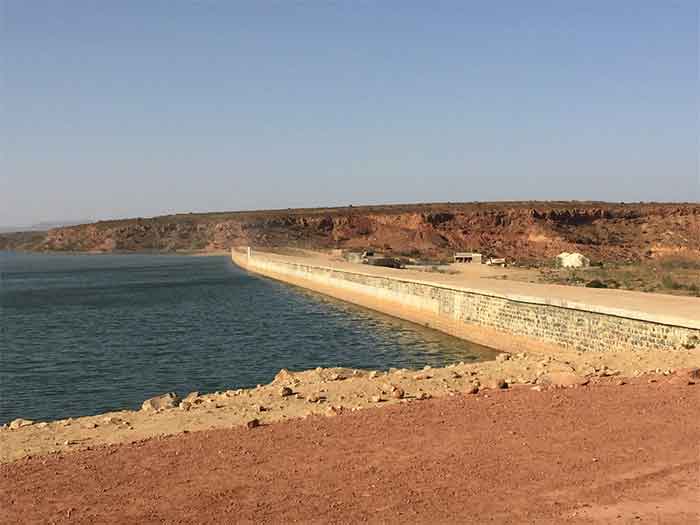
water conservation in eritreawater conservation in eritrea

As what is mainly a western caused climate disaster continues to hammer Africa, with tens of millions facing famine and starvation in the Horn of Africa, the small, underdeveloped country of Eritrea is leading the fight to prevent this from happening.

Eritrea is doing this by aggressively carrying out water conservation by building water reservoirs, both small and large. Over 800 and counting in the last 15 years including 9 large reservoirs, massive even, holding billions of tons of water. Breaking the age old dependency on rain fed irrigation is key to this with water conservation being the key to food security through modern irrigation techniques. This while Eritrea has been hammered by illegal US/UN just sanctions and record breaking droughts.

We lived in Eritrea from 2006 to 2021 and saw first hand the rapid rate of water conservation. Alongside water conservation the critical task of soil conservation through terracing and reforestation is taking place, for without both these new water reservoirs will quickly fill up with silt, making them far less effective.

In 2008-2009 Eritrea experienced the second back to back drought in history, the first being in 2003-2004, with the rain fed harvest completely failing throughout the country. Eritrea’s response, led hands on by the Eritrean President Issias Aferwerki was to divert a major part of the countries limited resources into water reservoir construction.

The results have been clear for all to see and African leaders including the President of Djibouti and the Prime Minister of Ethiopia have both been given guided tours. Today Eritrea is almost food secure in the critical area of cereal staple crops like wheat, barley, sorghum and millet. Eritrea no longer imports almost any fruit or vegetables and is progressing towards self sufficiency in processed products like cooking oil based on canola production.

To understand the accomplishment this is you must know the history of what can only be described as an environmental holocaust that was inflicted on Eritrea during the modern period of colonialism.

In the 1880’s when the first colonialists invaded and subjugated the Eritrean people, the Italians, Eritrea was almost 1/3 forested. By the time the last colonial power, the Ethiopians, were driven from Eritrea and the country became fully liberated, less than 2% of Eritrea was forested.

From almost 1/3 of the country being forested to less than 2% forested in less than a century constitutes an environmental catastrophe than I have been unable to find anywhere else in the world.

When Eritrea became independent in 1991 its leaders had to begin rebuilding the country not from zero but from far below zero.

So for today’s Eritrea in 30 years to become almost completely food self sufficient is a powerful role model for the rest of Africa. And remember, this is in a country wracked by major drought as well as being invaded by the TPLF terrorist regime in Ethiopia in 2000 where some 40% of the Eritrean people, 1.5 million, were driven from their homes and farms with little more than the clothes on their backs.

The lesson that needs to be learned for all Africans is that food security is national security and critical towards not just a countries survival but for its independence and ability to grow and prosper for western bankster institutions like the World Bank, whose policy is in opposition to food security, and the IMF, are determined to keep Africans poor, debt ridden with predatory loans, and on their knees begging for their survival from the very western bankster criminals that caused their problems in the first place.

Eritrea is not only about to be completely food secure but is the ONLY country in Africa NOT to accept predatory loans from the western banksters like the IMF and World Bank. Food secure, financially and politically independent, with the rest of Africa becoming increasingly aware of this small but powerful “threat of a good example”, it isn’t a coincidence that the LiarsForHire in the western MSM alongside their cohorts in the Human Rights Mob are going berserk in their efforts to demonize what remains the way forward towards the very survival of the African people as western caused climate disaster continues to menace the continent.

UK Prime Minister Truss pledges escalated offensive against Russia

Robert Stevens


Prime Minister Liz Truss, in her first trip outside the UK since she succeeded Boris Johnson on September 6, declared that London would double down on military aid and assistance to Ukraine.

Truss spoke evening at the United Nations General Assembly in New York, just hours after Russian President Vladimir Putin announced the mobilisation of 300,000 troops and threatened to use nuclear weapons. Putin was responding to NATO threats to do the same, and to dismember the Russian Federation.

She stated that Putin was “making yet more bogus claims and sabre-rattling threats. This will not work.”

Prime Minister Liz Truss (left) and the President of the United States, Joe Biden, during a bilateral meeting whilst attending the United Nations General Assembly in New York. [Photo by Andrew Parsons/No 10 Downing Street/Flickr / CC BY-NC-ND 4.0]

This was said just weeks after Truss declared her willingness to use nuclear weapons against Russia even though this would mean “global annihilation”. A Downing Street press release reported that Truss would announce a new defence review to “ensure the UK’s diplomatic, military and security architecture is keeping pace with evolving threats posed by hostile nations”.

The review comes 18 months after the last defence review ordered by Johnson. The Financial Times revealed, “Professor John Bew, the prime minister’s special adviser for foreign affairs and defence, will lead a Downing Street process to update the review, which is expected to be completed by the end of the year.”

Russia was to be offered no opportunity for a negotiated settlement in Ukraine, with Truss stating in reply to a question in New York, “First, Russia needs to leave Ukraine, and we need to make sure that there is proper recompense for what has happened in Ukraine, and we need to make sure Russia is never again able to threaten countries on its border.”

Downing Street said she will tell the UN, “The free world needs this economic strength and resilience to push back against authoritarian aggression and win this new era of strategic competition.”

Truss has pledged to increase UK spending on the military to 3 percent of GDP by 2030 at a staggering additional cost of £157 billion. The Financial Times, ever the watchful eye on the profit margins of the ruling elite, noted that an agenda of militarism and war against Russia and China was coupled with Truss’s agenda of class war at home. It commented, “In her speech to the UN General Assembly, Truss will try to link her rightwing economic reforms, including tax cuts and deregulation, with a broader imperative for the west to build its economic resilience.”

These comments are made ahead of an emergency budget Friday that Truss has already declared will be “unpopular” and centred on tax cuts for big business.

Prior to Truss’s trip, Downing Street said it “will meet or exceed the amount of military aid spent on Ukraine in 2022 next year.”

Truss told the UN, “The UK will spend 3% of GDP on defence by 2030, maintaining our position as the leading security actor in Europe. And that’s why – at this crucial moment in the conflict – I pledge that we will sustain or increase our military support to Ukraine, for as long as it takes. New UK weapons are arriving in Ukraine as I speak – including more MLRS [Multiple Launch Rocket System] rockets.”

In an acknowledgement of how deeply Britain is engaged in the military conflict and provocations against Moscow, Downing Street boasted, “The UK is already the second largest military donor to Ukraine, committing £2.3bn in 2022. We have trained 27,000 members of the Ukrainian Armed Forces since 2015, and in the last year we have provided hundreds of rockets, five air defence systems, 120 armoured vehicles and over 200,000 pieces of non-lethal military equipment.

“Last week saw the largest commercial road move of ammunition since the Second World War as tens of thousands more rounds of UK-donated artillery ammunition went to the front lines in Ukraine.”

There is no limit to Britain’s investment in military action against Russia. The statement warned, “The precise nature of UK military support in 2023 will be determined based on the needs of the Armed Forces of Ukraine.”

Figures with close connections to Putin have insisted for months that the first nation to face Russia’s vast nuclear arsenal would be Britain, given its role as Washington’s main partner in attacking Moscow.

Former Putin advisor Sergei Markov told the BBC’s Today radio programme Wednesday, “For western countries, for your British listeners, I would say that Vladimir Putin tells you that he will be ready to use nuclear weapons against western countries including nuclear weapons against Great Britain.”

Russia would use its nuclear arms, “if Great Britain continue to be aggressor against Russia, if Prime Minister of Great Britain Liz Truss still has plans to destroy Russia… This nuclear war could be [the] result of the crazy behaviour of the President of the United States, Joe Biden, and prime ministers of Great Britain Boris Johnson and Lizzie Truss. People in London should understand that this threat comes from Liz Truss, who is the aggressor.”

At the end of August, Russian General Andrey Gurulyov, a deputy in Russia’s parliament (Duma), said of a nuclear attack on Britain, “Let’s make it super-simple. Two ships, 50 launches of Zircon [hypersonic cruise] missiles—and there is not a single power station left in the UK. Fifty more Zircons and the entire port infrastructure is gone. One more—and we forget about the British Isles.”

None of this deters in the slightest the war fever of Britain’s ruling elite. Foreign & Commonwealth Office Minister of State Gillian Keegan said brazenly of Putin’s threat to use nuclear weapons, “Some of the language is quite concerning and obviously we should aim for calm… of course, we will still stand by Ukraine as well, with all of our Nato allies.” Her words echo the World War Two slogan, “Keep Calm and Carry on”.

Tobias Ellwood—a former Tory MP, chair of parliament’s Defence Select Committee and captain of the Royal Green Jackets regiment—who now sits in parliament as an Independent, has long demanded a doubling of military spending to a least 4 percent of GDP. This week he co-authored an op-ed in the Telegraph with Hamish de Bretton-Gordon. Only last month Bretton-Gordon, the former commanding officer of the UK’s Joint Chemical, Biological, Radiological and Nuclear Regiment, wrote in the same newspaper to insist, “Britain should prepare for nuclear war.”

Ellwood and Bretton-Gordon complain, “The West can throw money at the food and fuel crisis to alleviate problems in home countries and less developed ones, but not at the nuclear conundrum.”

Justifying their war aims by warning of the uncertain fate of Ukraine’s Zaporizhzhya nuclear facility, they insisted, “If we are to prevent a serious disaster, we must be far more proactive in establishing and defending precedents for modern nuclear warfare before it’s too late.”

As “the IAEA [International Atomic Energy Agency] and the UN are calling for a demilitarised zone to ring fence Zaporizhzhia and other nuclear power stations,” they wrote, “we need a No-fly zone around the plant. The UN could deploy air defence systems to enforce it. An anti-missile system could be in place to prevent missiles hitting the reactors.”

Britain’s involvement in the military confrontation with Russia continues apace. Between August 29-September 2, the UK completed Exercise Vigilant Knife alongside Swedish and Finnish Armed Forces. This followed a trip by Armed Forces Minister James Heappey to meet UK troops in Tapa, Estonia, 160 kilometres from Russia’s border. An MoD statement said, “More than 800 troops from 1st Battalion, the Royal Welsh currently lead a NATO enhanced Forward Presence (eFP) battlegroup in Estonia. The UK also has a second battlegroup of over 800 from 2nd Battalion, The Rifles, in the country after deploying them in response to Russia’s invasion of Ukraine.”

The MoD added, “Defence Secretary Ben Wallace announced in June that the lethality of these deployments would be enhanced with advanced capabilities including helicopters and artillery systems, as part of an increased UK contribution to NATO. Meanwhile, the UK’s existing HQ in Tallinn will be expanded. Led by a Brigadier, it will support the rapid deployment of high readiness forces at the brigade level.”