26 Sept 2022

Neo-fascist Georgia Meloni’s Brothers of Italy wins general election

Alex Lantier


Georgia Meloni of the Brothers of Italy (FdI) party, the political successor of the Fascist Party of World War II-era dictator Benito Mussolini, won last night’s Italian general election.

Far-Right party Brothers of Italy's leader Giorgia Meloni speaks to the media at her party's electoral headquarters in Rome, early Monday, Sept. 26, 2022. [AP Photo/Gregorio Borgia]

With 26 percent of the vote, she will seek to form a government with Silvio Berlusconi’s right-wing Forza Italia party (8 percent) and Matteo Salvini’s far-right Lega (9 percent). Due to the extra seats granted under the Italian electoral system to the party receiving the most votes, the FdI and its allies are projected to have an absolute majority in both houses of parliament. They would have around 235 of the Chamber’s 400 seats and 115 of the Senate’s 200 seats.

The elections saw a disintegration of the parties falsely designated by capitalist media as the “left.” The Democratic Party (PD), Italy’s main social-democratic party, fell to less than 19 percent, while populist Five-Star Movement (M5S) won 15.5 percent. The Popular Union, a coalition including remnants of Italy’s Rifondazione Comunista party that was endorsed by the pseudo-left Podemos government in Spain and Jean-Luc Mélenchon in France, received only 1.35 percent.

The return of Mussolini’s descendants to direct rule over Italy, for the first time since the end of World War II 77 years ago, is a warning to workers worldwide. The only way forward against imperialist war and social austerity is a break with a bankrupt political establishment and a struggle to mobilize the working class, independently of the existing parties and national trade union bureaucracies, in a struggle for socialism.

Since the 1991 Stalinist dissolution of the Soviet Union, European governments of all stripes have imposed austerity, bank bailouts for the rich, and waged imperialist wars. In Italy, Rifondazione Comunista and the PD played leading roles in government to impose these anti-worker policies. With the COVID-19 pandemic and the NATO war on Russia in Ukraine, the bourgeoisie is shifting even further to the right. Amid rising working class anger over the global surge of inflation, the ruling class is using Meloni’s populist demagogy to try to build a police state inspired by 20th-century fascism.

Last night, Meloni began her victory speech by indicating that she saw it as a triumph of the fascist tradition. Meloni, whom official European media euphemistically refer to as “post-fascist,” said, “I dedicate this victory to all those who are no longer here and who deserved to be alive tonight.”

She insisted that she would lead a “responsible” government and tried to use her gender to give herself a progressive gloss. Demanding “mutual respect” from other political organizations in Italy, she pledged to “concentrate on what unites us rather than what divides us. The time has come to be responsible.”

Meloni told the press that, as Italy’s first female prime minister, her election was “a step forward. I defined it as breaking the ‘glass ceiling,’ one that still exists in many western countries, not only in Italy, preventing women from achieving important public roles in society.”

Meloni also sought to calm concerns in ruling circles that she might make nationalist criticisms of the NATO war on Russia or the EU’s multi-trillion-euro bank bailouts for the super-rich. She emphasized that she supported Italy’s position inside the European Union (EU) and the NATO alliance, as well as the war against Russia in Ukraine.

“We will be guarantors, without ambiguity, of Italy’s positioning and of our uttermost support to the heroic battle of the Ukrainian people,” she said. She also backed the surge in EU military spending and the EU’s cut-off of purchases of Russian natural gas: “If we had an EU more like the one we imagine, we would have developed a more effective defense policy, invested in energy security and maintained short value chains to avoid reliance on other—often untrustworthy—countries for gas, raw materials, commodities, chips and other goods.”

PD leader Enrico Letta gave a press conference today conceding defeat. He insisted that the PD would “not allow Italy to leave the heart of Europe” and would defend “European values” as enshrined in Italy’s 1946 post-war constitution. He pledged to take a “hard and demanding position” to build majority support for “progressive and democratic values,” which Letta said his party had found impossible to do successfully during this election.

Meloni’s election victory is the product of the bankruptcy of the PD and its pseudo-left satellites. They speak not for democracy or historical progress, but for layers of the bourgeoisie and of the pro-imperialist affluent middle classes who support war with Russia, EU bank bailouts, inaction on COVID-19, and petty-bourgeois gender politics. During the campaign, they attacked Meloni largely from the right: first, claiming that she was anti-EU and pro-Russian, or “aligned on the pro-Putin front” in Letta’s words; and, secondly, that she was hostile to women.

Neither criticism proved effective against Meloni—who repeatedly made bellicose statements denouncing Russia and began her speeches with the refrain, “I am Giorgia, I am a woman, I am a mother, I am Italian, I am a Christian, and you can’t take that away from me.”

The Italian ruling class and political establishment carefully prepared Meloni’s victory and groomed her for it. Meloni was invited earlier this month to speak to the Ambrosetti economic forum, an influential Italian business forum held on the shores of Lake Como. After a friendly election debate on September 12 between Meloni and Letta, Germany’s Süddeutsche Zeitung wrote, “no one demonizes Giorgia Meloni in Italy, not even the press. She is sailing to her election victory, at least that is how it appears.”

This is because Letta—whose party was a key component alongside Salvini’s far-right Lega and the M5S of the outgoing Italian coalition government led by former European central banker Mario Draghi—himself has only the most limited political differences with the far right.

Among workers and youth in Italy and across Europe, however, there is deep opposition to policies jointly outlined by Meloni and Letta. Food and heating prices are skyrocketing, as energy conglomerates rake in billions of euros in super-profits from gouging consumers. With economists projecting that Italy could lose a half-million jobs or more due to energy shortages this winter, an explosive movement is being prepared.

This reality, of which ruling circles are well aware, played the decisive role in the Italian political establishment’s friendly treatment of Meloni during the election campaign. It is legitimizing fascism as it seeks to install a government that will be as aggressive as possible in waging war and repressing working-class opposition.

However, the lies of the ruling elite have not succeeded in whitewashing the legacy of Mussolini and Hitler in the eyes of millions. Today several high schools were occupied in Milan, Rome, and Palermo as students protested Meloni’s election victory.

Students occupying the Manzoni high school in Milan told the daily La Repubblica they opposed “exploitative and deadly temp work” facing their generation and the “dangerous and repressive political situation, given the recent electoral results.” Speaking to Meloni and the Confindustria business federation, they said, “We do not want to take more steps back, act as if nothing was happening and wait for you to change things.”

24 Sept 2022

Understanding Libya’s Relentless Destabilization

John P. Ruehl


Libya’s competing domestic actors are being exploited by foreign powers seeking to downplay their role in the fragile country.

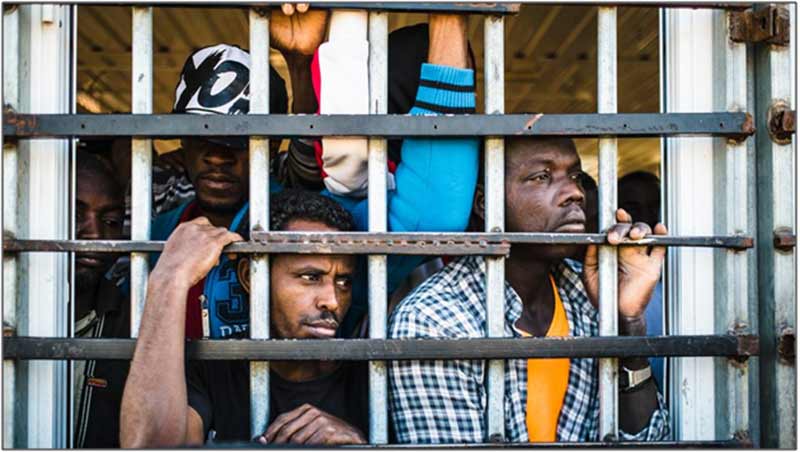
libyan refugees

After leading a military coup in 1969, Libyan dictator Muammar Gaddafi cemented his rule over Libya for more than 40 years. A variety of different political ideologies—Pan-Arabism, Pan-Africanism, socialism, Islamic leftism, and others—characterized his leadership, which were further reinforced by a cult of personality. While living standards for Libyans increased under his rule, Gaddafi attracted resentment among some non-Arab populations, Islamic extremists, and other political opponents.

As the Arab Spring spread outward from neighboring Tunisia into Libya in February 2011, protestors and militant groups seized parts of the country. Loyalist armed forces retook control of much of what they had lost over the next few weeks after the outbreak of the protests, but Gaddafi’s historical antagonism toward Western governments saw them seize the opportunity to impose a no-fly zone and bombing campaign against Libyan forces in March 2011.

Alongside assistance from regional Middle Eastern allies, the NATO-led intervention was successful in helping local militant groups topple Gaddafi, who was later captured and executed in October 2011. Soon after his death, questions were immediately raised about how Libya could be politically restructured and avoid becoming a failed state. After militant groups refused to disarm, they along with their allies began to contest territory and control over Libya’s fragile new national institutions.

The National Transitional Council (NTC) was established to coordinate rebel groups against Gaddafi, and naturally inherited much of the Libyan government after the war. But a number of countries did not recognize its authority, and after handing power over to the General National Congress (GNC) in 2012, Libya’s weak central government steadily lost political control over its enormous territory to competing groups.

Libya’s population of almost 7 million people lives in a highly urbanized society that has led to the development of strong regional identities among those living in its northern coastal cities. There has also historically been an east-west divide between the two coastal provinces of Cyrenaica in the east and Tripolitania in the west.

A large Turkish and part-Turkish minority also live throughout Libya’s major cities, particularly in the city of Misrata. Most of them have descended from the Ottoman troops who married local women during Ottoman rule from 1551-1912, and though not a strictly homogenous group, the majority revolted against Gaddafi as nationwide protests began in Libya.

The historical lack of central authority in Libya’s more rural south resulted in widespread autonomy for the Tuareg tribe in the southwest and the Tubu tribe in the southeast. While the Tuaregs largely supported Gaddafi, the Tubu joined the revolutionaries, sparking increased tension between these two tribes to gain control over the city of Ubari, local smuggling routes, and energy infrastructure.

Alongside ethnic and cultural disputes, Libya was further destabilized by radical Islamists after the fall of Gaddafi. Mass unemployment among Libya’s relatively young population fueled recruitment for ISIS and the Al Qaeda-affiliated Ansar al-Sharia. Having gained battlefield experience and with limited economic prospects, many militants in Libya had little incentive to return to civilian life, while the influx of foreign jihadists also kept the violence ongoing.

Rivalries between these numerous factions helped lead to the outbreak of the second Libyan civil war in 2014. The UN-brokered Libyan Political Agreement (LPA) was signed in December 2015 to create a Presidential Council (PC) for appointing a unity government in Tripoli but failed to curtail growing violence between local actors.

Two major entities came to dominate the country. The Government of National Accord (GNA), which was presided over by the PC, was recognized in March 2016 to lead Libya, with Fayez Serraj as the Libyan prime minister. This move partly incorporated elements of Libya’s political Islamic factions.

The Libyan House of Representatives (HoR), meanwhile, refused to endorse the GNA, and relocated to Tobruk in Cyrenaica after political pressure and Islamist militias forced it out of Tripoli in 2014. The HoR is led by former General Khalifa Haftar, who commands the Libyan National Army (LNA).

The GNA retained official recognition by the UN as well as Libya’s most important economic institutions, including the Central Bank of Libya (CBL). But both the GNA and the HoR continued to fight for influence over the National Oil Corporation (NOC), while many other national institutions were forced to work with both factions.

Military force has also been integral to enforcing rival claims to Libya’s leadership. In 2017, Haftar’s forces seized Benghazi, consolidating power across much of the east and center of the country. But his attempt to take Tripoli in 2019-2020 was repelled by GNA and allied forces, prompting an HoR retreat on several fronts. A ceasefire between the GNA and the rival administration of the LNA declared an end to the war in October 2020, but tensions and violence persisted.

Libya’s civil conflict has also been inflamed by outside powers. Turkey opposed the original NATO-led intervention in 2011 but supported Libyan Turks, some of whom founded the Libya Koroglu Association in 2015, to coordinate with Turkey. Ankara has also supported the GNA with arms, money, and diplomatic support for years, and Turkish forces and military technology were integral to repelling Haftar’s assault on Tripoli.

Turkey’s business interests in Libya and desire to increase its power in the Mediterranean remain Ankara’s core initiatives, and in June it voted to extend the mandate for military deployment in Libya for another 18 months. Both Turkey and Qatar, which has also been a strong backer of the GNA, are close with the Libyan branch of the Muslim Brotherhood and associated political circles in Libya, to attempt to promote a brand of political Islam that rivals Saudi-led initiatives.

With few core interests in Libya, the U.S. has shown tacit support for intervening again in a conflict it had allegedly won, but from 2015 to 2019, U.S. airstrikes and military support helped the GNA push ISIS out of many Libyan cities. Yet, Washington has remained wary of being associated with the Libyan conflict and with Islamists allied with the GNA, and the U.S. harbored and provided support to Haftar for decades to pressure Gaddafi before the civil war.

Egypt has been one of the HoR’s most crucial allies, providing weapons, military support, and safe haven through Libya’s eastern border. Besides protecting Libya’s Egyptian population, Egypt’s military-led government is also seeking to suppress political Islam in the region after Egypt’s Muslim Brotherhood briefly ruled Egypt from 2011 to 2013 following Egypt’s own revolution. In 2020, Cairo approved its own intervention in Libya.

Saudi Arabia and the United Arab Emirates (UAE) have similar interests in suppressing rival political Islamic forces in the region and have provided funding and weaponry to Haftar. Doing so has brought them closer to Russia, which has also supported Haftar with substantial military assistance. This includes warplanes piloted by the Russian private military company Wagner, which is suspected to be partially bankrolled in Libya by the UAE.

Libya’s destabilization complements the Kremlin’s attempts to influence Europe. Haftar’s forces and supporters managed to block Libyan oil exports in 2020 and again earlier this year, threatening continental supply and increasing Russia’s leverage. Additionally, instability in the region and porous borders encourage migrant flows to Europe, often increasing the popularity of right-wing political parties which have grown closer to Russia over the last two decades.

The HoR has also found less direct aid from France. Officially, Paris has supported UN negotiations and the GNA and has sought to minimize perceptions of its involvement in the conflict. But the death of three undercover French soldiers in Libya in 2016 showed that Paris remained deeply involved in the country’s civil war, and it has sold billions in weapons to Saudi Arabia and the UAE to help Haftar. This is part of France’s efforts to suppress Islamist groups in Africa, where France retains considerable interests.

France’s position has brought criticism from Western allies. In 2019, Paris blocked an EU statement calling on Haftar to stop his offensive on Tripoli, while its support for Haftar has severely undermined its relationship with Italy, which has seen its economic influence in Libya decline.

Since the conclusion of the second Libyan civil war in 2020, steps have been taken to unify the country. A Government of National Unity was established in 2021 to consolidate Libya’s political forces, and the new Prime Minister Abdul Hamid Dbeibeh reached an agreement with Haftar in July 2022 to enforce a ceasefire.

But based on the current dynamics of limited intervention, there is relatively little risk and high rewards for foreign powers to continue destabilizing Libya. Turkey and Russia are also using the conflict to add to their leverage over one another in Syria. With repeated delays in holding elections in Libya and rival local and foreign actors seeking to dominate the country, Libyan citizens risk continuing to be used instead of being helped to ensure a stable and secure future for their country.

UK Truss government delivers class war budget

Robert Stevens


Friday’s mini budget was a smash and grab raid by Britain’s Conservative government on behalf of the super-rich and the corporations.

Chancellor Kwasi Kwarteng made a statement lasting just 30 minutes, announcing policies reducing the taxes on the richest by tens of billions of pounds.

Prime Minister Liz Truss (left) and Chancellor Kwasi Kwarteng discuss their Growth Plan ahead of a fiscal statement to the House of Commons on September 23 . 10 Downing Street, September 22, 2022 [Photo by Rory Arnold/No 10 Downing Street/Flickr / CC BY-NC-ND 4.0]

The cuts in taxes for the richest were easily the biggest carried out by any government for 50 years.

In one fell swoop Kwarteng reversed a rise in corporation tax planned by the Johnson government, who Prime Minister Liz Truss replaced just 17 days ago. He announced, “The UK’s corporate tax rate will not rise to 25 percent - it will remain at 19 percent. We will have the lowest rate of Corporation Tax in the G20.” This will save the corporations “almost £19 billion a year” the chancellor said.

He then announced an even greater tax cut for the richest 1 percent who earn over £150,000 a year. They previously paid tax at 45 percent in the highest bracket known as the “Additional Rate”. Kwarteng stated, “At 45 percent, it is currently higher than the headline top rate in G7 countries like the US and Italy. And it is higher even than social democracies like Norway. But I’m not going to cut the additional rate of tax today… I’m going to abolish it altogether. From April 2023, we will have a single higher rate of income tax of 40 percent.”

A single higher rate covers all incomes from £50,271 upwards. The 660,000 people earning over £150,000 a year will save an average of £10,000. Torsten Bell of the Resolution Foundation thinktank tweeted, “Any of you earn £1m? You're getting a £55k tax cut next year - twice what a typical earner brings home a year”

The cost of abolishing the additional rate was listed by the government as £2 billion, but according to commentators including the Institute for Fiscal Studies it is closer to £6.6 billion.

What was offered to the UK’s 31 million workers was minuscule and will soon be eaten up by the escalating cost of living. A cut in the basic rate of tax from 20 pence to 19 pence next April will see workers save just £170 on average. A worker on £20,000 a year saves just £74.30. The reversal of a planned 10 percent rise in National Insurance tax contributions, set to be introduced in November, will save the lowest paid households earning just £12,00 a year—63 pence per month according to the IFS. A worker earning £20,000 a year saves £93 annually.

Kwarteng announced the abolition of the limited cap placed on bankers’ bonuses, set throughout the European Union in 2014, meaning no bonus could be more than 200 percent of annual salary. “A strong UK economy has always depended on a strong financial services sector… We need global banks to create jobs here, invest here … So we’re going to get rid of it”.

The chancellor would “reaffirm the UK’s status as the world’s financial services centre” with “an ambitious package of regulatory reforms later in the Autumn.”

There was nothing in Kwarteng’s speech that didn’t benefit big business—with the word business being referred to 28 times, almost once a minute. He confirmed that the cost of the energy price freeze announced by Truss on taking office would be £60 billion over the next six months. But this is another massive subvention to energy companies already drowning in profits.

Like the other handouts to the rich, it is to be paid for by additional government borrowing, which has jumped £72 billion as the deficit was revised upwards from £161.7 billion in April 2022 to £234 billion in September. This is a massive further borrowing commitment, after the measures taken during the pandemic forced the Johnson government to increase borrowing to £323 billion in 2020/21.

Yet those railing against government borrowing then, such as Janet Daley of the pro-Tory Telegraph, were ecstatic. “This was nothing less than a revolutionary Budget,” she declared, describing the governments of arch Tory right-wingers Johnson, Theresa May and David Cameron, as advocates of “the Big State-high tax interventionism willingly embraced for the last decade” that was now at an end.

However, the response to the budget’s give-away on global markets was hostile. It comes amid bourgeois demands for more austerity for workers and a clampdown on public spending. The Bank of England one day earlier acknowledged that Britain was officially in recession and hiked interest rates by 0.5 percent to 2.25 percent, their highest level since December 2008, to devastating effect for millions of mortgage payers.

The mini-budget sparked an immediate run on the pound as investors withdrew their backing and sold off UK government bonds. The pound fell to its lowest level against the dollar since 1985, plunging 3.5 cents on the previous day to $1.09. Against the euro the pound fell to €1.132, its weakest level since February 2021. The FTSE 100 share index fell by 2.3 percent.

Predicting that the pound could even fall to below parity against the US dollar, former US Clinton administration Treasury Secretary Lawrence Summers declared, “Between Brexit, how far the Bank of England got behind the curve and now these fiscal policies, I think Britain will be remembered for having pursuing the worst macroeconomic policies of any major country in a long time.”

The shoveling of tens of billions to the financial aristocracy was accompanied by a declaration of war on the working class, who will be made to pay for every penny handed over to the wealthiest.

In a filthy measure, Kwarteng announced a drive to force 120,000 people on the Universal Credit welfare benefit into work declaring, “We will make work pay by reducing people’s benefits if they don’t fulfil their job search commitments.”

Enforcing the cost of what is an unprecedented boon for big business is to be carried out by a frontal assault on fundamental democratic rights, above all the right to strike.

Kwarteng frothed, “At such a critical time for our economy, it is simply unacceptable that strike action is disrupting so many lives. Other European countries have Minimum Service Levels to stop militant trade unions closing down transport networks during strikes. So we will do the same.

“And we will go further. We will legislate to require unions to put pay offers to a member vote, to ensure strikes can only be called once negotiations have genuinely broken down.”

This move would prevent strikes such as that by National Health Service workers currently being balloted on. It would be a license for the employers and the unions to string out negotiations and “new deals” ad infinitum.

The drive to destroy workers’ living standards and eviscerate democratic rights is intimately bound up to British imperialism’s military confrontation of Russia in Ukraine.

Speaking at the United Nations General Assembly in New York this week, Truss reiterated her pledge to spend 3 percent of GDP on defence by 2030, an additional £157 billion, and to “sustain or increase our military support to Ukraine, for as long as it takes.”

Speaking about her domestic agenda, Truss told the media that the official mourning period over the queen had prevented her moving to legislate “for minimum service levels on rail.” But this would be done “as soon as possible”. Truss added that “I want to take a constructive approach with the unions,” but this meant calling of all strikes: “I would tell them to get back to work.”

The measures will throw petrol on the flames of working class opposition that saw Britain’s “Summer of Discontent” strike wave, ensuring that the next rounds of action will be more explosive still, especially as this will bring workers into direct conflict with the state and the government.

Bolsonaro, military intensify antidemocratic conspiracies on eve of Brazil’s elections

Tomas Castanheira


The antidemocratic conspiracies promoted by Brazil’s fascistic President Jair Bolsonaro and the military are advancing with the approach of the first round of presidential elections on October 2.

Brazilian special forces troops (Ministerio de Defensa)

As the president loudly proceeds with his plan to contest an increasingly likely defeat at the polls, the military has been elevated to the position of final arbiter of the political process, with the installation of the next president dependent on its approval.

Just two weeks before the election, the president has publicly reiterated that he will not accept a result other than victory. In an interview last Sunday on the SBT TV network, Bolsonaro declared that if he receives less than 60 percent of the vote, that is, if he is not declared elected in the first round, “something abnormal happened at the TSE [Superior Electoral Court].”

The claim that an electoral fraud is underway to remove him from power is the central argument of the Hitler-style “big lie” being systematically promoted by Bolsonaro. This coup narrative dismisses as fraudulent the results of all recent polls, pointing to the Workers Party (PT) candidate, Lula da Silva, beating him by a wide margin. The latest Datafolha poll, published on Thursday, showed Lula with 47 percent of the vote and Bolsonaro with only 33 percent.

In the interview recorded in London, where he attended Queen Elizabeth II’s funeral, Bolsonaro justified his certainty of victory on what he calls Data Povo (“Data People”), i.e., his subjective perception of the “popular will” based upon crowds attending his events, as opposed to data from institutes like Datafolha.

He said, “It’s pretty divided, you know, much more favorable to me. I say, if I get less than 60 percent of the vote, something abnormal has happened at the TSE in view obviously of the Data Povo that you measure by the amount of people who not only come to my events as well as welcome us along the way to get to the venue.”

Bolsonaro’s plan to contest the ballots widely mimics Donald Trump’s actions in the last US presidential elections, which culminated in the January 6 Capitol coup attempt. But much more than Trump, Bolsonaro has reasons to trust that a significant section of the Armed Forces will legitimize his attempt to hold on to state power.

Last week, the military clubs in Rio de Janeiro released a joint note calling for the “Rescue of the Green and Yellow” (the colors of Brazil’s flag) against what they claim to be “an explicit attempt to destroy the concepts of citizenship and patriotism.” Concluding with a passage from the Tamoio Song, by the Brazilian Romantic poet Gonçalves Dias, which says that “Life is combat, that slaughters the weak,” the document is an unequivocal call for a coup.

The demonstrations conducted by Bolsonaro on Independence Day, last September 7, had already confirmed these expectations. They were highly successful in merging, with the consent of the generals, a massive military parade with the demonstration of thousands of Bolsonaro’s far-right supporters.

The corrupt bourgeois opposition to Bolsonaro responded to this pivotal event in Brazil’s political history with new concessions to the military that put even more power into their hands.

On September 13, the TSE approved a reformulation of the “integrity test” of the electronic ballot boxes to meet demands from the military. The change, made on the eve of the electoral process, will introduce the use of biometrics in the inspection of the ballot boxes.

As admitted by the president of the TSE himself, Supreme Court (STF) Judge Alexandre de Moraes, this supposed “safety measure” lacks any technical justification. Moraes said that “there is no proof that the test [with biometrics] will or will not improve oversight [of the ballots].” In other words, the TSE accepted a requirement that is known to have the sole purpose of fomenting the distrust of the electoral process that underlies Bolsonaro’s conspiracy.

Moraes, who assumed the presidency of the TSE on August 17, has taken as his main task the fine tuning of the Electoral Court’s relations with the military, deepening the concessions made by his predecessors. He promptly set up exclusive TSE meetings with the military, behind closed doors and without minutes. His predecessor, Edson Fachin, had resisted accepting this anti-democratic demand made insistently by Defense Minister and Bolsonaro’s conspiracy collaborator, Gen. Paulo Sergio Oliveira.

The intimate relationship established by the PT and its pseudo-left ally, the Socialism and Freedom Party (PSOL), to these reactionary forces in the bourgeois state is highly revealing of the political bankruptcy of these parties.

The same Alexandre de Moraes was praised by the Brazilian pseudo-left as the great savior of democracy in the country. It has entrusted the STF judge with taking “all measures deemed appropriate to ensure that the result of the 2022 election is fully respected and fulfilled,” as stated in a document written by PSOL parliamentarians.

The “measures” taken by Moraes, with the criminal consent of the PT and the PSOL, are proving to be key pieces in the advance of military tutelage over the political regime.

In addition to the concessions taken from the TSE, the military is preparing to carry out, for the first time since the establishment of the bourgeois democratic regime in Brazil, a parallel check of the ballot boxes. Soldiers will be sent to hundreds of polling places around the country to personally check the “fairness” of the democratic process.

Whether the findings of this verification will serve to legitimize a political coup by Bolsonaro, or even an independent intervention by the military in the name of “political stabilization” of the country, remains a question to be answered. The degeneration of bourgeois democracy in Brazil, on the other hand, is a deepening process in which there is no turning back.

Opel destroys another 1,000 jobs in Germany

Ludwig Weller


Although automaker Opel is once again posting hefty profits under the Stellantis corporate umbrella, management is cutting another 1,000 jobs at its German sites over the coming months.

Opel’s main plant in Rüsselsheim will be the hardest hit. Employees working at the development centre (ITEZ) and in administration in particular are being asked to leave “voluntarily.” But jobs are also to be cut “in a socially responsible manner” at the Eisenach plant, which celebrated its 30th anniversary last weekend, and at the Kaiserslautern plant.

The ITEZ has been under fire since PSA (Peugeot/Citroën) acquired Opel in 2017. For corporate CEO Carlos Tavares, the engineers once considered “the heart” of Opel are now too expensive. He wants to move development to outside companies.

The merger of PSA with Fiat Chrysler Automotive (FCA) to form Stellantis, announced in 2019 and completed in early 2021, has further accelerated job cuts. Now, Opel’s current sales department in Rüsselsheim is also to be merged into a joint Stellantis sales organization as early as October 1. At the same time, hundreds of permanent staff have been replaced by temporary workers on the Rüsselsheim production lines.

Management justifies its plan by citing the consequences of the crisis, which the ruling class and the federal government have created. An Opel company spokesman declared, “Against the backdrop of the rapid transformation of the industry, the pandemic, the geopolitical situation, brittle supply chains and massive increases in energy and raw material prices.” The goal, he said, was to “strengthen the company’s competitiveness in the long term.”

In other words, workers who have often worn themselves out producing cars over decades are now to suffer the consequences of Germany’s involvement in the Ukraine war and the NATO-led economic boycott against Russia.

This under conditions where hundreds of thousands have already paid with their lives and health for the government’s refusal to contain the coronavirus pandemic, pursuing herd immunity policies allowing the virus to run wild, in the interests of the economic and financial elites. Now they are expected to voluntarily sacrifice their jobs as well.

What is conspicuous about the latest bad news is not only the lack of interest from the media and establishment politicians, but, most significantly, the silence of the IG Metall trade union. There is a simple reason for this. The latest job cuts simply continue the policy of slash and burn which company management has long agreed with IG Metall and the Opel works council representatives.

When the takeover of Opel by PSA was engineered in 2017, IG Metall and its works council representatives agreed to the cutting thousands of jobs. At the time, around 19,000 people still worked at Opel. At one time, 7,000 employees worked at the ITEZ alone; now there are fewer than 3,000.

At the end of 2019—PSA had just announced the merger with FCA to form Stellantis—the IG Metall and works council gave the green light to cut at least another 4,000 jobs in a position paper. As always, without any approval from the workforce, it agreed to cut jobs in stages. By the end of 2021, a further 2,100 jobs would be eliminated via so-called voluntary programs, i.e., partial retirement, early retirement, or severance payments. The works council pushed through these cuts with a promise from the corporate management it would forego compulsory redundancies until the end of 2025.

But that is not all: the position paper gave the company two further options. Stellantis can cut another 1,000 jobs in 2022 and 2023 at will. All the corporation must do is promise to gradually extend job protection until 2029.

The bare figures show just how much this alleged protection against dismissal is worth. Within six years, i.e., since the takeover by PSA until the end of 2023, 11,000 jobs will be eliminated without replacement. Given the 19,000 employees before the takeover, this is a reduction of around 60 percent.

Hesse news site VRM aptly noted: “Anyone who made this calculation a few years ago was accused by both the company and the unions of spreading horror scenarios. As of today, Opel is not far from such scenarios.”

The World Socialist Web Site early on foretold this development. The giant Stellantis corporation, which today employs about 410,000 workers and operates plants on almost every continent, is now the world’s third-largest car company. The World Socialist Web Site wrote at the time of the January 2021 merger:

“The merger of FCA and PSA has been driven by the ferocious struggle among the auto giants to dominate both new technologies, including electric and autonomous vehicles, and markets. The tie-up will itself push other companies to seek out further consolidation and cost savings. The major banks and investors have exerted relentless pressure on automakers in recent years to accelerate cuts and restructuring plans, with the aim of squeezing out every drop of profits possible from the working class.”

Stellantis CEO Carlos Tavares is notorious as a restructurer and cost-cutter, responsible for destroying thousands of jobs at PSA’s European operations in France, Germany, and Britain. Now he is waging similar attacks around the world so Stellantis can continue to pay high dividends to its shareholders and compete against its rivals in the rapidly growing electric vehicle market.

Without IG Metall and its pro-corporate works council representatives, Opel/Stellantis could not make the job cuts happen. With the union’s help, it has already succeeded in closing Opel plants in Antwerp and Bochum, and cutting thousands of jobs at its remaining sites in Rüsselsheim, Kaiserslautern, and Eisenach. The works councils have suppressed any opposition or resistance by workers. In the process, they and IG Metall have deliberately fomented nationalism and plant-vs-plant politics in order to divide workers and play them off against each other.

Hurricane Fiona exposes social inequality in Puerto Rico

Rafael Azul


On September 16, two days before Hurricane Fiona hit Puerto Rico, a video El Apagón—Aquí vive gente was posted in YouTube, featuring “Apagón” (Blackout), a song by Puerto Rican singer Bad Bunny about the blackout crisis on the island. 

The video, with its powerful message denouncing the growing inequality on the island, exposes the power crisis, which followed the privatization of the public utility after Hurricane Maria and the bankruptcy restructuring of the island. At the time LUMA Energy promised reliable, better and less expensive service. All three assurances had long been exposed as lies when the video documentary was released. 

People clean debris from a road after a mudslide caused by Hurricane Fiona in Cayey, Puerto Rico, Sunday, September 18, 2022. [AP Photo/Stephanie Rojas]

“Apagón” depicts the popular anger that exists in Puerto Rico, long before the hurricane that hit two days after its release. Five days after its release “Apagón” had been shared 6.4 million times.

“God has been good to us and kept us safe this time when things could have been much worse,” said Vice-Governor Anya Williams, downplaying the disastrous flooding and mudslides and the wholly inadequate response by federal and local authorities and LUMA management. 

No disaster is purely a natural event; it also has political and social content. The frequency and severity of hurricanes is bound up with climate change and the refusal of capitalist governments to take any serious measures to address it. Moreover, the catastrophic impact that Hurricanes Katrina (New Orleans, 2005), Maria, Fiona and so many others is conditioned by the vast socioeconomic inequality that defines Puerto Rico, the United States and the rest of the world. 

Both Governor Pedro Pierluisi and the electricity monopoly LUMA Energy had to walk back their promise that electricity would be restored within days. Predictably, the wealthy neighborhoods in San Juan and the beach condos were first in line.

This week, President Biden pledged “100 percent assistance” for Puerto Rico. What has in fact been offered is a pittance in “emergency aid.” Deanne Criswell, who heads Biden’s Federal Emergency Management Administration (FEMA), told Governor Pedro Pierluisi that it was making available an insulting $700 in aid per household. Criswell went out of her way to emphasize that this was way over the $500 offered in 2017 after the landing of Hurricane Maria.

This is Biden’s version of the infamous tossing of rolls of paper towels to people by President Trump five years ago. Despite all assurances in 2017, five years later less than one-third of the promised reconstruction has taken place and the island’s electricity grid is in the hands of a profit-driven private firm. 

President Biden also appoints the voting members of the Financial Control Board, which has placed the Puerto Rican economy on rations since the 2017 bankruptcy.

A week after the hurricane, 62 percent of households are still without power and face fuel shortages to power their generators, if they have them. Forty percent of households still lack running water. One thousand people are stuck in public shelters. Those most affected live in working class urban and rural municipalities. 

As with Hurricanes Irma and Maria, the real human cost of this storm is being concealed. Five years ago, between 3,000 and 5,000 people died from Hurricane Maria, which did not flood the island like Fiona has done. Over 30 inches (76 centimeters) of water fell in parts of the island. The report of only four casualties has been met with skepticism.

As flood waters recede, the devastating impact of this storm is becoming clearer. A preliminary estimate from the Puerto Rican Agriculture Department is that wind and flood damage exceeds $100 million, including the loss of this year’s banana and coffee crops and green vegetables. In addition, the storm virtually wiped out the bee industry. The Agriculture Department warned that when the full data is in, actual damages will surely exceed Friday’s account.

The collapse of roads and bridges from the flooding left scores of households isolated in six municipalities. Short on resources, local authorities report having to rely on volunteers, religious groups, NGOs (non-governmental organizations) and individuals to deliver food and first aid while waiting for government and FEMA assistance to clear roads and repair bridges.

Mexico City’s El Proceso news magazine interviewed Manuel Veguilla in a mountain region near Caguas, south of San Juan. “We are all incommunicado,” declared Veguilla, adding that he was worried about the elderly residents of the municipality, including his brother, who lack the strength to walk to the nearest community. Veguilla doubted that city workers would be able to reach the area, describing large boulders that have been left by the receding flood waters. Meanwhile neighbors are sharing water and food left by a volunteer group. The community still lacks electricity and must rely on spring water.

On September 1, two weeks before the hurricane hit, a mass protest of workers and students took place in San Juan denouncing the LUMA Energy debacle and social inequality. In addition to demanding that LUMA’s 15-year contract be rescinded, protesters carried signs calling for the restoration of social services, including the reopening of hundreds of schools that had been closed in the last decade. 

This was the latest in a series of protests, marches and rallies against the devastating social conditions in the US territory. Eighteen days ahead of Hurricane Fiona’s appearance, one demonstrator, José Rodriguez from Río Piedras, said he had come to the rally during the hurricane season because he was afraid that a total blackout would take place. “As an individual, I can survive,” declared Rodriguez, “but I must think about the more than 30,000, which are bed-ridden. I must think about what happened after Hurricane Maria.”

23 Sept 2022

The Costs of Unlimited Growth: A View from Vietnam

Mark A. Ashwill


Canada, the most affluent of countries, operates on a depletion economy which leaves destruction in its wake. Your people are driven by a terrible sense of deficiency. When the last tree is cut, the last fish is caught, and the last river is polluted; when to breathe the air is sickening, you will realize, too late, that wealth is not in bank accounts and that you can’t eat money. -Alanis Obomsawin, Abenaki American Canadian Filmmaker, Singer, Artist, and Activist

This quote, which first appeared in a 1972 book chapter entitled “Conversations with North American Indians” and has been reproduced countless times since, often without attribution or misattribution, applies to every country that has embraced the neoliberal economic order with open arms. Vietnam is no exception.

In this system, competition is “the defining characteristic of human relations” and citizens are reduced to consumers “whose democratic choices are best exercised by buying and selling, a process that rewards merit and punishes inefficiency,” in the words of George Monbiot, a British writer known for his environmental and political activism. Inequality is one of its regrettable yet unavoidable features, or so they say. Depending upon the level of government oversight and law enforcement, so is environmental pollution.

Everything Alanis Obomsawin described a half century ago and so much more is happening in Vietnam, including sand mining, deforestation, overfishing in the South China Sea, known as the East Sea in Vietnam, and widespread water pollution. Her searing critique of the fatal flaws of an economic model that prizes production and consumption over conservation and sustainability echoes through the ages and is truer now than when she penned those words.

Obomsawin’s view reflects Native Americans’ deep reverence for nature that transcends tribal affiliation. She speaks from a perspective that views “the entire universe as being alive – that is, as having movement and an ability to act. But more than that, indigenous Americans tend to see this living world as a fantastic and beautiful creation engendering extremely powerful feelings of gratitude and indebtedness, obliging us to behave as if we are related to one another.”

This is exactly how I feel looking out the window of my study into a sea of tropical green, trees of all kinds, birds and butterflies in flight, and squirrels jumping from branch to branch. I am connected to all of them, grateful for their existence, and steadfast in my desire to protect and nurture them.

Native spirituality encompassed the recognition of global interconnectedness and interdependence long before these terms entered the modern lexicon.

Vietnam in the Era of the Consumer Economy

There is a lot of talk these days about the dire need to shift from a linear economy, in which raw natural resources are fashioned into products that are consumed and disposed of, to a circular one. A circular economy is a model of production and consumption that involves sharing, leasing, reusing, repairing, refurbishing, and recycling existing products and materials for as long as possible.

There was a time in Vietnam’s recent past when most people were still poor. As such, they reused, repaired, refurbished, and recycled products because they had no other choice. One had the feeling that the idiom, Necessity is the mother of invention, was invented in Vietnam. I was amazed at people’s ingenuity is making the most of our what little they had.

During my early trips to the country, starting in 1996, just as foreign direct investment was beginning to trickle in and the consumer economy starting to heat up, there was relatively little garbage in the environment. Single-use plastic was just beginning to enter the market. People turned off electrical appliances like clockwork if they weren’t using them to save money and, indirectly, limit the environmental impact of electricity production.

The prevailing mentality was one of conservation and preservation, “waste not, want not,” as my parents, who lived through the Great Depression, used to say. Now, Vietnamese of means have no qualms about leaving all of the lights on in the house and using copious amounts of water and gasoline in their expensive oversized vehicles simply because they can afford it.

Depletion, Vietnamese-Style

The Organization of Economic Cooperation and Development (OECD) defines the depletion of natural economic assets as “the reduction in the value of deposits of subsoil assets as a result of their physical removal, the depletion of water resources, and the depletion of natural forests, fish stocks in the open seas and other non-cultivated biological resources as a result of harvesting, forest clearance, or other use.”

In other words, aside from energy supplied by the sun, we live in a system in which resources are finite. The supply of sand for the booming construction industry, trees for furniture and paper production, seafood for domestic consumption and export, and water for personal and industrial use are not inexhaustible.

One example of natural resource depletion that has been in the news recently is sand mining to feed the ravenous appetite of the construction industry in Vietnam’s rapidly expanding economy. Sand is used in concrete and manufacturing as an abrasive. Riverbanks are giving way and homes collapsing into rivers in the Mekong Delta, the rice basket of Vietnam. Here in the North, I see this illegal practice occurring with impunity in many places along the Red River

Another is overfishing. Five years ago, a top Vietnamese military official said that the government “should tighten its grip on overfishing as the seafood capacity in the Vietnamese sea is nearing exhaustion.” This means that fishing boats must venture out farther and farther, often into other countries’ territorial waters. As I stumble along the path to vegetarianism for ethical and health reasons, I think of this whenever I seafood.

The reasons are two-fold: 1) humanity’s insatiable appetite for fish and other seafood products; and 2) harvesting tools that now exceed nature’s capability to reproduce. This includes ships that can harvest fish at lower depths and process them on the way back to port. According to calculations, the total fishing tools in the world are sufficient to harvest all the fish in the oceans on four planets with ecosystems comparable to that of Earth.

Another widely reported problem is deforestation. Vietnam’s forests (and people) have had to contend with wartime defoliation by Agent Orange. More recently, they have been under siege by illegal loggers who are rarely apprehended. In 2010, Vietnam had 14.5 million hectares (35.8 million acres) of natural forest covering 50% of its land area. By 2021, it had lost 137,000 hectares (338,534 acres), which is the equivalent of 67.3 metric tons of CO2 emissions.

One endangered species is the fokienia tree, which grows at an elevation of 1,500 meters (4921 feet) in Dak Lak province. It is a “cash crop” among harvested trees because of its high price it fetches. The wood from these trees is used for furniture and art works. Given the rough terrain and lack of patrols, it is virtually impossible to catch illegal loggers in the act and prevent the continued destruction of these precious trees.

Finally, Vietnam has an existential problem with a precious natural resource that is the basis for life itself: water. One recent headline that caught my attention was HCMC’s water supply, lifeblood of 13 million, faces serious problems, an in-depth report. The reasons are pollution, an outdated water distribution network, and salt intrusion.

A report by the Ministry of Natural Resources and the Environment estimated that the total amount of wastewater released throughout the Dong Nai River could have reached 4.7 million cubic meters a day in 2020. The daily amount of wastewater released into this river alone accounts for one-third of the of wastewater released by the entire country. Water quality in the Saigon River, one of the most polluted rivers in southern Vietnam, is a serious issue.

Over the past decade, both of these rivers have played a pivotal role in the economic growth of the Southern Key Economic Zone, which grows. In 2019 alone, these waterways supplied over 5.1 billion cubic meters of water to factories, comprising for 68.3% of all the water used for industrial purposes in Vietnam.

Farther to the North in the Central Highlands, an alarming report came out in 2017 warning that Dalat may run out of clean water in 10 years. The main reason is the usual suspect of pollution related to agricultural activities upstream and the release of untreated wastewater directly into the environment.

For example, the water in the Dankia and Suoi Vang Lakes contains E. coli bacteria that is 12 times higher than the acceptable limit, in addition to heavy metals and other dangerous microorganisms. One end result is that the local water treatment company needs to use 10 times more chemicals than it did 10 years ago to ensure the water is potable.

What Is In Our Control

Some things are in our control and others not. -Epictetus, Greek Stoic Philosopher (50 BC-135)

While it’s true that you can’t eat money, the wealthy can move capital across borders with lightning speed in the technologically sophisticated global financial system of 2022. Many have long since hedged their “quality of life” bets by purchasing real estate in multiple locations as investments and a way out should the situation head south in their home country.

It’s the people with little to no means, the vast majority, who will suffer as their high-net-worth fellow citizens make their escape. They will be left with air that is not fit to breathe, water that is no longer potable, fish and other seafood that are but a distant culinary memory, and a desolate landscape where lush forests used to thrive that resembles the moon where lush forests used to thrive.

It is the obligation of the Vietnamese government and its international partners to act swiftly. What is in its control is the strict enforcement of environmental laws that apply to individuals and corporations. What is not must be negotiated bilaterally or multilaterally with international actors, including nation-states, all of which have a responsibility to solve these problems.

Our fate depends on it.