10 Oct 2022

German neo-Nazis remain at large after assassination attempt on journalists

Ela Maartens


In April 2018, two photojournalists were brutally attacked by neo-Nazis Gianluca B. and Nordulf H. in Fretterode, Thuringia. They suffered massive injuries, and it was only by luck that the attack did not end fatally. Although this was one of the most serious attacks on journalists in Germany in recent years, the perpetrators remain at large after the verdict was announced on September 15.

The journalists attacked, who conduct investigative work into the right-wing scene, were observing a meeting of right-wing extremists at the home of German National Party (NPD) member Thorsten Heise. When they were discovered, Gianluca B. and Nordulf H. chased the journalists in close pursuit through the streets of the region until they ended up in a ditch. Later, Gianluca B. smashed the skull of one of the two journalists using a tractor wrench. Nordulf H., Heise’s son, stabbed the other journalist in the leg with a knife.

Mühlhausen District Court (© Bubo bubo / Wikimedia Commons)

The assassination attempt on the journalists, as well as the absurdly lenient sentence handed down by the Mühlhausen Regional Court, are a serious blow to press freedom. According to Reporters Without Borders, this has been on the decline in Germany for years, and attacks from the right-wing milieu are on the rise.

At the same time, the Fretterode trial further worsens the climate created by all the establishment parties at federal and state level in recent years, in which right-wing extremists can take action against anyone who gets in their way—without having to fear serious consequences.

The verdict in the trial against the neo-Nazis reveals the extent of the rightward shift by the German judicial system. More than four years after the attack and after more than 30 days at trial, the perpetrators got off virtually scot-free. The criminal court only considered the charges of dangerous bodily harm and the damage to the journalists’ car to be proven. Nordulf H. was sentenced to 200 hours of community service under the juvenile criminal code; Gianluca B. received a 12-month suspended sentence. The theft of the journalists’ €1,500 camera equipment remains unsolved. The verdict is not yet legally binding, and both the public prosecutor’s office and the co-plaintiffs have announced an appeal.

The trial before the Mühlhausen court resembled a Kafkaesque performance in which the victims were turned into perpetrators. Presiding Judge Andrea Kortus believed Gianluca B. and Nordulf H. to have mistaken their victims not for journalists but for Antifa activists. In an interview with broadcaster NDR, Axel Kulbarsch, spokesman for the Mühlhausen Regional Court, defended the perpetrators in line with this statement: “Simply taking pictures and operating a camera” was not enough to know “that the person operating the camera is a journalist.”

In other words, in the court’s opinion, it is apparently legitimate to act against left-wing activists and to attack them in the most brutal way.

Judge Kortus did not say a word about the extreme right-wing views of the two defendants, speaking of “so-called neo-Nazis” and “two ideological camps” that were “far apart.” She also used this to justify the lenient sentence, since the attack by Gianluca B. and Nordulf H. had not been directed against journalists.

Kortus made no secret of her own convictions and articulated herself in the jargon of the neo-Nazi scene, as Kulbarsch confirmed: the defendants had been “fed up with being photographed or recorded, and therefore first of all—and this is how the chairwoman [judge] put it—wanted to send the insects away from their village.”

The neo-Nazis played down their attack as self-defence, with which they had wanted to peacefully assert the right to control their own image. The court also did not consider Nordulf H.’s statement that the reporters had tried to run him over twice to be refutable—and that this had possibly even led to the outbreak of violence in the first place. The actions of the neo-Nazis were “basically comprehensible and admitted,” according to the court.

There had also been “procedural delays contrary to the rule of law” that had led to mitigating circumstances for the defendants. Kulbarsch confirmed this to NDR: “The fact that the defendants were in the public eye and extensive reporting took place over a long period of time was taken into account by the Third Criminal Chamber as a mitigating circumstance when it came to the sentence.” The delay in the proceedings lies with the court, as the former presiding judge retired, and the replacement took a long time—for which the two accused neo-Nazis have now been rewarded.

The reasoning used by the court to justify the low sentence against the right-wing extremists is a slap in the face of the victims and a clear signal to the right-wing scene throughout the country: “We’ve got your back.”

The police’s negligent investigation extensively aided and abetted the scandalous verdict. Evidence was able to be brushed aside unchallenged, a knife in the perpetrators’ vehicle attracted no attention, and the journalists’ presumably stolen photographic equipment was searched for only once by a patrol in the semi-darkness.

Sven Adam, who defended one of the two journalists in court, called the police investigation a “systemic and structural failure.” The “charges could be tried here not because of, but in spite of, the investigative work of the local police.”

In contrast, the Thuringia state authorities reacted uncompromisingly to a complaint against the two journalists filed by Thorsten Heise. While the house of Gianluca B. was never searched and that of the Heise’s only half-heartedly, the public prosecutor’s office in Mühlhausen described the house search of one of the journalists two days before the verdict was announced as “proportionate.” A spokesman explained that the special protection of journalists ends when they are defendants and added, “We investigate without regard to the person.”

After the scandalous verdict, representatives of the Left Party-Social Democrat (SPD)-Green state government declared their dismay. Madeleine Henfling, a Green Party member of the state legislature, spoke of a “scandal” and a repeated failure of justice, trivializing right-wing violence. Dorothea Marx of the SPD told broadcaster MDR, “That the court considers the lives and health of supposed political opponents less worthy of protection than those of journalists and derives a penalty discount from that is humanly and legally wrong.”

This hypocrisy is surpassed only by the Left Party. Speaking to NRD, Katharina König-Preuss, a member of the state parliament, said, “Something is broken here on so many levels, something is crooked here, and this in a federal state that repeatedly declares, also through corresponding political representatives, that everything is being done here to take action against the right. I don’t notice that happening.”

The fact that König-Preuss “doesn’t notice anything” about the alleged “action against the right” is simply because this is not taking place. On the contrary, in Thuringia, in particular, the Left Party-SPD-Green state government, led by the Left Party, cooperates with the right-wing extremists in the state parliamentary committees and provides them with central positions. In early 2020, State Premier Ramelow even used his own vote to help far-right Alternative for Germany (AfD) deputy Michael Kaufmann become vice president of the Thuringia state legislature.

The main responsibility for the political and ideological climate in which neo-Nazis can declare journalists fair game without challenge lies with the ruling class. In recent years, all the establishment parties—above all the SPD, the Left Party, and the Greens—have moved further and further to the right and have largely adopted the AfD’s program—refugee baiting, the rearmament of Germany, and allowing the pandemic to run wild.

8 Oct 2022

Iranian and Turkish Moves to Join Shanghai Cooperation Organization Raise Its Profile

John P. Ruehl


While far from an alliance, the SCO is increasingly utilized for managing Eurasian affairs without traditional Western mechanisms and organizations.

shanghai cooperation organisation

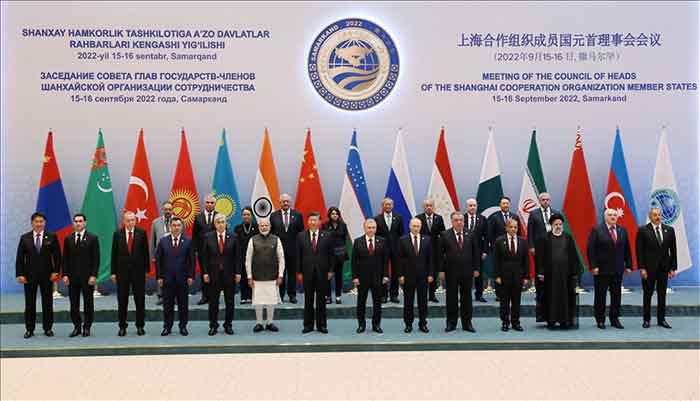
Held in Samarkand, Uzbekistan, from September 15 to 16, the 2022 summit of the Shanghai Cooperation Organization (SCO) Heads of State Council demonstrated that the SCO was continuing to evolve into a viable international political congregation independent from the West.

Beginning in the early 1800s, international organizations (IOs) began to emerge as modest arbiters of European affairs. But during and after World War II, new IOs established themselves as far more prominent actors on a global scale. The United Nations (UN), the Arab League, the Organization of Petroleum Exporting Countries (OPEC), the Association of Southeast Asian Nations (ASEAN), and several other IOs were created to manage the affairs of their member states.

After the Soviet collapse, more IOs were created to manage the independence of new states, globalization, and regional cooperation. The Commonwealth of Independent States (CIS), created in 1991, attempted to coordinate military, economic, and political policies between post-Soviet states. The European Union (EU) and the African Union (AU), created in 1993 and 2002, respectively, bound member states more forcefully to common economic and political norms. Other IOs, like the Arctic Council (1996) and Asia Cooperation Dialogue (2002), aimed to foster broader regional cooperation.

Most new international organizations meshed neatly with the Western-led liberal world order. But in 2001, the formation of the Shanghai Cooperation Organization (SCO) was formally announced, and it established itself as an exclusionary outlier. Originally known as the Shanghai Five when it was created in 1996, it included China, Russia, Kazakhstan, Kyrgyzstan, and Tajikistan, with Uzbekistan later joining when it evolved into the SCO in 2001.

The SCO was created partly to help coordinate a new era of peaceful relations between Moscow and Beijing and to manage their coalescing interests in Central Asian states. In addition, combatting the “Three Evils” of extremism, separatism, and terrorism were major priorities for the organization, which included data and intelligence sharing and common military drills among its member states.

Over time, the SCO began to embrace greater political and economic integration. Support for autocratic rule and limiting criticism of human rights violations set it apart from other Western-aligned IOs, with the SCO also overseeing the growth of joint energy projects, the fostering of trade agreements, and the introduction of the SCO Interbank Consortium in 2005 “to organize a mechanism for financing and banking services in investment projects supported by the governments of the SCO member states.”

But the organization’s most pressing vocation was facilitating a multipolar world order. Investing in an independent forum for economic, political, and military affairs outside of Western influence became a key component of Russian and Chinese attempts to reduce Western power in global affairs.

Russia and China have also developed complementary mechanisms to the SCO, which have helped decentralize its mission. Following the blacklisting of several Russian banks from the Society for Worldwide Interbank Financial Telecommunication (SWIFT) in 2014, for example, the Kremlin approved the creation of the System for Transfer of Financial Messages (SPFS) to replicate SWIFT and introduced the National Payment Card System (now known as Mir), while China created the Cross-Border Interbank Payment System (CIPS).

These initiatives even proved attractive to states that were more aligned with the Western-led global order. India and Pakistan began SCO accession talks in 2015 and officially joined the organization in 2017. Despite relatively positive relations with the West, India and Pakistan have both faced Western criticism over human rights and democratic backsliding in recent years. India’s introduction of platforms like RuPay in 2012 and Unified Payments Interface, which eroded the traditional dominance of Visa and Mastercard in the country, also complemented SCO’s attempts to reduce Western economic preeminence globally.

At the 2022 summit of the SCO Heads of State Council, Uzbek President Shavkat Mirziyoyev reiterated that the SCO was not an anti-U.S. or anti-NATO alliance. But the organization’s original motive to create a multipolar world was echoed in its Samarkand Declaration, the final declaration of this meeting, and continues to conflict with Washington’s attempts to maintain the U.S.-led world order. According to the declaration, the member states “confirm[ed] their commitment to [the] formation of a more representative, democratic, just and multipolar world order.”

This core stratagem continues to appeal to countries around the world. Alongside the leaders of its eight member states, the SCO invited the presidents of Belarus, Mongolia, and Iran as official observers to the recent summit. Having started its accession process in 2021, Iran signed a memorandum of understanding with the SCO to join the institution by April 2023.

The SCO would likely alleviate Iran’s sense of economic isolation stemming from Western sanctions, a sentiment shared by Iranian officials at the summit and something that was also noted back in 2007. Belarus has also found itself under increasing sanctions in recent years and enhanced its accession procedures to join the SCO in Samarkand.

The presidents of Azerbaijan, Turkmenistan, and Turkey were also invited to the SCO summit as special guests, with Turkish President Recep Tayyip Erdoğan announcing that his country would seek full membership to the SCO. In 2012, Erdoğan joked to Russian President Vladimir Putin about abandoning Turkey’s EU aspirations if Russia would allow them into the SCO. Turkey’s renewed attempt comes at a time when its ties with the rest of the Western world are increasingly strained and could instigate other NATO states, and potentially the EU states, to join the SCO as well.

The SCO has also established strong relations with other IOs. Representatives from ASEAN, the UN, the Russian-dominated CIS, the Collective Security Treaty Organization (CSTO), and the Eurasian Economic Union (EAEU) were invited to the 2022 summit. Notably absent were any representatives from the EU or NATO. Meanwhile, in 2005, the U.S. was rejected from gaining observer status, solidifying the SCO’s status as a bulwark against U.S. influence in Eurasia.

Like all major international organizations, the SCO faces systemic obstacles that hinder its effectiveness and long-term viability. At the recent summit in Uzbekistan, China’s Xi Jinping was welcomed to the country by his Uzbek counterpart, Shavkat Mirziyoyev. Putin, however, was greeted by Uzbek Prime Minister Abdulla Aripov, highlighting Russia’s strained relations with many of the former Soviet states and the growing strength of Beijing over Moscow. Unlike in the CSTO and the EAEU, Russia is not the dominant actor in the SCO, and will increasingly have to contend with China’s predominant authority.

Disputes also remain between SCO member states. India and Pakistan, for example, are afflicted with an ongoing struggle over Kashmir. China and India have their own territorial disputes and have engaged in minor violent skirmishes since India joined the SCO. Additionally, deadly clashes between Kyrgyzstan and Tajikistan erupted during the recent summit, while admitting Armenia and Azerbaijan, both of which are SCO dialogue partners, will only further increase the number of members currently locked in their own territorial disputes.

But the SCO has consistently portrayed itself as a vehicle to supervise these issues. The leaders of Kyrgyzstan and Tajikistan met for talks during the summit to assuage tensions. And since 2002, the Regional Anti-Terrorist Structure (RATS) has encouraged military coordination between member states, with the Indian and Pakistani militaries conducting RATS drills in 2021. More drills between them are planned for October, and while they are aimed primarily at countering unrest from Afghanistan, they are also part of SCO’s attempts to manage relations of member states.

China and Russia have also agreed to “synergize” the Belt and Road Initiative (BRI) and the EAEU to help mitigate possible tension between them, with both Xi and Putin meeting on the sidelines of the 2022 SCO summit and pledging to respect each other’s core interests.

The SCO member states clearly believe the organization can, and has greater potential to, effectively manage their concerns and regional affairs, and its appeal continues to grow. Besides the additional SCO dialogue partners (Cambodia, Nepal, and Sri Lanka), Qatar, Saudi Arabia, and Egypt were granted the status of SCO dialogue partners at the 2022 SCO summit. Myanmar, Bahrain, Kuwait, the United Arab Emirates (UAE), and the Maldives were also granted the status of dialogue partners.

Russian and Chinese influence will fall as more members join, which will also dilute consensus within the organization. But it remains a Beijing and Moscow-led initiative to manage world affairs and to demonstrate that the “international community” is not just the West. With almost half of the world’s population and a quarter of the global GDP, the SCO is increasingly becoming a representative of the Global South.

By pooling together other IOs into an umbrella forum, the SCO can further its goal of challenging the wider Western-dominated IO ecosystem and prevent Washington from setting the global agenda. This will require the constructive management of Russian and Chinese ambitions and the increasingly complex needs of more member states.

Eurowings pilots in Germany go on 24-hour strike

Marianne Arens


Pilots employed by the Lufthansa subsidiary Eurowings went on a 24-hour strike on October 6. A large proportion of the airline’s approximately 500 flights planned for that day had to be grounded, with more than 30,000 passengers affected.

[Photo by Steve Jurvetson / flickr / CC BY 2.0]

Well over 300 flights had to be cancelled. According to the individual airports, 118 flights were cancelled at Eurowings’ main base in Düsseldorf, 61 in Cologne/Bonn, 72 in Hamburg and 64 in Stuttgart. For its part, Eurowings claimed it had salvaged “half” of the planned flights. For some of the long-haul routes, the airline used aircraft from the non-striking Austrian subsidiary, Eurowings Europe, and partner companies.

In August, a ballot among Eurowings pilots produced a result of 97.7 percent in favour of strike action, based on 90 percent participation.

The pilots are primarily fighting against the scandalous and dangerous permanent overload of work due to staff shortages. “The workload has increased considerably,” read a press release from the Vereinigung Cockpit (VC) pilots union, which called for the strike action. “The employer regularly extends the working hours of colleagues to the maximum permitted.” Eurowings has been rejecting a new contract with shorter deployment times and additional days off for months.

Pilots also need adequate financial compensation for the losses due to inflation and the losses they had suffered during the coronavirus pandemic through short-time working and lost wages. During the pandemic, the airport unions, including Vereinigung Cockpit, agreed to the suspension of contractually agreed wages, the waiving of additional wage payments and massive job cuts. The Lufthansa subsidiary Germanwings was wound up. Under pressure, Lufthansa pilots alone sacrificed around €800 million.

Although Lufthansa has long since recovered the losses it made during the pandemic—with the help of a substantial government bailout—the company has not reimbursed the sums extorted during the pandemic, and its pilots continue to work under heavy pressure. This explains their current anger and willingness to strike. It coincides with a growing wave of industrial action throughout the aviation sector.

At the Rhein Main Airport, across Europe and around the world, air traffic strikes have been occurring repeatedly in recent weeks. To give just a few examples: In July, Lufthansa ground staff stopped work, while Ryanair crews held several 24-hour strikes across Europe, especially in Spain. On September 2, 5,000 Lufthansa and Lufthansa Cargo pilots went on strike. In Hanover, Swissport Cargo workers went on strike on the same day. Shortly afterwards, an air traffic controllers strike in France affected the whole of Europe. Currently, air traffic controllers are on strike in 18 African countries, including Cameroon, Mali, Burkina Faso and the Ivory Coast.

If pilots, cabin crews, ground workers and technicians at airports coordinated their struggles, they would unleash an enormous social power. All the more so because railway workers, dockers, bus drivers, teachers and health care workers are also angry and ready to strike, not to mention auto, metal and electrical workers. In addition, 7 million workers in Germany alone are involved in official wage struggles this autumn and winter.

Around the world, a wave of working class strikes and protests against inequality and exploitation is developing. After three years of the pandemic, increasing numbers of workers are taking up the fight against inflation, hunger and the threat of a third world war.

In all of these developments, however, workers confront the trade unions, which isolate and sell out these struggles due to their totally nationalist and pro-capitalist policies. This is true not only of mainstream unions like Verdi (public service) and IG Metall (metal and electrical industries) but also the smaller, specialist unions abundantly represented at airports, UFO (flight attendants), IGL (cabin crew) and the Vereinigung Cockpit (VC).

VC is a prime example of this policy of the unions. The pilots union is doing everything in its power to prevent a joint struggle that could really make a difference. It has lined up with the opposing side, with German business interests, the government and the Lufthansa Group, which it supports in the global trade war. In order not to harm the interests of the German-based company and its shareholders, the union strives to prevent any type of joint industrial action. VC not only separates the pilots’ struggle from that of flight attendants and ground staff but even refuses to unite the separate industrial actions carried out by Lufthansa and Eurowings pilots.

VC called off an already decided, second strike by Lufthansa pilots in September at very short notice, although at that time it was clear that Eurowings pilots in the same company were prepared to strike. Instead, the union agreed to a shabby deal with the company executive which failed to resolve any of the pilots’ problems. The same can now be expected for Eurowings pilots and the employees of other Lufthansa subsidiaries. The readiness of VC to put the interests of shareholders above those of employees has already been demonstrated by the union in the pandemic when it agreed to cut wages and jobs.

Half of Ukrainian 2023 budget dedicated to NATO proxy war against Russia

Jason Melanovski


Initial details on Ukraine’s 2023 draft $70 billion budget have revealed that half of the country’s spending for the upcoming year will be devoted to the NATO-backed proxy war with Russia. By contrast, social spending on medicine, housing and pensions will be cut massively as the country continues to run a monthly budget deficit of approximately $3 billion to $5 billion. 

According to the popular Ukrainian news outlet Strana, the government expects GDP to grow by 4.6 percent after contracting by a third this year due to the war. Meanwhile, the Ukrainian working class will be faced with an astounding 30 percent inflation rate and 28.2 percent unemployment. 

In addition, subsidies for housing will be cut by approximately $1 billion, education will be cut by approximately $800 million, and the medical budget will be cut by over $500 million, even as the COVID-19 pandemic continues to rage. Both the national minimum wage and pension rates will remain unchanged. 

While 7.4 million out of a pre-war population of 41 million have fled the country amid the war, the cuts combined with rapidly rising inflation will amount to a noticeable decrease in social spending for the remaining population.  

Overall, the country is facing an economic disaster as the World Bank predicted on Tuesday that the economy will fall by 35 percent, contradicting Kiev’s expectations of modest growth.

Estimates put the cost for rebuilding what has already been destroyed by the war at a minimum of $349 billion, or 1.5 times the size of the Ukrainian pre-war economy. Eight months into the war, a third of Ukraine’s population has been displaced and 60 percent are living below the national poverty line. 

With 7.4 million Ukrainian refugees living across Europe, it is also unclear when or if they will return to work in Ukraine, as large parts of the country could be left without heat this winter. As Europe faces its own energy crisis, the refugees remaining in Europe are already finding it harder to find shelter and food as local hosts themselves are unable to afford the rapidly increasing cost of living.

Alisa, a 16-year-old Ukrainian refugee living in Hungary, was recently told by her hosts they could no longer afford to provide her housing after the Hungarian government raised energy prices. “Back then, they said we could stay until the end of the war, but now they’ve realised they can’t afford the energy bills. They very politely told us we had to leave,” Alisa, who had been working long shifts at a factory as a minor, told the Guardian

The increased rate of evictions was confirmed by Anastasia Chukovskaya, a Russian volunteer living in Budapest who heads an organization dedicated to helping Ukrainian refugees. “There is a wave of evictions now from families who say they cannot afford to be hosts,” Chukovskaya said.

Due to the significant strengthening of the dollar this year, Ukraine itself will also face “a very serious debt situation” as it has to pay its massive debt back in dollars. Despite reaching a debt service freeze with Canada, France, Germany, Japan, the United Kingdom and the United States in September, the country will continue to spend billions of its revenue on paying off and servicing its external debt. 

Without significant loans from the IMF and debt service freezes from its western creditors, the country would quickly be forced into default. 

Regarding the country’s financial budget being controlled by foreign creditors who are backing the war, Oleg Pendzin, the head of the Ukrainian Economic Discussion club, stated, “In general, the budget for the next year is the cost of the war ($1.21 billion hryvnias, that is, most of the country’s revenue). All expenses are due to external borrowing, that means we are talking about direct ‘eating’ of credit funds. This means that all expenses must be strictly agreed to with the main creditors.”

Whatever the final outcome of the Ukrainian budget, Strana admitted that the budget could rapidly change as the main purpose for the continued existence of the Ukrainian government is to continue the war at the behest of its imperialist backers—whatever the cost. 

As Pendzin told Strana, “All these guys who are now running to lobby for their interests should keep in mind that the bulk of the money will go to the war. It is possible that the army’s already record funding will have to be increased even more. And the rest of the expenses will be cut. Plus every penny of spending should be agreed with creditors. In such a situation, I don’t see much room for maneuver. Although, of course, there will be all sorts of ‘small’ items of expenditure that they will try to stretch out for someone.” 

The massive expenditure on the war compared with diminished social spending reveals the reactionary nature of the Ukrainian government, which has used the war as a pretext to attack the country’s working class. 

In August, President Volodymyr Zelensky approved Law 5371, the so-called labor law, which effectively stripped Ukrainian workers at small and medium-sized companies of any labor protection rules. Earlier in July, the Zelensky government passed a law permitting employers to stop paying workers forced into the military. Another law legalized zero-hours contracts, which enable employers to forbid contracted workers from taking other jobs while cutting hours to whatever benefits the company. Further draft labor laws have proposed introducing a 12-hour work day and further enabling employers to fire workers without justification. 

Such reactionary measures in addition to the war itself are largely being funded by the United States and the EU. On Thursday, the US Senate passed an emergency funding bill sending another $12.3 billion in aid to Ukraine. The aid combined with previous packages means the US has already pledged $65 billion to Ukraine, which, as the New York Times noted, “will be the highest amount of military aid the United States has committed to any country in a single year in nearly half a century, since the Vietnam War.”

Should the current rate of US funding continue, US taxpayers could end up funding more than half of Ukraine’s proposed 2023 $70 billion budget. Meanwhile, the US has signaled it will expand its industrial base as it expects the war in Ukraine “will last years.” 

CDC deepens COVID-19 cover-up, switches to weekly reporting of cases and deaths

Evan Blake


On Wednesday, the US Centers for Disease Control and Prevention (CDC) quietly updated its national COVID-19 data surveillance protocols to switch from daily to weekly reporting of COVID-19 infections and deaths starting on October 20. Coming just before what is widely expected to be another devastating surge of the pandemic across the US this fall and winter, and three weeks before the US midterm elections on November 8, the move marks a major escalation of the Biden administration’s homicidal “forever COVID” policy and is tailored to match Biden’s lie that “the pandemic is over.”

There is no scientific basis whatsoever to the CDC’s change in policy, which undoubtedly had the direct approval of Director Dr. Rochelle Walensky. On a FAQ page where the announcement was made, the agency claims that the switch will “allow for additional reporting flexibility, reduce the reporting burden on states and jurisdictions, and maximize surveillance resources.” In reality, there is no “reporting burden” on states and “surveillance resources” are now all but nonexistent.

Since the emergence of the Omicron variant nearly one year ago, the vast majority of US states have systematically dismantled their COVID-19 data reporting and surveillance systems. According to the Johns Hopkins University Coronavirus Resource Center, a staggering 32 states have already switched to weekly reporting of COVID-19 cases, while 29 states only report deaths weekly. North Dakota, Nebraska, and the District of Columbia have stopped reporting deaths from COVID-19 entirely. As a result of the CDC’s new policy, in the coming weeks every state will likely switch to weekly reporting.

The CDC, the White House and state governments run by both the Democrats and Republicans have curtailed testing and contact tracing, and scrapped quarantine and isolation guidelines. Due to the closure of government-funded testing sites and the switch to unreported at-home testing, the official seven-day average of daily new cases is down to 41,248. The Institute for Health Metrics and Evaluation (IHME) estimates that the true number of infections now stands at roughly 530,000 per day, over 12 times higher than the official figure. In August, the CDC officially recommended against quarantining exposed individuals, as well as contact tracing and surveillance testing in most settings.

The CDC’s latest COVID cover-up takes place as an average of over 400 Americans are officially dying of COVID-19 every day, or roughly the equivalent of the death toll from the September 11 terrorist attacks each week. The curtailment of data reporting is central to the broader normalization of the pandemic, a global process which has been imposed in nearly every country except China over the past year.

As accomplices in this vast social crime, the corporate media has dutifully remained silent and thereby facilitated the deepening COVID cover-up. The latest CDC policy change has not been reported on by the New York TimesWashington PostPolitico and other leading print outlets which collectively have thousands of staff writers, while the broadcast media has entirely ignored the issue.

Also this week, the CDC quietly removed COVID-19 travel notices for foreign countries from its website, and on Friday eliminated an automated “self-checker” chatbot designed to assist COVID-19 patients in finding testing centers and medical care. Both of these developments have also gone almost entirely unreported.

Throughout the past year, the World Socialist Web Site has been the only outlet to raise the alarm and continuously expose the efforts of the Biden administration and other world governments to scrap all mitigation measures, manipulate data and cover-up the pandemic.

In January, the WSWS broke the news that the Department of Health and Human Services (HHS) was ending its collection of reports on daily deaths and other critical data from US hospitals. In March, only the WSWS seriously reported on the CDC’s sudden elimination of over 72,000 COVID-19 deaths from its Data Tracker system. At every turn, the WSWS has given voice to the opposition to the ending of each new mitigation measure.

As news broke Thursday that the CDC is switching to weekly reporting, numerous scientists, doctors and anti-COVID activists denounced this latest unscientific policy. In one widely-shared tweet, Dr. Jonathan Reiner, a cardiologist and professor of medicine and surgery at the George Washington University School of Medicine & Health Sciences, wrote, “With the onset of colder weather & an anticipated rise in cases it’s hard to ignore the obvious political explanation for this change. There’s no scientific reason.”

The latest stage in the deepening COVID cover-up takes place as evidence continues to mount proving the horrific consequences of these policies. On Wednesday, the same day the CDC announced its switch to weekly COVID-19 reporting, the US Census Bureau released the latest figures from its Household Pulse Survey on Long COVID.

The survey found that 15 million adults in the US currently have Long COVID, of whom 81.4 percent are experiencing some level of difficulty in carrying out their daily activities. In total, roughly 3.8 million US adults report Long COVID symptoms that reduce their ability to carry out day-to-day activities “a lot,” while another 8.5 million report Long COVID symptoms that reduce their ability “a little.”

These figures correspond closely with a recent Brookings Institution report, which found that up to 4 million American adults have left the workforce due to being disabled by Long COVID.

Numerous scientific studies underscore that the “forever COVID” policy of perpetual waves of infection will result in the ongoing mass disabling of a significant share of the population, further lowering life expectancy and straining the health care system to the breaking point.

Among the most comprehensive studies on Long COVID is that being led by Dr. Ziyad Al-Aly, the chief of research and education service at Veterans Affairs St. Louis Health Care System. His team’s most recent peer-reviewed study, published in late September, found that COVID-19 increases one’s risk of a neurological disorder by 42 percent, and that seven out of every 100 people with COVID-19 develop some form of neurological disorder, including strokes, Alzheimer’s disease, seizures, Parkinson’s-like symptoms, anxiety and depression and others. Other studies have found that COVID-19 causes elevated risk of numerous cardiovascular diseases, diabetes, kidney disease and more.

In a preprint study published on June 17, which is currently undergoing peer review, Dr. Al-Aly and his team found that people with two or more COVID-19 infections were twice as likely to die of any cause and three times as likely to be hospitalized in the six months after being reinfected, compared with people who had been infected once. In addition, people with reinfections had far higher rates of heart disease, kidney disorders and other ailments than those with just one infection. These results held for both people who were unvaccinated and for those who had received at least one dose of vaccine before their reinfection.

The results of this study and the immense body of research into Long COVID make clear that for the working class and society as a whole, there is no such thing as “living with the virus” and in no way is the pandemic “over.” In order to prevent perpetual mass death and the progressive disabling of ever-larger sections of the population, the only viable strategy is that of global elimination, in which all human-to-human transmission of SARS-CoV-2 is brought to an end. This requires the global deployment of every public health measure to stop viral transmission, including mass testing, rigorous contact tracing, temporary paid lockdowns, the safe isolation of infected patients and more.

The maintenance of this Zero-COVID elimination strategy in China, the most populous country on Earth with over 1.4 billion people, proves that this strategy is viable and must be expanded to every other country.

Class tensions mount in wake of rejection of Chile’s draft constitution

Mauricio Saavedra


Early last month, Chileans voted overwhelmingly against a newly drafted constitution touted by sections of the international corporate media as the “most progressive” charter ever written. Amid the skyrocketing cost of living and rising poverty, the rejection represents a popular rebuke to the pseudo-left coalition government headed by President Gabriel Boric and its acquiescence to every demand of international finance capital six months after taking office.

On September 4, more than 13 million people, or 85 percent of the eligible electorate, turned out to vote in the referendum, which asked whether they approved or rejected a draft constitution to replace the one drawn up by the military dictatorship in 1980. The unusually high turnout was due to voting being made mandatory for the first time since 2012.

In what has been described as a stunning defeat for the Apruebo Dignidad (I Support Dignity) ruling coalition, only 38.1 percent of the electorate backed the draft, while more than 61 percent rejected it. So sweeping was the defeat that the Reject option won in all 16 regions of Chile.

Chile's Carabinero police marching against protesters in Santiago (Credit: Rjcastillo/Wikimedia Commons)

The narrowest result between Reject and Approve votes took place in the capital Santiago, which has the highest concentration of people. Yet only five of its 52 municipalities approved the draft constitution. The only other municipality in the whole country to approve the proposed draft was the port city of San Antonio in the Valparaíso region, and there only by the slightest of margins.

The gap between Reject and Approve votes widened the further away from the capital. In the mining regions to the north—Tarapacá, Antofagasta, Atacama and Coquimbo—not one municipality approved the new constitution, while to the rural south the margins were even more pronounced. In Araucania, where the impoverished indigenous Mapuche communities are concentrated, the draft charter was rejected by 73 percent of voters.

Almost from the beginning of the process, major national and international newspapers gave voice to the right and ultra-right opposition to the constitutional convention. Their main concern was the expectations raised in the population by a plethora of pseudo-left elements who claimed they would end the military dictatorship’s free market charter that imposed the super-exploitation of labor and super-profiteering in all areas of the economy.

It came as no surprise that the mouthpieces for imperialist interests reveled in the result.

“Chile’s decision in a referendum on Sunday to reject decisively an impossibly utopian constitution stands out as a remarkable example of civic maturity,” the Financial Times declared the day after the vote. “What is likely to come next is a fresh attempt to rewrite the constitution. This will correct past mistakes by ensuring that delegates to a new constituent assembly are more representative of a country that is broadly divided between left and right.”

Time magazine stated that “Some Chileans argue that the delegates were not representative of Chilean society—the majority came from left-wing political blocs or independents with a similar political bend” and “the draft document—comprising 388 articles—went too far, enshrining a long list of unworkable rights and equalities in law that would scare off investors and lead to chaos.”

The Wall Street Journal commented, “Chileans…rejected a new constitution that would have empowered the left to restrict property rights and individual liberty… If (Gabriel Boric) hopes to salvage his Presidency, he will have to respond to the public’s needs by moving to the center and recognizing interests beyond his base of left-wing urban elites.”

The referendum to replace the military dictatorship-era charter and draft a new constitution was borne out of a desperate attempt to dissipate a revolutionary situation.

Popular opposition to Chile’s obscene levels of social inequality and against an increasingly despised civilian political caste surfaced initially in 2006 and again in 2011 with massive student protests demanding an end to the market-based education system. Progressively, teachers, port workers, miners, health professionals and pensioners entered the fray demanding sweeping changes in bitter protests that emerged between the second administration of Socialist Party President Michele Bachelet (2014-2018) and the second administration of right-wing billionaire President Sebastian Piñera (2018-2022).

A turning point was reached in late 2019, when, after years of bubbling tensions, opposition to capitalism and its servants erupted en masse. The largest demonstrations in the country’s history were held over several months with millions coming onto the streets despite the imposition of a state of emergency, with the Armed Forces and Carabineros special forces killing 36 people, mutilating hundreds and detaining thousands in the ensuing mass sweeps.

A real crisis of bourgeois rule opened up. Piñera’s beleaguered government convoked “national unity” discussions to bring an end to the massive anti-capitalist demonstrations at the end of 2019 and the beginning of 2020. He had a problem though: the center-left parties, having governed for 24 of the 30 years since the return to civilian rule in 1990, were a spent force.

Resuscitated in the 1980s with the funding and assistance of US and European imperialism, the Chilean Socialist Party, Party for Democracy, Christian Democrats and Radical Party formed a center-left ruling coalition that reformed only some of the more authoritarian aspects of Gen. Augusto Pinochet’s constitution, and only after the dictator was issued an arrest warrant by a Spanish magistrate in 1998.

However, they intensified the dictatorship’s extreme capitalist free market policies, leading to obscene levels of social inequality, the sprouting of shantytowns, dilapidated schools and hospitals, rising household and student debt and, ultimately ,to the social explosion.

The bourgeoisie responded to an existential threat from below as it has during other critical moments, relying upon the corporatist trade unions and the Chilean pseudo-left— in this case the Stalinist Communist Party and the Frente Amplio [Broad Front]—to disorient and divert anti-capitalist sentiment behind appeals to change the authoritarian constitution. They were aided by a plethora of Pabloite organizations whose chief function historically has been to prevent workers and youth from turning towards revolutionary socialism by subordinating them to the bankrupt national reformist politics of the trade unions and Stalinism or to equally reactionary petty-bourgeois guerrillaism.

How was this achieved this time? Firstly, the pseudo-left parties claimed to oppose Piñera’s national unity pact. Gabriel Boric was the only representative of the Frente Amplio coalition to enter into unity talks. But through their control of the unions, these parties called off strike action following the agreement to isolate the demonstrators from broader sectors of the working class that had previously been involved in the anti-capitalist protests.

At the same time, the Communist Party and Frente Amplio parliamentarians rubber stamped a series of police state laws. These laws enhanced the powers of the intelligence agencies and beefed up the police and military apparatus while other laws criminalized all social protests. Now, the pseudo-left Boric administration is using all of this against student protests and striking workers.

Secondly, with the onset of the coronavirus pandemic in March 2020, these same forces embraced a militarized response to the health crisis by voting in favor of declaring a State of Catastrophe that placed national defense chiefs in charge of the 16 regions of the country. The overriding concern was to put an end to social protest. Days before the State of Catastrophe decree, between one and two million people marched on International Women’s Day, putting paid to claims that the infamous national unity discussions had popular support.

Also, as the pseudo-left parliamentarians voted to furlough hundreds of thousands of workers, forcing them to eat into their own savings just to survive, the Stalinist-dominated Central Workers Union, the CUT, corralled workers back into unsafe workplaces in the export-oriented industries that had been classified as “essential.” While mining giants registered record profits in 2021, workers in the northern mining regions continue to suffer to this day high levels of COVID-19 infections and deaths.

The virus rapidly spread in densely populated working class neighborhoods and shantytowns, especially among informal workers who lacked any savings and were forced to continue working in order to eke out an existence. When hunger riots erupted in impoverished neighborhoods, Piñera cracked down with the anti-demonstration laws approved by the pseudo-left.

By October 2020, the pseudo-left, through the unions and the protest and community organizations they control, had successfully dissipated a revolutionary situation and channeled left-wing sentiment into parliamentary channels. That month, an overwhelming 78 percent of the electorate voted in favor of drafting a new constitution to replace Pinochet’s hated charter.

For the next seven months, their focus was almost exclusively on the election of delegates to the constitutional convention, even as bodies piled up due to the criminally negligent official response to the pandemic. During that period, the country registered 1.5 million COVID-19 cases and 35,000 deaths, while the richest families doubled their wealth from $21 billion to $42.7 billion.

The May 2021 elections for the 155 seats in the constitutional convention saw a crushing defeat for the right-wing and old center-left parties. While only 40 percent of the eligible electorate voted, those who did overwhelmingly sought candidates who promised to inscribe in the nation’s new charter guarantees to public health, public education, a decent pension, an end to social inequality, the redistribution of wealth, environmental protections, as well as indigenous and other democratic rights.

As the World Socialist Web Site explained at the time, no capitalist constitution could guarantee such demands because such documents fundamentally exist to protect a system based on the accumulation of private profit, the source of social inequality and exploitation. Any illusions in reactionary reformist myths are even more dangerous today as governments, both in the powerful imperialist nations as and the semi-colonial countries, respond to all social, health and environmental crisis by “letting it rip.”

It was at this stage that the Pabloites fulfilled their traditional role. Maria Rivera of the International Workers Movement (MIT), the Chilean section of the Morenoite International Workers League-Fourth International (LIT-CI), was elected to the constitutional convention along with a gamut of academics, professionals and “activists” linked in one way or another with the Stalinists and the pseudo-left.

Over the ensuing year, these political charlatans postured as revolutionaries, making calls for the nationalization of mining and the abolition of privatized education and health care, even as this entire exercise was given the imprimatur by imperialist mouthpieces like the Economist magazine and the US think tank Council of Foreign Relations. That the Economist later shifted its tune had to do with concerns about expectations that were being created by the draft constitution’s “fiscally irresponsible left-wing wish list.”

While the anti-communist scaremongering and disinformation campaign by the mainstream media and on social media definitely played a role in shaping opinion, especially among the more politically backward layers in the population, what secured the constitution’s defeat in the working class was the actions of the Boric administration since coming into office.

Identity politics was a centerpiece of the pseudo-left’s campaign from the beginning of both the constitutional convention and the presidential election at the end of last year. Touted as the most “progressive” constitution by swathes of the pseudo-left internationally and sections of the professional middle class and academia, its central thrust was to increase the size of the state, creating a new indigenous bureaucracy and guaranteeing gender parity in the civil service and the state.

After winning the runoff against José Antonio Kast of the fascistic Republican Party, Boric highly touted his selection of 14 women for his cabinet of 24 ministers.

Since coming to office, the pseudo-left government has turned to the same police state methods of previous governments. Over the last seven months, it has sent the riot police against protesting students and jailed striking workers. Indigenous communities to the south are under a State of Emergency with the military deployed to control the highways and thoroughfares. It has increased both the funding and size of the Carabineros police, infamous for its human rights violations, and purchased military-grade armored vehicles for their use.

The pseudo-left administration has also complied with finance capital’s demands by further integrating the old center-left political caste into his government and by implementing a fiscally tight monetary policy, ending stimulus programs to aid working and middle class families as inflation reaches levels not seen since 1992.

On Boric’s watch, the Central Bank has progressively increased its interest rate to 10.75 percent. Meanwhile, real incomes dropped 3 percent, while the cost of essential household items rose 15 percent annually up to August, pushing more than half of all working families into poverty.

The political role played by the Stalinists, Broad Front, and Pabloite outfits has only emboldened the most right-wing and fascistic forces, who feel they have the upper hand. While Boric makes feeble calls for dialogue, the right is pushing for more police state measures, including more police and soldiers on the streets and an expansion of the use of states of exception.

Far from being resolved, the crisis of bourgeois rule has only deepened. Amid a global resurgence of strikes and mass protests against inflation and inequality, the class struggle will burst to the surface sooner rather than later in Chile because all the same social and political issues remain.