9 Nov 2022

The Future of China’s Green Revolution

John Feffer


Photograph Source: Csp.guru – CC BY-SA 4.0

When it comes to a global clean energy transition, China is both part of the problem and part of the solution.

On the problem side, China is the largest emitter of carbon dioxide in the world by a rather wide margin. In 2020, China was responsible for a little over 30 percent of annual carbon emissions. The share of the number two emitter, the United States, was about 13.5 percent. Factoring in all greenhouse gasses doesn’t change the picture very much, with China still number one at 26 percent and the United States number two at approximately half that figure. But if you look at historical emissions, the picture reverses, with the United States responsible for approximate 20 percent of all carbon dioxide emissions since 1850 and China in second place at 11 percent. Also, on a per-capita basis, China slips to the number four position, with approximately half the emissions today of either the United States or Russia.

At the same time, China has been a global leader in shifting from fossil fuels to renewable energy, adding more renewable energy capacity than any other country. By the end of 2022, China is on pace to install an astounding 156 gigawatts of additional capacity provided by wind turbines and solar panels, which is 25 percent more than the record it set in 2021. By comparison, the United States is expected to install only about 30 gigawatts of solar and wind power this year.

China’s economy continues to grow, albeit less dramatically at the moment, and so does its energy needs. Total power usage has increased about 4 percent so far in 2022 compared to last year. Since China made its first international pledges to tackle climate change in 2009, its economy has grown threefold—but its energy consumption has only grown by half that figure.

“China hasn’t absolutely decoupled GDP growth from energy consumption and emissions,” points out Chinese journalist Liu Hongqiao, “but the trend is bringing us in the direction of decoupling.”

China has also been a driver of international climate agreements. Its 2014 bilateral climate deal with the United States made possible the subsequent Paris climate agreement. But more recently, China suspended climate discussions with the United States because of the latter’s Taiwan policy, including high-level congressional visits to the island.

“At the government-to-government level, the U.S.-China relationship appears to be in the dumps right now,” points out Jennifer Turner, the director of the Wilson Center’s China Environment Forum. “But in the area of environment and climate, cooperation has become part of the DNA of the two countries.” She points to subnational cooperation between, for instance, China and California, as well as the large number of U.S. environmental NGOs operating within China.

Tobita Chow, the founding director of Justice Is Global and the moderator of this recent conversation about the future of China’s Green Revolution, has been looking for alternative approaches to the U.S.-China relations “that get away from the framework of great power competition, which I think is dangerous in many ways. Cooperation is a promising way to define a healthier U.S.-China relationship, for instance cooperation around clean energy and tech-sharing in the Global South, which could be a powerful way of addressing the intersection between global inequality and climate change.”

In the space of a single generation, China transformed itself into a global economic giant. It now faces a task of comparable urgency and scale. In the space of a generation, China must lead the world by greening its enormous economy. How quickly Beijing can accomplish this goal will largely determine whether the world can prevent the global temperature from exceeding 1.5 degrees Celsius over pre-industrial levels, the goal the international community established as a goal for 2050 under the Paris climate agreement.

China’s Decarbonization Miracle

Despite its commitment to expand its renewal energy infrastructure, China remains the leading consumer of fossil fuels in the world, using twice as much as the United States. Moreover, more than half of China’s energy consumption comes from coal, which releases more carbon into the atmosphere than oil or natural gas.

Yet the Chinese government has pledged to reach peak carbon dioxide emissions before 2030 and to achieve carbon neutrality by 2060. “If China meets these goals,” notes Liu Hongqiao, “it can prevent a further 0.2 or 0.3 degrees of global warming. China is contributing its share, though you can argue whether it is a fair share or not” given the country’s current carbon output as well as its historic emissions.

The timeline for China is highly compressed. “In comparison to the European Union or the United States, China has to hit peak emissions in the next few years and go from peak emissions to net zero in 30 years, which is what the United States and other countries are accomplishing in 70 years,” she continues. “In reality, China’s emissions could peak earlier and at a lower level. And that would mean avoiding even more emissions on the path from peak emissions to carbon neutrality.”

But, she adds, the essential question remains, “Can the country go from the Chinese miracle that it created over the last 30 years to a decarbonization miracle in the next 30 years?”

To track China’s trajectory, Liu has dug into the details of China’s energy use. “We’re witnessing a fundamental change in China’s electricity mix,” she notes. “For instance, we all know that China is very dependent on coal. But that is changing. China has reduced its share of coal in primary energy and electricity consumption by 15 and 22 percentage points, respectively, since 2009. The share of coal is still about 56 percent right now in primary energy consumption. By 2025, however, the share of coal will drop below 50 percent.”

China has pledged to bring the share of non-fossil energy sources—wind, solar, hydro, biomass, and nuclear—to 80 percent of total energy consumption by 2060, but Liu notes that the share of wind and solar might get up to 96 percent in certain scenarios produced by the state-planners’ Energy Research Institute. The final result may depend as much on the provinces as on the state government.

“Provinces and cities are the gatekeepers of China’s decarbonization,” she points out, citing a recent Greenpeace report. “In some frontrunner cities and provinces, like Shanghai, Guangdong, and Beijing, we are already witnessing a strong decoupling of GDP and emissions. Other frontrunners like Sichuan province have pledged to ban new coal-powered plants. The city of Zhangjiakou, which is hosting the 2022 Winter Olympics, has more wind and solar capacity than all but nine countries in the world. On the other hand, there’s a relatively weak decoupling of GDP and emissions in Tianjin, Hubei, Jiangsu, and Anhui provinces.”

China’s climate strategy is not just narrowly about decarbonization. “The Chinese government thinks that addressing climate change is a lever to change China’s entire social and economic structure, not just energy,” Liu concludes. “It wants to put China on a pathway to decarbonization but more importantly to high-quality economic development.”

Pressure has also come from the Chinese public, for instance, to address air pollution. “Beginning in 2007, you saw a lot of street protests, and also complaints on social media about air quality in cities,” notes Jennifer Turner. “In 2013, the northern part of the country was hit by several shocking air-apocalypses. That year, China declared war on pollution, which has been nothing short of phenomenal in terms of improving air quality. If you’re addressing coal and cars for their air pollution, it has obvious co-benefits for addressing climate change, which the government is well aware of. So, yes, the government’s actions are about the economy and economic growth, but they are also in the interests of social stability.”

The Future of U.S.-China Climate Cooperation

In the wake of House Speaker Nancy Pelosi’s trip to Taiwan in early August 2022, China broke off talks on climate cooperation. Jennifer Turner remains optimistic that bilateral negotiations will resume: “Things are still happening, albeit at a slower rate.”

“I’ve had a front-row seat for 23 years to see how the two countries work together,” she recalls. “During the Obama administration, there were seven clean energy agreements. The U.S.-China Clean Energy Research Center (CERC) brings together national labs, NGOs, tech companies, business, and government to solve wicked problems involving electric vehicles and photovoltaic cells as well as the policies to enable the new technology.”

In addition to the national level, U.S.-China cooperation can be found at a subnational level. For years, Chinese experts studied California’s zero emission vehicle program as a model for China’s own program.

At the NGO level, a Chinese law in 2018 requiring the registration of foreign NGOs reduced the number of such organizations working in the environmental space. But some larger organizations like Greenpeace and the Environmental Defense Fund continue to operate, with largely Chinese staff. Meanwhile, Chinese NGOs continue to do important work, like mapping water pollution in rivers. In 2017, the government issued a call on social media to identify filthy rivers, but it was Ma Jun of the Institute of Public and Environmental Affairs who transformed this incoming information into a map. The organization Green Hunan has mobilized citizens to monitor the Yangtze River. These NGOs serve “as the ears and eyes of the local environment protection bureaus that can’t monitor in those ways,” Turner notes.

U.S. and Chinese environmental policies are linked sometimes in unexpected ways. For instance, China announced in 2018 that it would no longer import recycling waste from other countries. “China absorbed half the world market of recyclables, which it was using as industrial feedstock,” Turner explains. “China was choking on its own municipal waste.” In response to the ban, “a lot of U.S. cities and states canceled their recycling programs,” she adds. “But earlier this year, the international community came to an agreement to end plastic pollution by 2024.” Now the United States and China will be working together as part of an international effort to reduce one of the major components of the recycling stream.

More explicit partnerships between the two countries are essential, Turner urges. She points to the need for standards on lithium and rare earth elements, which are essential components of clean energy technology like electric vehicles and wind turbines. The need for lithium, primarily for batteries, will increase tremendously over the next decade as electric vehicles replace traditional internal combustion cars. China owns somewhere between 70 and 80 percent of the supply chain for electric vehicles and lithium-ion batteries, as well as 60 percent of the rare earth element production.

“Besides normal energy cooperation on climate, there’s also the issue of food and agriculture,” Turner points out. “China and the United States are both global superpowers when it comes to food. And one third of greenhouse gas emissions come from agriculture and food production. The two countries plus Europe are responsible for agricultural imports leading to emissions, biodiversity loss, and social-cultural threats.”

Another option would be to work together within China’s major global infrastructure development project, the Belt and Road Initiative (BRI). Chinese leader Xi Jinping “has pledged to green the BRI,” Turner continues. “For instance, China has announced that it is stopping overseas investments in coal-fired power plants.” The United States could compete with China in a “race to the top” in setting global standards for infrastructure development around the world.

Or, Tobita Chow adds, the United States could partner directly with China. He cites the recommendation of Rebecca Ray of the Global Development Policy Center for the United States to follow up on a Chinese suggestion to work jointly on specific development projects. “This would give the United States a say on standards governing any projects it collaborates on with China,” he notes.

Setting Standards

Both the United States and China have devoted considerable energy to establishing standards that can raise the quality of development projects. The United States has been instrumental in establishing the Blue Dot Network, which promotes “quality infrastructure investment that is open and inclusive, transparent, economically viable, Paris Agreement aligned, financially, environmentally and socially sustainable, and compliant with international standards, laws and regulations.” China, meanwhile, has developed a “traffic light system” to ensure that BRI projects reduce environmental risks and contribute to a green transformation, with green representing a positive contribution, yellow neutral, and red negative.

“Raising environmental and social standards for the mining of rare earth elements (REE) and other minerals crucial to a green transition is urgent,” Liu points out. “But if we frame this question under a just transition, it goes way beyond environmental standards. Concerns were raised in China about local communities’ sacrifice of their livelihoods,  environment, and clean water to supply the rest of the world and meet domestic demand for REE used in high-tech products. But that argument wasn’t taken into consideration in the WTO dispute when China cut its quota on REE exports. And attempts to incorporate such external costs and to raise the commodity price in the global market only started to receive attention as the United States and EU sought to secure the supply in their own territories.”

The Obama administration took China to the World Trade Organization, accusing it of unfairly restricting exports of REE. The United States argued that China was using export quotas to give a market advantage to domestic producers that had access to cheaper raw materials. The WTO ruled in the U.S. favor, and China cut its quotas accordingly.

“Since 2016, China has been passing new industrial and environmental standards to regulate REE and other minerals and has also ramped up enforcement of those standards,” Liu continues. “However, we simply don’t have enough supply in the market to meet China’s domestic demand let alone global demand. What’s very worrisome is the prospect of Myanmar and other developing countries taking over the REE supply chain. You can’t count on military-controlled Myanmar to enforce environmental standards, particularly where REE mining occurs illegally, against both the constitution and local laws.”

China and the United States thus have a common interest in global standard setting, whether the bar is raised by their cooperating on joint projects or their competing to see which country can promote cleaner projects.

“China has led the technical revolution on the mining of rare earth elements as well as cobalt and lithium,” Liu adds. “Because China has been the hub for production, processing, refining, and manufacturing, turning these minerals into key components for clean technology, China owns the most patents on this technology in this very niche field. If competition with the United States happens in a good way, it can bring down costs and that would benefit not just United States and China but also the rest of the world. Without fixing global resource governance, seeking alternative supplies from countries like Myanmar, where governance is even laxer than China’s, simply doesn’t make the problems go away. It will only produce more issues.”

A common criticism of higher environmental or labor standards is that they will deter outside investors, China among them. But Jennifer Turner notes that a recent study of countries in the Andean region shows that more stringent regulations has not affected Chinese investments. “China says that it will obey the rules in host countries,” she points out. “Often a host country or sub-region will invite China in, give it carte blanche. But this research gives ammunition to local governments and civil society to push for stronger enforcement in their own countries.”

Meanwhile, outside NGOs are coming up with tools to help civil society to do just that. Asia Society, for instance, has developed a BRI toolkit to support local stakeholders in their own efforts to push for stronger environmental and social standards. “It’s not just environmental impact assessments,” Turner notes. “There are different mechanisms along the entire path of a project to promote transparency and other goals.” At the same time, she acknowledges that raising BRI standards is challenging because so much of the work goes through subcontractors such that China state-owned enterprises can’t easily “green” every step of the supply chain.

“There have been a few breakthroughs on greening the BRI in the last one or two years,” Liu adds. “To start with, China committed to stop building overseas coal-powered projects, though this pledge has been challenged in some places where coal power is packaged as a ‘clean energy project.’ In addition, state planners issued their first high-level opinion on greening the BRI in March, outlining a dozen areas of cooperation in transportation, industry, and infrastructure.”

Hydropower continues to be a controversial issue. China has financed a lot of hydropower facilities in the Mekong Delta and in Africa. But they were largely built before the launching of the BRI in 2010. Today, under BRI, hydropower is still considered part of green energy cooperation.

“I participated in an environmental and social impact assessment of a Chinese company’s overseas hydro project in Azad Kashmir,” Liu continues. “Chinese companies do carry out such assessments, not just at the site but also increasingly covering the river basin. Can the standards for environmental and social safeguards be further improved? Absolutely, yes. Meanwhile, it is worth noting that the wind is changing. Large-scale energy infrastructure projects like traditional coal—and even gas power plants and mega-dams—are no longer the main focus of China’s overseas energy investment. Clean energy like wind and solar are becoming the next big push of the green BRI.”

The Role of Europe

Although China has suspended climate discussions with the United States, such talks continue with Europe. “I haven’t heard of any formal door-closing to the Europeans, compared to what I hope is temporary with the United States,” Turner reports. In February, France became the first country to partner with China on third-party intergovernmental infrastructure deals, inking an agreement to build seven infrastructure projects worth $1.9 billion in Africa, Southeast Asia, and Eastern Europe. China has separate investment deals with a number of Eastern European countries.

“Compared to the United States, Europe is viewed as relatively less hostile on climate cooperation policy not only by Chinese policymakers but also civil society and the public in general,” Liu points out. “Most of the time, Europe is not perceived as aggressively pushing China to do this or that, while we see the United States ‘urging’ China to take actions on many things. In fact, Europe is seen as a mediator in the bipolar conflict. It pushes the climate agenda forward without creating a triangular position in climate diplomacy. There is less competition in clean technology. We see fewer trade wars initiated by the EU than by the United States.”

But this is changing, she adds. “A proposed forced labor ban will be discussed very soon. Last year, there were sanctions from both the United States and Europe related to Xinjiang, and all this has had impact on climate cooperation.” Other tensions have emerged. In September, Chinese climate envoy Xie Zhenhua chided Europe for backsliding on its Paris commitments by increasing its use of coal to offset the reduction of imports of Russian oil and gas.

The war in Ukraine has indeed introduced a new dynamic into China’s relationship with Russia, Europe, and the United States. China imports a significant amount of energy from Russia—around 15 percent of its oil and its coal plus a good portion of its natural gas. Those purchases spiked over the summer as Russian sales to Europe dropped, and the Kremlin was cutting its prices. Beijing has also financed several energy projects in Russia as part of BRI—including a significant stake in Yamal LNG, the northernmost natural gas facility in the world.

But Chinese energy needs have also declined overall as its economic growth has slowed over the last year. “China’s actual fossil fuel imports from January to August this year dropped significantly,” Liu notes. “Meanwhile, China is ramping up domestic production of coal, oil, and gas to substitute for overseas imports. Energy security in China means gaining as much energy independence as possible: holding the rice bowl of energy supply in our own hands, as Xi Jinping said last year. China’s dependency on energy supply from Russia is very small compared to European countries. For instance, 70 percent of natural gas in Germany comes from Russia, while China has been diversifying its fossil energy imports to several dozens of countries.”

Framing China

According to one dominant narrative, China is the spoiler when it comes to the environment. It is the largest emitter of carbon in the world. It continues to rely heavily on the most polluting source of energy, coal. And it builds and finances huge, energy-intensive projects around the world.

But China is often blamed for the same sins of which the West is guilty. “The United States used to build big dams,” Jennifer Turner points out. “The World Bank used to build big dams. We don’t any more, but China based its hydropower construction on the U.S. model. U.S. government experts helped site the China’s Three Gorges Dam until they decided not to be involved in it.”

Liu Hongqiao cites the issue of the “debt trap,” the contention that China loans money to other countries with the intention of taking possession of the funded projects, like ports, when the recipient government defaults on the loans. “Many studies have confirmed that the ‘debt trap is a myth,” she notes. “Also, China’s development finance is demand-driven. If China’s development banks didn’t loan the money, other banks and financial institutions would. The difference is that often Chinese public financial institutions provide lower interest loans than Western commercial banks and the World Bank. Also, they operate in high-risk zones where other financial institutes refuse to take the risks.” On overseas coal finance, China’s public finance only makes up a small share despite China being the largest bilateral creditor.

Organizations working on questions of debt relief, Tobita Chow reports, “repeatedly run into the narrative that the problem is China. And that has become an excuse that Western actors will use to block progress on debt relief. In many cases, countries supposedly in a debt trap to China owe far more debt to Western banks and other private creditors.” African countries owe Western creditors three times what they owe China, and are being charged double the interest, according to a report this year from Debt Justice.

The politicizing of these narratives, Liu continues, distracts attention from many critical issues. “We have heard so much about China controlling, dominating, and weaponizing the critical raw material supply chain,” she says. “But we don’t hear much about how we can improve and elevate the value-chain of rare-earth or other materials so that resource-abundant countries—like China in the case of rare earth elements or the DRC in the case of cobalt—can benefit from the booming clean energy industry by moving up the value chain.”

“How do we respond to this dominant narrative that China is not a reliable partner on climate?” Chow asks.

“It’s a dated argument,” Turner responds. “Yes, China could probably move even faster on renewable energy. True, there’s been some slippage because with recent power outages, China is building more coal-fired power plants. But at least half of the existing coal-fired power plants are not being used or hardly being utilized, so this was very much a political move.”

“Some coal-fired plants that were already in the pipeline and had already completed preliminary studies were recently approved, but the current fleet of coal-fired plants operates below 50 percent of its designed utilization capacity,” Liu agrees. “The designers of China’s energy transition believe that the country’s young coal power fleet—with an average age of 15-16 years—would stay around for a long time, so why not use them to provide greater stability to the grid by improving fuel efficiency, reducing emission levels, and lowering their operational hours? The rational thinking behind this controversial ‘clean coal’ strategy that China has taken for its energy transition is not well understood in the global push for a coal phase-out. The trend provides some optimism: Coal use will peak very soon if it hasn’t done so already. China is marching to peak carbon emissions way ahead of the 2030 deadline.”

“Or take the example of solar panels,” Turner adds. “China flooded the world with cheaper solar panels. There were complaints that they were so cheap in order to undercut U.S. manufacturers. But those cheap panels enabled part of the global transition to clean energy. Also, as many studies have demonstrated, the jobs—75 percent of them—are where clean energy installed, so it it doesn’t matter who makes it.”

But what ultimately undermines the narrative of unreliability are the concrete interests that undergird the climate commitments of Chinese leaders.

“One factor that Jennifer mentioned is the rise of pollution protests in China,” Tobita Chow notes. “Since one of the top priorities of the government is to maintain social stability, shifting away from highly polluting industries can be understood as addressing that goal. Hongqiao mentioned that shifting to renewable energy is a strategy to increase China’s energy security. A third motivating factor is that China sees an opportunity to build soft power by positioning itself as a global climate leader. During the Trump period, China made a strong push when it became clear that the United States is not most reliable leader. This was an opportunity for China, particularly in the Global South.”

How the Islamic Revolution Gave Rise to a Massive Women’s Movement in Iran

Behrooz Ghamari Tabrizi


Photograph Source: Darafsh – CC BY-SA 4.0

Let me start with a straightforward proposition that is everywhere on social and mass media these days: The Islamic Republic’s patriarchal repression of women reached a tipping point after the murder in custody of Mahsa (Zhina) Amini by the Guidance Patrol on September 16, 2022. A revolt, led by young women, engulfed the entire country under the banner of women, life, freedom. At the root of this movement is the anti-women core of the Islamic regime and the struggle of Iranian women against it since its very beginning in 1979. The whole nation — inside and outside the country, the global community, the progressive Left as well as the hawkish Right, stand in solidarity with this movement. The protests that began against the compulsory hijab and the demand for abolishment of the Guidance Patrol, has now become a full-fledged intersectional revolt for regime change in Iran, led by women.

This indeed is true that the Islamic Republic instituted draconian patriarchal policies after the revolution on 1979 that stripped the very basic formal rights that women had been granted under the ancien régime. These measures formally reduced women to second-class citizens in matters of marriage, custody, inheritance, crime and judiciary, dress code, segregation, and many other spheres of social life.  Yet, despite all this, women’s social mobility and presence in public sphere grew exponentially in the past four decades.  Ironically, this is in part an effect of the unintended consequences of these policies. Women learned very quickly how to navigate the new terrain, push the boundaries of the new institutions, and in practice gain access to rights and privileges from which the Islamic Republic deprived them. The recent revolt could not materialize without the remarkable agentive presence and mobility of women who carved out a space for ceaseless social and political engagement during the past four decades. Women are revolting because they refuse to continue the struggle in a field the boundaries of which are drawn in the dilapidated spirits of patriarchy.  Their gains have reached a hard as well as a glass ceiling that needs to be overcome.

The Iranian revolution succeeded in ending the monarchy on February 11, 1979. On February 26, only two weeks after the victory of the revolution, Ayatollah Khomeini annulled the Family Protection Law of 1967 and its 1975 amended version, which had given women more rights in divorce and matters of custody under the Shah. Since its inception, the clergy by and large had opposed the law’s basic premises, which they believed violated the Islamic views on women’s role in family.  Khomeini knew that the unity and uniformity that his leadership afforded the revolutionary movement would not remain uncontested for long after the triumph of the revolution. He knew that the spirit of Islam and the symbolic revolutionary language with which it inspired millions of Iranians of many creeds and classes needed to be translated into a body of institutional projects of post-revolutionary state-building.  So, he seized the opportunity to put women under the control of their menfolk.

Despite such overt assaults on women’s rights, most political parties continue to address women’s issues in the frame of revolutionary politics, nationalism, class struggle, and anti-imperialism.  For the first few months after the revolution, except for the National Front, the oldest liberal organization in Iran, and small Trotskyist group, Left and liberal parties remained ambivalent about women’s issues. They failed to recognize the remarkable contribution of women to the revolutionary struggle and the need to check the assault on their rights.  At the time, most of the women’s organization operated as an appendix to different political parties to further the anti-imperialist struggle and tied women’s issues to greater demands for social justice.

The establishment of the Islamic Republic proved inconsistent with fundamental women’s formal and legal rights.  Despite earlier assurances, on the eve of March 8, 1979, less than a month after the triumph of the revolution, Ayatollah Khomeini called upon the Provisional Government to uphold Islamic dress codes in its offices.  His pronouncement scandalized many who played a significant role in the revolutionary movement, including several members of his own Revolutionary Council.  This was the second time, after the abrogation of the Family Protection Law, in three weeks that issues of women’s right had become a point of contention in the post-revolutionary power struggle. That was why the festive preparations for the first post-revolutionary International Women’s Day turned into a rally with specific women’s rights demands such as the recognition of women judges and, most importantly, a call against compulsory hejāb.  Thousands of women gathered in Tehran University and the next day in front of and inside the hallways of the Ministry of Justice chanting: In the Spring of freedom, absent is the rights of women.

Instituting compulsory hejāb even in the tightly controlled parliament and implementing it throughout the country was not an easy proposition. It took another four years for the mandate to become an enforceable law. Different factions inside the government as well as influential clerics in seminaries raised questions about the wisdom of such a law, its religious justification, as well as its feasibility. Nevertheless, the new law went into effect on August 9, 1983.

The institution of compulsory hejāb and other patriarchal measures in cases of travel, marriage, custody, inheritance, criminal laws, etc. all of which formally reduced women to second-class citizens, gave yet more credibility to feminist concerns that the Islamic republic would entirely force women out of the public sphere. Comparisons were made with Reza Shah.  Some argued that whereas he liberated Muslim women by the “unveiling law” that banned the hejāb in public spaces in 1936, the Islamic Republic was now forcing women back into the private sphere where they would be subjected to the repressive domestic patriarchy.  Yet curiously – these contrasting policies produced paradoxical results on the ground. Reza Shah’s “unveiling” did not liberate women, and the Islamic Republic’s repressive measures did not imprison women at home. Ironically, it was under Reza Shah’s “unveiling law” that a great majority of women in urban areas were forced to stay at home, either because they chose not to appear in public without a veil or were not allowed to leave their homes by their fathers or husbands. Under the Islamic Republic, despite the institution of repressive anti-women laws, rather than being imprisoned in their homes, women gained unprecedented mobility in the country and year after year increased their presence in the public sphere.

These were unintended consequences, but they were quite substantial. As a consequence of the restrictions imposed on women in public places, a new system emerged of what I call patriarchy by proxy. The new laws created the possibility for a great majority of socially conservative Iranian families who were previously reluctant to see women’s participation in social affairs, to trust the new “Islamized” public sphere as an extended domain of patriarchal/religious order. The state became the ultimate guardian of patriarchy and by becoming so, paradoxically, sanctioned an unprecedented mobility among rural and urban women. Despite barring women from entering key political and judicial positions of decision-making, women entered and shaped the conditions of those spheres in significant numbers.

In practice, gender politics and policy under the Islamic Republic have been far from the mere enactment of literal readings of the Qur’anic verses or a replication of women’s repression in Saudi Arabia. There is no doubt that the postrevolutionary regime instituted formal and legal apparatuses in order to constitute a homo Islamicus. But in its realpolitik, the Islamic Republic negated the anxieties that it would implement a literal reading of the Qur’an and expunge women from the pubic and restrict their lives to the domestic sphere. A quick look at the human development indexes in relation to women’s status in education, health, sports, artistic and cultural production, and civic engagement shows that the women in Iran have the most visible presence in public sphere in its history.  These changes were not the result of top-down state policies, but rather the consequence of a contentious engagement between different factions within the polity, women’s community and civic institutions, and political parties and activists.

From the time of revolution in 1979 to the latest reports in 2019, women’s literacy rate rose from 36% to 97.93%; share of women students in higher education rose from 15% to 60%; women’s life expectancy rose from 55 to 77; infant mortality decreased from 90 per 1000 to 10 per 1000. None of these could have been possible without a remarkable presence of women in public space and their involvement in policy planning and implementation.

The significant presence of women in the public arena created unanticipated shifts in gender relations in the country, conditions that forced even the most patriarchal factions in power to advocate unlikely propositions regarding women’s role in society. In 2006-2007 school year, women comprised 60% of incoming class of university students, and that trend continues. The conservatives of the 8th Parliament introduced legislation for affirmative action for men to catch up with women in higher education. The conservative parliamentarians, who otherwise insist that the place of women is at home to raise a virtuous family, argued that women who use resources of free public universities had to commit to a 10-year employment (public or private) after graduation. The paradox there is self-evident.

Another measure that contributed to the remarkable shift in family structure and gendered relations in public and private spheres was an aggressive family planning and population control program that was instituted in 1989. Although the Islamic Republic repealed the family planning and protection laws of the old regime soon after assuming power, in a significant shift, in 1988, the government introduced and carried out one of the most efficient family planning programs in the economically developing world.   Dictated by the perceived necessity of containing an unchecked rise in population, the program successfully reduced the population growth rate from the high of 3.4% in 1986 to 0.7% in 2007. During the same period, the number of children per family dropped from 6.5 to less than 2. Before his death in 1989, Ayatollah Khomeini endorsed the new program thus affording religious legitimacy to this ideological reversal.  As the Candadian-Iranian anthropologists Homa Hoodfar has shown, without national consensus-building, a massive mobilization of women, both by government agencies as well as non-governmental agents, promoted with effective religious justification, and offered through an efficient delivery service in birth control and contraceptives (such as distribution of free condoms), and premarital sex-education programs, this ambitious family planning project could not have been realized. Called by many “The Iranian Miracle,” the program was so successful that, fearing the emergence of an aging population, the authorities are now trying to encourage families to have more children.

The purpose of this brisk history is not to draw a sanguine picture of women’s conditions in contemporary Iran. The complexities of how government and non-governmental actors interact on these issues, how the expansion and containment of state power shape the social realities of women of different classes and ethnicities, or how religious doctrines and convictions hinder or facilitate women’s mobility cannot be fully detailed here.  Rather, I want to show that the Islamic Republic instituted policies and imposed patriarchal laws that produced unintended consequences in gender relations and women’s mobility. For an uprising to materialize, there needs to be a socially mobile, politically conscious, and subjectively free population. Iranian women have long been the fierce political actors we see on the street, not the oppressed, shadowy, veiled subjects that are the meat and potatoes of foreign misperception and paternalism. Yes, a mighty patriarchy shaped social order in Iran, like many other places in the world, but women were never its hapless captives. That image, the helpless veiled women, while effective in gathering support in global liberal feminist circles who believe that Muslim women need to be saved, does not correspond to the practice of those women’s everyday lives and fails to credit two generations of Iranian women for their political creativity.

At its core, Women-Life-Freedom is a movement for dignity and sovereignty of the subject.  It is a movement that has changed the political culture of defiance and expressions of dissent. Its radical creativity— posters, songs, graffiti, and imaginative forms of collective action, has opened in practice the possibility of thinking of politics anew. The transformative acts of insubordinate bodies and liberated souls has made party platforms and unruffled sermons ineffective and obsolete.

While Iranian women and their male allies fight against the state’s brutal crackdown, their aspiring revolt, with its novel singularities, faces instrumentalization by regional and global actors, facilitated through a misreading of Iranian women’s history of deliberate and agentive action. While the global reach of this movement through the media operates as an instrument of its effective dissemination, paradoxically, it also subjects it to a discursive violence.  We should not misread the core principles of Women, Life, Freedom as being a simple “desire for the west” by a population who are simply fed up.  Under such a misreading, a whole host of unsavory interests, from neocolonial expansionists to ethno-nationalist separatists, from delusional monarchists to all those who still lament being on the losing side of the 1979 revolution, try their best to claim ownership of this movement.  Yet Iranian women on the ground have been the very actors who historically have created the conditions of possibility for their protest.  They have opened space for themselves and their daughters in the face of a state desire for repressive patriarchy. Over decades they have succeeded to take advantage of the unintended consequences of state policies; they are not merely reacting—they are instead determined.

Today’s massive women’s movement in Iran represents one of the great achievements of the 1979 revolution—a revolution that generated hope-bearing, conscious subjects who have perpetuated themselves for more than four decades – despite and in the face of all manner of repression. The paradoxical effects of the Islamic Republic policies brought women to the centerstage of social transformation in Iran. Now that transformation has reached a point of frontal war with the state. Iranian women today hold key positions in journalism, artistic and cultural production, civic engagement, political organizing, higher education, scientific communities, local political offices, etc. Daughters of those women, irrevocably demand an extension and expansion of their mothers’ positions without any patriarchal restrictions, either by the state or inside their homes. Those demands will only be realized through the transformation of the state, or by rethinking the meaning of the state. How this transformation will unfold and with what means is yet not known, but its inevitability is evident. How fortunate we are that these generations of women taking the lead.

Australian Labor government in growing crisis over budget and IR bill

Mike Head


Just over five months after scraping into office with less than a third of the primary vote, Australia’s Labor government is already in a deepening political crisis, currently centred on the industrial relations bill that it is scrambling to push through parliament.

Anthony Albanese and Tony Burke [Photo: Parliament of Australia]

Despite there being only a handful of parliamentary sitting days left for 2022, Prime Minister Anthony Albanese and Workplace Relations Minister Tony Burke insist that all 250 pages of the fraudulently named “Secure Jobs Better Pay” bill must go through both houses of parliament before the end of the year.

Why the rush? That can be explained only by the fear in ruling circles of mounting discontent throughout the working class over the sky-rocketing cost of living.

The government and its partners in the trade union bureaucracy are cynically depicting the bill as a means to lift wages. The exact opposite is true. It is a mechanism to bolster the capacity of the unions to suppress strikes, enforce a new wave of workplace restructuring and confine pay rises to less than half the official inflation rate, which is expected to surge to 8 percent by the end of the year.

Labor’s first budget, handed down on October 25, was a political turning point. It tore up what was left of Labor’s phoney May election promises of a “better future,” “higher wages” and a dramatic cut to electricity bills.

The budget was explicitly based on real wages continuing to fall for at least two more years, with mortgage interest rates continuing to increase, more than 150,000 jobs being lost in the same period, and prices for food and other essentials soaring—fueled by domestic electricity and gas hikes of 56 percent and 40 percent respectively.

Millions of working-class households are facing lower living standards, financial stress and the possibility of home mortgage defaults.

Even according to the media polls, this was the most unpopular budget since the “emergency” austerity budget of 2014. Then the Liberal-National Coalition government imposed deep spending cuts, igniting mass opposition that led to the replacement of Prime Minister Tony Abbott the following year.

All Labor’s claims to want to “get wages moving” are lies. Burke has repeatedly declared for months that annual wage rises must be kept to around 3.5 percent. Echoing the orders of the financial markets, transmitted through the Reserve Bank of Australia, he has described this cap as an “anchor point.”

As the WSWS has explained in detail, the IR bill is designed to block strikes by workers, not permit them. It reinforces the reactionary anti-strike laws first imposed by the Hawke and Keating Labor governments and the Australian Council of Trade Unions (ACTU) in the 1980s and 1990s.

In particular, the bill enhances the powers of the pro-business Fair Work Commission, the industrial court created by Labor and the unions, to prevent or ban industrial action. Most of all, by proposing a regimented, union-controlled form of “multi-employer bargaining,” the bill seeks to expand the dwindling union coverage over sections of workers, so that the union bureaucrats can suffocate workers’ struggles.

The various amendments that the government is making to the bill in a bid to retain the support of employers underscore that agenda. Burke has inserted into the bill multiple new restrictions on workers taking any industrial action. One would impose a six-month “grace” period before multi-employer bargaining could commence. Another would require a majority vote in each workplace before industrial action could be taken. Last night the government tabled some 150 amendments in a bid to satisfy employers and ram the legislation through parliament.

Anxious to reinforce their industrial policing role, the union apparatuses are bombarding union members with emails and social media messages imploring them to send messages to senators urging them to vote for the bill. A November 7 mass email by the Australian Council of Trade Unions (ACTU) claimed: “The ‘Secure Jobs Better Pay’ bill is an absolute game changer for our wages” (emphasis in original).

Ludicrously, the email said the bill would “provide an improved mechanism to fix the wages crisis and ease the cost-of-living burden.” In reality, the legislation aims to shore up and extend the union-controlled enterprise bargaining system, which has straitjacketed workers since the 1990s, producing the lowest levels of industrial action in Australia’s post-World War II history.

The emerging opposition of workers, reflected in the first widespread strikes for a decade by school and TAFE teachers, nurses, and health, aged care and child care workers, is compounding an historical political crisis.

May’s election produced the smallest vote in a century for the two traditional parties of capitalist rule—Labor and the Liberal-National Coalition. This is the product of decades of intensifying corporate-driven attacks on working-class jobs and social and working conditions by successive governments, both Labor and Coalition.

Because the vote for the hated Morrison Coalition government fell the most, Labor was elected despite its support dropping to near record low levels in working-class electorates. It is depending very heavily on the unions to stifle the opposition of educators, health workers and other workers to low pay, intolerable workloads, unsafe pandemic conditions and budget cuts. 

These union apparatuses, however, are widely discredited. Their membership has collapsed to about 14 percent of the workforce, and just 5 percent among young workers. That is a direct result of betrayal after betrayal of workers over the past four decades, with the unions enforcing the anti-strike laws on behalf of employers and governments.

Sections of business are opposing the “multi-employer bargaining” provisions in the IR bill. That is because they have drawn the conclusion that the unions’ capacity to serve this policing role is increasingly exhausted, so employers must impose their dictates on workers without them.

This is under conditions in which, in the name of “budget repair,” working-class households are being made to pay for the massive handouts—over $400 billion—in corporate bailout packages in the first two years of the COVID-19 pandemic, on top of the pouring of billions into the financial markets since the 2008‒09 global financial crisis.

The Labor government is seeking to impose on workers the full burden of the world economic crisis triggered by the refusal of capitalist governments to take the necessary action to end the pandemic, and the US-instigated war against Russia in Ukraine, which threatens humanity with the spectre of a nuclear World War III. This offensive will be intensified to finance vastly expanded military spending to prepare for a potentially catastrophic US-led war against China.

Already, the criminal “let it rip” pandemic policies of governments—also enforced by the Labor and union bureaucracies—have exposed the readiness of the capitalist class to sacrifice lives for corporate profit and private wealth accumulation.

A warning must be sounded. The immediate response of the Australian political establishment as the pandemic first hit was to close ranks and resort to anti-democratic methods, deeply fearful of mass unrest. Prime Minister Scott Morrison and the state and territory government leaders—most from the Labor Party—formed a wartime-style “National Cabinet,” a de facto national unity regime bound by strict secrecy and confidentiality.

At the same time, the governor-general secretly centralised in the prime minister’s hands joint control of five extra key portfolios, covering federal emergency measures, government finances, border control, and the federal police and domestic intelligence apparatus. 

Albanese’s government has retained the National Cabinet as a mechanism of rule and is attempting to obscure and bury the anti-democratic implications of Morrison’s secret ministries. Labor has particularly sought to shield the governor-general, who has potentially dictatorial powers in times of political crisis, as shown in the 1975 dismissal of the Whitlam government.

COP27 climate summit overshadowed by US-NATO war against Russia in Ukraine

Bryan Dyne


The beginning of the United Nations climate summit COP27, being held in Sharm el-Sheikh, Egypt, has been overshadowed by the drive to increase oil and natural gas production in the United States and Europe as a result of the US-NATO war against Russia in Ukraine. Since the war began, the Biden administration in particular has pledged to deliver tens of billions of cubic meters of natural gas to Europe, promising a corresponding increase of greenhouse gas emissions and exposing the environmentalist pretensions of his administration and the American government as a whole.

As has been known for decades, and what was again made clear during the most recent Intergovernmental Panel on Climate Change, there is an urgent need to reduce the amount of greenhouse gases in the atmosphere to abate and reverse global warming. Thousands of workers and toilers die and millions are displaced around the world each year, especially in the most impoverished regions, as a result of the more or less unregulated release of carbon dioxide and methane into the atmosphere as the world’s corporations and nations compete with one another for global dominance.

Britain's Prime Minister Rishi Sunak, speaks during the COP27 U.N. Climate Summit, in Sharm el-Sheikh, Egypt, Monday, Nov. 7, 2022. [AP Photo/Nariman El-Mofty]

The colossal floods that began across Pakistan in June are among the most advanced expression of the climate crisis. Torrents of water that came from glacial melting in the Himalayas and unusually heavy rain have killed at least 1,700, injured more than 12,000 and displaced at least 33,000,000.

Climate models predict that such disasters will become increasingly regular if the current warming trend continues. And floods, hurricanes, wildfires, polar vortexes and other forms of extreme weather are known to be the precursors to even more lethal climate-induced catastrophes.

None of these issues, however, are being seriously addressed at COP27. There have been many speeches by various figures, including heads of state, calling for “climate justice,” code for increased funding to combat the effects of climate change in developing nations. UN Secretary General António Guterres warned that the world is on a “highway to climate hell with our foot on the accelerator.”

But as with all previous climate summits, from last year’s COP26 at Glasgow, Scotland to the 2015 Paris Accord and the 1997 Kyoto Protocol, none of the various speeches and agreements deal with the underlying cause of the climate crisis: capitalism and the drive for private profit.

The ongoing war in Ukraine serves as an example of this process. Just one day after the Russian military was provoked into its invasion, a US-based liquefied natural gas (LNG) lobbying group, called LNG Allies, wrote a letter to the Biden administration demanding at least $300 million in new infrastructure to establish “virtual transatlantic gas pipelines” in order to bolster domestic production.

The letter also called on the Department of Energy to “immediately approve” applications to further export LNG under the guise of helping to prevent “energy insecurity” in Europe. The administration moved swiftly, approving two such applications in March and a further two in April. It noted then that it expected US exports of the commodity to increase by 20 percent by the end of 2022.

These shifts were paralleled by an announcement between Biden and European Commission President Ursula von der Leyen that the US would provide an additional 15 billion cubic meters of LNG in 2022 to help “end [the European Union’s] dependence on Russian fossil fuels.” According to an article in the Bulletin of Atomic Scientists, about half of US gas production will be used as exports when the ongoing fossil fuel infrastructure plans are complete.

This has resulted in a financial bonanza for gas companies. Cheniere, which is based out of Houston, Texas, has so far increased its profits by $3.8 billion this year. Sempra, which provides natural gas to nearly 40 million people in California, Texas and Mexico, had its stock value spike by more than 25 percent in the weeks after the war began.

Militaries themselves are also immense emitters of greenhouse gases. A report from Boston University published in 2019 entitled “Pentagon Fuel Use, Climate Change, and the Costs of War” by Neta Crawford, co-director of the Costs of War project, found that the US military is among the largest polluters in the world, releasing more greenhouse gases than whole countries, including Sweden and Denmark. It explicitly noted that the wars in Afghanistan, Pakistan, Iraq and Syria have released at least 400 million metric tons of carbon dioxide into the atmosphere, about a third of the total released by the Pentagon since 2001.

No reference was made to these facts, however, at COP27. Instead, Ukrainian president Volodymyr Zelensky provided a diatribe against Russia, claiming that “deliberate Russian actions” have “brought about an energy crisis that has forced dozens of countries to resume coal-fired power generation.” He continued, again referring to Russia, “There are still many for whom climate change is just rhetoric or marketing, not real action.”

In reality, no government, from Russia, to Ukraine, to the United States, has a plan of “real action” to deal with climate change. Recent estimates suggest that $100 billion is needed each year to reverse global warming, a number which has never been achieved. Yet tens of billions of dollars have been been provided to fund the Ukrainian military’s purchase of advanced weapons from the US and its allies needed to fight against Russia. And that is nothing to say of the trillions that have been used to bail out US banks and corporations since 2008.

These staggering sums being spent on war and bailouts did not stop John Kerry, former Democratic presidential candidate and current Special Presidential Envoy for Climate under Biden, from stating Tuesday that “No government in the world has enough money to affect the transition.” He continued, “The entity that could help the most is the private sector with the right structure.”

Kerry, in two sentences, expresses the orientation of the entire capitalist social order. There is no money to deal with the vast pressing social problems of the day—climate change, social inequality, COVID-19—but unending sums for war and the enrichment of the financial oligarchy. And any initiatives that are set up to ostensibly deal with these issues must be subordinated to private profit.

8 Nov 2022

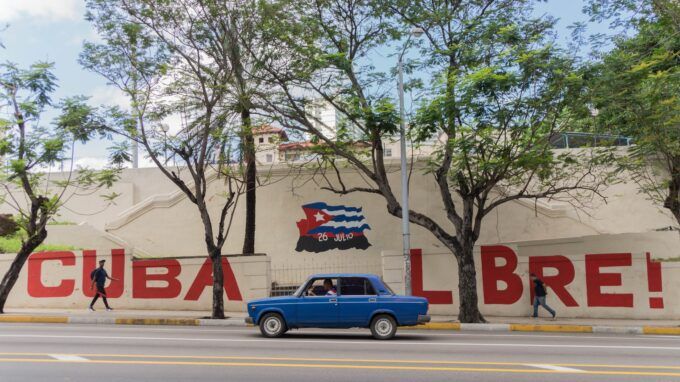
Cuba’s Victory at the UN

W.T. Whitney Jr.


Photo by Yerson Olivares

For the thirtieth consecutive year nations of the world have voted overwhelmingly to approve a Cuban resolution calling for an end to the U.S. economic blockade. The most recent vote, on November 3, had 185 nations favoring the resolution, the United States and Israel opposing, and Ukraine and Brazil not voting.

Cuba has withstood the blockade for 60 years, a duration equal to one-fourth of the years of U.S. national existence.  Cuba has lacked the resources and powerful allies that would have been necessary to force the U.S. government to backtrack.

Cuba has relied on ideals, high principles, and supportive consensus, as epitomized by the yearly votes in the General Assembly. These majorities have attested to the blockade’s cruelty, immorality, unfairness, and illegality under international law. An opportunistic and powerful U.S. ruling class does not budge.

The U.S. blockade won’t end soon because the Helms Burton Law of 1996 put that decision into the hands of Congress, where U.S. policy on Cuba is on automatic pilot.  The blockade might disappear if outcomes envisioned by U.S. State Department official Lester Mallory in April 1960 have their intended effect. The U.S. government regards the blockade as a tool for achieving “economic dissatisfaction and hardship,” “hunger,” “desperation,” and “overthrow of government.”

All but the last of these policy goals are being realized. What follows here is a look at U.S. methods, testimony from Cuba, and evidence provided by the Cuban president that corruption is accentuating. Pervasive corruption, assumed to be the product of desperation and destabilization, may signal that crisis is at hand in Cuba.

Disruption

At a press conference on October 19, Cuban foreign minister Bruno  Rodríguez explained operational aspects of the blockade leading to the Mallory results. He noted that Cuba had suffered the loss between August 2021 and February 2022 of $3.8 billion, which “is a historical record for such a short time.”  Losses over six decades amount to $154 billion. With inflation, that’s $1.39 trillion.

The U.S. government designates Cuba as a terrorist-sponsoring nation. That means foreign companies and financial institutions face severe U. S. penalties if they handle dollars in transactions with Cuba. Dollars are the principal currency used in international monetary transactions. As a result, Cuba’s income from exports is reduced and international loans are largely unavailable.

Without much money to pay for imports, Cuba experiences shortages of food, spare parts, raw materials for drug manufacture, and all kinds of supplies and equipment. Rodríguez mentioned long lines and “anxiety among the population.” The blockade affects “every Cuban family” and the government cannot “guarantee medicines that an ill person requires.”

“Cuba can in no way … buy technologies, equipment, spare parts, digital technologies or software containing more than 10 per cent US components.” Other difficulties aggravate adverse blockade effects, among them: inflation, hurricane damage, lingering effects of the Covid-19 pandemic, and fire recently at oil storage facilities in Matanzas that decimated fuel reserves.

Blockade restrictions “gravely hinder our fuel purchases by making them … [up to] 50 percent more expensive.” Electrical power generation “is going through an extremely serious situation” because of unavailable replacement parts. Blackouts bedevil Cubans every day and restoration of electrical power in hurricane-damaged Pinar del Rio has been slow.

First hand report

Richard Grassl, friend and political colleague, visited Cuba recently with his wife, who is Cuban. He recalls conversations touching on shortages, distress, and uncertainty as to who or what is responsible.

10/16      Talked to first cousin of wife …  He told me I will learn the real Cuba this time.  He says not to believe what the Cuban government says about the US blockade.  There are many lies.  My wife’s nephew says the economy is “nothing. Many Cubans think the blockade [itself] is secondary to issues of daily living like [shortages of] food, medicine, water and lack of opportunity because there is no money.

10/17     I asked him from where most food for Cubans comes from and about food imports.  He said most food comes from Miami.  [President] Diaz-Canel gets some blame for the situation.

10/18    There is not much social distancing as the times are urgent.  Food, consumer goods, fuel, construction materials are very expensive.  Eggs are $8USD / dozen.  The exchange rate is 80 CUP / USD which is 4x higher than before Covid-19.   No one talks about the blockade.  The problem is scarcity of money.

10/19     I talked with a friend.  He says the US has so much and we have so little.  He asks why cannot there be trade?  …  At several bodegas and public markets, many people, perhaps hundreds, waited all day for cooking oil, rice, beans, chicken etc. at prices subsidized by government.

10/20     I talked to another cousin from Matanzas who said the economy is “on the floor”.  It is very hard with little money.  A round trip from Matanzas to Havana (500 km) was $500 CUP/person one way or $2000 round trip for both persons by bus.

Corruption and blockade

Former Cuban President Fidel Castro delivered a wide-ranging speech on November 17, 2005 notable for highlighting corruption: “This country can self-destruct; this Revolution can destroy itself, but they can never destroy us; we can destroy ourselves, and it would be our fault.”

Similarly, President Miguel Díaz-Canel on October 26 convoked a meeting of Cuba’s Council of Ministers at which a plan was unveiled with “more than 40 directives aimed at confronting crime, corruption, and lack of social discipline.” The report appearing on the presidential website characterized the President’s remarks as “a forthright analysis of illegalities, stealing and price-gouging imposed on a population with no economic means.”

Both earlier and now, the toxic mixture of shortages of goods and money has led to stealing and lawlessness. It’s a destabilizing process entirely consistent with how the blockade was supposed to operate. President Díaz-Canel’s words are useful here for documenting the existence and reach of corruption.

He explained to the Council that, “neither the Party or the government can remain on the sidelines of what’s happening in society.” Therefore, “we must not allow those who neither work nor contribute, and are beyond the law, to acquire more and have more possibilities for life than do those who actually contribute. We have it backwards now and are breaking with the ideas of socialism.”

Díaz-Canel pointed out that, “Many of these things are the result of us not attending to the powers and responsibilities assigned to our institutions.” [Corrupt activities] “take place in full view of the Party centers, the administrative institutions, and leadership bodies.”

The President asserted that anyone able to work who is not doing so is not so vulnerable as to require “welfare assistance.” In fact, “the building of socialism does not depend upon a welfare system. What we have to seek out, instead, is social transformation.”

Díaz-Canel observed that, “We don’t do away with taxes here so that the rich get richer and poorer people have less. Here, we do have taxes so that those who have more give something up so that those who have less are better off.”  “That’s socialism,” he explained.

While celebrating another Cuban victory in the UN General Assembly, supporters of revolutionary Cuba, we think, ought to recognize that

the survival of Cuba’s government is now at unprecedented risk, thanks to the U.S. blockade. U.S. supporters of Cuba’s revolutionary project would do well to elevate actions of resistance against their own government to a new level, with new intensity. That’s because realities in Cuba appear to have altered, ominously so.

Already new mobilization may be underway. In the days prior to the General Assembly’s vote on November 3, dozens of rallies for ending the blockade took place in cities and towns throughout the United States (two of them in Maine, the author’s home state), with particularly big ones in Los Angeles, Portland Oregon; and New York. There, an impressive march took place between Times Square and the United Nations Plaza.