18 Nov 2022

As fallout from crypto collapse spreads, concerns grow over financial stability

Nick Beams


Further cracks are opening in the global financial system, both in expected and unexpected places, amid continued warnings about its overall stability.

In the crypto world, the collapse of the currency trader FTX has sent out shock waves with a number of companies on the skids because of their exposure to Sam Bankman-Fried’s essentially Ponzi scheme operation, the viability of which depended on the continual inflow of money.

The FTX Arena, of the collapsed crypto currency trading firm, and venue of the Miami Heat basketball team, Friday, Nov. 11. [AP Photo/Marta Lavandier]

On Wednesday, the crypto broker Genesis Trading announced it was halting trading at its lending unit, blaming the “unprecedented market turmoil” set off by the demise of FTX.

It said it had decided to suspend redemptions and halt new loan applications because of “abnormal withdrawal requests which have exceeded our current liquidity.” In other words, there was a run on the company it was unable to meet.

Genesis had already been hard hit because it was heavily connected to the Singapore-based crypto hedge fund company Three Arrows Capital, which filed for bankruptcy in July. It has been revealed that Genesis lent Three Arrows $2.4 billion that is now probably lost.

Crypto firms BlockFi and Voyager Digital are also reported to be under pressure. According to a report in the Wall Street Journal, BlockFi, which said it has “significant exposure” to FTX, is preparing to file for bankruptcy.

Bloomberg reported that Voyager was now “twisting in the wind” because Bankman-Fried was going to rescue it in a $1.4 billion deal, and it is now trying to find a replacement buyer for its assets.

The full extent of the fallout from the collapse of FTX has yet to be determined, but there are certain to be other firms that will go under because of the extent of Bankman-Fried’s operations.

The crypto crisis has its own peculiarities and, to borrow from Tolstoy’s famous quote regarding families, each crypto firm is “unhappy in its own way.” But whatever the circumstance of each firm, there is an underlying cause.

While money was pouring into the financial system from the US Federal Reserve and other central banks, the crypto families were “happy in the same way” as money was made hand over fist.

But the financial environment has completely changed because of the tight monetary policies of the world’s central banks as they seek to crush the global wages movement of the working class in response to the highest inflation in four decades.

The problems that have erupted in the crypto world are developing in all areas of the financial system as set out in the financial stability reports of the world’s major central banks—the latest being that of the European Central Bank issued on Wednesday.

Summarising the report, the Financial Times said it warned that the “toxic combination of recession, soaring inflation, rising funding costs and lower liquidity is threatening to trigger financial market turmoil in the euro area.”

The report noted that the turmoil in the long-term UK bond market (gilts), when the movement in yields occurred at a historically unprecedented pace, revealed the vulnerability to sharp shifts in market prices that could spark a broader crisis.

The inherent instability in financial markets was set out as follows:

“Uncertainty around the outlook for inflation and interest rates has heightened the risk of disorderly asset price adjustments in financial markets, notwithstanding recent corrections. Many investment funds remain heavily exposed to further valuation and credit losses. Those with large structural mismatches and low cash buffer are particularly vulnerable to market dislocation and the outflow of funding.”

It is not only the major financial firms that are facing problems but governments as well.

The ECB reported that prolonged high budget deficits in a number of countries, together with rising funding costs, because of interest rate rises, “may not only limit the fiscal space available to shelter the economy from future shocks, but may also put debt dynamics on a less favourable trajectory, especially in countries with higher levels of debt.”

The meaning of these words was spelled out by ECB Vice President Luis de Guindos in presenting the report. He said government measures to deal with the energy crisis and its devastating impact on the population had to be targeted and temporary.

“It cannot be the same ‘whatever its takes’ fiscal policy approach that we have seen during the pandemic,” he said.

Like the events in Britain, when former Prime Minister Liz Truss’ mini budget set off a financial crisis, an incident in South Korea illustrates the inherent fragility of the financial system.

South Korean bond markets have been plunged into turmoil because the newly elected right-wing governor of the Gangwon province, Kim Jin-tae, refused to honour debt commitments incurred in the building of a Legoland Korea theme park.

The theme park, which opened on May 5, was intended to boost the depressed economy of the province but failed to generate sufficient revenue to pay the debt used to construct it. On September 28, Kim announced he would not honour the commitment made by the previous province administration.

The South Korean bond market, the total value of which is more than $2 trillion and already under stress because of the interest rates emanating from the US, was thrown into turmoil. As an article in Foreign Policy put it, “Kim’s declaration all but threw a match” into what was a “dry winter forest.”

The withdrawal of support for a supposed government-backed project cast a dark shadow over the riskier corporate bond market.

It noted that one of the safest bonds in South Korea, that issued by the Korea Electric Power Corp, saw the yield on its three-year debt climb from around 2.2 percent at the start of the year to 5.8 percent and its latest issuance, worth about $146 million, could not find a buyer.

In response to the turmoil the government and financial authorities have had to intervene. The government has provided a liquidity facility of more than 50 trillion won, equivalent to $35 billion.

The Bank of Korea has injected the equivalent of $67 billion into the short-term bond market, and South Korea’s five largest banks have stepped in to pledge $67 billion in liquidity.

As the Foreign Policy report noted, there is an “absurdist” quality to these measures.

On the one hand, following the interest rate hikes initiated by the US Fed, the Bank of Korea has been “aggressively raising the benchmark rate to curb inflation by reducing liquidity, but on the other hand, the South Korean government is injecting liquidity to the market to stave off a total economic collapse.”

The old saying “those whom the gods would destroy they must first make mad” comes to mind.

Drawing a parallel with the UK crisis, which saw the demise of Liz Truss, and the crisis sparked by the actions of Kim, it concluded that “electing bad politicians leads to a bad economy.”

That may well be the case. But the deeper meaning of both events is that, as in the case of war, where even seemingly minor incidents can spark a full-scale military conflict, such is the brittle nature of the financial system everywhere that what might be viewed as accidents can trigger a major crisis.

17 Nov 2022

This is Where Bankrupt FTX’s Money Went

Pam Martens & Russ Martens


FTX’s penthouse in the Bahamas.

The executives running the bankrupt crypto exchange, FTX, may have broken speed records for how fast they could spend other people’s money. They just weren’t any good at managing it on behalf of their investors or safeguarding it for their crypto exchange customers.

Sam Bankman-Fried, CEO of FTX, lived in a 12,000 square foot, five-bedroom luxury penthouse overlooking the Atlantic Ocean in a prestigious resort in the Bahamas, which was put up for sale for $39.5 million the same day FTX filed for bankruptcy, according to reporting at the U.K. news outlet, The Guardian. The Block reports that an FTX-related entity called FTX Property Holdings “spent $74,230,193 on property in the Bahamas over 2022. The bulk of that money, $67,440,193.99, went to entities surrounding Albany Bahamas, a luxury condo resort in New Providence.”

According to data at the Federal Election Commission, Bankman-Fried sluiced $36 million on the campaign coffers of Democrats during the latest campaign cycle. Ryan Salame, the Co-CEO of FTX Digital Markets, the Bahamian subsidiary of FTX, dumped $23 million into the campaign coffers of Republicans and a Super PAC he created to support them, American Dream Federal Action.

Salame has also been on a buying spree in Lenox, Massachusetts, spending more than $5 million on restaurants and commercial buildings. Salame was operating the restaurants under the brand name of Lenox Eats, but that website appears to have been disabled in recent days. Fortunately, we located a web cache which provides details on Salame’s buying binge in Lenox. (Salame grew up in nearby Sandisfield, Massachusetts.)

Making the financial shenanigans at FTX that brought on its downfall all the more curious, Salame’s official bio states that he holds a CPA and “a Masters in Finance from Georgetown University,” and that he “worked for Ernst & Young, one of the largest and most respected global accounting firms.”

Another $20 million outflow from FTX went into an ad and marketing campaign with celebrity endorsers Tom Brady, the football icon, and his then wife, model Gisele Bündchen. (See video of one such ad below.)

Then there was the $135 million that went to grab the naming rights to the stadium where the Miami Heat play, which was renamed the FTX Arena. Millions more went to secure endorsements from other sports celebrities, including Shaquille O’Neal; Trevor Lawrence; David Ortiz and Udonis Haslem.

Millions of dollars also went to pay the hefty legal fees charged by one of Wall Street’s go-to law firms, Sullivan & Cromwell. As we reported on Sunday, Sullivan & Cromwell was involved in crypto acquisitions made by FTX and its sister companies, which also cost tens of millions of dollars.

According to OpenSecrets.org, FTX.US spent $690,000 between 2021 and 2022 on more than a dozen lobbyists hired to lobby members of Congress. Lobbying firms hired included Conaway Graves Group, Empire Consulting, Rich Feuer Anderson, and T Cap Solutions.

There have also been media reports, which Wall Street On Parade has not been able to independently verify, that Bankman-Fried (or FTX) owned a Gulfstream G450. According to Aircraft Bluebook’s 2022 data, a used Gulfstream G450 costs between $9 million for a 2005 model and $21.5 million for a 2017 model. The G450 is no longer manufactured.

If you add in FTX staff salaries and bonuses, along with pilots, housekeepers and expense accounts, it’s not difficult to see how FTX blew through its investors $1.8 billion and then moved on to its customers’ funds.

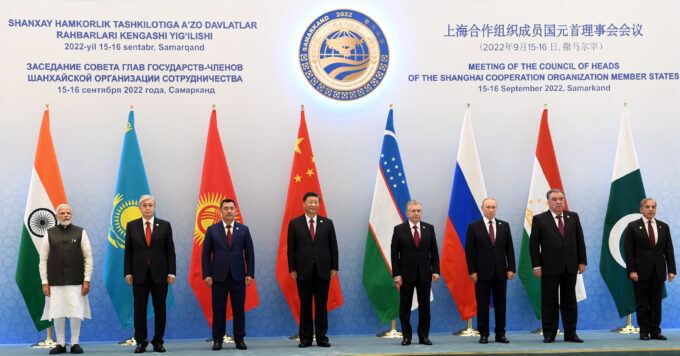
Chinese Geopolitical Inroads Into Central Asia Are Coming at Russia’s Expense

John P. Ruehl


Photograph Source: Prime Minister’s Office – GODL-India

At the recent Commonwealth for Independent States (CIS) summit held on October 14 in Astana, Kazakhstan, Tajik President Emomali Rahmon expressed previously inconceivable remarks. His public admonishment of Russian President Vladimir Putin to treat Central Asian states with more respect showed the growing confidence of Central Asian leaders amid Russia’s embroilment in Ukraine and China’s expanding regional influence.

After coming under Russian imperial rule in the 18th and 19th centuries, five Central Asian states—Kazakhstan, Kyrgyzstan, Tajikistan, Turkmenistan, and Uzbekistan—emerged independent from the Soviet Union in 1991.

While these countries remained heavily dependent on Russia for security, economic, and diplomatic support, China saw an opportunity in their vast resources and potential to facilitate trade across Eurasia. Chinese-backed development and commerce increased after the Soviet collapse and expanded further after the launch of China’s Belt and Road Initiative (BRI) in 2013.

Billions of dollars in investment, access to Chinese goods, and opening up China’s enormous consumer market allowed Beijing to restructure Central Asian economies. Soviet-era gas pipeline networks, for example, traditionally forced much of the region’s natural resources to flow through Russia to access the European market. The Central Asia-China pipeline and Kazakhstan-China oil pipeline are just some of the newer pipelines built to transport resources to the Chinese market instead.

These developments have added to friction between Central Asian states and Russia. Disputes between Turkmenistan and Russia over gas prices and a mysterious pipeline explosion in 2009 saw Russian gas imports from Turkmenistan decline until they halted completely in 2016, upending Turkmenistan’s access to Europe. Turkmenistan redirected much of its supply to China for the next three years, before a rapprochement with Moscow in 2019 saw imports to Russia resume.

This affair demonstrated the economic opportunities China could provide to Central Asian states that were previously dependent on Russia. Competing Chinese and Russian attempts to supply Central Asia with COVID-19 vaccines was another demonstration of Beijing’s multifaceted approach to increasing its regional influence.

Sensing the inevitability of Chinese investment in revolutionizing regional economies, the Kremlin announced the “Greater Eurasian Partnership” in 2015. This partnership attempted to integrate the Russian-led Eurasian Economic Union (EAEU), which Kazakhstan and Kyrgyzstan are members of, with the BRI. Though this partnership has only been partially successful, Putin has sought to use Chinese investment to help develop Russia’s Far East.

Russia’s connections to the remaining Soviet political networks and military power in the region have allowed Moscow to contend with China’s growing economic edge in Central Asia over the last two decades. But the increasing international pressure on Russia following its invasion of Ukraine has suddenly upset the traditional “division of labor” between Russia and China in Central Asia. Though still a vital partner to Central Asian states, Russia risks losing greater economic and security ground to China in the coming years.

After cross-border trade between the EU and Russia and Belarus was reduced following Russia’s invasion of Ukraine, for example, China placed renewed focus on developing the Trans-Caspian International Transport Route (TITR), or “Middle Corridor,” of the BRI. Instead of Chinese trade flowing from Russia into Europe, it is increasingly being transported through Central Asia, the Caucasus, and Turkey. The newly built Baku-Tbilisi-Kars (BTK) railway, as well as other projects like the China-Kazakhstan-Uzbekistan (CKU) railway, will further erode Russia’s importance to the BRI.

On September 14, 2022, Chinese President Xi Jinping traveled to Kazakhstan on his first foreign trip since the pandemic began. His destination was symbolic—the BRI was first announced by Xi in Kazakhstan in 2013, and the country has fashioned itself as the “buckle” of the project.

Alongside signing economic deals during his visit in September, Xi vowed to back Kazakhstan “in the defense of its independence, sovereignty and territorial integrity.” This contrasts with Russian political figures who have questioned the validity of Kazakhstan’s statehood in the past, including Putin. Xi then traveled to Uzbekistan to attend the Shanghai Cooperation Organization (SCO) summit on September 15 and 16 and signed deals worth $16 billion with Uzbekistan, dwarfing the $4.6 billion signed between Uzbekistan and Russia.

China’s auto industry has also increased its manufacturing presence and share of the market in Central Asia in 2022, as sanctions have hindered Russia’s production capabilities.

China’s growing military presence in Central Asia has similarly been a major concern for the Kremlin. Over the last decade, China has rapidly increased its arms exports to the region. And though China has conducted bilateral military exercises in Central Asia since 2002 in coordination with the SCO, in 2016 China held its first antiterrorism exercises with Tajikistan, and held the “Cooperation 2019” exercises with Tajikistan, Kyrgyzstan, and Uzbekistan, “marking the first time their national guard units had trained with China on counterterrorism.”

In 2021, Tajikistan also approved the construction of a Chinese-funded military base in the country near its border with Afghanistan—though China’s focus on Tajikistan is “linked more to Afghanistan than to Central Asia as a whole.” However, the use of Chinese private military and security companies (PMSCs) in Africa and the Middle East has also led to concern in Moscow that China’s PMSCs may expand further across Central Asia.

Moscow’s strained military situation became evident in September, when Tajikistan and Kyrgyzstan, both members of the Russian-led Collective Security Treaty Organization (CSTO) military alliance, engaged in deadly border clashes. While Russia and the CSTO were unable to calm hostilities, the leaders of Tajikistan and Kyrgyzstan met on the sidelines of the SCO summit on September 16 to cool tensions.

Nonetheless, several factors inhibit China from eclipsing Russia’s geopolitical influence in Central Asia. Beijing has typically been hesitant to commit military forces abroad and continues to see the Russian military as an asset against instability in the region. The Russian-led CSTO intervention in Kazakhstan in January 2022 showed the Kremlin was capable of stabilizing vulnerable national governments facing social unrest in the region, as well as cementing their authority and international legitimacy.

Russia also operates a military base in Tajikistan, while Kyrgyzstan hosts a Russian military air base. Kazakhstan’s large ethnic Russian minority, meanwhile, holds local economic and political power, and the Kazakh government remains fearful of a Russian military intervention ostensibly to protect them.

Additionally, Russia retains some economic leverage over Central Asian states. Russia conducts billions of dollars worth of trade with them annually and maintains several Soviet legacy projects that have bound Central Asia to it, such as common gas and oil pipelines, waterways, railway networks, and electricity grids. Central Asian states also have some of the largest annual remittance rates in the world, with the remittances from Russia to Kyrgyzstan and Tajikistan accounting for roughly 30 percent of their gross domestic product in 2021.

The Kremlin also has the ability to shape local perceptions of Russia through its dominant media and social media channels in Central Asia. But positive public opinion toward China across the region steadily declined between 2017 and 2021 for a variety of reasons, especially in Kazakhstan, Kyrgyzstan, and Uzbekistan. Many Central Asians are concerned over China’s “debt-trap diplomacy,” while large numbers of Chinese workers brought in to develop BRI projects in the region have resulted in deadly protests and clashes with locals.

Competition between China and Central Asian states over scarce regional water supplies, as well as China’s treatment of Uyghurs in Xinjiang, a Turkic-speaking, largely Muslim ethnic group, who “see themselves as culturally and ethnically close to Central Asian nations,” have also damaged China’s ties in the region.

Evidently, China’s own obstacles and Russia’s lingering presence in the region have helped sustain the geopolitical balance in Central Asia. But mutual pledges by China and Russia to respect one another’s core interests, most recently repeated in June 2022, have contributed the most to preventing greater agitation in the region. While Beijing and Moscow are destined to compete in Central Asia, careful diplomacy will likely prolong their cautious cooperation.

Ultimately, China remains more concerned with Taiwan, the South China Sea, and the broader Asia Pacific region, while Russia is more preoccupied in its eastern and southern regions, most notably Ukraine.

Russia has so far borne the brunt of U.S.-led efforts to contain their foreign policies. But the launch of the U.S.-China trade war in 2018 under former U.S. President Donald Trump marked a serious turn in the U.S.-Chinese relationship, which has continued under President Joe Biden. The Biden administration (as well as the EU) has criticized and sanctioned China over its policies in Xinjiang, and most recently imposed significant technology export controls on China on October 7.

Heightened tensions with the West will draw China and Russia closer together. While Central Asia is where their interests collide the most, Beijing and Moscow will continue to avoid conflict there to focus on pushing back against Western power elsewhere in the world.

UK schools face devastating funding crisis

Margot Miller & Liz Smith


Schools in the UK are facing an unprecedented funding crisis, threatening staff redundancies, larger class sizes, restrictions to the curriculum and the elimination of support services.

This is even before the Conservative government spells out in detail its budget on November 17, said to include £40 billion worth of cuts across all government departments.

A reception class teacher, (left) leads the class at the Holy Family Catholic Primary School in Greenwich, London, Monday, May 24, 2021. [AP Photo/Alastair Grant]

A recent snapshot survey by the National Association of Headteachers (NAHT) of 11,000 heads and school leaders in England revealed half are considering teacher redundancies or cutting school hours to balance the school budget. Nine out of 10 schools expect to run out of money even before the next tranche of cuts arrive. Some 66 percent anticipate losing teaching assistants.

Many respondents declared they would have to reduce learning support for individual pupils, including counselling for mental health problems, as well as axing school trips.

A survey of 670 out of 1,500 schools by the NAHT Cymru returned similar responses, with 60 percent saying they would have to reduce the number of teachers or staff hours. They are also considering cuts to building maintenance and school equipment and using school reserves to balance the books.

Powys council in Wales sent a briefing to schools with cost saving suggestions such as wearing coats to save on energy bills or teaching remotely one day a week.

In Yorkshire, more than half the schools are in deficit according to NAHT data. Headteacher at Molescroft Primary School, Beverley, told the BBC, “I can’t cure that amount of deficit without cutting staff.”

Chief executive of the Education Alliance group of seven schools Jonny Uttley said, “I’d love to be able to provide far more free school meals, far more breakfast clubs and after-school clubs but the money isn’t there to do that and we are having to make some really tough decisions.”

He explained there was a 20 percent uptake in pupils attending breakfast clubs. UK child poverty rose to 4.3 million this year, forecast to reach 33 percent by 2026-27. Families increasingly choose between heating and eating, with many parents skipping meals to feed their children. School breakfast clubs are a lifeline.

The Rev Steve Chalke, whose Oasis foundation runs 52 academies in England, told the Guardian, “At this burn rate, in under three years we will be bankrupt. No one is in a position to keep going for very long eating their reserves.”

Electricity and gas expenditure for his chain of schools soared from £26,000 a year to £89,000, despite the six-month energy price cap introduced by the government. “Any government that neglects the welfare and education of its children had better be saving up for its future mental health and benefits bills…”

Garry Ratcliffe, CEO of the Galaxy Trust schools, reported spending more on mental health support for children. The schools support families with advice on how to claim benefits or challenge rent rises, as well as providing food parcels.

The biggest expenditure for schools is wages. Schools are expected to self-finance a massively below inflation 5 percent teachers’ pay deal and cope with rising costs across the board.

In a comment shared thousands of times, the head of a London school tweeted November 5, “Been Head of a school of 1000 children for 3 years. The entire time has been spent cutting costs. Gone from 8 Senior Leaders down to 1. Cut several teaching staff. Total cuts of £1 million. It is still not enough and deficit budget beckons...”

If heads are contemplating laying off teaching staff, pastoral care in schools will be wiped out. Staff employed in these essential roles will be the first to go.

Pastoral care has been embedded in inner city schools with an impoverished intake for over two decades. The number of children entitled to free school meals was the initial criteria for extra funding, but it developed in all schools depending on levels of social and emotional need.

From 2004, schools were given—under the Children Act—joint responsibility with social services for child protection. Safeguarding measures were put in place to ensure levels of safety both in and out of school for more at risk pupils and the whole school.

There was a recognition that paraprofessionals were required to assist schools to tackle pressing social needs particularly for more vulnerable children and families. Some schools employ social workers, learning mentors, and school family liaison officers. Feeding and clothing are key issues, as well as help to access benefits and resources needed to learn.

Depending on the ethos of the school, pastoral care takes different forms. Schools may provide breakfast, lunchtime or after school clubs.

A spokesperson for the Department for Education dismissed head teachers’ concerns with the perfunctory response, “We understand that schools are facing cost pressures which is why we are providing them with £53.8 billion [secondary schools] this year in core funding, including a cash increase of £4 billion for this financial year.”

The extra £4 billion this year goes nowhere near what is needed to offset the consequences of soaring inflation. On Thursday, even the lowest measure of inflation (CPI) hit a 41-year high—rising to 11.1 percent from 10.1 percent the previous month. RPI inflation shot up to 14.2 percent.

In early October, 12 organisations, led by the largest teaching unions, sent an open letter to the government warning that a “cut in funding will be catastrophic”: These were the National Education Union (NEU); National Association of Schoolmasters Union of Women Teachers (NASUWT); Association of Colleges; Association of School and College Leaders (ASCL); Community Union; GMB Union, National Association of Head Teachers (NAHT); National Governance Association; Parentkind; Sixth Form Colleges Association; UNISON and Unite the Union.

On November 8, the Stop Schools Cuts website was relaunched in anticipation of the forthcoming budget. Stop School Cuts is run by the National Education Union, the largest education union in Europe, supported by the ASCL, National Association of Head Teachers and Parentkind. 

The website reveals:

“Of 20,094 schools with comparable data 18,060 (90%) had lower per pupil funding in real terms in 2023-24 than in 2022-23, and 12,952 (68%) had lower per pupil funding in real terms than in 2015-16.

Real terms per pupil funding… will be cut on average from £6,028 in 2022-23 to £5,881 in 2023-24... equivalent to a cut in school spending power of £1 bn or 2.4%. 

Even before the upcoming cuts, real terms per-pupil funding remains lower than it was in 2015-16…

Schools that have been historically under-funded face the largest cuts in 2023-24.”

Three demands are addressed in the open letter to Prime Minister Rishi Sunak; to reverse the cuts facing schools, fully fund the pay awards and restore real terms per-pupil funding to 2010 levels. All will fall on the deaf ears of a Department of Education that employs “school resource management advisers” to identify “savings” in schools.

Organisations which will not even fight for the health and safety of their members during an ongoing pandemic, or even for minimal mitigation measures, will not fight the cuts. The unions have overseen decades of cuts to education.

Alongside the Labour Party—which functioned in a de facto coalition with the Tories at the height of the pandemic—the education unions played a crucial role in the precipitous reopening of schools after lockdowns. As COVID was not suppressed this enabled the virus to mutate and run riot and claim further tens of thousands of victims, including educators and children.

Opposed to mobilising a joint offensive against funding cuts, attacks on teachers’ pensions and pay, the unions dissipate their members’ growing anger. The NEU is balloting 300,000 teachers and support staff members in England and Wales for strike action over pay. The ballot will not close for another two months on January 13. This delay is even though last month, in an indicative ballot by the NEU, 86 percent of teacher members already backed strikes for fully funded, above-inflation pay rise.

Republican Party wins control of the US House of Representatives

Patrick Martin


The Republican Party has won control of the US House of Representatives, according to projections by the Associated Press and the television networks early Wednesday evening. Republican candidates had won 218 seats, the exact number required for a majority. The Democrats won 211 seats, with six seats still too close to call, according to various tallies of the district-by-district results.

The six seats still undecided include three held by Republicans and three held by Democrats before the election. In each district, the party which had held the seat was in the lead in the vote counting. This led to widespread media forecasts that the ultimate division in the House would be 221-214, compared to the 222-213 majority held by the Democrats before the election.

The result is a divided legislature with historically narrow majorities: The Senate controlled by the Democratic Party 50-49, with one seat awaiting a runoff in Georgia on December 6; and the House controlled by the Republican Party, likely by a seven-seat majority. There has not been a smaller majority in the House since 1848, before the Republican Party came into existence.

Under the rules of the House, however, a narrow majority can pass any bill on which it is united. There is no filibuster rule, although for the bill to become law, it must pass the Senate and be signed by the president.

The House majority, no matter how small its margin, has full authority on such matters as investigations. One of the first actions of the new Republican-controlled House will be to shut down the House Select Committee investigating the January 6, 2021 attack on the Capitol and rescind all its subpoenas for documents and testimony.

This is likely to be followed by investigations aimed at the Biden administration, such as a probe of the collapse of the US puppet regime in Afghanistan, and at Biden personally, with the business dealings of his son Hunter a major target.

Despite the likelihood of such embarrassments, however, Biden immediately congratulated Republican leader Kevin McCarthy. An official message, which was sent from the White House within minutes of the media “call” that the Republicans would take a majority in the House, declared that the Democratic president is “ready to work with House Republicans to deliver results for working families.”

House Minority Leader Kevin McCarthy (Republican-California) speaks to reporters at the Capitol in Washington on March 18, 2022. [AP Photo/Scott Applewhite]

“Last week’s elections demonstrated the strength and resilience of American democracy. There was a strong rejection of election deniers, political violence and intimidation,” Biden continued. “There was an emphatic statement that, in America, the will of the people prevails … the future is too promising to be trapped in political warfare.”

Actually, while the American people reject Trump’s lies about a “stolen election,” the majority of House Republicans do not: They voted not to certify Biden’s own victory in the Electoral College, even after the fascist mob attack on Congress.

Biden concluded with a further appeal for bipartisan collaboration. “The American people want us to get things done for them. They want us to focus on the issues that matter to them and on making their lives better. And I will work with anyone—Republican or Democrat—willing to work with me to deliver results for them.”

This is more than just political boilerplate. Biden is counting on the Republicans to support his right-wing foreign policy, particularly in relation to the US-NATO war against Russia in Ukraine and the aggressive posture of American imperialism toward China, North Korea and Iran.

On domestic policy, a Republican majority in the House will become an all-purpose excuse for the Biden administration abandoning even the threadbare pretense of social reform that occupied much of its first two years in office. During that time, Biden had to rely on two right-wing Senate Democrats, Joe Manchin of West Virginia and Kyrsten Sinema of Arizona, to block measures on spending, expanding voting rights and reforming the filibuster rule.

There is little doubt that Biden and the Democratic congressional leadership also welcome the impending scrapping of the House Select Committee investigation into January 6, well before it has addressed such critical questions as the role of the military and the intelligence agencies in Trump’s attempted coup. These institutions must be preserved and strengthened as part of the war drive against Russia and China.

The Republican gain falls far short of pre-election projections by officials of both parties, as well as the corporate media. Republican leader Kevin McCarthy will have an even narrower majority than the 222-213 margin enjoyed by Democratic House Speaker Nancy Pelosi.

McCarthy was reelected as the House Republican leader Tuesday by a margin of 188-31, easily turning back a challenge from ultra-right Arizona Representative Andy Biggs. But given the Republican majority of a handful of seats, it is not certain that McCarthy will be elected as the next House speaker, since this will require 218 votes. A few defections or abstentions by ultra-right Republican members could block his election and force the Republican caucus to choose a different candidate for speaker.

One key outcome of the elections for the House has been determined: The Republican Party will maintain its majority of state delegations, which could become critical in the event of a deadlocked presidential election in 2024.

If no candidate wins a majority in the Electoral College, the presidential election goes to the House of Representatives, with each state delegation having one vote. This constitutional provision has not been invoked since 1824, but it was cited repeatedly by Trump’s co-conspirators leading up to the January 6, 2021 attack on the Capitol.

Several of Trump’s legal advisers claimed that Vice President Mike Pence could block the certification of the electoral votes won by Biden in Pennsylvania, Arizona, Georgia and other states, and thus reduce Biden’s total from the 306 he actually won to below the 270 required for a majority in the Electoral College. This would throw the election into the House of Representatives, where the Republican Party had a majority in 28 delegations and the Democrats 21, with one state delegation tied.

The balance in five state delegations shifted as a result of the 2022 vote, but the Republican Party still retains a majority, controlling 26 delegations, the Democrats 22, with two delegations tied.

Several election analysts have noted that the swing from Democratic control to Republican control can be explained entirely from the four-vote swing in the congressional delegation from New York state. Republicans won two Democratic-held seats on Long Island and two in the Hudson Valley. All four districts were carried by supposedly “moderate” Republicans, who did not enlist in the Trump-led “stop the steal” campaign calling for the overturning of the 2020 presidential vote.

The decisive factors in the Democratic Party debacle—in one of the most heavily Democratic states in the country—include the #MeToo campaign that forced the resignation of Governor Andrew Cuomo and the complete prostration of the Democrats before the law-and-order campaign waged by Republican gubernatorial candidate Lee Zeldin and echoed by Republican congressional candidates.

Cuomo, who had won three elections for governor by large margins, was ousted after a vitriolic media campaign over alleged sexual misconduct that produced no significant evidence of criminal actions. He was replaced by his largely unknown lieutenant governor Kathy Hochul, chosen to “balance” the ticket geographically because she had served one term in Congress from a Buffalo-area district, where she compiled a conservative voting record.

Hochul sought to match Zeldin in praise for the police and condemnation of efforts to abolish cash bail and investigate police killings. While winning a narrow election victory in the governor’s race, the Democratic Party lost support heavily in suburban and exurban districts, at the cost of the four congressional seats.