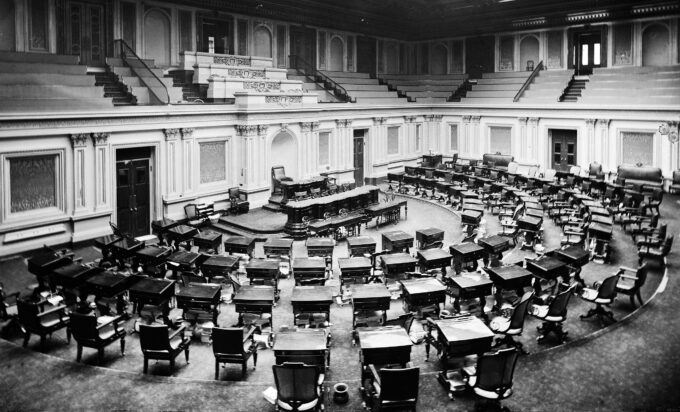
Photograph Source: Brady-Handy Photograph Collection (Library of Congress) – Public Domain
The filibuster has proved more pernicious to democracy than any other procedural rule of Congress. It’s time for it to go.
These claims may seem excessive in view of the real accomplishments of the 117th Congress, e.g., bills supporting a major upgrade of the nation’s infrastructure as well as substantive action in combating climate change. One can also note bills that expanded protections for victims of domestic abuse and sexual violence, designated lynching as a federal hate crime, and protected same-sex and interracial marriage, to name just a few.
But Congress failed to address fundamental problems afflicting American democracy, from the suppression of voting rights and workers’ rights, to the need for meaningful immigration reform. And a principal reason for its failure is the chokehold of the filibuster.
When using the term “filibuster” today, one must note that this isn’t the “talking filibuster” that director Frank Capra idealized in his 1939 film, “Mr. Smith Goes to Washington.” Nor is it the obstructionist “talking filibuster” used by Southern senators from the 1920’s through the 1940’s to block anti-lynching legislation, or to delay civil rights legislation in the 1950’s and 1960’s.
Instead, it is a Senate rule, worked out by both Democrats and Republicans in the 1970’s, that allows individual senators to block bills simply by announcing the intent to filibuster, with a 41-vote requirement to close debate. Called a “stealth,” or “silent,” filibuster, this rule simply means that the word “filibuster” is now shorthand for the requirement of a 60-vote supermajority on much critical legislation – with significant exceptions carved out for budget bills and votes on nominations, such as for Supreme Court justices.
Such a requirement has no basis in the U.S. Constitution, and it runs counter to a majoritarian philosophy espoused by such founders as James Madison and Alexander Hamilton. In recent times, it has wreaked havoc on Congress’s ability to strengthen representative democracy.
In October, 2021, the filibuster blocked passage of the Senate’s Freedom to Vote Act, which would have, among other things, made Election Day a national holiday, expanded voter registration through automatic and same-day registration, and limited the removal of voters from voting rolls. The next month, the filibuster marked for defeat the John R. Lewis Voting Rights Advancement Act, a bill that would have revitalized the 1965 Voting Rights Act, helping curtail discriminatory electoral practices. The defeat of this legislation must now be seen in the context of the plethora of bills intended to restrict voting access and promote partisan interference in voting processes – bills either passed or currently moving through many state legislatures.
The filibuster also blocked a major piece of labor reform legislation, the Protecting the Right to Organize Act (PRO Act), that would have enhanced workers’ protections from corporate interference when attempting to organize workplaces. And the stealth filibuster also made it impossible for the 590,000 recipients of DACA, young people brought here as children and raised and educated in America, to move out of the legal limbo in which they’ve been placed by judicial and political attacks.
One might object, in response to these critiques, that the filibuster offers protections to the minority. But the Senate is so constituted that power is already skewed to smaller states. If you happen to be one of the 576,851 residents of Wyoming, your two senators wield as much legislative clout as the senators representing the 39,538,223 residents of California. That’s a power ratio of almost 70 to 1.
You might ask, what minority would be protected in any case? When the U.S. Chamber of Commerce upheld the filibuster as a defense against raising the minimum wage, and against passage of labor’s PRO Act, one wonders if the issue is not so much about protecting the minority as about ensuring corporate hegemony.
It may seem quixotic to focus on the filibuster when the current House of Representatives promises little more than gridlock, if not legislative chaos. But there is perhaps no better time than now for the Senate, at least, to put its own house in order: to model a path to a more representative democracy – and to be ready when the time again comes for forward movement.
German public retirement insurance issuers generated a 2.1 billion euro surplus last year. A major contributor was the fact that an above-average number of pensioners died of COVID-19. This once again confirms the warnings of the World Socialist Web Site, which has called the official mass infection policy 'social murder.'
A woman waits for her vaccination at a vaccination Drive-in center in Cologne, Germany, Tuesday, Nov. 23, 2021. (AP Photo/Martin Meissner)
'Contrary to many expectations, the statutory pension insurance will end this year of the crisis with a remarkable plus of 2.1 billion euro,' the outgoing managing director of the Deutsche Rentenversicherung (the German public pension insurance society), Matthias Förster, said December 16 at an insurers’ meeting.
The president of the Rentenversicherung, Gundula Roßbach, spoke similarly in an interview with Deutsche Presse-Agentur (dpa) in Berlin on December 27. Just a year ago, a deficit of several billion euros had been expected, Roßbach said. As one reason for the unexpected surplus, she explicitly named 'the coronavirus pandemic, which has led to an increase in mortality, especially among older people.'
These reports quickly disappeared from news feeds. The bourgeois media raised no outcry. Journalists who commented on the news were not alarmed but delighted that the pension fund was on a solid financial footing. What went unmentioned was the extent of the grief, pain and suffering this development dealt those affected and their families.
The alarming extent of excess mortality in recent months is documented by the Federal Statistical Office on its official press portal. According to the report, in October 2022, when coronavirus mortality was particularly high, the number of deaths was 19 percent, or nearly 15,000 people, above the mean value (median) of the years 2018 to 2021.
In November, when COVID-19 cases declined slightly, the number of deaths was still seven percent, or nearly 6,000, above the median of the previous years. In the first two weeks of December, excess mortality increased again, and deaths were about 12 percent above the previous means, exacerbated by an unusually strong flu epidemic and rampant respiratory illness.
The World Socialist Web Site has reported the strikingly high excess mortality in 2022. Death rates that year averaged nine percent higher than the median for the previous four years, 2018-2021.
Officially, 162,688 coronavirus patients have died in Germany as of January 8, but the number of unreported cases is undoubtedly higher since the data is unreliable. The WHO puts the number of coronavirus deaths worldwide at just under 6.7 million, while experts give informed estimates of more than three times that number. By those estimates, more than 21 million people worldwide have died directly or indirectly from COVID-19.
The World Socialist Web Site's New Year's Statement declares:
More than 10 million children worldwide have lost a parent or primary caregiver from COVID-19. (...) A recent study on excess deaths by the World Health Organization found that COVID-19 was the third-leading cause of death globally in 2020 and the world’s leading cause of death in 2021. There were approximately 5.1 million excess deaths globally in 2022, making the “mild” Omicron variant the third-leading cause of death.
Life expectancy is falling for the first time since World War II as a result of the coronavirus pandemic. It had been rising steadily until 2019, at least in Germany, but SARS-CoV-2 has put an end to this trend. In 2020, life expectancy fell by an average of 0.2 years for men and 0.1 year for women, and in 2021 it fell another 0.4 years for men and another 0.3 years for women.
The figures vary greatly depending on the region. Accordingly, life expectancy for men in the German states of Thuringia, Saxony and Saxony-Anhalt fell by at least 1.5 years from 2019 to 2021! This is a completely unusual development for peacetime.
But it is deliberate. Even at the beginning of the coronavirus pandemic, when the government refused to protect the population with a sensible lockdown, then-Bundestag (Federal Parliament) President Wolfgang Schäuble (Christian Democratic Union, CDU) found an unmistakable formulation.
In his infamous commentary on German Basic Law, Schäuble declared, '[W]hen I hear that everything must take second place to the protection of life, then I must say: that is not correct in such an absolute sense.'
To justify opening up the economy and ruthless back-to-work policies, Schäuble argued pointedly, 'Fundamental rights are mutually limiting. If there is one absolute value in our Basic Law, then it is human dignity. It is sacrosanct. But that does not exclude us from having to die.'
Shortly before, the same Schäuble had demanded in a keynote speech on foreign policy that, in the interests of 'security,' Germany had to be prepared to intervene in Europe and around the world, and that this would include 'ultimately, the willingness to use military force.' Since then, the German government has found a welcome pretext in the Ukraine war for massively rearming the state both domestically and for foreign conflicts.
There is a direct connection between the calls for war and violence and the demand to place alleged 'dignity' above life, as the WSWS explained at the time, 'To advance its foreign and domestic interests in the deepest crisis of capitalism since the 1930s, the ruling class is again literally willing to walk over corpses.'
It was precisely the time, at the end of April 2020, when the government, together with businessmen, bankers and shareholders, sent hundreds of thousands of workers back to the factories and workplaces unprotected, despite the risk of infection. Since then, the official line has been that we must all learn to 'live with the virus.' More correct would be 'die with the virus,' because to this day it means nothing other than allowing ever new waves of infections, reinfections, and deaths, which could have been avoided, to wash over the population, harming entire generations through long-COVID.
In the meantime, many leading politicians only speak about the pandemic in the past tense. At the turn of 2022-2023, state government after state government is repealing the last protective measures. In Schleswig-Holstein, Bavaria and Saxony-Anhalt, the mask requirement in public transport has been abolished and most of the other German states plan to follow suit in the coming weeks.
At the same time, the latest, extremely easily transmitted coronavirus variant, XBB.1.5, is spreading out from the northeastern United States to Europe and the entire world. On January 7, Bavarian broadcaster BR24 quoted Bremen epidemiologist Hajo Zeeb as saying, 'One can say with some prognostic certainty that the variant will also become the dominant variant in our country.'
With the start of the new year, vaccination requirements for employees in health care facilities and homes for the elderly will also be struck. This requirement was never consistently implemented. As the Ärzte-Zeitung reports, the nearly 270,000 reported violations of this rule were offset by only 1,275 activity bans, which is not even half a percent. Just under 7,000 other violations were punished with fines while the rest went without consequences. Seven federal states stated that they had not levied a single fine.
The mendacious half-heartedness in the way such measures—vital for old people’s and nursing homes—are handled is revealing. It confirms what was evident in the disgracefully positive reaction to the unexpected surplus in the pension funds: the politicians did not decide in favor of mass infection solely because they wanted to keep the economy open at all costs in the interests of short-term profits. They also see it as an effective means of reducing the 'pensioner overhang' and relieving the government of pension subsidies long term.
Dozens of people demonstrated outside Rajaei-Shahr prison in Karaj, near Iran’s capital Tehran, on Monday in a bid to stop the executions of two young men convicted in sham trials for allegedly attacking security personnel during the now months-long wave of anti-government protests.
There were also reports of demonstrations in multiple Tehran neighborhoods last Saturday night following the execution earlier that day of two other protesters. Crowds reportedly exclaimed, “For every person killed, there are a thousand others behind him.”
Protests were also held in other Iranian cities last weekend in response to the executions. According to press reports, participants chanted “Death to Khamenei” (the ayatollah who has served as the country’s Supreme Leader since 1989), “We do not want the government that kills children,” and “Death to the Basij,” the Islamic Revolutionary Guard Corps volunteer force that has been front and centre in the repression of the anti-government protests.
Monday’s angry protests calling on the government to stop the executions followed rulings by Iran’s Supreme Court confirming death sentences for 22 year-old Mohammad Ghobadlou, who allegedly ran over several members of the security forces with his car, killing one, and 19 year-old Mohammad Boroughani, who was convicted of “moharebeh” or “waging war against God” for allegedly killing a member of the security forces with a knife.
Protesters chant slogans during a protest over the death of Mahsa Amini last September. [AP Photo/(AP) [AP Photo/AP Photo/FILE FOTOĞRAF ASSOCIATED PRESS ÇALIŞANI OLMAYAN BİR BİREY TARAFINDAN ÇEKİLMİŞ VE AP TARAFINDAN İRAN DIŞINA ÇIKARILMIŞTIR.]]
Iran’s crisis-ridden bourgeois clerical regime has branded the protests “riots” and repeatedly accused protestors of acting at the instigation of foreign governments, particularly the United States, Britain and Israel.
It has increasingly resorted to barbaric methods, including death sentences, a public execution, sham trials and torture, to terrorise the Iranian people and stomp out the mass demonstrations that erupted after the police-custody death in mid-September of a young Kurdish woman, Mahsa Amini. Its greatest fear is that under conditions of ever deepening poverty and ever widening social inequality, the working class will erupt onto the scene
The latest protests follow the execution over the weekend of two young men, Mohammad Mahdi Karami and Seyed Mohammad Hosseini, for allegedly killing a member of the Basij force in Karaj last November during the nationwide protests. Both men denied the charges and said they were tortured and denied access to their own lawyers. The UN Human Rights Office said they were victims of “unfair trials based on forced confessions.”
The US and its allies, who remain silent in the face of mass executions by their brutal ally Saudi Arabia, lost no time in excoriating the Islamic Republic.
Together with last month’s executions of two 23 year-olds, Mohsen Shekari and Majidreza Rahnavard, after similar sham trials, Saturday’s hangings bring the total number of anti-government protesters executed to date to four. At least 17 other people have been sentenced to death, according to the United Nations Human Rights Office, among them a doctor, a bodybuilding champion, a rapper and a barber, for purported crimes ranging from burning a trash can to killing security forces.
So far, at least 519 protesters and 68 security personnel have been killed in the unrest, according to the Human Rights Activists’ News Agency (HRANA). The government puts the number at just over 300 killed. HRANA says that another 19,290 protesters have been arrested, of whom 111 face charges for capital crimes.
Iranian authorities have also targeted well-known personalities, including filmmakers, lawyers, actors, athletes and activists as well as 84 journalists, for voicing their support for the protesters, jailing some and imposing severe restrictions and travel bans on others.
Among those imprisoned is Faezeh Hashemei, a former legislator and the 60 year-old daughter of Akbar Hashemi Rafsanjani, the late two-term president who long led a faction of the Islamic Republic’s Shia clerical political establishment eager for rapprochement with Washington and the European imperialist powers.
Hashemei was accused of “propaganda,” “instigating protests” and actions against public order and national security, and sentenced to five years in jail, said her lawyer, Neda Shams. She has long been an outspoken critic of Supreme Leader Ali Khamenei and the Islamic Revolutionary Guard Corps (IRGC). Last May, she called on the United States to keep the IRGC on its list of foreign terrorist organizations, prompting demands for her immediate prosecution.
The anti-government protests began in Amini’s home town, in the predominantly Kurdish northwest, under the slogan “Women, Life and Freedom,” popularized by Kurdish nationalists. But they spread rapidly across the country, particularly among the country’s youth and students, and are fueled by anger over the political privileges, social control and endemic corruption of the clerical elite, the mismanagement of the pandemic, the soaring cost of living—inflation is running at 50 percent a year—and widespread unemployment, particularly among young people. Some 50 percent of Iran’s 86 million people live below the poverty line according to the government’s own statistics. This is the outcome, on the one hand, of the punishing economic sanctions Washington has imposed against Iran with the aim of crashing its economy, and, on the other, the regime’s rolling back and elimination of the price subsidies and other social-welfare measures implemented in the wake of the 1979 revolution that toppled the bloody dictatorship of the US-backed Shah.
Teachers and some workers at major industrial facilities, including steel works in Isfahan and Persian Gulf oil refineries, have staged walkouts in conjunction with the anti-government protests, while some small traders have closed their shops and businesses in the bazaars in response to calls for anti-government “strikes.”
The protests, while not the largest the Islamic Republic has seen, have lasted longer than the wave of mass protests that rocked Iran in the days immediately preceding and following New Year 2018 and again in November 2019.
In recent years there have been myriad struggles by workers and the rural poor against privatization, the spread of precarious contract-labour jobs, the non-payment of wages, and the lack of government action in the face of a growing water-crisis in many rural areas.
However, the protests—due to the political domination within the opposition movement of more privileged layers previously aligned with the “reform” wing of the Islamic Republic’s clerical elite and/or oriented to the western imperialist powers— have articulated no social demands or programme that would appeal to the working class. The movement has consequently remained largely confined to students and other young people.
As mass participation in the protests has declined in recent weeks both because of the state repression and the lack of a viable strategy for opposing imperialism and the bourgeois nationalist regime, young people’s readiness for self-sacrifice has frequently been squandered in clashes between small groups of protesters and security forces.
Iran’s currency, the rial, has been in free fall since the protests erupted in September, plummeting from 316,700 to an all-time low of 440,000 against the US dollar at the end of December. While this has led to bitter attacks on President Ebrahim Raisi’s economic policies from his opponents within the political elite, the implications are truly catastrophic for Iranian workers, with the Faraz news site noting that Iran’s monthly minimum wage has fallen from the equivalent of US $251 in May 2017—when most sanctions had been lifted under the 2015 Iran nuclear deal—to just over $90 this month.
In this picture released by the office of the Iranian supreme leader, Supreme Leader Ayatollah Ali Khamenei speaks during a meeting in Tehran, Iran, Monday, Jan. 9, 2023. [AP Photo/Office of the Iranian Supreme Leader]
The efforts of the regime to rally support via its annual celebration of the supposed “covenant” between the Iranian people and the Islamic Republic’s Supreme Guardian, Ayatollah Khamenei, only served to further expose the erosion of its popular support. On December 30, 2009 the government staged a massive mobilization, including a so-called “million march,” against the US-backed bourgeois opposition Green movement. In subsequent years meetings and rallies have marked the occasion. This year, the state media promised that there would be huge pro-government rallies across the country on Dec. 30, but to no effect. At most, small gatherings were held, which the media thought it wise to ignore. This was in marked contrast to the large rallies and marches held on November 4, the anniversary of the start of the occupation of the US embassy in Tehran in 1979.
Far from making any concessions to the protest movement, amid what is undoubtedly a grave economic and political crisis, Supreme Leader Khamenei indicated in a televised speech Monday that the Islamic Republic intends to continue using savage repression. Those who “set fire to public places,” he declared, “have with no doubt committed treason'—an offence that carries the death penalty.
In a further signal of its bloody intentions, the government last week appointed Ahmad Reza Radan to head the country’s police force. Radan, a former Islamic Revolutionary Guard Corps officer, played an important role in the crackdown on the 2009 Green Movement protests and in 2014, due to the outcry over his savage methods, had to step down from a senior police position. He is notorious for his strict enforcement of the country's Islamic dress code for women.
This week, the judiciary ordered the police to “firmly punish any hijab violations” and demanded that “Courts must sentence the violators, as well as fine them, to additional penalties such as exile, bans on practicing certain professions and closing workplaces.” This comes just a week after Khamenei appeared to be willing to relax the rules, saying that women with “lax” hijab were still “our children” and should not be viewed as opponents of the Islamic Republic.
Iran’s clerical-dominated government also faces the ongoing aggression and intrigues of US imperialism, which is using the increasing economic and military ties between Tehran and Moscow in the context of the US/NATO provoked war in Ukraine, to further isolate Iran. Both US National Security Advisor Jake Sullivan and Secretary of State Anthony Blinken are to visit Israel later this month to discuss Iran. Blinken reportedly said that Washington aims to get its European allies on board with his plans for tightening still further the punishing economic sanctions that are pauperizing the Iranian people and denying them access to critical medical supplies.
Sinan Ateş, former chairman of the Turkish Grey Wolves or Ülkü Ocakları paramilitary group of the fascistic Nationalist Movement Party (MHP) and a faculty member at Hacettepe University, was murdered in an armed attack in the heart of Ankara on December 30.
Sinan Ateş sits at his desk in front of the logo of the Grey Wolves and a photo of MHP founder Alparslan Türkeş and current leader Devlet Bahçeli. [Photo: @sinanates16]
Ateş, who became the leader of Grey Wolves on the orders of MHP leader Devlet Bahçeli in 2019, was among those who remained loyal to Bahçeli during the establishment of the Good Party after the split in the MHP in 2017. Ateş resigned as chairman on April 2020, however, on the instruction of Bahçeli, and started working at Hacettepe University in Ankara.
Although it was claimed that Ateş had to leave the post due to differences of opinion, he had expressed his loyalty to the far-right leader in his resignation statement on Twitter, stating, “The General Presidency of the Grey Wolves will be the most sacred title I will carry for the rest of my life. As long as I live, I will be at the command of my leader Mr. Devlet Bahçeli and my cause.”
In the days following the murder, around a dozen people were detained, including the alleged instigator Doğukan Çep, a fascist mafia leader nicknamed “Dodo,” an MHP Istanbul provincial executive and two special operations police officers. Çep had been wanted for years due to his conviction for the 2013 shooting death of leftist youth Hasan Ferit Gedik during an anti-drug demonstration in Istanbul.
Meanwhile, Gizem Memioğlu, a former head of the MHP's women's branch in Taşköprü district of Kastamonu, was found dead in her home last week, although it is not yet known whether this is linked to Ateş's murder. Memioğlu had resigned from her post in December 2021.
The reports raise the question of the role of the MHP and elements within the state in the Ateş murder. Two assassins on motorcycles were reportedly transferred from Istanbul to Ankara in a vehicle accompanied by special operation officers. It is also reported that a suspect was detained from a house where an MHP deputy was present and was later released. The alleged shooter in the murder is still at large.
Last March, Çağrı Ünel, the former leader of the Grey Wolves in Mersin, responded to an assault by a group by opening fire, killing two people, allegedly MHP members. Ünel is considered one of the names close to Ateş.
On his social media account, Yavuz Selim Demirağ from the Good Party-affiliated daily Yeniçağ wrote, “The Sinan Ateş assassination is a political murder. The instigators used this criminal gang as a subcontractor. They may try to pass it off as a [common] judicial case. We must take the allegations of intense pressure on the police seriously.”
According to Demirağ, Ateş was popular in far-right circles and was seen as a possible successor of Bahçeli as leader of the MHP.
Before his murder, Ateş made political visits, which led to a backlash from the Grey Wolves. He visited governorships, police departments, municipalities, sheikhs, tribal leaders and prominent fascists across the country. Shortly before his death, he wrote on social media from Iğdır, on the eastern border of the country, “I had sent you greetings from the southernmost and northernmost parts of Turkey. Now I send you greetings from the easternmost part of Turkey, i.e. Iğdır.”
There are various speculations about events that led to Ateş’s murder. Some claim that Ateş was building a faction within the party against Bahçeli. Others claim he had recently become close to the Good Party, while some elements, especially within the MHP, are spreading allegations that he was linked to Islamic preacher Fethullah Gulen in the US, who Ankara claims led the putschist officers in the NATO-backed 2016 attempted coup against Erdoğan. What is certain is that the suspects arrested after Ateş’s murder are related with the MHP and related fascist mafia gangs.
This raises the possibility that Ateş may have been killed in a power struggle within the MHP. The funeral was attended by thousands of people and representatives from the Good Party as well as Erdoğan’s Justice and Development Party (AKP), with which the MHP is allied. However, no one representing the MHP, of which Ateş was a member, attended the funeral. Remarkably, neither the MHP nor the Grey Wolves made a statement on the murder.
In addition to his possible goal of becoming leader of the MHP, his friendship with the prominent figures of the Good Party, which is reflected on social media, also points to his growing conflict with the MHP leadership.
The MHP, an ally of the Erdoğan government, and the Good Party, part of the bourgeois opposition bloc led by the Kemalist Republican People’s Party (CHP), have a long and filthy record of political assassinations. Since the late 1960s, the ultra-nationalist fascists have functioned as a paramilitary force auxiliary to the state. They are responsible for countless assaults on striking workers and protesting students, the murder of journalists, and numerous attacks and massacres of leftists, Alevis and Kurds.
In 2017, the Good Party emerged as another mouthpiece of sections of the ruling class unhappy with the MHP’s increasing integration into the AKP government and Ankara’s growing conflicts with the US-led NATO allies. The faction led by Meral Akşener, who founded the Good Party, tried for a long time to convene an extraordinary congress within the MHP, but their attempts failed. It then severed ties with the MHP leadership after the NATO-backed 2016 coup attempt, when the MHP entered into an open alliance with the AKP, and especially during the April 16, 2017 presidential referendum.
In the run-up to the June 2023 presidential and parliamentary elections, the Erdoğan government, which has been in power for 20 years, has lost credibility due to rising social inequality and the cost of living, as well as its “profit against public health” response to the pandemic. It is very close to losing power in the elections.
In this context, an internal power struggle by the MHP, a partner of the AKP-led People’s Alliance, would be undesirable for the Erdoğan government. Polls show that the MHP’s potential vote is around only 7 percent. However, its support is critical for Erdoğan to have a chance in the presidential election. A connection of the murder to the MHP leadership, if it were to be established, would pose serious problems for the People’s Alliance.
Indeed, through its control over the police and the judiciary, the Erdoğan government is seeking to treat this as a simple case of murder and close it down. The operation on the Ateş assassination is being carried out not by the organized crime bureau, but by the homicide bureau of the Ankara Police Department, even though it is clearly a political murder. Interior Minister Süleyman Soylu and Justice Minister Bekir Bozdağ did not make a statement for days about this assassination in the heart of Ankara.
This official indifference to the murder of a fascist politician should be taken as a warning by working people. Amid growing political crisis and emerging class battles ahead of the elections, far right and fascist elements linked to the state, whatever their internal conflicts, are a deadly threat to the working class and the Kurdish people.
The World Bank has made a significant cut to its global growth forecast for 2023, laying out what amounts to a disaster for poorer countries that comprise a major proportion of the world’s population. It warned that the global economy is on a “razor’s edge” and could easily fall into recession.
World Bank Group President David Malpass addresses annual meeting of the International Monetary Fund and the World Bank Group, Friday, Oct. 14, 2022, in Washington. [AP Photo/Manuel Balce Ceneta]
In its twice yearly Global Economic Prospects report issued on Tuesday, the World Bank revised down the previous forecast of 3 percent growth, made back in June, to just 1.7 percent. Excluding the contractions resulting from the 2008 financial crisis and the onset of the pandemic, it is the lowest level in three decades, and could come in even lower than forecast.
The impact on emerging markets and developing economies is devastating. The estimated size of their economies at the end of 2024 is now 6 percent less than the forecasts before the pandemic struck. The cumulative loss of output between 2020 and 2024 amounting to 30 percent of the GDP recorded in 2019.
Numerous factors are cited as bearing down on global growth, including inflation and the effects of the pandemic. However, the chief reason is the synchronised tightening of monetary policies and the lifting of interest rates by the world’s central banks, spearheaded by the US Federal Reserve.
The effect of this new interest-rate regime, instituted to suppress the upsurge of the working class demanding wage increases amid the highest inflation in 40 years, is pointed to in many parts of the report.
In its opening chapter, it said the lowering of its forecast by 1.3 percentage points reflected “more aggressive financial tightening, deteriorating financial conditions and declining confidence.”
Growth projections for “almost all” of the advanced economies were downgraded along with around two-thirds of all emerging market and developing economies (EMDEs) for 2023 and for “about half of all economies in 2024.”
The downgrades mean that “global activity is now expected to fall even further below its pre-pandemic trend over the forecast horizon, with EMDEs accounting for most of the shortfall.”
In the advanced economies, it said, economic conditions had “deteriorated” with “one of the most aggressive monetary policy tightening cycles in recent history” in the US expected to “slow growth sharply.”
The risks to the growth outlook were “tilted to the downside.” In a situation of high inflation, with repeated negative supply shocks, there is considerable uncertainty about the impact of central bank policy, in terms of both magnitude and timing, and the persistence of inflation and interest rate hikes, which may be more than is currently expected, it noted.
“Financial stress among sovereigns [countries], banks, and nonbank financial institutions may result from the combination of additional monetary tightening, softer growth, and falling confidence in an environment of elevated debt.”
With global growth already weak, the combination of sharper monetary policy tightening and increased financial stress “could result in a more pronounced slowdown even a global recession [defined by the World Bank as a reduction in per capita income] this year.”
In the crisis of 2008, China rode to the rescue as its massive stimulus packages provided a buffer for many low-income commodity exporting countries, as well as some high-income countries, such as Australia and Canada. This is not going to be repeated as China is very much at the centre of the global recessionary wave.
The report noted that Chinese growth is estimated to have fallen to 2.7 percent in 2022, some 1.6 percentage points below the previous forecast, and, except for the onset of the pandemic in 2020, China is now experiencing “the weakest pace of growth since the mid-1970s.”
The situation is the same in two other key areas, the US and Europe.
US growth is expected to slow to just 0.5 percent in 2023, the lowest rate outside of official recessions in more than 50 years.
The World Bank has downgraded its growth forecast for the euro area to zero, from the previous prediction of 1.9 percent due to “ongoing energy supply disruptions and more monetary policy tightening than expected.”
While the worsening situation for EMDEs has been intensified by the pandemic, and now interest rate hikes, the trend was already evident.
The chief driving factor of growth is investment and, as the report noted, all the factors spurring it, such as strong output growth, credit expansion, rising capital flows and terms of trade improvements, have “seen a declining trend since the 2007–2009 global financial crisis.”
In the past, an increase in trade provided some limited relief for poorer countries. No longer. After falling to a low rate of 4 percent in 2022, global trade growth is expected to slow still further to 1.6 percent in 2023, reflecting lower global demand, with “the current post-recession rebound in global trade … on course to be among the weakest on record.”
While there has been some fall in the price of energy and food commodities over the past six months, in US dollar terms, this has not translated into lower prices for most of the world’s people because of the rise of the dollar against other currencies.
For example, the report said that while the price of Brent crude oil had fallen by 5 percent in US dollar terms from February to November, it rose in domestic currency terms by 7 percent on average in advanced economies (excluding the US) and by 5 percent in oil-importing EMDEs.
“As a result, commodity-driven inflationary pressures in many countries may be more persistent than indicated by recent declines in global commodity prices.”
With the US Fed insisting there will be no abatement in monetary tightening, this trend is set to continue.
The result is that 220 million people are confronted with “severe food insecurity” and this number could “rise further if upward risks to food prices materialise.”
Insofar as there has been a decline in commodity prices it is not a sign of “recovery” but rather an effect of the slowdown in growth and the development of recession.
In its executive summary of the report, the World Bank said “urgent efforts are needed to mitigate the risks of global recession and debt distress in EMDEs.” But it offered no policies to meet these growing threats.
Rather the report pointed to cuts in government spending, noting that “limited policy space”—the result of rising debt—means that policy makers must ensure that “any fiscal support is focused on vulnerable groups” while ensuring that inflation expectations remain well anchored and the financial system “continue to be resilient.”
These words, intended to give the impression that policy makers have answers, are thrown up as a smokescreen to cover the fact, as the body of the report makes clear, that all the institutions of global capitalism are confronting a situation racing out of their control.
But that does not mean they have no policies. They do. However, the measures they seek to implement are not aimed at alleviating the deepening crisis but at placing its burden on the backs of the working class in advanced capital countries and developing countries alike.
When the World Bank issued its June 2022 report, we said that, while it was not the intention, the content was “a major indictment of the operation of the global capitalist system.” That assessment is more than confirmed in the latest report and this raises before the working class the essential task.
On January 10, French Prime Minister Élisabeth Borne announced plans for sweeping cuts to state pensions in France. The bill, which would raise the official retirement age by two years, resurrects the pension cut President Emmanuel Macron tried and ultimately failed to ram through in 2019-2020.
Macron’s attack on French workers is part of a global offensive against the working class, whose aim is to impose the cost of the capitalist crisis onto workers all over the world. Macron’s plan has been been hailed by celebratory editorials in big business newspapers in the UK and US.
Protesters march during a demonstration in Lyon, central France, Thursday, Jan. 16, 2020. (AP Photo/Laurent Cipriani)
The cut is overwhelmingly unpopular, with 68 percent of the French people opposed, and Macron was forced to shelve the pension cut in 2019-2020. It provoked a six-week rail strike, which Macron and the parliament waited out, adopting the reform after the strike ended. However, Macron then felt compelled to abandon it in the spring of 2020—even after it was voted for in parliament—as mass strikes in Italy, France and across Europe against state inaction on COVID-19 forced Macron to heed doctors’ calls for a strict lockdown.
The revival of this plan by Macron, a former investment banker known as the “president of the rich,” makes clear the financial aristocracy’s plans for the new year. It acts with utter class contempt for the social rights of workers. As France and other NATO states recklessly pour billions of euros into sending tanks and artillery to Ukraine for war on Russia, risking an all-out Third World War, they intend to finance war by slashing living standards.
Borne announced several key attacks on the pension system initially set up in 1945-1946, amid the fall of the Nazi-collaborationist Vichy regime at the end of the Second World War: *Raising the minimum pay-in period to retire with a full pension one year, to 43. *Raising the minimum age at which one can retire with a full pension two years, to 64. *Canceling “special regime” pension plans offering better conditions to certain groups of public sector workers. *Helping “retired” workers to return to work to supplement inadequate pensions.
Raising the pay-in period and the minimum pension age allows the state to slash pension spending. Broad layers of blue-collar workers are too worn out to work until 64. Workers who obtained higher education, or who spent time unemployed, cannot pay into the state pension scheme for 43 years without working well beyond age 64. The French state can thus apply devastating penalties, cutting up to 5 percent of a worker’s pension for each year missing from the pay-in period, or each year spent retired before age 64.
Economy Minister Bruno Le Maire announced that the reform would cut €17.7 billion from overall spending on pensions in 2030—roughly €1,000 per retiree per year. This is more than 5 percent of the overall French pension spending in 2020, of €332 billion.
Borne’s call to help retirees work to supplement their pension only underscores that the financial aristocracy intends to scrap the social right to a livable public pension altogether. Already in 2019, 400,000 retirees in France had to work to supplement their state pensions; the pensions these retirees received averaged only €772 per month.
The pension cut of Macron and Borne is so wildly unpopular that it is unclear whether they have enough votes to pass it through the National Assembly, where Macron’s Renaissance party has only 170 of the 577 seats. There have been many reports of a deal between Macron and the right-wing The Republicans (LR) party to support the cuts. However, there are still concerns that, after Macron took back his cut in 2020, certain LR parliamentarians might at the last minute decline to support him now.
Borne has therefore adopted the cynical and anti-democratic trick of putting the cut in the budget law financing shortfalls in Social Security spending. She can then use an arcane provision in France’s constitution allowing the president to force through the Social Security budget with only the support of the French Senate—a body not elected via universal suffrage, and in which LR holds a majority.
The ruling classes in France and internationally are fully aware that by proceeding this way, the Macron government risks provoking explosive strikes and social opposition. Last week, an IFOP poll commissioned by the SUD Radio station found that 79 percent of French people believe a social explosion is “possible” in the coming months. Moreover, 52 percent want such an explosion to take place.
Above all, as Macron tries to slash pensions, strikes are erupting across Europe and internationally against austerity, inflation and policies of mass infection with COVID-19 and war. Britain in particular has seen a wave of strikes or strike votes by transport, port, education, health and civil service workers. Strikes by rail workers are ongoing in Germany and Portugal, and by metalworkers in Turkey. Across the United States, strikes by health staff are mounting and calls for strike action are mounting in rail, auto, and other key industries.
The only way to stop Macron’s cuts is to link opposition among French workers and youth to this growing global opposition to inflation and war, organizing workers in rank-and-file committees independent of the union bureaucracies in a movement against capitalism and for socialism.
The French union bureaucracies, in constrast, have responded to Borne’s announcement of pension cuts by holding a joint meeting to announce a one-day national protest strike on January 19. They have received the support of the Unsubmissive France (LFI) party of Jean-Luc Mélenchon, who tweeted that Borne’s pension cuts are “a grave social regression.”
Philippe Martinez, the head of the Stalinist General Confederation of Labor (CGT) union, claimed that trade union unity created the possibility of building a powerful national movement through the existing bureaucracies. “The fact that all the trade union organizations are in agreement … will allow for trade union alliances in enterprises, professions, and establishments,” he said. He added that the CGT is “determined that this bill will not pass.”
The French Democratic Labor Confederation (CFDT), historically linked to the big-business Socialist Party (PS), said it had warned Macron in their discussion of the cuts that it would had no choice but to oppose the measure. CFDT President Cyril Chabanier said: “We had warned that if there was an increase in the pension age, we would go into the streets. So, we will.”
This perspective for nationally-based protests controlled by the union bureaucracies is nothing but a trap for youth and workers opposed to Macron’s cuts. The CGT bureaucracy has already stated its support for multi-trillion-euro bank bailouts to the super-rich at the outset of the COVID-19 pandemic, as well as for the war in Ukraine. Committed to right-wing policies internationally, the union bureaucracies will prove hostile to any initiative mobilizing workers in France independently of their corrupt “social dialog” with the Macron administration.
Indeed, in 2018, Martinez responded to initial explosion of “yellow vest” protests for social equality by denouncing the “yellow vests” as a far-right mob, and isolating them by calling off solidarity strikes organized by truckers. The outcome of the CGT bureaucracy’s treachery was seen in 2019-2020: the CGT isolated and called off a powerful, six-week rail strike against Macron’s pension cuts, initially allowing Macron to write them into law.
The European Parliament’s Sakharov Fellowship offers up to 14 human rights defenders selected from non-EU countries the opportunity to follow a two week intensive training in Brussels and at the Global Campus of Human Rights in Venice. The empowering programme for human rights defenders has been organised annually since 2016 further to an initiative taken by the Sakharov Prize Community at the 25th Anniversary Conference of the Sakharov Prize.
Under the Sakharov Fellowship training programme human rights defenders will
enhance their knowledge of EU and international human rights frameworks, policies and mechanisms and
develop capacities to advocate for and effect positive change to protect human rights.
Beyond the training, Sakharov Fellows will
help grow the network of Sakharov Fellows to share best practices, disseminate the acquired knowledge and extend awareness of the Sakharov Prize and the Sakharov Community;
have the opportunity to maintain links with the work of the European Parliament and continue liaising with EU Delegations in their respective countries.
The Brussels programme focuses on EU policies and tools in support of human rights defenders, accessing funding, developing communications skills, and raising awareness of specific security challenges facing human rights defenders. It further includes meetings with Members of Parliament, officials of the EU institutions and Brussels-based NGOs. The Fellows will also have space for individual advocacy and networking activities.
Training at the Global Campus of Human Rights in Venice combines academic teaching on international human rights law, instruments and mechanisms with case studies and provides practical tools for improving the work of human rights defenders to effect change on the ground. Lecturers include prominent academics, representatives of leading human rights NGOs, Sakharov Prize laureates and other outstanding human rights practitioners.
What Type of Scholarship is this?
Fellowship
Who can apply for Sakharov Fellowship?
Candidates should have a proven record in campaigning for human rights in a NGO or other organisation or in an individual capacity. They must have a high level of English, sufficient to follow and contribute to discussion groups and workshops in Brussels and Venice.
How are Applicants Selected?
The selection of Fellows is based on the above criteria and the need to ensure gender balance as well as the representation of a variety of geographical areas and human rights issues.
Which Countries are Eligible?
Non-EU Countries
Where will Award be Taken?
The programme will be organised in person in Brussels and Venice. It might be changed to an on-line format if sanitary conditions require.
How Many Fellowships will be Given?
up to 14
What is the Benefit of Sakharov Fellowship?
The Fellowship covers return travel from the country of origin, accommodation in Brussels and Venice and a daily living allowance.
How Long will the Program Last?
2 weeks
How to Apply for Sakharov Fellowship:
The deadline for applications is midnight 29 January 2023 (CET). Successful candidates will receive confirmation by email, latest by 3 March 2023. Unsuccessful candidates will not be informed of the reasons why they were not shortlisted or offered a fellowship.
Accepted Subject Areas? All fields are eligible although WMF intends to favor helping professions such as health care, social work, education, social justice, as well as, professions that help the economy and progress of the country such as computers, engineering, agriculture and business.
About the Award:
Wells Mountain Foundation offers undergraduate scholarships to students from developing countries to study in their home country or any other developing country. The foundation hopes that by providing the opportunity to further one’s education, the scholarship participants will not only be able to improve their future, but also that of their communities. The foundation believes in the power and importance of community service and, as a result, all scholarship participants are required to volunteer for a minimum of one month a year.
Applicants are only allowed to select a university in a developing country. Applications to study in UK, USA, Europe and Australia will not be accepted
Offered Since: 2005
Type: Undergraduate
Who is qualified to apply? To be eligible to apply for this scholarship, applicant must be a student, male or female, from a country in the developing world, who:
completed secondary education, with good to excellent grades
will be studying in their country or another country in the developing world*
plans to live and work in their own country after they graduate
has volunteered before applying for this scholarship and/or is willing to volunteer while receiving the WMF scholarship
may have some other funds available for their education, but will not be able to go to school without a scholarship
*Scholars planning to study in the United States, Canada, Australia, UK or Western Europe will not qualify for a WMI Scholarship
Number of Awards: 10 to 30 per year
What are the benefits? Maximum scholarship is $3,000 USD.
tuition and fees
books and materials
room rent and meals
How to Apply:
Applicants must submit two letters of recommendation written by someone who knows you, but is not a family member, who can tell why you deserve to receive a WMF scholarship. What qualities will make you an excellent student, a successful graduate and a responsible citizen who will give back to his or her country? These letters of recommendation may come from a teacher, a religious leader, volunteer supervisor, or an employer.