10 Mar 2025

The Petrodollar – The US-Saudi Deal that Ruined the World

Daragh Cogley


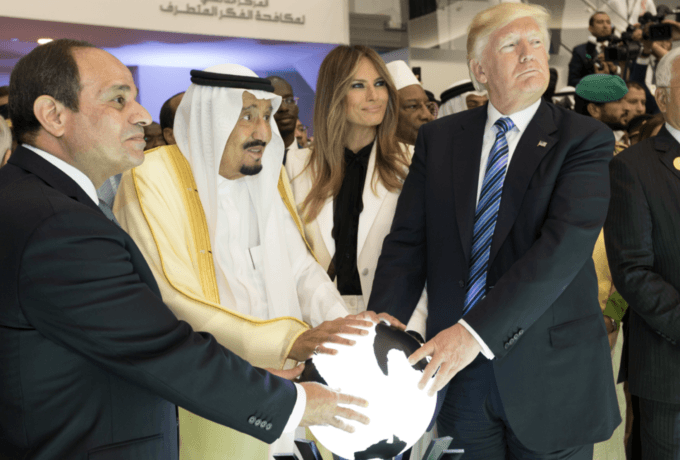
King Salman, Presidents Trump and el-Sisi inaugurate the Global Center for Combating Extremism by touching an illuminated globe of the Earth. Image Wikipedia.

“I’m going to Saudi Arabia. I made a deal with Saudi Arabia. I’d usually go to the U.K. first. Last time I went to Saudi Arabia they put up $450 billion. I said well, this time they’ve gotten richer, we’ve all gotten older so I said I’ll go if you pay $1 trillion to American companies, meaning the purchase over a four-year period of $ 1 trillion and they’ve agreed to do that. So, I’m going to be going there. I have a great relationship with them, and they’ve been very nice but they’re going to be spending a lot of money to American companies for buying military equipment and a lot of other things.” – President Donald Trump, 7th March 2025.

What is the true importance of the US-Saudi relationship in the global economy? It’s based on the two things that make the economy go round – money and oil.

The United States–Saudi “petrodollar” arrangement has underpinned American economic and military power for nearly five decades. In essence, oil exports from Saudi Arabia (and later OPEC broadly) have been priced in U.S. dollars since the 1974, ensuring a constant global demand for the dollar and U.S. Treasury assets. This monetary system forms the hidden backbone of a web of consequences – from U.S. imperialism and geopolitical maneuvering to environmental degradation and extreme wealth accumulation. Today, roughly 80% of global oil transactions are still conducted in USD, illustrating the petrodollar system’s enduring influence. Below, we analyze the historical origins of the petrodollar, explain how this monetary system became a root cause linking finance to geopolitics and ecological crisis, and discuss proposed alternatives like Modern Monetary Theory (MMT) that could break the cycle.

Background

In the aftermath of World War II, the Bretton Woods system (1944) established the U.S. dollar as the world’s anchor currency, pegged to gold, which cemented U.S. economic dominance. However, by 1971 the U.S. faced mounting trade deficits and dwindling gold reserves, as countries sought to trade USD for gold they didn’t have, US President Nixon ended dollar convertibility to gold – a move that threatened the dollar’s supremacy. The solution emerged via oil: in 1974, one year after the oil crisis, Washington and Riyadh struck a pivotal deal (kept secret until 2016) that ensured Saudi oil would be priced exclusively in dollars. In return, the U.S. provided military protection and lucrative arms sales to Saudi Arabia, and Saudi leaders would recycle their oil revenues into U.S. Treasuries and American investments. This U.S.–Saudi arrangement laid the foundation of the petrodollar system, firmly tying the world’s most traded commodity (oil) to the American currency.

The timing was crucial. The 1973 oil embargo had quadrupled oil prices from about $3 to $12 a barrel, sparking a global energy crisis. The U.S. sought to tame this “oil weapon” by binding oil exports to the dollar – thereby turning petrodollars into a pillar of U.S. financial might. By the late 1970s, most OPEC producers followed suit in trading oil for USD, and surplus petrodollars were funneled into Western banks and U.S. debt. This recycling of oil revenues back into American markets propped up U.S. budget deficits and helped finance Cold War expenditures. In effect, oil-exporting nations accepted dollars (often investing them in the US) in exchange for security guarantees and access to American goods and technology. The long-term implications were profound: the dollar became the default currency for global oil trade, bolstering its reserve currency status and enabling the U.S. to maintain economic and military pre-eminence “almost as a matter of course”. This petrodollar order has remained largely intact through the present, anchoring U.S. dominance in the world economy.

2. The Monetary System as the Root Cause

The petrodollar system entrenched the U.S. dollar’s global monetary hegemony, allowing the United States to exert outsized influence without the typical constraints faced by other nations. Because countries worldwide need dollars to buy oil, they hold vast USD reserves and invest in U.S. assets (like Treasury bonds), which funds U.S. deficits and keeps American interest rates lower than they otherwise would be. In practical terms, this means the U.S. can run the printing presses – or more accurately, expand money supply – to finance government spending (military, infrastructure, etc.) without triggering hyperinflation, as the excess dollars are absorbed abroad to settle trade and reserve needs. This unique privilege, often dubbed “exorbitant privilege,” roots many subsequent geopolitical and economic dynamics.

More broadly, the modern money creation process itself is a key structural driver. In most advanced economies, money is created predominantly by private banks issuing loans, not by governments minting cash. About 97% of money in circulation is created by commercial banks when they extend credit (e.g. granting loans), whereas only ~3% is physical cash from central banks. Debt-based money comes with a built-in growth imperative: banks lend money into existence with an obligation to be repaid with interest, meaning total debt continually exceeds the money available to repay it. New loans must constantly be created so borrowers can obtain the funds needed to pay interest on yesterday’s loans. If this expansion falters, the result is a contraction – loan defaults, bankruptcies, and recession – since under our interest-bearing system “an expanding amount of loans are needed to keep the system running smoothly” and avoid a cascading collapse.

Jem Bendell , author of Breaking Together, refers to this phenomenon as the “Monetary Growth Imperative,” wherein the economy “must expand whether society wishes it to or not” just to service the debt overhead. In other words, continual GDP growth is structurally required to sustain the monetary system.

This dynamic has fostered a financialized economy where speculation often outranks production. With easy credit and abundant petrodollars sloshing through global markets, capital tends to chase quick returns via financial instruments rather than long-term productive investment. Private banks, seeking secure profits, create money disproportionately for assets like real estate and stocks (fueling price bubbles) instead of lending to manufacturing or local businesses. As a result, we see huge asset bubbles that benefit the mega-rich but relatively underfunded productive sectors. The monetary system’s incentives thus tilt toward Wall Street over Main Street – leveraging debt to amplify wealth for those at the top. Additionally, the constant need to avoid contraction pressures governments to prioritize policies that stimulate growth (often measured as rising GDP) above all else, sometimes at the expense of social or environmental considerations. In sum, the petrodollar-reinforced debt-money system creates self-perpetuating cycles: the U.S. can flood the world with dollars to sustain its dominance, and globally the pursuit of dollar profits drives speculative finance and a growth-at-all-costs mentality. This underlies many downstream effects from military interventionism to ecological overshoot.

3. Imperialism and Geopolitics

Control over the international monetary system, anchored by the petrodollar, has directly enabled U.S. imperial reach and the expansion of its military–industrial complex. Since foreign governments must hold dollars, they effectively help finance U.S. deficit spending – including the Pentagon’s budget – by purchasing U.S. treasuries. This recycling of petrodollars allowed America to run “guns and butter” policies (funding warfare and domestic programs simultaneously) without bankrupting itself. Petrodollar inflows have explicitly financed U.S. weapons exports and military aid, especially in the Middle East. For instance, petrodollar-rich Gulf states like Saudi Arabia have spent hundreds of billions on American arms over the years, funneling their oil proceeds back into U.S. defence contractors. This symbiosis solidified a regional security architecture with the U.S. as the guarantor – protecting friendly oil monarchies in exchange for their loyalty to the dollar system.

The U.S. has likewise used its monetary and military might to suppress challenges to this order. During the Cold War, pan-Arabist and socialist-leaning movements in the Middle East – which aimed to unite Arab states or pursue independent economic policies – were seen as threats to U.S. “vital economic interests” (i.e. access to oil on U.S. terms. The Eisenhower Doctrine (1957) explicitly targeted Egypt’s Gamal Abdel Nasser and other Arab nationalists, seeking to fracture Arab unity and keep pro-Western regimes in power. This strategy “sowed divisions within Arab ranks, triggering a fierce Arab Cold War” and undermined any concerted effort by oil-producing nations to chart an autonomous course. Later, when individual leaders attempted to bypass the petrodollar system, they often met harsh reprisals. Notably, Iraq’s Saddam Hussein switched to selling oil in euros in 2000, and Libya’s Muammar Gaddafi proposed a gold-backed African currency – moves that preceded U.S.-led military interventions that removed them from power, summed up in the infamous video of Hillary Clinton reacting to Gaddafi’s killing  “We came, we saw, he died”. While many factors were at play in those conflicts, the message was clear: the U.S. would not tolerate challenges to dollar dominance in oil markets.

U.S. alliances in the region further reflect petrodollar geopolitics. Israel’s role as a key American ally (and military foothold) in the Middle East has been heavily financed by U.S. dollars – the U.S. currently has provided Israel with over $250bn since 1959, with unprecedented military-aid being sent to Israel since the beginning of the genocide in Gaza, in excess of more than $20bn. This support, partly enabled by America’s fiscal freedom under the petrodollar system, ensures Israel’s qualitative military edge and U.S. influence over the region’s political trajectory. Conversely, oil-rich countries that resist U.S. hegemony (Iran, Venezuela) have been isolated via sanctions that leverage the dollar’s centrality in global finance. More recently, the U.S. has been able to commit extraordinary sums to distant conflicts – for example, Congress approved $175 billion+ in aid to Ukraine since 2022 – with relatively little immediate economic fallout at home. This level of expenditure (unthinkable for most countries) is buoyed by the dollar’s reserve status and the Federal Reserve’s capacity to create money that the world will absorb. In short, the petrodollar-backed monetary order acts as a force multiplier for U.S. imperial strategy: it finances a global network of hundreds of overseas bases and proxy engagements, and it gives Washington a powerful economic weapon (control of dollar-based transactions) to reward allies and punish adversaries. The result is a geopolitical landscape where U.S. military supremacy and currency supremacy reinforce each other, often at the expense of smaller nations’ sovereignty.

In fact, it is the debt-based monetary system that has trapped many developing nations in a cycle of borrowing and export dependency, often enforced by international financial institutions and trade agreements. Under the current system, countries in the Global South are pressured to extract and export commodities (oil, minerals, cash crops) to earn the foreign currency needed to service debts and pay for imports – effectively subsidizing affluent lifestyles elsewhere at the cost of local ecosystems. Indeed, our “debt-based monetary system” creates a built-in incentive for “world export warfare”, where nations must compete for export markets to try to obtain debt-free income. This wealth transfer occurs through different mechanisms, primarily debt and price differentials in international trade resulting in unequal exchange, which, according to a 2022 paper from Hickel et al, between 1990-2015 alone, resulted in a wealth drain from the South totaling $242 trillion, equivalent to a quarter of Northern GDP.

4. Environmental and Economic Consequences

This debt-fueled, growth-obsessed petrodollar system has also driven environmental destruction and locked in a fossil-fuel-dependent global economy. The arrangement implicitly incentivizes high oil consumption: oil exporting nations earn dollars and invest in growth, while oil-importing countries need growth to afford expanding energy imports. Consequently, the world’s energy and economic structures have been slow to change. As of 2022, about 80% of global primary energy still comes from fossil fuels, a statistic tied to the petrodollar era’s legacy. There is a well-documented 1:1 coupling between global GDP and global energy use, particularly fossil fuel use . In effect, economic growth has meant burning more oil, gas, and coal, leading to rising carbon emissions. Under the current system, if we “don’t keep the global economy growing by at least 3% per year, it plunges into crisis,” doubling the economy’s size every ~20 years. This exponential growth mandate collides with the reality of a finite planet. It translates into ever-expanding extraction of natural resources and ever-expanding waste (greenhouse gases, pollution), because efficiency improvements alone have not stopped total resource use from climbing, due to Jevon’s paradox and the growth-paradigm.

Critically, the monetary growth imperative undermines efforts to transition to sustainability. As Bendell observes, our debt-based monetary system “does not allow a steady-state economy” – it literally “prevents effective climate change mitigation…without monetary reform” Governments are pressured to maximize short-term GDP (to service debts and maintain employment), often prioritizing elite accumulation through inflating asset prices, destructive economic expansion and consumerism over conservation. The petrodollar system reinforces this by promoting fossil-fueled development; countries that grow faster (with high energy use) accumulate more dollars, while those that try to curb fossil fuels risk economic stagnation under current metrics. Meanwhile, oil-rich states have had little incentive to diversify away from hydrocarbons as long as oil revenue secures their geopolitical standing. The result is a vicious cycle: debt drives growth, growth drives fossil fuel combustion, and fossil fuels exacerbate climate change and ecological harm. As one commentator put it, “American empire is inextricably linked with fossil fuels, and to mitigate climate change, it must come to an end”. In other words, genuine environmental solutions require confronting the political-economic system that maintains fossil dominance.

The petrodollar link also explains the slow global response to climate change. U.S. policymakers (and other major oil stakeholders) have often been reluctant to fully embrace decarbonization, not only due to oil industry lobbying but because a shift away from oil threatens the basis of the dollar-centric order. A world less dependent on oil could erode the automatic demand for USD, undermining U.S. financial power. Indeed, analysts note that if renewable energy and electrification significantly reduce oil trade in the coming decades, it “could eventually lead to a reduction in petrodollar flows” and weaken the dollar’s global standing. Thus the climate crisis and the petrodollar system are intertwined challenges. The very same debt-growth engine that boosted GDP (and elite wealth) in the 20th century is now pushing the planet toward ecological breakdown, by making perpetual expansion the condition for economic stability. Breaking this cycle is essential not only for environmental reasons but to free economies from what Jason Hickel calls “the logic of endless growth” that defies planetary limits.

5. Alternative Solutions and MMT

Addressing these deeply interlinked issues requires rethinking the monetary system itself. A range of economists and scholars have proposed solutions to remove the growth imperative and make finance serve people and planet rather than the elite few. One approach is to shift from privately controlled, debt-based money creation to democratically managed money that can be directed toward public purposes. Instead of relying on commercial banks to create money (and channel it into speculation or property bubbles), the state could create and spend new money directly into the real economy, funding useful projects like renewable energy, public infrastructure, healthcare, and education. Such a system of sovereign money (sometimes called “green quantitative easing” or public banking) would inject liquidity where it’s needed for social and environmental goals, rather than inflating huge asset bubbles that only benefit the mega-rich. The money supply could grow or contract in a controlled way to meet societal needs, without the destructive necessity of ever-increasing debt. Notably, the proposal is not for the government to print limitless cash, but to replace interest-bearing bank loans with debt-free public spending as the primary way new money enters circulation. This idea harkens back to thinkers like Samir Amin, who advocated “delinking” developing economies from the dictates of Western finance in order to pursue self-determined development. By reclaiming monetary sovereignty – whether through nationalizing credit creation or regional alternatives to the dollar system – countries could invest in long-term prosperity and sustainability without being trapped by dollar-denominated debt and growth-at-any-cost policies.

Modern Monetary Theory (MMT) offers another lens for solutions, especially for advanced economies like the U.S. and those with their own currencies. MMT economists (e.g. Stephanie Kelton , Fadhel Kaboub فاضل قابوب ) argue that a sovereign government cannot “run out of money” in its own fiat currency the way a household or business can. As Kelton puts it, for a country that issues its own currency, there is never a danger of debt spiraling out of control, because it can always create money to service its obligations. The real limits are not financial but resource-based – inflation will only arise if government spending pushes total demand beyond the economy’s productive capacity (labour, materials, technology). This perspective suggests that scarce funding is not the barrier to tackling issues like poverty, infrastructure, or climate change; what’s needed is political will and careful management of real resources. For example, using an MMT framework, the U.S. or any currency issuing country could finance a Green New Deal – mass investments in clean energy, transit, and green jobs – by issuing currency, without needing to tax or borrow first, as long as idle resources (unemployed labour, etc.) are put to work. Far from causing runaway inflation, such spending would increase productive output and sustainability, and any inflationary pressure can be managed via taxation or other tools. Importantly, MMT also highlights that monetarily sovereign governments don’t need petrodollar recycling or foreign loans to fund themselves; their spending is constrained by what’s available to buy in their own currency, not by foreign exchange. This undercuts the rationale for maintaining structures like the petrodollar – if the U.S. can afford to invest in renewable energy and social programs without Saudi petrodollar recycling, it might reduce the strategic obsession with oil-based dollar supremacy.

Leading voices have emerged to champion these ideas. Economist Fadhel Kaboub, for instance, emphasizes that developing nations can use MMT principles to achieve monetary sovereignty and resilience, rather than depending on IMF loans or dollar reserves. He points to strategies such as building domestic food and energy systems to reduce import dependence and denominating debts in local currency, so that Global South countries can escape the trap of dollar-denominated debt that forces austerity. Jason Hickel, from a “degrowth” and global justice perspective, likewise calls for moving beyond GDP growth as the measure of success and financing a fair economic transformation (especially in the Global South) through public-led investment and technology transfer. Dr. Steve Keen and David Graeber have both called for modern debt-jubilees, to liberate ourselves from this unpayable debt cycle that has dictated and limited human societies for millennia. Their work suggests cancelling odious debts, taxing or expropriating the excess wealth of elites, and redirecting resources toward climate mitigation, adaptation, and human wellbeing – all of which would be easier under a redesigned monetary regime that isn’t predicated on private profit. Even scholars of collapse like Jem Bendell argue that monetary reform is central to any hope of mitigating climate catastrophe; as he bluntly states, without altering how money is created and allocated, societies “will be prevented from effective climate change mitigation” and from adapting to coming disruptions. In summary, these alternative paradigms (sovereign money, MMT, degrowth) converge on a key point: freeing the economy from the tyranny of the petrodollar and debt-driven growth would enable humanity to prioritize ecological stability and equitable development. By reclaiming the monetary commons for public good, we could break the cycle of imperial warfare, environmental exploitation, and elite enrichment that the current system produces.

Conclusion

The U.S.–Saudi petrodollar deal of the 1970s created a self-reinforcing cycle that has shaped global politics, economics, and the environment in far-reaching ways. It tethered the world’s monetary order to fossil fuels and U.S. military might, allowing American elites to amass wealth and power under the guise of “maintaining liquidity” for global trade. The consequences – imperial interventions, entrenched petro-states, financial crises, and climate change – are not isolated problems but different facets of a singular system. Understanding the monetary root cause clarifies why efforts to address issues like endless wars or carbon emissions often hit a wall: the prevailing system is built to expand itself, not to prioritize peace or planetary limits. However, as we have seen, this system is not immutable. History is now at an inflection point where the petrodollar’s dominance is being quietly challenged. China, Russia, and other nations are experimenting with oil trade in other currencies, and U.S. financial sanctions on rivals have spurred talk of de-dollarization. At the same time, the imperative of climate action is pushing the world toward renewable energy, which in the long run will weaken the oil-dollar nexus. These trends suggest that the petrodollar system’s grip may loosen in the coming years.

Yet simply replacing the U.S. dollar with another currency for oil trade would not automatically dissolve the deeper problems – it might just shift the locus of power. The more fundamental change advocated by the thinkers cited above is to redesign how money works and what it serves. By moving to a post-petrodollar era of cooperative monetary policy, debt-free public investment, and truly sustainable economics, it becomes possible to address the interconnected crises at their source. That means breaking the feedback loop of oil, dollars, and weapons, and instead using monetary tools to foster global justice and ecological balance. In conclusion, the petrodollar deal was not just a quirky historical pact – it has been the linchpin of an entire world-system of U.S. hegemony, elite enrichment, and fossil-fueled growth that turbocharged the ‘great acceleration’ that has pushed the global economy far outside what our planet can sustainably support. Recognizing that the monetary system lies at the root of imperialism and environmental breakdown is the first step toward imagining new systems that prioritize peace, shared prosperity, and a livable planet. The challenges are immense, but so are the possibilities if money creation and resource allocation are reclaimed for the common good. The downfall of the petrodollar need not be a crisis; it could be an opportunity to chart a different course for both the global economy and Earth’s future.

Over 1,000 dead as Western-backed HTS regime in Syria escalates massacre of Alawites

Hakan Özal


In Syria, the Western-backed Haiat Tahrir al-Sham (HTS) regime’s massacre of Alawites has escalated, with over 1,000 people killed.

The UK-based Syrian Observatory for Human Rights (SOHR) reported that armed groups affiliated with the HTS regime have killed at least 745 civilians, including women and children, in the coastal region since Thursday. The brutality of the killings was demonstrated by the bodies being left in the streets as a warning.

Relatives and neighbours attend the funeral procession for four Syrian security force members killed in clashes with loyalists of ousted President Bashar Assad in coastal Syria, in the village of Al-Janoudiya, west of Idlib, March 8, 2025 [AP Photo/Omar Albam]

HTS jihadist terror against Alawites and other religious minorities is not new. As the World Socialist Web Site has reported, these attacks have been systematic since it took power in Syria in December, toppling the regime of President Bashar al-Assad. In late December, the aggression of the regime forces led to mass protests.

According to BBC reports, the violence began when residents of Beit Ana village in Latakia refused to hand over a suspect to security forces on Thursday and quickly spread to other coastal cities in the northwest. Armed groups composed of former Syrian army soldiers launched coordinated attacks on government checkpoints, security convoys, and military positions. In response, the interim government forces launched a large-scale operation.

By Saturday, SOHR was already reporting that at least 745 civilians, 148 insurgents, and 125 regime soldiers had been killed during the operation. Alawite men who served in the security forces during the Assad regime were executed by the new government forces, and many Alawite villages were looted and set on fire.

Jenan Moussa, Al-Aan TV’s Middle East correspondent, shared footage on social media related to HTS militia’s attacks in the Latakia region on Friday. The videos show severe violence against individuals described by the Syrian regime as “remnants of the old regime,” with most victims wearing civilian clothes. Moussa’s footage revealed 29 men executed in the Al- Mokhtariyeh area and 11 in Al-Hafa.

The videos included sectarian insults and slogans. In one, an HTS supporter referred to the victims as “dead animals.” Another showed a man in civilian clothes and slippers being shot at close range.

SOHR is an anti-Assad organisation funded by the UK Foreign Office and other European powers. It’s director, Rami Abdulrahman, was imprisoned three times in Syria before fleeing to the UK. He stated that the widespread massacres in areas with dense Alawite populations, such as Jableh, Baniyas, and surrounding regions, are among the worst violence in the 14-year civil war. Abdulrahman emphasized, “This is not about being pro or against the former Assad regime. These are sectarian massacres that aim to expel the Alawite population from their homes.”

On Saturday, social media platforms were filled with photos and condolence messages from Syrian users regarding those killed in the coastal region. Reuters spoke to six residents who reported that thousands of Alawites and Christians fled their homes due to safety concerns since Thursday. Many, mostly women, children, and the elderly, were forced to seek refuge at the Russian military base in Hmeymim, Latakia.

Abdulrahman noted that Alawite civilians, including women and children, were “executed,” and their homes and property looted. He reported that killings, looting, and arson continued throughout the night in Baniyas and surrounding villages as of Saturday.

Aron Lund from the independent research foundation Century International told AFP, “The authority [of the new regime] is based largely on radical jihadists who consider the Alawites to be enemies of God.” Lund added, “When there is an attack, these groups then carry out raids of Alawite villages, which don’t just include armed former soldiers but also vulnerable civilians.”

The Syrian state news agency SANA cited an unnamed security official stating that many fighters went to the coastal regions to avenge attacks against security forces.

Allegations suggest that HTS-affiliated groups, the successor organisation of the al-Nusra Front—which was formerly allied with al-Qaeda—have made calls in mosques stating that “killing Alawites is obligatory.” There are videos supporting these allegations on social media.

Al Jazeera’s correspondent in Damascus, Resul Serdar, reported on Saturday afternoon that the intensity of clashes had significantly decreased, although fighting continued in the outskirts of towns. Serdar emphasized the growing “tragedy” due to increasing casualties, noting, “Hundreds of people have been killed and the majority of them are civilians.”

BBC Verify confirmed the authenticity of two videos showing a corpse being dragged through the streets in Latakia.

A Syrian activist in Latakia told BBC Newshour that the violence has instilled great fear in the Alawite community. The activist, who wished to remain anonymous, said, “They are feeling so fearful… They don’t know what to do. There is no government or state who is ready to help them, to protect them.”

Curfews were imposed in Homs, Latakia, and Tartus, where Alawites are densely populated, while the governor of Latakia announced ongoing power outages in the region.

HTS leader Abu Muhammad al-Jolani (Ahmed al-Sharaa), declared “interim president” after the regime change, defended the massacre in a video message, stating, “Remnants of the ousted regime tried to test the new Syria without understanding it, and today they are relearning Syria.” Al-Jolani stated, “Prisoners should not be humiliated or beaten, as this is against God’s command and the country’s laws,” in order to avoid putting NATO allies in a difficult position.

While the NATO powers, including Turkey, have largely remained silent on the bloody aggression of their new ally, the HTS regime, some of the statements made are an example of utter hypocrisy.

“I am deeply shocked by the numerous victims in the western regions of Syria,” Stefan Schneck, Germany’s special envoy to Syria, said on X. Michael Ohnmacht, the European Union’s envoy to Syria, retweeted Schneck’s post, adding, “I share the opinion of my German counterpart regarding the call for all parties to exercise restraint.”

The NATO powers and their pseudo-left advocates, who claim that Islamist jihadists hostile to basic democratic rights have led a “democratic revolution” in Syria, share responsibility for these massacres. They hailed the coming to power last December of the Islamists they had backed since 2011 in the war for regime change, in order to undermine Russian and Iranian influence in Syria and the broader Middle East, and rushed to cement their ties with the new regime.

Trump announces Taiwan Semiconductor Manufacturing Company to invest $100 billion in US manufacturing

Shih-Yu Chou


Taiwan Semiconductor Manufacturing Company Limited (TSMC), the world’s largest contract manufacturer of the most advanced chips, would invest $100 billion in the United States over the next four years, US President Donald Trump declared on March 3 at the White House. He spoke alongside US Commerce Secretary Howard Lutnick and the corporation’s chief executive, Che Chia Wei.

Trump referred to Wei as a “legend” since the next planned investment would bring the company’s total investment in the US to $165 billion. The expansion includes three new fabrication plants (fabs), two advanced packaging facilities, and a major research and development center, consolidating this project as “the largest single foreign direct investment in US history”, as TSMC indicated.

Trump had previously asserted, “Taiwan took our chip business away”, and “we want that business back”. Prior to the spectacle at the White House, TSMC had already committed to investing $65 billion in advanced semiconductor production in Phoenix, Arizona. One fab has started to manufacture advanced 4 nanometer (nm) chips in the US since October 2024.

The generally law-abiding TSMC did not even submit the investment plan to Taiwan’s Ministry of Economic Affairs for assessment and approval, as it had previously done. In other words, the announcement was made unilaterally by the Trump administration.

Following Trump’s statement, Taiwan’s Minister of Foreign Affairs Lin Chia-lung noted in an interview on March 5 that the projected investment was in line with US strategic interests, and hence should be considered as a boost to semiconductor supply chain resiliency.

Trump was “very pleased” with the deal, he said. TSMC played “an indispensable role in bringing about America First.” Lin went on to urge the public to contemplate how to “Make Taiwan Great” and craft “a win-win situation” for both the United States and Taiwan.

His rhetoric echoed the statement made by Taiwanese President Lai Ching-te, who promised to “collaborate with” the Trump administration in order to establish “democratic supply chains” for industries connected to high-end chips on February 14.

The opposition Kuomintang (KMT) and the KMT-aligned media railed against the investment plan, accusing the ruling Democratic Progressive Party (DPP) of “getting nothing back” for “handing over Taiwan’s silicon shield” to the “business-minded” Trump administration. Unlike the Biden-Harris administration, Trump showed “no commitment to democracy and the defense of democratic allies of the US”. By ceding TSMC to the US, the DPP government had gradually turned Taiwan into Ukraine.

The term “silicon shield” was coined by Australian journalist Craig Addison, who authored a book of the same title in 2001. Since then, the Taiwanese bourgeoisie and corporate media have peddled the fiction that the concentration of global semiconductor production in Taiwan has made the island “an indispensable player” on the world stage. This supposedly ensures that if China invades, the United States will intervene to save the island.

Taiwanese nationalism feeds off this fantasy. The island’s ruling class and academics use the term “silicon shield” interchangeably with TSMC and “the holy mountain that safeguards the nation”. They brandish their case of Dunning-Kruger effects—a cognitive bias in which people with limited competence overestimate their capabilities.

Examples abound. Lai declared in 2023 that TSMC’s “achievements” and “products” were shared by the world. As a result, not only Taiwan must defend TSMC, but “the world has a responsibility to do its share” and to “safeguard world civilization”.

Wu Jieh-min, an establishment scholar at Academia Sinica, the island’s leading research institution, similarly asserted in 2024, the ultimate strength of the silicon shield stemmed from “the global consequences of any disruption to the chip supply chain… Any attack on Taiwan would... jeopardize global economic stability. That is the essence of the Silicon Shield.”

Despite tactical differences between the ruling DPP and the opposition KMT, the competing claims of “strengthening Taiwan’s silicon shield” and “handing over the island’s silicon shield” are demonstrably false.

It is necessary to examine to how the US imperialist bourgeoisie delivered a set of blows to Japan’s semiconductor industry before exposing the fraudulent notion of the silicon shield.

In the late 1970s, Japan established itself as a major semiconductor manufacturer, particularly in DRAMs. According to a RAND report, the United States’ market share of DRAMs plummeted from 70 percent to 20 percent between 1979 and 1986.

In the 1980s, the US semiconductor industry complained that it took years to file a successful patent application, and that by the time the patent was granted, the original design had become obsolete. This enabled the Japanese semiconductor industry to “pirate” the intricate circuit designs developed by US manufacturers.

In response, US President Ronald Reagan signed into law the Semiconductor Chip Protection Act of 1984, making layouts of integrated circuits legally protected upon registration.

This did not substantially reduce the US trade deficit with Japan. It also did not hinder the Japanese bourgeoisie’s ambition to compete with the US in manufacturing. Japan’s semiconductor industry turned out to be the country’s largest capital investor.

In 1985, the Reagan administration then “advised” Japan to reduce its investment in the semiconductor industry. Japan swiftly turned down the request, citing the fact that a significant portion of semiconductors destined for the US were manufactured by Japanese subsidiaries of US corporations.

President Reagan with William French Smith making a statement to the press regarding the air traffic controllers strike (PATCO) from the Rose Garden, August 3, 1981 [Photo: White House Press Office]

According to the New York Times, Clyde Prestowitz, then counselor to the Secretary of Commerce, acted like a Mafia gangster when he told his Japanese counterparts, “It’s not the business of the United States Government to tell the Japanese how much to invest, but if you can see ahead of you a potential firestorm, you have to think about how to deal with it.” This viewpoint had bipartisan support and was regarded as a “rational” response to Japan’s economic rise.

Such a threat might sound familiar to many. Trump’s remark at the annual meeting of the World Economic Forum in Davos is a different version of this, saying “if you don’t make your product in America, which is your prerogative, then, … you will have to pay a tariff … which will direct hundreds of billions of dollars and even trillions of dollars into our Treasury.”

Lionel Olmer, Under Secretary of Commerce for International Trade, then began to address claims of semiconductor dumping from Japan and its “predatory pricing policy” in the US market.

In September 1985, the US weaponized the dollar by “persuading” its G5 counterparts, which included France, West Germany, Japan, and the United Kingdom, to conclude the Plaza Accord. The deal was intended to drive up major currencies (especially the yen) relative to the dollar, hence increase US exports and reduce US trade imbalances in manufactured goods with “allies”.

In September 1986, Japan “voluntarily” signed the US-Japan Semiconductor Agreement, which limits Japan’s semiconductor exports to the United States, particularly DRAMs.

An article in the New York Times, “Japanese Chip Makers Falter”, praised the US economic war on Japan, noting that the five largest Japanese electronics companies reported “plunges of between 50 and 80 percent in pretax profits” for the first half of 1986. Noticeably, Japan was projected to “displace the United States for the first time [in 1987] as the world’s largest supplier of semiconductors”. Japan’s predicament came as “it [had] reache[d] a huge milestone of success.”

Head of the Intel Corporation Andrew Grove enthused over the fact that “the memory-chip market has turned out to be Japan’s economic Vietnam”, the same article of the New York Times reported.

The Reagan administration subsequently inflicted a one hundred percent tariff on Japan electronic products in 1987. According to the Los Angeles Times, the punitive measure was intended to generate up to $300 million in revenue while punishing Japanese companies such as NEC, Hitachi, Fujitsu, Toshiba, and Oki by either pricing their products out of the US market or causing substantial sales losses. The Reagan administration was not an outlier in insisting that America got “ripped off” by Japan.

As NPR showed in an audio clip, Trump lamented on Oprah Winfrey’s talk show in 1988, “We let Japan come in and dump everything right into our markets and everything. It’s not free trade.” This was a political expression of the normalization of destructive measures against Japan, which emerged as the second-largest manufacturing powerhouse after the United States.

Unlike Taiwan, Japan was more than merely a contract manufacturer. Japan’s semiconductor design and manufacturing capabilities, as well as its contributions to “world civilization”, however, offered no protection whatsoever against US economic warfare.

When Japan’s chip makers faltered, Western imperialist bourgeoisies felt no responsibility to safeguard Japan. Likewise, they had no obligations to confront the US when Japan was forced to accept the provisions of the Plaza Accord. When existing rules were incompatible with Washington’s imperialist interests, it changed them at will.

Successive governments of Taiwan have since the 1950s served as an instrument of US imperialism. The Island’s political establishment has been far more loyal to Washington and compliant with requests made by the US than even US-backed proxy regimes such as Israel and Ukraine.

As indicated by a 2021 article in the US Army War College Quarterly: Parameters, the US and Taiwanese governments should devise a “scorched-earth strategy that would render Taiwan... unattractive if ever seized by force,” which would include the destruction of TSMC fabs and supply chains within the island.

Taiwan Semiconductor Yilan Plant [Photo by Kevin CW Lu / CC BY-SA 4.0]

In other words, the Nord Stream moment would pale in comparison to the ruin inflicted on the Taiwanese toiling masses by the ruling classes of the United States and Taiwan.

The opposition KMT felt so outraged at Trump’s announcement since the former deluded itself and the general public into believing the island’s ruling elite deserved to be treated as “an ally”, not as a pawn. The ruling DPP groveled at the feet of the American Führer precisely because it could serve no purposes apart from as a tool of US imperialism. Prior to the White House’s unilateral move, Taiwan’s Minister of Economic Affairs blurted out that “It would not be unreasonable to levy a 100 percent tariff on chips from Taiwan”

The Taiwanese ruling class, across the political spectrum, has thus far concealed the fact that, similar to the Smoot-Hawley tariff measures adopted by the United States in 1930 and the German Reich’s autarky policy, the global economic warfare launched by Trump’s fascist regime is a prelude to all-out wars on all fronts between nuclear-armed powers.

The relocation of semiconductor production (encompassing 3 nm, the most advanced 2 nm, and the future 1.6 nm chips) along with the supply chains to the US territory in the coming years would massively accelerate US war drives against China and European powers.

As Rosa Luxemburg explains powerfully in “The Accumulation of Capital—an Anti-Critique”:

What distinguishes imperialism as the last struggle for capitalist world domination… is the circle of development is beginning to close—the return of the decisive struggle for expansion from those areas which are being fought over back to its home countries. In this way, imperialism brings catastrophe as a mode of existence back from the periphery of capitalist development to its point of departure.

The American oligarchy declares war on public education

Nancy Hanover


New College of Florida students and supporters protest ahead of a meeting by the college's board of trustees in Sarasota, Florida. [AP Photo/Rebecca Blackwell]

The Trump administration and newly confirmed Education Secretary and billionaire Linda McMahon have begun dismantling the US public education system. Public schools, built through 250 years of struggle, educate tens of millions of students and are overwhelmingly supported by the population as a fundamental democratic right.

According to a March 6 Washington Post article, congressional Republicans are pushing for a universal school voucher system in the budget reconciliation bill. Combined with the administration’s plan to shut down the Department of Education, this is part of a broader effort to dismantle public education entirely.

In line with Trump’s January 29 Executive Order, “Expanding Educational Freedom and Opportunity for Families,” the Republican voucher plan would divert $5-10 billion in public funds to private, parochial and homeschooling.

“The program would be fueled by a powerful, never-before-tried incentive: Taxpayers who donate to voucher programs would get 100 percent of their money back when they file their taxes,” the Post reported. Wealthy individuals and corporations could invest in or donate stocks to these programs, gaining dollar-for-dollar tax deductions while avoiding capital gains taxes.

The measure would be “the greatest threat to public education we’ve ever had at the federal level,” said Sasha Pudelski, director of advocacy for the School Superintendents Association.

According to the Wall Street Journal, Trump had a draft executive order to shut down the Department of Education (ED), though legal experts note it would require a 60-vote majority in the Senate. In the meantime, billionaires McMahon and Musk are executing a slash-and-burn operation—eliminating ED jobs, canceling grants and abruptly ending research and support programs.

The Department of Education provides critical support to underfunded schools and enforces anti-discrimination policies established through landmark rulings like Brown v. Board of Education (1954), the Individuals with Disabilities Education Act (1975) and Plyler v. Doe (1982), which protect minorities, students with disabilities, English-language learners and immigrants. These gains are now under direct attack, with Trump using Diversity, Equity, and Inclusion (DEI) programs as a pretext to dismantle democratic rights.

Last week, Trump slashed $400 million in federal funding to Columbia University as retaliation for student-led anti-genocide protests. This week, he ordered the denial of student loan forgiveness to teachers and nonprofit workers deemed to “harm American values” or who engage in “public disruptions”—effectively imposing a political loyalty test.

In K-12 education, an Executive Order now requires the teaching of the “1776 Report,” authored by far-right ideologues, along with other lies aimed at censoring the history of American imperialism, the suppression of the working class, and—above all—the class struggle and socialism.

Universal public education, a core ideal of the Enlightenment, has long been seen as essential to democracy and a safeguard against authoritarianism. Just three years after drafting the Declaration of Independence, Thomas Jefferson authored A Bill for the General Diffusion of Knowledge in 1779, reflecting the revolutionary founders’ belief that education was the foundation of democracy and social and political rights. “I know of no safe depositary of the ultimate powers of society but the people themselves,” Jefferson wrote, adding, “The remedy is not to take power from them, but to inform their discretion by education.”

The expansion of public education, however, was won through mass struggles. The Civil War—the Second American Revolution—was necessary to secure education rights for black people and many poor whites while expanding the system nationwide. After the defeat of the slavocracy, President Ulysses S. Grant mandated that states “establish and forever maintain free public schools” of a secular character, reinforcing the democratic principle of the separation of church and state.

The fight against child labor and for universal public education was a central demand of the early American labor movement. This struggle was given a huge impulse by the 1917 Russian Revolution, which created the first workers’ state and launched an unprecedented campaign for literacy and education. A 1919 decree mandated education for all Soviet citizens aged 8 to 50. By 1939, literacy among men had risen to 87 percent—far exceeding rates in Western countries.

The rise of the CIO (Congress of Industrial Organizations) movement in the 1930s, led by socialists inspired by the Russian Revolution, along with the massive post-war strike wave of 1945-46 and the decades-long Civil Rights movement significantly advanced the fight for quality public education. By 1955, high school graduation rates reached 80 percent for the first time, and by the 1960s, college became widely accessible to the working class.

Trump and McMahon are demanding the closure of the federal education department in order to “return education to the states.” This is a rehash of the “states’ rights” slogan the Southern segregationists used to oppose the racial integration of public schools.

The working class did not receive public education as a gift—it fought for it. However, as American capitalism has plunged into crisis, waged endless wars and fostered skyrocketing social inequality—especially over the past three decades—both corporate-controlled parties have systematically defunded public education.

Trump is following the blueprint laid by Democratic President Bill Clinton, who “ended welfare as we know it” in 1996. By converting federal aid into state-controlled block grants, Clinton upended key New Deal and Great Society programs. Trump has made clear that he intends to do the same with Title I and the Individuals with Disabilities Education Act (IDEA), effectively gutting these critical educational programs.

Former Democratic President Barack Obama notoriously slashed Title I aid to impoverished schools and the IDEA, axing the jobs of hundreds of thousands of educators and further institutionalizing school choice and merit pay through Race To The Top. 

Last year, Biden allowed the Elementary and Secondary School Emergency Relief fund (ESSER) to expire, cutting off a $190 billion lifeline to struggling school districts nationwide. This triggered mass layoffs, program cuts and school closures across the country.

Like every other aspect of his policies, Trump’s assault on public education is also a cash grab. Global venture capital investment in education businesses is surging, and the profit-mad oligarchy seeks to dismantle public education, siphoning its $850 billion budget into private hands or redirecting it to fund imperialist wars abroad.

But for the gangsters in the White House, this is about more than just privatization. Like every other democratic right, universal public education is fundamentally incompatible with the domination of society by an oligarchy.

The ruling class deeply fears the working class, freedom of inquiry and expression and education itself. It is using its control of the purse strings to fuel all manner of social backwardness, including xenophobia, racism, opposition to science and religious obscurantism. 

Trump and the oligarchy may believe they can destroy two-and-a-half centuries of democratic rights, but the working class, the most powerful constituency for democracy, must and will not let them.

The last two years have seen escalating struggles by educators across the world against austerity and cuts, including major strikes in the United Kingdom, Romania, Hungary, Portugal, Morocco, Kenya, Brazil, Argentina, Bolivia, Mexico and many other countries.

8 Mar 2025

US bans Chevron from Venezuela’s oil sector amid rising military tensions

Andrea Lobo


Héctor Obregón, President of PDVSA meets officials and operators at a gas processing plant in Barcelona, Anzoátegui, December 5, 2024 [Photo: PDVSA]

On Tuesday, the US Treasury Department set April 3 as the final day oil giant Chevron will be able to operate in Venezuela, even for maintenance purposes. Licenses for other foreign energy corporations will also be scrapped.

The revocation of oil licenses is a brutal provocation amid heightened military tensions with neighboring Guyana and the United States. 

President Donald Trump ordered the Treasury Department to remove all “specific licenses” last week. Trump, who attempted to overturn the US elections in 2020 and is signing illegal executive decrees daily, said Venezuela has failed to meet democratic standards and respond efficiently to the deportation of migrants from the United States. 

The licenses had provided an exemption to several North American, European and Indian companies from ongoing US sanctions on Venezuelan oil and gas that were imposed under the first Trump administration.

Their revocation ends a financial lifeline for Venezuela, with immediate, catastrophic consequences. Chevron produces 2420,000 barrels per day, while Spanish Repsol, French Maurel et Prom and Italian Eni produce an additional 83,000 bpd, according to the latest figures available. In total, these firms account for about 30 percent of Venezuelan oil output.

Venezuelan reliance on Chevron for imported diluents to sell its heavy crude oil, technical expertise and resources for maintenance and operation will have a much broader impact. The sector had not recovered after years of declining infrastructure and capacity due to sanctions, mismanagement and corruption.

While private Chinese and Iranian firms are expected to step in, and Caracas has focused on appealing to India for cooperation on energy, China and Russia more broadly have pulled back from operations with Venezuelan oil to avoid further US sanctions.

Oil production has historically been the main source of income for the Venezuelan government to pay for salaries, vital services and imports, including food, medicine and materials needed for production and maintenance. 

The decision is only the latest instance in which the Trump administration responds to concessions made by other governments by pushing for more. It follows agreements reached in early February between Venezuelan President Nicolas Maduro and Trump’s special envoy Richard Grenell, which included the release of six American prisoners and the resumption of deportation flights to Venezuela. 

US Secretary of State Marco Rubio, however, has insisted that none of these talks will lead to the recognition of Maduro and made clear the ongoing intentions of ousting the Venezuelan government. Washington has continued to recognize US-backed opposition candidate Edmundo González Urrutia as president-elect following elections last July which both González and Maduro claimed to have won. 

Along with the threats to “take back” the Panama Canal, control Greenland, invade Mexico and turn Canada into the 51st US state, the Trump administration is looking to assert its domination over the western hemisphere and turn its countries, particularly those with strategic natural resources like Venezuela’s oil reserves, into semi-colonies. 

The calculation behind these devastating sanctions was to encourage sections of the Venezuelan military and capitalist ruling clique to overthrow Maduro and set up a US puppet state; however, even after the economy was reduced to less than a fifth of its previous size and nearly 8 million people, roughly a third of the population, left the country, this strategy has failed to oust Maduro. 

This is due to the unpopularity of the far-right forces sponsored by the United States, who are known for demanding US sanctions and even an invasion, and not the result of popular policies by Maduro. On the contrary, the “Bolivarian” government has overseen an economic shock therapy to place the entire weight of the crisis on the shoulders of the working class while providing tax cuts and other incentives to foreign capital. A haphazard experiment of partial dollarization to overcome currency depreciation has made the economy much more vulnerable.

Given the failure of past coup attempts, Trump, Rubio and several other top officials have previously endorsed the possibility of a military incursion into Venezuela to overthrow Maduro. However, this could result in levels of destruction, death and economic cost akin to the US-led wars in the Middle East.

The recent decision by Donald Trump to revoke licenses that allowed Chevron to export Venezuelan oil is closely linked to rising tensions with neighboring Guyana.

Guyana’s President Irfaan Ali notified the Trump administration and other international allies on Saturday that an armed Venezuelan naval vessel had entered disputed waters that harbor a major offshore oil deposit being exploited by an Exxon-led consortium.

The Guyanese military, which operates in close collaboration with the Pentagon, deployed aircraft and naval vessels, while the US State Department warned on X: “Further provocation will result in consequences for the Maduro regime. 

Venezuelan Vice-President and Oil Minister, Delcy Rodríguez denounced Ali for telling “bald-faced lies” indicating that the naval activities took place in “disputed international waters.” The disputed territory of “Guyana Essequibo,” she added, “belongs to Venezuelan men and women and nobody else, and we will defend it with our lives. Don’t even dare, here we have a Bolivarian National Armed Forces, a civic-military-police union that stands up to defend our country.”

The nationalist bombast and militarism are signs of a cornered regime. The danger that Caracas makes the reactionary decision to move into the disputed territory and take the bait set up by Washington, similar to the Russian invasion of Ukraine in February 2022, cannot be discarded.

Rodríguez called Trump’s license revocation “damaging and inexplicable.” But the intensification of efforts to install a puppet regime are not only explicable but the only reasonable expectation from US imperialism and its leader Trump, who models his regime after Hitler.

Japan experiences largest wildfire in 50 years

Ben McGrath


Japan’s largest wildfire in decades has been burning in the northeastern region of the country for more than a week. While rain in recent days has appeared to halt the fire’s spread, firefighters are continuing to bring it under control. Thousands have evacuated and at least one fatality has been reported.

Wildfire near Ofunato, Iwate Prefecture, Japan, March 4, 2025 [Photo: X/watchtowergw]

As of Friday, the fire in Ofunato, Iwate Prefecture had burned 2,900 hectares of land, 9 percent of the city’s area. The last major wildfire in Japan of this magnitude occurred in 1975 when 2,700 hectares of land were burned in Kushiro, Hokkaido.

At least 78 homes have been destroyed while 4,596 people were ordered to evacuate. Until yesterday, 1,239 people were staying in 12 evacuation centers. Another 3,055 people were staying with friends and family members. In some cases, evacuees have been forced to live out of their cars.

Approximately 2,000 firefighters and members of the Self-Defense Forces (Japan’s military) were deployed to fight the blaze.

On Friday, the Ofunato government issued a partial lifting of evacuation orders impacting 957 people living in the city’s Akasakicho district. However, evacuation orders remained in place for other sections of the city as firefighters sought to confirm that the fire was no longer spreading.

Toshifumi Onoda, a spokesman for the local fire department, stated on Friday, “Aerial reconnaissance this morning has not confirmed any spread of fire, fire reaching buildings, or white smoke.” However, firefighters were still checking the forests for smoldering embers to ensure that the fire had been put out.

The fire began on February 26 under dry conditions, in part caused by low snowfall this year. It was the driest winter since 1946, when record-keeping began, the Japan Meteorological Agency stated. A dry-weather advisory had been in effect since February 18. On Wednesday, 26.5 millimeters of rain fell in Ofunato, more than the entire month of February, which saw just 2.5 millimeters of rain, a record low for the month.

Ofunato is located in northeastern Honshu, Japan’s main island. At least two other wildfires began around the city prior to the latest blaze, including on February 19 and February 25. Both were extinguished, but gave an indication of the danger that existed.

In addition, a large amount of kindling had accumulated on the forest floor in the region, including dry branches and fallen leaves, allowing the fire to spread more easily. Many of the trees are pine, which are highly flammable. Firefighting officials expressed concern that even if flames are extinguished on the tops of trees, embers beneath the kindling could continue to smolder and possibly reignite the blaze.

Akira Kato, an associate professor in forestry at Chiba University, explained to the media that three factors drove the Ofunato wildfire. First, the extended period of dryness the region has experienced this year. Second, the lack of undergrowth management in the forests around the city. He stressed that regular maintenance is necessary to prevent forest fires and to reduce their impact. Finally, the rugged terrain in the region makes it easier for wildfires to spread.

The intensity of the fire has shocked Ofunato city residents and people throughout Japan who believed that such large fires did not occur in humid countries. Kato explained in the Japan Times, “There is a big misconception that fires don’t occur in humid climates, but this is actually not true, and forest fires can occur anywhere in the world.” There are approximately 1,200 reported cases of wildfires in Japan each year, typically between January and May.

Natural disasters cannot be entirely predicted or prevented, but often they are compounded by inadequate planning and willful neglect by capitalist governments. “When fires occurred, (nature) was able to properly handle it in a natural cycle, but humans cut down trees and developed forests in various ways, disrupting this cycle,” Kato explained. “Once we’ve planted trees and meddled with nature, we need to have a sense of responsibility to continue to maintain it.” This includes regularly removing kindling and other materials that can cause fires to rapidly spread.

This basic maintenance, necessary to protect people’s homes and lives, did not take place, with inadequate attention paid to the country’s forests and to safety more broadly.

Prime Minister Shigeru Ishiba announced on Thursday, during a parliamentary upper house budget committee meeting, that he would apply the Natural Disaster Victims Relief Law to the victims of the Ofunato, claiming Tokyo would offer “generous financial support” to local governments. Victims, many of whom have had their whole lives turned upside down, will be offered a paltry 3 million yen ($US20,278) to rebuild their homes.

At the same time, the government has repeatedly earmarked record spending for imperialist war against China, including 8.7 trillion yen for 2025.

Wildfires in Japan and around the world are not simply the result of neglect, but the criminal attitude capitalist governments have taken to climate change. Last year was the hottest year on record, with the United Nations World Meteorological Organization confirming in January that temperatures had risen 1.55 degrees Celsius over pre-industrial levels.

This surpassed the 1.5-degree rise that governments had agreed to keep below in the 2015 Paris Agreement. This supposed limit, itself inadequate to protect the environment, is in fact ignored, as the major capitalist powers responsible for climate change base their policies on the profit interests of big business, not science and human need.

Extreme wildfire activity around the globe has more than doubled over the past two decades. Northern and temperate forest regions are particularly affected. This includes Japan, which had its hottest year on record in 2024. Wildfire seasons are also becoming longer as conditions become drier.

Kaitlyn Trudeau, a senior research associate at Climate Central told the Australian Broadcasting Corporation that large fires, once rare, are becoming more common as weather patterns shift. Trudeau stated, “Climate change doesn’t directly start fires, but what it is doing is making the conditions which allow fires to burn larger, faster, and become harder to fight more frequent and severe.”

This was highlighted most recently for millions around the world by the devastating wildfires that tore through Los Angeles, California in January. The danger from these fires will not disappear on their own. Addressing them requires a planned economy based on social need, not private profits.