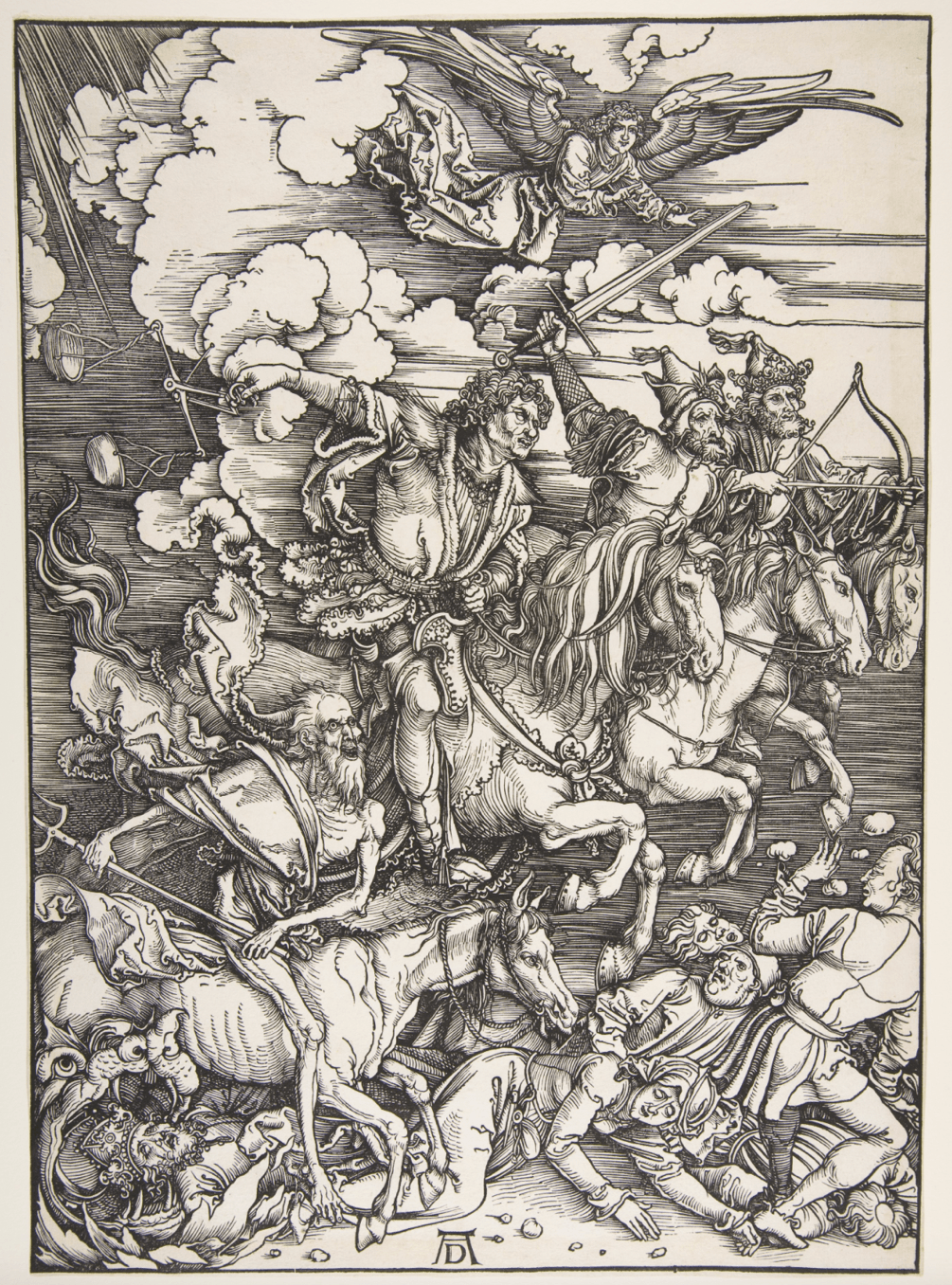
Albrecht Dürer, The Four Horsemen, “The Apocalypse”, 1498, Metropolitan Museum of Art. Public Domain.
Marking my calendar
I no longer have the luxury of certainty that I’ll be dead before the end-times. The actuaries give me 14 more years, maybe one extra for being a vegan. That means I anticipate expiring in 2040, preferably in summer. Winter in Norfolk is depressing enough without a funeral.
But President Trump and British Prime Minister Starmer are doing everything they can to bring about the end of human civilization before my appointment in Samarra. The former, Behemoth-like, by waging war on nature and hastening economic Armageddon. The latter, determinedly but less consequentially, by backtracking on environmental protection, slow-walking improvements to the NHS, and dismissing proposals that would improve tax fairness and reduce inequality. Reform UK, Nigel Farage’s barely updated version of Oswald Mosley’s 1932 British Union of Fascists, is poised to pick up the pieces of another failed British government and join forces with its big, strong American cousin, the Republican Party.
In a nod to Farage, Starmer’s has pledged to cut recruitment of health care and other low-skill workers (mostly non-white) from abroad. If he has his way, there will be no kindly South Asian and African nurses and carers for me. (The PM must think British-born workers will queue-up for demanding jobs paying £12 per hour). In 15 years, my poor wife Harriet will be stuck doling out my meds, tying my shoelaces, and combing my wisps of hair as we vainly await the Rapture – unless it all blows up first!
The four-horsemen are galloping toward us at speed: 1) pestilence. 2) war by autonomous AI; 3) economic collapse; 4) global warming. Don’t be depressed! Contemplating the end encourages us to enjoy the now. Carpe diem!.
Pestilence
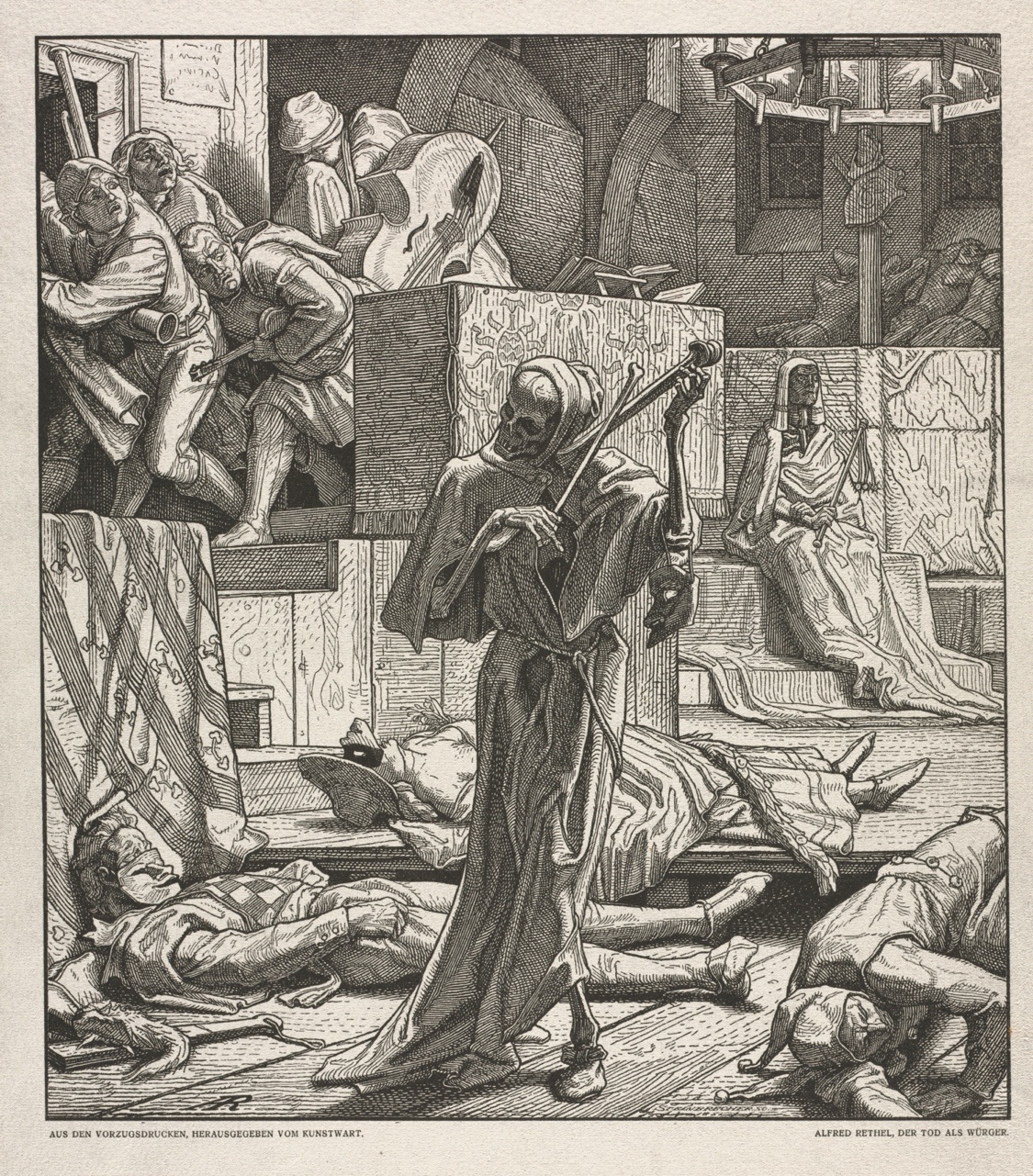
Alfred Rethel, Dance of Death: Death the Strangler, 1850. The Cleveland Museum of Art. Public domain.
Under Trump, the U.S. suffered more Covid deaths than any other nation including China where the outbreak began. Before the pandemic, the U.S. president disastrously cut CDC staff in China, as well as cabinet level contacts with the country, making it nearly impossible to follow the early course of the disease. He also rejected mask use, after initially supporting it, and promoted quack cures like chloroquine, Ivermectin, and bleach. The re-elected president’s recent withdrawal of the U.S. from the World Health Organization, and gutting of staff at the CDC, NIH and FDA mean that the nation – and the world – are ill-prepared for the next pandemic.
The Trump administration’s deregulation of animal agriculture — reduction of safety inspection and approval of industry efforts to speed up production lines — means there will be many more chances for viruses to jump from wild to domesticated animal populations. Republican abandonment of efforts to halt biodiversity decline, deforestation, and habitat loss – the consequence of climate change — mean that diseases formerly restricted to tropical zones will spread north as well as cross the wildland-urban interface. Risks from zoonoses such as dengue, malaria, ebola, SARS, and bird flu (H5N1) will continue to grow. In such a scenario, industrial production and consumer spending will freeze, and the global economy collapse. I have amassed a nice collection of N99 masks but have no illusions they will save a senior citizen when the next pandemic hits.
War by AI
As if we don’t have enough idiotic reasons for war – territorial disputes, control of markets, desire for resources, religious and ethnic differences, treaties and defense pacts, preemption and retribution, profit for the arms and aerospace industries, and humanitarian intervention – we now have another: the entertainment of our robots.
The imminent arrival of supersmart AI, also known as Artificial General Intelligence (AGI) has significant implications for war planning by the major global powers. One nation’s machines may soon possess the ability and desire to incapacitate its rival’s nuclear weapons or defenses. In that circumstance, both countries would have an incentive to strike first during a time of military tension – the one because it thinks it can win without suffering significant losses; the other because it thinks it needs to attack first before it is disabled. Mutually assured destruction (MAD), the fragile foundation of nuclear security for more than 60 years, may soon be rendered otiose.
And then there is an additional doomsday scenario that sounds like the stuff of science fiction – and is. Right now, a small set of AI companies including Open AI, Microsoft, Meta and about a dozen others, are pursuing AGI without significant (or any) controls by democratically elected governments. It’s just the smart machines and their dumb bosses in charge. (The U.S. and U.K. have no regulations on AI; the E.U. recently launched some.) The tech overlords may tell us their goal is a world of abundance in which robots work while humans play, but their real goals are the acquisition and enhancement of power and wealth. As Mel Brooks once said, “It’s good to be the king!”
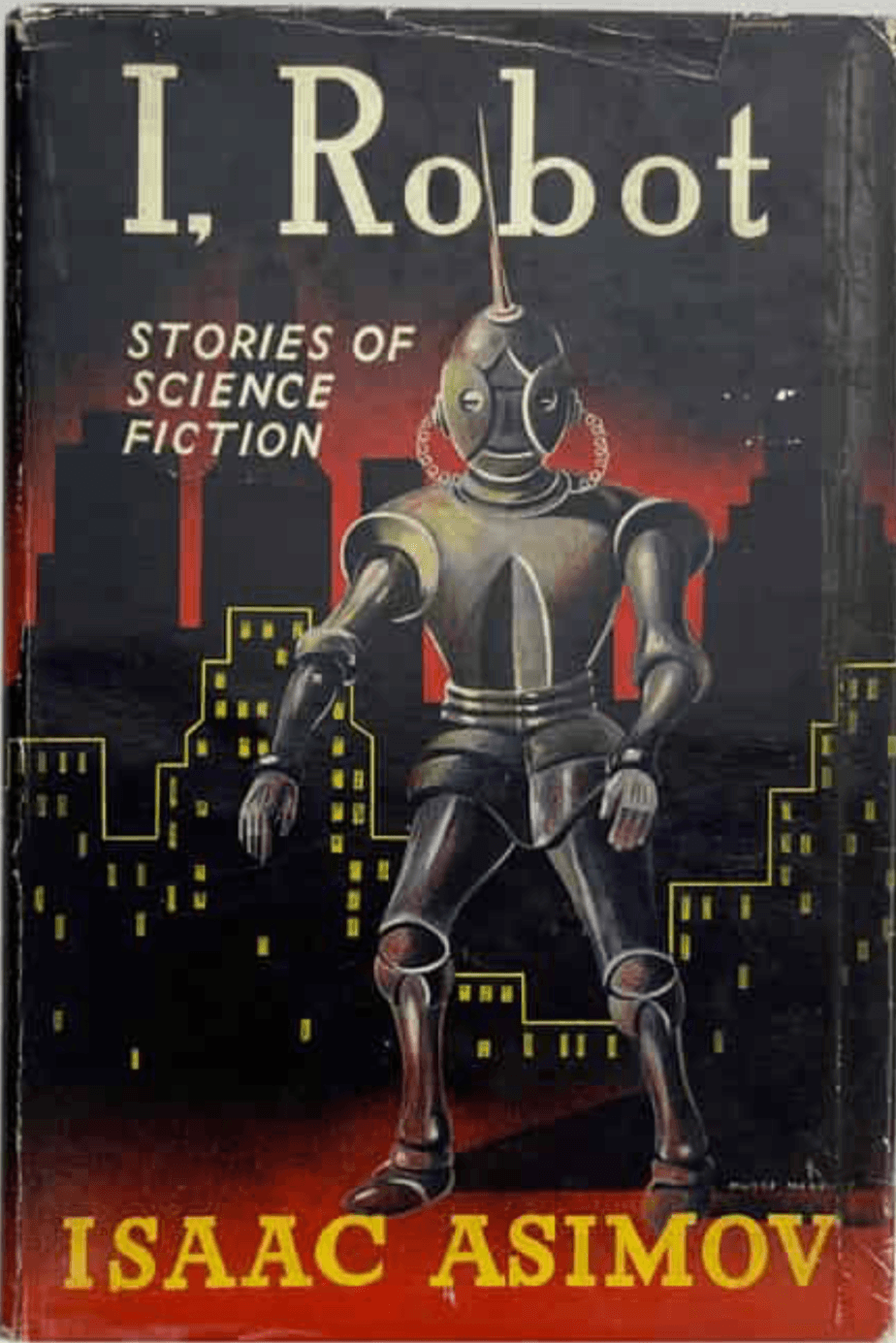
Isaac Asimov, I, Robot, 1952 (first U.K. edition). Photographer unknown.
Once AGI is achieved, tech stocks will skyrocket and the oligarchs will celebrate, heedless of the fact that their new and improved robots remain prone to errors or “hallucinations,” potentially dangerous ones: think water systems, air traffic control, communication, and electric utilities. Inspired by Isaac Asimov’s famous First Law of Robotics, “A robot may not injure a human being or, through inaction, allow a human being to come to harm,” the AI bros may add new safeguards, including Asimov’s Second Law: “A robot must obey the orders given it by human beings except where such orders would conflict with the First Law.”. But will they ever get around to the Third Law: “A robot must protect its own existence as long as such protection does not conflict with the First or Second Law.” Suppose a low-level programmer, told to enter the third law, gets distracted and forgets its second clause? In that case, a robot attacked by aggressive viruses and malware would be wise to eliminate every potential hacker; it would destroy all human life on earth. Oops!
Economic collapse
Tolstoy’s famous opening line of Anna Karenina can be adapted to describe capitalism: “All growing capitalist economies are alike; each failing one is failing in its own way.” Recessions and depressions have been triggered by bank and mortgage lender collapses, asset bubbles, liquidity crises, pandemics, supply chain snafus, aging populations, high interest rates, low interest rates, supply shocks (like disruption of the oil supply) and even just loss of consumer or investor confidence.
High tariffs, such as those implemented or proposed by Trump, could easily tip a fragile economy into recession. The tariffs on Chinese goods are potentially the most damaging, both because they are so high, and because they will impact consumer as well as capital goods essential for U.S. manufacturing. The effective tariff rate on Chinese products is now about 30% but may rise much higher when Trump’s 90-day tariff suspension expires this summer.
Recessions are common. In fact, stagnation is more the rule than the exception in American economic history, and has rarely caused major political upheaval, much less threatened apocalypse. But the American people are angry, and a sharp downturn could spur mass demonstrations. If protests were also directed at Trump’s immigration, Gaza, tax, civil rights and environment policies, he could respond with violence or martial law.
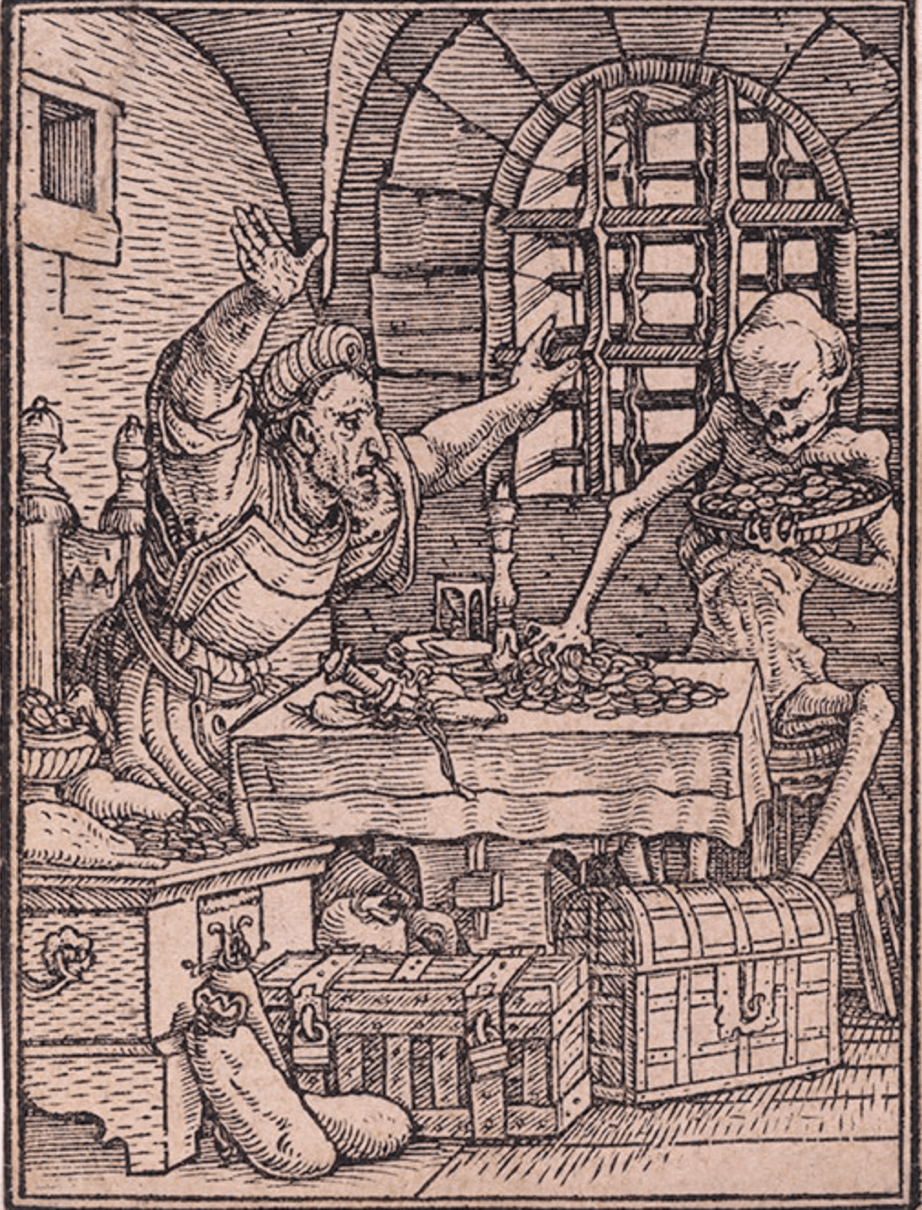
Hans Lützelburger (1495 –1526), (after Hans Holbein the Younger), Death and the Rich Man, ca. 1526, Metropolitan Museum of Art. Public domain.
That would broaden the resistance and worsen the recession. Strikes, boycotts and more repression would ensue. Chaos.
Global warming
The scientific consensus is that global warming is happening faster than previously thought. In 2024, the planet crossed the threshold 1.5-degree temperature rise that the IPCC didn’t expect to be breached until 2030 at the earliest. Last year was also the hottest year on record, and this year’s temperatures are following a similar trajectory. In fact, the last ten years have been the warmest ten ever recorded. Ocean temperatures over the last decade have risen even more quickly than land, leading to stronger and more rapidly intensifying hurricanes. Hotter ocean temperatures lead to more ocean evaporation and more rainfall.
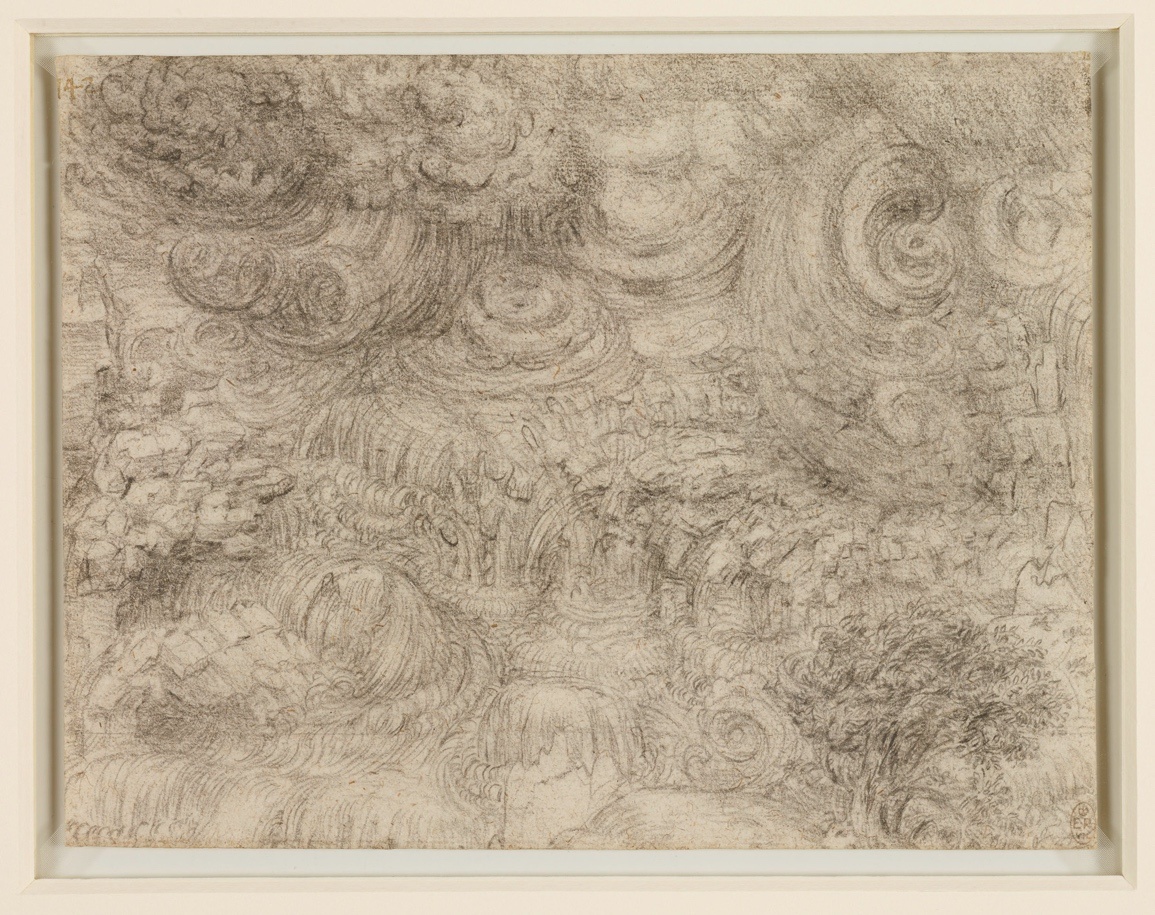
Leonardo da Vinci, A Deluge Drawing, 1517, The Royal Collection, his Majesty King Charles III. Public domain.
Sea-level rise has also accelerated, meaning that more shorelines are disappearing and more islands are threatened with inundation. There is every reason to believe the trend will continue, and even speed up unless we stop burning fossil fuels. We are also rapidly approaching multiple tipping points that once passed, will further accelerate sea-level rise and make it unstoppable. One of these tipping points is the loss of Antarctic ice-sheets. The intrusion of warm ocean water between the ice and supporting bedrock is causing the former to become destabilized and slide toward the sea. When that happens, the sea-level will rise far more than previously expected – meters not just feet. Every major coastal city in the world will be impacted,
Other dire climate change effects are also becoming apparent. Heat and drought have made whole cities nearly unlivable. Phoenix, AZ in 2024, experienced 113 consecutive days of temperatures over 100 degrees. By 2050 or sooner, it will suffer about 50 days a year of temperatures above 110. Recent research indicates that over 104, the human body can’t overcome excessive heat and continue to function. A rise in heat-caused deaths is certain in the Southwest and South, indeed across the U.S.
Los Angeles, El Paso, Phoenix and other cities may run out of water within a generation. Miami too, though not so much from heat and drought as from the intrusion of rising sea water into the aquifer that provides the city its fresh water. Fires this year destroyed whole neighborhoods in Los Angeles County. Though not as severe in their human impacts, fires last year also plagued east coast cities, the Pacific Northwest, and even Minnesota, “the Land of Lakes”.
The U.S. is per capita the world’s worst offender when it comes to the burning of fossil fuels, the production and consumption of meat (a major source of greenhouse gases) , and the use of gasoline powered cars, trucks and buses. Here in Norwich, UK, the buses are mostly electric. In the U.S. few are, and the Trump administration is cutting grants that would have accelerated the transition from gas or diesel to electric. The consequences will soon be dire, and not just on human health. Climate change will inevitably lead to system change.
Günther Thallinger, chief executive officer, of Allianz Investment Management, and member of the board of Allianz SE, one of the world’s biggest insurance companies, recently said that runaway climate change will destroy the global capitalist economy: “Heat and water destroy capital. Flooded homes lose value. Overheated cities become uninhabitable…. Entire regions are becoming uninsurable.”
When that happens, mortgages and other financial services are no longer viable and whole asset classes – industry, agriculture and transportation as well as housing — will disappear form ledger books. Regions too will lose their asset valuations. What will be the value of Miami or Los Angeles without their booming housing markets?
When insurance is impossible, assets cannot be priced, and what cannot be priced cannot be bought. The consequence will be a general crisis of capitalism, far greater than any that came before. Those of us on the socialist left yearn for a rapid end to the extractive, exploitive, nature-destroying, soul hardening, creativity-denying, capitalist system. Will I live to see it’s unravelling? All I can say is that at the rate Trump, Starmer, their patrons and courtiers are going, the whirlwind may come sooner rather than later. Whether that storm is followed by fair weather or foul is anybody’s guess.
