13 Jul 2025

Trump’s tariffs and the threat of World War III

Nick Beams


The longer and more intensive Trump’s tariff war becomes—new threats being issued almost daily through executive orders and posts on social media—the more clearly is revealed the underlying logic of what appears in the form of economic madness.

Donald Trump [AP Photo/Evan Vucci]

The economic war against the world being waged by the US is reproducing, at a higher level, the conditions of the disastrous decade of the 1930s that played a major role in creating the conditions for World War II.

The 1930s Depression was deepened by the formation of currency and trade blocs—the division of the world into rival imperialist camps—which eventually led to the most destructive war in history, resulting in hundreds of millions of deaths and culminating in the use by the US of two atomic bombs against Japan.

While it was couched as a fight for democracy against fascism, whether in German or Japanese form, World War II was an imperialist war waged to determine which of the major capitalist powers would assume global dominance.

The US, due to its industrial capacity and consequent military might, was able to emerge victorious through the defeat of its rivals, Germany and Japan, and ensure that its ally, British imperialism, was placed in a subordinate position, unable to return to the glory days of the Empire.

Now a new world war is in rapid gestation as US imperialism seeks to overcome its protracted decline and reassert its global dominance.

Its elemental driving force is not the personality or political proclivities of Trump. His actions are the expression of a deep-seated crisis in the American economy arising from its transformation from the industrial powerhouse of the world to the epicentre of speculation and parasitism, wracked by continuous financial storms.

Having no economic solution to its decline, US imperialism increasingly turns to “mechanical means”—war—to maintain its position, a process which is necessarily accompanied by ever deeper attacks on the social position of the working class at home, enforced by the evisceration of what remains of bourgeois democracy and the creation of a fascist authoritarian regime.

The dominance of US imperialism in the post-war period has been epitomised in the role of the dollar as the global currency, conferring upon it what has been characterised as “exorbitant privilege.” For the first quarter century after 1945, when the US enjoyed industrial dominance, the dollar was backed by real value in the form of gold.

As that power waned, President Nixon in 1971 was forced to remove the gold backing from the US currency. A new period began in which the dollar maintained its global role but on a different foundation. Now it was a fiat currency backed only by the power of the American financial system and the might of the US state, above all its military capacity.

But the rise and rise of financialisation—the process by which profit came to be increasingly accumulated by speculative operations—which this new system produced has resulted in a series of crises over the past quarter century.

At the same time because of the dollar’s global role, the US state has been able to run up ever increasing debt. The result is the US government debt is now $36 trillion and is rising at what is universally acknowledged as an “unsustainable” rate, while debt has accumulated to unprecedented levels in the corporate world. The result is that the US is the most indebted country in history.

The ravings of Trump that the previous global economic and financial arrangements have resulted in the US being “ripped off” by the rest of the world through the growth of trade deficits and that it is necessary to Make America Great Again should not be dismissed as those of a lunatic.

In their own way, they reflect objective processes. The post-war economic and financial mechanisms have brought about a decline in the dominant economic position of the US. Trump expresses the insistence by all sections of the US political, military and economic establishment that it must be restored by all methods—economic war against its rivals combined with military means.

When Trump’s tariff war began under his first administration, it was primarily directed against China, accompanied by a series of analyses from intelligence agencies and numerous think tanks linked to them that the economic rise of China in and of itself constituted an existential threat to the hegemony of US imperialism.

Reflecting the universality of this assessment in all sections of the US ruling class and the two parties of Wall Street, the Democrats and Republicans, the economic war against China intensified under Biden. The Trump tariffs were largely retained with additional measures banning the export of high-tech products aimed at trying to cripple the next stage of China’s economic rise.

While these measures have impacted on China, they have demonstrably failed.

China has continued to make advances in manufacturing—it has become the leading manufacturing power in the world, a position once held by the US—using the most advanced techniques as well as making gains in the crucial field of artificial intelligence as exemplified by the developments made by the Chinese start-up AI firm DeepSeek announced in January.

In the second Trump administration the economic war for US supremacy has now extended as was made clear in the executive order of April 2 announcing the imposition of reciprocal tariffs against the rest of the world.

The order insisted that “the post-war international economic order” was based on “incorrect assumptions.” In other words, it had to be destroyed. Underscoring this perspective an accompanying Fact Sheet said: “Made in America is not just a tagline—it’s an economic and national security priority of this administration.”

The implications of this assessment should be soberly considered.

It must be emphasised that the post-war trading system, based on free trade, and the removal of tariffs and the establishment of the dollar as the global currency to prevent the formation of blocs, was not simply a series of economic measures.

It was no less an attempt to construct an international political system which mitigated against the economic conflicts becoming transformed into wars.

It was based on the conception that if nations, above all the major powers, freely traded goods and services then they would not go to war against each other—a situation which had to be prevented because it had the potential for bringing about socialist revolution following barbarism of the first half of the 20th century.

Of course, the notion that free trade was the antidote to war was always a fiction as evidenced by the fact that prior to World War I there were no two countries more bound together by their trade than Germany and Britain.

But the post-war system did serve to regulate and contain economic conflicts. Now the US is dedicated to its destruction.

Consequently, the economic war waged by the US has gone well beyond China. Trump issues diktats against friends and foes alike—the European Union, Japan, the UK, South Korea, indeed the entire world.

The attack is not only directed at trade deficits but against all domestic policies, such as taxes, regulations, bio-security measures and social services including the provision of subsidised pharmaceutical schemes, deemed to be inimical to the interests of US corporations.

And it is being extended into the political sphere. The announcement by Trump of a 50 percent tariff against Brazil—one of the few countries with which the US enjoys a trade surplus—because of legal proceedings against the former fascistic president Jair Bolsonaro makes this clear.

A crucial feature of all the so-called trade deals, really diktats—Trump has stipulated that what he sets out in a letter is what constitutes a deal—is that those countries wanting an agreement must align themselves with US “national security” interests. These interests are not only the suppression of China, important as that is, but US dominance in every part of the world.

At present Europe and Japan, together with many others are desperately seeking, at least publicly, to accommodate themselves to the US hoping they may get some concessions.

But in the councils and institutions of all the capitalist states—not only in China—there is a recognition that there is no real likelihood of this happening, and the US onslaught is directed against them.

Another response is starting to emerge based on the recognition that at some point they will be forced to confront the US if they wish to avoid being transformed into semi-colonies.

This outlook is reflected in the recent assertions by the European Central Bank president Christine Lagarde that the hour of the euro has struck, and it must play an increased global role. It is expressed in the resistance of Japan and its insistence that it cannot allow rice farmers to be sacrificed in return for concessions in the auto industry.

Other less powerful countries are aligning themselves with the BRICS grouping—originally comprising Brazil, Russia, India, China and South Africa but now with a membership of 11—which is trying to move away from dollar dependence in international trade, bringing further threats from Trump who has said losing dollar supremacy would be equivalent to losing a war.

No one has a crystal ball which can predict when and under what circumstances a miliary clash will break out.

But the objective logic of events is unmistakeable. Economic conflict is being accompanied by the rise in miliary spending to the highest levels in the post war period. In the case of Germany, which twice waged wars against the US in the 20th century, it has risen to levels not seen since the rearmament under Hitler.

Anyone who thinks that Japan and the European imperialist powers are simply going to fade away into the soft good night or that the US is going to let up on its drive for global domination is betting against history.

They have gone to war in the past and all the contradictions of the global capitalist system which precipitated those conflicts not only remain but have intensified.

In 1915, with the outbreak of World War I, Leon Trotsky explained that its source was the contradiction between the development of a global economy and the nation-state system in which the capitalist profit system is rooted.

Capitalist governments sought to resolve this contradiction “through the exploitation of the world’s economic system by the capitalist class of the victorious country; which country is by this war to be transformed from a great power into the world power.”

World War II was rooted in the same contradiction and was the means which the US assumed global hegemony. But the contradictions of capitalism remained and have intensified to an enormous degree with the development of globalised production over the past 50 years.

11 Jul 2025

Royal Society University Research Fellowship

Application Deadline:

  • Opening Date: 15 July 2025
  • Closing Date: 10 September 2025
  • Decision By: 30 June 2026

🏆 Tell Me About the Award:

The University Research Fellowship (URF) is one of the most prestigious fellowships in the natural sciences. Offered by the Royal Society, it supports early-career researchers who demonstrate exceptional potential to become leaders in their field. The fellowship provides up to eight years of flexible funding, career independence, and professional development opportunities to carry out innovative research in the UK or Republic of Ireland.

Which Fields Are Eligible?

The fellowship supports research in the natural sciences, including but not limited to:

  • Biological Sciences
  • Biomedical Sciences
  • Chemistry
  • Physics
  • Engineering
  • Mathematics
  • Computer Science
  • Environmental Sciences
  • Earth and Planetary Sciences

Type:

  • Fully funded early-career research fellowship
  • Independent academic research position

Who Can Apply?

You are eligible if you:

  • Have 3 to 8 years of post-PhD research experience (excluding career breaks)
  • Do not hold a permanent position (or proleptic appointment)
  • Have not held an equivalent fellowship supporting research independence
  • Work in an area covered by the Royal Society’s natural sciences remit
  • Are of any nationality and eligible to apply for a Global Talent Visa

Note: Applicants in Republic of Ireland must meet additional SFI requirements.

How Are Applicants Selected?

  • Applications are reviewed by one of five Research Appointment Panels based on subject area
  • Initial review by expert panel members
  • Longlisted applications undergo independent peer review
  • Shortlisted applicants are invited for an interview
  • Final selections are made by the panels with oversight from the Royal Society

Which Countries Are Eligible?

  • Open to applicants of all nationalities
  • Host institution must be in the UK or Republic of Ireland

Where Will the Award be Taken?

  • At a university or not-for-profit research institution in the UK or Republic of Ireland

How Many Awards?

  • The number of fellowships awarded varies by year based on available funding
  • Historically, around 40–50 fellowships are awarded annually

What is the Benefit of the Award?

Up to £1.87 million over 8 years, covering:

  • Salary (full or partial)
  • Research expenses (equipment, consumables, travel)
  • One or more 4-year PhD studentships
  • Relocation and visa costs for applicant and dependants
  • Flexible working options, maternity/paternity leave support
  • Childcare expenses for conference travel
  • Access to professional development, leadership training, and public engagement activities

How Long Will the Award Last?

  • 8 years total, with a mid-fellowship review after year 4
  • Years 6–8 are conditional on satisfactory progress

How to Apply:

  • Applications must be submitted via the Royal Society’s Flexi-Grant® system
  • Prepare:
    • CV and publication list
    • Research proposal
    • Host institution support documents
    • Head of Department statement (now visible to the applicant)
    • Budget and justification

Visit the Award Webpage for Details:

https://royalsociety.org/grants/university-research

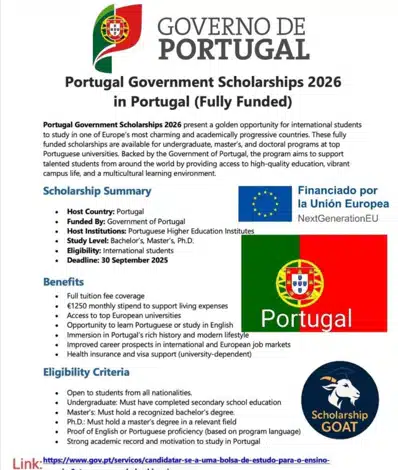
Portugal Government Scholarships 2026

Application Deadline:

  • 30th September 2025
  • Interviews (if required): October to November 2025 (institution-specific)
  • Notification of Results: Late 2025
  • Course Start Date: Autumn 2026 (varies by institution)

Tell Me About Portugal Government Scholarships:

The Portugal Government Scholarships 2026 offer an exceptional opportunity for international students to pursue undergraduate, master’s, or doctoral degrees at top Portuguese universities. Fully funded by the Government of Portugal, this program is part of the NextGenerationEU initiative and is designed to support talented students worldwide through access to quality education, world-class research, and cultural exchange.

This competitive scholarship targets high-achieving individuals committed to advancing their academic goals in a vibrant and globally connected European environment. Portugal, known for its strong academic institutions, inclusive society, and dynamic research output, is an increasingly attractive destination for international scholars.

Type:

Scholarship (Bachelor’s, Master’s, and PhD)

Who can Apply?

Undergraduate Applicants

  • Completion of secondary school or high school equivalent
  • Strong academic performance

Master’s Applicants

  • A recognized bachelor’s degree in a relevant field
  • Proof of language proficiency in English or Portuguese

PhD Applicants

  • A master’s degree in a related subject area
  • Research experience or a clear proposal aligned with the host institution
  • Strong academic references and academic record

Applicants must show a genuine motivation to study in Portugal and demonstrate potential for contributing to their academic field and future careers. There is no nationality or age restriction, making this opportunity inclusive for students worldwide.

Language Requirements

Programs are available in both English and Portuguese. Applicants should submit proof of proficiency in the language of instruction for their chosen program. Accepted tests typically include IELTS, TOEFL, or institutional certifications.

How Are Applicants Selected?

Applications are reviewed on academic merit, research potential (if applicable), and alignment with program goals. Shortlisted candidates may be invited to online interviews by the respective institutions.

Which Countries are Eligible?

All

How Many Awards?

Not specified

What is the Benefit of Portugal Government Scholarships?

  • Full coverage of tuition fees
  • Monthly stipend of €1,250 to cover living expenses
  • Health insurance and visa assistance (depending on the institution)
  • Access to programs taught in English or Portuguese
  • Language and cultural immersion opportunities
  • Enhanced career prospects across the EU and international job markets
  • Academic support and mentorship through Portugal’s top universities

Why Should I Study in Portugal?

Portugal offers a unique combination of high academic standards, affordable living, and a welcoming multicultural society. As part of the European Higher Education Area, degrees from Portuguese institutions are recognized throughout Europe and beyond. Students benefit from small class sizes, innovative teaching methods, and strong industry-academic connections, particularly in fields like technology, engineering, sustainability, health sciences, and the arts.

Furthermore, Portugal’s historical ties across Africa, South America, and Europe create a particularly diverse academic community. Many universities have active international offices and support networks for global students.

How to Apply:

  1. Visit the official government portal:
    Apply Here
  2. Register an account and select your preferred academic level and institution. Applicants can apply to more than one program.
  3. Prepare and upload the following documents:
    • Curriculum Vitae
    • Academic transcripts and certificates
    • Passport or identification document
    • Language proficiency certificate
    • Motivation letter and research proposal (for master’s or PhD)
    • Letters of recommendation
  4. Submit the completed application online by 23:59 (Lisbon time), 30 September 2025

US Supreme Court permits Trump to move ahead with mass layoffs and destruction of federal agencies

Kevin Reed


The Supreme Court is seen on Capitol Hill in Washington, Dec. 17, 2024. [AP Photo/J. Scott Applewhite, ]

In an attack on workers’ democratic and social rights, the Supreme Court of the United States (SCOTUS) has cleared the way for the Trump administration to proceed with mass layoffs of federal employees.

The tens of thousands of job cuts target the infrastructure of government and public services, the focus of the assault by the Department of Government Efficiency (DOGE), formerly led by billionaire oligarch Elon Musk.

The decision, which overrides a lower court injunction, marks a new stage in the offensive by the Trump administration against US government services dating back to the New Deal reforms that were implemented to forestall social revolution in the 1930s.

On July 8, the Supreme Court lifted a lower court ruling that temporarily blocked Trump’s sweeping plans to lay off federal workers across more than 20 agencies.

The unsigned SCOTUS order, supported by the Court’s right-wing majority as well as liberal Justices Elena Kagan and Sonia Sotomayor, allows the administration to resume its efforts to “reorganize and scale back” the federal government while the legal challenge proceeds.

The order does not decide the underlying legality of Trump’s executive order announcing the elimination of the jobs or the specific agency reduction plans. Instead, the Court claims the government is “likely to succeed” in its argument that the executive order and related directives are within presidential authority.

The court majority states:

We express no view on the legality of any agency reduction-in-force and reorganization plan produced or approved pursuant to the executive order and memorandum. The district court enjoined further implementation or approval of the plans based on its view about the illegality of the executive order and memorandum, not on any assessment of the plans themselves. Those plans are not before this court.

As it has done in other recent critical decisions, SCOTUS refused to address the substance of the matter while granting Trump precisely what he wanted: the green light to proceed with his fascist agenda.

The Supreme Court’s order is notably terse, offering little in the way of legal language. There is no engagement with the catastrophic real-world consequences of the layoffs or the constitutional questions raised by the lower courts.

The lower court decision, issued by US District Judge Susan Illston in San Francisco, had temporarily blocked the layoffs, saying that Trump had exceeded his authority by ordering mass firings and reorganizations without Congressional approval, which is required for agencies created and funded by Congress.

The judge asserted this critical element of constitutional checks and balances, noting that the executive cannot unilaterally dismantle the federal government.

Justice Ketanji Brown Jackson stood alone in dissent, issuing a rebuke and warning to the nation. She wrote:

Given the fact-based nature of the issue in this case and the many serious harms that result from allowing the President to dramatically reconfigure the Federal Government, it was eminently reasonable for the District Court to maintain the status quo while the courts evaluate the lawfulness of the President’s executive action.

Jackson accused the majority of allowing Trump to take a “wrecking ball” to the federal bureaucracy:

At bottom, this case is about whether that action amounts to a structural overhaul that usurps Congress’s policymaking prerogatives—and it is hard to imagine deciding that question in any meaningful way after those changes have happened. Yet, for some reason, this Court sees fit to step in now and release the President’s wrecking ball at the outset of this litigation.

Her dissent points to the court’s ongoing abdication of its responsibility to defend the constitutional separation of powers and protect the public from executive abuse.

The case originated in a wave of lawsuits filed by states and labor unions after Trump’s February executive order mandating mass layoffs and agency downsizing. Attorneys general from Washington D.C. and 19 states argued that federal agencies were violating the law by firing probationary employees under the pretense of poor performance, when they were executing a politically motivated far-right reduction of the workforce.

The states warned that these actions would devastate regional economies and public services, as federal law requires advance notice and coordination for mass layoffs to mitigate economic dislocation.

The layoffs target departments including Agriculture, Commerce, Health and Human Services, State, Treasury and Veterans Affairs. Experts and state officials warned that the cuts would disrupt essential services such as healthcare, food safety and veterans’ benefits, create cascading instability in local economies reliant on federal employment, and overwhelm state support systems as displaced workers seek assistance.

Arthur Wheaton, director of labor studies at Cornell University, cautioned:

It will not save a lot of money if they try to maintain the same level of service, so you may be getting less from the smaller workforce. … It’s going to be real expensive for the lawsuits and the fights that are going to go on for long term. And it creates an incredible amount of tension and stress within the system, which is partly by design.

Federal workers themselves report deep anxiety and exhaustion, with many contemplating early retirement or fearing for the future of their departments. The layoffs, already affecting over 10,000 workers, threaten to cripple agencies like Veterans Affairs, the Centers for Disease Control and Prevention and the Environmental Protection Agency.

The dire impact of staff reductions has already been manifested in the death and destruction caused by the flooding in Texas, where the National Weather Service was ill-prepared to warn the public due to understaffing and a lack of critical resources.

The response of federal government employee unions, particularly the American Federation of Government Employees (AFGE) and the AFL-CIO, has been characterized solely by legal maneuvering and appeals to the courts, without any mass mobilization of the workers.

When the layoffs were first announced, the unions filed lawsuits and issued statements but refused to organize strikes or workplace actions that would mobilize the broader working class against the Trump administration in defense of jobs and services.

This strategy, rooted in the unions’ alliance with the Democratic Party, has proven bankrupt. The unions have preferred to rely on legal appeals and negotiations with the very political establishment that is complicit in the assault on public sector jobs.

This has left the working class vulnerable and without any effective means of resisting the deadly impact of the destruction of government infrastructure and the vital services it provides.

The Democratic Party has played a critical role in enabling the Trump administration’s offensive. In March, Senate Minority Leader Chuck Schumer announced that he would vote to keep the government running by supporting a Republican-led continuing resolution, providing Trump with the votes needed to avert a shutdown and continue his policies.

Schumer insisted a shutdown would be worse than giving Trump the means to further attack federal employees. This maneuver, combined with the Democrats’ reliance on stunts and legal challenges with little hope of success, has allowed Trump and his fascist Republican allies to push through their “Big Beautiful Bill”—a massive transfer of wealth to the billionaire elite which balloons the federal deficit while destroying public services and kicking more than 11 million workers off Medicaid.