13 Sept 2025

Election in Norway returns Labour to power, as far-right Progress Party doubles vote share

Jordan Shilton


People cast ballots at Norway’s Parliamentary elections in Oslo, Norway, Monday, Sept. 8, 2025. (AP Photo/Kostya Manenkov)

Norway’s governing Labour Party (AP) emerged as the largest party in Monday’s general election, taking 28.0 percent of the vote and 53 seats in the 169-seat parliament (Storting). Although the bloc of “left” parties secured a total of 88 seats—a majority needed to re-elect AP’s Jonas Gahr Støre as Prime Minister—the biggest gain in the vote was achieved by the far-right Progress Party (FRP), which doubled its support to around 24 percent.

Støre will now enter talks with the other members of the “red” bloc on forming a coalition government or at least securing support from the outside for a minority AP government. The four smaller parties are the rural-based Centre Party (SP), the Socialist Left (SV), the Red Party, and Environmental Party the Greens (MDG). While differences exist among these parties—particularly on the continued exploitation of Norway’s oil resources, which MDG and SV formally oppose—they all agree on investing huge sums to strengthen Norway’s position as a military staging ground for war and supporting the far-right Ukrainian regime in the US/NATO-backed war on Russia.

Last year, all nine parties in the Storting united to pass a 12-year military spending plan that will effectively double the military budget with an additional 600 billion kroner (about €50 billion) in additional investments. One of those, the purchase of five frigates at a cost of 136 billion kroner, was announced by Støre during the last weeks of the election campaign. It went hand in hand with the government’s release of a new Arctic strategy entitled “Norway in the North,” which called for a stepped up military presence on the part of Norway and NATO to confront Russia and China.

The parties also unanimously approved a major increase in funding to the far-right Ukrainian regime earlier this year, bringing the total financial support from Oslo to Kiev during 2025 to 85 billion kroner. Since all of the military spending is being funded while the Norwegian government maintains its pledge to spend no more than 3 percent of its Government Pension Fund Global (GPFG), better known as the Oil Fund, each year, the parties backing the explosion in war spending do so at the expense of public services and social programmes. The GPFG has an estimated value of €1.7 trillion, making it the world’s largest sovereign wealth fund.

The Norwegian political establishment’s unanimous support for NATO militarism and war will mean, whatever the differences that may emerge over the composition of the new government, increased attacks on the living conditions and rights of the working class. Over the past three years, energy prices spiked dramatically due to the European imperialists’ support for war with Russia, which saw them massively reduce low-cost Russian gas imports. Norway substantially increased natural gas exports throughout Europe, and demand for its hydro power rose sharply as its energy grid was integrated ever more closely into supply chains across the continent.

With domestic energy prices at a record high in December 2024, Labour’s popularity slumped to just 14 percent in the polls. In January, the SP left the government coalition, criticising Labour for giving up national control over Norway’s energy policy to the European Union. This stoking of nationalism played directly into the hands of the FRP, whose gains across many of Norway’s regions came at the expense of the SP. The SP lost more than half of its more than 13 percent support at the 2021 election, securing just 5.6 percent this time around.

Støre responded to the energy price crisis by persuading former NATO Secretary General Jens Stoltenberg to return to national politics as Finance Minister. He also introduced a “Norway price” for home energy bills, capping the cost at 0.4 kroner per kilowatt hour. The price takes effect on 1 October, less than a month after Monday’s vote, and played a major role in the revival of Labour’s fortunes.

Norway’s Trade Union Confederation (LO), which has over a million members in a country with a population of just over 5 million, lauded Monday’s election result. “Our social model is based on freedom, equality, and solidarity,” declared LO leader Kine Asper Vistnes. “It has proven itself well equipped to handle crises and transitions. Now we must take care of it.”

The so-called Norwegian or “Scandinavian model” has in fact long passed into history. In its heyday in the post-war period, it rested on an extremely transitory set of global economic and geopolitical factors that allowed governments in the Nordic region to make substantial concessions to the working class while maintaining close ties to American imperialism. The restabilisation of world capitalism by Washington in the aftermath of World War II, during which the Norwegian bourgeoisie proved itself more than willing to collaborate with the Nazi occupation of the country, created a brief window of perhaps 25 to 30 years in which national reformist programmes gained a new lease of life, allowing levels of social inequality across the Nordic region to decline significantly and the welfare state to expand. But since the 1980s, this process has been in steady reverse. Privatisations, handouts to the wealthy, and strict spending controls have seen the gap between rich and poor increase across Norway, Sweden, and Denmark.

For Vistnes to hold up the present political conditions in Norway as a powerful advertisement for the “Norwegian model” provides in fact one of the most devastating refutations to all of those political forces around the world who claim that capitalism can be “humanised” by means of pressure for “reforms” from below, and the advice of well-placed and well-paid union bureaucrats. The country is a frontline state in NATO’s war aimed at subjugating Russia to the status of a semi-colony, and the entire political establishment has mortgaged the future on building up the military in alliance with American and European imperialism. Although in comparative terms many Norwegian workers still enjoy better-paid jobs and stronger protections than their colleagues across Europe, these rights are under constant attack. Moreover, the hundreds of billions to be invested in war will, one way or another, be extracted from the workers and the public services on which they depend.

In addition, Norway’s traditional political setup is decomposing. Norwegian workers do not live in some kind of national bubble, but increasingly confront the same fundamental political problems posed to the working class internationally. Notwithstanding Labour’s victory, its level of support is nowhere near the more than 35 percent it regularly achieved in elections into the 1980s. What’s more, the official right-wing parties are collapsing in the face of the growth of the far right, which enjoys significant financial support from sections of big business. Hoyre, the traditional conservative party, finished a distant third Monday with just 14.6 percent of the vote, while the liberal Venstre fell below the 4 percent barrier needed to secure the status of a parliamentary group and will only be represented by three deputies in parliament.

FRP leader Sylvi Listhaug, who calls for the elimination of taxes on the wealthy, a state crackdown on “criminals” and an intensification of Norway’s already restrictive immigration policy, will be the leader of the opposition over the next four years. In neighbouring Sweden, the right-wing government relies for its majority on the support of the far-right Sweden Democrats, whose origins are in the country’s neo-Nazi movement.

In his victory speech, Støre offered an olive branch to the right-wing parties, including Listhaug’s FRP. After noting that he had spoken to both Hoyre leader Erna Solberg and Listhaug, and accepted their congratulations on his victory, Støre added, “In Norway we have political opponents, but we don’t have enemies.” It has been suggested that if agreement with the smaller “red bloc” parties proves impossible, Støre could rely on the support of the right-wing parties in parliament to pass some of his measures.

The parties to the “left” of AP, above all SV and Red, seek to justify their readiness to back Støre as Prime Minister with the threat of Listhaug coming to power. In her election night speech following Red’s slight increase in support from 4.7 percent to 5.3 percent, leader Marie Sneve Martinussen stressed that her party was ready to work with Støre to bring about “practical change.”

Both Red, which was founded as the successor organisation to the Maoist Workers Communist Party of Norway in 2007, and SV, an alliance established in the 1970s by a faction of the Stalinist Communist Party and a split-off from AP, sought to capitalise on widespread horror over the genocide in Gaza during their election campaigns. They both called for the Oil Fund to divest from Israeli companies and for Oslo, which became one of the first European countries to recognise a Palestinian state, to “do more for Palestine.” They also called for increases to taxation on the rich to reduce inequality and help fund public services. While Red’s support increased marginally, SV fell from over 7 percent in the 2021 election to 5.6 percent this time around.

The idea that a new edition of the Støre government, whatever its final composition, will do anything to reverse the trend of growing social inequality and Norway’s ever more direct integration into the aggressive war plans of the imperialist powers is pure fantasy. With Stoltenberg set to continue as Finance Minister, having rejected a position as head of the Munich Security Conference, the new government will deepen Oslo’s collaboration in the war on Russia and enforce further spending restraint.

Although some of the most right-wing sections of the business elite expressed their frustration at the election outcome, the relatively relaxed attitude of the main sections of the establishment was summed up in comments by Confederation of Norwegian Enterprise (NHO) head Ole Erik Almlid. He told NRK, “I am sure that ways can be found to cooperate well with both the Storting and government in the future.”

Asked “Can the NHO cooperate just as well with a Støre government or a Solberg/Listhaug government?”, he replied, “We always cooperate well with the sitting Storting and government, and we’ve shown that in various areas.”


10 Sept 2025

AI’s Ballooning Energy Consumption Puts Spotlight on Data Center Efficiency

Divya Mahajan


Photograph Source: IMarcoHerrera – CC BY-SA 4.0

Artificial intelligence is growing fast, and so are the number of computers that power it. Behind the scenes, this rapid growth is putting a huge strain on the data centers that run AI models. These facilities are using more energy than ever.

AI models are getting larger and more complex. Today’s most advanced systems have billions of parameters, the numerical values derived from training data, and run across thousands of computer chips. To keep up, companies have responded by adding more hardware, more chips, more memory and more powerful networks. This brute force approach has helped AI make big leaps, but it’s also created a new challenge: Data centers are becoming energy-hungry giants.

Some tech companies are responding by looking to power data centers on their own with fossil fuel and nuclear power plants. AI energy demand has also spurred efforts to make more efficient computer chips.

I’m a computer engineer and a professor at Georgia Tech who specializes in high-performance computing. I see another path to curbing AI’s energy appetite: Make data centers more resource aware and efficient.

Energy and heat

Modern AI data centers can use as much electricity as a small city. And it’s not just the computing that eats up power. Memory and cooling systems are major contributors, too. As AI models grow, they need more storage and faster access to data, which generates more heat. Also, as the chips become more powerful, removing heat becomes a central challenge.

Cooling isn’t just a technical detail; it’s a major part of the energy bill. Traditional cooling is done with specialized air conditioning systems that remove heat from server racks. New methods like liquid cooling are helping, but they also require careful planning and water management. Without smarter solutions, the energy requirements and costs of AI could become unsustainable.

Even with all this advanced equipment, many data centers aren’t running efficiently. That’s because different parts of the system don’t always talk to each other. For example, scheduling software might not know that a chip is overheating or that a network connection is clogged. As a result, some servers sit idle while others struggle to keep up. This lack of coordination can lead to wasted energy and underused resources.

A smarter way forward

Addressing this challenge requires rethinking how to design and manage the systems that support AI. That means moving away from brute-force scaling and toward smarter, more specialized infrastructure.

Here are three key ideas:

Address variability in hardware. Not all chips are the same. Even within the same generation, chips vary in how fast they operate and how much heat they can tolerate, leading to heterogeneity in both performance and energy efficiency. Computer systems in data centers should recognize differences among chips in performance, heat tolerance and energy use, and adjust accordingly.

Adapt to changing conditions. AI workloads vary over time. For instance, thermal hotspots on chips can trigger the chips to slow down, fluctuating grid supply can cap the peak power that centers can draw, and bursts of data between chips can create congestion in the network that connects them. Systems should be designed to respond in real time to things like temperature, power availability and data traffic.

How data center cooling works.

Break down silos. Engineers who design chips, software and data centers should work together. When these teams collaborate, they can find new ways to save energy and improve performance. To that end, my colleagues, students and I at Georgia Tech’s AI Makerspace, a high-performance AI data center, are exploring these challenges hands-on. We’re working across disciplines, from hardware to software to energy systems, to build and test AI systems that are efficient, scalable and sustainable.

Scaling with intelligence

AI has the potential to transform science, medicine, education and more, but risks hitting limits on performance, energy and cost. The future of AI depends not only on better models, but also on better infrastructure.

To keep AI growing in a way that benefits society, I believe it’s important to shift from scaling by force to scaling with intelligence.

Nepal’s Gen-Z Uprising is About Jobs, Dignity—and a Broken Development Model

Atul Chandra & Pramesh Pokharel


Photograph Source: हिमाल सुवेदी – CC0

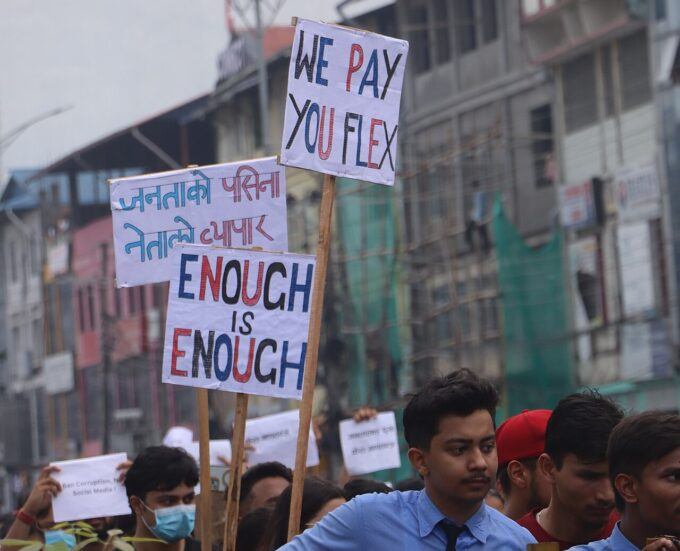
Kathmandu is on edge not because of “apps,” but because a generation raised on the promise of democracy and mobility has collided with an economy and political order that keep shutting every door. The proximate trigger was regulatory: the government ordered 26 major social-media platforms to register locally and began blocking those deemed non-compliant, including Facebook, YouTube, Instagram, WhatsApp, X and others. Crowds surged toward Parliament; police deployed tear gas, rubber bullets and, in several places, live fire. By late 9 September, at least 19 people were killed and well over 300 injured. Under pressure, the government lifted the social-media ban and Prime Minister K. P. Sharma Oli resigned.

The Spark Was the Ban. The Fuel Was Political Economy

It is tempting—especially from afar—to narrate this as a clash over digital freedoms. That would be analytically thin. For Gen-Z Nepalis, platforms are not just entertainment; they are job boards, news wires, organizing tools, and social lifelines. Shutting them off—after years of economic drift—felt like collective punishment. But the deeper story is structural: Nepal’s growth has been stabilized by remittances rather than transformed by domestic investment capable of producing dignified work. In FY 2024/25, the Department of Foreign Employment issued 839,266 labor permits—staggering out-migration for a country of ~30 million. Remittances hovered around 33 percent of GDP in 2024, among the highest ratios worldwide. These numbers speak to survival, not social progress; they are a referendum on a model that exports its youth to low-wage contracts while importing basics, and that depends on patronage rather than productivity.

That is why the ban detonated so quickly. With youth under- and unemployment already high at 20.82 percent as seen in 2024, ministerial churn the norm, and corruption scandals ambient, attempts to police the digital commons looked less like “order” and more like humiliation. The movement’s form—fast, horizontal, cross-class—echoed Bangladesh’s student-led mobilizations and Sri Lanka’s Aragalaya: school and college students in uniform, unemployed graduates, gig and informal workers, and a broader, disillusioned public converged around a shared verdict on misrule.

Facts on the Ground: Casualties, Curfews, and Climb-Down

The event’s sequence is unambiguous. An expansive registration order and blocking decision ignited protests; security forces responded with escalating force; by Monday night 19 were dead and hundreds injured; curfews and assembly bans spread; the Home Minister quit; an emergency cabinet huddle withdrew the ban; by Tuesday, Oli resigned.
Importantly, the grievance was never only digital. Protest signs and chants centered on corruption, elite impunity, and the absence of a credible development horizon. Amnesty International demanded an independent probe into possible unlawful use of lethal force—another reason the uprising hardened from a platform quarrel into a legitimacy crisis.

Migration as the Silent Plebiscite

If one metric explains the generational mood, it is Exits. The 839,266 labor permits issued in FY 2024/25 (up sharply from the previous year) translate into thousands leaving every day at the peak. These are not tourists; they are the very cohort now on the streets. Their remittances—~33 percent of GDP—keep households afloat and the import bill paid, but they also mask a lack of structural transformation in the domestic economy. In a system that cannot absorb its educated youth into stable, value-adding work, the public square—online and offline—becomes the one place where dignity can be asserted. Trying to close that square amid scarcity was bound to provoke an explosion.

A Self-Inflicted Wound for Nepal’s Left

Following Nepal’s four-year IMF Extended Credit Facility (ECF) program, the government faced pressure to boost domestic revenue. This led to a new Digital Services Tax and stricter VAT rules for foreign e-service providers, but when major platforms refused to register, the state escalated by blocking them. This move, which began as a tax enforcement effort, quickly became a tool of digital control, and it occurred as the public was already dealing with rising fuel costs and economic hardships driven by the program’s push for fiscal consolidation. The government’s platform ban became the final trigger for widespread protests against corruption, joblessness, and a lack of opportunities, highlighting that the unrest was less about a “color revolution” and more about material grievances fueled by austerity measures.

That the crackdown and its political denouement unfolded under a CPN (UML) prime minister makes this a strategic calamity for Nepal’s left. Years of factional splits, opportunistic coalitions, and policy drift had already eroded credibility among the young. When a left-branded government narrows civic space instead of widening material opportunity, it cedes the moral terrain to actors who thrive on anti-party cynicism—individual-cult politics and a resurgent monarchist right. The latter has mobilized visibly this year; with Oli’s resignation, it will seek to portray itself as the guarantor of “order,” even as its economic vision remains thin and regressive. This is the danger: the very forces most hostile to egalitarian transformation can capitalize on left misgovernance to expand their footprint.

From an anti-imperialist vantage—one that opposes Northern privilege yet insists on unsentimental analysis—the crisis is textbook dependency without development. Remittances smooth consumption but entrench external dependence; donor-driven governance tweaks rarely become employment-first industrial policy; and procurement-heavy public spending feeds rent circuits more than productive capacity. In such an order, the state is tempted to police visibility rather than transform conditions. That is why an attempt to regulate platforms by switching them off—rather than by ensuring due process and narrow tailoring—was read as an effort to manage dissent, not to solve problems.

What Opposition Signals Tell Us (and What They Don’t) 

Opposition statements recognized the larger canvas sooner than the government did. Pushpa Kamal Dahal (Prachanda) expressed condolences, urged action on anti-corruption demands, and called for removing “sanctions on social networks.” The CPN (Unified Socialist) and CPN (Maoist Centre) statements condemned the repression, demanded an impartial investigation, and linked digital curbs to failures on jobs and governance. These reactions matter analytically because they show that even within mainstream politics there is acknowledgment that the crisis is about livelihoods and legitimacy, not merely law-and-order.

But these signals also reveal the predicament of the left: if its leading figures can only react to a youth uprising rather than prefigure the development horizon that would have prevented it, then the arena will be dominated by anti-establishment and royalist currents claiming to deliver order faster—even at the cost of democratic space.

The bottom line

These protests in Nepal began because a government tried to regulate by switching off the public square. They exploded because that square is where a precarious generation looks for work, community and voice in the absence of opportunity at home. A complete accounting must therefore record both the human toll—19 dead and hundreds injured—and the structural toll: hundreds of thousands compelled to leave each year and remittances that prop up consumption while postponing transformation. With Oli’s resignation and the ban withdrawn, the immediate confrontation may ebb, but the verdict delivered by Gen-Z will not. Until Nepal replaces remittance complacency and coalition arithmetic with an employment-first development model, the streets will remain the most credible arena of accountability.