
13 Sept 2025

Ending Mass Shootings Requires Fewer Guns

Peter Phillips


Image by Chip Vincent.

The mass shooting on August 27, 2025, at a Minneapolis Catholic church killed two children and wounded 14 children and three adults. A shocked America prompted many calls for stronger gun control laws. First Lady Melania Trump posted on X about the need for pre-emptive intervention in identifying potential shooters. Both approaches, restricted gun ownership and mental health intervention, have some validity. The problem isn’t going away!

Gun violence is the leading cause of death for children in the United States. Gun deaths for children and teens rose fifty percent from 1,731 in 2019 to 2,590 in 2021. In 2021, guns killed more than forty-five thousand Americans. In 2023, 647 people in the US were killed in mass shootings; In 2024 711 mass shooting deaths were reported. A mass shooting is defined an incident in which an attacker kills or wounds four or more people.

The United States accounts for less than five percent of the world’s population, yet has 46 percent of civilian-owned guns in the world, making the US globally the highest per capita gun ownership country. People in the US own 393 million firearms, equating to about 120.5 guns per 100 people. Therefore, the availability of firearms in the US makes for easy access to guns for people seeking to own one or multiple weapons. Many millions of firearms remain unregistered in the US as well. Efforts to prevent mass shootings in the US must include reducing the total number of guns. One way to reduce weapons would be to cut back on the two million new guns produced annually in the US.

Smith and Wesson and Sturm, Rogers & Co are the largest makers of firearms in the US. Together, they produce over 2.2 million new handguns and rifles per year, earning over $600 million in revenue. Three large investment management companies, Blackrock, Vanguard, and State Street collectively invest over $600 million in Smith & Weston, and Sturn, Rogers & Co. making then the largest profiters from new weapon sales in the US.
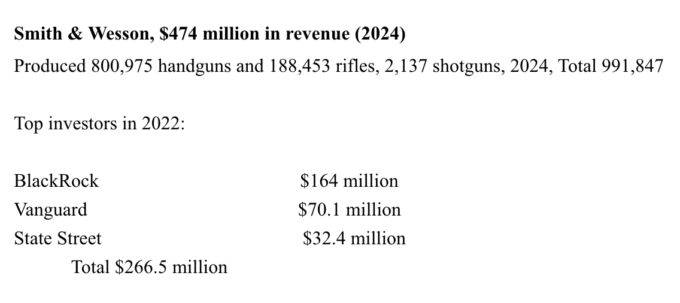
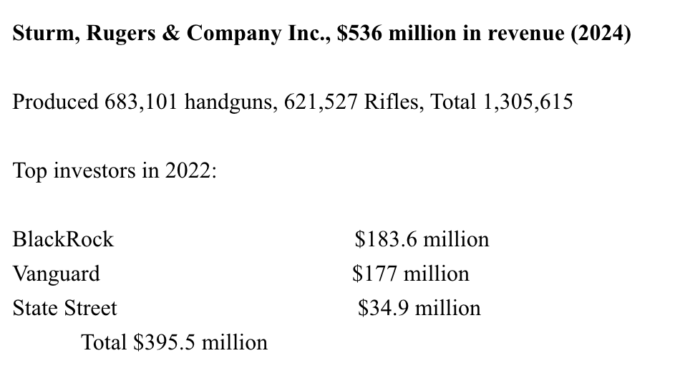
To reduce weapons in the US towards lowering mass shootings, we must ask the

investors in gun making to suspend profits on weapons. That is an immediate first step to reducing firearms in the US. Government buybacks of privately held weapons and full enforcement of registration laws would also contribute to smaller numbers of weapons.

Our first task is to ask the multimillionaire CEOs of these three assets companies to withdraw investment funds in gun manufacturers for the greater good and human safety in America. The amounts involved are only a small portion of their total investments. The following individuals are the CEOs of the large weapons investors and can easily be reached through their companies

Blackrock, Assets under management, AUM $9.5 Trillion. Contact 800-441-7762

Laurence (Larry) D. Fink, US, CEO: BlackRock and director of PNC Financial Services Group, Innovir Laboratories (private) Member Financial Services Roundtable, Museum of Modern Art, Trustee-World Economic Forum (2019-2023) International Business Council, Business Roundtable, Director-Council on Foreign Relations, Trustee: New York University Education– UCLA (MBA, BA) Financials– Net worth $1 Billion (2022) (Forbes), BlackRock compensation $36 million (2021), BlackRock shares owned 608,271—$428.1 million (2021).

Vanguard Group, AUM $8.1 Trillion. Contact 877-662-7447

Salim Ramji, Born Tanzania, Dual US-Tanzanian citizenship, CEO Vanguard (2024) Prior Employment- Blackrock, Global I-shares and Index Investing, McKinsey and Company, Cliffard Caance Law, London Hong Kong, Education-BA University Toronto, MA Law Cambridge University, Financials- Vanguard salary $26 million, Net worth $20 million+.

State Street Corporation, AUM $4.02 Trillion. Contact 617-786-3000

Ronald P. O’Hanley, US CB– CEO/Chair: State Street, Director: Unum Group Member World Economic Forum, (2023) Greater Boston Chamber of Commerce, Federal Reserve’s Federal Advisory Council, The Boston Foundation, The Ireland Funds, IYRS School of Technology and Trades, Syracuse University, Education– Harvard Business School (MBA), Syracuse University (BA) F–  State Street Compensation $14 million (2021); Unum Group Compensation $290,001 (2021); net worth 2022: $25.9 million.

Ending mass shootings in the US means reducing the number of guns available and making strong efforts by governments to enforce registration laws. Doing this combined with increased mental health efforts will save lives from mass shootings. We must insist that the CEOs of the largest investment management companies cease all investment in new gun manufacturing. Many thousands of us must ask them to quit these dangerous investments.

Nepal’s prime minister resigns amid spiraling protests

Rohantha De Silva & Peter Symonds


Nepal has been plunged into political crisis by three days of mass protests involving tens of thousands of mainly young people that erupted on Monday. While the immediate trigger was a government ban last Thursday on 26 social media platforms including Facebook, Instagram, X and YouTube, the protests reflect widespread frustration and anger over a lack of opportunities, corruption and the social gulf between rich and poor.  

Protesters take selfies and celebrate at the Singha Durbar, after it was set on fire during a protest against a social media ban and corruption in Kathmandu, September 9, 2025. [Photo: Niranjan Shrestha/WSWS]

Young people viewed the social media ban as censorship. Before it was imposed, posts on X and TikTok using the hashtag #nepokids exposed the lavish lifestyles of the families of politicians. Unverified but widely shared photos of a minister’s son posing with luxury brand boxes and a video showing a former judge’s son dining in upscale restaurants and standing beside a Mercedes went viral recently.

Protest slogans included “[Prime Minister] Oli is a thief, quit the country,” “Shut down corruption, not social media,” “Justice and accountability for the lives lost,” “We are standing here for our future” and “Provide economic opportunity.” 

Nepal is one of the poorest countries in the world with one in four living below the poverty line. Official unemployment last year was 10.7 percent and for youth (ages 15-24) was 22.7 percent. Many young people are forced to leave the country to look for work.

The protests quickly spiraled out of control despite a brutal police crackdown using tear gas, rubber bullets, water cannons and live ammunition. In a desperate effort to placate the protesters, Home Minister Ramesh Lekhak resigned on Monday, and the government announced the lifting of the social media ban. 

Protesters, however, ignored these attempts at appeasement as well as a curfew that was imposed not only in the capital Kathmandu but in other cities throughout the country. Angered by police violence, young people clashed with police and targeted symbols of the political establishment, including the parliament building, the Supreme Court and other government buildings. 

The homes of prominent politicians including two former prime ministers—Sher Bahadur Deuba of the Nepali Congress Party and Pushpa Kamal Dahal of the Communist Party of Nepal (Maoist Centre)—were broken into and vandalised. Nepali Congress is part of the ruling coalition. Kathmandu’s airport was also temporarily closed by fires. 

Prime Minister K.P. Sharma Oli, from the Communist Party of Nepal—United Marxist-Leninist (CPN-UML), resigned on Tuesday after widespread criticism in the media and by opposition parties of the government’s handling of the protests. Some reports indicate that Chief General Ashok Raj Sigdel also called on Oli to resign. Oli remains as caretaker prime minister. 

Amid the deployment of the army and continuing protests, the military held talks on Wednesday with representatives of the protesters, who proposed the formation of a technocratic interim government with former Chief Justice Sushila Karki suggested as a possible interim prime minister. No agreement was reached, however.

Also on Wednesday, prisoners staged jail breaks from several prisons, with widely varying estimates of escapees from around 3,000 to 13,500. Troops remained on the streets to enforce a curfew, with the military warning of harsh measures against looters and rioters. About 25 people have been arrested for looting and violence. The death toll over the past three days stands at 25, with the health ministry reporting on Wednesday that more than 1,000 have been injured.

The protest movement is the most significant since mass demonstrations forced the abdication of King Gyanendra Shah in 2008 and resulted in the formal abolition of the country’s 240-year-old absolute monarchy. Since then, Nepal has been plagued by political instability with 14 governments in the past 17 years—none of which has completed a full term of five years. Last year, 73-year-old Oli was sworn in for a fourth time as prime minister.

None of the major parties is able to address the country’s economic and social crisis. The various Stalinist parties—including Oli’s CPN-UML and the CPN (Maoist Centre) of Pushpa Kamal Dahal—have been just as ruthless as the conservative Nepali Congress in imposing the burden of the crisis on working people that has hit young people in particular.

Pushpa Kamal Dahal headed the CPN (Maoist) before it split. It had waged a protracted guerilla war against the army and the monarchy. After the fall of the monarchy, it gave up its weapons and joined the Kathmandu political establishment, serving a vital role in containing opposition and anger to the existing parties.

Dahal, who has subsequently served as prime minister three times, has proven to be a staunch defender of Nepali capitalism and big business interests, and an advocate of pro-market reforms. The transformation of the Nepalese Maoists into trusted props of bourgeois rule is another graphic expression of the reactionary character of the Stalinist two-stage theory, which justifies the embrace of capitalism and so-called progressive layers of the bourgeoisie.

Underlying the political turmoil is the country’s worsening economic crisis. A comment in the Annapurna Express in April, which expressed the frustration and concerns in business circles, declared:

“The economy is in shambles, the citizens are crying out, and the ones in power are stuffing their ears with wads of cash. The recession currently faced by the nation is the result of decades of corruption, inefficiency, and misplaced priorities.”

It noted the lack of foreign aid, compounded by the ending of USAID and warned of “some tough times in the future.” After pointing out that optimistic growth figures were questionable, it painted a picture of a backward capitalist economy dependent on tourism, agriculture and remittances from overseas workers. Some 67 percent of the workforce is engaged in agriculture, which contributes less than a quarter of GDP. 

It is little wonder that there are few opportunities for young people and mounting frustration that finds no outlet in any of the traditional parties. The only party that has expressed any support or sympathy for the protesters is the populist Rastriya Swatantra Party (RSP), which was only established in June 2022 and has won 20 parliamentary seats, by appealing to youth on an anti-corruption platform. 

It is capitalism, however, not corruption, that is the source of the political and economic crisis in Nepal and that is fueling mass discontent and anger throughout the region and internationally, including in recent weeks in Indonesia where mass protests of young people erupted.

“Gargantuan” downward revision in US job-creation numbers

Nick Beams


Electric Hummers on the assembly line at GM’s Factory Zero [Photo by Jeffrey Sauger/GM]

A very sharp downward revision of almost 1 million in the estimate of the number of jobs created in the 12 months to March this year has cast a revealing look at the real state of the US economy, as opposed to the hype about economic growth and a strong labour market.

Carrying out a more in-depth review of employment than can be obtained through monthly surveys, the Bureau of Labor Statistics (BLS) found that employers had added 911,000 fewer jobs than has been previously reported.

The report followed the release of survey data last week which showed that only 22,000 jobs had been created in August, and that over the past four months the number of jobs added has been 27,000—well below the levels of 2024.

Economists voiced their concerns over the size of the downward revision with Samuel Tombs, chief US economist at Pantheon Macroeconomics, telling the Financial Times it was “gargantuan.”

The number of jobs created was revised down in almost every sector of the economy. Leisure and hospitality were down 176,000, business services 158,000 and retail 126,000.

Commenting on the result for services—lower by 13,000 per month than previous estimates—Bradley Saunders, North American economist for Capital Economics, said: “With services being the last bastion of employment growth, this does not bode well for the overall health of the labour market.”

While the numbers are not so large, the all-important manufacturing sector, according to the monthly data, recorded its fourth consecutive monthly decline in August, the longest such period since the pandemic, with employment in the sector now negative for the year.

The boost to jobs which Trump claimed would result from tariffs has not materialised. In fact, the tariffs are giving rise to job cuts as employers seek to cut costs because of the hit to their bottom line caused by the price rises in their inputs.

According to Bob Schwartz of Oxford Economics, whose comments were reported in the FT: “If tariffs are aimed at bolstering the domestic manufacturing economy, the benefits are not showing up on the hiring front. … It appears that the higher input costs linked to tariffs are having an immediate effect, whereas the incentive for companies to bring operations—and jobs—to the US have yet to bear fruit.”

The Trump administration eagerly seized on the jobs data as justification for its actions on two fronts—the sacking of the head of the BLS at the beginning of last month and its push to have the Federal Reserve make a major cut in its interest rate.

In a statement on the major revision, White House Press Secretary Karolin Leavitt said: “This is exactly why we need new leadership to restore trust and confidence in the BLS’s data on behalf of the financial markets, businesses, policymakers and families that rely on this data to make decisions.”

In fact, the new data do not support the decision to sack BLS head Erika McEntarfer because her dismissal and replacement by Trump acolyte E.J. Antoni was carried out amid claims that the August monthly data, which contained a major downward revision, had been “rigged.”

Those numbers, far from reflecting a political agenda, as claimed by Trump, expressed an objective trend that has now become even more apparent.

The reason for the large revisions lies in the difficulties in rapidly gathering monthly data based on surveys. The overestimations of the number of jobs created is rooted, at least in part, in the fact that only 43 percent of employers respond to the monthly survey, down from the 60 percent who replied before the pandemic.

The BLS has been trying to improve its data gathering methods, but has been hampered by budget cuts carried out under both previous Republican and Democratic administrations and the further cuts under the second Trump regime.

A statement issued by the National Association of Business Economists earlier this week said that “with sufficient funding, agencies can modernise data collection and improve the accuracy of first estimates.”

After claiming that earlier numbers were “rigged,” Trump has now changed tack and is seeking to use them as the basis for his push to have the Fed cut interest rates. A White House statement said Trump had been right about the Fed being “too late” and that the revisions “make clear that the Fed’s monetary policy is far too restrictive and interest rates remain too high.”

It is almost certain that the Fed will cut rates by 0.25 percentage points at its meeting next week, and may well make a so-called “jumbo” cut of 0.5. One of Trump’s appointees to the Fed’s governing council, Christopher Waller, who dissented from the July decision to keep rates on hold, has indicated he is in favour of such a move if there were a significant deterioration on the jobs front.

But even a cut of that size is nowhere near the reduction by as much as three percentage points that Trump has been demanding.

However, his campaign to change the balance of power in the Fed’s governing body and weaken the position of Chair Jerome Powell, whom he has denounced as a “numbskull” while trying to find ways to have him removed, has received something of a setback. A US judge has ruled that Fed governor Lisa Cook, sacked by Trump, could retain her position while her case for wrongful dismissal proceeded.

In a ruling handed down late on Tuesday, Judge Jia Cobb said: “Cook has made a strong showing that her purported removal was done in violation of the Federal Reserve Act.”

Cook came under attack from the Trump administration over allegations that before her appointment to the Fed she had claimed two properties as her primary residence when seeking a mortgage, enabling her to receive a lower interest rate, and she should be removed from her position.

But in her ruling, Judge Cobb appeared to close that off saying that a president could only remove a governor for “cause” on grounds pertaining to their conduct in office, and that “for cause” did not “contemplate removing an individual purely for conduct that occurred before they began in office.” This battle, however, is far from over as the administration has said it will appeal, and the issue could go all the way to the Supreme Court.

Jobless claims highest in 4 years as tariff-driven layoffs, price hikes wreak havoc on US workers

Tom Hall


Unemployment documentation from Michigan and Nevada, 2025.

More than 260,000 Americans filed initial unemployment claims last week, the highest level in four years, according to data released Thursday by the Bureau of Labor Statistics (BLS). This is a sign of the deepening social crisis confronting the US working class, driven increasingly by the trade war measures of the Trump administration and the use of AI to slash jobs.

The mounting unemployment portends an eruption of class struggle under conditions where Trump is escalating his drive toward dictatorship. Seizing on the assassination of Charlie Kirk, the administration is accelerating political repression.

The new report comes just after the BLS massively revised downward employment figures for the 2024 fiscal year. It now says that 911,000 fewer jobs were created than previously estimated. Figures for August show only 22,000 jobs were added, while June was revised into negative territory. Manufacturing jobs overall are in the negative for the year.

The latest layoff figures underline the scope of the devastation. Challenger, Gray & Christmas reported a 39 percent increase in announced layoffs last month, to 85,979, with the steepest cuts in pharmaceuticals. Some of the more notable recent announcements include:

  • 1,000 at grocery giant Kroger’s technology and digital team. One worker posted to thelayoff.com: “The big bosses, Yael the CIO and Rana the Senior HR Director, couldn’t even bother to show up live for the announcement. Nope, they dropped a pre-recorded video on everyone like it was a bad Zoom prank. “Hey team, you’re fired—cut! That’s a wrap!”

  • Oil and gas producer ConocoPhillips is cutting up to one quarter of its global workforce, equal to around 3,200 jobs. “These layoffs aren’t going to end,” one worker wrote on thelayoff.com. “They say the end of 2027 but let’s face it. All of us will slowly be phased out up until 2030.” Another worker wrote: “There are very few oil and gas jobs out there as well as the same in other industries. … I am not a big backer of AI, OSDU, and AWS but it looks like those are here to stay”;

  • Insurance company State Farm is rolling out voluntary buyouts;

  • Tech firm Oracle is cutting 254 jobs in the San Francisco Bay Area;

  • More than 200 layoffs have been announced at electric vehicle startup Rivian;

  • 150 cuts at BlueCross BlueShield in Chattanooga, Tennessee; and

  • 4,000 layoffs at Salesforce, whose CEO declared frankly: “I need less heads with AI.”

In addition, the takeover of Walgreens by private equity firm Sycamore Partners is set to break up the company into five separate entities, a move which will likely lead to massive layoffs.

Amid the rising cost-of-living crisis, Trump’s tariff measures are beginning to manifest in higher inflation figures. Tariffs, which are taxes paid by importers, function as a regressive sales tax because costs are eventually passed on to consumers. This process is now clearly underway.

CPI inflation was around 2.9 percent for August, the BLS reported Thursday. Among the basket of goods used to calculate the index, the highest increases were in coffee (21.7 percent) and raw beef steaks (16.6 percent). Home gas prices jumped 13.6 percent year-on-year, motor vehicle repair was up 15 percent, and furniture rose 9.5 percent.

For some time, inflation had fallen from its historic 9 percent peak in 2022, but it has now stopped declining and is beginning to rise again. Last month’s figures were the highest since January. Moody’s economist Mark Zandi told CNBC: “I think we should expect a further acceleration in inflation over the next 6 to 12 months.”

Trump’s claim—parroted by the union bureaucracy—that tariffs would benefit American workers and bring back jobs has been exposed as a lie. The opposite is taking place. Through mass layoffs and price increases generated by tariffs, American capitalism aims to make workers pay for the mounting economic crisis, the growth of public and private debt, the uncontrolled rise in share values, and the diversion of resources toward war.

For the ruling elite, the main significance of the numbers is to what extent they impact the likelihood of an interest rate cut by the Federal Reserve next week, ensuring continued access to cheap money to fuel speculative bubbles and unimaginable personal fortunes.

On Thursday, the Dow Jones Industrial Average ended trading above 46,000 for the first time ever. The day before Oracle co-founder Larry Ellison increased his wealth by $100 billion in a single day, surpassing Elon Musk as the world’s richest person.

Significantly, General Motors CEO Mary Barra sold 40 percent of her stock in the company, worth tens of millions of dollars.

For workers, however, the picture is disastrous. A majority of Americans are already living paycheck to paycheck, and a significant portion cannot afford the unexpected expense of even a few hundred dollars. Personal bankruptcies rose 11.8 percent between June of 2024 and June of 2025, according to Newsweek.

Officially, the unemployment rate remains at 4.3 percent. But this is a massive underestimation of the real toll. The labor force participation rate, a measure of those of working age either employed or actively looking for work, has been falling for the last two years from its post-lockdown high of 62.8 percent in August 2023 (a figure far below pre-pandemic levels, which had already declined to their lowest since the 1980s). This is a sign that millions are dropping out of the labor force, including those who have given up looking for jobs.

Youth unemployment stands at 10.8 percent, more than double the national figure.

The economic war on the working class finds its political reflection in preparations for civil war, with the deployment of troops to Washington, DC and soon to Chicago and dozens of other cities.

The aim is to suppress all opposition to policies which are already generating significant opposition. In particular, they are aimed at the working class, which is being thrust into struggle by the impossible cost of living and brutal working conditions. The death of Stellantis worker Ronald Adams Sr. five months ago was followed by a string of major industrial accidents, including explosions at US Steel’s Clairton Coke Works near Pittsburgh and a fireworks factory in southern California, and the death of a food processing worker in a meat grinder.

Signs of opposition include strikes by defense workers at Boeing and GE Aerospace. Boeing, no doubt with the blessings of the White House, is moving to replace striking workers. The International Association of Machinists (IAM) bureaucracy, which earlier urged Trump to intervene, has said nothing about the move.

Trump’s response to the recent jobs figures has been to attack the BLS, falsely claiming it was rigging data to make him look bad. Last month he fired the head of the agency. His nominee for replacement is loyalist EJ Antoni, who has reportedly floated ending publication of the monthly job reports altogether.

At the same time, the jobs data are a sign of the deepening crisis in the US economy. The dollar is down 10 percent since the start of the year and the gold price has nearly doubled since 2023. There are growing concerns about the US Treasury market, as government debt, already the largest in history, continues to balloon.

Trump’s tariff policies, while aimed at finding new sources of revenue and attempting to address the balance of trade deficit, are wreaking havoc on the US economy, and on the world economy of which the US and every other country is a component part. Postal volumes into the US have declined by 80 percent due to the reversal of de minimis tariff exemptions, as many companies suspend shipping to the US. Consumers are reporting hundreds of dollars in tariffs for relatively small purchases, such as computer equipment.