17 Feb 2017

Families demand investigation into New Zealand mine disaster

Tom Peters 

A New Zealand parliamentary committee on February 16 heard submissions on behalf of 25 of the 29 families who lost members in the November 2010 Pike River Coal mine tragedy.
The hearing was called in response to a petition organised by novelist Fiona Kidman, with the support of the families, calling on the government to re-enter the 2.3-kilometre drift tunnel leading into the mine to search for bodies and for evidence of what caused the fatal explosion.
Since November 2016, the families have picketed the road to the mine site, on the remote West Coast of the South Island, to prevent Solid Energy, the government-owned company that now owns the site, from permanently sealing the mine.
No one has entered the tunnel since the disaster, despite initial promises by the National Party government and Solid Energy that everything possible would be done to retrieve the 29 bodies.
The day before the committee hearing, some families met with Prime Minister Bill English, who refused to instruct Solid Energy to re-enter the drift because it “would be unsafe.” Anxious, however, about growing anger toward the government over the dispute, English said he would direct the company not to seal the mine and to investigate the “feasibility” of sending in a camera-equipped drone.
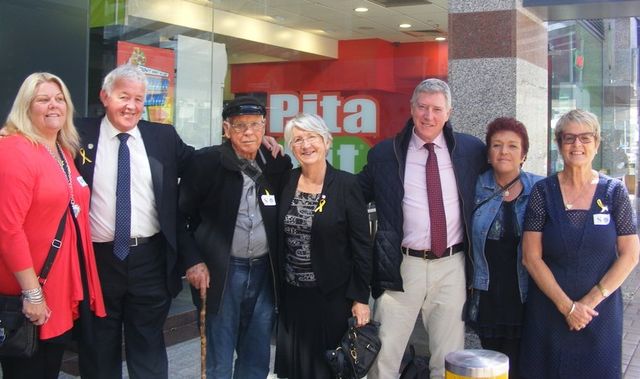
Family members and supporters (left to right) - Sonya Rockhouse, Bernie Monk, Ian Kidman, Fiona Kidman, Tony Forster, Anna Osborne and Kath Monk
At the committee hearing the families were given less than an hour to make their submission and answer questions from government and opposition members of parliament.
Bernie Monk, whose son Michael died at Pike River, told the hearing that an electrical substation several hundred metres inside the drift could provide vital information. “Nobody is being held responsible for this disaster and we need evidence to get this justice,” he said. “Now is the time to get the evidence and any remains of the men … This is a crime scene and should be investigated as such.
“Twenty-nine men died while working. The mining company and the regulators were aware of the safety concerns underground and no one fulfilled their responsibility to protect the workers.”
The government regulators and the police have refused to prosecute anyone for the tragedy, despite a Royal Commission finding in 2012 that it was preventable and that Pike River Coal was in flagrant breach of health and safety laws. The mine had inadequate ventilation and methane gas monitoring, and no adequate emergency exit. WorkSafe, however, dropped charges against Pike River CEO Peter Whittall in December 2013 on the pretext that there was not enough physical evidence of the explosion’s precise cause.
Just hours after the committee hearing, the Court of Appeal dismissed a bid by some of the families for a judicial review of the decision to drop the charges against Whittall. Anna Osborne, whose husband Milton died in the disaster, told the media the outcome was “despicable” and “I’m so frustrated with the court system.” She said the families would take the case to the Supreme Court.
At the hearing, government MPs and members of the opposition Labour, Green and New Zealand First Parties feigned sympathy with the families while remaining silent on the role of successive governments in paving the way for the catastrophe. Since the 1990s, National and Labour-led governments have gutted the mines inspectorate and allowed companies to self-regulate.
Pike River mine was developed during the previous Labour government and there were no objections to its safety violations from official regulators or the Engineering, Printing and Manufacturing Union, whose national secretary Andrew Little now leads the Labour Party.
Labour, the Greens and NZ First have said they would consider re-entering the drift if they win the September election. But none of these parties has pledged to prosecute anyone over the disaster.
MPs concentrated on asking how the drift could be re-entered safely. Tony Forster, who worked as the government’s chief mines inspector from 2013 to 2016, spoke in support of a re-entry plan drawn up for the families by Dr David Creedy, a renowned coal methane gas expert, and Bob Stevenson, former UK Principal Mines Inspector. Forster said he was confident the drift could be made safe and he did not know why Solid Energy had decided against re-entry.
Solid Energy CEO Andy Coupe responded by declaring that the decision not to re-enter was based on safety concerns. He told the hearing “the insinuation of a cover-up is unfounded.” Yet he and the government have refused to arrange a meeting between the company’s advisors and the families’ experts. Coupe was interrupted more than once by family members in the audience, who scoffed at his suggestion that Solid Energy was primarily concerned about safety.
Speaking to the World Socialist Web Site after the hearing, Bernie Monk denounced the refusal to investigate “one of the biggest homicides in New Zealand’s history.” He said it was “not right” that the families had been forced to fight for six years just to be heard.
His wife Kath Monk had no confidence the government would change its position after hearing the families’ petition. “But we have to fight on,” she said. “It’s not right, in New Zealand, that 29 men died at work and no one has taken any responsibility for that. Where else would that happen?”
Sonya Rockhouse, whose son Ben died in the mine, thought Solid Energy and the government were “hoping we will just go away if they give us a little bit of what we want.” Anna Osborne said Prime Minister English “gave us nothing we don’t already have.”
The families’ protest has gained widespread support in the working class, and local contractors on the West Coast have refused to assist Solid Energy in sealing the mine. Anna Osborne added that even if a drone were sent into the mine, as English suggested, this would not be enough to gather all the evidence.
Responding to the denials of a cover-up by Solid Energy and the government, Osborne said: “We live in a very corrupt society. There’s lots of evidence to be found down there and it will point fingers at the government departments who should be brought to account for the loss of our men’s lives as well.
“There’s no will on the government’s part to get into the drift. It’s easier for them to seal it and walk away. This isn’t just about the Pike 29, this is about every single person’s right to go to work and return home safely to their loved ones.”


French authorities step up financial probe of conservative presidential candidate François Fillon

Stéphane Hugues & Alex Lantier 

The French national financial prosecutors’ office (PNF) announced yesterday that it would continue investigations into conservative Les Républicains (LR) presidential candidate François Fillon. Fillon has collapsed in the polls and has come under escalating pressure since the Canard Enchaîné weekly published an article three weeks ago, accusing him of creating no-show jobs for his wife and their children, accumulating a total bill of around one million euros.
“As the authority tasked with bringing charges, it is my duty to affirm that the numerous pieces of evidence that have already been gathered do not allow us currently to consider the possibility of ending the investigation,” prosecutor Éliane Houlette wrote in a statement. This suggests that the PNF is either considering bringing charges against Fillon or handing the case to a specialized investigating judge, setting the stage for a longer judicial battle.
Fillon’s legal team issued a statement declaring that “after three weeks of investigations and numerous interrogations, there is insufficient evidence to bring charges,” while Fillon said that he would rely on “the judgment of universal suffrage alone from now on.”
What is taking place is a vicious faction fight inside the French ruling elite, as the judiciary, under the watchful eyes of the Socialist Party (PS) executive, mounts a devastating offensive against the LR campaign. With Fillon relatively isolated in his pro-Russian views on foreign policy, he is now caught up in swirling conflicts over ties to Russia inside the NATO alliance.
This campaign already claimed the Trump administration’s national security advisor, Michael Flynn, who was accused of inappropriately discussing US sanctions on Russia with Russian officials.
Fillon’s campaign is badly damaged, as he has been unable to explain away the charges in public, claiming that he had the right to employ his family, as it is something that is legal in the French Parliament. However, he refused to talk about the jobs being no-show ones, which is illegal. Over a week after the story had come out, he finally claimed that only he could determine that his wife and his children had carried out the tasks he had set them, and no one else.
The unrelenting media and judicial assault on the LR campaign is continuing and escalating, extending well beyond Fillon himself. The day before the PNF released its statement on Fillon, a further article appeared in the Canard Enchaîné, accusing MP Thierry Solère, the Fillon campaign’s press spokesman, of fiscal fraud.
Furthermore, former President Nicolas Sarkozy has recently been indicted on “illegal financing of an electoral campaign.” His campaign spent €20 million over the legal limit of €22.5 million in the 2012 presidential elections. Sarkozy has also faced investigations in a long list of other scandals, including charges that he financed his 2007 campaign with funds from the late Libyan head of state, Muammar Gaddafi—whom France and NATO forces murdered at the end of the 2011 Libyan war.
The finances of LR, which have provoked countless scandals in recent decades, are undoubtedly corrupt. Alain Juppé, the final major candidate in last year’s LR presidential primaries alongside Fillon and Sarkozy, was already found guilty in 2004 of creating no-show jobs under Jacques Chirac as Mayor of Paris. This is not the driving force behind the charges, however.
The attempt to wreck Fillon’s campaign is based on opposition to Fillon’s program, and notably his foreign policy orientation to President Vladimir Putin’s regime in Russia. Revelations of irregularities in the employment conditions of Fillon’s wife and children emerged less than a week after he traveled to Berlin to meet with German Chancellor Angela Merkel and called for an alliance with Germany and Russia directed against the Trump administration.
This trip crossed not only powerful forces in Washington, but also the PS government and the candidate closest to President François Hollande, nominally independent banker Emmanuel Macron, who has called for continuing Paris’s close relations with both Berlin and Washington.
It appears that the material that the Canard Enchaîné published in its exposé on Fillon had been prepared long ago, well before widespread media coverage of its allegations began last month.
Mediapart, a French investigative journalism web site, had already revealed elements contained in the Canard Enchaîné’s article on Solère last September: namely, that an official complaint had been lodged by French financial authorities with the judiciary. At that point, no details were available. However, the complaint first had to pass muster in the Commission of Tax Offenses, an independent body, which took place during the summer of 2016. Thus, evidence used by the Canard Enchaîné had been known to key authorities since at least September 2016.
It was in the wake of Fillon’s trip to Berlin, however, that this material suddenly appeared in the Canard Enchaîné and became the focal point of a media campaign aimed at discrediting the presidential candidate.
This campaign reflects deep tensions inside the NATO alliance over the controversial pro-Russian positions Fillon has repeatedly taken during major international crises in recent years.
Fillon was prime minister under Sarkozy’s presidency in the winter of 2010, during the initial stages of the Franco-German confrontation over the Greek debt crisis, when France concluded a sale of four Mistral-class helicopter carriers to Russia. This was part of a strategy of trying to rival Germany for political and commercial influence in Russia, and German officials strongly objected to the sale behind the scenes. Heavy pressure from Germany and Eastern Europe subsequently led to the cancellation of the sale; Hollande later sold the warships to Egypt.
When Obama backed down from a war in Syria in September 2013, embarrassing the Hollande government, which had aggressively pressed for the war, Fillon reacted by flying directly to Moscow and meeting with Putin, the Syrian regime’s main ally. Addressing the Valdai Club with Putin, whom he referred to as “dear Vladimir,” Fillon criticized Hollande’s alignment on Washington: “I hope that on this issue that France will return to its independence and freedom of judgment and action that alone give it moral authority in this crisis.”
After Fillon won the LR nomination last November, papers including the Canard Enchaîné were already investigating reports that Fillon’s 2F consulting firm had taken Russian funds. According to the Canard’s initial report, it was this investigation that led it to publish its first piece on Fillon’s wife and children last month.

General Motors intends to sell Opel-Vauxhall to Peugeot-Citroen

Marianne Arens

General Motors (GM) is planning to sell the Opel-Vauxhall company to French group PSA. The news spread like wildfire on Tuesday that the French PSA group, the producer of Peugeot and Citroen, had been in talks with GM and wanted to assume control of its European plants at Opel and Vauxhall.
This implicit threat to the jobs of thousands poses the necessity of German, British, French and American autoworkers uniting in a common struggle to prevent plant shutdowns, layoffs and further attacks.
The news came just three weeks after the coming to power of the administration of Donald Trump in the United States. Mary Barra, CEO of GM, which is headquartered in Detroit, is a member of Trump’s 16-person economic policy team. She intends to refocus GM more on North America and get rid of unprofitable overseas subsidiaries.
GM could as a result drop out of the ranks of the world’s largest automakers. Last year it sold, together with Volkswagen and Toyota, more than 10 million vehicles. Barra said in an interview that profit margin was more important than market share. Over recent years GM has closed a plant in St. Petersburg, its Holden production in Australia and Opel plants in Antwerp, Belgium, and Bochum, Germany.
Three years ago, as autoworkers in Bochum faced the shuttering of their factory, Barra visited the company’s main facility in Rüsselsheim and assured workers that Opel was “certainly an essential part of our company.” This expression was repeated by the IG Metall trade union and the central works council. They claimed that the closure of Bochum was the bitter pill that had to be swallowed in order to return Opel to profitability.
But now, GM wants to offload Opel as a whole. While Donald Trump is aiming with his “America first” policy to retain investment in the United States by reducing business taxes, doing away with environmental regulations and imposing tariffs, GM has decided to focus on North America and operate at most in China and India.
Opel-Vauxhall, from which GM now intends to separate, has been to date responsible for approximately 10 percent of the company’s global sales. But Opel has been recording losses for 18 years. 2016 was expected to have been the first year to see a return to the black, but these hopes were upended by Brexit, and Opel finished the year with a loss of $250 million.
The PSA group is hoping through the merger with Opel-Vauxhall to assume second place in the European market, close behind Volkswagen. PSA is also interested in an international research and development centre in Rüsselsheim that focuses mainly on electric cars.
The French government and China’s Dongfeng Motor Co., the country’s largest automaker, each own a 14 percent stake in PSA. Reuters commented that for PSA and Opel, it was “a rare opportunity to consolidate its position in a sector suffering with high costs, low profit margins and tough competition.”
GM and PSA have both confirmed the takeover talks, and Peugeot head Carlos Tavares arranged a meeting to discuss it with German Chancellor Angela Merkel. On Wednesday, Barra met in Rüsselsheim with Opel’s supervisory board chairman Dan Amman. Although nothing has yet been decided, a decision could be taken “in a few weeks.”
PSA and GM shares rose on the news. Shareholders anticipate that the sale will set the stage for comprehensive rationalizations. The takeover will at least produce synergies and cost-savings that will affect Opel most of all, since PSA is larger and has smaller losses.
Last year GM’s European facilities were only operating at 63 percent capacity and Opel had to impose reduced shifts in several plants. There are many indications that the sale will be the prelude to large-scale layoffs. Opel currently employs around 38,200 workers in Europe, with more than half employed in Germany. It currently operates plants in Rüsselsheim, Kaiserslautern, Eisenach, Zaragoza in Spain and Gliwize in Poland. Vauxhall operates in Luton and Ellesmere Port, near Liverpool.
Rainer Einenkel, who played a key role in the shutdown of the Bochum plant as works council chair, told Deutschlandfunk that he expects “German factories” to be “very acutely threatened.” In the years-long conflict over the Bochum plant, Einenkel strung out the workers with promises and systematically blocked a joint struggle by workers at all facilities.
Einenkel is once again recommending that workers limit themselves to reliance on the courts “To clarify legally that these contracts will not be called into question” and make “General Motors give an accounting.” He further noted, “Politicians are called upon to act” in an appeal to state and federal governments.
Workers should reject the unions’ policy of dividing workers and playing one location off against another, and organise a joint struggle of all autoworkers, including workers in the United States, France, England, Spain, Poland or Germany.
The experience of the last 10 years confirms this. In the United States, GM used its forced bankruptcy filing in 2009 to institute a two-tier wage system that imposed a 50 percent pay cut on new hires. At the time GM wanted to sell Opel to the Canadian Magna company. However, it instead decided to restructure its European operations by shutting down Antwerp and Bochum.
In December 2016, GM announced a new wave of layoffs in the United States. Likewise in France, PSA also has imposed sacrifices on workers for the benefit of shareholders, relying on President François Hollande’s new labour laws. VW, Toyota, Fiat Chrysler, Ford and other automakers are seeking to retain their competitiveness at the expense of their workforces.
The struggle against this requires a break from the nationalist programme of the trade unions. Whether it is IG Metall, the CGT, TUC or the United Auto Workers, the unions preach the identity of the interests of workers and management. They insist that workers subordinate their needs to the corporate drive for ever greater profits.
The criticism levelled by IG Metall in Germany against GM’s plans amounts to little more than the complaint that they were not informed early enough and included in the talks. The union is outraged, not by the threat the deal poses to workers, but by the disregard of the co-determination role of their officials. In a joint statement, IG Metall and the Opel works council complained, “If it is true that GM and PSA are conducting talks aimed at a takeover of Opel/Vauxhall, this would be an unprecedented break with all German and European co-determination laws.”
Federal Minister for the Economy Brigitte Zypries expressed herself similarly. It was “unacceptable that the company holds talks without the works council, the Hesse state government or anyone else being involved,” she said on television news.
The experience of recent years shows that IG Metall, the Social Democrats and Left Party can be relied upon by management to enforce whatever job cuts they require on the backs of workers. This also applies to Opel Antwerp and Bochum.
The World Socialist Web Site insists that to defend jobs and wages workers must break free from the control of the nationalist trade unions. It is necessary to construct action committees to organise and coordinate resistance at all plants globally. An international leadership must be created to draw together all of the various struggles by workers into a global movement guided by a socialist strategy.

Jeep announces partial shutdown of Toledo, Ohio complex

Shannon Jones

The deadline for the elimination of the second shift at the General Motors Detroit-Hamtramck assembly plant is fast approaching with workers expressing anger and concern over their fate as the United Auto Workers collaborates with management to throw some 1,300 workers into the street.
GM workers contacted by the World Socialist Web Site AutoworkerNewsletter said that the UAW is now indicating that March 3 will be the last day for the second shift at the plant. These job cuts follow the layoff of some 2,000 workers at the GM Lordstown plant outside of Warren, Ohio and the GM Grand River plant in Lansing, Michigan. The cuts point to a broader slowdown in the auto industry as the sales boom of the past several years winds down.
This week the Toledo Blade announced that 3,200 workers at the Fiat Chrysler Jeep complex would be laid off for six months while the plant is retooled for a new version of the Jeep Wrangler. The changeover is part of a restructuring process, whose long-term effect on employment is still not clear. It involves FCA ending passenger car production in the US while the company concentrates on more profitable trucks and SUVs. Workers at the Sterling Heights Assembly Plant north of Detroit remain on long-term layoff after FCA ended production of the Chrysler 200 passenger car previously built at that facility.
GM Hamtramck Assembly interviews
A Jeep worker contacted by the Autoworker Newsletter said that while permanent employees affected by the layoff at Jeep are covered by Supplemental Unemployment Benefits (SUB) that can provide up to 95 percent of their standard wages, some 1,500 Temporary Part Time (TPT) workers at the facility are only eligible for state unemployment benefits, good for just 20 weeks.
While doing nothing to defend the jobs of autoworkers, the UAW in a statement Thursday praised President Donald Trump and said that the union wanted to work with him to renegotiate the North American Free Trade Agreement. UAW President Dennis Williams also said that the union plans to resurrect its nationalist “Buy American” campaign. “We’re seeing a trend in this country—the boycott may be coming back,” adding that the “Buy American” push is gaining steam for the first time in “many, many years.”
This has nothing to do with defending jobs. Instead it is a ploy aimed at diverting the justified anger of workers over layoffs against their brother workers overseas just as the UAW did in the 1970s and 1980s as it was collaborating with the auto bosses in the destruction of workers’ jobs and living standards. The racism and anti-Asian chauvinism promoted by the UAW reached such a pitch that it led to the 1982 beating death of 27-year-old Chinese-American Vincent Chin by a Chrysler manager and his laid-off son.
Not only is the “Buy American” slogan reactionary, it is also absurd. Given the globally integrated nature of capitalist production, every vehicle produced, whether assembled in America or overseas, is the product of the coordinated efforts of workers in many different countries.
A GM Detroit Hamtramck worker contacted by the WSWS said that despite her 34 years at the plant, the job cuts felt “scary.”
A worker on second shift said, “We just hear bits and pieces. People are still quitting and they have temporary workers filling in for those jobs.”
Another worker described a situation of near chaos with the company firing some workers while others quit in anticipation of being laid off. “We are so short-handed they are having people stay over from day shift and working 12-16 hours a day.
“They are telling me I won’t be transferred. My only option is to sit back and hope to be recalled.
“It’s bogus. It is not fair. People come to work every day and do their jobs and then are treated like this.”
A second-shift worker who is slated to be laid off in March noted that temporary workers were not eligible to receive profit-sharing checks. “Union workers are getting $12,000 but we’re not getting anything because we’re temps. Absolutely nothing. Give us $1,000, or something! But no, they said we don’t get anything. But we helped them perform to get that.
“They [the UAW] told us they would help us go to school, which is all well and good. And while we’re going to school we can get unemployment up to two years. $300 a week can help a little while you’re going to school, but a lot of these schools don’t help you get a job. So what are we supposed to do without SUB pay too?”
A skilled trades worker from the GM Tech Center in Warren, Michigan spoke to the Autoworker Newsletter. He said that at his facility management was bringing in a lot of subcontractors to do skilled trades work. He also said that it appeared that temporary workers at the tech center might be laid off to provide openings for full-time workers laid off at the Detroit Hamtramck facility.
“They are working them 10, 12, 14 hours a day. But GM brought in 80-90 temporary workers since last year, knowing they are going to use and get rid of these people. It’s a sticky situation because lots are losing their jobs.
"I feel for my brothers and sisters at the Detroit plant. The UAW doesn’t defend us. We have to get workers together to protect all our jobs.”
The cuts at GM will have an impact throughout that Detroit area, which over the decades has been decimated by the shutdown of the auto industry. While Detroit Democratic Mayor Michael Duggan loses no opportunity to boast about the supposed “comeback” of Detroit and the upscale development taking place in downtown Detroit, he has said nothing about the cutting of 1,300 jobs at GM.
Dan, a street maintenance worker for the City of Detroit who works near the GM Detroit-Hamtramck plant, spoke to the WSWS Autoworker Newsletter. “My thought is that here they are having these layoffs at the same time they are talking about investing hundreds of millions of dollars in the city. I don’t understand it. It’s also affecting people in Lansing—my friend works at GM in Lansing—and 800 people are losing their jobs out there.
“I know it’s a business. But they need to be more responsible for the lives they disrupt with this hiring and firing. These workers gave up their livelihoods to work at GM, and now they are being laid off."
He said that workers employed by the city of Detroit face a management no less ruthless than that at GM. “We took a 10 percent pay cut,” he said, referring to the 2013-14 Detroit bankruptcy. “Now most of us are living paycheck to paycheck. We are making about $2-$3 an hour less than at comparable jobs at other cities.
“The city has these rehabbed houses that they are offering, but we can’t afford to take advantage of it. Nothing is affordable for us, not even our insurance. People are losing their houses and hiding their cars to keep them from being repossessed.”

Thousands participate in nation-wide “A day without immigrants” protest

Genevieve Leigh

Thousands of workers, students and youth across the United States participated in protests yesterday under the banner of “A day without immigrants,” or “Un día sin inmigrantes.”
The protests, which consisted of one-day work stoppages, keeping kids out of school and boycotting shopping and dining, drew substantial participation in New York City, Atlanta, Detroit, Washington DC, Philadelphia, Los Angeles, Austin and elsewhere. The aim of the events was to protest the Trump administration’s recent executive orders by showing the massive impact that immigrant workers have on the economy.
The day’s events seem to have been largely spontaneous, picking up steam mainly through social media, with the hashtag #DayWithoutImmigrants used about 200,000 times on Twitter within the 24-hour period of the scheduled protests.
The wave of resistance comes on the heels of a massive protest held in Milwaukee on Wednesday, premised on the very similar slogan, “A day without Latinos,” in which thousands marched to defend immigrant rights.
The spontaneous character of the events resulted in varying participation in each city. In New York, many restaurants and parts of the construction industry were shut down. In New Mexico, the state with the largest percentage of Hispanic residents in the nation, state officials worried that hundreds of students might stay home and took measures to prevent massive student absences in advance, sending a letter to parents that read: “We respectfully ask all parents to acknowledge that students need to be in class every day to benefit from the education they are guaranteed and to avoid falling behind in school and life.”
Spurred on by the increasingly active role that youth and students have been playing in protests throughout the country, many other city school districts and universities took similar measures.
Alma Pena-Sanchez, chief of staff of the Los Angeles Unified School District (LAUSD), which is 74 percent Latino, left a recorded voicemail for parents and employees Wednesday night asking that everyone show up in the morning, saying, “While we respect everyone’s right to have their voices heard and to participate in civic action such as protest, all students and staff are encouraged and expected to come to school.” The students, many of whom were among the thousands of LAUSD students who walked out of class in protest the week after Trump’s inauguration, were also asked not to partake in any walkouts for the day. A similar message was sent by officials in the Albuquerque, New Mexico, Grand Rapids, Michigan and Washington DC school districts.
Figures for most of these school districts were not available at the time of this writing aside from Grand Rapids, Michigan, which reported a dip in attendance so severe that the day will likely not count as a school day. Instead, it will count as a snow day. In order to count, 75 percent of the student body must be in school. Many schools have reported less than 50 percent attendance for the day, including Buchanan Elementary, Cesar E. Chavez Elementary, Westwood Middle, Harrison Park School, Burton Elementary and Middle, Union High, Innovation Central High and SWCC.
Another prominent feature of yesterday’s protests was the active participation of restaurant establishments. Scores of restaurants in major cities from Los Angeles to New York closed in solidarity with the protest, with over 50 restaurants participating in the nation’s capital alone. The restaurant industry employs 7.1 million immigrants, according to the most recent report from the Bureau of Labor statistics, 1.2 million of whom are undocumented workers, according to Pew Research center. This industry is also the second largest and the fastest growing market in the US economy.
Many well known restaurant owners and chefs have spoken out against the Trump administration and in support of the wave of protests, including Washington’s José Andrés, the famed Spanish-born chef whose public duels with Trump have attracted much attention; Chef Silvana Salcido Esparza in Phoenix; famed Oaxacan restaurant Guelaguetza in Los Angeles, as well as hundreds of other smaller restaurants throughout the country, including an impressive number in the Chicago area.
The effect of the strike on the restaurant industry even reached within the walls of the political establishment, forcing the food service in the US Senate to operate on reduced hours.
Many cities participating in the strike organized marches in conjunction with the business closings, including New York, Atlanta, Chicago, Washington DC and Detroit. One of the largest turnouts was in Southwest Detroit, where over 1,000 people participated.
The World Socialist Web Site spoke to several families at the Detroit protest who participated to take a stand against the Trump administration’s anti-immigrant policies, which are widely despised by both immigrant and native-born working people.
Flavio and his wife Kimberlynn said they were upset with the charge by Trump that Mexican immigrants are criminals. “We support the rights of all immigrants and Latinos,” stated Flavio, “Everyone wants to get a better future.”
Flavio and Kimberlynn with their child
“We want better opportunities,” added Kimberlynn, “We want to be able to go to college, to school. People want a safe place for their children.”
When asked why they thought Trump was whipping up anti-immigrant chauvinism, Kimberlynn said she thought it was to keep the people fighting each other. “It’s to push for a bigger war. I believe there is a danger of bigger wars.”
Flavio spoke on the widespread character of Trump’s attacks, noting, “This is not only against Latinos, they are also targeting Muslims.”
“We are all citizens who were born here,” added Kimberlynn, referring to herself, Flavio and their child. “But my parents came here 30 years ago. Everyone is scared. No one has seen it like this before.”
While discussing the fact that Obama deported more immigrants than any other president, Flavio replied, “I don’t want to call it a setup, but people put a lot of trust in Obama and he let them down." Flavio noted that "A lot of people voted for Trump,” with the new president receiving about one in three Hispanic votes in the election. “But I don’t like Trump.” Both said they did not like Hillary Clinton and had voted for Bernie Sanders.
Melissa Guile, who was at the protest with her four children, told WSWS reporters why she attended. “My husband was deported three years ago. Me and my children are all US citizens, but we are trying to get him back legally."
Melissa and her children
“My father was deported too,” she added. “It has taken a real toll on all of us.”
Melissa said the challenge of taking care of four kids without her husband is enormous. She works at night to make sure the kids are taken care of during the day. “There are a lot of problems," she said. "My kids have a hard time in school.” She cited the difficulties that come with trying to make ends meet. Noting the millions of deportations that took place under Obama, she said, “The government is supposed to be helping people, not hurting them.”
Amid these protests of workers, youth and students across the country, Trump spoke Thursday afternoon at a White House news conference where he boasted of his border security measures and ICE raids, which have resulted in hundreds of arrests in the past week, saying, “We are saving lives every single day.”
The opposition to attacks on democratic rights expressed by the millions of people who have protested since Trump’s inauguration less than 30 days ago finds no expression in the political establishment.
Bernie Sanders, who is seen as the only establishment figure who can ensure that the rising anger of the masses is “properly contained” and channeled behind the Democratic Party, is busy in Washington calling for the Senate Intelligence Committee to “thoroughly investigate if Russia coordinated with Trump and his campaign.”
In order for the working class to carry out a sustained battle with the Trump administration, it must break with the Democratic Party and all of its representatives and take the road of independent political struggle against capitalism.

US demands greater European military spending at NATO summit

Chris Marsden

The two-day NATO summit in Brussels that concluded yesterday began with a threat by president Donald Trump’s Defence Secretary James Mattis that the US would “moderate its commitment” if its European allies did not hike up their military spending.
It ended with a press conference at which NATO General Secretary Jens Stoltenberg announced a ramping up of military deployments in the states bordering Russia, including Estonia, Latvia, Lithuania and Poland.
Stoltenberg told the media, “Troops have started to arrive. And we expect the four multinational battle groups to be fully operational by June... they send a clear message to any potential aggressor.”
“Complementing our strengthened regional posture in the air and on land—based on a multinational framework brigade in Romania,” he added, NATO’s naval forces were being strengthened in the Black Sea region.
This was proof, he said, that “Allies stand together, united and strong.”
In response to questions, Stoltenberg stressed a desire for “dialogue” with Russia, but only based on “core principles” including the territorial integrity of Ukraine and the delivering of what he euphemistically called “credible deterrence.”
Mattis was attending the summit to reiterate the demand made last month by Trump that the European powers step up their defence spending to meet the target of two percent of GDP to which they are pledged. In an interview where he declared the alliance to be “obsolete” and suggested friendlier bilateral relations with Russia, Trump also declared support for Britain’s decision to leave the European Union and spoke favourably of the break-up of a “vehicle for Germany.”
The Europeans were therefore said to be cautiously pleased that Trump’s National Security Adviser, Michael Flynn, had resigned and is subject to an investigation by US counterintelligence officials for holding secret conversations with Russian ambassador Sergey Kislyak regarding the lifting of sanctions over alleged Russian hacking in the 2016 US elections.
Mattis led an earlier investigation into then-Lt Gen Flynn that found him responsible for the unauthorised disclosures of classified information to Afghanistan—believed to be about CIA operations—and himself takes a hard-line anti-Russia stand. However, he combined a hard-line position on Russia with an equally belligerent approach to America’s NATO allies—even accusing them of not doing enough to combat Russia.
After first making reassuring public noises about NATO being “a fundamental bedrock for the United States,” he made more critical remarks during closed-door talks that were then circulated publicly by US officials.
Mattis accused “Some in this alliance” of having “looked away in denial of what is happening” by ignoring threats from Russia and Islamic State (Isis).
“America will meet its responsibilities, but if your nations do not want to see America moderate its commitment to this Alliance, each of your capitals needs to show support for our common defence,” he threatened.
“No longer can the American taxpayer carry a disproportionate share of the defence of Western values,” he continued. “Americans cannot care more for your children’s security than you do. Disregard for military readiness demonstrates a lack of respect for ourselves, for the alliance and for the freedoms we inherited, which are now clearly threatened.”
The conflict between the US and Europe over military spending is a real one.
Last year, NATO’s European powers spent $253 billion on defence, an average of 1.43 percent of GDP, compared with at least $618 billion by the US, or 3.1 percent of GDP. Military spending is now increasing for the first time in many years, with the Western European powers pledged to boost defence budgets by about $10 billion. To meet the two percent target would require an increase of around $100 billion and far more if there were a return to the 3.1 percent of GDP average during the last years of the Cold War.
But the bitter row over who pays what should not be allowed to obscure the underlying significance of demands for increased defence spending whether they are made in the US or Europe. It is the fundamental conflict between rival imperialist powers for the control of global markets and resources that finds expression in the fallout within NATO. And as Stoltenberg made clear in his press conference, this means that the purchase of additional military hardware and the recruitment of personnel is preparation for war, not preserving “peace” and “security.”
Mattis’s demands were dutifully echoed by UK Defence Secretary Sir Michael Fallon, who insisted that NATO members must all “meet their fair share of the burden by increasing their expenditure to 2 percent” so as to make the alliance “more agile and more responsive.”
The UK boasts of being one of the five NATO countries to meet the two percent target along with the US, Poland, Greece and Estonia, and the Conservative government offered its services as an attack dog on the issue when Prime Minister Theresa May met Trump last month in Washington. The Labour opposition for its part focuses its ire on allegations that the government has met the target only by creative accounting, with Shadow Defence Secretary Nia Griffith declaring immediately prior to the summit that “To be spending less than two percent of GDP on defence is utterly unacceptable, particularly in this time of immense global uncertainty.”
More strikingly, German Defence Minister Ursula von der Leyen also welcomed Mattis’s intervention as it provided a convenient rationale for implementing existing plans to step up military spending. Berlin’s spending presently stands at just 1.2 percent of GDP, primarily due to constraints placed on German imperialism by widespread public hostility to militarism. This would need to increase by $30 billion just to reach the two percent target.
This would require a massive offensive against the living standards of German workers, as similar increases in military spending would in every European country.
For this reason, von der Leyen happily expressed sympathy with Mattis and insisted that “We Europeans, we Germans, we have to do more for our own security, we have to invest more there.”
In an article published Thursday in the ddeutsche Zeitung under the title “We have understood,” she called upon Europe to take a leadership role within NATO and boasted that Germany “has taken the initiative in matters of security policy in the past years” regarding Ukraine, the military build-up against Russia and interventions in the Middle East and Africa, and will “continue on this way.”
At present, the European powers are seeking a new accommodation with the US, centred above all on a mutual targeting of Russia and efforts to militarily stabilise the oil-rich Middle East. Carnegie Europe wrote of a “geostrategically assertive Russia” and “the accelerating threat of Islamic terrorism” providing “a unique opportunity for NATO to align the security outlooks of key European members with that of the United States.”
Putin himself noted, “At the NATO summit last July in Warsaw for the first time since 1989, Russia was recognized as the key security threat for the alliance, and its deterrence was officially proclaimed the new NATO mission. To this end, a further enlargement of the bloc is conducted”—citing as proof of NATO’s eastward expansion, Montenegro, Georgia and Ukraine seeking membership in the alliance.
However, it remains to be seen for how long the competing global interests of the American and European imperialists can be constrained within the post-war framework provided by NATO. On the last day of the summit, defence ministers from France, Germany, Belgium and Norway announced in a letter of intent that they will now jointly buy transport and tanker planes and will aim to open a new command headquarters for elite troops, in a move described by CNBC as designed to end “years of competing national strategies that have left Europe reliant on the United States.”

French Embassy Master Degree & PhD Scholarship Programmes 2017/2018 for Ghanaian students

Application Deadline: Friday 17th March, 2017 – 12.30 pm
Eligible Countries: Ghana
To be taken at (country): Selected Higher Institutions in France

Field of Study:
1 Agriculture & food industry
1 Biology
1 Chemistry
1 Environment & earth sciences 
1 Languages & literature
1 Mathematics
1 Physics
1 Health sciences
1 Engineering
1 Economics & political science
1 Humanities & social studies
Type: Masters, PhD
Eligibility: 
  • 35 years for applicants of a Master degree and 40 years for those of PhD.
  • 1 Bachelor Degree for a Master 1 Mphil Degree for a PhD
Number of Awardees: 11
Value of Scholarship:
Masters: 2 return tickets to France
o Free Visa
o Free university basic registration fees
o Health insurance
o Living allowance of 440 Euros/month
Selected candidates will have to provide additional revenues of a minimum of 330 Euros/month – about 1422 GHC/month from a private source of funding, or personal revenues
PhD: 3 return tickets to France (1 for each stay)
o Free Visa
o Free university basic registration fees
o Health insurance
o Living allowance of 440 Euros/month
Selected candidates will have to provide additional revenues of a minimum of 330 Euros/month – about 1422 GHC/month from a private source of funding, or personal revenues
Duration of Scholarship:
  • Masters:  24 months
  • PhD: 3 stays in France of 6 months each, over a period of three-year
How to Apply: 
  • Applications must be sent to the Institut Français at the French Embassy in Ghana, Presidential Drive – PO BOX 187 ACCRA
  • An acknowledgement of receipt will be sent to applicants by e-mail.
  • Please note that applications sent by e-mail are not accepted
Award Provider: French Embassy

Facebook Bots for Messenger Challenge for Creative Developers in Africa and the Middle East 2017

Application Deadline: 28th April 2017
Eligible Regions: (i) The Middle East and North Africa; and (ii) Sub-Saharan Africa
To be taken at (country): 
About the Award: For many years Facebook has been promoting innovation across the Middle East and Africa, providing startups with the tools they need to build, grow, monetize, and measure. Facebook grew out of a hacker culture, and we thrive on seeking out and promoting innovation on new platforms. That’s why we are launching the Bots for Messenger Challenge, a contest to recognize and reward developers who are able to create the most innovative new bots on Messenger in (i) the Middle East and North Africa; and (ii) Sub-Saharan Africa.
Offered Since:
Field of Challenge: 
  1. Gaming and Entertainment
  2. Productivity and Utility
  3. Social Good
Type: Contest
Eligibility: Teams of up to 3 people are invited to participate in the Challenge.
Selection Criteria: 
  • Technical Quality – How well does the Bot use the Messenger platform features? [35%]
  • Non-Technical Quality – What is the degree of excellence of the Bot, taking into account the Bot’s distinctive attributes and characteristics (except for the technical aspects)? [35%]
  • User Experience – How useable is the Bot for the intended audience, including how well the conversation flows? [30%]
Number of Awardees: 60 finalist teams announced per region
  1. 30 teams in the Middle East and North Africa
  2. 30 teams in Sub-Saharan Africa
Value of Challenge: 
  • Finalist Teams: From each region (i) Middle East and North Africa; and (ii) Sub-Saharan Africa, 30 finalist teams (10 from each category) will win a Gear VR and mobile phone, one hour of Facebook mentorship, and up to $40,000 USD in tools and services from FbStart, a Facebook program designed to help early stage mobile startups build and grow their bots.
All student teams or indivdiual student entrants who make it to the finals will win an additional $2,000 USD (students will be verified against their registration via their government accredited school email accounts).
  • Runner Up Teams: For each region (i) Middle East and North Africa; and (ii) Sub-Saharan Africa; 3 runner up teams (1 from each category) will win $10,000 USD and 3 months of Facebook mentorship (1 hour per month).
  • Winning Teams: For each region (i) Middle East and North Africa; and (ii) Sub-Saharan Africa; 3 winning teams (1 from each category) will win $20,000 USD and 3 months of Facebook mentorship (1 hour per month).
Award Provider: Facebook

Win an Internship. Enter for Corporate Communications Pitch Competition 2017 for Nigerian Students

Application Deadline: Monday 27th February, 2017
Eligible Countries: Nigeria
To be taken at (country): Nigeria
About the Award: As part of the selection process, applicants for the PR/COMMUNICATIONS ASPECT are requested to write an essay on “How PR agencies can manage negative perception of government in a dwindling economy” while applicants for the IT/GRAPHICS DESIGN ASPECT will be required to “Design an AD banner to promote a new talent management company (The Company in focus engages in managing talents in music, acting and fashion)”
Type: Contest, Internship
Eligibility: To be eligible for participation, PR Applicants must:
  • Be between 20 -26 years old
  • Possess a minimum of second class lower degree in Mass Communication, Public Relations, English language, Communications and Media Studies, Advertising or any other related field.
  • Must have completed or about to complete the National Youth Service Corp programme
While IT/GRAPHICS DESIGN Applicants must;
  • Be between 20 -26 years old
  • Have a background in Computer Science, Information Technology or any other related Field.
  • Must have completed or about to complete the National Youth Service Corp programme
Value of Contest: Six (6) month paid internship with Sesema Public Relations which may lead to full employment and One Hundred and Thirty Thousand Naira (N130,000) cash prize for each category. And other prizes
How to Apply: You will be required to submit copies of the following documents along with your entry;
  • University statement of result or certificate
  • A valid identification card
  • NYSC cards or Discharge Certificate
Follow the link to submit your entry: http://ccas.org.ng/pitch-2017/
Award Provider: The Corporate Communications Pitch Competition is supported by Jobberman, Business Day, Myschool.com.ng and Olorisupergal.

Leakey Foundation Fellowship for Developing Countries Students 2017

Application Deadline: There are two different deadlines depending on whether you have previously recieved a Baldwin Fellowship:
  • New Applicants: 15th February 2017
  • Returning Applicants: 1st March 2017
Scholarship Name: The Franklin Mosher Baldwin Fellowship
Offered annually? Yes
Accepted Subject Areas: Human origins, including paleoanthropology, primate behavior, and studies of modern hunter-gatherer groups
About the Award: The Franklin Mosher Baldwin Fellowship program for developing countries is based on a realistic assessment of needs and priorities. Many developing nations possesses extraordinary resources in the field of prehistory. The stewardship and careful use of these assets is a task of international importance. By enabling bright young scholars to obtain graduate education, the Leakey Foundation is helping to equip these individuals to assume a leadership role in the future of paleoanthropology.
Offered Since: 1978. More than 70 Baldwin Fellowships have been awarded.
Type: This award is for a program of approved, advanced special training or studies leading towards an MA or PhD.
Selection Criteria: Candidates must be prepared to demonstrate:
  • Affiliation and/or employment with an institution in their home country.
  • Provisional acceptance (or evidence of application) to the host institution.
  • Financial assistance from the host institution.
  • Intention to return and work in the home country upon completion of training.
Eligibility: Human origins scholars from developing nations seeking advanced degrees (M.A./M.S. or Ph.D.) are eligible for Baldwin Fellowships.
If you are thinking of applying for a Baldwin Fellowship ask yourself the following questions:
  • Am I enrolled in a M.A., M.S., Ph.D. or equivalent program related to the study of human origins or evolution?
  • Have I been accepted or have a provisional acceptance to a host institution?
  • Do I have financial assistance from the host institution?
  • Do I intend to return and work in my home country upon completion of training?
If your answer is “Yes” to all of the above questions, you’re likely to be eligible to receive a Baldwin Fellowship.
If you are concerned as to whether your research topic is eligible, contact the Foundation at least a month ahead of the application deadline.
Number of Scholarship: Several
Scholarship Worth: Awards are limited to two years. The maximum award is limited to $15,000 per year.
Duration of Scholarship: This award is limited to a program of two years.
Eligible Countries: Ethiopia, Eritrea, Kenya, Malawi, Nigeria, Somalia, South Africa, Sudan, Tanzania, Togo, Uganda, Zimbabwe, Zambia, Republic of Congo and other developing countries
How can I Apply? Please review the general instructions available here on how to apply.
Sponsors: The Leakey Foundation
Important Notes: If you are wondering whether your research topic is eligible, contact the Foundation at least a month ahead of the application deadline. Email grants (at) leakeyfoundation.org