24 Feb 2017

Remembering the Coup in Ghana

Yves Engler

A half-century and one year ago today Canada helped overthrow a leading pan Africanist president. Ghana’s Canadian-trained army overthrew Kwame Nkrumah, a leader dubbed “Man of the Millennium” in a 2000 poll by BBC listeners in Africa.
Washington, together with London, backed the coup. Lester Pearson’s government also gave its blessing to Nkrumah’s ouster. In The Deceptive Ash: Bilingualism and Canadian Policy in Africa: 1957-1971, John P. Schlegel writes: “the Western orientation and the more liberal approach of the new military government was welcomed by Canada.”
The day Nkrumah was overthrown the Canadian prime minister was asked in the House of Commons his opinion about this development. Pearson said nothing of substance on the matter. The next day External Affairs Minister Paul Martin Sr. responded to questions about Canada’s military training in Ghana, saying there was no change in instructions. In response to an MP’s question about recognizing the military government, Martin said: “In many cases recognition is accorded automatically. In respective cases such as that which occurred in Ghana yesterday, the practice is developing of carrying on with the government which has taken over, but according no formal act until some interval has elapsed. We shall carry on with the present arrangement for Ghana. Whether there will be any formal act will depend on information which is not now before us.”
While Martin and Pearson were measured in public, the Canadian high commissioner in Accra, C.E. McGaughey, was not. In an internal memo to External Affairs just after Nkrumah was overthrown, McGaughey wrote “a wonderful thing has happened for the West in Ghana and Canada has played a worthy part.” Referring to the coup, the high commissioner added “all here welcome this development except party functionaries and communist diplomatic missions.” He then applauded the Ghanaian military for having “thrown the Russian and Chinese rascals out.”
Less than two weeks after the coup, the Pearson government informed the military junta that Canada intended to carry on normal relations. In the immediate aftermath of Nkrumah’s overthrow, Canada sent $1.82 million ($15 million today) worth of flour to Ghana and offered the military regime a hundred CUSO volunteers. For its part, the International Monetary Fund (IMF), which had previously severed financial assistance to Nkrumah’s government, engaged immediately after the coup by restructuring Ghana’s debt.
Canada’s contribution was an outright gift. During the three years between 1966 and 1969 the National Liberation Council military regime, received as much Canadian aid as during Nkrumah’s ten years in office with $22 million in grants and loans. Ottawa was the fourth major donor after the US, UK and UN.
Two months after Nkrumah’s ouster the Canadian high commissioner in Ghana wrote to Montréal-based de Havilland Aircraft with a request to secure parts for Ghana’s Air Force. Worried Nkrumah might attempt a counter coup, the Air Force sought parts for non-operational aircraft in the event it needed to deploy its forces.
Six months after overthrowing Nkrumah, the country’s new leader, General Joseph Ankrah, made an official visit to Ottawa as part of a trip that also took him through London and Washington.
On top of diplomatic and economic support for Nkrumah’s ouster, Canada provided military training. Schlegel described the military government as a “product of this military training program.” A Canadian major who was a training advisor to the commander of a Ghanaian infantry brigade discovered preparations for the coup the day before its execution. Bob Edwards said nothing. After Nkrumah’s removal the Canadian high commissioner boasted about the effectiveness of Canada’s Junior Staff Officers training program at the Ghanaian Defence College. Writing to the Canadian under secretary of external affairs, McGaughey noted, “All the chief participants of the coup were graduates of this course.”
After independence Ghana’s army remained British dominated. The colonial era British generals were still in place and the majority of Ghana’s officers continued to be trained in Britain. In response to a number of embarrassing incidents, Nkrumah released the British commanders in September 1961. It was at this point that Canada began training Ghana’s military.
While Canadians organized and oversaw the Junior Staff Officers course, a number of Canadians took up top positions in the Ghanaian Ministry of Defence. In the words of Canada’s military attaché to Ghana, Colonel Desmond Deane-Freeman, the Canadians in these positions imparted “our way of thinking”.
Celebrating the influence of “our way of thinking”, in 1965 High Commissioner McGaughey wrote the under secretary of external affairs: “Since independence, it [Ghana’s military] has changed in outlook, perhaps less than any other institution. It is still equipped with Western arms and although essentially non-political, is Western oriented.”
Not everyone was happy with the military’s attitude or Canada’s role therein. A year after Nkrumah’s ouster, McGaughey wrote Ottawa: “For some African and Asian diplomats stationed in Accra, I gather that there is a tendency to identify our aid policies particularly where military assistance is concerned with the aims of American and British policies. American and British objectives are unfortunately not regarded by such observers as being above criticism or suspicion.” Thomas Howell and Jeffrey Rajasooria echo the high commissioner’s assessment in their book Ghana and Nkrumah: “Members of the ruling CPP tended to identify Canadian aid policies, especially in defence areas, with the aims of the U.S. and Britain. Opponents of the Canadian military program went so far as to create a countervailing force in the form of the Soviet equipped, pro-communist President’s Own Guard Regiment [POGR]. The coup on 24 February 1966 which ousted Kwame Krumah and the CPP was partially rooted in this divergence of military loyalty.”
The POGR became a “direct and potentially potent rival” to the Canadian-trained army, notes Christopher Kilford in The Other Cold War: Canada’s Military Assistance to the Developing World, 1945-1975. Even once Canadian officials in Ottawa “well understood” Canada’s significant role in the internal military battle developing in Ghana, writes Kilford, “there was never any serious discussion around withdrawing the Canadian training team.”
As the 1960s wore on Nkrumah’s government became increasingly critical of London and Washington’s support for the white minority in southern Africa. Ottawa had little sympathy for Nkrumah’s pan-African ideals and so it made little sense to continue training the Ghanaian Army if it was, in Kilford’s words, to “be used to further Nkrumah’s political aims”. Kilford continued his thought, stating: “that is unless the Canadian government believed that in time a well-trained, professional Ghana Army might soon remove Nkrumah.”
During a visit to Ghana in 2012 former Canadian Governor General Michaëlle Jean laid a wreath on Nkrumah’s tomb. But, in commemorating this leading pan-Africanist, she failed to acknowledge the role her country played in his downfall.

The United States of Permanent War

Edward Hunt

As the foreign policy establishment continues to grapple with the consequences of Trump’s election, U.S. officials can still agree on one thing. The United States is a nation that is waging a permanent war.
In December 2016, President Obama reflected on the development in a speech that he delivered to U.S. soldiers at MacDill Air Force Base in Tampa, Florida. “By the time I took office, the United States had been at war for seven years,” Obama said. By continuing that war, “I will become the first president of the United States to serve two full terms during a time of war.”
Notably, Obama did not issue his remarks to criticize the United States. He only made his point to note that Congress had never provided him with authority to perpetuate the wars of the Bush administration. “Right now, we are waging war under authorities provided by Congress over 15 years ago—15 years ago,” Obama said. Consequently, he wanted Congress to craft new legislation that made it appear as if it had not permitted the United States to remain at war forever. “Democracies should not operate in a state of permanently authorized war,” Obama said.
The Bush Plan
Regardless of what Obama really felt about the matter, the Bush administration had always intended for the United States to wage a permanent war. In the days after 9/11, President Bush provided the guiding vision when he announced in a speech to the nation that the United States would be fighting an indefinite global war on terror. “Our response involves far more than instant retaliation and isolated strikes,” Bush explained. “Americans should not expect one battle, but a lengthy campaign, unlike any other we have ever seen.”
The following year, Director of Policy Planning Richard Haass provided additional confirmation of the administration’s intentions. “There can be no exit strategy in the war against terrorism,” Haass declared. “It is a war that will persist.” In other words, Haass announced that the United States would remain at war against terrorism forever. “There is unlikely to be an Antietam, a decisive battle in this war,” Haass stated. “An exit strategy, therefore, will do us no good. What we need is an endurance strategy.”
As U.S. officials developed their endurance strategy, they also settled on a few guiding principles. For starters, U.S. officials determined that they would have to maintain some kind of permanent presence in Afghanistan. “We’re not leaving Afghanistan prematurely,” Secretary of Defense Robert Gates remarked during the early years of the Obama administration. “In fact, we’re not ever leaving at all.”
More recently, a number of officials in the Obama administration articulated a similar principle for the Middle East. In October 2016, for example, Director of National Intelligence James Clapper noted that the United States would remain in the region well into the future. Even if the Islamic State is defeated, “it is probably not going to go away, and it’ll morph into something else or other similar extremist groups will be spawned,” Clapper said. “And I believe we’re going to be in the business of suppressing these extremist movements for a long time to come.”
This past December, Secretary of Defense Ashton Carter made a similar point, arguing that coalition forces “must be ready for anything” and “must remain engaged militarily even after the inevitable expulsion of ISIL from Mosul and Raqqa.”
In essence, U.S. officials agree that the war against terrorism must remain permanent.
The Trump Turn
Officials in the Trump administration, who are now taking over the endurance strategy, have also remained determined to keep the nation at war. Although Trump promised during his campaign that “war and aggression will not be my first instinct,” both he and his cabinet members have displayed a clear preference for war.
Secretary of Defense James Mattis, who is perhaps most well known for once commenting that it was “a hell of a hoot” and “a hell of a lot of fun” to shoot enemy forces in Afghanistan, argued during his confirmation hearing that the United States should take advantage of its “power of intimidation.” In fact, Mattis pledged to increase the lethality of U.S. military forces. “Our armed forces in this world must remain the best led, the best equipped, and the most lethal in the world,” Mattis insisted.
Furthermore, Secretary of State Rex Tillerson has positioned himself as an even stronger advocate of war. For example, Tillerson insisted during his confirmation hearing that the Obama administration should have helped Ukrainian military forces fight Russia after Putin had seized Crimea in early 2014. “My opinion is there should have been a show of force, a military response, in defensive posture,” Tillerson said. In addition, Tillerson insisted that the Trump administration will not permit China to continue building islands in the South China Sea. “We’re going to have to send China a clear signal that first, the island-building stops, and second, your access to those islands also not going to be allowed,” Tillerson said.
Altogether, Tillerson argued that the United States must display a greater willingness to go to war. In the years ahead, the United States will follow “the old tenet of Teddy Roosevelt, walk softly and carry a big stick,” he promised.
Finally, Trump has displayed an even stronger preference for war. In his many public statements, Trump has essentially branded himself as the new face of the permanent war against terrorism. “Radical Islamic terrorism” is something that “we will eradicate completely from the face of the Earth,” Trump promised during his inaugural address.
In short, officials in Washington are committed to perpetual war. Although they regularly promise to end war and support peace, they have spent the past 16 years transforming the United States into a nation that is permanently at war.
In fact, “the fighting is wonderful,” Trump has said.

A Foreign Policy of Cruel Populism

Vijay Prashad

Just before he was inaugurated as the U.S. President, Donald Trump laid out some principles of what appeared to be his non-interventionist foreign policy. “We will stop racing to topple foreign regimes that we know nothing about, that we shouldn’t be involved with,” he said in North Carolina. “Instead our focus must be on defeating terrorism and destroying ISIS, and we will.” What Mr. Trump implied is that his administration would not conduct regime-change operations — such as against Iraq in 2003 during the George W. Bush administration — and certainly not indulge in nation-building outside the United States. He promised nation-building within the United States and to enhance the military “not as an act of aggression, but as an act of prevention”.
The tenor of Mr. Trump’s statements suggested that the United States would have a much less interventionist foreign policy. It would not be overthrowing governments or struggling to rebuild them into a liberal, market-friendly paradise. The concepts of regime change and nation-building — so fundamental to the consensus within the U.S. since the 1990s — now seem to be in retirement. Mr. Trump’s main concept — America First — suggests that he would take the country into an isolationist period, with foreign adventures off the table and with the United States gradually pulling out of alliances such as NATO.
Misplaced targets
The U.S. President’s agenda is part of the emergence of a cruel populism that has emerged across the West, inaugurated by the Brexit vote in the United Kingdom. The heart of this cruel populism is that the people of the West have been ignored by their ‘globalist’ leaders, who care more for free trade deals than for the haemorrhaging of jobs in their own homelands. In this they are correct. What makes them cruel is that rather than actually get to the heart of joblessness — which is partly due to unshared productivity gains through mechanisation — they offer a harsh cultural agenda to solve an economic problem. It is hatred of Muslims and other religious, sexual and ethnic minorities that focus the attention of Mr. Trump and France’s Marine Le Pen, Holland’s Geert Wilders and Germany’s Frauke Petry. They want to do such things as ‘de-Islamise’ their countries, ban minarets and secure their borders against refugees.
Building walls against migrants — simple campaign fodder — will not address the economies of the West, which are fundamentally integrated with the rest of the world. The global commodity chain has enabled Western corporations to enjoy large profits as countries in the chain struggle to underbid each other on wages and regulations.
To secure and control this global commodity chain, the West has used its vast military footprint — from bases to aircraft carriers — and it has used its military and political power to pressure countries to honour intellectual property rights and to fix currencies to advantage the global elites. No wonder, then, that the eight richest persons have as much wealth as the poorest half of the world’s population. This global 1%, with a majority in the West, has truly benefited from globalisation.
Isolation from this global commodity chain would seriously threaten the reproduction of wealth for this small minority. It is unlikely that the cruel populists — for all their ranting against free trade regimes — would be able to move an agenda that undermines this global footprint. Their isolationism is more rhetoric than policy. Economic sovereignty is not possible for their states, which is why they strive for cultural sovereignty. Demagogy is the prize for this kind of populism. ‘Keep out the Muslims’ stands in for economic policymaking.
Inhumane intervention
We have not entered into a period of isolation. Nor is the old doctrine of humanitarian intervention alive and well. It has certainly been set aside. Our new period, with the cruel populists in power, is defined by ruthless inhumane intervention. Bombs will fall, no doubt, but these will not be dropped to draw countries into the global order. Their purpose will be to encage areas seen to be lesser and inherently dangerous.
The doctrine of humanitarian intervention came into its own in the 1990s, when the United States began to justify its military operations based on the idea of ‘human rights’. Wars against Iraq and Yugoslavia as well as designations of Iran, Iraq, North Korea, Libya and Syria as ‘rogue states’ set the terms for humanitarian or liberal interventionism. The general idea was that these states were holdouts against globalisation and that pressure against them — sanctions or armed force — was utterly justified. A notion of universal humanity guided this theory, since it was assumed that violence would tutor lesser societies into the global commodity chain. The idea of ‘regime change’ required the idea of ‘nation-building’ to complete its task. Not only would governments be overthrown, but they would be replaced by regimes that acceded to the neo-liberal policy slate and to the institutions of globalisation.
The cruel populists do not accept the theory of universal humanity. For them, the world’s people are divided along the axis of culture — Christendom, on one side, against Islam, on the other. Mr. Trump has vowed to rebuild the U.S. military so that “no one will ever mess with us”. What is this military to be used for? “I would bomb those s******,” Mr. Trump said of the Islamic State and its oil infrastructure. “I’d blow up every single inch,” he said, so that “there would be nothing left”. But the use of force does not end there. “And you know what, you’ll get Exxon to come in there, and in two months — you ever see these guys? How good they are, the great oil companies. They’ll rebuild it brand new.” It is suggestive that Mr. Trump’s Secretary of State is Rex Tillerson, who ran ExxonMobil for 10 years. Would ExxonMobil re-build the oil infrastructure for Iraq? No. “I’ll take the oil,” Mr. Trump said brashly and against international law.
The U.S. President’s instinctual militarism is evident with his appointment of Generals to his cabinet and his habit of continuing to call them by their military rank. These are not ordinary Generals. They have demonstrated a virulent anti-Muslim streak, which is in keeping with the cruel populism of the Trump agenda. Such prejudice blinds them from reality. Against all logic, Defence Secretary James Mattis said, “I consider ISIS nothing more than an excuse for Iran to continue its mischief.” That Iran and the Islamic State are fierce adversaries is of no consequence. For this General, they are both in the camp of Islam. War against them is instinctual. It will not be to draw the people in their societies into the global order. Inhumane intervention serves as a prophylaxis against the fantasy of cultural sovereignty.

The Coming Decline of US and UK Power

Patrick Cockburn

Boris Yeltsin was making a presidential visit to Washington in 1995 when he was found one night outside the White House dressed only in his underpants. He explained in a slurred voice to US secret service agents that he was trying to hail a cab so he could go and buy a pizza. The following night he was discovered by a guard, who thought he was an intruder, wandering drunkenly around the basement of his official residence.
Drunk or sober, Yeltsin and his escapades became the living symbol for the world, not just of the collapse of the Soviet Union but of a dysfunctional administration in the Kremlin and the decline of Russia as a great power. It was impossible to take seriously a state whose leader was visibly inebriated much of the time and in which policy was determined by a coterie of corrupt family members and officials serving at Yeltsin’s whim.
Donald Trump is often compared to Vladimir Putin by the media which detects ominous parallels between the two men as populist nationalist leaders. The message is that Trump with his furious attacks on the media would like to emulate Putin’s authoritarianism. There is some truth in this, but when it comes to the effect on US status and power in the world, the similarities are greater between Trump and Yeltsin than between Trump and Putin.
Trump does not drink alcohol, but his incoherent verbal onslaughts on Australia, Mexico and Sweden since he became President are strongly reminiscent of Yeltsin’s embarrassing antics. Both men won power as demagogic anti-establishment leaders who won elections by promising to reform and clear out corruption in the existing system. The result in Russia was calamitous national decline and the same thing could now happen in America.
It will be difficult for the US to remain a super-power under a leader who is an international figure of fun and is often visibly detached from reality. His battle cry of “Fake News” simply means an inability to cope with criticism or accept facts or views that contradict his own. World leaders who have met him say they are astonished by his ignorance of events at home and abroad.
This cannot go on very long without sizeably diminishing American global influence as its judgement and actions become so unpredictable. Over the last three quarters of a century, countries of all political hues – dictatorships and democracies, republics and monarchies – have wanted to be an ally of the US because it was the most powerful player in world affairs.
It will remain so but the degree and nature of its primacy is changing significantly for four reasons. The US has a leader who appears unhinged to an extent not true of any of his predecessors. Secondly, political combat in the US has reached an all-absorbing ferocity not seen since the 1850s. This does not mean that the last act of this crisis will be a civil war, but American society is more divided today than at any time since the conflict between North and South. From the moment Trump took office he has shown no inclination towards compromise and his divisiveness inevitably makes America becomes a lesser power than it was.
The US is in a much stronger position today than the Soviet Union in 1991, but aspects of the two situations are the same. The Soviet Union was past its peak when it dissolved, but the US is weaker than it was fifteen years ago. Despite its vastly expensive armed forces, the US has failed to win wars in Afghanistan and Iraq or to obtain regime change in Syria. In all three wars, it made serious mistakes and suffered important setbacks. Barack Obama had an acute sense of just how far US military strength could be turned into political gains without stumbling into unwinnable wars in the Middle East and beyond. Contrary to Trump’s jibes about Obama doing disastrous deals with Iran and others, the last president kept out of the Syrian civil war, which would have been as draining as Afghanistan or Iraq, and gave priority to the campaign to eliminate Isis.
As presidential candidate Trump presented himself as an isolationist, claiming to have opposed the wars in Iraq and Libya. He had taken on board, as Hillary Clinton had not, that the American public does not want to fight another ground war in the Middle East. But Trump’s appointment of two senior generals – James Mattis as Defence Secretary and HR McMaster as National Security Adviser – tells a different and more belligerent story. Already, there are steps being taken to create a Sunni Arab coalition, led by Saudi Arabia and the Gulf monarchies and in cooperation with Israel, to confront Iran.
The Trump administration does not have a coherent foreign policy and will probably go along at first with many of the policies already in place. The dangerous moment will come later when it has to devise its own responses to new events, such as terrorist attacks by Isis, and its real capacity becomes apparent. It looks all too likely that a president who has such a ludicrously warped picture of life in Sweden will fail to grapple successfully with complex crises in Yemen, Syria or Iraq.
The election of Trump brings with it another negative but less tangible outcome that is already eating away at American primacy: the US will be not only divided but unable to focus on for the foreseeable future on anything other than the consequences of Trumpism. When US politicians, officials and media look at Russia, China, Ukraine, Iran, Israel or anywhere else in the world from Sweden to Australia, they will view them through a prism distorted by his preconceptions and fantasies.
The US is not alone in this. The debilitating result of a single factor marginalising other crucial issues has become all too clear in Britain since the Brexit vote. Tony Blair said in his recent speech that “this is a government for Brexit, of Brexit and dominated by Brexit. It is a mono-purpose political entity.” Aside from this single-minded focus, nothing else really matters, not the health service, the economy, technology, education, investment or crime. “Governments’ priorities are not really defined by white papers or words, but by the intensity of focus,” explained Blair. “This government has bandwidth for only one thing: Brexit. It is the waking thought, the daily grind, the meditation before sleep and the stuff of its dreams; or nightmares.”
In the US, Trump is a similarly obsessive concern. Once it was smaller European countries like Ireland and Poland that were derided for an exaggerated and unhealthy preoccupation with their own problems. A Polish joke from the 1920s relates how an Englishman, a Frenchman and a Pole competed to write the best essay on the elephant. The Englishman described “elephant hunting in India”, the French wrote about “the elephant in love” and the Pole produced a lengthy paper on “the elephant and the Polish Question”. These days the Englishman would undoubtedly write about “the elephant and Brexit” and an American, if he was allowed to enter the competition, would write interminably about “the elephant and Donald Trump”.

Australian governments’ decade-long cultural wrecking operation

Richard Phillips & Linda Tenenbaum

Over the past decade, Australian governments have drastically reduced the country’s already-limited public funding to the arts. In the last three years alone, the Liberal-National coalition government—first under Tony Abbott and now Malcolm Turnbull, who previously postured as a “friend of the arts”—has cut more than $300 million from federal arts spending.
Thousands of jobs have been eliminated in every sector and the career hopes dashed of hundreds of young people in the visual and performing arts, literature, film and music.
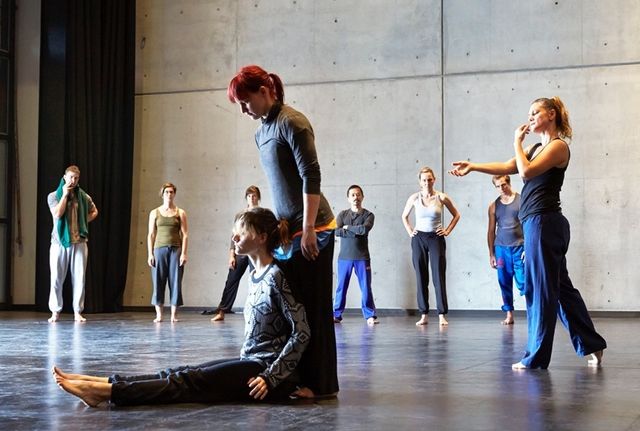
Force Majeure dance company, one of scores of arts organisations denied federal government funds last year. Photograph © Peter Plozza
While the cuts are part of the government’s social austerity measures on all social spending, its actions are not just driven by financial considerations. The national arts budget, after all, is miniscule compared to the billions spent on tax cuts for the rich, or new weaponry and the promotion of militarism. The assault on state-funding of the arts—in Australia and around the world—is motivated by deeper political considerations.
In its struggle against the decaying feudal order, the bourgeoisie in previous centuries sought to lift society’s intellectual and cultural climate in order to challenge the old aristocratic regimes. It championed artistic freedom, recognising its role in enhancing the critical capacities of the population.
Today, such sentiments are anathema to the ruling elites, who regard genuinely critical and creative voices with suspicion or outright hostility.
To maintain political power and justify unprecedented levels of social inequality, attacks on democratic rights and preparations for war, governments everywhere seek to keep the population ignorant, demoralised and in a state of political confusion. That means eviscerating anything that inspires thoughtful reflection, humane sensitivity and honest artistic work.
This is the essential purpose of the Australian government’s gutting of the Australia Council for the Arts, the country’s nominally independent arts funding body, and the network of federally funded museums, libraries, art galleries and other key cultural institutions.
Prior to 1967, federal arts funding in Australia was virtually non-existent. Apart from small amounts to a few well-known authors via the Commonwealth Literary Fund, which was set up in the late 1930s, and the establishment of the Australian Elizabethan Theatre Trust in 1954 to assist large performing arts companies, Canberra gave nothing to assist or encourage artistic activity.
The Australian government is turning the clock back to these dark days, forcing artists to rely on corporate sponsorship or rich benefactors.
Melbourne artists and performers rally against funding cuts
Last May, after a $100 million reduction in government funds, the Australia Council was forced to cut its grants to 62 small- and medium-sized arts organisations, many of them outside the major state capitals and in remote areas. Grants to individual artists were also drastically reduced—down from over 1,140 in 2014 to just 700 in 2016.
While it is not possible here to list the scores of organisations destroyed by these policies, the damage caused and the social implications have been far-reaching. Nothing short of a cultural wrecking operation is underway that impacts most heavily on young artists, the smaller arts companies and those providing vital arts programs in regional and marginalised communities.
The destruction of ArtStart and numerous other financial assistance schemes for young writers, visual artists, musicians and others, for example, prevents all but the sons and daughters of the wealthy from working full-time in their chosen artistic field. Without these grants, it is impossible for young artists to live while devoting adequate time and effort to their work—to experiment, take risks, make mistakes and gain the necessary experience to expand their creative vision and skills.
Australia Council cuts to regional arts communities and remote indigenous settlements have been equally devastating. Arts programs in many indigenous communities play a vital role in enhancing social well-being. In many cases they provide the only source of employment or creative outlet in these desperately poor areas.
As well, arts programs for the disabled and the mentally ill in cities and towns across Australia have been targeted. Starting this year, funding will cease to 13 organisations that deliver remedial treatment arts courses to over 16,000 people across Australia.
David Doyle, head of Disability in the Arts, Disadvantage in the Arts in Western Australia, told a 2015 Senate inquiry into federal funding that the cuts were catastrophic. Community arts programs for the disabled, he said, were being hit by a “perfect storm”—the Australia Council cuts, government “reforms” of national disability and health services and falling sponsorship caused by the collapse of the mining boom.
Helen Bock from Community Arts Network SA told the same inquiry that the government cutbacks would mean that “ordinary Australians will have less or no access to the arts … I have always talked about the arts as the ‘haves’ and the ‘have nots.’ Now what we are going to have is the ‘haves’ and the ‘have mores’…”
Bock correctly observed: “Ordinary Australians will miss out on that transition to appreciating the arts. Organisations will miss out on having their lives improved, having opportunities to build their self-esteem and confidence—a stepping stone and having the experience of creating things …”
Another part of Canberra’s wrecking operation is the annual “efficiency dividend”—an Orwellian cost-cutting measure first introduced by the Hawke Labor government in 1987 and imposed on federally funded cultural institutions and all public sector agencies.
Labor’s “efficiency dividend” policy, which has been retained by consecutive federal governments, forces management at the National Library, National Museum, National Gallery and other important cultural bodies, including most recently the Australia Council, to reduce annual operational costs by up to 2.5 percent. This has led to the destruction of hundreds of jobs and a serious decrease in services—shorter opening hours, fewer resources, fewer exhibitions and in some cases outright closures.
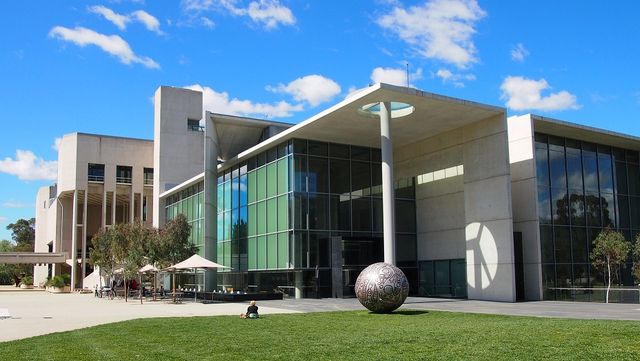
National Gallery of Australia
The Australia Council cuts run parallel with growing demands in government and right-wing media circles for grants to be stopped to individuals and arts organisations that dare to speak out against the government or challenge policy.
George Brandis, then arts minister in the Abbott government, made this abundantly clear in 2014 when he ordered that the Australia Council establish new grant guidelines. Any artist who rejected corporate sponsorship for political reasons should not be given Australia Council funds, he declared.
Brandis’ diktat was in response to a decision by nine visual artists who withdrew their work from the Sydney Biennale because the event was sponsored by Transfield, one of the companies running Australia’s repressive offshore asylum seeker facilities. The arts minister’s demands were echoed by various right-wing columnists and radio shock jock commentators.
Tim Blair at the Murdoch-owned Daily Telegraph supported Brandis and denounced the Australia Council as a “multi-million-dollar tax playpen.”
The Council, Blair said, had perpetrated a “spineless movement of grant-dependent tax sucklings” and “should be shut down, along with just about all arts funding. This would save close to $700 million per year—absolutely guaranteed—and would result in better art.”
What sort of society is being created by these demands? How distant is this from the direct censorship of anything that fails to conform to the political status quo? Or from the measures introduced in Nazi Germany and Mussolini’s fascist Italy to suppress oppositional art?
Those demanding that artists remain silent about Australia’s concentration camp-style refugee detention centres and other anti-democratic violations will soon be calling for direct censorship against anyone daring to speak out against militarism and war.
And what happens if the so-called “efficiency dividend” regime is applied across the board to individual artists? Should painters be forced to cut back on art supplies, or writers to produce novels, or poetry, at a faster rate? Should a choreographer or composer be required to use fewer dancers or musicians, or be obligated to organise more performances of their works?
The Turnbull government, with bipartisan support from Labor and the Greens, claims there is no money. This is a lie. A massive $495 billion military acquisitions program is being carried out over the next decade, to purchase submarines, warships, F-35A strike fighters and a fleet of new battle tanks and other infantry vehicles. Moreover, more than $500 million has been allocated, as part of the promotion of the centenary of World War I, to funding scores of government-commissioned works and events aimed at fostering militarism and fanning the noxious fumes of nationalism.
Scores of arts colleges, galleries and libraries, not to mention schools, hospitals and other vital social facilities, could be financed and staffed with such resources. And countless regional arts organisations and disability arts programs could also be funded.
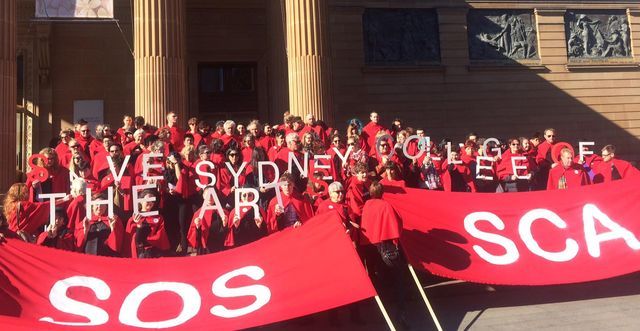
Save Sydney College of the Arts demonstration in 2016
Art seeks to cognise life and provide a deeper understanding of the world and society beyond what is immediately revealed in everyday life. That is why, if artists are unable to survive and do their work, then society as a whole suffers—intellectual life is denuded and critical thought compromised.
The development of serious art and the nurturing of those who carry out this work, however, is a complex social process, and, in the 21st century, the necessary conditions cannot be created or sustained by ordinary individuals—i.e., those without wealthy patrons.
State-funding of the arts is essential—and on a far higher level than currently provided by any country in the world—to create the conditions to train and develop those involved in genuinely creative work and as an essential component of the struggle for a genuinely humane society.
Artists, writers, filmmakers, musicians and other cultural workers have sought to fight the cuts over the past two years via fruitless appeals and protests to government and opposition MPs. But in order to confront the government onslaught, artists and other creative workers need to frankly confront what these measures reveal about the existing social order, what kind of struggle is required and on the basis of what political perspective.
The dangerous undermining of the arts by the Australian government is not a national issue. Nor is it simply the fault of the predilections of individual politicians. Its retrogressive policies, along with the official promotion of xenophobia, ignorance and militarism, are inseparable from the social war being conducted against the working class—the destruction of its jobs, living standards and basic rights—in every country.
In Britain and Europe state-funding of the arts is being eliminated, while the Trump administration plans to destroy what little remains of US government support for the arts. Its targets include the National Endowment for the Arts and the National Endowment for the Humanities, and it aims to sell off the Corporation for Public Broadcasting.
These far-reaching attacks are another measure of the fact that the capitalist socio-economic order, where everything is measured according to its ability to generate profits, has reached an historic impasse. While extraordinary advances have been made in science, technology, and human productivity, which provide the objective conditions for a new and humane social order, the continuation of a society based on private ownership of the means of production and embedded in the system of rival nation states, offers only a dystopian future of social destruction, dictatorship and war.
The democratic right to art and culture has become a revolutionary issue, intimately bound up with the struggle for a new and higher social order. Serious creative and intellectual endeavour has no future under this moribund system.
As Leon Trotsky, revolutionary Marxist and co-leader with Lenin of the 1917 Russian Revolution, explained in 1938, on the eve of World War II: “To find a solution to this impasse through art itself is impossible. It is a crisis which concerns all culture, beginning at its economic base and ending in the highest spheres of ideology.
“Art can neither escape the crisis nor partition itself off. Art cannot save itself. It will rot away inevitably—as Grecian art rotted beneath the ruins of a culture founded on slavery—unless present-day society is able to rebuild itself. This task is essentially revolutionary in character. For these reasons the function of art in our epoch is determined by its relation to the revolution.”
Those wanting to fight the cultural vandalism now underway need to be equipped with an understanding of the complex theoretical and political conceptions, based on the historical and scientific socialist perspective of Marxism, that found their highest expression in the October 1917 revolution and in Trotsky’s struggle against the Stalinist bureaucracy. These liberating ideas, which, in the first decades of the 20th century, attracted the most far-sighted artists, writers and intellectuals, provide the only progressive solution to the explosive political and social issues facing humanity today.

New President of the Gambia, Adama Barrow opens the country for plunder

Eddie Haywood

Newly elected president of Gambia, Adama Barrow, was inaugurated last month after a contentious election held in the small Western African nation. Gambia comprises a sliver of land following the Gambia River, and is bounded by Senegal.
The outgoing president Yayha Jammeh at first conceded defeat to Barrow, and agreed to cede power, but backtracked days later, declaring last December's poll fraudulent and cited unsubstantiated “abnormal irregularities” in the vote count. The Obama administration and governments throughout Europe sharply condemned Jammeh's refusal to concede to Barrow.
Barrow was sworn into office last month in neighboring Senegal under fears of a violent crackdown by the Jammeh government. Jammeh had declared a state of emergency, and the Gambian armed forces occupied the streets in the capital city Banjul.
With the approval of the United Nations Security Council, a military force led by the Senegalese military was organized comprising of forces from the West African nations of Nigeria, Mali and Ghana, and invaded the Gambia with the explicit mission of forcing Jammeh out of the country. Without a shot fired, Jammeh voluntarily boarded a plane in Banjul and left the country.
The universal condemnation of Jammeh heard in the capitals of Western Europe and Washington is a clear indication that Jammeh had fallen out of favor with international finance capital.
The autocrat's 22-year rule was beset by a souring of relations between his government and the imperialist powers; in 2013 Jammeh had withdrawn the Gambia from the British Commonwealth, the organization comprised of 52 former British colonial African nations. Last year Jammeh rescinded the Gambia from the jurisdiction of the International Criminal Court.
In 2014, in response to the sharp international displeasure with Jammeh, the European Union withdrew its economic aid to the nation.
Jammeh had conducted a campaign of expropriating industry during his rule and operating it for the benefit of himself and his clique which raised the ire of international capitalist interests. Jammeh's confiscated enterprises consisted of sectors throughout the Gambian economy, including agriculture, telecommunications, and the service and tourism sector.
The repressive regime was also viewed unfavorably by Western governments not on the basis of democratic rights, but that such brutality is considered “bad for business” in exploiting the Gambian economic resources.
Also viewed intolerably were Jammeh's imposition of overvalued exchange rates for the Gambian dalasi, seeking to prop up the Gambian currency at the expense of the world currency exchange market. These moves provoked a 33 percent drop of international investment in the Gambia in 2014.
With the end of Jammeh's rule, the Gambian economy has been bankrupted, collapsing under years of corruption, cronyism, mismanagement, and ostracism from international markets. It has been reported that Jammeh looted the state coffers of as much as $11 million before his departure from the country.
Barrow, in contrast, is welcomed favorably by Washington and its partners in Europe. Since his inauguration, Barrow has declared that the Gambia is “open for business”, and the new government has agreed to cooperate with the recommendations of the International Monetary Fund and the World Bank for “economic reform” in the country. Interpreted bluntly, this “reform” is nothing short of the complete opening up of the Gambian economy to plunder.
Washington and Europe, in the face of the global crisis of capitalism, are salivating at the massive profits to be made out of exploiting the African continent’s resources and labor in a new “scramble for Africa.”
For its part, Washington sees Africa as a geo-political prize to be lodged securely under its control. For several years, China has increased its economic investment in Africa, and Washington is threatened by Beijing's vast economic influence on the continent.
Barrow has been busy in the first days of his administration lining up investors seeking to carve up the Gambia’s economy. According to African Business magazine, Barrow has pledged to work with investors to create a climate in the country that is consistent with business and market expectations.
The main sectors of the Gambia's economy are agriculture, tourism, and remittances from the Gambian diaspora throughout Europe. Barrow has vowed to expand the Gambian economy further for exploitation.
The oil industry is keen to exploit the Gambia for what it calls “significant reserves” discovered offshore of the tiny nation. CAMAC energy, a conglomerate of oil producing corporations headquartered in Houston, Texas, obtained an exclusive contract last year for the development of oil extraction in the country.
Barrow has promised that the Gambia will return to its membership in the British Commonwealth, the organization set up to continue the capitalist exploitation of the former colonies of Africa after the nations won official independence from British colonialism.
UK Foreign Secretary Boris Johnson paid a visit to the Gambia on February 14 to meet with the new president. In an statement to the media, Johnson said, “President Barrow is determined to take Gambia back to the Commonwealth, and the Commonwealth is ready to welcome Gambia back,” Johnson vowed to do whatever possible to “speed up” the process.
Barrow has also guaranteed that the Gambia will return its cooperation in the International Criminal Court.
With the Barrow in place the European Union has committed €225 million in new funding to Gambia. In African Business magazine Neven Mimica, the European Commissioner for International Cooperation and Development, praised the Barrow government, stating that he wishes to work with the Barrow government in “promoting inclusive entrepreneurship schemes along various value chains with […] potential for exports.”
The Economic Organization of Western African States (ECOWAS), the economic trade bloc comprising the region of Western Africa, has hailed Barrow's election as a promising sign of new investment opportunities in The Gambia.
ECOWAS was set up in 1975 as a regional trade bloc to oversee and facilitate the ease of exploitation and trade of Western Africa's economic resources. Headquartered in Lagos, Nigeria, ECOWAS works in tandem with the United Nations and the African Union.
Underlining this foul climate of capitalist exploitation are the Gambian masses, who, according to the UN, are among the poorest populations in the world. Some 60% live in at or below the poverty line, and earn little more than a dollar a day.
The Barrow administration’s proclamation of “new era for Gambian democracy” and its promises of improvement in living standards is a lie, intensified capitalist exploitation will only deepen the immiseration of the Gambian masses.

Inequality deepens in New Zealand

John Braddock

A report on global inequality, published last month by Oxfam, highlighted that not only is the difference in wealth between people in different countries extreme, the growing gap between the rich and the poor within the same countries is also “alarming.”
Oxfam reported that eight billionaires, six of them from the US, own as much combined wealth as the bottom half of the world’s population, some 3.6 billion people.
In New Zealand, the report found that the two richest individuals have more wealth combined than the poorest 30 percent of the adult population. Graeme Hart and Richard Chandler have an estimated $US6.4 billion and $2.7 billion respectively. Hart owns a swathe of global packaging and consumer goods firms, while the Singapore-based Chandler runs a personal investment fund. The gap is wider than in Australia, where two individuals own more than the bottom 20 percent.
Oxfam’s figures belie the current media spin about an economic recovery. A New Zealand Herald editorial on February 6 celebrated the national holiday by proclaiming the country was “thriving” and brushing aside any “despondency” caused by the US Trump’s administration’s looming protectionist measures.
The richest 1 percent of New Zealanders own 20 percent of the wealth, while 90 percent of the population have less than half. The number of individuals with more than $NZ50 million surged from 212 in October 2015 to 252 in June 2016—an increase of almost 20 percent. Figures from Inland Revenue (IRD) show more than a third of this group declared income of less than $70,000 in 2015. The 252 individuals were linked to 7,500 financial and business entities, some in dispute with IRD over nearly $111 million in tax.
Fairfax Media reported on January 17 that the top 20 percent of households hold 70 percent of the wealth. The top 10 percent of households have 53 percent of total wealth, a higher concentration than the average in the 35 industrialised countries of the Organisation for Economic Co-operation and Development (OECD). There are just 140,000 households in this bracket, each with more than $1.5 million. The bottom 40 percent account for just 3 percent of total wealth. More than 86,000 households have negative worth, nearly 10,000 with debts over $100,000.
These figures do not account for housing costs. In Auckland, the largest city, the average house price is over $1 million and over half of all adults are renting. According to a new Salvation Army report, average rents in the city jumped from $392 to $490 a week in the five years to December. An average Auckland wage-earner works 16 hours just to pay rent, compared with 14.2 hours a week five years ago.
The Salvation Army points to homelessness “unseen in more than a generation,” persistent child poverty and a record imprisonment rate. Radio Newstalk ZB earlier this month found a dozen sites around Auckland where “villages” of people are regularly living in cars, tents, trees and huts. At most sites, in the city’s working class western suburbs, half the inhabitants are young people. Meanwhile the latest National Business Review Rich List showed the fortunes of the wealthy elite are increasingly derived from property speculation.
The National Party government last year dismissed as “sensationalist rubbish” reports that almost one third of children, more than 300,000, are living in poverty. However, the numbers living below the poverty line increased by 45,000 in a year and are now double the number in 1984. A Unicef spokesman told the Guardian child poverty was becoming “normalised” in the country of 4.5 million people.
A major factor in growing child poverty is the government’s deepening attack on welfare entitlements. Draconian work requirements have cut the numbers on sole-parent benefits from 3.1 percent of the working age group in 2008 to 2.3 percent last December—the lowest since 1983. An estimated 50,000 children have been adversely affected. Welfare numbers have dropped faster than official unemployment, indicating that many of those pushed off benefits have not found jobs.
Inequality widened markedly in the late 1980s and 1990s under both Labour and National Party governments. The Gini co-efficient, one measure of household income inequality, has risen from 0.27 in the mid-1980s to 0.35 today.
The increase is the result of two interconnected factors: the boom in financial parasitism and the relentless assault on the living standards of the working class.
Over the past 30 years the economy has gone from being one of the most tightly regulated in the OECD to one of the least regulated. There are no exchange controls or restrictions on bringing in or repatriating funds. In 2015, the World Bank ranked New Zealand as the second easiest country in which to do business and the easiest place to start a business.
The beneficiaries have been a social layer many of whom enriched themselves through the privatisation of public assets begun by the Lange Labour government of 1984–89. Between 1982 and 2011, gross domestic product grew by 35 percent. Almost half of that increase went to the tiny richest group.
Among them were Maori tribal-based businesses, now worth around $42 billion. These were created through multi-million dollar Treaty of Waitangi settlements with successive governments, purportedly in recompense for the crimes of British colonialism. While a small elite has been enriched, the vast majority of Maori remain among the most impoverished layers of the working class.
The wider economy is dominated by parasitic activities related to finance, banking and currency trading, which are equivalent in importance for the capitalist class to dairying, the country’s major export industry. The New Zealand dollar is listed among the world’s 10 most traded currencies. The stock market soared 121 percent from April 2009 to June 2015.
The working class, meanwhile, has suffered an historic social reversal, imposed by successive governments with the close collaboration of the trade unions. Income levels, which used to exceed those of many Western European countries before the 1970s, have dropped in relative terms and never recovered.
The official unemployment rate rose to 5.2 percent at the end of 2016. The unreported figures, including people who want to work or are seeking more work, are far higher. According to economist Rob Stock in the Sunday Star Times, the “underutilisation rate” has been “stubbornly high,” remaining at 13 percent since the 2008 financial crisis. Compared to the 132,000 jobless, there were 342,000 workers classed as underutilised.
Stock noted that for people in this situation the labour market “could feel more like a Portugal or a Greece.” Some 12 percent of youth aged 15–24 are not in employment, education or training, down from a recession peak of 14.1 percent in 2009 but still above the 2007 rate of 10.9 percent.

Australian industrial tribunal slashes workers’ wages

Oscar Grenfell 

The Fair Work Commission (FWC), the federal government’s industrial tribunal, yesterday cut wage rates for workers on Sundays and public holidays across the retail, hospitality, pharmacy and fast food industries.
The wage reductions, which target some of the lowest-paid workers, will be used by the corporate elite to step up the assault on the wages and conditions of the entire working class. Employer groups and media editorials are already demanding deeper and more sweeping cuts.
Around one million workers will be directly affected by the pay cuts. Another three million, who work on weekends, likewise face the future prospect of being stripped of the after-hours penalty rates on which they depend to live.
The ruling follows a protracted campaign by business groups, the financial press and successive Labor and Liberal-National governments against penalty rates, which were first introduced in 1947 for after-hours work.
It was the Labor government of Kevin Rudd and Julia Gillard that established the FWC in 2009, with the full support of the trade unions, and then included penalty rates in a four-year FWC review, aimed at stripping back conditions in industrial awards.
Under the FWC ruling, Sunday penalty rates will be reduced from 175 to 150 percent of the base rate of pay for permanent employees in the hospitality industry. Permanent fast food workers face a reduction from 150 to 125 percent, while casuals will suffer a cut from 175 to 150 percent.
For permanent retail and pharmacy workers, the rate will be slashed from 200 to 150 percent, while for casuals, it will be reduced from 200 to 175 percent. Across the sectors, public holiday rates will decrease from 250 percent to 225 percent. Most of the cuts take effect at the beginning of July.
According to trade union estimates, which are likely to be under-stated, the changes will strip workers of up to $6,000 in annual wages. Permanent retail workers, paid the award rate of $19.44 per hour will lose over $72 for every Sunday shift.
This comes on top of the lowest wage growth in recorded history, with average weekly earnings rising only 1.6 percent over the past year, just above the official inflation rate of 1.5 percent.
These figures hide a widespread decline in real wages, particularly hitting the poorest workers. Forty-one percent of households earning less than $40,000 a year reported a decline in income last year, according to this month’s Household Financial Comfort Report. Less than a third of households, overwhelmingly the wealthiest, reported income gains.
Under conditions of soaring major city housing and rental prices, fuelled by speculative investment, the penalty rates cut will increase the hardships facing broad sections of the working class. According to recent figures, over 42 percent of low-income renters are in housing stress—spending more than a third of their income on housing. Household debt is at record highs, with a debt-to-income ratio of over 189 percent.
The FWC ruling has already provoked widespread opposition, with thousands of hostile comments on social media and elsewhere pointing to the social consequences of the ruling. Labor, the Greens and the trade unions have adopted cynical postures of opposing the decision, making vague claims of challenging it by seeking to amend industrial legislation.
In reality, it was current Labor leader, Bill Shorten who amended the Fair Work Act in 2013, as workplace relations minister, to specifically include penalty rates among those aspects of award rates to be “reviewed,” i.e., cut. The FWC president who handed down yesterday’s ruling, Ian Ross, is a former union official whom Shorten appointed in 2012.
Throughout last year, including during the July 2 federal election, Shorten stressed that he would not challenge any FWC ruling cutting penalty rates, in a bid to assure the corporate elite of Labor’s pro-business credentials.
Moreover, in handing down its ruling, the FWC was fulfilling its mandate, based on draconian legislation enacted by the last Labor government, which outlaws most industrial action by workers and is aimed at facilitating continuous cuts to workers’ wages and conditions, usually via union-negotiated enterprise agreements.
In January the FWC endorsed pay cuts of up to 65 percent for power workers at AGL’s Loy Yang A plant in Victoria’s Latrobe Valley, establishing a new wage-cutting precedent. In other aggressive interventions into industrial disputes, the FWC has banned strike action on a number of occasions, including with the support of state Labor governments.
The statements of Greens leaders denouncing the ruling are no less hypocritical. In 2013, Senator Peter Whish-Wilson, the party’s treasury spokesman and a former Wall Street banker, denounced penalty rates as “outdated” and called for a “national discussion” on their abolition.
For their part, the union leaders who condemned the ruling as “the biggest wage cut since the depression” have already established a host of backroom agreements eliminating penalty rates and other rights for broad sections of the working class.
In 1998 the Australian Workers Union (AWU) established a secret deal with Cleanevent, a major cleaning corporation, to dismantle penalty rates, costing poorly-paid cleaners up to $400 million over more than a decade. Bill Shorten, as AWU national secretary, was intimately involved in the arrangement.
In 2015, the Shop Distributive and Allied Employees Association (SDA), the country’s largest union, struck a deal with Business South Australia to abolish Saturday and weeknight penalty rates for up to 40,000 shop assistants. The agreement, a precedent for the FWC ruling, slashed Sunday rates by 50 percent, and public holiday loadings by a third.
At the time, Shorten hailed the SDA deal as a “win-win,” and Mark Butler, a Labor shadow minister and former union official said: “This is what we envisaged when Paul Keating’s government put together the enterprise bargaining model.” In other words, the entire industrial relations framework set in place by Labor and the unions was aimed at imposing wage cuts.
Hailing the FWC decision, Martin Ferguson, who was president of the Australian Council of Trade Unions during the Keating Labor government, and later became a key government minister, urged workers to accept the ruling. Currently the chairman of Tourism Accommodation Australia, an employer organisation, he complained that his industry still did not get the full rate reductions it was hoping for.
Likewise, editorials in the financial press, while welcoming the ruling, demanded much more. The Australian said the ruling was “correct in principle” but “evolutionary” and “limited in scope.” The Australian Financial Review said the decision fell “well short” of those recommended by the government’s Productivity Commission in 2015, and declared that “a less regulated job market is a critical condition for sustaining Australia’s modern prosperity in a more competitive world.”
In other words, what is being demanded is essentially the destruction of all that remains of the conditions and basic rights won by workers over decades of struggle.