25 Feb 2017

Pentagon prepares for bigger, bloodier war in Iraq and Syria

Bill Van Auken

The Pentagon has prepared recommendations to be submitted to President Donald Trump at the beginning of next week for a major escalation of the US military intervention in Iraq and Syria.
According to unnamed US officials cited Friday by the Wall Street Journal, the proposal is expected to include “sending additional troops to Iraq and Syria” and “loosening battlefield restrictions” to “ease rules designed to minimize civilian casualties.”
The new battle plans stem from an executive order signed by Trump on January 28 giving the Pentagon 30 days to a deliver a “preliminary draft of the Plan to defeat ISIS [Islamic State] in Iraq and Syria.”
According to independent estimates, as many as 8,000 civilians have already died in air strikes carried out by US and allied warplanes against targets in both Syria and Iraq, even as the Pentagon routinely denies the vast majority of reported deaths of unarmed men, women and children resulting from US bombings. The new policy to be rolled out next week, which the Journal reports is aimed at “increasing the number and rate of operations,” will inevitably entail a horrific intensification of this bloodletting.
Speaking before the Center for 21st Century Security and Intelligence at the Brookings Institution in Washington on Thursday, the chairman of Joint Chiefs of Staff, Marine General Joseph Dunford, said that the Pentagon would be presenting Trump with a “political-military plan” to deal not only with ISIS in Iraq and Syria, but to “advance our long-term interests in the region.”
Referring to the intense contradictions besetting the US intervention in the region, which has relied on the use of Kurdish militias as proxy ground troops in Syria, even as Washington’s NATO ally, Turkey, has intervened to militarily counter their influence, Dunford insisted that Washington “can’t be paralyzed by tough choices.”
Pointing to the regional scope of the planned US military escalation, Dunford echoed earlier bellicose rhetoric from the administration against Iran, listing it alongside Russia, China, North Korea and “transnational violent extremism” as the major targets of the US military.
The US military commander stated that “the major export of Iran is actually malign influence across the region.” He said that the US military buildup against Iran was designed to “make sure we have freedom of navigation through the Straits of Hormuz, and that we deter conflict and crisis in the region, and that we advance our interest to include our interest in dealing with violent extremism of all forms.” All of these alleged aims are pretexts for continuous US provocations aimed at countering Iran’s regional influence and furthering the drive for US hegemony in the Middle East.
In relation to Iraq, Dunford signaled US intentions to maintain a US military occupation long after the campaign against ISIS is completed. He referred to a “dialog about a long-term commitment to grow the capacity, maintain the capacity of the Iraqi security forces,” adding that Iraq’s Prime Minister Haider Abadi had spoken of “the international community continuing to support defense capacity building.”
Dunford’s comments echoed those of Secretary of Defense James “Mad Dog” Mattis during a trip earlier this week to Baghdad. While disavowing Trump’s crude comments last month—“We’re not in Iraq to seize anybody’s oil,” Mattis said—he also suggested that plans are being developed for a permanent US military presence in the country.
“The Iraqi people, the Iraqi military and the Iraqi political leadership recognizes what they’re up against and the value of the coalition and the partnership in particular with the United States,” Mattis told reporters Monday. “I imagine we’ll be in this fight for a while and we’ll stand by each other.”
Currently, Washington has more than 5,000 US troops in Iraq and another 500 Special Forces troops operating inside Syria. These forces are backed by tens of thousands of military contractors as well as other military units that are rotated in and out of the region. The plan to be presented next week will likely involve the deployment of thousands more US combat forces.
Trump has repeatedly indicated his support for establishing “safe zones” in Syria, an intervention that would require large numbers of US soldiers backed by air power to seize and control swathes of Syrian territory. It would also entail threats of military confrontation with Russian warplanes operating in support of the Syrian government.
As the Pentagon prepares its plans for military escalation in the region, US ground forces have reportedly entered Mosul, operating on the front lines with Iraqi forces in the bloody offensive to retake Iraq’s second-largest city from ISIS. American Special Forces “advisers” joined Iraqi troops Thursday in the first incursion into western Mosul, with the retaking of the Mosul International Airport as well as a nearby military base. The operation was conducted with close air support from US warplanes.
The airport and the base, located in the southern part of western Mosul, are to be used as the launching pad for a major assault into the most densely populated area of the city, where an estimated three quarters of a million civilians are trapped with no means of escape.
The International Rescue Committee warned that this stage of the offensive would represent the “most dangerous phase” for civilians.
“This will be a terrifying moment for the 750,000 people still in the west of the city, and there is a real danger that the battle will be raging around them for weeks and possibly months to come,” said Jason Kajer, the Iraq acting country director for the humanitarian group.
Referring to the increasingly desperate plight of civilians in western Mosul, the International Committee of the Red Cross’s field coordinator in Erbil, Dany Merhy, said: “Supply routes have been cut from that side of the city and people have been facing shortages of food, water, fuel and medicine. We can only imagine the state people will be in.”
As in previous US-backed offensives against Fallujah and Ramadi, Mosul faces the prospect of being reduced to rubble. It is in this city where the proposed changes in the “rules of engagement” will find their first expression in the elevated slaughter of Iraqi civilians.

Lurid claims that North Korea used VX poison to kill Kim Jong-nam

Peter Symonds

Malaysian police stated yesterday that Kim Jong-nam, the older half-brother of North Korean leader Kim Jong-un, was killed by a potent nerve poison, VX, when he was attacked at Kuala Lumpur International Airport on February 13.
The American press immediately seized on the unsubstantiated claim to ramp up its demonisation of the North Korean regime over its alleged use of a banned chemical weapon and to suggest that the Trump administration take action against Pyongyang.
The New York Times, for instance, entitled its story “In Kim Jong-nam’s death, North Korea lets loose a weapon of mass destruction.” The Wall Street Journal headline declared, “Role of VX nerve agent in Kim Jong-nam’s death raises global alarm.”
What is publicly known about the murder is limited. The Malaysian police investigation is still underway. Three people have been detained—two young women, one from Indonesia and the other from Malaysia, along with a North Korean man. Malaysian authorities have named seven other North Koreans, including a diplomat, they are seeking in relation to the murder.
Kim Jong-nam was attacked by the two women, who allegedly smeared chemicals on his face then fled. Kim sought medical help, quickly collapsed and died on the way to hospital. Two autopsies have been performed but details have not been released. No one has come forward to claim the body or make a positive identification.
Relations between Malaysia and North Korea deteriorated sharply after Pyongyang demanded the release of the body without an autopsy and publicly criticised the Malaysian investigation. North Korea’s ambassador to Kuala Lumpur, Kang Chol, told reporters last week that “we cannot trust the investigation” and accused Malaysia of colluding with “hostile forces”—claims that Malaysian authorities have dismissed.
Kim Jong-nam lived much of his life abroad and had a reputation as a playboy, living in the Chinese territory of Macau. He was publicly critical of the North Korean regime headed by his half-brother and called for pro-market reform, but made no indication he would make a bid for power in Pyongyang.
Despite the lack of detailed evidence or formal police findings, a mountain of media speculation continues to grow as how and why Kim Jong-nam was killed, all pointing to North Korea. Whether or not Pyongyang carried out the assassination, the incident is being exploited to the hilt to further a reactionary political agenda.
An editorial in yesterday’s Wall Street Journal entitled “North Korean Terror Notice” blamed the murder on Pyongyang and declared: “This is one more reason the US should redesignate North Korea a state sponsor of terror, a status it never should have lost in 2008.”
The editorial is part of the mounting clamour in US foreign policy and military circles for diplomatic, economic and/or military action against Pyongyang as a high priority. The Obama administration reportedly recommended to Trump and his advisers that Pyongyang be placed at the top of its foreign policy agenda because of the alleged threat it would have a nuclear-capable intercontinental ballistic missile (ICBM) in the next few years.
When the North Korean leader Kim Jong-un announced on New Year’s Day that his country would soon test an ICBM, Trump, as president-elect, tweeted that “won’t happen,” implying military action to prevent it. His administration is reviewing US policy toward North Korea, having been critical of failure of the Obama administration to force Pyongyang to dismantle its nuclear and missile programs.
The call for North Korea to be redesignated as a state sponsor of terrorism only highlights the cynical character of US policy. The Wall Street Journal editorial claims that the Bush administration delisted Pyongyang “in exchange for denuclearisation promises that Pyongyang broke as always.” In reality, as part of a deal struck in 2007, the Bush administration only belatedly and reluctantly took North Korea off the US State Department list after Pyongyang had shut down and begun to dismantle its nuclear facilities and readmitted UN inspectors. The deal broke down after the US insisted on additional, more intrusive inspection protocols.
As the editorial admitted, branding North Korea as a state sponsor of terrorism would have little practical effect. It would, however, effectively sabotage China’s attempts to restart the six-party talks that led to the 2007 agreement and end any prospect of direct US negotiation with North Korea, which has been urged by a few US commentators.
The editorial also made clear that the chief target is not North Korea, but its neighbour and ally China, which the Trump administration has already threatened with trade war measures and military action to block access to its South China Sea islets. Relisting North Korea, it declared, “especially if followed by long-overdue sanctions on the Chinese firms that sustain the Pyongyang regime… would put Kim Jong-un and his Chinese patrons on notice.”
Trump has previously lashed out at Beijing for allegedly failing to use Pyongyang’s dependence on China to force North Korea to submit to US demands. Under pressure from Washington, Beijing, which has already imposed heavy UN sanctions on Pyongyang, announced this week that it would suspend all coal imports from North Korea for the rest of the year, compounding its economic crisis. Coal exports have been the country’s single largest foreign currency earner.
China has opposed North Korea’s nuclear and missile program, as it provides the US with a pretext for expanding its military presence in North East Asia and could trigger a nuclear arms race involving Japan and South Korea. At the same time, Beijing fears an implosion of the North Korean regime that could result in a unified Korea allied to the United States.
Relations between Beijing and Pyongyang deteriorated further this week when the North Korean state-run KCNA news agency castigated “a neighbouring country, which often calls itself a ‘friendly neighbour’”—a reference that can only mean China—for “dancing to the tune of the US.” Such explicit public criticism of China is unprecedented and will likely produce a reaction from Beijing.
The mounting media campaign against North Korea over Kim Jong-nam’s murder recalls the propaganda about the “war on terror” and “weapons of mass destruction” that was used as the pretext for the US-led illegal wars of intervention in Afghanistan, Iraq and Syria. Any US action to destabilise or take military action against the crisis-ridden North Korean regime threatens rapidly draw in other powers, including China, and plunge the entire region into conflict.

Italy: Pseudo-left founds Italian Left Party

Marianne Arens

Several hundred representatives of the Italian pseudo-left gathered in Rimini February 17-19 to found the Sinistra Italiana (Italian Left Party, SI). Its role is to defend bourgeois rule, the European Union and the euro in their deepest crisis to date.
The driving force behind the new Italian Left Party is Nichi Vendola, a former leader of the Italian Communist Party (PCI). He co-founded Rifondazione Comunista in 1991 and, in 2009, the party alliance Sinistra, Ecologia, Libertà (Left, Ecology, Freedom, SEL). In Rimini, he gathered together some 650 politicians, trade unionists and officials, mainly from the SEL and Rifondazione Comunista, as well as several defectors from Matteo Renzi’s Democratic Party (PD) and Beppe Grillo’s Five Star Movement (M5S).
The new party has an extremely amorphous programme based on the lowest common denominator, as the name “Italian Left Party” demonstrates. The only thing of which these “lefts” are certain is their commitment to Italy. For example, it says in the party statutes, the SI is a “union of men and women who have assembled to represent labour, as it is constituted in today’s Italy.”
The SI is not entirely new: It has existed as a parliamentary slate for two years. Nichi Vendola brought it into being in July 2015, in order to cover up the treachery of Alexis Tsipras in Greece and establish an Italian counterpart to Greece’s Syriza, Spain’s Podemos and Germany’s Left Party. Its predecessor was the Lista con Tsipras (List for Tsipras), an electoral alliance that contested the 2014 European elections three years ago.
In August 2015, the World Socialist Web Site wrote: “Vendola’s support for Tsipras’ austerity policies underscores that, like Tsipras in Greece, he is prepared to sacrifice all the social rights of the working class to defend the interests of European capitalism. Given the growing crisis of the Renzi government, he wants to establish a new political vehicle to this end.”
This was the focus of the congress in Rimini. The new pseudo-left party has the task of channelling opposition to the ailing centre-left government of Renzi confidante Paolo Gentiloni. Its role is to head off an independent movement of the working class by those turning to an international socialist perspective.
The new party elected Nicola Fratoianni as its secretary. The 45-year-old began his career as a youth leader in Rifondazione Comunista, the successor to the PCI, which he headed for years in Apulia before forming the SEL together with Nichi Vendola. He increasingly became the right hand of Vendola, who was regional president of the desperately poor Apulia region for 10 ten years, from 2005 to 2015.
In Rimini, Fratoianni stressed that the new party would represent “a broad political project.” He promised that it would cooperate with the PD as long as this precluded Renzi’s re-election. Even Vendola stressed, “Sinistra Italiana is ready to join with others.” He hoped to receive 10 percent of the vote in the next elections.
Artur Scotto, SEL parliamentary group leader, also expressed a fundamental willingness to cooperate with the PD. Scotto was a rival of Fratoianni for the new party leadership, but withdrew before the SI was founded. Before the congress, Scotto said, “We have to throw ourselves into the fray and not stand on the side-lines and watch. For me, the centre-left camp is the perspective. I am looking to the post-Renzi era.”
The PD is in a deep crisis and threatens to break apart after Matteo Renzi’s referendum on constitutional reform was clearly lost on December 4, 2016. The clear rejection by nearly 60 percent of the electorate expressed the social opposition to the austerity measures of the Renzi government and the European Union. Renzi subsequently resigned as Italian prime minister, leaving the post to his confidante Paolo Gentiloni.
In fact, Renzi’s resignation was a manoeuvre prior to his standing again as a candidate for prime minister in early elections. But in the meantime the crisis in the PD has intensified. On February 19, the same weekend the SI was founded, Renzi resigned as party leader.
At the same time, he announced he would stand in the PD primaries on April 9. “You can force me to resign, but you cannot stop me running again,” he told his inner-party opponents before he left on a trip to California.
He has been tweeting from there every day, and commented on the party crisis words like: “While politicians are arguing, I am thinking about the future” and “It’s nice to be a patriot—Long live Italy.” The newspaper Il Fatto Quotidiano speculated that Renzi wanted to transform the PD into a “party of the nation” or a “party for all.”
His opponents are rallying around the former party leader Pier Luigi Bersani, who fears that in this way the ruling party will whip up the working class against it. On the TV show “Martedì,” Bersani said he hoped people did not perceive the whole thing as a dispute over the person of Renzi.
Bersani, Massimo D’Alema and other PD bigwigs had demanded Renzi give up pushing for early elections and leave Paolo Gentiloni in office until the end of the legislative period in February 2018. They fear that early elections could benefit the EU opponents Beppe Grillo and the far-right Northern League. Renzi, however, has rejected this.
Bersani, D’Alema and other politicians from the early days of the Democratic Party now want to leave the PD. They have announced they will not participate in the next party congress. “The firm doesn’t exist any longer,” said Bersani. Even the ex-governor of Emilia Romagna, Vasco Errani, wants to leave Renzi, who had recently appointed him as special commissioner for earthquake reconstruction.
Romano Prodi, the former prime minister, European commissioner and representative of the banks, who was involved in founding the PD, recently declared that the party was committing “political suicide.” It is visibly losing support in the population. The reason is the desperate social situation, a youth unemployment rate of 40 percent, rampant poverty affecting pensioners, a wave of bankruptcies among small and medium-sized enterprises and the unresolved banking crisis.
The PD deserters and the new party SI have no progressive answer to this. They are merely trying to forestall the rapid breakup of the ruling party. Like the new Social Democratic Party chairman Martin Schulz in Germany, who allegedly wants to reverse parts of the Agenda 2010 welfare and labour “reforms” of the Schröder government, they want to support a referendum called by the Italian General Confederation of Labour (CGIL) to reverse Renzi’s labour market reform, called the Jobs Act. This is all a transparent manoeuvre to maintain control over an increasingly angry population.
The founding of Sinistra Italiana serves to cover up these manoeuvres and to prevent the outbreak of open class struggles. Like Syriza in Greece, these practised bourgeois politicians are quite ready to join the government to carry out the attacks on the working class themselves. At the same time, they are driving voters towards the right-wing populists with their nationalist and pro-EU policies.
Their programme does not differ fundamentally from Grillo’s Five Star Movement (M5S). This has already been shown by the fact that several M5S politicians have abandoned Grillo and joined the new SI, such as senators Francesco Campanella and Fabrizio Bocchino, and parliamentary deputies Adriano Zaccagnini, Leandro Bracco et al.
Grillo is trying to exploit the coming to power of Donald Trump for his own benefit, and is aggressively calling for elections to be held swiftly. He claims that his party is the only one that can achieve the necessary 40 percent for a one-party government. The M5S is currently polling just below 30 percent.

Far-right Front National surges in French presidential election polls

Kumaran Ira and Alex Lantier 

Little more than nine weeks before the first round of the French presidential election on April 23, neo-fascist Front National (FN) candidate Marine Le Pen is consolidating her lead over her main rivals. According to recent surveys, she will easily qualify for the May 7 runoff, most likely facing either Emmanuel Macron of En Marche or right-wing The Republicans (LR) candidate François Fillon.
Just as Donald Trump emerged as a viable and ultimately victorious candidate in the United States despite broad popular hostility, Le Pen could also win the 2017 elections due to explosive social anger against her opponents, particularly the Socialist Party (PS) government. An Elabe poll for BFMTV on Wednesday found that on the first round, she would get 27 percent of the vote, well ahead of Fillon (20 percent) and Macron (17 percent).
Even after François Bayrou, the president of the right-wing Mouvement Démocrate (MoDem), announced Wednesday that he would not run for president and endorsed Macron, Le Pen still led in polls. According to an Ifop-Fiducial poll held after Bayrou’s endorsement, Macron would receive 22 percent of the vote. The same poll found that he would win the second round, 61 percent to Le Pen’s 39 percent—more than double her father Jean-Marie’s score of 18 percent in the 2002 presidential elections, the only other time the FN advanced to the runoff.
Though Le Pen would currently lose the presidency, she is steadily increasing her score in polls on the runoff, having risen between 1.5 and 2 percent since the last poll. With 53 percent of voters still undecided, a last-minute shift in favor of Le Pen cannot be ruled out.
Amid broad anger at PS austerity policies, the FN is surging among manual workers: 44 percent intend to vote for Le Pen, compared to Left Front candidate Jean-Luc Mélenchon (17 percent), Macron (15 percent), PS candidate Benoit Hamon (12 percent) and Fillon (7 percent). The New Anti-Capitalist Party (NPA) and Workers Struggle (LO)—which received nearly 10 percent of the total vote in 2002—would get only 3 and 2 percent of manual workers’ vote, respectively, according to the polls.
The FN’s rise as a serious contender for power is part of an international collapse of the post-World War II, US-dominated world order. After Britain voted last year to exit the European Union (EU), Trump took office having dismissed the NATO alliance as “obsolete,” signaled sympathy for Russia and attacked the EU as a tool of Germany. The international framework of European capitalist politics is disintegrating.
If Le Pen has been granted media access and treated as a respectable candidate, this is due to deep divisions in the French financial aristocracy over how to now assert its interests. The Socialist Party and the campaign of Macron, the former PS economy minister, back NATO’s war drive against Russia and EU austerity led by Berlin. They were hostile to Trump during the US presidential campaign.
The FN, however, speaks for a faction that feels threatened by the euro, German rearmament and German economic hegemony in the EU, and seeks to partially revive France’s traditional alliance with Moscow against Berlin. Le Pen, whose nationalist foreign policy echoes that of Trump, hailed the latter’s election as the beginning of a “new world.” She also praised Brexit and called for France to leave the EU and the euro, returning to a French national currency, the franc.
“The euro is a major obstacle to the development of our economy,” she said. She has pledged several shock proposals, including organizing a European summit to renegotiate all EU treaties. She has repeatedly said she wants to devalue the currency to revitalize French industry, and that in the case of the failure of such talks, she would propose a referendum on France’s exit from the euro currency.
Should it take power, the FN would lead a regime of war and deep social reaction that would vastly accelerate the political disintegration of bourgeois Europe. Besides trying to slash workers’ purchasing power with a policy of competitive devaluation aimed above all at Germany, its stated policies include slashing attacks on basic social and democratic rights. It would rely on broad support for the FN in the police, which has been given virtually arbitrary powers by the PS’s state of emergency, to try to crush popular opposition.
In line with far-right parties across Europe, the FN plans to stir up anti-immigrant and anti-Muslim hysteria to divide the working class and cultivate a militarist atmosphere. It plans to expel undocumented immigrants, limit immigration and impose harsh conditions for obtaining French nationality. Le Pen has vowed to end free education for foreign children, declaring: “If you come to our country, don’t expect to be taken care of, treated, that your kids will be educated for free, that’s ended, game over!”
There is deep opposition in the population, above all in the working class, to the FN’s agenda. Opposition to Trump in France, at over 80 percent, gives an idea of the underlying unpopularity of the FN’s far-right nationalist program.
A columnist in Britain’s right-wing Spectator recently gave voice to the bourgeoisie’s fears of opposition a FN regime could provoke in the working class, writing: “If she did become president, France would face a genuine crisis, the worst for half a century. There would certainly be strikes and violent demonstrations by those who would see themselves as defending the Republic against fascism. How she could form a viable government or win a majority in parliament is unclear.”
The working class cannot ward off the threats posed by the FN by supporting Macron, the PS, or the PS’s various satellites—the Left Front, the NPA or LO. All helped pave the way for the neo-fascists’ emergence. They defended the PS as it tried to fashion a social base for its austerity policies, wars and attacks on democratic rights, imposing a perpetually renewed state of emergency and inviting Le Pen to the Elysée presidential palace as a mark of respectability.
More fundamentally, they are discredited by the failure of the PS and the global capitalist order. Macron, who laid out his economic proposals in the financial daily Les Echos yesterday, called for drastic spending cuts of €60 billion [$US63.5 billion], including €25 billion in public spending and cutting 125,000 public sector jobs. At the same time, he threatened Berlin with “frank and demanding” negotiations to obtain more favorable policies.
Reports suggest that inside the PS, where utter demoralization prevails, the idea of the inevitability of a Le Pen victory is gaining ground. In a February 16 article headlined, “Why the PS believes in a Marine Le Pen victory,” Le Point cited top PS officials including PS National Secretary Jean-Christophe Cambadélis, who said: “The alignment of planets was never so favorable to Marine Le Pen.”
It listed 10 reasons—including Brexit, Trump’s election and the impact of potential new terrorist attacks in France—why Le Pen could win. Remarkably, one of the reasons given was that the neo-fascists and allied pro-FN intellectuals, like journalist Eric Zemmour and writer Michel Onfray, had “won the cultural battle” of ideas. This comment, from a leading liberal publication in France, amounts to a devastating self-indictment by the ruling class of its own historical bankruptcy.

Capitalism and America’s addiction epidemic

Andre Damon

The US Centers for Disease Control and Prevention (CDC) released a report Friday showing that nearly 13,000 people died from heroin overdoses in 2015, up four-fold from the 3,036 deaths reported in 2010. The overall incidence of overdoses from all drugs has more than doubled since 1999.
The drug epidemic affects all ages, genders and races. The overdose rate for the 55–64 age group has gone up nearly five-fold, while the 45-54 age group had the highest rate of overdoses overall.
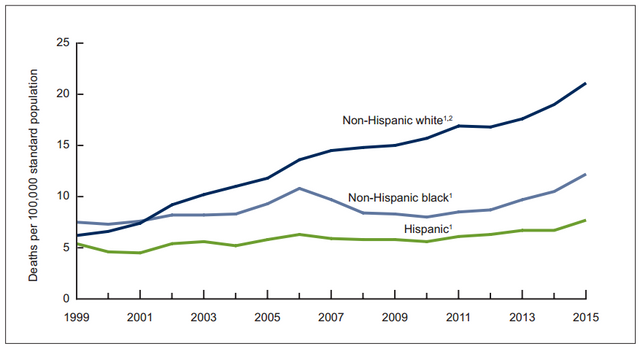
Whites had the highest rate of overdose deaths of any ethnicity, more than double the combined death rate for blacks and Latinos. The overdose death rate for whites, which was lower than that of blacks in 1999, has more than tripled since then.
What is behind the shocking and tragic growth in drug overdoses?
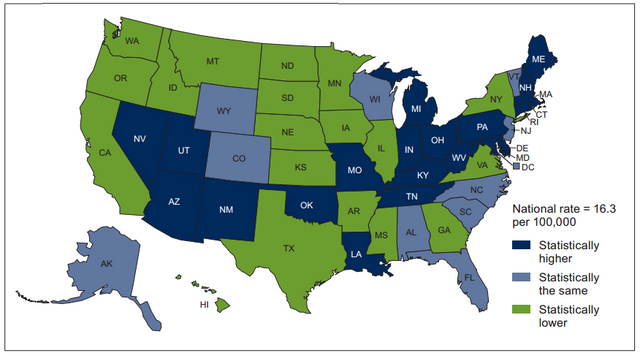
The drug epidemic has been concentrated in former coal mining regions such as Kentucky, West Virginia and Tennessee, along with so-called “rust-belt” states such as Michigan, Ohio, Indiana and Pennsylvania. These areas of the country have been hardest hit by decades of deindustrialization, mass layoffs and wage-cutting, beginning in the late 1970s and continuing ever since.
Age-adjusted drug overdose death rates by state- United States - 2015
Industrial and mining towns in these states have been turned into wastelands, littered with the rusting hulks of factories that once employed thousands of people. In places like Pontiac, Michigan; Akron, Ohio; and Huntington, West Virginia decent-paying jobs are scarce, while schools and community centers have been closed by the dozens.
The social distress that finds a particularly concentrated expression in the rust belt exists throughout the country. In 2015, for the first time in 23 years, US life expectancy decreased, led by a sharp increase in mortality rates for white Americans.
Last month, a survey by the Young Invincibles found that millennials earn 20 percent less than their parents did at the same stage in life, despite being better-educated. Homeownership rates have hit their lowest levels since 1965, with record numbers of young people being too poor to move out of their parents’ homes.
At the other end of the age spectrum, indebtedness among seniors has increased dramatically and household debt as a whole is soaring.
There is a palpable sense that American society is going backward. The drug epidemic is a malignant expression of the fact that millions of people see no prospect for living an economically secure and fulfilling life.
The conditions of life for working people, whose incomes have been stagnant or declining for decades, stand in the starkest contrast to the phenomenal enrichment of the ruling elite, whose wealth has more than doubled since 2009, driven by an unprecedented stock market boom.
Drug overdose death rates - by race and ethnicity in the United States
In its quest for cheap and easy profits at any social cost, the American health care system, dominated by the pharmaceutical industry, the insurance giants and for-profit hospital chains, has turned to over-prescribing opioid painkillers. As a result, over a third of Americans now use prescription painkillers, whether obtained legally or illegally. This is a higher percentage of the population than the portion that smokes or uses smokeless tobacco.
Alongside the economic underpinnings of the social crisis there are the crippling intellectual and cultural effects of a quarter-century of endless war and political reaction. War, xenophobia, chauvinism, the worship of money and power—all are extolled by the ruling elite, its political parties and the media and entertainment establishment. These are the symptoms of an economic and political system breaking down under the weight of its own internal contradictions.
The period since the baseline of the CDC report, 1999, has seen repeated eruptions of protest and struggle against the policies of war and social reaction carried out by Democratic and Republican administrations alike. Fourteen years ago this month, the largest anti-war demonstrations in US and world history took place in cities across America and around the world in opposition to the impending US war in Iraq. This movement against war was suppressed and dissipated by being channeled behind the Democratic Party and its presidential candidate John Kerry.
Four years later, millions of workers and youth went to the polls to express their hatred for the policies of war and austerity of the Bush administration and elect the candidate who promised “hope” and “change,” Barack Obama. The hopes invested in Obama turned into bitter disillusionment and anger as the Democratic administration continued and intensified the right-wing, militaristic policies of Bush and oversaw a further growth of social inequality.
The 2016 election was dominated by mass popular hostility to the political establishment and both parties of big business. This took a left-wing form in the mass support among working people and particularly youth for Bernie Sanders, who garnered 13 million votes in the Democratic presidential primaries by presenting himself as a socialist and opponent of the “billionaire class.” Sanders cynically used his anti-capitalist pretensions to divert popular opposition back behind the Democratic Party, throwing his support to the embodiment of the Democrats’ repudiation of social reform and open embrace of Wall Street and the CIA—Hillary Clinton.
This opened the way for Trump, the personification of the financial oligarchy, to exploit mass discontent on a right-wing, pseudo-populist and chauvinist basis and win the election.
The political impasse caused by the subordination of the working class to the Democratic Party and the two-party system, reinforced by the corporatist trade unions, has fueled the frustrations and dashed hopes that foster anti-social acts, from mass shootings to drug addiction.
But the readiness of the working class and youth to fight has once again found expression in the mass protests since Trump’s inauguration. The Women’s March one day after the inauguration was the biggest international protest since the February 2003 demonstration on the eve of the Iraq War, and demonstrations against Trump’s assault on immigrants and democratic rights more broadly have continued ever since.
Once again, there is a concentrated attempt to divert and dissipate social opposition by channeling it behind the Democratic Party, whose central preoccupation is creating the conditions for war against Russia. The urgent lesson that must be drawn is the need to reject all such efforts and break decisively from the Democratic Party and all parties and politicians of the capitalist class.
The social crisis expressed in the surge in drug overdoses can be overcome only in a struggle to mobilize the working class in the US and internationally against the capitalist system, the source of poverty, inequality and war.

24 Feb 2017

Remembering the Coup in Ghana

Yves Engler

A half-century and one year ago today Canada helped overthrow a leading pan Africanist president. Ghana’s Canadian-trained army overthrew Kwame Nkrumah, a leader dubbed “Man of the Millennium” in a 2000 poll by BBC listeners in Africa.
Washington, together with London, backed the coup. Lester Pearson’s government also gave its blessing to Nkrumah’s ouster. In The Deceptive Ash: Bilingualism and Canadian Policy in Africa: 1957-1971, John P. Schlegel writes: “the Western orientation and the more liberal approach of the new military government was welcomed by Canada.”
The day Nkrumah was overthrown the Canadian prime minister was asked in the House of Commons his opinion about this development. Pearson said nothing of substance on the matter. The next day External Affairs Minister Paul Martin Sr. responded to questions about Canada’s military training in Ghana, saying there was no change in instructions. In response to an MP’s question about recognizing the military government, Martin said: “In many cases recognition is accorded automatically. In respective cases such as that which occurred in Ghana yesterday, the practice is developing of carrying on with the government which has taken over, but according no formal act until some interval has elapsed. We shall carry on with the present arrangement for Ghana. Whether there will be any formal act will depend on information which is not now before us.”
While Martin and Pearson were measured in public, the Canadian high commissioner in Accra, C.E. McGaughey, was not. In an internal memo to External Affairs just after Nkrumah was overthrown, McGaughey wrote “a wonderful thing has happened for the West in Ghana and Canada has played a worthy part.” Referring to the coup, the high commissioner added “all here welcome this development except party functionaries and communist diplomatic missions.” He then applauded the Ghanaian military for having “thrown the Russian and Chinese rascals out.”
Less than two weeks after the coup, the Pearson government informed the military junta that Canada intended to carry on normal relations. In the immediate aftermath of Nkrumah’s overthrow, Canada sent $1.82 million ($15 million today) worth of flour to Ghana and offered the military regime a hundred CUSO volunteers. For its part, the International Monetary Fund (IMF), which had previously severed financial assistance to Nkrumah’s government, engaged immediately after the coup by restructuring Ghana’s debt.
Canada’s contribution was an outright gift. During the three years between 1966 and 1969 the National Liberation Council military regime, received as much Canadian aid as during Nkrumah’s ten years in office with $22 million in grants and loans. Ottawa was the fourth major donor after the US, UK and UN.
Two months after Nkrumah’s ouster the Canadian high commissioner in Ghana wrote to Montréal-based de Havilland Aircraft with a request to secure parts for Ghana’s Air Force. Worried Nkrumah might attempt a counter coup, the Air Force sought parts for non-operational aircraft in the event it needed to deploy its forces.
Six months after overthrowing Nkrumah, the country’s new leader, General Joseph Ankrah, made an official visit to Ottawa as part of a trip that also took him through London and Washington.
On top of diplomatic and economic support for Nkrumah’s ouster, Canada provided military training. Schlegel described the military government as a “product of this military training program.” A Canadian major who was a training advisor to the commander of a Ghanaian infantry brigade discovered preparations for the coup the day before its execution. Bob Edwards said nothing. After Nkrumah’s removal the Canadian high commissioner boasted about the effectiveness of Canada’s Junior Staff Officers training program at the Ghanaian Defence College. Writing to the Canadian under secretary of external affairs, McGaughey noted, “All the chief participants of the coup were graduates of this course.”
After independence Ghana’s army remained British dominated. The colonial era British generals were still in place and the majority of Ghana’s officers continued to be trained in Britain. In response to a number of embarrassing incidents, Nkrumah released the British commanders in September 1961. It was at this point that Canada began training Ghana’s military.
While Canadians organized and oversaw the Junior Staff Officers course, a number of Canadians took up top positions in the Ghanaian Ministry of Defence. In the words of Canada’s military attaché to Ghana, Colonel Desmond Deane-Freeman, the Canadians in these positions imparted “our way of thinking”.
Celebrating the influence of “our way of thinking”, in 1965 High Commissioner McGaughey wrote the under secretary of external affairs: “Since independence, it [Ghana’s military] has changed in outlook, perhaps less than any other institution. It is still equipped with Western arms and although essentially non-political, is Western oriented.”
Not everyone was happy with the military’s attitude or Canada’s role therein. A year after Nkrumah’s ouster, McGaughey wrote Ottawa: “For some African and Asian diplomats stationed in Accra, I gather that there is a tendency to identify our aid policies particularly where military assistance is concerned with the aims of American and British policies. American and British objectives are unfortunately not regarded by such observers as being above criticism or suspicion.” Thomas Howell and Jeffrey Rajasooria echo the high commissioner’s assessment in their book Ghana and Nkrumah: “Members of the ruling CPP tended to identify Canadian aid policies, especially in defence areas, with the aims of the U.S. and Britain. Opponents of the Canadian military program went so far as to create a countervailing force in the form of the Soviet equipped, pro-communist President’s Own Guard Regiment [POGR]. The coup on 24 February 1966 which ousted Kwame Krumah and the CPP was partially rooted in this divergence of military loyalty.”
The POGR became a “direct and potentially potent rival” to the Canadian-trained army, notes Christopher Kilford in The Other Cold War: Canada’s Military Assistance to the Developing World, 1945-1975. Even once Canadian officials in Ottawa “well understood” Canada’s significant role in the internal military battle developing in Ghana, writes Kilford, “there was never any serious discussion around withdrawing the Canadian training team.”
As the 1960s wore on Nkrumah’s government became increasingly critical of London and Washington’s support for the white minority in southern Africa. Ottawa had little sympathy for Nkrumah’s pan-African ideals and so it made little sense to continue training the Ghanaian Army if it was, in Kilford’s words, to “be used to further Nkrumah’s political aims”. Kilford continued his thought, stating: “that is unless the Canadian government believed that in time a well-trained, professional Ghana Army might soon remove Nkrumah.”
During a visit to Ghana in 2012 former Canadian Governor General Michaëlle Jean laid a wreath on Nkrumah’s tomb. But, in commemorating this leading pan-Africanist, she failed to acknowledge the role her country played in his downfall.

The United States of Permanent War

Edward Hunt

As the foreign policy establishment continues to grapple with the consequences of Trump’s election, U.S. officials can still agree on one thing. The United States is a nation that is waging a permanent war.
In December 2016, President Obama reflected on the development in a speech that he delivered to U.S. soldiers at MacDill Air Force Base in Tampa, Florida. “By the time I took office, the United States had been at war for seven years,” Obama said. By continuing that war, “I will become the first president of the United States to serve two full terms during a time of war.”
Notably, Obama did not issue his remarks to criticize the United States. He only made his point to note that Congress had never provided him with authority to perpetuate the wars of the Bush administration. “Right now, we are waging war under authorities provided by Congress over 15 years ago—15 years ago,” Obama said. Consequently, he wanted Congress to craft new legislation that made it appear as if it had not permitted the United States to remain at war forever. “Democracies should not operate in a state of permanently authorized war,” Obama said.
The Bush Plan
Regardless of what Obama really felt about the matter, the Bush administration had always intended for the United States to wage a permanent war. In the days after 9/11, President Bush provided the guiding vision when he announced in a speech to the nation that the United States would be fighting an indefinite global war on terror. “Our response involves far more than instant retaliation and isolated strikes,” Bush explained. “Americans should not expect one battle, but a lengthy campaign, unlike any other we have ever seen.”
The following year, Director of Policy Planning Richard Haass provided additional confirmation of the administration’s intentions. “There can be no exit strategy in the war against terrorism,” Haass declared. “It is a war that will persist.” In other words, Haass announced that the United States would remain at war against terrorism forever. “There is unlikely to be an Antietam, a decisive battle in this war,” Haass stated. “An exit strategy, therefore, will do us no good. What we need is an endurance strategy.”
As U.S. officials developed their endurance strategy, they also settled on a few guiding principles. For starters, U.S. officials determined that they would have to maintain some kind of permanent presence in Afghanistan. “We’re not leaving Afghanistan prematurely,” Secretary of Defense Robert Gates remarked during the early years of the Obama administration. “In fact, we’re not ever leaving at all.”
More recently, a number of officials in the Obama administration articulated a similar principle for the Middle East. In October 2016, for example, Director of National Intelligence James Clapper noted that the United States would remain in the region well into the future. Even if the Islamic State is defeated, “it is probably not going to go away, and it’ll morph into something else or other similar extremist groups will be spawned,” Clapper said. “And I believe we’re going to be in the business of suppressing these extremist movements for a long time to come.”
This past December, Secretary of Defense Ashton Carter made a similar point, arguing that coalition forces “must be ready for anything” and “must remain engaged militarily even after the inevitable expulsion of ISIL from Mosul and Raqqa.”
In essence, U.S. officials agree that the war against terrorism must remain permanent.
The Trump Turn
Officials in the Trump administration, who are now taking over the endurance strategy, have also remained determined to keep the nation at war. Although Trump promised during his campaign that “war and aggression will not be my first instinct,” both he and his cabinet members have displayed a clear preference for war.
Secretary of Defense James Mattis, who is perhaps most well known for once commenting that it was “a hell of a hoot” and “a hell of a lot of fun” to shoot enemy forces in Afghanistan, argued during his confirmation hearing that the United States should take advantage of its “power of intimidation.” In fact, Mattis pledged to increase the lethality of U.S. military forces. “Our armed forces in this world must remain the best led, the best equipped, and the most lethal in the world,” Mattis insisted.
Furthermore, Secretary of State Rex Tillerson has positioned himself as an even stronger advocate of war. For example, Tillerson insisted during his confirmation hearing that the Obama administration should have helped Ukrainian military forces fight Russia after Putin had seized Crimea in early 2014. “My opinion is there should have been a show of force, a military response, in defensive posture,” Tillerson said. In addition, Tillerson insisted that the Trump administration will not permit China to continue building islands in the South China Sea. “We’re going to have to send China a clear signal that first, the island-building stops, and second, your access to those islands also not going to be allowed,” Tillerson said.
Altogether, Tillerson argued that the United States must display a greater willingness to go to war. In the years ahead, the United States will follow “the old tenet of Teddy Roosevelt, walk softly and carry a big stick,” he promised.
Finally, Trump has displayed an even stronger preference for war. In his many public statements, Trump has essentially branded himself as the new face of the permanent war against terrorism. “Radical Islamic terrorism” is something that “we will eradicate completely from the face of the Earth,” Trump promised during his inaugural address.
In short, officials in Washington are committed to perpetual war. Although they regularly promise to end war and support peace, they have spent the past 16 years transforming the United States into a nation that is permanently at war.
In fact, “the fighting is wonderful,” Trump has said.

A Foreign Policy of Cruel Populism

Vijay Prashad

Just before he was inaugurated as the U.S. President, Donald Trump laid out some principles of what appeared to be his non-interventionist foreign policy. “We will stop racing to topple foreign regimes that we know nothing about, that we shouldn’t be involved with,” he said in North Carolina. “Instead our focus must be on defeating terrorism and destroying ISIS, and we will.” What Mr. Trump implied is that his administration would not conduct regime-change operations — such as against Iraq in 2003 during the George W. Bush administration — and certainly not indulge in nation-building outside the United States. He promised nation-building within the United States and to enhance the military “not as an act of aggression, but as an act of prevention”.
The tenor of Mr. Trump’s statements suggested that the United States would have a much less interventionist foreign policy. It would not be overthrowing governments or struggling to rebuild them into a liberal, market-friendly paradise. The concepts of regime change and nation-building — so fundamental to the consensus within the U.S. since the 1990s — now seem to be in retirement. Mr. Trump’s main concept — America First — suggests that he would take the country into an isolationist period, with foreign adventures off the table and with the United States gradually pulling out of alliances such as NATO.
Misplaced targets
The U.S. President’s agenda is part of the emergence of a cruel populism that has emerged across the West, inaugurated by the Brexit vote in the United Kingdom. The heart of this cruel populism is that the people of the West have been ignored by their ‘globalist’ leaders, who care more for free trade deals than for the haemorrhaging of jobs in their own homelands. In this they are correct. What makes them cruel is that rather than actually get to the heart of joblessness — which is partly due to unshared productivity gains through mechanisation — they offer a harsh cultural agenda to solve an economic problem. It is hatred of Muslims and other religious, sexual and ethnic minorities that focus the attention of Mr. Trump and France’s Marine Le Pen, Holland’s Geert Wilders and Germany’s Frauke Petry. They want to do such things as ‘de-Islamise’ their countries, ban minarets and secure their borders against refugees.
Building walls against migrants — simple campaign fodder — will not address the economies of the West, which are fundamentally integrated with the rest of the world. The global commodity chain has enabled Western corporations to enjoy large profits as countries in the chain struggle to underbid each other on wages and regulations.
To secure and control this global commodity chain, the West has used its vast military footprint — from bases to aircraft carriers — and it has used its military and political power to pressure countries to honour intellectual property rights and to fix currencies to advantage the global elites. No wonder, then, that the eight richest persons have as much wealth as the poorest half of the world’s population. This global 1%, with a majority in the West, has truly benefited from globalisation.
Isolation from this global commodity chain would seriously threaten the reproduction of wealth for this small minority. It is unlikely that the cruel populists — for all their ranting against free trade regimes — would be able to move an agenda that undermines this global footprint. Their isolationism is more rhetoric than policy. Economic sovereignty is not possible for their states, which is why they strive for cultural sovereignty. Demagogy is the prize for this kind of populism. ‘Keep out the Muslims’ stands in for economic policymaking.
Inhumane intervention
We have not entered into a period of isolation. Nor is the old doctrine of humanitarian intervention alive and well. It has certainly been set aside. Our new period, with the cruel populists in power, is defined by ruthless inhumane intervention. Bombs will fall, no doubt, but these will not be dropped to draw countries into the global order. Their purpose will be to encage areas seen to be lesser and inherently dangerous.
The doctrine of humanitarian intervention came into its own in the 1990s, when the United States began to justify its military operations based on the idea of ‘human rights’. Wars against Iraq and Yugoslavia as well as designations of Iran, Iraq, North Korea, Libya and Syria as ‘rogue states’ set the terms for humanitarian or liberal interventionism. The general idea was that these states were holdouts against globalisation and that pressure against them — sanctions or armed force — was utterly justified. A notion of universal humanity guided this theory, since it was assumed that violence would tutor lesser societies into the global commodity chain. The idea of ‘regime change’ required the idea of ‘nation-building’ to complete its task. Not only would governments be overthrown, but they would be replaced by regimes that acceded to the neo-liberal policy slate and to the institutions of globalisation.
The cruel populists do not accept the theory of universal humanity. For them, the world’s people are divided along the axis of culture — Christendom, on one side, against Islam, on the other. Mr. Trump has vowed to rebuild the U.S. military so that “no one will ever mess with us”. What is this military to be used for? “I would bomb those s******,” Mr. Trump said of the Islamic State and its oil infrastructure. “I’d blow up every single inch,” he said, so that “there would be nothing left”. But the use of force does not end there. “And you know what, you’ll get Exxon to come in there, and in two months — you ever see these guys? How good they are, the great oil companies. They’ll rebuild it brand new.” It is suggestive that Mr. Trump’s Secretary of State is Rex Tillerson, who ran ExxonMobil for 10 years. Would ExxonMobil re-build the oil infrastructure for Iraq? No. “I’ll take the oil,” Mr. Trump said brashly and against international law.
The U.S. President’s instinctual militarism is evident with his appointment of Generals to his cabinet and his habit of continuing to call them by their military rank. These are not ordinary Generals. They have demonstrated a virulent anti-Muslim streak, which is in keeping with the cruel populism of the Trump agenda. Such prejudice blinds them from reality. Against all logic, Defence Secretary James Mattis said, “I consider ISIS nothing more than an excuse for Iran to continue its mischief.” That Iran and the Islamic State are fierce adversaries is of no consequence. For this General, they are both in the camp of Islam. War against them is instinctual. It will not be to draw the people in their societies into the global order. Inhumane intervention serves as a prophylaxis against the fantasy of cultural sovereignty.

The Coming Decline of US and UK Power

Patrick Cockburn

Boris Yeltsin was making a presidential visit to Washington in 1995 when he was found one night outside the White House dressed only in his underpants. He explained in a slurred voice to US secret service agents that he was trying to hail a cab so he could go and buy a pizza. The following night he was discovered by a guard, who thought he was an intruder, wandering drunkenly around the basement of his official residence.
Drunk or sober, Yeltsin and his escapades became the living symbol for the world, not just of the collapse of the Soviet Union but of a dysfunctional administration in the Kremlin and the decline of Russia as a great power. It was impossible to take seriously a state whose leader was visibly inebriated much of the time and in which policy was determined by a coterie of corrupt family members and officials serving at Yeltsin’s whim.
Donald Trump is often compared to Vladimir Putin by the media which detects ominous parallels between the two men as populist nationalist leaders. The message is that Trump with his furious attacks on the media would like to emulate Putin’s authoritarianism. There is some truth in this, but when it comes to the effect on US status and power in the world, the similarities are greater between Trump and Yeltsin than between Trump and Putin.
Trump does not drink alcohol, but his incoherent verbal onslaughts on Australia, Mexico and Sweden since he became President are strongly reminiscent of Yeltsin’s embarrassing antics. Both men won power as demagogic anti-establishment leaders who won elections by promising to reform and clear out corruption in the existing system. The result in Russia was calamitous national decline and the same thing could now happen in America.
It will be difficult for the US to remain a super-power under a leader who is an international figure of fun and is often visibly detached from reality. His battle cry of “Fake News” simply means an inability to cope with criticism or accept facts or views that contradict his own. World leaders who have met him say they are astonished by his ignorance of events at home and abroad.
This cannot go on very long without sizeably diminishing American global influence as its judgement and actions become so unpredictable. Over the last three quarters of a century, countries of all political hues – dictatorships and democracies, republics and monarchies – have wanted to be an ally of the US because it was the most powerful player in world affairs.
It will remain so but the degree and nature of its primacy is changing significantly for four reasons. The US has a leader who appears unhinged to an extent not true of any of his predecessors. Secondly, political combat in the US has reached an all-absorbing ferocity not seen since the 1850s. This does not mean that the last act of this crisis will be a civil war, but American society is more divided today than at any time since the conflict between North and South. From the moment Trump took office he has shown no inclination towards compromise and his divisiveness inevitably makes America becomes a lesser power than it was.
The US is in a much stronger position today than the Soviet Union in 1991, but aspects of the two situations are the same. The Soviet Union was past its peak when it dissolved, but the US is weaker than it was fifteen years ago. Despite its vastly expensive armed forces, the US has failed to win wars in Afghanistan and Iraq or to obtain regime change in Syria. In all three wars, it made serious mistakes and suffered important setbacks. Barack Obama had an acute sense of just how far US military strength could be turned into political gains without stumbling into unwinnable wars in the Middle East and beyond. Contrary to Trump’s jibes about Obama doing disastrous deals with Iran and others, the last president kept out of the Syrian civil war, which would have been as draining as Afghanistan or Iraq, and gave priority to the campaign to eliminate Isis.
As presidential candidate Trump presented himself as an isolationist, claiming to have opposed the wars in Iraq and Libya. He had taken on board, as Hillary Clinton had not, that the American public does not want to fight another ground war in the Middle East. But Trump’s appointment of two senior generals – James Mattis as Defence Secretary and HR McMaster as National Security Adviser – tells a different and more belligerent story. Already, there are steps being taken to create a Sunni Arab coalition, led by Saudi Arabia and the Gulf monarchies and in cooperation with Israel, to confront Iran.
The Trump administration does not have a coherent foreign policy and will probably go along at first with many of the policies already in place. The dangerous moment will come later when it has to devise its own responses to new events, such as terrorist attacks by Isis, and its real capacity becomes apparent. It looks all too likely that a president who has such a ludicrously warped picture of life in Sweden will fail to grapple successfully with complex crises in Yemen, Syria or Iraq.
The election of Trump brings with it another negative but less tangible outcome that is already eating away at American primacy: the US will be not only divided but unable to focus on for the foreseeable future on anything other than the consequences of Trumpism. When US politicians, officials and media look at Russia, China, Ukraine, Iran, Israel or anywhere else in the world from Sweden to Australia, they will view them through a prism distorted by his preconceptions and fantasies.
The US is not alone in this. The debilitating result of a single factor marginalising other crucial issues has become all too clear in Britain since the Brexit vote. Tony Blair said in his recent speech that “this is a government for Brexit, of Brexit and dominated by Brexit. It is a mono-purpose political entity.” Aside from this single-minded focus, nothing else really matters, not the health service, the economy, technology, education, investment or crime. “Governments’ priorities are not really defined by white papers or words, but by the intensity of focus,” explained Blair. “This government has bandwidth for only one thing: Brexit. It is the waking thought, the daily grind, the meditation before sleep and the stuff of its dreams; or nightmares.”
In the US, Trump is a similarly obsessive concern. Once it was smaller European countries like Ireland and Poland that were derided for an exaggerated and unhealthy preoccupation with their own problems. A Polish joke from the 1920s relates how an Englishman, a Frenchman and a Pole competed to write the best essay on the elephant. The Englishman described “elephant hunting in India”, the French wrote about “the elephant in love” and the Pole produced a lengthy paper on “the elephant and the Polish Question”. These days the Englishman would undoubtedly write about “the elephant and Brexit” and an American, if he was allowed to enter the competition, would write interminably about “the elephant and Donald Trump”.