7 Oct 2017

What would a “Jamaica” coalition in Germany represent?

Peter Schwarz

The formation of a new government in Germany has been delayed. Eleven days after the federal election, coalition talks have not even begun. While in the past, four to six weeks usually went by between the election and the swearing in of a new government, four years ago it took almost three months. Now it appears as though the organisation of a new government could take until Christmas or even the new year.
The most fundamental reason for the slow progress is the deep gulf between the established parties and the vast majority of the population expressed in the recent election. The so-called “people’s parties,” the Christian Democratic Union (CDU), Christian Social Union (CSU) and Social Democratic Party (SPD), achieved their worst results since 1945. Behind this alienation lie the policies of militarism and social cutbacks, which have been met with stiff opposition and have produced a rapid rise in poverty.
As the SPD and Left Party have also pursued such policies, the right-wing extremist Alternative for Germany (AfD) was able to emerge as the main beneficiary of popular dissatisfaction, entering parliament as the third strongest party. As a result, and with the return of the Free Democrats (FDP), six different parliamentary groups will now be represented in the Bundestag (parliament), which presents an additional challenge to the formation of a government.
However, the chief obstacle to forming a government is the need to establish a stable regime capable of continuing the policies of militarism and social cuts, strengthening the repressive state apparatus and suppressing all opposition. All of the parties are agreed on this, including the SPD, which decided to go into opposition, and the Left Party, which is currently not needed to form a majority.
Although all the parties continue to reject an alliance with the AfD, they are going a long way toward adopting its right-wing policies. The CSU, which is urging that its “right flank” be closed, is doing this most explicitly. Saxony’s Minister President Stanislaw Tillich (CDU), justified the call for his party to shift to the right by saying, “The people want Germany to remain Germany.” Even his predecessor, Kurt Biedenkopf (CDU), accused Tillich of wanting to “end up to the right of them [the AfD].”
But each of these parties, rather than resisting the AfD and the Nazis in their ranks, who are entering parliament for the first time since Hitler’s death, are instead embracing them. German President Frank-Walter Steinmeier (SPD) did this very clearly in his speech on German Unity Day. “We cannot allow hostility to emerge from our differences—out of disagreements [there must be] no irreconcilability,” argued Steinmeier, who demanded a harder line on refugee policy—one of the AfD’s central demands.
It is already becoming clear that the incoming government—most likely a so-called “Jamaica” coalition (from the three parties’ colours, black, yellow and green, those of the Jamaican flag) composed of the CDU-CSU, FDP and Greens—will be the most right-wing in the history of the German Federal Republic. All proposals in relation to personnel and policy that have been made public thus far underscore this.
It is considered certain that both the Greens and FDP will insist upon leading one key ministry each. For the FDP, this is likely to be the Finance Ministry, which has been left vacant by Finance Minister Wolfgang Schäuble’s move to assume the post of president of the Bundestag.
With Christian Lindner, the FDP’s 38-year-old leader, an individual could assume responsibility for the federal budget who is associated more than any other with the continuation of strict austerity policies, tax cuts for the rich and opposition to financial redistribution within Europe. It is likely that the rise in the DAX, Germany’s stock exchange, above the record high of 13,000 is connected with the prospect that a party advocating the interests of big business like the FDP will probably be managing the state budget.
Lindner also advocates a hard-right stance on refugee policy. For example, he has called for “an immigration law that clearly distinguishes between permanent migration of qualified people who we will select, and humanitarian protection.” The latter should be time-restricted, according to the FDP leader, so that refugees from civil wars and their children born in Germany could be deported at a later date.
Cem Özdemir is being considered for the post of Foreign Minister. The Green politician, who completed the Atlantic Bridge’s Young Leader programme, spent time as Transatlantic fellow of the German Marshall Fund in the United States, and sat on the foreign affairs committees in the European and German parliaments, never misses an opportunity to express his opinion on foreign policy matters.
Özdemir is an outspoken proponent of German military interventions under the pretexts of humanitarian and environmental concerns. He advocates a confrontational policy towards Russia and Turkey, and backs French President Emmanuel Macron’s plans for a European Union armed to the teeth.
In an interview with Britain’s Economist, Özdemir called for Germany to have a global leadership role: “Germany has to step up and take responsibility: we are the country that must show that you can combine growth, prosperity, jobs and the fight against climate crisis.”
Özdemir accused his possible future coalition partner, Lindner, who spoke out in favour of a friendlier approach towards Russia in an interview, of spreading “Putin’s propaganda” and stoking “anti-Western resentments in German society.”
“Imagine you’re Ukrainian,” continued Özdemir. “You stood up for European values on Maidan Square. In the Budapest Memorandum of 1994 your country got rid of its nuclear weapons in return for a guarantee of its territorial integrity. And now Russia splits off Crimea and along comes Lindner and says ‘we’ll have to live with it’.”
Discussions over who should be given the Interior Ministry are also already well advanced. Consideration is being given to Bavarian Interior Minister Joachim Herrmann (CSU), whose law-and-order policies go even further than the current Interior Minister, Thomas de Maizière. Herrmann is strongly in favour of more police officers, surveillance and stricter border controls. He has nothing to fear regarding objections from the Greens and FDP liberals, who also called for a massive strengthening of the police during the election campaign.
If de Maizière, a close ally of Chancellor Angela Merkel (CDU), keeps his post, Herrmann could be considered for the post of Defence Minister. Current Defence Minister Ursula Von der Leyen has made enemies in the military because following the exposure of a right-wing terrorist cell in the army, she demanded that the traditions of Hitler’s Wehrmacht no longer be cultivated. By contrast, Herrmann would be a comrade in arms. He is a lieutenant colonel in the reserves and participated several months ago in a military exercise that tested the deployment of the armed forces domestically.
It remains an open question, however, as to whether the Jamaica coalition will be established. The SPD could have a change of heart, or the AfD—or a split from it—could still be brought into government. Even a new election is not completely out of the question. But this will do nothing to alter the right-wing character of the future government. Its programme will be determined by the global capitalist crisis and intensifying social tensions to which the ruling class has only one answer: militarism and repression.
The brutal crackdown by the Spanish government against the Catalonian independence referendum, and the support for this from the German government and European Union, shows how ruthlessly the ruling class will respond to any sign of opposition.

Trump administration limits access to birth control under ACA

Trévon Austin

The Trump administration has announced plans to revoke the federal requirement for employers to include birth control coverage in health insurance plans. The new policy would expand exemptions under the Affordable Care Act (ACA) for employers who claim moral or religious objections to contraception.
Under the previous mandate, more than 55 million women employees had access to no-cost birth control. According to the Kaiser Family Foundation, the percentage of women employees that pay with their own money for birth control fell from 21 percent to 3 percent after contraception became a covered preventive benefit.
The new exemptions will be available to for-profit companies, nonprofit organizations and colleges and universities that provide health care to students and employees.
Hundreds of thousands of women could potentially lose access to benefits they receive at no cost. The Trump administration itself estimated that some 200 employers who have already voiced opposition to the Obama-era mandate would qualify for exemption, and that 120,000 women would be affected.
In expanding the exemption for employers, the Trump administration claims there are “dozens of programs that subsidize contraception for the low-income women” and various alternative sources for birth control exist.
The administration also cites health risks that it says are correlated with the use of certain types of contraceptives, and claims the previous mandate that required employers to cover birth control could promote “risky sexual behavior” among teenagers and young adults.
In contrast, many obstetricians and gynecologists say contraceptives have been and are generally beneficial for women's health.
Dr. Haywood L. Brown, the president of the American College of Obstetricians and Gynecologists, expressed concern for consequences on women’s health. “Affordable contraception for women saves lives,” he said. “It prevents pregnancies. It improves maternal mortality. It prevents adolescent pregnancies.”
The Trump administration cites the Religious Freedom Restoration Act, a 1993 law protecting religious liberty, as legal reasoning for the new mandate. The administration admits that moral objections are not protected by the law, but states: “Congress has a consistent history of supporting conscience protections for moral convictions alongside protections for religious beliefs.”
Attorney General Jeff Sessions announced the Department of Justice would take steps to protect the new policy and stated, “President Trump promised that this administration would ‘lead by example on religious liberty,’ and he is delivering on that promise.”
The new policy is expected to facilitate a large number of lawsuits. The National Women’s Law Center, a nonprofit advocacy group, has been preparing a lawsuit since last spring. Brigitte Amiri, a senior attorney for the ACLU, said, “We are preparing to see the government in court.”
In addition, Massachusetts Attorney General Maura Healey and California Attorney General Javier Becerra announced plans to file a suit against the new mandate.
Trump’s new policy is an obvious attempt to win support from religious groups and conservatives, such as Speaker of the House Paul Ryan, who claimed today is “a landmark day for religious liberty.”
A group supportive of the administration’s action is the Little Sisters of the Poor, an order of Roman Catholic nuns who said that being required to cover contraception would make them “morally complicit in grave sin.” The organization sued the government, despite an already existing exemption for churches and other religious employers to opt out by notifying the government.
During his 2016 presidential bid, Trump promised that he would “make absolutely certain religious orders like the Little Sisters of the Poor are not bullied by the federal government because of their religious beliefs.” At a Rose Garden ceremony in May, he told the religious order, “Your long ordeal will soon be over.”
The Trump administration’s mandate sets a dangerous precedent for working women’s health. In 2014, in the case Burwell v. Hobby Lobby, the Supreme Court ruled that the ACA violated the religious liberty of Hobby Lobby, and stated that corporations could object to the birth control coverage mandate on religious grounds. Under Trump’s mandate, corporations could deny women employees access to no-cost birth control simply based on “moral objections.”
The new policy sets a precedent for corporations to deny other health coverage to employees under conditions in which the state of women’s health in the United States is already dire. The US holds the highest maternal mortality rate among industrialized nations, and a lack of access to birth control will potentially exacerbate the problem.
The new policy goes into effect immediately.

Killings of four elite soldiers in Niger highlight vast scale of American military operations in Africa

Eddie Haywood

On Wednesday, four US Green Berets soldiers were killed in an ambush while conducting a training mission with the Nigerien military in southwestern Niger near the border with neighboring Mali. The Nigerien soldiers suffered four casualties. Two other US soldiers, along with eight Nigerien soldiers were injured in the attack.
The ambush occurred 120 miles north of the capital city Niamey, near the village of Tongo-Tongo in the remote Tillaberi region. During the course of conducting a patrol with Nigerien forces, the troops came under attack.
According to the Washington Post, the garrison of US elite troops and Nigerien forces were led into an ambush by Malian Islamist militants affiliated with Al-Qaeda who crossed the border into Niger. The remote region has been an area of frequent raids by Islamist militants targeting Nigerien garrisons and checkpoints.
The official claim that US troops practice “non-engagement” with hostile forces, and are only providing training and sharing intelligence with the Nigerien military, has been exposed as a lie by this latest incident. It is clear that the US soldiers were carrying out an offensive operation, since the elite troops were patrolling with Nigerien forces deep into a hostile region.
The deployment of troops to Niger is an element of Washington’s “scramble for Africa,” which was commenced by Obama and is being continued under Trump. In occupying the Sahel region, soldiers under the command of AFRICOM have also been stationed in neighboring Algeria, Burkina Faso, Chad, Mali, Mauritania, and Nigeria.
Measuring the vast dimension of US military operations, General Donald Bolduc, head of US Special Operations for AFRICOM, recently reported that there are over 100 active US special operations missions at any given moment across the African continent.
The exact number of elite US forces deployed in Niger is unknown, but it is reported to be at least several dozen. The cumulative numbers deployed across the Sahel and surrounding region number in the hundreds. These forces occupy numerous outposts in Niger and the Lake Chad region, with some 250 US military service personnel deployed to a military base in Garoua, Cameroon. Dozens of special forces soldiers have been deployed to neighboring Nigeria last year.
Underscoring the scope of US military activity across Africa is Flintlock, an annual military exercise conducted by AFRICOM and the military forces of several Sahel countries, including Niger, as well as forces from Canada, the Netherlands, France, Italy, Germany, Spain, and the United Kingdom. The military exercises began in 2005.
Flintlock is just one of the numerous military exercises conducted in recent years across the continent. The nature and scale of warfare scenarios the exercises conjure up, comprising aircraft and ground combat exercises, crowd control, mass bombardment and urban warfare, makes clear that Washington is preparing for much larger wars in Africa.
The backdrop to Washington’s hostile presence in the Sahel is the joint US and French-led war conducted in neighboring Mali, and the imperialist US/NATO bombing and destruction of Libya in 2011.
Under US-French leadership, the Nigerien forces have been conducting offensive missions against Malian Islamist militants since 2014, under the guise of the G5 Sahel, a proxy army comprised of forces from nations in the Sahel region. In addition to Niger, the G5 Sahel includes Chad, Mauritania, and Burkina Faso.
The roots of the war in Mali flow from the fallout of the US-backed NATO regime change operation against neighboring Libya, in which the US/NATO nexus armed and trained Islamist fighters to carry out its dirty operation of capturing and assassinating Libyan leader Muammar Gaddafi.
Spilling forth from the complete breakdown of Libyan society brought by US/NATO bombardment, the Islamist forces scattered to various parts of Northern Africa and the Middle East, including the Sahel region.
Starting in 2012 with the Tuareg rebellion in Northern Mali after a coup ousted Mali President Amadou Toure, the Tuareg rebels took advantage of the diversionary chaos the coup afforded. The rebels advanced deeper into Mali’s interior and began taking control of territory and cities formerly held by government forces.
In early 2013, France, with Washington’s backing, deployed troops to Mali to neutralize the rebel militias. In exchange for deploying its military forces, France extracted agreements from the new Malian government for establishing French bases to host a permanent contingent of French troops.
After the joint US-French effort stabilized the government in Bamako, France supported the installation of the current president of Mali, Ibrahim Keïta, a figure with a long history in Mali politics who resided in Paris, where he obtained his education.
Niger is seen as an integral component of American military operations in West Africa with AFRICOM’s Niamey base conducting drone flights across the region. The construction of a new drone facility in Agadez, a city in central Niger, constitutes an expansion of the United States’ drone capability in the Sahel with further flight range and duration.
The US military outposts in Niger are part of an extensive network of such bases reaching into nearly every corner of the African continent. Over 60 bases dot the African continent, highlighting Washington’s determined effort to establish US dominance over Africa’s vast economic resources by force. The Sahel region alone possesses trillions of dollars of mineral wealth, as well as holding significant gas and oil reserves.
The US military forces arrayed across the Sahel underscore the reckless imperialist ambition behind Washington’s geopolitical strategy for the region, that in its drive for military domination it runs the risk of sparking a conflict with its rivals that could lead to all-out war on the continent.
A significant part of the equation in the new “scramble for Africa” is Washington’s aim to neutralize China. In the last decade, Beijing has increased its economic influence across the continent, drawing up investment deals signed with various African governments for the rights of resource extraction and development, including minerals, oil, and gas.

Puerto Rico continues to languish as tropical storm Nate threatens US Gulf Coast

Rafael Azul 

The current hurricane season in the Caribbean Sea and Gulf of Mexico is proving to be one of the most destructive on record.
On October 5, tropical storm Nate struck Central America and skirted Mexico’s Yucatan Peninsula; it is now headed toward the Gulf Coast of the United States.
Nate is fast moving and is headed in the direction of the Mississippi River Delta; New Orleans, Louisiana; Mobile, Alabama; and Pensacola, Florida, where it is expected to strike late tonight as a category one hurricane, with winds of 75 miles an hour.
An early count shows seven casualties in Costa Rica and 15 in Nicaragua. Costa Rican authorities also reported that 15 people are missing and some 5,000 were evacuated to emergency shelters. Louisiana has declared a state of emergency and ordered evacuations of low-lying areas.
Further to the east torrential rain and high winds are being predicted for Puerto Rico this weekend, still languishing from hurricane Maria, which struck more than two weeks ago knocking out the US territory’s entire electrical grid. Approximately 90 percent of the island remains without power and access to clean drinking water is limited.
Rain fell hard in Ponce and other southern cities on Friday increasing the danger of flash floods and mudslides. There are predictions of 10 inches of rain across the island by Sunday. Puerto Rican authorities issued a flash flood warning for the entire island.
Lares and Utuado, in the center of the island, are among the most damaged by Hurricane María, and still largely isolated, facing floods and mudslides. Directly to the north from them are the cities of Quebradillas and Isabela, close to the damaged Guajataca Dam. If this weekend’s rains force authorities to release more water from the dam into the Guajataca River, more flooding will impact those two cities and other coastal communities. The rainstorm is also limiting shipping around the island.
Meanwhile, Trump administration officials have continued to insist that President Donald Trump did not mean to say in a Tuesday night interview on Fox News that Puerto Rico would not have to pay its $74 billion debt obligation.
White House Press Secretary Sarah Sanders declared that the president does not believe that the debt should be erased. What he really meant, said Sanders, is that the island should continue with the bankruptcy process under the Promise Act, administered by the Financial Oversight and Management Board.
“There’s a process for how to deal with Puerto Rico’s debt, and it will have to go through that process to have a lasting recovery and growth,” Sanders insisted. “This was a process that was put in place and set up under Obama, and that has a board of advisors that deals with that debt. And it will go through that process as we move forward.”
Sanders spoke a day after White House budget director Mick Mulvaney urged people not to take the president’s remarks literally.
The grim reality is that a $74 billion debt that was “not payable” in 2015, in the words of Governor Alejandro Padilla, before the one-two punch of Hurricanes Irma and María, is ever more so now that there are no significant assets for the vulture funds to pillage, and as a greater portion of the Puerto Rican population migrates to the US. Puerto Rico will now have to raise some $90 billion just to rebuild the inadequate infrastructure and housing that existed the day before Irma struck.
Recovery across the island is slow, there are reports that some public schools may reopen by the end of the month, and electricity is being restored at a snail’s pace. People continue to cue up for gasoline and for cash. According to one resident, “fuel has become like gold.” Forty percent or more of the population continues to be out of water.
The existence of water distribution centers, which in many cases consist of just one faucet or garden hose, are often not being advertised by the government with people finding out about them through word of mouth. The lack of water combined with no electricity to power air conditioners and fans in the island’s tropical heat is fast becoming a public health catastrophe.
Two weeks on there has yet to be a credible accounting of the extent of the damage, of how many people actually died from the storm; how many were injured; how many remain missing; an exact count of destroyed homes and businesses; how many people are still employed; or how the mosquito population exploded bringing with it the danger of Zika and other diseases.
As with London’s Grenfell Tower Fire, authorities are keen on hiding this information, surely out of concern that it will trigger a social explosion. Many of the reports coming in appear in the Facebook pages of volunteer groups in the mainland organizing the delivery of supplies and the rescue of those of that need to leave the island.
New information, particularly from the south and southeast, where the hurricane hit first and hardest, indicates that conditions are much worse than initially expected. Eleven thousand homes were destroyed in just four suburbs of Ponce, for instance. Yauco and Juana Díaz to the west survived the harshest pummeling of the storm only to be inundated a day after by the flooding of the Luchetti River, entirely covering many homes with water.
On Wednesday a resident of a Río Piedras home for the elderly committed suicide in desperation. Meanwhile, in at least one hospital, the stench of rotting corpses in its morgue forced it to sharply curtail all but emergency operations.

German government backs Spain’s violent crackdown on Catalonia

Peter Schwarz 

Germany’s government has given its explicit backing to the violent suppression of the Catalonian independence movement by the Spanish government.
At a government press conference on Wednesday, government spokesman Stefan Seibert stated, “We have a major interest in the stability of Spain, and it is therefore important that everything going on there politically remains within the rule of law.” Spain’s constitutional court took a clear decision that “this so-called referendum” was not in accord with the Spanish constitution. The Spanish government has the task of “maintaining the constitutional order.”
Seibert emphasised that the German Chancellor was not striving for a mediation mission, because the issue at stake is “according to our firm conviction an internal Spanish affair.”
Despite repeated follow-up questions from several journalists, the government spokesman stubbornly refused to utter a single word of criticism over the Spanish police’s brutal crackdown, which injured up to a thousand participants in the referendum.
Asked why the German government was not responding to the violations of human rights and police violence on Catalonia’s streets“What are you waiting for? What still needs to happen?”Seibert answered, “I have made the federal government’s stance on this absolutely clear. It is focused on the legal reality, on Spain’s constitutional reality, just as any future solution to this internal Spanish conflict must focus on Spain’s constitution. That is our firm conviction.”
As other journalists asked if the police violence had not been jointly responsible for the escalation, Seibert responded, “It is certainly not my job here to evaluate police operations in Spain. For the federal government, the central issue in our considerations is the situation as provided for in the Spanish constitution.” The referendum was “a breach of the Spanish constitution.”
Similar responses followed. A journalist asked, “Could you inform us at what point you condemn police violence or police operations? When police violence rules in Russia, you are the first to condemn it, and equally so in Turkey and other countries. Why not now in Spain?” Seibert answered predictably, “The question draws absurd parallels. I deliberately said earlier, in a democratic state, the constitution protects the rights of all citizens. That’s why the constitution has to be respected.”
The spokesman for Chancellor Merkel sought to avoid answering a question about the appropriateness of the force used by the state, “Spain is a democratic state. In terms of the media, it is also a pluralist state. All necessary discussions are being conducted in Spain. Nobody needs a statement on and an evaluation of a police intervention by a German government spokesman.”
A growing number of pieces in the German media are also supporting the Spanish government’s militarist crackdown. While some commentaries call for mediation and deescalation, right-wing hardliners are increasingly winning the upper hand.
Spiegel Online published Thursday an angry tirade entitled “This referendum cannot be allowed to succeed” by Markus Becker. He compared the head of the Catalan government, Carkes Puigdemont, with “the Kaczynskis, Orbans and Erdogans of the world” and justified this by saying, “He declares himself to be fulfilling the people’s will and deduces from this the right to break the law.”
Becker could not be more explicit about his opinion of referendums. They are good when they benefit the ruling class, and bad when they don’t fit in with its plans. “Referenda can be a valuable instrument of democracy,” he wrote. “They can give people the feeling that they are participating directly in the polity …at least this applies when referenda are used responsibly and for a definite purpose. But in the hands of populists, they are an extremely dangerous tool, which Puigdemont has once again dramatically proven.”
Puigdemont has, according to Spiegel Online, “transformed the referendum into a political weapon which he is aiming at the heart of the Spanish state and European Union, and with the help of which he is holding hostage the section of his own people that is against separation.”
Becker employs concepts that are normally reserved for justifying the bombardment of civilians in Aleppo, Mosul and Raqqa. “This purported majority,” he wrote, “is becoming something akin to a human shield in a conflict which in the most extreme scenario could culminate in bloodshed under conditions similar to civil war.” In this way, he leaves no doubt about the fact that he would support a bloodbath inflicted by the Spanish government.
Reinhard Müller was equally forthright in the Frankfurter Allgemeine Zeitung on Thursday in a comment entitled “Self-determination does not mean secession.”
Müller wrote, “No doubt: all peoples have the right to self-determination,” and referred to the United Nations Charter and other UN documents. But he went on to add that the right to secede from an existing state only applied in extreme cases. “Because the inviolability of the state is one of the fundamentals of the international community. Every state therefore has the right to oppose separatist strivings within its borders.”
Müller also sought to wrap himself in the Spanish constitution, which explicitly stipulates “that the central government can compel autonomous regions like Catalonia to the ‘forcible fulfillment’ of its obligations.”
Why is the German government endorsing the violent clampdown on the Catalonian referendum by the Spanish state, which 42 years after the fall of the Franco dictatorship, is returning to its authoritarian traditions?
The references to the rule of law and the Spanish constitution are threadbare pretexts, as shown by the German government’s stance in other cases. Whether they support or resist a separatist movement has nothing to do with the legal situation, but rather depends on their own interests. In the 1990s, Germany actively pushed for the fracturing of Yugoslavia and promoted separatist movements in Croatia, Slovenia and Bosnia, which led to a series of bloody wars with well over 100,000 deaths. The first military intervention by the German army since World War II took place in 1999 with the goal of separating Kosovo from Serbia.
The German government is backing the uncompromising stance of Mariano Rajoy because it fears concessions to the Catalan separatists could trigger a chain reaction, weaken the EU and thus undermine Berlin’s plans to rise to the position of an economic, political and military world power on the basis of the EU.
Several European governments fear that Catalonia will be followed by others. Flanders is threatening Belgium with secession, Lombardy is threatening Italy, and in Britain, the danger exists that with Brexit, the conflict in Northern Ireland could erupt once again. This is also why the EU Commission has adopted an unrelenting stance towards the Catalan nationalists. The Commission has made clear that in the case of secession, Barcelona should not expect to be accepted into the EU, and has even opposed adopting a mediation role, although some who fear the situation will otherwise get out of control are calling for EU mediation.
German EU Commissioner Günther Oetinger (CDU) warned of a dramatic escalation, “The situation is very, very concerning. A civil war in the midst of Europe is conceivable,” he said. “One can only hope that negotiating channels between Madrid and Barcelona are established soon.”
But there is a more fundamental reason why the German government is uncompromising in its approach to the Catalan nationalists. The ruling elite fears that any sign of relenting could encourage mounting opposition to social inequality and militarism. The period in which social conflicts in Europe could be overcome by means of compromise has long passed into history. Millions of workers and young people have been experiencing declining wages, tougher working conditions and worsening career prospects for years. Trust in the traditional parties is eroding.
The ruling classes are responding to this by resorting to authoritarian forms of rule. In France, the long-standing state of emergency is now being written permanently into law. During the German election campaign, the parties sought to outdo each other with demands for more police, surveillance and internet censorship. For the first time since the downfall of the Nazis, a right-wing extremist party is entering parliament.
Berlin’s support for Rajoy’s violent suppression of Catalonia’s independence referendum must therefore be taken as a warning. The German ruling class is preparing to brutally suppress any form of social and political opposition.

Identity politics and the growth of inequality within racial minorities

Eric London

A September 2017 report published by the Federal Reserve shows that social inequality in the US has grown to record levels over the last decade. From 2004 to 2016, the wealth of the bottom 90 percent of the population drastically declined while the top 1 percent saw a sharp increase.
The data also show that the growth in social inequality is most acute within racial minorities. Over the course of the last 10 years, affluent African-Americans and Latinos have seen their wealth skyrocket at the expense of the working class of all races.
This large shift of wealth has had a dramatic impact on the social anatomy of the population, placing wind behind the sails of sections of the affluent upper-middle class whose racialist political outlook has come to play a dominant role in bourgeois politics.
Matt Bruening of the People’s Policy Project analyzed data from the Federal Reserve report and showed the extreme degree of inequality within racial minority groups.
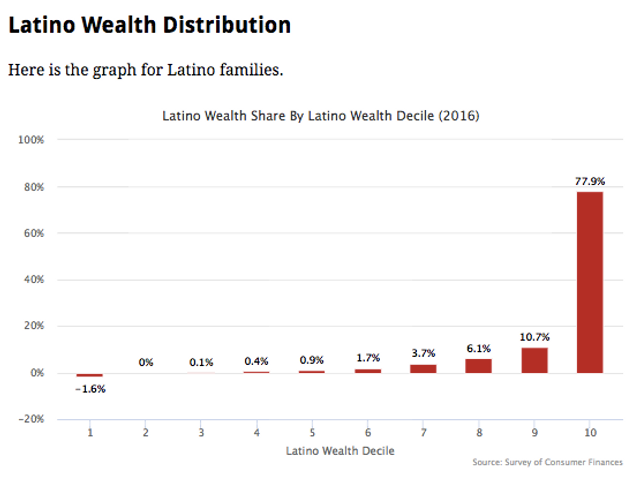
Among both African-American and Latino populations, roughly 65 percent own zero percent of the total wealth owned by their respective racial groups. The richest 10 percent of African-Americans own 75.3 percent of all wealth owned by African-Americans; the richest 10 percent of Latinos own 77.9 percent of all Latino wealth; and 74.6 percent of the wealth owned by whites is owned by the top 10 percent of whites.
Top one percent share of wealth by race
The level of inequality within racial groups has skyrocketed since the coming to power of Barack Obama. Over the course of his presidency, from 2007 to 2016, the top 1 percent of African-Americans increased its share from 19.4 percent to 40.5 percent. Among Latinos, the top 1 percent increased its share from 30.7 to 44.7. The figure also increased among whites, but less dramatically, from 31.9 to 36.5.
In another dataset, Bruening shows that during the Obama administration, wealth for the top 2 percent of African-Americans and Latinos skyrocketed, while declining for the bottom 99 percent within those groups.
Bruening also explains that due to higher levels of poverty among African-Americans and Latinos, only the top 2 percent within each racial group has sufficient wealth to enter the overall top 10 percent among all racial groups. In other words, the years 2007 to 2016 further devastated Latino and black working people while greatly enriching the minority members of the wealthiest 10 percent.
Black wealth distribution by decile
The Federal Reserve data show that the wealth of Latinos in the overall top 10 percent increased by $298,161 from 2007 to 2016, and by $275,414 for African-Americans in this group. The wealth of those whites who comprise the top 10 percent overall also increased under Obama.
Bruening’s analysis also shows that sections of the Latino and African-American working class which had previously been more economically stable—those in the 60th to 95th percentile in their respective groups, and situated in the 40th to 80th percentile overall—were particularly devastated from 2007 to 2016, as compared to the poorer halves of their racial groups who also lost wealth but had less to lose. These sections of the minority working class, which would have had relatively well-paying jobs with benefits in earlier decades, lost between $100,000 and $350,000 over the past decade.
Latino wealth distribution by decile
This massive transfer of wealth exposes the sham of Obama’s presidency. Hailed by the corporate media and pseudo-left as a “transformative figure” on account of his race, his administration oversaw the bank bailout, the bankruptcy of Detroit, the poisoning of the water in Flint, the deportation of 2.7 million immigrants, the expansion of NSA surveillance and a permanent state of war, and major cuts to social programs, education and food stamps.
The Democratic Party consciously used Obama’s skin color to give a political cover to social counterrevolution. The super-rich were primary beneficiaries, but the affluent middle class, including sections of African-Americans and Latinos, were among the greatest beneficiaries of this policy of intensified class exploitation. This created the conditions for the victory of Trump, who benefited from a decline in the vote for the candidate of Wall Street, Hillary Clinton, among all workers, including minority workers.
The Federal Reserve report shows that workers of all racial groups face declining wealth and stagnant incomes, and that growing economic hardship is prevalent across different strata of the working class. In other words, workers of different races and at differing income and wealth levels are objectively being drawn closer together by the impact of the ruling class’s social counterrevolutionary policies.
American society is increasingly polarized—not between races, but between classes. In this context, the class basis of the upper-middle class’s obsession with racial and identity politics becomes clearer. This is the reactionary political essence of groups like Black Lives Matter, authors like Ta-Nahesi Coates, and academics like Keeyanga Yamada-Taylor, who push racial politics to better fleece the working class members of their “own” racial groups, and the working class overall.
Their claims of a unitary “black community” or “Latino community” are fraudulent attempts to hide the immense class divisions that exist within these groups. At the same time, the affluent sections of these racial groups seek to manipulate discontent to advance their own claims to a greater share of wealth and privilege within the top 10 percent.
Identity politics has become a key mechanism through which the next 9 percent situated below the top 1 percent advances its grievances within the political establishment, fighting for “space” in the universities, trade unions, political parties, state apparatus, and corporate media. This layer, which forms a principal social base for the Democratic Party, is generally pro-war and supportive of the right-wing policies that have produced a soaring stock market.
Socialists fight not for a redistribution of wealth within the top 10 percent, but for a complete restructuring of society to abolish social inequality and end the domination of the corporate and financial elite over social and economic life. The social basis for the building of a revolutionary socialist movement lies in the bottom 90 percent, the working class, which will attract the support of the most socially-conscious and humane elements among the next 9 percent.
The social interests of all nationalities, races and social strata of workers are being drawn together by the impact of the social counterrevolutionary policies of the two parties. The task of socialists is to fight to give political expression to this objective process, breaking the barriers of racial chauvinism, linking workers across the world in a common revolutionary fight for social equality and socialism.

Observation of gravitational waves wins Nobel Prize in physics

Bryan Dyne

The Nobel Prize in Physics for 2017 has been awarded to Kip Thorne, Rainer Weiss and Barry Barish for their pioneering work to directly observe gravitational waves. As noted by the Nobel committee, this was a decisive advance in scientific cognition and technical mastery and has been celebrated around the world.
The most recent detection of a gravitational wave was made by both LIGO and Virgo, allowing astronomers to more accurately locate the wave's source. Credit: LIGO- Virgo Collaboration—Optical Sky Data: A. Mellinger
The work spanned the course of five decades and culminated on September 14, 2015 when the twin Advanced Laser Interferometer Gravitational-wave Observatory (LIGO) detectors recorded the first unambiguous signature of a gravity wave—one which also matched theoretical predictions of what a merger of two black holes into a larger one would show. Gravitational waves were first predicted by Einstein in 1916 and have been pursued for the past century as one of the many proofs of the general theory of relativity, and as a tool to explore a new facet of the universe.
Those honored in the prize ceremony reflect some of the variety of backgrounds of the nearly 1200 researchers and engineers that work on LIGO. Thorne was born in Utah in 1940 to a Mormon family whose ancestors traveled west by foot and horse during the era during and after the American Civil War. He studied general relativity at Princeton and joined the faculty of the California Institute of Technology in 1967 where he began to work on the mathematics needed to detect gravitational waves. Weiss and his family were forced to flee Nazi Germany and then Europe in 1938, when the future physicist was six years old, so that his father could avoid persucution and possibly death at the hands of the Nazis for being Jewish and for being a member of the German Communist Party. His academic career, from his bachelor's through his professorship, centered around the Massechusetts Institute of Technology, where he started work in the 1970s to develop the special instruments needed to test general relativity. Barish, now 81, was born in Nebraska to Jewish immigrants from Belarus. His education and professional life have been at CalTech, where he is currently a professor emeritus and the principal investigator and director of the LIGO collaboration.

Two others, both deceased and thus ineligible for the Nobel, deserve mention for their critical contributions to LIGO: Ronald Drever and Vladimir Braginsky. Drever was born in 1931 in Bishopton, Renfrewshire, Scotland and received both his bachelor's and doctorate at the University of Glasgow. He was part of the original team in the 1970s that worked on the mathematics to analyze and detect gravitational waves. Braginsky was born in Moscow in 1931 and received his Ph.D. from the Moscow State University in 1967. He had been working on his own method to detect gravitational waves when he was visited by Kip Thorne in 1968 and the two worked closely until Braginsky's death in 2016.
From a technical standpoint alone, the achievement of the LIGO collaboration is deserving of the prize. Starting in the early 1990s, the detectors were developed with the understanding that new technologies in lasers, vacuums, remote sensing, mirror polishing and seismology would all be needed to achieve the necessary sensitivity. The hundreds of engineers on this project played critical roles in trailblazing new fields to complete the first iteration of this detector, and to further upgrade it to sensitivities which now permit “routine” detection.
A rendering showing the merger of two black holes just before they collide and the resultant gravitational waves rippling outward. Credit: LIGO/T. Pyle
Researchers on the project also had to develop new areas of mathematics to properly understand the signals that were recorded and to extract an actual gravitational wave signature from the myriad false signals that appear. In effect, they had to measure the distance between Earth and the nearest star, Proxima Centauri, to the accuracy of the width of a human hair, while at the same time accounting for the subtle shifts in Earth's orbit caused by every planet, moon, asteroid and comet in the Solar System.
The theoretical achievement, however, is even more profound. The vast majority of what humanity has learned about what exists beyond Earth has been through the study of light and its different wavelengths and orientations. On occasion, we have learned about high energy processes when Earth is struck by a particularly intense cosmic ray, a particle produced vary far away and by some colossally powerful event such as a gamma ray burst. Once, in 1987, 20 neutrinos were detected from a star as it collapsed into a supernova, confirming parts of our understanding of the last moments of the life of stars much more massive than our own Sun.
Now, however, astronomers have a growing data set of events only observable through their gravitational interactions, through the warping of space and time that is caused as objects accelerate. While this field is still basically brand new, it has already yielded an impressive amount of scientific results.
To date, there have been four concrete detections of gravitational waves and a handful more that are less statistically certain. One of the initial findings is that all the events detected so far are from the merger of black holes in the range of seven to 36 times the mass of the Sun. While the existence of these objects had been considered a possibility, they had never been previously observed and no one was sure of how common they were or how often they collide. The origin of this population remains uncertain—some think many may arise from the very first population of stars. Thanks to LIGO and its sister detector Virgo, cosmologists now have new windows into the formation and evolution of rare ultra-heavy stars, addressing some long-standing questions.
There are also tantalizing clues, which a larger sample of detections will pin down, as to whether this first generation of stars formed preferentially in dense clusters or was more evenly distributed. The detected black hole collisions also give clues about how the supermassive black holes formed that are found at the heart of virtually every galaxy.
Four gravitational waves have been detected so far, each lasting mere moments as the two merging black holes collide and become one. Credit: Virgo Collaboration
The most recent detection, recorded seven and a half weeks ago on August 14, has revealed even more. This was the first time that the two LIGO detectors, in Hanford, Washington and Livingston, Louisiana, were able to work in conjunction with the newly upgraded Virgo Observatory located near Pisa, Italy. By utilizing the detection recorded by all three instruments, the astronomers on each project were able to shrink the volume of sky from which the gravitational waves originated by a factor of 20. This enabled 25 facilities from around the world to perform follow-up visual observations, but no bright event was identified in the calculated region, further confirmation that what is producing the gravitational wave is a black hole merger.
The three-detector observation has also allowed researchers to determine the internal oscillation structure (the polarization) of the gravitational wave. This was a critical test of general relativity, which predicts a certain description of gravitational waves. Other theories of gravity, which modify, expand or sometimes replace general relativity, have their own predictions. The current analysis shows that even in such extreme cases, Einstein's theory is correct.
One of the more exciting future prospects about gravitational wave astronomy is the ability to directly gather information further back in time than is possible with light. As anyone who has ever stood in the shadow of a tree on a sunny day understands, branches, leaves and a variety of types of matter can block light. This is replicated on a cosmic scale when attempting to use light to see the first moments of the known universe. There is a "shadow" known as the cosmic microwave background that prevents us from seeing the first 380,000 years of the known universe's existence.
Gravitational waves do not have this problem. As far as we know, the only object that might reflect, refract, diffract or absorb a gravitational wave is a black hole, and they are few enough in number compared to the vastness of space that gravitational waves travel essentially unimpeded from where they were created to Earth. This allows us to get first-hand knowledge from events that we literally cannot see.
While a great deal has been learned in the past two years, a great many more questions remain. For example, there has yet to be a detected gravitational wave signal from a collision involving neutron stars or white dwarfs, both extremely dense objects whose insides are much more complicated than that of a black hole. And LIGO and Virgo themselves only observe one part of the gravitational wave spectrum.
A different sort of detection method, known as pulsar timing, observes different frequencies of gravitational waves than those observed by LIGO and Virgo and is expected to find gravitational waves from supermassive black holes during galactic mergers. As more and more instruments to detect gravitational waves come online, the more humanity learns about some of the most esoteric events in the cosmos, including its origins.

Huge increase in UK firefighters with mental health problems

Dennis Moore

The pain of such tragedy
The waste of such life
The death of a husband, his children, and wife.
The stairs were too many
My breaths were too few
My body exhausted. Now mentally too
It is difficult to sum up just how anyone could feel, after having entered Grenfell Tower on that fateful night, battling terrible conditions, desperately trying to save residents lives, against insurmountable odds. But Ricky Nuttall, one of the firefighters who was part of the Grenfell rescue effort, wrote a moving poem, “The Firefighter,” a part of which is quoted above. It says that the tragedy has “left a hole in my soul that will never repair.” The poem ends with the lines:
My lips wet with tears. I am lost. There is no plan.
Emotionally ruined. One broken man. 
The poem was read out on BBC Radio 5 live during a discussion on the impact of trauma on the mental health of fire crews. Nuttall, a firefighter for 13 years stationed at Knightsbridge and Hillingdon, told the getwestlondon web site of the mental anguish Grenfell wrought:
“I have been to counselling and I still currently go to counselling. I have had eight sessions since Grenfell. Grenfell was the catalyst for a lot of other incidents and stuff coming to the fore. It’s a collective thing, not just Grenfell. It’s other countless incidents I have attended over the years.”
Many of the firefighters who tackled the Grenfell fire suffered mental health problems following that terrible event. This year alone 103 firefighters from the London Fire Brigade had to take mental health leave, five as a direct result of Grenfell.
These figures were uncovered by the BBC’s 5 “Live Investigates” programme, using Freedom of Information requests.
The number of firefighters and other employees taking long-term leave because of mental health issues, including depression and anxiety, has risen from 600 to 780 in the last six years. Since 2011, 126 fire service workers have left the service due to mental health issues.
Separate research carried out by the Fire Fighters Charity found that there were 41,000 shifts lost nationally in the past year because of mental health issues.
The new findings substantiate research undertaken last year by the Mind mental health charity’s Blue Light Programme. It found that 27 percent of firefighters had contemplated suicide due to stress or poor mental health, with post-traumatic stress disorder (PTSD) commonplace.
Mind’s research included an online survey of 3,627 emergency staff personnel, representing 1.5 percent of the “blue light” national workforce, including firefighters and ambulance workers. It found that those working in the emergency services were disproportionately affected by the work they do, with nine out of ten staff having experienced stress and poor mental health at work.
As a group of workers, they are twice as likely to identify problems at work as the cause of their poor mental health.
Emergency services workers are exposed to trauma by the nature of their work. However, large numbers of staff reported factors such as reduced budgets, with more challenging targets placing them under increasing pressure, and reducing the opportunities for more informal support—a significant factor that staff depended on in the past.
Of those interviewed, 56 percent were affected by excessive workload. Pressure from management was cited by 52 percent and long hours by 45 percent. Stress from exposure to traumatic incidents stood at 42 percent.
The aftermath of a fire or other incident can potentially leave staff experiencing symptoms associated with trauma. This can include, poor sleep, low mood, flashbacks, depression and anxiety. Without the right help, this can have a long lasting and detrimental effect and can in some cases lead to long lasting, and serious mental health problems.
Many emergency staff did their best to prevent their mental health affecting their performance at work, but this came at a high personal price, often affecting their physical health, and relationship breakdowns. Mind found that 28 percent of staff turned to drink and drugs to deal with increasing pressure.
Faye McGuinness, programme manager for the Blue Light programme, said, “Our survey of over 1,600 staff and volunteers across emergency services shows nearly nine in ten have experienced stress, low mood or poor mental health while working in their current role. A shocking one in four told us they had contemplated taking their own lives.”
Sean Starbuck, mental health lead for the Fire Brigades Union, said, “Grenfell has brought this issue to the forefront, but we’ve been raising it for some time with our employers on the back of the earlier Mind information.”
The Fire Fighters Charity reports a growing number of firefighters and rescue staff turning to them for help. According to CEO, Dr Jill Tolfrey, 5,000 people visit their support centres every year and 40 percent enlist for psychological support.
The drastic increase in stress and trauma levels among emergency services workers is a direct outcome of nearly a decade of unrelenting austerity measures, which have destroyed or sharply reduced their budgets. Cuts to London’s fire service vastly reduced their ability to deal with fires, but also included cuts to counselling services for those working on the frontline.
Former Conservative Mayor of London Boris Johnson, prior to the Grenfell fire, made enormous cuts to the fire services across the capital. These included the closure of 10 fire stations, the loss of 13 fire engines and 600 firefighters’ jobs. At the same time counselling services were slashed, with the number of counsellors trained to help firefighters process traumatic scenes slashed from an already low 14 to just 2. This is what the ruling elite now considers adequate for nearly 6,000 firefighters who serve the capital’s population of nearly 10 million and attend around 50,000 incidents each year.
Since 2010, 11,000 firefighters (one fifth of the workforce) have lost their jobs, while at the same time firefighters are responding to a record number of incidents. Latest government figures show a rise in fire deaths by 15 percent in 2015/16.
In April 2016, the heads of six large fire services across England, but outside London, raised concerns that further budget cuts posed a risk to community safety. In 2015, 294 deaths were caused by fire, as against 242 for the year 2014, a rise of 21 percent. This was the largest rise since 2001-2002.
The fire services face budget cuts of up to 50 percent by 2020, from a 2010 benchmark. Greater Manchester fire service is being cut by 43 percent, from £117 million to £96 million, and West Midlands by 46 percent, from £119 million to £94 million.
The firefighters who faced the inferno at Grenfell were clearly ill equipped to be able to deal with the fire as it unfolded. Following the fire, in an outpouring of solidarity from the local community, there were offers of help from more than 300 hundred professional counsellors and therapists. They offered free sessions to all those forced to deal with the trauma of the blaze.
This instinctive response to help others contrasted sharply with that of the central government and the Royal Borough of Kensington and Chelsea council, who stood by and did nothing despite possessing enormous wealth and resources. This callous indifference was summed up by Johnson, who in 2013 told protesting firefighters—warning him about the life threatening impact his cuts would have—to “get stuffed.”

Siemens and Alstom rail train units merge as corporations prepare for trade war

Gustav Kemper

On September 26, the supervisory boards of the German company Siemens and the French Alstom Group unanimously approved a deal to merge the rail train units of both companies by the end of 2018 in a “merger of equals.” With 62,000 employees and an annual turnover of around 15 billion euros, the new corporation will be the world’s second-largest railway technology company.
Recent years have witnessed fierce competition on the world market for rail vehicles. In mid-2015, two Chinese manufacturers combined to form the China Railway Rolling Stock Group (CRRC). With over 180,000 employees and branches and production facilities in more than one hundred countries CRRC took over first place from Bombardier Transportation, the former world market leader. With a turnover of $34.5 billion CRRC also significantly exceeded the joint sales of the two Europe-based manufacturers, Siemens and Alstom.
Since then, Siemens, Alstom and Bombardier have worked to create a counterpart to the Chinese company. A series of mergers, rationalization, savings through increased production and a conversion from design and production to platform construction, in which the same components are used in different models, similar to the automotive industry, were all intended to increase competitiveness.
In mid-2014, Siemens offered Alstom its French subsidiary, Siemens Mobility. In return, the German company planned to take over Power and Grid, the most profitable sector of Alstom’s energy interests. The deal collapsed after the US company, General Electric, won the bid for the energy sector.
Siemens then began negotiations with Bombardier Transportation, a subsidiary of Bombardier Inc., the Canadian aircraft manufacturer. Bombardier Aerospace had suffered losses, and its management decided to implement a comprehensive restructuring program. As a result a total of 8,500 jobs are to be slashed, 5,000 in the transport sector. German plants saw 1,430 job cuts in 2016 and a further 2,200 jobs are due to go in 2018, mainly at the German Hennigsdorf and Görlitz plants.
In May 2017 it was reported that the joint venture agreements between Siemens and Bombardier were close to completion. However, Siemens, whose mobility department is an industry leader in signal technology and network infrastructure, generating higher profit margins than the production of rail vehicles, was able to pick and choose its merger partner.
Further financial problems at Bombardier were on the cards after the American aircraft manufacturer, Boeing, accused its Canadian competitor of unfair government support in the production of its C-series of aircraft. The company’s problems then increased dramatically when the Trump government raised an import tax of 219 percent on Canadian aircraft in September. The Siemens executive decided to quickly reorient to a deal with Alstom.
When the heads of Siemens and Alstom addressed the press on September 20 to announce the merger, they made clear that what was at stake were not just economic priorities but also political motives. Siemens CEO Joe Kaeser told the press: “We are putting the European ideal into practice and together with our friends at Alstom, creating a new long-term European champion of the railway industry.”
The merger is part of German and French plans to boost Europe to the status of a world power able to confront the US and China both economically and politically. Siemens CEO Kaeser had already consulted Chancellor Angela Merkel before the Bundestag election in September. Merkel then consulted with French President Emmanuel Macron, according to a number of daily newspapers.
On the day of the announcement of the Siemens-Alstom fusion, Macron had called for a “determined and concrete Franco-German initiative” to develop new European projects. The EU must be built up as a “competitor to China and the US.” The French state holds one-fifth of the Alstom shares and the merger was only possible with Macron’s approval.
Alstom’s CEO, Poupart-Lafarge, declared the merger to be a “key moment” in the company’s history. It will “create added value for customers, employees and shareholders.”
The sort of value generated was immediately reflected in the share prices of both companies: the price of Siemens shares rose by two percent and that of Alstom by 18 percent within the space of a few days. The merger is intended to provide savings of around €470 million annually through a so-called “synergy effect” in the fields of research, development, sales and product reduction over a four-year transition period. Until then, both companies have guaranteed to maintain jobs levels and existing plants.
The location of Siemens Alstom’s headquarters will be in Paris, as will the company center for rail vehicles, while the headquarters for mobility solutions and signal technology will remain in Berlin. Chief executive will be the current Alstom CEO Poupart-Lafarge, while Siemens CEO Joe Kaeser will chair the eleven-member Supervisory Board, where a total of six Siemens representatives hold the majority.
Siemens will receive 50 percent plus one of the shares listed on the Paris stock exchange, with the option to buy another two percent after the merger. The real power of the merged company therefore resides at Siemens, despite all the talk of equal partners.
The merger is supported by both the French and German governments, thereby overriding antitrust law. Trust law expert Martin Gramsch told the WirtschaftsWoche that the decision of Europe’s cartel monitors would be based on geographic considerations. When customers around the world seek out the products of manufacturers worldwide, then there could not be substantial objections to the Siemens Alstom merger.
The merger of whole industries into two or three world-dominating monopolies has accelerated enormously since the financial crisis in 2008. The sum of all mergers and acquisitions (M&A) reached its second highest peak in 2016 with 3.6 trillion US dollars. In 2015 this figure was 17 percent higher.
Historically low interest rates and huge amounts of money pumped into the economy are a major factor in promoting mergers. “Many companies are faced with poor organic growth prospects, which force them to consider the purchase of competitors or expand into new territories,” the Financial Times noted late last year.
Increasingly, however, mergers are also linked to the development of commercial and economic blocs. They are no longer continental, such as the takeover of Chrysler by Fiat, but serve to create “national champions,” which, with the backing of respective national governments, can compete fiercely for a share of the world market—a process which has historically taken violent, military forms. Donald Trump’s “America First” policy is the most naked expression of this development.
Such conditions have long prevailed in the market for passenger aircraft, where Europe’s Airbus and America’s Boeing are fighting for supremacy. The development in the rail industry is now assuming a similar form, but this time the main rival of the “European champion” Siemens Alstom is not the US, but rather China. The purchase of the US-German car maker Opel by Peugeot and the merger of the steel sector giants ThyssenKrupp and Tata should also be regarded in this light.
This policy of trade war has the fervent support of the trade unions, which share the nationalist outlook of the company bosses and shareholders.
The French trade unions and the German union, IG Metall, have welcomed the fusion of Siemens and Alstom. “If you want sufficient impact, a new ordering of forces is imperative,” declared the CFE-CGC union coordinator for Alstom, Claude Mandart.
According to Elisabeth Mongs, a leader of IG Metall in Erlangen, the fusion of the two train companies makes sense, creating a strong European alliance able to confront competition from China.
Heinz Spörk, Chairman of the Siemens Works Council in Krefeld, told the Westdeutsche Zeitung: “Alstom and us are currently generating 7.3 percent [sales revenue]. This can definitely be improved upon in the new company with far lower overhead costs.”
“This merger was desired and promoted by the federal government,” Spörk continued. “That is why I am confident that the antitrust authorities in Europe will give a green light. We need a strong European rail industry in order to challenge the world market leader China. The railway division of Siemens would have been too small in the long run.”
In common with the managers the union functionaries see their role as maintaining the “impact” and “competitiveness” of their company at the expense of the workforce by ensuring that “synergy effects”—i.e., job destruction and pay cuts—are made without resistance.
This is true not only of Siemens and Alstom’s employees, but even more so for Bombardier Transportation, the loser in this merger. Fresh job cuts are on the board or even the closure of entire plants. “The merger of Siemens and Alstom will increase pressure on Bombardier. I regard this with concern,” Olivier Höbel, head of the IG Metall district of Berlin-Brandenburg-Saxony, told the paper Welt am Sonntag.
Workers can only defend their jobs and oppose the development towards trade war and military warfare by breaking with the reactionary trade union apparatuses. The defence of jobs, working conditions and wages confront workers with political tasks—first and foremost the building of a socialist movement to unite the working class in the fight against war and capitalism. This is the prerequisite for harnessing the enormous potential of the globalized economy for the benefit of the world’s population.